

















Modern
Post-Exploitation
Strategies
Rich Smith
Kyrus


             Rich@Kyr.us
3


•  Going to discuss some ongoing research
   in extending attack techniques

•  Came from real world needs of being
   able to manage complex, long term
   attack engagements for customers


  What are we going to discuss
4


•  Looking at:
    •  Attack process
    •  Attack workflow
    •  How current tooling map to complex
       workflows
    •  Pen-test vs Attack


  What are we going to discuss
5
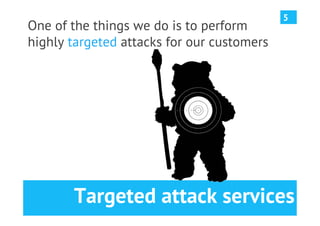
One of the things we do is to perform
highly targeted attacks for our customers


       Targeted attack services
6

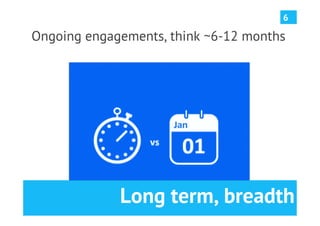
Ongoing engagements, think ~6-12 months


             Long term, breadth
7


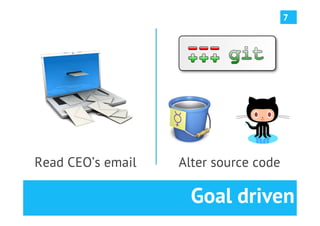
Read CEO’s email   Alter source code

                     Goal driven
8

•  Baby steps towards a goal


       Multi-stage, incremental
9


Current tooling falls short
10


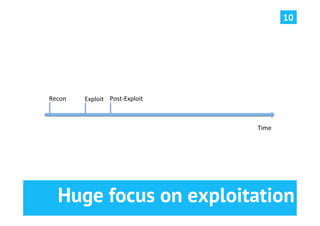
Recon	
     Exploit	
   Post-­‐Exploit	


                                             Time	


    Huge focus on exploitation
11


•  What you do after you compromise

•  Nothing to do with how you compromise


    What is post-exploitation?
12

‘How to make the BEST use of the systems
      that have been compromised’


Or from the attacker perspective
13


What do I worry about at night?
14


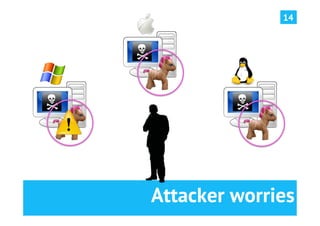
Attacker worries
15


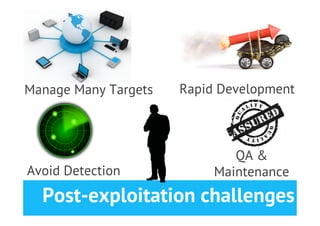
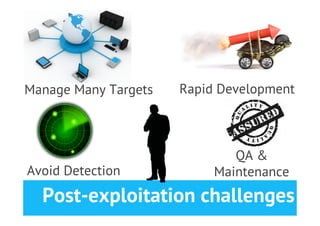
Manage Many Targets	
     Rapid Development	


                                   QA &
Avoid Detection	
               Maintenance	
  
   Post-exploitation challenges
16

I also worry about technology futures & how
it may change the attack landscape


     Post-exploitation worries
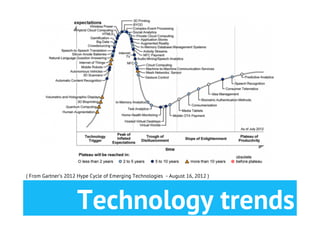
( From Gartner’s 2012 Hype Cycle of Emerging Technologies - August 16, 2012 )


                     Technology trends
18
                  Co$t	
  of	
  
                  A3ack	
  
                                   Shi>	
  the	
  
                                    Target	
  
   A3ack	
  
Effec7veness	


              Future questions
Cloud Computing


                  Trends
Mobile Devices


 Trends
Bring your own device (BYOD)


               Trends
Social Media


               Trends
23


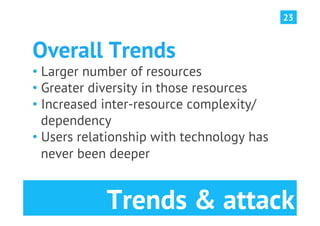
Overall Trends
•  Larger number of resources
•  Greater diversity in those resources
•  Increased inter-resource complexity/
   dependency
•  Users relationship with technology has
   never been deeper


            Trends & attack
24


Manage Many Targets	
     Rapid Development	


                                   QA &
Avoid Detection	
               Maintenance	
  
   Post-exploitation challenges
25


Not well, if at all
26


•  Recognize current post-exploitation
   ‘binary dropper’ approaches don’t scale well
  •  In the development process

  •  In the ability to be effective against diverse targets

  •  Pen-test frameworks use this approach
        - Software engineering nightmare


                            Scale poorly
27


•  Baking in capabilities to the implant is sub-
   optimal for most situations

  •  Reduce your flexibility post-compromise

  •  Can reveal an overall attack intent
        - Reverse engineering field day


                           Baking in
28


BIG
         is not what should be
             most worrying


  Small is


      Size matters
29


Scalability
  ­  Greater platform independence
  ­  Easier to develop & maintain logic

Stealth
  ­  Reduced attribution & MO leakage
  ­  Avoid existing deployed defenses


            High Level Aims
30


Technical
Proof of concept
31


•  Would be great to have a single payload
   that would run everywhere!

  •  Cross platform, Interpreted Languages
     such as Java or Python could help here

  •  They also help address some of the
     software engineering worries


                                  Goals
32


•  Separate what you do, from why you do it

  •  Lots of distributed system approaches
     that may help out here e.g. RPC

  •  Can also help with reducing complexity
     in the implant, pushing it to the server


                                  Goals
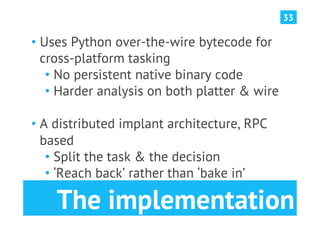
33

•  Uses Python over-the-wire bytecode for
   cross-platform tasking
    •  No persistent native binary code
    •  Harder analysis on both platter & wire

•  A distributed implant architecture, RPC
   based
    •  Split the task & the decision
    •  ‘Reach back’ rather than ‘bake in’

    The implementation
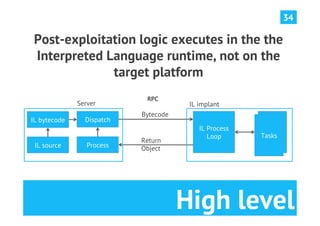
34

Post-exploitation logic executes in the the
Interpreted Language runtime, not on the
             target platform
                            RPC	
  
              Server                   IL implant
                           Bytecode
IL bytecode     Dispatch
                                          IL Process    Task
                                             Loop      Tasks
                                                       process
                           Return
 IL source       Process   Object


                                      High level
35


Python internals
101  Python Internals
           101
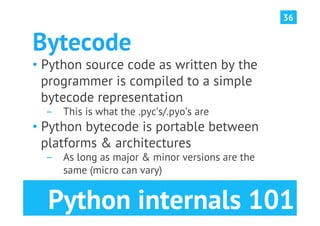
36


Bytecode
•  Python source code as written by the
   programmer is compiled to a simple
   bytecode representation
  ­  This is what the .pyc’s/.pyo’s are
•  Python bytecode is portable between
   platforms & architectures
  ­  As long as major & minor versions are the
     same (micro can vary)


  Python internals 101
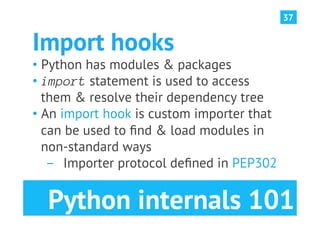
37


Import hooks
•  Python has modules & packages
•  import statement is used to access
   them & resolve their dependency tree
•  An import hook is custom importer that
   can be used to find & load modules in
   non-standard ways
    ­  Importer protocol defined in PEP302


  Python internals 101
38


•  Writing new hooks can be a pain in the ***
  ­  Worth a whole talk in itself, see ‘Import this, that
     and the other thing’ by Brett Cannon PyCon2010 –
     it’s excellent
•  Python 3.x reduces this pain via importlib
•  Not available in Python 2.x so you need to
   implement from scratch using PEP 302
  ­  Available since v2.3 to better customize the
     __import__ builtin
  ­  Given 2.x is in the widest use this is what I did


  Python internals 101
39


•  The PEP 302 protocol defines
  ­  A Finder
     ­  Tends to be pretty straightforward
     ­  Locate the module/package code
  ­  A Loader
     ­  More complex
     ­  Compile to bytecode if needed
     ­  Insert module into namespace
     ­  Execute top level code
     ­  Lots of annoying metadata bookkeeping


  Python internals 101
40


Python internals
101
41
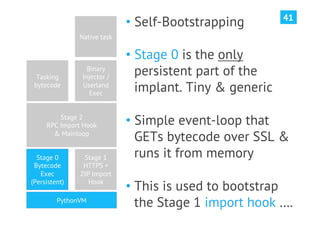
                             •  Self-Bootstrapping
               Native task

                             •  Stage 0 is the only
  Tasking
                  Binary
                Injector /
                                persistent part of the
 bytecode       Userland
                   Exec
                                implant. Tiny & generic

         Stage 2
     RPC Import Hook         •  Simple event-loop that
       & Mainloop
                                GETs bytecode over SSL &
  Stage 0       Stage 1         runs it from memory
 Bytecode       HTTPS +
   Exec        ZIP Import
(Persistent)      Hook
                             •  This is used to bootstrap
         PythonVM
                                the Stage 1 import hook ….
42
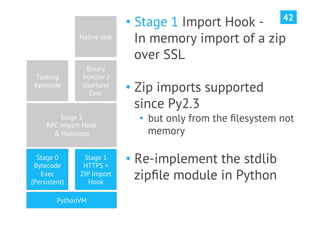
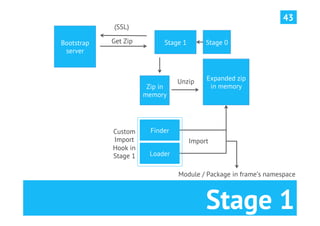
                             •  Stage 1 Import Hook -
               Native task      In memory import of a zip
                                over SSL
                  Binary
  Tasking       Injector /
 bytecode       Userland
                   Exec
                             •  Zip imports supported
                                since Py2.3
         Stage 2               •  but only from the filesystem not
     RPC Import Hook
       & Mainloop                 memory

  Stage 0
 Bytecode
                Stage 1
                HTTPS +
                             •  Re-implement the stdlib
   Exec
(Persistent)
               ZIP Import
                  Hook
                                zipfile module in Python
         PythonVM
43
            (SSL)

Bootstrap   Get Zip         Stage 1        Stage 0
 server


                                 Unzip     Expanded zip
                       Zip in               in memory
                      memory


            Custom      Finder
            Import                    Import
            Hook in
            Stage 1     Loader

                                 Module / Package in frame’s namespace


                                           Stage 1
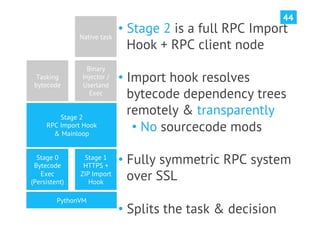
44

               Native task
                             •  Stage 2 is a full RPC Import
                                Hook + RPC client node
                  Binary
  Tasking
 bytecode
                Injector /
                Userland
                             •  Import hook resolves
                   Exec         bytecode dependency trees
         Stage 2
                                remotely & transparently
     RPC Import Hook
       & Mainloop
                                 •  No sourcecode mods

  Stage 0
 Bytecode
                Stage 1
                HTTPS +
                             •  Fully symmetric RPC system
   Exec
(Persistent)
               ZIP Import
                  Hook
                                over SSL
         PythonVM
                             •  Splits the task & decision
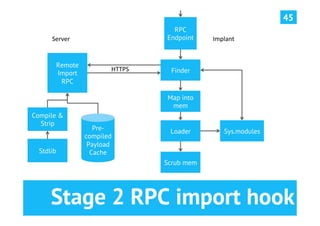
45
                                         RPC
      Server	
                         Endpoint    Implant	


           Remote
                           HTTPS	
      Finder
           Import
            RPC

                                       Map into
                                        mem
Compile &
  Strip
                       Pre-             Loader          Sys.modules
                    compiled
                     Payload
  Stdlib              Cache
                                       Scrub mem


      Stage 2 RPC import hook
46


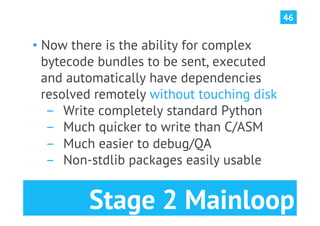
•  Now there is the ability for complex
   bytecode bundles to be sent, executed
   and automatically have dependencies
   resolved remotely without touching disk
    ­  Write completely standard Python
    ­  Much quicker to write than C/ASM
    ­  Much easier to debug/QA
    ­  Non-stdlib packages easily usable


         Stage 2 Mainloop
47


•  1st Task performed is to derive a UUID
  ­  IP’s are often used but generally a bad choice
     when managing many targets

•  Instead we use SYSUUID from SMBIOS
  ­  Fairly easy to get at from Pure Python on
     Unixes, Linux & OSX
  ­  Pain in the a** on Windows but can be done
     via Ctypes


                       Initialization
48


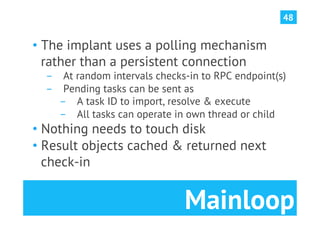
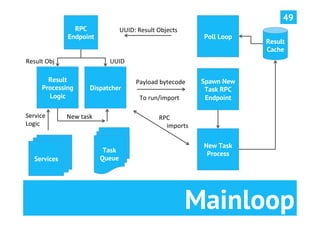
•  The implant uses a polling mechanism
   rather than a persistent connection
  ­  At random intervals checks-in to RPC endpoint(s)
  ­  Pending tasks can be sent as
     ­  A task ID to import, resolve & execute
     ­  All tasks can operate in own thread or child
•  Nothing needs to touch disk
•  Result objects cached & returned next
   check-in


                               Mainloop
49
                      RPC                     UUID:	
  Result	
  Objects	
  
                    Endpoint                                                                       Poll Loop
                                                                                                               Result
                                                                                                               Cache
Result	
  Obj	
                         UUID	
  

           Result                                     Payload	
  bytecode	
                        Spawn New
         Processing             Dispatcher                                                          Task RPC
           Logic                                        To	
  run/import	
                          Endpoint

Service	
           New	
  task	
                                RPC	
  	
  
Logic	


  imports	
  

                                                                                                   New Task
      Services                         Task
     Services                                                                                       Process
    Services                          Queue


                                                                                          Mainloop
50

•  Tasks are split into 2 parts
  ­  Payload: What executes on the target
  ­  Service: The logic that processes the result of
     the payload, executes on the server
•  Payloads are pure Python bytecode
•  Determination of next task happens at
   the server
  ­  If compromise detected we leak minimal MO
  ­  Allows easy updating of goal oriented logic
  ­  No need to define goal at asset creation time


                                          Tasks
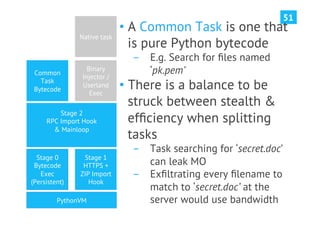
51
                             •  A Common Task is one that
               Native task
                                is pure Python bytecode
                               ­  E.g. Search for files named
 Common
                  Binary          ‘pk.pem’
                Injector /
   Task
 Bytecode
                Userland
                   Exec
                             •  There is a balance to be
                                struck between stealth &
         Stage 2
     RPC Import Hook            efficiency when splitting
       & Mainloop
                                tasks
                               ­  Task searching for ‘secret.doc’
  Stage 0       Stage 1
 Bytecode       HTTPS +           can leak MO
   Exec        ZIP Import      ­  Exfiltrating every filename to
(Persistent)      Hook
                                  match to ‘secret.doc’ at the
         PythonVM                 server would use bandwidth
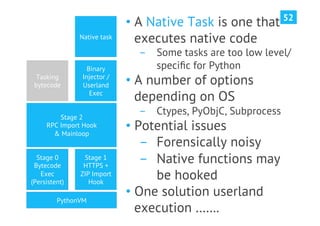
52
                             •  A Native Task is one that
               Native task      executes native code
                               ­  Some tasks are too low level/
                  Binary          specific for Python
  Tasking
 bytecode
                Injector /
                Userland     •  A number of options
                   Exec
                                depending on OS
         Stage 2
                               ­  Ctypes, PyObjC, Subprocess
     RPC Import Hook
       & Mainloop
                             •  Potential issues
                                 ­  Forensically noisy
  Stage 0
 Bytecode
                Stage 1
                HTTPS +
                                 ­  Native functions may
   Exec
(Persistent)
               ZIP Import
                  Hook
                                    be hooked
                             •  One solution userland
         PythonVM
                                execution …….
53


•  Allows execution through the
   replacement/modification of existing
   process image with a new one
  ­  Without calling OS (Execve, loadlibrary etc)
  ­  Without having to load from disk
•  Useful in a number of scenarios
  ­  Antiforensics
  ­  Non-exec filesystem mounts
  ­  Wanting to inject native code from a IL VM!


       Userland execution
54


•  Builds on years of other people research

  •    Grugqs Phrack 62 paper ul_exec & FIST (Linux)
  •    Pluf & Ripe’s SELF work from Phrack 63 (Linux)
  •    Immunity’s PyELF library (Linux)
  •    Nebbet’s Shuttle (Windows)
  •    Dai Zovi’s & Iozzo’s Mach-O work (OS X)
  •    pyMachO …


          Userland execution
55


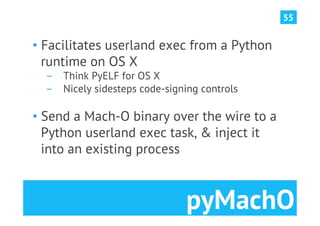
•  Facilitates userland exec from a Python
   runtime on OS X
  ­  Think PyELF for OS X
  ­  Nicely sidesteps code-signing controls

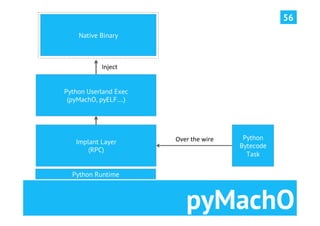
•  Send a Mach-O binary over the wire to a
   Python userland exec task, & inject it
   into an existing process


                               pyMachO
56
    Native Binary


           Inject	


Python Userland Exec
 (pyMachO, pyELF….)


                        Over	
  the	
  wire	
       Python
   Implant Layer                                    Native
                                                   Bytecode
       (RPC)                                      Binary Data
                                                     Task

  Python Runtime


                              pyMachO
57


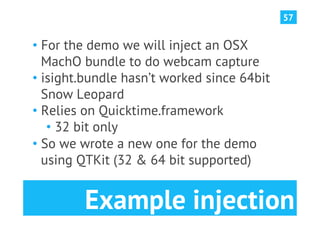
•  For the demo we will inject an OSX
   MachO bundle to do webcam capture
•  isight.bundle hasn’t worked since 64bit
   Snow Leopard
•  Relies on Quicktime.framework
    •  32 bit only
•  So we wrote a new one for the demo
   using QTKit (32 & 64 bit supported)


         Example injection
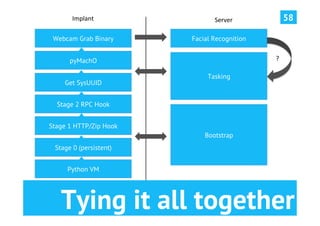
Implant	
               Server	
              58

 Webcam Grab Binary     Facial Recognition


      pyMachO                                ?	
  

                             Tasking
    Get SysUUID


  Stage 2 RPC Hook


Stage 1 HTTP/Zip Hook
                            Bootstrap
 Stage 0 (persistent)


     Python VM


   Tying it all together
59


Demo Time!
60


Takeaways
•  Current post-exploitation approaches do
   not scale well
•  Baking-in capabilities can leak your intent
•  Interpreted languages can help with scale
•  Distributed architectures can help with
   separating action from reason


                           Summary
61


Calls to action
Providers
•  Don’t let the current toolsets dictate and limit you,
   critique, innovate & change them to suit your needs

Customers
•  Understand the difference between, and value of
   Pen-Testing vs Attack Teaming


                                  Summary
62


              ¿
Rich@Kyr.us
Rich@Kyr.us


                  Questions
Modern Post-Exploitation Strategies - 44CON 2012

Modern Post-Exploitation Strategies - 44CON 2012

  • 2.
  • 3.
    3 •  Going todiscuss some ongoing research in extending attack techniques •  Came from real world needs of being able to manage complex, long term attack engagements for customers What are we going to discuss
  • 4.
    4 •  Looking at: •  Attack process •  Attack workflow •  How current tooling map to complex workflows •  Pen-test vs Attack What are we going to discuss
  • 5.
    5 One of thethings we do is to perform highly targeted attacks for our customers Targeted attack services
  • 6.
    6 Ongoing engagements, think~6-12 months Long term, breadth
  • 7.
    7 Read CEO’s email Alter source code Goal driven
  • 8.
    8 •  Baby stepstowards a goal Multi-stage, incremental
  • 9.
  • 10.
    10 Recon   Exploit   Post-­‐Exploit   Time   Huge focus on exploitation
  • 11.
    11 •  What youdo after you compromise •  Nothing to do with how you compromise What is post-exploitation?
  • 12.
    12 ‘How to makethe BEST use of the systems that have been compromised’ Or from the attacker perspective
  • 13.
    13 What do Iworry about at night?
  • 14.
  • 15.
    15 Manage Many Targets   Rapid Development   QA & Avoid Detection   Maintenance   Post-exploitation challenges
  • 16.
    16 I also worryabout technology futures & how it may change the attack landscape Post-exploitation worries
  • 17.
    ( From Gartner’s2012 Hype Cycle of Emerging Technologies - August 16, 2012 ) Technology trends
  • 18.
    18 Co$t  of   A3ack   Shi>  the   Target   A3ack   Effec7veness   Future questions
  • 19.
  • 20.
  • 21.
    Bring your owndevice (BYOD) Trends
  • 22.
  • 23.
    23 Overall Trends •  Largernumber of resources •  Greater diversity in those resources •  Increased inter-resource complexity/ dependency •  Users relationship with technology has never been deeper Trends & attack
  • 24.
    24 Manage Many Targets   Rapid Development   QA & Avoid Detection   Maintenance   Post-exploitation challenges
  • 25.
  • 26.
    26 •  Recognize currentpost-exploitation ‘binary dropper’ approaches don’t scale well •  In the development process •  In the ability to be effective against diverse targets •  Pen-test frameworks use this approach - Software engineering nightmare Scale poorly
  • 27.
    27 •  Baking incapabilities to the implant is sub- optimal for most situations •  Reduce your flexibility post-compromise •  Can reveal an overall attack intent - Reverse engineering field day Baking in
  • 28.
    28 BIG is not what should be most worrying Small is Size matters
  • 29.
    29 Scalability ­ Greater platform independence ­  Easier to develop & maintain logic Stealth ­  Reduced attribution & MO leakage ­  Avoid existing deployed defenses High Level Aims
  • 30.
  • 31.
    31 •  Would begreat to have a single payload that would run everywhere! •  Cross platform, Interpreted Languages such as Java or Python could help here •  They also help address some of the software engineering worries Goals
  • 32.
    32 •  Separate whatyou do, from why you do it •  Lots of distributed system approaches that may help out here e.g. RPC •  Can also help with reducing complexity in the implant, pushing it to the server Goals
  • 33.
    33 •  Uses Pythonover-the-wire bytecode for cross-platform tasking •  No persistent native binary code •  Harder analysis on both platter & wire •  A distributed implant architecture, RPC based •  Split the task & the decision •  ‘Reach back’ rather than ‘bake in’ The implementation
  • 34.
    34 Post-exploitation logic executesin the the Interpreted Language runtime, not on the target platform RPC   Server IL implant Bytecode IL bytecode Dispatch IL Process Task Loop Tasks process Return IL source Process Object High level
  • 35.
    35 Python internals 101 Python Internals 101
  • 36.
    36 Bytecode •  Python sourcecode as written by the programmer is compiled to a simple bytecode representation ­  This is what the .pyc’s/.pyo’s are •  Python bytecode is portable between platforms & architectures ­  As long as major & minor versions are the same (micro can vary) Python internals 101
  • 37.
    37 Import hooks •  Pythonhas modules & packages •  import statement is used to access them & resolve their dependency tree •  An import hook is custom importer that can be used to find & load modules in non-standard ways ­  Importer protocol defined in PEP302 Python internals 101
  • 38.
    38 •  Writing newhooks can be a pain in the *** ­  Worth a whole talk in itself, see ‘Import this, that and the other thing’ by Brett Cannon PyCon2010 – it’s excellent •  Python 3.x reduces this pain via importlib •  Not available in Python 2.x so you need to implement from scratch using PEP 302 ­  Available since v2.3 to better customize the __import__ builtin ­  Given 2.x is in the widest use this is what I did Python internals 101
  • 39.
    39 •  The PEP302 protocol defines ­  A Finder ­  Tends to be pretty straightforward ­  Locate the module/package code ­  A Loader ­  More complex ­  Compile to bytecode if needed ­  Insert module into namespace ­  Execute top level code ­  Lots of annoying metadata bookkeeping Python internals 101
  • 40.
  • 41.
    41 •  Self-Bootstrapping Native task •  Stage 0 is the only Tasking Binary Injector / persistent part of the bytecode Userland Exec implant. Tiny & generic Stage 2 RPC Import Hook •  Simple event-loop that & Mainloop GETs bytecode over SSL & Stage 0 Stage 1 runs it from memory Bytecode HTTPS + Exec ZIP Import (Persistent) Hook •  This is used to bootstrap PythonVM the Stage 1 import hook ….
  • 42.
    42 •  Stage 1 Import Hook - Native task In memory import of a zip over SSL Binary Tasking Injector / bytecode Userland Exec •  Zip imports supported since Py2.3 Stage 2 •  but only from the filesystem not RPC Import Hook & Mainloop memory Stage 0 Bytecode Stage 1 HTTPS + •  Re-implement the stdlib Exec (Persistent) ZIP Import Hook zipfile module in Python PythonVM
  • 43.
    43 (SSL) Bootstrap Get Zip Stage 1 Stage 0 server Unzip Expanded zip Zip in in memory memory Custom Finder Import Import Hook in Stage 1 Loader Module / Package in frame’s namespace Stage 1
  • 44.
    44 Native task •  Stage 2 is a full RPC Import Hook + RPC client node Binary Tasking bytecode Injector / Userland •  Import hook resolves Exec bytecode dependency trees Stage 2 remotely & transparently RPC Import Hook & Mainloop •  No sourcecode mods Stage 0 Bytecode Stage 1 HTTPS + •  Fully symmetric RPC system Exec (Persistent) ZIP Import Hook over SSL PythonVM •  Splits the task & decision
  • 45.
    45 RPC Server   Endpoint Implant   Remote HTTPS   Finder Import RPC Map into mem Compile & Strip Pre- Loader Sys.modules compiled Payload Stdlib Cache Scrub mem Stage 2 RPC import hook
  • 46.
    46 •  Now thereis the ability for complex bytecode bundles to be sent, executed and automatically have dependencies resolved remotely without touching disk ­  Write completely standard Python ­  Much quicker to write than C/ASM ­  Much easier to debug/QA ­  Non-stdlib packages easily usable Stage 2 Mainloop
  • 47.
    47 •  1st Taskperformed is to derive a UUID ­  IP’s are often used but generally a bad choice when managing many targets •  Instead we use SYSUUID from SMBIOS ­  Fairly easy to get at from Pure Python on Unixes, Linux & OSX ­  Pain in the a** on Windows but can be done via Ctypes Initialization
  • 48.
    48 •  The implantuses a polling mechanism rather than a persistent connection ­  At random intervals checks-in to RPC endpoint(s) ­  Pending tasks can be sent as ­  A task ID to import, resolve & execute ­  All tasks can operate in own thread or child •  Nothing needs to touch disk •  Result objects cached & returned next check-in Mainloop
  • 49.
    49 RPC UUID:  Result  Objects   Endpoint Poll Loop Result Cache Result  Obj   UUID   Result Payload  bytecode   Spawn New Processing Dispatcher Task RPC Logic To  run/import   Endpoint Service   New  task   RPC     Logic            imports   New Task Services Task Services Process Services Queue Mainloop
  • 50.
    50 •  Tasks aresplit into 2 parts ­  Payload: What executes on the target ­  Service: The logic that processes the result of the payload, executes on the server •  Payloads are pure Python bytecode •  Determination of next task happens at the server ­  If compromise detected we leak minimal MO ­  Allows easy updating of goal oriented logic ­  No need to define goal at asset creation time Tasks
  • 51.
    51 •  A Common Task is one that Native task is pure Python bytecode ­  E.g. Search for files named Common Binary ‘pk.pem’ Injector / Task Bytecode Userland Exec •  There is a balance to be struck between stealth & Stage 2 RPC Import Hook efficiency when splitting & Mainloop tasks ­  Task searching for ‘secret.doc’ Stage 0 Stage 1 Bytecode HTTPS + can leak MO Exec ZIP Import ­  Exfiltrating every filename to (Persistent) Hook match to ‘secret.doc’ at the PythonVM server would use bandwidth
  • 52.
    52 •  A Native Task is one that Native task executes native code ­  Some tasks are too low level/ Binary specific for Python Tasking bytecode Injector / Userland •  A number of options Exec depending on OS Stage 2 ­  Ctypes, PyObjC, Subprocess RPC Import Hook & Mainloop •  Potential issues ­  Forensically noisy Stage 0 Bytecode Stage 1 HTTPS + ­  Native functions may Exec (Persistent) ZIP Import Hook be hooked •  One solution userland PythonVM execution …….
  • 53.
    53 •  Allows executionthrough the replacement/modification of existing process image with a new one ­  Without calling OS (Execve, loadlibrary etc) ­  Without having to load from disk •  Useful in a number of scenarios ­  Antiforensics ­  Non-exec filesystem mounts ­  Wanting to inject native code from a IL VM! Userland execution
  • 54.
    54 •  Builds onyears of other people research •  Grugqs Phrack 62 paper ul_exec & FIST (Linux) •  Pluf & Ripe’s SELF work from Phrack 63 (Linux) •  Immunity’s PyELF library (Linux) •  Nebbet’s Shuttle (Windows) •  Dai Zovi’s & Iozzo’s Mach-O work (OS X) •  pyMachO … Userland execution
  • 55.
    55 •  Facilitates userlandexec from a Python runtime on OS X ­  Think PyELF for OS X ­  Nicely sidesteps code-signing controls •  Send a Mach-O binary over the wire to a Python userland exec task, & inject it into an existing process pyMachO
  • 56.
    56 Native Binary Inject   Python Userland Exec (pyMachO, pyELF….) Over  the  wire   Python Implant Layer Native Bytecode (RPC) Binary Data Task Python Runtime pyMachO
  • 57.
    57 •  For thedemo we will inject an OSX MachO bundle to do webcam capture •  isight.bundle hasn’t worked since 64bit Snow Leopard •  Relies on Quicktime.framework •  32 bit only •  So we wrote a new one for the demo using QTKit (32 & 64 bit supported) Example injection
  • 58.
    Implant   Server   58 Webcam Grab Binary Facial Recognition pyMachO ?   Tasking Get SysUUID Stage 2 RPC Hook Stage 1 HTTP/Zip Hook Bootstrap Stage 0 (persistent) Python VM Tying it all together
  • 59.
  • 60.
    60 Takeaways •  Current post-exploitationapproaches do not scale well •  Baking-in capabilities can leak your intent •  Interpreted languages can help with scale •  Distributed architectures can help with separating action from reason Summary
  • 61.
    61 Calls to action Providers • Don’t let the current toolsets dictate and limit you, critique, innovate & change them to suit your needs Customers •  Understand the difference between, and value of Pen-Testing vs Attack Teaming Summary
  • 62.
    62 ¿ Rich@Kyr.us Rich@Kyr.us Questions