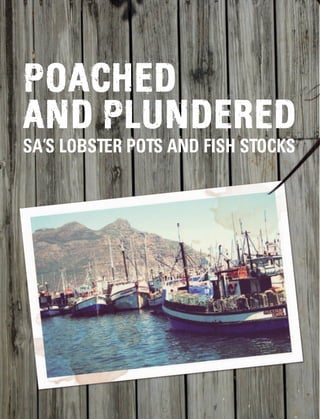
SA’S LOBSTER POTS AND FISH STOCKS
natural resources – in particular, lobster
stocks (see box on page XX).
So when news broke in June of a New
York court’s decision that the Bengises and
their US counterpart, Jeffrey Noll, must pay
South Africa the staggering amount of
US$22.5 million (some R294m) in restitu-
tion, they rejoiced. They’re hoping that fi-
nally, old promises will be kept and part of
the money will be paid out in compensation
to them.
This is highly unlikely, says Desmond
Stevens, Acting Head of Fisheries for the De-
partment of Agriculture, Fisheries and
Forestry (DAFF).“It’s uncommon, in restitu-
tion cases, that smaller people directly af-
fected are ever compensated,” he says.
“Basically, the money reverts to the State
with the intention that the State then effects
the necessary restitution.”
There’s no doubt that massive restitution
efforts are needed to offset the damage done
by organised syndicates such as Bengis:
ll year round, regardless of the ele-
ments, boats and trawlers head out
to sea from Hout Bay’s harbour.
Aboard are fishermen, eager to har-
vest as much as they can, even in life-threat-
ening conditions. And on any given day,
you’ll find Christina Mitchell, her daughter
Janica Phillips and their small team industri-
ously scaling, filleting and preparing the
latest catch for sale.
Today it’s hake, tomorrow it could be line
fish – but they work with what they’re lucky
enough to get. What they’re really best at is
preparing crayfish. And they’ve not been able
to do that since the company they were
working for, Hout Bay Fishing Industries, was
bust for illegal activities more than a decade
ago. When owner Arnold Bengis and various
company associates were initially brought to
book in 2002 and convicted, Christina was
one of the many men and women who dis-
covered how the company had not only ex-
ploited her and her workmates, but also our
Earlier this year, news broke that a former Hout Bay
businessman and his associates had been ordered to
pay a staggering R294 million in restitution after years
of plundering our seas for profit. But, asks Lucinda
Jordaan, will any of that money return to the strug-
gling fishing community?
— Desmond Stevens
John Duncan, WWF
The out-of-the-box option would be to pay outfishermen for a period to not fish at all. Thiswould reduce the pressure on fisheries for a fewyears and make a big difference. So if anyonegot caught with any crayfish catch, it would ob-viously be illegal; this would go a long way tostamping out illegal trade.
It’s been tried before – Nigeria closed off-shore tuna fishing – and globally, there are ef-forts to effect massive restitution yields to max-imise catches; in some cases, governments evenbought back fishing rights. But in this case, thevalue of crayfish harvesting to the community isgreater than the value of the restitution.The pragmatic approach would be to capa-citate communities, to bring them up to a levelwhere they can reliably manage these resources– this would mean the sustainable implementa-tion of the small-scale fisheries policy.
TBI asked environmental experts, local fishermen
and former Hout Bay Fisheries employees: where
should the money go?
“They basically stripped [the area of] our
marine resources [such as] West Coast rock
lobster, hake and line fish – but mostly of
lobster,” says Stevens.
Maritime Security in Southern African
Waters by Professor Thean Potgieter and Ren-
ier Pommerin describes how “a shift in man-
agement strategy… combined with the
removal of Hout Bay Fisheries’ vessels from
the fishery (their rights were revoked in
2002) led to a strong recovery of West coast
rock lobster between 2001 and 2006.” A
graph depicts recovery of up to 9% at the
time. However, continued harvesting – both
legal and illegal – has seen South Africa’s
West Coast rock lobster stocks again plunge
to critical levels, says John Duncan, senior
manager of the Marine Programme for the
World Wildlife Fund. “Generally, our off-
shore resources such as hake, anchovies, etc,
are well managed, but the biggest concern in
terms of stock is that West Coast rock lobster
is at critically low levels of only 3% of
pristine biomass (ie, before harvesting star-
ted). A well-managed fishery [allows] fishing
at about 30 – 50% of biomass.”
Government has a recovery plan in
place. Total Allowable Catch (TAC) quotas
aim to see stock recover to some 35% by
2021. But it looks as though a healthy or sus-
tainable scenario is unlikely to be reached.
“That’s a recovery of 35% of the current 3%,
which means basically only a total recovery
of 5%,” Duncan points out.
Alarmingly, he says, government also
overlooked the recovery plan last year and
over-allocated quotas. For the 2013/2014 sea-
son, it’s even more important that govern-
ment sticks to TAC commitments.
Quotas have been a sore point between
government and local fishermen for many
years as many struggle to acquire fishing
rights. “My husband is a fisherman, and has
been one all his life – but can’t get a quota,”
says Lucille Phillips, who worked for former
Hout Bay Fishing Industries’ subsidiary Trad-
equick 62. “He goes out on private boats and
often comes home with nothing.”
Even those who do get quotas have no
guarantees of making a living. “The crayfish
season ends at the end of September, but
we’ve already finished our quota,” sighs Ed-
ward Swiegelaar, a former Amandla
Abasebenzi crew member who managed to
legally regain the company and now con-
tracts to Premier Fishing. “We started off
with a TAC of 5.5 tonnes, now we only get
3.3 tonnes and expect another cut when
quotas are announced in mid-October.”
But quotas, as the Hout Bay Fishing in-
dustries saga proved, are no indication of ac-
tual catch. Duncan says catches are often
higher than allocated. “And then there’s
poaching, which obviously also has a
massive impact on available stocks.” Poach-
ing is figured into the TAC, but Duncan reck-
ons not nearly enough effort is being made
to monitor catches or to stop the plunder.
“The current estimate is that about 500
tonnes of crayfish are poached per annum;
personally, I think that figure is even high-
er. What’s of greater concern is that you
don’t need trawlers or big vessels to harvest
the lobster; it’s almost open access.”
For now, there’s still a viable harvest of
crayfish in Hout Bay. Saldanha has been
hardest hit by overharvesting, and the sea-
son there closes earlier, with poor yields.
Swiegelaar reckons that a good day of cray-
fishing in Hout Bay – still the centre of cray-
fishing in the Cape – can yield up to 2 tonnes
per day.
When the stocks are finally depleted,
small-scale fishermen will be hardest hit,
notes Duncan. “The greatest impact that a
lack of resources and over-allocation has is
on the small-scale fishermen, who depend
on the harvest for their livelihoods. If we got
back to sustainable figures, we could harvest
at maximum sustainable yields.”
One way to get there, he reckons, is for
government’s small-scale fisheries policy to
be implemented and sustained. “The idea be-
hind the small-scale fisheries policy is to de-
velop co-management structures that enables
the small-scale fisherman to be a part of
managing stock; this will help with compli-
ance and enforcement.”
It’s a positive development, but as Duncan
points out: “There is the fear that some may
already be involved in poaching or that they
might end up taking on poachers who may
be armed.”
“It’s important to look at how com-
munities will be supported in future,” says
Duncan. In the end, it’s whether communit-
ies feel responsible for sustainable fishing or
not that could make the difference.
THE HOUT BAY
FISHING
INDUSTRIES SAGA
In May 2001, Marine & Coastal Management
(now DAFF’s Marine Living Resources) inter-
cepted a container of illegally harvested fish
from Hout Bay Fishing Industries (HBFI),
bound for New York. The subsequent court
case revealed that the 26-year-old company
had been illegally catching and exporting
large quantities of south and west coast rock
lobster from South Africa to the USA by
under-reporting catches, bribing fisheries in-
spectors and submitting false information to
the Department.
HBFI had formed trusts with three em-
powerment companies, Amandla Abaseben-
zi Fishing, Tradequick 62 and Full Input. They
used these agreements to obtain fishing
rights, then pocketed the proceeds. They
were also guilty of employing workers
without valid work permits and having them
work for low wages in their American pro-
cessing factory. The company’s managing
director, Arnold Bengis, was convicted in
2002 and ordered to pay up to R40 million in
penalties. In June this year Arnold, his son
David and their US associate Jeffrey Noll
were ordered by the US
Janica Phillips
HBFI sent us women to the US in groups to show
their workers how to process our crayfish, and
when the last group came back, we found we’d
been struck off the payroll. We had no papers,
no money and no way to claim for anything, even
UIF. Now we don’t even have our quotas. Most
of these women are too old to work, so
government should give us some money in
compensation.
SHOW US THE MONEY
Just when the R294 million will arrive is uncer-
tain. It’s the biggest restitution order yet according
to the US Lacey Act (legislation that makes it a
crime to import fish, wildlife or plants that are taken
in violation of another country's laws into the USA).
In mid-August, the SA government received notific-
ation that the defendants had appealed the NY court
order. “But the US court has compelled the defend-
ants to pay in security the full amount of restitution
granted, pending the appeal,” says Stevens.
The DAFF is confident that the appeal will not
succeed, and has already asked national govern-
ment to consider channelling funds to the DAFF’s
Marine Living Resources Fund (MLRF). “The MLRF
raises funding through levies to do our operational
work; government only pays our salary,” says
Stevens. The funds could help to “secure our coast
and investigate illegal and undeclared fishing”.
There is the chance that fisheries doesn’t see a
cent. “The Department of Justice also feels that
they deserve a share because of the work the Scor-
pions did in securing the convictions,” Stevens ex-
plains. “But we feel we have a bigger claim
because of the work and the mandate that we have
around illegal fishing, and the fact that our stocks
are depleted.”
Treasury itself says there will be no ring-fen-
cing of funds. According to the director of media
management and communications, Phumza
Macanda, all monies received by the national gov-
ernment is paid into the National Revenue Fund, ex-
cept money reasonably excluded by the Public
Finance Management Act (PFMA) or another Act
of Parliament.
“Appropriations to departments are made
through the Parliamentary appropriation process,
following consideration by the Ministers’ Commit-
tee on the Budget and the Cabinet,” Macanda said.
“The medium term expenditure framework and the
budget system addresses environmental protection
as well as protection of marine resources for which
the respective departments receive significant
funding; in the 2013 MTEF this totalled a few billion
rand over the medium term.”
Edward Swiegelaar
When the Scorpions caught the owners, they tookpossession of a container full of crayfish and prom-ised that the money from the container (worth R8million at the time) would come to us, but we neversaw any of it. The lawyer for Amandla Abase-benzifiled for claims for R19m and Scorpions said that wewould get money from America, and we’re waitingfor that. We fought through lawyers for our quotaand got one of our vessels back, but we ended uphaving to pay R100 000 for docking fees for the ves-sel for the time we couldn’t use it, while the casewas still on. We deserve the compensation that waspromised to us.
Sally Lewis, 63
The government should set up a trust to
compensate the workers who were left with
nothing.
Charmaine Phillips, 49
We deserve some of that money back; I was
promised compensation for testifying against the
company, but got nothing. And ever since then,
I’ve been marked – no one wants to employ me
because they say I am a piemper (whistleblower).
Barbara Clarke, 54
The government should use some of that money
to give us our company (Tradequick 62) and our
quotas back; we were told that we were share-
holders yet we walked out of there with zit. When
the company closed down we stood in queues at
every factory looking for work. Now, I work as a
domestic.
Greg Louw
Hout Bay Community Leader
The Hangberg community has a partnership
agreement with government; government has a
responsibility to empower these people, they
have a right to economic enrichment and job cre-
ation. The entire community has been affected
by the illegal activities and closure of Hout Bay
Fishing Industries; women are the stronghold of
the community and when the fisherwomen lost
their jobs the entire community suffered. The
state should not benefit from people being ex-
ploited by having their quotas abused and then
taken from them.
Jan Lewis
Hout Bay Community Leader
These people [the Hout Bay Fishery Industries
employees] were innocent of any wrongdoing,
yet they lost more than just their jobs – when
they lost their quotas they also lost any chance
of a livelihood. Give back what belongs to them
so they can continue to earn a living.

lobsters

  • 1.
    SA’S LOBSTER POTSAND FISH STOCKS
  • 2.
    natural resources –in particular, lobster stocks (see box on page XX). So when news broke in June of a New York court’s decision that the Bengises and their US counterpart, Jeffrey Noll, must pay South Africa the staggering amount of US$22.5 million (some R294m) in restitu- tion, they rejoiced. They’re hoping that fi- nally, old promises will be kept and part of the money will be paid out in compensation to them. This is highly unlikely, says Desmond Stevens, Acting Head of Fisheries for the De- partment of Agriculture, Fisheries and Forestry (DAFF).“It’s uncommon, in restitu- tion cases, that smaller people directly af- fected are ever compensated,” he says. “Basically, the money reverts to the State with the intention that the State then effects the necessary restitution.” There’s no doubt that massive restitution efforts are needed to offset the damage done by organised syndicates such as Bengis: ll year round, regardless of the ele- ments, boats and trawlers head out to sea from Hout Bay’s harbour. Aboard are fishermen, eager to har- vest as much as they can, even in life-threat- ening conditions. And on any given day, you’ll find Christina Mitchell, her daughter Janica Phillips and their small team industri- ously scaling, filleting and preparing the latest catch for sale. Today it’s hake, tomorrow it could be line fish – but they work with what they’re lucky enough to get. What they’re really best at is preparing crayfish. And they’ve not been able to do that since the company they were working for, Hout Bay Fishing Industries, was bust for illegal activities more than a decade ago. When owner Arnold Bengis and various company associates were initially brought to book in 2002 and convicted, Christina was one of the many men and women who dis- covered how the company had not only ex- ploited her and her workmates, but also our Earlier this year, news broke that a former Hout Bay businessman and his associates had been ordered to pay a staggering R294 million in restitution after years of plundering our seas for profit. But, asks Lucinda Jordaan, will any of that money return to the strug- gling fishing community? — Desmond Stevens John Duncan, WWF The out-of-the-box option would be to pay outfishermen for a period to not fish at all. Thiswould reduce the pressure on fisheries for a fewyears and make a big difference. So if anyonegot caught with any crayfish catch, it would ob-viously be illegal; this would go a long way tostamping out illegal trade. It’s been tried before – Nigeria closed off-shore tuna fishing – and globally, there are ef-forts to effect massive restitution yields to max-imise catches; in some cases, governments evenbought back fishing rights. But in this case, thevalue of crayfish harvesting to the community isgreater than the value of the restitution.The pragmatic approach would be to capa-citate communities, to bring them up to a levelwhere they can reliably manage these resources– this would mean the sustainable implementa-tion of the small-scale fisheries policy. TBI asked environmental experts, local fishermen and former Hout Bay Fisheries employees: where should the money go?
  • 3.
    “They basically stripped[the area of] our marine resources [such as] West Coast rock lobster, hake and line fish – but mostly of lobster,” says Stevens. Maritime Security in Southern African Waters by Professor Thean Potgieter and Ren- ier Pommerin describes how “a shift in man- agement strategy… combined with the removal of Hout Bay Fisheries’ vessels from the fishery (their rights were revoked in 2002) led to a strong recovery of West coast rock lobster between 2001 and 2006.” A graph depicts recovery of up to 9% at the time. However, continued harvesting – both legal and illegal – has seen South Africa’s West Coast rock lobster stocks again plunge to critical levels, says John Duncan, senior manager of the Marine Programme for the World Wildlife Fund. “Generally, our off- shore resources such as hake, anchovies, etc, are well managed, but the biggest concern in terms of stock is that West Coast rock lobster is at critically low levels of only 3% of pristine biomass (ie, before harvesting star- ted). A well-managed fishery [allows] fishing at about 30 – 50% of biomass.” Government has a recovery plan in place. Total Allowable Catch (TAC) quotas aim to see stock recover to some 35% by 2021. But it looks as though a healthy or sus- tainable scenario is unlikely to be reached. “That’s a recovery of 35% of the current 3%, which means basically only a total recovery of 5%,” Duncan points out. Alarmingly, he says, government also overlooked the recovery plan last year and over-allocated quotas. For the 2013/2014 sea- son, it’s even more important that govern- ment sticks to TAC commitments. Quotas have been a sore point between government and local fishermen for many years as many struggle to acquire fishing rights. “My husband is a fisherman, and has been one all his life – but can’t get a quota,” says Lucille Phillips, who worked for former Hout Bay Fishing Industries’ subsidiary Trad- equick 62. “He goes out on private boats and often comes home with nothing.” Even those who do get quotas have no guarantees of making a living. “The crayfish season ends at the end of September, but we’ve already finished our quota,” sighs Ed- ward Swiegelaar, a former Amandla Abasebenzi crew member who managed to legally regain the company and now con- tracts to Premier Fishing. “We started off with a TAC of 5.5 tonnes, now we only get 3.3 tonnes and expect another cut when quotas are announced in mid-October.” But quotas, as the Hout Bay Fishing in- dustries saga proved, are no indication of ac- tual catch. Duncan says catches are often higher than allocated. “And then there’s poaching, which obviously also has a massive impact on available stocks.” Poach- ing is figured into the TAC, but Duncan reck- ons not nearly enough effort is being made to monitor catches or to stop the plunder. “The current estimate is that about 500 tonnes of crayfish are poached per annum; personally, I think that figure is even high- er. What’s of greater concern is that you don’t need trawlers or big vessels to harvest the lobster; it’s almost open access.” For now, there’s still a viable harvest of crayfish in Hout Bay. Saldanha has been hardest hit by overharvesting, and the sea- son there closes earlier, with poor yields. Swiegelaar reckons that a good day of cray- fishing in Hout Bay – still the centre of cray- fishing in the Cape – can yield up to 2 tonnes per day. When the stocks are finally depleted, small-scale fishermen will be hardest hit, notes Duncan. “The greatest impact that a lack of resources and over-allocation has is on the small-scale fishermen, who depend on the harvest for their livelihoods. If we got back to sustainable figures, we could harvest at maximum sustainable yields.” One way to get there, he reckons, is for government’s small-scale fisheries policy to be implemented and sustained. “The idea be- hind the small-scale fisheries policy is to de- velop co-management structures that enables the small-scale fisherman to be a part of managing stock; this will help with compli- ance and enforcement.” It’s a positive development, but as Duncan points out: “There is the fear that some may already be involved in poaching or that they might end up taking on poachers who may be armed.” “It’s important to look at how com- munities will be supported in future,” says Duncan. In the end, it’s whether communit- ies feel responsible for sustainable fishing or not that could make the difference. THE HOUT BAY FISHING INDUSTRIES SAGA In May 2001, Marine & Coastal Management (now DAFF’s Marine Living Resources) inter- cepted a container of illegally harvested fish from Hout Bay Fishing Industries (HBFI), bound for New York. The subsequent court case revealed that the 26-year-old company had been illegally catching and exporting large quantities of south and west coast rock lobster from South Africa to the USA by under-reporting catches, bribing fisheries in- spectors and submitting false information to the Department. HBFI had formed trusts with three em- powerment companies, Amandla Abaseben- zi Fishing, Tradequick 62 and Full Input. They used these agreements to obtain fishing rights, then pocketed the proceeds. They were also guilty of employing workers without valid work permits and having them work for low wages in their American pro- cessing factory. The company’s managing director, Arnold Bengis, was convicted in 2002 and ordered to pay up to R40 million in penalties. In June this year Arnold, his son David and their US associate Jeffrey Noll were ordered by the US Janica Phillips HBFI sent us women to the US in groups to show their workers how to process our crayfish, and when the last group came back, we found we’d been struck off the payroll. We had no papers, no money and no way to claim for anything, even UIF. Now we don’t even have our quotas. Most of these women are too old to work, so government should give us some money in compensation.
  • 4.
    SHOW US THEMONEY Just when the R294 million will arrive is uncer- tain. It’s the biggest restitution order yet according to the US Lacey Act (legislation that makes it a crime to import fish, wildlife or plants that are taken in violation of another country's laws into the USA). In mid-August, the SA government received notific- ation that the defendants had appealed the NY court order. “But the US court has compelled the defend- ants to pay in security the full amount of restitution granted, pending the appeal,” says Stevens. The DAFF is confident that the appeal will not succeed, and has already asked national govern- ment to consider channelling funds to the DAFF’s Marine Living Resources Fund (MLRF). “The MLRF raises funding through levies to do our operational work; government only pays our salary,” says Stevens. The funds could help to “secure our coast and investigate illegal and undeclared fishing”. There is the chance that fisheries doesn’t see a cent. “The Department of Justice also feels that they deserve a share because of the work the Scor- pions did in securing the convictions,” Stevens ex- plains. “But we feel we have a bigger claim because of the work and the mandate that we have around illegal fishing, and the fact that our stocks are depleted.” Treasury itself says there will be no ring-fen- cing of funds. According to the director of media management and communications, Phumza Macanda, all monies received by the national gov- ernment is paid into the National Revenue Fund, ex- cept money reasonably excluded by the Public Finance Management Act (PFMA) or another Act of Parliament. “Appropriations to departments are made through the Parliamentary appropriation process, following consideration by the Ministers’ Commit- tee on the Budget and the Cabinet,” Macanda said. “The medium term expenditure framework and the budget system addresses environmental protection as well as protection of marine resources for which the respective departments receive significant funding; in the 2013 MTEF this totalled a few billion rand over the medium term.” Edward Swiegelaar When the Scorpions caught the owners, they tookpossession of a container full of crayfish and prom-ised that the money from the container (worth R8million at the time) would come to us, but we neversaw any of it. The lawyer for Amandla Abase-benzifiled for claims for R19m and Scorpions said that wewould get money from America, and we’re waitingfor that. We fought through lawyers for our quotaand got one of our vessels back, but we ended uphaving to pay R100 000 for docking fees for the ves-sel for the time we couldn’t use it, while the casewas still on. We deserve the compensation that waspromised to us. Sally Lewis, 63 The government should set up a trust to compensate the workers who were left with nothing. Charmaine Phillips, 49 We deserve some of that money back; I was promised compensation for testifying against the company, but got nothing. And ever since then, I’ve been marked – no one wants to employ me because they say I am a piemper (whistleblower). Barbara Clarke, 54 The government should use some of that money to give us our company (Tradequick 62) and our quotas back; we were told that we were share- holders yet we walked out of there with zit. When the company closed down we stood in queues at every factory looking for work. Now, I work as a domestic. Greg Louw Hout Bay Community Leader The Hangberg community has a partnership agreement with government; government has a responsibility to empower these people, they have a right to economic enrichment and job cre- ation. The entire community has been affected by the illegal activities and closure of Hout Bay Fishing Industries; women are the stronghold of the community and when the fisherwomen lost their jobs the entire community suffered. The state should not benefit from people being ex- ploited by having their quotas abused and then taken from them. Jan Lewis Hout Bay Community Leader These people [the Hout Bay Fishery Industries employees] were innocent of any wrongdoing, yet they lost more than just their jobs – when they lost their quotas they also lost any chance of a livelihood. Give back what belongs to them so they can continue to earn a living.