#1 If this PowerPoint presentation contains mathematical equations, you may need to check that your computer has the following installed:
1) Math Type Plugin
2) Math Player (free versions available)
3) NVDA Reader (free versions available)
#4 The key term in this definition is integration. Effective supply chain management is all about getting all members of the supply chain working together as though they were one vertically integrated company. Mathematically, this suggests a global (across the supply chain) optimization strategy, as opposed to a collection of local (firm-only) optimization strategies.
LO 1: Explain the strategic importance of the supply chain.
#5 The key term in this definition is integration. Effective supply chain management is all about getting all members of the supply chain working together as though they were one vertically integrated company. Mathematically, this suggests a global (across the supply chain) optimization strategy, as opposed to a collection of local (firm-only) optimization strategies.
LO 1: Explain the strategic importance of the supply chain.
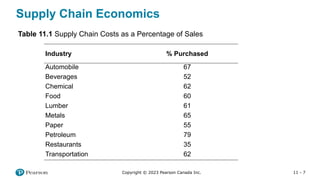
#7 Using selected data from Table 11.1 in the text, this kind of information is often used when first introducing the importance of supply chain management. With such a huge portion of revenue devoted to the supply chain, proper control of supply chain costs can ensure success for an organization, and vice-versa.
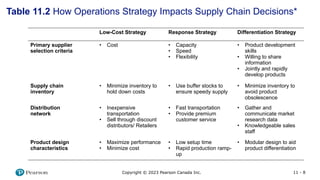
#8 This slide reproduces Table 11.1 from the text. We see here another example of how important it is to clearly define and disseminate the firm’s strategy to all employees, as the strategy dictates very different supply chain policies that should be followed.
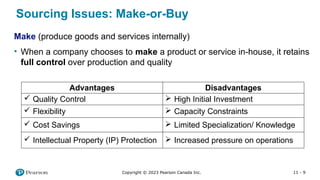
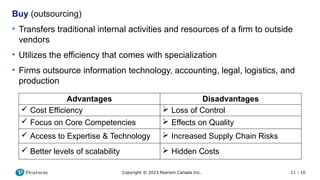
#9 There is a slight difference between make-or-buy decisions vs. outsourcing. Firms are outsourcing more and more support (non-production) functions, such as payroll and call centres. Outsourcing is covered in detail in the supplement to Chapter 11.
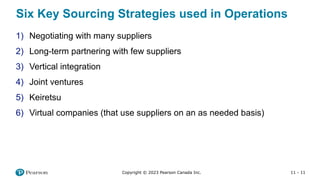
#11 This slide identifies very different approaches to managing the supply base, which are detailed in the following set of slides.
LO 2: Identify six supply-chain strategies.
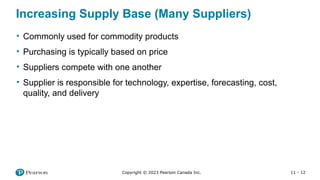
#12 The “many suppliers” approach is considered to be the “old” or “unenlightened” method for selecting suppliers, but it may still make sense for certain commodity products or for firms who practice an extreme low-cost strategy. These are called “arms-length” transactions, and firms may switch suppliers frequently.
#13 The “few suppliers” approach is considered to be a more “enlightened” method for selecting suppliers, and many top companies have been aggressively working to reduce their respective supply bases. It can be nearly impossible to “work together” in the supply chain integration sense if dealing with many suppliers for the same components. When successfully implemented, the few suppliers approach creates win-win opportunities for all parties.
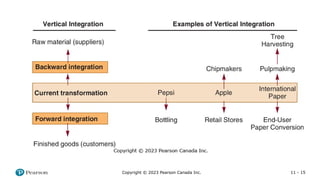
#15 Importantly, vertical integration works in both directions, including taking over the distribution network. Clearly, the internet has allowed many manufacturers to open up new direct sales channels to customers. Vertical integration is in many ways the opposite of outsourcing; thus, outsourcing’s recent popularity implies that we’re seeing less vertical integration than we used to. Certainly for some products, such as paper mills, vertical integration makes perfect sense. Some of the giant South Korean companies have a fascinating history of growth through a substantial effort towards both vertical and horizontal integration.
#16 Joint ventures can represent a nice way to gain the benefits of partnering while retaining independence and being in a relationship that is easier to dissolve.
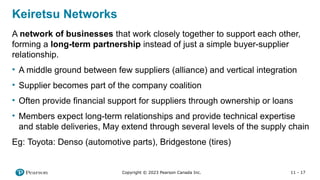
#17 Keiretsu networks come from Japan, and may include banks as well. In addition to cross-ownership and loans among members, in many cases officers of some companies serve on the board of directors of other firms within the network.
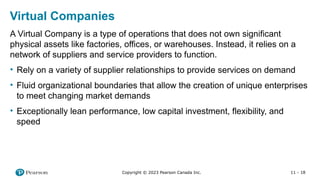
#18 In a virtual company, the supply chain is the company. In some sense, a virtual company takes delegation to the limit. Several firms have become very profitable by using this strategy. Some critics argue that an economy that becomes full of “hollowed out” organizations that do not make anything themselves carries significant risk and does not represent a strong, stable economy. This concern could be addressed in a short class discussion.
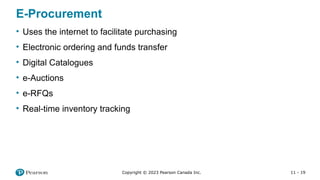
#19 This set of slides covers the increasing practice of firms that order items with computers. One example is Online auctions, which have become excellent mechanisms for firms to unload excess material or inventory. eBay is probably the best known consumer-based example of such auctions. At this point, instructors could ask the students about their experiences with eBay or similar auctions. The pros and cons identified there might be relevant for business-to-business auctions as well. The RFQ process has stream-lined e-procurement.
Furthermore, the combination of e-procurement, bar codes, and RFID have made tracking of inventory and individual products much more accurate.
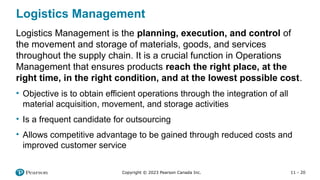
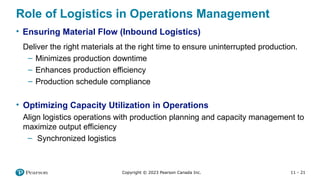
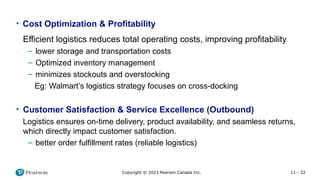
#20 The distribution component of supply chain management is covered under logistics management. Companies such as Walmart have attained competitive advantage by implementing outstanding logistics systems.
LO 5: Explain major issues in logistics management.
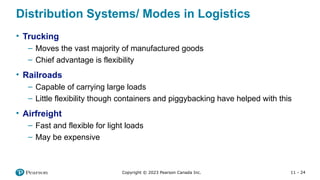
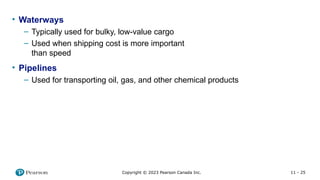
#24 These slides identify the major distribution systems. Trucking is by far the most common, but the others still play a substantial role in some industries. For international shipments, the huge cost savings attained by sending goods by ship instead of plane must be weighed against substantially longer lead times. Instructors might ask if students can think of any “modern” distribution system that is not on the slides—Answer: electronic (downloading music, etc.).
LO 5: Explain major issues in logistics management.
#25 LO 5: Explain major issues in logistics management.
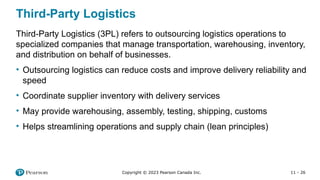
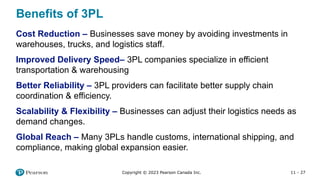
#26 This slide describes the concept of third-party logistics, where firms completely outsource their logistics efforts, including, in some cases, their warehousing, assembly, and customs. FedEx, UPS, and DHL have expanded their roles from shipping companies to full-service logistics providers.
#27 This slide describes the concept of third-party logistics, where firms completely outsource their logistics efforts, including, in some cases, their warehousing, assembly, and customs. FedEx, UPS, and DHL have expanded their roles from shipping companies to full-service logistics providers.
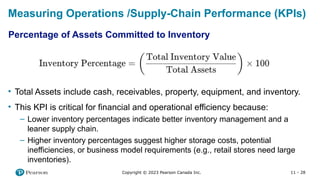
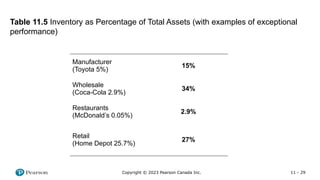
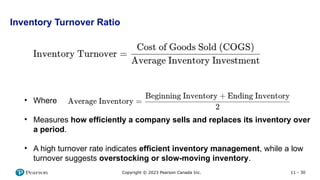
#30 The formula for inventory turnover is provided in this slide. Note how inventory turnover can vary substantially, depending on industry and company conditions. In general, higher turnover is better.
#44 The Supply-Chain Operations Reference (SCOR) model is developed by the Supply-Chain Council. Membership in the council is currently about 900 members. It provides, among other benefits, access to the process, metric, and best practice data from the SCOR model.



![Scm[1]](https://cdn.slidesharecdn.com/ss_thumbnails/scm1-121009223848-phpapp02-thumbnail.jpg?width=640&height=640&fit=bounds)


