L’Élection
Présidentiel!
Qui sera le nouveau président
de la République Française?
Requirements for Candidacy
 Must be a French citizen.
 Must be at least 18 years old.
 Must complete the following 3 procedures:
 Must obtain at least 500 signatures from elected officials supporting the
candidate.
 Signature does not necessarily mean one supports the candidate’s platform,
rather only that he/she is a serious candidate.
 Does not need the support of the party they represent (at least not initially).
 Submit a detail account of personal property/assets.
 Submit campaign accounts 2 months prior to elections.
 This is the 9th
election of the 5th
Republic (1958 de Gaulle)
 President is voted for directly by the people, not an electoral college.
 Campaigning is limited to 30 days.
Brief Explanation of the French
Government
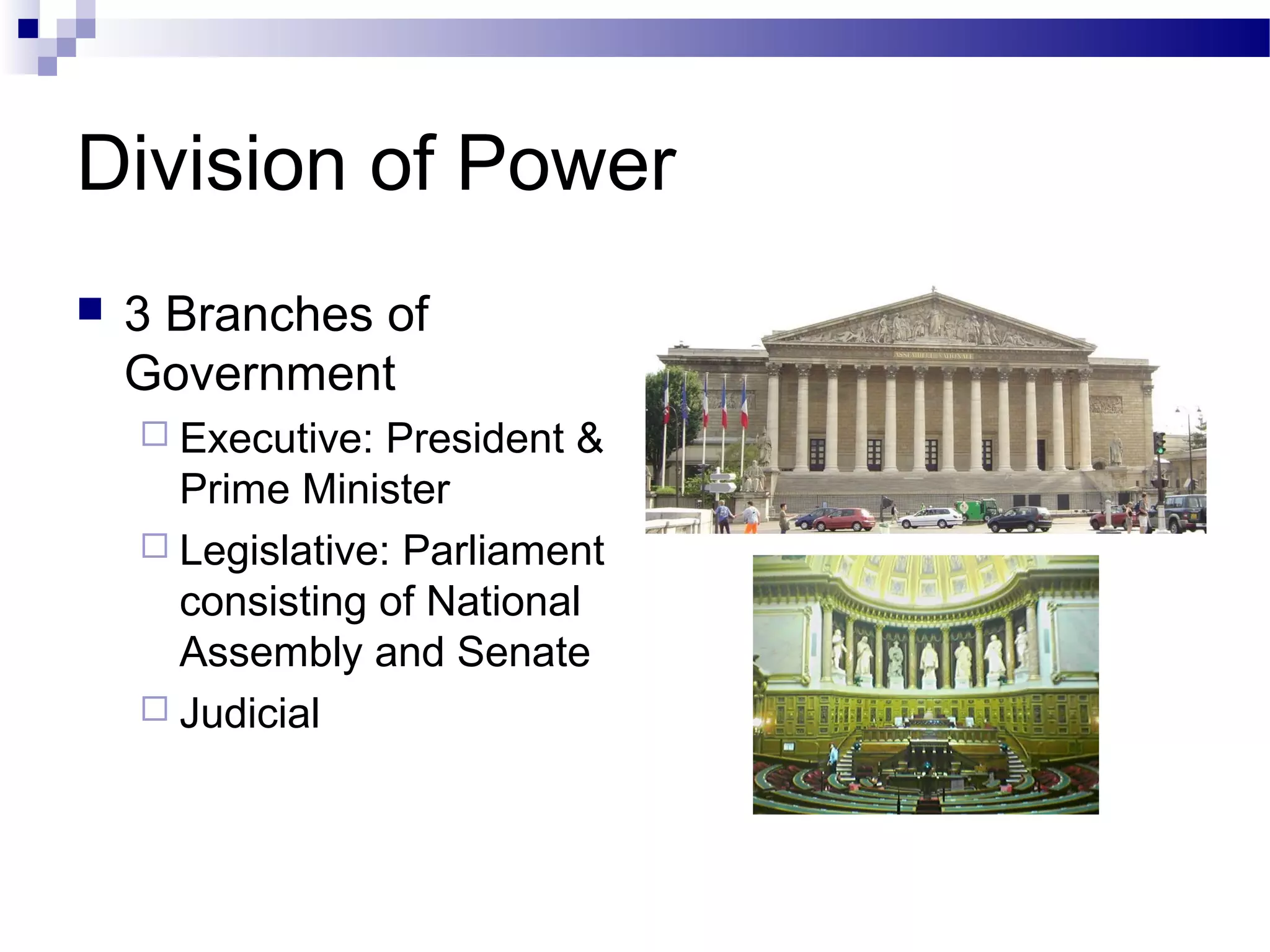
Division of Power
 3 Branches of
Government
 Executive: President &
Prime Minister
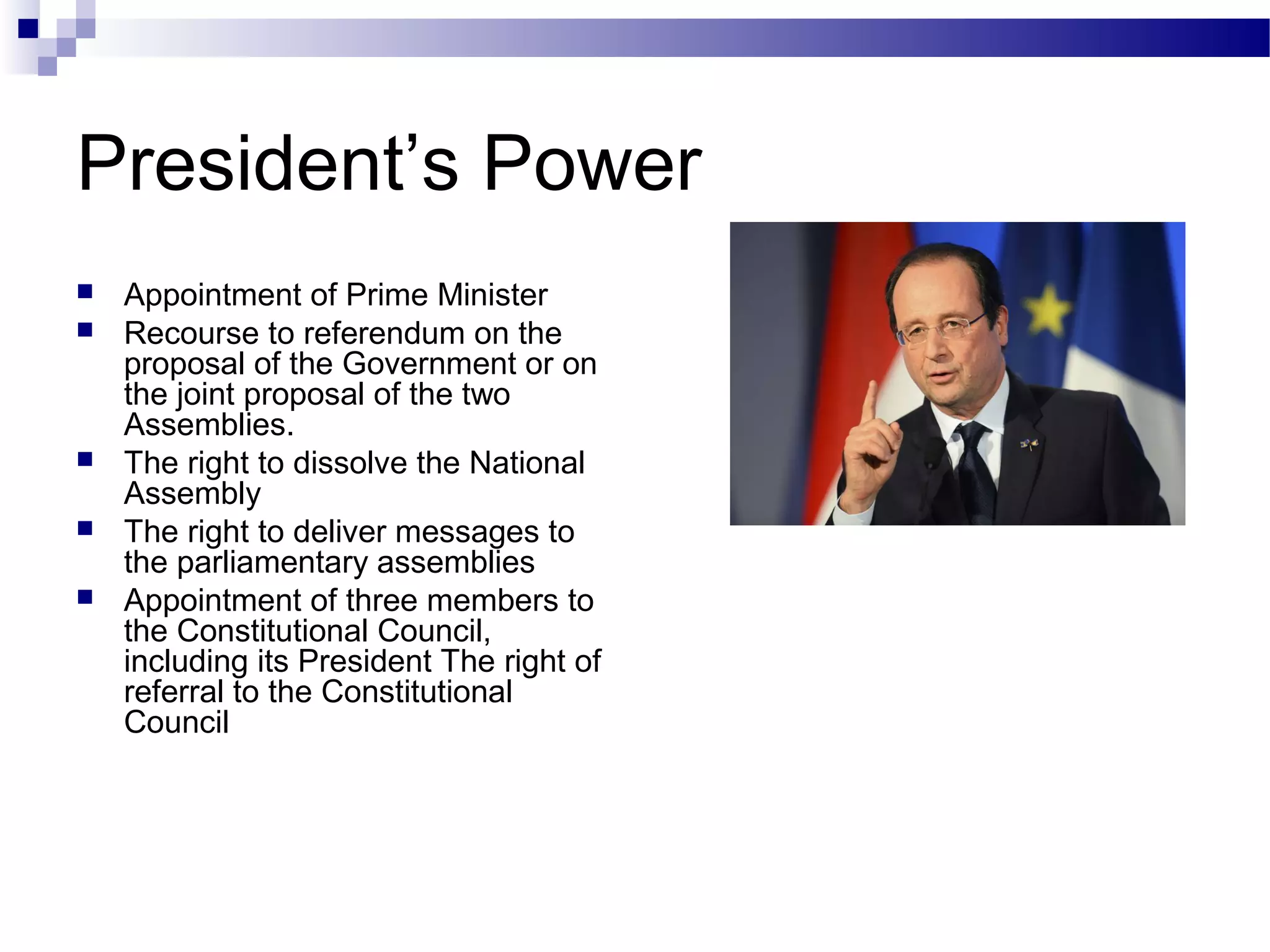
 Legislative: Parliament
consisting of National
Assembly and Senate
 Judicial
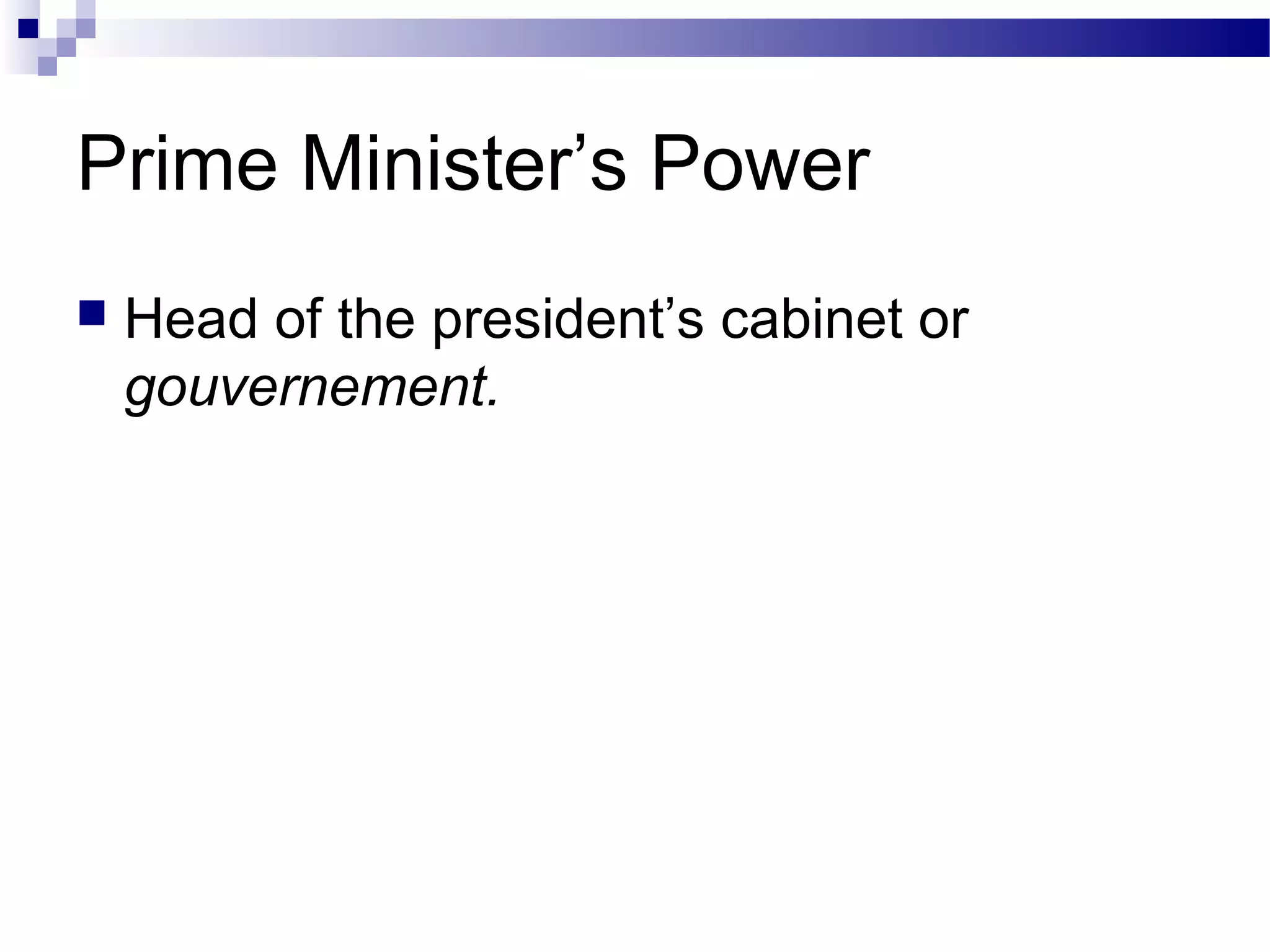
President’s Power
 Appointment of Prime Minister
 Recourse to referendum on the
proposal of the Government or on
the joint proposal of the two
Assemblies.
 The right to dissolve the National
Assembly
 The right to deliver messages to
the parliamentary assemblies
 Appointment of three members to
the Constitutional Council,
including its President The right of
referral to the Constitutional
Council
Additional Powers Include…
 The French President has the power to make regulations
 He appoints ministers and terminates their appointment on the proposal of the Prime Minister.
 He signs the ordinances and decrees deliberated upon in the Council of Ministers
 He makes appointments to the civil and military posts of the State
 He may call an extraordinary session of Parliament at the request of the Government or of a
majority of deputies
 He has the right to grant pardon
 The French President appoints ambassadors
 He negotiates and ratifies treaties
 The French President has the duty to promulgate Acts of Parliament within fifteen days following
the final adoption of an Act and its transmission to the Government. Before the expiry of this time
limit, he may ask Parliament to reconsider the Act or certain of its sections. This reconsideration
may not be refused).
 He chairs the Council of Ministers
 He chairs the Higher Council of the Judiciary
 As Commander-in-Chief of the Armed Forces, he chairs the higher national defense councils and
committees
Prime Minister’s Power
 Head of the president’s cabinet or
gouvernement.
Élysée Palace
55 rue du Faubourg St-Honoré,
Paris Official residence for the
French president.
 Built in 1718 as a private
residence.
 Used by the government of
Napoléon Bonaparte, it was
officially purchased in 1816 as
the residence of the restored
monarchy of Louis XVIII.
 Has remained the official
residence of French leaders.
Other Official Residences of the
Republic
 Chateau de Rambouillet
 Summer residence
 Dates to the 14th
Century.
Original castle to a medieval
mannor.
 Named after original owner
Marquis de Rambouillet.
 François I died here in 1547.
 Purchased by Louis XVI in
1783 as a gift for the queen.
 Site of the first G6 Summit in
1975.
Fort de Brégonçon
 Vacation residence (since 1968) located near
Marseille.
The Issues
 Voter registration increased over 50% since the 2002 election—mostly
immigrant citizens and first generation children
 Forces politicians to confront issues long ignored: racial, ethnic, and religious
discrimination.
 Immigration.
 Political scandals: Finance Minister Alain Juppé convicted for mishandling
public funds.
 Future direction of the European Union—2005 Constitutional vote not
achieved.
 Feminism: A female French president???
 France’s declining status abroad.
 High unemployment rates—9%.
 Crime rates—Higher than the USA?
 Globalization: How will France compete?
Voting Day
 April 22 & May 6: Why are there two
elections??
There is a run off election and only the
candidates with the top votes continue to the
next round of voting in the event there is not a
clear majority winner in the first round.
Reflections…
 In what way is the French election process
similar to that of the American process?
How is it different?
 How are the platforms of the French
candidates similar and/or different to
American candidates?
 Who would you consider voting for and
why?

L’élection présidentiel

  • 1.
    L’Élection Présidentiel! Qui sera lenouveau président de la République Française?
  • 2.
    Requirements for Candidacy Must be a French citizen.  Must be at least 18 years old.  Must complete the following 3 procedures:  Must obtain at least 500 signatures from elected officials supporting the candidate.  Signature does not necessarily mean one supports the candidate’s platform, rather only that he/she is a serious candidate.  Does not need the support of the party they represent (at least not initially).  Submit a detail account of personal property/assets.  Submit campaign accounts 2 months prior to elections.  This is the 9th election of the 5th Republic (1958 de Gaulle)  President is voted for directly by the people, not an electoral college.  Campaigning is limited to 30 days.
  • 3.
    Brief Explanation ofthe French Government
  • 4.
    Division of Power 3 Branches of Government  Executive: President & Prime Minister  Legislative: Parliament consisting of National Assembly and Senate  Judicial
  • 5.
    President’s Power  Appointmentof Prime Minister  Recourse to referendum on the proposal of the Government or on the joint proposal of the two Assemblies.  The right to dissolve the National Assembly  The right to deliver messages to the parliamentary assemblies  Appointment of three members to the Constitutional Council, including its President The right of referral to the Constitutional Council
  • 6.
    Additional Powers Include… The French President has the power to make regulations  He appoints ministers and terminates their appointment on the proposal of the Prime Minister.  He signs the ordinances and decrees deliberated upon in the Council of Ministers  He makes appointments to the civil and military posts of the State  He may call an extraordinary session of Parliament at the request of the Government or of a majority of deputies  He has the right to grant pardon  The French President appoints ambassadors  He negotiates and ratifies treaties  The French President has the duty to promulgate Acts of Parliament within fifteen days following the final adoption of an Act and its transmission to the Government. Before the expiry of this time limit, he may ask Parliament to reconsider the Act or certain of its sections. This reconsideration may not be refused).  He chairs the Council of Ministers  He chairs the Higher Council of the Judiciary  As Commander-in-Chief of the Armed Forces, he chairs the higher national defense councils and committees
  • 7.
    Prime Minister’s Power Head of the president’s cabinet or gouvernement.
  • 8.
    Élysée Palace 55 ruedu Faubourg St-Honoré, Paris Official residence for the French president.  Built in 1718 as a private residence.  Used by the government of Napoléon Bonaparte, it was officially purchased in 1816 as the residence of the restored monarchy of Louis XVIII.  Has remained the official residence of French leaders.
  • 9.
    Other Official Residencesof the Republic  Chateau de Rambouillet  Summer residence  Dates to the 14th Century. Original castle to a medieval mannor.  Named after original owner Marquis de Rambouillet.  François I died here in 1547.  Purchased by Louis XVI in 1783 as a gift for the queen.  Site of the first G6 Summit in 1975.
  • 10.
    Fort de Brégonçon Vacation residence (since 1968) located near Marseille.
  • 11.
    The Issues  Voterregistration increased over 50% since the 2002 election—mostly immigrant citizens and first generation children  Forces politicians to confront issues long ignored: racial, ethnic, and religious discrimination.  Immigration.  Political scandals: Finance Minister Alain Juppé convicted for mishandling public funds.  Future direction of the European Union—2005 Constitutional vote not achieved.  Feminism: A female French president???  France’s declining status abroad.  High unemployment rates—9%.  Crime rates—Higher than the USA?  Globalization: How will France compete?
  • 12.
    Voting Day  April22 & May 6: Why are there two elections?? There is a run off election and only the candidates with the top votes continue to the next round of voting in the event there is not a clear majority winner in the first round.
  • 13.
    Reflections…  In whatway is the French election process similar to that of the American process? How is it different?  How are the platforms of the French candidates similar and/or different to American candidates?  Who would you consider voting for and why?