LIVER NEOPLASMS
CLASSIFICATION
•Primary Solid Benign Tumors
•Primary Solid Malignant Neoplasms
•Cystic Neoplasms
•Metastatic Tumors
PRIMARY SOLID BENIGN TUMORS
 Liver cell adenoma
 Focal nodular hyperplasia
 Hemangioma
 Adenomatous hyperplasia
 Nodular regenerative hyperplasia
 Mesenchymal hamartomas
 Fatty tumors
 Benign fibrous tumors
 Bile duct adenomas
Primary Solid Malignant Neoplasms
 Hepatocellular Carcinoma
 Intrahepatic Cholangiocarcinoma
 Angiosarcoma
 Non-hodgkins Lymphoma
 Carcinoid Tumors
 Malignant Germ Cell Tumors
 Epitheliod Hemangioendothelioma
CYSTIC NEOPLASMS
 Simple Cyst
 Cystadenoma & Cystadenocarcinoma
 Polycystic Liver Disease
 Bile Duct Cysts
METASTATIC TUMORS
 Colorectal Metastases
 Neuroendocrine Metastases
 Non- Colorectal Non- Neuroendocrine Metastases
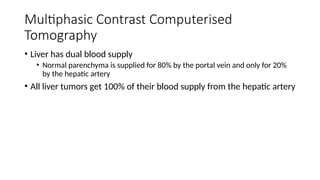
Multiphasic Contrast Computerised
Tomography
• Liver has dual blood supply
• Normal parenchyma is supplied for 80% by the portal vein and only for 20%
by the hepatic artery
• All liver tumors get 100% of their blood supply from the hepatic artery
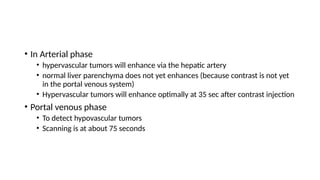
• In Arterial phase
• hypervascular tumors will enhance via the hepatic artery
• normal liver parenchyma does not yet enhances (because contrast is not yet
in the portal venous system)
• Hypervascular tumors will enhance optimally at 35 sec after contrast injection
• Portal venous phase
• To detect hypovascular tumors
• Scanning is at about 75 seconds
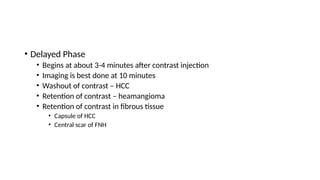
• Delayed Phase
• Begins at about 3-4 minutes after contrast injection
• Imaging is best done at 10 minutes
• Washout of contrast – HCC
• Retention of contrast – heamangioma
• Retention of contrast in fibrous tissue
• Capsule of HCC
• Central scar of FNH
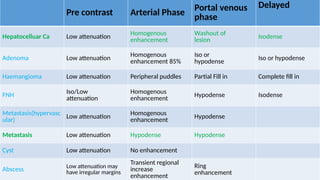
Pre contrast Arterial Phase Portal venous
phase
Delayed
Hepatocelluar Ca Low attenuation
Homogenous
enhancement
Washout of
lesion Isodense
Adenoma Low attenuation Homogenous
enhancement 85%
Iso or
hypodense
Iso or hypodense
Haemangioma Low attenuation Peripheral puddles Partial Fill in Complete fill in
FNH Iso/Low
attenuation
Homogenous
enhancement
Hypodense Isodense
Metastasis(hypervasc
ular)
Low attenuation Homogenous
enhancement
Hypodense
Metastasis Low attenuation Hypodense Hypodense
Cyst Low attenuation No enhancement
Abscess Low attenuation may
have irregular margins
Transient regional
increase
enhancement
Ring
enhancement
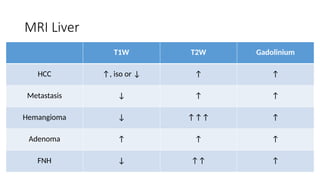
MRI Liver
T1W T2W Gadolinium
HCC ↑, iso or ↓ ↑ ↑
Metastasis ↓ ↑ ↑
Hemangioma ↓ ↑↑↑ ↑
Adenoma ↑ ↑ ↑
FNH ↓ ↑↑ ↑
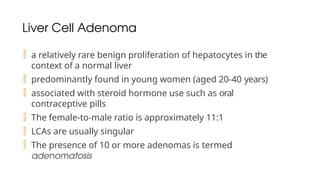
Liver Cell Adenoma
 a relatively rare benign proliferation of hepatocytes in the
context of a normal liver
 predominantly found in young women (aged 20-40 years)
 associated with steroid hormone use such as oral
contraceptive pills
 The female-to-male ratio is approximately 11:1
 LCAs are usually singular
 The presence of 10 or more adenomas is termed
adenomatosis
HISTOLOGY
 composed of cords of benign hepatocytes containing
increased glycogen and fat
 Bile ductules are not seen
 normal architecture of the liver is not present in these
lesions
CLINICAL PRESENTATION
 Symptomatic in 50% to 75% of cases
 MC symptom - Upper abdominal pain
 tumor markers are normal
 CT
 a well-circumscribed heterogenous mass that shows early
enhancement during the arterial phase
 MRI - pecific imaging characteristics
 well-demarcated heterogenous mass containing fat or hemorrhage
 resection may be necessary to secure a diagnosis in difficult
cases
MANAGEMENT
 acute hemorrhage - need emergent attention
 hepatic artery embolization - helpful and effective temporary
maneuver
 Once stabilized and appropriately resuscitated, a laparotomy and
resection of the mass is required
 Symptomatic masses, likewise, are resected
 Patients with asymptomatic LCA who take OCPs can be watched for
regression after stopping the OCPs
 Margin status is not important in these resections, and limited
resections can be performed
Focal Nodular Hyperplasia
 second most common benign tumor of the liver
 predominantly discovered in young women
 usually a small (<5 cm) nodular mass arising in a normal
liver that involves the right and left liver equally
 characterized by a central fibrous scar with radiating
septa
 no central scar is seen in about 15% of cases
HISTOLOGY
 FNH contains cords of benign-appearing hepatocytes
divided by multiple fibrous septa originating from a
central scar
 Typical hepatic vascularity is not seen
 atypical biliary epithelium is found scattered throughout
the lesion
 The central scar often contains a large artery that
branches out into multiple smaller arteries in a spoke-
wheel pattern
CLINICAL PRESENTATION
 In most patients - incidental finding at laparotomy or more
commonly on imaging studies
 most often vague abdominal pain
 Physical examination is usually unrevealing
 mild abnormalities of LFTs may be found
 Serum AFP levels are normal
 Contrast-enhanced CT and MRI have become accurate methods of
diagnosing FNH
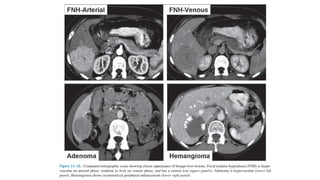
 a homogeneous mass with a central scar that rapidly enhances during the
arterial phase of contrast administration
MANAGEMENT
 Asymptomatic patients mostly remain so over long periods
of time
 Rupture, bleeding, and infarction are exceedingly rare
 malignant degeneration of FNH has never been
reported
 The treatment depends on diagnostic certainty and
symptom
 Asymptomatic patients with typical radiologic features do not require
treatment
 If diagnostic uncertainty exists, resection may be necessary for
histologic confirmation
 Symptomatic patients are thoroughly investigated
 Careful observation of symptomatic FNH with serial imaging is
reasonable because symptoms may resolve in a significant number of
cases
 persistent symptomatic FNH or an enlarging mass need to be
considered for resection.
Hemangioma
 Hemangioma is the most common benign tumor of the liver
 occurs in women more commonly than men (3:1 ratio) and at
a mean age of about 45 years
 Small capillary hemangiomas are of no clinical significance
 Cavernous hemangiomas have been associated with FNH
 Enlargement of hemangiomas are by ectasia rather than
neoplasia
 They are usually single and less than 5 cm in diameter
 occur equally in the right and left liver
 greater than 5 cm are arbitrarily called giant hemangiomas.
 Involution or thrombosis of hemangiomas can result in
dense fibrotic masses that may be difficult to differentiate
from malignancy
CLINICAL PRESENTATION
• Most commonly, hemangiomas are asymptomatic and
incidentally found on imaging studies
• Large compressive masses may cause vague upper
abdominal symptoms
• Rapid expansion or acute thrombosis can, on occasion, cause
symptoms
• Spontaneous rupture is exceedingly rare
• An associated syndrome of thrombocytopenia and
consumptive coagulopathy known as Kasabach-Merritt
syndrome
INVESTIGATIONS
•LFTs and tumor markers are usually normal
•CT and MRI are usually sufficient
• typical peripheral nodular enhancement pattern
•Labeled red blood cell scans are an accurate test rarely
necessary
•Percutaneous biopsy of a suspected hemangioma is
potentially dangerous and inaccurate and is therefore not
recommended
MANAGEMENT
 Most of these tumors remain stable over long periods of time
 low risk for rupture or hemorrhage
 Growth and development of symptoms do occur, occasionally
requiring resection
 An asymptomatic patient with a secure diagnosis can be
simply observed
 Symptomatic patients are candidates for resection if no
other cause is found
 Rupture, change in size, and development of the Kasabach-
Merritt syndrome are indications for resection
 In rare cases of diagnostic uncertainty, resection may
be necessary to make a definitive diagnosis
 The preferred approach to resection is enucleation with
inflow control
Liver hemangiomas in children
 account for about 12% of all childhood hepatic tumors
 usually multifocal and can involve other organs
 Large hemangiomas in children can result in congestive heart failure
secondary to arteriovenous shunting
 Untreated symptomatic childhood hemangiomas are associated with a 70%
mortality rate
 small capillary hemangiomas almost all resolve
 Symptomatic childhood hemangiomas may be treated medically for
congestive heart failure, with therapeutic embolization
 Resection may be necessary for symptomatic lesions or for rupture
Macroregenerative nodules
 previously known as adenomatous hyperplasia
 single or multiple
 they result from the hyperplastic response to chronic liver
injury
 well-circumscribed, bile-stained, bulging surface
nodules that occur primarily in cirrhotic patients
 have malignant potential
 very difficult to distinguish from hepatocellular carcinoma
Nodular regenerative hyperplasia (NRH)
• benign, diffuse, micronodular (usually <2 cm) process
• associated with
• lymphoproliferative disorders
• collagen vascular diseases
• use of steroids or chemotherapy
 no malignant potential
 not associated with cirrhosis
 Biopsy may be necessary to distinguish these focal
nodules from malignancy
Primary Solid Malignant Neoplasms
• Hepatocellular Carcinoma
• Most common primary malignancy of the liver
• Third most common cause of cancer related death
• The incidence of HCC is rising, largely attributed to a rise in hepatitis C
infection
EPIDEMOLOGY
 most common primary malignancy of the liver and 5th
most common malignancies worldwide
 two to eight times more common in males than in females
 75% to 80% of HCC cases have viral etiology
 HBV (50%-55%) infection
 HCV (25%-30%) infection
 Cirrhosis is not required for the development of HCC
 HCC is not an inevitable result of cirrhosis
AETIOLOGY
 Chronic alcohol abuse - increased
risk for HCC
 synergistic effect with HBV and HCV
infection
 Cigarette smoking - evidence is not
consistent
 Congenital biliary atresia
 Inborn errors of metabolism
 haemochromatosis
 alpha-1 antitrypsin deficiency
 type 1 glycogen storage disease
 Wilson disease
 Chemical
 Aflatoxin [Aspergillus
species]
 Nitrites
 Hydrocarbons &
solvents
 Pesticides
 Vinyl chloride
 Thorotrast (colloidal
thorium dioxide)
CLINICAL PRESENTATION
 Most commonly men of 50 to 60 years of age
 right upper quadrant abdominal pain and weight loss ±
palpable mass
 anorexia, nausea, lethargy
 hepatic decompensation in a patient with known mild cirrhosis
or even in patients without previously recognized cirrhosis
 HCC can present as a rupture, hepatic vein occlusion (Budd-
Chiari syndrome), obstructive jaundice, hemobilia, or fever of
unknown origin
DIAGNOSIS
• Ultrasound - significant role in screening and early
detection of HCC
• CT and MRI - definitive diagnosis and treatment planning
• An AFP level greater than 20 ng/mL is noted in about three
fourths of documented cases of HCC
• hyper vascular mass consistent with HCC combined with an
AFP higher than 400 ng/mL is diagnostic
• AFP levels are particularly useful in monitoring treated
patients for recurrence after normalization of levels
 Percutaneous needle biopsies of liver lesions suspected of
being HCC are only necessary in patients who are being
considered for non-operative therapies
 Contrast-enhanced CT and MRI protocols aimed at diagnosing
HCC take advantage of the hyper vascularity of these tumors,
and arterial phase images are critical to adequately assess the
extent of disease
 CT and MRI also evaluate the extent of disease in terms of
peritoneal metastases, nodal metastases, and extent of
vascular and biliary involvement
STAGING
A. assessing the extent of disease
 Extent of disease in the liver, including macro vascular
invasion and the presence of multiple liver masses
 the common sites of metastases must be considered
 A preoperative chest x-ray is mandatory
 Routine bone scans are not performed unless there are
suggestive symptoms or signs.
B. Assessment of liver function
 absolutely critical in considering treatment options for a
patient with HCC
 the risk for postoperative liver failure and death must be
considered
 clinical assessment schemes most commonly, Child's status
(as modified by Pugh) is used
 significant portal hypertension regardless of biochemical
assessments is highly predictive of postoperative liver
failure and death
ROLE OF STAGING LAPAROSCOPY
 Staging laparoscopy has recently been employed as a
staging tool in HCC
 spares about one in five patients a nontherapeutic
laparotomy
 Laparoscopy yields additional information about extent of
disease in the liver, extrahepatic disease, and cirrhosis
STAGING SYSTEMS
 probably depend on the specific population being staged and the
etiology of HCC in that particular population
 The TNM staging system is not routinely used for HCC
 does not accurately predict survival because it does not take liver
function into account
 The Okuda staging system is an older but simple and effective
system that takes into account liver function and tumor-related
factors
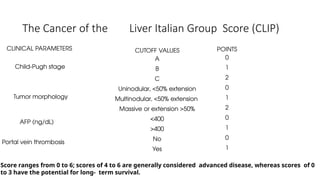
 The most well-validated staging system is the Cancer of the
Liver Italian Program (CLIP)
The Cancer of the Liver Italian Group Score (CLIP)
CLINICAL PARAMETERS
Child-Pugh stage
Tumor morphology
AFP (ng/dL)
Portal vein thrombosis
CUTOFF VALUES
A
B
C
Uninodular, <50% extension
Multinodular, <50% extension
Massive or extension >50%
<400
>400
No
Yes
Score ranges from 0 to 6; scores of 4 to 6 are generally considered advanced disease, whereas scores of 0
to 3 have the potential for long- term survival.
POINTS
0
1
2
0
1
2
0
1
0
1
PATHOLOGY
 Histologically, HCC is graded as well, moderately, or poorly
differentiated
 The grade of HCC, however, has never been shown to
accurately predict outcome
 A.HANGING TYPE
 B.PUSHING TYPE
 C.INFILTRTIVE TYPE
 Small tumors less than 5 cm in size usually do not fall into any
of these groups and are often discussed as a separate entity
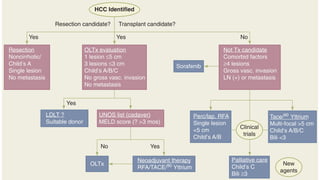
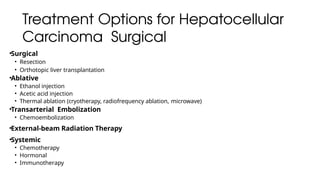
Treatment Options for Hepatocellular
Carcinoma Surgical
•Surgical
• Resection
• Orthotopic liver transplantation
•Ablative
• Ethanol injection
• Acetic acid injection
• Thermal ablation (cryotherapy, radiofrequency ablation, microwave)
•Transarterial Embolization
• Chemoembolization
•External-beam Radiation Therapy
•Systemic
• Chemotherapy
• Hormonal
• Immunotherapy
 Complete excision of HCC either by partial hepatectomy or
by total hepatectomy and transplantation is the
treatment of choice when possible because it has the
highest chance of long-term survival
 only 10% to 20% of patients are considered to have
resectable disease
 mortality rate less than 5% for partial hepatectomy
 Patients with Child's B or C cirrhosis or portal hypertension
do not tolerate resection
 The volume of the future liver remnant (FLR) is also an
important consideration
 Preoperative portal vein embolization is an effective
strategy to increase the volume and function of the FLR
Negative Prognostic Factors
 Tumour Size
 Cirrhosis
 Infiltrative Growth Pattern
 Vascular Invasion
 Intrahepatic Metastases
 Multifocal Tumours
 Lymph Node Metastases
 Margin Less Than 1 Cm
 Lack Of A Capsule
ROLE OF LIVER TRANSPLANTATION
 ideal treatment for HCC
 addresses both the liver dysfunction and the HCC
 Limitations
 need for chronic immunosuppression
 lack of organ donors
 improved outcomes
 single tumors less than 5 cm
 multiple tumors no more than three in number and 3 cm in size
 Patients with advanced cirrhosis (Child's B and C) and
early-stage HCC are considered for transplantation
 Child's A cirrhosis have similar results with transplantation
and resection and should probably undergo resection
Percutaneous ethanol injection (PEI)
 useful technique for ablating small tumors
 The tumor is killed by a combination of cellular dehydration,
coagulative necrosis, and vascular thrombosis
 tumors less than 2 cm in size can be ablated with a single
application of PEI
 Larger tumors may require multiple injections
 Long-term survival after PEI for tumors less than 5 cm has
been reported to range from 24% to 40
Thermal ablative techniques
 freeze or heat tumors to destroy them - popular in recent years
 Cryotherapy
 uses a specialized cryoprobe to freeze and thaw tumor and surrounding
liver tissue with resulting necrosis
 usually performed at laparotomy or laparoscopically
 recently been performed with percutaneous techniques
 Radiofrequency ablation (RFA)
 high-frequency alternating current to create heat around an inserted probe,
resulting in temperatures greater than 60°C and immediate cell death
 can easily be performed percutaneously with low complication rates
Transarterial therapy
 Principle most of the tumor's blood supply is by hepatic artery
 Hepatic arterial infusion (HAI) chemotherapy using 5-fluorouracil
(5-FU)- based compounds, cisplatin, and doxorubicin has been
studied
 requirement of a laparotomy to place the pump and associated
hepatic toxicity limits the applicability of this approach
 appropriate candidates - patients with preserved liver
function and asymptomatic multinodular tumors without
vascular invasion
OTHER MODALITIES
 Systemic chemotherapy with a variety of agents has been
ineffective for the treatment of HCC and has a minimal
role in the treatment of HCC
 External-beam radiation therapy (EBRT) has a limited role
in the treatment of HCC, although occasional dramatic
responses are seen
Fibrolamellar HCC
 generally occurs in younger patients without a history of
cirrhosis
 usually well demarcated and encapsulated
 may have a central fibrotic area
 central scar can make distinguishing this tumor from FNH
difficult
 FHCC does not produce AFP
 associated with elevated neurotensin levels
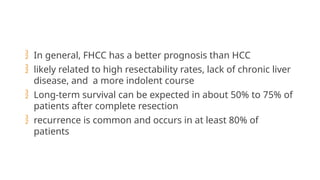
 In general, FHCC has a better prognosis than HCC
 likely related to high resectability rates, lack of chronic liver
disease, and a more indolent course
 Long-term survival can be expected in about 50% to 75% of
patients after complete resection
 recurrence is common and occurs in at least 80% of
patients
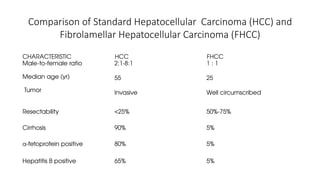
Comparison of Standard Hepatocellular Carcinoma (HCC) and
Fibrolamellar Hepatocellular Carcinoma (FHCC)
CHARACTERISTIC HCC FHCC
Male-to-female ratio
Median age (yr)
Tumor
2:1-8:1
55
Invasive
1 : 1
25
Well circumscribed
Resectability <25% 50%-75%
Cirrhosis 90% 5%
α-fetoprotein positive 80% 5%
Hepatitis B positive 65% 5%
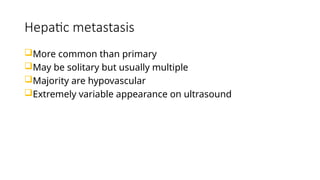
Hepatic metastasis
More common than primary
May be solitary but usually multiple
Majority are hypovascular
Extremely variable appearance on ultrasound
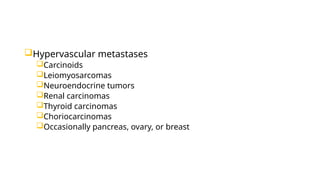
Hypervascular metastases
Carcinoids
Leiomyosarcomas
Neuroendocrine tumors
Renal carcinomas
Thyroid carcinomas
Choriocarcinomas
Occasionally pancreas, ovary, or breast
LIVER NEOPLASMS - classification, example, clinical presentation, imaging, histology

LIVER NEOPLASMS - classification, example, clinical presentation, imaging, histology

  • 1.
  • 2.
    CLASSIFICATION •Primary Solid BenignTumors •Primary Solid Malignant Neoplasms •Cystic Neoplasms •Metastatic Tumors
  • 3.
    PRIMARY SOLID BENIGNTUMORS  Liver cell adenoma  Focal nodular hyperplasia  Hemangioma  Adenomatous hyperplasia  Nodular regenerative hyperplasia  Mesenchymal hamartomas  Fatty tumors  Benign fibrous tumors  Bile duct adenomas
  • 4.
    Primary Solid MalignantNeoplasms  Hepatocellular Carcinoma  Intrahepatic Cholangiocarcinoma  Angiosarcoma  Non-hodgkins Lymphoma  Carcinoid Tumors  Malignant Germ Cell Tumors  Epitheliod Hemangioendothelioma
  • 5.
    CYSTIC NEOPLASMS  SimpleCyst  Cystadenoma & Cystadenocarcinoma  Polycystic Liver Disease  Bile Duct Cysts
  • 6.
    METASTATIC TUMORS  ColorectalMetastases  Neuroendocrine Metastases  Non- Colorectal Non- Neuroendocrine Metastases
  • 7.
    Multiphasic Contrast Computerised Tomography •Liver has dual blood supply • Normal parenchyma is supplied for 80% by the portal vein and only for 20% by the hepatic artery • All liver tumors get 100% of their blood supply from the hepatic artery
  • 8.
    • In Arterialphase • hypervascular tumors will enhance via the hepatic artery • normal liver parenchyma does not yet enhances (because contrast is not yet in the portal venous system) • Hypervascular tumors will enhance optimally at 35 sec after contrast injection • Portal venous phase • To detect hypovascular tumors • Scanning is at about 75 seconds
  • 9.
    • Delayed Phase •Begins at about 3-4 minutes after contrast injection • Imaging is best done at 10 minutes • Washout of contrast – HCC • Retention of contrast – heamangioma • Retention of contrast in fibrous tissue • Capsule of HCC • Central scar of FNH
  • 10.
    Pre contrast ArterialPhase Portal venous phase Delayed Hepatocelluar Ca Low attenuation Homogenous enhancement Washout of lesion Isodense Adenoma Low attenuation Homogenous enhancement 85% Iso or hypodense Iso or hypodense Haemangioma Low attenuation Peripheral puddles Partial Fill in Complete fill in FNH Iso/Low attenuation Homogenous enhancement Hypodense Isodense Metastasis(hypervasc ular) Low attenuation Homogenous enhancement Hypodense Metastasis Low attenuation Hypodense Hypodense Cyst Low attenuation No enhancement Abscess Low attenuation may have irregular margins Transient regional increase enhancement Ring enhancement
  • 12.
    MRI Liver T1W T2WGadolinium HCC ↑, iso or ↓ ↑ ↑ Metastasis ↓ ↑ ↑ Hemangioma ↓ ↑↑↑ ↑ Adenoma ↑ ↑ ↑ FNH ↓ ↑↑ ↑
  • 13.
    Liver Cell Adenoma a relatively rare benign proliferation of hepatocytes in the context of a normal liver  predominantly found in young women (aged 20-40 years)  associated with steroid hormone use such as oral contraceptive pills  The female-to-male ratio is approximately 11:1  LCAs are usually singular  The presence of 10 or more adenomas is termed adenomatosis
  • 14.
    HISTOLOGY  composed ofcords of benign hepatocytes containing increased glycogen and fat  Bile ductules are not seen  normal architecture of the liver is not present in these lesions
  • 15.
    CLINICAL PRESENTATION  Symptomaticin 50% to 75% of cases  MC symptom - Upper abdominal pain  tumor markers are normal  CT  a well-circumscribed heterogenous mass that shows early enhancement during the arterial phase  MRI - pecific imaging characteristics  well-demarcated heterogenous mass containing fat or hemorrhage  resection may be necessary to secure a diagnosis in difficult cases
  • 16.
    MANAGEMENT  acute hemorrhage- need emergent attention  hepatic artery embolization - helpful and effective temporary maneuver  Once stabilized and appropriately resuscitated, a laparotomy and resection of the mass is required  Symptomatic masses, likewise, are resected  Patients with asymptomatic LCA who take OCPs can be watched for regression after stopping the OCPs  Margin status is not important in these resections, and limited resections can be performed
  • 17.
    Focal Nodular Hyperplasia second most common benign tumor of the liver  predominantly discovered in young women  usually a small (<5 cm) nodular mass arising in a normal liver that involves the right and left liver equally  characterized by a central fibrous scar with radiating septa  no central scar is seen in about 15% of cases
  • 18.
    HISTOLOGY  FNH containscords of benign-appearing hepatocytes divided by multiple fibrous septa originating from a central scar  Typical hepatic vascularity is not seen  atypical biliary epithelium is found scattered throughout the lesion  The central scar often contains a large artery that branches out into multiple smaller arteries in a spoke- wheel pattern
  • 19.
    CLINICAL PRESENTATION  Inmost patients - incidental finding at laparotomy or more commonly on imaging studies  most often vague abdominal pain  Physical examination is usually unrevealing  mild abnormalities of LFTs may be found  Serum AFP levels are normal  Contrast-enhanced CT and MRI have become accurate methods of diagnosing FNH  a homogeneous mass with a central scar that rapidly enhances during the arterial phase of contrast administration
  • 20.
    MANAGEMENT  Asymptomatic patientsmostly remain so over long periods of time  Rupture, bleeding, and infarction are exceedingly rare  malignant degeneration of FNH has never been reported  The treatment depends on diagnostic certainty and symptom
  • 21.
     Asymptomatic patientswith typical radiologic features do not require treatment  If diagnostic uncertainty exists, resection may be necessary for histologic confirmation  Symptomatic patients are thoroughly investigated  Careful observation of symptomatic FNH with serial imaging is reasonable because symptoms may resolve in a significant number of cases  persistent symptomatic FNH or an enlarging mass need to be considered for resection.
  • 22.
    Hemangioma  Hemangioma isthe most common benign tumor of the liver  occurs in women more commonly than men (3:1 ratio) and at a mean age of about 45 years  Small capillary hemangiomas are of no clinical significance  Cavernous hemangiomas have been associated with FNH
  • 23.
     Enlargement ofhemangiomas are by ectasia rather than neoplasia  They are usually single and less than 5 cm in diameter  occur equally in the right and left liver  greater than 5 cm are arbitrarily called giant hemangiomas.  Involution or thrombosis of hemangiomas can result in dense fibrotic masses that may be difficult to differentiate from malignancy
  • 24.
    CLINICAL PRESENTATION • Mostcommonly, hemangiomas are asymptomatic and incidentally found on imaging studies • Large compressive masses may cause vague upper abdominal symptoms • Rapid expansion or acute thrombosis can, on occasion, cause symptoms • Spontaneous rupture is exceedingly rare • An associated syndrome of thrombocytopenia and consumptive coagulopathy known as Kasabach-Merritt syndrome
  • 25.
    INVESTIGATIONS •LFTs and tumormarkers are usually normal •CT and MRI are usually sufficient • typical peripheral nodular enhancement pattern •Labeled red blood cell scans are an accurate test rarely necessary •Percutaneous biopsy of a suspected hemangioma is potentially dangerous and inaccurate and is therefore not recommended
  • 26.
    MANAGEMENT  Most ofthese tumors remain stable over long periods of time  low risk for rupture or hemorrhage  Growth and development of symptoms do occur, occasionally requiring resection  An asymptomatic patient with a secure diagnosis can be simply observed  Symptomatic patients are candidates for resection if no other cause is found
  • 27.
     Rupture, changein size, and development of the Kasabach- Merritt syndrome are indications for resection  In rare cases of diagnostic uncertainty, resection may be necessary to make a definitive diagnosis  The preferred approach to resection is enucleation with inflow control
  • 28.
    Liver hemangiomas inchildren  account for about 12% of all childhood hepatic tumors  usually multifocal and can involve other organs  Large hemangiomas in children can result in congestive heart failure secondary to arteriovenous shunting  Untreated symptomatic childhood hemangiomas are associated with a 70% mortality rate  small capillary hemangiomas almost all resolve  Symptomatic childhood hemangiomas may be treated medically for congestive heart failure, with therapeutic embolization  Resection may be necessary for symptomatic lesions or for rupture
  • 29.
    Macroregenerative nodules  previouslyknown as adenomatous hyperplasia  single or multiple  they result from the hyperplastic response to chronic liver injury  well-circumscribed, bile-stained, bulging surface nodules that occur primarily in cirrhotic patients  have malignant potential  very difficult to distinguish from hepatocellular carcinoma
  • 30.
    Nodular regenerative hyperplasia(NRH) • benign, diffuse, micronodular (usually <2 cm) process • associated with • lymphoproliferative disorders • collagen vascular diseases • use of steroids or chemotherapy  no malignant potential  not associated with cirrhosis  Biopsy may be necessary to distinguish these focal nodules from malignancy
  • 31.
    Primary Solid MalignantNeoplasms • Hepatocellular Carcinoma • Most common primary malignancy of the liver • Third most common cause of cancer related death • The incidence of HCC is rising, largely attributed to a rise in hepatitis C infection
  • 32.
    EPIDEMOLOGY  most commonprimary malignancy of the liver and 5th most common malignancies worldwide  two to eight times more common in males than in females  75% to 80% of HCC cases have viral etiology  HBV (50%-55%) infection  HCV (25%-30%) infection  Cirrhosis is not required for the development of HCC  HCC is not an inevitable result of cirrhosis
  • 33.
    AETIOLOGY  Chronic alcoholabuse - increased risk for HCC  synergistic effect with HBV and HCV infection  Cigarette smoking - evidence is not consistent  Congenital biliary atresia  Inborn errors of metabolism  haemochromatosis  alpha-1 antitrypsin deficiency  type 1 glycogen storage disease  Wilson disease  Chemical  Aflatoxin [Aspergillus species]  Nitrites  Hydrocarbons & solvents  Pesticides  Vinyl chloride  Thorotrast (colloidal thorium dioxide)
  • 34.
    CLINICAL PRESENTATION  Mostcommonly men of 50 to 60 years of age  right upper quadrant abdominal pain and weight loss ± palpable mass  anorexia, nausea, lethargy  hepatic decompensation in a patient with known mild cirrhosis or even in patients without previously recognized cirrhosis  HCC can present as a rupture, hepatic vein occlusion (Budd- Chiari syndrome), obstructive jaundice, hemobilia, or fever of unknown origin
  • 35.
    DIAGNOSIS • Ultrasound -significant role in screening and early detection of HCC • CT and MRI - definitive diagnosis and treatment planning • An AFP level greater than 20 ng/mL is noted in about three fourths of documented cases of HCC • hyper vascular mass consistent with HCC combined with an AFP higher than 400 ng/mL is diagnostic • AFP levels are particularly useful in monitoring treated patients for recurrence after normalization of levels
  • 36.
     Percutaneous needlebiopsies of liver lesions suspected of being HCC are only necessary in patients who are being considered for non-operative therapies  Contrast-enhanced CT and MRI protocols aimed at diagnosing HCC take advantage of the hyper vascularity of these tumors, and arterial phase images are critical to adequately assess the extent of disease  CT and MRI also evaluate the extent of disease in terms of peritoneal metastases, nodal metastases, and extent of vascular and biliary involvement
  • 37.
    STAGING A. assessing theextent of disease  Extent of disease in the liver, including macro vascular invasion and the presence of multiple liver masses  the common sites of metastases must be considered  A preoperative chest x-ray is mandatory  Routine bone scans are not performed unless there are suggestive symptoms or signs.
  • 38.
    B. Assessment ofliver function  absolutely critical in considering treatment options for a patient with HCC  the risk for postoperative liver failure and death must be considered  clinical assessment schemes most commonly, Child's status (as modified by Pugh) is used  significant portal hypertension regardless of biochemical assessments is highly predictive of postoperative liver failure and death
  • 39.
    ROLE OF STAGINGLAPAROSCOPY  Staging laparoscopy has recently been employed as a staging tool in HCC  spares about one in five patients a nontherapeutic laparotomy  Laparoscopy yields additional information about extent of disease in the liver, extrahepatic disease, and cirrhosis
  • 40.
    STAGING SYSTEMS  probablydepend on the specific population being staged and the etiology of HCC in that particular population  The TNM staging system is not routinely used for HCC  does not accurately predict survival because it does not take liver function into account  The Okuda staging system is an older but simple and effective system that takes into account liver function and tumor-related factors  The most well-validated staging system is the Cancer of the Liver Italian Program (CLIP)
  • 41.
    The Cancer ofthe Liver Italian Group Score (CLIP) CLINICAL PARAMETERS Child-Pugh stage Tumor morphology AFP (ng/dL) Portal vein thrombosis CUTOFF VALUES A B C Uninodular, <50% extension Multinodular, <50% extension Massive or extension >50% <400 >400 No Yes Score ranges from 0 to 6; scores of 4 to 6 are generally considered advanced disease, whereas scores of 0 to 3 have the potential for long- term survival. POINTS 0 1 2 0 1 2 0 1 0 1
  • 42.
    PATHOLOGY  Histologically, HCCis graded as well, moderately, or poorly differentiated  The grade of HCC, however, has never been shown to accurately predict outcome  A.HANGING TYPE  B.PUSHING TYPE  C.INFILTRTIVE TYPE  Small tumors less than 5 cm in size usually do not fall into any of these groups and are often discussed as a separate entity
  • 44.
    Treatment Options forHepatocellular Carcinoma Surgical •Surgical • Resection • Orthotopic liver transplantation •Ablative • Ethanol injection • Acetic acid injection • Thermal ablation (cryotherapy, radiofrequency ablation, microwave) •Transarterial Embolization • Chemoembolization •External-beam Radiation Therapy •Systemic • Chemotherapy • Hormonal • Immunotherapy
  • 45.
     Complete excisionof HCC either by partial hepatectomy or by total hepatectomy and transplantation is the treatment of choice when possible because it has the highest chance of long-term survival  only 10% to 20% of patients are considered to have resectable disease  mortality rate less than 5% for partial hepatectomy
  • 46.
     Patients withChild's B or C cirrhosis or portal hypertension do not tolerate resection  The volume of the future liver remnant (FLR) is also an important consideration  Preoperative portal vein embolization is an effective strategy to increase the volume and function of the FLR
  • 47.
    Negative Prognostic Factors Tumour Size  Cirrhosis  Infiltrative Growth Pattern  Vascular Invasion  Intrahepatic Metastases  Multifocal Tumours  Lymph Node Metastases  Margin Less Than 1 Cm  Lack Of A Capsule
  • 48.
    ROLE OF LIVERTRANSPLANTATION  ideal treatment for HCC  addresses both the liver dysfunction and the HCC  Limitations  need for chronic immunosuppression  lack of organ donors
  • 49.
     improved outcomes single tumors less than 5 cm  multiple tumors no more than three in number and 3 cm in size  Patients with advanced cirrhosis (Child's B and C) and early-stage HCC are considered for transplantation  Child's A cirrhosis have similar results with transplantation and resection and should probably undergo resection
  • 50.
    Percutaneous ethanol injection(PEI)  useful technique for ablating small tumors  The tumor is killed by a combination of cellular dehydration, coagulative necrosis, and vascular thrombosis  tumors less than 2 cm in size can be ablated with a single application of PEI  Larger tumors may require multiple injections  Long-term survival after PEI for tumors less than 5 cm has been reported to range from 24% to 40
  • 51.
    Thermal ablative techniques freeze or heat tumors to destroy them - popular in recent years  Cryotherapy  uses a specialized cryoprobe to freeze and thaw tumor and surrounding liver tissue with resulting necrosis  usually performed at laparotomy or laparoscopically  recently been performed with percutaneous techniques  Radiofrequency ablation (RFA)  high-frequency alternating current to create heat around an inserted probe, resulting in temperatures greater than 60°C and immediate cell death  can easily be performed percutaneously with low complication rates
  • 52.
    Transarterial therapy  Principlemost of the tumor's blood supply is by hepatic artery  Hepatic arterial infusion (HAI) chemotherapy using 5-fluorouracil (5-FU)- based compounds, cisplatin, and doxorubicin has been studied  requirement of a laparotomy to place the pump and associated hepatic toxicity limits the applicability of this approach  appropriate candidates - patients with preserved liver function and asymptomatic multinodular tumors without vascular invasion
  • 53.
    OTHER MODALITIES  Systemicchemotherapy with a variety of agents has been ineffective for the treatment of HCC and has a minimal role in the treatment of HCC  External-beam radiation therapy (EBRT) has a limited role in the treatment of HCC, although occasional dramatic responses are seen
  • 54.
    Fibrolamellar HCC  generallyoccurs in younger patients without a history of cirrhosis  usually well demarcated and encapsulated  may have a central fibrotic area  central scar can make distinguishing this tumor from FNH difficult  FHCC does not produce AFP  associated with elevated neurotensin levels
  • 55.
     In general,FHCC has a better prognosis than HCC  likely related to high resectability rates, lack of chronic liver disease, and a more indolent course  Long-term survival can be expected in about 50% to 75% of patients after complete resection  recurrence is common and occurs in at least 80% of patients
  • 56.
    Comparison of StandardHepatocellular Carcinoma (HCC) and Fibrolamellar Hepatocellular Carcinoma (FHCC) CHARACTERISTIC HCC FHCC Male-to-female ratio Median age (yr) Tumor 2:1-8:1 55 Invasive 1 : 1 25 Well circumscribed Resectability <25% 50%-75% Cirrhosis 90% 5% α-fetoprotein positive 80% 5% Hepatitis B positive 65% 5%
  • 57.
    Hepatic metastasis More commonthan primary May be solitary but usually multiple Majority are hypovascular Extremely variable appearance on ultrasound
  • 58.
    Hypervascular metastases Carcinoids Leiomyosarcomas Neuroendocrine tumors Renalcarcinomas Thyroid carcinomas Choriocarcinomas Occasionally pancreas, ovary, or breast