INTO EUROPE
Prepare for Modern English Exams
Listening
INTO EUROPE
Series editor: J. Charles Alderson
Other volumes in this series:
Reading and Use of English
The Speaking Handbook
The Writing Handbook
Into Europe
Prepare for Modern English Exams
Listening
Katalin Fehérváryné Horváth
Karmen Piμorn
CONTENTS
Acknowledgements 7
PART ONE Introduction 13
Chapter 1: To the Teacher and the Student 15
Chapter 2: Listening 19
PART TWO Listening Tasks 29
Chapter 3: Short-answer questions 31
Chapter 4: Multiple-choice tasks 47
Chapter 5: True/false tasks 61
Chapter 6: Completion tasks 71
Chapter 7: Matching tasks 91
PART THREE Answer Keys 103
APPENDICES
1 Guidelines for Writers of Listening Tasks 115
2 Contents of the CDs 127
Series Editor’s preface
Modern Europe encourages mobility of labour and of students across the frontiers
of the European Union and beyond. In order to be able to take up study places
or work opportunities, knowledge of a foreign language is essential. In the modern
Europe,it isincreasingly important not only to be able to use a foreign language,
especially a widespread and widely learned language like English, but also to be
able to prove that one can use the language at the level required by employers,
schools, universities or other agencies. And that means passing a recognised,
valid examination which offers certificates in a foreign language.
The 'Into Europe' series is intended to provide teachers and learners alike with
opportunities to prepare to pass modern European examinations of English.
The series originated in a British-Council-funded project spanning some seven
years, which initially developed communicative, skill-based test tasks to
contribute to the reform of English school-leaving examinations in Hungary.
Recently the Council decided to make these tasks and associated guidelines and
advice more widely available, in order to help teachers and students understand
the levels and demands of modern European exams. This book is the fourth in
the series,and it focusses on the ability to understand spoken English, as tested
by tests of Listening. The book will help teachers and their students to improve
their listening abilities in English, in order not only to prepare for modern
European examinations, but also to use English in real life.
The abiliy to understand people speaking in a foreign language is an essential
skill in the modern world, but it is frequently neglected in language classrooms,
and it is certainly one of the most difficult abilities to develop. Yet modern
European language examinations always include a section that assesses how
well learners can understand the spoken language, and so it is very important
that teachers and learners pay more attention to this neglected skill. We believe
that this book will help considerably in this regard.
Unlike more traditional tests, modern European examinations present
listening tests based on authentic texts recorded from real life. Therefore this
volume also presents a wide variety of different texts and listening tasks which
reflect the sort of things that learners may encounter on such tests. The book
is accompanied by two CDs containing the texts on which the tests in this book
are based.
All too often, textbooks purporting to teach listening provide transcripts of the
spoken texts. The authors of this book do not do this, since they believe that
the best way to develop learners' listening abilities is to get them to listen, not
to read the texts. The more students can hear authentic English, the easier it will
be for them to understand what speakers are saying, and the easier it will be for
them to pass a listening test.
The practice tasks included in this book were developed in accordance with
modern European testing practice by item writers trained in modern testing
techniques. The items went through a process of quality control, which involved
reviewing, revising, piloting, analysing and revising the tasks. It also involved a
rigorous standard-setting process where experts in English language education
and assessment gave their professional judgements as to the level of the texts
according to the levels of the Common European Framework, on which many
modern European examinations are now based.
The authors of this book have been involved in language testing and assessment
for a considerable time. They both have extensive experience of developing tests
in their respective contexts, in Hungary and Slovenia. This book is the result of
collaboration between the British Council in Hungary and the British Council
in Slovenia, who decided to pool their expertise in order to make these tasks
available to a wider audience.
Language teachers who have to test their students' listening abilities and those
who wish to prepare their students for modern English examinations will both
find this book a valuable resource.
8 INTO EUROPE Listening
Acknowledgements
We were privileged to work with Prof. Charles Alderson, our Series Editor, to whom
we would like to express our profound gratitude. Without his guidance and me-
ticulous attention to detail, this volume would not have been published in its cur-
rent state. From the inception of the Project, Charles has provided eminently
helpful advice on everything from test development to statistical analysis. His
faith in us and his ability to bring us back on track at difficult times have been
invaluable. He has taught us that quality in testing is not a term we may play with
in any way we like. His professionalism has set a great example for all the Project
members to follow. Charles is not only our mentor, supervisor and consultant
but also a colleague and a friend. Thank you!
Our heartfelt appreciation goes to Edit Nagy, our Project Manager, the originator
of the British Council’s support to Examination Reform in Hungary. Without Edit
the Project would never have started and would never have been completed. For
your inestimable support and continuous encouragement, and your careful and
wise guidance throughout the creation of the Into Europe series, we cannot thank
you enough.
We would particularly like to thank Mária Cseresznyés, the consultant to this
volume, for her tremendously useful comments on the texts and the tasks
themselves. Offering timely feedback, she has made invaluable contributions to
the development of our ideas and the organisation of the book as a whole. Cseri,
we are grateful that you were ready to share with us your deep understanding of
language assessment in general and test construction in particular.
We are very happy to acknowledge the support of KÁOKSZI, most especially of
Krisztina Szollás, who promoted the cause of quality exam reform when we seemed
to have more opponents than friends.
We are extremely grateful to the British Council Hungary for its unfaltering
support over the years, especially the support of Directors Paul Dick, John
Richards and Jim McGrath and their able Assistant Directors Ian Marvin, Peter
Brown, Nigel Bellingham and Paul Clementson. We have counted on and
benefitted enormously from your support in good times and in bad.
We would also like to acknowledge the support of the British Council Slovenia
and are especially grateful to Danila Beloglavec, ELT Project Manager for her un-
derstanding of our needs for training in testing and to Steve Green, the ex-
director of the British Council Slovenia for his unhesitating support throughout
the Nine-Year External Examinations Project.
We wish to thank József Farkasházi, our sound engineer, for the professionalism
and good spirit he radiated throughout the studio recording and the production
of the sound tracks. We are extremely grateful to Zsuzsanna Nyirő, who organ-
ised the studio recording events, and whose patience and positive attitude were
felt during the long studio hours. We would also like to acknowledge the fruitful
cooperation of those people who have lent their voices to the tasks: Ashley Brees,
Andrew Reid, Louise Petri, Irina Tapolcai, Mark Gilbert, Kate Masters, Josh
Masters, Nigel Greer, Sonia Bullivant-Pawson, Nic Bullivant-Pawson and
Michael Hughes – thank you all. Many thanks go to Chris White who has kindly
written a number of tapescripts for the tasks. We are also very happy to
acknowledge the support of Dezső Gregus of the DZ Studio, the CD production
manager, whose dedication and flexibility have always been appreciated. To our
layout editor Rita Révész, thank you for your professional contribution to the nice
look of this volume. Without a committed publisher, a book cannot appear. We
are privileged to have had the support of the Teleki Foundation, its manager Béla
Barabás, and his assistant Calligalisné Bocsárdy Györgyi.
Pilot data management and statistical analyses were professionally produced by
Ludányi Zsuzsa, Himmer Éva and Szabó Gábor. Thank you very much for your
contribution.
We also acknowledge gratefully the support of our consultants, listed below,
without whose expertise, experience and encouragement, we would not have got
as far as we have.
Without the enthusiastic participation of countless secondary school teachers
and their principals and students, we would not have been able to pilot and
improve these test tasks: to you, we owe a great deal.
And finally to you, the reader and the listener, thank you for using this book and
we hope you enjoy and benefit from the results.
There are so many more people who have helped us on the way to this publication
that we are not able to mention all. However, below we list those individuals who
have written items, attended training courses, taken part in Editing Committee
meetings, designed teacher-support materials and courses, benchmarked and
standard-set, and who did other multi-faceted tasks in the examination
construction process.
PEOPLE AND INSTITUTIONS
British Council Project Manager
Nagy Edit
10 INTO EUROPE Listening
KÁOKSZI Project Manager
Szollás Krisztina
Item writers and test developers, who took part in the development of the
examination model, item production, standard setting and benchmarking
SzabóGábor,BartaÉva,FehérvárynéHorváthKatalin,CseresznyésMária, Sulyok
Andrea, Szabó Kinga, Martsa Sándorné, Szollás Krisztina, Horváth József, Gróf
Szilvia, Schultheisz Olga, Weltler Csilla, Sándor Ernőné, Tankó Gyula, Hegyközi
Zsuzsanna, Ábrahám Károlyné, Bukta Katalin, Csépes Ildikó, Grezsu Katalin,
Csolákné Bognár Judit, Magyar Miklósné, Hardiené Molnár Erika, Gál Ildikó,
Pércsich Richárd, Dr Kiss Istvánné, Együd J. Györgyi, Lomniczi Ágnes, Dóczi
Brigitta, Nikolov Marianne, Nábrádi Katalin, Némethné Hock Ildikó, Margittay
Lívia, Lusztig Ágnes, Himmer Éva, Weisz György, Böhm József, Cser Roxane,
Tóth Ildikó, Sándor Éva, Berke Ildikó, Czeglédi Csaba, Bojana Petric, Torda Márta.
Slovene item writers
Majda Lukan, Alenka Ketiš, Milena Forštner, Jelka Čeligoj, Tatjana Shrestha,
Zdenka Marinič, Dragica Breščak and Karmen Pižorn
Editing Committee
Philip Glover, Kissné Gulyás Judit, Szollás Krisztina, Cseresznyés Mária, Gróf
Szilvia, Nikolov Marianne, Csépes Ildikó, Nyirő Zsuzsanna, Dávid Gergely,
Fekete Hajnal
OKI English Team leaders
Vándor Judit, 1996-1999
Öveges Enikő, 1999-2000
Editing and layout
Révész Rita
Project consultants
Richard West (University of Manchester)
Jane Andrews (University of Manchester)
11
John McGovern (Lancaster University)
Dianne Wall (Lancaster University)
Jayanti Banerjee (Lancaster University)
Caroline Clapham (Lancaster University)
Nick Saville (Cambridge ESOL)
Nick Kenny (Cambridge ESOL)
Lucrecia Luque (Cambridge ESOL)
Annette Capel (Cambridge ESOL)
Hugh Gordon (The Scottish Qualifications Authority)
John Francis (The Associated Examining Board)
Vita Kalnberzina (Latvia)
Ülle Türk (Estonia)
Zita Mazuoliene (Lithuania)
Stase Skapiene (Lithuania)
Hungarian Schools taking part in the piloting of tasks
Ady Endre Gimnázium, Debrecen; Apáczai Csere János Gimnázium és Szakkö-
zépiskola, Pécs; Babits Mihály Gimnázium, Budapest; Batthyányi Lajos Gimná-
zium, Nagykanizsa; Bencés Gimnázium, Pannonhalma; Béri-Balogh Ádám Gim-
názium, Szakközépiskola és Szakiskola, Zalaszentgrót; Berze Nagy János Gim-
názium, Gyöngyös; Berzsenyi Dániel Gimnázium, Budapest; Bethlen Gábor Re-
formátus Gimnázium, Hódmezővásárhely; Bocskai István Gimnázium és Köz-
gazdasági Szakközépiskola, Szerencs; Boronkay György Műszaki Szakiskola és
Gimnázium, Vác; Bolyai János Gimnázium, Salgótarján; Ciszterci Rend Nagy
Lajos Gimnáziuma, Pécs; Deák Ferenc Kéttannyelvű Gimnázium, Szeged; Deb-
receni Egyetem Kossuth Lajos Gyakorló Gimnáziuma, Debrecen; Dobó István
Gimnázium, Eger; Dobó Katalin Gimnázium, Esztergom; ELTE Radnóti Miklós
Gyakorló Gimnáziuma, Budapest; ELTE Trefort Ágoston Gyakorló Gimnáziuma,
Budapest; Eötvös József Gimnázium, Tata; Fazekas Mihály Fővárosi Gyakorló
Gimnázium, Budapest; Gábor Áron Gimnázium, Karcag; Gábor Dénes Gimná-
zium, Műszaki Szakközépiskola és Kollégium, Szeged; Gárdonyi Géza Gimnázi-
um, Eger; Herman Ottó Gimnázium, Miskolc; Hunfalvy János Gyakorló Kéttan-
nyelvű Közgazdasági és Külkereskedelmi Szakközépiskola, Budapest; I. István
Kereskedelmi és Közgazdasági Szakközépiskola, Székesfehérvár; Janus
Pannonius Gimnázium, Pécs; JATE Ságvári Endre Gyakorló Gimnázium,
Szeged; Karinthy Frigyes Kéttannyelvű Gimnázium, Budapest; Kazinczy Ferenc
Gimnázium, Győr; Kereskedelmi és Vendéglátóipari Szakközépiskola, Eger;
Kölcsey Ferenc Gimnázium, Zalaegerszeg; Kossuth Lajos Gimnázium,
Budapest; Krúdy Gyula Gimnázium, Győr; Krúdy Gyula Gimnázium,
Nyíregyháza; Krúdy Gyula Kereskedelmi, Vendéglátóipari Szakközépiskola és
Szakiskola, Szeged; Lauder Javne Zsidó Közösségi Iskola, Budapest; Lengyel
Gyula Kereskedelmi Szakközépiskola, Budapest; Leőwey Klára Gimnázium,
Pécs; Madách Imre Gimnázium, Vác; Mecsekaljai Oktatási és Sportközpont,
Pécs; Mikszáth Kálmán Gimnázium, Pásztó; Móricz Zsigmond Gimnázium,
12 INTO EUROPE Listening
Budapest; Németh László Gimnázium, Budapest; Neumann János Közgazdasági
Szakközépiskola és Gimnázium, Eger; Neumann János Informatikai
Szakközépiskola, Budapest; Óbudai Gimnázium, Budapest; Pásztorvölgyi
Gimnázium, Eger; Pesti Barnabás Élelmiszeripari Szakközépiskola,
Szakmunkásképző és Gimnázium, Budapest; Petrik Lajos Vegyipari
Szakközépiskola, Budapest; Pécsi Művészeti Szakközépiskola, Pécs; Premontrei
Szent Norbert Gimnázium, Gödöllő; PTE Babits Mihály Gyakorló Gimnázium,
Pécs; Radnóti Miklós Kísérleti Gimnázium, Szeged; Révai Miklós Gimnázium,
Győr; Sancta Maria Leánygimnázium, Eger; Sipkay Barna Kereskedelmi és
Vendéglátóipari Szakközépiskola, Nyíregyháza; Sport és Angoltagozatos Gimná-
zium, Budapest; Szent István Gimnázium, Budapest; Szilády Áron Gimnázium,
Kiskunhalas; Szilágyi Erzsébet Gimnázium, Eger; Talentum Gimnázium, Tata;
Táncsics Mihály Gimnázium, Kaposvár; Táncsics Mihály Közgazdasági Szakkö-
zépiskola, Salgótarján; Teleki Blanka Gimnázium, Székesfehérvár; Terézvárosi
Kereskedelmi Szakközépiskola, Budapest; Toldy Ferenc Gimnázium, Nyíregyhá-
za; Városmajori Gimnázium, Budapest; Vásárhelyi Pál Kereskedelmi Szakkö-
zépiskola, Budapest; Veres Péter Gimnázium, Budapest; Vörösmarty Mihály
Gimnázium, Érd; Wigner Jenő Műszaki Szakközépiskola, Eger
Slovene schools where the tasks were piloted
Gimnazija Kranj; Gimnazija Ptuj; Gimnazija Ravne na Koroškem; Gimnazija
Celje – Center; Gimnazija Novo mesto; Ekonomska šola Novo mesto; Šolski
center Črnomelj
13
PPAARRTT OONNEE
Introduction
This book is the fourth in a series of books aimed at teachers and students who
plan to take a modern English language examination. This examination may be
a school-leaving examination, some other type of national or regional
examination, or an international examination. The examination will hopefully
be a recognised examination which is based upon international standards and
which has been developed according to good testing practice. If you are a
teacher and your students are planning to do such an examination, then this
book should serve your needs.
This publication differs from the others in the “Into Europe” series because it is
the result of successful collaboration between the British Council, Slovenia and
the British Council, Hungary, and between trained test writers of the two
countries who are at the same time teachers of English. Both the British Council
Hungary and the British Council Slovenia have been involved in school-leaving
examinations reforms that started in the 1990’s. The British Council Hungary
funded a project to develop test tasks in Reading, Listening, Writing and Spea-
king, as well as Use of English, for the reform of the Hungarian School-leaving
Examinations in English. The Project was conducted under an agreement with
the Hungarian Ministry of Education, through its agency OKI (the National
Institute of Education). The task of the Project was to design test specifications,
guidelines for test writers and test tasks. The test tasks were developed according
to modern European testing standards, and piloted on large samples of students
similar to those who would take school-leaving examinations in the future. Many
of the tasks were also calibrated statistically, and performances on speaking and
writing tasks were benchmarked against standardised rating scales. In addition,
test writers were trained in modern testing techniques, oral examiners were trai-
ned in administering and assessing speaking performances and raters were
taught how to assess written scripts. In addition, the Project developed in-servi-
ce training courses for teachers of English, to help them become aware of the de-
mands of modern European examinations, and how best to prepare their
students for such examinations.
The British Council Slovenia has helped the National Testing Committee for Eng-
lish to develop the new Nine-year Primary School-leaving exam. The three-year
Project included test item writing, piloting, benchmarking, developing teacher
training skills, and managing testing systems. From 1993 to 1997 The British
Council Slovenia supported the development of the new external secondary
school-leaving examination, the Matura, which has been administered to
students in Slovenia since 1995 and which has successfully replaced university
entrance examinations.
The common goal of this joint Hungarian-Slovenian Project has been to help
teachers and students understand the requirements and the proficiency levels
of modern English listening tests. The listening tasks in this book have been
developed by trained test item writers from Hungary and Slovenia and have
been pre-tested in both countries. We hope that you will find this publication
useful in preparing for a modern European English exam.
16 INTO EUROPE Listening
Chapter 1
To the Teacher and the Student
This book has been written to help students as well as their teachers to prepare
for modern European English examinations. People take language exams for
many different reasons. They can help them to improve their English, follow a
course taught in English at university or college, get a good job, travel abroad or
even live abroad.
Such examinations require a student to be able to use the language in situa-
tions similar to everyday life, and not to know the language rules by heart. Test-
takers will not be asked to memorise the biography of famous English writers, or
explain a list of expressions, or understand each and every word of a discussion
of a radio programme. Modern European examinations in English assess how
well a student is able to communicate in realistic situations. They usually cover
all the four main language skills.
European Standards
The Common European Framework of Reference for Languages, devised by the
Council of Europe, and increasingly becoming the standard for language curric-
ula, textbooks and other teaching materials, and for language examinations and
assessment procedures, has similar aims. The Common European Framework,
or CEF for short, seeks to encourage the use of the target language for com-
munication purposes in real-life contexts. In so doing, it presents a framework
of the sorts of texts learners may have to read, listen to, or produce in writing or
in speech, the sorts of things they may have to do with those texts, the sorts of
topics they may have to deal with, the way in which they may have to use the
language to achieve their ends, and the sorts of goals they may have in using
the language. Modern European examinations are increasingly linked to the
CEF, and employers and others who require evidence of proficiency in a foreign
language – especially but, of course, not only English – will wish to know what
level in terms of the Framework a learner has achieved.
The Framework has six major levels, which go from what is often called
“beginner” or “false beginner” to “highly advanced”, but since what is considered
a beginner in one context may be considered an intermediate in another
context, the CEF does not use such labels – because their meaning is relative.
Rather the levels are labelled with letters and numbers. A1 is the lowest level
and C2 is the highest. The different levels for Listening are described in the
following terms (Council of Europe, 2001: Table 2, 26):
18 INTO EUROPE Listening
A1
I can recognise familiar words and very basic phrases concerning
myself, my family and immediate concrete surroundings when
people speak slowly and clearly.
A2
I can understand phrases and the highest frequency vocabulary
related to areas of most immediate personal relevance (e.g. very
basic personal and family information, shopping, local area, em-
ployment). I can catch the main point in short, clear, simple
messages and announcements.
B1
I can understand the main points of clear standard speech on fam-
iliar matters regularly encountered in work, school, leisure, etc.
I can understand the main point of many radio or TV programmes
on current affairs or topics of personal or professional interest
when the delivery is relatively slow and clear.
B2
I can understand extended speech and lectures and follow even
complex lines of argument provided the topic is reasonably familiar.
I can understand most TV news and current affairs programmes.
I can understand the majority of films in standard dialect.
C1
I can understand extended speech even when it is not clearly
structured and when relationships are only implied and not
signalled explicitly. I can understand television programmes and
films without much effort.
C2
I have no difficulty in understanding any kind of spoken language,
whether live or broadcast, even when delivered at fast native
speed, provided I have some time to get familiar with the accent.
Many international examinations are now defined according to the CEF levels,
and increasingly universities and other educational institutions and employers
and government agencies require those who they admit or employ to have a de-
fined level, whether that be A2 or C1. Different levels will be required for different
purposes. For instance, the planned Hungarian school-leaving examination is, in
current documents, said to be at levels A2 or B1 for the so-called Intermediate
level, and at B2 for the so-called Advanced level. Cambridge’s Preliminary Eng-
lish Test (PET) is at level B1 and the First Certificate in English (FCE) is at B2.
Typically, modern language examinations make use of texts, contexts, and tasks
which simulate ‘real life’ as much as possible. They attempt to use situations and
tasks which are likely to be familiar and relevant to the intended test taker at
the given level. In addition, they should be designed in such a way that the
purpose for carrying out a particular task is clear, and that the test taker knows
in advance what is needed for a successful completion of the task.
All quality modern language examinations publish, in paper, or on the web, a doc-
ument known as test specifications which gives test designers and test takers a
clear picture of the exam. Whether you are a student or a teacher, it is essential
that you are informed about the format and the content of the exam well in ad-
vance. In the specifications document, you should find information about what is
being tested, how many sections there are in the test, how many items there are
in each section, what kind of text types are used as input, which text sources are
used, how long the test lasts, how many hours of study are thought necessary in
preparation for the test, how many marks are given for each task and the total
test, which test section weighs more and which less, what criteria for assessment
are used, where and when the test can be taken, whether past papers or specimen
papers are available, and so on.
Sometimes you will be able to decide on your own which language examination to
take. The following test characteristics should help you to select an examination
that will be relevant to your needs but which will also be valid and recognised
on a national and international level. Modern language examinations must:
• be valid, i.e. they must measure what they claim to measure. For example,
listening skills can only be measured by having students listen to spoken
texts.
• be developed by skilled and trained item writers who are thoroughly famil-
iar with the basic principles of testing.
• contain only pre-tested or piloted tasks. This means that students who are
at the same level as the intended candidates have been given tests under
simulated examination conditions.
• be graded fairly, which means that examiners are trained to do the grading,
and productive tasks are marked by two raters, separately.
• use standard instructions in all the tasks of the same type.
• have a positive impact on teaching and learning.
Organisation of this book
The next chapter (Chapter 2) describes in more detail what is meant by the term
“Listening”. We also discuss why people listen, how they listen, what spoken texts
people listen to in real life and what kind of listening passages you will hear on
the two CDs, what listening skills are essential for completing the test tasks
successfully, and which testing techniques you will practice and why.
Chapters 3-7 contain practice tasks for listening, which are organized
according to the test method used.
We decided to group test tasks according to test method: short answer questions,
multiple choice tasks, true/false tasks, completion and matching. Each
chapter starts with a short introduction to the test method. We try to answer
the following questions: Which listening skills are usually tested by this kind of
19Chapter 1 To the Teacher and the Student
task? What are you expected to do in this particular task type? What strategies
should you use or avoid?
A special characteristic of Chapters 3-7 is that they each contain a sample task,
which includes explanations for the right answers. In this way, we would like to
encourage students and teachers to approach listening tasks in a more con-
scious way.
The sample tasks within each of the five chapters are then followed by tasks for
practice which are arranged in order of difficulty. Thus, after the sample task,
the first test tasks in each chapter are the easiest, and the tasks that follow are
more and more difficult.
Each task in the five chapters is numbered, and the same number is used on the
CDs accompanying the book.
The Answer Key to the tasks is found in Part Three of this book. We strongly ad-
vise you not to look at the answer key before doing the task.
There are no tapescripts available in this book. You might find this a bit unusual
but we want to encourage you to listen as much as possible. To become a good
listener in a foreign language, it is essential that you learn to understand what
the speakers say, without any written support. Many listening textbooks provide
transcripts of the recordings, but we believe that this is bad practice because
learners (and teachers) all too frequently read the transcripts before listening to
the spoken text, or they turn to the written text whenever they cannot
understand a word. We believe that it is much better to learn that you do not have
to understand every word spoken in order to get a reasonable idea of what is
being said, and you need to learn not to rely on the written word.
In Appendix 1, you will find the detailed Guidelines, produced by the Hungarian
British Council
,
s English School-leaving Examination Reform Project. These
guidelines were developed, revised and refined over the years, in order to help
item writers to design suitable listening tasks. We belive that the Guidelines will
be helpful as they offer a thorough explanation of why the tasks are designed in
the way they are.
In Appendix 2, we give the details of the contents of the two CDs. The tasks are
arranged in the order they appear in the book. Each task is accompanied by its
title, the level of difficulty in the terms of the Common European Framework,
the task type, the page number where you can find the task in the book, the
number of items in the task, and the length of the recording for that task.
In the next chapter – Chapter 2, we help you to understand how listening skills
are tested in modern European English examinations and what we mean when
we talk about listening processes and listening skills in a foreign language.
20 INTO EUROPE Listening
Chapter 2
Listening
The aim of this book is to help you develop the skills needed to understand
spoken English in real life situations, as well as to prepare for the listening part
of modern European English examinations. In this chapter, we will focus on
listening as an activity and listening as a skill.
When preparing for an exam, it is essential that you understand what is being
tested and how it is being tested. This means that you should know what kinds
of skills are involved in a particular type of task, how to master these skills and
what test strategies are important for each of the task types. If you understand
what the listening process in English is about and how listening tasks are de-
signed, you will be able to become a better listener and a more successful test-
taker. As a teacher, you will have a clearer picture of how to get your students
ready for the exam.
Effective listening is a skill. Like any other skill, competency in listening is
achieved through learning and practice. It is, therefore, essential for a teacher
and a student to have an overall understanding of what listening is, why it may
be difficult, and what can be done in order to improve listening skills.
It used to be believed that in order to understand a spoken text, you had to hear
every sound and syllable, and understand every word, phrase and clause, before
you could get the meaning of the text as a whole. However, these days it is rec-
ognised that listeners do not, indeed cannot, process every sound before reach-
ing the meaning of the text. It is at least as important to consider what you
know about the topic being spoken about, by getting a general idea of what is
being said and predicting what people might say next. For example, when we
listen to a radio programme talking about elections in the USA, we immediately
think of what we know about the political situation in that country to help us
to understand what comes next.
It is therefore important for you to remember that although understanding spok-
en information includes the ability to recognise at least some of the individual
sounds and words, it is also important not to panic when we miss a word, when
we are confused by a sound. Instead we need to try at least to get the general gist
of what is being said, and relate that to what we think is likely to be said.
The nature of listening in a foreign language
Most of us rarely have any trouble understanding spoken texts in our mother
tongue. The reason for this is that speech perception and comprehension in
our mother tongue is fast, largely automatic and happens without special effort.
Foreign language perception and comprehension, on the other hand, is slower,
not automatic and involves quite a lot of effort. Although it is important to know
how individual sounds are pronounced, what is more crucial is to understand
that once isolated words become part of connected speech they may change as
sounds, and some of them may even disappear. Therefore, you should not be sur-
prised when some of the speakers in the tasks will not “pronounce each and
every sound’’ or speak very “clearly”. This is perfectly normal, in any language.
Another reason why listening in a foreign language demands more effort on the
part of a listener has to do with the differences between languages. For example,
in English, stressed syllables occur regularly while this is not the case in some
other languages, such as Hungarian, French, Italian, or Slovenian. Moreover, it
is not always the choice of words that carries the meaning, but rather the
manner in which the words are said, i.e. with a rising tone or with a falling tone,
with sentence stress in one place or another.
Practising the listening tasks included in this book will help you to master the
features of the listening texts and will help you to understand even very fast
speech.
Purposes
In real life we listen for different purposes. We are sometimes more interested in
the main idea and sometimes our aim is to understand a specific piece of
information. The same is true for modern listening tests. Some tasks will require
you to extract the main point of a recorded passage, and others will oblige you to
listen for a very particular piece of information.
When we watch TV we do not listen for each and every word, because our
attention is selective. We do not listen to all radio news programmes with the same
level of attention, especially if we are busy with something else at the same time.
If we are teachers we will be more alert when the news is about some educatio-
nal issue. If we own a farm then the weather forecast will attract our attention
and if we intend to travel by train the next day information about a rail strike
will make us attend to that part of the news programme in every detail. When tra-
velling by train, it is important to understand station announcements, even if
they are of poor sound quality, since they may inform us about probable delays,
where and when we have to change, which platform to go to, and so on.
Every day we hear sounds coming from our immediate environment, such as
horns in traffic, background sounds like music in shops, sounds coming from
22 INTO EUROPE Listening
radio and television news programmes, and the sounds produced in
conversation. However, the way we listen does not always include listening for
understanding. Much of the time, we simply filter sounds out until we hear
something worth paying attention to. Even in our mother tongue, it may hap-
pen that we hear something but we do not listen for comprehension. It is vital
to remember that listening happens only if there is a desire to organize the
incoming sounds effectively on the speaker,s part.
Spoken texts
There are many different kinds of texts which we may listen to in the real world:
radio or TV news programmes, radio and TV interviews, reports, public announce-
ments, radio and TV advertisements, documentaries, talk shows, plays, films,
formal speeches, lectures, live discussions and debates, and so on. Therefore,
modern listening tests will also contain a range of different texts, to see which
texts you are able to understand and how well you can understand them. They
will not only focus on a dialogue between two people or on a story read by a pro-
fessional speaker in clear, slow, standard speech. Test designers want to see
whether you are able to understand more “authentic”, i.e. real-life, texts. For
example, you may be asked to listen to a text where several speakers are engaged
in a lively discussion on a topic (food production, children and media, reading in
today’s society, etc.). The speakers may speak quite fast, maybe with a regional
accent, or using colloquial expressions, and possibly even all talking at the
same time.
Spoken texts – both in life and in test situations – have specific features which
are important for you to bear in mind. In everyday situations, English native
speakers and fluent non-native speakers may speak clearly and carefully, or
they may speak very quietly and indistinctly, or they may speak so fast that the
words seem to run into one stream of sounds. If the spoken texts include speak-
ers who do not speak clearly the listener cannot expect to understand each and
every word. Skilled listeners do not panic and tune out but try to understand
whatever they can, using whatever clues they can grasp in the flow of speech and
trying to make sense of the text as it goes along.
One of the main barriers to a foreign language listener getting a message across
is undoubtedly fast speech. Many foreign language textbooks, even for advanced
students, include pre-recorded, carefully and clearly spoken texts which can
mislead you into believing that this is a “natural’’ speed, used by native speakers
in real-life communication. Listening texts in this book are at different speeds
and if you feel that you have difficulty in following fast spoken texts then you
should start with slower texts and gradually build up to understanding faster
ones. Tasks above B1 level usually include texts spoken at a fairly fast speed.
Sound quality and background noise can also play an important role in listening
comprehension. Speakers may speak in a loud voice or they may whisper softly.
23Chapter 2 Listening
The text may also contain background noise, such as traffic noise, sounds of
ringing phones or moving objects. Unclear sounds resulting from poor-quality
equipment can also interfere with your comprehension. It is therefore
important especially in the beginning to use a quiet place to listen to the tasks
and good quality equipment when practising for the exam.
Finally, spoken texts in a modern listening test may not be very interesting and
challenging for everyone. However, good listeners try to remain interested in the
topic, they work hard to get the meaning and they try to avoid distractions as
much as possible.
Listening skills
Modern language exams try to simulate what we do on a regular basis outside
the classroom or examination hall. Therefore, most modern listening tests will
measure how good you are at skimming texts, or in other words, whether you can
recognize the main idea of spoken texts, whether you can understand specific de-
tail or whether you can understand what situation the speakers are in. In Part Two
of this book, you will find a number of tasks which measure your abilities to get
the general meaning. If you are confronted with such tasks, you should ignore
the detail and just follow the overall topic even if you do not understand every
word, phrase or sentence. For example, if the question in the task asks “How did
the students feel?” and what you hear is “For many students, the experience was
very disheartening”, you may not understand the word “disheartening” straight
away. However, you should continue listening and look out for expressions that
may explain what was meant by the word “disheartening”. You may come across
other expressions, such as “disappointing, hopeless, discouraging, frustrating”
and so on and you may be able to work out the meaning of the unknown word.
It is, therefore, important to listen selectively. In many exam tasks it may not ac-
tually matter whether or not you have understood all the details of what was said.
All that matters is that, in the context of the listening task, you are able to con-
struct enough of a reasonable interpretation to complete the task successfully.
Thus, in the tasks which require you to listen for specific details you may skip
some of the information that the task does not focus on. However, you must
listen very attentively to those parts of the text which are crucial for the comple-
tion of the task. For example, if the test item is “How high is Triglav?” and the lis-
tening text says “… Mount Triglav lies in the Julian Alps. Its name, “Three-
headed”, describes its shape as seen from the Bohinj Valley. This shape can also
be seen in the Slovenian coat of arms. The mountain is the highest peak in
Slovenia, at 2,864 metres”, you may skip the information about the shape of the
mountain, or the fact that it is the highest mountain in Slovenia. As long as you
catch the number 2864 you have got the correct answer.
When listening, people often understand things that are not directly stated by
the speakers. We say that they listen between the lines. In other words, they infer
24 INTO EUROPE Listening
or interpret what the speaker is trying to say by listening for intonation clues,
fillers (hm, yes, well, etc.), stress patterns, and so on. Often test designers will
ask questions the answer to which is not directly expressed by the speaker, but
which can be inferred from the text. It is therefore very important to learn how to
infer from a spoken text and how to check whether your inferences are plausible.
The Hungarian school-leaving examination specifications say that listeners
should be able to demonstrate their ability to follow the main points, understand
detail in a text, as required by the task, without necessarily understanding every
word in a given text. Similarly, Cambridge
,
s FCE examinations test listeners
,
abil-
ity to understand gist, main points, details, speakers
,
attitudes, opinions or
feelings.
It is vital to remember when preparing for a test that successful foreign language
listeners can predict what speakers are going to talk about and they will there-
fore read the task instructions very carefully. Good listeners also try to guess
unknown words or phrases without panicking, and instead help themselves by
using their own knowledge of the subject to understand and identify relevant
points and reject irrelevant information.
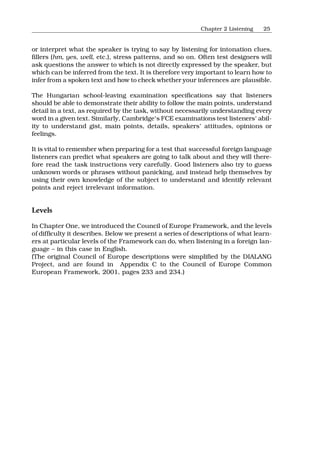
Levels
In Chapter One, we introduced the Council of Europe Framework, and the levels
of difficulty it describes. Below we present a series of descriptions of what learn-
ers at particular levels of the Framework can do, when listening in a foreign lan-
guage – in this case in English.
(The original Council of Europe descriptions were simplified by the DIALANG
Project, and are found in Appendix C to the Council of Europe Common
European Framework, 2001, pages 233 and 234.)
25Chapter 2 Listening
CEF
What the learner can do
Level
• I can understand everyday expressions dealing with simple and
concrete everyday needs, in clear, slow and repeated speech.
A1
• I can follow speech which is very slow and carefully articulated,
with long pauses for me to get the meaning.
• I can understand questions and instructions and follow short,
simple directions.
• I can understand numbers, prices and times.
• I can understand enough to manage simple, routine exchanges
without too much effort.
• I can generally identify the topic of discussion around me which is
conducted slowly and clearly.
• I can generally understand clear, standard speech on familiar mat-
ters, although in a real life situation I might have to ask for repetition
or reformulation.
• I can understand enough to be able to meet concrete needs in
everyday life provided speech is clear and slow.
A2
• I can understand phrases and expressions related to immediate
needs.
• I can handle simple business in shops, post offices or banks.
• I can understand simple directions relating to how to get from X
to Y, by foot or public transport.
• I can understand the essential information from short recorded
passages dealing with predictable everyday matters which are
spoken slowly and clearly.
• I can identify the main point of TV news items reporting events, ac-
cidents, etc, where the visual material supports the commentary.
• I can catch the main point in short, clear, simple messages and
announcements.
26 INTO EUROPE Listening
• I can guess the meaning of occasional unknown words from the con-
text and understand sentence meaning if the topic discussed is fa-
miliar.
• Icangenerallyfollow the main points of extended discussion around
me, provided speech is clear and in standard language.
• I can follow clear speech in everyday conversation, though in a real
life situation I will sometimes have to ask for repetition of particular
words and phrases.
• I can understand straightforward factual information about com-
mon everyday or job-related topics, identifying both general mes-
sages and specific details, provided speech is clear and generally fa-
miliar accent is used.
• I can understand the main points of clear standard speech on fa-
miliar matters which occur regularly.B1
• I can follow a lecture or a talk within my own field, provided the sub-
ject matter is familiar and the presentation straightforward and
clearly organised.
• I can understand simple technical information, such as operation
instructions for everyday equipment.
• I can understand the information content of the majority of recorded
orbroadcastaudio material about familiar subjects spoken relatively
slowly and clearly.
• I can follow many films in which visuals and action carry much of
the storyline, and in which the story is straightforward and the lan-
guage clear.
• I can catch the main points in broadcasts on familiar topics and top-
ics of personal interest when the language is relatively slow and
clear.
• I can understand in detail what is said to me in the standard
spoken language. I can do this even when there is some noise in
the background.
• I can understand standard spoken language, live or broadcast, on
both familiar and unfamiliar topics normally encountered in
personal, academic or vocational life.
• Only extreme background noise, unclear structure and/or idiomatic
usage causes some problems.B2
• I can understand the main ideas of complex speech on both concrete
and abstract topics delivered in a standard language including
technical discussions in my field of specialisation.
• I can follow extended speech and complex lines of argument pro-
vided the topic is reasonably familiar, and the direction of the talk
is clearly stated by the speaker.
• I can follow the essentials of lectures, talks and reports and other
forms of presentation which use complex ideas and language.
27Chapter 2 Listening
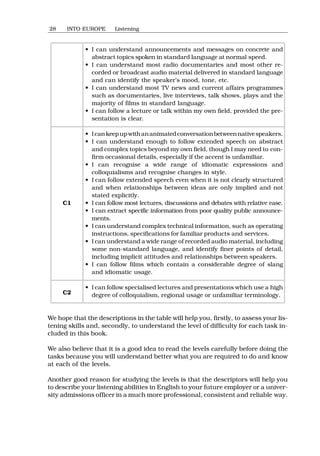
• I can understand announcements and messages on concrete and
abstract topics spoken in standard language at normal speed.
• I can understand most radio documentaries and most other re-
corded or broadcast audio material delivered in standard language
and can identify the speaker’s mood, tone, etc.
• I can understand most TV news and current affairs programmes
such as documentaries, live interviews, talk shows, plays and the
majority of films in standard language.
• I can follow a lecture or talk within my own field, provided the pre-
sentation is clear.
• Icankeepupwithananimatedconversationbetweennativespeakers.
• I can understand enough to follow extended speech on abstract
and complex topics beyond my own field, though I may need to con-
firm occasional details, especially if the accent is unfamiliar.
• I can recognise a wide range of idiomatic expressions and
colloquialisms and recognise changes in style.
• I can follow extended speech even when it is not clearly structured
and when relationships between ideas are only implied and not
stated explicitly.
C1 • I can follow most lectures, discussions and debates with relative ease.
• I can extract specific information from poor quality public announce-
ments.
• I can understand complex technical information, such as operating
instructions, specifications for familiar products and services.
• I can understand a wide range of recorded audio material, including
some non-standard language, and identify finer points of detail,
including implicit attitudes and relationships between speakers.
• I can follow films which contain a considerable degree of slang
and idiomatic usage.
C2
• I can follow specialised lectures and presentations which use a high
degree of colloquialism, regional usage or unfamiliar terminology.
We hope that the descriptions in the table will help you, firstly, to assess your lis-
tening skills and, secondly, to understand the level of difficulty for each task in-
cluded in this book.
We also believe that it is a good idea to read the levels carefully before doing the
tasks because you will understand better what you are required to do and know
at each of the levels.
Another good reason for studying the levels is that the descriptors will help you
to describe your listening abilities in English to your future employer or a univer-
sity admissions officer in a much more professional, consistent and reliable way.
28 INTO EUROPE Listening
Summary
We have seen that listeners listen for a variety of purposes, they listen to a range
of different texts, they may understand different sorts of information from these
texts, and they may need different skills in order to understand what is being
said. We have also seen that modern European exams use a variety of testing
techniques to test a learner’s ability to understand spoken texts.
It is crucial that you prepare for the listening test by practising different testing
techniques, so that on the day of the exam you do not have to worry where to
write your answers, how many words you are allowed to use in your answer,
and so on. The next chapters are arranged according to test methods and they
aim to familiarise you with a selection of testing techniques, and a variety of
texts, accents, and difficulty levels.
29Chapter 2 Listening
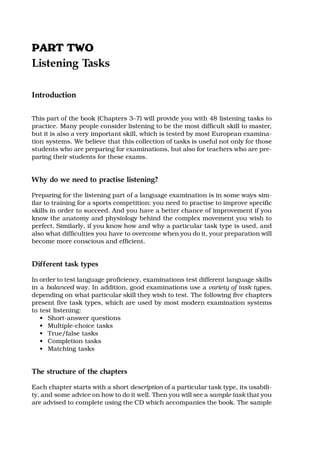
PPAARRTT TTWWOO
Listening Tasks
Introduction
This part of the book (Chapters 3–7) will provide you with 48 listening tasks to
practice. Many people consider listening to be the most difficult skill to master,
but it is also a very important skill, which is tested by most European examina-
tion systems. We believe that this collection of tasks is useful not only for those
students who are preparing for examinations, but also for teachers who are pre-
paring their students for these exams.
Why do we need to practise listening?
Preparing for the listening part of a language examination is in some ways sim-
ilar to training for a sports competition: you need to practise to improve specific
skills in order to succeed. And you have a better chance of improvement if you
know the anatomy and physiology behind the complex movement you wish to
perfect. Similarly, if you know how and why a particular task type is used, and
also what difficulties you have to overcome when you do it, your preparation will
become more conscious and efficient.
Different task types
In order to test language proficiency, examinations test different language skills
in a balanced way. In addition, good examinations use a variety of task types,
depending on what particular skill they wish to test. The following five chapters
present five task types, which are used by most modern examination systems
to test listening:
• Short-answer questions
• Multiple-choice tasks
• True/false tasks
• Completion tasks
• Matching tasks
The structure of the chapters
Each chapter starts with a short description of a particular task type, its usabili-
ty, and some advice on how to do it well. Then you will see a sample task that you
are advised to complete using the CD which accompanies the book. The sample
task section also includes the answer key with the correct answers, and com-
ments on the items that make up the task. The rest of the chapter provides mo-
re tasks of the same type arranged in order of increasing difficulty.
Council of Europe Levels
As part of the piloting and analysis of these listening tasks,14 experts in language
testing and language education more generally assessed the level of the tasks in
terms of the Council of Europe Framework. The judgements given by these ex-
perts were then compared with the actual difficulty that the tasks had shown
when they were tried out on learners in school. As a result each task has been
given a provisional level (A1, A2, etc.) on the Council of Europe Framework and
this level is marked on the task, and on the Contents pages in Appendix 2.
How to use the CDs
The tasks on the CDs are numbered in the order they appear in the book. You
can see the contents of the two CDs that accompany the book in Appendix 2.
The table provides information relating to the tasks: title, CEF level, task type,
page number, length, and the total score available, i.e. the number of items in
the task.
Each task begins with instructions (the rubric), which you can also read in the
book. On the CD NO silence is given after the instructions to allow you to study
the task and so you should pause the CD at this point for 30 seconds if you wish
to do the task as if you were in an examination. In a real exam, the text would be
played twice with a 30-second pause in between. In this practice material,
however, we wanted to make optimum use of the 160 minutes available on the
two CDs. Therefore the texts are only recorded once. You are asked to listen to
the text twice, so you need to go back to the beginning of the task after the first
listening. However, you do not need to listen to the instructions again. You can
either skip them, or use the time – about 30 seconds for the instruction – to begin
to complete the questions before the second listening. You will find the Answer
Keys to the tasks in Part Three of this book.
32 INTO EUROPE Listening
Chapter 3
Short–answer questions
This test method is called short-answer questions, or a short-answer test, or
sometimes, open-ended questions. In this type of task, you have to think up the
answer for yourself and the answer should be short, usually only a few words.
In all of the tasks in this chapter, you are expected to write a maximum of four
words on the line provided.
Short-answer questions may test different listening skills, from listening for the
main point(s) of the text to listening for specific details. For example, the ques-
tion “Where do the cheaper citruses come from?” in Task 6 [Albanian Farming] as-
sesses your ability to listen for a specific detail. However, in the same task, the
question “How do the farmer’s children work in Greece?” tests whether you are
able to extract the appropriate information from a longer passage, so you will
need to listen for a while to come to the right answer.
As you will notice, there are often several ways of saying the same thing and
therefore several answers are allowed. However, it is very important to pay
attention to the number of words that is allowed in your answer. This number is
always given in the instructions. Do not write more than necessary and check
whether your response makes sense. You will be awarded a point if you answer in
a straightforward manner using specific and exact information. For example, in
Task 6 [Albanian Farming], the example question “Who does the Albanian farm-
er live with?” does not require long, elaborate answers: there are only three words
written on the line: “He lives alone”. If the candidate had written “Alone”, this
one-word answer would still have been a perfectly acceptable solution.
Howtoapproachshort-answerquestions? As in all other test methods, you should
read the instructions very thoroughly and get prepared for the topic you are go-
ing to hear. Next, it is very important that you make good use of the 30-second
preparation time and read the questions carefully. You may even want to under-
line the key words in each question. For example, in the question “What could be
a future solution for the Albanian economy?” you could underline solution, econo-
my. This will help you to listen for the words or expressions that you need.
Finally, it is helpful to use grammatical clues within the questions as hints for
the correct answer. These can be question words such as When….?, Where…..?,
How often…..?, or tenses, which are also useful clues. For example, the question
in Task 4 [Celebrating The New Year] “In Sydney, where do people watch fire-
works on New Year’s Eve?” has a question word, which tells you to look for a
certain place. The use of the present simple tense denotes a general activity, not a
specific event and you should be ready to listen for habitual or routine events
that take place around the New Year in Sydney.
You do not have to worry about spelling mistakes too much because in listening
tests the examiners are interested in whether you have understood the texts and
not whether you can spell or use grammar correctly. However, if the examiner
cannot read your handwriting or if the spelling mistake changes the meaning of
the word completely, your answer will be marked as wrong.
And as with all test tasks, guess if you really cannot answer the question. A guess
based on common sense could get you more points than if you leave an answer
blank.
Now you should start practising short-answer questions tasks, doing the Sample
Task on the next page first.
34 INTO EUROPE Listening
SSaammppllee TTaasskk –– TTaasskk 11 –– LLeevveell BB22
YYoouu aarree ggooiinngg ttoo hheeaarr aa tteexxtt aabboouutt aa CChhiinneessee mmuusseeuumm.. FFiirrsstt yyoouu wwiillll hhaavvee 3300 sseeccoonnddss
ttoo ssttuuddyy tthhee qquueessttiioonnss bbeellooww.. TThheenn yyoouu wwiillll hheeaarr tthhee tteexxtt ttwwiiccee.. WWhhiillee lliisstteenniinngg,,
aannsswweerr tthhee qquueessttiioonnss ((11--88)) iinn aa mmaaxxiimmuumm ooff FFOOUURR wwoorrddss.. TThheerree iiss oonnee eexxaammppllee ((00))
aatt tthhee bbeeggiinnnniinngg.. AAfftteerr tthhee sseeccoonndd lliisstteenniinngg,, yyoouu wwiillll hhaavvee 3300 sseeccoonnddss ttoo ffiinnaalliissee yyoouurr
aannsswweerrss.. SSttaarrtt ssttuuddyyiinngg tthhee qquueessttiioonnss nnooww..
THE NATIONAL PALACE MUSEUM
Two hundred thousand.0 How many items can be seen in the museum?
1 When did bronze vessels first appear?
2 Who were the vessels offered to?
3 Where were many of the vessels found?
4 When did the origins of the collection begin?
5 Where was the collection stored?
6 How much time did the last emperor have to prepare for leaving the palace?
7 Why was the collection moved in 1931?
8 How much of the collection can be seen at one time?
SSccoorree:: 88 ppooiinnttss
35Chapter 3 Short-answer questions
Answer Key:
0 two hundred thousand
1 3,000 years ago / three thousand years ago
2 (spirits of) dead ancestors
3 in tombs / in the soil / in the earth / under the ground
4 (over) 1,000 years ago
5 (in the) Forbidden City / Peking
6 two hours
7 (because of) war / war broke out / to protect it
8 1/3 /one third / 200,000
Item 1: Looking at the question word “when”, the most likely structures we should
be prepared to listen for are “in …...”, or “…... ago”. However, what we hear is
“dating back”. This should not cause any problem because the structure is fol-
lowed by the number we need. Note that the number alone is not acceptable; al-
though unlikely, a possible answer could also be 3000BC.
Item 2: Our attention quickens when we hear “… vessels …were used to make
offerings to”, which is highly likely to be followed by the answer we need.
Item 3: There is no literal word-by-word answer to this question, but there are
certainly a few clues to help you – even if you miss the words “emerged from”.
These clues are “tombs”, “rain washed away topsoil” and “earth”. What you need
to do is produce an answer which indicates that their original location was some-
where below the ground. In the Key you can see the acceptable alternatives se-
parated by a slash (/).
Item 4: You need to listen for a time phrase, so when you hear “collection” and
“began”, you are ready to catch it. The answer is acceptable with or without
“over”.
Item 5: The answer should probably start with an “in ….” since the question is
about location. And you are almost there when you hear the alternative word
“housed” for the word “stored” written in the question. Peking or Beijing – or any
of its possible spelling formats – is the answer that the task writer expects.
Item 6: The answer to this question is hidden in a passage which contains some
less frequently used words as well as a lot of additional information, which we can
ignore. Although the key word (“evacuation”, a substitute for “leaving”) is rather
difficult, the intonation of the speaker will make it easy to spot the answer.
Item 7: An interesting twist here: if you listen carefully, you will notice that the
answer – the reason for the evacuation – is mentioned earlier than the year and
the very fact of moving the collection. Test writers know that this reverse order
36 INTO EUROPE Listening
should normally be avoided because it may easily confuse the test taker. In this
case, however, all the necessary pieces – the answer and the clues – are packed
into one sentence, and therefore the item is not too challenging.
Item 8: Quite a straightforward question; all you need to do is choose from be-
tween the two possible numbers that you hear. “How much of” requires a
fraction, which makes it easier for you to spot the correct answer. In addition to
this, the answer in Item 0 will support your choice and the number 200,000 is
also acceptable.
NNooww ccoonnttiinnuuee wwiitthh mmoorree sshhoorrtt--aannsswweerr qquueessttiioonnss
iinn tthhee rreesstt ooff tthhiiss cchhaapptteerr..
37Chapter 3 Short-answer questions
TTaasskk 22 –– LLeevveell AA22
YYoouu aarree ggooiinngg ttoo hheeaarr aa tteexxtt aabboouutt tthhee iissllaanndd ooff CCoorrffuu.. FFiirrsstt yyoouu wwiillll hhaavvee 3300 sseeccoonnddss
ttoo ssttuuddyy tthhee qquueessttiioonnss bbeellooww.. TThheenn yyoouu wwiillll hheeaarr tthhee tteexxtt ttwwiiccee.. WWhhiillee lliisstteenniinngg,,
aannsswweerr tthhee qquueessttiioonnss ((11--77)) iinn aa mmaaxxiimmuumm ooff FFOOUURR wwoorrddss.. TThheerree iiss oonnee eexxaammppllee ((00))
aatt tthhee bbeeggiinnnniinngg.. AAfftteerr tthhee sseeccoonndd lliisstteenniinngg,, yyoouu wwiillll hhaavvee 3300 sseeccoonnddss ttoo ffiinnaalliissee yyoouurr
aannsswweerrss.. SSttaarrtt ssttuuddyyiinngg tthhee ttaasskk nnooww..
CORFU
0 How long is Corfu’s coastline?
125 miles
1 What are the beaches like in Corfu?
2 Who shaped Corfu’s history besides the French and the Venetians?
3 What is the temperature in winter?
4 Which age group does the resort of Rhoda attract?
5 How many people can stay in a Theodor apartment unit?
6 What belongs to each apartment?
7 What does the poolside bar offer besides drinks?
SSccoorree:: 77 ppooiinnttss
38 INTO EUROPE Listening
TTaasskk 33 –– LLeevveell BB11
YYoouu aarree ggooiinngg ttoo hheeaarr EEiilleeeenn ttaallkkiinngg aabboouutt hheerr ppaassttiimmee aaccttiivviittiieess.. FFiirrsstt yyoouu wwiillll hhaavvee
3300 sseeccoonnddss ttoo ssttuuddyy tthhee qquueessttiioonnss bbeellooww.. TThheenn yyoouu wwiillll hheeaarr tthhee tteexxtt ttwwiiccee.. WWhhiillee
lliisstteenniinngg,, aannsswweerr tthhee qquueessttiioonnss ((11--88)) iinn aa mmaaxxiimmuumm ooff FFOOUURR wwoorrddss.. TThheerree iiss oonnee
eexxaammppllee ((00)) aatt tthhee bbeeggiinnnniinngg.. AAfftteerr tthhee sseeccoonndd lliisstteenniinngg,, yyoouu wwiillll hhaavvee 3300 sseeccoonnddss ttoo
ffiinnaalliissee yyoouurr aannsswweerrss.. SSttaarrtt ssttuuddyyiinngg tthhee qquueessttiioonnss nnooww..
GAME BOY AND MUSIC
While travelling.0 When does she use a Game Boy a lot?
1 Where does she often spend 8-12 hours?
2 What skill do the games develop?
3 What nationality was her mother?
4 What handicraft did her mother do besides crocheting?
5 How much time did it take for her mother to get better?
6 Who did her mother beat at Game Boy?
7 What does she do when listening to rock’n’roll music?
8 What does she drink when listening to baroque music?
SSccoorree:: 88 ppooiinnttss
39Chapter 3 Short-answer questions
TTaasskk 44 –– LLeevveell BB11
YYoouu aarree ggooiinngg ttoo hheeaarr aa tteexxtt aabboouutt hhooww ppeeooppllee cceelleebbrraattee NNeeww YYeeaarr.. FFiirrsstt yyoouu wwiillll
hhaavvee 3300 sseeccoonnddss ttoo ssttuuddyy tthhee qquueessttiioonnss bbeellooww.. TThheenn yyoouu wwiillll hheeaarr tthhee tteexxtt ttwwiiccee..
WWhhiillee lliisstteenniinngg,, aannsswweerr tthhee qquueessttiioonnss ((11--66)) iinn aa mmaaxxiimmuumm ooff FFOOUURR wwoorrddss.. TThheerree iiss
oonnee eexxaammppllee ((00)) aatt tthhee bbeeggiinnnniinngg.. AAfftteerr tthhee sseeccoonndd lliisstteenniinngg,, yyoouu wwiillll hhaavvee 3300
sseeccoonnddss ttoo ffiinnaalliissee yyoouurr aannsswweerrss.. SSttaarrtt ssttuuddyyiinngg tthhee qquueessttiioonnss nnooww..
CELEBRATING THE NEW YEAR
Her friends.0 Who usually visits Jane at New Year?
1 What do people in Trafalgar Square usually do at midnight?
2 What do people drink when Big Ben strikes twelve?
3 What New Year resolution did the speaker make?
4 What is the Big Apple, which falls down at midnight?
5 What does Father Christmas in Australia sometimes do?
6 In Sydney, where do people watch fireworks on New Year’s Eve?
SSccoorree:: 66 ppooiinnttss
40 INTO EUROPE Listening
TTaasskk 55 –– LLeevveell BB22
YYoouu aarree ggooiinngg ttoo hheeaarr aann iinntteerrvviieeww aabboouutt ffaarrmmiinngg.. FFiirrsstt yyoouu wwiillll hhaavvee 3300 sseeccoonnddss ttoo
ssttuuddyy tthhee qquueessttiioonnss bbeellooww.. TThheenn yyoouu wwiillll hheeaarr tthhee tteexxtt ttwwiiccee.. WWhhiillee lliisstteenniinngg,, aannsswweerr
tthhee qquueessttiioonnss ((11--77)) iinn aa mmaaxxiimmuumm ooff FFOOUURR wwoorrddss.. TThheerree iiss oonnee eexxaammppllee ((00)) aatt tthhee
bbeeggiinnnniinngg.. AAfftteerr tthhee sseeccoonndd lliisstteenniinngg,, yyoouu wwiillll hhaavvee 3300 sseeccoonnddss ttoo ffiinnaalliissee yyoouurr
aannsswweerrss.. SSttaarrtt ssttuuddyyiinngg tthhee qquueessttiioonnss nnooww..
A TOWNIE TURNED TO FARMING
0 Where do the majority of people interested in buying farms come from?
1 What was David’s job in London?
2 What did Mrs. Scott think about moving to the country?
3 What kind of farming did David decide to do?
4 How many acres of land have they planted with trees?
5 How is living in Kent different from living in London?
6 What did the Scotts decide to do because of economic reasons?
7 Why is David going to London today?
SSccoorree:: 77 ppooiinnttss
41Chapter 3 Short-answer questions
Big cities
TTaasskk 66 –– LLeevveell BB22
YYoouu aarree ggooiinngg ttoo hheeaarr aann iinntteerrvviieeww wwiitthh aann AAllbbaanniiaann ffaarrmmeerr.. FFiirrsstt yyoouu wwiillll hhaavvee 3300
sseeccoonnddss ttoo ssttuuddyy tthhee qquueessttiioonnss bbeellooww.. TThheenn yyoouu wwiillll hheeaarr tthhee tteexxtt ttwwiiccee.. WWhhiillee
lliisstteenniinngg,, ccoommpplleettee yyoouurr aannsswweerrss ((11--77)) iinn aa mmaaxxiimmuumm ooff FFOOUURR wwoorrddss.. TThheerree iiss oonnee
eexxaammppllee ((00)) aatt tthhee bbeeggiinnnniinngg.. AAfftteerr tthhee sseeccoonndd lliisstteenniinngg,, yyoouu wwiillll hhaavvee 3300 sseeccoonnddss ttoo
ffiinnaalliissee yyoouurr aannsswweerrss.. SSttaarrtt ssttuuddyyiinngg tthhee qquueessttiioonnss nnooww..
ALBANIAN FARMING
0 Who does the Albanian farmer live with?
He lives alone.
1 Where do the cheaper citruses come from?
2 How do the farmer’s children work in Greece?
3 How much money is spent subsidising EU agriculture?
4 What do the Albanian farmers use for cultivating larger pieces of land?
5 What is the water melon farmer afraid of?
6 What is the purpose of the financial support from the EU?
7 What could be a future solution for the Albanian economy?
SSccoorree:: 77 ppooiinnttss
42 INTO EUROPE Listening
TTaasskk 77 –– LLeevveell BB22
YYoouu aarree ggooiinngg ttoo hheeaarr aa tteexxtt aabboouutt SSccoottttiisshh kkiillttss.. FFiirrsstt yyoouu wwiillll hhaavvee 3300 sseeccoonnddss ttoo
ssttuuddyy tthhee qquueessttiioonnss bbeellooww.. TThheenn yyoouu wwiillll hheeaarr tthhee tteexxtt ttwwiiccee.. WWhhiillee lliisstteenniinngg,, aannsswweerr
tthhee qquueessttiioonnss ((11--88)) iinn aa mmaaxxiimmuumm ooff FFOOUURR wwoorrddss.. TThheerree iiss oonnee eexxaammppllee ((00)) aatt tthhee
bbeeggiinnnniinngg.. AAfftteerr tthhee sseeccoonndd lliisstteenniinngg,, yyoouu wwiillll hhaavvee 3300 sseeccoonnddss ttoo ffiinnaalliissee yyoouurr
aannsswweerrss.. SSttaarrtt ssttuuddyyiinngg tthhee qquueessttiioonnss nnooww..
SCOTTISH KILTS
0 When was the kilt worn a long time ago?
Day and night.
1 When was there a change?
2 What does Jerry wear under the kilt?
3 Since when has the Alex Scott Company been in the kilt business?
4 When did people start to wear kilts again?
5 How many dollars does a kilt cost?
6 What is Damien McLeod’s job?
7 Why are kilts more popular today than they were in the past?
8 What distinguishes Scottish football supporters abroad?
SSccoorree:: 88 ppooiinnttss
43Chapter 3 Short-answer questions
TTaasskk 88 –– LLeevveell BB22
YYoouu aarree ggooiinngg ttoo hheeaarr aa rraaddiioo iinntteerrvviieeww wwiitthh aa wwoommaann wwhhoo iiss ttaallkkiinngg aabboouutt hheerr lliiffee..
FFiirrsstt yyoouu wwiillll hhaavvee 3300 sseeccoonnddss ttoo ssttuuddyy tthhee qquueessttiioonnss bbeellooww.. TThheenn yyoouu wwiillll hheeaarr tthhee
tteexxtt ttwwiiccee.. WWhhiillee lliisstteenniinngg,, aannsswweerr tthhee qquueessttiioonnss ((11--99)) iinn aa mmaaxxiimmuumm ooff FFOOUURR
wwoorrddss.. TThheerree iiss oonnee eexxaammppllee ((00)) aatt tthhee bbeeggiinnnniinngg.. AAfftteerr tthhee sseeccoonndd lliisstteenniinngg,, yyoouu wwiillll
hhaavvee 3300 sseeccoonnddss ttoo ffiinnaalliissee yyoouurr aannsswweerrss.. SSttaarrtt ssttuuddyyiinngg tthhee
qquueessttiioonnss nnooww..
CCAASSEEYY
16 months.0 How old is Casey’s youngest child?
1 What kind of lessons is Casey’s husband taking?
2 When did Casey and her husband decide to start their own business?
3 How many children does Casey have?
4 How was the business going?
5 Who runs the business?
6 How old is the oldest child?
7 Who looks after the children?
8 When does Casey sometimes get home?
9 Who picks the children up from school?
SSccoorree:: 99 ppooiinnttss
44 INTO EUROPE Listening
TTaasskk 99 –– LLeevveell CC11
YYoouu aarree ggooiinngg ttoo hheeaarr aa tteexxtt aabboouutt tthhee eeffffeecctt ooff tthhee cclliimmaattiicc eevveenntt EEll NNiiññoo oonn sseeaallss aanndd
sseeaa lliioonnss.. FFiirrsstt yyoouu wwiillll hhaavvee 3300 sseeccoonnddss ttoo ssttuuddyy tthhee qquueessttiioonnss bbeellooww.. TThheenn yyoouu wwiillll
hheeaarr tthhee tteexxtt ttwwiiccee.. WWhhiillee lliisstteenniinngg,, aannsswweerr tthhee qquueessttiioonnss ((11--55)) iinn aa mmaaxxiimmuumm ooff
FFOOUURR wwoorrddss.. TThheerree iiss oonnee eexxaammppllee ((00)) aatt tthhee bbeeggiinnnniinngg.. AAfftteerr tthhee sseeccoonndd lliisstteenniinngg,,
yyoouu wwiillll hhaavvee 3300 sseeccoonnddss ttoo ffiinnaalliissee yyoouurr aannsswweerrss.. SSttaarrtt ssttuuddyyiinngg tthhee qquueessttiioonnss nnooww..
EL NIÑO
0 What is the reason why seals and sea lions are less playful this year?
El Niño.
1 Where do fish go because of warmer seawaters?
2 What is the rescuers’ attitude to large groups of seals?
3 How many seals and sea lions may die this year because of El Niño?
4 How have seal population figures changed in the past 20 years?
5 How can environmentalists help if they decide to step in when El Niño strikes?
SSccoorree:: 55 ppooiinnttss
45Chapter 3 Short-answer questions
TTaasskk 1100 –– LLeevveell CC11
YYoouu aarree ggooiinngg ttoo hheeaarr aann iinntteerrvviieeww wwiitthh aa mmaann aabboouutt hhiiss eexxppeeddiittiioonnss.. FFiirrsstt yyoouu wwiillll hhaavvee
3300 sseeccoonnddss ttoo ssttuuddyy tthhee qquueessttiioonnss bbeellooww.. TThheenn yyoouu wwiillll hheeaarr tthhee tteexxtt ttwwiiccee.. WWhhiillee
lliisstteenniinngg,, aannsswweerr tthhee qquueessttiioonnss ((11--66)) iinn aa mmaaxxiimmuumm ooff FFOOUURR wwoorrddss.. TThheerree iiss oonnee
eexxaammppllee ((00)) aatt tthhee bbeeggiinnnniinngg.. AAfftteerr tthhee sseeccoonndd lliisstteenniinngg,, yyoouu wwiillll hhaavvee 3300 sseeccoonnddss ttoo
ffiinnaalliissee yyoouurr aannsswweerrss.. SSttaarrtt ssttuuddyyiinngg tthhee qquueessttiioonnss nnooww..
CLIMBING
0 What has Mark Anstess been doing lately?
1 What did Mark focus on in his expeditions?
2 How has the mountain changed since the 1950s?
3 Since when has Mark been involved in expeditions?
4 Why could he only climb Mount Ararat by night?
5 What could have happened if Mark had climbed Ararat during the day?
6 Why do many maps lack more precise information?
SSccoorree:: 66 ppooiinnttss
46 INTO EUROPE Listening
Exploring
TTaasskk 1111 –– LLeevveell CC11
YYoouu aarree ggooiinngg ttoo hheeaarr aa tteexxtt aabboouutt aa ggooaatt wwhhiicchh iiss aatt tthhee AAnniimmaall HHeeaalltthh CCeennttrree
bbeeccaauussee ooff aann iinnjjuurryy.. FFiirrsstt yyoouu wwiillll hhaavvee 3300 sseeccoonnddss ttoo ssttuuddyy tthhee qquueessttiioonnss bbeellooww..
TThheenn yyoouu wwiillll hheeaarr tthhee tteexxtt ttwwiiccee.. WWhhiillee lliisstteenniinngg,, aannsswweerr tthhee qquueessttiioonnss ((11--77)) iinn aa
mmaaxxiimmuumm ooff FFOOUURR wwoorrddss.. TThheerree iiss oonnee eexxaammppllee ((00)) aatt tthhee bbeeggiinnnniinngg.. AAfftteerr tthhee
sseeccoonndd lliisstteenniinngg,, yyoouu wwiillll hhaavvee 3300 sseeccoonnddss ttoo ffiinnaalliissee yyoouurr aannsswweerrss.. SSttaarrtt ssttuuddyyiinngg tthhee
qquueessttiioonnss nnooww..
RAINBOW THE BILLY GOAT
Very well.0 How is the goat doing?
1 Why had somebody put tar on the wound?
2 Where was the tarred wound?
3 How do vets feel about Rainbow’s recovery?
4 What was Rainbow once like?
5 Why was Locksley the bullock at the centre?
6 How many goats has the lady taken so far?
7 What is her reason for keeping goats?
SSccoorree:: 77 ppooiinnttss
47Chapter 3 Short-answer questions
Chapter 4
Multiple-choice tasks
This testing technique presents you with three or more different options from
which you must choose the correct answer. The options are marked by the letters
A, B, C, and D and only one of them is correct. Options that are not right but
possibly acceptable are called “distractors” as they try to take your attention
away from the correct answer. It is important that you always mark ONE choice
only. If you mark two choices your answer will be marked as incorrect.
When doing multiple-choice tasks you should listen to and read the instructions
carefully to find out about the topic, the speakers and the situation. It is easier
to answer the questions if you are tuned in to the listening text, because you be-
gin to think about the words, expressions, and phrases related to the topic.
After you have read and listened to the instructions, you have 30 seconds to read
the questions or the sentences with blanks. The best way to approach this type of
task is to read the questions/sentences but not the options provided (A, B, C, D) yet.
It always helps if you try to imagine the possible answer first. After this, you may go
on to read the options to check which of them is closest to the meaning you opted
for. If there are none, you have to consider all options as possible answers. However,
remember that guessing may not always be helpful and that intuition may lead to
a wrong answer. Distractors can also trick you into picking the wrong option.
In multiple-choice tests, you may be tested on listening for specific information
or listening for the main point. Let us have a look at the following two examples.
Task 12 [Shuttle launch] in this chapter has an item that tests your
understanding of a specific detail. You have to listen to part of the recording
carefully to find out the specific place of the woman’s work:
Earlier Eileen Collins had worked with Russian astronauts in _________
A … a space station.
B … a spaceship.
C … Russia and the US.
In another item, however, you have to listen to a longer passage to extract the
main idea and thus give the right answer:
She thinks emotions are _________ when flying in space.
A … motivating
B … exhausting
C … uncontrollable
Both examples show that all three options may seem to be possible options: they
all logically relate to the content of the listening text and they also fit in the blank
grammatically. Moreover, you can actually hear the words in the recording. What
you have to listen for is what context these words are used in.
Each listening text will be played twice. It is, therefore, important that you should
decide on one of the options during the first listening, and use the second listen-
ing to finalise your decisions. This is when you can ignore the tricky distractors
and become confident about your choice. In case you cannot decide on the an-
swer, you should still try to guess and not leave the question unanswered. It is
always worth guessing as you may have understood more than you actually
think.
Multiple-choice items are often thought to be difficult to do because they offer op-
tions that you may not have even thought about before. They demand a thorough
understanding of the wordings of each of the options and are for this reason
considered to be quite difficult.
Now start practising multiple-choice tasks, doing the Sample Task on the next page
first.
50 INTO EUROPE Listening
SSaammppllee TTaasskk –– TTaasskk 1122 –– LLeevveell CC11
YYoouu aarree ggooiinngg ttoo hheeaarr aann iinntteerrvviieeww wwiitthh ssppaacceewwoommaann EEiilleeeenn CCoolllliinnss.. FFiirrsstt yyoouu wwiillll
hhaavvee 3300 sseeccoonnddss ttoo ssttuuddyy tthhee ttaasskk bbeellooww.. TThheenn yyoouu wwiillll hheeaarr tthhee tteexxtt ttwwiiccee.. WWhhiillee
lliisstteenniinngg,, ddeecciiddee wwhhiicchh ooppttiioonn ((AA,, BB oorr CC)) bbeesstt ccoommpplleetteess eeaacchh sseenntteennccee ((11--77)).. MMaarrkk
yyoouurr aannsswweerrss iinn tthhee ssppaaccee pprroovviiddeedd.. TThheerree iiss oonnee eexxaammppllee ((00)) aatt tthhee bbeeggiinnnniinngg.. AAfftteerr
tthhee sseeccoonndd lliisstteenniinngg,, yyoouu wwiillll hhaavvee 3300 sseeccoonnddss ttoo ffiinnaalliissee yyoouurr aannsswweerrss.. SSttaarrtt ssttuuddyyiinngg
tthhee ttaasskk nnooww..
SHUTTLE LAUNCH
A0 Earlier she had worked with Russian astronauts in
A … a space station.
B … spaceship.
C … Russia and the US.
1 Working with the Russians meant
A … small language problems.
B … competition in space science.
C … experience and fun.
2 The Columbia mission was
A … successful after two delays.
B … the big event of her life.
C … the biggest technical achievement.
3 She thinks emotions are when flying in space.
A … motivating
B … exhausting
C … uncontrollable
4 The crew worked very well because of the
A … excellent training.
B … well-organized daily routine.
C … trust in the success of the mission.
5 She says the launch is the most exciting because
A … her emotions are more dynamic.
B … several problems may emerge.
C … it’s almost a miracle she can be there.
52 INTO EUROPE Listening
6 During the lift-off
A … your eyes are burning.
B … you can see the flames.
C … you find the suit heavy.
7 During the lift-off
A … she is overwhelmed by the environment.
B … she focuses on technical things.
C … she doesn’t have to control the system.
SSccoorree:: 77 ppooiinnttss
53Chapter 4 Multiple-choice tasks
Answer Key:
0 1 2 3 4 5 6 7
A C A B C B C B
Item 1: The astronaut mentions ”we got to be friends”, and “learned how they did
space operations and how they did science in space”. Then she adds, “it was great
to learn how to speak some of their language” and “experience their culture”. These
fragments contain words that you find both in A and B, but “tremendous, wonder-
ful experience” should convince those who have doubts that the overall meaning
has a good match in C.
Item 2: Flying in space is obviously a big event (B) and a wonderful technical
achievement (C), but this part of the interview is more about how one can recov-
er from the frustration caused by the fact that “it was delayed twice”. You may
ask how we know the mission was successful as stated in A. The fact that a space
flight, obviously a very complex project, is eventually completed is certainly a good
indicator of success.
Item 3: Before hearing the text, we may think that any of the three options can
be acceptable. But then the astronaut says she tries to “take emotions out of ev-
erything that I do” because they “can be very draining”. This and the short
explanation that follows should help you to arrive at B.
Item 4: Here again, all the three options seem to be acceptable. Still, you need to
find the one that is emphasised by the mission commander. And what she says
is “we really believed in what we were doing”. So your best choice is C.
Item 5: We can hear the spacewoman explaining how “dynamic” (compare with A)
it is. But what she means is not emotions but the period of time when “there are
many things that could malfunction”. She also mentions the word “miracle”, but
not in the context that is offered in C. What you need to filter out from this part
is the complexity of the take-off when “many things have to work right”. And this
is what will take you to B.
Item 6: In this part Eileen explains what astronauts can see, hear and feel during
lift-off. Be careful, “the light is flashing in the windows” doesn’t mean you actu-
ally see the flames (B). We hear “burning” (written in A), but this has nothing to
do with her eyes: “it sounds like you’re in a room that’s … burning”. Finally, we
hear “you feel the … weight of … your suit on your chest”, which is a direct clue to
the correct answer.
54 INTO EUROPE Listening
Item 7: Eileen is talking about how the crew can avoid being influenced by the
extremes of the lift-off: “the way we get through that without letting … the environ-
ment just overwhelm you”, so you can exclude A. Then we hear about things that
need checking, but this part is preceded by a more general introduction: “you
focus on your job, you focus on your checklist”, which finds a good match in B.
And if you notice the difference between “checking” and “controlling” as they are
used in this context, you won’t be misled by option C.
NNooww ccoonnttiinnuuee wwiitthh mmoorree mmuullttiippllee--cchhooiiccee ttaasskkss iinn
tthhee rreesstt ooff tthhiiss cchhaapptteerr..
55Chapter 4 Multiple-choice tasks
TTaasskk 1133 –– LLeevveell AA22
YYoouu aarree ggooiinngg ttoo hheeaarr aa ppaassssaaggee ffrroomm aa ssttoorryy.. IItt’’ss aabboouutt aa mmaann ccaalllleedd IIcchhaabboodd CCrraannee..
FFiirrsstt yyoouu wwiillll hhaavvee 3300 sseeccoonnddss ttoo ssttuuddyy tthhee qquueessttiioonnss aanndd ppiiccttuurreess bbeellooww.. TThheenn yyoouu
wwiillll hheeaarr tthhee tteexxtt ttwwiiccee.. WWhhiillee lliisstteenniinngg,, aannsswweerr tthhee qquueessttiioonnss ((11--55)) bbyy cciirrcclliinngg tthhee
lleetttteerr ooff tthhee rriigghhtt ppiiccttuurree ((AA,, BB,, CC oorr DD)).. TThheerree iiss oonnee eexxaammppllee ((00)) aatt tthhee bbeeggiinnnniinngg..
AAfftteerr tthhee sseeccoonndd lliisstteenniinngg,, yyoouu wwiillll hhaavvee 3300 sseeccoonnddss ttoo ffiinnaalliissee yyoouurr aannsswweerrss.. SSttaarrtt
ssttuuddyyiinngg tthhee ttaasskk nnooww..
SLEEPY HOLLOW
0 Ichabod Crane lived in Terry Town. What kind of place was it?
B C D
1 Where did Ichabod work?
A B C D
2 Ichabod looked like an animal. Which one?
A B C D
56 INTO EUROPE Listening
A
3 Which head is similar to Ichabod’s head?
A B C D
4 What was Ichabod teaching on Sundays?
A B C D
5 Ichabod liked Miss Van Tassel. Which flower or fruit is she compared to?
A B C D
SSccoorree:: 55 ppooiinnttss
57Chapter 4 Multiple-choice tasks
TTaasskk 1144 –– LLeevveell AA22
YYoouu aarree ggooiinngg ttoo hheeaarr aa tteexxtt aabboouutt aann aaccttrreessss.. FFiirrsstt yyoouu wwiillll hhaavvee 3300 sseeccoonnddss ttoo ssttuuddyy
tthhee sseenntteenncceess bbeellooww.. TThheenn yyoouu wwiillll hheeaarr tthhee tteexxtt ttwwiiccee.. WWhhiillee lliisstteenniinngg,, ccoommpplleettee tthhee
sseenntteenncceess ((11--66)) bbyy wwrriittiinngg tthhee lleetttteerr ooff tthhee bbeesstt ooppttiioonn ((AA,, BB,, CC oorr DD)) iinn tthhee ssppaacceess..
TThheerree iiss oonnee eexxaammppllee ((00)) aatt tthhee bbeeggiinnnniinngg.. AAfftteerr tthhee sseeccoonndd lliisstteenniinngg,, yyoouu wwiillll hhaavvee
3300 sseeccoonnddss ttoo ffiinnaalliissee yyoouurr aannsswweerrss.. SSttaarrtt ssttuuddyyiinngg tthhee ttaasskk nnooww..
NICOLE KIDMAN
B0 Nicole Kidman was born in .
A) Australia B) Hawaii C) Canada D) Argentina
1 She was chosen Actress of the Year at the age of .
A) 6 B) 16 C) 17 D) 18
2 She made her first American film in .
A) 1989 B) 1988 C) 1998 D) 1990
3 Nicole Kidman and Tom Cruise got married at in 1990.
A) New Year B) Easter C) Thanksgiving D) Christmas
4 In the film To Die For Nicole played a .
A) housewife B) TV reporter C) journalist D) hairdresser
5 Nicole’s first theatre performance was in .
A) Melbourne B) New York C) Paris D) London
6 Nicole and Tom had adopted children.
A) two B) three C) ten D) four
SSccoorree:: 66 ppooiinnttss
58 INTO EUROPE Listening
TTaasskk 1155 –– LLeevveell BB22
YYoouu aarree ggooiinngg ttoo hheeaarr aann iinntteerrvviieeww wwiitthh aa mmuussiiccaall aarrttiisstt.. FFiirrsstt yyoouu wwiillll hhaavvee 3300
sseeccoonnddss ttoo ssttuuddyy tthhee sseenntteenncceess bbeellooww.. TThheenn yyoouu wwiillll hheeaarr tthhee tteexxtt ttwwiiccee.. WWhhiillee
lliisstteenniinngg,, ddeecciiddee wwhhiicchh aannsswweerr ((AA,, BB,, CC oorr DD)) bbeesstt ccoommpplleetteess eeaacchh sseenntteennccee ((11--66))..
MMaarrkk yyoouurr aannsswweerrss iinn tthhee ssppaaccee pprroovviiddeedd.. TThheerree iiss oonnee eexxaammppllee ((00)) aatt tthhee bbeeggiinnnniinngg..
AAfftteerr tthhee sseeccoonndd lliisstteenniinngg,, yyoouu wwiillll hhaavvee 3300 sseeccoonnddss ttoo ffiinnaalliissee yyoouurr aannsswweerrss.. SSttaarrtt
ssttuuddyyiinngg tthhee sseenntteenncceess nnooww..
THE JAZZ SINGER
D0 Annie got interested in popular western music .
A) 29 years ago B) half a century ago C) recently D) 25 years ago
1 Annie recorded her first album .
A) in Russia B) before marriage C) not long ago D)as a child
2 When a child, her family mostly listened to .
A) modern music B) classical music C) folk music D)the Beatles
3 Western music was not much listened to in Russia because it was .
A) too expensive B) forbidden C) not popular D)hard to get
4 Beatle-mania made her .
A) marry an Englishman B) dislike Russian music C) learn English D)feel sad
5 Annie works as .
A) an interpreter B) a composer C) a teacher D)an actor
6 Annie got interested in jazz when she was .
A) still in Russia B) already in the UK C) still single D)still a child
SSccoorree:: 66 ppooiinnttss
59Chapter 4 Multiple-choice tasks
TTaasskk 1166 –– LLeevveell BB22
YYoouu aarree ggooiinngg ttoo hheeaarr aann iinntteerrvviieeww wwiitthh aa mmaann wwhhoo wwaass bblliinndd ffoorr 4433 yyeeaarrss,, bbuutt wwhhoo
ccaann sseeee aaggaaiinn aafftteerr aann ooppeerraattiioonn.. FFiirrsstt yyoouu wwiillll hhaavvee 3300 sseeccoonnddss ttoo ssttuuddyy tthhee
sseenntteenncceess bbeellooww.. TThheenn yyoouu wwiillll hheeaarr tthhee tteexxtt ttwwiiccee.. WWhhiillee lliisstteenniinngg,, ddeecciiddee wwhhiicchh
ooppttiioonn ((AA,, BB oorr CC)) bbeesstt ccoommpplleetteess eeaacchh sseenntteennccee ((11--66)).. MMaarrkk yyoouurr aannsswweerrss iinn tthhee
ssppaaccee pprroovviiddeedd.. TThheerree iiss oonnee eexxaammppllee ((00)) aatt tthhee bbeeggiinnnniinngg.. AAfftteerr tthhee sseeccoonndd lliisstteenniinngg,,
yyoouu wwiillll hhaavvee 3300 sseeccoonnddss ttoo ffiinnaalliissee yyoouurr aannsswweerrss.. SSttaarrtt ssttuuddyyiinngg tthhee ttaasskk nnooww..
VISION REGAINED
C0 He was pushed to have the operation by .
A) his wife B) everybody except his wife C) nobody
1 His children enjoy showing him .
A) their drawings B) their toys C) animals and plants
2 He sees an object .
A) like anybody else B) detail by detail C) asoneglobal image
3 He touches the objects he sees .
A) to reinforce the image B) to enjoy the image more C) unintentionally
4 He thinks that fear .
A) is stronger in the blind B) stimulates him C) still hinders him
5 A car dashing by is more fearful if .
A) he can see it B) he’s walking on his own C) he can only hear it
6 Michael sometimes switches off his vision .
A) by focusing on sounds B) by covering his eyes C) by losing attention
SSccoorree:: 66 ppooiinnttss
60 INTO EUROPE Listening
TTaasskk 1177 –– LLeevveell CC11
YYoouu aarree ggooiinngg ttoo hheeaarr aa tteexxtt aabboouutt mmooddeerrnn hhoommeess.. FFiirrsstt yyoouu wwiillll hhaavvee 3300 sseeccoonnddss ttoo
ssttuuddyy tthhee qquueessttiioonnss ((00--55)) bbeellooww.. TThheenn yyoouu wwiillll hheeaarr tthhee tteexxtt ttwwiiccee.. WWhhiillee lliisstteenniinngg,,
ddeecciiddee wwhhiicchh aannsswweerr ((AA,, BB,, CC oorr DD)) bbeesstt ffiittss aaccccoorrddiinngg ttoo wwhhaatt yyoouu hheeaarr.. MMaarrkk yyoouurr
aannsswweerrss iinn tthhee ssppaaccee pprroovviiddeedd.. TThheerree iiss oonnee eexxaammppllee ((00)) aatt tthhee bbeeggiinnnniinngg.. AAfftteerr tthhee
sseeccoonndd lliisstteenniinngg,, yyoouu wwiillll hhaavvee 3300 sseeccoonnddss ttoo ffiinnaalliissee yyoouurr aannsswweerrss.. SSttaarrtt ssttuuddyyiinngg tthhee
qquueessttiioonnss nnooww..
HOME OF THE FUTURE
D0 How much do houses cost in this subdivision?
A 10,000 to 20,000 dollars.
B 200 dollars.
C 100,000 dollars.
D 100,000 to 200,000 dollars.
1 What is used for heating and cooling?
A Ground radiation.
B Geothermal energy.
C Sinking pipes.
D Gas circulation.
2 What compensates for the high installation costs?
A Low maintenance costs.
B Reliability.
C Low utility bills.
D Comfort.
3 What was the Monsanto Corporation’s philosophy?
A Disneyland is the future.
B California means convenience.
C Life is full of opportunities.
DD Future life should be comfortable.
4 What happened to Monsanto’s ideas?
A A few of them were accepted.
B Their vision came true.
C They turned into diner designs.
D They never caught on.
5 What does the home of the future look like?
A Like a modern laboratory.
B Like an ordinary home.
C Like a floating diner.
D Like the next door.
61Chapter 4 Multiple-choice tasks
SSccoorree:: 55 ppooiinnttss
Chapter 5
True/False tasks
This testing method is called true/false, or yes/no tasks because each test item
can either be true or false according to the text that you hear. While listening, you
have to decide whether the statements are true or false. You should write a letter
T next to a true statement or a letter F next to a false statement in the space pro-
vided. The example sentence at the beginning helps you to become tuned in and
see where and how to write your answers.
True/False items may test different listening skills, from listening for the main
points of the text to listening for specific information. For example, the statement
“They are going to a Cuban concert tonight” in Task 18 [Peter’s day] tests your abil-
ity to listen for a specific piece of information. You have to listen carefully to catch
a particular part of the text, in this case, that they are going to see a Cuban film,
and not a Cuban concert.
However, in Task 23 [Jumble at the sale], “He wants to keep it forever” is a
statement that you are only able to judge if you understand the general message
of a longer piece of text.
Before you start listening to the text, it is essential to read the statements
carefully and thoroughly. With a little practice, you can develop the skill to guess
which part of the statement is the one that may NOT be true. Quite often this is
a name or a number:
“She gives the interview at the Johnson Space Center in Houston.” [Task 21]
“Eileen’s daughter is 13 years old.” [Task 21]
Next, it is important to check the statement for qualifying words, such as
adjectives and adverbs which may entirely change the overall meaning of the
statement. Qualifying words are often keys to choosing the correct answer:
“She says that the majority of the population is very highly educated.” [Task 20]
“The European fishing industry receives little government aid.” [Task 22]
The above expressions printed in bold are usually very important for the compre-
hension of the test item. It is, therefore, vital to remember that if just one element
in a statement is incorrect, the whole statement is false. In other words, every
element in the statement must be true for the whole statement to be true.
You will not normally find negative statements in True/False tasks. This is
because test writers know very well that there would be a difficult logical
problem if you had to mark a negative statement wrong. To prevent confusion,
they try to avoid using negative statements as much as possible.
A final piece of advice: guess if you do not know the answer. You have a 50%
chance of getting the answer correct on true-false questions.
Now start practising true/false tasks, doing the Sample Task on the next page
first.
64 INTO EUROPE Listening
SSaammppllee TTaasskk –– TTaasskk 1188 –– LLeevveell BB11
YYoouu aarree ggooiinngg ttoo hheeaarr aa mmaann ttaallkkiinngg aabboouutt hhiimmsseellff aanndd tthhee ppeeooppllee hhee iiss ggooiinngg ttoo mmeeeett
ttooddaayy.. FFiirrsstt yyoouu wwiillll hhaavvee 3300 sseeccoonnddss ttoo ssttuuddyy tthhee ssttaatteemmeennttss bbeellooww.. TThheenn yyoouu wwiillll
hheeaarr tthhee tteexxtt ttwwiiccee.. WWhhiillee lliisstteenniinngg,, mmaarrkk tthhee ssttaatteemmeennttss ((11--77)) ttrruuee ((TT)) oorr ffaallssee ((FF))
iinn tthhee ssppaaccee pprroovviiddeedd.. TThheerree iiss oonnee eexxaammppllee ((00)) aatt tthhee bbeeggiinnnniinngg.. AAfftteerr tthhee sseeccoonndd
lliisstteenniinngg,, yyoouu wwiillll hhaavvee 3300 sseeccoonnddss ttoo ffiinnaalliissee yyoouurr aannsswweerrss.. SSttaarrtt ssttuuddyyiinngg tthhee
ssttaatteemmeennttss nnooww..
PETER’S DAY
0 Peter last saw Jane yesterday. F
1 He is still friends with his former girlfriend.
2 Daniela is his daughter.
3 They are going to a Cuban concert tonight.
4 Peter likes Jane’s cooking.
5 Jane gives him a lot of freedom.
6 Peter likes going out more than Jane.
7 He would like to move to a new home.
SSccoorree:: 77 ppooiinnttss
65Chapter 5 True/False tasks
Answer Key:
0. F 4. T
1. T 5. F
2. F 6. F
3. F 7. T
Item 1: Peter says about Angela that “we’re just friends and there’s no ...sort of
romance or anything”. This, and the fact that they are meeting today should be
enough for a confident choice of T.
Item 2: Angela’s daughter is Daniela, and we hear Peter saying “I regard (her) as
my step daughter”. We also learn that there is probably a strong bond between
them although Peter is not Daniela’s biological father.
Item 3: Although people tend to associate “Cuba” and “club” with the word “mu-
sic” and “concert”, you hear “we’re going to go and see Buena Vista Social Club
which is a Cuban film or film about Cuban music”. So they are not going to a
concert.
Item 4: This should be an easy item for you hearing all the nice words about
Jane, the “latest girlfriend”. Among them “she cooks wonderfully” is a really ho-
nest expression of appreciation.
Item 5: Did you hear the “but”? Peter remains polite, but he cannot hide what
he would like to be different. “Sometimes I need to escape from her”. “I really do
like having my own place” is another clear expression of Peter wanting some
more freedom from Jane.
Item 6: Still tactfully, Peter continues saying “she’s trying to encourage me to ...
spend more time going to the cinema and everything …”. “She seems to lead a
life of leisure, and ...I’m sure she’d like me to sort of do the same” is clearly an
indicator that Peter has a different attitude.
Item 7: Although not using the words of the table, in the last part Peter makes
it clear what he would really like to do: “save some money up to get a bigger
place to…live in”.
NNooww ccoonnttiinnuuee wwiitthh mmoorree ttrruuee//ffaallssee ttaasskkss iinn tthhee
rreesstt ooff tthhiiss cchhaapptteerr..
66 INTO EUROPE Listening
TTaasskk 1199 –– LLeevveell BB11
YYoouu aarree ggooiinngg ttoo hheeaarr aann iinntteerrvviieeww wwiitthh tthhee mmaaiinn aaccttoorr iinn tthhee mmoovviiee HHaarrrryy PPootttteerr..
FFiirrsstt yyoouu wwiillll hhaavvee 3300 sseeccoonnddss ttoo ssttuuddyy tthhee ssttaatteemmeennttss bbeellooww.. TThheenn yyoouu wwiillll hheeaarr tthhee
tteexxtt ttwwiiccee.. WWhhiillee lliisstteenniinngg,, mmaarrkk tthhee ssttaatteemmeennttss ((11--55)) ttrruuee ((TT)) oorr ffaallssee ((FF)) iinn tthhee
ssppaaccee pprroovviiddeedd.. TThheerree iiss oonnee eexxaammppllee ((00)) aatt tthhee bbeeggiinnnniinngg.. AAfftteerr tthhee sseeccoonndd lliisstteenniinngg,,
yyoouu wwiillll hhaavvee 3300 sseeccoonnddss ttoo ffiinnaalliissee yyoouurr aannsswweerrss.. SSttaarrtt ssttuuddyyiinngg tthhee ssttaatteemmeennttss nnooww..
HARRY POTTER AT HOME
0 Playing Harry Potter has changed Daniel’s life a lot. F
1 Daniel still plays Harry Potter computer games.
2 His private teacher has stopped helping him with his studies.
3 Daniel will take a school examination soon.
4 In the film it was hard to fight against invisible creatures.
5 Daniel believes children can learn a lot from Harry.
SSccoorree:: 55 ppooiinnttss
67Chapter 5 True/False tasks
TTaasskk 2200 –– LLeevveell BB11
YYoouu aarree ggooiinngg ttoo hheeaarr aann AAmmeerriiccaann wwoommaann ttaallkkiinngg aabboouutt hheerr hhoommeellaanndd aanndd tthhee ppeeooppllee
lliivviinngg tthheerree.. FFiirrsstt yyoouu wwiillll hhaavvee 3300 sseeccoonnddss ttoo ssttuuddyy tthhee ssttaatteemmeennttss bbeellooww.. TThheenn yyoouu wwiillll
hheeaarr tthhee tteexxtt ttwwiiccee.. WWhhiillee lliisstteenniinngg,, mmaarrkk tthhee ssttaatteemmeennttss ((11--99)) ttrruuee ((TT)) oorr ffaallssee ((FF)) iinn
tthhee ssppaaccee pprroovviiddeedd.. TThheerree iiss oonnee eexxaammppllee ((00)) aatt tthhee bbeeggiinnnniinngg.. AAfftteerr tthhee sseeccoonndd lliisstteenn--
iinngg,, yyoouu wwiillll hhaavvee 3300 sseeccoonnddss ttoo ffiinnaalliissee yyoouurr aannsswweerrss.. SSttaarrtt ssttuuddyyiinngg tthhee ssttaatteemmeennttss
nnooww..
MIDWEST PEOPLE
0 The woman is from Ohio, which is part of the region called the Midwest. T
1 She explains the geographical location of the Midwest.
2 She believes that the people living there are very honest.
3 She says that the majority of the population is very highly educated.
4 It is usual for a person in this region to lead a rural way of life.
5 Most people here find cities attractive.
6 The woman says Midwesterners do not easily make friends.
7 The people in this region usually welcome changes.
8 Their favourite pastime is to work in their homes and around the house.
9 In summer local people like to see exhibitions of agricultural produce.
SSccoorree:: 99 ppooiinnttss
68 INTO EUROPE Listening
TTaasskk 2211 –– LLeevveell BB22
YYoouu aarree ggooiinngg ttoo hheeaarr aann iinntteerrvviieeww wwiitthh EEiilleeeenn CCoolllliinnss,, aa ffeemmaallee aassttrroonnaauutt.. FFiirrsstt yyoouu
wwiillll hhaavvee 3300 sseeccoonnddss ttoo ssttuuddyy tthhee sseenntteenncceess bbeellooww.. TThheenn yyoouu wwiillll hheeaarr tthhee tteexxtt ttwwiiccee..
WWhhiillee lliisstteenniinngg,, mmaarrkk tthhee sseenntteenncceess ((11--77)) ttrruuee ((TT)) oorr ffaallssee ((FF)) iinn tthhee ssppaaccee pprroovviiddeedd..
TThheerree iiss oonnee eexxaammppllee ((00)) aatt tthhee bbeeggiinnnniinngg.. AAfftteerr tthhee sseeccoonndd lliisstteenniinngg,, yyoouu wwiillll hhaavvee
3300 sseeccoonnddss ttoo ffiinnaalliissee yyoouurr aannsswweerrss.. SSttaarrtt ssttuuddyyiinngg tthhee sseenntteenncceess nnooww..
A FEMALE ASTRONAUT
0 Eileen Collins is the first woman space shuttle engineer. F
1 She gives the interview at the Johnson Space Center in Houston.
2 As a high school student Eileen hoped she could become a pilot.
3 Eileen’s parents wanted her to fly.
4 At college she saved up for flying lessons.
5 The most exciting moment was looking back at the Earth.
6 For her age, Eileen’s daughter knows a lot about her job.
7 Eileen’s daughter is 13 years old.
SSccoorree:: 77 ppooiinnttss
69Chapter 5 True/False tasks
70 INTO EUROPE Listening
TTaasskk 2222 –– LLeevveell BB22
YYoouu aarree ggooiinngg ttoo hheeaarr aabboouutt aa ssppeecciiaall oobbjjeecctt.. FFiirrsstt yyoouu wwiillll hhaavvee 3300 sseeccoonnddss ttoo ssttuuddyy
tthhee ssttaatteemmeennttss bbeellooww.. TThheenn yyoouu wwiillll hheeaarr tthhee tteexxtt ttwwiiccee.. WWhhiillee lliisstteenniinngg,, mmaarrkk tthhee
ssttaatteemmeennttss ((11--77)) ttrruuee ((TT)) oorr ffaallssee ((FF)) iinn tthhee ssppaaccee pprroovviiddeedd.. TThheerree iiss oonnee eexxaammppllee ((00))
aatt tthhee bbeeggiinnnniinngg.. AAfftteerr tthhee sseeccoonndd lliisstteenniinngg,, yyoouu wwiillll hhaavvee 3300 sseeccoonnddss ttoo ffiinnaalliissee yyoouurr
aannsswweerrss.. SSttaarrtt ssttuuddyyiinngg tthhee ssttaatteemmeennttss nnooww..
JUMBLE AT THE SALE
0 Anthony found a Japanese tobacco box. T
1 He found the box in a pub.
2 People around him were very excited.
3 He fell on the floor because a woman hit him with her bag.
4 Then the woman and a table fell upon him.
5 The box was originally made for the Dutch king.
6 Anthony knows how the box got to England.
7 He wants to keep it forever.
SSccoorree:: 77 ppooiinnttss
TTaasskk 2233 –– LLeevveell CC11
YYoouu aarree ggooiinngg ttoo hheeaarr aa tteexxtt aabboouutt ffiisshhiinngg.. FFiirrsstt yyoouu wwiillll hhaavvee 3300 sseeccoonnddss ttoo ssttuuddyy
tthhee ssttaatteemmeennttss bbeellooww.. TThheenn yyoouu wwiillll hheeaarr tthhee tteexxtt ttwwiiccee.. WWhhiillee lliisstteenniinngg,, mmaarrkk tthhee
ssttaatteemmeennttss ((11--99)) ttrruuee ((TT)) oorr ffaallssee ((FF)) iinn tthhee ssppaaccee pprroovviiddeedd.. TThheerree iiss oonnee eexxaammppllee ((00))
aatt tthhee bbeeggiinnnniinngg.. AAfftteerr tthhee sseeccoonndd lliisstteenniinngg,, yyoouu wwiillll hhaavvee 3300 sseeccoonnddss ttoo ffiinnaalliissee yyoouurr
aannsswweerrss.. SSttaarrtt ssttuuddyyiinngg tthhee ssttaatteemmeennttss nnooww..
EMPTY SEAS
0 Overfishing is a regional problem. F
1 The European fishing industry receives little government aid.
2 Overfishing threatens 60% of the world’s fish species.
3 In the Baltic Sea they only allow a fifth of earlier herring catches.
4 Britain has drastically limited fishing quotas for cod.
5 In Canada they disregarded the signs of overfishing.
6 3,000 Canadian fishermen have become unemployed.
7 They stopped building fish farms because of the pollution they cause.
8 Europeans are looking for new fishing areas near West Africa.
9 The Common Fisheries Policy will try to solve the conflict of interests.
SSccoorree:: 99 ppooiinnttss
71Chapter 5 True/False tasks
TTaasskk 2244 –– LLeevveell CC11
YYoouu aarree ggooiinngg ttoo hheeaarr aa tteexxtt aabboouutt aa nneeww ttyyppee ooff wwaatteerr sskkii.. FFiirrsstt yyoouu wwiillll hhaavvee 3300
sseeccoonnddss ttoo ssttuuddyy tthhee ssttaatteemmeennttss bbeellooww.. TThheenn yyoouu wwiillll hheeaarr tthhee tteexxtt ttwwiiccee.. WWhhiillee
lliisstteenniinngg,, mmaarrkk tthhee ssttaatteemmeennttss ((11--66)) ttrruuee ((TT)) oorr ffaallssee ((FF)) iinn tthhee ssppaaccee pprroovviiddeedd.. TThheerree
iiss oonnee eexxaammppllee ((00)) aatt tthhee bbeeggiinnnniinngg.. AAfftteerr tthhee sseeccoonndd lliisstteenniinngg,, yyoouu wwiillll hhaavvee 3300
sseeccoonnddss ttoo ffiinnaalliissee yyoouurr aannsswweerrss.. SSttaarrtt ssttuuddyyiinngg tthhee ssttaatteemmeennttss nnooww..
AIR CHAIR
0 It took twelve years to develop the air chair. F
1 You need to lean back for the take off.
2 One of the stunts requires diving.
3 Light watercraft can pull the air chair easily.
4 People with physical disabilities can learn to use it.
5 The foil is dangerous when you fall.
6 The air chair can be taken apart.
SSccoorree:: 66 ppooiinnttss
72 INTO EUROPE Listening
Chapter 6
Completion tasks
This test method is called completion or open gap-filling and has either a table,
or a list of sentences, with a certain number of blanks to be completed. Tables
may look a bit confusing at the beginning, especially if you are not used to doing
such sorts of tasks. However, if you practise table completions before the exam,
and if you follow the numbered gaps while listening to the text, you will improve
and will no longer find the task format problematic.
Most of the items in this type of task will test how good you are at listening for
specific information. For example, to complete the table in Task 25 [Courmayeur],
you have to listen for an exact number: “Altitude: from 1124 m to __________m”.
Note that the expressions you hear on the tape do not always literally fit in the
gap, and you may have to modify them. For example, if the question is “How many
times a week did the speaker go to the market?” and what the speaker says is
“…every Monday…” the solution is “Once” and not “Every Monday”, the speak-
er’s exact words.
Sometimes you have to listen to a longer passage to be able to fill in the missing
word/s. For instance, in the item “the age she plans to __________ is 30 or more.”
the missing words are “get married”, but the speaker does not use the exact
sentence structure, she may say something like “… well, I don’t know when I’ll
find the right man, but to live with somebody, one has to be older, 30 or even more.
Marriage is a serious thing.” So what you need to use is a paraphrase of what you
hear in the recording.
When you do a sentence completion task, it is very important that you read the
instructions and the incomplete sentences, trying to predict the missing words
before the text begins. Sometimes the information you need for your answer is
mentioned in two different ways in different parts of the recording, so you get a
second chance to check your answer. For example, if you hear “8 weeks”, you
may later hear the same information as “2 months”.
It is helpful to identify the type of word that you think should fit the gap, for
example, whether it should be a verb, a noun, an adjective, an adverb, or a pre-
position, etc. In the following gap, for example, only a superlative adjective (lar-
gest, smallest, prettiest, etc) or a numeral (first, second, etc) is suitable:
“Arequipa is the __________ city in Peru.”
74 INTO EUROPE Listening
Another piece of advice is that you should complete as many gaps as you can
during the first listening. If you wait until the second listening, you may not re-
member what you thought earlier could be a possible answer. In the pause be-
tween the two recordings, see which blanks are still empty and which have
vague answers. When you hear the recording for the second time, listen for the
information you are either not sure of or you have not understood at all.
In table-completion tasks, write your answers in note form. The instruction al-
ways states the maximum number of words – usually four – that you can write.
If you write more words than allowed you may be penalised even if the answer is
otherwise correct. Do not worry about spelling as long as the examiners
understand what you wanted to write.
In sentence and text completion tasks make sure at the end that the words or
phrases make sense. It is very helpful if you read the whole item to check wheth-
er the text now sounds sensible with the gap completed with your solution.
Finally, do not get confused if some gaps are completed with one word only and
others with three or four words, as long as they make sense and are true accord-
ing to the ideas expressed by the speaker(s) on the recording.
Now start practising completion tasks, doing the Sample Task on the next page
first.
75Chapter 6 Completion tasks
SSaammppllee –– TTaasskk 2255 –– LLeevveell AA22
YYoouu aarree ggooiinngg ttoo hheeaarr aa tteexxtt aabboouutt aa sskkii rreessoorrtt.. FFiirrsstt yyoouu wwiillll hhaavvee 3300 sseeccoonnddss ttoo
ssttuuddyy tthhee ttaabbllee bbeellooww.. TThheenn yyoouu wwiillll hheeaarr tthhee tteexxtt ttwwiiccee.. WWhhiillee lliisstteenniinngg,, ccoommpplleettee
tthhee ssppaacceess ((11--77)) iinn aa mmaaxxiimmuumm ooff FFOOUURR wwoorrddss.. TThheerree iiss oonnee eexxaammppllee ((00)) aatt tthhee bbee--
ggiinnnniinngg.. AAfftteerr tthhee sseeccoonndd lliisstteenniinngg,, yyoouu wwiillll hhaavvee 3300 sseeccoonnddss ttoo ffiinnaalliissee yyoouurr aannsswweerrss..
SSttaarrtt ssttuuddyyiinngg tthhee ttaabbllee nnooww..
COURMAYEUR
NorthwestLOCATION _________________ (0) of Italy
Altitude from 1224m to ___________ m (1)
SKI AREA Total length of ski runs ____________ km (2)
Beginner: nine
Number of runs Intermediate: ____________ (3)
Advanced: one
LOCAL
SPECIALITIES cheese, _________________ (4), and wines
Atmosphere Italian
THE TOWN
Market – how often? _________________ (5)
OF
COURMAYEUR Shopping varied
Sports facilities ice rink and _________________ (6)
ACTIVITIES
IN THE walking, climbing, and _________________ (7)
COUNTRYSIDE
SSccoorree:: 77 ppooiinnttss
Answer Key:
0 northwest
1 3470 m
2 100 km
3 13
4 beef steak
5 weekly / once a week
6 swimming (pool)
7 horse riding
It is good to familiarise yourself with the table before you start listening to the
text. By then you will see that this is not a task where you need to complete
sentences (as you need to do in several other tasks in this chapter). What you
have to do is complete notes, using up to four words. This, of course, does not
mean that you have to write four words; it means that you can if you need to. The
table structures the notes around topics: the location of Courmayeur, the
features of the ski area, the local specialities, the characteristics of the town, and
activities in the countryside. Let the topics guide you through the text.
Item 1: The first incomplete note requires you to listen for an exact number. Even
if you are not familiar with the term altitude – it is not mentioned anyway – the
symbol m for metres will make the missing number easy to spot. The only diffi-
culty may be that the whole text is relatively fast. But do not worry; you can
listen to it twice.
Item 2: You need another number here. ‘…with 100 km of marked piste…’ looks
different from what you read in the table, but the symbol for kilometre (km) will
probably make this another easy item.
Item 3: Looking at the gap, you can see it is again a number that you need to
listen for. This item is embedded in the description of the three types of ski runs,
so you are unlikely to get lost and miss the required information.
Item 4: The text continues with some specialities of the local cuisine. Again, the
notes are half-completed for you, there is a clue before the missing bit, and there
is a clue right after it.
Item 5: The text continues with a description of the town of Courmayeur. You hear
about its bars and pubs, its Italian atmosphere, the accommodation and
shopping facilities as well as its nightlife. This list also includes ‘a bustling weekly
market’, which helps you to spot the missing word.
Item 6: The next point is also relatively easy to score, because ‘…ice rink…’ is
mentioned right before the words you need, turning your mind to the second
sports facility.
76 INTO EUROPE Listening
Item 7: The last item should not pose a problem to an A2 student: all you need
to do is to add the third activity that you hear to the activities that are already
written down for you.
NNooww ccoonnttiinnuuee wwiitthh mmoorree ccoommpplleettiioonn ttaasskkss iinn tthhee
rreesstt ooff tthhiiss cchhaapptteerr..
77Chapter 6 Completion tasks
TTaasskk 2266 –– LLeevveell AA22
YYoouu aarree ggooiinngg ttoo hheeaarr ppaarrtt ooff aa rraaddiioo pprrooggrraammmmee MMoonneeyybbooxx.. FFiirrsstt yyoouu wwiillll hhaavvee 3300
sseeccoonnddss ttoo ssttuuddyy tthhee ttaasskk bbeellooww.. TThheenn yyoouu wwiillll hheeaarr tthhee tteexxtt ttwwiiccee.. WWhhiillee lliisstteenniinngg,,
ccoommpplleettee tthhee nnootteess ((11--66)) bbyy wwrriittiinngg aa mmaaxxiimmuumm ooff FFOOUURR wwoorrddss.. TThheerree iiss oonnee
eexxaammppllee ((00)) aatt tthhee bbeeggiinnnniinngg.. AAfftteerr tthhee sseeccoonndd lliisstteenniinngg,, yyoouu wwiillll hhaavvee 3300 sseeccoonnddss ttoo
ffiinnaalliissee yyoouurr aannsswweerrss.. SSttaarrtt ssttuuddyyiinngg tthhee ttaasskk nnooww..
PENSION CALCULATOR
pensionA new website answers the questions about your _____________________________ (0)
A pension calculator is launched today by the Association of __________________
_____________________________________________________________ (1)
The sample data the woman uses to see how the calculator works are
– age: __________________ (2)
– at the age of 65 she plans to __________________ (3):
£– monthly contribution: __________________ (4)
The calculated pension will be £61 per __________________ (5)
You can link to the calculator through this website: __________________/moneybox (6)
SSccoorree:: 66 ppooiinnttss
78 INTO EUROPE Listening
TTaasskk 2277 –– LLeevveell BB11
YYoouu aarree ggooiinngg ttoo hheeaarr aa tteexxtt aabboouutt tthhee HHootteell SSaaoo JJooaaoo.. FFiirrsstt yyoouu wwiillll hhaavvee 3300 sseecc--
oonnddss ttoo ssttuuddyy tthhee sseenntteenncceess bbeellooww.. TThheenn yyoouu wwiillll hheeaarr tthhee tteexxtt ttwwiiccee.. WWhhiillee lliisstteenniinngg,,
ccoommpplleettee tthhee sseenntteenncceess ((11--77)) iinn aa mmaaxxiimmuumm ooff FFOOUURR wwoorrddss.. TThheerree iiss oonnee eexxaammppllee
((00)) aatt tthhee bbeeggiinnnniinngg.. AAfftteerr tthhee sseeccoonndd lliisstteenniinngg,, yyoouu wwiillll hhaavvee 3300 sseeccoonnddss ttoo ffiinnaalliissee
yyoouurr aannsswweerrss.. SSttaarrtt ssttuuddyyiinngg tthhee sseenntteenncceess nnooww..
HOTEL SAO JOAO
relax0 In the lounge you can _________________ .
1 You can get _________________ from the waiters during the whole day.
2 Besides swimming, in the pool area you can do exercises and _________________ .
3 Maximum _________________ people can sleep in a room.
4 Some rooms overlook _________________ .
5 _________________ can be buffet or served by waiters.
6 The lowest price for seven nights is £ _________________ per person.
7 Insurance is _________________.
SSccoorree:: 77 ppooiinnttss
79Chapter 6 Completion tasks
TTaasskk 2288 –– LLeevveell BB11
YYoouu aarree ggooiinngg ttoo hheeaarr GGeerraalldd ttaallkkiinngg aabboouutt hhiiss ffaammiillyy.. FFiirrsstt yyoouu wwiillll hhaavvee 3300 sseeccoonnddss
ttoo ssttuuddyy tthhee ttaasskk bbeellooww.. TThheenn yyoouu wwiillll hheeaarr tthhee tteexxtt ttwwiiccee.. WWhhiillee lliisstteenniinngg,, ccoommpplleettee
tthhee nnootteess ((11--1111)) bbyy wwrriittiinngg aa mmaaxxiimmuumm ooff TTWWOO wwoorrddss.. TThheerree iiss oonnee eexxaammppllee ((00)) aatt
tthhee bbeeggiinnnniinngg.. TThhee aannsswweerrss aarree nnoott iinn tthhee oorrddeerr ooff tthhee nnuummbbeerrss;; uussee tthhee nnaammeess ttoo
ffoollllooww wwhhoo GGeerraalldd iiss ttaallkkiinngg aabboouutt.. AAfftteerr tthhee sseeccoonndd lliisstteenniinngg,, yyoouu wwiillll hhaavvee 3300 sseecc--
oonnddss ttoo ffiinnaalliissee yyoouurr aannsswweerrss.. SSttaarrtt ssttuuddyyiinngg tthhee ttaasskk nnooww..
GERALD’S FAMILY
Score: 11 points
80 INTO EUROPE Listening
Nationality: Italian
She _______________ 8 years ago. (3)
Works as a yoga teacher in her own
_______________ (4)
Nationality: ___________ (1)
He _______________ before
Christmas. (2)
_______ years older
than Gerald. (5)
Job: graphic-
_______________ (6)
Works free-lance
because it’s ______
_______________ (7)
GERALD’S FATHER
GERALD’S MOTHER
LISA
Lives in
______ (8)
Job:
______ (9)
Nationality:
Australian_______________ (0)
Job: graphic-
______________ (10)
Plans to study:
_________________–
psychology (11)
LISA LISA GERALD
START HERE
TTaasskk 2299 –– LLeevveell BB11
YYoouu aarree ggooiinngg ttoo hheeaarr ppaarrtt ooff aann iinntteerrvviieeww wwiitthh CChhrriiss aabboouutt hhiiss ccyycclliinngg ccaarreeeerr.. FFiirrsstt
yyoouu wwiillll hhaavvee 3300 sseeccoonnddss ttoo ssttuuddyy tthhee ppaarraaggrraapphh bbeellooww.. TThheenn yyoouu wwiillll hheeaarr tthhee tteexxtt
ttwwiiccee.. WWhhiillee lliisstteenniinngg,, ccoommpplleettee tthhee sseenntteenncceess ((11--55)) bbyy wwrriittiinngg aa mmaaxxiimmuumm ooff FFOOUURR
wwoorrddss.. TThheerree iiss oonnee eexxaammppllee ((00)) aatt tthhee bbeeggiinnnniinngg.. AAfftteerr tthhee sseeccoonndd lliisstteenniinngg,, yyoouu wwiillll
hhaavvee 3300 sseeccoonnddss ttoo ffiinnaalliissee yyoouurr aannsswweerrss.. SSttaarrtt ssttuuddyyiinngg tthhee ttaasskk nnooww..
CYCLING
seventeenChris started cycling at the age of ____________________________ (0). Cycling on the
road was hard: he was often ____________________________ (1) and he had to get
up early in the morning. Chris says cycling requires a lot of
____________________________ (2).
The peak of his career was while he was at Manchester University. He won me-
dals at the ____________________________ (3) championships. However, because
of cycling he had to give up his hobby of ____________________________ (4).
Doing cycling defined his entire life, for example when he had to
____________________________ (5), what he could eat, and so on. He found this
too much, and eventually his cycling career stopped.
SSccoorree:: 55 ppooiinnttss
81Chapter 6 Completion tasks
TTaasskk 3300 –– LLeevveell BB11
YYoouu aarree ggooiinngg ttoo hheeaarr aa tteexxtt aabboouutt aann eeaarrtthhqquuaakkee.. FFiirrsstt yyoouu wwiillll hhaavvee 3300 sseeccoonnddss ttoo
ssttuuddyy tthhee sseenntteenncceess bbeellooww.. TThheenn yyoouu wwiillll hheeaarr tthhee tteexxtt ttwwiiccee.. WWhhiillee lliisstteenniinngg,, ccoomm--
pplleettee eeaacchh sseenntteennccee ((11--77)) iinn aa mmaaxxiimmuumm ooff FFOOUURR wwoorrddss.. TThheerree iiss oonnee eexxaammppllee ((00))
aatt tthhee bbeeggiinnnniinngg.. AAfftteerr tthhee sseeccoonndd lliisstteenniinngg,, yyoouu wwiillll hhaavvee 3300 sseeccoonnddss ttoo ffiinnaalliissee yyoouurr
aannsswweerrss.. SSttaarrtt ssttuuddyyiinngg tthhee sseenntteenncceess nnooww..
EARTHQUAKE IN PERU
Thousands of0 ______________________ people are homeless.
1 The earthquake happened ______________________ yesterday.
2 The Geological Survey measured __________________ on the Richter scale.
3 Arequipa is the ______________________ city in Peru.
4 The epicentre of the earthquake was 50 miles ______________________ .
5 The earthquake was also felt in Chile and ______________________ .
6 There is a town where ______________________ per cent of the buildings
have been ruined.
7 The most seriously hit part of Arequipa is ______________________ .
SSccoorree:: 77 ppooiinnttss
82 INTO EUROPE Listening
TTaasskk 3311 –– LLeevveell BB22
YYoouu aarree ggooiinngg ttoo hheeaarr aann iinntteerrvviieeww wwiitthh tthhee wwrriitteerr KKeenn FFoolllleetttt.. FFiirrsstt yyoouu wwiillll hhaavvee
3300 sseeccoonnddss ttoo ssttuuddyy tthhee sseenntteenncceess bbeellooww.. TThheenn yyoouu wwiillll hheeaarr tthhee tteexxtt ttwwiiccee.. WWhhiillee
lliisstteenniinngg,, ccoommpplleettee eeaacchh sseenntteennccee ((11--88)) iinn aa mmaaxxiimmuumm ooff FFOOUURR wwoorrddss.. TThheerree iiss oonnee
eexxaammppllee ((00)) aatt tthhee bbeeggiinnnniinngg.. AAfftteerr tthhee sseeccoonndd lliisstteenniinngg,, yyoouu wwiillll hhaavvee 3300 sseeccoonnddss ttoo
ffiinnaalliissee yyoouurr aannsswweerrss.. SSttaarrtt ssttuuddyyiinngg tthhee sseenntteenncceess nnooww..
KEN FOLLETT
thrillers0 Ken Follett writes _______________________________
1 Ken Follett studied philosophy at
_______________________________________________________________________________
2 Ken Follett is especially popular in
_______________________________________________________________________________
3 When Ken was at college he decided to become a
_______________________________________________________________________________
4 Ken changed his profession because he was never going to be
_______________________________________________________________________________
5 In the beginning, Ken wrote ten books and all of them
_______________________________________________________________________________
6 When writing his books Ken used four different
_______________________________________________________________________________
7 Ken thinks that some things in the Eye of the Needle could be
_______________________________________________________________________________
8 What Ken likes more and more about the Eye of the Needle is its
_______________________________________________________________________________
SSccoorree:: 88 ppooiinnttss
83Chapter 6 Completion tasks
TTaasskk 3322 –– LLeevveell BB22
YYoouu aarree ggooiinngg ttoo hheeaarr aa tteexxtt aabboouutt aa ccaavvee.. FFiirrsstt yyoouu wwiillll hhaavvee 3300 sseeccoonnddss ttoo ssttuuddyy tthhee
sseenntteenncceess bbeellooww.. TThheenn yyoouu wwiillll hheeaarr tthhee tteexxtt ttwwiiccee.. WWhhiillee lliisstteenniinngg,, ccoommpplleettee tthhee
sseenntteenncceess ((11--77)) iinn aa mmaaxxiimmuumm ooff FFOOUURR wwoorrddss.. TThheerree iiss oonnee eexxaammppllee ((00)) aatt tthhee
bbeeggiinnnniinngg.. AAfftteerr tthhee sseeccoonndd lliisstteenniinngg,, yyoouu wwiillll hhaavvee 3300 sseeccoonnddss ttoo ffiinnaalliissee yyoouurr
aannsswweerrss.. SSttaarrtt ssttuuddyyiinngg tthhee sseenntteenncceess nnooww..
CHEDDAR IN THE CAVE
river0 The cave was created by an underground _____________________________________ .
1 The temperature in the cave is _______________________________________________ .
2 The amount they want to store in the cave is _________________________________ .
3 After the ripening time they will check ________________________________________ .
4 In the past the cave was used by _____________________________________________ .
5 They used the cave for storing cheese and ____________________________________ .
6 The cave has been used by man for ___________________________________________ .
7 Cheddar will be ready for consumption by ____________________________________ .
SSccoorree:: 77 ppooiinnttss
84 INTO EUROPE Listening
TTaasskk 3333 –– LLeevveell BB22
YYoouu aarree ggooiinngg ttoo hheeaarr aann iinntteerrvviieeww aabboouutt tthhee NNyyaassaa WWiillddlliiffee RReesseerrvvee iinn AAffrriiccaa.. FFiirrsstt
yyoouu wwiillll hhaavvee 3300 sseeccoonnddss ttoo ssttuuddyy tthhee sseenntteenncceess bbeellooww.. TThheenn yyoouu wwiillll hheeaarr tthhee tteexxtt
ttwwiiccee.. WWhhiillee lliisstteenniinngg,, ccoommpplleettee tthhee sseenntteenncceess ((11--77)) iinn aa mmaaxxiimmuumm ooff FFOOUURR wwoorrddss..
TThheerree iiss oonnee eexxaammppllee ((00)) aatt tthhee bbeeggiinnnniinngg.. AAfftteerr tthhee sseeccoonndd lliisstteenniinngg,, yyoouu wwiillll hhaavvee
3300 sseeccoonnddss ttoo ffiinnaalliissee yyoouurr aannsswweerrss.. SSttaarrtt ssttuuddyyiinngg tthhee sseenntteenncceess nnooww..
NYASA ANIMALS
mountains0 The territory of Nyasa is littered with huge solitary ____________________________ .
1 The only way to reach Nyasa is _______________________________________________ .
2 Along the river it looks like a _________________________________________________ .
3 At first they didn’t see any animals but there were lots of
_________________________________________________ on the river banks.
4 The ____________________________________________ in the chopper was impossible.
5 They saw a couple of really big _______________________________________________ .
6 There’s an interesting zebra race in Nyasa: their whiteness is
_________________________________________________ .
7 There are about ______________________________________ sable antelopes in Nyasa.
SSccoorree:: 77 ppooiinnttss
85Chapter 6 Completion tasks
TTaasskk 3344 –– LLeevveell BB22
YYoouu aarree ggooiinngg ttoo hheeaarr aann iinntteerrvviieeww wwiitthh aa ccoouuppllee wwhhoo tthhiinnkk tthhaatt tthheeiirr hhoouussee iiss hhaauunntt--
eedd bbyy aa gghhoosstt.. FFiirrsstt yyoouu wwiillll hhaavvee 3300 sseeccoonnddss ttoo ssttuuddyy tthhee ppaarraaggrraapphh bbeellooww.. TThheenn yyoouu
wwiillll hheeaarr tthhee tteexxtt ttwwiiccee.. WWhhiillee lliisstteenniinngg,, ccoommpplleettee tthhee ssuummmmaarryy bbyy ffiilllliinngg iinn tthhee ggaappss
((11--99)) iinn aa mmaaxxiimmuumm ooff FFOOUURR wwoorrddss.. TThheerree iiss oonnee eexxaammppllee ((00)) aatt tthhee bbeeggiinnnniinngg..
AAfftteerr tthhee sseeccoonndd lliisstteenniinngg,, yyoouu wwiillll hhaavvee 3300 sseeccoonnddss ttoo ffiinnaalliissee yyoouurr aannsswweerrss.. SSttaarrtt
ssttuuddyyiinngg tthhee ttaasskk nnooww..
HAUNTING MONK
17th centuryDavid and Rosemary bought a ____________________ (0) farmhouse in the
wilds. When Rosemary saw a monk in the garden she thought he was a
____________________ (1). Later the same figure appeared in the corner of
____________________ (2). Rosemary finds watching the wall carvings more
interesting than ____________________ (3). Rosemary has already seen the
monk ____________________ (4) times, but David, who is a scientist, has
never met him. Their first thought was that ____________________ (5) had
invented an invisible ink, which would turn brown from time to time.
David doesn’t want the ghost to ____________________ (6) because he
enjoys the situation. If David or Rosemary found out that the other one
does the carving, David would ____________________ (7) but Rosemary
would ____________________(8).
SSccoorree:: 88 ppooiinnttss
86 INTO EUROPE Listening
TTaasskk 3355 –– LLeevveell BB22
YYoouu aarree ggooiinngg ttoo hheeaarr aann iinntteerrvviieeww wwiitthh aann eexxppeerrtt aabboouutt ddiiffffeerreenntt ccooffffeeee ttyyppeess.. FFiirrsstt
yyoouu wwiillll hhaavvee 3300 sseeccoonnddss ttoo ssttuuddyy tthhee ttaabbllee bbeellooww.. TThheenn yyoouu wwiillll hheeaarr tthhee tteexxtt ttwwiiccee..
WWhhiillee lliisstteenniinngg,, ccoommpplleettee tthhee nnootteess ((11--77)) bbyy wwrriittiinngg aa mmaaxxiimmuumm ooff FFOOUURR wwoorrddss..
TThheerree iiss oonnee eexxaammppllee ((00)) aatt tthhee bbeeggiinnnniinngg.. AAfftteerr tthhee sseeccoonndd lliisstteenniinngg,, yyoouu wwiillll hhaavvee
3300 sseeccoonnddss ttoo ffiinnaalliissee yyoouurr aannsswweerrss.. SSttaarrtt ssttuuddyyiinngg tthhee ttaasskk nnooww..
COFFEE
Special features of
Region History
production
Characteristics
birthplace
– Techniques:
– _____________ (0) of coffee medieval
YEMEN ________________ (3)
– Until the 18th
century: – Machinery:
________________________ (1) ________________ (2)
full body,
The Dutch _____________ (4) Soil: volcanic not earthy,
JAVA
smooth,coffee seeds.
chocolatey,
JAMAICA _________________ (5)
Plantation started:
KENYA
________________________ (6) _________________ (7)
SSccoorree:: 77 ppooiinnttss
87Chapter 6 Completion tasks
TTaasskk 3366 –– LLeevveell BB22
YYoouu aarree ggooiinngg ttoo hheeaarr aann iinntteerrvviieeww aabboouutt tthhee uurrbbaann eennvviirroonnmmeenntt iinn GGrreeaatt BBrriittaaiinn..
FFiirrsstt yyoouu wwiillll hhaavvee 3300 sseeccoonnddss ttoo ssttuuddyy tthhee sseenntteenncceess bbeellooww.. TThheenn yyoouu wwiillll hheeaarr tthhee
tteexxtt ttwwiiccee.. WWhhiillee lliisstteenniinngg,, ccoommpplleettee tthhee sseenntteenncceess ((11--55)) iinn aa mmaaxxiimmuumm ooff FFOOUURR
wwoorrddss.. TThheerree iiss oonnee eexxaammppllee ((00)) aatt tthhee bbeeggiinnnniinngg.. AAfftteerr tthhee sseeccoonndd lliisstteenniinngg,, yyoouu wwiillll
hhaavvee 3300 sseeccoonnddss ttoo ffiinnaalliissee yyoouurr aannsswweerrss.. SSttaarrtt ssttuuddyyiinngg tthhee sseenntteenncceess nnooww..
HEALTHY URBAN LIVING
green space0 In our future urban environment we need ________________________________
1 The interviewer had his first job in the ___________________________________
2 Decades of neglect have made many British parks ________________________
3 The Urban Green Spaces Task Force has been set up by __________________
4 The number of officers English Nature employs is ________________________
5 According to Matthew Frith, urban nature conservation is ________________
SSccoorree:: 55 ppooiinnttss
88 INTO EUROPE Listening
TTaasskk 3377 –– LLeevveell BB22
YYoouu aarree ggooiinngg ttoo hheeaarr aa tteexxtt aabboouutt rroolllleerr--sskkaattiinngg iinn PPaarriiss.. FFiirrsstt yyoouu wwiillll hhaavvee 3300 sseecc--
oonnddss ttoo ssttuuddyy tthhee sseenntteenncceess bbeellooww.. TThheenn yyoouu wwiillll hheeaarr tthhee tteexxtt ttwwiiccee.. WWhhiillee lliisstteenniinngg,,
ffiillll iinn eeaacchh ggaapp ((11--1111)) iinn aa mmaaxxiimmuumm ooff FFOOUURR wwoorrddss.. TThheerree iiss oonnee eexxaammppllee ((00)) aatt
tthhee bbeeggiinnnniinngg.. AAfftteerr tthhee sseeccoonndd lliisstteenniinngg,, yyoouu wwiillll hhaavvee 3300 sseeccoonnddss ttoo ffiinnaalliissee yyoouurr
aannsswweerrss.. SSttaarrtt ssttuuddyyiinngg tthhee sseenntteenncceess nnooww..
PARIS SKATERS
pedestriansProblem: Skaters are counted as ___________________ (0) but many of them use the
roads.
Plan: to change the ______________________________ (1)
Skating became popular after the ______________________________ (2) in 1995.
The number of skaters on Sundays: ______________________________ (3)
Why Paris is excellent for skaters: – ______________________________ (4)
– they get on well with the police
Main reasons for fining skaters: – ______________________________ (5)
– passing through red lights
Maximum speed skaters can reach: ______________________________ (6)
Per cent of misbehaving skaters: ______________________________ (7)
Skaters will be allowed to ride in the streets if they:
– have experience
– ______________________________ (8)
Some complaints against skaters: – jumping ______________________________ (9)
– taking ______________________________ (10) the
wrong way
Planned time for the change: ______________________________ (11)
SSccoorree:: 1111 ppooiinnttss
89Chapter 6 Completion tasks
TTaasskk 3388 –– LLeevveell CC11
YYoouu aarree ggooiinngg ttoo hheeaarr aa rraaddiioo wweeaatthheerr ffoorreeccaasstt.. FFiirrsstt yyoouu wwiillll hhaavvee 3300 sseeccoonnddss ttoo
ssttuuddyy tthhee ttaabbllee bbeellooww.. TThheenn yyoouu wwiillll hheeaarr tthhee tteexxtt ttwwiiccee.. WWhhiillee lliisstteenniinngg,, ccoommpplleettee
tthhee nnootteess ((11--77)) bbyy wwrriittiinngg aa mmaaxxiimmuumm ooff FFOOUURR wwoorrddss.. TThheerree iiss oonnee eexxaammppllee ((00)) aatt
tthhee bbeeggiinnnniinngg.. AAfftteerr tthhee sseeccoonndd lliisstteenniinngg,, yyoouu wwiillll hhaavvee 3300 sseeccoonnddss ttoo ffiinnaalliissee yyoouurr
aannsswweerrss.. SSttaarrtt ssttuuddyyiinngg tthhee sseenntteenncceess nnooww..
WEATHER FORECAST
REGION WEATHER
snowPrecipitation in the morning: ________________________(0)
SCOTLAND Eastern areas may receive some ___________________ (1)
Melting snow may cause ___________________________(2)
NORTHERN IRELAND
Highest temperature in Belfast: ____________________ (3)
Stormy winds expected in _________________________ (4)
It will turn dry and sunny _________________________ (5)
ENGLAND & WALES Speed of strongest wind: ___________________________ (6)
It will feel cold because ____________________________ (7)
SSccoorree:: 77 ppooiinnttss
90 INTO EUROPE Listening
TTaasskk 3399 –– LLeevveell CC11
YYoouu aarree ggooiinngg ttoo hheeaarr aa tteexxtt aabboouutt ttuulliippss.. FFiirrsstt yyoouu wwiillll hhaavvee 3300 sseeccoonnddss ttoo ssttuuddyy tthhee
qquueessttiioonnss bbeellooww.. TThheenn yyoouu wwiillll hheeaarr tthhee tteexxtt ttwwiiccee.. WWhhiillee lliisstteenniinngg,, ccoommpplleettee tthhee
aannsswweerrss ((11--99)) bbyy wwrriittiinngg aa mmaaxxiimmuumm ooff FFOOUURR wwoorrddss.. TThheerree iiss oonnee eexxaammppllee ((00)) aatt
tthhee bbeeggiinnnniinngg.. AAfftteerr tthhee sseeccoonndd lliisstteenniinngg,, yyoouu wwiillll hhaavvee 3300 sseeccoonnddss ttoo ffiinnaalliissee yyoouurr
aannsswweerrss.. SSttaarrtt ssttuuddyyiinngg tthhee qquueessttiioonnss nnooww..
TTUULLIIPPSS
0 What is the tulip’s current status?
celebratedIt is __________________________________________________ worldwide.
1 What does the subtitle of the book say about tulips?
They _________________________________________________________________________.
2 How much did tulip bulbs cost in Holland in the early 17th
century?
The same amount as _________________________________________________________.
3 How expensive was a prized bulb in France?
As expensive as _______________________________________________________________.
4 When did the great tulip business end?
In ____________________________________________________________________________.
5 Who was tulip art for?
For those who ________________________________________________________________.
6 What was the function of the late 17th
, early 18th
century book?
It was a ______________________________________________________________________.
7 What does Anna Pavord think of tulips?
She considers them ___________________________________________________________.
8 What does she think of other flowers?
They are less _____________________________________________________ than tulips.
9 What does the tulip’s history explain?
The tulip’s ____________________________________________________________________.
SSccoorree:: 99 ppooiinnttss
91Chapter 6 Completion tasks
Chapter 7
Matching tasks
Different types of multiple-matching are commonly used in modern language
examinations. This test method involves linking parts of a text, which is what you
hear on the tape, to statements or pictures on the paper. For example, in Task 47
[Listeners’ Views], you are asked to match the speakers’ views to the list of
statements. In Task 40 [English Courses], you have to match the number of the
course with a short description of it.
Matching tasks draw upon your ability to make connections between ideas and
they are used to assess your understanding of associations, relationships, defini-
tions, and so on. They often test your ability to summarise longer listening
passages, or to understand the main point(s). For example, in Task 45 [Eileen’s
objects], where a speaker talks about different objects, you need to listen to the
whole passage in order to make the necessary connection between the item
“champagne” and the statement “Eileen wants a large collection”.
In order to complete the task successfully, you once again have to get ready for the
particular topic and prepare yourself for expressions related to the theme. You will
do this best if you read the task instructions carefully and if you study the individ-
ual statements or pictures very thoroughly.
In most of the matching tasks in this chapter, you will see that there is a list of
numbers (from zero onwards) presented in a column, generally on the left side of
the page. These numbers usually denote the speaker or the listening passage. They
are presented in a logical way, usually in chronological order – in the order you
hear them. A second column, generally on the right side of the page, contains
choices, i.e. letters from A onwards with corresponding statements or illustrations.
Note, however, that there are always more choices than matches: there are extra
choices in the answer column to avoid selection by elimination. The number of ex-
tra choices is given in the instructions to the task. For example, in Task 40 [Eng-
lish Courses], the instructions say, “There is one description that you do not need
to use”, which means that one letter (from A to J) will not be used as an answer.
Remember that each of the choices – statements or pictures – may be used only
once, which means that there is only one possible answer for each test item.
Finally, always remember to read the instructions carefully, because they will tell
you a) what exactly you are required to do, b) the number of extra choices, and c)
information about the topic of the text.
Now start practising matching tasks, doing the Sample Task on the next page first.
SSaammppllee TTaasskk –– TTaasskk 4400 –– LLeevveell BB11
YYoouu aarree ggooiinngg ttoo hheeaarr aa tteexxtt aabboouutt EEnngglliisshh ccoouurrsseess.. FFiirrsstt yyoouu wwiillll hhaavvee 3300 sseeccoonnddss ttoo
ssttuuddyy tthhee ttaabbllee bbeellooww.. TThheenn yyoouu wwiillll hheeaarr tthhee tteexxtt ttwwiiccee.. WWhhiillee lliisstteenniinngg,, mmaattcchh tthhee
ccoouurrssee ddeessccrriippttiioonnss ((AA--GG)) ttoo tthhee ccoouurrsseess ((11--55)).. TThheerree iiss oonnee eexxaammppllee ((00)) aatt tthhee
bbeeggiinnnniinngg.. TThheerree iiss oonnee ddeessccrriippttiioonn tthhaatt yyoouu ddoo nnoott nneeeedd ttoo uussee.. AAfftteerr tthhee sseeccoonndd
lliisstteenniinngg,, yyoouu wwiillll hhaavvee 3300 sseeccoonnddss ttoo ffiinnaalliissee yyoouurr aannsswweerrss.. SSttaarrtt ssttuuddyyiinngg tthhee ttaasskk nnooww..
ENGLISH COURSES
COURSE THIS COURSE ...
E0 _________________
A … has lessons only in the morning.
1 _________________
B … gives you practice in note taking.
C … teaches you to make telephone calls.2 _________________
D … offers lessons all day.
3 _________________ E … improves your conversation skills.
4 _________________
F … helps you to study on your own.
5 _________________
G … focuses on writing and discussion.
SSccoorree:: 55 ppooiinnttss
94 INTO EUROPE Listening
Answer Key:
0 1 2 3 4 5
E F D G A B
As the instruction suggests, it is important – as always – to study the task before
you start listening. You need to tune into the topic and understand what exactly
is required from you. As you read the descriptions or possible course themes,
be aware that in this task type there is usually at least one extra option that you
will not need to use. And it is always useful to mobilise your knowledge about the
topic – in this case it is language learning and courses – and think of synonyms
for the words in the descriptions (e.g. speaking and conversation) so that you are
better prepared for the decision-making.
Item 1: We hear “improve their existing knowledge”, which only indicates that the
course is not for beginners, but later we hear “help learners to become more
independent” and “continue when the course is over”. These are the clues for
matching Course 1 to “helps you study on your own” in E.
Item 2: The text says “intensive”, “morning classes”, and “additional classes each
afternoon”, which should be sufficient for making a good choice: E and what it
offers – “lessons all day”.
Item 3: To begin with, “practice in all the language skills” is not much help to you,
but then you hear “writing skills”, “class journal” and “discussion skills”, which
will guide you to G.
Item 4: “weekday afternoons” and “four evenings per week” could contradict
what is stated in A, but if we listen carefully, it becomes clear that only the “mor-
nings are spent studying”, while the “social and cultural activities” will follow later.
Item 5: Among the several skills we need to improve as a student abroad, “taking
……notes” neatly fits with “practice in note-taking” in B.
NNooww ccoonnttiinnuuee wwiitthh mmoorree mmaattcchhiinngg ttaasskkss iinn tthhee
rreesstt ooff tthhiiss cchhaapptteerr..
95Chapter 7 Matching tasks
TTaasskk 4411 –– LLeevveell AA11
YYoouu aarree ggooiinngg ttoo hheeaarr aa tteexxtt aabboouutt JJaannee’’ss rroooomm.. FFiirrsstt yyoouu wwiillll hhaavvee 3300 sseeccoonnddss ttoo
ssttuuddyy tthhee ppiiccttuurreess bbeellooww.. TThheenn yyoouu wwiillll hheeaarr tthhee tteexxtt ttwwiiccee.. WWhhiillee lliisstteenniinngg,, mmaarrkk tthhee
oobbjjeeccttss ((AA--II)) wwiitthh aa iiff tthheeyy aarree mmeennttiioonneedd iinn tthhee tteexxtt,, aanndd wwiitthh aann X iiff tthheeyy aarree nnoott..
TThheerree iiss oonnee eexxaammppllee aatt tthhee bbeeggiinnnniinngg.. AAfftteerr tthhee sseeccoonndd lliisstteenniinngg,, yyoouu wwiillll hhaavvee 3300
sseeccoonnddss ttoo ffiinnaalliissee yyoouurr aannsswweerrss iinn tthhee ttaabbllee.. SSttaarrtt ssttuuddyyiinngg tthhee ppiiccttuurreess nnooww..
MY ROOM
96 INTO EUROPE Listening
A
B
C
D
E
F
G
H
I
A B C D
SSccoorree:: 88 ppooiinnttss
E F G
H I
TTaasskk 4422 –– LLeevveell AA11
YYoouu aarree ggooiinngg ttoo hheeaarr ssiixx ddiiaalloogguueess ffrroomm ddiiffffeerreenntt ppllaacceess.. FFiirrsstt yyoouu wwiillll hhaavvee 3300 ssee--
ccoonnddss ttoo ssttuuddyy tthhee ttaabbllee bbeellooww.. TThheenn yyoouu wwiillll hheeaarr tthhee tteexxtt ttwwiiccee.. WWhhiillee lliisstteenniinngg,,
cchhoooossee tthhee rriigghhtt ppllaaccee ((AA--HH)) ffoorr eeaacchh ddiiaalloogguuee ((11--55)).. TThheerree iiss oonnee eexxaammppllee ((00)) aatt tthhee
bbeeggiinnnniinngg.. TThheerree aarree ttwwoo ppllaacceess tthhaatt yyoouu ddoo nnoott nneeeedd ttoo uussee.. AAfftteerr tthhee sseeccoonndd lliisstteenniinngg,,
yyoouu wwiillll hhaavvee 3300 sseeccoonnddss ttoo ffiinnaalliissee yyoouurr aannsswweerrss.. SSttaarrtt ssttuuddyyiinngg tthhee ttaasskk nnooww..
DIALOGUES
DIALOGUE PLACE
A at the library
C0 ______________
B at the railway station
1 ______________ C at the shop
2 ______________
D in the garden
3 ______________
E at the doctor’s
4 ______________
F in the classroom5 ______________
G at the police station
H in the street
SSccoorree:: 55 ppooiinnttss
97Chapter 7 Matching tasks
TTaasskk 4433 –– LLeevveell AA22
YYoouu aarree ggooiinngg ttoo hheeaarr aa tteexxtt aabboouutt eemmbbaarrrraassssiinngg ssiittuuaattiioonnss.. FFiirrsstt yyoouu wwiillll hhaavvee 3300
sseeccoonnddss ttoo ssttuuddyy tthhee ppiiccttuurreess bbeellooww.. TThheenn yyoouu wwiillll hheeaarr tthhee tteexxtt ttwwiiccee.. WWhhiillee lliisstteenniinngg,,
cchhoooossee aa ppiiccttuurree ((AA--JJ)) ffoorr eeaacchh ssiittuuaattiioonn ((11--77)) aanndd mmaarrkk yyoouurr aannsswweerr iinn tthhee ssppaaccee
pprroovviiddeedd.. TThheerree iiss oonnee eexxaammppllee ((00)) aatt tthhee bbeeggiinnnniinngg.. TThheerree aarree ttwwoo eexxttrraa ppiiccttuurreess
tthhaatt yyoouu ddoo nnoott nneeeedd ttoo uussee.. AAfftteerr tthhee sseeccoonndd lliisstteenniinngg,, yyoouu wwiillll hhaavvee 3300 sseeccoonnddss ttoo
ffiinnaalliissee yyoouurr aannsswweerrss.. SSttaarrtt ssttuuddyyiinngg tthhee ttaasskk nnooww..
SO EMBARRASSING!
0 1 2 3 4 5 6 7
E
98 INTO EUROPE Listening
A B
C D
99Chapter 7 Matching tasks
E
F
G
H
I J
SSccoorree:: 77 ppooiinnttss
TTaasskk 4444 –– LLeevveell BB11
YYoouu aarree ggooiinngg ttoo hheeaarr ppaarrttss ooff ddiiffffeerreenntt rraaddiioo pprrooggrraammmmeess.. FFiirrsstt yyoouu wwiillll hhaavvee 3300
sseeccoonnddss ttoo ssttuuddyy tthhee ttaasskk bbeellooww.. TThheenn yyoouu wwiillll hheeaarr tthhee tteexxtt ttwwiiccee.. WWhhiillee lliisstteenniinngg,,
cchhoooossee aa ttooppiicc ((AA--HH)) ffoorr eeaacchh pprrooggrraammmmee ((11--55)).. MMaarrkk yyoouurr aannsswweerr iinn tthhee ssppaaccee
pprroovviiddeedd.. TThheerree iiss oonnee eexxaammppllee ((00)) aatt tthhee bbeeggiinnnniinngg.. TThheerree aarree ttwwoo ttooppiiccss tthhaatt yyoouu
ddoo nnoott nneeeedd ttoo uussee.. AAfftteerr tthhee sseeccoonndd lliisstteenniinngg,, yyoouu wwiillll hhaavvee 3300 sseeccoonnddss ttoo ffiinnaalliissee
yyoouurr aannsswweerrss.. SSttaarrtt ssttuuddyyiinngg tthhee ttaabbllee nnooww..
RADIO
PROGRAMME TOPIC
A Sport news
G0 ______________
B Listeners’ choice
1 ______________ C A new programme
2 ______________
D Information technology
3 ______________
E Business World
4 ______________
F Nation’s Health5 ______________
G Weather forecast
H News briefing
SSccoorree:: 55 ppooiinnttss
100 INTO EUROPE Listening
101Chapter 7 Matching tasks
TTaasskk 4455 –– LLeevveell BB11
YYoouu aarree ggooiinngg ttoo hheeaarr aa wwoommaann ttaallkkiinngg aabboouutt cceerrttaaiinn oobbjjeeccttss.. FFiirrsstt yyoouu wwiillll hhaavvee 3300
sseeccoonnddss ttoo ssttuuddyy tthhee ttaasskk bbeellooww.. TThheenn yyoouu wwiillll hheeaarr tthhee tteexxtt ttwwiiccee.. WWhhiillee lliisstteenniinngg,,
mmaattcchh tthhee aapppprroopprriiaattee lleetttteerrss ((AA--JJ)) ttoo tthhee oobbjjeeccttss ((11--88)) aaccccoorrddiinngg ttoo wwhhaatt sshhee ssaayyss
aabboouutt tthheemm.. TThheerree iiss oonnee eexxaammppllee ((00)) aatt tthhee bbeeggiinnnniinngg.. TThheerree iiss oonnee iitteemm tthhaatt yyoouu
ddoo nnoott nneeeedd ttoo uussee.. AAfftteerr tthhee sseeccoonndd lliisstteenniinngg,, yyoouu wwiillll hhaavvee 3300 sseeccoonnddss ttoo ffiinnaalliissee
yyoouurr aannsswweerrss.. SSttaarrtt ssttuuddyyiinngg tthhee ttaasskk nnooww..
EILEEN’S OBJECTS
Objects Eileen…
0 champagne D
A … cleans faster thanks to it
1 special passport
B … likes every kind
2 washing machine C … didn’t pay much for it
3 stereo
D … wants a large collection
4 book
E … prefers the simple version
5 garlic press
F … gave it as a present
6 Game Boy
G … wouldn’t use it much
7 dishwasher
H … plans to buy
8 can-opener and knife
I … associates it with reading
J … could use it forever
SSccoorree:: 88 ppooiinnttss
TTaasskk 4466 –– LLeevveell BB22
YYoouu aarree ggooiinngg ttoo hheeaarr aa ddiissccuussssiioonn oonn tthhee wwiillddlliiffee iinn BBrriittiisshh ppaarrkkss.. FFiirrsstt yyoouu wwiillll hhaavvee
3300 sseeccoonnddss ttoo ssttuuddyy tthhee ttaasskk bbeellooww.. TThheenn yyoouu wwiillll hheeaarr tthhee tteexxtt ttwwiiccee.. WWhhiillee
lliisstteenniinngg,, mmaattcchh tthhee ooppiinniioonnss ((AA--GG)) ttoo tthhee ggrroouuppss ooff ppeeooppllee ((11--55)).. TThheerree iiss oonnee
eexxaammppllee ((00)) aatt tthhee bbeeggiinnnniinngg.. TThheerree iiss oonnee ooppiinniioonn tthhaatt yyoouu ddoo nnoott nneeeedd ttoo uussee.. AAfftteerr
tthhee sseeccoonndd lliisstteenniinngg,, yyoouu wwiillll hhaavvee 3300 sseeccoonnddss ttoo ffiinnaalliissee yyoouurr aannsswweerrss.. SSttaarrtt ssttuuddyyiinngg
tthhee ttaasskk nnooww..
ATTITUDES TO PARKS
0
Focus groups
E
A Parks maintenance should attract
around Brighton more wildlife.
1 Ethnic minority group
B Tidy parks are more refreshing than
the countryside.
2 “Other people”
C Bird singing in the morning is loud but
refreshing.
3
Unemployed and
D Parks shouldn’t look like the country-
homeless people
side.
4 A “Friends Group” member
E Mixed feelings about more wildlife in parks.
5 The interviewer
F Long grass may hide frightening creatures.
G People leave more rubbish in untidy parks.
SSccoorree:: 55 ppooiinnttss
102 INTO EUROPE Listening
TTaasskk 4477 –– CC11
YYoouu aarree ggooiinngg ttoo hheeaarr ppaarrttss ooff aa rraaddiioo pprrooggrraammmmee.. TTwwoo lliisstteenneerrss sseenntt tthheeiirr lleetttteerrss ttoo
ccoommmmeenntt oonn pprreevviioouuss pprrooggrraammmmeess.. FFiirrsstt yyoouu wwiillll hhaavvee 3300 sseeccoonnddss ttoo ssttuuddyy tthhee ttaabblleess
bbeellooww.. TThheenn yyoouu wwiillll hheeaarr tthhee tteexxtt ttwwiiccee.. WWhhiillee lliisstteenniinngg,, mmaattcchh tthhee ppeeooppllee ((11--66)) ttoo
tthhee iiddeeaass ((AA--II)).. TThheerree iiss oonnee eexxaammppllee ((00)) aatt tthhee bbeeggiinnnniinngg.. IInn eeaacchh ppaarrtt,, tthheerree iiss oonnee
eexxttrraa iiddeeaa tthhaatt yyoouu ddoo nnoott nneeeedd ttoo uussee.. AAfftteerr tthhee sseeccoonndd lliisstteenniinngg,, yyoouu wwiillll hhaavvee 3300
sseeccoonnddss ttoo ffiinnaalliissee yyoouurr aannsswweerrss.. SSttaarrtt ssttuuddyyiinngg tthhee ttaasskk nnooww..
LISTENERS’ VIEWS
A) PYJAMA-WEARING HABITS
C0 ________ A …pyjamas are only for the home.
Africans think…
B …pyjamas should be worn in the summer only.
1 ________
C …pyjamas can be worn in the street in any season.
Listener thinks…
2 ________
D …wearing pyjamas in the street is improper.
3 ________ E …pyjamas are not different from trousers and shirts.
B) YOUNG PEOPLE’S ATTITUDES
in South-East Asia… 4 ________
F …your looks must be unusual.
G …there’s no need to be different.
in the West…
5 ________ H …traditional attitudes are not considered right.
6 ________ I …“I am the most important person.”
SSccoorree:: 66 ppooiinnttss
103Chapter 7 Matching tasks
TTaasskk 4488 –– LLeevveell CC11
YYoouu aarree ggooiinngg ttoo hheeaarr ppeeooppllee eexxppllaaiinniinngg wwhhaatt tthheeyy tthhiinnkk aabboouutt iinnttuuiittiioonn aanndd llooggiicc..
FFiirrsstt yyoouu wwiillll hhaavvee 3300 sseeccoonnddss ttoo ssttuuddyy tthhee ttaasskk bbeellooww.. TThheenn yyoouu wwiillll hheeaarr tthhee tteexxtt
ttwwiiccee.. WWhhiillee lliisstteenniinngg,, mmaattcchh tthhee ooppiinniioonnss ((AA––HH)) ttoo tthhee ppeerrssoonnss ((11––66)) bbyy wwrriittiinngg tthhee
mmoosstt ssuuiittaabbllee lleetttteerrss iinn tthhee bbooxxeess.. TThheerree iiss oonnee eexxaammppllee ((00)) aatt tthhee bbeeggiinnnniinngg.. TThheerree
iiss oonnee eexxttrraa ooppiinniioonn tthhaatt yyoouu ddoo nnoott nneeeedd ttoo uussee.. AAfftteerr tthhee sseeccoonndd lliisstteenniinngg,, yyoouu wwiillll
hhaavvee 3300 sseeccoonnddss ttoo ffiinnaalliissee yyoouurr aannsswweerrss.. SSttaarrtt ssttuuddyyiinngg tthhee ttaasskk nnooww..
INTUITION AND LOGIC
104 INTO EUROPE Listening
People Opinion
0 E
1
2
3
4
5
6
Intuition …
A ................ is trusted mainly by women
B ................ should be balanced by intellect
C ................ can be dangerous
D ................ can’t be separated from feelings
E ................ can’t replace logic
F ................ is faster than logic
G ................ was trusted more in the past
H ................ makes life more interesting
SSccoorree:: 66 ppooiinnttss
PPAARRTT TTHHRREEEE
Answer Keys
SHORT-ANSWER QUESTIONS
TTaasskk 11 SSaammppllee TTaasskk –– TThhee NNaattiioonnaall PPaallaaccee MMuusseeuumm
See page 34
TTaasskk 22 CCoorrffuu
0 125 miles
1 clean
2 British
3 10 o
C
4 all ages / every age group
5 (up to) four
6 balcony / terrace
7 lunch
TTaasskk 33 GGaammee BBooyy aanndd mmuussiicc
0 while travelling
1 on a plane
2 logic / problem solving
3 German
4 knitting
5 within a few weeks
6 (all) the kids
7 cleaning
8 (a glass of) wine
TTaasskk 44 CCeelleebbrraattiinngg tthhee NNeeww YYeeaarr
0 her friends
1 cross their arms / join their hands
2 a toast / champagne
3 not to eat chocolate / no more chocolate
4 picture
5 surf(-ing) OR/AND sunbathe(-ing)
6 on the coast
TTaasskk 55 AA ttoowwnniiee ttuurrnneedd ttoo ffaarrmmiinngg
0 big cities
1 newsagent
2 she approved of it / she liked it / she agreed / good idea
3 fruit farming
4 90 acres
5 less hectic / more quiet / harder / seven days to work
6 to diversify / make their own juice / getting into juice(s)
7 to sell his juice / sell his products
TTaasskk 66 AAllbbaanniiaann ffaarrmmiinngg
0 he lives alone
1 Greece
2 illegally / without papers
3 40 billion euros
4 heavy equipment / heavy machinery.
5 going bankrupt / getting ruined by competition / the Greek com-
petition / (he) cannot sell his product
6 (to) fight (against) illegal migration
7 tourism
TTaasskk 77 SSccoottttiisshh kkiillttss
0 day and night
1 200 years ago
2 nothing
3 beginning of the century / 1900 / 1901
4 (in the) 19th
century / 15 years ago
5 500-2,000 / 500 to 2,000
6 (master) tailor / (master) craftsman / tailor and master craftsman
7 they are cheaper / people can afford them
8 their kilt / their tartan
TTaasskk 88 CCaasseeyy
0 16 months
1 driving lessons
106 INTO EUROPE Listening
2 7 years ago
3 three
4 it grew and grew / it was successful
5 Casey / the wife
6 Seven / 7
7 the husband
8 at 9 (p.m.)
9 the neighbour
TTaasskk 99 EEll NNiiññoo
0 El Niño
1 further from (the) shore / away from (the) shore
2 (they) won’t disturb them / don’t disturb them / not (to) disturb
them
3 (some) 3,000
4 (they have) increased / expanded (by 20%)
5 with feeding programs
TTaasskk 1100 CClliimmbbiinngg
0 exploring
1 culture
2 (the) snow(cap) (has) melted
3 since the army
4 it was forbidden / it was not allowed / because of the military
5 (could have been) killed /(could have been) arrested / (could have
been) shot (down)
6 made from the air / they are air surveys / not done from (the)
ground
TTaasskk 1111 RRaaiinnbbooww tthhee bbiillllyy ggooaatt
0 very well
1 (to) keep flies off
2 around the neck / on his neck
3 happy (with the healing) / optimistic
4 aggressive / badly treated
5 (his) owners were cruel / cruelty by owner(s)
6 10-15 / ten to fifteen
7 to milk them / to have goat’s milk / allergic to dairy /milk products
107Answer Key
108 INTO EUROPE Listening
MULTIPLE-CHOICE TASKS
TTaasskk 1122 SSaammppllee TTaasskk –– SShhuuttttllee llaauunncchh
See page 52.
TTaasskk 1133 SSlleeeeppyy HHoollllooww
0 1 2 3 4 5
A D C B D B
TTaasskk 1144 NNiiccoollee KKiiddmmaann
0 1 2 3 4 5 6
B C A D B D A
TTaasskk 1155 TThhee jjaazzzz ssiinnggeerr
0 1 2 3 4 5 6
D C B D C A B
TTaasskk 1166 VViissiioonn rreeggaaiinneedd
0 1 2 3 4 5 6
C C B A B A C
TTaasskk 1177 HHoommee ooff tthhee ffuuttuurree
0 1 2 3 4 5
D B C D A B
TRUE/FALSE TASKS
TTaasskk 1188 SSaammppllee TTaasskk –– PPeetteerr’’ss ddaayy
See page 64.
TTaasskk 1199 HHaarrrryy PPootttteerr
0 1 2 3 4 5
F T F F T T
TTaasskk 2200 MMiiddwweesstt ppeeooppllee
0 1 2 3 4 5 6 7 8 9
T T T F T F T F T T
TTaasskk 2211 AA ffeemmaallee aassttrroonnaauutt
0 1 2 3 4 5 6 7
F T F T T F T F
TTaasskk 2222 JJuummbbllee aatt tthhee ssaallee
0 1 2 3 4 5 6 7
T F T T F F F T
TTaasskk 2233 EEmmppttyy sseeaass
0 1 2 3 4 5 6 7 8 9
F F T F T T F F T T
109Answer Key
TTaasskk 2244 AAiirr cchhaaiirr
0 1 2 3 4 5 6
F T F T T F T
COMPLETION TASKS
TTaasskk 2255 SSaammppllee TTaasskk –– CCoouurrmmaayyeeuurr
See page 74.
TTaasskk 2266 PPeennssiioonn ccaallccuullaattoorr
0 pension
1 British Insurers (ALSO ACCEPTABLE: British Insurance)
2 30
3 retire
4 80
5 week
6 www.bbc.co.uk
TTaasskk 2277 HHootteell SSaaoo JJooaaoo
0 relax
1 snacks / sandwiches / service
2 (play) tennis / look at scenery / tennis sports / tennis courses
3 3 / 2 to 3 / 2-3
4 the sea
5 dinner
6 343
7 free / included
TTaasskk 2288 GGeerraalldd’’ss ffaammiillyy
0 Australian
1 French
2 Retired
3 divorced
4 studio / home
110 INTO EUROPE Listening
5 9 / nine
6 designer / artist
7 better paid
8 Paris
9 journalist
10 (PE) teacher
11 sports
TTaasskk 2299 CCyycclliinngg
0 seventeen
1 cold / wet / cold and wet
2 dedication / camaraderie / sacrifice / determination
3 national student(s) / national / student(s)
4 playing music / playing the (electronic) (bass) guitar / playing instruments
5 go to bed
TTaasskk 3300 EEaarrtthhqquuaakkee iinn PPeerruu
0 thousands of
1 late afternoon / in Peru
2 7.9
3 second largest
4 off the coast
5 Bolivia / Lima
6 90
7 the cathedral / stone architecture / the historic district/part
TTaasskk 3311 KKeenn FFoolllleetttt
0 thrillers
1 (London) University
2 the USA and Italy / the USA / Italy
3 (newspaper) reporter / journalist
4 a scoop journalist / a hot shot / good enough
5 were published
6 names / pennames
7 better / changed
8 (raw) energy
111Answer Key
TTaasskk 3322 CChheeddddaarr iinn tthhee ccaavvee
0 river
1 12 o
C / (constant) cool
2 30 tons
3 quality / taste / taste and texture
4 the Romans
5 wine
6 50,000 years
7 November
TTaasskk 3333 NNyyaassaa aanniimmaallss
0 mountains
1 (by) helicopter / by air
2 rain forest
3 footprints
4 noise
5 crocs / crocodiles
6 very dark / almost black / not white
7 7-8,000
TTaasskk 3344 HHaauunnttiinngg mmoonnkk
0 17th
century
1 a (visiting) tourist
2 a bedroom /their bedroom
3 (watching) (the) television / TV
4 four / 4
5 their (elder) daughter
6 leave / go away / move
7 laugh
8 not / be upset / be angry / be cross
TTaasskk 3355 CCooffffeeee
0 birthplace
1 monopoly / the only source
2 hand-driven / cranky
3 ANY OF wild / high / extraordinary / strange
4 exported / smuggled in
5 (heavy/pleasant) oiliness (in the aftertaste) / oily
6 (about) 100 years ago
7 ANY OF sublime / winey / acidic
112 INTO EUROPE Listening
TTaasskk 3366 HHeeaalltthhyy uurrbbaann lliivviinngg
0 green space
1 (Local) Parks Department
2 unwelcoming / unattractive
3 the government
4 (over) 900
5 not taken seriously
TTaasskk 3377 PPaarriiss sskkaatteerrss
0 pedestrians
1 highway code / rules
2 (transport) strike
3 25,000 / twenty-five thousand
4 outstanding pavements
5 speeding
6 30 miles per hour
7 5 / five
8 wear protective gear / wear helmet(s)
9 on the pavements
10 one-way streets
11 January
TTaasskk 3388 WWeeaatthheerr ffoorreeccaasstt
0 snow
1 sunshine / showers / rainfall
2 (localised) flooding
3 8 degree Celsius
4 the (far) north
5 later this afternoon / in the afternoon / in east England / in east
Anglia
6 50-60 mph / 60 mph
7 of the wind / it’s windy
TTaasskk 3399 TTuulliippss
0 celebrated
1 (have) made (the) men mad
2 15 years’ wages
3 gold
4 (early) 1637
5 couldn’t afford the flowers / couldn’t buy the flowers
113Answer Key
6 (trade) catalogue /(trade) catalog
7 worthy of (this/great) attention
8 varied / coloured / colourful / multi-shaped / interesting
9 (enduring) popularity
MATCHING TASKS
TTaasskk 4400 SSaammppllee TTaasskk –– EEnngglliisshh ccoouurrsseess
See page 93.
TTaasskk 4411 MMyy rroooomm
A B C D E F G H I
X X X
TTaasskk 4422 DDiiaalloogguueess
0 1 2 3 4 5
C B H E A F
TTaasskk 4433 SSoo eemmbbaarrrraassssiinngg!!
0 1 2 3 4 5 6 7
E J A D F I B C
TTaasskk 4444 RRaaddiioo
0 1 2 3 4 5
G H A E C D
114 INTO EUROPE Listening
TTaasskk 4455 EEiilleeeenn’’ss oobbjjeeccttss
0 1 2 3 4 5 6 7 8
D J I A B C F G E
TTaasskk 4466 AAttttiittuuddeess ttoo ppaarrkkss
0 1 2 3 4 5
E F D G A C
TTaasskk 4477 LLiisstteenneerrss’’ vviieewwss
0 1 2 3 4 5 6
C E A D G I F
A and D are interchangeable, and so are I and F.
TTaasskk 4488 IInnttuuiittiioonn aanndd llooggiicc
0 1 2 3 4 5 6
E B D F A H C
115Answer Key
APPENDIX 1
© British Council, Hungary
Guidelines for
Writers of Listening Tasks
1 Introduction
These Guidelines were originally written for secondary school and university
teachers, who had been trained in language testing to write test items for the Brit-
ish Council School-leaving Examination Reform Project. We hope that they will be
also useful for English teachers in general, and will help them write better class-
room listening tests. And even if teachers do not have to or do not wish to write
their own listening test tasks, understanding how listening tests are designed
should help language teachers understand the ready-made tests and textbook
exercises better. These teachers will also prepare their students for modern
European English examinations in a more efficient way.
On the next pages, you will find both general and specific guidelines for the
construction of Listening test items and tasks. Each set of guidelines includes the
following subtopics: text selection, task selection, task design, and rubrics.
Guidelines like these should normally be attached to a set of test specifications.
Each examination should have a set of specifications which describes what the test
is aiming to test and how it does this. Specifications are normally produced in a
handbook together with sample test papers so that those who are interested in the
test can obtain a clear idea of what the test is like. For example, you should find
the information about the test’s purpose, who the test-takers are (or are likely to
be), what is the difficulty level of the test (for example, in terms of the Common
European Framework), which language skills and sub-skills are being tested, and
how they are being tested, how many sections there are in one paper, how much
time is given for doing a task and a test as a whole, which task types should be
used, how many points are awarded for each item and each task, what is the length
of a (listening) text, what is the language of the rubrics (the students’ mother
tongue or the target language), how rubrics should be worded, what criteria
should be used for marking, and so on.
Test writers of international, national, or classroom tests have to be familiar with
the test specifications they are writing items for. Even classroom teachers can
write their own specifications which can be a simple and practical outline of the
test. They may indicate how a 45-minute lesson (during which the test will be ad-
ministered) will be divided up, what the aim of the test is, how much time will be
given to each section of the test, what language skills will be tested, and what the
items will look like, i.e. whether the students will have to write short answers or
longer texts, circle the given choices or match the parts of the texts, etc.
Specifications for testing listening skills in the classroom setting may look
something like this:
119Appendix 1
Listening test
Date: 20th
April 2010
Aim or purpose of the test: diagnostic: to identify weaknesses in students’ listening
skills
Age group: 18/19
Sex: 20 male and 10 female;
Difficulty level: intermediate, approximately at the B1 level.
First/second foreign language: first foreign language (English)
Study programme: Grammar school (600 45-minute lessons of English of
instruction so far)
Number of test sections/parts: 2
Skills tested: listening for specific information and listening for the main points
Target language situation: listening to the radio and understanding the main
points and some specific details
Task type: integrative; both objectively and subjectively assessable
Test method: completion/short answer
Text type: radio news/radio interview with a writer
Text length: 3 minutes each (listened to twice)
Number of items: 10 per task
Rubrics: According to a standard template, in English. Students will have been
familiarised with these in class. One example is given at the beginning;
Time: Students have 30 seconds to read the task before they start listening and
30 seconds after the listening to finalise their answers. Total test time: 30 minutes
Criteria: Answer key (acceptable and unacceptable) is provided; meaning more
important than spelling;
Length of answers: in the short-answer task, answers longer than 4 words will
be penalised
It is clear, however, that for standardised, large-scale tests that are intended to be
widely distributed and therefore widely generalised, test specifications must be
much more formal and detailed. The test construction process, of which item writ-
ing is only a part, must follow internationally accepted procedures. These proce-
dures were also respected in producing the tasks for this book.
There are several phases that test construction has to go through:
Writing Specifications
⇓
Familiarising with Specifications
⇓
Writing Guidelines for item writers
⇓
Familiarising with Guidelines
⇓
Writing items and tasks
⇓
120 INTO EUROPE Listening
Pre-testing tasks on a small scale
⇓
Revising the pre-tested tasks and items
⇓
Receiving feedback from pre-editing
⇓
Revising items and tasks
⇓
Accepting or rejecting items/tasks according to the feedback given by an
Editing Committee
⇓
Pre-testing items on a larger scale
⇓
Analysing items statistically
⇓
Revising items centrally
⇓
Building item banks
⇓
Constructing test papers
It is clearly very difficult for a classroom teacher to design tests according to the
procedure mentioned above in all its stages. However, what all teachers should
remember is that nobody can write good tasks on their own and nobody can write
tests without mistakes. It is therefore essential to ask a few teacher colleagues to
do the test tasks and give you their feedback on task suitability, item difficulty,
instructions, etc. Any feedback a teacher receives on his or her test tasks is in-
valuable. If you want to get some more information on the items and tasks, then
youshouldpre-testyourowntestingmaterialsonstudentsof similar abilities that
the test is intended to assess. These you may find in your colleagues’ classes or
at a neighbouring school.
After marking the tests, it is a good idea to analyse the results, not only the task
results but also item scores. In this way, you will be able to find out which items
performed well andwhichnot andwhy.Nexttime,youmayavoidmakingthe same
mistake(s) again.
After compiling a number of suitable and well-written tests, you may start build-
ing your own bank of tasks. For example, a bank for testing listening skills may
be organised according to topic, text type, text source, task type, listening skill,
task difficulty, and so on. Such a collection of tasks will make assessment easier
for you, and more reliable and fairer for the students.
121Appendix 1
2 General Guidelines
2.1 Text selection
2.1.1 All texts must be authentic.
2.1.2 Texts must not be taken from printed material in other examinations or
English language teaching materials.
2.1.3 The topic of the texts must be accessible to the students’ age group.
2.1.4 Texts must not be offensive, distressing or violent.
2.1.5 Texts must be of a suitable length.
2.1.6 Texts must be of a suitable level of difficulty.
2.1.7 A text must have a title unless it is used as part of the item.
2.1.8 The same text can be used with more than one task. For example, a listen-
ing text with different tasks could be used for intermediate and advanced
levels.
2.2 Task selection
2.2.1 Have a clear idea what skill and sub-skill(s) you intend to test and select
the task and texts/prompts accordingly.
2.2.2 The task type must be one which is familiar to the students who are tested.
2.2.3 Tasks must be accessible to the students’ age group.
2.2.4 Tasks must not be offensive, distressing or violent.
2.2.5 The time allocated for each task must be sufficient for somebody who has
the ability being tested to complete the task comfortably within the time
limit.
2.2.6 Students must be able to see easily how the task relates to the text.
2.2.7 No more than one testing technique should be used in each task. Do not
switch from multiple-choice to single-word answers in a single task, for
example.
2.3 Task design
2.3.1 There should be a minimum of five items in a task.
2.3.2 Items must follow the text sequence.
2.3.3 Items must be spread evenly through the text.
2.3.4 It must not be possible to answer any item without reference to the text.
This must be checked carefully.
2.3.5 In non-sequencing tasks, items must not be interdependent – students
should not need one answer in order to find another.
2.3.6 Items must not overlap.
2.3.7 Two items must not have similar answers.
122 INTO EUROPE Listening
2.3.8 Items must have a complete answer key on a separate sheet. All
possible good answers and predictable wrong answers should be
provided.
2.3.9 The items in each task must be numbered sequentially.
2.3.10 One item in each task must have an answer provided as an example. The
example item, written in italics, should be marked 0 (zero) and should
precede the other items.
2.3.11 The example answer must be provided in the form in which candidates
are expected to write their answers and, where appropriate, it must be
hand-written.
2.3.12 “Find the wrong answer” type items are not acceptable in multiple-
choice tasks.
2.3.13 Each item must score one point.
2.4 Rubrics
2.4.1 Rubrics should be in English. They must be clear, simple and brief. Re-
dundancies must be deleted. Do not use exclamation marks and meta-
language.
2.4.2 Conform to standard rubrics, for example, the ones in this textbook.
2.4.3 Indicate clearly what students have to do i.e. what they have to write
and where.
2.4.4 The rubrics should be in bold.
2.4.5 Put the total number of points available for each task (in other words,
the number of items) at the end of the task, in bold.
2.5 Checklist
Text
2.5.1 Is the text type worth testing?
2.5.2 Is the text user-friendly in style and acceptable in content?
2.5.3 Is the length of text appropriate for your students?
2.5.4 Is the level of difficulty appropriate? Do any alterations to the text
conform to the Guidelines?
Task
2.5.5 Is the rubric clear, brief and in bold?
2.5.6 Has the example been provided for each task?
2.5.7 Is there a complete answer key for each task?
2.5.8 Is the task type familiar to students?
2.5.9 Is the task type accessible and acceptable?
2.5.10 Is the number of items acceptable?
2.5.11 Are the items spread evenly through the text?
123Appendix 1
2.5.12 Are all items properly labelled: questions with numbers, options with
letters?
2.5.13 Can each question be answered independently?
2.5.14 Do items follow the text sequence?
2.5.15 Do answer keys reflect the form in which the answer is expected?
2.5.16 Does the answer key include alternative answers (if applicable)?
2.6. Acknowledgements
The following reference materials have been used in compiling these guidelines:
Alderson, J. C., Clapham, C., & Wall, D. (1995). Language Test Construction and
Evaluation. Cambridge Language Teaching Library. Cambridge: Cambridge Uni-
versity Press.
Milanovic, M. (Ed.). (1996). User’s Guide for Examiners. Council of Europe, CC-
LANG, 10.
124 INTO EUROPE Listening
3 Listening Paper
3.1 Text selection
3.1.1 Use spoken texts that sound like spoken English. Where, for example,
pauses or fillers would be normal in conversation, they should also be
used in the recording. You may record the listening texts from radio
stations off-air, or from audio files available on the Internet. You may
also record your own texts, using a good microphone and a digital
recorder.
3.1.2. Avoid using texts from television programmes. These texts have been re-
corded for TV viewers who listen and watch at the same time. Therefore,
these texts consist of two sources of information, one is the picture and
the other is the sound. If one is missing, comprehension becomes very
difficult or even impossible.
3.1.3 Select texts whose topic is accessible to the students’ age group.
3.1.4 Try to select texts that are likely to be interesting for students. Be aware
that humorous texts, for example radio comedy shows, might be enjoy-
able and easy for you but very difficult for students.
3.1.4 Avoid offensive and distressing topics, such as war, fatal diseases,
family tragedies, etc.
3.1.5 Avoid well-known audio recorded novels or any other well-known radio
programmes as text sources.
3.1.6 Avoid listening materials that were recorded and published for teaching.
3.1.7 Select texts of suitable length. If the text is a part of a longer text, make
sure it stands alone and does not contain references to previous or
following parts of the original texts.
3.1.8 Do not use more illustrations than necessary. When illustrations are
used, they should be clear and photocopiable.
3.1.9 Do not use texts with content covered in detail in any listening exercise
included in a language textbook. You do not want to test knowledge of
content, but ability to understand recorded texts.
3.1.10 Select texts that do not assume a high level of background knowledge
(social, cultural, factual etc.).
3.1.11 If you decide to produce a text of your own, you must seek the advice
of a fellow teacher and, if at all possible, of a native speaker as to the
accuracy and the acceptability of the vocabulary and grammatical struc-
tures used in the spoken texts.
3.1.12 Ensure that in case of sequencing tasks the text lends itself to sequencing.
3.1.13 Do not use listening texts with many speakers participating in a
conversation, especially if it is not absolutely clear who says what, or
where the relationships are not explicitly stated.
3.1.14 Ideally each speaker’s voice should be clearly distinguished from the oth-
ers. For example, a male could be paired with a female, or a younger
with an older person.
125Appendix 1
3.2 Task selection
3.2.1 Have a clear idea about the purpose of each listening task, which listen-
ing skill is to be tested in a particular task (e.g. listening for the main idea
or listening for specific information), and why a particular task type is
used.
3.2.2 The task should reflect the way in which people usually listen to the type
of text used.
3.2.3 The students should be familiarised with the task type in advance.
3.2.4 Tasks should not test students’ memory.
3.2.5 Consider applying more difficult texts with easier tasks and vice versa.
3.3 Task design
3.3.1 Produce tasks from tapes, not tape-scripts.
3.3.2 There should be a minimum of five items in a task.
3.3.3 The wording of the items should be such that it is easy to understand
and does not require too much reading.
3.3.4 Make sure items cannot be answered correctly without listening to the text.
3.3.5 Use clear signposts to help students in tasks where texts consist of a
number of segments.
3.3.6 Provide an example, written in italics and marked with (0), at the
beginning of each task. Example answers should be given in a hand-
written form where appropriate.
3.3.7 Allow enough time for students to familiarise themselves with items be-
fore listening to the text. Intermediate: 4 seconds per item; advanced:
3 seconds per item.
3.3.8 Allow enough time for students to finalise their answers after the text
is finished: 3 seconds per item.
3.3.9 Make sure that each question can be answered independently; that is,
the answer to one question does not depend on the answer to another
question (except in sequencing tasks).
3.3.10 Select items in such a way that there is enough time for students to
answer before having to concentrate on the text again for the next item.
3.3.11 Spread items evenly. Do not have long stretches of text where no item
needs to be answered.
3.3.12 Sequence items following the sequence of ideas in the text.
3.3.13 Number items and use letters to mark options.
3.3.14 Make sure there is only one possible answer to each question. If more
than one answer is required, this fact must be clearly indicated, and
they must count as different items.
3.3.15 Do not focus only on one type of factual information (numerals,
countries, nationalities etc.).
3.3.16 Do not base items on proper names and avoid items the answer to
which depends on understanding proper names (e.g. people’s names,
geographical names, etc.).
126 INTO EUROPE Listening
3.3.17 Provide four options for multiple choice items but make sure they do
not require too much reading.
3.3.18 Provide more options than pairs in matching tasks.
3.3.19 Make sure you base completion items on factual information, and not
on subjective judgment. The missing words should be concrete nouns
and verbs rather than adjectives because adjectives usually have syno-
nyms and many other plausible replacements.
3.3.20 In sentence completion tasks the sentences candidates hear should not
be the same as the sentences they have to complete.
3.3.21 In productive tasks (i.e. in completion tasks and short-answer question
tasks) avoid items whose answer is very difficult to spell.
3.3.22 Design one task to fit on one page or two facing pages.
3.3.23 Design tasks with clear and consistent layout.
3.3.24 Provide answer keys reflecting the form in which answers are expected.
Give all possible or acceptable answers. Unacceptable answers that are
likely to occur should also be indicated. In tasks where the correct an-
swer may be phrased in various ways, the answer key should provide
content-related instructions concerning acceptable answers.
3.3.25 Weigh items equally (1 item = 1 point).
3.4 Rubrics
3.4.1 Use simple, standardised rubrics.
3.4.2 Word all instructions in English.
3.4.3 Present all instructions, identical with the taped rubrics, on the test sheet.
3.4.4 Inform candidates what they are going to hear: the text type and/or source.
3.4.5 Inform candidates in the rubrics when they are expected to answer,
and how many times the text will be played.
3.4.6 Indicate clearly what candidates are expected to do i.e. what they have
to write and where.
3.4.7 Give guidance on the length of appropriate answers.
3.4.8 Rubrics must be written in bold.
3.4.9 Indicate the total number of points available for each task at the end of
the task in bold.
List of reference books
Alderson, J. C., Clapham, C., & Wall, D. (1995). Language Test Construction and
Evaluation. Cambridge University Press.
Anderson, A. & Lynch T. (1988). Listening. Oxford University Press.
Bachman, L. F. (1990). Fundamental Considerations in Language Testing.
Oxford University Press.
Blundell, L. & Stokes, J. (1981). Task Listening. Cambridge University Press.
Buck, G. (2001). Assessing listening. Cambridge University Press.
Harrison, A. (1983). A Language Testing Handbook. Macmillan.
127Appendix 1
Heaton. J. B. (Ed.). (1982). Language Testing. Modern English Publications.
Heaton, J.B. (1998). Writing English Language Tests. Longman.
Hughes, A. (2003). Testing for Language Teachers. Second edition. Cambridge
University Press.
Rixon, S. (1986). Developing Listening Skills. Macmillan.
Rost, M. (1990). Listening in Language Learning. Longman.
Rost, M. (1991). Listening in Action. Prentice Hall.
Scarborough, D. (1984). Reasons for Listening. Cambridge University Press.
Underwood, M. (1989). Teaching Listening. Longman.
Ur, P. (1992). Teaching Listening Comprehension. Cambridge University Press.
Weir, C. (1993a). Communicative Language Testing. Prentice Hall.
Weir, C. (1993b). Understanding and Developing Language Tests. Prentice Hall.
Practice test booklets and practice books for the Cambridge FCE and CAE
examinations.
128 INTO EUROPE Listening
APPENDIX 2
Contents of the CDs
CD1
Task Title Level Task Type Page Items Lengthno.
1
The National Palace
B2 Short answer 33 8 2:51Museum – Sample
2 Corfu A2 Short answer 36 7 2:48
3 Game Boy and music B1 Short answer 37 8 2:12
4 Celebrating the New York B1 Short answer 38 6 2:11
5 A townie turned to farming B2 Short answer 39 7 3:29
6 Albanian farming B2 Short answer 40 7 3:30
7 Scottish kilts B2 Short answer 41 8 2:35
8 Casey B2 Short answer 42 9 2:57
9 El Niño C1 Short answer 43 5 1:52
10 Climbing C1 Short answer 44 6 3:31
11 Rainbow, the billy goat C1 Short answer 45 7 2:14
12 Shuttle launch – Sample C1 Multiple choice 50 7 3:51
13 Sleepy Hollow A2 Multiple choice 54 5 1:54
14 Nicole Kidman A2 Multiple choice 56 6 3:05
15 The jazz singer B2 Multiple choice 57 6 2:29
16 Vision reined B2 Multiple choice 58 6 4:07
17 Home of the future C2 Multiple choice 59 5 2:02
18 Peter’s day – Sample B1 True/False 63 7 2:48
19 Harry Potter B1 True/False 65 5 2:04
20 Midwest people B1 True/False 66 9 4:06
21 A female astronaut B2 True/False 67 7 3:14
22 Jumble at the sale B2 True/False 68 7 1:45
23 Empty seas C1 True/False 69 9 2:27
24 Air chair C1 True/False 70 6 2:33
CD2
25 Courmayeur – Sample A2 Completion 73 7 2:09
26 Pension calculator A2 Completion 76 6 1:50
27 Hotel Sao Joao B1 Completion 77 7 2:07
28 Gerald’s family B1 Completion 78 11 2:59
29 Cycling B1 Completion 79 5 2:34
30 Earthquake B1 Completion 80 7 2:13
31 Ken Follet B2 Completion 81 8 3:31
32 Cheddar in the cave B2 Completion 82 7 1:52
33 Nyasa animals B2 Completion 83 7 2:07
34 Haunting monk B2 Completion 84 8 3:28
35 Coffee B2 Completion 85 7 2:47
36 Healthy urban living B2 Completion 86 5 1:50
37 Paris skaters B2 Completion 87 11 3:33
38 Weather forecast C1 Completion 88 7 2:35
39 Tulips C1 Completion 89 9 3:07
40 English courses – Sample B1 Matching 92 5 2:57
41 My room A1 Matching 94 7 1:15
42 Dialogues A1 Matching 95 5 2:35
43 So embarassing! A2 Matching 96 7 3:01
44 Radio B1 Matching 98 5 3:15
45 Eileen’s objects B1 Matching 99 8 3:29
46 Attitudes to parks B2 Matching 100 5 2:20
47 Listeners’ views C1 Matching 101 6 2:47
48 Intuition and logic C1 Matching 102 6 2:32
130 INTO EUROPE Listening
Task Title Level Task Type Page Items Lengthno.

Into Europe Listening

  • 1.
    INTO EUROPE Prepare forModern English Exams Listening
  • 2.
    INTO EUROPE Series editor:J. Charles Alderson Other volumes in this series: Reading and Use of English The Speaking Handbook The Writing Handbook
  • 3.
    Into Europe Prepare forModern English Exams Listening Katalin Fehérváryné Horváth Karmen Piμorn
  • 4.
    CONTENTS Acknowledgements 7 PART ONEIntroduction 13 Chapter 1: To the Teacher and the Student 15 Chapter 2: Listening 19 PART TWO Listening Tasks 29 Chapter 3: Short-answer questions 31 Chapter 4: Multiple-choice tasks 47 Chapter 5: True/false tasks 61 Chapter 6: Completion tasks 71 Chapter 7: Matching tasks 91 PART THREE Answer Keys 103 APPENDICES 1 Guidelines for Writers of Listening Tasks 115 2 Contents of the CDs 127
  • 6.
    Series Editor’s preface ModernEurope encourages mobility of labour and of students across the frontiers of the European Union and beyond. In order to be able to take up study places or work opportunities, knowledge of a foreign language is essential. In the modern Europe,it isincreasingly important not only to be able to use a foreign language, especially a widespread and widely learned language like English, but also to be able to prove that one can use the language at the level required by employers, schools, universities or other agencies. And that means passing a recognised, valid examination which offers certificates in a foreign language. The 'Into Europe' series is intended to provide teachers and learners alike with opportunities to prepare to pass modern European examinations of English. The series originated in a British-Council-funded project spanning some seven years, which initially developed communicative, skill-based test tasks to contribute to the reform of English school-leaving examinations in Hungary. Recently the Council decided to make these tasks and associated guidelines and advice more widely available, in order to help teachers and students understand the levels and demands of modern European exams. This book is the fourth in the series,and it focusses on the ability to understand spoken English, as tested by tests of Listening. The book will help teachers and their students to improve their listening abilities in English, in order not only to prepare for modern European examinations, but also to use English in real life. The abiliy to understand people speaking in a foreign language is an essential skill in the modern world, but it is frequently neglected in language classrooms, and it is certainly one of the most difficult abilities to develop. Yet modern European language examinations always include a section that assesses how well learners can understand the spoken language, and so it is very important that teachers and learners pay more attention to this neglected skill. We believe that this book will help considerably in this regard. Unlike more traditional tests, modern European examinations present listening tests based on authentic texts recorded from real life. Therefore this volume also presents a wide variety of different texts and listening tasks which reflect the sort of things that learners may encounter on such tests. The book is accompanied by two CDs containing the texts on which the tests in this book are based. All too often, textbooks purporting to teach listening provide transcripts of the spoken texts. The authors of this book do not do this, since they believe that
  • 7.
    the best wayto develop learners' listening abilities is to get them to listen, not to read the texts. The more students can hear authentic English, the easier it will be for them to understand what speakers are saying, and the easier it will be for them to pass a listening test. The practice tasks included in this book were developed in accordance with modern European testing practice by item writers trained in modern testing techniques. The items went through a process of quality control, which involved reviewing, revising, piloting, analysing and revising the tasks. It also involved a rigorous standard-setting process where experts in English language education and assessment gave their professional judgements as to the level of the texts according to the levels of the Common European Framework, on which many modern European examinations are now based. The authors of this book have been involved in language testing and assessment for a considerable time. They both have extensive experience of developing tests in their respective contexts, in Hungary and Slovenia. This book is the result of collaboration between the British Council in Hungary and the British Council in Slovenia, who decided to pool their expertise in order to make these tasks available to a wider audience. Language teachers who have to test their students' listening abilities and those who wish to prepare their students for modern English examinations will both find this book a valuable resource. 8 INTO EUROPE Listening
  • 8.
    Acknowledgements We were privilegedto work with Prof. Charles Alderson, our Series Editor, to whom we would like to express our profound gratitude. Without his guidance and me- ticulous attention to detail, this volume would not have been published in its cur- rent state. From the inception of the Project, Charles has provided eminently helpful advice on everything from test development to statistical analysis. His faith in us and his ability to bring us back on track at difficult times have been invaluable. He has taught us that quality in testing is not a term we may play with in any way we like. His professionalism has set a great example for all the Project members to follow. Charles is not only our mentor, supervisor and consultant but also a colleague and a friend. Thank you! Our heartfelt appreciation goes to Edit Nagy, our Project Manager, the originator of the British Council’s support to Examination Reform in Hungary. Without Edit the Project would never have started and would never have been completed. For your inestimable support and continuous encouragement, and your careful and wise guidance throughout the creation of the Into Europe series, we cannot thank you enough. We would particularly like to thank Mária Cseresznyés, the consultant to this volume, for her tremendously useful comments on the texts and the tasks themselves. Offering timely feedback, she has made invaluable contributions to the development of our ideas and the organisation of the book as a whole. Cseri, we are grateful that you were ready to share with us your deep understanding of language assessment in general and test construction in particular. We are very happy to acknowledge the support of KÁOKSZI, most especially of Krisztina Szollás, who promoted the cause of quality exam reform when we seemed to have more opponents than friends. We are extremely grateful to the British Council Hungary for its unfaltering support over the years, especially the support of Directors Paul Dick, John Richards and Jim McGrath and their able Assistant Directors Ian Marvin, Peter Brown, Nigel Bellingham and Paul Clementson. We have counted on and benefitted enormously from your support in good times and in bad. We would also like to acknowledge the support of the British Council Slovenia and are especially grateful to Danila Beloglavec, ELT Project Manager for her un- derstanding of our needs for training in testing and to Steve Green, the ex- director of the British Council Slovenia for his unhesitating support throughout the Nine-Year External Examinations Project.
  • 9.
    We wish tothank József Farkasházi, our sound engineer, for the professionalism and good spirit he radiated throughout the studio recording and the production of the sound tracks. We are extremely grateful to Zsuzsanna Nyirő, who organ- ised the studio recording events, and whose patience and positive attitude were felt during the long studio hours. We would also like to acknowledge the fruitful cooperation of those people who have lent their voices to the tasks: Ashley Brees, Andrew Reid, Louise Petri, Irina Tapolcai, Mark Gilbert, Kate Masters, Josh Masters, Nigel Greer, Sonia Bullivant-Pawson, Nic Bullivant-Pawson and Michael Hughes – thank you all. Many thanks go to Chris White who has kindly written a number of tapescripts for the tasks. We are also very happy to acknowledge the support of Dezső Gregus of the DZ Studio, the CD production manager, whose dedication and flexibility have always been appreciated. To our layout editor Rita Révész, thank you for your professional contribution to the nice look of this volume. Without a committed publisher, a book cannot appear. We are privileged to have had the support of the Teleki Foundation, its manager Béla Barabás, and his assistant Calligalisné Bocsárdy Györgyi. Pilot data management and statistical analyses were professionally produced by Ludányi Zsuzsa, Himmer Éva and Szabó Gábor. Thank you very much for your contribution. We also acknowledge gratefully the support of our consultants, listed below, without whose expertise, experience and encouragement, we would not have got as far as we have. Without the enthusiastic participation of countless secondary school teachers and their principals and students, we would not have been able to pilot and improve these test tasks: to you, we owe a great deal. And finally to you, the reader and the listener, thank you for using this book and we hope you enjoy and benefit from the results. There are so many more people who have helped us on the way to this publication that we are not able to mention all. However, below we list those individuals who have written items, attended training courses, taken part in Editing Committee meetings, designed teacher-support materials and courses, benchmarked and standard-set, and who did other multi-faceted tasks in the examination construction process. PEOPLE AND INSTITUTIONS British Council Project Manager Nagy Edit 10 INTO EUROPE Listening
  • 10.
    KÁOKSZI Project Manager SzollásKrisztina Item writers and test developers, who took part in the development of the examination model, item production, standard setting and benchmarking SzabóGábor,BartaÉva,FehérvárynéHorváthKatalin,CseresznyésMária, Sulyok Andrea, Szabó Kinga, Martsa Sándorné, Szollás Krisztina, Horváth József, Gróf Szilvia, Schultheisz Olga, Weltler Csilla, Sándor Ernőné, Tankó Gyula, Hegyközi Zsuzsanna, Ábrahám Károlyné, Bukta Katalin, Csépes Ildikó, Grezsu Katalin, Csolákné Bognár Judit, Magyar Miklósné, Hardiené Molnár Erika, Gál Ildikó, Pércsich Richárd, Dr Kiss Istvánné, Együd J. Györgyi, Lomniczi Ágnes, Dóczi Brigitta, Nikolov Marianne, Nábrádi Katalin, Némethné Hock Ildikó, Margittay Lívia, Lusztig Ágnes, Himmer Éva, Weisz György, Böhm József, Cser Roxane, Tóth Ildikó, Sándor Éva, Berke Ildikó, Czeglédi Csaba, Bojana Petric, Torda Márta. Slovene item writers Majda Lukan, Alenka Ketiš, Milena Forštner, Jelka Čeligoj, Tatjana Shrestha, Zdenka Marinič, Dragica Breščak and Karmen Pižorn Editing Committee Philip Glover, Kissné Gulyás Judit, Szollás Krisztina, Cseresznyés Mária, Gróf Szilvia, Nikolov Marianne, Csépes Ildikó, Nyirő Zsuzsanna, Dávid Gergely, Fekete Hajnal OKI English Team leaders Vándor Judit, 1996-1999 Öveges Enikő, 1999-2000 Editing and layout Révész Rita Project consultants Richard West (University of Manchester) Jane Andrews (University of Manchester) 11
  • 11.
    John McGovern (LancasterUniversity) Dianne Wall (Lancaster University) Jayanti Banerjee (Lancaster University) Caroline Clapham (Lancaster University) Nick Saville (Cambridge ESOL) Nick Kenny (Cambridge ESOL) Lucrecia Luque (Cambridge ESOL) Annette Capel (Cambridge ESOL) Hugh Gordon (The Scottish Qualifications Authority) John Francis (The Associated Examining Board) Vita Kalnberzina (Latvia) Ülle Türk (Estonia) Zita Mazuoliene (Lithuania) Stase Skapiene (Lithuania) Hungarian Schools taking part in the piloting of tasks Ady Endre Gimnázium, Debrecen; Apáczai Csere János Gimnázium és Szakkö- zépiskola, Pécs; Babits Mihály Gimnázium, Budapest; Batthyányi Lajos Gimná- zium, Nagykanizsa; Bencés Gimnázium, Pannonhalma; Béri-Balogh Ádám Gim- názium, Szakközépiskola és Szakiskola, Zalaszentgrót; Berze Nagy János Gim- názium, Gyöngyös; Berzsenyi Dániel Gimnázium, Budapest; Bethlen Gábor Re- formátus Gimnázium, Hódmezővásárhely; Bocskai István Gimnázium és Köz- gazdasági Szakközépiskola, Szerencs; Boronkay György Műszaki Szakiskola és Gimnázium, Vác; Bolyai János Gimnázium, Salgótarján; Ciszterci Rend Nagy Lajos Gimnáziuma, Pécs; Deák Ferenc Kéttannyelvű Gimnázium, Szeged; Deb- receni Egyetem Kossuth Lajos Gyakorló Gimnáziuma, Debrecen; Dobó István Gimnázium, Eger; Dobó Katalin Gimnázium, Esztergom; ELTE Radnóti Miklós Gyakorló Gimnáziuma, Budapest; ELTE Trefort Ágoston Gyakorló Gimnáziuma, Budapest; Eötvös József Gimnázium, Tata; Fazekas Mihály Fővárosi Gyakorló Gimnázium, Budapest; Gábor Áron Gimnázium, Karcag; Gábor Dénes Gimná- zium, Műszaki Szakközépiskola és Kollégium, Szeged; Gárdonyi Géza Gimnázi- um, Eger; Herman Ottó Gimnázium, Miskolc; Hunfalvy János Gyakorló Kéttan- nyelvű Közgazdasági és Külkereskedelmi Szakközépiskola, Budapest; I. István Kereskedelmi és Közgazdasági Szakközépiskola, Székesfehérvár; Janus Pannonius Gimnázium, Pécs; JATE Ságvári Endre Gyakorló Gimnázium, Szeged; Karinthy Frigyes Kéttannyelvű Gimnázium, Budapest; Kazinczy Ferenc Gimnázium, Győr; Kereskedelmi és Vendéglátóipari Szakközépiskola, Eger; Kölcsey Ferenc Gimnázium, Zalaegerszeg; Kossuth Lajos Gimnázium, Budapest; Krúdy Gyula Gimnázium, Győr; Krúdy Gyula Gimnázium, Nyíregyháza; Krúdy Gyula Kereskedelmi, Vendéglátóipari Szakközépiskola és Szakiskola, Szeged; Lauder Javne Zsidó Közösségi Iskola, Budapest; Lengyel Gyula Kereskedelmi Szakközépiskola, Budapest; Leőwey Klára Gimnázium, Pécs; Madách Imre Gimnázium, Vác; Mecsekaljai Oktatási és Sportközpont, Pécs; Mikszáth Kálmán Gimnázium, Pásztó; Móricz Zsigmond Gimnázium, 12 INTO EUROPE Listening
  • 12.
    Budapest; Németh LászlóGimnázium, Budapest; Neumann János Közgazdasági Szakközépiskola és Gimnázium, Eger; Neumann János Informatikai Szakközépiskola, Budapest; Óbudai Gimnázium, Budapest; Pásztorvölgyi Gimnázium, Eger; Pesti Barnabás Élelmiszeripari Szakközépiskola, Szakmunkásképző és Gimnázium, Budapest; Petrik Lajos Vegyipari Szakközépiskola, Budapest; Pécsi Művészeti Szakközépiskola, Pécs; Premontrei Szent Norbert Gimnázium, Gödöllő; PTE Babits Mihály Gyakorló Gimnázium, Pécs; Radnóti Miklós Kísérleti Gimnázium, Szeged; Révai Miklós Gimnázium, Győr; Sancta Maria Leánygimnázium, Eger; Sipkay Barna Kereskedelmi és Vendéglátóipari Szakközépiskola, Nyíregyháza; Sport és Angoltagozatos Gimná- zium, Budapest; Szent István Gimnázium, Budapest; Szilády Áron Gimnázium, Kiskunhalas; Szilágyi Erzsébet Gimnázium, Eger; Talentum Gimnázium, Tata; Táncsics Mihály Gimnázium, Kaposvár; Táncsics Mihály Közgazdasági Szakkö- zépiskola, Salgótarján; Teleki Blanka Gimnázium, Székesfehérvár; Terézvárosi Kereskedelmi Szakközépiskola, Budapest; Toldy Ferenc Gimnázium, Nyíregyhá- za; Városmajori Gimnázium, Budapest; Vásárhelyi Pál Kereskedelmi Szakkö- zépiskola, Budapest; Veres Péter Gimnázium, Budapest; Vörösmarty Mihály Gimnázium, Érd; Wigner Jenő Műszaki Szakközépiskola, Eger Slovene schools where the tasks were piloted Gimnazija Kranj; Gimnazija Ptuj; Gimnazija Ravne na Koroškem; Gimnazija Celje – Center; Gimnazija Novo mesto; Ekonomska šola Novo mesto; Šolski center Črnomelj 13
  • 14.
    PPAARRTT OONNEE Introduction This bookis the fourth in a series of books aimed at teachers and students who plan to take a modern English language examination. This examination may be a school-leaving examination, some other type of national or regional examination, or an international examination. The examination will hopefully be a recognised examination which is based upon international standards and which has been developed according to good testing practice. If you are a teacher and your students are planning to do such an examination, then this book should serve your needs. This publication differs from the others in the “Into Europe” series because it is the result of successful collaboration between the British Council, Slovenia and the British Council, Hungary, and between trained test writers of the two countries who are at the same time teachers of English. Both the British Council Hungary and the British Council Slovenia have been involved in school-leaving examinations reforms that started in the 1990’s. The British Council Hungary funded a project to develop test tasks in Reading, Listening, Writing and Spea- king, as well as Use of English, for the reform of the Hungarian School-leaving Examinations in English. The Project was conducted under an agreement with the Hungarian Ministry of Education, through its agency OKI (the National Institute of Education). The task of the Project was to design test specifications, guidelines for test writers and test tasks. The test tasks were developed according to modern European testing standards, and piloted on large samples of students similar to those who would take school-leaving examinations in the future. Many of the tasks were also calibrated statistically, and performances on speaking and writing tasks were benchmarked against standardised rating scales. In addition, test writers were trained in modern testing techniques, oral examiners were trai- ned in administering and assessing speaking performances and raters were taught how to assess written scripts. In addition, the Project developed in-servi- ce training courses for teachers of English, to help them become aware of the de- mands of modern European examinations, and how best to prepare their students for such examinations. The British Council Slovenia has helped the National Testing Committee for Eng- lish to develop the new Nine-year Primary School-leaving exam. The three-year Project included test item writing, piloting, benchmarking, developing teacher training skills, and managing testing systems. From 1993 to 1997 The British Council Slovenia supported the development of the new external secondary school-leaving examination, the Matura, which has been administered to students in Slovenia since 1995 and which has successfully replaced university entrance examinations.
  • 15.
    The common goalof this joint Hungarian-Slovenian Project has been to help teachers and students understand the requirements and the proficiency levels of modern English listening tests. The listening tasks in this book have been developed by trained test item writers from Hungary and Slovenia and have been pre-tested in both countries. We hope that you will find this publication useful in preparing for a modern European English exam. 16 INTO EUROPE Listening
  • 16.
    Chapter 1 To theTeacher and the Student This book has been written to help students as well as their teachers to prepare for modern European English examinations. People take language exams for many different reasons. They can help them to improve their English, follow a course taught in English at university or college, get a good job, travel abroad or even live abroad. Such examinations require a student to be able to use the language in situa- tions similar to everyday life, and not to know the language rules by heart. Test- takers will not be asked to memorise the biography of famous English writers, or explain a list of expressions, or understand each and every word of a discussion of a radio programme. Modern European examinations in English assess how well a student is able to communicate in realistic situations. They usually cover all the four main language skills. European Standards The Common European Framework of Reference for Languages, devised by the Council of Europe, and increasingly becoming the standard for language curric- ula, textbooks and other teaching materials, and for language examinations and assessment procedures, has similar aims. The Common European Framework, or CEF for short, seeks to encourage the use of the target language for com- munication purposes in real-life contexts. In so doing, it presents a framework of the sorts of texts learners may have to read, listen to, or produce in writing or in speech, the sorts of things they may have to do with those texts, the sorts of topics they may have to deal with, the way in which they may have to use the language to achieve their ends, and the sorts of goals they may have in using the language. Modern European examinations are increasingly linked to the CEF, and employers and others who require evidence of proficiency in a foreign language – especially but, of course, not only English – will wish to know what level in terms of the Framework a learner has achieved. The Framework has six major levels, which go from what is often called “beginner” or “false beginner” to “highly advanced”, but since what is considered a beginner in one context may be considered an intermediate in another context, the CEF does not use such labels – because their meaning is relative. Rather the levels are labelled with letters and numbers. A1 is the lowest level and C2 is the highest. The different levels for Listening are described in the following terms (Council of Europe, 2001: Table 2, 26):
  • 17.
    18 INTO EUROPEListening A1 I can recognise familiar words and very basic phrases concerning myself, my family and immediate concrete surroundings when people speak slowly and clearly. A2 I can understand phrases and the highest frequency vocabulary related to areas of most immediate personal relevance (e.g. very basic personal and family information, shopping, local area, em- ployment). I can catch the main point in short, clear, simple messages and announcements. B1 I can understand the main points of clear standard speech on fam- iliar matters regularly encountered in work, school, leisure, etc. I can understand the main point of many radio or TV programmes on current affairs or topics of personal or professional interest when the delivery is relatively slow and clear. B2 I can understand extended speech and lectures and follow even complex lines of argument provided the topic is reasonably familiar. I can understand most TV news and current affairs programmes. I can understand the majority of films in standard dialect. C1 I can understand extended speech even when it is not clearly structured and when relationships are only implied and not signalled explicitly. I can understand television programmes and films without much effort. C2 I have no difficulty in understanding any kind of spoken language, whether live or broadcast, even when delivered at fast native speed, provided I have some time to get familiar with the accent. Many international examinations are now defined according to the CEF levels, and increasingly universities and other educational institutions and employers and government agencies require those who they admit or employ to have a de- fined level, whether that be A2 or C1. Different levels will be required for different purposes. For instance, the planned Hungarian school-leaving examination is, in current documents, said to be at levels A2 or B1 for the so-called Intermediate level, and at B2 for the so-called Advanced level. Cambridge’s Preliminary Eng- lish Test (PET) is at level B1 and the First Certificate in English (FCE) is at B2. Typically, modern language examinations make use of texts, contexts, and tasks which simulate ‘real life’ as much as possible. They attempt to use situations and tasks which are likely to be familiar and relevant to the intended test taker at the given level. In addition, they should be designed in such a way that the purpose for carrying out a particular task is clear, and that the test taker knows in advance what is needed for a successful completion of the task.
  • 18.
    All quality modernlanguage examinations publish, in paper, or on the web, a doc- ument known as test specifications which gives test designers and test takers a clear picture of the exam. Whether you are a student or a teacher, it is essential that you are informed about the format and the content of the exam well in ad- vance. In the specifications document, you should find information about what is being tested, how many sections there are in the test, how many items there are in each section, what kind of text types are used as input, which text sources are used, how long the test lasts, how many hours of study are thought necessary in preparation for the test, how many marks are given for each task and the total test, which test section weighs more and which less, what criteria for assessment are used, where and when the test can be taken, whether past papers or specimen papers are available, and so on. Sometimes you will be able to decide on your own which language examination to take. The following test characteristics should help you to select an examination that will be relevant to your needs but which will also be valid and recognised on a national and international level. Modern language examinations must: • be valid, i.e. they must measure what they claim to measure. For example, listening skills can only be measured by having students listen to spoken texts. • be developed by skilled and trained item writers who are thoroughly famil- iar with the basic principles of testing. • contain only pre-tested or piloted tasks. This means that students who are at the same level as the intended candidates have been given tests under simulated examination conditions. • be graded fairly, which means that examiners are trained to do the grading, and productive tasks are marked by two raters, separately. • use standard instructions in all the tasks of the same type. • have a positive impact on teaching and learning. Organisation of this book The next chapter (Chapter 2) describes in more detail what is meant by the term “Listening”. We also discuss why people listen, how they listen, what spoken texts people listen to in real life and what kind of listening passages you will hear on the two CDs, what listening skills are essential for completing the test tasks successfully, and which testing techniques you will practice and why. Chapters 3-7 contain practice tasks for listening, which are organized according to the test method used. We decided to group test tasks according to test method: short answer questions, multiple choice tasks, true/false tasks, completion and matching. Each chapter starts with a short introduction to the test method. We try to answer the following questions: Which listening skills are usually tested by this kind of 19Chapter 1 To the Teacher and the Student
  • 19.
    task? What areyou expected to do in this particular task type? What strategies should you use or avoid? A special characteristic of Chapters 3-7 is that they each contain a sample task, which includes explanations for the right answers. In this way, we would like to encourage students and teachers to approach listening tasks in a more con- scious way. The sample tasks within each of the five chapters are then followed by tasks for practice which are arranged in order of difficulty. Thus, after the sample task, the first test tasks in each chapter are the easiest, and the tasks that follow are more and more difficult. Each task in the five chapters is numbered, and the same number is used on the CDs accompanying the book. The Answer Key to the tasks is found in Part Three of this book. We strongly ad- vise you not to look at the answer key before doing the task. There are no tapescripts available in this book. You might find this a bit unusual but we want to encourage you to listen as much as possible. To become a good listener in a foreign language, it is essential that you learn to understand what the speakers say, without any written support. Many listening textbooks provide transcripts of the recordings, but we believe that this is bad practice because learners (and teachers) all too frequently read the transcripts before listening to the spoken text, or they turn to the written text whenever they cannot understand a word. We believe that it is much better to learn that you do not have to understand every word spoken in order to get a reasonable idea of what is being said, and you need to learn not to rely on the written word. In Appendix 1, you will find the detailed Guidelines, produced by the Hungarian British Council , s English School-leaving Examination Reform Project. These guidelines were developed, revised and refined over the years, in order to help item writers to design suitable listening tasks. We belive that the Guidelines will be helpful as they offer a thorough explanation of why the tasks are designed in the way they are. In Appendix 2, we give the details of the contents of the two CDs. The tasks are arranged in the order they appear in the book. Each task is accompanied by its title, the level of difficulty in the terms of the Common European Framework, the task type, the page number where you can find the task in the book, the number of items in the task, and the length of the recording for that task. In the next chapter – Chapter 2, we help you to understand how listening skills are tested in modern European English examinations and what we mean when we talk about listening processes and listening skills in a foreign language. 20 INTO EUROPE Listening
  • 20.
    Chapter 2 Listening The aimof this book is to help you develop the skills needed to understand spoken English in real life situations, as well as to prepare for the listening part of modern European English examinations. In this chapter, we will focus on listening as an activity and listening as a skill. When preparing for an exam, it is essential that you understand what is being tested and how it is being tested. This means that you should know what kinds of skills are involved in a particular type of task, how to master these skills and what test strategies are important for each of the task types. If you understand what the listening process in English is about and how listening tasks are de- signed, you will be able to become a better listener and a more successful test- taker. As a teacher, you will have a clearer picture of how to get your students ready for the exam. Effective listening is a skill. Like any other skill, competency in listening is achieved through learning and practice. It is, therefore, essential for a teacher and a student to have an overall understanding of what listening is, why it may be difficult, and what can be done in order to improve listening skills. It used to be believed that in order to understand a spoken text, you had to hear every sound and syllable, and understand every word, phrase and clause, before you could get the meaning of the text as a whole. However, these days it is rec- ognised that listeners do not, indeed cannot, process every sound before reach- ing the meaning of the text. It is at least as important to consider what you know about the topic being spoken about, by getting a general idea of what is being said and predicting what people might say next. For example, when we listen to a radio programme talking about elections in the USA, we immediately think of what we know about the political situation in that country to help us to understand what comes next. It is therefore important for you to remember that although understanding spok- en information includes the ability to recognise at least some of the individual sounds and words, it is also important not to panic when we miss a word, when we are confused by a sound. Instead we need to try at least to get the general gist of what is being said, and relate that to what we think is likely to be said.
  • 21.
    The nature oflistening in a foreign language Most of us rarely have any trouble understanding spoken texts in our mother tongue. The reason for this is that speech perception and comprehension in our mother tongue is fast, largely automatic and happens without special effort. Foreign language perception and comprehension, on the other hand, is slower, not automatic and involves quite a lot of effort. Although it is important to know how individual sounds are pronounced, what is more crucial is to understand that once isolated words become part of connected speech they may change as sounds, and some of them may even disappear. Therefore, you should not be sur- prised when some of the speakers in the tasks will not “pronounce each and every sound’’ or speak very “clearly”. This is perfectly normal, in any language. Another reason why listening in a foreign language demands more effort on the part of a listener has to do with the differences between languages. For example, in English, stressed syllables occur regularly while this is not the case in some other languages, such as Hungarian, French, Italian, or Slovenian. Moreover, it is not always the choice of words that carries the meaning, but rather the manner in which the words are said, i.e. with a rising tone or with a falling tone, with sentence stress in one place or another. Practising the listening tasks included in this book will help you to master the features of the listening texts and will help you to understand even very fast speech. Purposes In real life we listen for different purposes. We are sometimes more interested in the main idea and sometimes our aim is to understand a specific piece of information. The same is true for modern listening tests. Some tasks will require you to extract the main point of a recorded passage, and others will oblige you to listen for a very particular piece of information. When we watch TV we do not listen for each and every word, because our attention is selective. We do not listen to all radio news programmes with the same level of attention, especially if we are busy with something else at the same time. If we are teachers we will be more alert when the news is about some educatio- nal issue. If we own a farm then the weather forecast will attract our attention and if we intend to travel by train the next day information about a rail strike will make us attend to that part of the news programme in every detail. When tra- velling by train, it is important to understand station announcements, even if they are of poor sound quality, since they may inform us about probable delays, where and when we have to change, which platform to go to, and so on. Every day we hear sounds coming from our immediate environment, such as horns in traffic, background sounds like music in shops, sounds coming from 22 INTO EUROPE Listening
  • 22.
    radio and televisionnews programmes, and the sounds produced in conversation. However, the way we listen does not always include listening for understanding. Much of the time, we simply filter sounds out until we hear something worth paying attention to. Even in our mother tongue, it may hap- pen that we hear something but we do not listen for comprehension. It is vital to remember that listening happens only if there is a desire to organize the incoming sounds effectively on the speaker,s part. Spoken texts There are many different kinds of texts which we may listen to in the real world: radio or TV news programmes, radio and TV interviews, reports, public announce- ments, radio and TV advertisements, documentaries, talk shows, plays, films, formal speeches, lectures, live discussions and debates, and so on. Therefore, modern listening tests will also contain a range of different texts, to see which texts you are able to understand and how well you can understand them. They will not only focus on a dialogue between two people or on a story read by a pro- fessional speaker in clear, slow, standard speech. Test designers want to see whether you are able to understand more “authentic”, i.e. real-life, texts. For example, you may be asked to listen to a text where several speakers are engaged in a lively discussion on a topic (food production, children and media, reading in today’s society, etc.). The speakers may speak quite fast, maybe with a regional accent, or using colloquial expressions, and possibly even all talking at the same time. Spoken texts – both in life and in test situations – have specific features which are important for you to bear in mind. In everyday situations, English native speakers and fluent non-native speakers may speak clearly and carefully, or they may speak very quietly and indistinctly, or they may speak so fast that the words seem to run into one stream of sounds. If the spoken texts include speak- ers who do not speak clearly the listener cannot expect to understand each and every word. Skilled listeners do not panic and tune out but try to understand whatever they can, using whatever clues they can grasp in the flow of speech and trying to make sense of the text as it goes along. One of the main barriers to a foreign language listener getting a message across is undoubtedly fast speech. Many foreign language textbooks, even for advanced students, include pre-recorded, carefully and clearly spoken texts which can mislead you into believing that this is a “natural’’ speed, used by native speakers in real-life communication. Listening texts in this book are at different speeds and if you feel that you have difficulty in following fast spoken texts then you should start with slower texts and gradually build up to understanding faster ones. Tasks above B1 level usually include texts spoken at a fairly fast speed. Sound quality and background noise can also play an important role in listening comprehension. Speakers may speak in a loud voice or they may whisper softly. 23Chapter 2 Listening
  • 23.
    The text mayalso contain background noise, such as traffic noise, sounds of ringing phones or moving objects. Unclear sounds resulting from poor-quality equipment can also interfere with your comprehension. It is therefore important especially in the beginning to use a quiet place to listen to the tasks and good quality equipment when practising for the exam. Finally, spoken texts in a modern listening test may not be very interesting and challenging for everyone. However, good listeners try to remain interested in the topic, they work hard to get the meaning and they try to avoid distractions as much as possible. Listening skills Modern language exams try to simulate what we do on a regular basis outside the classroom or examination hall. Therefore, most modern listening tests will measure how good you are at skimming texts, or in other words, whether you can recognize the main idea of spoken texts, whether you can understand specific de- tail or whether you can understand what situation the speakers are in. In Part Two of this book, you will find a number of tasks which measure your abilities to get the general meaning. If you are confronted with such tasks, you should ignore the detail and just follow the overall topic even if you do not understand every word, phrase or sentence. For example, if the question in the task asks “How did the students feel?” and what you hear is “For many students, the experience was very disheartening”, you may not understand the word “disheartening” straight away. However, you should continue listening and look out for expressions that may explain what was meant by the word “disheartening”. You may come across other expressions, such as “disappointing, hopeless, discouraging, frustrating” and so on and you may be able to work out the meaning of the unknown word. It is, therefore, important to listen selectively. In many exam tasks it may not ac- tually matter whether or not you have understood all the details of what was said. All that matters is that, in the context of the listening task, you are able to con- struct enough of a reasonable interpretation to complete the task successfully. Thus, in the tasks which require you to listen for specific details you may skip some of the information that the task does not focus on. However, you must listen very attentively to those parts of the text which are crucial for the comple- tion of the task. For example, if the test item is “How high is Triglav?” and the lis- tening text says “… Mount Triglav lies in the Julian Alps. Its name, “Three- headed”, describes its shape as seen from the Bohinj Valley. This shape can also be seen in the Slovenian coat of arms. The mountain is the highest peak in Slovenia, at 2,864 metres”, you may skip the information about the shape of the mountain, or the fact that it is the highest mountain in Slovenia. As long as you catch the number 2864 you have got the correct answer. When listening, people often understand things that are not directly stated by the speakers. We say that they listen between the lines. In other words, they infer 24 INTO EUROPE Listening
  • 24.
    or interpret whatthe speaker is trying to say by listening for intonation clues, fillers (hm, yes, well, etc.), stress patterns, and so on. Often test designers will ask questions the answer to which is not directly expressed by the speaker, but which can be inferred from the text. It is therefore very important to learn how to infer from a spoken text and how to check whether your inferences are plausible. The Hungarian school-leaving examination specifications say that listeners should be able to demonstrate their ability to follow the main points, understand detail in a text, as required by the task, without necessarily understanding every word in a given text. Similarly, Cambridge , s FCE examinations test listeners , abil- ity to understand gist, main points, details, speakers , attitudes, opinions or feelings. It is vital to remember when preparing for a test that successful foreign language listeners can predict what speakers are going to talk about and they will there- fore read the task instructions very carefully. Good listeners also try to guess unknown words or phrases without panicking, and instead help themselves by using their own knowledge of the subject to understand and identify relevant points and reject irrelevant information. Levels In Chapter One, we introduced the Council of Europe Framework, and the levels of difficulty it describes. Below we present a series of descriptions of what learn- ers at particular levels of the Framework can do, when listening in a foreign lan- guage – in this case in English. (The original Council of Europe descriptions were simplified by the DIALANG Project, and are found in Appendix C to the Council of Europe Common European Framework, 2001, pages 233 and 234.) 25Chapter 2 Listening
  • 25.
    CEF What the learnercan do Level • I can understand everyday expressions dealing with simple and concrete everyday needs, in clear, slow and repeated speech. A1 • I can follow speech which is very slow and carefully articulated, with long pauses for me to get the meaning. • I can understand questions and instructions and follow short, simple directions. • I can understand numbers, prices and times. • I can understand enough to manage simple, routine exchanges without too much effort. • I can generally identify the topic of discussion around me which is conducted slowly and clearly. • I can generally understand clear, standard speech on familiar mat- ters, although in a real life situation I might have to ask for repetition or reformulation. • I can understand enough to be able to meet concrete needs in everyday life provided speech is clear and slow. A2 • I can understand phrases and expressions related to immediate needs. • I can handle simple business in shops, post offices or banks. • I can understand simple directions relating to how to get from X to Y, by foot or public transport. • I can understand the essential information from short recorded passages dealing with predictable everyday matters which are spoken slowly and clearly. • I can identify the main point of TV news items reporting events, ac- cidents, etc, where the visual material supports the commentary. • I can catch the main point in short, clear, simple messages and announcements. 26 INTO EUROPE Listening
  • 26.
    • I canguess the meaning of occasional unknown words from the con- text and understand sentence meaning if the topic discussed is fa- miliar. • Icangenerallyfollow the main points of extended discussion around me, provided speech is clear and in standard language. • I can follow clear speech in everyday conversation, though in a real life situation I will sometimes have to ask for repetition of particular words and phrases. • I can understand straightforward factual information about com- mon everyday or job-related topics, identifying both general mes- sages and specific details, provided speech is clear and generally fa- miliar accent is used. • I can understand the main points of clear standard speech on fa- miliar matters which occur regularly.B1 • I can follow a lecture or a talk within my own field, provided the sub- ject matter is familiar and the presentation straightforward and clearly organised. • I can understand simple technical information, such as operation instructions for everyday equipment. • I can understand the information content of the majority of recorded orbroadcastaudio material about familiar subjects spoken relatively slowly and clearly. • I can follow many films in which visuals and action carry much of the storyline, and in which the story is straightforward and the lan- guage clear. • I can catch the main points in broadcasts on familiar topics and top- ics of personal interest when the language is relatively slow and clear. • I can understand in detail what is said to me in the standard spoken language. I can do this even when there is some noise in the background. • I can understand standard spoken language, live or broadcast, on both familiar and unfamiliar topics normally encountered in personal, academic or vocational life. • Only extreme background noise, unclear structure and/or idiomatic usage causes some problems.B2 • I can understand the main ideas of complex speech on both concrete and abstract topics delivered in a standard language including technical discussions in my field of specialisation. • I can follow extended speech and complex lines of argument pro- vided the topic is reasonably familiar, and the direction of the talk is clearly stated by the speaker. • I can follow the essentials of lectures, talks and reports and other forms of presentation which use complex ideas and language. 27Chapter 2 Listening
  • 27.
    • I canunderstand announcements and messages on concrete and abstract topics spoken in standard language at normal speed. • I can understand most radio documentaries and most other re- corded or broadcast audio material delivered in standard language and can identify the speaker’s mood, tone, etc. • I can understand most TV news and current affairs programmes such as documentaries, live interviews, talk shows, plays and the majority of films in standard language. • I can follow a lecture or talk within my own field, provided the pre- sentation is clear. • Icankeepupwithananimatedconversationbetweennativespeakers. • I can understand enough to follow extended speech on abstract and complex topics beyond my own field, though I may need to con- firm occasional details, especially if the accent is unfamiliar. • I can recognise a wide range of idiomatic expressions and colloquialisms and recognise changes in style. • I can follow extended speech even when it is not clearly structured and when relationships between ideas are only implied and not stated explicitly. C1 • I can follow most lectures, discussions and debates with relative ease. • I can extract specific information from poor quality public announce- ments. • I can understand complex technical information, such as operating instructions, specifications for familiar products and services. • I can understand a wide range of recorded audio material, including some non-standard language, and identify finer points of detail, including implicit attitudes and relationships between speakers. • I can follow films which contain a considerable degree of slang and idiomatic usage. C2 • I can follow specialised lectures and presentations which use a high degree of colloquialism, regional usage or unfamiliar terminology. We hope that the descriptions in the table will help you, firstly, to assess your lis- tening skills and, secondly, to understand the level of difficulty for each task in- cluded in this book. We also believe that it is a good idea to read the levels carefully before doing the tasks because you will understand better what you are required to do and know at each of the levels. Another good reason for studying the levels is that the descriptors will help you to describe your listening abilities in English to your future employer or a univer- sity admissions officer in a much more professional, consistent and reliable way. 28 INTO EUROPE Listening
  • 28.
    Summary We have seenthat listeners listen for a variety of purposes, they listen to a range of different texts, they may understand different sorts of information from these texts, and they may need different skills in order to understand what is being said. We have also seen that modern European exams use a variety of testing techniques to test a learner’s ability to understand spoken texts. It is crucial that you prepare for the listening test by practising different testing techniques, so that on the day of the exam you do not have to worry where to write your answers, how many words you are allowed to use in your answer, and so on. The next chapters are arranged according to test methods and they aim to familiarise you with a selection of testing techniques, and a variety of texts, accents, and difficulty levels. 29Chapter 2 Listening
  • 30.
    PPAARRTT TTWWOO Listening Tasks Introduction Thispart of the book (Chapters 3–7) will provide you with 48 listening tasks to practice. Many people consider listening to be the most difficult skill to master, but it is also a very important skill, which is tested by most European examina- tion systems. We believe that this collection of tasks is useful not only for those students who are preparing for examinations, but also for teachers who are pre- paring their students for these exams. Why do we need to practise listening? Preparing for the listening part of a language examination is in some ways sim- ilar to training for a sports competition: you need to practise to improve specific skills in order to succeed. And you have a better chance of improvement if you know the anatomy and physiology behind the complex movement you wish to perfect. Similarly, if you know how and why a particular task type is used, and also what difficulties you have to overcome when you do it, your preparation will become more conscious and efficient. Different task types In order to test language proficiency, examinations test different language skills in a balanced way. In addition, good examinations use a variety of task types, depending on what particular skill they wish to test. The following five chapters present five task types, which are used by most modern examination systems to test listening: • Short-answer questions • Multiple-choice tasks • True/false tasks • Completion tasks • Matching tasks The structure of the chapters Each chapter starts with a short description of a particular task type, its usabili- ty, and some advice on how to do it well. Then you will see a sample task that you are advised to complete using the CD which accompanies the book. The sample
  • 31.
    task section alsoincludes the answer key with the correct answers, and com- ments on the items that make up the task. The rest of the chapter provides mo- re tasks of the same type arranged in order of increasing difficulty. Council of Europe Levels As part of the piloting and analysis of these listening tasks,14 experts in language testing and language education more generally assessed the level of the tasks in terms of the Council of Europe Framework. The judgements given by these ex- perts were then compared with the actual difficulty that the tasks had shown when they were tried out on learners in school. As a result each task has been given a provisional level (A1, A2, etc.) on the Council of Europe Framework and this level is marked on the task, and on the Contents pages in Appendix 2. How to use the CDs The tasks on the CDs are numbered in the order they appear in the book. You can see the contents of the two CDs that accompany the book in Appendix 2. The table provides information relating to the tasks: title, CEF level, task type, page number, length, and the total score available, i.e. the number of items in the task. Each task begins with instructions (the rubric), which you can also read in the book. On the CD NO silence is given after the instructions to allow you to study the task and so you should pause the CD at this point for 30 seconds if you wish to do the task as if you were in an examination. In a real exam, the text would be played twice with a 30-second pause in between. In this practice material, however, we wanted to make optimum use of the 160 minutes available on the two CDs. Therefore the texts are only recorded once. You are asked to listen to the text twice, so you need to go back to the beginning of the task after the first listening. However, you do not need to listen to the instructions again. You can either skip them, or use the time – about 30 seconds for the instruction – to begin to complete the questions before the second listening. You will find the Answer Keys to the tasks in Part Three of this book. 32 INTO EUROPE Listening
  • 32.
    Chapter 3 Short–answer questions Thistest method is called short-answer questions, or a short-answer test, or sometimes, open-ended questions. In this type of task, you have to think up the answer for yourself and the answer should be short, usually only a few words. In all of the tasks in this chapter, you are expected to write a maximum of four words on the line provided. Short-answer questions may test different listening skills, from listening for the main point(s) of the text to listening for specific details. For example, the ques- tion “Where do the cheaper citruses come from?” in Task 6 [Albanian Farming] as- sesses your ability to listen for a specific detail. However, in the same task, the question “How do the farmer’s children work in Greece?” tests whether you are able to extract the appropriate information from a longer passage, so you will need to listen for a while to come to the right answer. As you will notice, there are often several ways of saying the same thing and therefore several answers are allowed. However, it is very important to pay attention to the number of words that is allowed in your answer. This number is always given in the instructions. Do not write more than necessary and check whether your response makes sense. You will be awarded a point if you answer in a straightforward manner using specific and exact information. For example, in Task 6 [Albanian Farming], the example question “Who does the Albanian farm- er live with?” does not require long, elaborate answers: there are only three words written on the line: “He lives alone”. If the candidate had written “Alone”, this one-word answer would still have been a perfectly acceptable solution. Howtoapproachshort-answerquestions? As in all other test methods, you should read the instructions very thoroughly and get prepared for the topic you are go- ing to hear. Next, it is very important that you make good use of the 30-second preparation time and read the questions carefully. You may even want to under- line the key words in each question. For example, in the question “What could be a future solution for the Albanian economy?” you could underline solution, econo- my. This will help you to listen for the words or expressions that you need. Finally, it is helpful to use grammatical clues within the questions as hints for the correct answer. These can be question words such as When….?, Where…..?, How often…..?, or tenses, which are also useful clues. For example, the question in Task 4 [Celebrating The New Year] “In Sydney, where do people watch fire- works on New Year’s Eve?” has a question word, which tells you to look for a certain place. The use of the present simple tense denotes a general activity, not a
  • 33.
    specific event andyou should be ready to listen for habitual or routine events that take place around the New Year in Sydney. You do not have to worry about spelling mistakes too much because in listening tests the examiners are interested in whether you have understood the texts and not whether you can spell or use grammar correctly. However, if the examiner cannot read your handwriting or if the spelling mistake changes the meaning of the word completely, your answer will be marked as wrong. And as with all test tasks, guess if you really cannot answer the question. A guess based on common sense could get you more points than if you leave an answer blank. Now you should start practising short-answer questions tasks, doing the Sample Task on the next page first. 34 INTO EUROPE Listening
  • 34.
    SSaammppllee TTaasskk ––TTaasskk 11 –– LLeevveell BB22 YYoouu aarree ggooiinngg ttoo hheeaarr aa tteexxtt aabboouutt aa CChhiinneessee mmuusseeuumm.. FFiirrsstt yyoouu wwiillll hhaavvee 3300 sseeccoonnddss ttoo ssttuuddyy tthhee qquueessttiioonnss bbeellooww.. TThheenn yyoouu wwiillll hheeaarr tthhee tteexxtt ttwwiiccee.. WWhhiillee lliisstteenniinngg,, aannsswweerr tthhee qquueessttiioonnss ((11--88)) iinn aa mmaaxxiimmuumm ooff FFOOUURR wwoorrddss.. TThheerree iiss oonnee eexxaammppllee ((00)) aatt tthhee bbeeggiinnnniinngg.. AAfftteerr tthhee sseeccoonndd lliisstteenniinngg,, yyoouu wwiillll hhaavvee 3300 sseeccoonnddss ttoo ffiinnaalliissee yyoouurr aannsswweerrss.. SSttaarrtt ssttuuddyyiinngg tthhee qquueessttiioonnss nnooww.. THE NATIONAL PALACE MUSEUM Two hundred thousand.0 How many items can be seen in the museum? 1 When did bronze vessels first appear? 2 Who were the vessels offered to? 3 Where were many of the vessels found? 4 When did the origins of the collection begin? 5 Where was the collection stored? 6 How much time did the last emperor have to prepare for leaving the palace? 7 Why was the collection moved in 1931? 8 How much of the collection can be seen at one time? SSccoorree:: 88 ppooiinnttss 35Chapter 3 Short-answer questions
  • 35.
    Answer Key: 0 twohundred thousand 1 3,000 years ago / three thousand years ago 2 (spirits of) dead ancestors 3 in tombs / in the soil / in the earth / under the ground 4 (over) 1,000 years ago 5 (in the) Forbidden City / Peking 6 two hours 7 (because of) war / war broke out / to protect it 8 1/3 /one third / 200,000 Item 1: Looking at the question word “when”, the most likely structures we should be prepared to listen for are “in …...”, or “…... ago”. However, what we hear is “dating back”. This should not cause any problem because the structure is fol- lowed by the number we need. Note that the number alone is not acceptable; al- though unlikely, a possible answer could also be 3000BC. Item 2: Our attention quickens when we hear “… vessels …were used to make offerings to”, which is highly likely to be followed by the answer we need. Item 3: There is no literal word-by-word answer to this question, but there are certainly a few clues to help you – even if you miss the words “emerged from”. These clues are “tombs”, “rain washed away topsoil” and “earth”. What you need to do is produce an answer which indicates that their original location was some- where below the ground. In the Key you can see the acceptable alternatives se- parated by a slash (/). Item 4: You need to listen for a time phrase, so when you hear “collection” and “began”, you are ready to catch it. The answer is acceptable with or without “over”. Item 5: The answer should probably start with an “in ….” since the question is about location. And you are almost there when you hear the alternative word “housed” for the word “stored” written in the question. Peking or Beijing – or any of its possible spelling formats – is the answer that the task writer expects. Item 6: The answer to this question is hidden in a passage which contains some less frequently used words as well as a lot of additional information, which we can ignore. Although the key word (“evacuation”, a substitute for “leaving”) is rather difficult, the intonation of the speaker will make it easy to spot the answer. Item 7: An interesting twist here: if you listen carefully, you will notice that the answer – the reason for the evacuation – is mentioned earlier than the year and the very fact of moving the collection. Test writers know that this reverse order 36 INTO EUROPE Listening
  • 36.
    should normally beavoided because it may easily confuse the test taker. In this case, however, all the necessary pieces – the answer and the clues – are packed into one sentence, and therefore the item is not too challenging. Item 8: Quite a straightforward question; all you need to do is choose from be- tween the two possible numbers that you hear. “How much of” requires a fraction, which makes it easier for you to spot the correct answer. In addition to this, the answer in Item 0 will support your choice and the number 200,000 is also acceptable. NNooww ccoonnttiinnuuee wwiitthh mmoorree sshhoorrtt--aannsswweerr qquueessttiioonnss iinn tthhee rreesstt ooff tthhiiss cchhaapptteerr.. 37Chapter 3 Short-answer questions
  • 37.
    TTaasskk 22 ––LLeevveell AA22 YYoouu aarree ggooiinngg ttoo hheeaarr aa tteexxtt aabboouutt tthhee iissllaanndd ooff CCoorrffuu.. FFiirrsstt yyoouu wwiillll hhaavvee 3300 sseeccoonnddss ttoo ssttuuddyy tthhee qquueessttiioonnss bbeellooww.. TThheenn yyoouu wwiillll hheeaarr tthhee tteexxtt ttwwiiccee.. WWhhiillee lliisstteenniinngg,, aannsswweerr tthhee qquueessttiioonnss ((11--77)) iinn aa mmaaxxiimmuumm ooff FFOOUURR wwoorrddss.. TThheerree iiss oonnee eexxaammppllee ((00)) aatt tthhee bbeeggiinnnniinngg.. AAfftteerr tthhee sseeccoonndd lliisstteenniinngg,, yyoouu wwiillll hhaavvee 3300 sseeccoonnddss ttoo ffiinnaalliissee yyoouurr aannsswweerrss.. SSttaarrtt ssttuuddyyiinngg tthhee ttaasskk nnooww.. CORFU 0 How long is Corfu’s coastline? 125 miles 1 What are the beaches like in Corfu? 2 Who shaped Corfu’s history besides the French and the Venetians? 3 What is the temperature in winter? 4 Which age group does the resort of Rhoda attract? 5 How many people can stay in a Theodor apartment unit? 6 What belongs to each apartment? 7 What does the poolside bar offer besides drinks? SSccoorree:: 77 ppooiinnttss 38 INTO EUROPE Listening
  • 38.
    TTaasskk 33 ––LLeevveell BB11 YYoouu aarree ggooiinngg ttoo hheeaarr EEiilleeeenn ttaallkkiinngg aabboouutt hheerr ppaassttiimmee aaccttiivviittiieess.. FFiirrsstt yyoouu wwiillll hhaavvee 3300 sseeccoonnddss ttoo ssttuuddyy tthhee qquueessttiioonnss bbeellooww.. TThheenn yyoouu wwiillll hheeaarr tthhee tteexxtt ttwwiiccee.. WWhhiillee lliisstteenniinngg,, aannsswweerr tthhee qquueessttiioonnss ((11--88)) iinn aa mmaaxxiimmuumm ooff FFOOUURR wwoorrddss.. TThheerree iiss oonnee eexxaammppllee ((00)) aatt tthhee bbeeggiinnnniinngg.. AAfftteerr tthhee sseeccoonndd lliisstteenniinngg,, yyoouu wwiillll hhaavvee 3300 sseeccoonnddss ttoo ffiinnaalliissee yyoouurr aannsswweerrss.. SSttaarrtt ssttuuddyyiinngg tthhee qquueessttiioonnss nnooww.. GAME BOY AND MUSIC While travelling.0 When does she use a Game Boy a lot? 1 Where does she often spend 8-12 hours? 2 What skill do the games develop? 3 What nationality was her mother? 4 What handicraft did her mother do besides crocheting? 5 How much time did it take for her mother to get better? 6 Who did her mother beat at Game Boy? 7 What does she do when listening to rock’n’roll music? 8 What does she drink when listening to baroque music? SSccoorree:: 88 ppooiinnttss 39Chapter 3 Short-answer questions
  • 39.
    TTaasskk 44 ––LLeevveell BB11 YYoouu aarree ggooiinngg ttoo hheeaarr aa tteexxtt aabboouutt hhooww ppeeooppllee cceelleebbrraattee NNeeww YYeeaarr.. FFiirrsstt yyoouu wwiillll hhaavvee 3300 sseeccoonnddss ttoo ssttuuddyy tthhee qquueessttiioonnss bbeellooww.. TThheenn yyoouu wwiillll hheeaarr tthhee tteexxtt ttwwiiccee.. WWhhiillee lliisstteenniinngg,, aannsswweerr tthhee qquueessttiioonnss ((11--66)) iinn aa mmaaxxiimmuumm ooff FFOOUURR wwoorrddss.. TThheerree iiss oonnee eexxaammppllee ((00)) aatt tthhee bbeeggiinnnniinngg.. AAfftteerr tthhee sseeccoonndd lliisstteenniinngg,, yyoouu wwiillll hhaavvee 3300 sseeccoonnddss ttoo ffiinnaalliissee yyoouurr aannsswweerrss.. SSttaarrtt ssttuuddyyiinngg tthhee qquueessttiioonnss nnooww.. CELEBRATING THE NEW YEAR Her friends.0 Who usually visits Jane at New Year? 1 What do people in Trafalgar Square usually do at midnight? 2 What do people drink when Big Ben strikes twelve? 3 What New Year resolution did the speaker make? 4 What is the Big Apple, which falls down at midnight? 5 What does Father Christmas in Australia sometimes do? 6 In Sydney, where do people watch fireworks on New Year’s Eve? SSccoorree:: 66 ppooiinnttss 40 INTO EUROPE Listening
  • 40.
    TTaasskk 55 ––LLeevveell BB22 YYoouu aarree ggooiinngg ttoo hheeaarr aann iinntteerrvviieeww aabboouutt ffaarrmmiinngg.. FFiirrsstt yyoouu wwiillll hhaavvee 3300 sseeccoonnddss ttoo ssttuuddyy tthhee qquueessttiioonnss bbeellooww.. TThheenn yyoouu wwiillll hheeaarr tthhee tteexxtt ttwwiiccee.. WWhhiillee lliisstteenniinngg,, aannsswweerr tthhee qquueessttiioonnss ((11--77)) iinn aa mmaaxxiimmuumm ooff FFOOUURR wwoorrddss.. TThheerree iiss oonnee eexxaammppllee ((00)) aatt tthhee bbeeggiinnnniinngg.. AAfftteerr tthhee sseeccoonndd lliisstteenniinngg,, yyoouu wwiillll hhaavvee 3300 sseeccoonnddss ttoo ffiinnaalliissee yyoouurr aannsswweerrss.. SSttaarrtt ssttuuddyyiinngg tthhee qquueessttiioonnss nnooww.. A TOWNIE TURNED TO FARMING 0 Where do the majority of people interested in buying farms come from? 1 What was David’s job in London? 2 What did Mrs. Scott think about moving to the country? 3 What kind of farming did David decide to do? 4 How many acres of land have they planted with trees? 5 How is living in Kent different from living in London? 6 What did the Scotts decide to do because of economic reasons? 7 Why is David going to London today? SSccoorree:: 77 ppooiinnttss 41Chapter 3 Short-answer questions Big cities
  • 41.
    TTaasskk 66 ––LLeevveell BB22 YYoouu aarree ggooiinngg ttoo hheeaarr aann iinntteerrvviieeww wwiitthh aann AAllbbaanniiaann ffaarrmmeerr.. FFiirrsstt yyoouu wwiillll hhaavvee 3300 sseeccoonnddss ttoo ssttuuddyy tthhee qquueessttiioonnss bbeellooww.. TThheenn yyoouu wwiillll hheeaarr tthhee tteexxtt ttwwiiccee.. WWhhiillee lliisstteenniinngg,, ccoommpplleettee yyoouurr aannsswweerrss ((11--77)) iinn aa mmaaxxiimmuumm ooff FFOOUURR wwoorrddss.. TThheerree iiss oonnee eexxaammppllee ((00)) aatt tthhee bbeeggiinnnniinngg.. AAfftteerr tthhee sseeccoonndd lliisstteenniinngg,, yyoouu wwiillll hhaavvee 3300 sseeccoonnddss ttoo ffiinnaalliissee yyoouurr aannsswweerrss.. SSttaarrtt ssttuuddyyiinngg tthhee qquueessttiioonnss nnooww.. ALBANIAN FARMING 0 Who does the Albanian farmer live with? He lives alone. 1 Where do the cheaper citruses come from? 2 How do the farmer’s children work in Greece? 3 How much money is spent subsidising EU agriculture? 4 What do the Albanian farmers use for cultivating larger pieces of land? 5 What is the water melon farmer afraid of? 6 What is the purpose of the financial support from the EU? 7 What could be a future solution for the Albanian economy? SSccoorree:: 77 ppooiinnttss 42 INTO EUROPE Listening
  • 42.
    TTaasskk 77 ––LLeevveell BB22 YYoouu aarree ggooiinngg ttoo hheeaarr aa tteexxtt aabboouutt SSccoottttiisshh kkiillttss.. FFiirrsstt yyoouu wwiillll hhaavvee 3300 sseeccoonnddss ttoo ssttuuddyy tthhee qquueessttiioonnss bbeellooww.. TThheenn yyoouu wwiillll hheeaarr tthhee tteexxtt ttwwiiccee.. WWhhiillee lliisstteenniinngg,, aannsswweerr tthhee qquueessttiioonnss ((11--88)) iinn aa mmaaxxiimmuumm ooff FFOOUURR wwoorrddss.. TThheerree iiss oonnee eexxaammppllee ((00)) aatt tthhee bbeeggiinnnniinngg.. AAfftteerr tthhee sseeccoonndd lliisstteenniinngg,, yyoouu wwiillll hhaavvee 3300 sseeccoonnddss ttoo ffiinnaalliissee yyoouurr aannsswweerrss.. SSttaarrtt ssttuuddyyiinngg tthhee qquueessttiioonnss nnooww.. SCOTTISH KILTS 0 When was the kilt worn a long time ago? Day and night. 1 When was there a change? 2 What does Jerry wear under the kilt? 3 Since when has the Alex Scott Company been in the kilt business? 4 When did people start to wear kilts again? 5 How many dollars does a kilt cost? 6 What is Damien McLeod’s job? 7 Why are kilts more popular today than they were in the past? 8 What distinguishes Scottish football supporters abroad? SSccoorree:: 88 ppooiinnttss 43Chapter 3 Short-answer questions
  • 43.
    TTaasskk 88 ––LLeevveell BB22 YYoouu aarree ggooiinngg ttoo hheeaarr aa rraaddiioo iinntteerrvviieeww wwiitthh aa wwoommaann wwhhoo iiss ttaallkkiinngg aabboouutt hheerr lliiffee.. FFiirrsstt yyoouu wwiillll hhaavvee 3300 sseeccoonnddss ttoo ssttuuddyy tthhee qquueessttiioonnss bbeellooww.. TThheenn yyoouu wwiillll hheeaarr tthhee tteexxtt ttwwiiccee.. WWhhiillee lliisstteenniinngg,, aannsswweerr tthhee qquueessttiioonnss ((11--99)) iinn aa mmaaxxiimmuumm ooff FFOOUURR wwoorrddss.. TThheerree iiss oonnee eexxaammppllee ((00)) aatt tthhee bbeeggiinnnniinngg.. AAfftteerr tthhee sseeccoonndd lliisstteenniinngg,, yyoouu wwiillll hhaavvee 3300 sseeccoonnddss ttoo ffiinnaalliissee yyoouurr aannsswweerrss.. SSttaarrtt ssttuuddyyiinngg tthhee qquueessttiioonnss nnooww.. CCAASSEEYY 16 months.0 How old is Casey’s youngest child? 1 What kind of lessons is Casey’s husband taking? 2 When did Casey and her husband decide to start their own business? 3 How many children does Casey have? 4 How was the business going? 5 Who runs the business? 6 How old is the oldest child? 7 Who looks after the children? 8 When does Casey sometimes get home? 9 Who picks the children up from school? SSccoorree:: 99 ppooiinnttss 44 INTO EUROPE Listening
  • 44.
    TTaasskk 99 ––LLeevveell CC11 YYoouu aarree ggooiinngg ttoo hheeaarr aa tteexxtt aabboouutt tthhee eeffffeecctt ooff tthhee cclliimmaattiicc eevveenntt EEll NNiiññoo oonn sseeaallss aanndd sseeaa lliioonnss.. FFiirrsstt yyoouu wwiillll hhaavvee 3300 sseeccoonnddss ttoo ssttuuddyy tthhee qquueessttiioonnss bbeellooww.. TThheenn yyoouu wwiillll hheeaarr tthhee tteexxtt ttwwiiccee.. WWhhiillee lliisstteenniinngg,, aannsswweerr tthhee qquueessttiioonnss ((11--55)) iinn aa mmaaxxiimmuumm ooff FFOOUURR wwoorrddss.. TThheerree iiss oonnee eexxaammppllee ((00)) aatt tthhee bbeeggiinnnniinngg.. AAfftteerr tthhee sseeccoonndd lliisstteenniinngg,, yyoouu wwiillll hhaavvee 3300 sseeccoonnddss ttoo ffiinnaalliissee yyoouurr aannsswweerrss.. SSttaarrtt ssttuuddyyiinngg tthhee qquueessttiioonnss nnooww.. EL NIÑO 0 What is the reason why seals and sea lions are less playful this year? El Niño. 1 Where do fish go because of warmer seawaters? 2 What is the rescuers’ attitude to large groups of seals? 3 How many seals and sea lions may die this year because of El Niño? 4 How have seal population figures changed in the past 20 years? 5 How can environmentalists help if they decide to step in when El Niño strikes? SSccoorree:: 55 ppooiinnttss 45Chapter 3 Short-answer questions
  • 45.
    TTaasskk 1100 ––LLeevveell CC11 YYoouu aarree ggooiinngg ttoo hheeaarr aann iinntteerrvviieeww wwiitthh aa mmaann aabboouutt hhiiss eexxppeeddiittiioonnss.. FFiirrsstt yyoouu wwiillll hhaavvee 3300 sseeccoonnddss ttoo ssttuuddyy tthhee qquueessttiioonnss bbeellooww.. TThheenn yyoouu wwiillll hheeaarr tthhee tteexxtt ttwwiiccee.. WWhhiillee lliisstteenniinngg,, aannsswweerr tthhee qquueessttiioonnss ((11--66)) iinn aa mmaaxxiimmuumm ooff FFOOUURR wwoorrddss.. TThheerree iiss oonnee eexxaammppllee ((00)) aatt tthhee bbeeggiinnnniinngg.. AAfftteerr tthhee sseeccoonndd lliisstteenniinngg,, yyoouu wwiillll hhaavvee 3300 sseeccoonnddss ttoo ffiinnaalliissee yyoouurr aannsswweerrss.. SSttaarrtt ssttuuddyyiinngg tthhee qquueessttiioonnss nnooww.. CLIMBING 0 What has Mark Anstess been doing lately? 1 What did Mark focus on in his expeditions? 2 How has the mountain changed since the 1950s? 3 Since when has Mark been involved in expeditions? 4 Why could he only climb Mount Ararat by night? 5 What could have happened if Mark had climbed Ararat during the day? 6 Why do many maps lack more precise information? SSccoorree:: 66 ppooiinnttss 46 INTO EUROPE Listening Exploring
  • 46.
    TTaasskk 1111 ––LLeevveell CC11 YYoouu aarree ggooiinngg ttoo hheeaarr aa tteexxtt aabboouutt aa ggooaatt wwhhiicchh iiss aatt tthhee AAnniimmaall HHeeaalltthh CCeennttrree bbeeccaauussee ooff aann iinnjjuurryy.. FFiirrsstt yyoouu wwiillll hhaavvee 3300 sseeccoonnddss ttoo ssttuuddyy tthhee qquueessttiioonnss bbeellooww.. TThheenn yyoouu wwiillll hheeaarr tthhee tteexxtt ttwwiiccee.. WWhhiillee lliisstteenniinngg,, aannsswweerr tthhee qquueessttiioonnss ((11--77)) iinn aa mmaaxxiimmuumm ooff FFOOUURR wwoorrddss.. TThheerree iiss oonnee eexxaammppllee ((00)) aatt tthhee bbeeggiinnnniinngg.. AAfftteerr tthhee sseeccoonndd lliisstteenniinngg,, yyoouu wwiillll hhaavvee 3300 sseeccoonnddss ttoo ffiinnaalliissee yyoouurr aannsswweerrss.. SSttaarrtt ssttuuddyyiinngg tthhee qquueessttiioonnss nnooww.. RAINBOW THE BILLY GOAT Very well.0 How is the goat doing? 1 Why had somebody put tar on the wound? 2 Where was the tarred wound? 3 How do vets feel about Rainbow’s recovery? 4 What was Rainbow once like? 5 Why was Locksley the bullock at the centre? 6 How many goats has the lady taken so far? 7 What is her reason for keeping goats? SSccoorree:: 77 ppooiinnttss 47Chapter 3 Short-answer questions
  • 48.
    Chapter 4 Multiple-choice tasks Thistesting technique presents you with three or more different options from which you must choose the correct answer. The options are marked by the letters A, B, C, and D and only one of them is correct. Options that are not right but possibly acceptable are called “distractors” as they try to take your attention away from the correct answer. It is important that you always mark ONE choice only. If you mark two choices your answer will be marked as incorrect. When doing multiple-choice tasks you should listen to and read the instructions carefully to find out about the topic, the speakers and the situation. It is easier to answer the questions if you are tuned in to the listening text, because you be- gin to think about the words, expressions, and phrases related to the topic. After you have read and listened to the instructions, you have 30 seconds to read the questions or the sentences with blanks. The best way to approach this type of task is to read the questions/sentences but not the options provided (A, B, C, D) yet. It always helps if you try to imagine the possible answer first. After this, you may go on to read the options to check which of them is closest to the meaning you opted for. If there are none, you have to consider all options as possible answers. However, remember that guessing may not always be helpful and that intuition may lead to a wrong answer. Distractors can also trick you into picking the wrong option. In multiple-choice tests, you may be tested on listening for specific information or listening for the main point. Let us have a look at the following two examples. Task 12 [Shuttle launch] in this chapter has an item that tests your understanding of a specific detail. You have to listen to part of the recording carefully to find out the specific place of the woman’s work: Earlier Eileen Collins had worked with Russian astronauts in _________ A … a space station. B … a spaceship. C … Russia and the US. In another item, however, you have to listen to a longer passage to extract the main idea and thus give the right answer: She thinks emotions are _________ when flying in space. A … motivating B … exhausting C … uncontrollable
  • 49.
    Both examples showthat all three options may seem to be possible options: they all logically relate to the content of the listening text and they also fit in the blank grammatically. Moreover, you can actually hear the words in the recording. What you have to listen for is what context these words are used in. Each listening text will be played twice. It is, therefore, important that you should decide on one of the options during the first listening, and use the second listen- ing to finalise your decisions. This is when you can ignore the tricky distractors and become confident about your choice. In case you cannot decide on the an- swer, you should still try to guess and not leave the question unanswered. It is always worth guessing as you may have understood more than you actually think. Multiple-choice items are often thought to be difficult to do because they offer op- tions that you may not have even thought about before. They demand a thorough understanding of the wordings of each of the options and are for this reason considered to be quite difficult. Now start practising multiple-choice tasks, doing the Sample Task on the next page first. 50 INTO EUROPE Listening
  • 51.
    SSaammppllee TTaasskk ––TTaasskk 1122 –– LLeevveell CC11 YYoouu aarree ggooiinngg ttoo hheeaarr aann iinntteerrvviieeww wwiitthh ssppaacceewwoommaann EEiilleeeenn CCoolllliinnss.. FFiirrsstt yyoouu wwiillll hhaavvee 3300 sseeccoonnddss ttoo ssttuuddyy tthhee ttaasskk bbeellooww.. TThheenn yyoouu wwiillll hheeaarr tthhee tteexxtt ttwwiiccee.. WWhhiillee lliisstteenniinngg,, ddeecciiddee wwhhiicchh ooppttiioonn ((AA,, BB oorr CC)) bbeesstt ccoommpplleetteess eeaacchh sseenntteennccee ((11--77)).. MMaarrkk yyoouurr aannsswweerrss iinn tthhee ssppaaccee pprroovviiddeedd.. TThheerree iiss oonnee eexxaammppllee ((00)) aatt tthhee bbeeggiinnnniinngg.. AAfftteerr tthhee sseeccoonndd lliisstteenniinngg,, yyoouu wwiillll hhaavvee 3300 sseeccoonnddss ttoo ffiinnaalliissee yyoouurr aannsswweerrss.. SSttaarrtt ssttuuddyyiinngg tthhee ttaasskk nnooww.. SHUTTLE LAUNCH A0 Earlier she had worked with Russian astronauts in A … a space station. B … spaceship. C … Russia and the US. 1 Working with the Russians meant A … small language problems. B … competition in space science. C … experience and fun. 2 The Columbia mission was A … successful after two delays. B … the big event of her life. C … the biggest technical achievement. 3 She thinks emotions are when flying in space. A … motivating B … exhausting C … uncontrollable 4 The crew worked very well because of the A … excellent training. B … well-organized daily routine. C … trust in the success of the mission. 5 She says the launch is the most exciting because A … her emotions are more dynamic. B … several problems may emerge. C … it’s almost a miracle she can be there. 52 INTO EUROPE Listening
  • 52.
    6 During thelift-off A … your eyes are burning. B … you can see the flames. C … you find the suit heavy. 7 During the lift-off A … she is overwhelmed by the environment. B … she focuses on technical things. C … she doesn’t have to control the system. SSccoorree:: 77 ppooiinnttss 53Chapter 4 Multiple-choice tasks
  • 53.
    Answer Key: 0 12 3 4 5 6 7 A C A B C B C B Item 1: The astronaut mentions ”we got to be friends”, and “learned how they did space operations and how they did science in space”. Then she adds, “it was great to learn how to speak some of their language” and “experience their culture”. These fragments contain words that you find both in A and B, but “tremendous, wonder- ful experience” should convince those who have doubts that the overall meaning has a good match in C. Item 2: Flying in space is obviously a big event (B) and a wonderful technical achievement (C), but this part of the interview is more about how one can recov- er from the frustration caused by the fact that “it was delayed twice”. You may ask how we know the mission was successful as stated in A. The fact that a space flight, obviously a very complex project, is eventually completed is certainly a good indicator of success. Item 3: Before hearing the text, we may think that any of the three options can be acceptable. But then the astronaut says she tries to “take emotions out of ev- erything that I do” because they “can be very draining”. This and the short explanation that follows should help you to arrive at B. Item 4: Here again, all the three options seem to be acceptable. Still, you need to find the one that is emphasised by the mission commander. And what she says is “we really believed in what we were doing”. So your best choice is C. Item 5: We can hear the spacewoman explaining how “dynamic” (compare with A) it is. But what she means is not emotions but the period of time when “there are many things that could malfunction”. She also mentions the word “miracle”, but not in the context that is offered in C. What you need to filter out from this part is the complexity of the take-off when “many things have to work right”. And this is what will take you to B. Item 6: In this part Eileen explains what astronauts can see, hear and feel during lift-off. Be careful, “the light is flashing in the windows” doesn’t mean you actu- ally see the flames (B). We hear “burning” (written in A), but this has nothing to do with her eyes: “it sounds like you’re in a room that’s … burning”. Finally, we hear “you feel the … weight of … your suit on your chest”, which is a direct clue to the correct answer. 54 INTO EUROPE Listening
  • 54.
    Item 7: Eileenis talking about how the crew can avoid being influenced by the extremes of the lift-off: “the way we get through that without letting … the environ- ment just overwhelm you”, so you can exclude A. Then we hear about things that need checking, but this part is preceded by a more general introduction: “you focus on your job, you focus on your checklist”, which finds a good match in B. And if you notice the difference between “checking” and “controlling” as they are used in this context, you won’t be misled by option C. NNooww ccoonnttiinnuuee wwiitthh mmoorree mmuullttiippllee--cchhooiiccee ttaasskkss iinn tthhee rreesstt ooff tthhiiss cchhaapptteerr.. 55Chapter 4 Multiple-choice tasks
  • 55.
    TTaasskk 1133 ––LLeevveell AA22 YYoouu aarree ggooiinngg ttoo hheeaarr aa ppaassssaaggee ffrroomm aa ssttoorryy.. IItt’’ss aabboouutt aa mmaann ccaalllleedd IIcchhaabboodd CCrraannee.. FFiirrsstt yyoouu wwiillll hhaavvee 3300 sseeccoonnddss ttoo ssttuuddyy tthhee qquueessttiioonnss aanndd ppiiccttuurreess bbeellooww.. TThheenn yyoouu wwiillll hheeaarr tthhee tteexxtt ttwwiiccee.. WWhhiillee lliisstteenniinngg,, aannsswweerr tthhee qquueessttiioonnss ((11--55)) bbyy cciirrcclliinngg tthhee lleetttteerr ooff tthhee rriigghhtt ppiiccttuurree ((AA,, BB,, CC oorr DD)).. TThheerree iiss oonnee eexxaammppllee ((00)) aatt tthhee bbeeggiinnnniinngg.. AAfftteerr tthhee sseeccoonndd lliisstteenniinngg,, yyoouu wwiillll hhaavvee 3300 sseeccoonnddss ttoo ffiinnaalliissee yyoouurr aannsswweerrss.. SSttaarrtt ssttuuddyyiinngg tthhee ttaasskk nnooww.. SLEEPY HOLLOW 0 Ichabod Crane lived in Terry Town. What kind of place was it? B C D 1 Where did Ichabod work? A B C D 2 Ichabod looked like an animal. Which one? A B C D 56 INTO EUROPE Listening A
  • 56.
    3 Which headis similar to Ichabod’s head? A B C D 4 What was Ichabod teaching on Sundays? A B C D 5 Ichabod liked Miss Van Tassel. Which flower or fruit is she compared to? A B C D SSccoorree:: 55 ppooiinnttss 57Chapter 4 Multiple-choice tasks
  • 57.
    TTaasskk 1144 ––LLeevveell AA22 YYoouu aarree ggooiinngg ttoo hheeaarr aa tteexxtt aabboouutt aann aaccttrreessss.. FFiirrsstt yyoouu wwiillll hhaavvee 3300 sseeccoonnddss ttoo ssttuuddyy tthhee sseenntteenncceess bbeellooww.. TThheenn yyoouu wwiillll hheeaarr tthhee tteexxtt ttwwiiccee.. WWhhiillee lliisstteenniinngg,, ccoommpplleettee tthhee sseenntteenncceess ((11--66)) bbyy wwrriittiinngg tthhee lleetttteerr ooff tthhee bbeesstt ooppttiioonn ((AA,, BB,, CC oorr DD)) iinn tthhee ssppaacceess.. TThheerree iiss oonnee eexxaammppllee ((00)) aatt tthhee bbeeggiinnnniinngg.. AAfftteerr tthhee sseeccoonndd lliisstteenniinngg,, yyoouu wwiillll hhaavvee 3300 sseeccoonnddss ttoo ffiinnaalliissee yyoouurr aannsswweerrss.. SSttaarrtt ssttuuddyyiinngg tthhee ttaasskk nnooww.. NICOLE KIDMAN B0 Nicole Kidman was born in . A) Australia B) Hawaii C) Canada D) Argentina 1 She was chosen Actress of the Year at the age of . A) 6 B) 16 C) 17 D) 18 2 She made her first American film in . A) 1989 B) 1988 C) 1998 D) 1990 3 Nicole Kidman and Tom Cruise got married at in 1990. A) New Year B) Easter C) Thanksgiving D) Christmas 4 In the film To Die For Nicole played a . A) housewife B) TV reporter C) journalist D) hairdresser 5 Nicole’s first theatre performance was in . A) Melbourne B) New York C) Paris D) London 6 Nicole and Tom had adopted children. A) two B) three C) ten D) four SSccoorree:: 66 ppooiinnttss 58 INTO EUROPE Listening
  • 58.
    TTaasskk 1155 ––LLeevveell BB22 YYoouu aarree ggooiinngg ttoo hheeaarr aann iinntteerrvviieeww wwiitthh aa mmuussiiccaall aarrttiisstt.. FFiirrsstt yyoouu wwiillll hhaavvee 3300 sseeccoonnddss ttoo ssttuuddyy tthhee sseenntteenncceess bbeellooww.. TThheenn yyoouu wwiillll hheeaarr tthhee tteexxtt ttwwiiccee.. WWhhiillee lliisstteenniinngg,, ddeecciiddee wwhhiicchh aannsswweerr ((AA,, BB,, CC oorr DD)) bbeesstt ccoommpplleetteess eeaacchh sseenntteennccee ((11--66)).. MMaarrkk yyoouurr aannsswweerrss iinn tthhee ssppaaccee pprroovviiddeedd.. TThheerree iiss oonnee eexxaammppllee ((00)) aatt tthhee bbeeggiinnnniinngg.. AAfftteerr tthhee sseeccoonndd lliisstteenniinngg,, yyoouu wwiillll hhaavvee 3300 sseeccoonnddss ttoo ffiinnaalliissee yyoouurr aannsswweerrss.. SSttaarrtt ssttuuddyyiinngg tthhee sseenntteenncceess nnooww.. THE JAZZ SINGER D0 Annie got interested in popular western music . A) 29 years ago B) half a century ago C) recently D) 25 years ago 1 Annie recorded her first album . A) in Russia B) before marriage C) not long ago D)as a child 2 When a child, her family mostly listened to . A) modern music B) classical music C) folk music D)the Beatles 3 Western music was not much listened to in Russia because it was . A) too expensive B) forbidden C) not popular D)hard to get 4 Beatle-mania made her . A) marry an Englishman B) dislike Russian music C) learn English D)feel sad 5 Annie works as . A) an interpreter B) a composer C) a teacher D)an actor 6 Annie got interested in jazz when she was . A) still in Russia B) already in the UK C) still single D)still a child SSccoorree:: 66 ppooiinnttss 59Chapter 4 Multiple-choice tasks
  • 59.
    TTaasskk 1166 ––LLeevveell BB22 YYoouu aarree ggooiinngg ttoo hheeaarr aann iinntteerrvviieeww wwiitthh aa mmaann wwhhoo wwaass bblliinndd ffoorr 4433 yyeeaarrss,, bbuutt wwhhoo ccaann sseeee aaggaaiinn aafftteerr aann ooppeerraattiioonn.. FFiirrsstt yyoouu wwiillll hhaavvee 3300 sseeccoonnddss ttoo ssttuuddyy tthhee sseenntteenncceess bbeellooww.. TThheenn yyoouu wwiillll hheeaarr tthhee tteexxtt ttwwiiccee.. WWhhiillee lliisstteenniinngg,, ddeecciiddee wwhhiicchh ooppttiioonn ((AA,, BB oorr CC)) bbeesstt ccoommpplleetteess eeaacchh sseenntteennccee ((11--66)).. MMaarrkk yyoouurr aannsswweerrss iinn tthhee ssppaaccee pprroovviiddeedd.. TThheerree iiss oonnee eexxaammppllee ((00)) aatt tthhee bbeeggiinnnniinngg.. AAfftteerr tthhee sseeccoonndd lliisstteenniinngg,, yyoouu wwiillll hhaavvee 3300 sseeccoonnddss ttoo ffiinnaalliissee yyoouurr aannsswweerrss.. SSttaarrtt ssttuuddyyiinngg tthhee ttaasskk nnooww.. VISION REGAINED C0 He was pushed to have the operation by . A) his wife B) everybody except his wife C) nobody 1 His children enjoy showing him . A) their drawings B) their toys C) animals and plants 2 He sees an object . A) like anybody else B) detail by detail C) asoneglobal image 3 He touches the objects he sees . A) to reinforce the image B) to enjoy the image more C) unintentionally 4 He thinks that fear . A) is stronger in the blind B) stimulates him C) still hinders him 5 A car dashing by is more fearful if . A) he can see it B) he’s walking on his own C) he can only hear it 6 Michael sometimes switches off his vision . A) by focusing on sounds B) by covering his eyes C) by losing attention SSccoorree:: 66 ppooiinnttss 60 INTO EUROPE Listening
  • 60.
    TTaasskk 1177 ––LLeevveell CC11 YYoouu aarree ggooiinngg ttoo hheeaarr aa tteexxtt aabboouutt mmooddeerrnn hhoommeess.. FFiirrsstt yyoouu wwiillll hhaavvee 3300 sseeccoonnddss ttoo ssttuuddyy tthhee qquueessttiioonnss ((00--55)) bbeellooww.. TThheenn yyoouu wwiillll hheeaarr tthhee tteexxtt ttwwiiccee.. WWhhiillee lliisstteenniinngg,, ddeecciiddee wwhhiicchh aannsswweerr ((AA,, BB,, CC oorr DD)) bbeesstt ffiittss aaccccoorrddiinngg ttoo wwhhaatt yyoouu hheeaarr.. MMaarrkk yyoouurr aannsswweerrss iinn tthhee ssppaaccee pprroovviiddeedd.. TThheerree iiss oonnee eexxaammppllee ((00)) aatt tthhee bbeeggiinnnniinngg.. AAfftteerr tthhee sseeccoonndd lliisstteenniinngg,, yyoouu wwiillll hhaavvee 3300 sseeccoonnddss ttoo ffiinnaalliissee yyoouurr aannsswweerrss.. SSttaarrtt ssttuuddyyiinngg tthhee qquueessttiioonnss nnooww.. HOME OF THE FUTURE D0 How much do houses cost in this subdivision? A 10,000 to 20,000 dollars. B 200 dollars. C 100,000 dollars. D 100,000 to 200,000 dollars. 1 What is used for heating and cooling? A Ground radiation. B Geothermal energy. C Sinking pipes. D Gas circulation. 2 What compensates for the high installation costs? A Low maintenance costs. B Reliability. C Low utility bills. D Comfort. 3 What was the Monsanto Corporation’s philosophy? A Disneyland is the future. B California means convenience. C Life is full of opportunities. DD Future life should be comfortable. 4 What happened to Monsanto’s ideas? A A few of them were accepted. B Their vision came true. C They turned into diner designs. D They never caught on. 5 What does the home of the future look like? A Like a modern laboratory. B Like an ordinary home. C Like a floating diner. D Like the next door. 61Chapter 4 Multiple-choice tasks SSccoorree:: 55 ppooiinnttss
  • 62.
    Chapter 5 True/False tasks Thistesting method is called true/false, or yes/no tasks because each test item can either be true or false according to the text that you hear. While listening, you have to decide whether the statements are true or false. You should write a letter T next to a true statement or a letter F next to a false statement in the space pro- vided. The example sentence at the beginning helps you to become tuned in and see where and how to write your answers. True/False items may test different listening skills, from listening for the main points of the text to listening for specific information. For example, the statement “They are going to a Cuban concert tonight” in Task 18 [Peter’s day] tests your abil- ity to listen for a specific piece of information. You have to listen carefully to catch a particular part of the text, in this case, that they are going to see a Cuban film, and not a Cuban concert. However, in Task 23 [Jumble at the sale], “He wants to keep it forever” is a statement that you are only able to judge if you understand the general message of a longer piece of text. Before you start listening to the text, it is essential to read the statements carefully and thoroughly. With a little practice, you can develop the skill to guess which part of the statement is the one that may NOT be true. Quite often this is a name or a number: “She gives the interview at the Johnson Space Center in Houston.” [Task 21] “Eileen’s daughter is 13 years old.” [Task 21] Next, it is important to check the statement for qualifying words, such as adjectives and adverbs which may entirely change the overall meaning of the statement. Qualifying words are often keys to choosing the correct answer: “She says that the majority of the population is very highly educated.” [Task 20] “The European fishing industry receives little government aid.” [Task 22] The above expressions printed in bold are usually very important for the compre- hension of the test item. It is, therefore, vital to remember that if just one element in a statement is incorrect, the whole statement is false. In other words, every element in the statement must be true for the whole statement to be true. You will not normally find negative statements in True/False tasks. This is because test writers know very well that there would be a difficult logical
  • 63.
    problem if youhad to mark a negative statement wrong. To prevent confusion, they try to avoid using negative statements as much as possible. A final piece of advice: guess if you do not know the answer. You have a 50% chance of getting the answer correct on true-false questions. Now start practising true/false tasks, doing the Sample Task on the next page first. 64 INTO EUROPE Listening
  • 64.
    SSaammppllee TTaasskk ––TTaasskk 1188 –– LLeevveell BB11 YYoouu aarree ggooiinngg ttoo hheeaarr aa mmaann ttaallkkiinngg aabboouutt hhiimmsseellff aanndd tthhee ppeeooppllee hhee iiss ggooiinngg ttoo mmeeeett ttooddaayy.. FFiirrsstt yyoouu wwiillll hhaavvee 3300 sseeccoonnddss ttoo ssttuuddyy tthhee ssttaatteemmeennttss bbeellooww.. TThheenn yyoouu wwiillll hheeaarr tthhee tteexxtt ttwwiiccee.. WWhhiillee lliisstteenniinngg,, mmaarrkk tthhee ssttaatteemmeennttss ((11--77)) ttrruuee ((TT)) oorr ffaallssee ((FF)) iinn tthhee ssppaaccee pprroovviiddeedd.. TThheerree iiss oonnee eexxaammppllee ((00)) aatt tthhee bbeeggiinnnniinngg.. AAfftteerr tthhee sseeccoonndd lliisstteenniinngg,, yyoouu wwiillll hhaavvee 3300 sseeccoonnddss ttoo ffiinnaalliissee yyoouurr aannsswweerrss.. SSttaarrtt ssttuuddyyiinngg tthhee ssttaatteemmeennttss nnooww.. PETER’S DAY 0 Peter last saw Jane yesterday. F 1 He is still friends with his former girlfriend. 2 Daniela is his daughter. 3 They are going to a Cuban concert tonight. 4 Peter likes Jane’s cooking. 5 Jane gives him a lot of freedom. 6 Peter likes going out more than Jane. 7 He would like to move to a new home. SSccoorree:: 77 ppooiinnttss 65Chapter 5 True/False tasks
  • 65.
    Answer Key: 0. F4. T 1. T 5. F 2. F 6. F 3. F 7. T Item 1: Peter says about Angela that “we’re just friends and there’s no ...sort of romance or anything”. This, and the fact that they are meeting today should be enough for a confident choice of T. Item 2: Angela’s daughter is Daniela, and we hear Peter saying “I regard (her) as my step daughter”. We also learn that there is probably a strong bond between them although Peter is not Daniela’s biological father. Item 3: Although people tend to associate “Cuba” and “club” with the word “mu- sic” and “concert”, you hear “we’re going to go and see Buena Vista Social Club which is a Cuban film or film about Cuban music”. So they are not going to a concert. Item 4: This should be an easy item for you hearing all the nice words about Jane, the “latest girlfriend”. Among them “she cooks wonderfully” is a really ho- nest expression of appreciation. Item 5: Did you hear the “but”? Peter remains polite, but he cannot hide what he would like to be different. “Sometimes I need to escape from her”. “I really do like having my own place” is another clear expression of Peter wanting some more freedom from Jane. Item 6: Still tactfully, Peter continues saying “she’s trying to encourage me to ... spend more time going to the cinema and everything …”. “She seems to lead a life of leisure, and ...I’m sure she’d like me to sort of do the same” is clearly an indicator that Peter has a different attitude. Item 7: Although not using the words of the table, in the last part Peter makes it clear what he would really like to do: “save some money up to get a bigger place to…live in”. NNooww ccoonnttiinnuuee wwiitthh mmoorree ttrruuee//ffaallssee ttaasskkss iinn tthhee rreesstt ooff tthhiiss cchhaapptteerr.. 66 INTO EUROPE Listening
  • 66.
    TTaasskk 1199 ––LLeevveell BB11 YYoouu aarree ggooiinngg ttoo hheeaarr aann iinntteerrvviieeww wwiitthh tthhee mmaaiinn aaccttoorr iinn tthhee mmoovviiee HHaarrrryy PPootttteerr.. FFiirrsstt yyoouu wwiillll hhaavvee 3300 sseeccoonnddss ttoo ssttuuddyy tthhee ssttaatteemmeennttss bbeellooww.. TThheenn yyoouu wwiillll hheeaarr tthhee tteexxtt ttwwiiccee.. WWhhiillee lliisstteenniinngg,, mmaarrkk tthhee ssttaatteemmeennttss ((11--55)) ttrruuee ((TT)) oorr ffaallssee ((FF)) iinn tthhee ssppaaccee pprroovviiddeedd.. TThheerree iiss oonnee eexxaammppllee ((00)) aatt tthhee bbeeggiinnnniinngg.. AAfftteerr tthhee sseeccoonndd lliisstteenniinngg,, yyoouu wwiillll hhaavvee 3300 sseeccoonnddss ttoo ffiinnaalliissee yyoouurr aannsswweerrss.. SSttaarrtt ssttuuddyyiinngg tthhee ssttaatteemmeennttss nnooww.. HARRY POTTER AT HOME 0 Playing Harry Potter has changed Daniel’s life a lot. F 1 Daniel still plays Harry Potter computer games. 2 His private teacher has stopped helping him with his studies. 3 Daniel will take a school examination soon. 4 In the film it was hard to fight against invisible creatures. 5 Daniel believes children can learn a lot from Harry. SSccoorree:: 55 ppooiinnttss 67Chapter 5 True/False tasks
  • 67.
    TTaasskk 2200 ––LLeevveell BB11 YYoouu aarree ggooiinngg ttoo hheeaarr aann AAmmeerriiccaann wwoommaann ttaallkkiinngg aabboouutt hheerr hhoommeellaanndd aanndd tthhee ppeeooppllee lliivviinngg tthheerree.. FFiirrsstt yyoouu wwiillll hhaavvee 3300 sseeccoonnddss ttoo ssttuuddyy tthhee ssttaatteemmeennttss bbeellooww.. TThheenn yyoouu wwiillll hheeaarr tthhee tteexxtt ttwwiiccee.. WWhhiillee lliisstteenniinngg,, mmaarrkk tthhee ssttaatteemmeennttss ((11--99)) ttrruuee ((TT)) oorr ffaallssee ((FF)) iinn tthhee ssppaaccee pprroovviiddeedd.. TThheerree iiss oonnee eexxaammppllee ((00)) aatt tthhee bbeeggiinnnniinngg.. AAfftteerr tthhee sseeccoonndd lliisstteenn-- iinngg,, yyoouu wwiillll hhaavvee 3300 sseeccoonnddss ttoo ffiinnaalliissee yyoouurr aannsswweerrss.. SSttaarrtt ssttuuddyyiinngg tthhee ssttaatteemmeennttss nnooww.. MIDWEST PEOPLE 0 The woman is from Ohio, which is part of the region called the Midwest. T 1 She explains the geographical location of the Midwest. 2 She believes that the people living there are very honest. 3 She says that the majority of the population is very highly educated. 4 It is usual for a person in this region to lead a rural way of life. 5 Most people here find cities attractive. 6 The woman says Midwesterners do not easily make friends. 7 The people in this region usually welcome changes. 8 Their favourite pastime is to work in their homes and around the house. 9 In summer local people like to see exhibitions of agricultural produce. SSccoorree:: 99 ppooiinnttss 68 INTO EUROPE Listening
  • 68.
    TTaasskk 2211 ––LLeevveell BB22 YYoouu aarree ggooiinngg ttoo hheeaarr aann iinntteerrvviieeww wwiitthh EEiilleeeenn CCoolllliinnss,, aa ffeemmaallee aassttrroonnaauutt.. FFiirrsstt yyoouu wwiillll hhaavvee 3300 sseeccoonnddss ttoo ssttuuddyy tthhee sseenntteenncceess bbeellooww.. TThheenn yyoouu wwiillll hheeaarr tthhee tteexxtt ttwwiiccee.. WWhhiillee lliisstteenniinngg,, mmaarrkk tthhee sseenntteenncceess ((11--77)) ttrruuee ((TT)) oorr ffaallssee ((FF)) iinn tthhee ssppaaccee pprroovviiddeedd.. TThheerree iiss oonnee eexxaammppllee ((00)) aatt tthhee bbeeggiinnnniinngg.. AAfftteerr tthhee sseeccoonndd lliisstteenniinngg,, yyoouu wwiillll hhaavvee 3300 sseeccoonnddss ttoo ffiinnaalliissee yyoouurr aannsswweerrss.. SSttaarrtt ssttuuddyyiinngg tthhee sseenntteenncceess nnooww.. A FEMALE ASTRONAUT 0 Eileen Collins is the first woman space shuttle engineer. F 1 She gives the interview at the Johnson Space Center in Houston. 2 As a high school student Eileen hoped she could become a pilot. 3 Eileen’s parents wanted her to fly. 4 At college she saved up for flying lessons. 5 The most exciting moment was looking back at the Earth. 6 For her age, Eileen’s daughter knows a lot about her job. 7 Eileen’s daughter is 13 years old. SSccoorree:: 77 ppooiinnttss 69Chapter 5 True/False tasks
  • 69.
    70 INTO EUROPEListening TTaasskk 2222 –– LLeevveell BB22 YYoouu aarree ggooiinngg ttoo hheeaarr aabboouutt aa ssppeecciiaall oobbjjeecctt.. FFiirrsstt yyoouu wwiillll hhaavvee 3300 sseeccoonnddss ttoo ssttuuddyy tthhee ssttaatteemmeennttss bbeellooww.. TThheenn yyoouu wwiillll hheeaarr tthhee tteexxtt ttwwiiccee.. WWhhiillee lliisstteenniinngg,, mmaarrkk tthhee ssttaatteemmeennttss ((11--77)) ttrruuee ((TT)) oorr ffaallssee ((FF)) iinn tthhee ssppaaccee pprroovviiddeedd.. TThheerree iiss oonnee eexxaammppllee ((00)) aatt tthhee bbeeggiinnnniinngg.. AAfftteerr tthhee sseeccoonndd lliisstteenniinngg,, yyoouu wwiillll hhaavvee 3300 sseeccoonnddss ttoo ffiinnaalliissee yyoouurr aannsswweerrss.. SSttaarrtt ssttuuddyyiinngg tthhee ssttaatteemmeennttss nnooww.. JUMBLE AT THE SALE 0 Anthony found a Japanese tobacco box. T 1 He found the box in a pub. 2 People around him were very excited. 3 He fell on the floor because a woman hit him with her bag. 4 Then the woman and a table fell upon him. 5 The box was originally made for the Dutch king. 6 Anthony knows how the box got to England. 7 He wants to keep it forever. SSccoorree:: 77 ppooiinnttss
  • 70.
    TTaasskk 2233 ––LLeevveell CC11 YYoouu aarree ggooiinngg ttoo hheeaarr aa tteexxtt aabboouutt ffiisshhiinngg.. FFiirrsstt yyoouu wwiillll hhaavvee 3300 sseeccoonnddss ttoo ssttuuddyy tthhee ssttaatteemmeennttss bbeellooww.. TThheenn yyoouu wwiillll hheeaarr tthhee tteexxtt ttwwiiccee.. WWhhiillee lliisstteenniinngg,, mmaarrkk tthhee ssttaatteemmeennttss ((11--99)) ttrruuee ((TT)) oorr ffaallssee ((FF)) iinn tthhee ssppaaccee pprroovviiddeedd.. TThheerree iiss oonnee eexxaammppllee ((00)) aatt tthhee bbeeggiinnnniinngg.. AAfftteerr tthhee sseeccoonndd lliisstteenniinngg,, yyoouu wwiillll hhaavvee 3300 sseeccoonnddss ttoo ffiinnaalliissee yyoouurr aannsswweerrss.. SSttaarrtt ssttuuddyyiinngg tthhee ssttaatteemmeennttss nnooww.. EMPTY SEAS 0 Overfishing is a regional problem. F 1 The European fishing industry receives little government aid. 2 Overfishing threatens 60% of the world’s fish species. 3 In the Baltic Sea they only allow a fifth of earlier herring catches. 4 Britain has drastically limited fishing quotas for cod. 5 In Canada they disregarded the signs of overfishing. 6 3,000 Canadian fishermen have become unemployed. 7 They stopped building fish farms because of the pollution they cause. 8 Europeans are looking for new fishing areas near West Africa. 9 The Common Fisheries Policy will try to solve the conflict of interests. SSccoorree:: 99 ppooiinnttss 71Chapter 5 True/False tasks
  • 71.
    TTaasskk 2244 ––LLeevveell CC11 YYoouu aarree ggooiinngg ttoo hheeaarr aa tteexxtt aabboouutt aa nneeww ttyyppee ooff wwaatteerr sskkii.. FFiirrsstt yyoouu wwiillll hhaavvee 3300 sseeccoonnddss ttoo ssttuuddyy tthhee ssttaatteemmeennttss bbeellooww.. TThheenn yyoouu wwiillll hheeaarr tthhee tteexxtt ttwwiiccee.. WWhhiillee lliisstteenniinngg,, mmaarrkk tthhee ssttaatteemmeennttss ((11--66)) ttrruuee ((TT)) oorr ffaallssee ((FF)) iinn tthhee ssppaaccee pprroovviiddeedd.. TThheerree iiss oonnee eexxaammppllee ((00)) aatt tthhee bbeeggiinnnniinngg.. AAfftteerr tthhee sseeccoonndd lliisstteenniinngg,, yyoouu wwiillll hhaavvee 3300 sseeccoonnddss ttoo ffiinnaalliissee yyoouurr aannsswweerrss.. SSttaarrtt ssttuuddyyiinngg tthhee ssttaatteemmeennttss nnooww.. AIR CHAIR 0 It took twelve years to develop the air chair. F 1 You need to lean back for the take off. 2 One of the stunts requires diving. 3 Light watercraft can pull the air chair easily. 4 People with physical disabilities can learn to use it. 5 The foil is dangerous when you fall. 6 The air chair can be taken apart. SSccoorree:: 66 ppooiinnttss 72 INTO EUROPE Listening
  • 72.
    Chapter 6 Completion tasks Thistest method is called completion or open gap-filling and has either a table, or a list of sentences, with a certain number of blanks to be completed. Tables may look a bit confusing at the beginning, especially if you are not used to doing such sorts of tasks. However, if you practise table completions before the exam, and if you follow the numbered gaps while listening to the text, you will improve and will no longer find the task format problematic. Most of the items in this type of task will test how good you are at listening for specific information. For example, to complete the table in Task 25 [Courmayeur], you have to listen for an exact number: “Altitude: from 1124 m to __________m”. Note that the expressions you hear on the tape do not always literally fit in the gap, and you may have to modify them. For example, if the question is “How many times a week did the speaker go to the market?” and what the speaker says is “…every Monday…” the solution is “Once” and not “Every Monday”, the speak- er’s exact words. Sometimes you have to listen to a longer passage to be able to fill in the missing word/s. For instance, in the item “the age she plans to __________ is 30 or more.” the missing words are “get married”, but the speaker does not use the exact sentence structure, she may say something like “… well, I don’t know when I’ll find the right man, but to live with somebody, one has to be older, 30 or even more. Marriage is a serious thing.” So what you need to use is a paraphrase of what you hear in the recording. When you do a sentence completion task, it is very important that you read the instructions and the incomplete sentences, trying to predict the missing words before the text begins. Sometimes the information you need for your answer is mentioned in two different ways in different parts of the recording, so you get a second chance to check your answer. For example, if you hear “8 weeks”, you may later hear the same information as “2 months”. It is helpful to identify the type of word that you think should fit the gap, for example, whether it should be a verb, a noun, an adjective, an adverb, or a pre- position, etc. In the following gap, for example, only a superlative adjective (lar- gest, smallest, prettiest, etc) or a numeral (first, second, etc) is suitable: “Arequipa is the __________ city in Peru.”
  • 73.
    74 INTO EUROPEListening Another piece of advice is that you should complete as many gaps as you can during the first listening. If you wait until the second listening, you may not re- member what you thought earlier could be a possible answer. In the pause be- tween the two recordings, see which blanks are still empty and which have vague answers. When you hear the recording for the second time, listen for the information you are either not sure of or you have not understood at all. In table-completion tasks, write your answers in note form. The instruction al- ways states the maximum number of words – usually four – that you can write. If you write more words than allowed you may be penalised even if the answer is otherwise correct. Do not worry about spelling as long as the examiners understand what you wanted to write. In sentence and text completion tasks make sure at the end that the words or phrases make sense. It is very helpful if you read the whole item to check wheth- er the text now sounds sensible with the gap completed with your solution. Finally, do not get confused if some gaps are completed with one word only and others with three or four words, as long as they make sense and are true accord- ing to the ideas expressed by the speaker(s) on the recording. Now start practising completion tasks, doing the Sample Task on the next page first.
  • 74.
    75Chapter 6 Completiontasks SSaammppllee –– TTaasskk 2255 –– LLeevveell AA22 YYoouu aarree ggooiinngg ttoo hheeaarr aa tteexxtt aabboouutt aa sskkii rreessoorrtt.. FFiirrsstt yyoouu wwiillll hhaavvee 3300 sseeccoonnddss ttoo ssttuuddyy tthhee ttaabbllee bbeellooww.. TThheenn yyoouu wwiillll hheeaarr tthhee tteexxtt ttwwiiccee.. WWhhiillee lliisstteenniinngg,, ccoommpplleettee tthhee ssppaacceess ((11--77)) iinn aa mmaaxxiimmuumm ooff FFOOUURR wwoorrddss.. TThheerree iiss oonnee eexxaammppllee ((00)) aatt tthhee bbee-- ggiinnnniinngg.. AAfftteerr tthhee sseeccoonndd lliisstteenniinngg,, yyoouu wwiillll hhaavvee 3300 sseeccoonnddss ttoo ffiinnaalliissee yyoouurr aannsswweerrss.. SSttaarrtt ssttuuddyyiinngg tthhee ttaabbllee nnooww.. COURMAYEUR NorthwestLOCATION _________________ (0) of Italy Altitude from 1224m to ___________ m (1) SKI AREA Total length of ski runs ____________ km (2) Beginner: nine Number of runs Intermediate: ____________ (3) Advanced: one LOCAL SPECIALITIES cheese, _________________ (4), and wines Atmosphere Italian THE TOWN Market – how often? _________________ (5) OF COURMAYEUR Shopping varied Sports facilities ice rink and _________________ (6) ACTIVITIES IN THE walking, climbing, and _________________ (7) COUNTRYSIDE SSccoorree:: 77 ppooiinnttss
  • 75.
    Answer Key: 0 northwest 13470 m 2 100 km 3 13 4 beef steak 5 weekly / once a week 6 swimming (pool) 7 horse riding It is good to familiarise yourself with the table before you start listening to the text. By then you will see that this is not a task where you need to complete sentences (as you need to do in several other tasks in this chapter). What you have to do is complete notes, using up to four words. This, of course, does not mean that you have to write four words; it means that you can if you need to. The table structures the notes around topics: the location of Courmayeur, the features of the ski area, the local specialities, the characteristics of the town, and activities in the countryside. Let the topics guide you through the text. Item 1: The first incomplete note requires you to listen for an exact number. Even if you are not familiar with the term altitude – it is not mentioned anyway – the symbol m for metres will make the missing number easy to spot. The only diffi- culty may be that the whole text is relatively fast. But do not worry; you can listen to it twice. Item 2: You need another number here. ‘…with 100 km of marked piste…’ looks different from what you read in the table, but the symbol for kilometre (km) will probably make this another easy item. Item 3: Looking at the gap, you can see it is again a number that you need to listen for. This item is embedded in the description of the three types of ski runs, so you are unlikely to get lost and miss the required information. Item 4: The text continues with some specialities of the local cuisine. Again, the notes are half-completed for you, there is a clue before the missing bit, and there is a clue right after it. Item 5: The text continues with a description of the town of Courmayeur. You hear about its bars and pubs, its Italian atmosphere, the accommodation and shopping facilities as well as its nightlife. This list also includes ‘a bustling weekly market’, which helps you to spot the missing word. Item 6: The next point is also relatively easy to score, because ‘…ice rink…’ is mentioned right before the words you need, turning your mind to the second sports facility. 76 INTO EUROPE Listening
  • 76.
    Item 7: Thelast item should not pose a problem to an A2 student: all you need to do is to add the third activity that you hear to the activities that are already written down for you. NNooww ccoonnttiinnuuee wwiitthh mmoorree ccoommpplleettiioonn ttaasskkss iinn tthhee rreesstt ooff tthhiiss cchhaapptteerr.. 77Chapter 6 Completion tasks
  • 77.
    TTaasskk 2266 ––LLeevveell AA22 YYoouu aarree ggooiinngg ttoo hheeaarr ppaarrtt ooff aa rraaddiioo pprrooggrraammmmee MMoonneeyybbooxx.. FFiirrsstt yyoouu wwiillll hhaavvee 3300 sseeccoonnddss ttoo ssttuuddyy tthhee ttaasskk bbeellooww.. TThheenn yyoouu wwiillll hheeaarr tthhee tteexxtt ttwwiiccee.. WWhhiillee lliisstteenniinngg,, ccoommpplleettee tthhee nnootteess ((11--66)) bbyy wwrriittiinngg aa mmaaxxiimmuumm ooff FFOOUURR wwoorrddss.. TThheerree iiss oonnee eexxaammppllee ((00)) aatt tthhee bbeeggiinnnniinngg.. AAfftteerr tthhee sseeccoonndd lliisstteenniinngg,, yyoouu wwiillll hhaavvee 3300 sseeccoonnddss ttoo ffiinnaalliissee yyoouurr aannsswweerrss.. SSttaarrtt ssttuuddyyiinngg tthhee ttaasskk nnooww.. PENSION CALCULATOR pensionA new website answers the questions about your _____________________________ (0) A pension calculator is launched today by the Association of __________________ _____________________________________________________________ (1) The sample data the woman uses to see how the calculator works are – age: __________________ (2) – at the age of 65 she plans to __________________ (3): £– monthly contribution: __________________ (4) The calculated pension will be £61 per __________________ (5) You can link to the calculator through this website: __________________/moneybox (6) SSccoorree:: 66 ppooiinnttss 78 INTO EUROPE Listening
  • 78.
    TTaasskk 2277 ––LLeevveell BB11 YYoouu aarree ggooiinngg ttoo hheeaarr aa tteexxtt aabboouutt tthhee HHootteell SSaaoo JJooaaoo.. FFiirrsstt yyoouu wwiillll hhaavvee 3300 sseecc-- oonnddss ttoo ssttuuddyy tthhee sseenntteenncceess bbeellooww.. TThheenn yyoouu wwiillll hheeaarr tthhee tteexxtt ttwwiiccee.. WWhhiillee lliisstteenniinngg,, ccoommpplleettee tthhee sseenntteenncceess ((11--77)) iinn aa mmaaxxiimmuumm ooff FFOOUURR wwoorrddss.. TThheerree iiss oonnee eexxaammppllee ((00)) aatt tthhee bbeeggiinnnniinngg.. AAfftteerr tthhee sseeccoonndd lliisstteenniinngg,, yyoouu wwiillll hhaavvee 3300 sseeccoonnddss ttoo ffiinnaalliissee yyoouurr aannsswweerrss.. SSttaarrtt ssttuuddyyiinngg tthhee sseenntteenncceess nnooww.. HOTEL SAO JOAO relax0 In the lounge you can _________________ . 1 You can get _________________ from the waiters during the whole day. 2 Besides swimming, in the pool area you can do exercises and _________________ . 3 Maximum _________________ people can sleep in a room. 4 Some rooms overlook _________________ . 5 _________________ can be buffet or served by waiters. 6 The lowest price for seven nights is £ _________________ per person. 7 Insurance is _________________. SSccoorree:: 77 ppooiinnttss 79Chapter 6 Completion tasks
  • 79.
    TTaasskk 2288 ––LLeevveell BB11 YYoouu aarree ggooiinngg ttoo hheeaarr GGeerraalldd ttaallkkiinngg aabboouutt hhiiss ffaammiillyy.. FFiirrsstt yyoouu wwiillll hhaavvee 3300 sseeccoonnddss ttoo ssttuuddyy tthhee ttaasskk bbeellooww.. TThheenn yyoouu wwiillll hheeaarr tthhee tteexxtt ttwwiiccee.. WWhhiillee lliisstteenniinngg,, ccoommpplleettee tthhee nnootteess ((11--1111)) bbyy wwrriittiinngg aa mmaaxxiimmuumm ooff TTWWOO wwoorrddss.. TThheerree iiss oonnee eexxaammppllee ((00)) aatt tthhee bbeeggiinnnniinngg.. TThhee aannsswweerrss aarree nnoott iinn tthhee oorrddeerr ooff tthhee nnuummbbeerrss;; uussee tthhee nnaammeess ttoo ffoollllooww wwhhoo GGeerraalldd iiss ttaallkkiinngg aabboouutt.. AAfftteerr tthhee sseeccoonndd lliisstteenniinngg,, yyoouu wwiillll hhaavvee 3300 sseecc-- oonnddss ttoo ffiinnaalliissee yyoouurr aannsswweerrss.. SSttaarrtt ssttuuddyyiinngg tthhee ttaasskk nnooww.. GERALD’S FAMILY Score: 11 points 80 INTO EUROPE Listening Nationality: Italian She _______________ 8 years ago. (3) Works as a yoga teacher in her own _______________ (4) Nationality: ___________ (1) He _______________ before Christmas. (2) _______ years older than Gerald. (5) Job: graphic- _______________ (6) Works free-lance because it’s ______ _______________ (7) GERALD’S FATHER GERALD’S MOTHER LISA Lives in ______ (8) Job: ______ (9) Nationality: Australian_______________ (0) Job: graphic- ______________ (10) Plans to study: _________________– psychology (11) LISA LISA GERALD START HERE
  • 80.
    TTaasskk 2299 ––LLeevveell BB11 YYoouu aarree ggooiinngg ttoo hheeaarr ppaarrtt ooff aann iinntteerrvviieeww wwiitthh CChhrriiss aabboouutt hhiiss ccyycclliinngg ccaarreeeerr.. FFiirrsstt yyoouu wwiillll hhaavvee 3300 sseeccoonnddss ttoo ssttuuddyy tthhee ppaarraaggrraapphh bbeellooww.. TThheenn yyoouu wwiillll hheeaarr tthhee tteexxtt ttwwiiccee.. WWhhiillee lliisstteenniinngg,, ccoommpplleettee tthhee sseenntteenncceess ((11--55)) bbyy wwrriittiinngg aa mmaaxxiimmuumm ooff FFOOUURR wwoorrddss.. TThheerree iiss oonnee eexxaammppllee ((00)) aatt tthhee bbeeggiinnnniinngg.. AAfftteerr tthhee sseeccoonndd lliisstteenniinngg,, yyoouu wwiillll hhaavvee 3300 sseeccoonnddss ttoo ffiinnaalliissee yyoouurr aannsswweerrss.. SSttaarrtt ssttuuddyyiinngg tthhee ttaasskk nnooww.. CYCLING seventeenChris started cycling at the age of ____________________________ (0). Cycling on the road was hard: he was often ____________________________ (1) and he had to get up early in the morning. Chris says cycling requires a lot of ____________________________ (2). The peak of his career was while he was at Manchester University. He won me- dals at the ____________________________ (3) championships. However, because of cycling he had to give up his hobby of ____________________________ (4). Doing cycling defined his entire life, for example when he had to ____________________________ (5), what he could eat, and so on. He found this too much, and eventually his cycling career stopped. SSccoorree:: 55 ppooiinnttss 81Chapter 6 Completion tasks
  • 81.
    TTaasskk 3300 ––LLeevveell BB11 YYoouu aarree ggooiinngg ttoo hheeaarr aa tteexxtt aabboouutt aann eeaarrtthhqquuaakkee.. FFiirrsstt yyoouu wwiillll hhaavvee 3300 sseeccoonnddss ttoo ssttuuddyy tthhee sseenntteenncceess bbeellooww.. TThheenn yyoouu wwiillll hheeaarr tthhee tteexxtt ttwwiiccee.. WWhhiillee lliisstteenniinngg,, ccoomm-- pplleettee eeaacchh sseenntteennccee ((11--77)) iinn aa mmaaxxiimmuumm ooff FFOOUURR wwoorrddss.. TThheerree iiss oonnee eexxaammppllee ((00)) aatt tthhee bbeeggiinnnniinngg.. AAfftteerr tthhee sseeccoonndd lliisstteenniinngg,, yyoouu wwiillll hhaavvee 3300 sseeccoonnddss ttoo ffiinnaalliissee yyoouurr aannsswweerrss.. SSttaarrtt ssttuuddyyiinngg tthhee sseenntteenncceess nnooww.. EARTHQUAKE IN PERU Thousands of0 ______________________ people are homeless. 1 The earthquake happened ______________________ yesterday. 2 The Geological Survey measured __________________ on the Richter scale. 3 Arequipa is the ______________________ city in Peru. 4 The epicentre of the earthquake was 50 miles ______________________ . 5 The earthquake was also felt in Chile and ______________________ . 6 There is a town where ______________________ per cent of the buildings have been ruined. 7 The most seriously hit part of Arequipa is ______________________ . SSccoorree:: 77 ppooiinnttss 82 INTO EUROPE Listening
  • 82.
    TTaasskk 3311 ––LLeevveell BB22 YYoouu aarree ggooiinngg ttoo hheeaarr aann iinntteerrvviieeww wwiitthh tthhee wwrriitteerr KKeenn FFoolllleetttt.. FFiirrsstt yyoouu wwiillll hhaavvee 3300 sseeccoonnddss ttoo ssttuuddyy tthhee sseenntteenncceess bbeellooww.. TThheenn yyoouu wwiillll hheeaarr tthhee tteexxtt ttwwiiccee.. WWhhiillee lliisstteenniinngg,, ccoommpplleettee eeaacchh sseenntteennccee ((11--88)) iinn aa mmaaxxiimmuumm ooff FFOOUURR wwoorrddss.. TThheerree iiss oonnee eexxaammppllee ((00)) aatt tthhee bbeeggiinnnniinngg.. AAfftteerr tthhee sseeccoonndd lliisstteenniinngg,, yyoouu wwiillll hhaavvee 3300 sseeccoonnddss ttoo ffiinnaalliissee yyoouurr aannsswweerrss.. SSttaarrtt ssttuuddyyiinngg tthhee sseenntteenncceess nnooww.. KEN FOLLETT thrillers0 Ken Follett writes _______________________________ 1 Ken Follett studied philosophy at _______________________________________________________________________________ 2 Ken Follett is especially popular in _______________________________________________________________________________ 3 When Ken was at college he decided to become a _______________________________________________________________________________ 4 Ken changed his profession because he was never going to be _______________________________________________________________________________ 5 In the beginning, Ken wrote ten books and all of them _______________________________________________________________________________ 6 When writing his books Ken used four different _______________________________________________________________________________ 7 Ken thinks that some things in the Eye of the Needle could be _______________________________________________________________________________ 8 What Ken likes more and more about the Eye of the Needle is its _______________________________________________________________________________ SSccoorree:: 88 ppooiinnttss 83Chapter 6 Completion tasks
  • 83.
    TTaasskk 3322 ––LLeevveell BB22 YYoouu aarree ggooiinngg ttoo hheeaarr aa tteexxtt aabboouutt aa ccaavvee.. FFiirrsstt yyoouu wwiillll hhaavvee 3300 sseeccoonnddss ttoo ssttuuddyy tthhee sseenntteenncceess bbeellooww.. TThheenn yyoouu wwiillll hheeaarr tthhee tteexxtt ttwwiiccee.. WWhhiillee lliisstteenniinngg,, ccoommpplleettee tthhee sseenntteenncceess ((11--77)) iinn aa mmaaxxiimmuumm ooff FFOOUURR wwoorrddss.. TThheerree iiss oonnee eexxaammppllee ((00)) aatt tthhee bbeeggiinnnniinngg.. AAfftteerr tthhee sseeccoonndd lliisstteenniinngg,, yyoouu wwiillll hhaavvee 3300 sseeccoonnddss ttoo ffiinnaalliissee yyoouurr aannsswweerrss.. SSttaarrtt ssttuuddyyiinngg tthhee sseenntteenncceess nnooww.. CHEDDAR IN THE CAVE river0 The cave was created by an underground _____________________________________ . 1 The temperature in the cave is _______________________________________________ . 2 The amount they want to store in the cave is _________________________________ . 3 After the ripening time they will check ________________________________________ . 4 In the past the cave was used by _____________________________________________ . 5 They used the cave for storing cheese and ____________________________________ . 6 The cave has been used by man for ___________________________________________ . 7 Cheddar will be ready for consumption by ____________________________________ . SSccoorree:: 77 ppooiinnttss 84 INTO EUROPE Listening
  • 84.
    TTaasskk 3333 ––LLeevveell BB22 YYoouu aarree ggooiinngg ttoo hheeaarr aann iinntteerrvviieeww aabboouutt tthhee NNyyaassaa WWiillddlliiffee RReesseerrvvee iinn AAffrriiccaa.. FFiirrsstt yyoouu wwiillll hhaavvee 3300 sseeccoonnddss ttoo ssttuuddyy tthhee sseenntteenncceess bbeellooww.. TThheenn yyoouu wwiillll hheeaarr tthhee tteexxtt ttwwiiccee.. WWhhiillee lliisstteenniinngg,, ccoommpplleettee tthhee sseenntteenncceess ((11--77)) iinn aa mmaaxxiimmuumm ooff FFOOUURR wwoorrddss.. TThheerree iiss oonnee eexxaammppllee ((00)) aatt tthhee bbeeggiinnnniinngg.. AAfftteerr tthhee sseeccoonndd lliisstteenniinngg,, yyoouu wwiillll hhaavvee 3300 sseeccoonnddss ttoo ffiinnaalliissee yyoouurr aannsswweerrss.. SSttaarrtt ssttuuddyyiinngg tthhee sseenntteenncceess nnooww.. NYASA ANIMALS mountains0 The territory of Nyasa is littered with huge solitary ____________________________ . 1 The only way to reach Nyasa is _______________________________________________ . 2 Along the river it looks like a _________________________________________________ . 3 At first they didn’t see any animals but there were lots of _________________________________________________ on the river banks. 4 The ____________________________________________ in the chopper was impossible. 5 They saw a couple of really big _______________________________________________ . 6 There’s an interesting zebra race in Nyasa: their whiteness is _________________________________________________ . 7 There are about ______________________________________ sable antelopes in Nyasa. SSccoorree:: 77 ppooiinnttss 85Chapter 6 Completion tasks
  • 85.
    TTaasskk 3344 ––LLeevveell BB22 YYoouu aarree ggooiinngg ttoo hheeaarr aann iinntteerrvviieeww wwiitthh aa ccoouuppllee wwhhoo tthhiinnkk tthhaatt tthheeiirr hhoouussee iiss hhaauunntt-- eedd bbyy aa gghhoosstt.. FFiirrsstt yyoouu wwiillll hhaavvee 3300 sseeccoonnddss ttoo ssttuuddyy tthhee ppaarraaggrraapphh bbeellooww.. TThheenn yyoouu wwiillll hheeaarr tthhee tteexxtt ttwwiiccee.. WWhhiillee lliisstteenniinngg,, ccoommpplleettee tthhee ssuummmmaarryy bbyy ffiilllliinngg iinn tthhee ggaappss ((11--99)) iinn aa mmaaxxiimmuumm ooff FFOOUURR wwoorrddss.. TThheerree iiss oonnee eexxaammppllee ((00)) aatt tthhee bbeeggiinnnniinngg.. AAfftteerr tthhee sseeccoonndd lliisstteenniinngg,, yyoouu wwiillll hhaavvee 3300 sseeccoonnddss ttoo ffiinnaalliissee yyoouurr aannsswweerrss.. SSttaarrtt ssttuuddyyiinngg tthhee ttaasskk nnooww.. HAUNTING MONK 17th centuryDavid and Rosemary bought a ____________________ (0) farmhouse in the wilds. When Rosemary saw a monk in the garden she thought he was a ____________________ (1). Later the same figure appeared in the corner of ____________________ (2). Rosemary finds watching the wall carvings more interesting than ____________________ (3). Rosemary has already seen the monk ____________________ (4) times, but David, who is a scientist, has never met him. Their first thought was that ____________________ (5) had invented an invisible ink, which would turn brown from time to time. David doesn’t want the ghost to ____________________ (6) because he enjoys the situation. If David or Rosemary found out that the other one does the carving, David would ____________________ (7) but Rosemary would ____________________(8). SSccoorree:: 88 ppooiinnttss 86 INTO EUROPE Listening
  • 86.
    TTaasskk 3355 ––LLeevveell BB22 YYoouu aarree ggooiinngg ttoo hheeaarr aann iinntteerrvviieeww wwiitthh aann eexxppeerrtt aabboouutt ddiiffffeerreenntt ccooffffeeee ttyyppeess.. FFiirrsstt yyoouu wwiillll hhaavvee 3300 sseeccoonnddss ttoo ssttuuddyy tthhee ttaabbllee bbeellooww.. TThheenn yyoouu wwiillll hheeaarr tthhee tteexxtt ttwwiiccee.. WWhhiillee lliisstteenniinngg,, ccoommpplleettee tthhee nnootteess ((11--77)) bbyy wwrriittiinngg aa mmaaxxiimmuumm ooff FFOOUURR wwoorrddss.. TThheerree iiss oonnee eexxaammppllee ((00)) aatt tthhee bbeeggiinnnniinngg.. AAfftteerr tthhee sseeccoonndd lliisstteenniinngg,, yyoouu wwiillll hhaavvee 3300 sseeccoonnddss ttoo ffiinnaalliissee yyoouurr aannsswweerrss.. SSttaarrtt ssttuuddyyiinngg tthhee ttaasskk nnooww.. COFFEE Special features of Region History production Characteristics birthplace – Techniques: – _____________ (0) of coffee medieval YEMEN ________________ (3) – Until the 18th century: – Machinery: ________________________ (1) ________________ (2) full body, The Dutch _____________ (4) Soil: volcanic not earthy, JAVA smooth,coffee seeds. chocolatey, JAMAICA _________________ (5) Plantation started: KENYA ________________________ (6) _________________ (7) SSccoorree:: 77 ppooiinnttss 87Chapter 6 Completion tasks
  • 87.
    TTaasskk 3366 ––LLeevveell BB22 YYoouu aarree ggooiinngg ttoo hheeaarr aann iinntteerrvviieeww aabboouutt tthhee uurrbbaann eennvviirroonnmmeenntt iinn GGrreeaatt BBrriittaaiinn.. FFiirrsstt yyoouu wwiillll hhaavvee 3300 sseeccoonnddss ttoo ssttuuddyy tthhee sseenntteenncceess bbeellooww.. TThheenn yyoouu wwiillll hheeaarr tthhee tteexxtt ttwwiiccee.. WWhhiillee lliisstteenniinngg,, ccoommpplleettee tthhee sseenntteenncceess ((11--55)) iinn aa mmaaxxiimmuumm ooff FFOOUURR wwoorrddss.. TThheerree iiss oonnee eexxaammppllee ((00)) aatt tthhee bbeeggiinnnniinngg.. AAfftteerr tthhee sseeccoonndd lliisstteenniinngg,, yyoouu wwiillll hhaavvee 3300 sseeccoonnddss ttoo ffiinnaalliissee yyoouurr aannsswweerrss.. SSttaarrtt ssttuuddyyiinngg tthhee sseenntteenncceess nnooww.. HEALTHY URBAN LIVING green space0 In our future urban environment we need ________________________________ 1 The interviewer had his first job in the ___________________________________ 2 Decades of neglect have made many British parks ________________________ 3 The Urban Green Spaces Task Force has been set up by __________________ 4 The number of officers English Nature employs is ________________________ 5 According to Matthew Frith, urban nature conservation is ________________ SSccoorree:: 55 ppooiinnttss 88 INTO EUROPE Listening
  • 88.
    TTaasskk 3377 ––LLeevveell BB22 YYoouu aarree ggooiinngg ttoo hheeaarr aa tteexxtt aabboouutt rroolllleerr--sskkaattiinngg iinn PPaarriiss.. FFiirrsstt yyoouu wwiillll hhaavvee 3300 sseecc-- oonnddss ttoo ssttuuddyy tthhee sseenntteenncceess bbeellooww.. TThheenn yyoouu wwiillll hheeaarr tthhee tteexxtt ttwwiiccee.. WWhhiillee lliisstteenniinngg,, ffiillll iinn eeaacchh ggaapp ((11--1111)) iinn aa mmaaxxiimmuumm ooff FFOOUURR wwoorrddss.. TThheerree iiss oonnee eexxaammppllee ((00)) aatt tthhee bbeeggiinnnniinngg.. AAfftteerr tthhee sseeccoonndd lliisstteenniinngg,, yyoouu wwiillll hhaavvee 3300 sseeccoonnddss ttoo ffiinnaalliissee yyoouurr aannsswweerrss.. SSttaarrtt ssttuuddyyiinngg tthhee sseenntteenncceess nnooww.. PARIS SKATERS pedestriansProblem: Skaters are counted as ___________________ (0) but many of them use the roads. Plan: to change the ______________________________ (1) Skating became popular after the ______________________________ (2) in 1995. The number of skaters on Sundays: ______________________________ (3) Why Paris is excellent for skaters: – ______________________________ (4) – they get on well with the police Main reasons for fining skaters: – ______________________________ (5) – passing through red lights Maximum speed skaters can reach: ______________________________ (6) Per cent of misbehaving skaters: ______________________________ (7) Skaters will be allowed to ride in the streets if they: – have experience – ______________________________ (8) Some complaints against skaters: – jumping ______________________________ (9) – taking ______________________________ (10) the wrong way Planned time for the change: ______________________________ (11) SSccoorree:: 1111 ppooiinnttss 89Chapter 6 Completion tasks
  • 89.
    TTaasskk 3388 ––LLeevveell CC11 YYoouu aarree ggooiinngg ttoo hheeaarr aa rraaddiioo wweeaatthheerr ffoorreeccaasstt.. FFiirrsstt yyoouu wwiillll hhaavvee 3300 sseeccoonnddss ttoo ssttuuddyy tthhee ttaabbllee bbeellooww.. TThheenn yyoouu wwiillll hheeaarr tthhee tteexxtt ttwwiiccee.. WWhhiillee lliisstteenniinngg,, ccoommpplleettee tthhee nnootteess ((11--77)) bbyy wwrriittiinngg aa mmaaxxiimmuumm ooff FFOOUURR wwoorrddss.. TThheerree iiss oonnee eexxaammppllee ((00)) aatt tthhee bbeeggiinnnniinngg.. AAfftteerr tthhee sseeccoonndd lliisstteenniinngg,, yyoouu wwiillll hhaavvee 3300 sseeccoonnddss ttoo ffiinnaalliissee yyoouurr aannsswweerrss.. SSttaarrtt ssttuuddyyiinngg tthhee sseenntteenncceess nnooww.. WEATHER FORECAST REGION WEATHER snowPrecipitation in the morning: ________________________(0) SCOTLAND Eastern areas may receive some ___________________ (1) Melting snow may cause ___________________________(2) NORTHERN IRELAND Highest temperature in Belfast: ____________________ (3) Stormy winds expected in _________________________ (4) It will turn dry and sunny _________________________ (5) ENGLAND & WALES Speed of strongest wind: ___________________________ (6) It will feel cold because ____________________________ (7) SSccoorree:: 77 ppooiinnttss 90 INTO EUROPE Listening
  • 90.
    TTaasskk 3399 ––LLeevveell CC11 YYoouu aarree ggooiinngg ttoo hheeaarr aa tteexxtt aabboouutt ttuulliippss.. FFiirrsstt yyoouu wwiillll hhaavvee 3300 sseeccoonnddss ttoo ssttuuddyy tthhee qquueessttiioonnss bbeellooww.. TThheenn yyoouu wwiillll hheeaarr tthhee tteexxtt ttwwiiccee.. WWhhiillee lliisstteenniinngg,, ccoommpplleettee tthhee aannsswweerrss ((11--99)) bbyy wwrriittiinngg aa mmaaxxiimmuumm ooff FFOOUURR wwoorrddss.. TThheerree iiss oonnee eexxaammppllee ((00)) aatt tthhee bbeeggiinnnniinngg.. AAfftteerr tthhee sseeccoonndd lliisstteenniinngg,, yyoouu wwiillll hhaavvee 3300 sseeccoonnddss ttoo ffiinnaalliissee yyoouurr aannsswweerrss.. SSttaarrtt ssttuuddyyiinngg tthhee qquueessttiioonnss nnooww.. TTUULLIIPPSS 0 What is the tulip’s current status? celebratedIt is __________________________________________________ worldwide. 1 What does the subtitle of the book say about tulips? They _________________________________________________________________________. 2 How much did tulip bulbs cost in Holland in the early 17th century? The same amount as _________________________________________________________. 3 How expensive was a prized bulb in France? As expensive as _______________________________________________________________. 4 When did the great tulip business end? In ____________________________________________________________________________. 5 Who was tulip art for? For those who ________________________________________________________________. 6 What was the function of the late 17th , early 18th century book? It was a ______________________________________________________________________. 7 What does Anna Pavord think of tulips? She considers them ___________________________________________________________. 8 What does she think of other flowers? They are less _____________________________________________________ than tulips. 9 What does the tulip’s history explain? The tulip’s ____________________________________________________________________. SSccoorree:: 99 ppooiinnttss 91Chapter 6 Completion tasks
  • 92.
    Chapter 7 Matching tasks Differenttypes of multiple-matching are commonly used in modern language examinations. This test method involves linking parts of a text, which is what you hear on the tape, to statements or pictures on the paper. For example, in Task 47 [Listeners’ Views], you are asked to match the speakers’ views to the list of statements. In Task 40 [English Courses], you have to match the number of the course with a short description of it. Matching tasks draw upon your ability to make connections between ideas and they are used to assess your understanding of associations, relationships, defini- tions, and so on. They often test your ability to summarise longer listening passages, or to understand the main point(s). For example, in Task 45 [Eileen’s objects], where a speaker talks about different objects, you need to listen to the whole passage in order to make the necessary connection between the item “champagne” and the statement “Eileen wants a large collection”. In order to complete the task successfully, you once again have to get ready for the particular topic and prepare yourself for expressions related to the theme. You will do this best if you read the task instructions carefully and if you study the individ- ual statements or pictures very thoroughly. In most of the matching tasks in this chapter, you will see that there is a list of numbers (from zero onwards) presented in a column, generally on the left side of the page. These numbers usually denote the speaker or the listening passage. They are presented in a logical way, usually in chronological order – in the order you hear them. A second column, generally on the right side of the page, contains choices, i.e. letters from A onwards with corresponding statements or illustrations. Note, however, that there are always more choices than matches: there are extra choices in the answer column to avoid selection by elimination. The number of ex- tra choices is given in the instructions to the task. For example, in Task 40 [Eng- lish Courses], the instructions say, “There is one description that you do not need to use”, which means that one letter (from A to J) will not be used as an answer. Remember that each of the choices – statements or pictures – may be used only once, which means that there is only one possible answer for each test item. Finally, always remember to read the instructions carefully, because they will tell you a) what exactly you are required to do, b) the number of extra choices, and c) information about the topic of the text. Now start practising matching tasks, doing the Sample Task on the next page first.
  • 93.
    SSaammppllee TTaasskk ––TTaasskk 4400 –– LLeevveell BB11 YYoouu aarree ggooiinngg ttoo hheeaarr aa tteexxtt aabboouutt EEnngglliisshh ccoouurrsseess.. FFiirrsstt yyoouu wwiillll hhaavvee 3300 sseeccoonnddss ttoo ssttuuddyy tthhee ttaabbllee bbeellooww.. TThheenn yyoouu wwiillll hheeaarr tthhee tteexxtt ttwwiiccee.. WWhhiillee lliisstteenniinngg,, mmaattcchh tthhee ccoouurrssee ddeessccrriippttiioonnss ((AA--GG)) ttoo tthhee ccoouurrsseess ((11--55)).. TThheerree iiss oonnee eexxaammppllee ((00)) aatt tthhee bbeeggiinnnniinngg.. TThheerree iiss oonnee ddeessccrriippttiioonn tthhaatt yyoouu ddoo nnoott nneeeedd ttoo uussee.. AAfftteerr tthhee sseeccoonndd lliisstteenniinngg,, yyoouu wwiillll hhaavvee 3300 sseeccoonnddss ttoo ffiinnaalliissee yyoouurr aannsswweerrss.. SSttaarrtt ssttuuddyyiinngg tthhee ttaasskk nnooww.. ENGLISH COURSES COURSE THIS COURSE ... E0 _________________ A … has lessons only in the morning. 1 _________________ B … gives you practice in note taking. C … teaches you to make telephone calls.2 _________________ D … offers lessons all day. 3 _________________ E … improves your conversation skills. 4 _________________ F … helps you to study on your own. 5 _________________ G … focuses on writing and discussion. SSccoorree:: 55 ppooiinnttss 94 INTO EUROPE Listening
  • 94.
    Answer Key: 0 12 3 4 5 E F D G A B As the instruction suggests, it is important – as always – to study the task before you start listening. You need to tune into the topic and understand what exactly is required from you. As you read the descriptions or possible course themes, be aware that in this task type there is usually at least one extra option that you will not need to use. And it is always useful to mobilise your knowledge about the topic – in this case it is language learning and courses – and think of synonyms for the words in the descriptions (e.g. speaking and conversation) so that you are better prepared for the decision-making. Item 1: We hear “improve their existing knowledge”, which only indicates that the course is not for beginners, but later we hear “help learners to become more independent” and “continue when the course is over”. These are the clues for matching Course 1 to “helps you study on your own” in E. Item 2: The text says “intensive”, “morning classes”, and “additional classes each afternoon”, which should be sufficient for making a good choice: E and what it offers – “lessons all day”. Item 3: To begin with, “practice in all the language skills” is not much help to you, but then you hear “writing skills”, “class journal” and “discussion skills”, which will guide you to G. Item 4: “weekday afternoons” and “four evenings per week” could contradict what is stated in A, but if we listen carefully, it becomes clear that only the “mor- nings are spent studying”, while the “social and cultural activities” will follow later. Item 5: Among the several skills we need to improve as a student abroad, “taking ……notes” neatly fits with “practice in note-taking” in B. NNooww ccoonnttiinnuuee wwiitthh mmoorree mmaattcchhiinngg ttaasskkss iinn tthhee rreesstt ooff tthhiiss cchhaapptteerr.. 95Chapter 7 Matching tasks
  • 95.
    TTaasskk 4411 ––LLeevveell AA11 YYoouu aarree ggooiinngg ttoo hheeaarr aa tteexxtt aabboouutt JJaannee’’ss rroooomm.. FFiirrsstt yyoouu wwiillll hhaavvee 3300 sseeccoonnddss ttoo ssttuuddyy tthhee ppiiccttuurreess bbeellooww.. TThheenn yyoouu wwiillll hheeaarr tthhee tteexxtt ttwwiiccee.. WWhhiillee lliisstteenniinngg,, mmaarrkk tthhee oobbjjeeccttss ((AA--II)) wwiitthh aa iiff tthheeyy aarree mmeennttiioonneedd iinn tthhee tteexxtt,, aanndd wwiitthh aann X iiff tthheeyy aarree nnoott.. TThheerree iiss oonnee eexxaammppllee aatt tthhee bbeeggiinnnniinngg.. AAfftteerr tthhee sseeccoonndd lliisstteenniinngg,, yyoouu wwiillll hhaavvee 3300 sseeccoonnddss ttoo ffiinnaalliissee yyoouurr aannsswweerrss iinn tthhee ttaabbllee.. SSttaarrtt ssttuuddyyiinngg tthhee ppiiccttuurreess nnooww.. MY ROOM 96 INTO EUROPE Listening A B C D E F G H I A B C D SSccoorree:: 88 ppooiinnttss E F G H I
  • 96.
    TTaasskk 4422 ––LLeevveell AA11 YYoouu aarree ggooiinngg ttoo hheeaarr ssiixx ddiiaalloogguueess ffrroomm ddiiffffeerreenntt ppllaacceess.. FFiirrsstt yyoouu wwiillll hhaavvee 3300 ssee-- ccoonnddss ttoo ssttuuddyy tthhee ttaabbllee bbeellooww.. TThheenn yyoouu wwiillll hheeaarr tthhee tteexxtt ttwwiiccee.. WWhhiillee lliisstteenniinngg,, cchhoooossee tthhee rriigghhtt ppllaaccee ((AA--HH)) ffoorr eeaacchh ddiiaalloogguuee ((11--55)).. TThheerree iiss oonnee eexxaammppllee ((00)) aatt tthhee bbeeggiinnnniinngg.. TThheerree aarree ttwwoo ppllaacceess tthhaatt yyoouu ddoo nnoott nneeeedd ttoo uussee.. AAfftteerr tthhee sseeccoonndd lliisstteenniinngg,, yyoouu wwiillll hhaavvee 3300 sseeccoonnddss ttoo ffiinnaalliissee yyoouurr aannsswweerrss.. SSttaarrtt ssttuuddyyiinngg tthhee ttaasskk nnooww.. DIALOGUES DIALOGUE PLACE A at the library C0 ______________ B at the railway station 1 ______________ C at the shop 2 ______________ D in the garden 3 ______________ E at the doctor’s 4 ______________ F in the classroom5 ______________ G at the police station H in the street SSccoorree:: 55 ppooiinnttss 97Chapter 7 Matching tasks
  • 97.
    TTaasskk 4433 ––LLeevveell AA22 YYoouu aarree ggooiinngg ttoo hheeaarr aa tteexxtt aabboouutt eemmbbaarrrraassssiinngg ssiittuuaattiioonnss.. FFiirrsstt yyoouu wwiillll hhaavvee 3300 sseeccoonnddss ttoo ssttuuddyy tthhee ppiiccttuurreess bbeellooww.. TThheenn yyoouu wwiillll hheeaarr tthhee tteexxtt ttwwiiccee.. WWhhiillee lliisstteenniinngg,, cchhoooossee aa ppiiccttuurree ((AA--JJ)) ffoorr eeaacchh ssiittuuaattiioonn ((11--77)) aanndd mmaarrkk yyoouurr aannsswweerr iinn tthhee ssppaaccee pprroovviiddeedd.. TThheerree iiss oonnee eexxaammppllee ((00)) aatt tthhee bbeeggiinnnniinngg.. TThheerree aarree ttwwoo eexxttrraa ppiiccttuurreess tthhaatt yyoouu ddoo nnoott nneeeedd ttoo uussee.. AAfftteerr tthhee sseeccoonndd lliisstteenniinngg,, yyoouu wwiillll hhaavvee 3300 sseeccoonnddss ttoo ffiinnaalliissee yyoouurr aannsswweerrss.. SSttaarrtt ssttuuddyyiinngg tthhee ttaasskk nnooww.. SO EMBARRASSING! 0 1 2 3 4 5 6 7 E 98 INTO EUROPE Listening A B C D
  • 98.
    99Chapter 7 Matchingtasks E F G H I J SSccoorree:: 77 ppooiinnttss
  • 99.
    TTaasskk 4444 ––LLeevveell BB11 YYoouu aarree ggooiinngg ttoo hheeaarr ppaarrttss ooff ddiiffffeerreenntt rraaddiioo pprrooggrraammmmeess.. FFiirrsstt yyoouu wwiillll hhaavvee 3300 sseeccoonnddss ttoo ssttuuddyy tthhee ttaasskk bbeellooww.. TThheenn yyoouu wwiillll hheeaarr tthhee tteexxtt ttwwiiccee.. WWhhiillee lliisstteenniinngg,, cchhoooossee aa ttooppiicc ((AA--HH)) ffoorr eeaacchh pprrooggrraammmmee ((11--55)).. MMaarrkk yyoouurr aannsswweerr iinn tthhee ssppaaccee pprroovviiddeedd.. TThheerree iiss oonnee eexxaammppllee ((00)) aatt tthhee bbeeggiinnnniinngg.. TThheerree aarree ttwwoo ttooppiiccss tthhaatt yyoouu ddoo nnoott nneeeedd ttoo uussee.. AAfftteerr tthhee sseeccoonndd lliisstteenniinngg,, yyoouu wwiillll hhaavvee 3300 sseeccoonnddss ttoo ffiinnaalliissee yyoouurr aannsswweerrss.. SSttaarrtt ssttuuddyyiinngg tthhee ttaabbllee nnooww.. RADIO PROGRAMME TOPIC A Sport news G0 ______________ B Listeners’ choice 1 ______________ C A new programme 2 ______________ D Information technology 3 ______________ E Business World 4 ______________ F Nation’s Health5 ______________ G Weather forecast H News briefing SSccoorree:: 55 ppooiinnttss 100 INTO EUROPE Listening
  • 100.
    101Chapter 7 Matchingtasks TTaasskk 4455 –– LLeevveell BB11 YYoouu aarree ggooiinngg ttoo hheeaarr aa wwoommaann ttaallkkiinngg aabboouutt cceerrttaaiinn oobbjjeeccttss.. FFiirrsstt yyoouu wwiillll hhaavvee 3300 sseeccoonnddss ttoo ssttuuddyy tthhee ttaasskk bbeellooww.. TThheenn yyoouu wwiillll hheeaarr tthhee tteexxtt ttwwiiccee.. WWhhiillee lliisstteenniinngg,, mmaattcchh tthhee aapppprroopprriiaattee lleetttteerrss ((AA--JJ)) ttoo tthhee oobbjjeeccttss ((11--88)) aaccccoorrddiinngg ttoo wwhhaatt sshhee ssaayyss aabboouutt tthheemm.. TThheerree iiss oonnee eexxaammppllee ((00)) aatt tthhee bbeeggiinnnniinngg.. TThheerree iiss oonnee iitteemm tthhaatt yyoouu ddoo nnoott nneeeedd ttoo uussee.. AAfftteerr tthhee sseeccoonndd lliisstteenniinngg,, yyoouu wwiillll hhaavvee 3300 sseeccoonnddss ttoo ffiinnaalliissee yyoouurr aannsswweerrss.. SSttaarrtt ssttuuddyyiinngg tthhee ttaasskk nnooww.. EILEEN’S OBJECTS Objects Eileen… 0 champagne D A … cleans faster thanks to it 1 special passport B … likes every kind 2 washing machine C … didn’t pay much for it 3 stereo D … wants a large collection 4 book E … prefers the simple version 5 garlic press F … gave it as a present 6 Game Boy G … wouldn’t use it much 7 dishwasher H … plans to buy 8 can-opener and knife I … associates it with reading J … could use it forever SSccoorree:: 88 ppooiinnttss
  • 101.
    TTaasskk 4466 ––LLeevveell BB22 YYoouu aarree ggooiinngg ttoo hheeaarr aa ddiissccuussssiioonn oonn tthhee wwiillddlliiffee iinn BBrriittiisshh ppaarrkkss.. FFiirrsstt yyoouu wwiillll hhaavvee 3300 sseeccoonnddss ttoo ssttuuddyy tthhee ttaasskk bbeellooww.. TThheenn yyoouu wwiillll hheeaarr tthhee tteexxtt ttwwiiccee.. WWhhiillee lliisstteenniinngg,, mmaattcchh tthhee ooppiinniioonnss ((AA--GG)) ttoo tthhee ggrroouuppss ooff ppeeooppllee ((11--55)).. TThheerree iiss oonnee eexxaammppllee ((00)) aatt tthhee bbeeggiinnnniinngg.. TThheerree iiss oonnee ooppiinniioonn tthhaatt yyoouu ddoo nnoott nneeeedd ttoo uussee.. AAfftteerr tthhee sseeccoonndd lliisstteenniinngg,, yyoouu wwiillll hhaavvee 3300 sseeccoonnddss ttoo ffiinnaalliissee yyoouurr aannsswweerrss.. SSttaarrtt ssttuuddyyiinngg tthhee ttaasskk nnooww.. ATTITUDES TO PARKS 0 Focus groups E A Parks maintenance should attract around Brighton more wildlife. 1 Ethnic minority group B Tidy parks are more refreshing than the countryside. 2 “Other people” C Bird singing in the morning is loud but refreshing. 3 Unemployed and D Parks shouldn’t look like the country- homeless people side. 4 A “Friends Group” member E Mixed feelings about more wildlife in parks. 5 The interviewer F Long grass may hide frightening creatures. G People leave more rubbish in untidy parks. SSccoorree:: 55 ppooiinnttss 102 INTO EUROPE Listening
  • 102.
    TTaasskk 4477 ––CC11 YYoouu aarree ggooiinngg ttoo hheeaarr ppaarrttss ooff aa rraaddiioo pprrooggrraammmmee.. TTwwoo lliisstteenneerrss sseenntt tthheeiirr lleetttteerrss ttoo ccoommmmeenntt oonn pprreevviioouuss pprrooggrraammmmeess.. FFiirrsstt yyoouu wwiillll hhaavvee 3300 sseeccoonnddss ttoo ssttuuddyy tthhee ttaabblleess bbeellooww.. TThheenn yyoouu wwiillll hheeaarr tthhee tteexxtt ttwwiiccee.. WWhhiillee lliisstteenniinngg,, mmaattcchh tthhee ppeeooppllee ((11--66)) ttoo tthhee iiddeeaass ((AA--II)).. TThheerree iiss oonnee eexxaammppllee ((00)) aatt tthhee bbeeggiinnnniinngg.. IInn eeaacchh ppaarrtt,, tthheerree iiss oonnee eexxttrraa iiddeeaa tthhaatt yyoouu ddoo nnoott nneeeedd ttoo uussee.. AAfftteerr tthhee sseeccoonndd lliisstteenniinngg,, yyoouu wwiillll hhaavvee 3300 sseeccoonnddss ttoo ffiinnaalliissee yyoouurr aannsswweerrss.. SSttaarrtt ssttuuddyyiinngg tthhee ttaasskk nnooww.. LISTENERS’ VIEWS A) PYJAMA-WEARING HABITS C0 ________ A …pyjamas are only for the home. Africans think… B …pyjamas should be worn in the summer only. 1 ________ C …pyjamas can be worn in the street in any season. Listener thinks… 2 ________ D …wearing pyjamas in the street is improper. 3 ________ E …pyjamas are not different from trousers and shirts. B) YOUNG PEOPLE’S ATTITUDES in South-East Asia… 4 ________ F …your looks must be unusual. G …there’s no need to be different. in the West… 5 ________ H …traditional attitudes are not considered right. 6 ________ I …“I am the most important person.” SSccoorree:: 66 ppooiinnttss 103Chapter 7 Matching tasks
  • 103.
    TTaasskk 4488 ––LLeevveell CC11 YYoouu aarree ggooiinngg ttoo hheeaarr ppeeooppllee eexxppllaaiinniinngg wwhhaatt tthheeyy tthhiinnkk aabboouutt iinnttuuiittiioonn aanndd llooggiicc.. FFiirrsstt yyoouu wwiillll hhaavvee 3300 sseeccoonnddss ttoo ssttuuddyy tthhee ttaasskk bbeellooww.. TThheenn yyoouu wwiillll hheeaarr tthhee tteexxtt ttwwiiccee.. WWhhiillee lliisstteenniinngg,, mmaattcchh tthhee ooppiinniioonnss ((AA––HH)) ttoo tthhee ppeerrssoonnss ((11––66)) bbyy wwrriittiinngg tthhee mmoosstt ssuuiittaabbllee lleetttteerrss iinn tthhee bbooxxeess.. TThheerree iiss oonnee eexxaammppllee ((00)) aatt tthhee bbeeggiinnnniinngg.. TThheerree iiss oonnee eexxttrraa ooppiinniioonn tthhaatt yyoouu ddoo nnoott nneeeedd ttoo uussee.. AAfftteerr tthhee sseeccoonndd lliisstteenniinngg,, yyoouu wwiillll hhaavvee 3300 sseeccoonnddss ttoo ffiinnaalliissee yyoouurr aannsswweerrss.. SSttaarrtt ssttuuddyyiinngg tthhee ttaasskk nnooww.. INTUITION AND LOGIC 104 INTO EUROPE Listening People Opinion 0 E 1 2 3 4 5 6 Intuition … A ................ is trusted mainly by women B ................ should be balanced by intellect C ................ can be dangerous D ................ can’t be separated from feelings E ................ can’t replace logic F ................ is faster than logic G ................ was trusted more in the past H ................ makes life more interesting SSccoorree:: 66 ppooiinnttss
  • 104.
    PPAARRTT TTHHRREEEE Answer Keys SHORT-ANSWERQUESTIONS TTaasskk 11 SSaammppllee TTaasskk –– TThhee NNaattiioonnaall PPaallaaccee MMuusseeuumm See page 34 TTaasskk 22 CCoorrffuu 0 125 miles 1 clean 2 British 3 10 o C 4 all ages / every age group 5 (up to) four 6 balcony / terrace 7 lunch TTaasskk 33 GGaammee BBooyy aanndd mmuussiicc 0 while travelling 1 on a plane 2 logic / problem solving 3 German 4 knitting 5 within a few weeks 6 (all) the kids 7 cleaning 8 (a glass of) wine TTaasskk 44 CCeelleebbrraattiinngg tthhee NNeeww YYeeaarr 0 her friends 1 cross their arms / join their hands 2 a toast / champagne 3 not to eat chocolate / no more chocolate
  • 105.
    4 picture 5 surf(-ing)OR/AND sunbathe(-ing) 6 on the coast TTaasskk 55 AA ttoowwnniiee ttuurrnneedd ttoo ffaarrmmiinngg 0 big cities 1 newsagent 2 she approved of it / she liked it / she agreed / good idea 3 fruit farming 4 90 acres 5 less hectic / more quiet / harder / seven days to work 6 to diversify / make their own juice / getting into juice(s) 7 to sell his juice / sell his products TTaasskk 66 AAllbbaanniiaann ffaarrmmiinngg 0 he lives alone 1 Greece 2 illegally / without papers 3 40 billion euros 4 heavy equipment / heavy machinery. 5 going bankrupt / getting ruined by competition / the Greek com- petition / (he) cannot sell his product 6 (to) fight (against) illegal migration 7 tourism TTaasskk 77 SSccoottttiisshh kkiillttss 0 day and night 1 200 years ago 2 nothing 3 beginning of the century / 1900 / 1901 4 (in the) 19th century / 15 years ago 5 500-2,000 / 500 to 2,000 6 (master) tailor / (master) craftsman / tailor and master craftsman 7 they are cheaper / people can afford them 8 their kilt / their tartan TTaasskk 88 CCaasseeyy 0 16 months 1 driving lessons 106 INTO EUROPE Listening
  • 106.
    2 7 yearsago 3 three 4 it grew and grew / it was successful 5 Casey / the wife 6 Seven / 7 7 the husband 8 at 9 (p.m.) 9 the neighbour TTaasskk 99 EEll NNiiññoo 0 El Niño 1 further from (the) shore / away from (the) shore 2 (they) won’t disturb them / don’t disturb them / not (to) disturb them 3 (some) 3,000 4 (they have) increased / expanded (by 20%) 5 with feeding programs TTaasskk 1100 CClliimmbbiinngg 0 exploring 1 culture 2 (the) snow(cap) (has) melted 3 since the army 4 it was forbidden / it was not allowed / because of the military 5 (could have been) killed /(could have been) arrested / (could have been) shot (down) 6 made from the air / they are air surveys / not done from (the) ground TTaasskk 1111 RRaaiinnbbooww tthhee bbiillllyy ggooaatt 0 very well 1 (to) keep flies off 2 around the neck / on his neck 3 happy (with the healing) / optimistic 4 aggressive / badly treated 5 (his) owners were cruel / cruelty by owner(s) 6 10-15 / ten to fifteen 7 to milk them / to have goat’s milk / allergic to dairy /milk products 107Answer Key
  • 107.
    108 INTO EUROPEListening MULTIPLE-CHOICE TASKS TTaasskk 1122 SSaammppllee TTaasskk –– SShhuuttttllee llaauunncchh See page 52. TTaasskk 1133 SSlleeeeppyy HHoollllooww 0 1 2 3 4 5 A D C B D B TTaasskk 1144 NNiiccoollee KKiiddmmaann 0 1 2 3 4 5 6 B C A D B D A TTaasskk 1155 TThhee jjaazzzz ssiinnggeerr 0 1 2 3 4 5 6 D C B D C A B TTaasskk 1166 VViissiioonn rreeggaaiinneedd 0 1 2 3 4 5 6 C C B A B A C TTaasskk 1177 HHoommee ooff tthhee ffuuttuurree 0 1 2 3 4 5 D B C D A B
  • 108.
    TRUE/FALSE TASKS TTaasskk 1188SSaammppllee TTaasskk –– PPeetteerr’’ss ddaayy See page 64. TTaasskk 1199 HHaarrrryy PPootttteerr 0 1 2 3 4 5 F T F F T T TTaasskk 2200 MMiiddwweesstt ppeeooppllee 0 1 2 3 4 5 6 7 8 9 T T T F T F T F T T TTaasskk 2211 AA ffeemmaallee aassttrroonnaauutt 0 1 2 3 4 5 6 7 F T F T T F T F TTaasskk 2222 JJuummbbllee aatt tthhee ssaallee 0 1 2 3 4 5 6 7 T F T T F F F T TTaasskk 2233 EEmmppttyy sseeaass 0 1 2 3 4 5 6 7 8 9 F F T F T T F F T T 109Answer Key
  • 109.
    TTaasskk 2244 AAiirrcchhaaiirr 0 1 2 3 4 5 6 F T F T T F T COMPLETION TASKS TTaasskk 2255 SSaammppllee TTaasskk –– CCoouurrmmaayyeeuurr See page 74. TTaasskk 2266 PPeennssiioonn ccaallccuullaattoorr 0 pension 1 British Insurers (ALSO ACCEPTABLE: British Insurance) 2 30 3 retire 4 80 5 week 6 www.bbc.co.uk TTaasskk 2277 HHootteell SSaaoo JJooaaoo 0 relax 1 snacks / sandwiches / service 2 (play) tennis / look at scenery / tennis sports / tennis courses 3 3 / 2 to 3 / 2-3 4 the sea 5 dinner 6 343 7 free / included TTaasskk 2288 GGeerraalldd’’ss ffaammiillyy 0 Australian 1 French 2 Retired 3 divorced 4 studio / home 110 INTO EUROPE Listening
  • 110.
    5 9 /nine 6 designer / artist 7 better paid 8 Paris 9 journalist 10 (PE) teacher 11 sports TTaasskk 2299 CCyycclliinngg 0 seventeen 1 cold / wet / cold and wet 2 dedication / camaraderie / sacrifice / determination 3 national student(s) / national / student(s) 4 playing music / playing the (electronic) (bass) guitar / playing instruments 5 go to bed TTaasskk 3300 EEaarrtthhqquuaakkee iinn PPeerruu 0 thousands of 1 late afternoon / in Peru 2 7.9 3 second largest 4 off the coast 5 Bolivia / Lima 6 90 7 the cathedral / stone architecture / the historic district/part TTaasskk 3311 KKeenn FFoolllleetttt 0 thrillers 1 (London) University 2 the USA and Italy / the USA / Italy 3 (newspaper) reporter / journalist 4 a scoop journalist / a hot shot / good enough 5 were published 6 names / pennames 7 better / changed 8 (raw) energy 111Answer Key
  • 111.
    TTaasskk 3322 CChheeddddaarriinn tthhee ccaavvee 0 river 1 12 o C / (constant) cool 2 30 tons 3 quality / taste / taste and texture 4 the Romans 5 wine 6 50,000 years 7 November TTaasskk 3333 NNyyaassaa aanniimmaallss 0 mountains 1 (by) helicopter / by air 2 rain forest 3 footprints 4 noise 5 crocs / crocodiles 6 very dark / almost black / not white 7 7-8,000 TTaasskk 3344 HHaauunnttiinngg mmoonnkk 0 17th century 1 a (visiting) tourist 2 a bedroom /their bedroom 3 (watching) (the) television / TV 4 four / 4 5 their (elder) daughter 6 leave / go away / move 7 laugh 8 not / be upset / be angry / be cross TTaasskk 3355 CCooffffeeee 0 birthplace 1 monopoly / the only source 2 hand-driven / cranky 3 ANY OF wild / high / extraordinary / strange 4 exported / smuggled in 5 (heavy/pleasant) oiliness (in the aftertaste) / oily 6 (about) 100 years ago 7 ANY OF sublime / winey / acidic 112 INTO EUROPE Listening
  • 112.
    TTaasskk 3366 HHeeaalltthhyyuurrbbaann lliivviinngg 0 green space 1 (Local) Parks Department 2 unwelcoming / unattractive 3 the government 4 (over) 900 5 not taken seriously TTaasskk 3377 PPaarriiss sskkaatteerrss 0 pedestrians 1 highway code / rules 2 (transport) strike 3 25,000 / twenty-five thousand 4 outstanding pavements 5 speeding 6 30 miles per hour 7 5 / five 8 wear protective gear / wear helmet(s) 9 on the pavements 10 one-way streets 11 January TTaasskk 3388 WWeeaatthheerr ffoorreeccaasstt 0 snow 1 sunshine / showers / rainfall 2 (localised) flooding 3 8 degree Celsius 4 the (far) north 5 later this afternoon / in the afternoon / in east England / in east Anglia 6 50-60 mph / 60 mph 7 of the wind / it’s windy TTaasskk 3399 TTuulliippss 0 celebrated 1 (have) made (the) men mad 2 15 years’ wages 3 gold 4 (early) 1637 5 couldn’t afford the flowers / couldn’t buy the flowers 113Answer Key
  • 113.
    6 (trade) catalogue/(trade) catalog 7 worthy of (this/great) attention 8 varied / coloured / colourful / multi-shaped / interesting 9 (enduring) popularity MATCHING TASKS TTaasskk 4400 SSaammppllee TTaasskk –– EEnngglliisshh ccoouurrsseess See page 93. TTaasskk 4411 MMyy rroooomm A B C D E F G H I X X X TTaasskk 4422 DDiiaalloogguueess 0 1 2 3 4 5 C B H E A F TTaasskk 4433 SSoo eemmbbaarrrraassssiinngg!! 0 1 2 3 4 5 6 7 E J A D F I B C TTaasskk 4444 RRaaddiioo 0 1 2 3 4 5 G H A E C D 114 INTO EUROPE Listening
  • 114.
    TTaasskk 4455 EEiilleeeenn’’ssoobbjjeeccttss 0 1 2 3 4 5 6 7 8 D J I A B C F G E TTaasskk 4466 AAttttiittuuddeess ttoo ppaarrkkss 0 1 2 3 4 5 E F D G A C TTaasskk 4477 LLiisstteenneerrss’’ vviieewwss 0 1 2 3 4 5 6 C E A D G I F A and D are interchangeable, and so are I and F. TTaasskk 4488 IInnttuuiittiioonn aanndd llooggiicc 0 1 2 3 4 5 6 E B D F A H C 115Answer Key
  • 116.
    APPENDIX 1 © BritishCouncil, Hungary Guidelines for Writers of Listening Tasks
  • 118.
    1 Introduction These Guidelineswere originally written for secondary school and university teachers, who had been trained in language testing to write test items for the Brit- ish Council School-leaving Examination Reform Project. We hope that they will be also useful for English teachers in general, and will help them write better class- room listening tests. And even if teachers do not have to or do not wish to write their own listening test tasks, understanding how listening tests are designed should help language teachers understand the ready-made tests and textbook exercises better. These teachers will also prepare their students for modern European English examinations in a more efficient way. On the next pages, you will find both general and specific guidelines for the construction of Listening test items and tasks. Each set of guidelines includes the following subtopics: text selection, task selection, task design, and rubrics. Guidelines like these should normally be attached to a set of test specifications. Each examination should have a set of specifications which describes what the test is aiming to test and how it does this. Specifications are normally produced in a handbook together with sample test papers so that those who are interested in the test can obtain a clear idea of what the test is like. For example, you should find the information about the test’s purpose, who the test-takers are (or are likely to be), what is the difficulty level of the test (for example, in terms of the Common European Framework), which language skills and sub-skills are being tested, and how they are being tested, how many sections there are in one paper, how much time is given for doing a task and a test as a whole, which task types should be used, how many points are awarded for each item and each task, what is the length of a (listening) text, what is the language of the rubrics (the students’ mother tongue or the target language), how rubrics should be worded, what criteria should be used for marking, and so on. Test writers of international, national, or classroom tests have to be familiar with the test specifications they are writing items for. Even classroom teachers can write their own specifications which can be a simple and practical outline of the test. They may indicate how a 45-minute lesson (during which the test will be ad- ministered) will be divided up, what the aim of the test is, how much time will be given to each section of the test, what language skills will be tested, and what the items will look like, i.e. whether the students will have to write short answers or longer texts, circle the given choices or match the parts of the texts, etc. Specifications for testing listening skills in the classroom setting may look something like this: 119Appendix 1
  • 119.
    Listening test Date: 20th April2010 Aim or purpose of the test: diagnostic: to identify weaknesses in students’ listening skills Age group: 18/19 Sex: 20 male and 10 female; Difficulty level: intermediate, approximately at the B1 level. First/second foreign language: first foreign language (English) Study programme: Grammar school (600 45-minute lessons of English of instruction so far) Number of test sections/parts: 2 Skills tested: listening for specific information and listening for the main points Target language situation: listening to the radio and understanding the main points and some specific details Task type: integrative; both objectively and subjectively assessable Test method: completion/short answer Text type: radio news/radio interview with a writer Text length: 3 minutes each (listened to twice) Number of items: 10 per task Rubrics: According to a standard template, in English. Students will have been familiarised with these in class. One example is given at the beginning; Time: Students have 30 seconds to read the task before they start listening and 30 seconds after the listening to finalise their answers. Total test time: 30 minutes Criteria: Answer key (acceptable and unacceptable) is provided; meaning more important than spelling; Length of answers: in the short-answer task, answers longer than 4 words will be penalised It is clear, however, that for standardised, large-scale tests that are intended to be widely distributed and therefore widely generalised, test specifications must be much more formal and detailed. The test construction process, of which item writ- ing is only a part, must follow internationally accepted procedures. These proce- dures were also respected in producing the tasks for this book. There are several phases that test construction has to go through: Writing Specifications ⇓ Familiarising with Specifications ⇓ Writing Guidelines for item writers ⇓ Familiarising with Guidelines ⇓ Writing items and tasks ⇓ 120 INTO EUROPE Listening
  • 120.
    Pre-testing tasks ona small scale ⇓ Revising the pre-tested tasks and items ⇓ Receiving feedback from pre-editing ⇓ Revising items and tasks ⇓ Accepting or rejecting items/tasks according to the feedback given by an Editing Committee ⇓ Pre-testing items on a larger scale ⇓ Analysing items statistically ⇓ Revising items centrally ⇓ Building item banks ⇓ Constructing test papers It is clearly very difficult for a classroom teacher to design tests according to the procedure mentioned above in all its stages. However, what all teachers should remember is that nobody can write good tasks on their own and nobody can write tests without mistakes. It is therefore essential to ask a few teacher colleagues to do the test tasks and give you their feedback on task suitability, item difficulty, instructions, etc. Any feedback a teacher receives on his or her test tasks is in- valuable. If you want to get some more information on the items and tasks, then youshouldpre-testyourowntestingmaterialsonstudentsof similar abilities that the test is intended to assess. These you may find in your colleagues’ classes or at a neighbouring school. After marking the tests, it is a good idea to analyse the results, not only the task results but also item scores. In this way, you will be able to find out which items performed well andwhichnot andwhy.Nexttime,youmayavoidmakingthe same mistake(s) again. After compiling a number of suitable and well-written tests, you may start build- ing your own bank of tasks. For example, a bank for testing listening skills may be organised according to topic, text type, text source, task type, listening skill, task difficulty, and so on. Such a collection of tasks will make assessment easier for you, and more reliable and fairer for the students. 121Appendix 1
  • 121.
    2 General Guidelines 2.1Text selection 2.1.1 All texts must be authentic. 2.1.2 Texts must not be taken from printed material in other examinations or English language teaching materials. 2.1.3 The topic of the texts must be accessible to the students’ age group. 2.1.4 Texts must not be offensive, distressing or violent. 2.1.5 Texts must be of a suitable length. 2.1.6 Texts must be of a suitable level of difficulty. 2.1.7 A text must have a title unless it is used as part of the item. 2.1.8 The same text can be used with more than one task. For example, a listen- ing text with different tasks could be used for intermediate and advanced levels. 2.2 Task selection 2.2.1 Have a clear idea what skill and sub-skill(s) you intend to test and select the task and texts/prompts accordingly. 2.2.2 The task type must be one which is familiar to the students who are tested. 2.2.3 Tasks must be accessible to the students’ age group. 2.2.4 Tasks must not be offensive, distressing or violent. 2.2.5 The time allocated for each task must be sufficient for somebody who has the ability being tested to complete the task comfortably within the time limit. 2.2.6 Students must be able to see easily how the task relates to the text. 2.2.7 No more than one testing technique should be used in each task. Do not switch from multiple-choice to single-word answers in a single task, for example. 2.3 Task design 2.3.1 There should be a minimum of five items in a task. 2.3.2 Items must follow the text sequence. 2.3.3 Items must be spread evenly through the text. 2.3.4 It must not be possible to answer any item without reference to the text. This must be checked carefully. 2.3.5 In non-sequencing tasks, items must not be interdependent – students should not need one answer in order to find another. 2.3.6 Items must not overlap. 2.3.7 Two items must not have similar answers. 122 INTO EUROPE Listening
  • 122.
    2.3.8 Items musthave a complete answer key on a separate sheet. All possible good answers and predictable wrong answers should be provided. 2.3.9 The items in each task must be numbered sequentially. 2.3.10 One item in each task must have an answer provided as an example. The example item, written in italics, should be marked 0 (zero) and should precede the other items. 2.3.11 The example answer must be provided in the form in which candidates are expected to write their answers and, where appropriate, it must be hand-written. 2.3.12 “Find the wrong answer” type items are not acceptable in multiple- choice tasks. 2.3.13 Each item must score one point. 2.4 Rubrics 2.4.1 Rubrics should be in English. They must be clear, simple and brief. Re- dundancies must be deleted. Do not use exclamation marks and meta- language. 2.4.2 Conform to standard rubrics, for example, the ones in this textbook. 2.4.3 Indicate clearly what students have to do i.e. what they have to write and where. 2.4.4 The rubrics should be in bold. 2.4.5 Put the total number of points available for each task (in other words, the number of items) at the end of the task, in bold. 2.5 Checklist Text 2.5.1 Is the text type worth testing? 2.5.2 Is the text user-friendly in style and acceptable in content? 2.5.3 Is the length of text appropriate for your students? 2.5.4 Is the level of difficulty appropriate? Do any alterations to the text conform to the Guidelines? Task 2.5.5 Is the rubric clear, brief and in bold? 2.5.6 Has the example been provided for each task? 2.5.7 Is there a complete answer key for each task? 2.5.8 Is the task type familiar to students? 2.5.9 Is the task type accessible and acceptable? 2.5.10 Is the number of items acceptable? 2.5.11 Are the items spread evenly through the text? 123Appendix 1
  • 123.
    2.5.12 Are allitems properly labelled: questions with numbers, options with letters? 2.5.13 Can each question be answered independently? 2.5.14 Do items follow the text sequence? 2.5.15 Do answer keys reflect the form in which the answer is expected? 2.5.16 Does the answer key include alternative answers (if applicable)? 2.6. Acknowledgements The following reference materials have been used in compiling these guidelines: Alderson, J. C., Clapham, C., & Wall, D. (1995). Language Test Construction and Evaluation. Cambridge Language Teaching Library. Cambridge: Cambridge Uni- versity Press. Milanovic, M. (Ed.). (1996). User’s Guide for Examiners. Council of Europe, CC- LANG, 10. 124 INTO EUROPE Listening
  • 124.
    3 Listening Paper 3.1Text selection 3.1.1 Use spoken texts that sound like spoken English. Where, for example, pauses or fillers would be normal in conversation, they should also be used in the recording. You may record the listening texts from radio stations off-air, or from audio files available on the Internet. You may also record your own texts, using a good microphone and a digital recorder. 3.1.2. Avoid using texts from television programmes. These texts have been re- corded for TV viewers who listen and watch at the same time. Therefore, these texts consist of two sources of information, one is the picture and the other is the sound. If one is missing, comprehension becomes very difficult or even impossible. 3.1.3 Select texts whose topic is accessible to the students’ age group. 3.1.4 Try to select texts that are likely to be interesting for students. Be aware that humorous texts, for example radio comedy shows, might be enjoy- able and easy for you but very difficult for students. 3.1.4 Avoid offensive and distressing topics, such as war, fatal diseases, family tragedies, etc. 3.1.5 Avoid well-known audio recorded novels or any other well-known radio programmes as text sources. 3.1.6 Avoid listening materials that were recorded and published for teaching. 3.1.7 Select texts of suitable length. If the text is a part of a longer text, make sure it stands alone and does not contain references to previous or following parts of the original texts. 3.1.8 Do not use more illustrations than necessary. When illustrations are used, they should be clear and photocopiable. 3.1.9 Do not use texts with content covered in detail in any listening exercise included in a language textbook. You do not want to test knowledge of content, but ability to understand recorded texts. 3.1.10 Select texts that do not assume a high level of background knowledge (social, cultural, factual etc.). 3.1.11 If you decide to produce a text of your own, you must seek the advice of a fellow teacher and, if at all possible, of a native speaker as to the accuracy and the acceptability of the vocabulary and grammatical struc- tures used in the spoken texts. 3.1.12 Ensure that in case of sequencing tasks the text lends itself to sequencing. 3.1.13 Do not use listening texts with many speakers participating in a conversation, especially if it is not absolutely clear who says what, or where the relationships are not explicitly stated. 3.1.14 Ideally each speaker’s voice should be clearly distinguished from the oth- ers. For example, a male could be paired with a female, or a younger with an older person. 125Appendix 1
  • 125.
    3.2 Task selection 3.2.1Have a clear idea about the purpose of each listening task, which listen- ing skill is to be tested in a particular task (e.g. listening for the main idea or listening for specific information), and why a particular task type is used. 3.2.2 The task should reflect the way in which people usually listen to the type of text used. 3.2.3 The students should be familiarised with the task type in advance. 3.2.4 Tasks should not test students’ memory. 3.2.5 Consider applying more difficult texts with easier tasks and vice versa. 3.3 Task design 3.3.1 Produce tasks from tapes, not tape-scripts. 3.3.2 There should be a minimum of five items in a task. 3.3.3 The wording of the items should be such that it is easy to understand and does not require too much reading. 3.3.4 Make sure items cannot be answered correctly without listening to the text. 3.3.5 Use clear signposts to help students in tasks where texts consist of a number of segments. 3.3.6 Provide an example, written in italics and marked with (0), at the beginning of each task. Example answers should be given in a hand- written form where appropriate. 3.3.7 Allow enough time for students to familiarise themselves with items be- fore listening to the text. Intermediate: 4 seconds per item; advanced: 3 seconds per item. 3.3.8 Allow enough time for students to finalise their answers after the text is finished: 3 seconds per item. 3.3.9 Make sure that each question can be answered independently; that is, the answer to one question does not depend on the answer to another question (except in sequencing tasks). 3.3.10 Select items in such a way that there is enough time for students to answer before having to concentrate on the text again for the next item. 3.3.11 Spread items evenly. Do not have long stretches of text where no item needs to be answered. 3.3.12 Sequence items following the sequence of ideas in the text. 3.3.13 Number items and use letters to mark options. 3.3.14 Make sure there is only one possible answer to each question. If more than one answer is required, this fact must be clearly indicated, and they must count as different items. 3.3.15 Do not focus only on one type of factual information (numerals, countries, nationalities etc.). 3.3.16 Do not base items on proper names and avoid items the answer to which depends on understanding proper names (e.g. people’s names, geographical names, etc.). 126 INTO EUROPE Listening
  • 126.
    3.3.17 Provide fouroptions for multiple choice items but make sure they do not require too much reading. 3.3.18 Provide more options than pairs in matching tasks. 3.3.19 Make sure you base completion items on factual information, and not on subjective judgment. The missing words should be concrete nouns and verbs rather than adjectives because adjectives usually have syno- nyms and many other plausible replacements. 3.3.20 In sentence completion tasks the sentences candidates hear should not be the same as the sentences they have to complete. 3.3.21 In productive tasks (i.e. in completion tasks and short-answer question tasks) avoid items whose answer is very difficult to spell. 3.3.22 Design one task to fit on one page or two facing pages. 3.3.23 Design tasks with clear and consistent layout. 3.3.24 Provide answer keys reflecting the form in which answers are expected. Give all possible or acceptable answers. Unacceptable answers that are likely to occur should also be indicated. In tasks where the correct an- swer may be phrased in various ways, the answer key should provide content-related instructions concerning acceptable answers. 3.3.25 Weigh items equally (1 item = 1 point). 3.4 Rubrics 3.4.1 Use simple, standardised rubrics. 3.4.2 Word all instructions in English. 3.4.3 Present all instructions, identical with the taped rubrics, on the test sheet. 3.4.4 Inform candidates what they are going to hear: the text type and/or source. 3.4.5 Inform candidates in the rubrics when they are expected to answer, and how many times the text will be played. 3.4.6 Indicate clearly what candidates are expected to do i.e. what they have to write and where. 3.4.7 Give guidance on the length of appropriate answers. 3.4.8 Rubrics must be written in bold. 3.4.9 Indicate the total number of points available for each task at the end of the task in bold. List of reference books Alderson, J. C., Clapham, C., & Wall, D. (1995). Language Test Construction and Evaluation. Cambridge University Press. Anderson, A. & Lynch T. (1988). Listening. Oxford University Press. Bachman, L. F. (1990). Fundamental Considerations in Language Testing. Oxford University Press. Blundell, L. & Stokes, J. (1981). Task Listening. Cambridge University Press. Buck, G. (2001). Assessing listening. Cambridge University Press. Harrison, A. (1983). A Language Testing Handbook. Macmillan. 127Appendix 1
  • 127.
    Heaton. J. B.(Ed.). (1982). Language Testing. Modern English Publications. Heaton, J.B. (1998). Writing English Language Tests. Longman. Hughes, A. (2003). Testing for Language Teachers. Second edition. Cambridge University Press. Rixon, S. (1986). Developing Listening Skills. Macmillan. Rost, M. (1990). Listening in Language Learning. Longman. Rost, M. (1991). Listening in Action. Prentice Hall. Scarborough, D. (1984). Reasons for Listening. Cambridge University Press. Underwood, M. (1989). Teaching Listening. Longman. Ur, P. (1992). Teaching Listening Comprehension. Cambridge University Press. Weir, C. (1993a). Communicative Language Testing. Prentice Hall. Weir, C. (1993b). Understanding and Developing Language Tests. Prentice Hall. Practice test booklets and practice books for the Cambridge FCE and CAE examinations. 128 INTO EUROPE Listening
  • 128.
    APPENDIX 2 Contents ofthe CDs CD1 Task Title Level Task Type Page Items Lengthno. 1 The National Palace B2 Short answer 33 8 2:51Museum – Sample 2 Corfu A2 Short answer 36 7 2:48 3 Game Boy and music B1 Short answer 37 8 2:12 4 Celebrating the New York B1 Short answer 38 6 2:11 5 A townie turned to farming B2 Short answer 39 7 3:29 6 Albanian farming B2 Short answer 40 7 3:30 7 Scottish kilts B2 Short answer 41 8 2:35 8 Casey B2 Short answer 42 9 2:57 9 El Niño C1 Short answer 43 5 1:52 10 Climbing C1 Short answer 44 6 3:31 11 Rainbow, the billy goat C1 Short answer 45 7 2:14 12 Shuttle launch – Sample C1 Multiple choice 50 7 3:51 13 Sleepy Hollow A2 Multiple choice 54 5 1:54 14 Nicole Kidman A2 Multiple choice 56 6 3:05 15 The jazz singer B2 Multiple choice 57 6 2:29 16 Vision reined B2 Multiple choice 58 6 4:07 17 Home of the future C2 Multiple choice 59 5 2:02 18 Peter’s day – Sample B1 True/False 63 7 2:48 19 Harry Potter B1 True/False 65 5 2:04 20 Midwest people B1 True/False 66 9 4:06 21 A female astronaut B2 True/False 67 7 3:14 22 Jumble at the sale B2 True/False 68 7 1:45 23 Empty seas C1 True/False 69 9 2:27 24 Air chair C1 True/False 70 6 2:33
  • 129.
    CD2 25 Courmayeur –Sample A2 Completion 73 7 2:09 26 Pension calculator A2 Completion 76 6 1:50 27 Hotel Sao Joao B1 Completion 77 7 2:07 28 Gerald’s family B1 Completion 78 11 2:59 29 Cycling B1 Completion 79 5 2:34 30 Earthquake B1 Completion 80 7 2:13 31 Ken Follet B2 Completion 81 8 3:31 32 Cheddar in the cave B2 Completion 82 7 1:52 33 Nyasa animals B2 Completion 83 7 2:07 34 Haunting monk B2 Completion 84 8 3:28 35 Coffee B2 Completion 85 7 2:47 36 Healthy urban living B2 Completion 86 5 1:50 37 Paris skaters B2 Completion 87 11 3:33 38 Weather forecast C1 Completion 88 7 2:35 39 Tulips C1 Completion 89 9 3:07 40 English courses – Sample B1 Matching 92 5 2:57 41 My room A1 Matching 94 7 1:15 42 Dialogues A1 Matching 95 5 2:35 43 So embarassing! A2 Matching 96 7 3:01 44 Radio B1 Matching 98 5 3:15 45 Eileen’s objects B1 Matching 99 8 3:29 46 Attitudes to parks B2 Matching 100 5 2:20 47 Listeners’ views C1 Matching 101 6 2:47 48 Intuition and logic C1 Matching 102 6 2:32 130 INTO EUROPE Listening Task Title Level Task Type Page Items Lengthno.