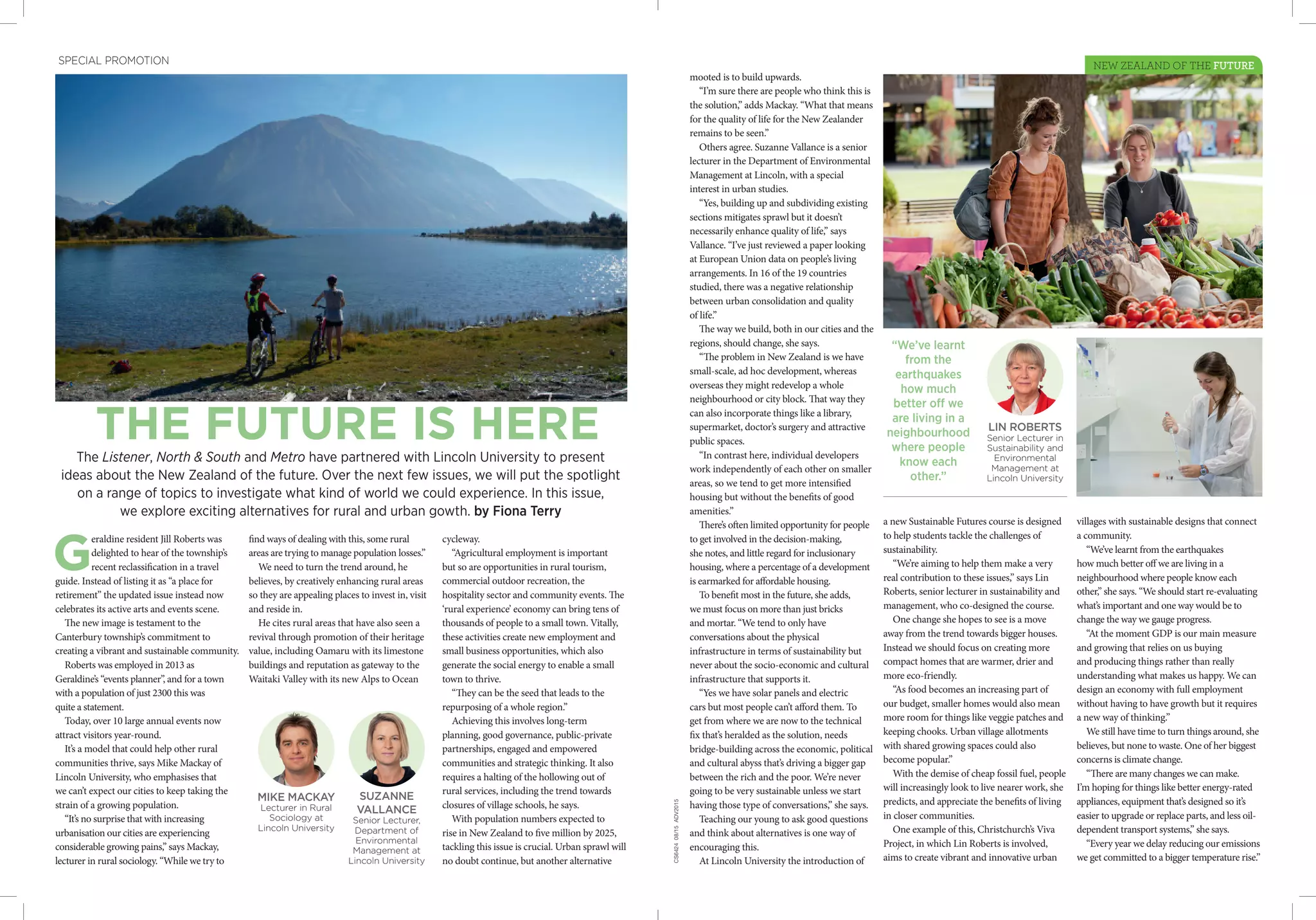
G
eraldine resident Jill Roberts was
delighted to hear of the township’s
recent reclassification in a travel
guide. Instead of listing it as “a place for
retirement” the updated issue instead now
celebrates its active arts and events scene.
The new image is testament to the
Canterbury township’s commitment to
creating a vibrant and sustainable community.
Roberts was employed in 2013 as
Geraldine’s “events planner”, and for a town
with a population of just 2300 this was
quite a statement.
Today, over 10 large annual events now
attract visitors year-round.
It’s a model that could help other rural
communities thrive, says Mike Mackay of
Lincoln University, who emphasises that
we can’t expect our cities to keep taking the
strain of a growing population.
“It’s no surprise that with increasing
urbanisation our cities are experiencing
considerable growing pains,” says Mackay,
lecturer in rural sociology. “While we try to
find ways of dealing with this, some rural
areas are trying to manage population losses.”
We need to turn the trend around, he
believes, by creatively enhancing rural areas
so they are appealing places to invest in, visit
and reside in.
He cites rural areas that have also seen a
revival through promotion of their heritage
value, including Oamaru with its limestone
buildings and reputation as gateway to the
Waitaki Valley with its new Alps to Ocean
cycleway.
“Agricultural employment is important
but so are opportunities in rural tourism,
commercial outdoor recreation, the
hospitality sector and community events. The
‘rural experience’ economy can bring tens of
thousands of people to a small town. Vitally,
these activities create new employment and
small business opportunities, which also
generate the social energy to enable a small
town to thrive.
“They can be the seed that leads to the
repurposing of a whole region.”
Achieving this involves long-term
planning, good governance, public-private
partnerships, engaged and empowered
communities and strategic thinking. It also
requires a halting of the hollowing out of
rural services, including the trend towards
closures of village schools, he says.
With population numbers expected to
rise in New Zealand to five million by 2025,
tackling this issue is crucial. Urban sprawl will
no doubt continue, but another alternative
mooted is to build upwards.
“I’m sure there are people who think this is
the solution,” adds Mackay. “What that means
for the quality of life for the New Zealander
remains to be seen.”
Others agree. Suzanne Vallance is a senior
lecturer in the Department of Environmental
Management at Lincoln, with a special
interest in urban studies.
“Yes, building up and subdividing existing
sections mitigates sprawl but it doesn’t
necessarily enhance quality of life,” says
Vallance. “I’ve just reviewed a paper looking
at European Union data on people’s living
arrangements. In 16 of the 19 countries
studied, there was a negative relationship
between urban consolidation and quality
of life.”
The way we build, both in our cities and the
regions, should change, she says.
“The problem in New Zealand is we have
small-scale, ad hoc development, whereas
overseas they might redevelop a whole
neighbourhood or city block. That way they
can also incorporate things like a library,
supermarket, doctor’s surgery and attractive
public spaces.
“In contrast here, individual developers
work independently of each other on smaller
areas, so we tend to get more intensified
housing but without the benefits of good
amenities.”
There’s often limited opportunity for people
to get involved in the decision-making,
she notes, and little regard for inclusionary
housing, where a percentage of a development
is earmarked for affordable housing.
To benefit most in the future, she adds,
we must focus on more than just bricks
and mortar. “We tend to only have
conversations about the physical
infrastructure in terms of sustainability but
never about the socio-economic and cultural
infrastructure that supports it.
“Yes we have solar panels and electric
cars but most people can’t afford them. To
get from where we are now to the technical
fix that’s heralded as the solution, needs
bridge-building across the economic, political
and cultural abyss that’s driving a bigger gap
between the rich and the poor. We’re never
going to be very sustainable unless we start
having those type of conversations,” she says.
Teaching our young to ask good questions
and think about alternatives is one way of
encouraging this.
At Lincoln University the introduction of
The Listener, North & South and Metro have partnered with Lincoln University to present
ideas about the New Zealand of the future. Over the next few issues, we will put the spotlight
on a range of topics to investigate what kind of world we could experience. In this issue,
we explore exciting alternatives for rural and urban gowth. by Fiona Terry
CS642408/15ADV2015
SUZANNE
VALLANCE
Senior Lecturer,
Department of
Environmental
Management at
Lincoln University
mike mackay
Lecturer in Rural
Sociology at
Lincoln University
a new Sustainable Futures course is designed
to help students tackle the challenges of
sustainability.
“We’re aiming to help them make a very
real contribution to these issues,” says Lin
Roberts, senior lecturer in sustainability and
management, who co-designed the course.
One change she hopes to see is a move
away from the trend towards bigger houses.
Instead we should focus on creating more
compact homes that are warmer, drier and
more eco-friendly.
“As food becomes an increasing part of
our budget, smaller homes would also mean
more room for things like veggie patches and
keeping chooks. Urban village allotments
with shared growing spaces could also
become popular.”
With the demise of cheap fossil fuel, people
will increasingly look to live nearer work, she
predicts, and appreciate the benefits of living
in closer communities.
One example of this, Christchurch’s Viva
Project, in which Lin Roberts is involved,
aims to create vibrant and innovative urban
New Zealand of the future
the future is here
villages with sustainable designs that connect
a community.
“We’ve learnt from the earthquakes
how much better off we are living in a
neighbourhood where people know each
other,” she says. “We should start re-evaluating
what’s important and one way would be to
change the way we gauge progress.
“At the moment GDP is our main measure
and growing that relies on us buying
and producing things rather than really
understanding what makes us happy. We can
design an economy with full employment
without having to have growth but it requires
a new way of thinking.”
We still have time to turn things around, she
believes, but none to waste. One of her biggest
concerns is climate change.
“There are many changes we can make.
I’m hoping for things like better energy-rated
appliances, equipment that’s designed so it’s
easier to upgrade or replace parts, and less oil-
dependent transport systems,” she says.
“Every year we delay reducing our emissions
we get committed to a bigger temperature rise.”
“We’ve learnt
from the
earthquakes
how much
better off we
are living in a
neighbourhood
where people
know each
other.”
lin roberts
Senior Lecturer in
Sustainability and
Environmental
Management at
Lincoln University
special promotion

listener Lincoln university_part2

  • 1.
    G eraldine resident JillRoberts was delighted to hear of the township’s recent reclassification in a travel guide. Instead of listing it as “a place for retirement” the updated issue instead now celebrates its active arts and events scene. The new image is testament to the Canterbury township’s commitment to creating a vibrant and sustainable community. Roberts was employed in 2013 as Geraldine’s “events planner”, and for a town with a population of just 2300 this was quite a statement. Today, over 10 large annual events now attract visitors year-round. It’s a model that could help other rural communities thrive, says Mike Mackay of Lincoln University, who emphasises that we can’t expect our cities to keep taking the strain of a growing population. “It’s no surprise that with increasing urbanisation our cities are experiencing considerable growing pains,” says Mackay, lecturer in rural sociology. “While we try to find ways of dealing with this, some rural areas are trying to manage population losses.” We need to turn the trend around, he believes, by creatively enhancing rural areas so they are appealing places to invest in, visit and reside in. He cites rural areas that have also seen a revival through promotion of their heritage value, including Oamaru with its limestone buildings and reputation as gateway to the Waitaki Valley with its new Alps to Ocean cycleway. “Agricultural employment is important but so are opportunities in rural tourism, commercial outdoor recreation, the hospitality sector and community events. The ‘rural experience’ economy can bring tens of thousands of people to a small town. Vitally, these activities create new employment and small business opportunities, which also generate the social energy to enable a small town to thrive. “They can be the seed that leads to the repurposing of a whole region.” Achieving this involves long-term planning, good governance, public-private partnerships, engaged and empowered communities and strategic thinking. It also requires a halting of the hollowing out of rural services, including the trend towards closures of village schools, he says. With population numbers expected to rise in New Zealand to five million by 2025, tackling this issue is crucial. Urban sprawl will no doubt continue, but another alternative mooted is to build upwards. “I’m sure there are people who think this is the solution,” adds Mackay. “What that means for the quality of life for the New Zealander remains to be seen.” Others agree. Suzanne Vallance is a senior lecturer in the Department of Environmental Management at Lincoln, with a special interest in urban studies. “Yes, building up and subdividing existing sections mitigates sprawl but it doesn’t necessarily enhance quality of life,” says Vallance. “I’ve just reviewed a paper looking at European Union data on people’s living arrangements. In 16 of the 19 countries studied, there was a negative relationship between urban consolidation and quality of life.” The way we build, both in our cities and the regions, should change, she says. “The problem in New Zealand is we have small-scale, ad hoc development, whereas overseas they might redevelop a whole neighbourhood or city block. That way they can also incorporate things like a library, supermarket, doctor’s surgery and attractive public spaces. “In contrast here, individual developers work independently of each other on smaller areas, so we tend to get more intensified housing but without the benefits of good amenities.” There’s often limited opportunity for people to get involved in the decision-making, she notes, and little regard for inclusionary housing, where a percentage of a development is earmarked for affordable housing. To benefit most in the future, she adds, we must focus on more than just bricks and mortar. “We tend to only have conversations about the physical infrastructure in terms of sustainability but never about the socio-economic and cultural infrastructure that supports it. “Yes we have solar panels and electric cars but most people can’t afford them. To get from where we are now to the technical fix that’s heralded as the solution, needs bridge-building across the economic, political and cultural abyss that’s driving a bigger gap between the rich and the poor. We’re never going to be very sustainable unless we start having those type of conversations,” she says. Teaching our young to ask good questions and think about alternatives is one way of encouraging this. At Lincoln University the introduction of The Listener, North & South and Metro have partnered with Lincoln University to present ideas about the New Zealand of the future. Over the next few issues, we will put the spotlight on a range of topics to investigate what kind of world we could experience. In this issue, we explore exciting alternatives for rural and urban gowth. by Fiona Terry CS642408/15ADV2015 SUZANNE VALLANCE Senior Lecturer, Department of Environmental Management at Lincoln University mike mackay Lecturer in Rural Sociology at Lincoln University a new Sustainable Futures course is designed to help students tackle the challenges of sustainability. “We’re aiming to help them make a very real contribution to these issues,” says Lin Roberts, senior lecturer in sustainability and management, who co-designed the course. One change she hopes to see is a move away from the trend towards bigger houses. Instead we should focus on creating more compact homes that are warmer, drier and more eco-friendly. “As food becomes an increasing part of our budget, smaller homes would also mean more room for things like veggie patches and keeping chooks. Urban village allotments with shared growing spaces could also become popular.” With the demise of cheap fossil fuel, people will increasingly look to live nearer work, she predicts, and appreciate the benefits of living in closer communities. One example of this, Christchurch’s Viva Project, in which Lin Roberts is involved, aims to create vibrant and innovative urban New Zealand of the future the future is here villages with sustainable designs that connect a community. “We’ve learnt from the earthquakes how much better off we are living in a neighbourhood where people know each other,” she says. “We should start re-evaluating what’s important and one way would be to change the way we gauge progress. “At the moment GDP is our main measure and growing that relies on us buying and producing things rather than really understanding what makes us happy. We can design an economy with full employment without having to have growth but it requires a new way of thinking.” We still have time to turn things around, she believes, but none to waste. One of her biggest concerns is climate change. “There are many changes we can make. I’m hoping for things like better energy-rated appliances, equipment that’s designed so it’s easier to upgrade or replace parts, and less oil- dependent transport systems,” she says. “Every year we delay reducing our emissions we get committed to a bigger temperature rise.” “We’ve learnt from the earthquakes how much better off we are living in a neighbourhood where people know each other.” lin roberts Senior Lecturer in Sustainability and Environmental Management at Lincoln University special promotion