LIS 60020 Information Organization Metadata Schema Assignment template
Page 1 of 9
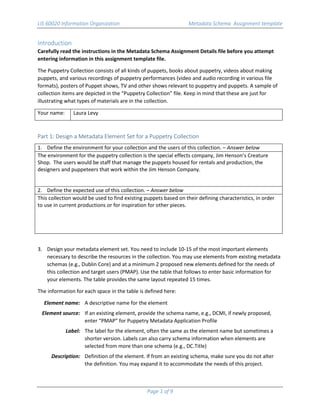
Introduction
Carefully read the instructions in the Metadata Schema Assignment Details file before you attempt
entering information in this assignment template file.
The Puppetry Collection consists of all kinds of puppets, books about puppetry, videos about making
puppets, and various recordings of puppetry performances (video and audio recording in various file
formats), posters of Puppet shows, TV and other shows relevant to puppetry and puppets. A sample of
collection items are depicted in the “Puppetry Collection” file. Keep in mind that these are just for
illustrating what types of materials are in the collection.
Your name: Laura Levy
Part 1: Design a Metadata Element Set for a Puppetry Collection
1. Define the environment for your collection and the users of this collection. – Answer below
The environment for the puppetry collection is the special effects company, Jim Henson’s Creature
Shop. The users would be staff that manage the puppets housed for rentals and production, the
designers and puppeteers that work within the Jim Henson Company.
2. Define the expected use of this collection. – Answer below
This collection would be used to find existing puppets based on their defining characteristics, in order
to use in current productions or for inspiration for other pieces.
3. Design your metadata element set. You need to include 10-15 of the most important elements
necessary to describe the resources in the collection. You may use elements from existing metadata
schemas (e.g., Dublin Core) and at a minimum 2 proposed new elements defined for the needs of
this collection and target users (PMAP). Use the table that follows to enter basic information for
your elements. The table provides the same layout repeated 15 times.
The information for each space in the table is defined here:
Element name: A descriptive name for the element
Element source: If an existing element, provide the schema name, e.g., DCMI, if newly proposed,
enter “PMAP” for Puppetry Metadata Application Profile
Label: The label for the element, often the same as the element name but sometimes a
shorter version. Labels can also carry schema information when elements are
selected from more than one schema (e.g., DC.Title)
Description: Definition of the element. If from an existing schema, make sure you do not alter
the definition. You may expand it to accommodate the needs of this project.
LIS 60020 Information Organization Metadata Schema Assignment template
Page 2 of 9
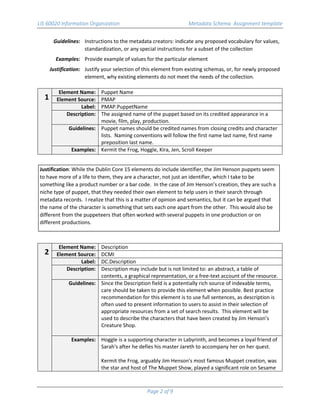
Guidelines: Instructions to the metadata creators: indicate any proposed vocabulary for values,
standardization, or any special instructions for a subset of the collection
Examples: Provide example of values for the particular element
Justification: Justify your selection of this element from existing schemas, or, for newly proposed
element, why existing elements do not meet the needs of the collection.
1
Element Name: Puppet Name
Element Source: PMAP
Label: PMAP.PuppetName
Description: The assigned name of the puppet based on its credited appearance in a
movie, film, play, production.
Guidelines: Puppet names should be credited names from closing credits and character
lists. Naming conventions will follow the first name last name, first name
preposition last name.
Examples: Kermit the Frog, Hoggle, Kira, Jen, Scroll Keeper
2
Element Name: Description
Element Source: DCMI
Label: DC.Description
Description: Description may include but is not limited to: an abstract, a table of
contents, a graphical representation, or a free-text account of the resource.
Guidelines: Since the Description field is a potentially rich source of indexable terms,
care should be taken to provide this element when possible. Best practice
recommendation for this element is to use full sentences, as description is
often used to present information to users to assist in their selection of
appropriate resources from a set of search results. This element will be
used to describe the characters that have been created by Jim Henson’s
Creature Shop.
Examples: Hoggle is a supporting character in Labyrinth, and becomes a loyal friend of
Sarah's after he defies his master Jareth to accompany her on her quest.
Kermit the Frog, arguably Jim Henson's most famous Muppet creation, was
the star and host of The Muppet Show, played a significant role on Sesame
Justification: While the Dublin Core 15 elements do include identifier, the Jim Henson puppets seem
to have more of a life to them, they are a character, not just an identifier, which I take to be
something like a product number or a bar code. In the case of Jim Henson’s creation, they are such a
niche type of puppet, that they needed their own element to help users in their search through
metadata records. I realize that this is a matter of opinion and semantics, but it can be argued that
the name of the character is something that sets each one apart from the other. This would also be
different from the puppeteers that often worked with several puppets in one production or on
different productions.
LIS 60020 Information Organization Metadata Schema Assignment template
Page 3 of 9
Street, and served as the logo of The Jim Henson Company. He continues to
star in the Muppet movies and makes numerous TV appearances.
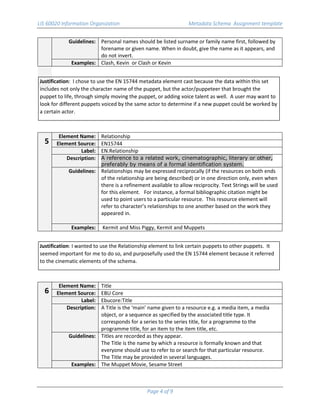
3
Element Name: Date
Element Source: DCMI
Label: DC.Date
Description: A point or period of time associated with an event in the lifecycle of the
resource. Will reference the date that the production that the puppet was
involved in was first released.
Guidelines:
Refinements;
Released – DC.Date.Released: This refinement will refer to the date of
release for any production that is contained in the metadata.
Aired – DC.Date.Aired: This refinement will refer to the air date of any
productions that are contained in the metadata.
Appearance – DC.Date.Appearance: This refinement will refer to any
physical appearances that are not covered by the release and aired
refinements above.
Recommended best practice for encoding the date value is defined in a
profile of ISO 8601 [Date and Time Formats, W3C Note,
http://www.w3.org/TR/NOTE- datetime] and follows the YYYY-MM-DD
format.
If the full date is unknown, month and year (YYYY-MM) or just year (YYYY)
may be used. Many other schemes are possible, but if used, they may not
be easily interpreted by users or software.
Examples: 1976-05, 1986, 1978-05-15
4
Element Name: Cast
Element Source: EN15744
Label: EN.Cast:
Description: A collective term for actors and their roles. A broad distinction is made
between cast and credits by defining cast as those in front of the camera
and credits as those behind the camera.
Justification: I chose to use Dublin Core’s Description element in order to allow for free text and
keyword searches. So much about the creatures/puppets that are created cannot be contained
within 1-2 keywords.
Justification: I chose to include the date in this schema because when a user is searching for a certain
puppet they are most likely going to want to know when the puppet was used in productions, or if it
was even used at all. This is helpful, especially in trying to determine if the puppet can be re-
introduced or has been along the entire time.
LIS 60020 Information Organization Metadata Schema Assignment template
Page 4 of 9
Guidelines: Personal names should be listed surname or family name first, followed by
forename or given name. When in doubt, give the name as it appears, and
do not invert.
Examples: Clash, Kevin or Clash or Kevin
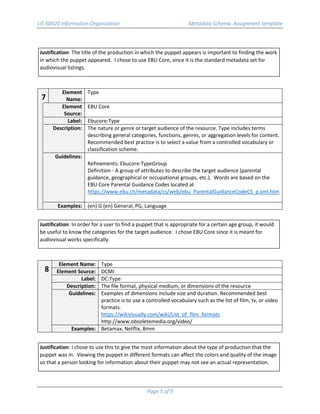
5
Element Name: Relationship
Element Source: EN15744
Label: EN.Relationship
Description: A reference to a related work, cinematographic, literary or other,
preferably by means of a formal identification system.
Guidelines: Relationships may be expressed reciprocally (if the resources on both ends
of the relationship are being described) or in one direction only, even when
there is a refinement available to allow reciprocity. Text Strings will be used
for this element. For instance, a formal bibliographic citation might be
used to point users to a particular resource. This resource element will
refer to character’s relationships to one another based on the work they
appeared in.
Examples: Kermit and Miss Piggy, Kermit and Muppets
6
Element Name: Title
Element Source: EBU Core
Label: Ebucore:Title
Description: A Title is the ‘main’ name given to a resource e.g. a media item, a media
object, or a sequence as specified by the associated title type. It
corresponds for a series to the series title, for a programme to the
programme title, for an item to the item title, etc.
Guidelines: Titles are recorded as they appear.
The Title is the name by which a resource is formally known and that
everyone should use to refer to or search for that particular resource.
The Title may be provided in several languages.
Examples: The Muppet Movie, Sesame Street
Justification: I chose to use the EN 15744 metadata element cast because the data within this set
includes not only the character name of the puppet, but the actor/puppeteer that brought the
puppet to life, through simply moving the puppet, or adding voice talent as well. A user may want to
look for different puppets voiced by the same actor to determine if a new puppet could be worked by
a certain actor.
Justification: I wanted to use the Relationship element to link certain puppets to other puppets. It
seemed important for me to do so, and purposefully used the EN 15744 element because it referred
to the cinematic elements of the schema.
LIS 60020 Information Organization Metadata Schema Assignment template
Page 5 of 9
7
Element
Name:
Type
Element
Source:
EBU Core
Label: Ebucore:Type
Description: The nature or genre or target audience of the resource. Type includes terms
describing general categories, functions, genres, or aggregation levels for content.
Recommended best practice is to select a value from a controlled vocabulary or
classification scheme.
Guidelines:
Refinements: Ebucore:TypeGroup
Definition - A group of attributes to describe the target audience (parental
guidance, geographical or occupational groups, etc.). Words are based on the
EBU Core Parental Guidance Codes located at
https://www.ebu.ch/metadata/cs/web/ebu_ParentalGuidanceCodeCS_p.xml.htm
Examples: (en) G (en) General, PG, Language
8
Element Name: Type
Element Source: DCMI
Label: DC:Type
Description: The file format, physical medium, or dimensions of the resource
Guidelines: Examples of dimensions include size and duration. Recommended best
practice is to use a controlled vocabulary such as the list of film, tv, or video
formats.
https://wikivisually.com/wiki/List_of_film_formats
http://www.obsoletemedia.org/video/
Examples: Betamax, Netflix, 8mm
Justification: The title of the production in which the puppet appears is important to finding the work
in which the puppet appeared. I chose to use EBU Core, since it is the standard metadata set for
audiovisual listings.
Justification: In order for a user to find a puppet that is appropriate for a certain age group, it would
be useful to know the categories for the target audience. I chose EBU Core since it is meant for
audiovisual works specifically.
Justification: I chose to use this to give the most information about the type of production that the
puppet was in. Viewing the puppet in different formats can affect the colors and quality of the image
so that a person looking for information about their puppet may not see an actual representation.
LIS 60020 Information Organization Metadata Schema Assignment template
Page 6 of 9
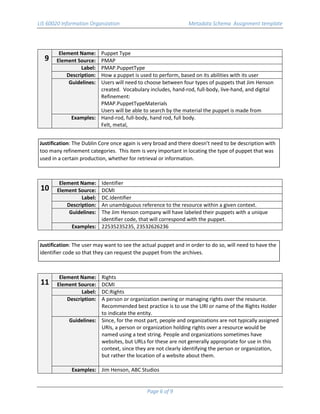
9
Element Name: Puppet Type
Element Source: PMAP
Label: PMAP.PuppetType
Description: How a puppet is used to perform, based on its abilities with its user
Guidelines: Users will need to choose between four types of puppets that Jim Henson
created. Vocabulary includes, hand-rod, full-body, live-hand, and digital
Refinement:
PMAP.PuppetTypeMaterials
Users will be able to search by the material the puppet is made from
Examples: Hand-rod, full-body, hand rod, full body.
Felt, metal,
10
Element Name: Identifier
Element Source: DCMI
Label: DC.Identifier
Description: An unambiguous reference to the resource within a given context.
Guidelines: The Jim Henson company will have labeled their puppets with a unique
identifier code, that will correspond with the puppet.
Examples: 22535235235, 23532626236
11
Element Name: Rights
Element Source: DCMI
Label: DC:Rights
Description: A person or organization owning or managing rights over the resource.
Recommended best practice is to use the URI or name of the Rights Holder
to indicate the entity.
Guidelines: Since, for the most part, people and organizations are not typically assigned
URIs, a person or organization holding rights over a resource would be
named using a text string. People and organizations sometimes have
websites, but URLs for these are not generally appropriate for use in this
context, since they are not clearly identifying the person or organization,
but rather the location of a website about them.
Examples: Jim Henson, ABC Studios
Justification: The Dublin Core once again is very broad and there doesn’t need to be description with
too many refinement categories. This item is very important in locating the type of puppet that was
used in a certain production, whether for retrieval or information.
Justification: The user may want to see the actual puppet and in order to do so, will need to have the
identifier code so that they can request the puppet from the archives.
LIS 60020 Information Organization Metadata Schema Assignment template
Page 7 of 9
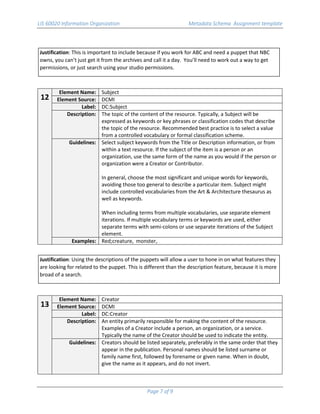
12
Element Name: Subject
Element Source: DCMI
Label: DC:Subject
Description: The topic of the content of the resource. Typically, a Subject will be
expressed as keywords or key phrases or classification codes that describe
the topic of the resource. Recommended best practice is to select a value
from a controlled vocabulary or formal classification scheme.
Guidelines: Select subject keywords from the Title or Description information, or from
within a text resource. If the subject of the item is a person or an
organization, use the same form of the name as you would if the person or
organization were a Creator or Contributor.
In general, choose the most significant and unique words for keywords,
avoiding those too general to describe a particular item. Subject might
include controlled vocabularies from the Art & Architecture thesaurus as
well as keywords.
When including terms from multiple vocabularies, use separate element
iterations. If multiple vocabulary terms or keywords are used, either
separate terms with semi-colons or use separate iterations of the Subject
element.
Examples: Red;creature, monster,
13
Element Name: Creator
Element Source: DCMI
Label: DC:Creator
Description: An entity primarily responsible for making the content of the resource.
Examples of a Creator include a person, an organization, or a service.
Typically the name of the Creator should be used to indicate the entity.
Guidelines: Creators should be listed separately, preferably in the same order that they
appear in the publication. Personal names should be listed surname or
family name first, followed by forename or given name. When in doubt,
give the name as it appears, and do not invert.
Justification: This is important to include because if you work for ABC and need a puppet that NBC
owns, you can’t just get it from the archives and call it a day. You’ll need to work out a way to get
permissions, or just search using your studio permissions.
Justification: Using the descriptions of the puppets will allow a user to hone in on what features they
are looking for related to the puppet. This is different than the description feature, because it is more
broad of a search.
LIS 60020 Information Organization Metadata Schema Assignment template
Page 8 of 9
In the case of organizations where there is clearly a hierarchy present, list
the parts of the hierarchy from largest to smallest, separated by full stops
and a space. If it is not clear whether there is a hierarchy present, or
unclear which is the larger or smaller portion of the body, give the name as
it appears in the item.
If the Creator and Publisher are the same, do not repeat the name in the
Publisher area. If the nature of the responsibility is ambiguous, the
recommended practice is to use Publisher for organizations, and Creator for
individuals. In cases of lesser or ambiguous responsibility, other than
creation, use Contributor.
Examples: Henson, Jim, Creature Shop
14
Element Name:
Element Source: Click here to enter text.
Label: Click here to enter text.
Description: Click here to enter text.
Guidelines: Click here to enter text.
Examples: Click here to enter text.
15
Element Name: Click here to enter text.
Element Source: Click here to enter text.
Label: Click here to enter text.
Description: Click here to enter text.
Guidelines: Click here to enter text.
Examples: Click here to enter text.
Justification: Certain puppets created by one person may look entirely different than another, which
would hinder a person searching for a certain style to the puppets.
Justification: Click here to enter text.
LIS 60020 Information Organization Metadata Schema Assignment template
Page 9 of 9
Part 2: Create metadata for two resources in the collection
This metadata should be created for the objects, not an image of the object. Use your metadata
schema (defined above) to create the metadata with all applicable elements for the following two
items:
The genius puppetry behind War Horse (describe the video)
Zebra State Puppet (describe the actual puppet, not the image available on the web)
– Answer below
The Genius Puppetry Behind War Horse
PMAP.PuppetName: Joey
DC.Description: A video about War Horse puppet used in the film War Horse
DC.Date: 2011-02
EN.Cast: Kohler, Adrian; Jones, Basil; Brett, Mikey; Leo, Craig; Zem, Joaquin
EN.Relationship: War Horse; Tall Horse;
EBUCORE.Title: The Genius Puppetry Behind War Horse
EBUCORE.Type: G
DC.Type: streaming video
PMAP.PuppetType: full-body
PMAP.PuppetTypeMaterials: cane, aluminum, nylon mesh, brown
DC.Identifier: unknown
DC.Rights: Ted Talks
DC.Creator: Handspring Puppet Company
ZEBRA STATE PUPPET
PMAP.PuppetName: Zebra Stage Puppet
DC.Description: A plush zebra hand puppet that has a movable mouth and measures 8” long.
DC.Date: 2007-01
EN.Cast: unknown
EN.Relationship: Sounds of the Savanna
EBUCORE.Title: n/a
EBUCORE.Type: n/a
DC.Type: n/a
PMAP.PuppetType: Hand - puppet
PMAP.PuppetTypeMaterials: leatherette; plush; black; white
DC.Identifier: 2565
DC.Rights: Folkmanis
DC.Creator: Folkmanis

LIS 60020 Metadata Schema

  • 1.
    LIS 60020 InformationOrganization Metadata Schema Assignment template Page 1 of 9 Introduction Carefully read the instructions in the Metadata Schema Assignment Details file before you attempt entering information in this assignment template file. The Puppetry Collection consists of all kinds of puppets, books about puppetry, videos about making puppets, and various recordings of puppetry performances (video and audio recording in various file formats), posters of Puppet shows, TV and other shows relevant to puppetry and puppets. A sample of collection items are depicted in the “Puppetry Collection” file. Keep in mind that these are just for illustrating what types of materials are in the collection. Your name: Laura Levy Part 1: Design a Metadata Element Set for a Puppetry Collection 1. Define the environment for your collection and the users of this collection. – Answer below The environment for the puppetry collection is the special effects company, Jim Henson’s Creature Shop. The users would be staff that manage the puppets housed for rentals and production, the designers and puppeteers that work within the Jim Henson Company. 2. Define the expected use of this collection. – Answer below This collection would be used to find existing puppets based on their defining characteristics, in order to use in current productions or for inspiration for other pieces. 3. Design your metadata element set. You need to include 10-15 of the most important elements necessary to describe the resources in the collection. You may use elements from existing metadata schemas (e.g., Dublin Core) and at a minimum 2 proposed new elements defined for the needs of this collection and target users (PMAP). Use the table that follows to enter basic information for your elements. The table provides the same layout repeated 15 times. The information for each space in the table is defined here: Element name: A descriptive name for the element Element source: If an existing element, provide the schema name, e.g., DCMI, if newly proposed, enter “PMAP” for Puppetry Metadata Application Profile Label: The label for the element, often the same as the element name but sometimes a shorter version. Labels can also carry schema information when elements are selected from more than one schema (e.g., DC.Title) Description: Definition of the element. If from an existing schema, make sure you do not alter the definition. You may expand it to accommodate the needs of this project.
  • 2.
    LIS 60020 InformationOrganization Metadata Schema Assignment template Page 2 of 9 Guidelines: Instructions to the metadata creators: indicate any proposed vocabulary for values, standardization, or any special instructions for a subset of the collection Examples: Provide example of values for the particular element Justification: Justify your selection of this element from existing schemas, or, for newly proposed element, why existing elements do not meet the needs of the collection. 1 Element Name: Puppet Name Element Source: PMAP Label: PMAP.PuppetName Description: The assigned name of the puppet based on its credited appearance in a movie, film, play, production. Guidelines: Puppet names should be credited names from closing credits and character lists. Naming conventions will follow the first name last name, first name preposition last name. Examples: Kermit the Frog, Hoggle, Kira, Jen, Scroll Keeper 2 Element Name: Description Element Source: DCMI Label: DC.Description Description: Description may include but is not limited to: an abstract, a table of contents, a graphical representation, or a free-text account of the resource. Guidelines: Since the Description field is a potentially rich source of indexable terms, care should be taken to provide this element when possible. Best practice recommendation for this element is to use full sentences, as description is often used to present information to users to assist in their selection of appropriate resources from a set of search results. This element will be used to describe the characters that have been created by Jim Henson’s Creature Shop. Examples: Hoggle is a supporting character in Labyrinth, and becomes a loyal friend of Sarah's after he defies his master Jareth to accompany her on her quest. Kermit the Frog, arguably Jim Henson's most famous Muppet creation, was the star and host of The Muppet Show, played a significant role on Sesame Justification: While the Dublin Core 15 elements do include identifier, the Jim Henson puppets seem to have more of a life to them, they are a character, not just an identifier, which I take to be something like a product number or a bar code. In the case of Jim Henson’s creation, they are such a niche type of puppet, that they needed their own element to help users in their search through metadata records. I realize that this is a matter of opinion and semantics, but it can be argued that the name of the character is something that sets each one apart from the other. This would also be different from the puppeteers that often worked with several puppets in one production or on different productions.
  • 3.
    LIS 60020 InformationOrganization Metadata Schema Assignment template Page 3 of 9 Street, and served as the logo of The Jim Henson Company. He continues to star in the Muppet movies and makes numerous TV appearances. 3 Element Name: Date Element Source: DCMI Label: DC.Date Description: A point or period of time associated with an event in the lifecycle of the resource. Will reference the date that the production that the puppet was involved in was first released. Guidelines: Refinements; Released – DC.Date.Released: This refinement will refer to the date of release for any production that is contained in the metadata. Aired – DC.Date.Aired: This refinement will refer to the air date of any productions that are contained in the metadata. Appearance – DC.Date.Appearance: This refinement will refer to any physical appearances that are not covered by the release and aired refinements above. Recommended best practice for encoding the date value is defined in a profile of ISO 8601 [Date and Time Formats, W3C Note, http://www.w3.org/TR/NOTE- datetime] and follows the YYYY-MM-DD format. If the full date is unknown, month and year (YYYY-MM) or just year (YYYY) may be used. Many other schemes are possible, but if used, they may not be easily interpreted by users or software. Examples: 1976-05, 1986, 1978-05-15 4 Element Name: Cast Element Source: EN15744 Label: EN.Cast: Description: A collective term for actors and their roles. A broad distinction is made between cast and credits by defining cast as those in front of the camera and credits as those behind the camera. Justification: I chose to use Dublin Core’s Description element in order to allow for free text and keyword searches. So much about the creatures/puppets that are created cannot be contained within 1-2 keywords. Justification: I chose to include the date in this schema because when a user is searching for a certain puppet they are most likely going to want to know when the puppet was used in productions, or if it was even used at all. This is helpful, especially in trying to determine if the puppet can be re- introduced or has been along the entire time.
  • 4.
    LIS 60020 InformationOrganization Metadata Schema Assignment template Page 4 of 9 Guidelines: Personal names should be listed surname or family name first, followed by forename or given name. When in doubt, give the name as it appears, and do not invert. Examples: Clash, Kevin or Clash or Kevin 5 Element Name: Relationship Element Source: EN15744 Label: EN.Relationship Description: A reference to a related work, cinematographic, literary or other, preferably by means of a formal identification system. Guidelines: Relationships may be expressed reciprocally (if the resources on both ends of the relationship are being described) or in one direction only, even when there is a refinement available to allow reciprocity. Text Strings will be used for this element. For instance, a formal bibliographic citation might be used to point users to a particular resource. This resource element will refer to character’s relationships to one another based on the work they appeared in. Examples: Kermit and Miss Piggy, Kermit and Muppets 6 Element Name: Title Element Source: EBU Core Label: Ebucore:Title Description: A Title is the ‘main’ name given to a resource e.g. a media item, a media object, or a sequence as specified by the associated title type. It corresponds for a series to the series title, for a programme to the programme title, for an item to the item title, etc. Guidelines: Titles are recorded as they appear. The Title is the name by which a resource is formally known and that everyone should use to refer to or search for that particular resource. The Title may be provided in several languages. Examples: The Muppet Movie, Sesame Street Justification: I chose to use the EN 15744 metadata element cast because the data within this set includes not only the character name of the puppet, but the actor/puppeteer that brought the puppet to life, through simply moving the puppet, or adding voice talent as well. A user may want to look for different puppets voiced by the same actor to determine if a new puppet could be worked by a certain actor. Justification: I wanted to use the Relationship element to link certain puppets to other puppets. It seemed important for me to do so, and purposefully used the EN 15744 element because it referred to the cinematic elements of the schema.
  • 5.
    LIS 60020 InformationOrganization Metadata Schema Assignment template Page 5 of 9 7 Element Name: Type Element Source: EBU Core Label: Ebucore:Type Description: The nature or genre or target audience of the resource. Type includes terms describing general categories, functions, genres, or aggregation levels for content. Recommended best practice is to select a value from a controlled vocabulary or classification scheme. Guidelines: Refinements: Ebucore:TypeGroup Definition - A group of attributes to describe the target audience (parental guidance, geographical or occupational groups, etc.). Words are based on the EBU Core Parental Guidance Codes located at https://www.ebu.ch/metadata/cs/web/ebu_ParentalGuidanceCodeCS_p.xml.htm Examples: (en) G (en) General, PG, Language 8 Element Name: Type Element Source: DCMI Label: DC:Type Description: The file format, physical medium, or dimensions of the resource Guidelines: Examples of dimensions include size and duration. Recommended best practice is to use a controlled vocabulary such as the list of film, tv, or video formats. https://wikivisually.com/wiki/List_of_film_formats http://www.obsoletemedia.org/video/ Examples: Betamax, Netflix, 8mm Justification: The title of the production in which the puppet appears is important to finding the work in which the puppet appeared. I chose to use EBU Core, since it is the standard metadata set for audiovisual listings. Justification: In order for a user to find a puppet that is appropriate for a certain age group, it would be useful to know the categories for the target audience. I chose EBU Core since it is meant for audiovisual works specifically. Justification: I chose to use this to give the most information about the type of production that the puppet was in. Viewing the puppet in different formats can affect the colors and quality of the image so that a person looking for information about their puppet may not see an actual representation.
  • 6.
    LIS 60020 InformationOrganization Metadata Schema Assignment template Page 6 of 9 9 Element Name: Puppet Type Element Source: PMAP Label: PMAP.PuppetType Description: How a puppet is used to perform, based on its abilities with its user Guidelines: Users will need to choose between four types of puppets that Jim Henson created. Vocabulary includes, hand-rod, full-body, live-hand, and digital Refinement: PMAP.PuppetTypeMaterials Users will be able to search by the material the puppet is made from Examples: Hand-rod, full-body, hand rod, full body. Felt, metal, 10 Element Name: Identifier Element Source: DCMI Label: DC.Identifier Description: An unambiguous reference to the resource within a given context. Guidelines: The Jim Henson company will have labeled their puppets with a unique identifier code, that will correspond with the puppet. Examples: 22535235235, 23532626236 11 Element Name: Rights Element Source: DCMI Label: DC:Rights Description: A person or organization owning or managing rights over the resource. Recommended best practice is to use the URI or name of the Rights Holder to indicate the entity. Guidelines: Since, for the most part, people and organizations are not typically assigned URIs, a person or organization holding rights over a resource would be named using a text string. People and organizations sometimes have websites, but URLs for these are not generally appropriate for use in this context, since they are not clearly identifying the person or organization, but rather the location of a website about them. Examples: Jim Henson, ABC Studios Justification: The Dublin Core once again is very broad and there doesn’t need to be description with too many refinement categories. This item is very important in locating the type of puppet that was used in a certain production, whether for retrieval or information. Justification: The user may want to see the actual puppet and in order to do so, will need to have the identifier code so that they can request the puppet from the archives.
  • 7.
    LIS 60020 InformationOrganization Metadata Schema Assignment template Page 7 of 9 12 Element Name: Subject Element Source: DCMI Label: DC:Subject Description: The topic of the content of the resource. Typically, a Subject will be expressed as keywords or key phrases or classification codes that describe the topic of the resource. Recommended best practice is to select a value from a controlled vocabulary or formal classification scheme. Guidelines: Select subject keywords from the Title or Description information, or from within a text resource. If the subject of the item is a person or an organization, use the same form of the name as you would if the person or organization were a Creator or Contributor. In general, choose the most significant and unique words for keywords, avoiding those too general to describe a particular item. Subject might include controlled vocabularies from the Art & Architecture thesaurus as well as keywords. When including terms from multiple vocabularies, use separate element iterations. If multiple vocabulary terms or keywords are used, either separate terms with semi-colons or use separate iterations of the Subject element. Examples: Red;creature, monster, 13 Element Name: Creator Element Source: DCMI Label: DC:Creator Description: An entity primarily responsible for making the content of the resource. Examples of a Creator include a person, an organization, or a service. Typically the name of the Creator should be used to indicate the entity. Guidelines: Creators should be listed separately, preferably in the same order that they appear in the publication. Personal names should be listed surname or family name first, followed by forename or given name. When in doubt, give the name as it appears, and do not invert. Justification: This is important to include because if you work for ABC and need a puppet that NBC owns, you can’t just get it from the archives and call it a day. You’ll need to work out a way to get permissions, or just search using your studio permissions. Justification: Using the descriptions of the puppets will allow a user to hone in on what features they are looking for related to the puppet. This is different than the description feature, because it is more broad of a search.
  • 8.
    LIS 60020 InformationOrganization Metadata Schema Assignment template Page 8 of 9 In the case of organizations where there is clearly a hierarchy present, list the parts of the hierarchy from largest to smallest, separated by full stops and a space. If it is not clear whether there is a hierarchy present, or unclear which is the larger or smaller portion of the body, give the name as it appears in the item. If the Creator and Publisher are the same, do not repeat the name in the Publisher area. If the nature of the responsibility is ambiguous, the recommended practice is to use Publisher for organizations, and Creator for individuals. In cases of lesser or ambiguous responsibility, other than creation, use Contributor. Examples: Henson, Jim, Creature Shop 14 Element Name: Element Source: Click here to enter text. Label: Click here to enter text. Description: Click here to enter text. Guidelines: Click here to enter text. Examples: Click here to enter text. 15 Element Name: Click here to enter text. Element Source: Click here to enter text. Label: Click here to enter text. Description: Click here to enter text. Guidelines: Click here to enter text. Examples: Click here to enter text. Justification: Certain puppets created by one person may look entirely different than another, which would hinder a person searching for a certain style to the puppets. Justification: Click here to enter text. Justification: Click here to enter text.
  • 9.
    LIS 60020 InformationOrganization Metadata Schema Assignment template Page 9 of 9 Part 2: Create metadata for two resources in the collection This metadata should be created for the objects, not an image of the object. Use your metadata schema (defined above) to create the metadata with all applicable elements for the following two items: The genius puppetry behind War Horse (describe the video) Zebra State Puppet (describe the actual puppet, not the image available on the web) – Answer below The Genius Puppetry Behind War Horse PMAP.PuppetName: Joey DC.Description: A video about War Horse puppet used in the film War Horse DC.Date: 2011-02 EN.Cast: Kohler, Adrian; Jones, Basil; Brett, Mikey; Leo, Craig; Zem, Joaquin EN.Relationship: War Horse; Tall Horse; EBUCORE.Title: The Genius Puppetry Behind War Horse EBUCORE.Type: G DC.Type: streaming video PMAP.PuppetType: full-body PMAP.PuppetTypeMaterials: cane, aluminum, nylon mesh, brown DC.Identifier: unknown DC.Rights: Ted Talks DC.Creator: Handspring Puppet Company ZEBRA STATE PUPPET PMAP.PuppetName: Zebra Stage Puppet DC.Description: A plush zebra hand puppet that has a movable mouth and measures 8” long. DC.Date: 2007-01 EN.Cast: unknown EN.Relationship: Sounds of the Savanna EBUCORE.Title: n/a EBUCORE.Type: n/a DC.Type: n/a PMAP.PuppetType: Hand - puppet PMAP.PuppetTypeMaterials: leatherette; plush; black; white DC.Identifier: 2565 DC.Rights: Folkmanis DC.Creator: Folkmanis