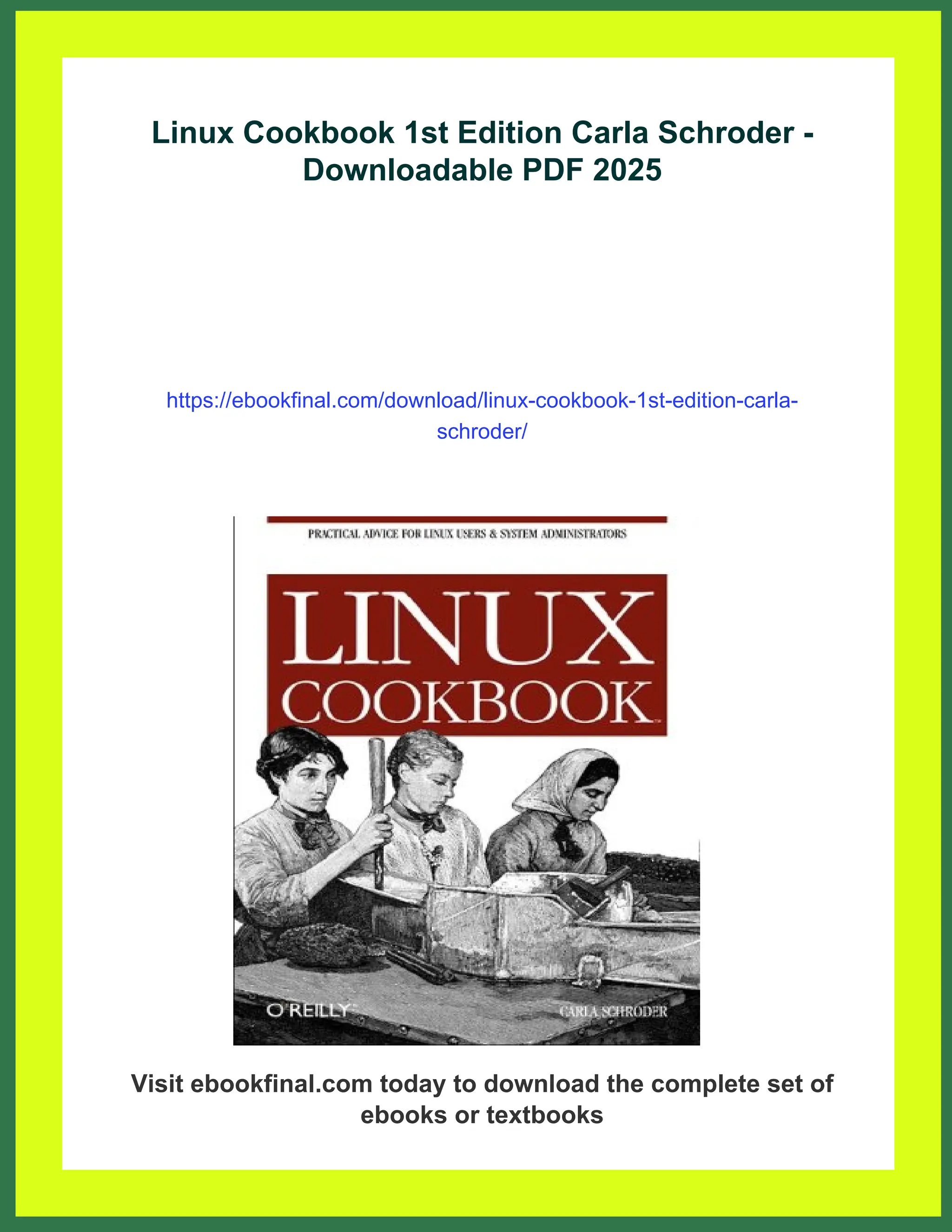
Linux Cookbook 1stEdition Carla Schroder -
Downloadable PDF 2025
https://ebookfinal.com/download/linux-cookbook-1st-edition-carla-
schroder/
Visit ebookfinal.com today to download the complete set of
ebooks or textbooks
2.
Here are somerecommended products that we believe you will be
interested in. You can click the link to download.
Linux Networking Cookbook 1st Edition Gregory Boyce
https://ebookfinal.com/download/linux-networking-cookbook-1st-edition-
gregory-boyce/
Linux Security Cookbook 1st ed Edition Daniel J. Barrett
https://ebookfinal.com/download/linux-security-cookbook-1st-ed-
edition-daniel-j-barrett/
Kali Linux Cookbook Effective penetration testing
solutions 2nd Edition Corey P. Schultz
https://ebookfinal.com/download/kali-linux-cookbook-effective-
penetration-testing-solutions-2nd-edition-corey-p-schultz/
Salve 1st Edition Carla Larese Riga
https://ebookfinal.com/download/salve-1st-edition-carla-larese-riga/
3.
The Angel CarlaNeggers
https://ebookfinal.com/download/the-angel-carla-neggers/
Queer Early Modern 1st Edition Carla Freccero
https://ebookfinal.com/download/queer-early-modern-1st-edition-carla-
freccero/
Prosciutto An Italian Pantry Carla Bardi
https://ebookfinal.com/download/prosciutto-an-italian-pantry-carla-
bardi/
Introducing Qualitative Research in Psychology 2nd Edition
Carla Willig
https://ebookfinal.com/download/introducing-qualitative-research-in-
psychology-2nd-edition-carla-willig/
Linux R Patch Management Keeping Linux R Systems Up To
Date 1st Edition Michael Jang
https://ebookfinal.com/download/linux-r-patch-management-keeping-
linux-r-systems-up-to-date-1st-edition-michael-jang/
5.
Linux Cookbook 1stEdition Carla Schroder Digital
Instant Download
Author(s): Carla Schroder
ISBN(s): 9780596006402, 0596006403
Edition: 1
File Details: PDF, 5.30 MB
Year: 2004
Language: english
6.
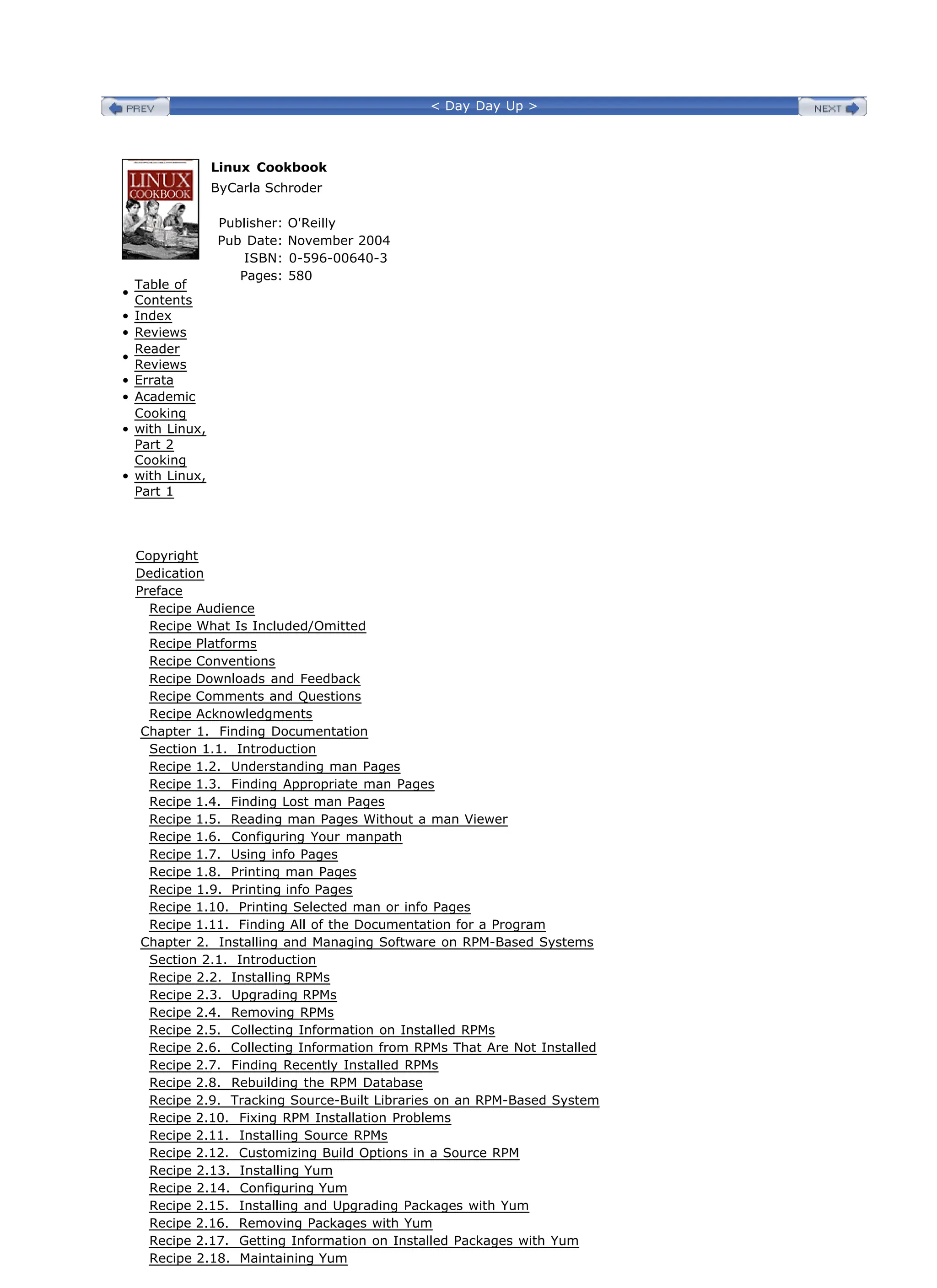
< Day DayUp >
•
Table of
Contents
• Index
• Reviews
•
Reader
Reviews
• Errata
• Academic
•
Cooking
with Linux,
Part 2
•
Cooking
with Linux,
Part 1
Linux Cookbook
ByCarla Schroder
Publisher: O'Reilly
Pub Date: November 2004
ISBN: 0-596-00640-3
Pages: 580
Linux information can be found scattered in man pages,
texinfo files, and source code comments, but the best
source is the experts who have built up a working
knowledge of managing Linux systems. The Linux
Cookbook 's tested techniques distill years of hard-won
experience into practical cut-and-paste solutions to
everyday Linux dilemmas. Use just one recipe from this
collection of real-world solutions, and the hours of
tedious trial-and-error saved will more than pay for the
cost of the book. It's more than a time-saver; it's a
sanity saver.
< Day Day Up >
7.
< Day DayUp >
•
Table of
Contents
• Index
• Reviews
•
Reader
Reviews
• Errata
• Academic
•
Cooking
with Linux,
Part 2
•
Cooking
with Linux,
Part 1
Linux Cookbook
ByCarla Schroder
Publisher: O'Reilly
Pub Date: November 2004
ISBN: 0-596-00640-3
Pages: 580
Copyright
Dedication
Preface
Recipe Audience
Recipe What Is Included/Omitted
Recipe Platforms
Recipe Conventions
Recipe Downloads and Feedback
Recipe Comments and Questions
Recipe Acknowledgments
Chapter 1. Finding Documentation
Section 1.1. Introduction
Recipe 1.2. Understanding man Pages
Recipe 1.3. Finding Appropriate man Pages
Recipe 1.4. Finding Lost man Pages
Recipe 1.5. Reading man Pages Without a man Viewer
Recipe 1.6. Configuring Your manpath
Recipe 1.7. Using info Pages
Recipe 1.8. Printing man Pages
Recipe 1.9. Printing info Pages
Recipe 1.10. Printing Selected man or info Pages
Recipe 1.11. Finding All of the Documentation for a Program
Chapter 2. Installing and Managing Software on RPM-Based Systems
Section 2.1. Introduction
Recipe 2.2. Installing RPMs
Recipe 2.3. Upgrading RPMs
Recipe 2.4. Removing RPMs
Recipe 2.5. Collecting Information on Installed RPMs
Recipe 2.6. Collecting Information from RPMs That Are Not Installed
Recipe 2.7. Finding Recently Installed RPMs
Recipe 2.8. Rebuilding the RPM Database
Recipe 2.9. Tracking Source-Built Libraries on an RPM-Based System
Recipe 2.10. Fixing RPM Installation Problems
Recipe 2.11. Installing Source RPMs
Recipe 2.12. Customizing Build Options in a Source RPM
Recipe 2.13. Installing Yum
Recipe 2.14. Configuring Yum
Recipe 2.15. Installing and Upgrading Packages with Yum
Recipe 2.16. Removing Packages with Yum
Recipe 2.17. Getting Information on Installed Packages with Yum
Recipe 2.18. Maintaining Yum
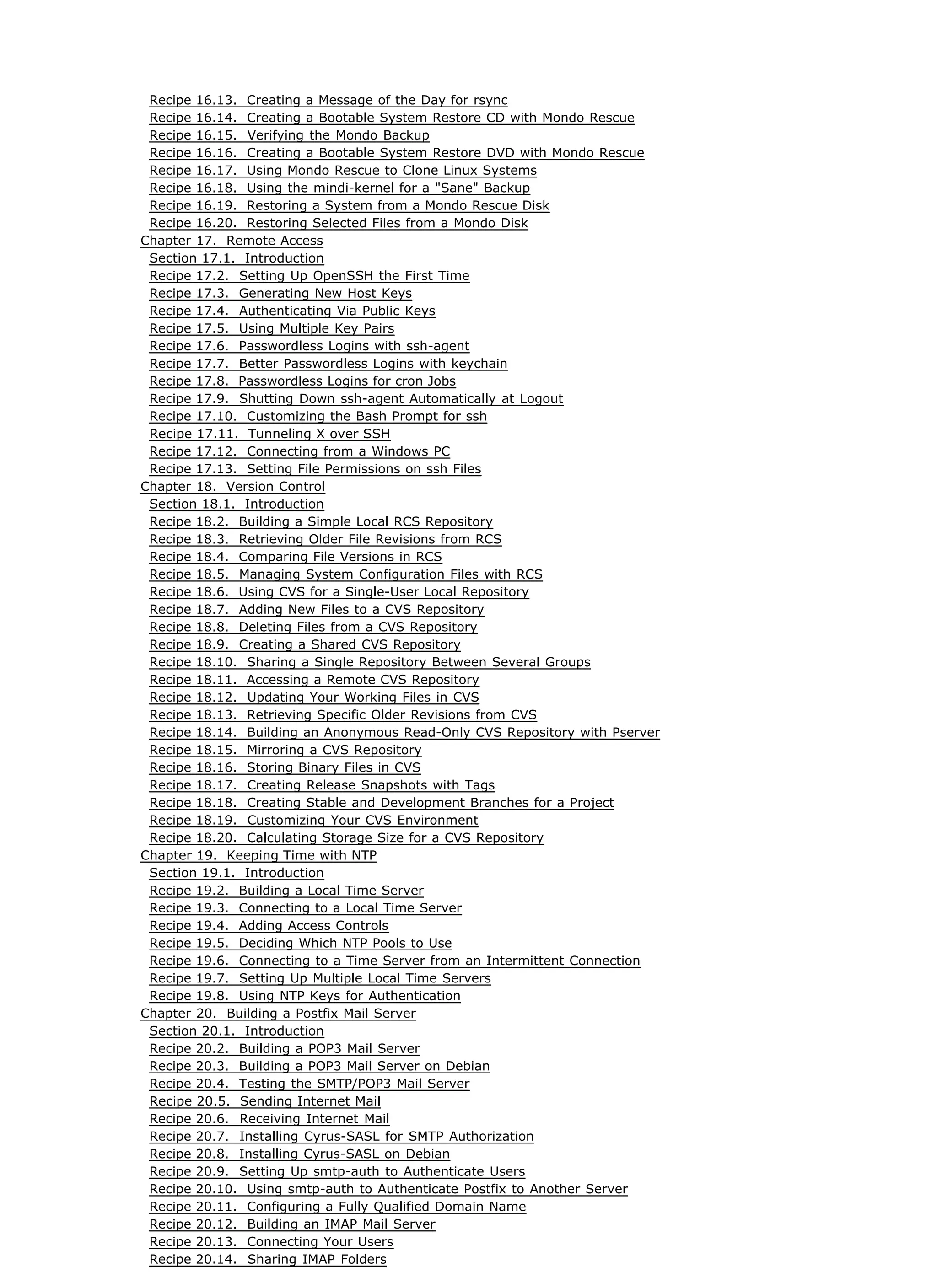
8.
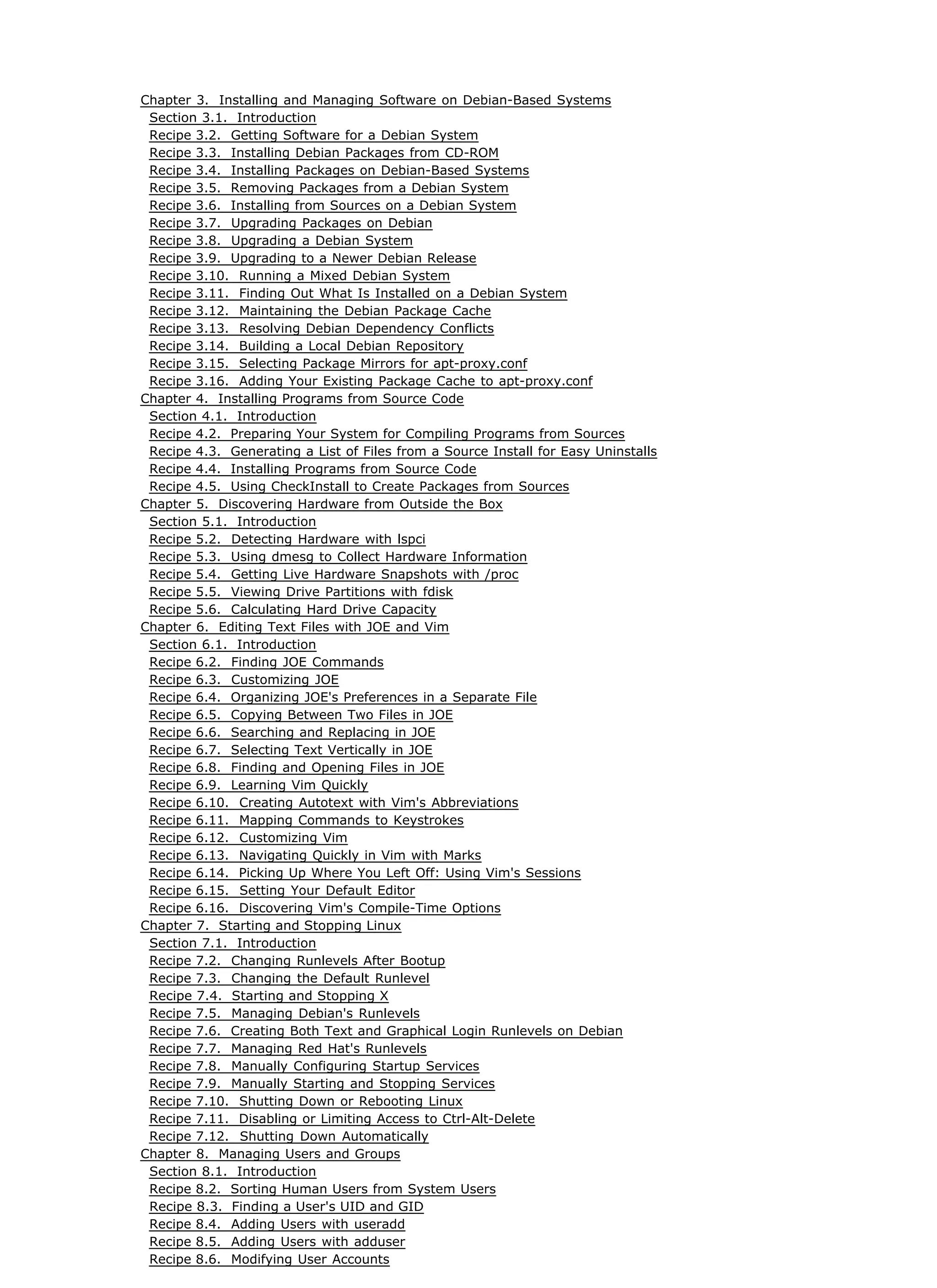
Chapter 3. Installingand Managing Software on Debian-Based Systems
Section 3.1. Introduction
Recipe 3.2. Getting Software for a Debian System
Recipe 3.3. Installing Debian Packages from CD-ROM
Recipe 3.4. Installing Packages on Debian-Based Systems
Recipe 3.5. Removing Packages from a Debian System
Recipe 3.6. Installing from Sources on a Debian System
Recipe 3.7. Upgrading Packages on Debian
Recipe 3.8. Upgrading a Debian System
Recipe 3.9. Upgrading to a Newer Debian Release
Recipe 3.10. Running a Mixed Debian System
Recipe 3.11. Finding Out What Is Installed on a Debian System
Recipe 3.12. Maintaining the Debian Package Cache
Recipe 3.13. Resolving Debian Dependency Conflicts
Recipe 3.14. Building a Local Debian Repository
Recipe 3.15. Selecting Package Mirrors for apt-proxy.conf
Recipe 3.16. Adding Your Existing Package Cache to apt-proxy.conf
Chapter 4. Installing Programs from Source Code
Section 4.1. Introduction
Recipe 4.2. Preparing Your System for Compiling Programs from Sources
Recipe 4.3. Generating a List of Files from a Source Install for Easy Uninstalls
Recipe 4.4. Installing Programs from Source Code
Recipe 4.5. Using CheckInstall to Create Packages from Sources
Chapter 5. Discovering Hardware from Outside the Box
Section 5.1. Introduction
Recipe 5.2. Detecting Hardware with lspci
Recipe 5.3. Using dmesg to Collect Hardware Information
Recipe 5.4. Getting Live Hardware Snapshots with /proc
Recipe 5.5. Viewing Drive Partitions with fdisk
Recipe 5.6. Calculating Hard Drive Capacity
Chapter 6. Editing Text Files with JOE and Vim
Section 6.1. Introduction
Recipe 6.2. Finding JOE Commands
Recipe 6.3. Customizing JOE
Recipe 6.4. Organizing JOE's Preferences in a Separate File
Recipe 6.5. Copying Between Two Files in JOE
Recipe 6.6. Searching and Replacing in JOE
Recipe 6.7. Selecting Text Vertically in JOE
Recipe 6.8. Finding and Opening Files in JOE
Recipe 6.9. Learning Vim Quickly
Recipe 6.10. Creating Autotext with Vim's Abbreviations
Recipe 6.11. Mapping Commands to Keystrokes
Recipe 6.12. Customizing Vim
Recipe 6.13. Navigating Quickly in Vim with Marks
Recipe 6.14. Picking Up Where You Left Off: Using Vim's Sessions
Recipe 6.15. Setting Your Default Editor
Recipe 6.16. Discovering Vim's Compile-Time Options
Chapter 7. Starting and Stopping Linux
Section 7.1. Introduction
Recipe 7.2. Changing Runlevels After Bootup
Recipe 7.3. Changing the Default Runlevel
Recipe 7.4. Starting and Stopping X
Recipe 7.5. Managing Debian's Runlevels
Recipe 7.6. Creating Both Text and Graphical Login Runlevels on Debian
Recipe 7.7. Managing Red Hat's Runlevels
Recipe 7.8. Manually Configuring Startup Services
Recipe 7.9. Manually Starting and Stopping Services
Recipe 7.10. Shutting Down or Rebooting Linux
Recipe 7.11. Disabling or Limiting Access to Ctrl-Alt-Delete
Recipe 7.12. Shutting Down Automatically
Chapter 8. Managing Users and Groups
Section 8.1. Introduction
Recipe 8.2. Sorting Human Users from System Users
Recipe 8.3. Finding a User's UID and GID
Recipe 8.4. Adding Users with useradd
Recipe 8.5. Adding Users with adduser
Recipe 8.6. Modifying User Accounts
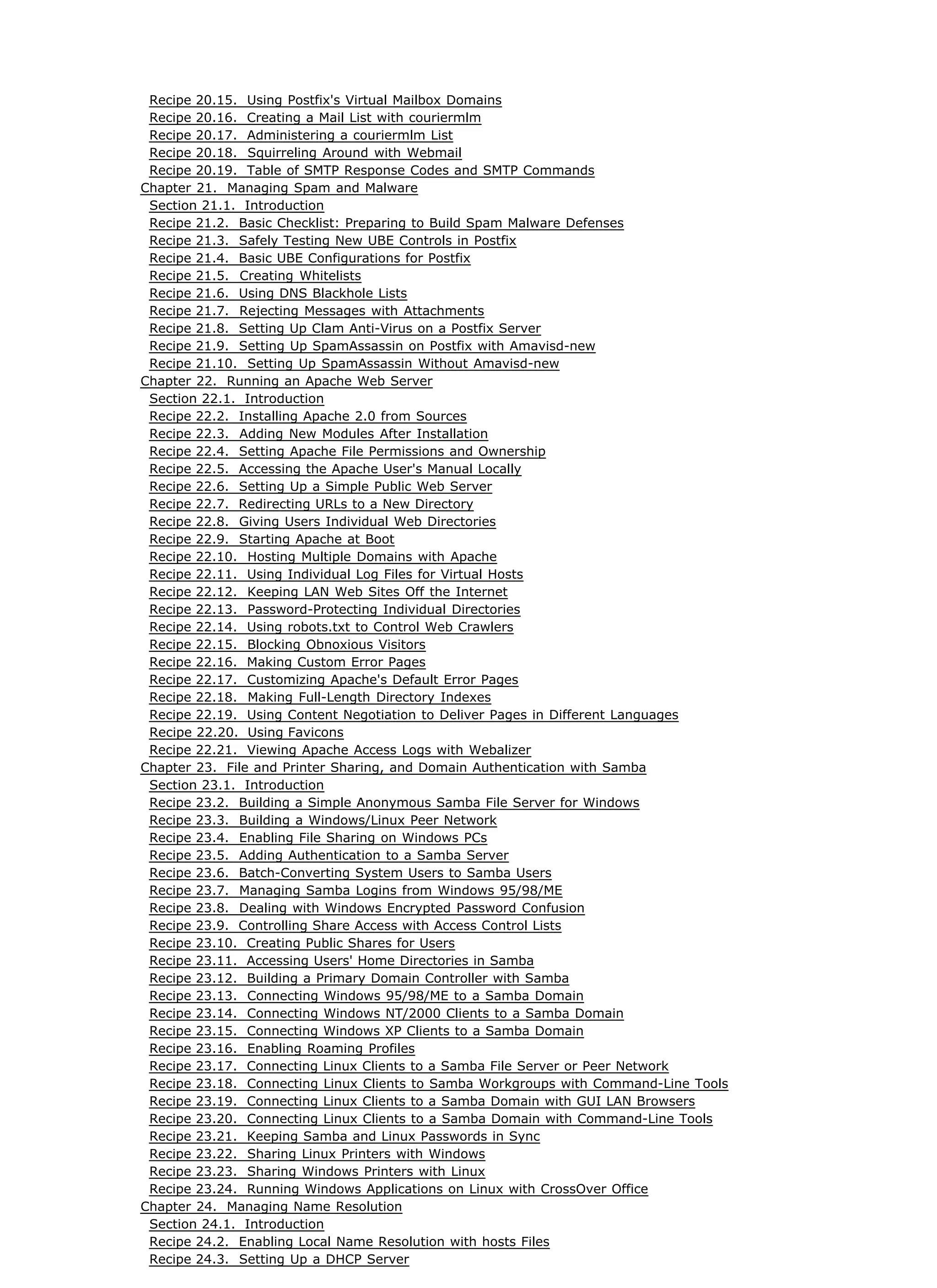
9.
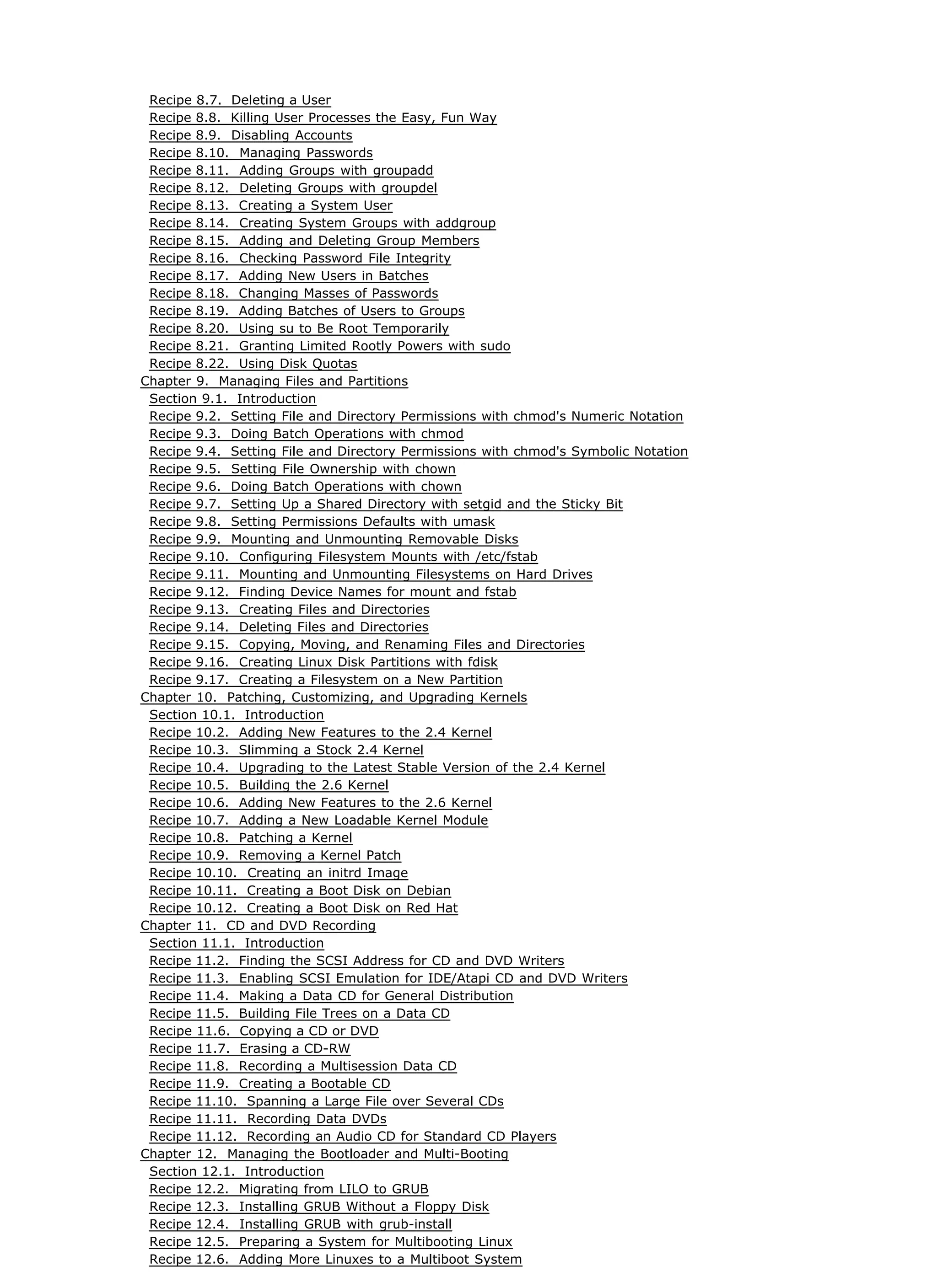
Recipe 8.7. Deletinga User
Recipe 8.8. Killing User Processes the Easy, Fun Way
Recipe 8.9. Disabling Accounts
Recipe 8.10. Managing Passwords
Recipe 8.11. Adding Groups with groupadd
Recipe 8.12. Deleting Groups with groupdel
Recipe 8.13. Creating a System User
Recipe 8.14. Creating System Groups with addgroup
Recipe 8.15. Adding and Deleting Group Members
Recipe 8.16. Checking Password File Integrity
Recipe 8.17. Adding New Users in Batches
Recipe 8.18. Changing Masses of Passwords
Recipe 8.19. Adding Batches of Users to Groups
Recipe 8.20. Using su to Be Root Temporarily
Recipe 8.21. Granting Limited Rootly Powers with sudo
Recipe 8.22. Using Disk Quotas
Chapter 9. Managing Files and Partitions
Section 9.1. Introduction
Recipe 9.2. Setting File and Directory Permissions with chmod's Numeric Notation
Recipe 9.3. Doing Batch Operations with chmod
Recipe 9.4. Setting File and Directory Permissions with chmod's Symbolic Notation
Recipe 9.5. Setting File Ownership with chown
Recipe 9.6. Doing Batch Operations with chown
Recipe 9.7. Setting Up a Shared Directory with setgid and the Sticky Bit
Recipe 9.8. Setting Permissions Defaults with umask
Recipe 9.9. Mounting and Unmounting Removable Disks
Recipe 9.10. Configuring Filesystem Mounts with /etc/fstab
Recipe 9.11. Mounting and Unmounting Filesystems on Hard Drives
Recipe 9.12. Finding Device Names for mount and fstab
Recipe 9.13. Creating Files and Directories
Recipe 9.14. Deleting Files and Directories
Recipe 9.15. Copying, Moving, and Renaming Files and Directories
Recipe 9.16. Creating Linux Disk Partitions with fdisk
Recipe 9.17. Creating a Filesystem on a New Partition
Chapter 10. Patching, Customizing, and Upgrading Kernels
Section 10.1. Introduction
Recipe 10.2. Adding New Features to the 2.4 Kernel
Recipe 10.3. Slimming a Stock 2.4 Kernel
Recipe 10.4. Upgrading to the Latest Stable Version of the 2.4 Kernel
Recipe 10.5. Building the 2.6 Kernel
Recipe 10.6. Adding New Features to the 2.6 Kernel
Recipe 10.7. Adding a New Loadable Kernel Module
Recipe 10.8. Patching a Kernel
Recipe 10.9. Removing a Kernel Patch
Recipe 10.10. Creating an initrd Image
Recipe 10.11. Creating a Boot Disk on Debian
Recipe 10.12. Creating a Boot Disk on Red Hat
Chapter 11. CD and DVD Recording
Section 11.1. Introduction
Recipe 11.2. Finding the SCSI Address for CD and DVD Writers
Recipe 11.3. Enabling SCSI Emulation for IDE/Atapi CD and DVD Writers
Recipe 11.4. Making a Data CD for General Distribution
Recipe 11.5. Building File Trees on a Data CD
Recipe 11.6. Copying a CD or DVD
Recipe 11.7. Erasing a CD-RW
Recipe 11.8. Recording a Multisession Data CD
Recipe 11.9. Creating a Bootable CD
Recipe 11.10. Spanning a Large File over Several CDs
Recipe 11.11. Recording Data DVDs
Recipe 11.12. Recording an Audio CD for Standard CD Players
Chapter 12. Managing the Bootloader and Multi-Booting
Section 12.1. Introduction
Recipe 12.2. Migrating from LILO to GRUB
Recipe 12.3. Installing GRUB Without a Floppy Disk
Recipe 12.4. Installing GRUB with grub-install
Recipe 12.5. Preparing a System for Multibooting Linux
Recipe 12.6. Adding More Linuxes to a Multiboot System
10.
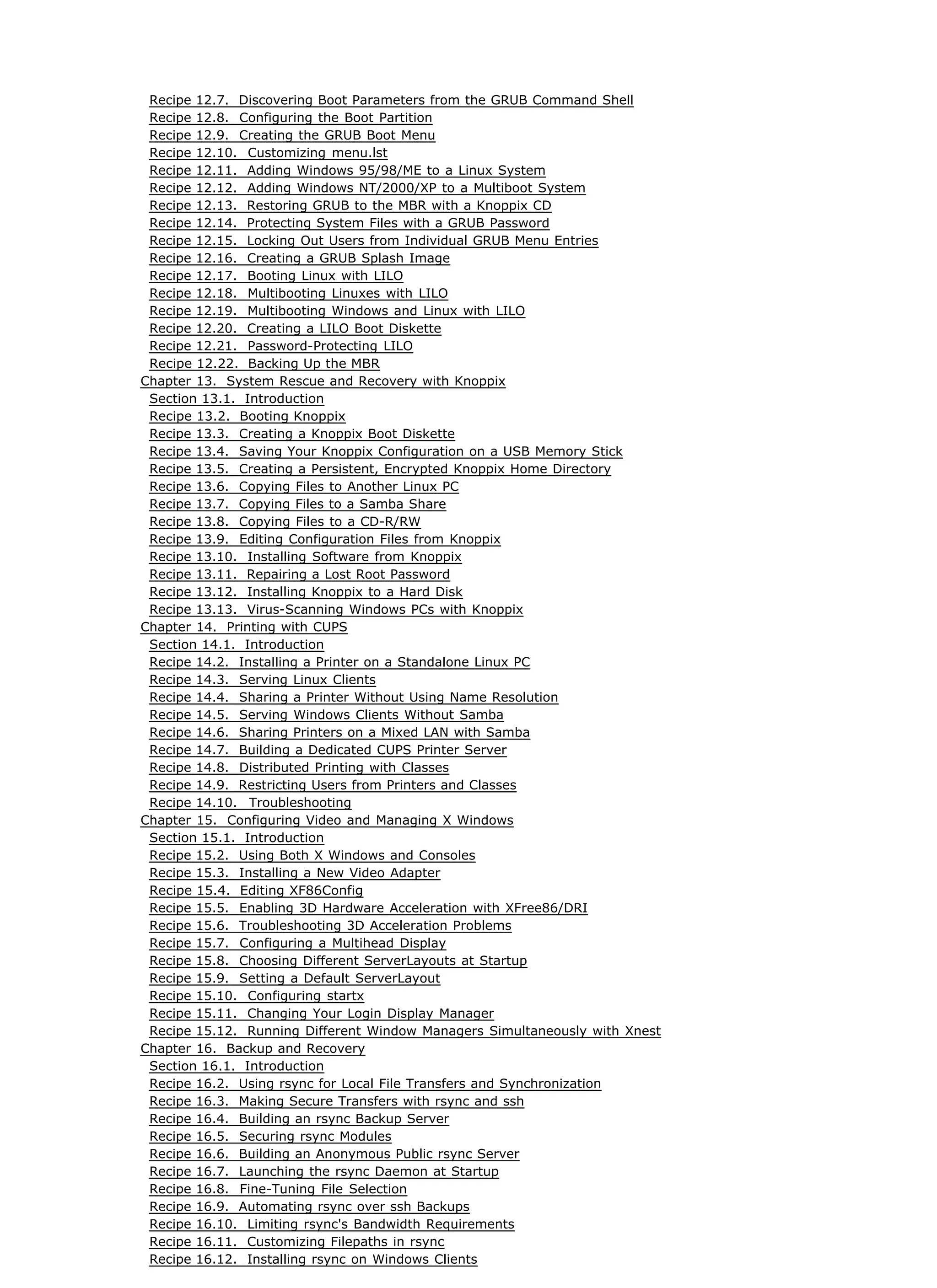
Recipe 12.7. DiscoveringBoot Parameters from the GRUB Command Shell
Recipe 12.8. Configuring the Boot Partition
Recipe 12.9. Creating the GRUB Boot Menu
Recipe 12.10. Customizing menu.lst
Recipe 12.11. Adding Windows 95/98/ME to a Linux System
Recipe 12.12. Adding Windows NT/2000/XP to a Multiboot System
Recipe 12.13. Restoring GRUB to the MBR with a Knoppix CD
Recipe 12.14. Protecting System Files with a GRUB Password
Recipe 12.15. Locking Out Users from Individual GRUB Menu Entries
Recipe 12.16. Creating a GRUB Splash Image
Recipe 12.17. Booting Linux with LILO
Recipe 12.18. Multibooting Linuxes with LILO
Recipe 12.19. Multibooting Windows and Linux with LILO
Recipe 12.20. Creating a LILO Boot Diskette
Recipe 12.21. Password-Protecting LILO
Recipe 12.22. Backing Up the MBR
Chapter 13. System Rescue and Recovery with Knoppix
Section 13.1. Introduction
Recipe 13.2. Booting Knoppix
Recipe 13.3. Creating a Knoppix Boot Diskette
Recipe 13.4. Saving Your Knoppix Configuration on a USB Memory Stick
Recipe 13.5. Creating a Persistent, Encrypted Knoppix Home Directory
Recipe 13.6. Copying Files to Another Linux PC
Recipe 13.7. Copying Files to a Samba Share
Recipe 13.8. Copying Files to a CD-R/RW
Recipe 13.9. Editing Configuration Files from Knoppix
Recipe 13.10. Installing Software from Knoppix
Recipe 13.11. Repairing a Lost Root Password
Recipe 13.12. Installing Knoppix to a Hard Disk
Recipe 13.13. Virus-Scanning Windows PCs with Knoppix
Chapter 14. Printing with CUPS
Section 14.1. Introduction
Recipe 14.2. Installing a Printer on a Standalone Linux PC
Recipe 14.3. Serving Linux Clients
Recipe 14.4. Sharing a Printer Without Using Name Resolution
Recipe 14.5. Serving Windows Clients Without Samba
Recipe 14.6. Sharing Printers on a Mixed LAN with Samba
Recipe 14.7. Building a Dedicated CUPS Printer Server
Recipe 14.8. Distributed Printing with Classes
Recipe 14.9. Restricting Users from Printers and Classes
Recipe 14.10. Troubleshooting
Chapter 15. Configuring Video and Managing X Windows
Section 15.1. Introduction
Recipe 15.2. Using Both X Windows and Consoles
Recipe 15.3. Installing a New Video Adapter
Recipe 15.4. Editing XF86Config
Recipe 15.5. Enabling 3D Hardware Acceleration with XFree86/DRI
Recipe 15.6. Troubleshooting 3D Acceleration Problems
Recipe 15.7. Configuring a Multihead Display
Recipe 15.8. Choosing Different ServerLayouts at Startup
Recipe 15.9. Setting a Default ServerLayout
Recipe 15.10. Configuring startx
Recipe 15.11. Changing Your Login Display Manager
Recipe 15.12. Running Different Window Managers Simultaneously with Xnest
Chapter 16. Backup and Recovery
Section 16.1. Introduction
Recipe 16.2. Using rsync for Local File Transfers and Synchronization
Recipe 16.3. Making Secure Transfers with rsync and ssh
Recipe 16.4. Building an rsync Backup Server
Recipe 16.5. Securing rsync Modules
Recipe 16.6. Building an Anonymous Public rsync Server
Recipe 16.7. Launching the rsync Daemon at Startup
Recipe 16.8. Fine-Tuning File Selection
Recipe 16.9. Automating rsync over ssh Backups
Recipe 16.10. Limiting rsync's Bandwidth Requirements
Recipe 16.11. Customizing Filepaths in rsync
Recipe 16.12. Installing rsync on Windows Clients
11.
Recipe 16.13. Creatinga Message of the Day for rsync
Recipe 16.14. Creating a Bootable System Restore CD with Mondo Rescue
Recipe 16.15. Verifying the Mondo Backup
Recipe 16.16. Creating a Bootable System Restore DVD with Mondo Rescue
Recipe 16.17. Using Mondo Rescue to Clone Linux Systems
Recipe 16.18. Using the mindi-kernel for a "Sane" Backup
Recipe 16.19. Restoring a System from a Mondo Rescue Disk
Recipe 16.20. Restoring Selected Files from a Mondo Disk
Chapter 17. Remote Access
Section 17.1. Introduction
Recipe 17.2. Setting Up OpenSSH the First Time
Recipe 17.3. Generating New Host Keys
Recipe 17.4. Authenticating Via Public Keys
Recipe 17.5. Using Multiple Key Pairs
Recipe 17.6. Passwordless Logins with ssh-agent
Recipe 17.7. Better Passwordless Logins with keychain
Recipe 17.8. Passwordless Logins for cron Jobs
Recipe 17.9. Shutting Down ssh-agent Automatically at Logout
Recipe 17.10. Customizing the Bash Prompt for ssh
Recipe 17.11. Tunneling X over SSH
Recipe 17.12. Connecting from a Windows PC
Recipe 17.13. Setting File Permissions on ssh Files
Chapter 18. Version Control
Section 18.1. Introduction
Recipe 18.2. Building a Simple Local RCS Repository
Recipe 18.3. Retrieving Older File Revisions from RCS
Recipe 18.4. Comparing File Versions in RCS
Recipe 18.5. Managing System Configuration Files with RCS
Recipe 18.6. Using CVS for a Single-User Local Repository
Recipe 18.7. Adding New Files to a CVS Repository
Recipe 18.8. Deleting Files from a CVS Repository
Recipe 18.9. Creating a Shared CVS Repository
Recipe 18.10. Sharing a Single Repository Between Several Groups
Recipe 18.11. Accessing a Remote CVS Repository
Recipe 18.12. Updating Your Working Files in CVS
Recipe 18.13. Retrieving Specific Older Revisions from CVS
Recipe 18.14. Building an Anonymous Read-Only CVS Repository with Pserver
Recipe 18.15. Mirroring a CVS Repository
Recipe 18.16. Storing Binary Files in CVS
Recipe 18.17. Creating Release Snapshots with Tags
Recipe 18.18. Creating Stable and Development Branches for a Project
Recipe 18.19. Customizing Your CVS Environment
Recipe 18.20. Calculating Storage Size for a CVS Repository
Chapter 19. Keeping Time with NTP
Section 19.1. Introduction
Recipe 19.2. Building a Local Time Server
Recipe 19.3. Connecting to a Local Time Server
Recipe 19.4. Adding Access Controls
Recipe 19.5. Deciding Which NTP Pools to Use
Recipe 19.6. Connecting to a Time Server from an Intermittent Connection
Recipe 19.7. Setting Up Multiple Local Time Servers
Recipe 19.8. Using NTP Keys for Authentication
Chapter 20. Building a Postfix Mail Server
Section 20.1. Introduction
Recipe 20.2. Building a POP3 Mail Server
Recipe 20.3. Building a POP3 Mail Server on Debian
Recipe 20.4. Testing the SMTP/POP3 Mail Server
Recipe 20.5. Sending Internet Mail
Recipe 20.6. Receiving Internet Mail
Recipe 20.7. Installing Cyrus-SASL for SMTP Authorization
Recipe 20.8. Installing Cyrus-SASL on Debian
Recipe 20.9. Setting Up smtp-auth to Authenticate Users
Recipe 20.10. Using smtp-auth to Authenticate Postfix to Another Server
Recipe 20.11. Configuring a Fully Qualified Domain Name
Recipe 20.12. Building an IMAP Mail Server
Recipe 20.13. Connecting Your Users
Recipe 20.14. Sharing IMAP Folders
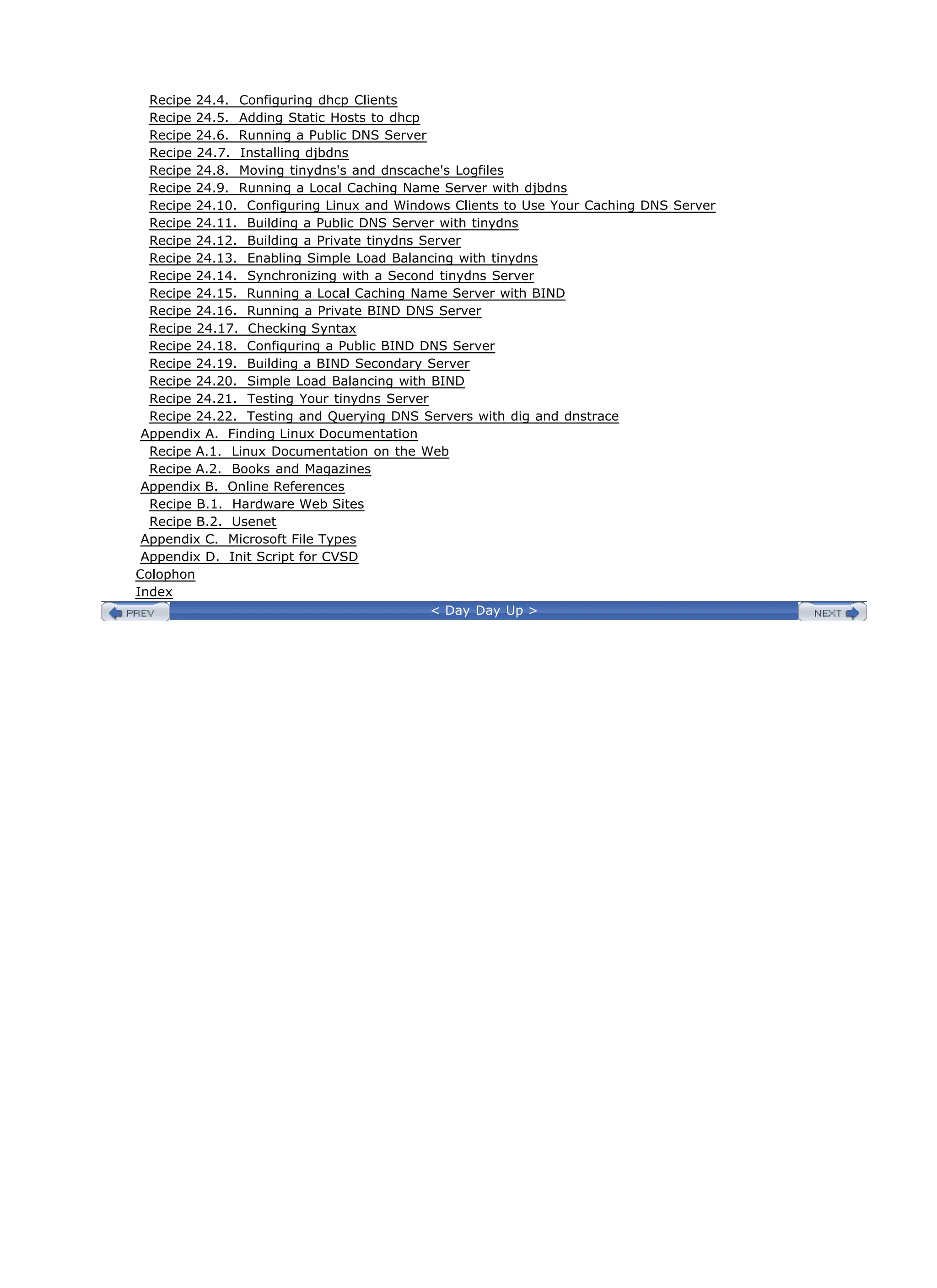
12.
Recipe 20.15. UsingPostfix's Virtual Mailbox Domains
Recipe 20.16. Creating a Mail List with couriermlm
Recipe 20.17. Administering a couriermlm List
Recipe 20.18. Squirreling Around with Webmail
Recipe 20.19. Table of SMTP Response Codes and SMTP Commands
Chapter 21. Managing Spam and Malware
Section 21.1. Introduction
Recipe 21.2. Basic Checklist: Preparing to Build Spam Malware Defenses
Recipe 21.3. Safely Testing New UBE Controls in Postfix
Recipe 21.4. Basic UBE Configurations for Postfix
Recipe 21.5. Creating Whitelists
Recipe 21.6. Using DNS Blackhole Lists
Recipe 21.7. Rejecting Messages with Attachments
Recipe 21.8. Setting Up Clam Anti-Virus on a Postfix Server
Recipe 21.9. Setting Up SpamAssassin on Postfix with Amavisd-new
Recipe 21.10. Setting Up SpamAssassin Without Amavisd-new
Chapter 22. Running an Apache Web Server
Section 22.1. Introduction
Recipe 22.2. Installing Apache 2.0 from Sources
Recipe 22.3. Adding New Modules After Installation
Recipe 22.4. Setting Apache File Permissions and Ownership
Recipe 22.5. Accessing the Apache User's Manual Locally
Recipe 22.6. Setting Up a Simple Public Web Server
Recipe 22.7. Redirecting URLs to a New Directory
Recipe 22.8. Giving Users Individual Web Directories
Recipe 22.9. Starting Apache at Boot
Recipe 22.10. Hosting Multiple Domains with Apache
Recipe 22.11. Using Individual Log Files for Virtual Hosts
Recipe 22.12. Keeping LAN Web Sites Off the Internet
Recipe 22.13. Password-Protecting Individual Directories
Recipe 22.14. Using robots.txt to Control Web Crawlers
Recipe 22.15. Blocking Obnoxious Visitors
Recipe 22.16. Making Custom Error Pages
Recipe 22.17. Customizing Apache's Default Error Pages
Recipe 22.18. Making Full-Length Directory Indexes
Recipe 22.19. Using Content Negotiation to Deliver Pages in Different Languages
Recipe 22.20. Using Favicons
Recipe 22.21. Viewing Apache Access Logs with Webalizer
Chapter 23. File and Printer Sharing, and Domain Authentication with Samba
Section 23.1. Introduction
Recipe 23.2. Building a Simple Anonymous Samba File Server for Windows
Recipe 23.3. Building a Windows/Linux Peer Network
Recipe 23.4. Enabling File Sharing on Windows PCs
Recipe 23.5. Adding Authentication to a Samba Server
Recipe 23.6. Batch-Converting System Users to Samba Users
Recipe 23.7. Managing Samba Logins from Windows 95/98/ME
Recipe 23.8. Dealing with Windows Encrypted Password Confusion
Recipe 23.9. Controlling Share Access with Access Control Lists
Recipe 23.10. Creating Public Shares for Users
Recipe 23.11. Accessing Users' Home Directories in Samba
Recipe 23.12. Building a Primary Domain Controller with Samba
Recipe 23.13. Connecting Windows 95/98/ME to a Samba Domain
Recipe 23.14. Connecting Windows NT/2000 Clients to a Samba Domain
Recipe 23.15. Connecting Windows XP Clients to a Samba Domain
Recipe 23.16. Enabling Roaming Profiles
Recipe 23.17. Connecting Linux Clients to a Samba File Server or Peer Network
Recipe 23.18. Connecting Linux Clients to Samba Workgroups with Command-Line Tools
Recipe 23.19. Connecting Linux Clients to a Samba Domain with GUI LAN Browsers
Recipe 23.20. Connecting Linux Clients to a Samba Domain with Command-Line Tools
Recipe 23.21. Keeping Samba and Linux Passwords in Sync
Recipe 23.22. Sharing Linux Printers with Windows
Recipe 23.23. Sharing Windows Printers with Linux
Recipe 23.24. Running Windows Applications on Linux with CrossOver Office
Chapter 24. Managing Name Resolution
Section 24.1. Introduction
Recipe 24.2. Enabling Local Name Resolution with hosts Files
Recipe 24.3. Setting Up a DHCP Server
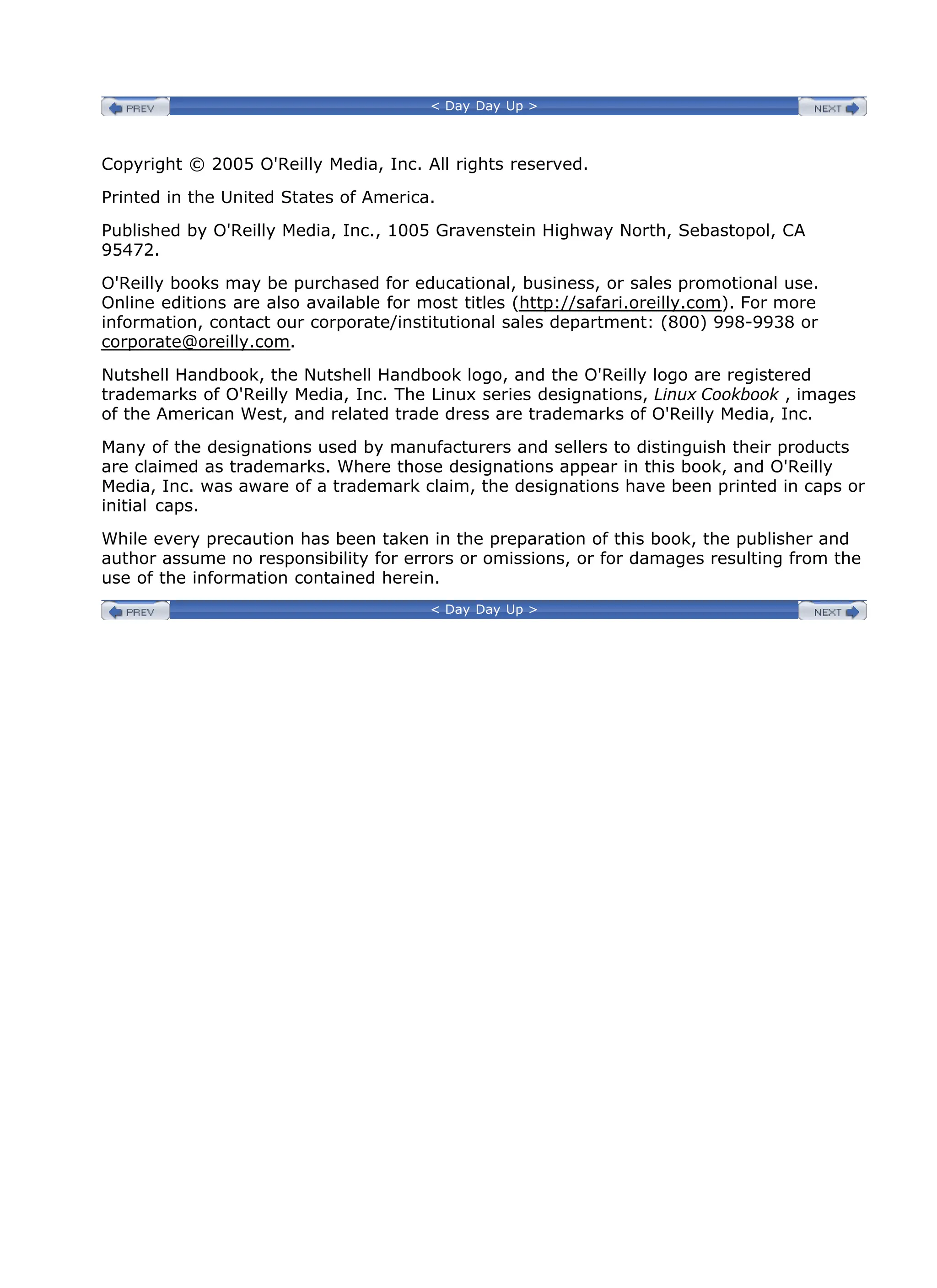
13.
Recipe 24.4. Configuringdhcp Clients
Recipe 24.5. Adding Static Hosts to dhcp
Recipe 24.6. Running a Public DNS Server
Recipe 24.7. Installing djbdns
Recipe 24.8. Moving tinydns's and dnscache's Logfiles
Recipe 24.9. Running a Local Caching Name Server with djbdns
Recipe 24.10. Configuring Linux and Windows Clients to Use Your Caching DNS Server
Recipe 24.11. Building a Public DNS Server with tinydns
Recipe 24.12. Building a Private tinydns Server
Recipe 24.13. Enabling Simple Load Balancing with tinydns
Recipe 24.14. Synchronizing with a Second tinydns Server
Recipe 24.15. Running a Local Caching Name Server with BIND
Recipe 24.16. Running a Private BIND DNS Server
Recipe 24.17. Checking Syntax
Recipe 24.18. Configuring a Public BIND DNS Server
Recipe 24.19. Building a BIND Secondary Server
Recipe 24.20. Simple Load Balancing with BIND
Recipe 24.21. Testing Your tinydns Server
Recipe 24.22. Testing and Querying DNS Servers with dig and dnstrace
Appendix A. Finding Linux Documentation
Recipe A.1. Linux Documentation on the Web
Recipe A.2. Books and Magazines
Appendix B. Online References
Recipe B.1. Hardware Web Sites
Recipe B.2. Usenet
Appendix C. Microsoft File Types
Appendix D. Init Script for CVSD
Colophon
Index
< Day Day Up >
< Day DayUp >
Dedication
To Dawn Marie.
During the writing of this book, she tilled the fields, trained the horses, cooked the meals,
cleaned the ditches, and graciously fended off generous neighbors bearing large zucchinis.
No author could ask for more. Thank you for 14 great years; may we have many more.
< Day Day Up >
16.
< Day DayUp >
Preface
So: you're a relatively new Linux user. You've got Linux installed, you've managed to log
in, do some web browsing, send and receive email, and—now what? Although you can
handle some of the basics, you feel like you're flying blind: you know you've got lots of
really powerful stuff at your fingertips, or at least so your Linux guru friend told you, but
how do you make it do tricks? What's there, and how does it work? What's this thing
called grep that they're always talking about? How do you Samba? And where's the #$%^
documentation?
The Linux-Unix world is abundantly documented. No, really! You can always find an
answer, if you know where to look. The problem, of course, is knowing where to look.
There are man pages, info pages, READMEs, HTML manuals, and the code itself. You don't
have to be a programmer to unearth useful bits in source code, because the comments
often tell you what you need to know.
There are thousands upon thousands of online communities, one (or more) surrounding
nearly every bit of software in the Linux universe. Nearly every program, no matter how
small, has its own user mailing list. Every Linux distribution has its own mailing lists and
user forums. There are forums and lists and Usenet groups for every computing subject
under the sun.
And of course there are books and magazines of every description. So the real problem
with Linux documentation is not the lack of it, but finding the bits you need without
having to embark on a lengthy, heroic quest.
< Day Day Up >
17.
< Day DayUp >
Audience
This book is aimed at folks who want to know what button to push. Understanding the
underlying theory is useful, but if you can't make the darn thing work, not very helpful. So
it's light on theory and heavy on how-to-make-this-go, with detailed, step-by-step
instructions. I've included many references to additional resources.
Readers should have a bit of Linux experience. You don't need to be a guru, but you
should have some familiarity with the basics of booting up and shutting down, starting
applications, Web surfing, and poking around the filesystem. You should know how to find
and use the command line, as well as work in a graphical environment. You should
understand that Linux is a true multi-user system, and that you use an ordinary
unprivileged user account as much as possible, and that you only invoke root when you
really need to.
This book assumes that you are in charge of a PC or LAN, and can acquire rootly powers
when the occasion calls for them. You might be a power user who wants complete control
of your Linux box, or a home user who wants to run a personal web or mail server, or set
up a small LAN. Perhaps you are a Windows system admininstrator who has suddenly been
ordered to "do Linux," and you need to know how to set up Linux servers for Windows
clients. Maybe you want to add Linux servers to an existing network. You might need to
integrate Linux and Windows desktop users on a LAN.
Or you have no need for Windows at all, and just want to learn Linux system
administration.
< Day Day Up >
18.
< Day DayUp >
What Is Included/Omitted
Given that there are thousands of software packages to choose from, almost all of which
do something useful, it was a foregone conclusion that I couldn't cover everything. Or
even most of everything. I decided what to include, and what to leave out, based on my
opinion of what a fundamental Linux skill set should include. (You may have different
ideas.) I included programs that I consider to be the best-of-breed, such djbdns, GRUB,
Apache 2, vim, and Postfix. And I didn't neglect old standbys like LILO and BIND.
You'll find some excellent, innovative scripts for:
Adding users in batches
Changing passwords in batches
Finding all the installed documentation for a program
Finding orphaned libraries on RPM-based systems, and adding them to the RPM
database
I decided not to include productivity and desktop applications, like Open Office, KMail,
Firefox, Konqueror, the Gimp, GnuCash, and so forth. This book is about building
infrastructure. Once you master the fundamentals of running and maintaining a Linux
system, it will take you anywhere you want to go.
< Day Day Up >
19.
< Day DayUp >
Platforms
There are more Linux distributions than can be counted; there are literally thousands of
distributions, many of which are peculiar to a company, a campus, or even a circle of
friends who like to roll their own. However, the world of distributions breaks (not very
cleanly) into two large camps: RPM-based systems, represented in this book by Red Hat
and Fedora, and apt-based systems, represented by Debian. Debian-based distributions
are spreading like weeds, such as Knoppix, Xandros, Libranet, Unbuntu, and Linspire.
Even if you are using a distribution that does not fall into one of these two categories,
such as Slackware or Gentoo, the fundamentals are pretty much the same. The kernel is
the same; the programs and utilities available are the same; the window managers are
the same; the only substantial difference is the way you install software.
That's not to say there aren't other differences between Linux distributions. A chronic
bugaboo with Linux is differing file locations on different distributions. Get used to it; it's
not going to go away. This book provides several excellent methods for finding out where
your particular distribution puts configuration files, executables, and program
documentation.
< Day Day Up >
20.
< Day DayUp >
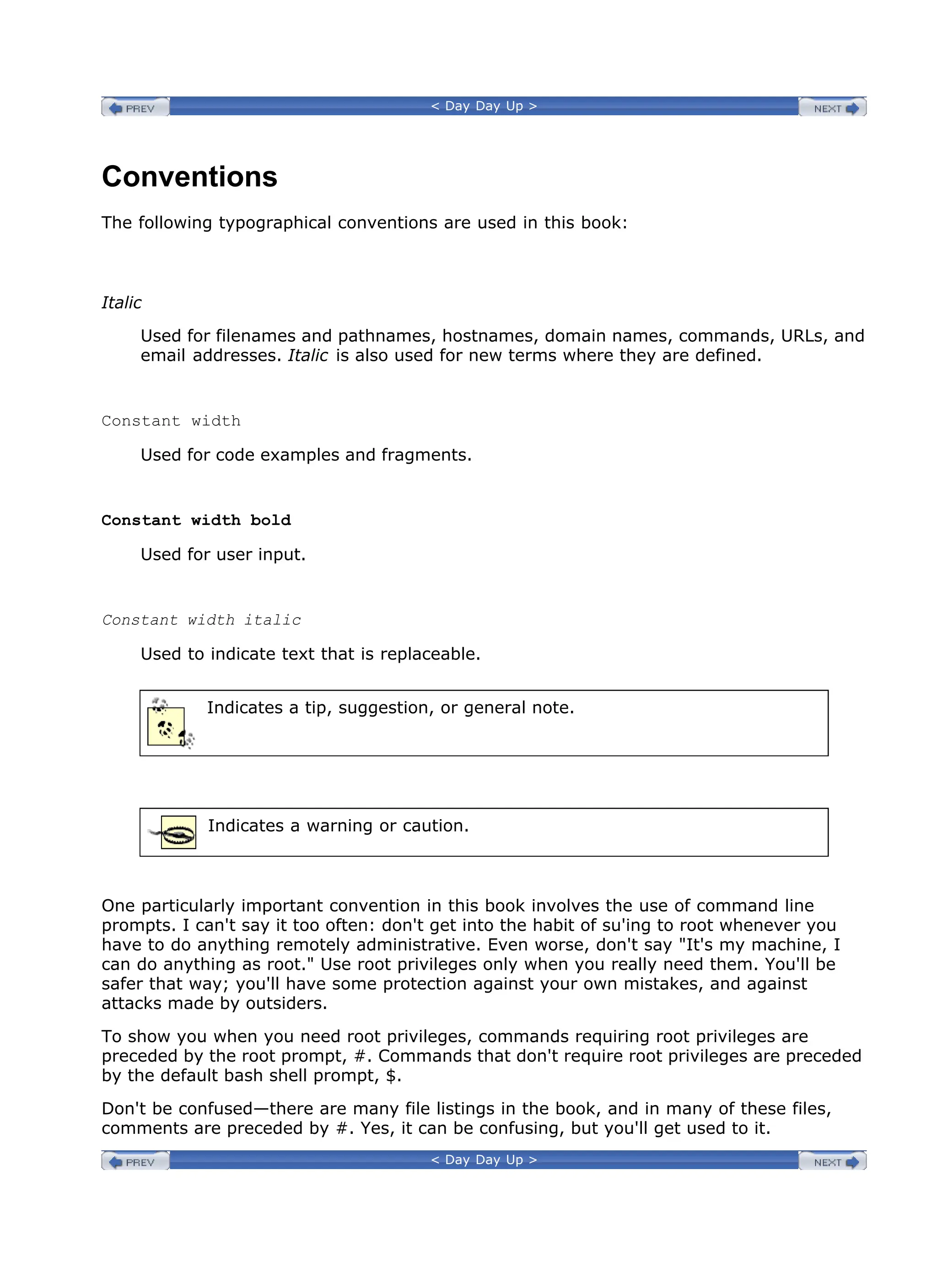
Conventions
The following typographical conventions are used in this book:
Italic
Used for filenames and pathnames, hostnames, domain names, commands, URLs, and
email addresses. Italic is also used for new terms where they are defined.
Constant width
Used for code examples and fragments.
Constant width bold
Used for user input.
Constant width italic
Used to indicate text that is replaceable.
Indicates a tip, suggestion, or general note.
Indicates a warning or caution.
One particularly important convention in this book involves the use of command line
prompts. I can't say it too often: don't get into the habit of su'ing to root whenever you
have to do anything remotely administrative. Even worse, don't say "It's my machine, I
can do anything as root." Use root privileges only when you really need them. You'll be
safer that way; you'll have some protection against your own mistakes, and against
attacks made by outsiders.
To show you when you need root privileges, commands requiring root privileges are
preceded by the root prompt, #. Commands that don't require root privileges are preceded
by the default bash shell prompt, $.
Don't be confused—there are many file listings in the book, and in many of these files,
comments are preceded by #. Yes, it can be confusing, but you'll get used to it.
< Day Day Up >
21.
< Day DayUp >
Downloads and Feedback
Doubtless this book, despite the heroic efforts of me and the fabulous O'Reilly team,
contains flaws, errors, and omissions. Please email your feedback and suggestions to
cookbook@bratgrrl.com, so we can make the second edition even better. Be sure to visit
http://tuxcomputing.com for errata, updates, and to download the scripts and
configuration files used in the book.
This book was authored entirely in Open Office Writer, on Libranet Debian 2.8.
< Day Day Up >
22.
< Day DayUp >
Comments and Questions
Please address comments and questions concerning this book to the publisher:
O'Reilly Media, Inc.
1005 Gravenstein Highway North
Sebastopol, CA 95472
(800) 998-9938 (in the United States or Canada)
(707) 829-0515 (international or local)
(707) 829-0104 (fax)
There is a web page for this book, which lists errata, examples, and any additional
information. You can access this page at:
http://www.oreilly.com/catalog/linuxckbk/
To comment on or ask technical questions about this book, send email to:
bookquestions@oreilly.com
For more information about books, conferences, software, Resource Centers, and the
O'Reilly Network, see the O'Reilly web site at:
http://www.oreilly.com
< Day Day Up >
23.
< Day DayUp >
Acknowledgments
Thank you to ace O'Reilly editor Michael Loukides, whose good taste, eagle editorial eye,
patient endurance, and implacable insistence made this a much better book.
Thank you to ace technical reviewer Jenn Vesperman, and her attention to detail. Silly
computers are completely literal, and must be fed precise input—thanks Jenn!
Many thanks to Akkana Peck, Jenn Vesperman, Paul Heinlein, and Peter Samuelson,
whose contributions appear in this book. Heartfelt thanks to the gang at Linuxchix,
including Jenn Vesperman (benevolent dictator of Linuxchix), Dancer Vesperman,
Danamania (the camera does not lie), Colby, Evilpig, Almut Behrens, Andrew (Mandrake
Guru), Hamster, Piglet, Val Henson (uppity rabble rouser), H. Peter Anvin (kernel guru and
rabbit rouser), Rik Rose, Devdas Bhagat, David North (for comic relief), Telsa Gwynne,
Maria Blackmore, Meredydd Luff, Kai MacTane, and Erinn Clark (for more uppity rabble-
rousing). Linuxchix rawks!
I'm sure I missed some folks who patiently endured my endless pestering. Tell me who
you are, and I'll fix it in the second edition.
< Day Day Up >
24.
< Day DayUp >
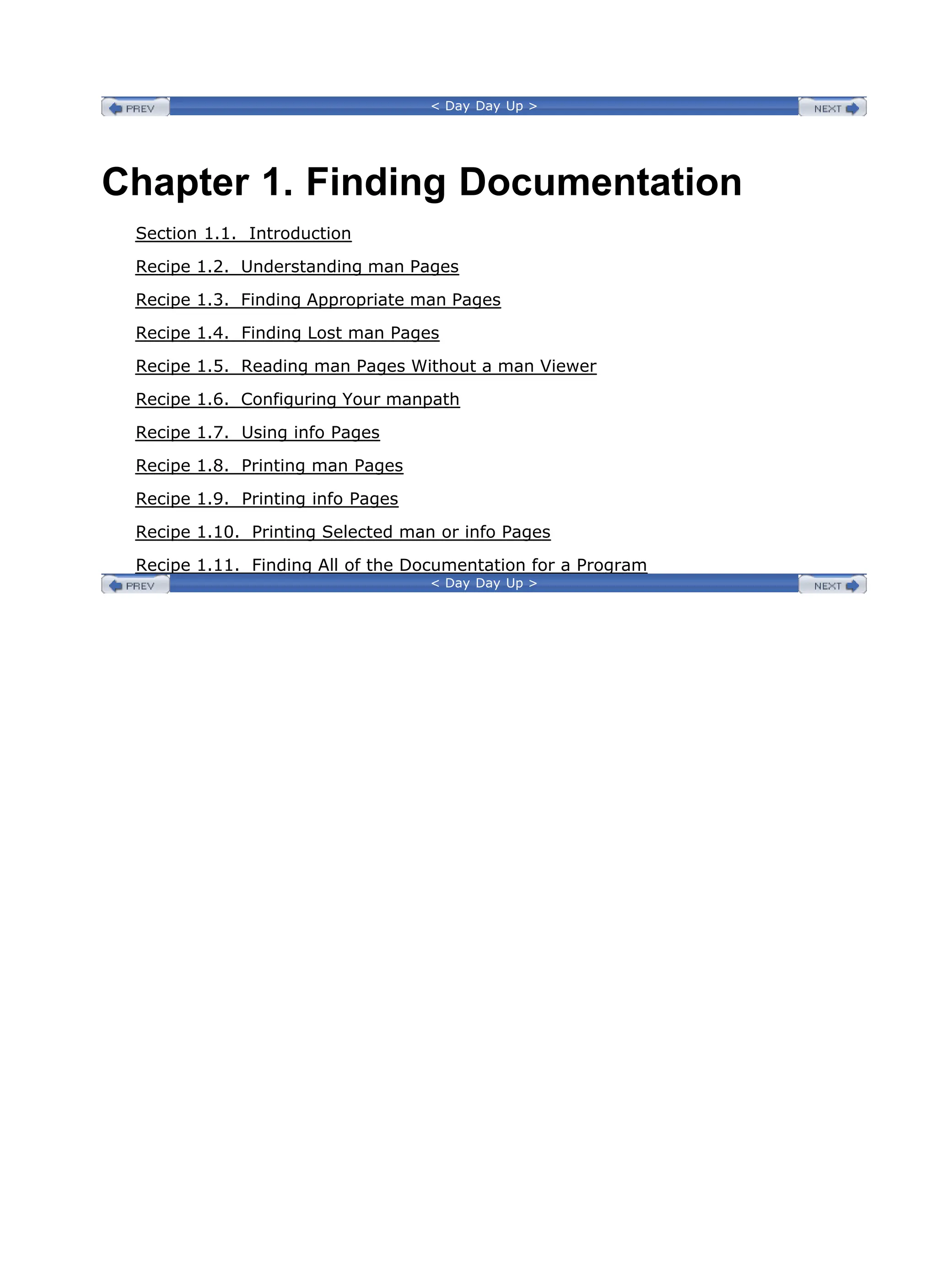
Chapter 1. Finding Documentation
Section 1.1. Introduction
Recipe 1.2. Understanding man Pages
Recipe 1.3. Finding Appropriate man Pages
Recipe 1.4. Finding Lost man Pages
Recipe 1.5. Reading man Pages Without a man Viewer
Recipe 1.6. Configuring Your manpath
Recipe 1.7. Using info Pages
Recipe 1.8. Printing man Pages
Recipe 1.9. Printing info Pages
Recipe 1.10. Printing Selected man or info Pages
Recipe 1.11. Finding All of the Documentation for a Program
< Day Day Up >
25.
< Day DayUp >
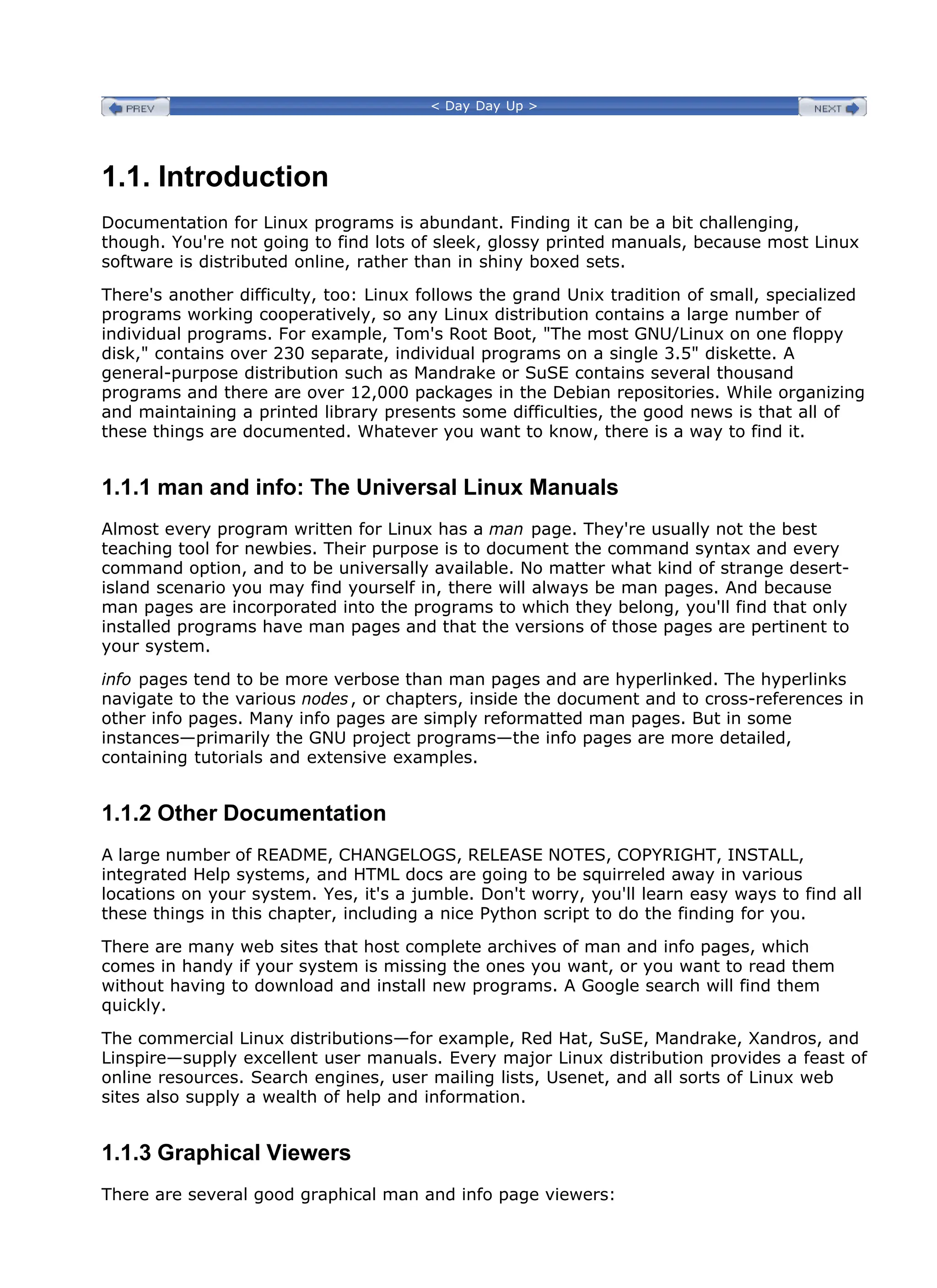
1.1. Introduction
Documentation for Linux programs is abundant. Finding it can be a bit challenging,
though. You're not going to find lots of sleek, glossy printed manuals, because most Linux
software is distributed online, rather than in shiny boxed sets.
There's another difficulty, too: Linux follows the grand Unix tradition of small, specialized
programs working cooperatively, so any Linux distribution contains a large number of
individual programs. For example, Tom's Root Boot, "The most GNU/Linux on one floppy
disk," contains over 230 separate, individual programs on a single 3.5" diskette. A
general-purpose distribution such as Mandrake or SuSE contains several thousand
programs and there are over 12,000 packages in the Debian repositories. While organizing
and maintaining a printed library presents some difficulties, the good news is that all of
these things are documented. Whatever you want to know, there is a way to find it.
1.1.1 man and info: The Universal Linux Manuals
Almost every program written for Linux has a man page. They're usually not the best
teaching tool for newbies. Their purpose is to document the command syntax and every
command option, and to be universally available. No matter what kind of strange desert-
island scenario you may find yourself in, there will always be man pages. And because
man pages are incorporated into the programs to which they belong, you'll find that only
installed programs have man pages and that the versions of those pages are pertinent to
your system.
info pages tend to be more verbose than man pages and are hyperlinked. The hyperlinks
navigate to the various nodes, or chapters, inside the document and to cross-references in
other info pages. Many info pages are simply reformatted man pages. But in some
instances—primarily the GNU project programs—the info pages are more detailed,
containing tutorials and extensive examples.
1.1.2 Other Documentation
A large number of README, CHANGELOGS, RELEASE NOTES, COPYRIGHT, INSTALL,
integrated Help systems, and HTML docs are going to be squirreled away in various
locations on your system. Yes, it's a jumble. Don't worry, you'll learn easy ways to find all
these things in this chapter, including a nice Python script to do the finding for you.
There are many web sites that host complete archives of man and info pages, which
comes in handy if your system is missing the ones you want, or you want to read them
without having to download and install new programs. A Google search will find them
quickly.
The commercial Linux distributions—for example, Red Hat, SuSE, Mandrake, Xandros, and
Linspire—supply excellent user manuals. Every major Linux distribution provides a feast of
online resources. Search engines, user mailing lists, Usenet, and all sorts of Linux web
sites also supply a wealth of help and information.
1.1.3 Graphical Viewers
There are several good graphical man and info page viewers:
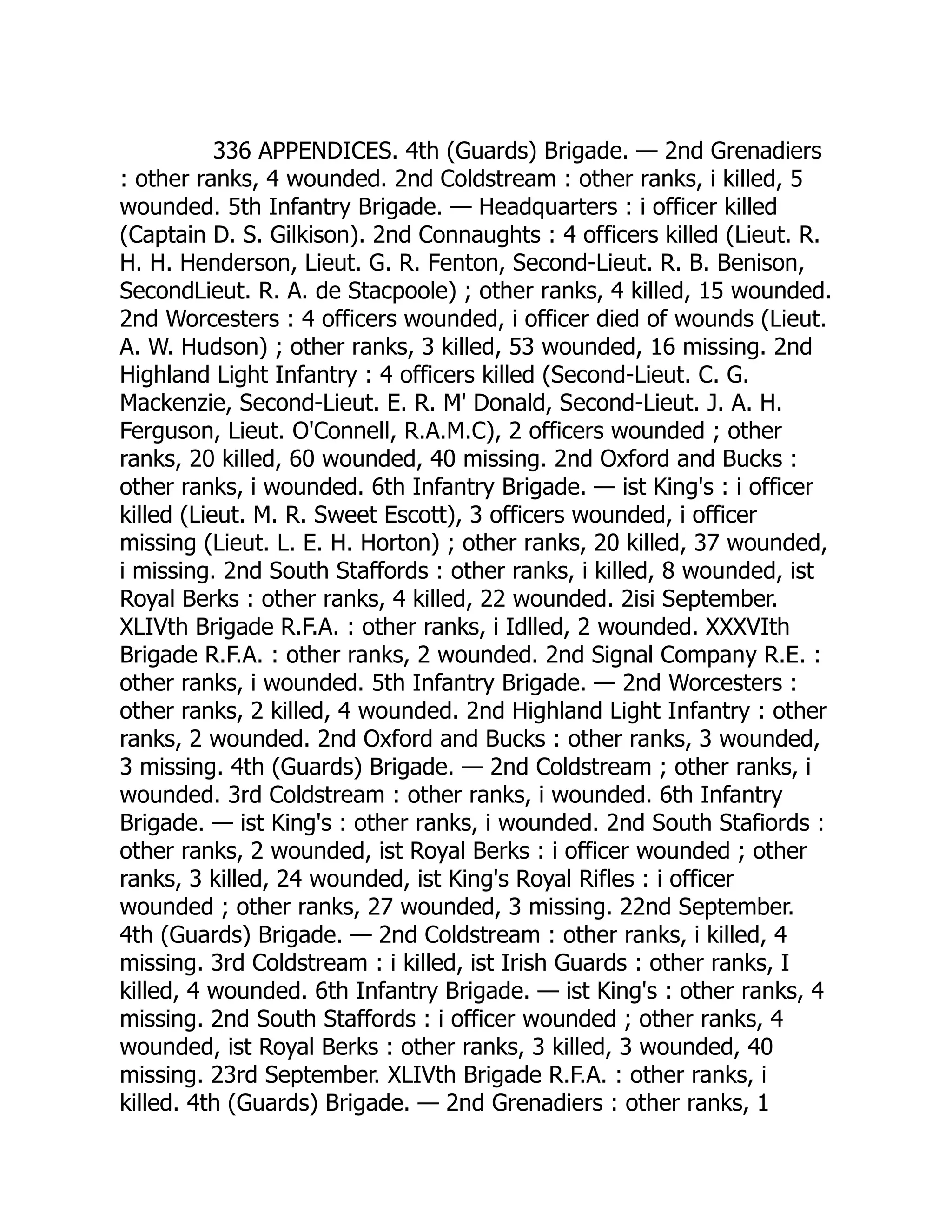
336 APPENDICES. 4th(Guards) Brigade. — 2nd Grenadiers
: other ranks, 4 wounded. 2nd Coldstream : other ranks, i killed, 5
wounded. 5th Infantry Brigade. — Headquarters : i officer killed
(Captain D. S. Gilkison). 2nd Connaughts : 4 officers killed (Lieut. R.
H. H. Henderson, Lieut. G. R. Fenton, Second-Lieut. R. B. Benison,
SecondLieut. R. A. de Stacpoole) ; other ranks, 4 killed, 15 wounded.
2nd Worcesters : 4 officers wounded, i officer died of wounds (Lieut.
A. W. Hudson) ; other ranks, 3 killed, 53 wounded, 16 missing. 2nd
Highland Light Infantry : 4 officers killed (Second-Lieut. C. G.
Mackenzie, Second-Lieut. E. R. M' Donald, Second-Lieut. J. A. H.
Ferguson, Lieut. O'Connell, R.A.M.C), 2 officers wounded ; other
ranks, 20 killed, 60 wounded, 40 missing. 2nd Oxford and Bucks :
other ranks, i wounded. 6th Infantry Brigade. — ist King's : i officer
killed (Lieut. M. R. Sweet Escott), 3 officers wounded, i officer
missing (Lieut. L. E. H. Horton) ; other ranks, 20 killed, 37 wounded,
i missing. 2nd South Staffords : other ranks, i killed, 8 wounded, ist
Royal Berks : other ranks, 4 killed, 22 wounded. 2isi September.
XLIVth Brigade R.F.A. : other ranks, i Idlled, 2 wounded. XXXVIth
Brigade R.F.A. : other ranks, 2 wounded. 2nd Signal Company R.E. :
other ranks, i wounded. 5th Infantry Brigade. — 2nd Worcesters :
other ranks, 2 killed, 4 wounded. 2nd Highland Light Infantry : other
ranks, 2 wounded. 2nd Oxford and Bucks : other ranks, 3 wounded,
3 missing. 4th (Guards) Brigade. — 2nd Coldstream ; other ranks, i
wounded. 3rd Coldstream : other ranks, i wounded. 6th Infantry
Brigade. — ist King's : other ranks, i wounded. 2nd South Stafiords :
other ranks, 2 wounded, ist Royal Berks : i officer wounded ; other
ranks, 3 killed, 24 wounded, ist King's Royal Rifles : i officer
wounded ; other ranks, 27 wounded, 3 missing. 22nd September.
4th (Guards) Brigade. — 2nd Coldstream : other ranks, i killed, 4
missing. 3rd Coldstream : i killed, ist Irish Guards : other ranks, I
killed, 4 wounded. 6th Infantry Brigade. — ist King's : other ranks, 4
missing. 2nd South Staffords : i officer wounded ; other ranks, 4
wounded, ist Royal Berks : other ranks, 3 killed, 3 wounded, 40
missing. 23rd September. XLIVth Brigade R.F.A. : other ranks, i
killed. 4th (Guards) Brigade. — 2nd Grenadiers : other ranks, 1
28.
killed. 2nd Coldstream: other ranks, i wounded, ist Irish Guards :
other ranks, 4 wounded. 24th September. 35th (Heavy) Battery
R.G.A. : other ranks. 2 wounded. 4th (Guards) Brigade. — 2nd
Grenadiers : other ranks, 2 killed, 2 wounded. 2nd Coldstream :
other ranks, 4 wounded. 3rd Coldstream : other ranks, i wounded, 4
missing. 5th Field Company R.E. : other ranks, i wounded.
29.
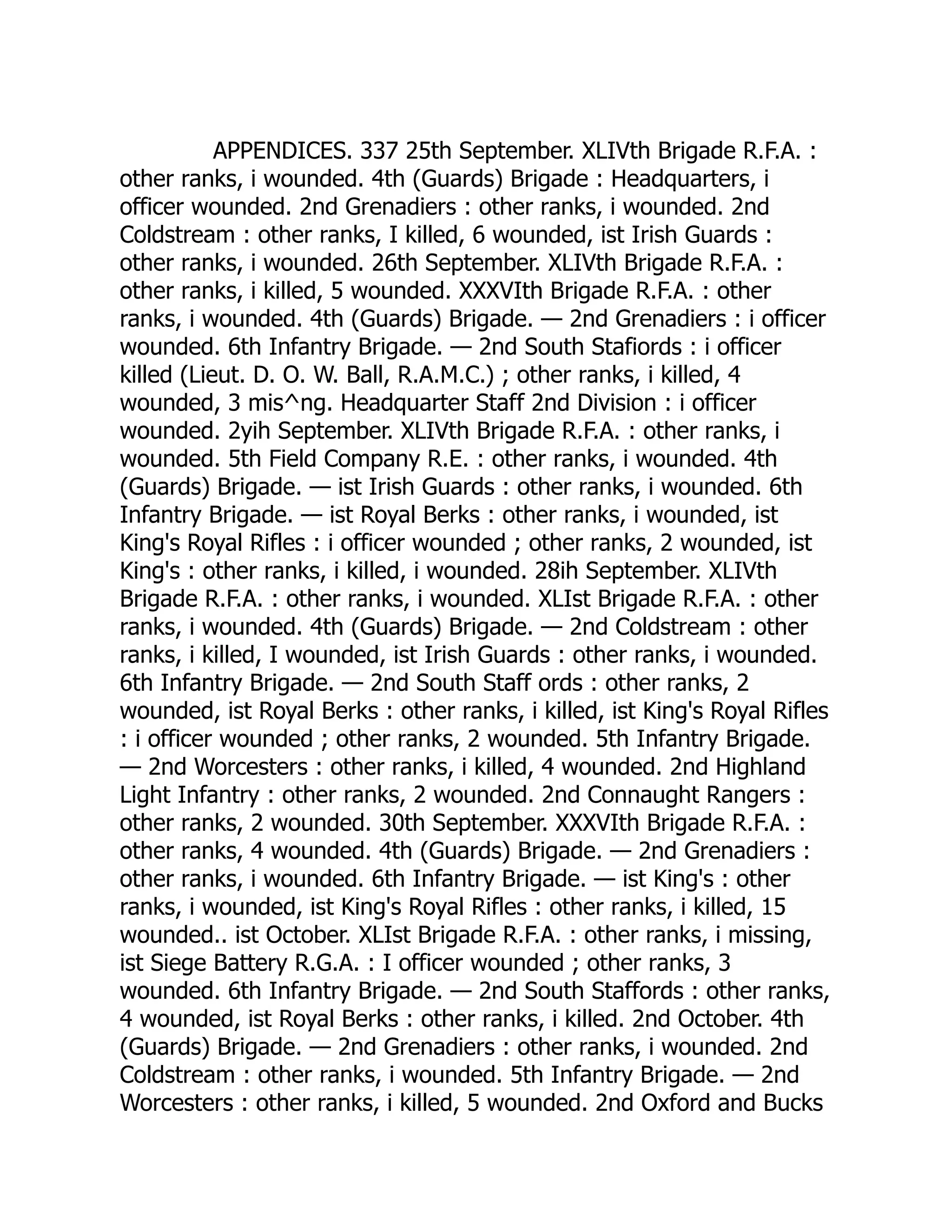
APPENDICES. 337 25thSeptember. XLIVth Brigade R.F.A. :
other ranks, i wounded. 4th (Guards) Brigade : Headquarters, i
officer wounded. 2nd Grenadiers : other ranks, i wounded. 2nd
Coldstream : other ranks, I killed, 6 wounded, ist Irish Guards :
other ranks, i wounded. 26th September. XLIVth Brigade R.F.A. :
other ranks, i killed, 5 wounded. XXXVIth Brigade R.F.A. : other
ranks, i wounded. 4th (Guards) Brigade. — 2nd Grenadiers : i officer
wounded. 6th Infantry Brigade. — 2nd South Stafiords : i officer
killed (Lieut. D. O. W. Ball, R.A.M.C.) ; other ranks, i killed, 4
wounded, 3 mis^ng. Headquarter Staff 2nd Division : i officer
wounded. 2yih September. XLIVth Brigade R.F.A. : other ranks, i
wounded. 5th Field Company R.E. : other ranks, i wounded. 4th
(Guards) Brigade. — ist Irish Guards : other ranks, i wounded. 6th
Infantry Brigade. — ist Royal Berks : other ranks, i wounded, ist
King's Royal Rifles : i officer wounded ; other ranks, 2 wounded, ist
King's : other ranks, i killed, i wounded. 28ih September. XLIVth
Brigade R.F.A. : other ranks, i wounded. XLIst Brigade R.F.A. : other
ranks, i wounded. 4th (Guards) Brigade. — 2nd Coldstream : other
ranks, i killed, I wounded, ist Irish Guards : other ranks, i wounded.
6th Infantry Brigade. — 2nd South Staff ords : other ranks, 2
wounded, ist Royal Berks : other ranks, i killed, ist King's Royal Rifles
: i officer wounded ; other ranks, 2 wounded. 5th Infantry Brigade.
— 2nd Worcesters : other ranks, i killed, 4 wounded. 2nd Highland
Light Infantry : other ranks, 2 wounded. 2nd Connaught Rangers :
other ranks, 2 wounded. 30th September. XXXVIth Brigade R.F.A. :
other ranks, 4 wounded. 4th (Guards) Brigade. — 2nd Grenadiers :
other ranks, i wounded. 6th Infantry Brigade. — ist King's : other
ranks, i wounded, ist King's Royal Rifles : other ranks, i killed, 15
wounded.. ist October. XLIst Brigade R.F.A. : other ranks, i missing,
ist Siege Battery R.G.A. : I officer wounded ; other ranks, 3
wounded. 6th Infantry Brigade. — 2nd South Staffords : other ranks,
4 wounded, ist Royal Berks : other ranks, i killed. 2nd October. 4th
(Guards) Brigade. — 2nd Grenadiers : other ranks, i wounded. 2nd
Coldstream : other ranks, i wounded. 5th Infantry Brigade. — 2nd
Worcesters : other ranks, i killed, 5 wounded. 2nd Oxford and Bucks
30.
: other ranks,i killed. 6th Infantry Brigade. — 2nd South Staffords :
other ranks, 3 wounded. XLIVth Brigade R.F.A. : other ranks, 3
wounded. (2,242) 22
31.
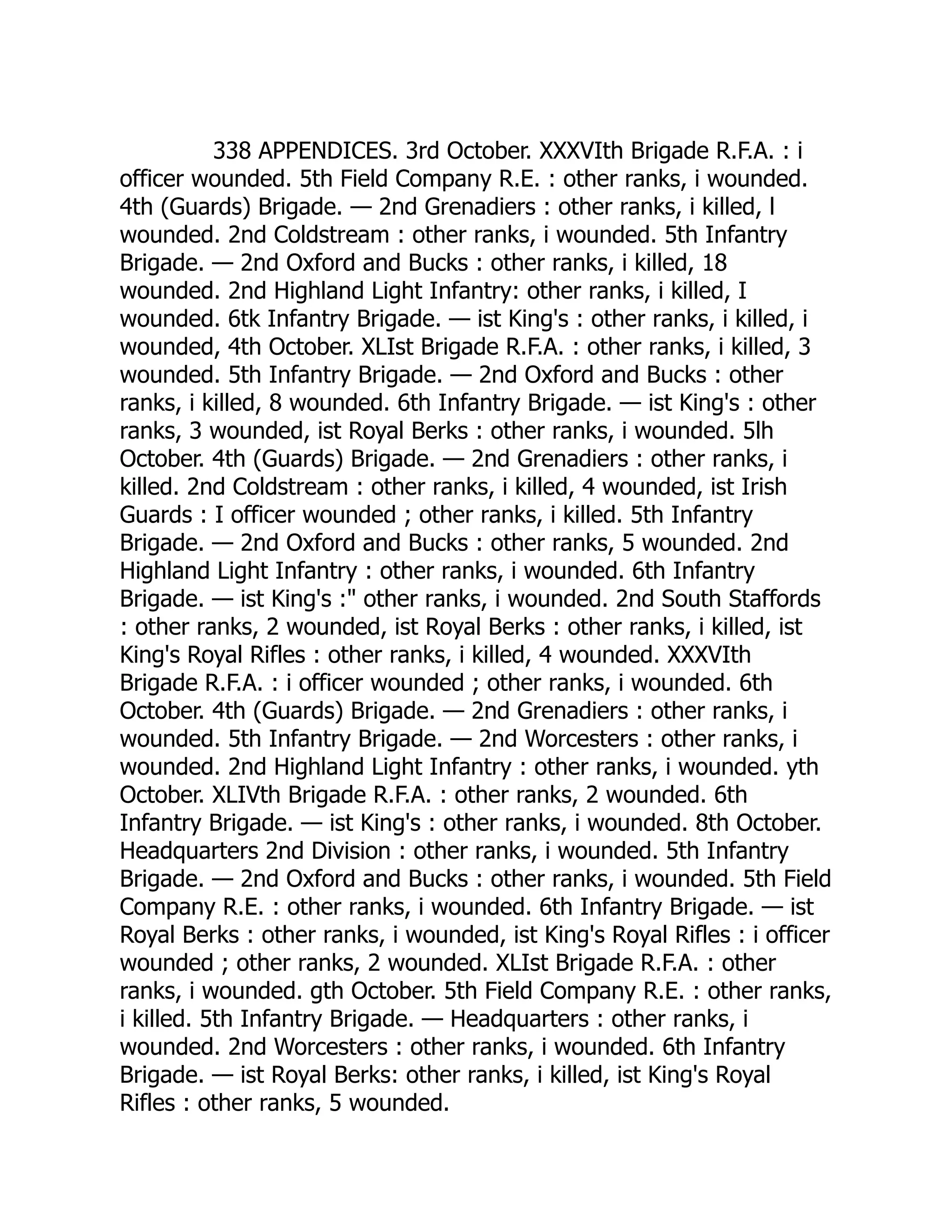
338 APPENDICES. 3rdOctober. XXXVIth Brigade R.F.A. : i
officer wounded. 5th Field Company R.E. : other ranks, i wounded.
4th (Guards) Brigade. — 2nd Grenadiers : other ranks, i killed, l
wounded. 2nd Coldstream : other ranks, i wounded. 5th Infantry
Brigade. — 2nd Oxford and Bucks : other ranks, i killed, 18
wounded. 2nd Highland Light Infantry: other ranks, i killed, I
wounded. 6tk Infantry Brigade. — ist King's : other ranks, i killed, i
wounded, 4th October. XLIst Brigade R.F.A. : other ranks, i killed, 3
wounded. 5th Infantry Brigade. — 2nd Oxford and Bucks : other
ranks, i killed, 8 wounded. 6th Infantry Brigade. — ist King's : other
ranks, 3 wounded, ist Royal Berks : other ranks, i wounded. 5lh
October. 4th (Guards) Brigade. — 2nd Grenadiers : other ranks, i
killed. 2nd Coldstream : other ranks, i killed, 4 wounded, ist Irish
Guards : I officer wounded ; other ranks, i killed. 5th Infantry
Brigade. — 2nd Oxford and Bucks : other ranks, 5 wounded. 2nd
Highland Light Infantry : other ranks, i wounded. 6th Infantry
Brigade. — ist King's :" other ranks, i wounded. 2nd South Staffords
: other ranks, 2 wounded, ist Royal Berks : other ranks, i killed, ist
King's Royal Rifles : other ranks, i killed, 4 wounded. XXXVIth
Brigade R.F.A. : i officer wounded ; other ranks, i wounded. 6th
October. 4th (Guards) Brigade. — 2nd Grenadiers : other ranks, i
wounded. 5th Infantry Brigade. — 2nd Worcesters : other ranks, i
wounded. 2nd Highland Light Infantry : other ranks, i wounded. yth
October. XLIVth Brigade R.F.A. : other ranks, 2 wounded. 6th
Infantry Brigade. — ist King's : other ranks, i wounded. 8th October.
Headquarters 2nd Division : other ranks, i wounded. 5th Infantry
Brigade. — 2nd Oxford and Bucks : other ranks, i wounded. 5th Field
Company R.E. : other ranks, i wounded. 6th Infantry Brigade. — ist
Royal Berks : other ranks, i wounded, ist King's Royal Rifles : i officer
wounded ; other ranks, 2 wounded. XLIst Brigade R.F.A. : other
ranks, i wounded. gth October. 5th Field Company R.E. : other ranks,
i killed. 5th Infantry Brigade. — Headquarters : other ranks, i
wounded. 2nd Worcesters : other ranks, i wounded. 6th Infantry
Brigade. — ist Royal Berks: other ranks, i killed, ist King's Royal
Rifles : other ranks, 5 wounded.
32.
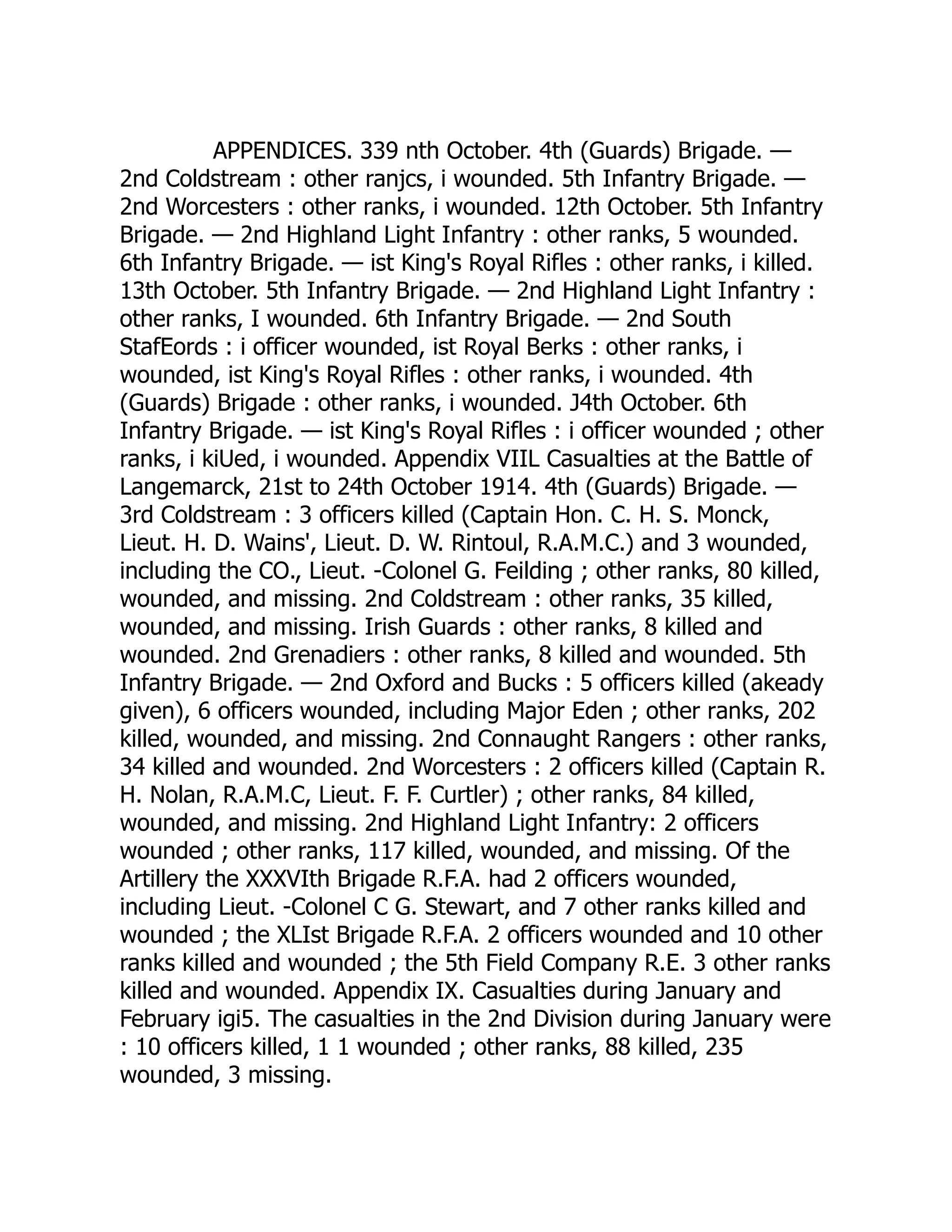
APPENDICES. 339 nthOctober. 4th (Guards) Brigade. —
2nd Coldstream : other ranjcs, i wounded. 5th Infantry Brigade. —
2nd Worcesters : other ranks, i wounded. 12th October. 5th Infantry
Brigade. — 2nd Highland Light Infantry : other ranks, 5 wounded.
6th Infantry Brigade. — ist King's Royal Rifles : other ranks, i killed.
13th October. 5th Infantry Brigade. — 2nd Highland Light Infantry :
other ranks, I wounded. 6th Infantry Brigade. — 2nd South
StafEords : i officer wounded, ist Royal Berks : other ranks, i
wounded, ist King's Royal Rifles : other ranks, i wounded. 4th
(Guards) Brigade : other ranks, i wounded. J4th October. 6th
Infantry Brigade. — ist King's Royal Rifles : i officer wounded ; other
ranks, i kiUed, i wounded. Appendix VIIL Casualties at the Battle of
Langemarck, 21st to 24th October 1914. 4th (Guards) Brigade. —
3rd Coldstream : 3 officers killed (Captain Hon. C. H. S. Monck,
Lieut. H. D. Wains', Lieut. D. W. Rintoul, R.A.M.C.) and 3 wounded,
including the CO., Lieut. -Colonel G. Feilding ; other ranks, 80 killed,
wounded, and missing. 2nd Coldstream : other ranks, 35 killed,
wounded, and missing. Irish Guards : other ranks, 8 killed and
wounded. 2nd Grenadiers : other ranks, 8 killed and wounded. 5th
Infantry Brigade. — 2nd Oxford and Bucks : 5 officers killed (akeady
given), 6 officers wounded, including Major Eden ; other ranks, 202
killed, wounded, and missing. 2nd Connaught Rangers : other ranks,
34 killed and wounded. 2nd Worcesters : 2 officers killed (Captain R.
H. Nolan, R.A.M.C, Lieut. F. F. Curtler) ; other ranks, 84 killed,
wounded, and missing. 2nd Highland Light Infantry: 2 officers
wounded ; other ranks, 117 killed, wounded, and missing. Of the
Artillery the XXXVIth Brigade R.F.A. had 2 officers wounded,
including Lieut. -Colonel C G. Stewart, and 7 other ranks killed and
wounded ; the XLIst Brigade R.F.A. 2 officers wounded and 10 other
ranks killed and wounded ; the 5th Field Company R.E. 3 other ranks
killed and wounded. Appendix IX. Casualties during January and
February igi5. The casualties in the 2nd Division during January were
: 10 officers killed, 1 1 wounded ; other ranks, 88 killed, 235
wounded, 3 missing.
33.
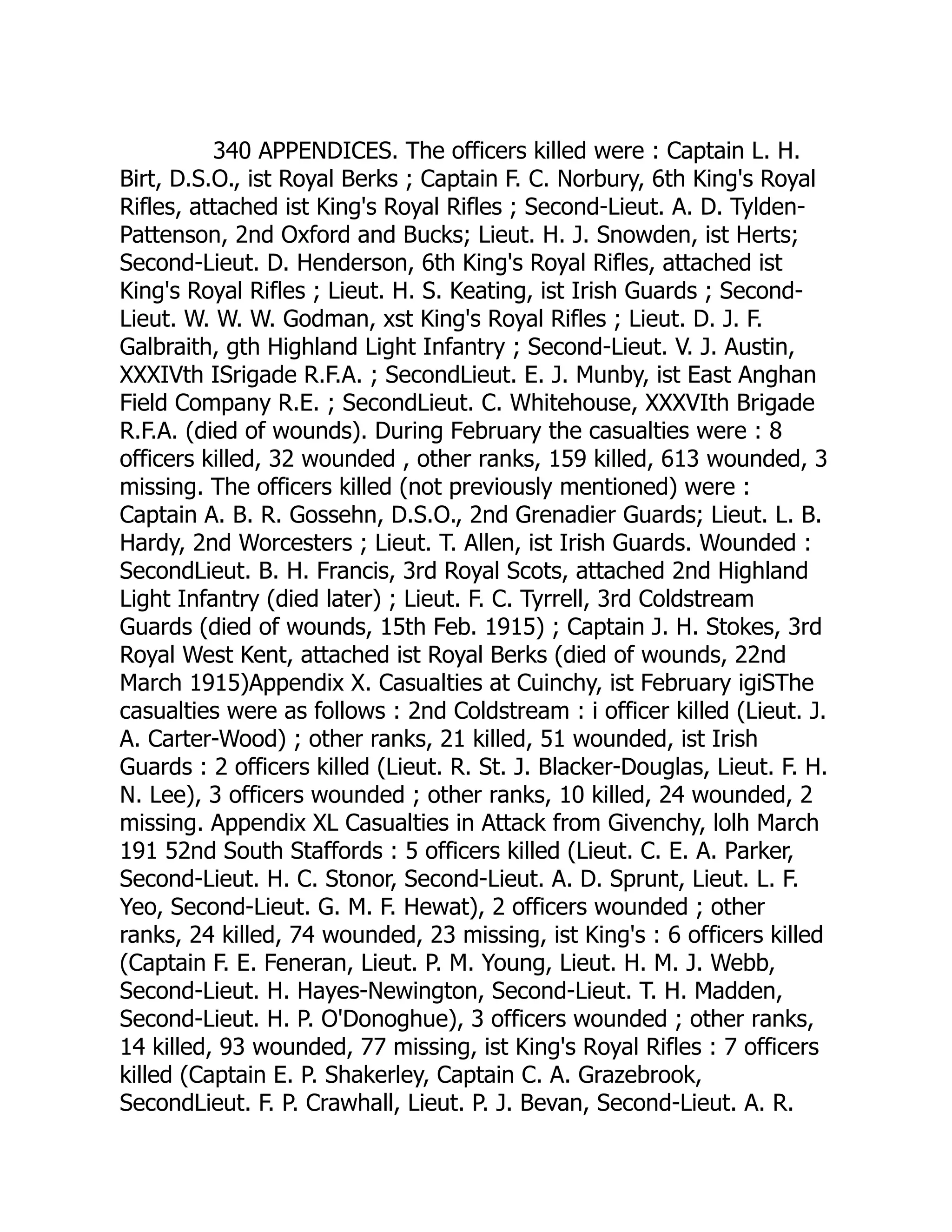
340 APPENDICES. Theofficers killed were : Captain L. H.
Birt, D.S.O., ist Royal Berks ; Captain F. C. Norbury, 6th King's Royal
Rifles, attached ist King's Royal Rifles ; Second-Lieut. A. D. Tylden-
Pattenson, 2nd Oxford and Bucks; Lieut. H. J. Snowden, ist Herts;
Second-Lieut. D. Henderson, 6th King's Royal Rifles, attached ist
King's Royal Rifles ; Lieut. H. S. Keating, ist Irish Guards ; Second-
Lieut. W. W. W. Godman, xst King's Royal Rifles ; Lieut. D. J. F.
Galbraith, gth Highland Light Infantry ; Second-Lieut. V. J. Austin,
XXXIVth ISrigade R.F.A. ; SecondLieut. E. J. Munby, ist East Anghan
Field Company R.E. ; SecondLieut. C. Whitehouse, XXXVIth Brigade
R.F.A. (died of wounds). During February the casualties were : 8
officers killed, 32 wounded , other ranks, 159 killed, 613 wounded, 3
missing. The officers killed (not previously mentioned) were :
Captain A. B. R. Gossehn, D.S.O., 2nd Grenadier Guards; Lieut. L. B.
Hardy, 2nd Worcesters ; Lieut. T. Allen, ist Irish Guards. Wounded :
SecondLieut. B. H. Francis, 3rd Royal Scots, attached 2nd Highland
Light Infantry (died later) ; Lieut. F. C. Tyrrell, 3rd Coldstream
Guards (died of wounds, 15th Feb. 1915) ; Captain J. H. Stokes, 3rd
Royal West Kent, attached ist Royal Berks (died of wounds, 22nd
March 1915)Appendix X. Casualties at Cuinchy, ist February igiSThe
casualties were as follows : 2nd Coldstream : i officer killed (Lieut. J.
A. Carter-Wood) ; other ranks, 21 killed, 51 wounded, ist Irish
Guards : 2 officers killed (Lieut. R. St. J. Blacker-Douglas, Lieut. F. H.
N. Lee), 3 officers wounded ; other ranks, 10 killed, 24 wounded, 2
missing. Appendix XL Casualties in Attack from Givenchy, lolh March
191 52nd South Staffords : 5 officers killed (Lieut. C. E. A. Parker,
Second-Lieut. H. C. Stonor, Second-Lieut. A. D. Sprunt, Lieut. L. F.
Yeo, Second-Lieut. G. M. F. Hewat), 2 officers wounded ; other
ranks, 24 killed, 74 wounded, 23 missing, ist King's : 6 officers killed
(Captain F. E. Feneran, Lieut. P. M. Young, Lieut. H. M. J. Webb,
Second-Lieut. H. Hayes-Newington, Second-Lieut. T. H. Madden,
Second-Lieut. H. P. O'Donoghue), 3 officers wounded ; other ranks,
14 killed, 93 wounded, 77 missing, ist King's Royal Rifles : 7 officers
killed (Captain E. P. Shakerley, Captain C. A. Grazebrook,
SecondLieut. F. P. Crawhall, Lieut. P. J. Bevan, Second-Lieut. A. R.
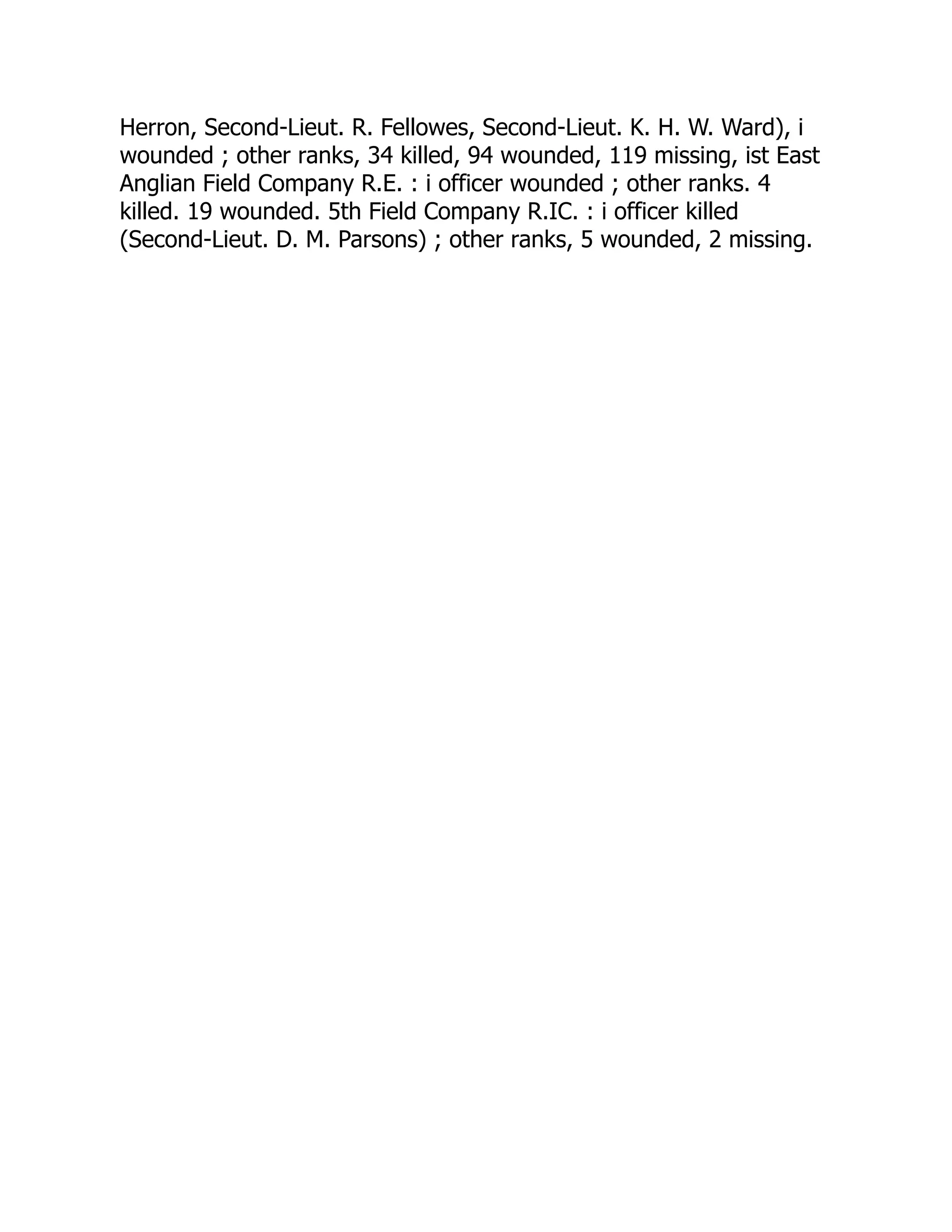
34.
Herron, Second-Lieut. R.Fellowes, Second-Lieut. K. H. W. Ward), i
wounded ; other ranks, 34 killed, 94 wounded, 119 missing, ist East
Anglian Field Company R.E. : i officer wounded ; other ranks. 4
killed. 19 wounded. 5th Field Company R.IC. : i officer killed
(Second-Lieut. D. M. Parsons) ; other ranks, 5 wounded, 2 missing.
35.
APPENDICES. 341 AppendixXIL Casualties at the Battle of
Festubert, 15th to 25th May igis. The Irish Guards lost 17 officers ;
the 2nd Royal Inniskilling FusiUers, 19 ; the 2nd Oxford and Bucks,
20 ; the ist King's (Liverpool) Regiment, 14 ; the 2nd South
Staffords, ist King's Royal Rifles, and the i/5th King's (Liverpool)
Regiment, 13 each; whilst other units lost from 4 upwards. The 2nd
Grenadiers, 2nd South StafiEords, and ist King's Royal Rifles lost
their commanding officers (Lieut.Colonel W. R. A. Smith, C.M.G. ;
Lieut. -Colonel P. C. L. Routledge ; and Lieut. -Colonel C. G. Shakerly,
D.S.O., respectively — killed). The names of the of&cers killed (not
already mentioned) were given as : — Roval Artillery : Second-Lieut.
C. Q. Roberts, R.F.A. ; Royal Engineers : Lieut. A. Trewby, nth Field
Company; 2nd Grenadier Guards : Major B. H. Barrington-Kennett ;
ist Irish Guards : Captain J. N. Guthrie, Second-Lieut. V. W. D. Fox ;
2nd Royal Inniskilling FusiUers : Lieut. R. W. S. Hinds, Second-Lieuts.
L. St. G. MordauntSmith, J. J. L. Morgan, W. J. Whittington : 2nd
Worcesters : Lieuts. A. W. H. Scott, F. C. F. Biscow, Second-Lieut. J.
S. McCormick ; 2nd Oxford and Bucks : Capt. F. H. Beaufort, Lieuts.
D. H. W. Humfrey, R. E. B. Bull, Second-Lieut. L. A. Dashwood ; 2nd
Highland Light Infantry : Captains A. W. D. Gaussen, H. E. Johnston-
Stewart, Lieut. H. B. O. Hughes, Second-Lieuts. B. Crossley, W. H.
Oldfield ; 9th Highland Light Infantry : Captain A. J. Martin, Lieut. W.
Spens ; ist King's Regiment : Second-Lieuts. J. D. W. Kenyon, J. S.
Rich, G. Martin ; 2nd Staffords: Captain K. J. Maples; ist Roval Berks:
Captain S. Belcher, Lieuts. W. J. Cox, C. R. TafIs ; ist' King's Royal
Rifles : Captain Hon. J. M. Bigge, Lieut. W. H. Grenville-Grey,
Second-Lieut. J. S. H. Jones; i/5th King's: Lieuts. G. H. Cohen, A. H.
Plummer ; i/yth King's: Major A. Hughes, Captain M. Tweedale,
Lieuts. L. K. Adams, W. S. Allan, Second-Lieuts. W. G. Alexander, N.
L. Hannon, T. McClelland, R. G. Gamble. Appendix XIIL Casualties at
the Battle of Loos, 25th September 1913. Officers Idlled : — ist
Middlesex Regiment : Captain N. Y. L. Weimar^, D.S.O., Captain F. V.
A. Dyer, Captain L. G. Coward, Captain B. J. Deighton, Second-
Lieuts. C. A. J. Mackinnon, C. Pery, B. U. Hare, A. L. Hill, R. C.
Mellish, J. H. Linsell, Lieut. A. W. R. Carless (died of wounds). 2nd
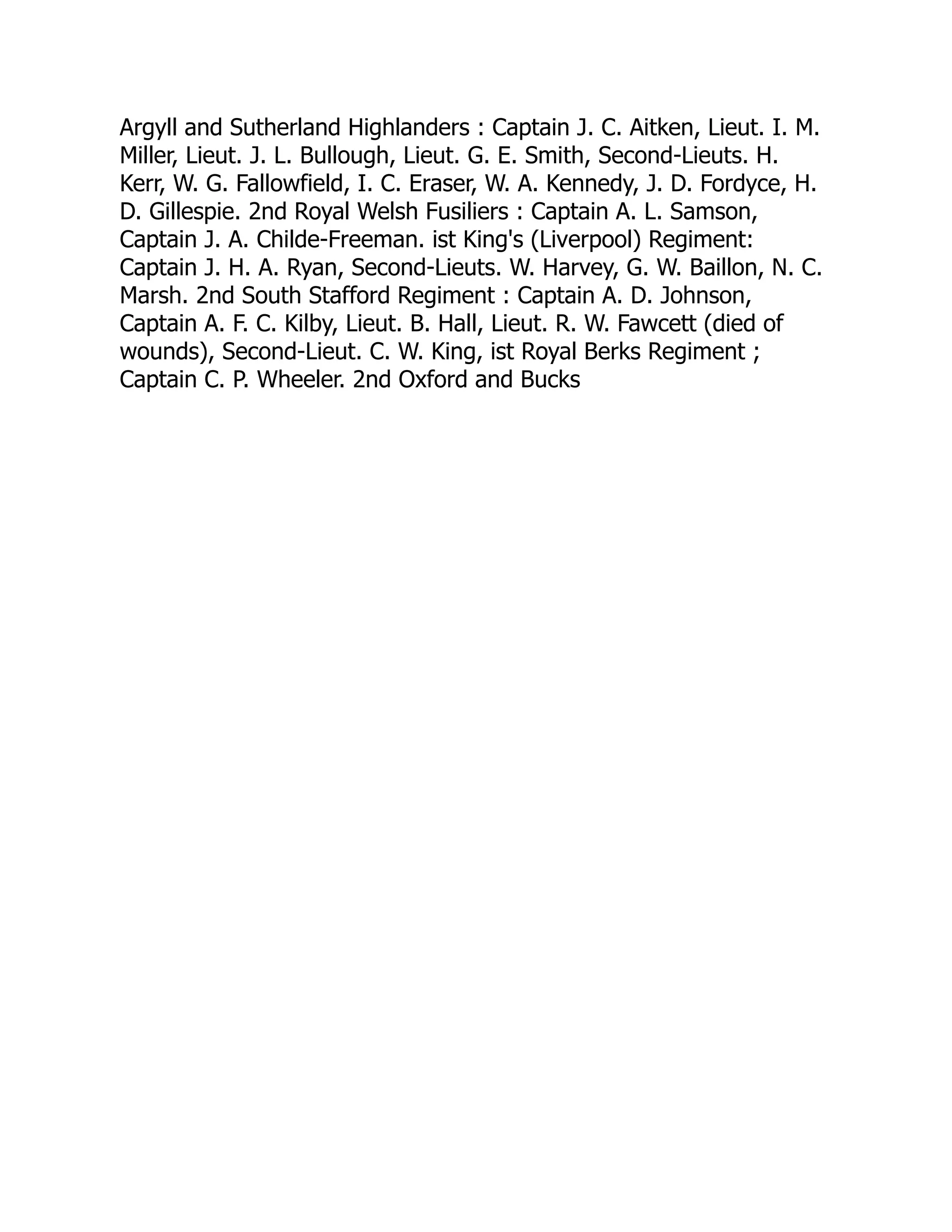
36.
Argyll and SutherlandHighlanders : Captain J. C. Aitken, Lieut. I. M.
Miller, Lieut. J. L. Bullough, Lieut. G. E. Smith, Second-Lieuts. H.
Kerr, W. G. Fallowfield, I. C. Eraser, W. A. Kennedy, J. D. Fordyce, H.
D. Gillespie. 2nd Royal Welsh Fusiliers : Captain A. L. Samson,
Captain J. A. Childe-Freeman. ist King's (Liverpool) Regiment:
Captain J. H. A. Ryan, Second-Lieuts. W. Harvey, G. W. Baillon, N. C.
Marsh. 2nd South Stafford Regiment : Captain A. D. Johnson,
Captain A. F. C. Kilby, Lieut. B. Hall, Lieut. R. W. Fawcett (died of
wounds), Second-Lieut. C. W. King, ist Royal Berks Regiment ;
Captain C. P. Wheeler. 2nd Oxford and Bucks
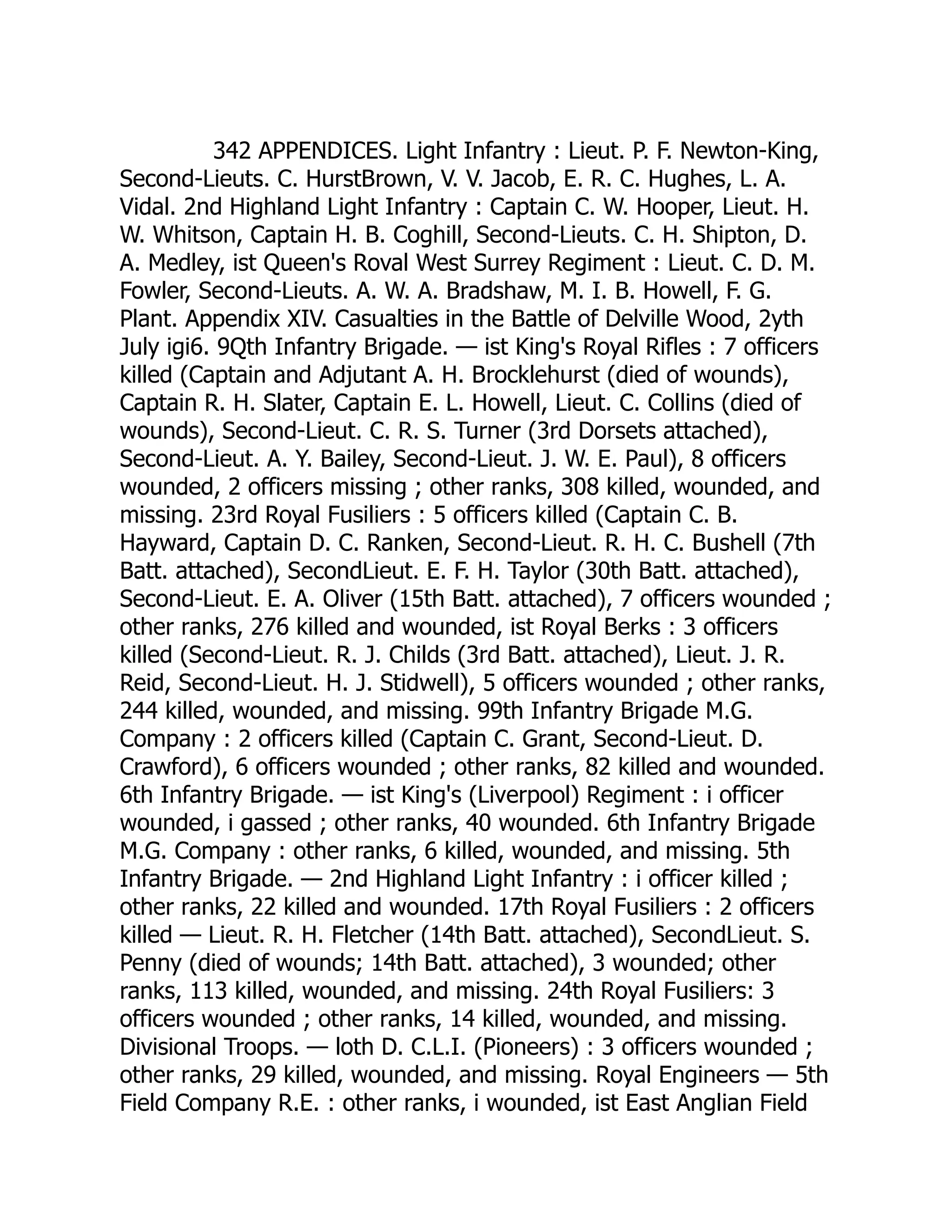
37.
342 APPENDICES. LightInfantry : Lieut. P. F. Newton-King,
Second-Lieuts. C. HurstBrown, V. V. Jacob, E. R. C. Hughes, L. A.
Vidal. 2nd Highland Light Infantry : Captain C. W. Hooper, Lieut. H.
W. Whitson, Captain H. B. Coghill, Second-Lieuts. C. H. Shipton, D.
A. Medley, ist Queen's Roval West Surrey Regiment : Lieut. C. D. M.
Fowler, Second-Lieuts. A. W. A. Bradshaw, M. I. B. Howell, F. G.
Plant. Appendix XIV. Casualties in the Battle of Delville Wood, 2yth
July igi6. 9Qth Infantry Brigade. — ist King's Royal Rifles : 7 officers
killed (Captain and Adjutant A. H. Brocklehurst (died of wounds),
Captain R. H. Slater, Captain E. L. Howell, Lieut. C. Collins (died of
wounds), Second-Lieut. C. R. S. Turner (3rd Dorsets attached),
Second-Lieut. A. Y. Bailey, Second-Lieut. J. W. E. Paul), 8 officers
wounded, 2 officers missing ; other ranks, 308 killed, wounded, and
missing. 23rd Royal Fusiliers : 5 officers killed (Captain C. B.
Hayward, Captain D. C. Ranken, Second-Lieut. R. H. C. Bushell (7th
Batt. attached), SecondLieut. E. F. H. Taylor (30th Batt. attached),
Second-Lieut. E. A. Oliver (15th Batt. attached), 7 officers wounded ;
other ranks, 276 killed and wounded, ist Royal Berks : 3 officers
killed (Second-Lieut. R. J. Childs (3rd Batt. attached), Lieut. J. R.
Reid, Second-Lieut. H. J. Stidwell), 5 officers wounded ; other ranks,
244 killed, wounded, and missing. 99th Infantry Brigade M.G.
Company : 2 officers killed (Captain C. Grant, Second-Lieut. D.
Crawford), 6 officers wounded ; other ranks, 82 killed and wounded.
6th Infantry Brigade. — ist King's (Liverpool) Regiment : i officer
wounded, i gassed ; other ranks, 40 wounded. 6th Infantry Brigade
M.G. Company : other ranks, 6 killed, wounded, and missing. 5th
Infantry Brigade. — 2nd Highland Light Infantry : i officer killed ;
other ranks, 22 killed and wounded. 17th Royal Fusiliers : 2 officers
killed — Lieut. R. H. Fletcher (14th Batt. attached), SecondLieut. S.
Penny (died of wounds; 14th Batt. attached), 3 wounded; other
ranks, 113 killed, wounded, and missing. 24th Royal Fusiliers: 3
officers wounded ; other ranks, 14 killed, wounded, and missing.
Divisional Troops. — loth D. C.L.I. (Pioneers) : 3 officers wounded ;
other ranks, 29 killed, wounded, and missing. Royal Engineers — 5th
Field Company R.E. : other ranks, i wounded, ist East Anglian Field
38.
Company R.E. :other ranks, i wounded. Appendix XV. Casualties at
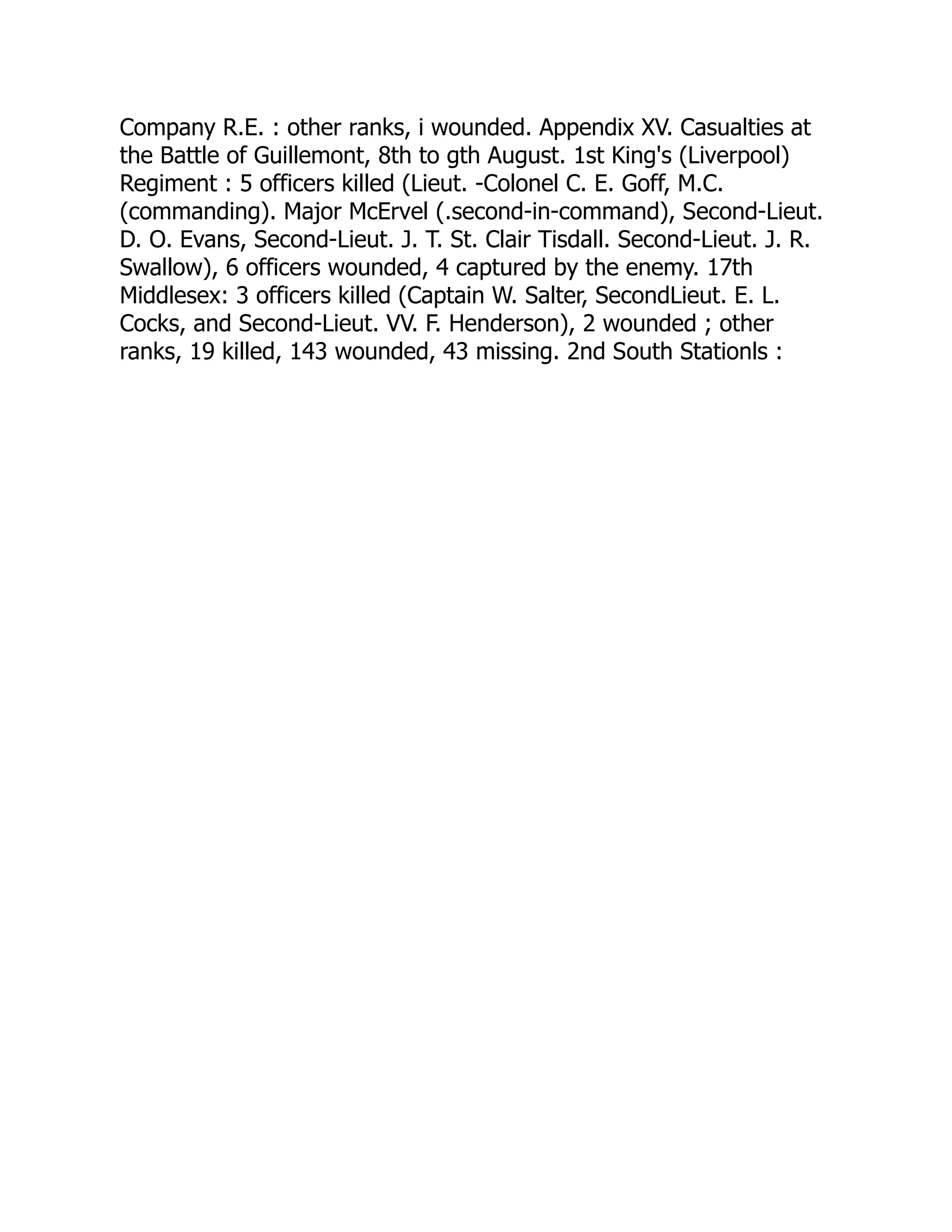
the Battle of Guillemont, 8th to gth August. 1st King's (Liverpool)
Regiment : 5 officers killed (Lieut. -Colonel C. E. Goff, M.C.
(commanding). Major McErvel (.second-in-command), Second-Lieut.
D. O. Evans, Second-Lieut. J. T. St. Clair Tisdall. Second-Lieut. J. R.
Swallow), 6 officers wounded, 4 captured by the enemy. 17th
Middlesex: 3 officers killed (Captain W. Salter, SecondLieut. E. L.
Cocks, and Second-Lieut. VV. F. Henderson), 2 wounded ; other
ranks, 19 killed, 143 wounded, 43 missing. 2nd South Stationls :
39.
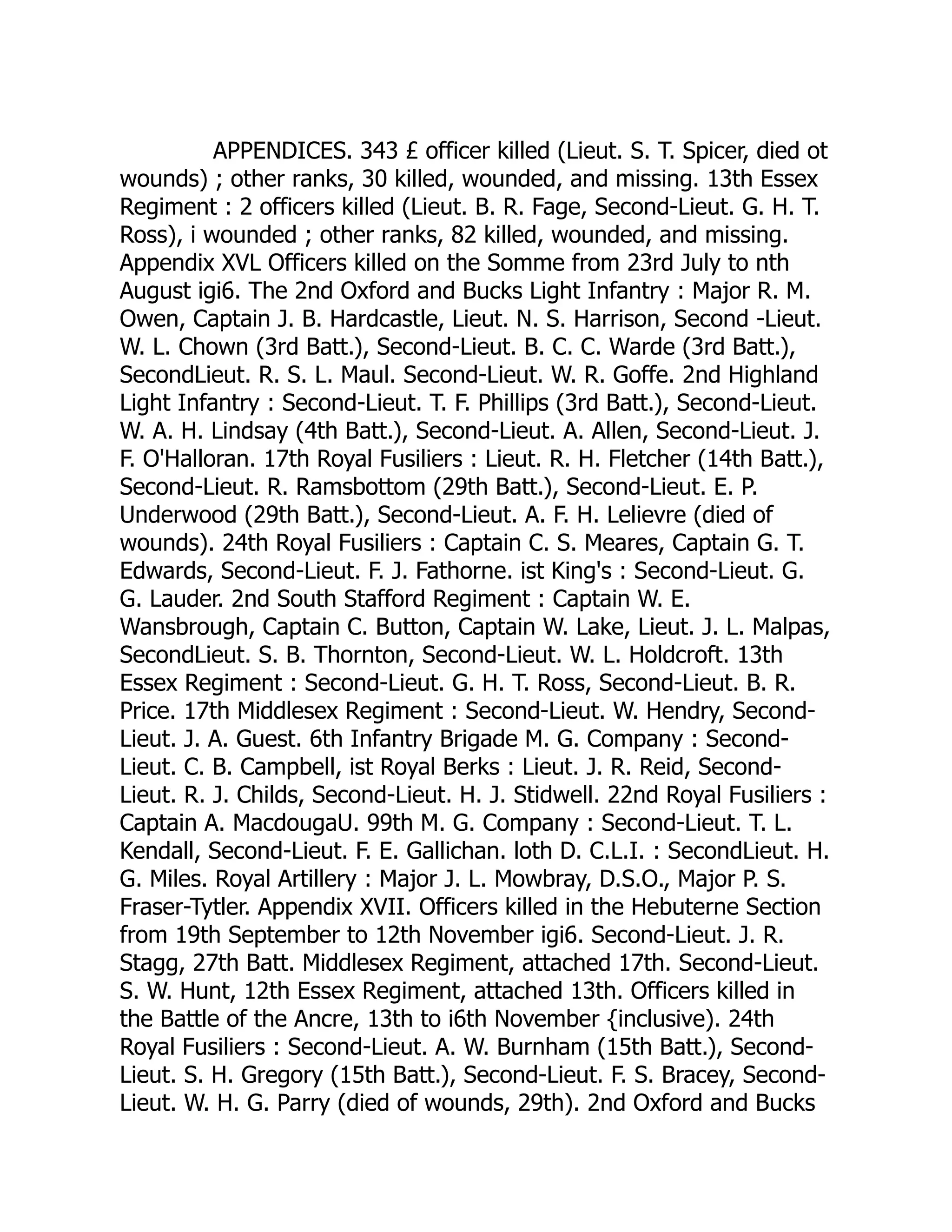
APPENDICES. 343 £officer killed (Lieut. S. T. Spicer, died ot
wounds) ; other ranks, 30 killed, wounded, and missing. 13th Essex
Regiment : 2 officers killed (Lieut. B. R. Fage, Second-Lieut. G. H. T.
Ross), i wounded ; other ranks, 82 killed, wounded, and missing.
Appendix XVL Officers killed on the Somme from 23rd July to nth
August igi6. The 2nd Oxford and Bucks Light Infantry : Major R. M.
Owen, Captain J. B. Hardcastle, Lieut. N. S. Harrison, Second -Lieut.
W. L. Chown (3rd Batt.), Second-Lieut. B. C. C. Warde (3rd Batt.),
SecondLieut. R. S. L. Maul. Second-Lieut. W. R. Goffe. 2nd Highland
Light Infantry : Second-Lieut. T. F. Phillips (3rd Batt.), Second-Lieut.
W. A. H. Lindsay (4th Batt.), Second-Lieut. A. Allen, Second-Lieut. J.
F. O'Halloran. 17th Royal Fusiliers : Lieut. R. H. Fletcher (14th Batt.),
Second-Lieut. R. Ramsbottom (29th Batt.), Second-Lieut. E. P.
Underwood (29th Batt.), Second-Lieut. A. F. H. Lelievre (died of
wounds). 24th Royal Fusiliers : Captain C. S. Meares, Captain G. T.
Edwards, Second-Lieut. F. J. Fathorne. ist King's : Second-Lieut. G.
G. Lauder. 2nd South Stafford Regiment : Captain W. E.
Wansbrough, Captain C. Button, Captain W. Lake, Lieut. J. L. Malpas,
SecondLieut. S. B. Thornton, Second-Lieut. W. L. Holdcroft. 13th
Essex Regiment : Second-Lieut. G. H. T. Ross, Second-Lieut. B. R.
Price. 17th Middlesex Regiment : Second-Lieut. W. Hendry, Second-
Lieut. J. A. Guest. 6th Infantry Brigade M. G. Company : Second-
Lieut. C. B. Campbell, ist Royal Berks : Lieut. J. R. Reid, Second-
Lieut. R. J. Childs, Second-Lieut. H. J. Stidwell. 22nd Royal Fusiliers :
Captain A. MacdougaU. 99th M. G. Company : Second-Lieut. T. L.
Kendall, Second-Lieut. F. E. Gallichan. loth D. C.L.I. : SecondLieut. H.
G. Miles. Royal Artillery : Major J. L. Mowbray, D.S.O., Major P. S.
Fraser-Tytler. Appendix XVII. Officers killed in the Hebuterne Section
from 19th September to 12th November igi6. Second-Lieut. J. R.
Stagg, 27th Batt. Middlesex Regiment, attached 17th. Second-Lieut.
S. W. Hunt, 12th Essex Regiment, attached 13th. Officers killed in
the Battle of the Ancre, 13th to i6th November {inclusive). 24th
Royal Fusiliers : Second-Lieut. A. W. Burnham (15th Batt.), Second-
Lieut. S. H. Gregory (15th Batt.), Second-Lieut. F. S. Bracey, Second-
Lieut. W. H. G. Parry (died of wounds, 29th). 2nd Oxford and Bucks
40.
Light Infantry :Captain H. W. H. Rawson (3rd Batt.), Lieut. V. E.
Fanning, Second-Lieut. A. O. W. Webster-Jones (3rd Batt.), Second-
Lieut. J. P. C. Holland, Second-Lieut. H. Davies (6th Batt.), Second-
Lieut. R. H. Cresswell. 22nd Royal Fusiliers : Second-Lieut. N. Fitton.
23rd Royal Fusiliers : Second-Lieut. L. A. Green (6th
41.
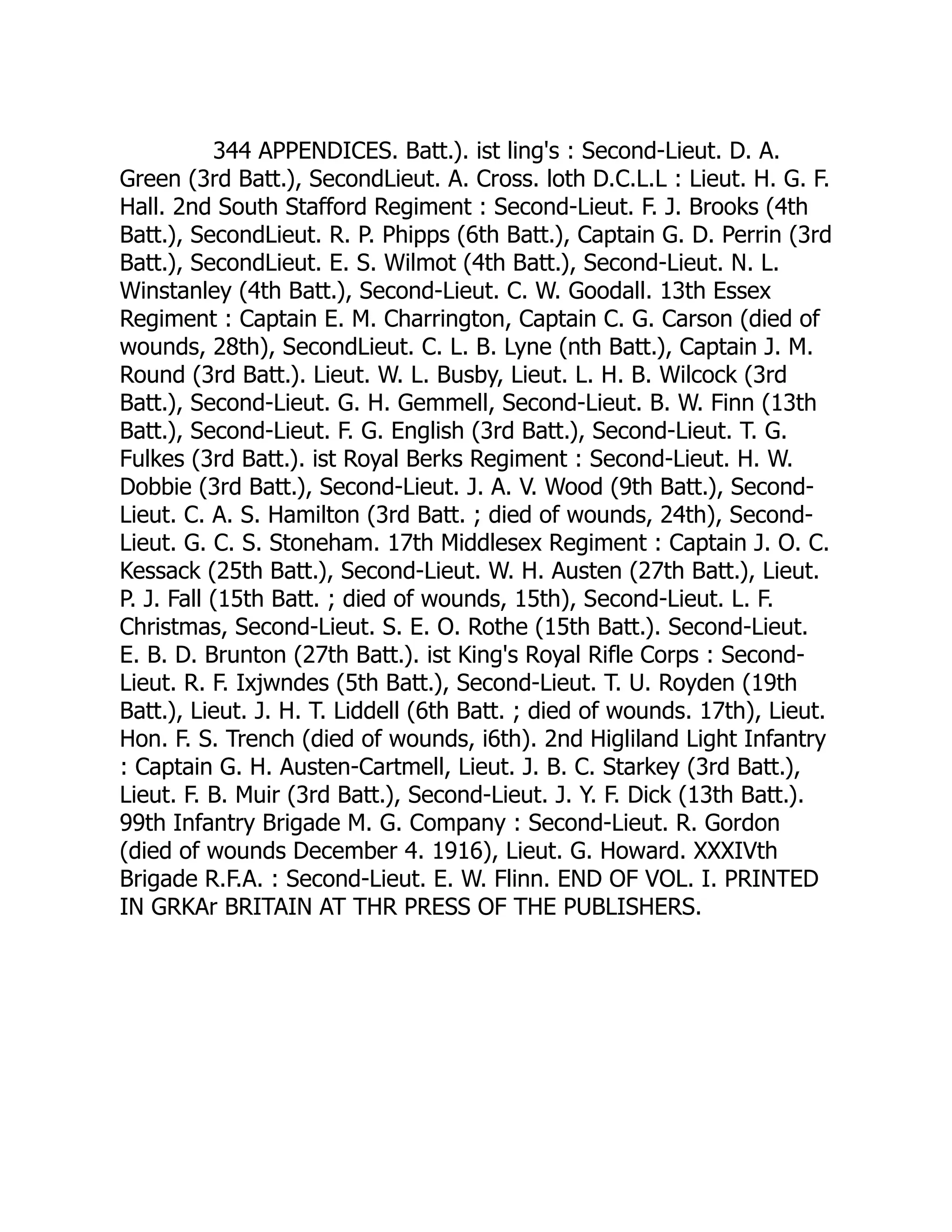
344 APPENDICES. Batt.).ist ling's : Second-Lieut. D. A.
Green (3rd Batt.), SecondLieut. A. Cross. loth D.C.L.L : Lieut. H. G. F.
Hall. 2nd South Stafford Regiment : Second-Lieut. F. J. Brooks (4th
Batt.), SecondLieut. R. P. Phipps (6th Batt.), Captain G. D. Perrin (3rd
Batt.), SecondLieut. E. S. Wilmot (4th Batt.), Second-Lieut. N. L.
Winstanley (4th Batt.), Second-Lieut. C. W. Goodall. 13th Essex
Regiment : Captain E. M. Charrington, Captain C. G. Carson (died of
wounds, 28th), SecondLieut. C. L. B. Lyne (nth Batt.), Captain J. M.
Round (3rd Batt.). Lieut. W. L. Busby, Lieut. L. H. B. Wilcock (3rd
Batt.), Second-Lieut. G. H. Gemmell, Second-Lieut. B. W. Finn (13th
Batt.), Second-Lieut. F. G. English (3rd Batt.), Second-Lieut. T. G.
Fulkes (3rd Batt.). ist Royal Berks Regiment : Second-Lieut. H. W.
Dobbie (3rd Batt.), Second-Lieut. J. A. V. Wood (9th Batt.), Second-
Lieut. C. A. S. Hamilton (3rd Batt. ; died of wounds, 24th), Second-
Lieut. G. C. S. Stoneham. 17th Middlesex Regiment : Captain J. O. C.
Kessack (25th Batt.), Second-Lieut. W. H. Austen (27th Batt.), Lieut.
P. J. Fall (15th Batt. ; died of wounds, 15th), Second-Lieut. L. F.
Christmas, Second-Lieut. S. E. O. Rothe (15th Batt.). Second-Lieut.
E. B. D. Brunton (27th Batt.). ist King's Royal Rifle Corps : Second-
Lieut. R. F. Ixjwndes (5th Batt.), Second-Lieut. T. U. Royden (19th
Batt.), Lieut. J. H. T. Liddell (6th Batt. ; died of wounds. 17th), Lieut.
Hon. F. S. Trench (died of wounds, i6th). 2nd Higliland Light Infantry
: Captain G. H. Austen-Cartmell, Lieut. J. B. C. Starkey (3rd Batt.),
Lieut. F. B. Muir (3rd Batt.), Second-Lieut. J. Y. F. Dick (13th Batt.).
99th Infantry Brigade M. G. Company : Second-Lieut. R. Gordon
(died of wounds December 4. 1916), Lieut. G. Howard. XXXIVth
Brigade R.F.A. : Second-Lieut. E. W. Flinn. END OF VOL. I. PRINTED
IN GRKAr BRITAIN AT THR PRESS OF THE PUBLISHERS.
42.
PLEASE DO NOTREMOVE CARDS OR SLIPS FROM THIS
POCKET UNIVERSITY OF TORONTO LIBRARY u iVyrall, Everard 546
The history of the iecond .5 division, 1914-1913 2nd V.3 v.l
43.
The text onthis page is estimated to be only 1.45%
accurate
S ^^^liJ o> ^_ iZ o UJ^ =tr> >^ 2 *^ w~= z-^ ^^u. o
— 1 Q^ y—^^ ^ ^ = =^< «, OC 1 O) '^ Q CO ^«^ j^:^^*^^
44.
Welcome to ourwebsite – the ideal destination for book lovers and
knowledge seekers. With a mission to inspire endlessly, we offer a
vast collection of books, ranging from classic literary works to
specialized publications, self-development books, and children's
literature. Each book is a new journey of discovery, expanding
knowledge and enriching the soul of the reade
Our website is not just a platform for buying books, but a bridge
connecting readers to the timeless values of culture and wisdom. With
an elegant, user-friendly interface and an intelligent search system,
we are committed to providing a quick and convenient shopping
experience. Additionally, our special promotions and home delivery
services ensure that you save time and fully enjoy the joy of reading.
Let us accompany you on the journey of exploring knowledge and
personal growth!
ebookfinal.com