LinkedIn


B2B SMM
@kevinsigliano
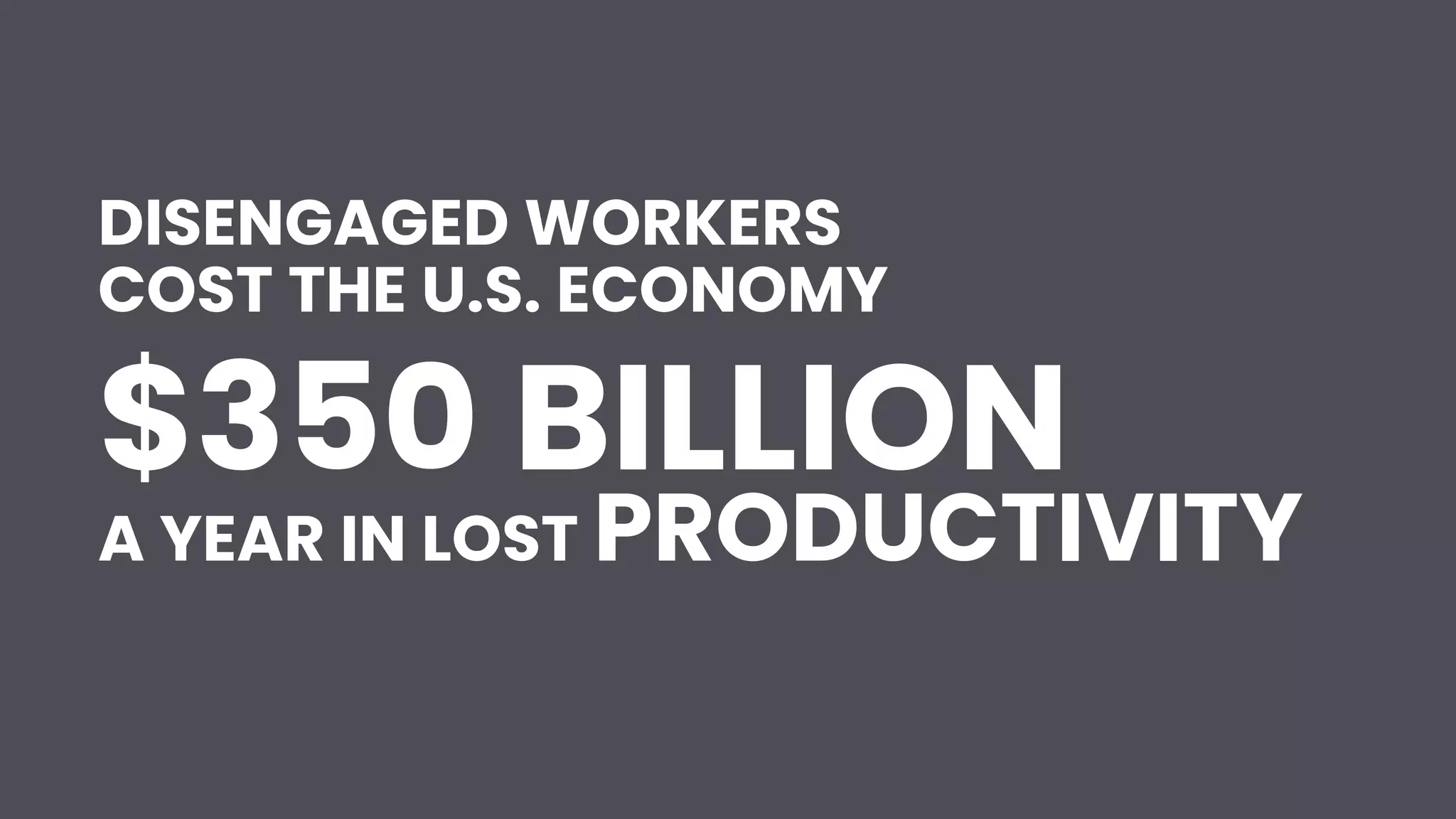
DISENGAGED WORKERS


COST THE U.S. ECONOMY


$350 BILLION


A YEAR IN LOST PRODUCTIVITY
#PeopleFirst is the


new advertising
Companies need new


#peoplefirst strategies
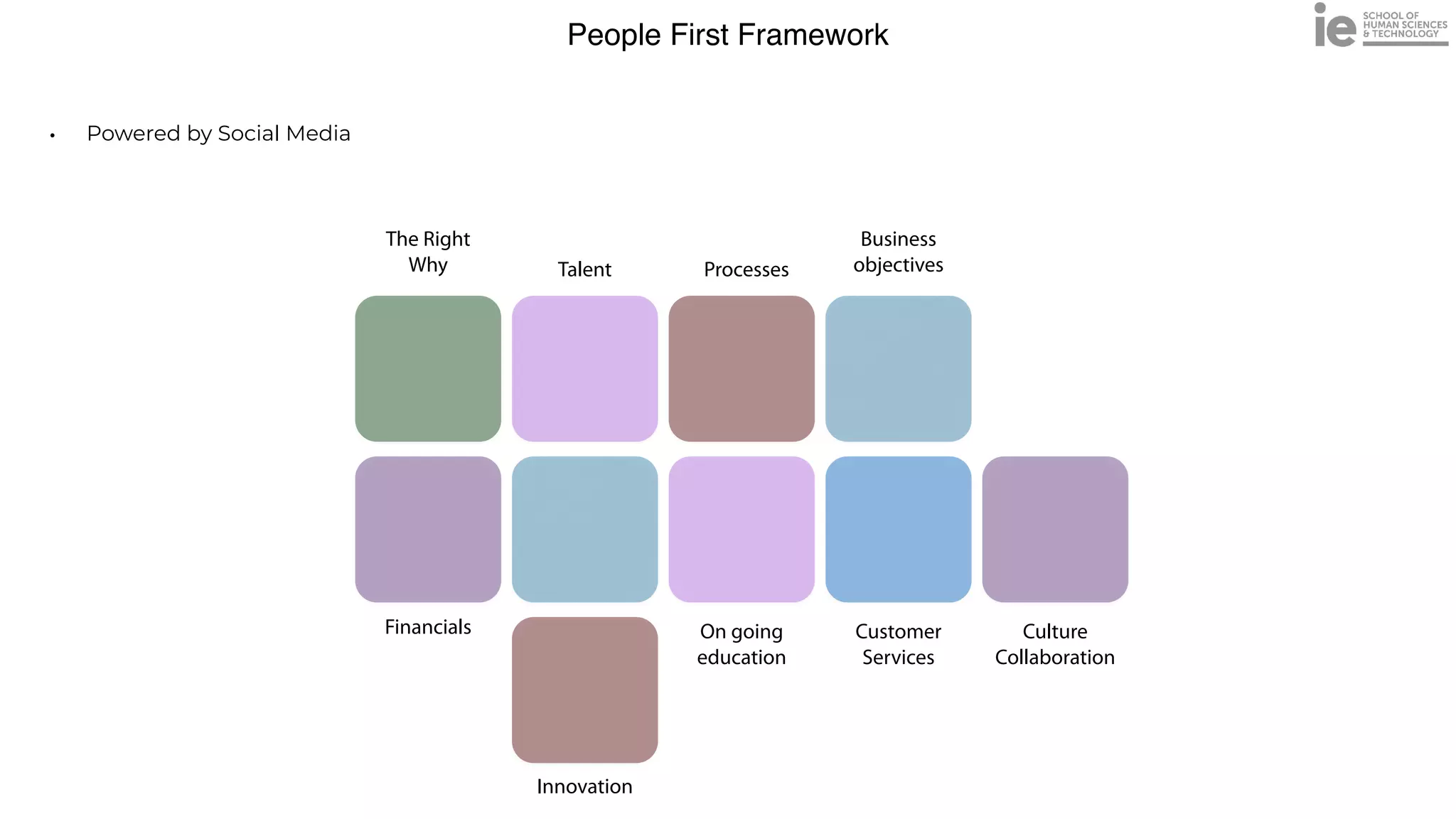
People First Framework
• Powered by Social Media
Business


objectives
Innovation
Culture


Collaboration
Talent
On going


education
The Right


Why Processes
Customer


Services
Financials
#people
fi
rst principles
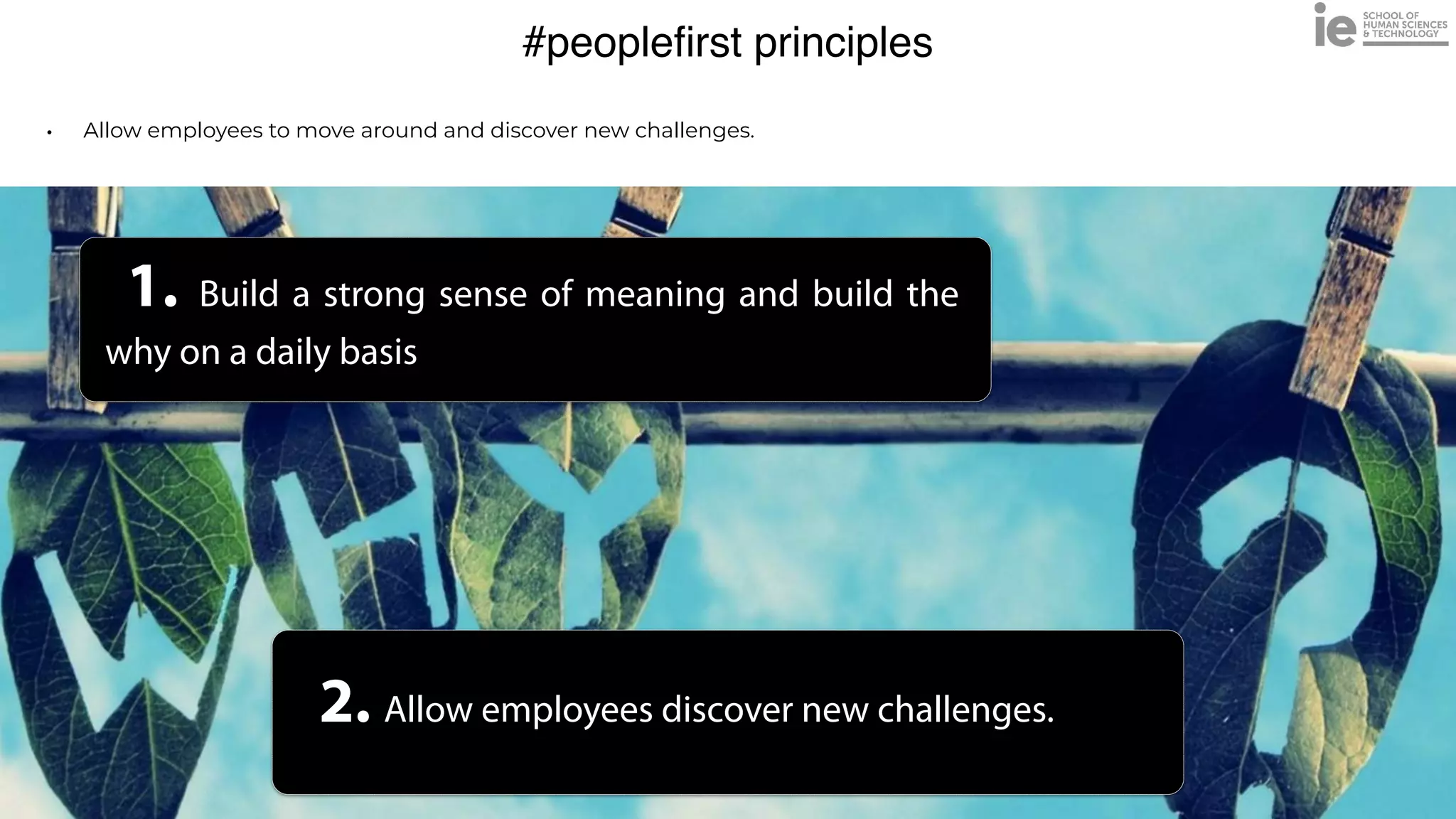
• Allow employees to move around and discover new challenges.
1. Build a strong sense of meaning and build the
why on a daily basis
2. Allow employees discover new challenges.
#people
fi
rst principles
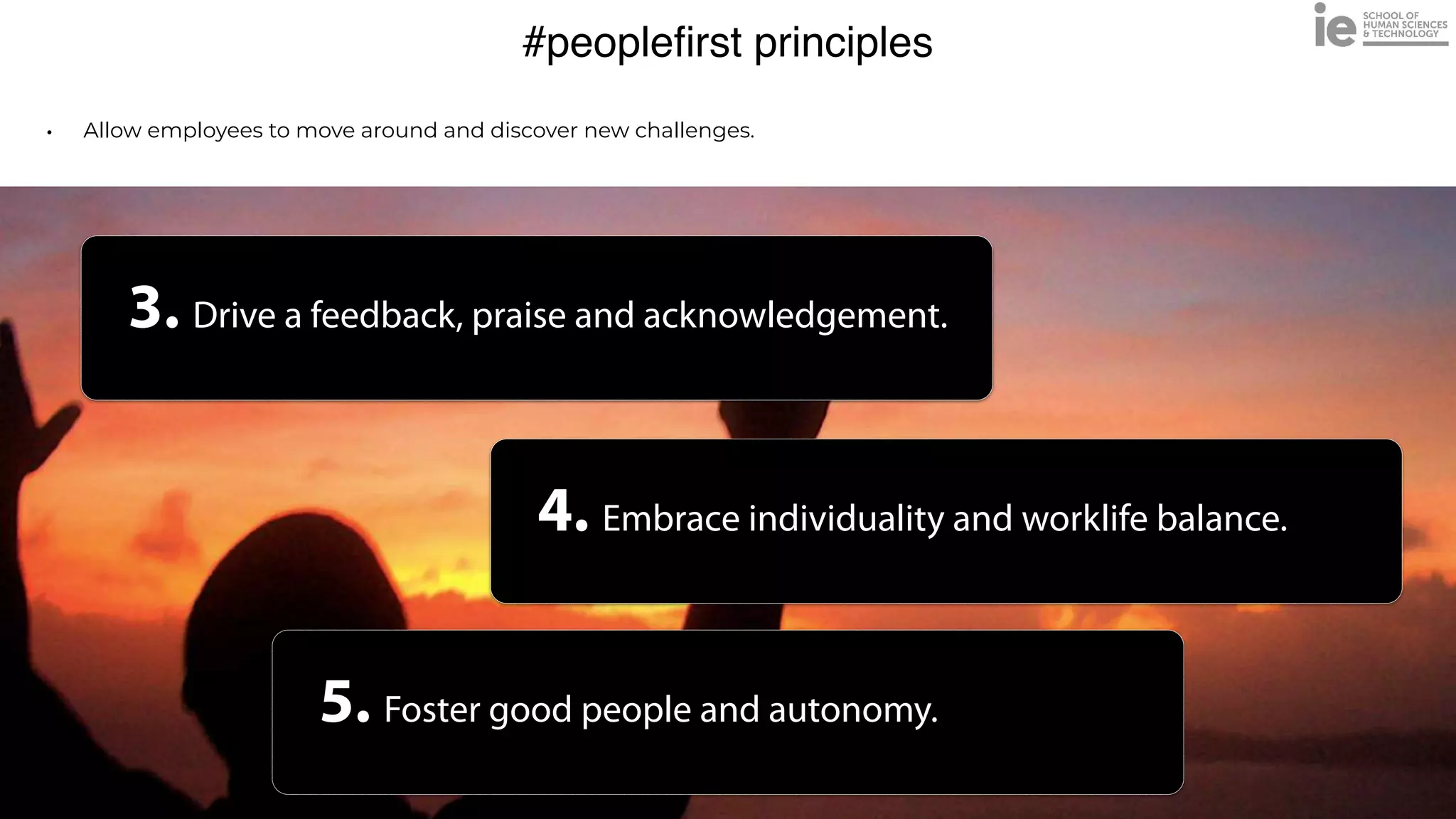
• Allow employees to move around and discover new challenges.
3. Drive a feedback, praise and acknowledgement.
4. Embrace individuality and worklife balance.
5. Foster good people and autonomy.
Why employee advocacy is social?
The communication landscape is changing
CEOs must communicate more openly and directly with their
employees, and empower them to become company advocates.
Edelman
What is employee advocacy?
• Employee advocacy programs strengthen a corporate brand by publicly empowering its leaders and
employees to communicate on behalf of the brand.


• In doing so:


• Employees gain expertise and profile, and become more engaged.


• The organisation increases the number, effectiveness and credibility of brand and value proposition.
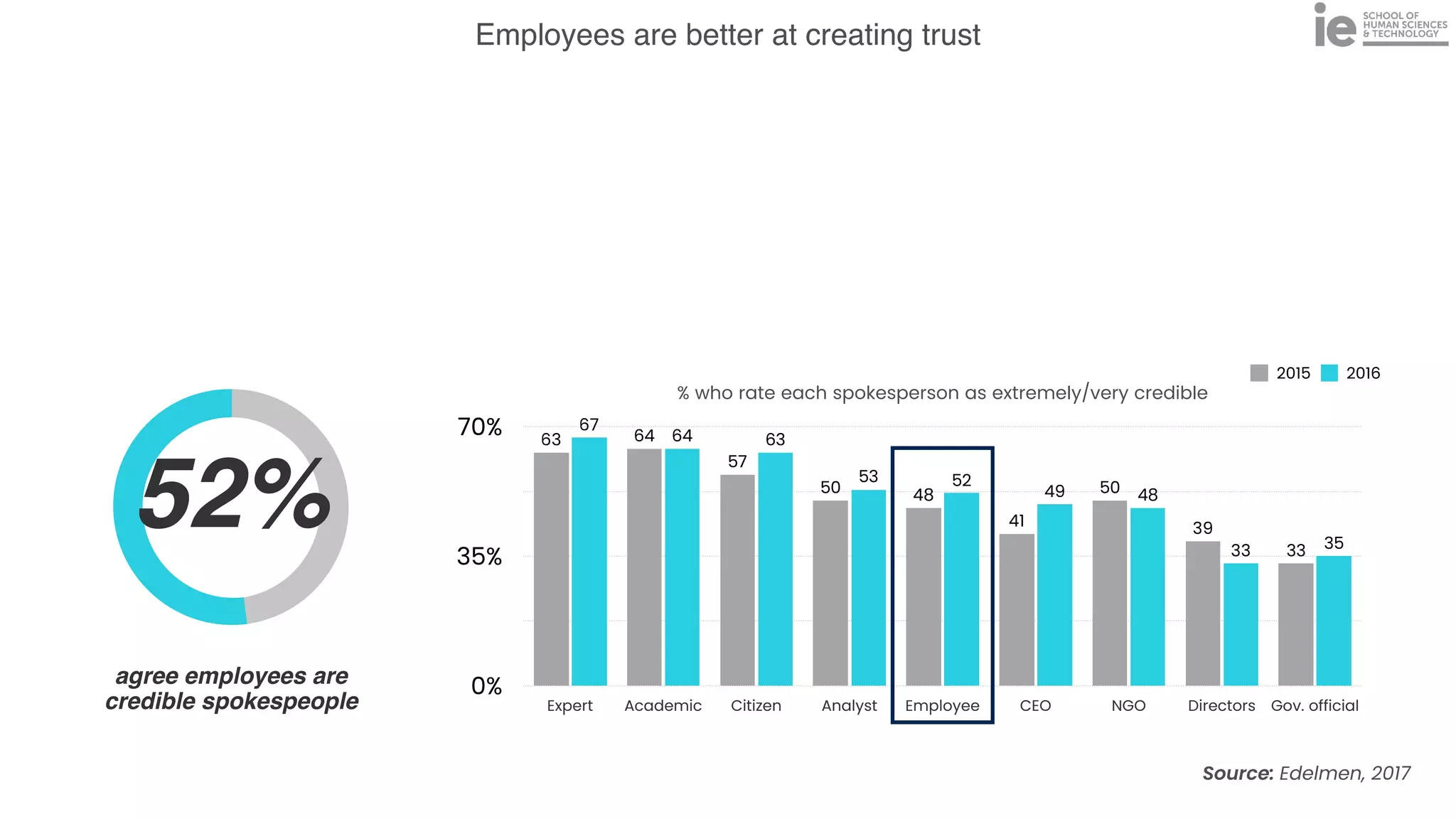
Employees are better at creating trust
52%
agree employees are
credible spokespeople
% who rate each spokesperson as extremely/very credible
0%
35%
70%
Expert Academic Citizen Analyst Employee CEO NGO Directors Gov. official
35
33
48
49
52
53
63
64
67
33
39
50
41
48
50
57
64
63
2015 2016
Source: Edelmen, 2017
Creating brand ambassadors from employees is about
more than just throwing out a few incentives. You have to
begin by looking at your organizational culture.


By assessing your company's core values and cultivating
a workforce that lives up to those values, you're creating a
company culture that promotes strong customer service,
loyalty and a sense of fun.


Forbes, 2013
This is about long-term culture change
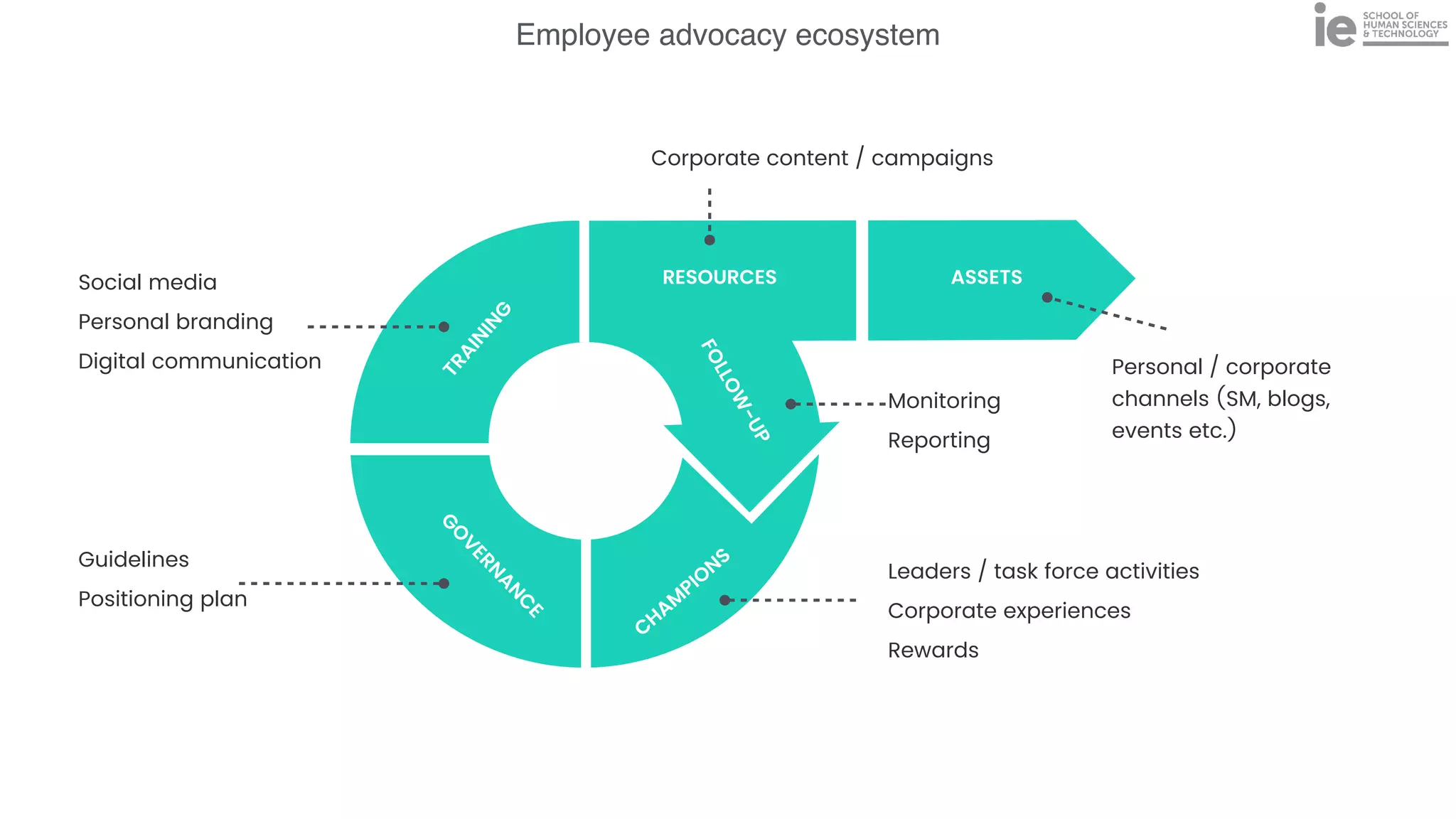
Employee advocacy ecosystem
ASSETS
RESOURCES
T
R
A
I
N
I
N
G
G
O
V
E
R
N
A
N
C
E
C
HAM
PIO
NS
F
O
L
L
O
W
-
U
P
Leaders / task force activities


Corporate experiences


Rewards
Guidelines


Positioning plan
Social media


Personal branding


Digital communication
Corporate content / campaigns
Monitoring


Reporting
Personal / corporate
channels (SM, blogs,
events etc.)

Policy for Social Media
• Policy elements


• “Social media” refers to a variety of online communities like blogs, social networks, chat rooms and forums.


• We consider two different elements: using personal social media at work and representing our company through social media.


•Using personal social media


• We allow employees to access their personal accounts at work. But, we expect them to act responsibly and ensure their
productivity isn’t affected. Using social media excessively while at work can reduce ef
fi
ciency and concentration. Whether
employees are using their accounts for business or personal purposes, they may easily get sidetracked by the vast amount of
available content.
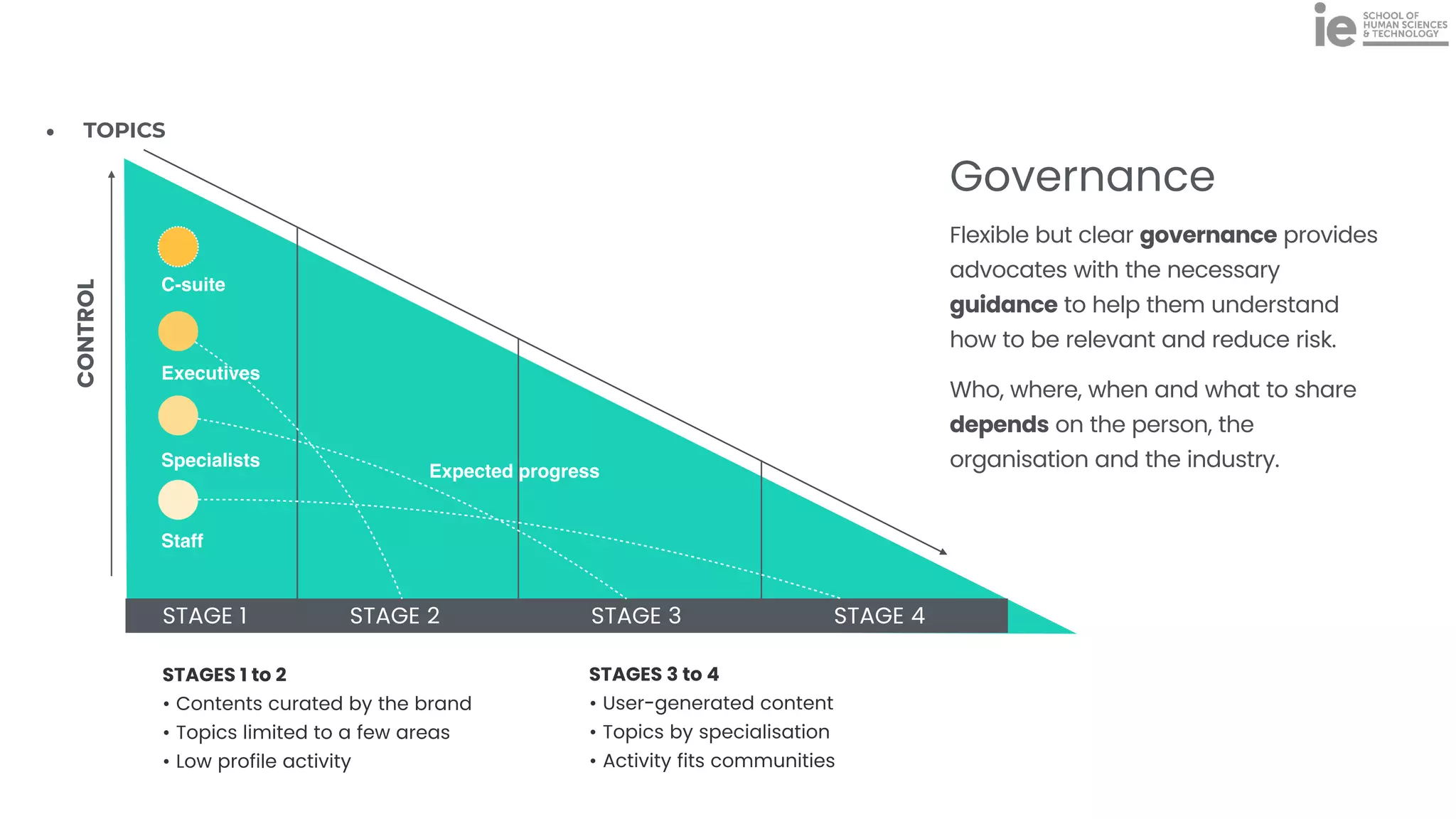
• TOPICS
STAGES 3 to 4


• User-generated content


• Topics by specialisation


• Activity fits communities
STAGES 1 to 2


• Contents curated by the brand


• Topics limited to a few areas


• Low profile activity
STAGE 1 STAGE 2 STAGE 3 STAGE 4
CONTROL
C-suite
Executives
Specialists
Staff
Expected progress
Governance


Flexible but clear governance provides
advocates with the necessary
guidance to help them understand
how to be relevant and reduce risk.


Who, where, when and what to share
depends on the person, the
organisation and the industry.
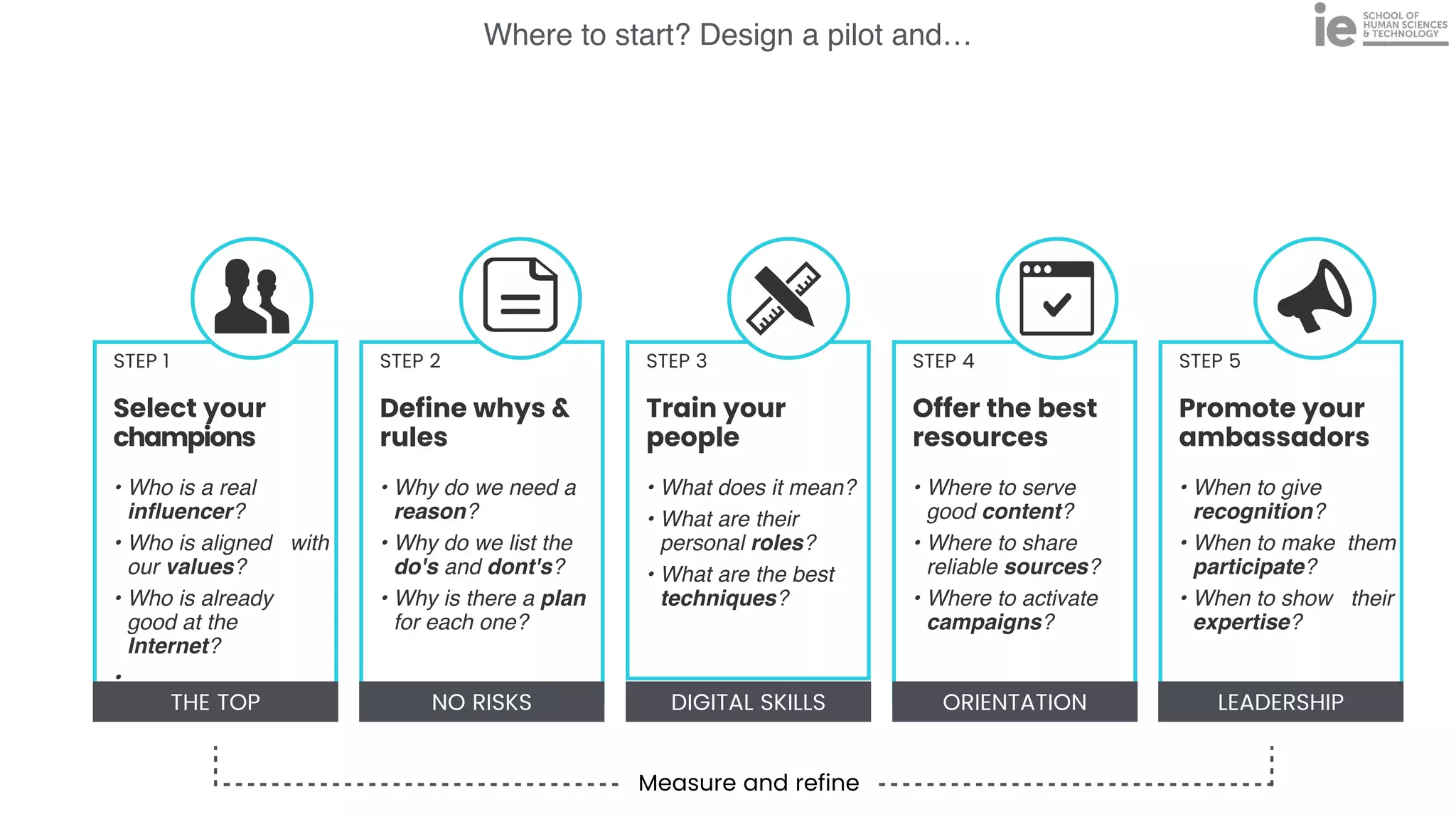
STEP 1


Select your
champions


• Who is a real
in
fl
uencer?
• Who is aligned with
our values?
• Who is already
good at the
Internet?
•
STEP 2


Define whys &
rules


• Why do we need a
reason?
• Why do we list the
do's and dont's?
• Why is there a plan
for each one?
STEP 3


Train your
people


• What does it mean?
• What are their
personal roles?
• What are the best
techniques?
STEP 4


Offer the best
resources


• Where to serve
good content?
• Where to share
reliable sources?
• Where to activate
campaigns?
STEP 5


Promote your
ambassadors


• When to give
recognition?
• When to make them
participate?
• When to show their
expertise?
THE TOP NO RISKS DIGITAL SKILLS ORIENTATION LEADERSHIP
Where to start? Design a pilot and…
Measure and refine
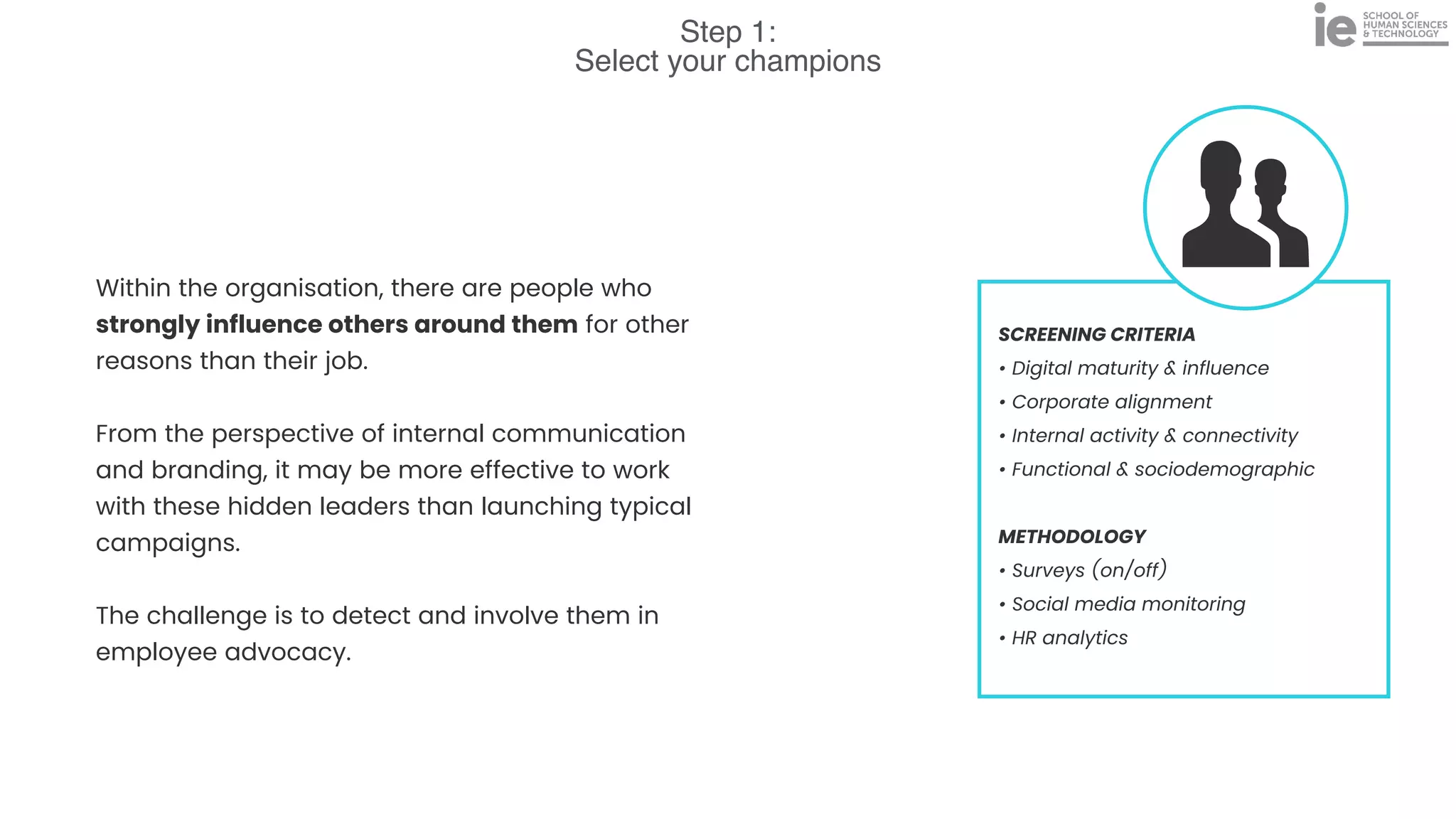
Step 1:
Select your champions
SCREENING CRITERIA


• Digital maturity & influence


• Corporate alignment


• Internal activity & connectivity


• Functional & sociodemographic


METHODOLOGY


• Surveys (on/off)

• Social media monitoring


• HR analytics
Within the organisation, there are people who
strongly influence others around them for other
reasons than their job.


From the perspective of internal communication
and branding, it may be more effective to work
with these hidden leaders than launching typical
campaigns.


The challenge is to detect and involve them in
employee advocacy.
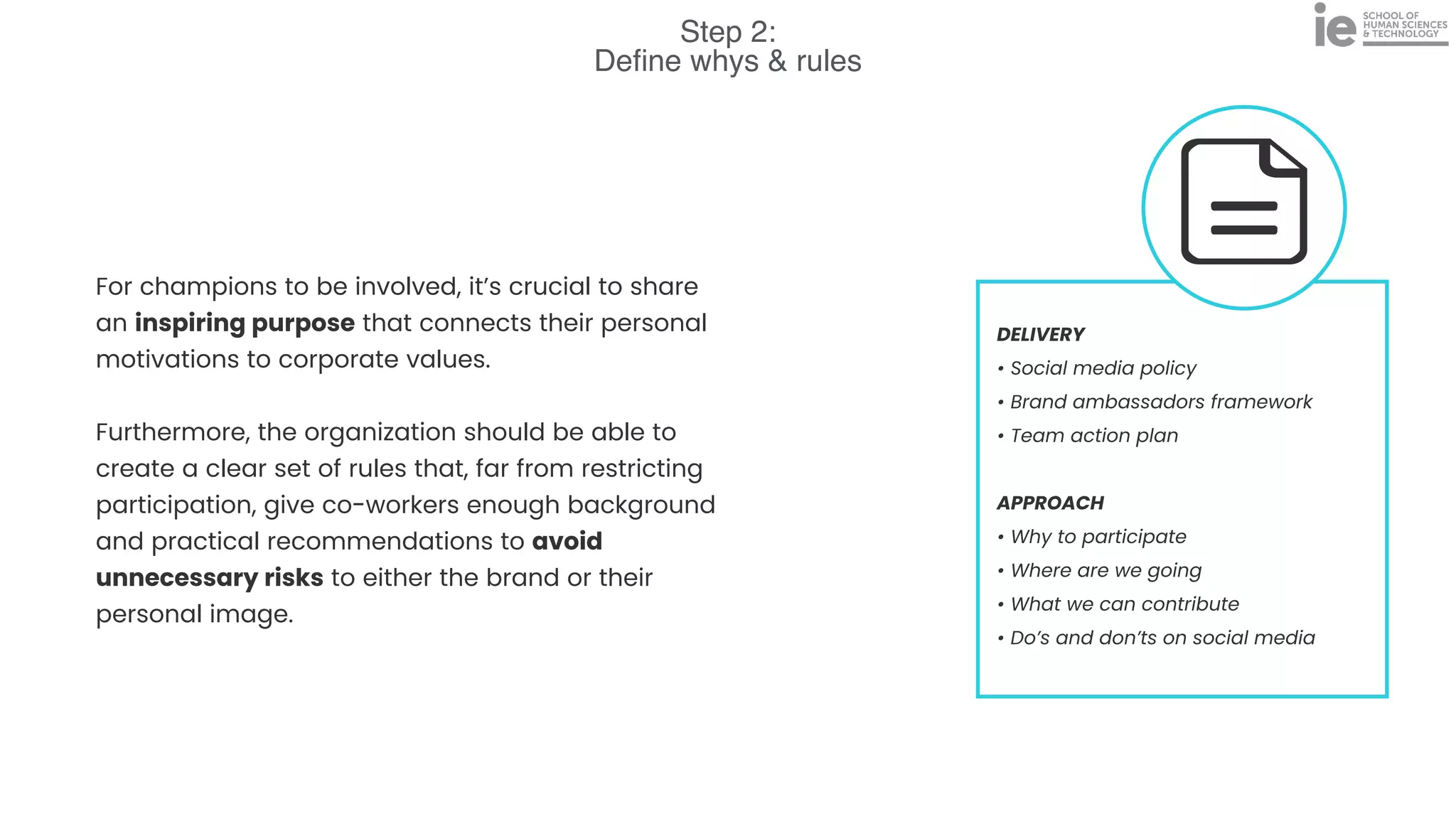
Step 2:
De
fi
ne whys & rules
DELIVERY


• Social media policy


• Brand ambassadors framework


• Team action plan


APPROACH


• Why to participate


• Where are we going


• What we can contribute


• Do’s and don’ts on social media
For champions to be involved, it’s crucial to share
an inspiring purpose that connects their personal
motivations to corporate values.


Furthermore, the organization should be able to
create a clear set of rules that, far from restricting
participation, give co-workers enough background
and practical recommendations to avoid
unnecessary risks to either the brand or their
personal image.
Step 3:
Train your people
TRAINING


• In-person and online classes


• 10 to 40 hours of teaching courses


• Case studies and exercises


• Ongoing support


CONTENTS


• Social media


• Personal branding


• Digital communication tools
The company has to help champions to build and
promote a strong and consistent digital identity.
To do this, they are expected to provide training
regarding the use of the right management tools,
content formats, and social media platforms.


This is where these co-workers best connect with
the groups and communities that are relevant to
them… where they can become influencers… and
where the brand alone will never have as much
impact.
Step 4:
Offer the best resources
TOOLS


• Web repository


• Living content board


• Social internal network


• RSS Feed readers


MATERIALS


• Stories, pictures and videos


• Pre-created content & campaigns


• Top sources by specialty
The company can provide their champions with
tools and corporate resources that ease
participation.


Depending on the stage, these materials may be
content repositories with fresh stories and image
assets, and sometimes a live pipeline of content
ready to edit and share on social media


In such way, brand ambassadors will never be
afraid to publish misaligned messages, and risk is
further reduced.
Step 5:
Promote your ambassadors
PLATFORMS


• Web, blog, Social Media, Newsletters


• Events, seminars, training sessions


• Rituals & focus groups


• Physical bulletin boards


OUTCOMES


• Visibility


• First-hand experiences


• Scoops, prices and rewards
Companies must recognize and project their
ambassadors’ activity by implementing physical
and virtual spaces to celebrate their progress to
other co-workers and to their clients and
stakeholders.


We refer to corporate communication assets such
as blogs, social media dashboards, events, bulletin
boards, discussion forums, newsletters etc,
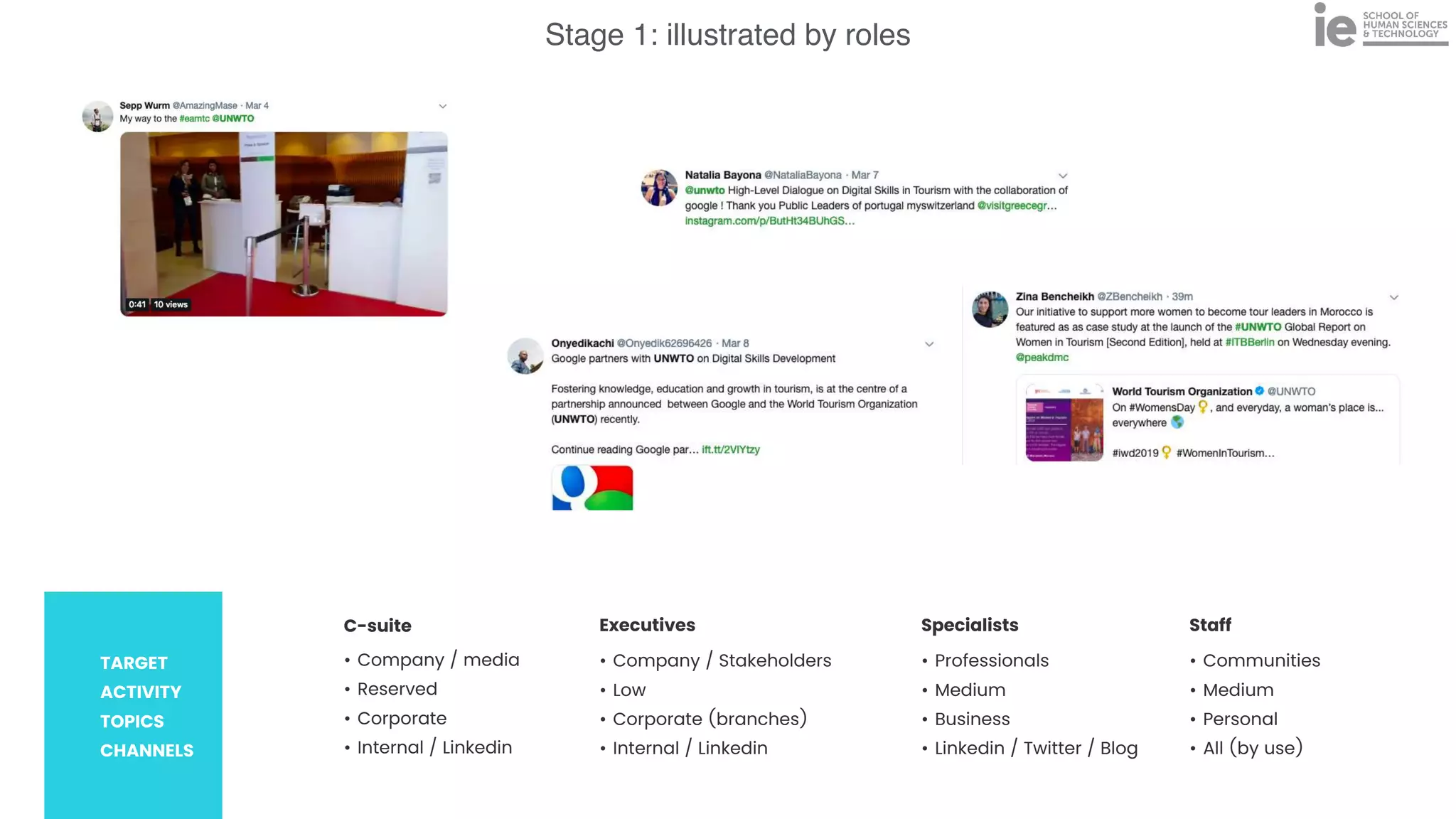
Stage 1: illustrated by roles
C-suite


• Company / media


• Reserved


• Corporate


• Internal / Linkedin
Executives


• Company / Stakeholders


• Low


• Corporate (branches)


• Internal / Linkedin
Specialists


• Professionals


• Medium


• Business


• Linkedin / Twitter / Blog
Staff


• Communities


• Medium


• Personal


• All (by use)
TARGET


ACTIVITY


TOPICS


CHANNELS
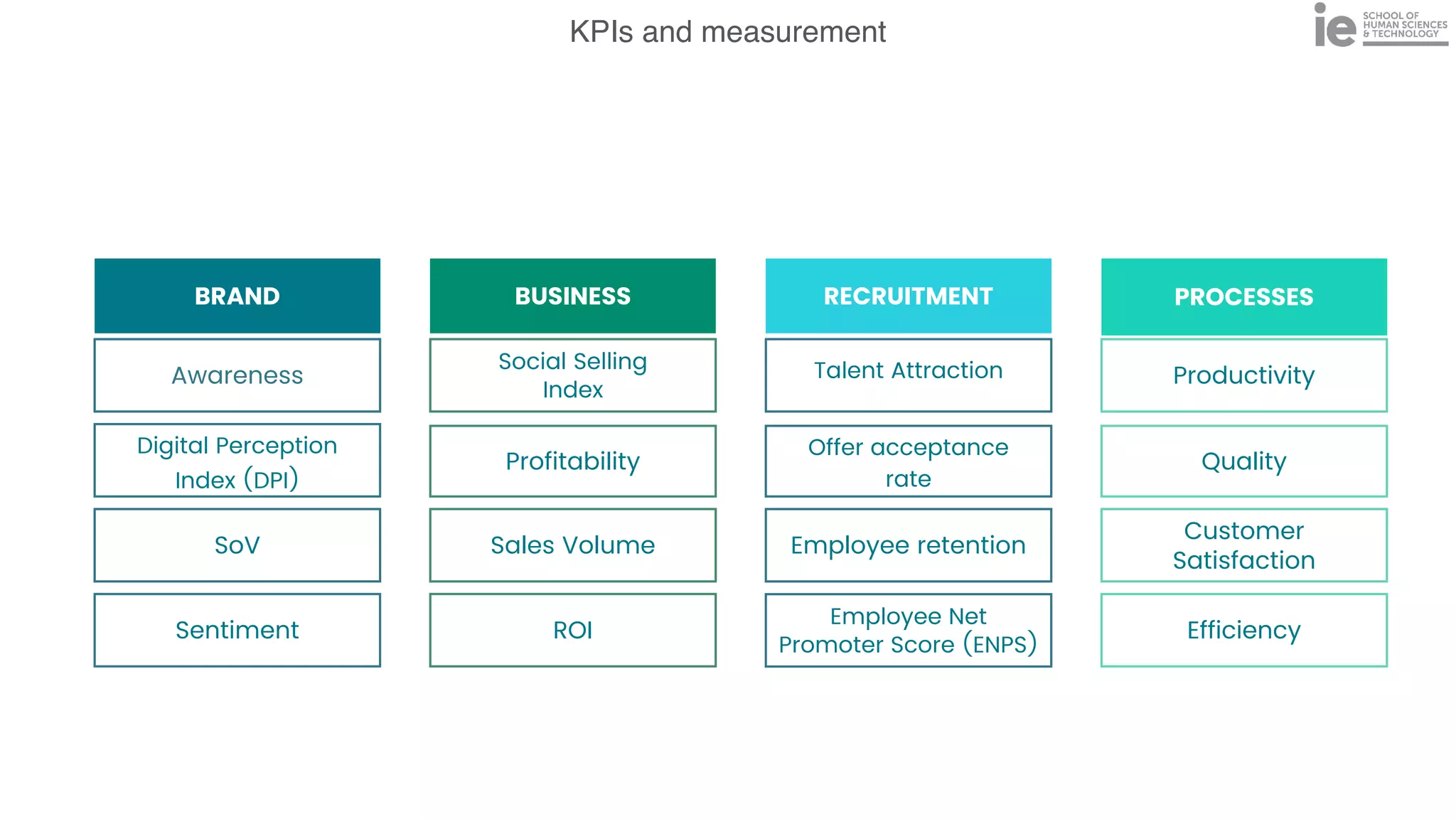
KPIs and measurement
BUSINESS
Social Selling


Index
Profitability
Sales Volume
ROI
PROCESSES
Productivity
Quality
Customer


Satisfaction
Efficiency
RECRUITMENT
Offer acceptance


rate
Employee retention
Employee Net


Promoter Score (ENPS)
Talent Attraction
BRAND
Awareness
SoV
Sentiment
Digital Perception


Index (DPI)
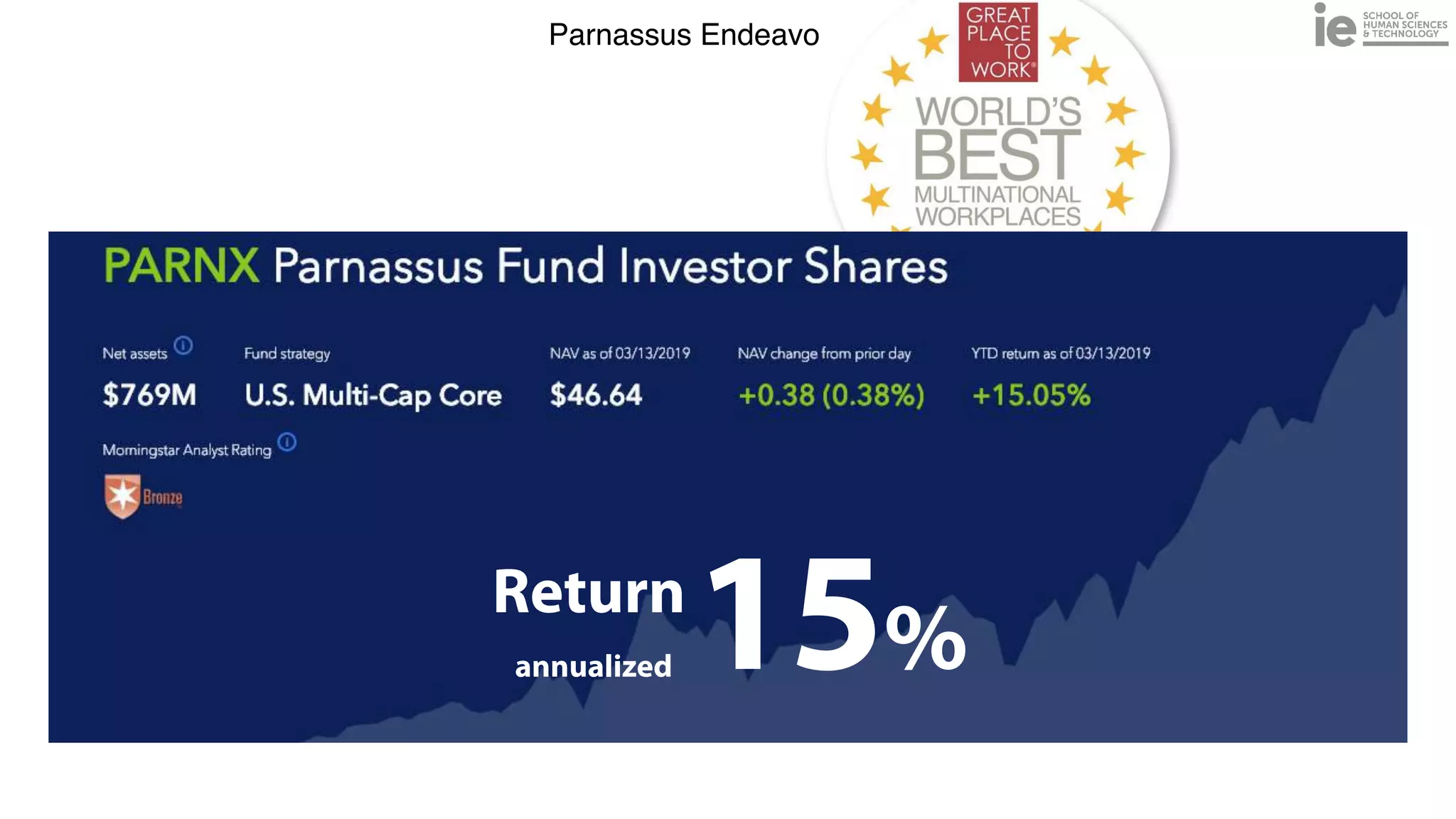
Parnassus Endeavor Fund
Return


annualized 15%
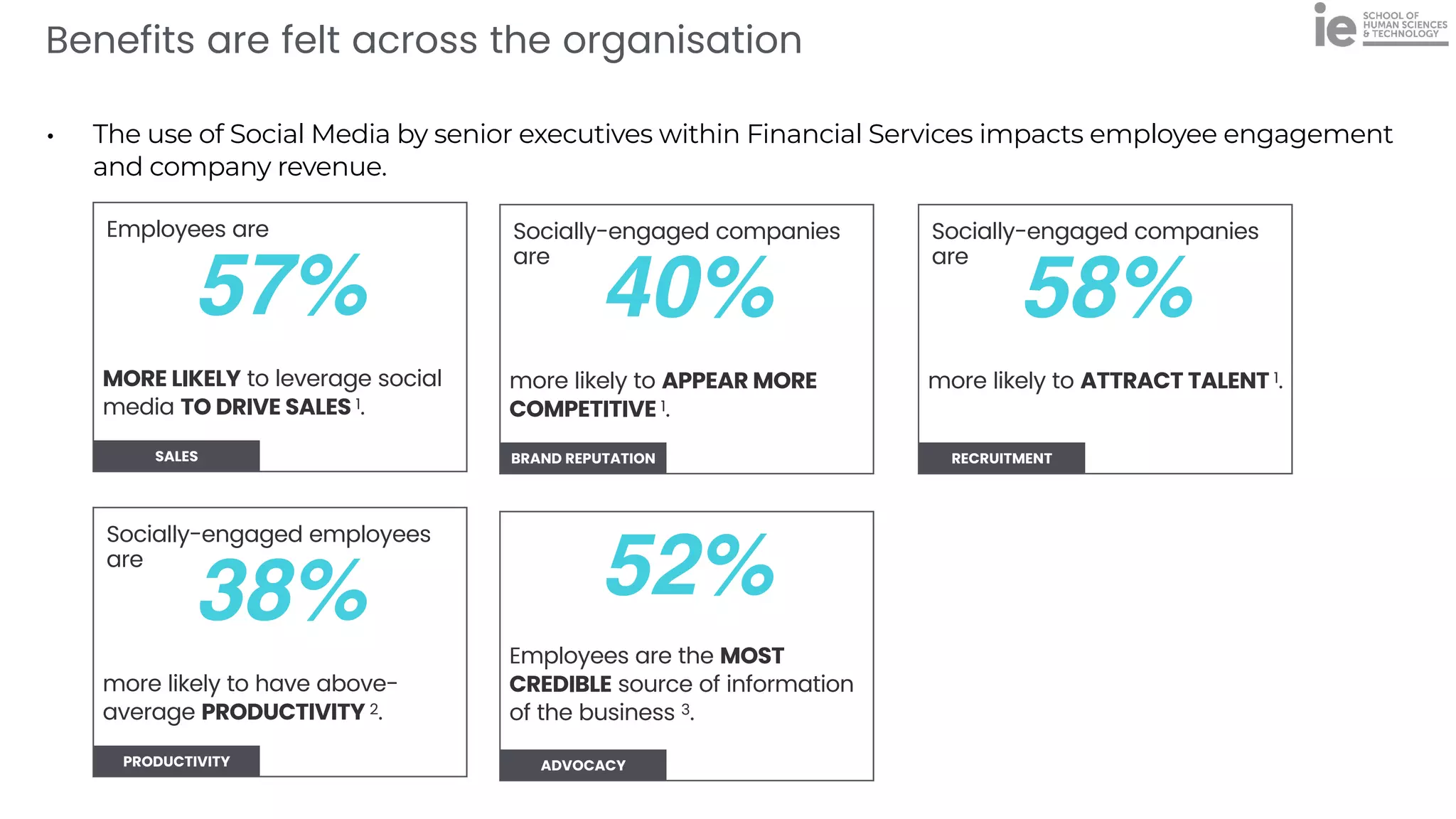
SALES
MORE LIKELY to leverage social
media TO DRIVE SALES 1.
57%
Employees are
PRODUCTIVITY
more likely to have above-
average PRODUCTIVITY 2.
38%
Socially-engaged employees


are
BRAND REPUTATION
more likely to APPEAR MORE
COMPETITIVE 1.
40%
Socially-engaged companies


are
RECRUITMENT
more likely to ATTRACT TALENT 1.
58%
Socially-engaged companies


are
ADVOCACY
Employees are the MOST
CREDIBLE source of information
of the business 3.
52%
Benefits are felt across the organisation
• The use of Social Media by senior executives within Financial Services impacts employee engagement
and company revenue.
Building Employee advocacy
Best Practices
Policy for Social Media
• Policy elements


• “Social media” refers to a variety of online communities like blogs, social networks, chat rooms and forums.


• We consider two different elements: using personal social media at work and representing our company through social media.


•Using personal social media


• We allow employees to access their personal accounts at work. But, we expect them to act responsibly and ensure their
productivity isn’t affected. Using social media excessively while at work can reduce ef
fi
ciency and concentration. Whether
employees are using their accounts for business or personal purposes, they may easily get sidetracked by the vast amount of
available content.
Policy for Social Media
•We advise our employees to:


• Use their common sense. If employees neglect their job duties to spend time on social media, their decline in productivity will show on
their performance reviews. 


• Ensure others know that personal account or statements don’t represent our company. Employees shouldn’t state or imply that their
personal opinions and content are authorized or endorsed by our company. We advise using a disclaimer such as “opinions are my own” to
avoid misunderstandings.


• Avoid sharing intellectual property like trademarks on a personal account without approval. Con
fi
dentiality policies and laws always apply.


• Avoid any defamatory, offensive or derogatory content. It may be considered as a violation of our company’s anti-harassment policy, if
directed towards colleagues, clients or partners.
Policy for Social Media
•Representing our company:


•Some employees represent our company by handling corporate social media accounts or speak on our company’s behalf. We
expect them to act carefully and responsibly to protect our company’s image and reputation. Employees should:


• Be respectful, polite and patient, when engaging in conversations on our company’s behalf. They should be extra careful when
making declarations or promises towards customers and stakeholders.


• Avoid speaking on matters outside their
fi
eld of expertise when possible. Everyone should be careful not to answer questions
or make statements that fall under somebody else’s responsibility.


• Follow our con
fi
dentiality policy and data protection policy and observe laws on copyright, trademarks, plagiarism and fair use.
Policy for Social Media
•Representing our company:


• Inform our [PR/Marketing department] when they’re about to share any major-impact content


• Avoid deleting or ignoring comments for no reason. They should listen and reply to criticism.


• Never post discriminatory, offensive or libelous content and commentary


• Correct or remove any misleading or false content as quickly as possible
Disregarding job responsibilities and deadlines to use social media


Disclosing confidential information through personal or corporate accounts


Directing offensive comments towards other members of the online community
Advice for Social Media
• Introduce the purpose of social media as part of your corporate strategy, be it concerning marketing, recruitment or employer
branding.


• Add value – when employees publish work-related social media content, they should provide useful information or insight that is
relevant to the business.


• Employees should be prohibited from sharing con
fi
dential and proprietary information online.


• Responsibility for content – employees should know to exercise good judgment and be prepared to deal with any consequences
that result from inappropriate actions or statements online.


• Authenticity is critical – users of social media should identify themselves by name, and when relevant, position and company.
Advice for Social Media
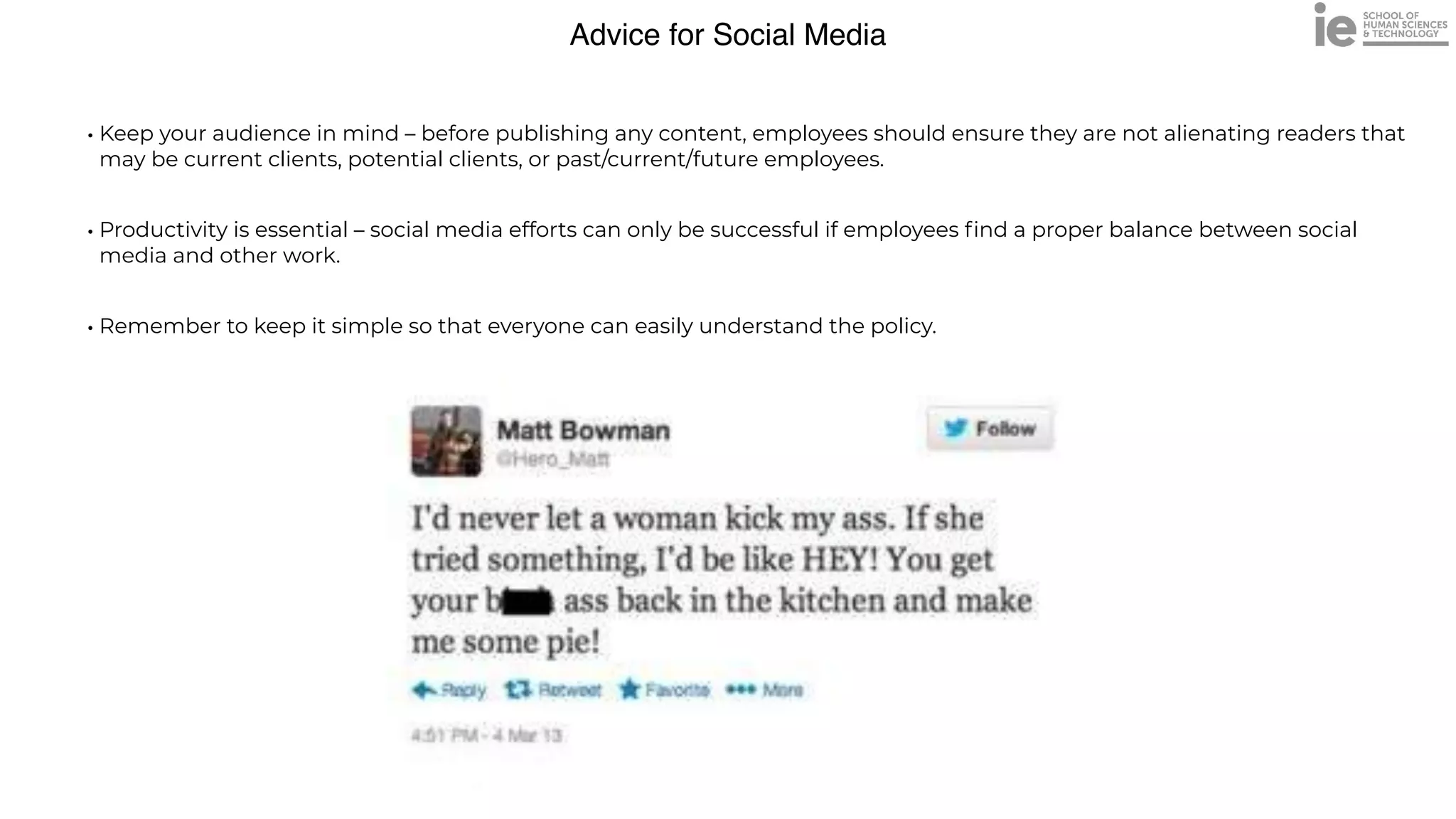
• Keep your audience in mind – before publishing any content, employees should ensure they are not alienating readers that
may be current clients, potential clients, or past/current/future employees.


• Productivity is essential – social media efforts can only be successful if employees
fi
nd a proper balance between social
media and other work.


• Remember to keep it simple so that everyone can easily understand the policy.
LinkedIn
The Best Place for B2B SMM
Why is Linkedin so Important?
• Senior-level in
fl
uencers


• Decision makers and opinion leaders


• C-level execs and talent


• Industry news


• Expert advice


• Career training


• Peer insights and recommendations


• Content published by LinkedIn’s 500+ In
fl
uencers


Why is Linkedin so Important?
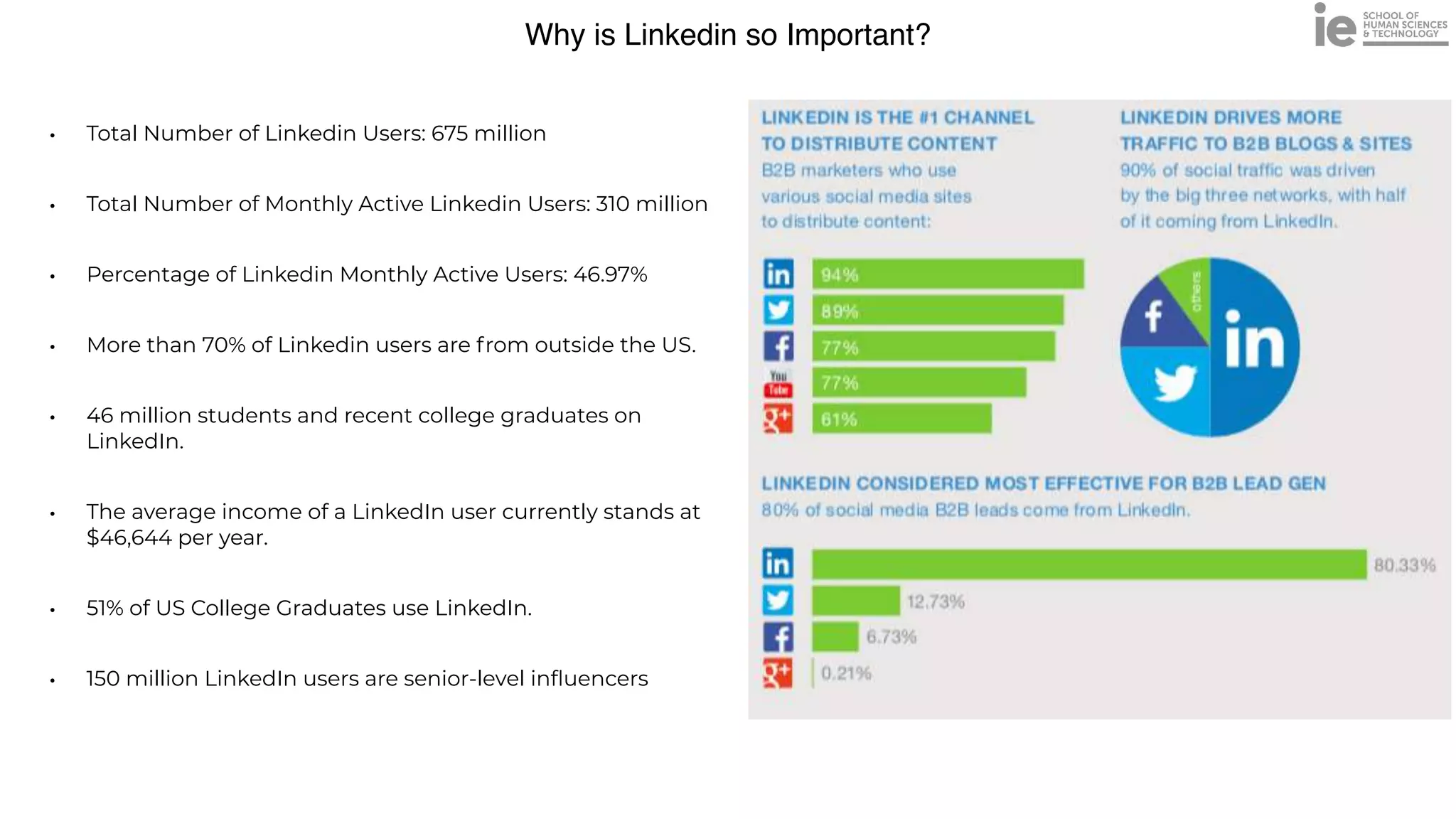
• Total Number of Linkedin Users: 675 million


• Total Number of Monthly Active Linkedin Users: 310 million


• Percentage of Linkedin Monthly Active Users: 46.97%


• More than 70% of Linkedin users are from outside the US.


• 46 million students and recent college graduates on
LinkedIn.


• The average income of a LinkedIn user currently stands at
$46,644 per year.


• 51% of US College Graduates use LinkedIn.


• 150 million LinkedIn users are senior-level in
fl
uencers
Why is Linkedin so Important?
• 1. Targeting


Creating awareness of your brand and products early in the purchase process


• 2. engaging


Positioning your brand as a thought leader and engaging audiences more deeply


with content as they’re forming perceptions and decisions


• 3. optimizing


Driving the right audiences to take action, helping you generate quality leads and new business
Create Company Page
• Complete your Page


Pages with complete information get 30% more weekly views. Here’s what you’ll need to
fi
ll out.


• Logo


Add your organization’s logo and a cover image to bring your Page to life.


• Overview


Lead with relevant terms and phrases that describe your organization’s mission and purpose (LinkedIn members can search
by keywords).


• Organization info


Input your website URL and location, and select your industry and company size.


• Call-to-action button


Customize your button to align with your goals and track who’s clicked in the admin view or in visitor analytics.
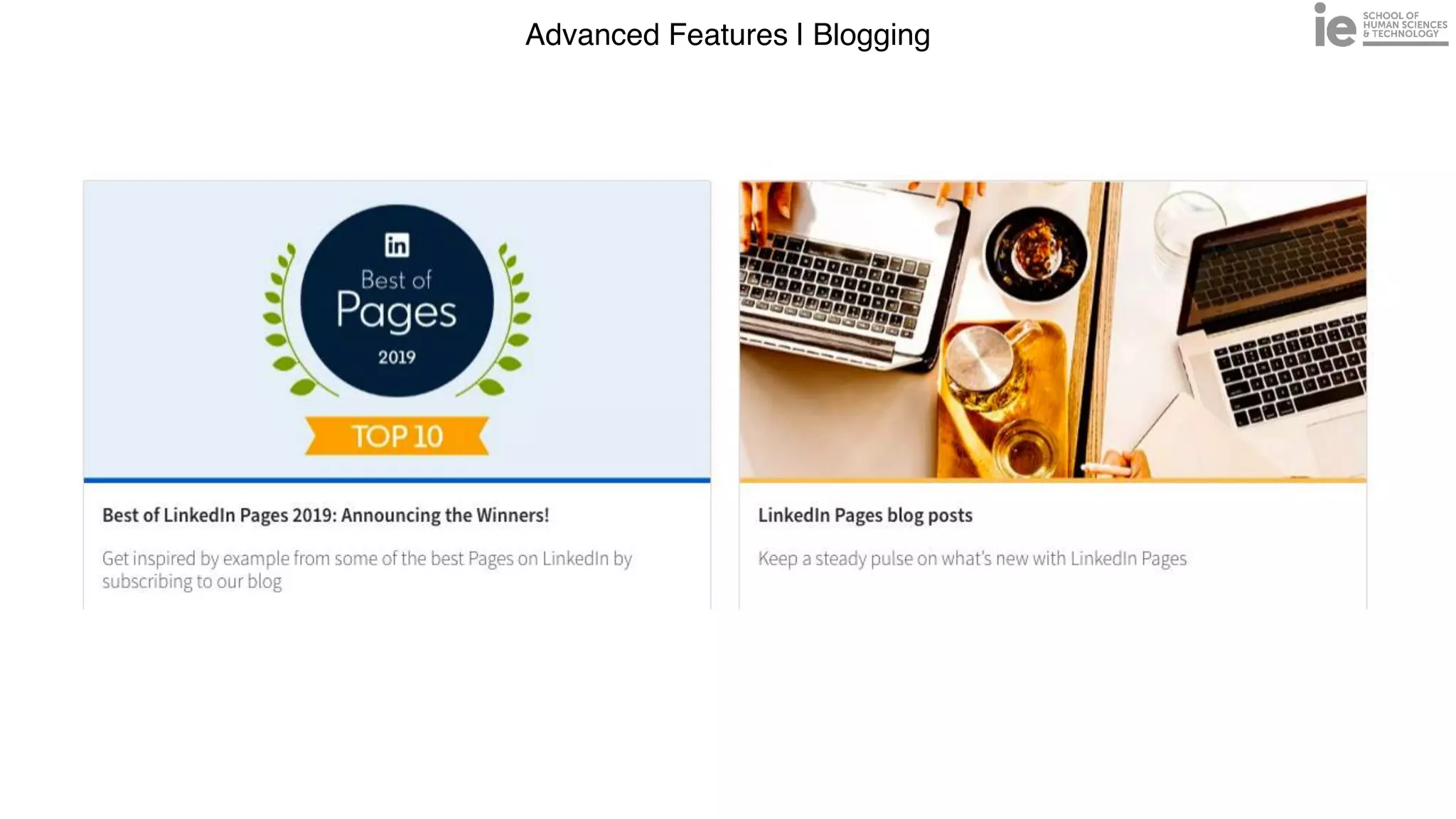
Advanced Features | Blogging
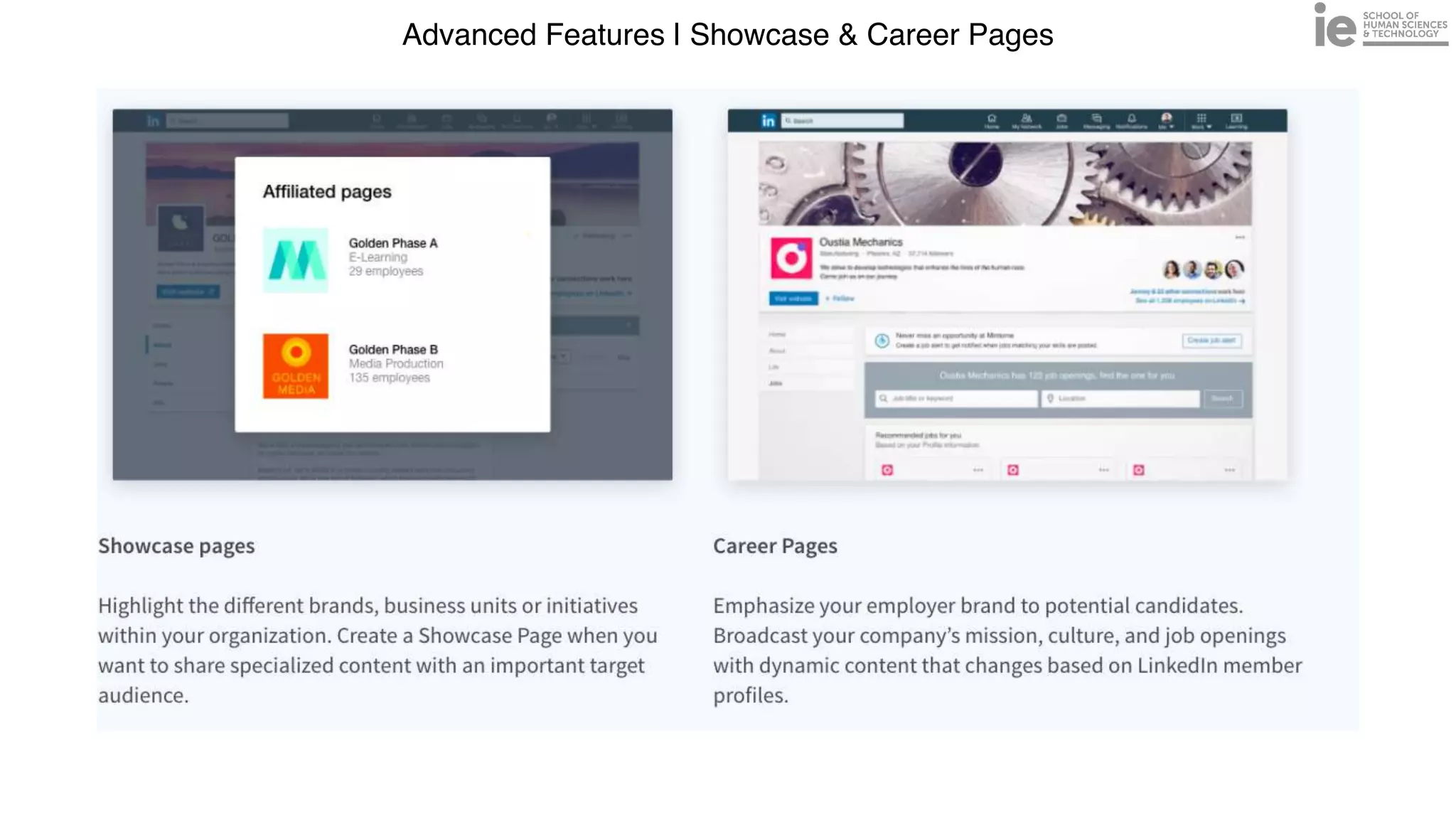
Advanced Features | Showcase & Career Pages
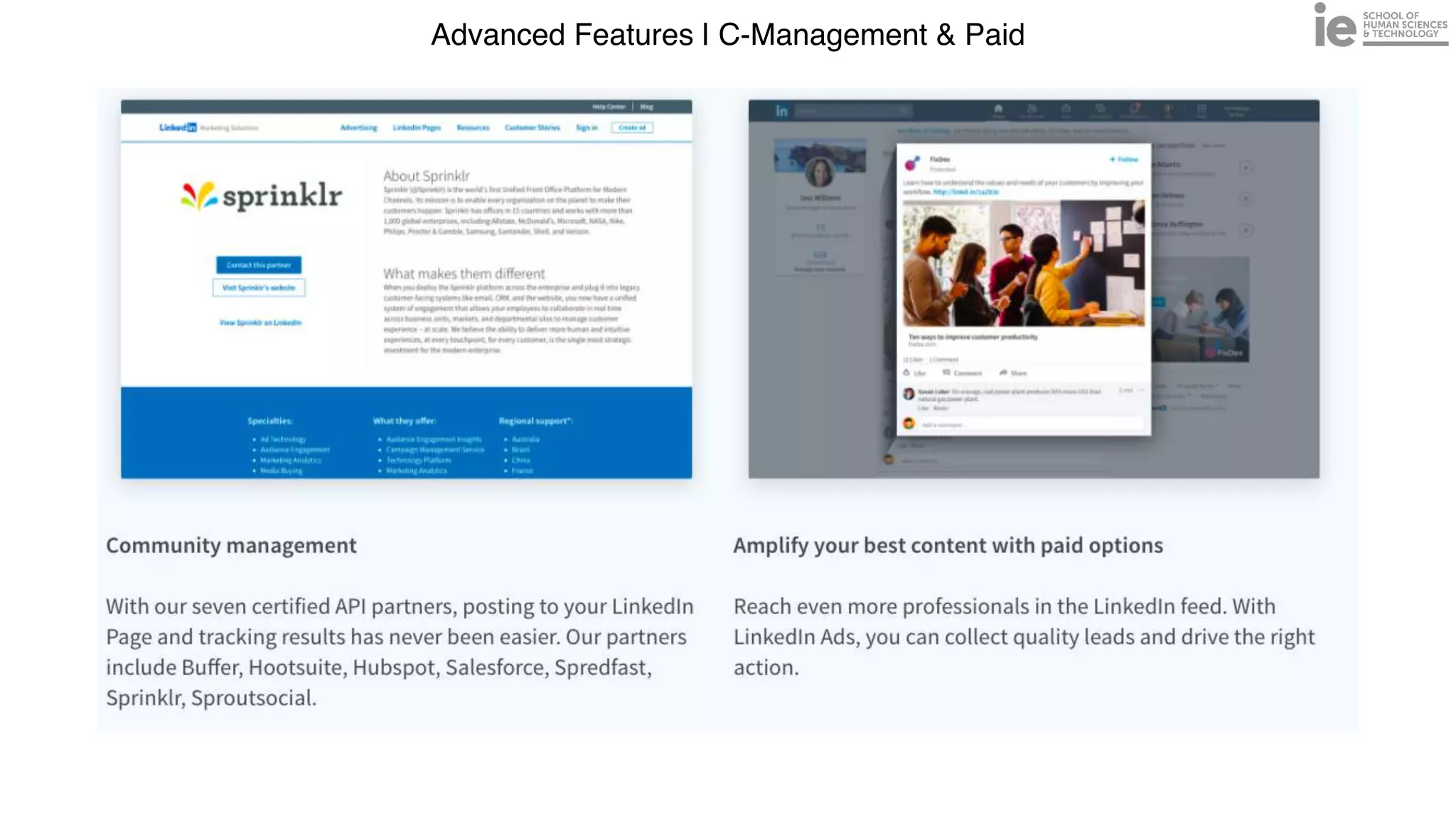
Advanced Features | C-Management & Paid
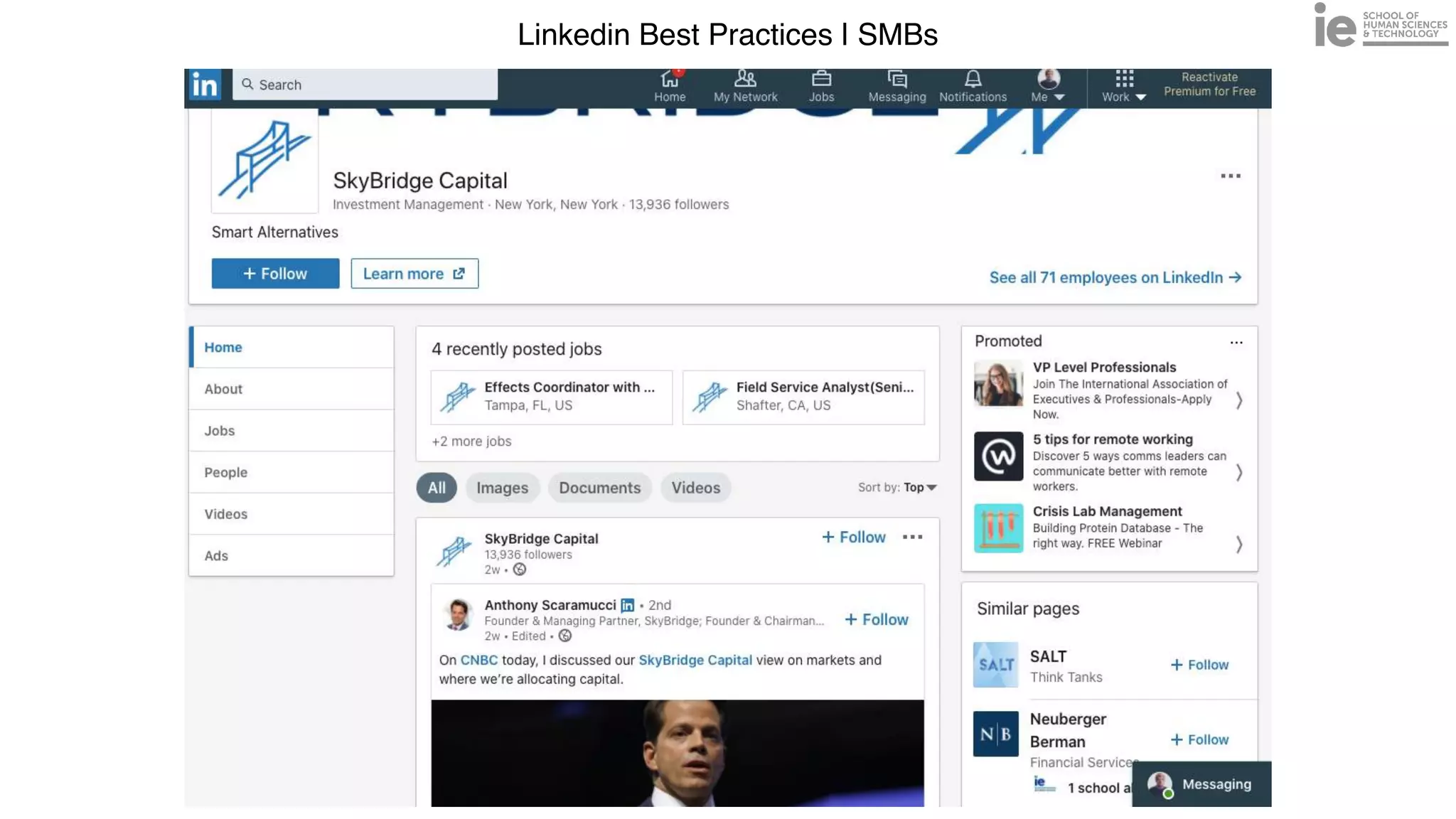
Linkedin Best Practices | SMBs
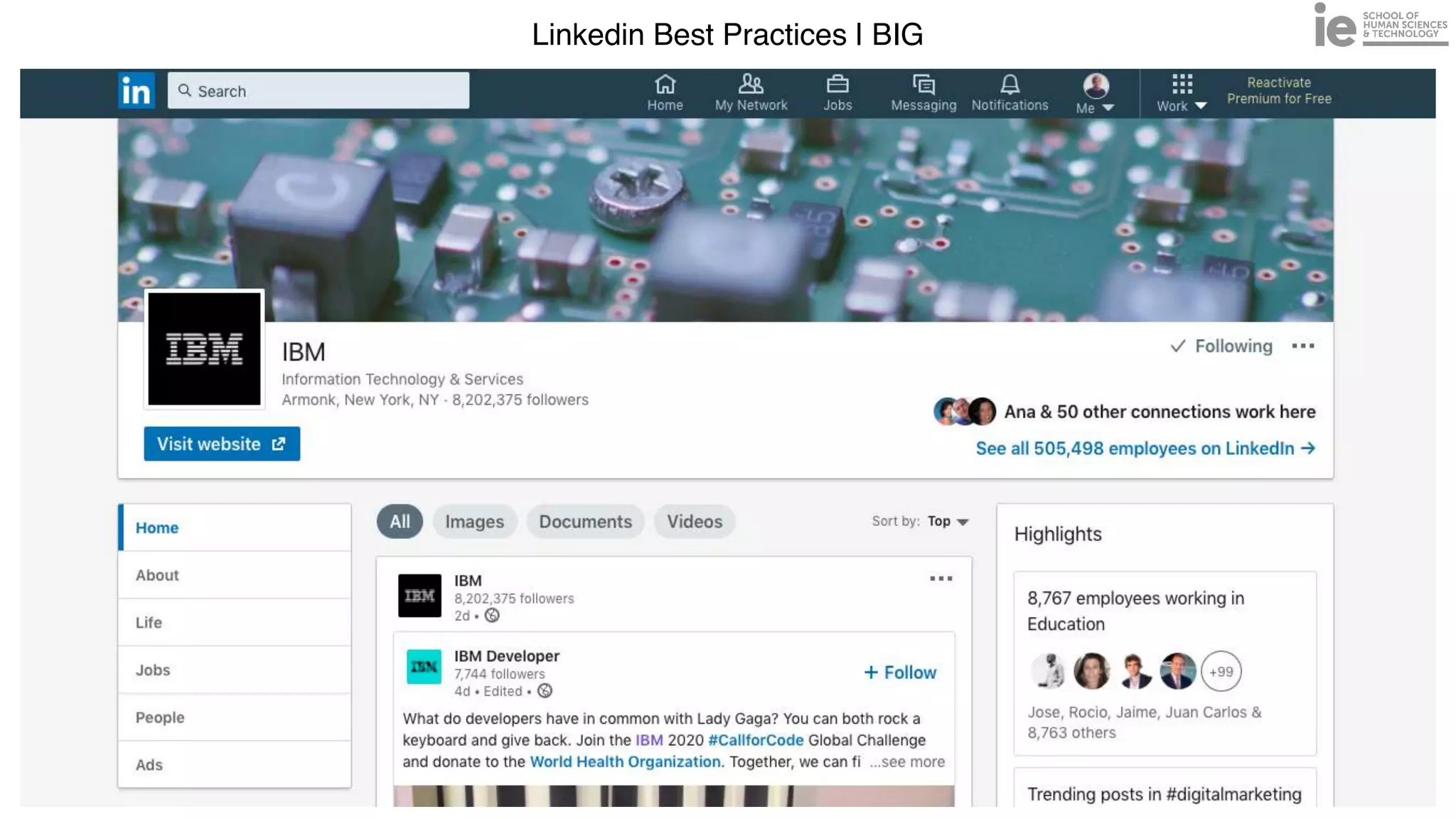
Linkedin Best Practices | BIG
What’s next?


How to maximize your ROI in Linkedin?
Groups


Phantom Buster


Sales Navigator


Advanced Paid


CRM Connectivity
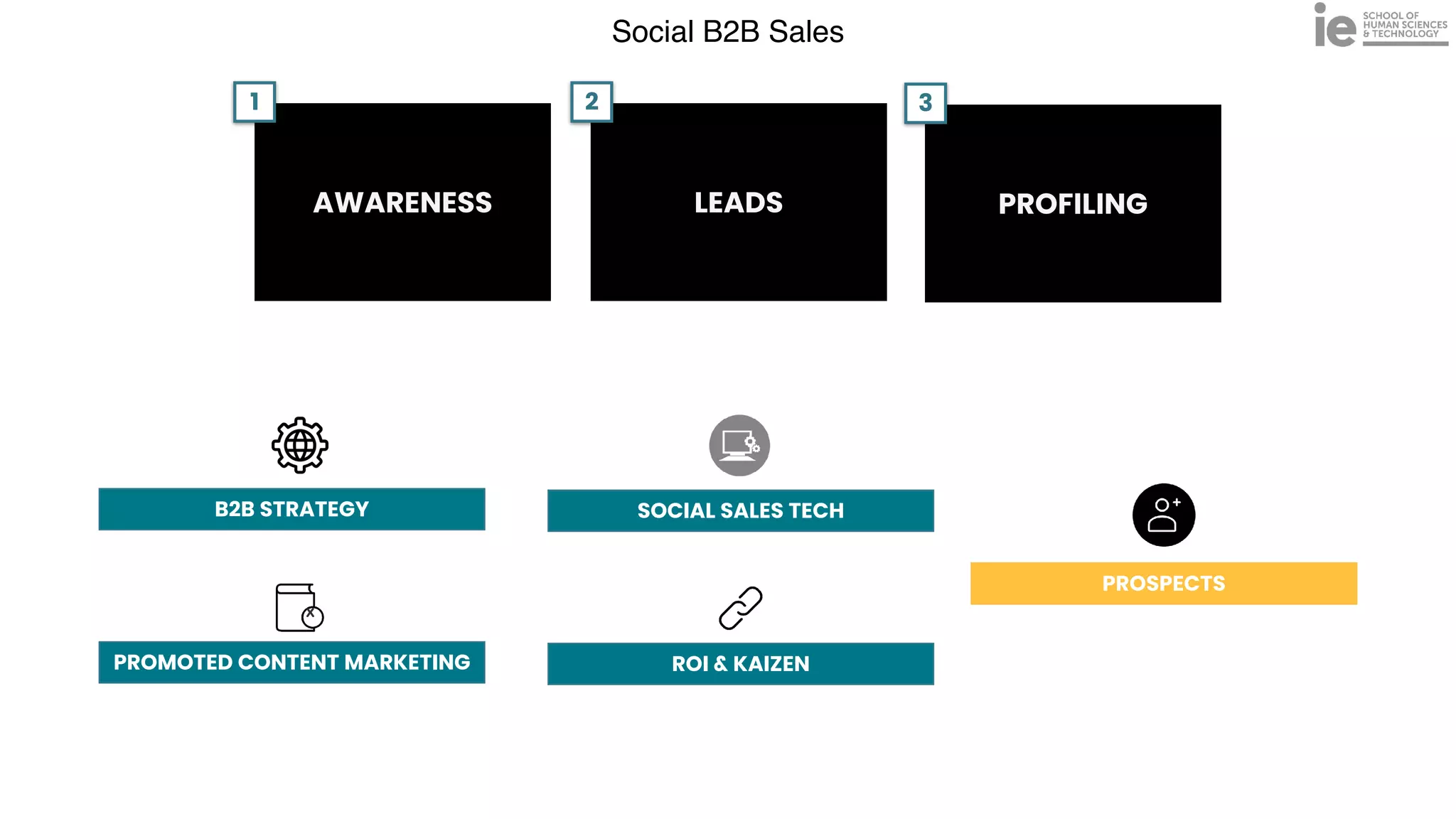
Social B2B Sales
AWARENESS LEADS PROFILING
1 2 3
B2B STRATEGY
PROMOTED CONTENT MARKETING
SOCIAL SALES TECH
ROI & KAIZEN
x
PROSPECTS
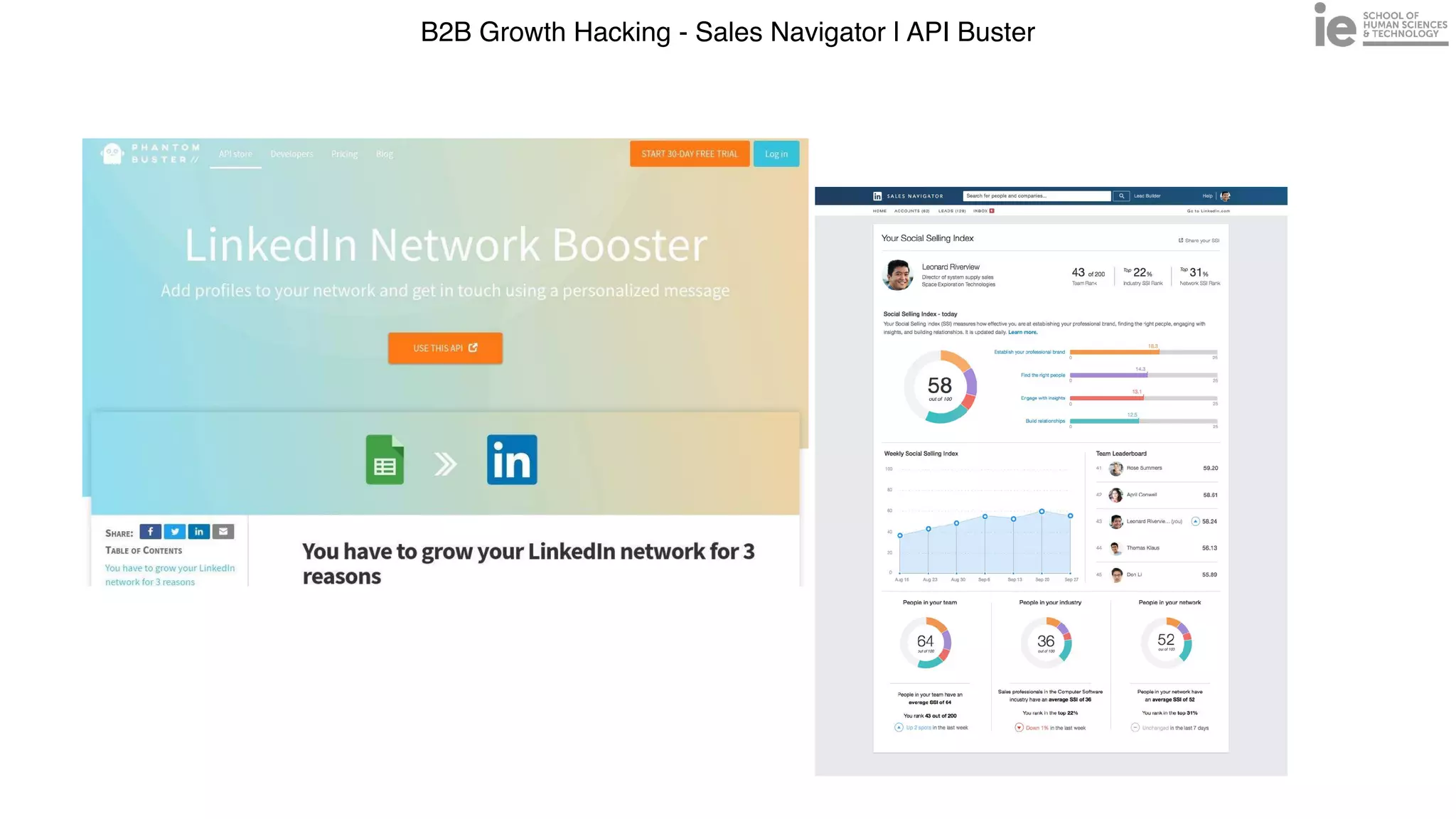
B2B Growth Hacking - Sales Navigator | API Buster
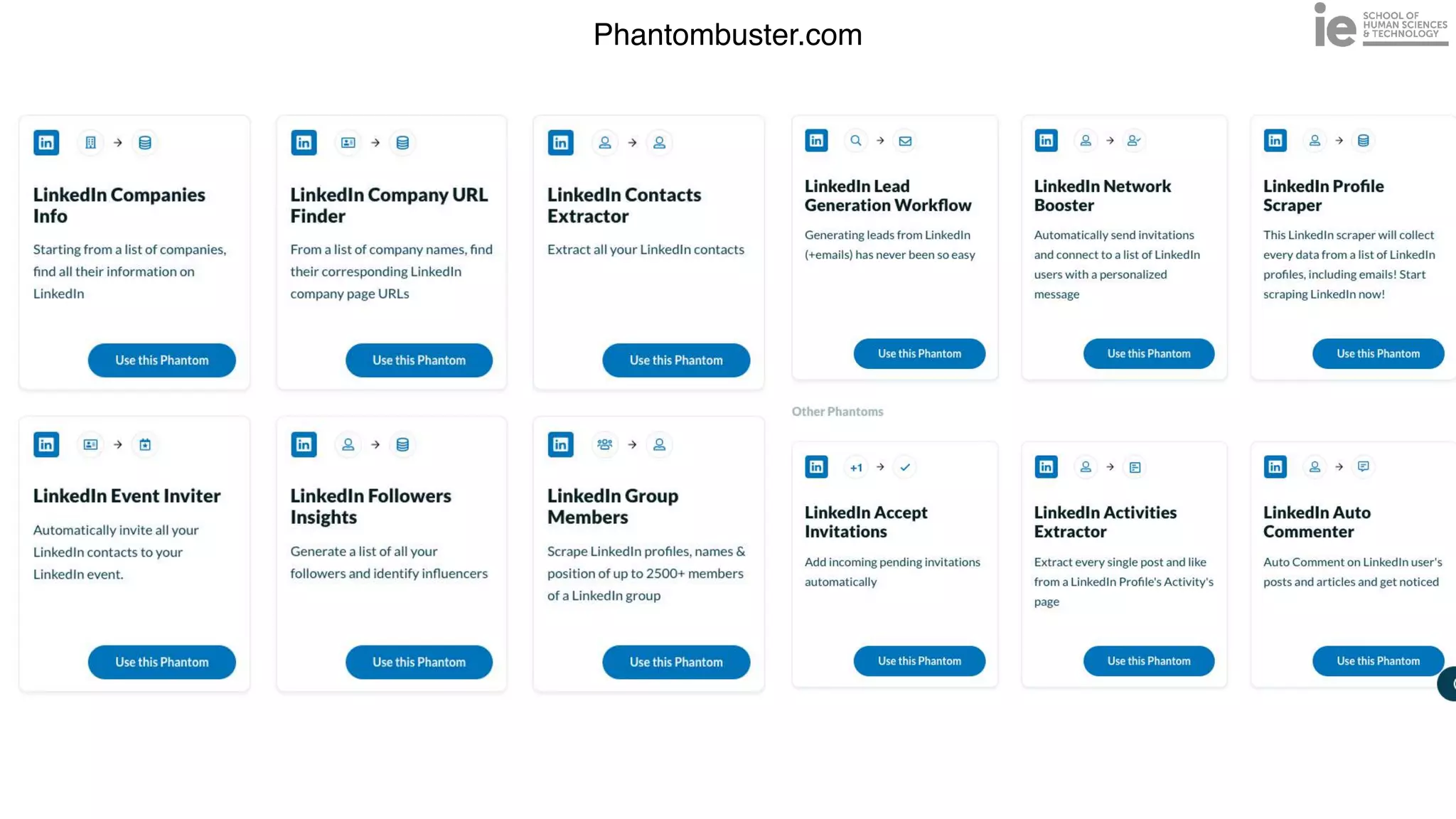
Phantombuster.com
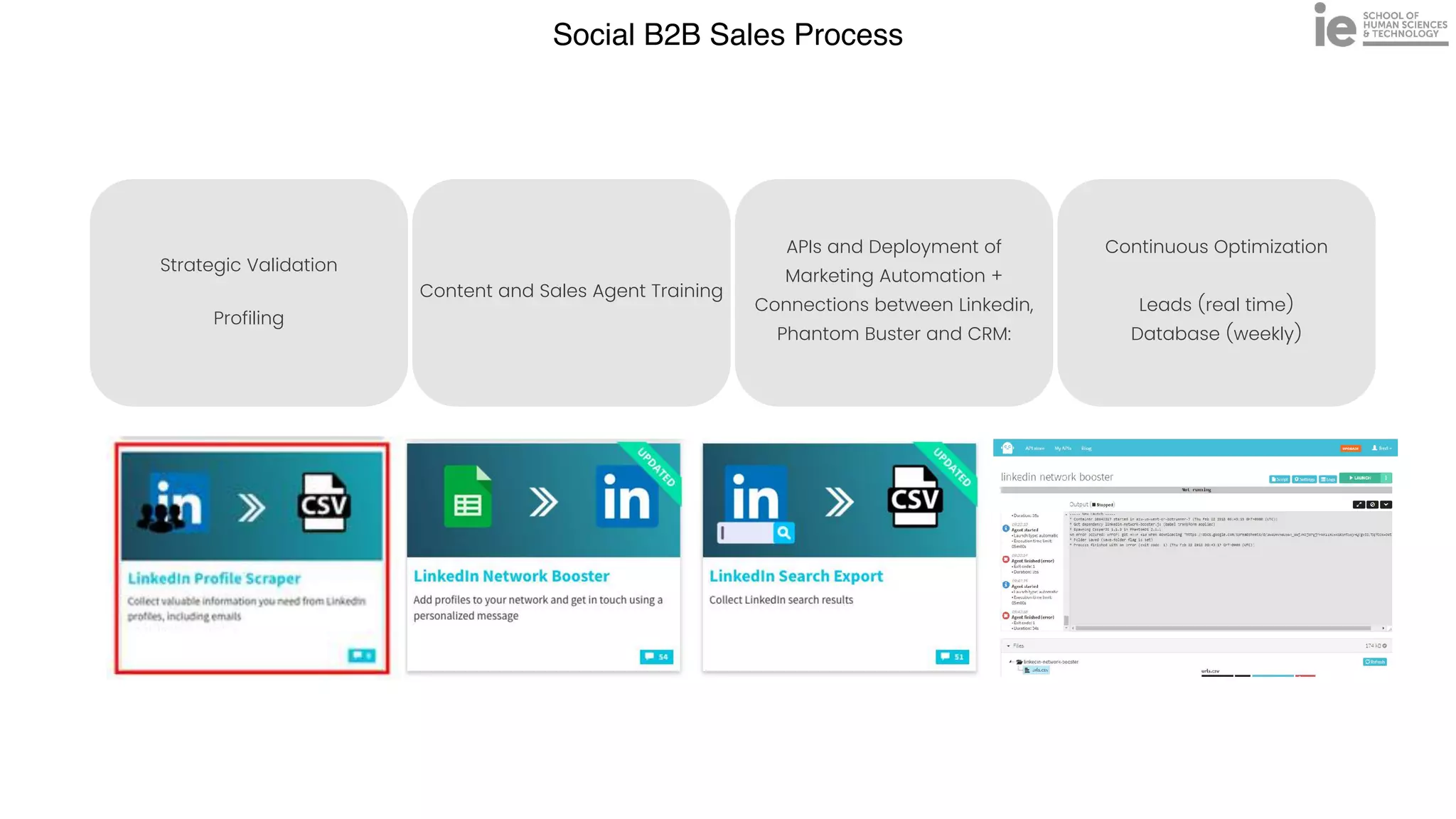
Social B2B Sales Process
Content and Sales Agent Training
APIs and Deployment of
Marketing Automation +
Connections between Linkedin,
Phantom Buster and CRM:
Continuous Optimization


Leads (real time)


Database (weekly)
Strategic Validation


Profiling
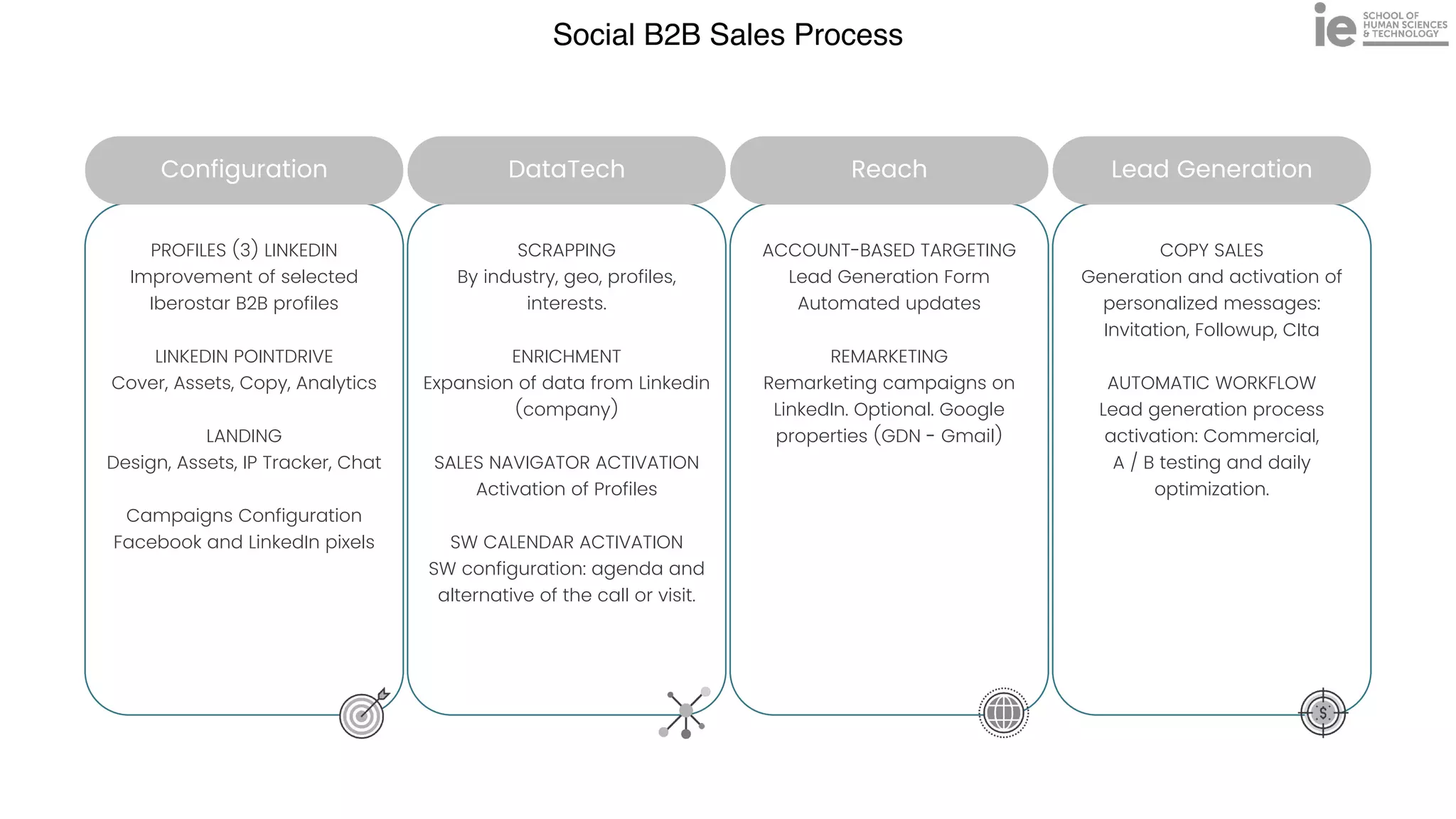
Social B2B Sales Process
SCRAPPING


By industry, geo, profiles,
interests.


ENRICHMENT


Expansion of data from Linkedin
(company)


SALES NAVIGATOR ACTIVATION


Activation of Profiles


SW CALENDAR ACTIVATION


SW configuration: agenda and
alternative of the call or visit.


ACCOUNT-BASED TARGETING


Lead Generation Form


Automated updates


REMARKETING


Remarketing campaigns on
LinkedIn. Optional. Google
properties (GDN - Gmail)


COPY SALES


Generation and activation of
personalized messages:
Invitation, Followup, CIta


AUTOMATIC WORKFLOW


Lead generation process
activation: Commercial,


A / B testing and daily
optimization.


PROFILES (3) LINKEDIN


Improvement of selected
Iberostar B2B profiles


LINKEDIN POINTDRIVE


Cover, Assets, Copy, Analytics


LANDING


Design, Assets, IP Tracker, Chat


Campaigns Configuration


Facebook and LinkedIn pixels


DataTech Reach Lead Generation
Configuration
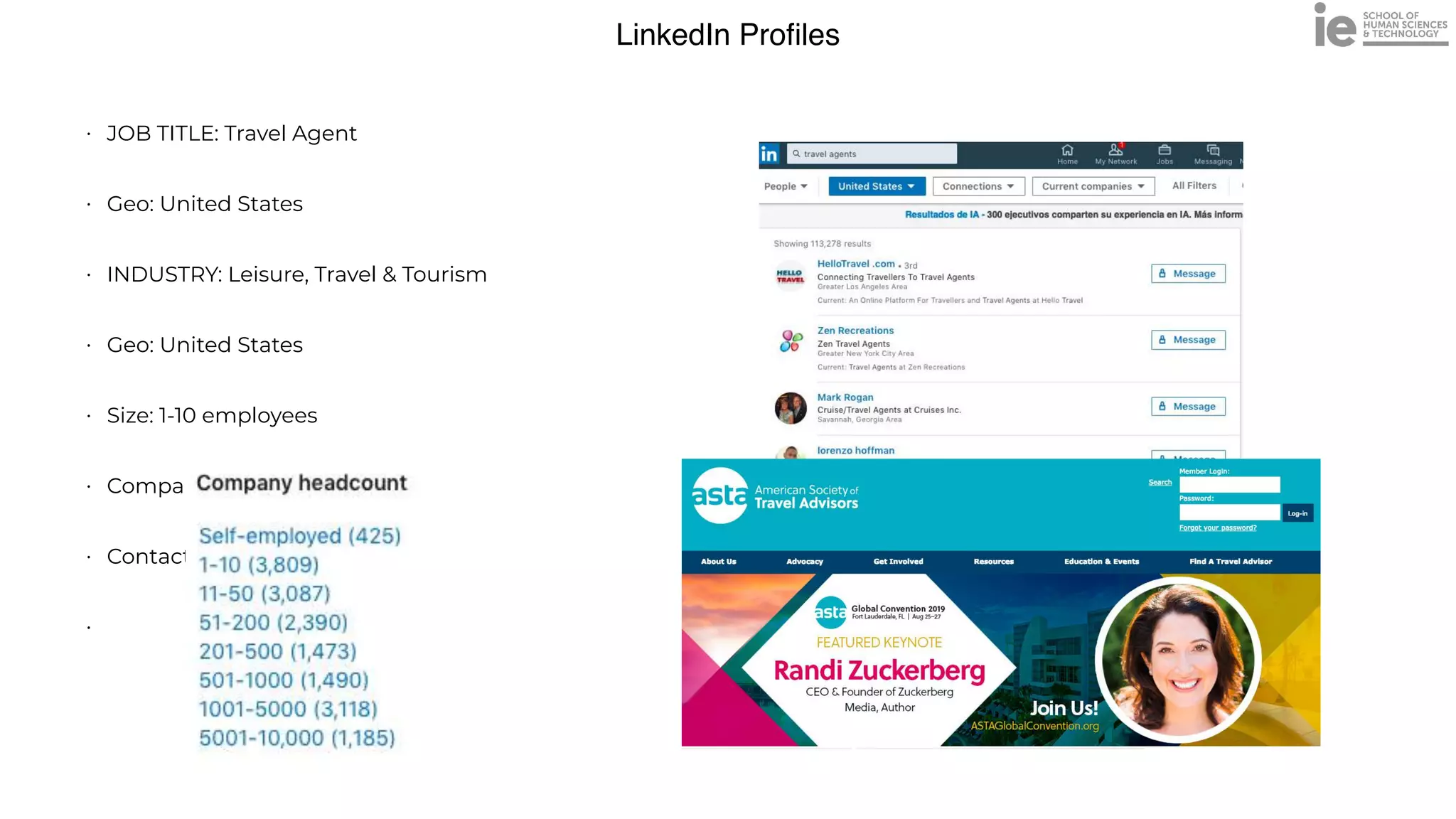
LinkedIn Pro
fi
les
• JOB TITLE: Travel Agent


• Geo: United States


• INDUSTRY: Leisure, Travel & Tourism


• Geo: United States


• Size: 1-10 employees


• Companies: 14,525


• Contacts: 27,547


•
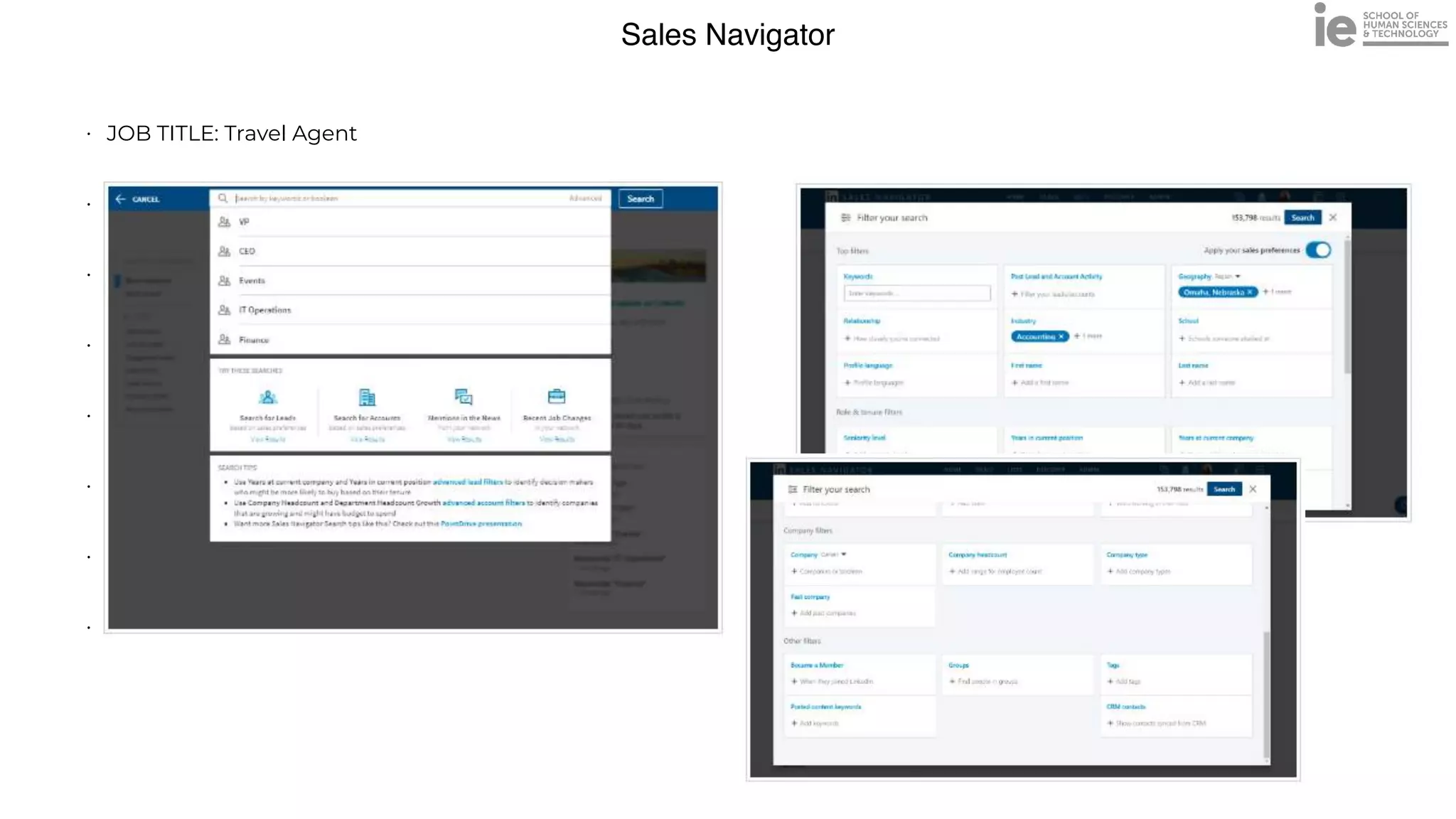
Sales Navigator
• JOB TITLE: Travel Agent


• Geo: United States


• INDUSTRY: Leisure, Travel & Tourism


• Geo: United States


• Size: 1-10 employees


• Companies: 14,525


• Contacts: 27,547


•
Leads
• JOB TITLE: Travel Agent


• Geo: United States


• INDUSTRY: Leisure, Travel & Tourism


• Geo: United States


• Size: 1-10 employees


• Companies: 14,525


• Contacts: 27,547


•
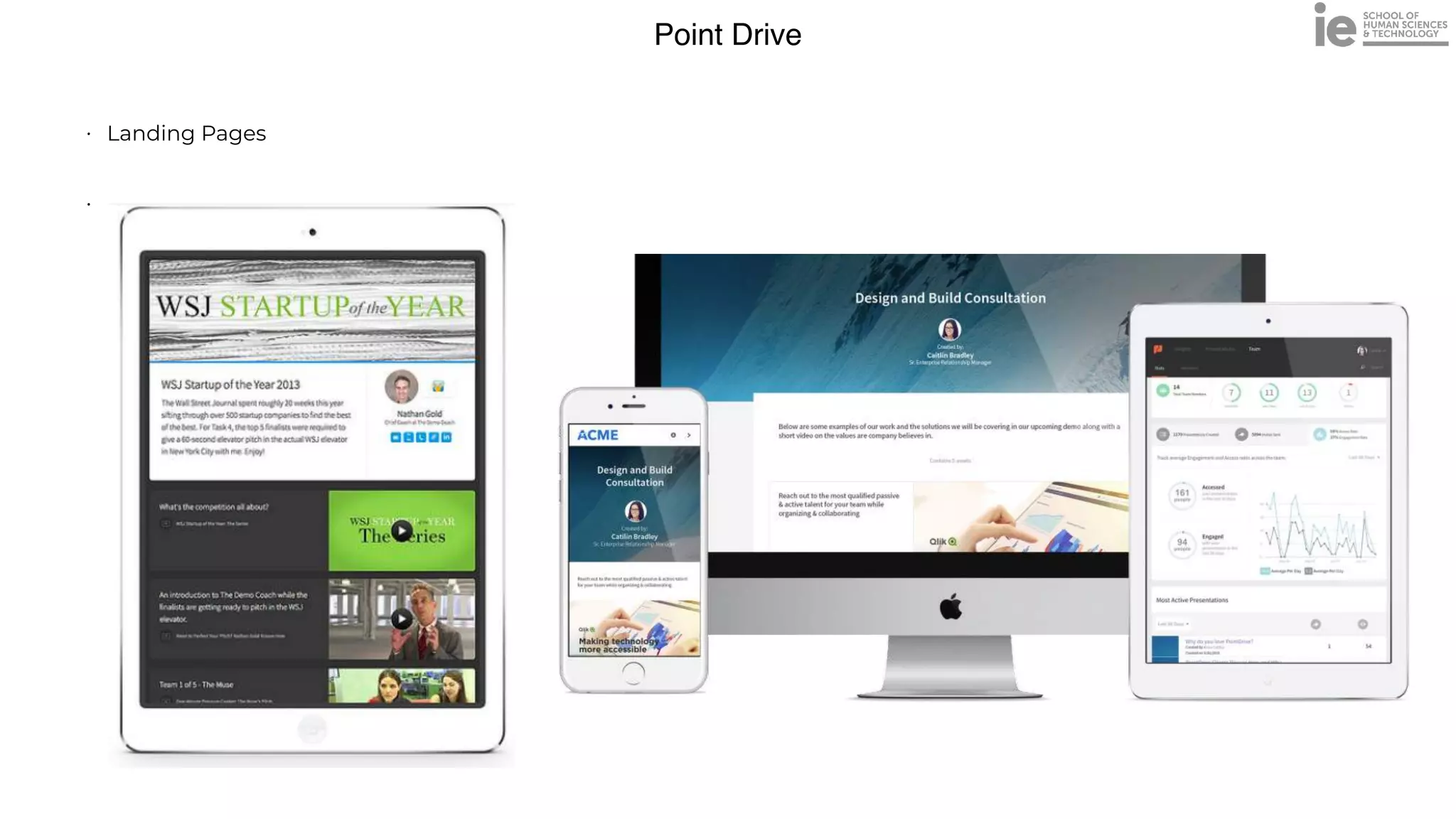
Point Drive
• Landing Pages


•
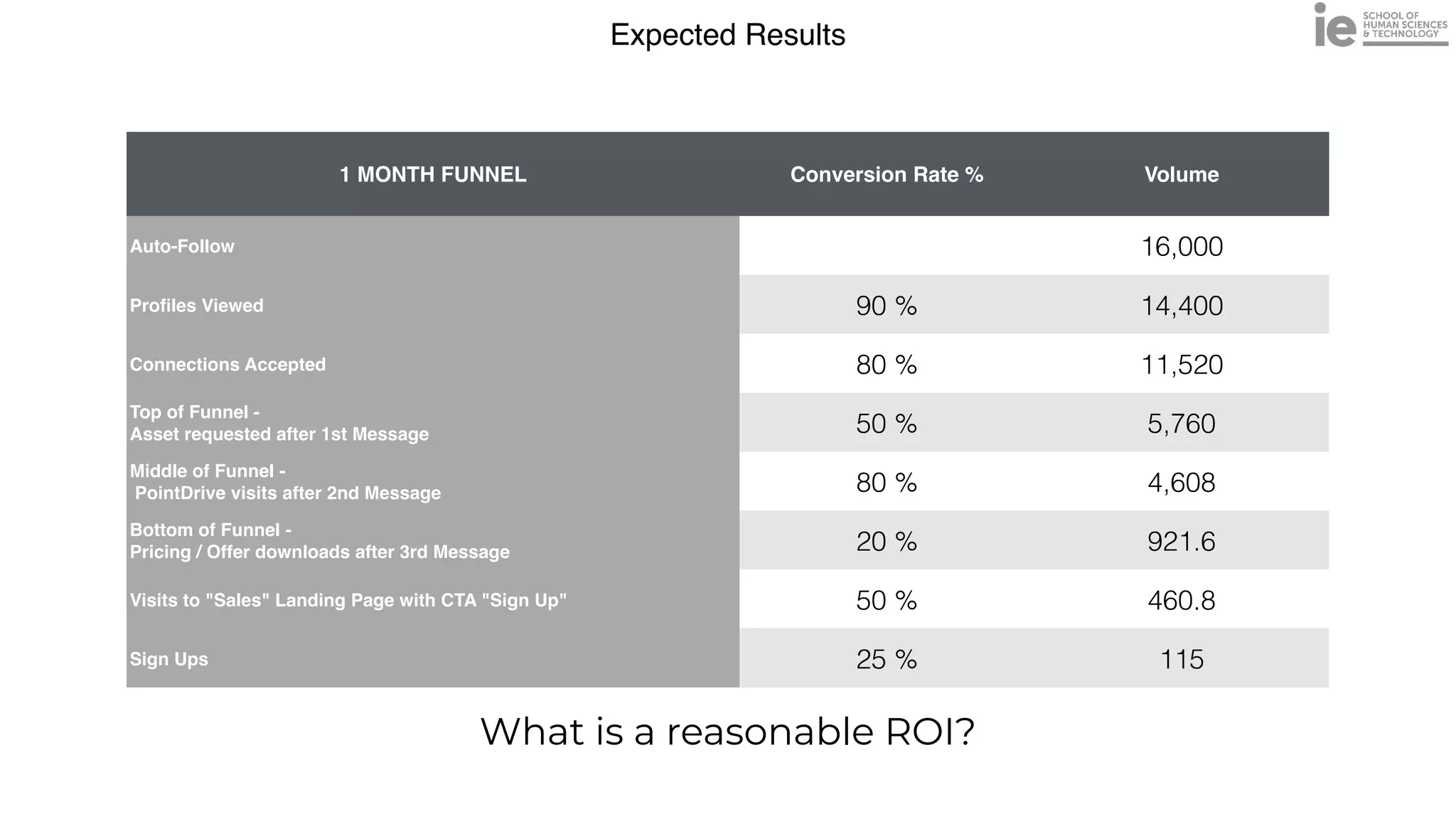
Expected Results
1 MONTH FUNNEL Conversion Rate % Volume
Auto-Follow 16,000
Pro
fi
les Viewed 90 % 14,400
Connections Accepted 80 % 11,520
Top of Funnel - 

Asset requested after 1st Message 50 % 5,760
Middle of Funnel -

PointDrive visits after 2nd Message 80 % 4,608
Bottom of Funnel - 

Pricing / Offer downloads after 3rd Message 20 % 921.6
Visits to "Sales" Landing Page with CTA "Sign Up" 50 % 460.8
Sign Ups 25 % 115
What is a reasonable ROI?
Bene
fi
ts
• Generation of new business | Revenue & LTV


• Degree of consideration of the brand and value proposition


• Greater impact and reach on LinkedIn


• In
fl
uence and networking of sales agents


• Greater knowledge of the sector and degree of sector traction / buyer persona


• Commercial activity by interests and interactions


• Use of data from the companies CRM | Productivity


• Innovation and learning about Social B2B Sales
Buyer Persona B2B
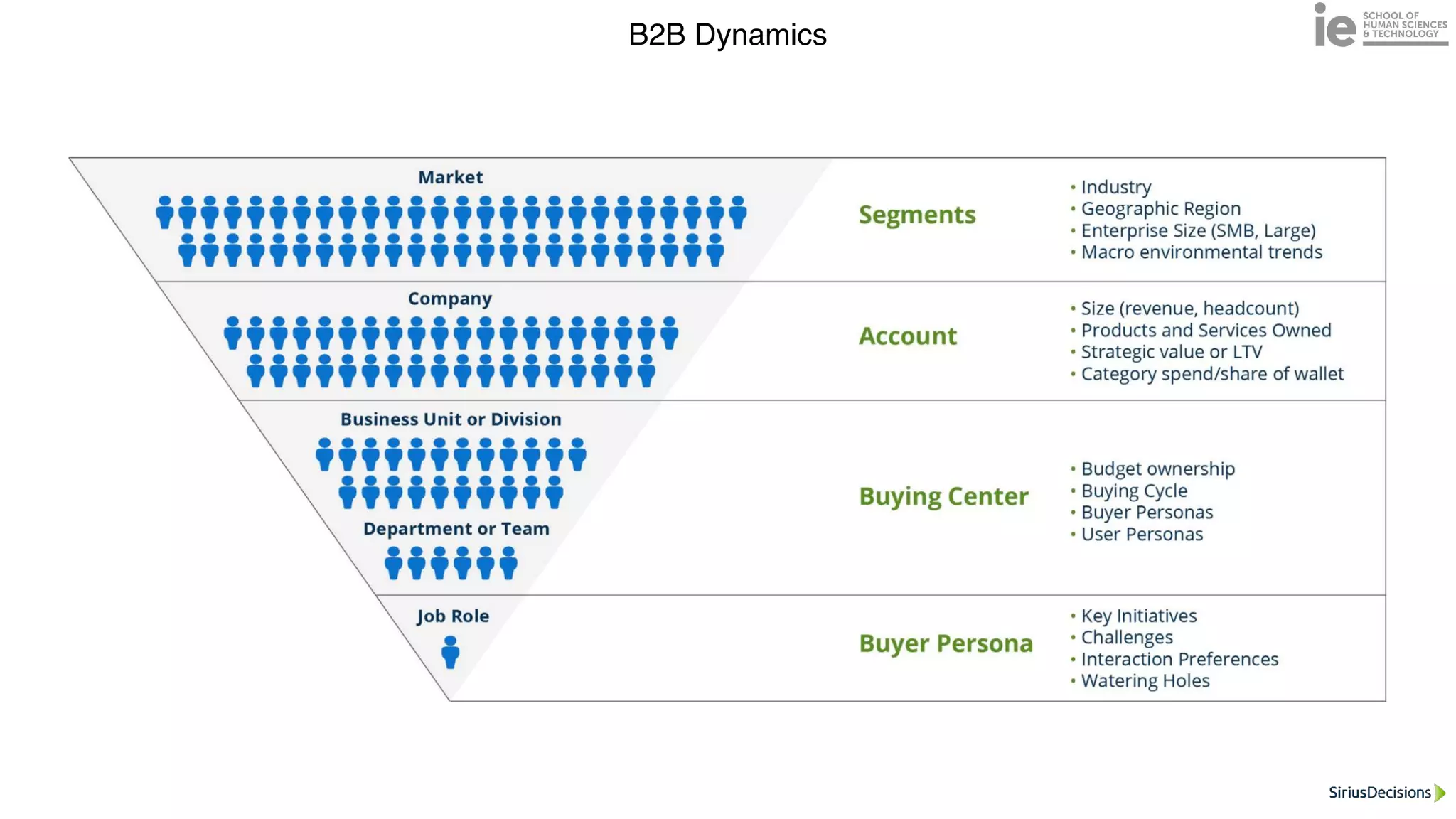
B2B Dynamics
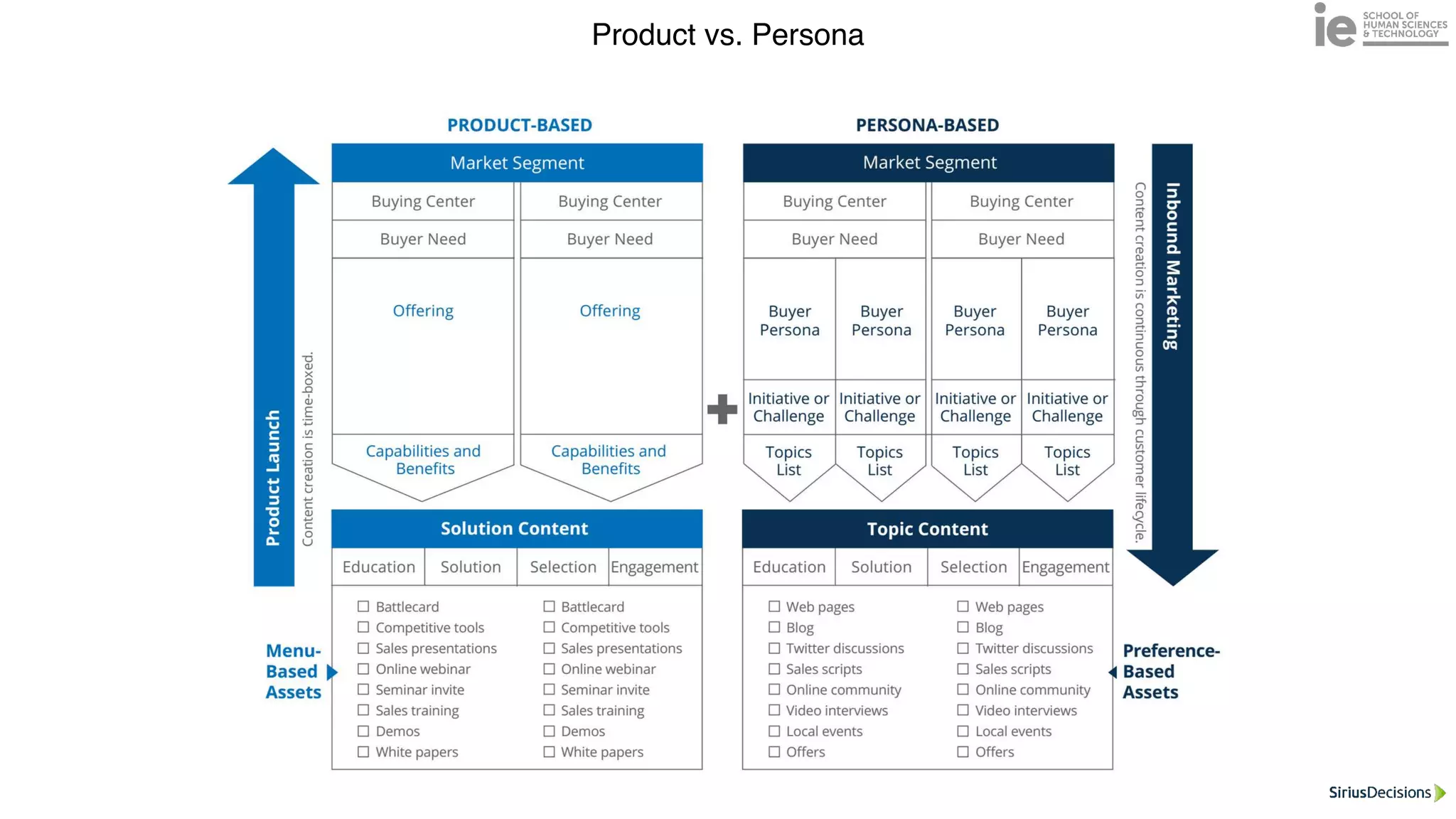
Product vs. Persona
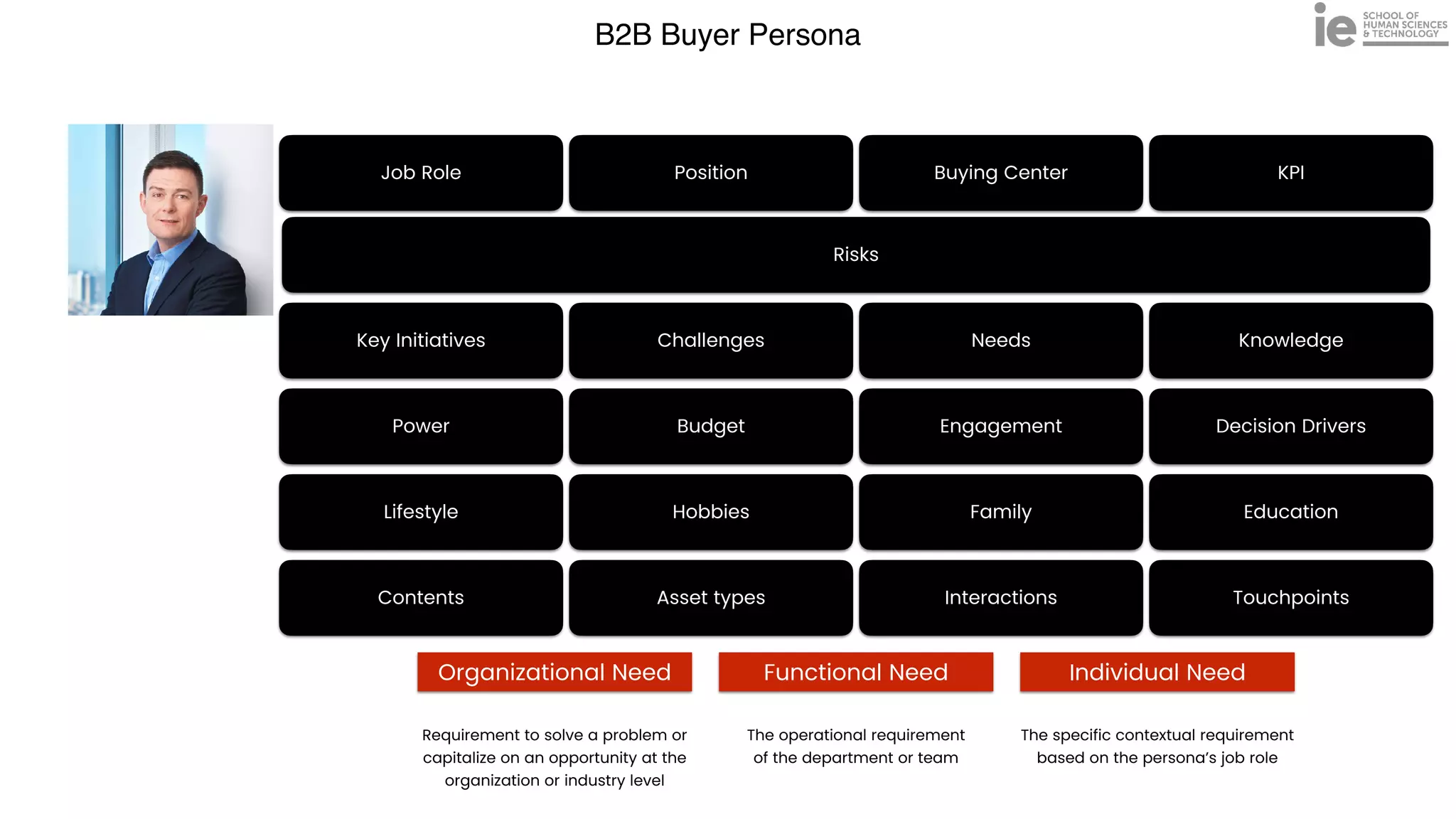
B2B Buyer Persona
Job Role Position Buying Center KPI
Risks
Key Initiatives Challenges Needs Knowledge
Power Budget Engagement Decision Drivers
Lifestyle Hobbies Family Education
Contents Asset types Interactions Touchpoints
Requirement to solve a problem or
capitalize on an opportunity at the
organization or industry level
Organizational Need
The operational requirement


of the department or team


Functional Need
The specific contextual requirement
based on the persona’s job role


Individual Need
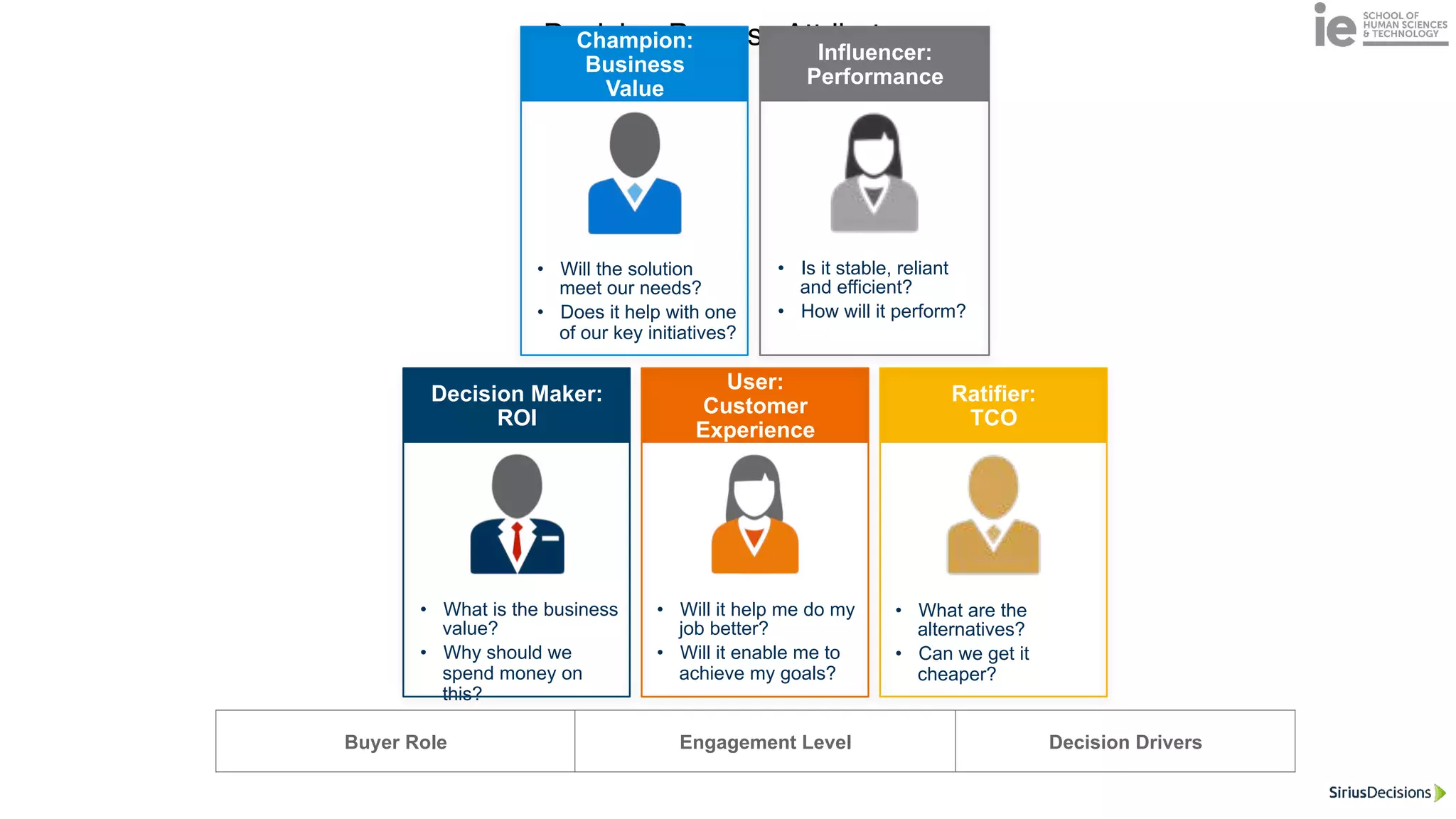
Decision Process Attributes
•  What is the business
value?
•  Why should we
spend money on
this?
Decision Maker:
ROI
•  Will it help me do my
job better?
•  Will it enable me to
achieve my goals?
User:
Customer
Experience
•  What are the
alternatives?
•  Can we get it
cheaper?
Ratifier:
TCO
•  Will the solution
meet our needs?
•  Does it help with one
of our key initiatives?
Champion:
Business
Value
•  Is it stable, reliant
and efficient?
•  How will it perform?
Influencer:
Performance
Buyer Role Engagement Level Decision Drivers
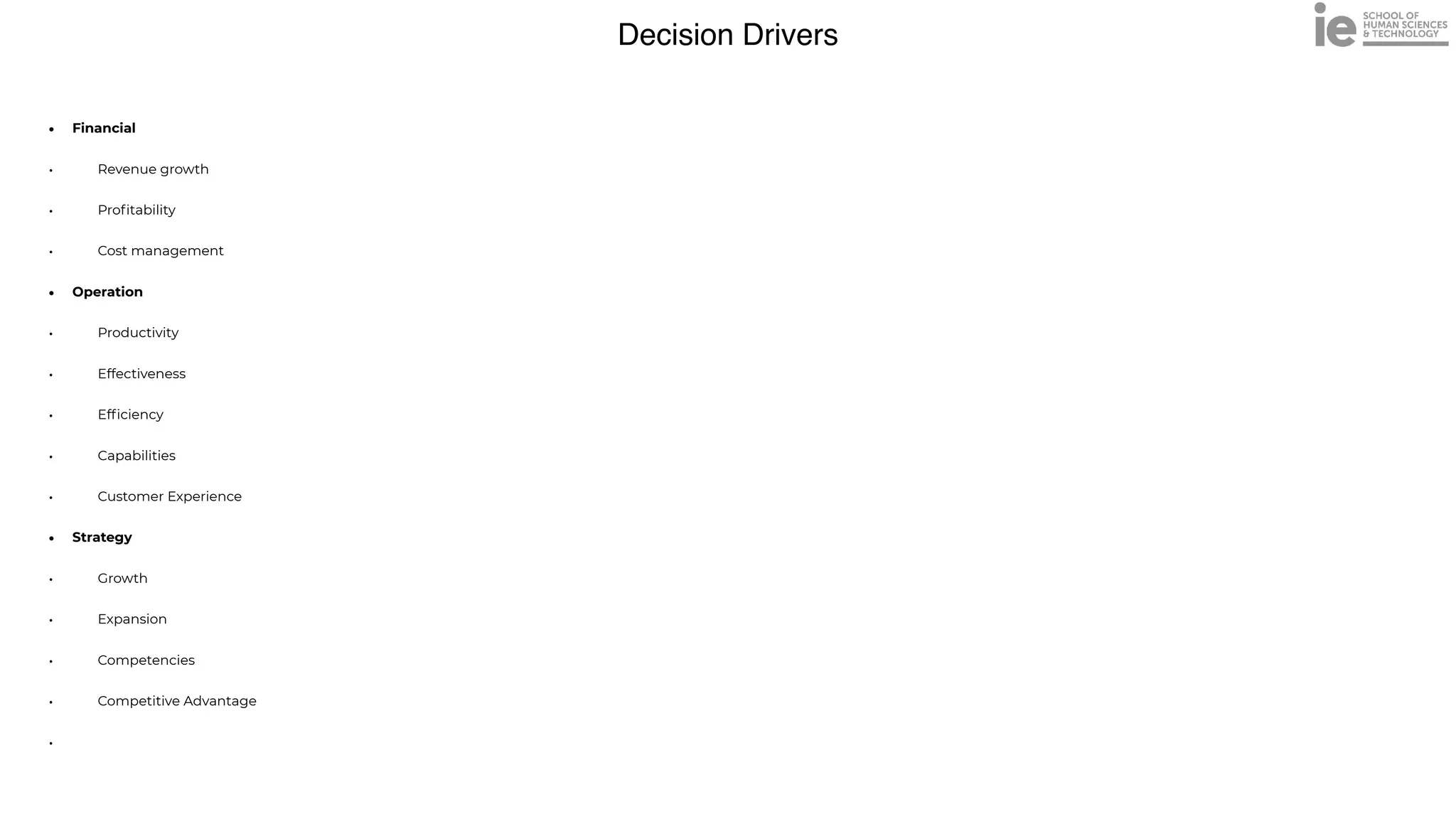
Decision Drivers
• Financial


•
	
Revenue growth


•
	
Pro
fi
tability


•
	
Cost management


• Operation


•
	
Productivity


•
	
Effectiveness


•
	
Ef
fi
ciency


•
	
Capabilities


•
	
Customer Experience


• Strategy


•
	
Growth


•
	
Expansion


•
	
Competencies


•
	
Competitive Advantage


•
How to
fi
nd your next job app
Building your LinkedIn Power
Where to start
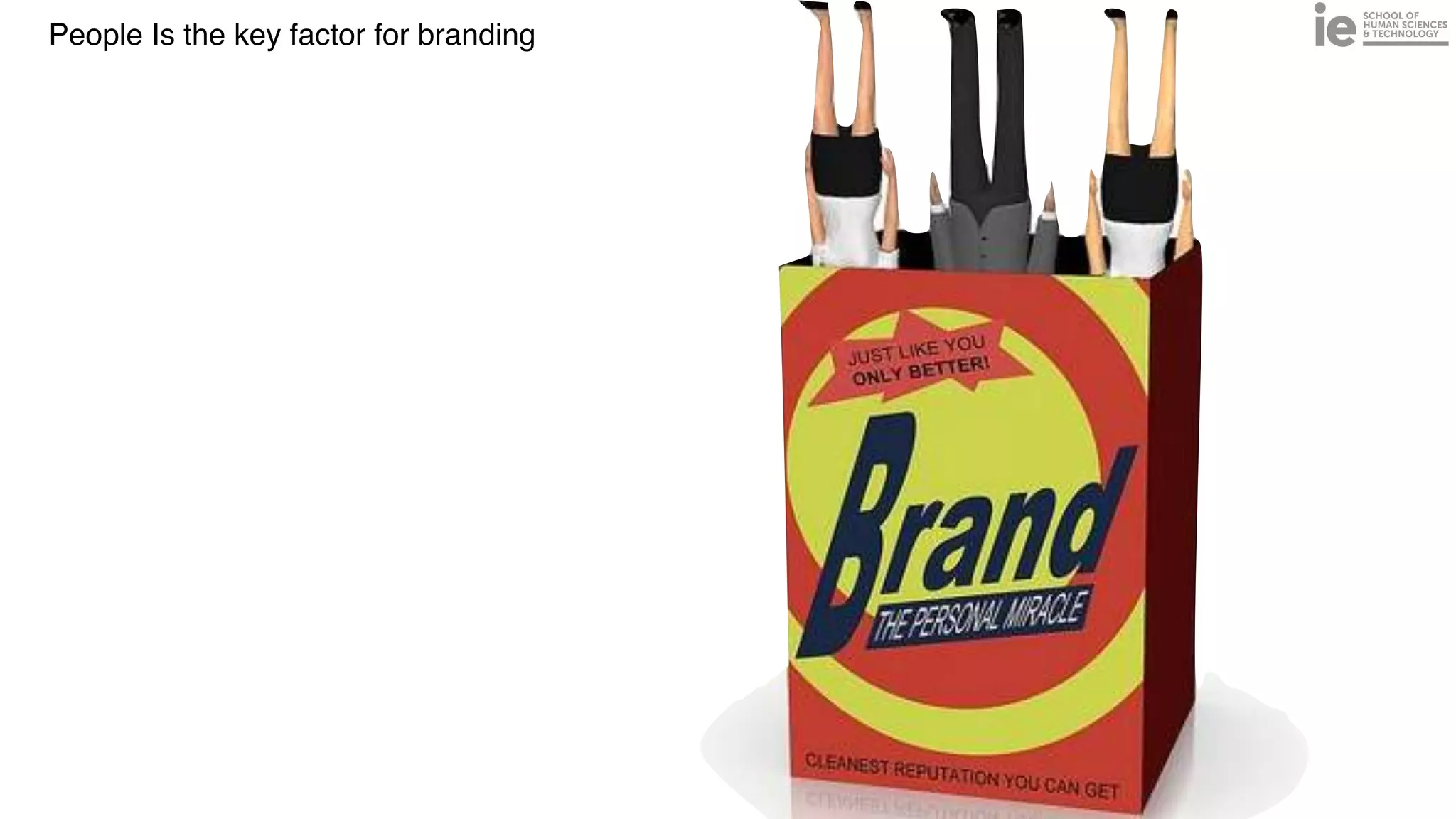
People Is the key factor for branding
Be Ubiquitous: Create Multiple Streams of You
Be Interesting: Write, Video, Photograph, Share, Give
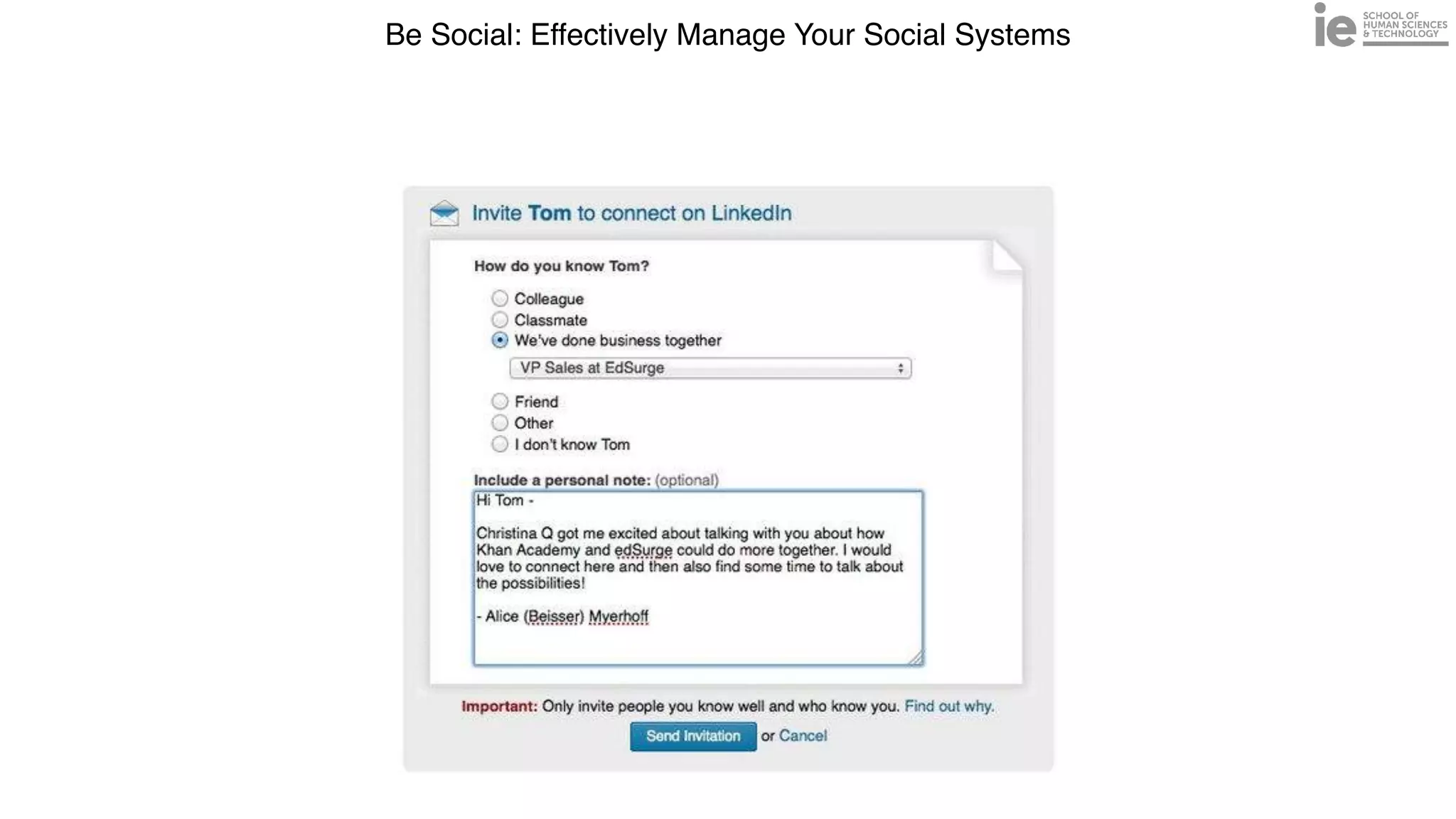
Be Social: Effectively Manage Your Social Systems
Be Remarkable: Do Something Worthy Of a Remark
Be Yourself: Let Your Personality Shine Through
Process
LO
OK
&
FE
EL
ST
YL
E
CO
NT
EN
T
PL
AN
PL
AT
FO
RM
S
CO
MM
UN
ITY
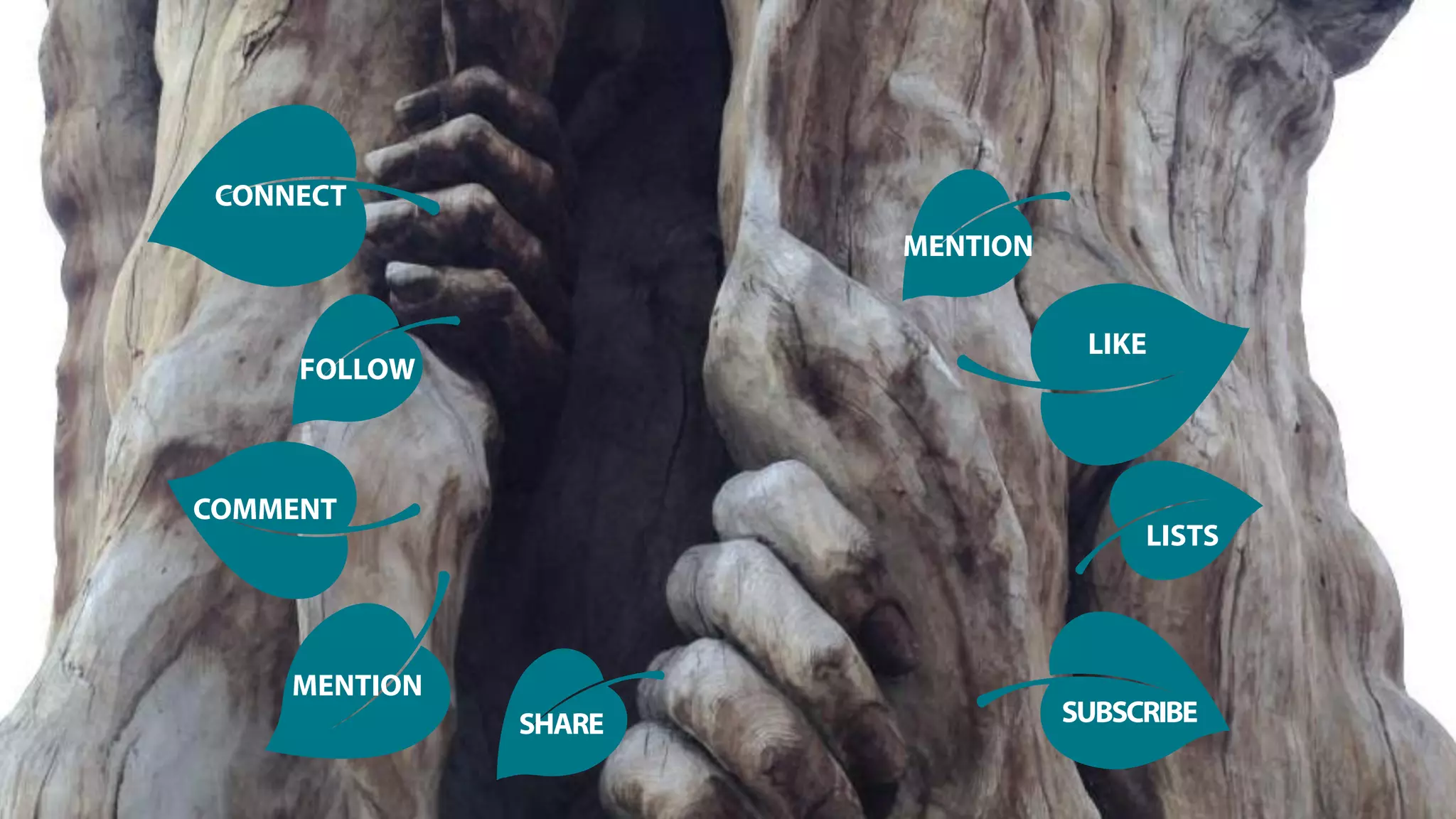
CONNECT
COMMENT
FOLLOW
MENTION
LIKE
LISTS
SUBSCRIBE
MENTION
SHARE
9
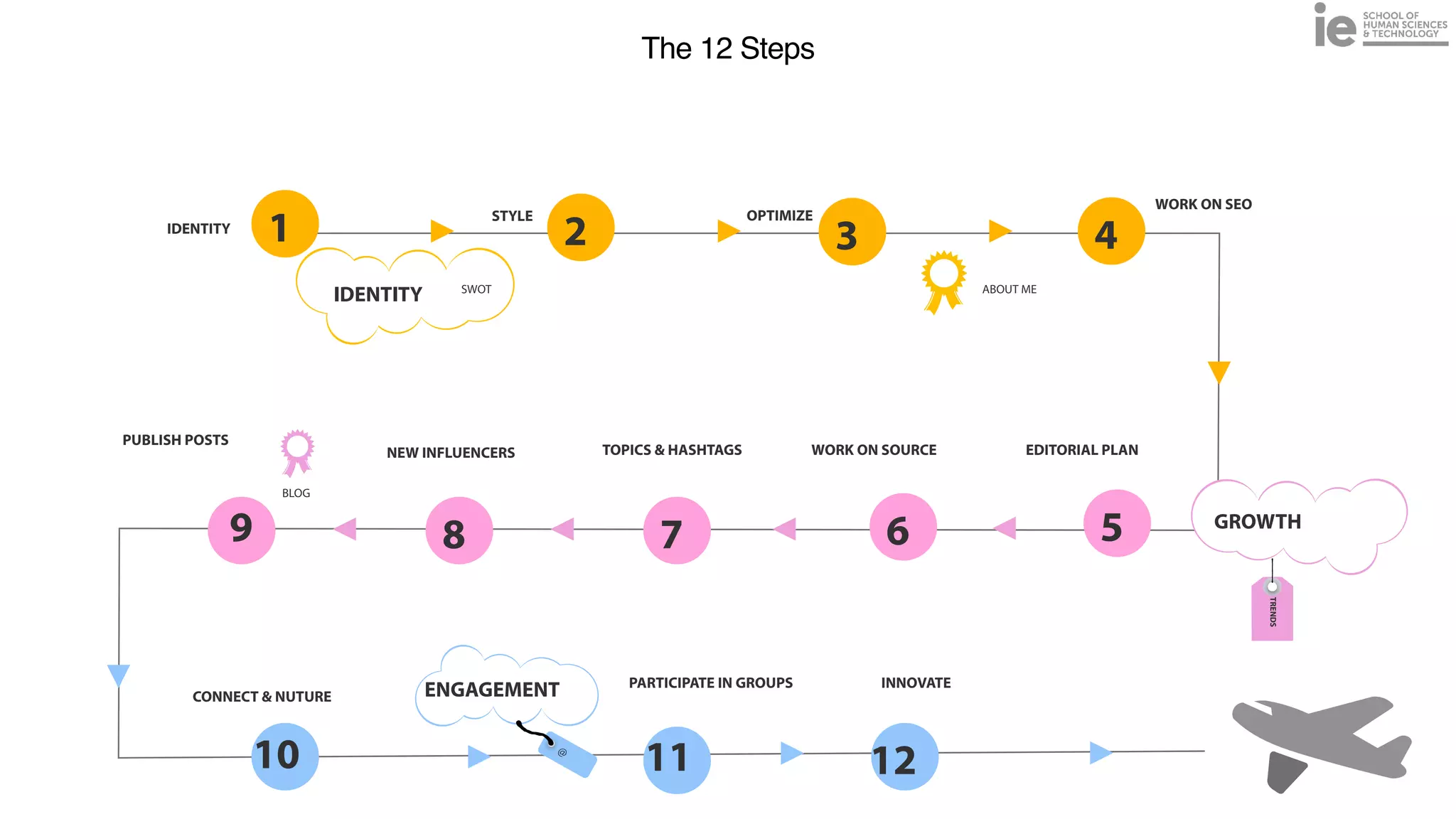
The 12 Steps
BLOG
1 2 3
5
6
7
8
10 11
IDENTITY
STYLE OPTIMIZE
PUBLISH POSTS
NEW INFLUENCERS TOPICS & HASHTAGS WORK ON SOURCE EDITORIAL PLAN
PARTICIPATE IN GROUPS
CONNECT & NUTURE
WORK ON SEO
4
INNOVATE
IDENTITY
GROWTH
ENGAGEMENT
SWOT
TRENDS
12
@
ABOUT ME
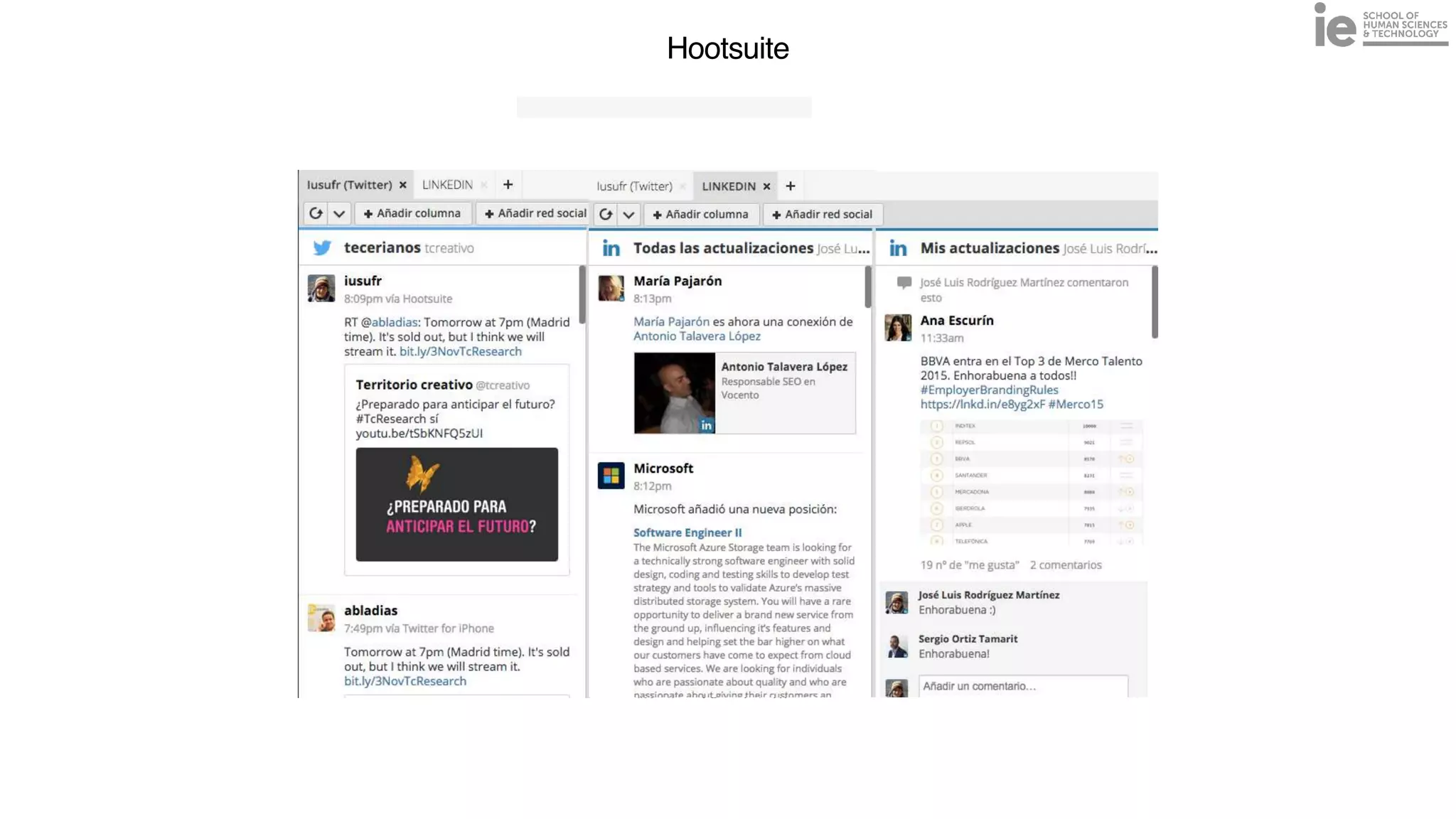
Hootsuite
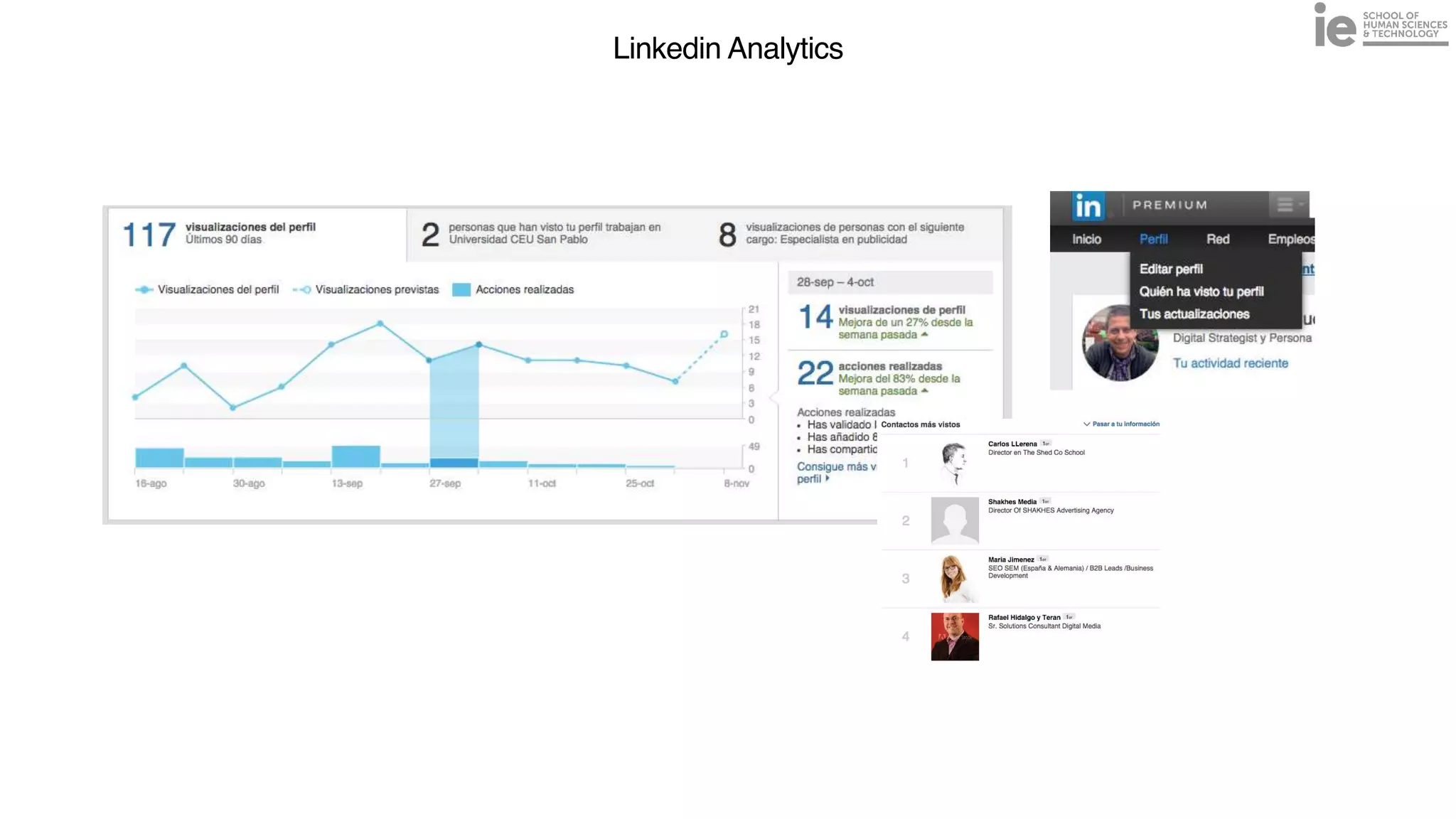
Linkedin Analytics
7
6
2
3
4
5
1
2
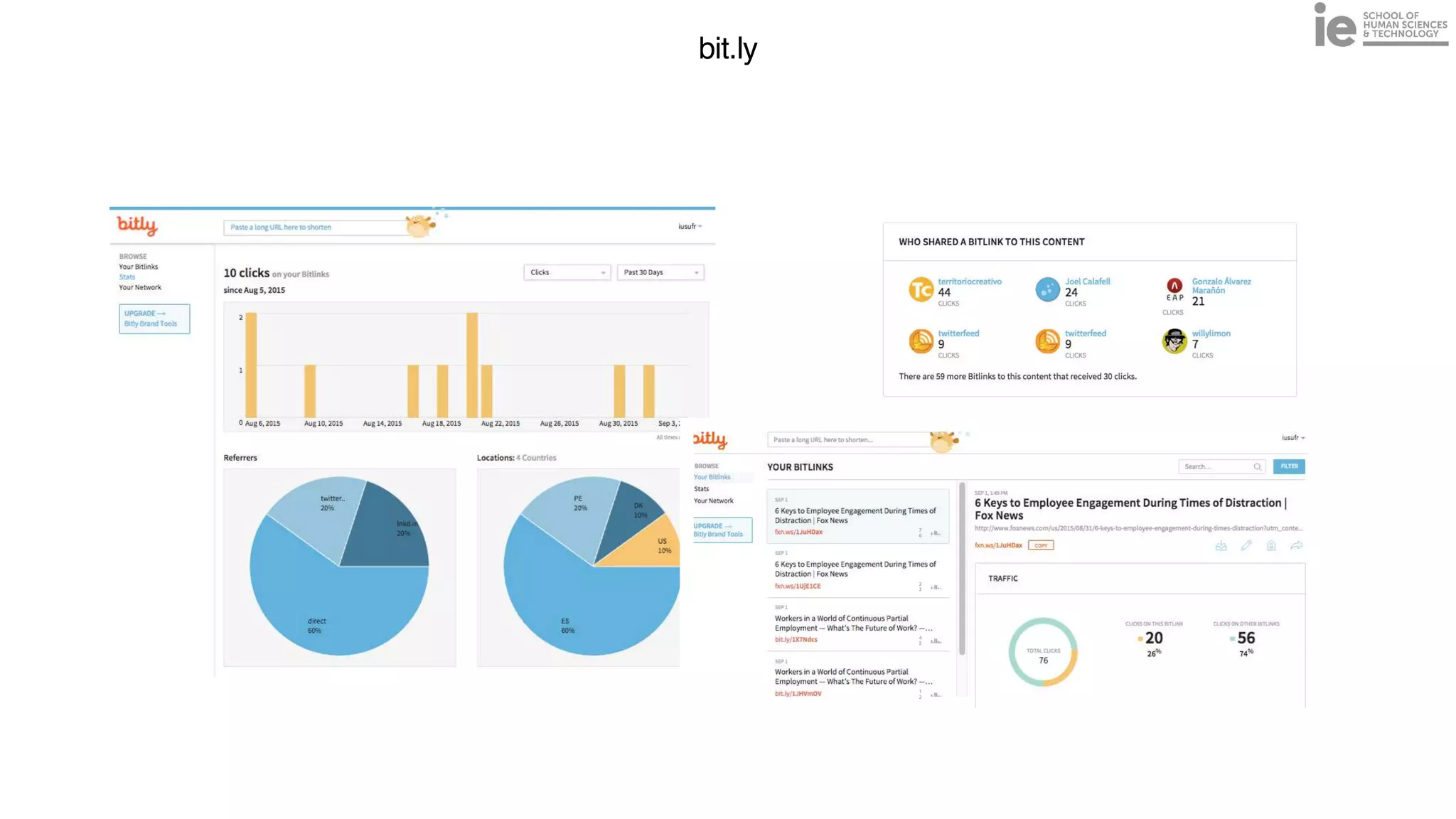
bit.ly
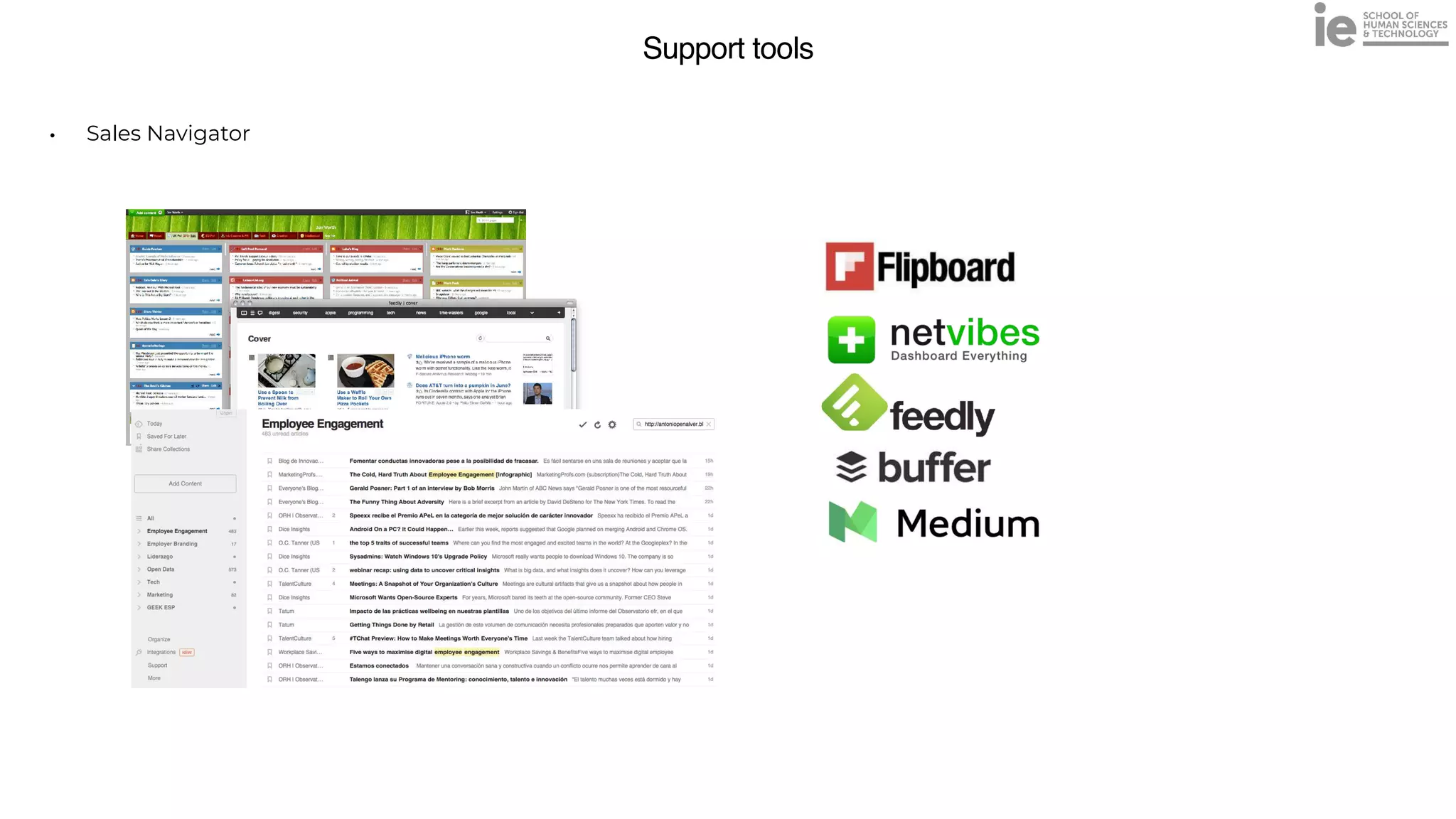
Support tools
• Sales Navigator
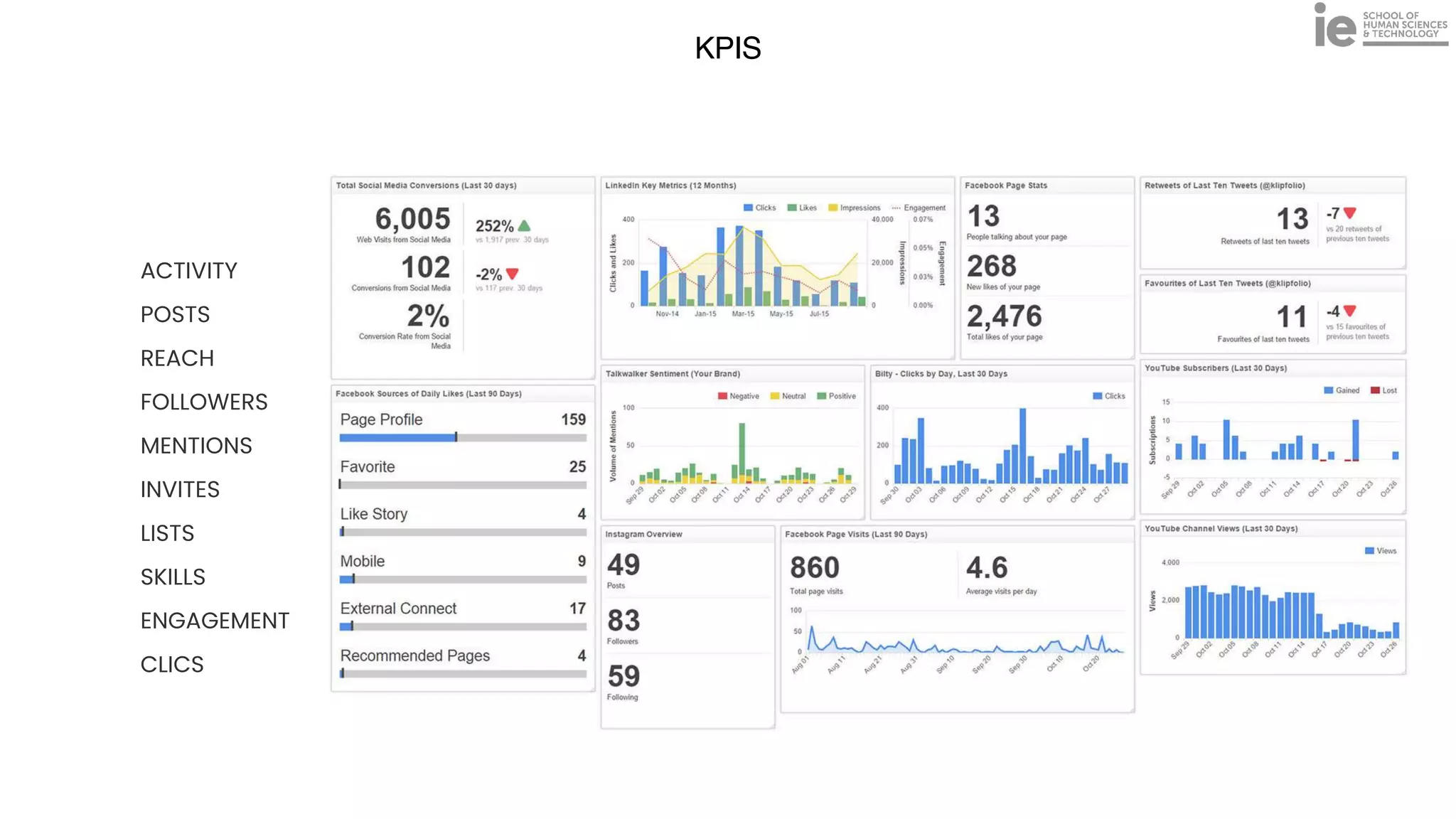
KPIS
ACTIVITY


POSTS


REACH


FOLLOWERS


MENTIONS


INVITES


LISTS


SKILLS


ENGAGEMENT


CLICS
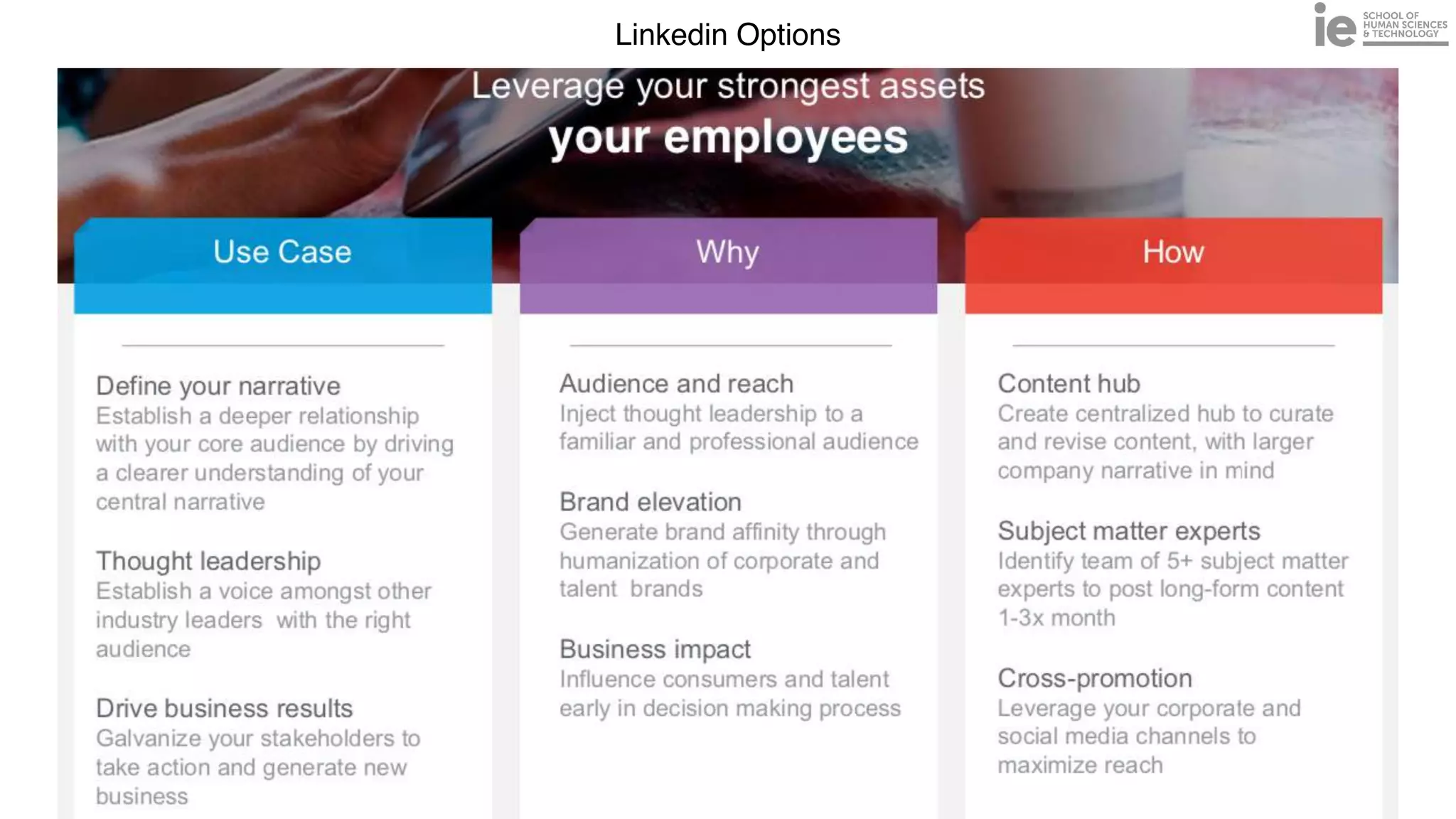
Linkedin Options
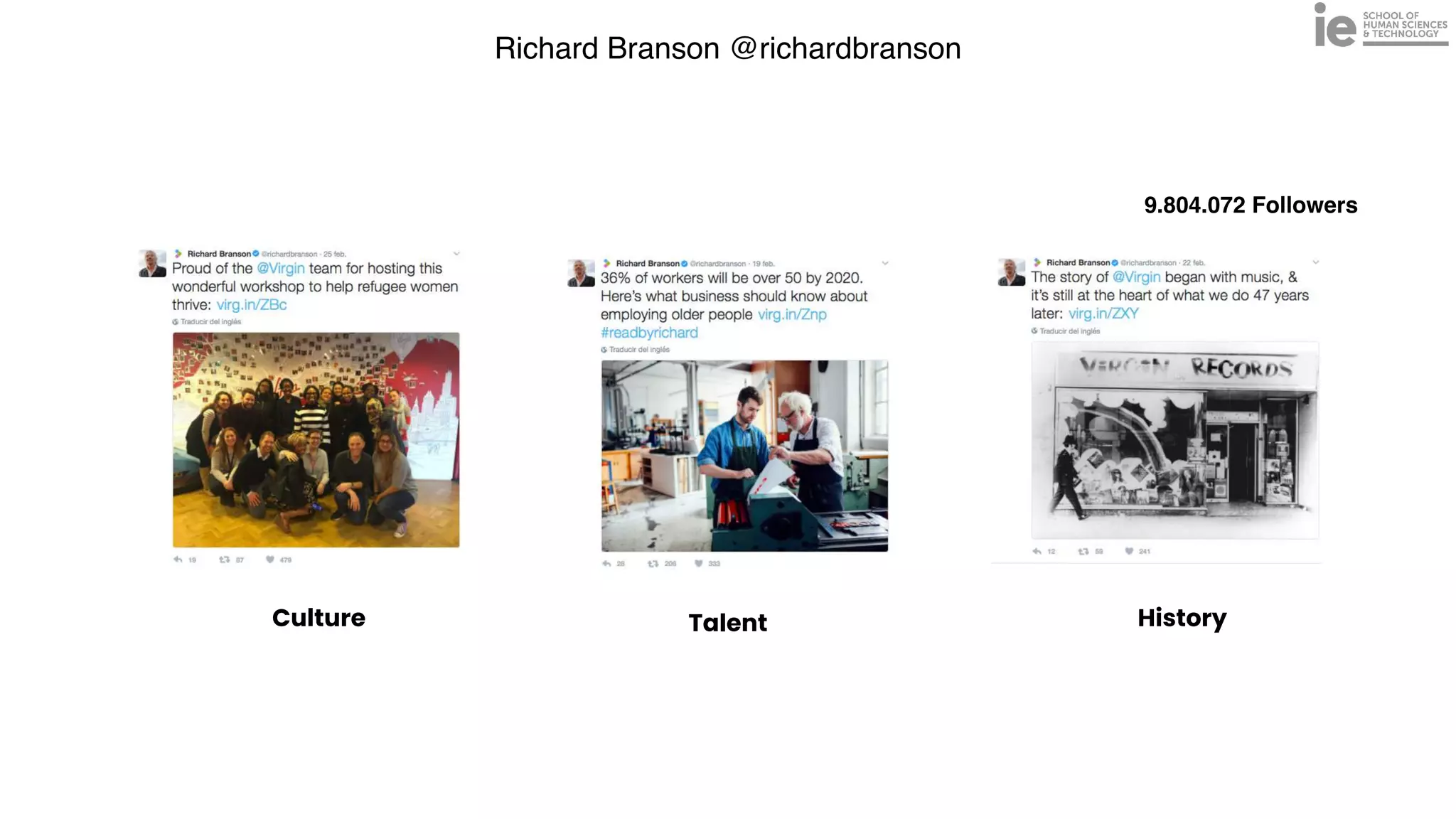
Richard Branson @richardbranson
9.804.072 Followers
Culture Talent History
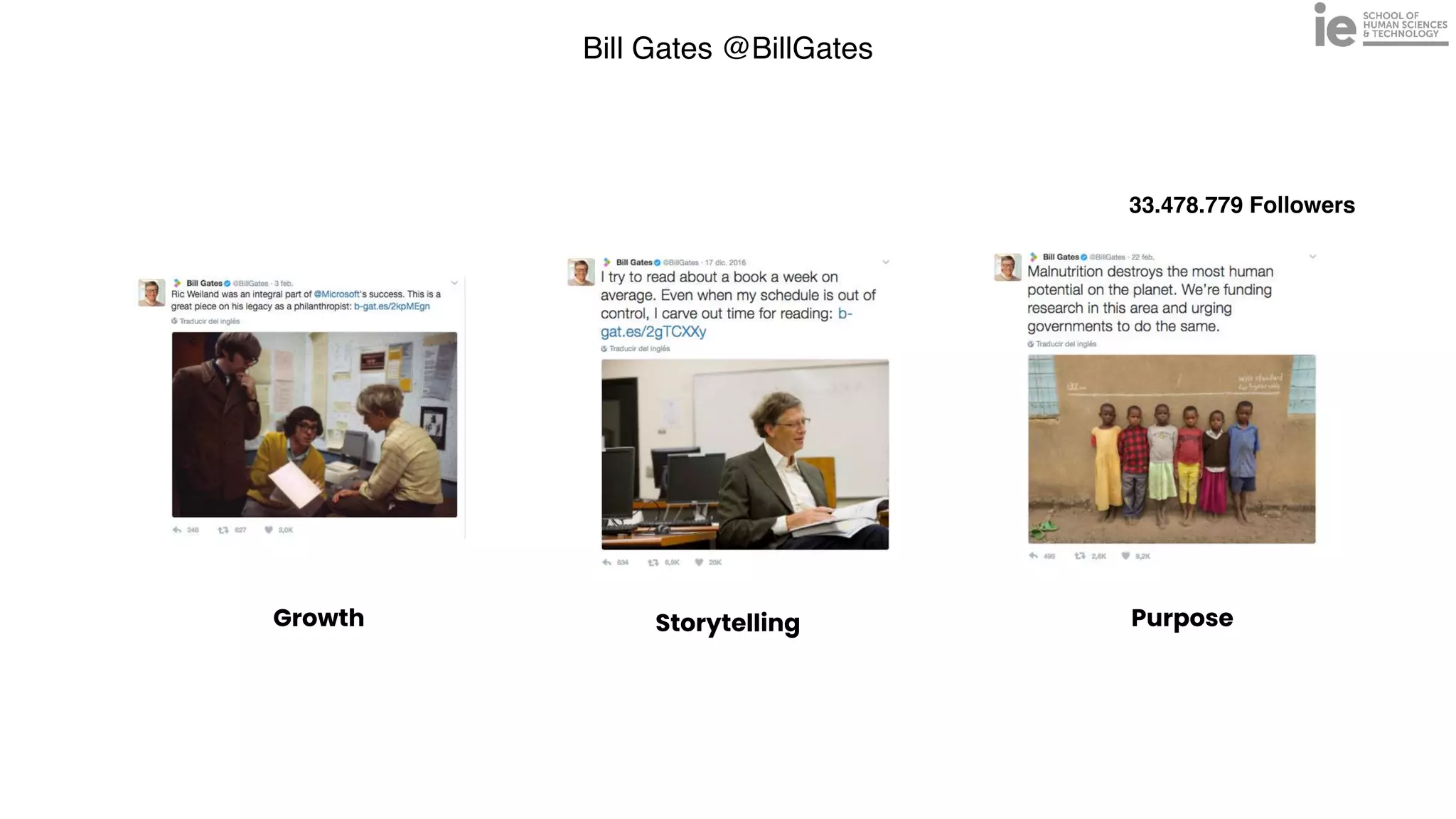
Bill Gates @BillGates
33.478.779 Followers
Growth Storytelling Purpose
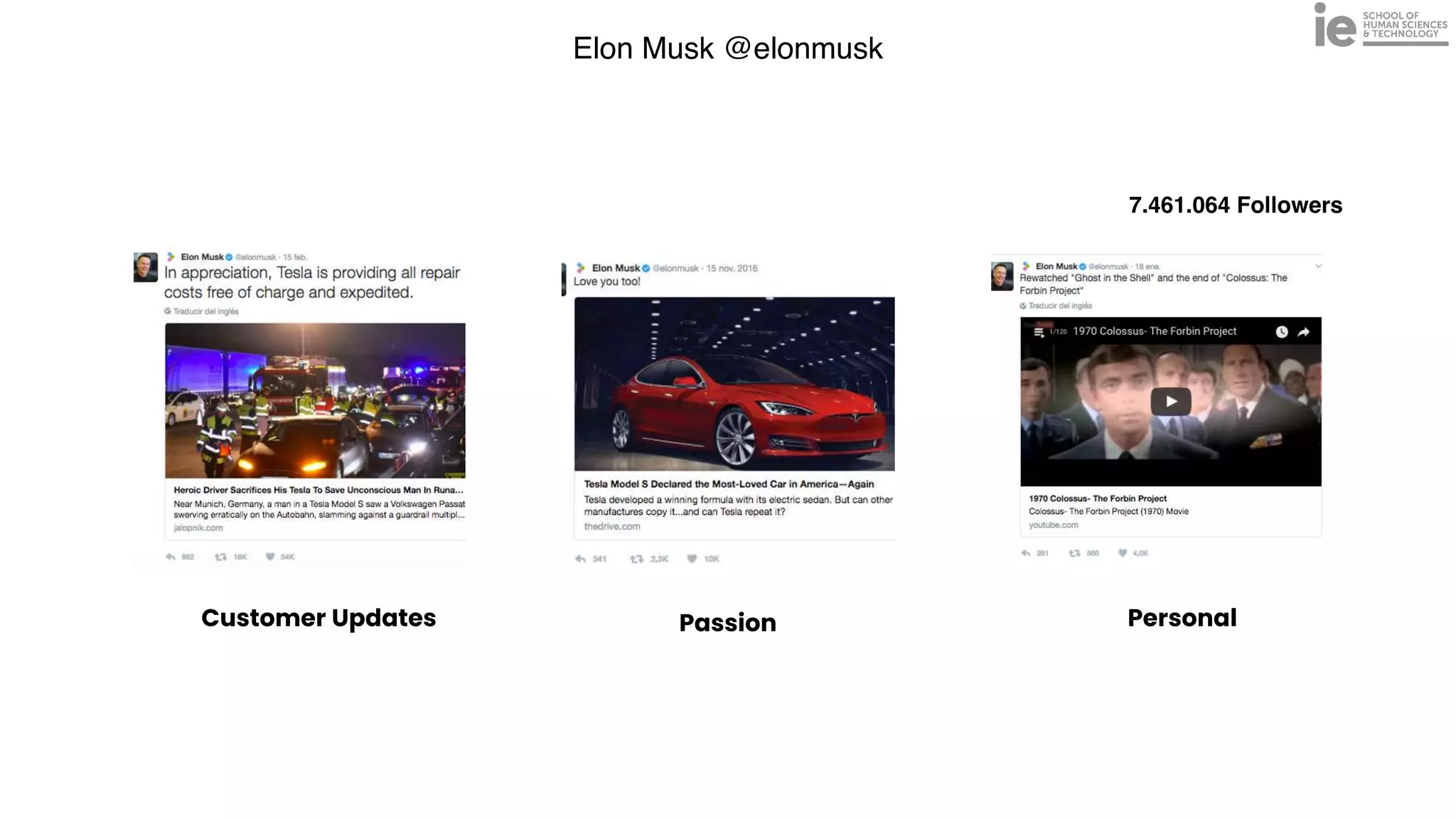
Elon Musk @elonmusk
7.461.064 Followers
Customer Updates Passion Personal
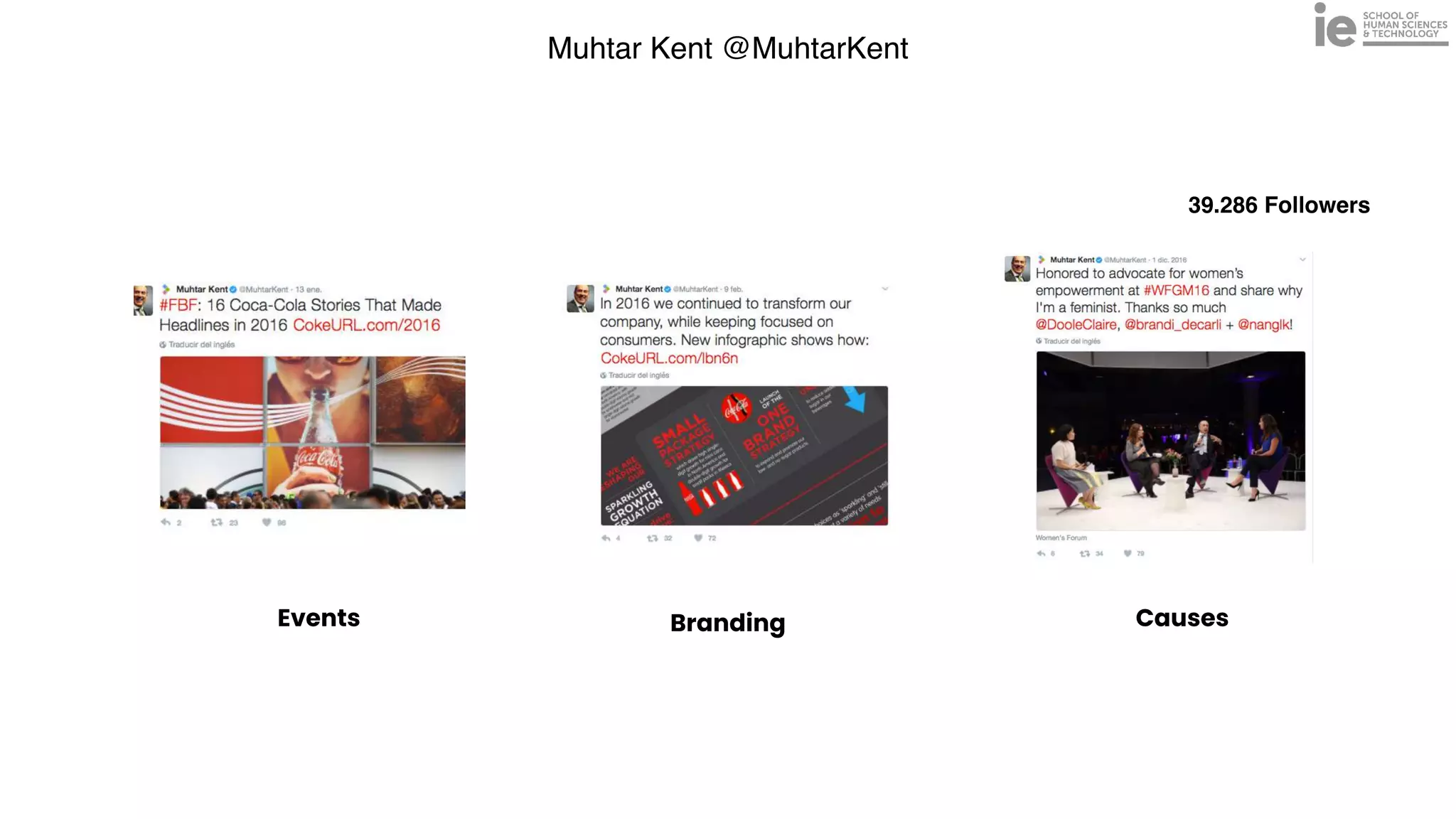
Muhtar Kent @MuhtarKent
39.286 Followers
Events Branding Causes
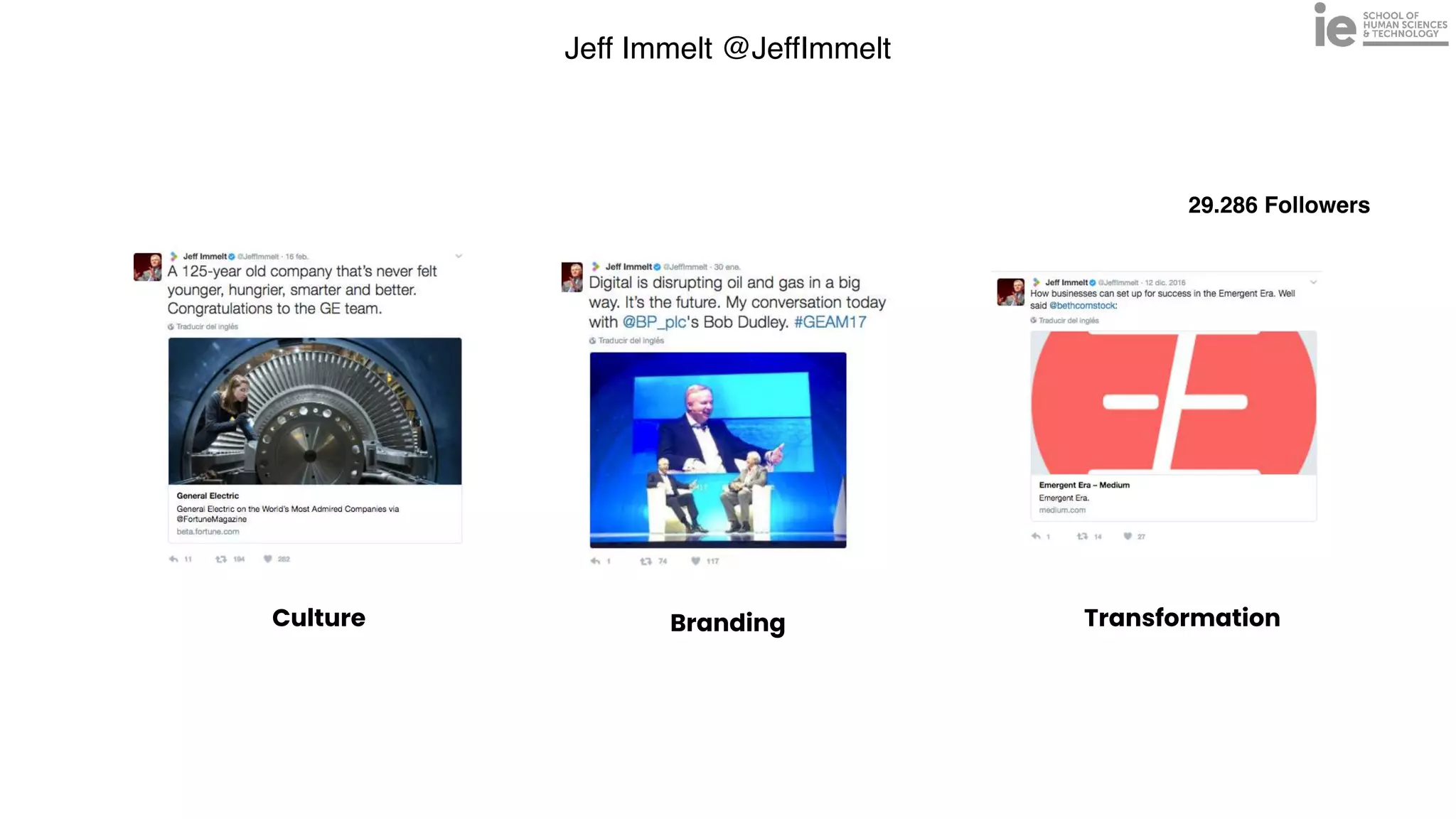
Jeff Immelt @JeffImmelt
29.286 Followers
Culture Branding Transformation
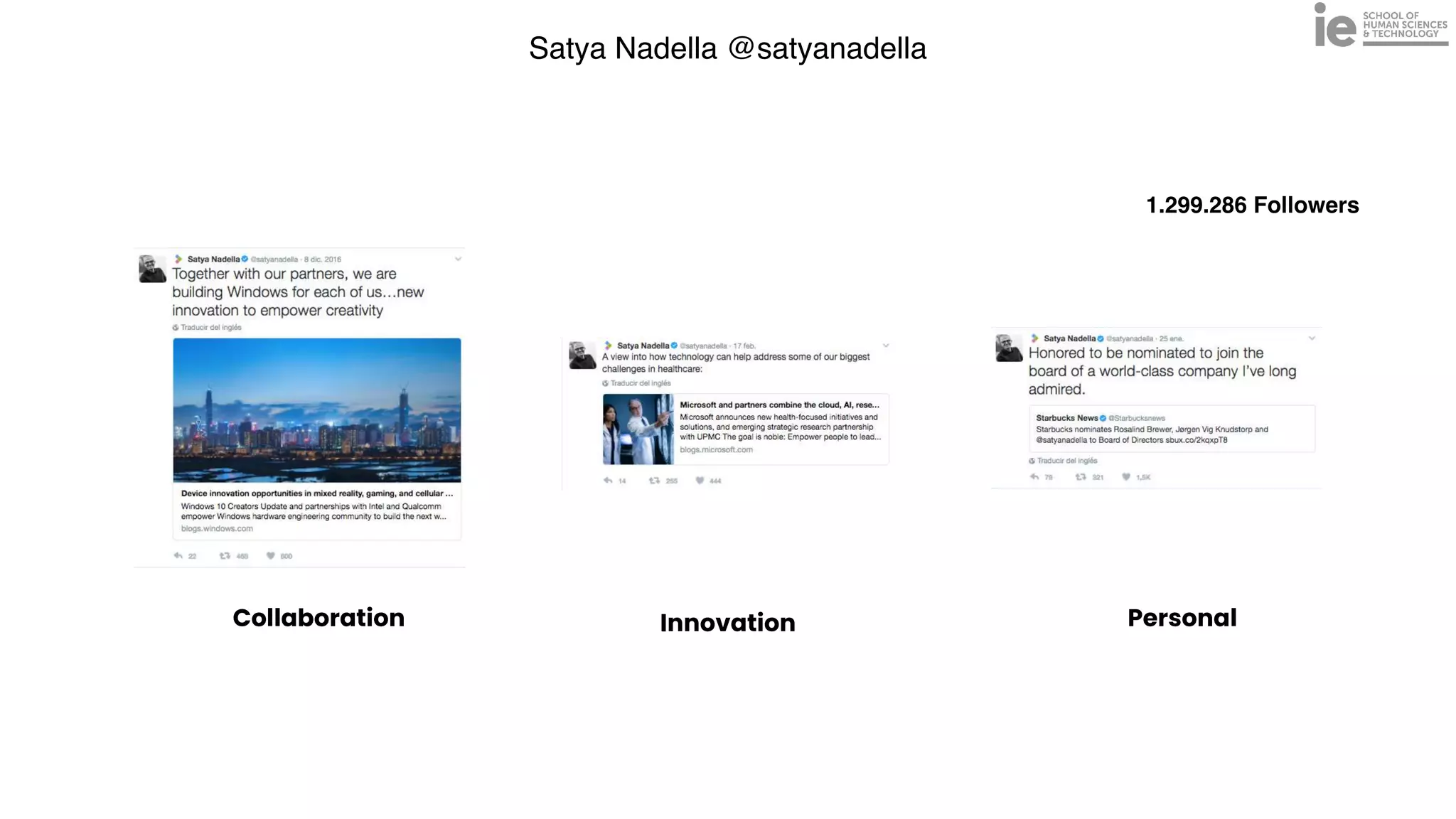
Satya Nadella @satyanadella
1.299.286 Followers
Collaboration Innovation Personal
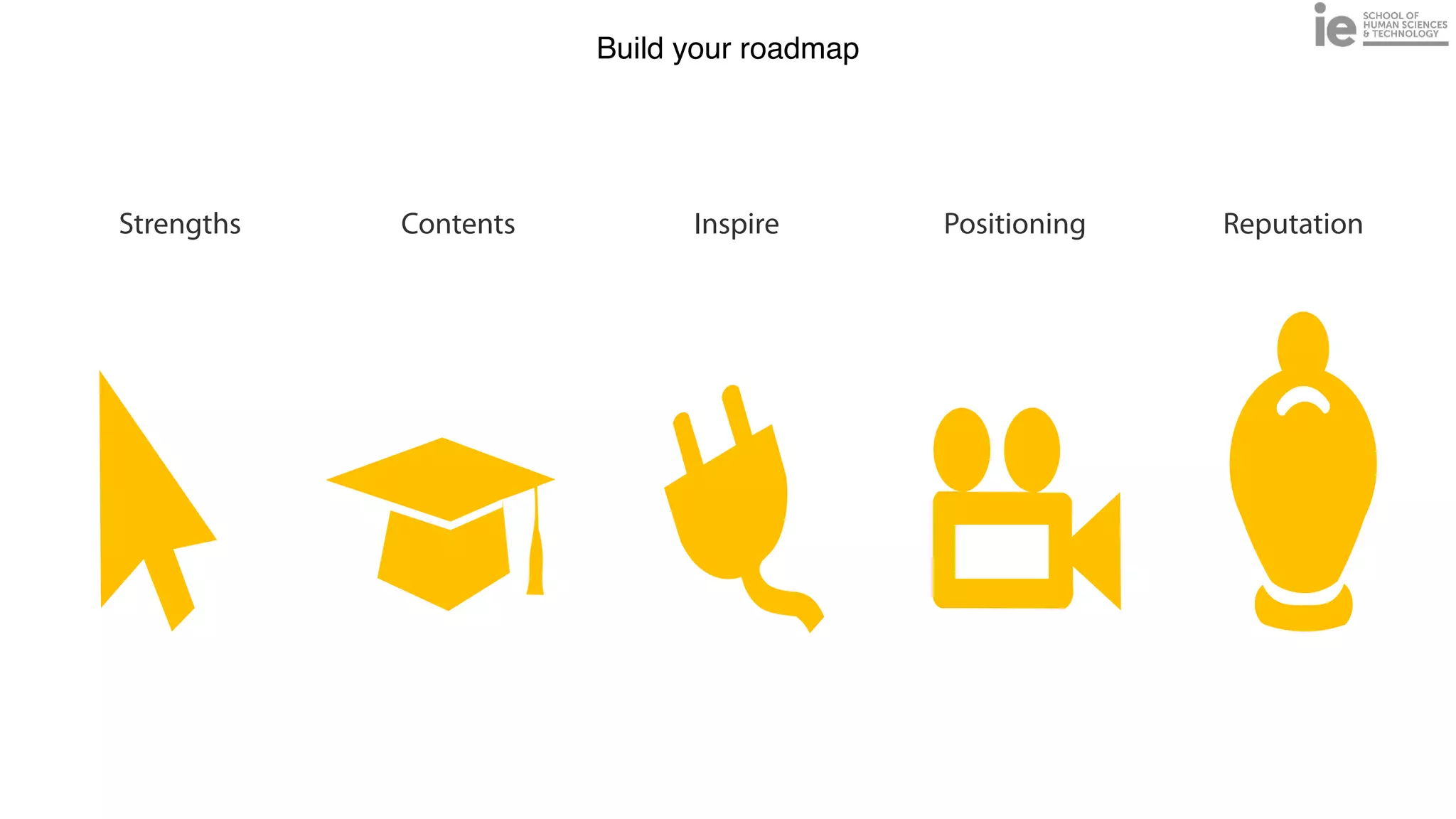
Build your roadmap
Strengths Contents Inspire Positioning Reputation
Q&As?
LinkedIn


Paid
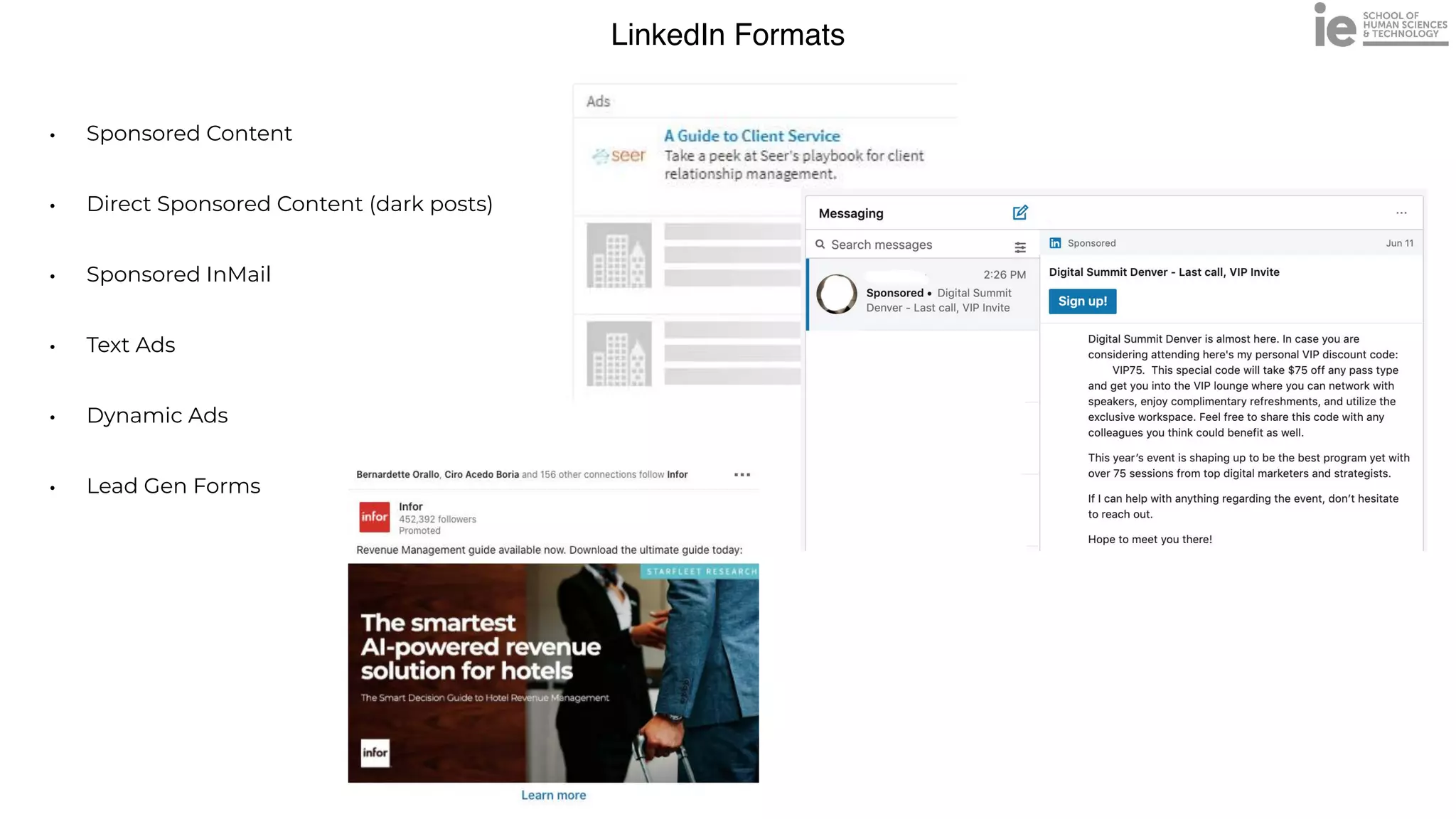
LinkedIn Formats
• Sponsored Content


• Direct Sponsored Content (dark posts)


• Sponsored InMail


• Text Ads


• Dynamic Ads


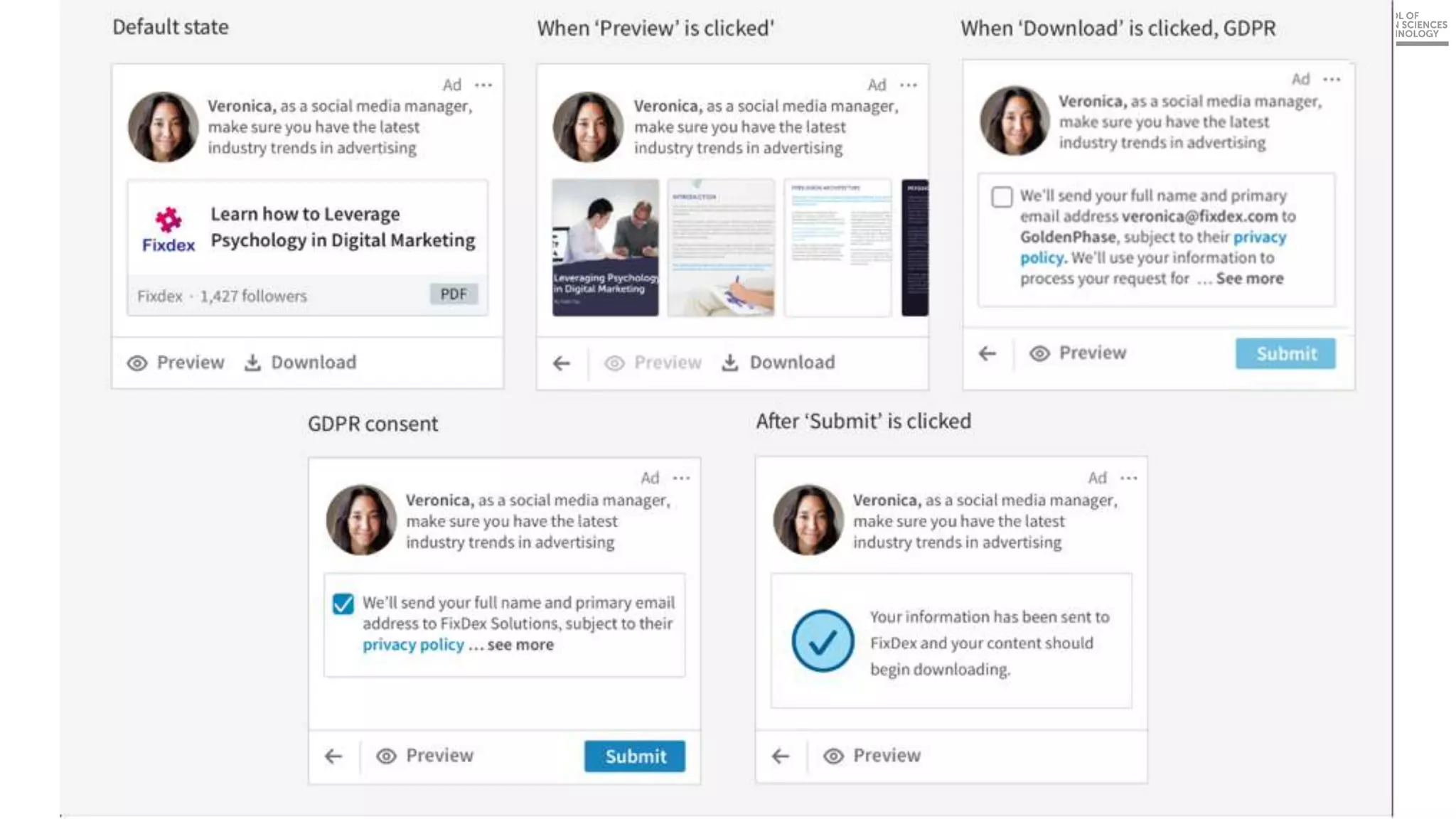
• Lead Gen Forms
Formats
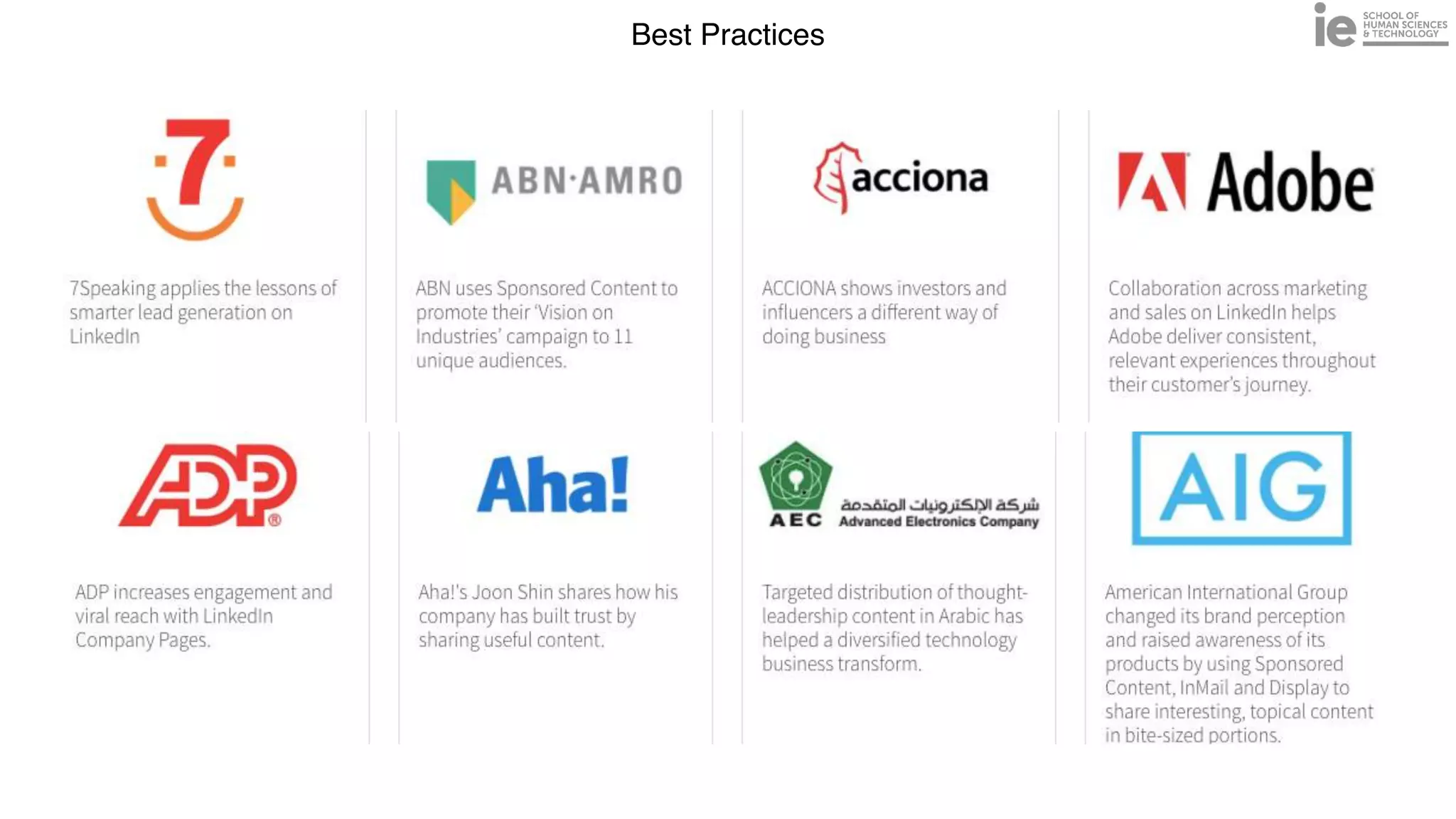
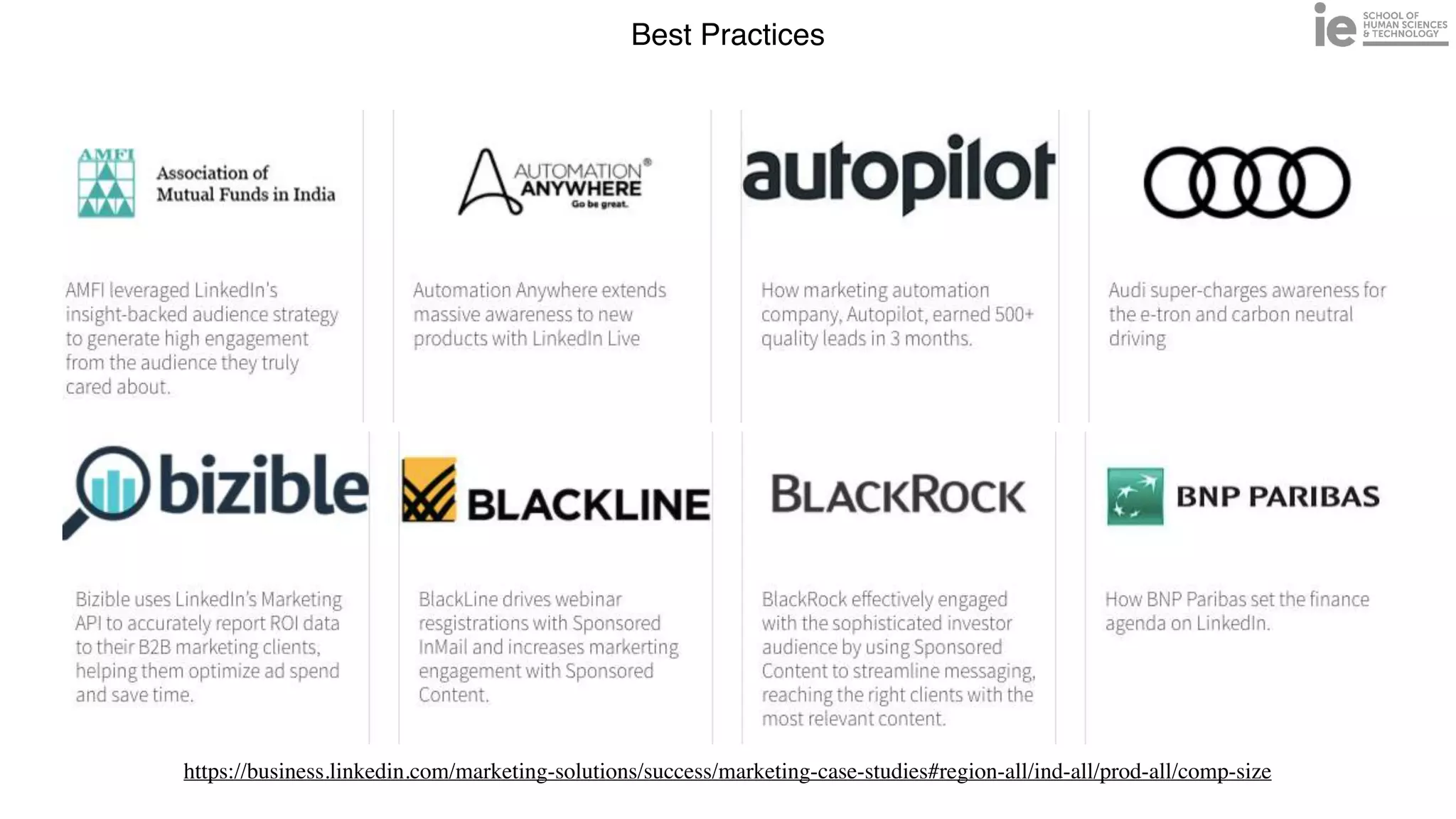
Best Practices
Best Practices
https://business.linkedin.com/marketing-solutions/success/marketing-case-studies#region-all/ind-all/prod-all/comp-size
LinkedIn Paid


Lessons Learned
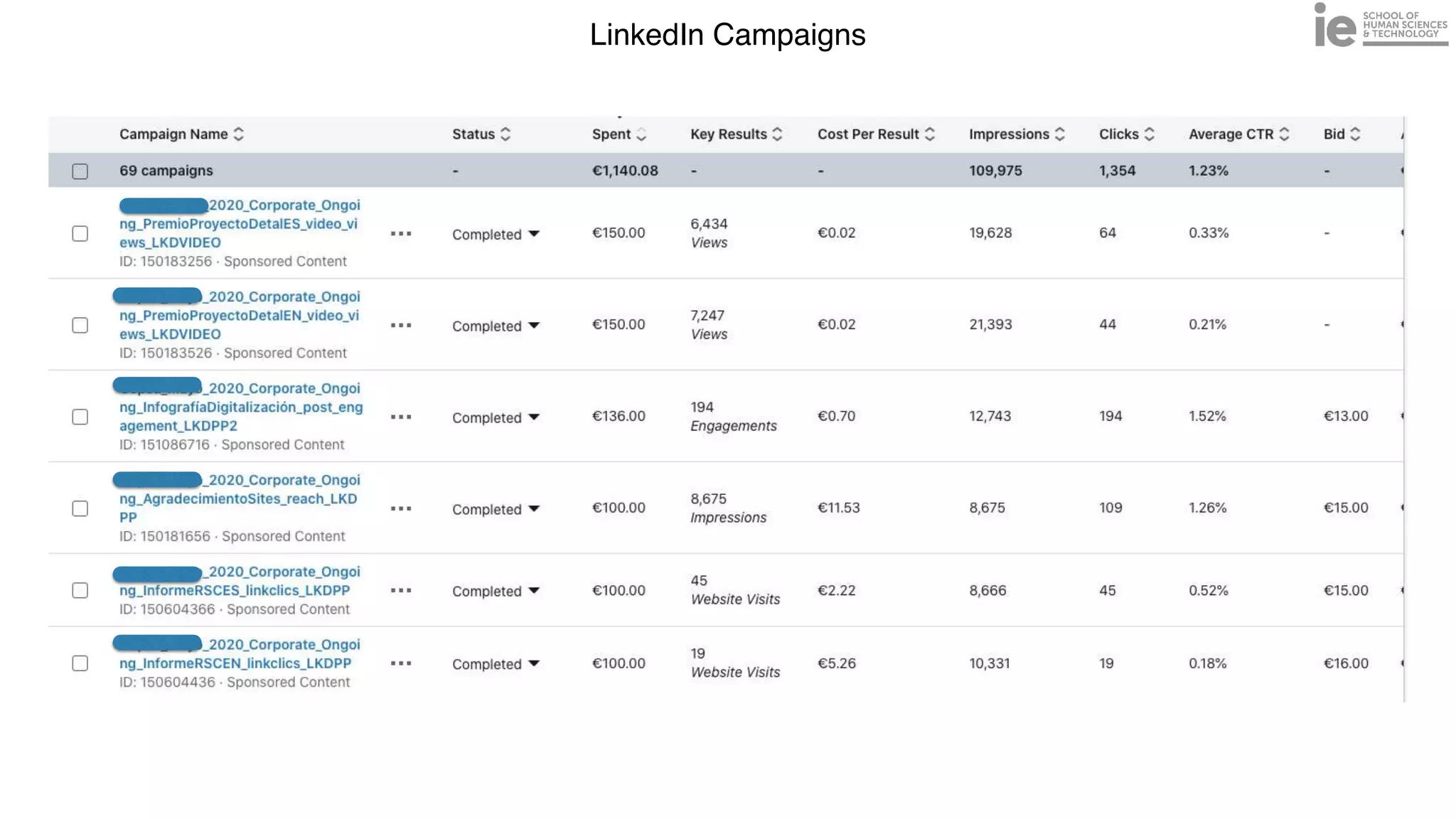
LinkedIn Campaigns
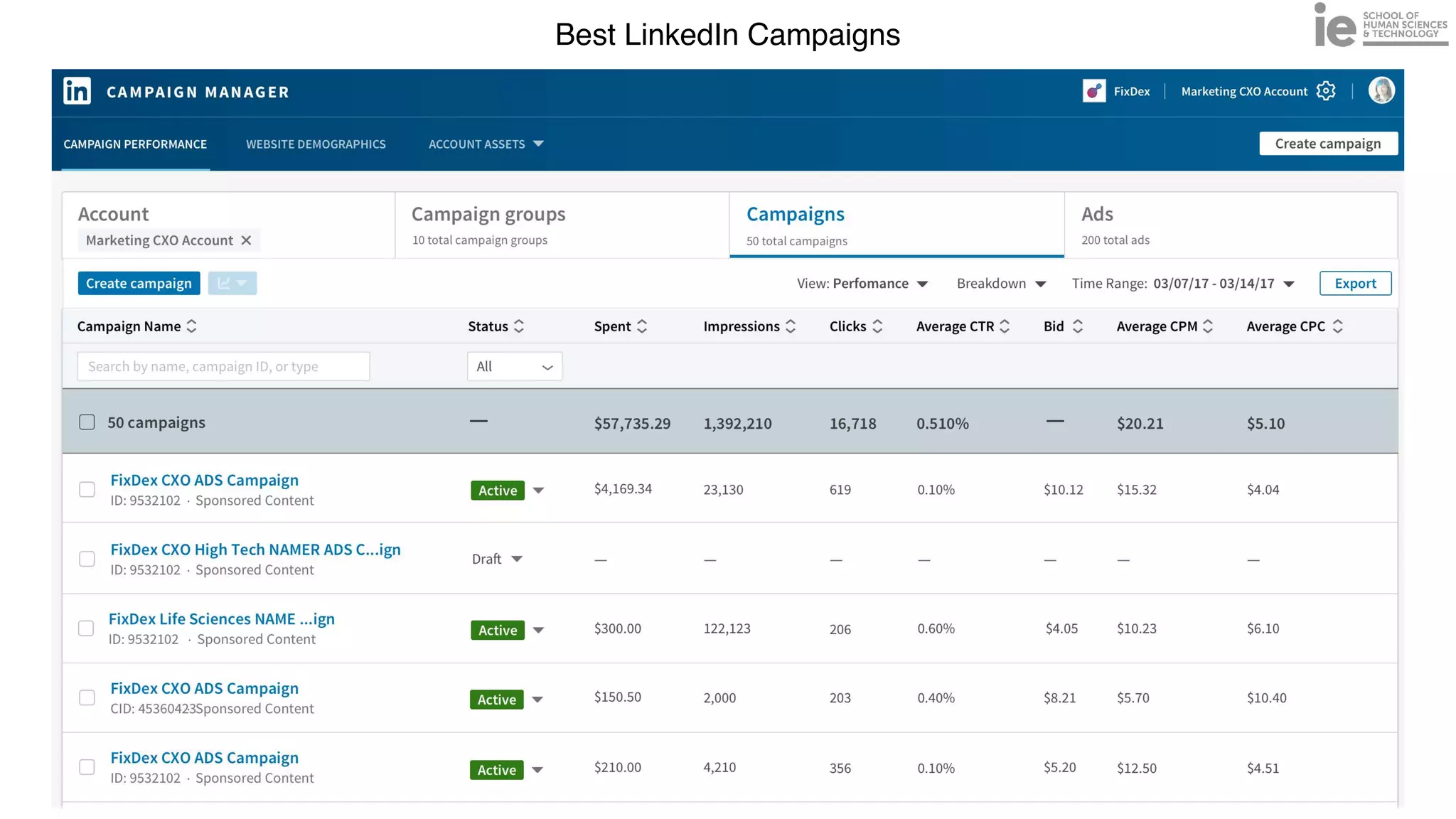
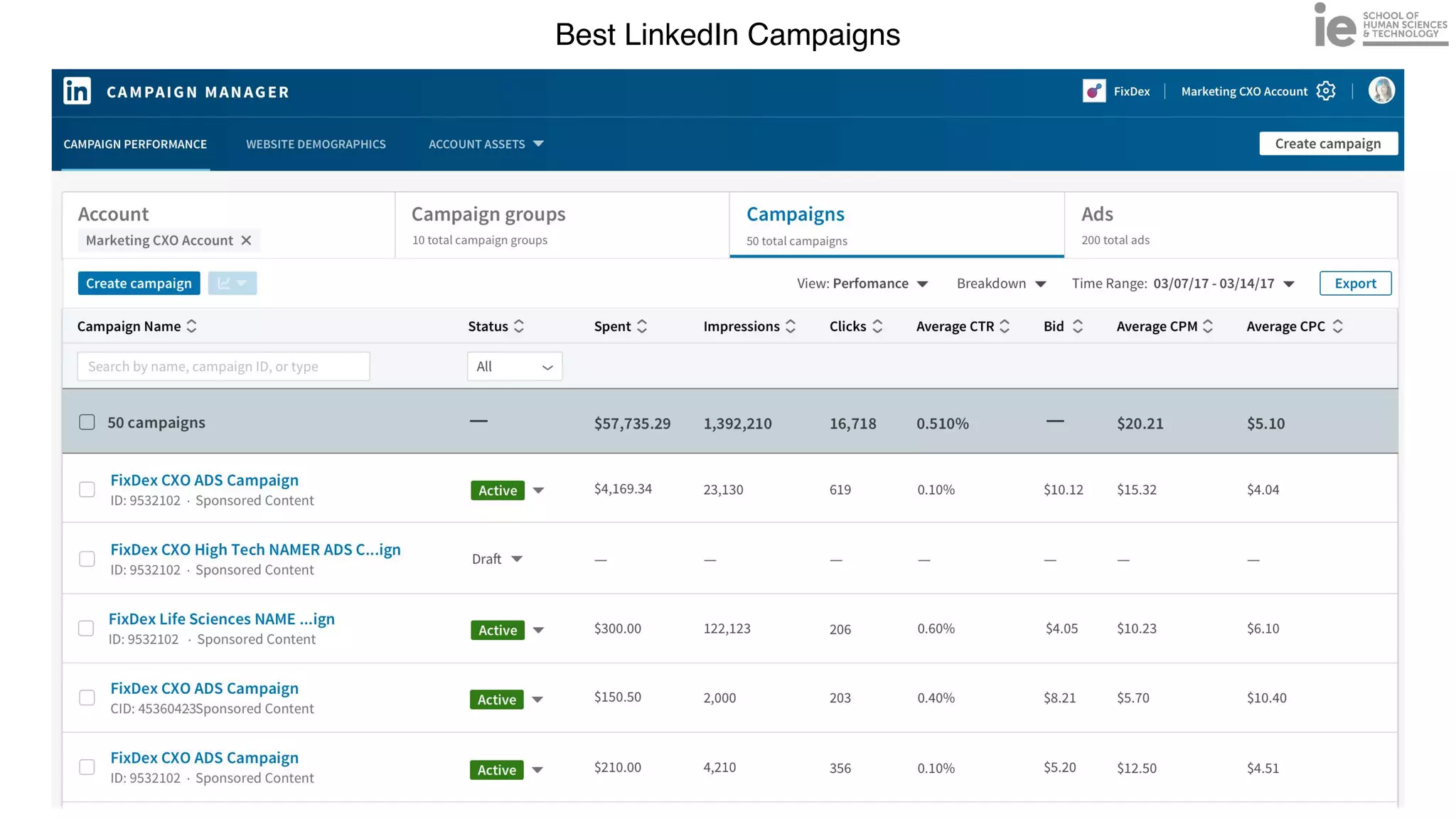
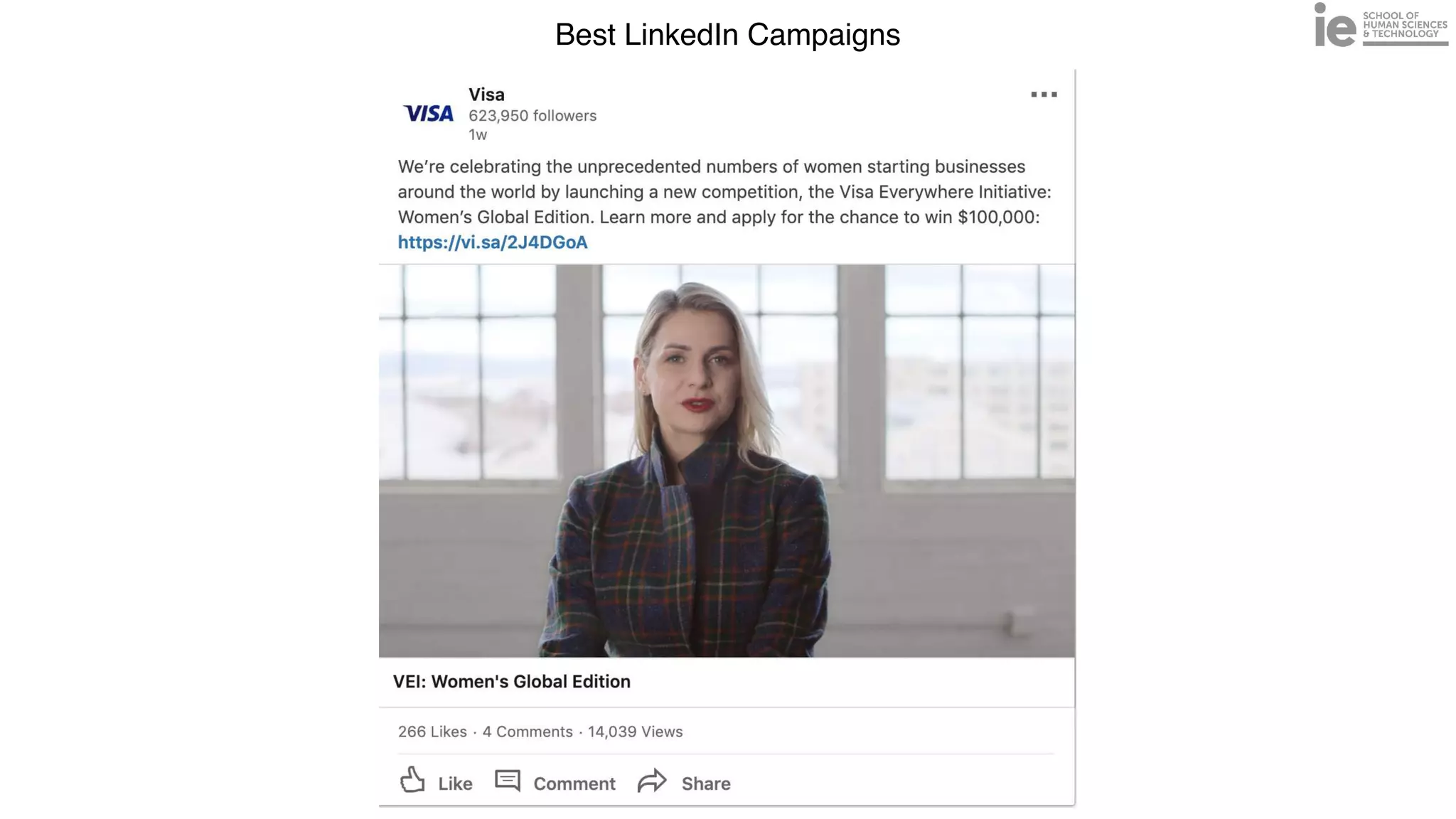
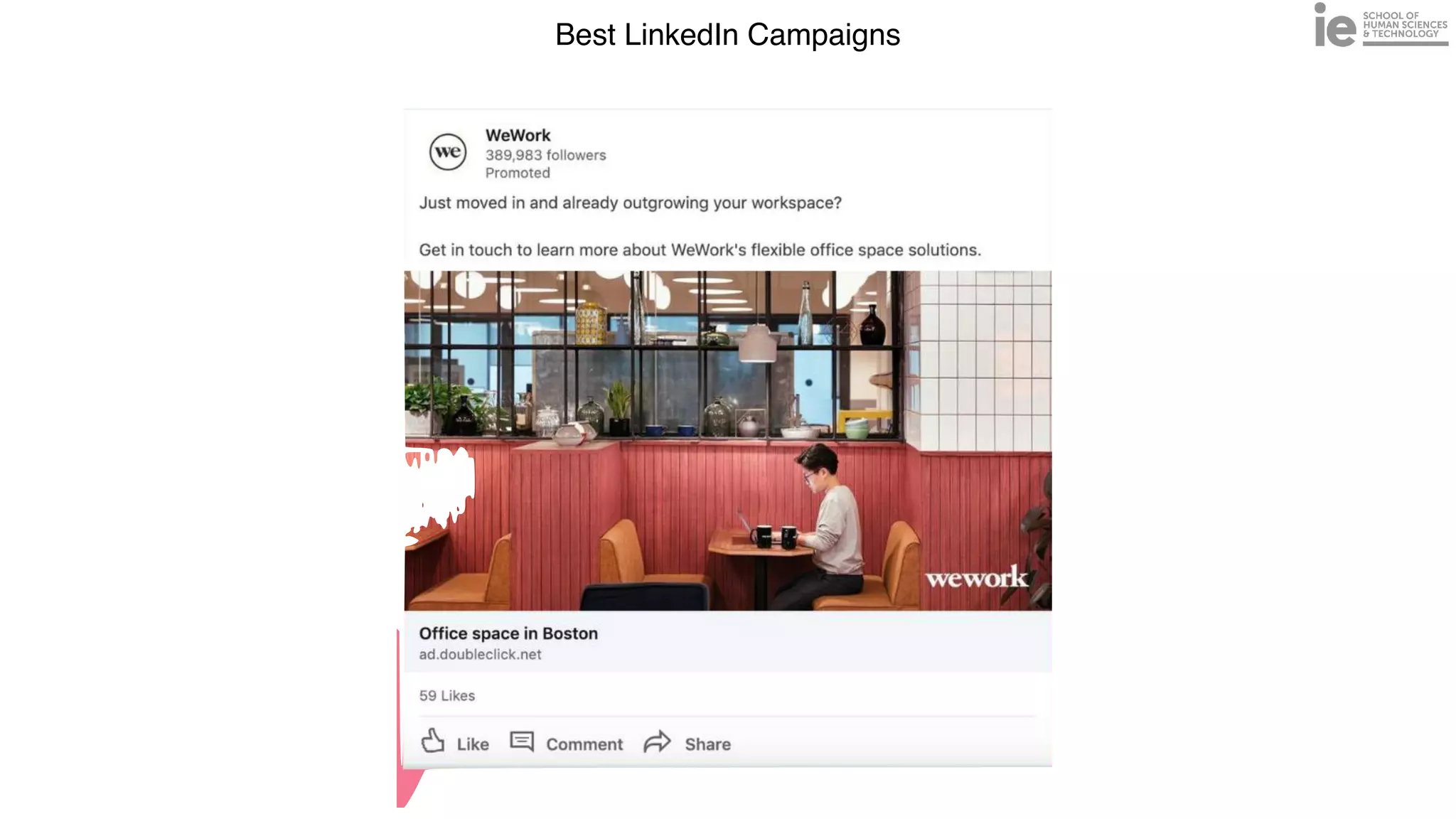
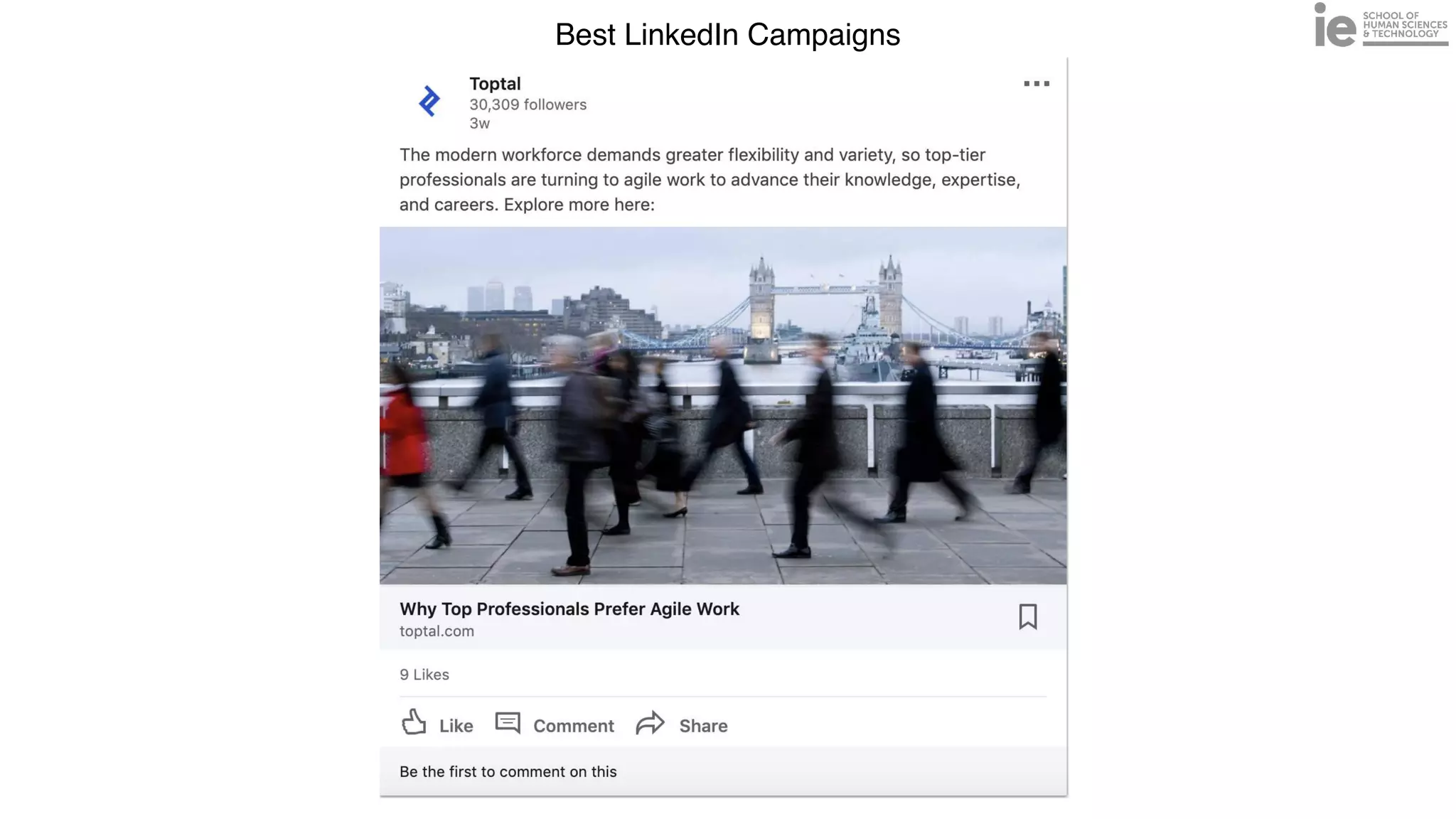
Best LinkedIn Campaigns
LinkedIn Reality
• LinkedIn median CPC is $3.49


• LinkedIn median CPM is $8.23


• LinkedIn median CTR is 0.26%
Best LinkedIn Campaigns
LinkedIn Demo
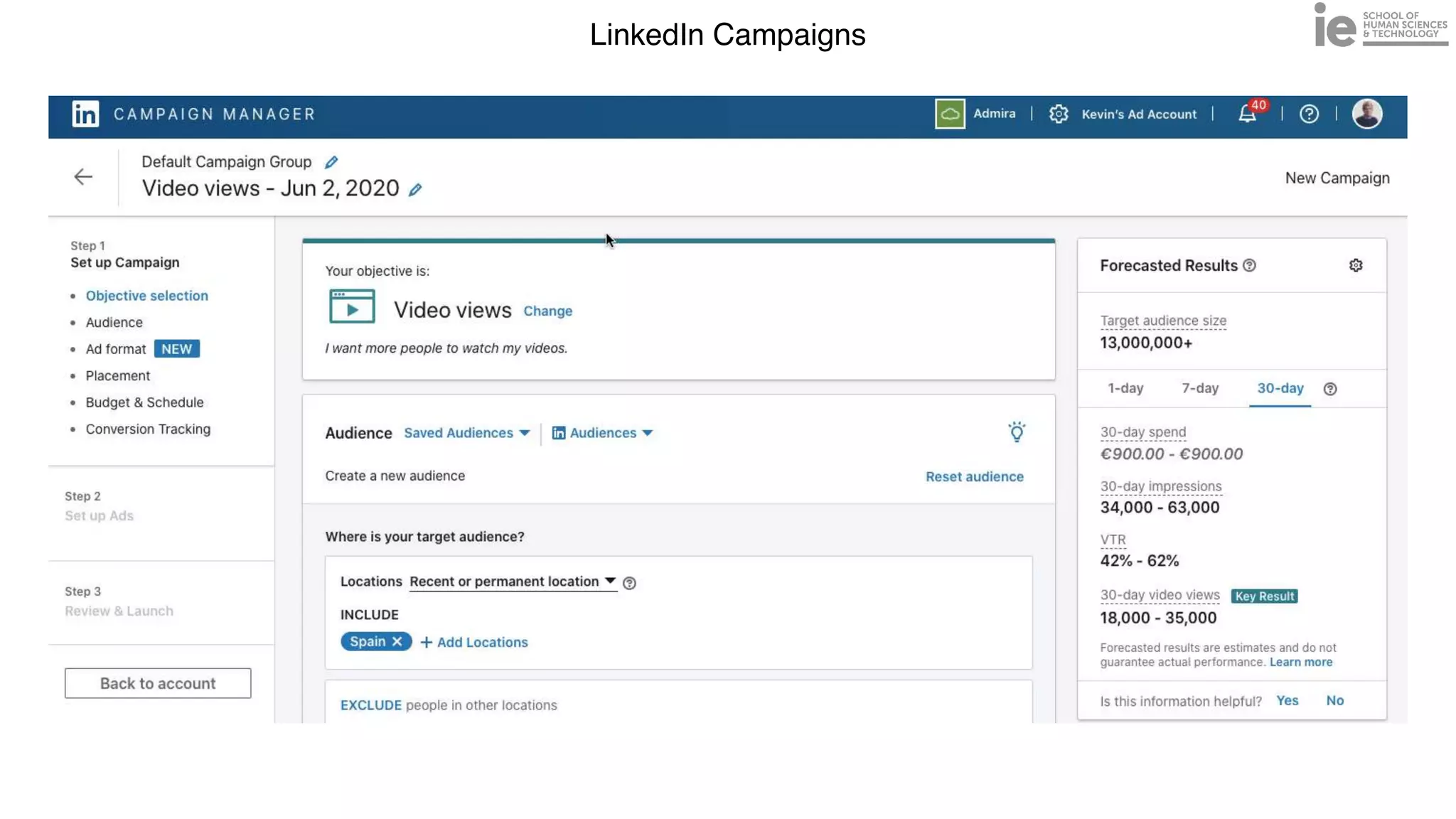
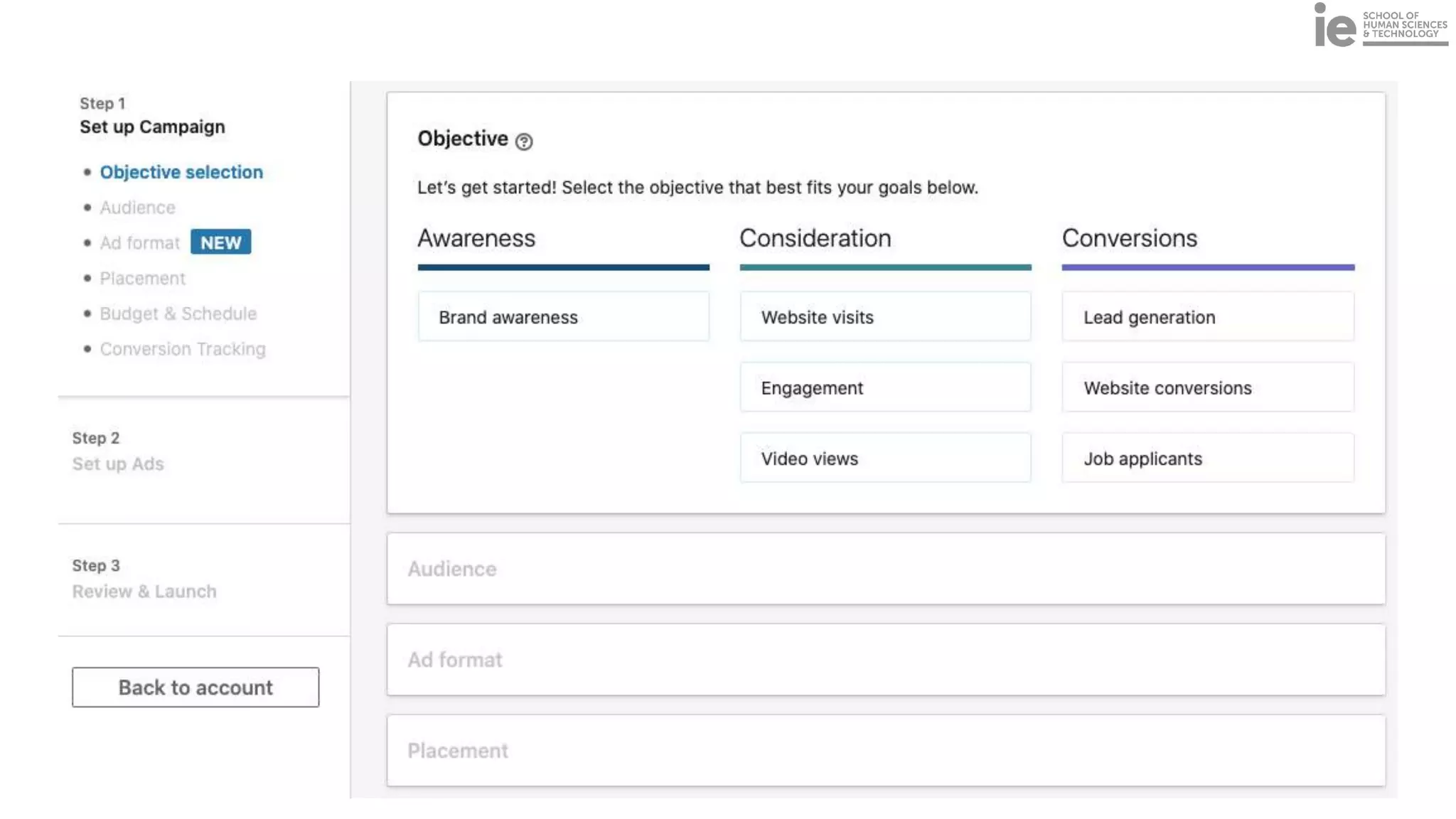
LinkedIn Campaigns
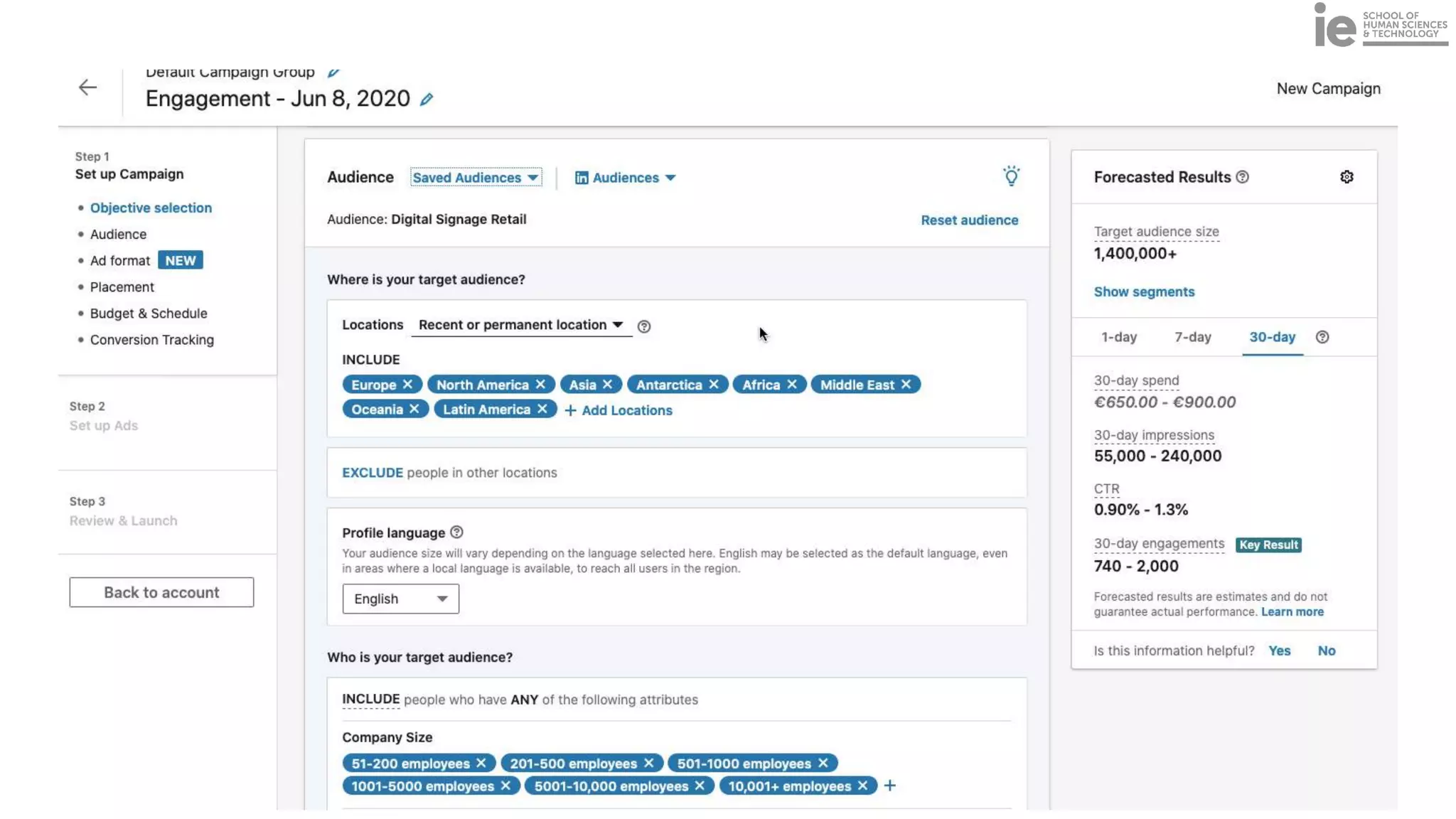
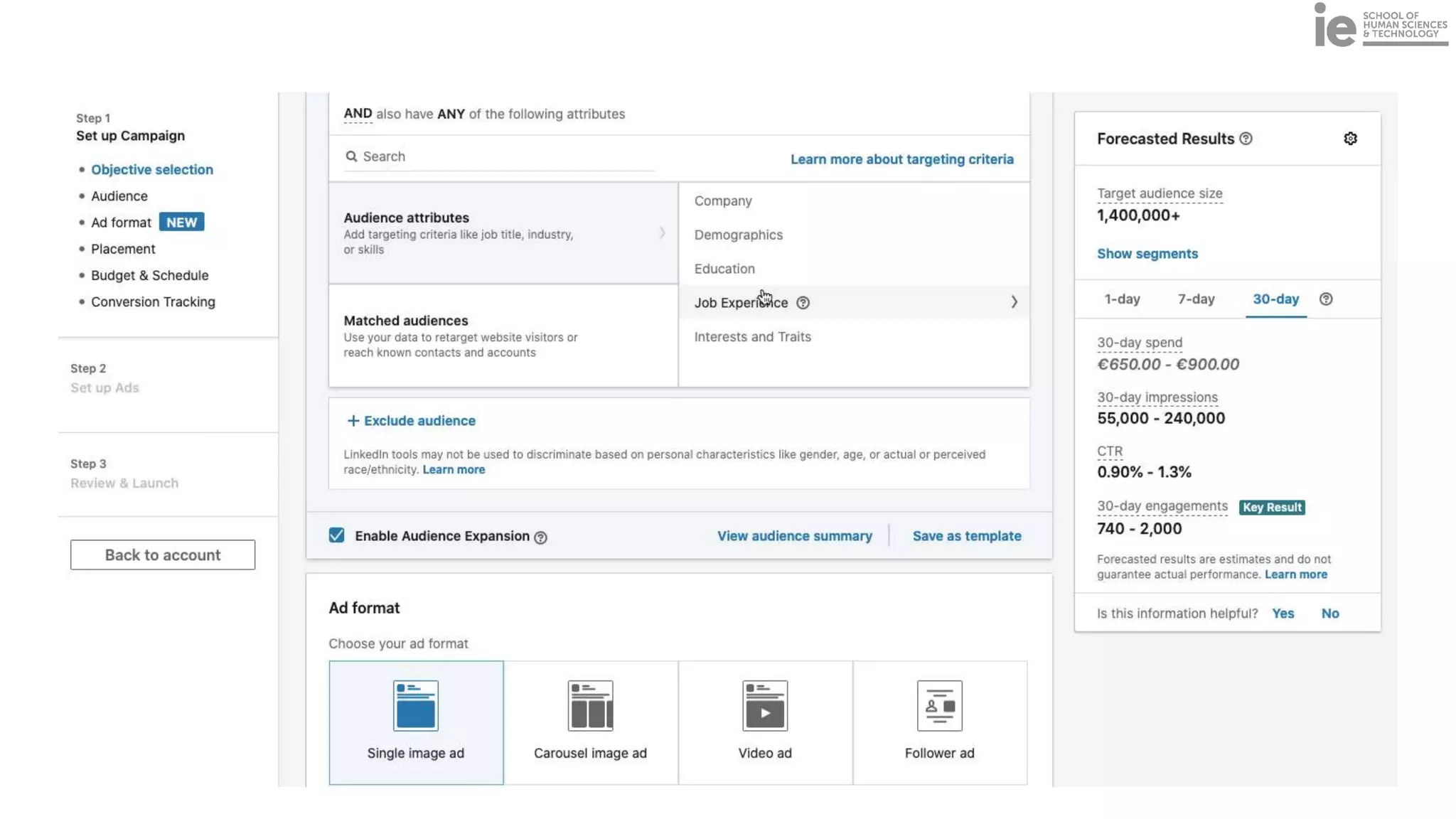
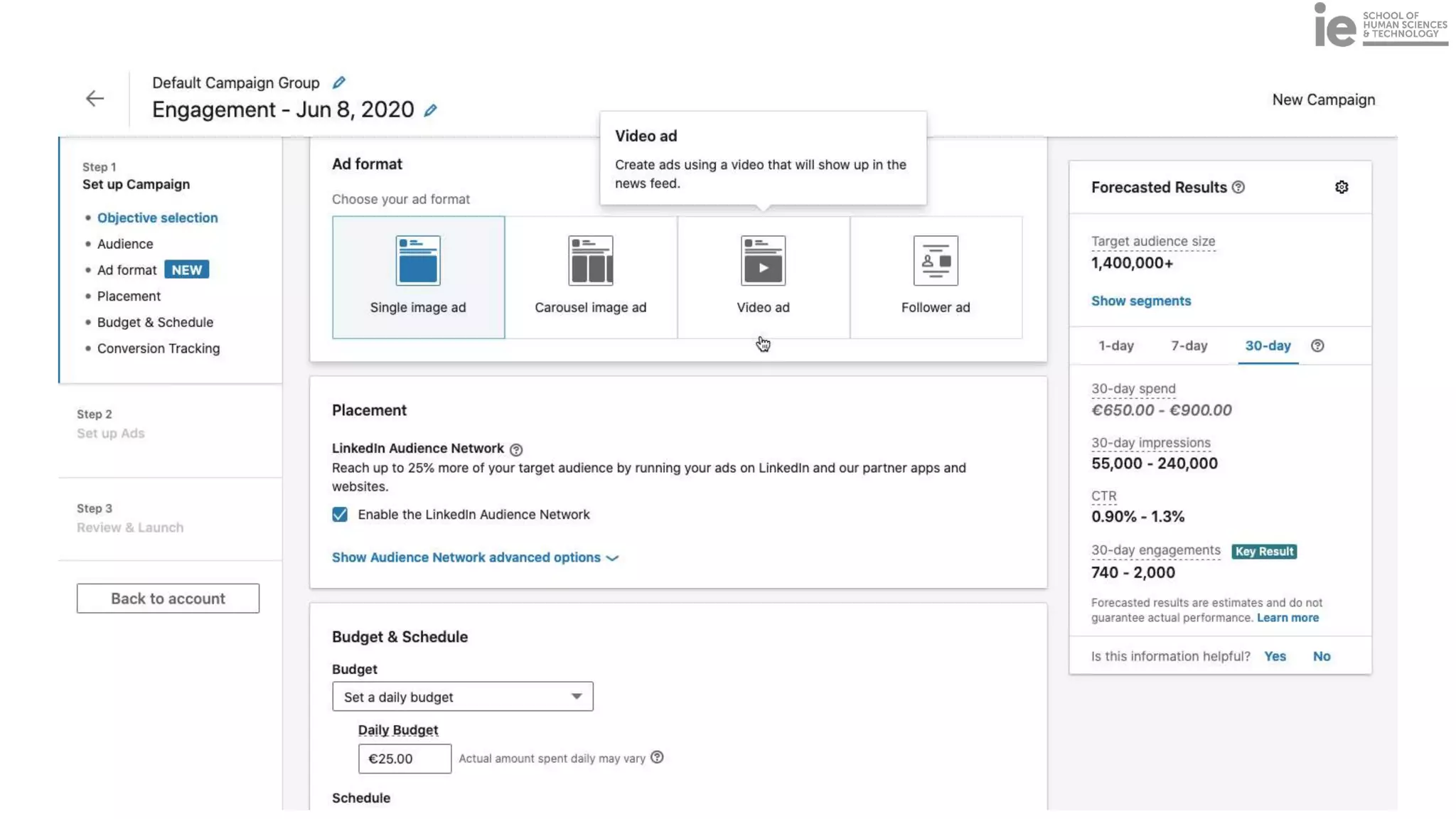
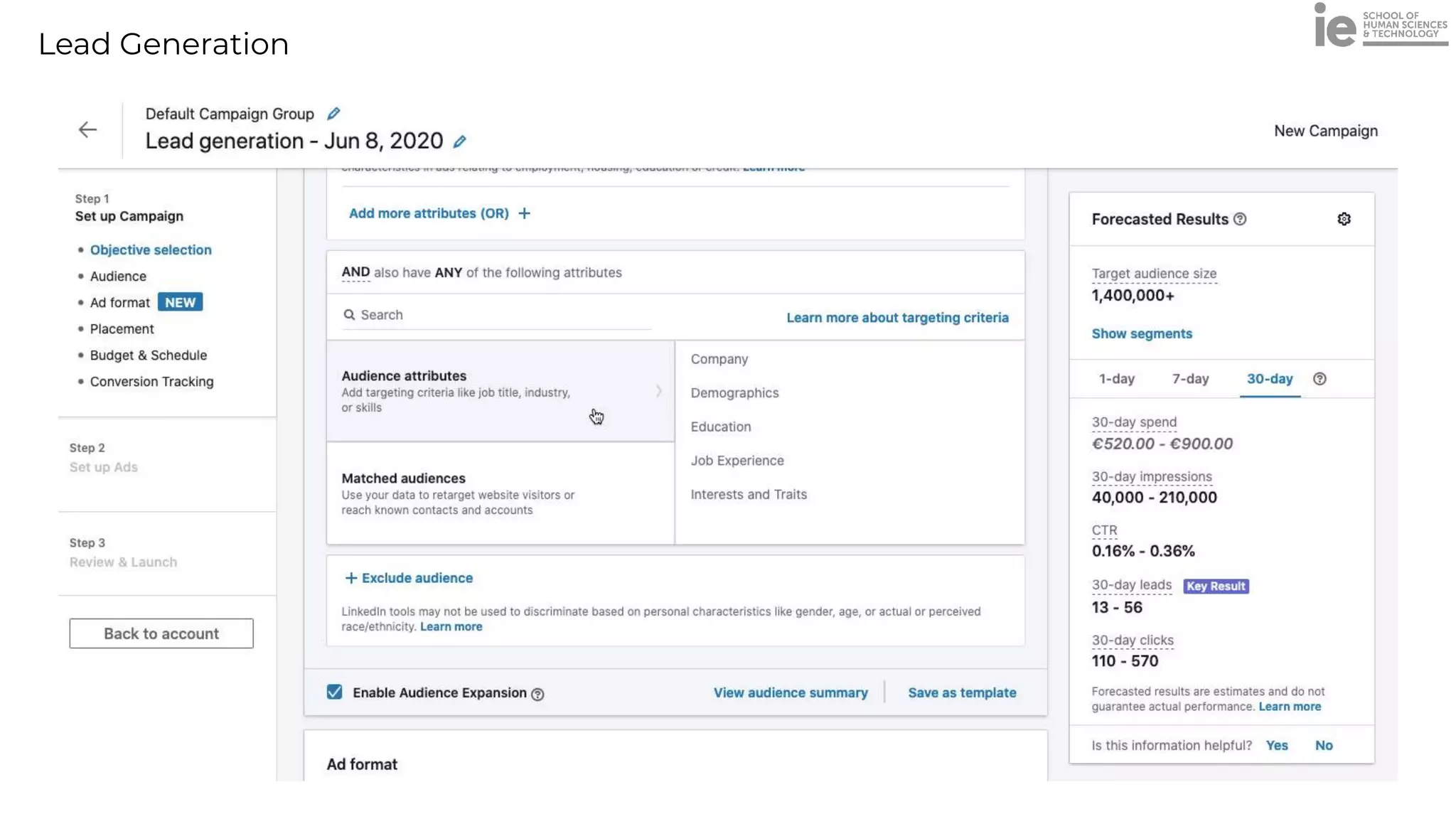
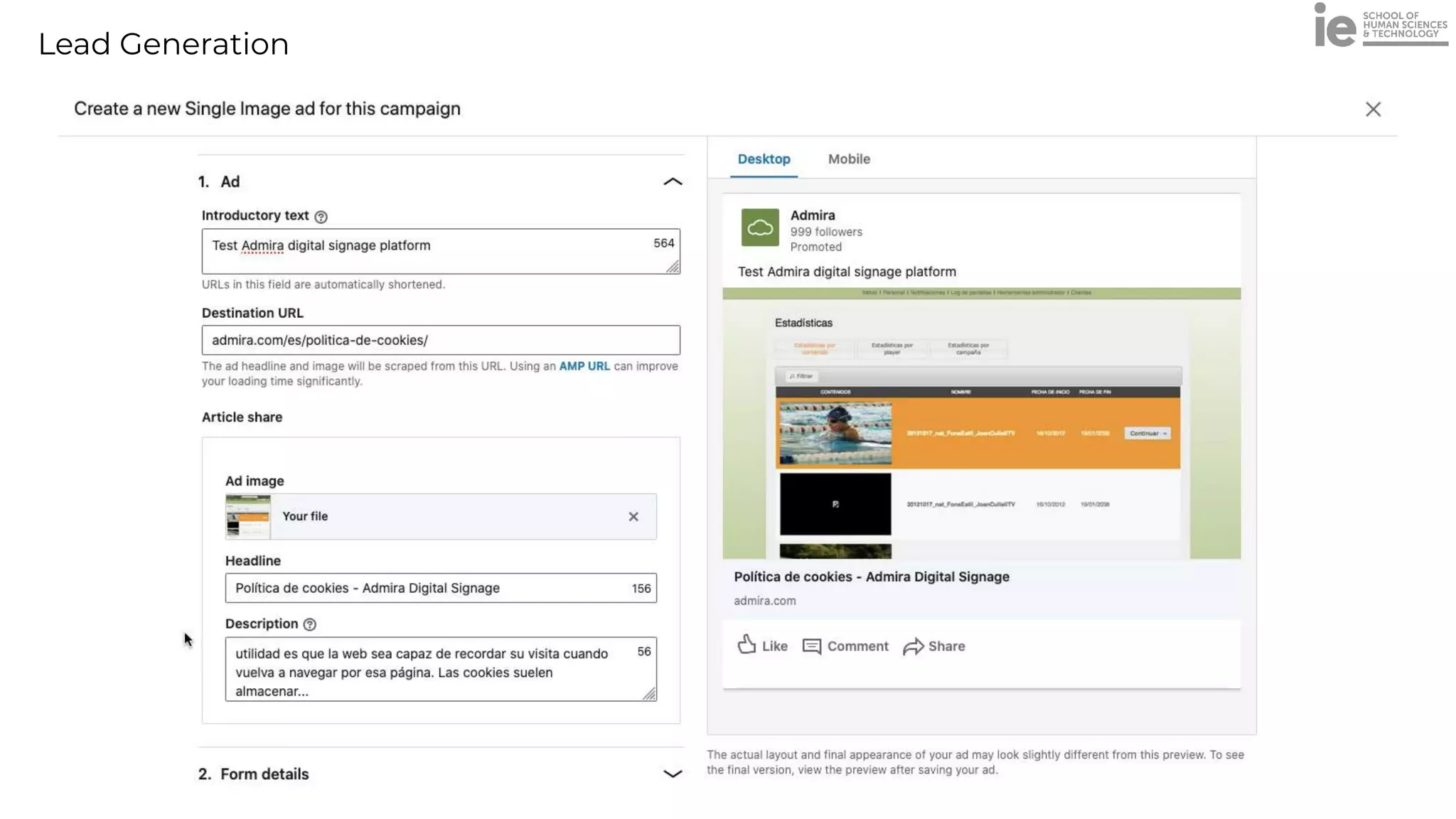
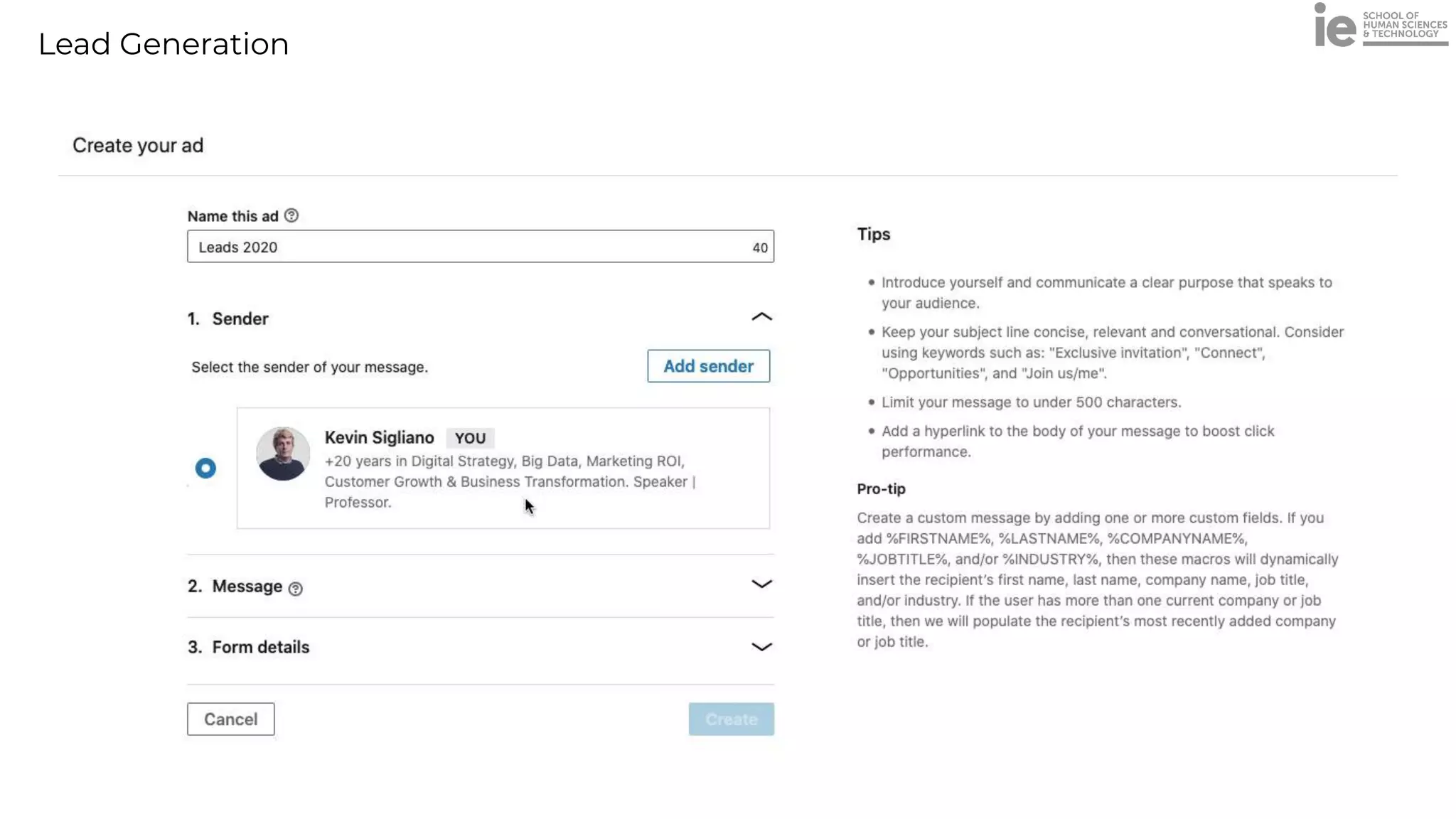
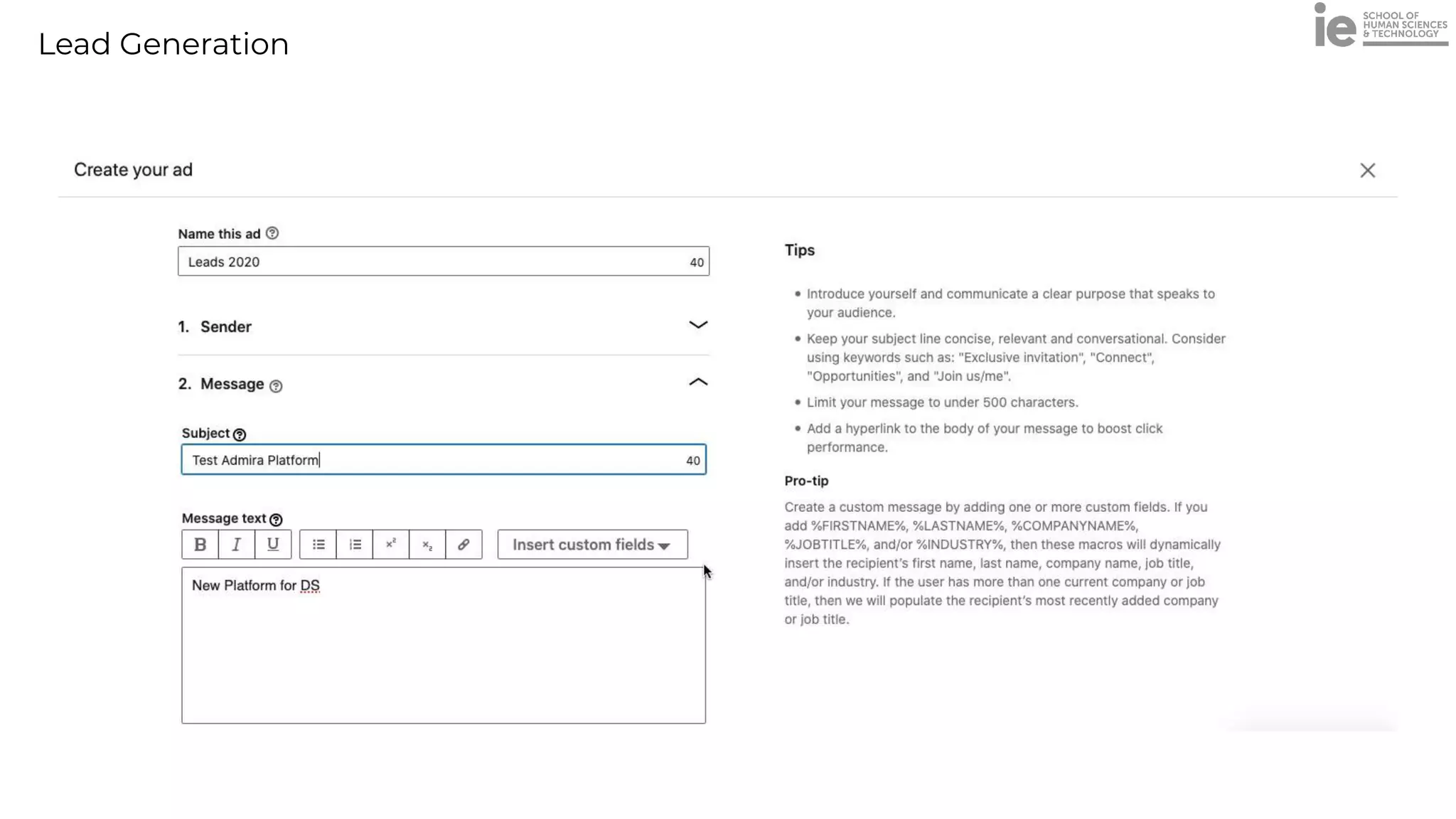
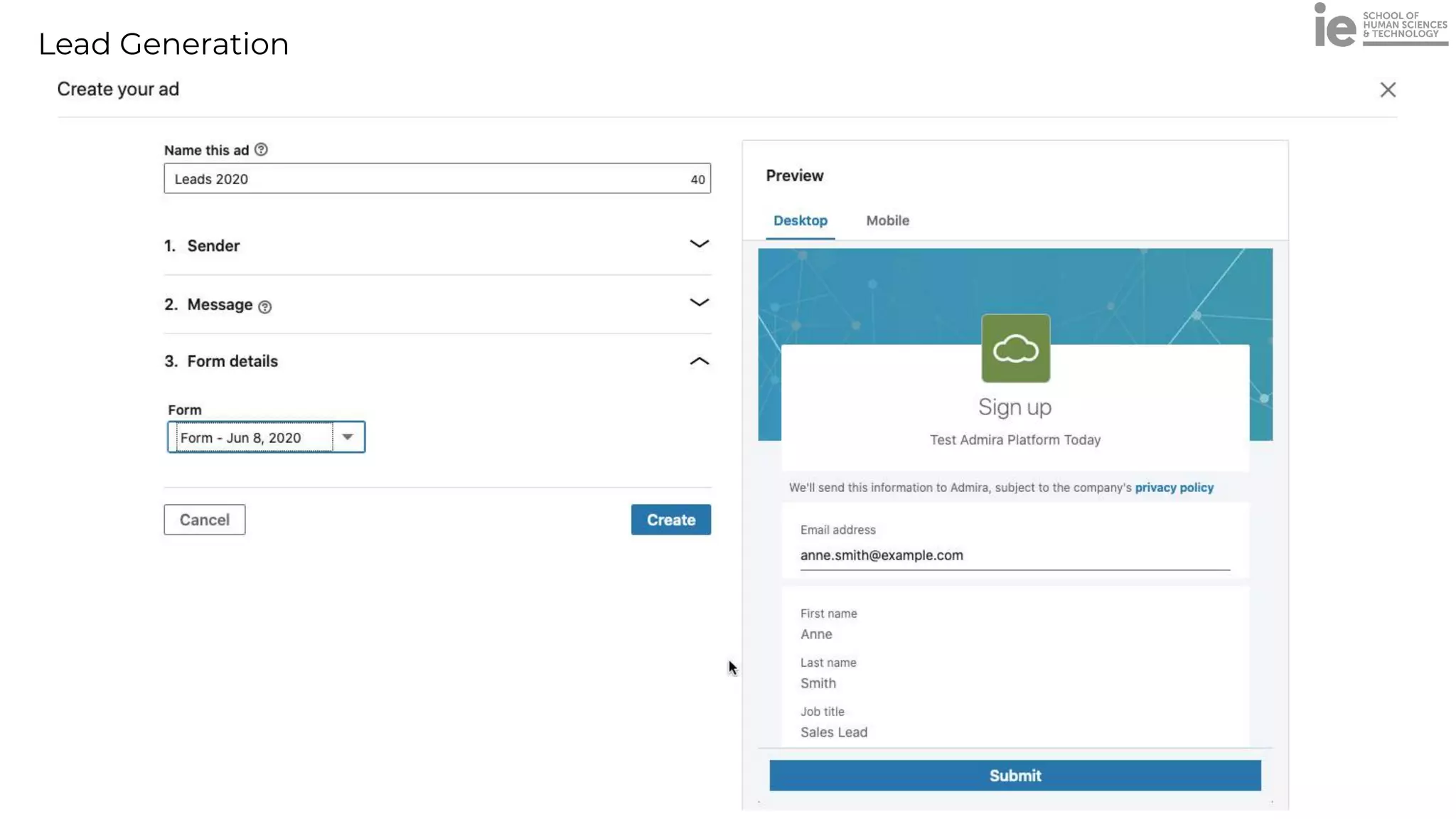
Lead Generation
Lead Generation
Lead Generation
Lead Generation
Lead Generation
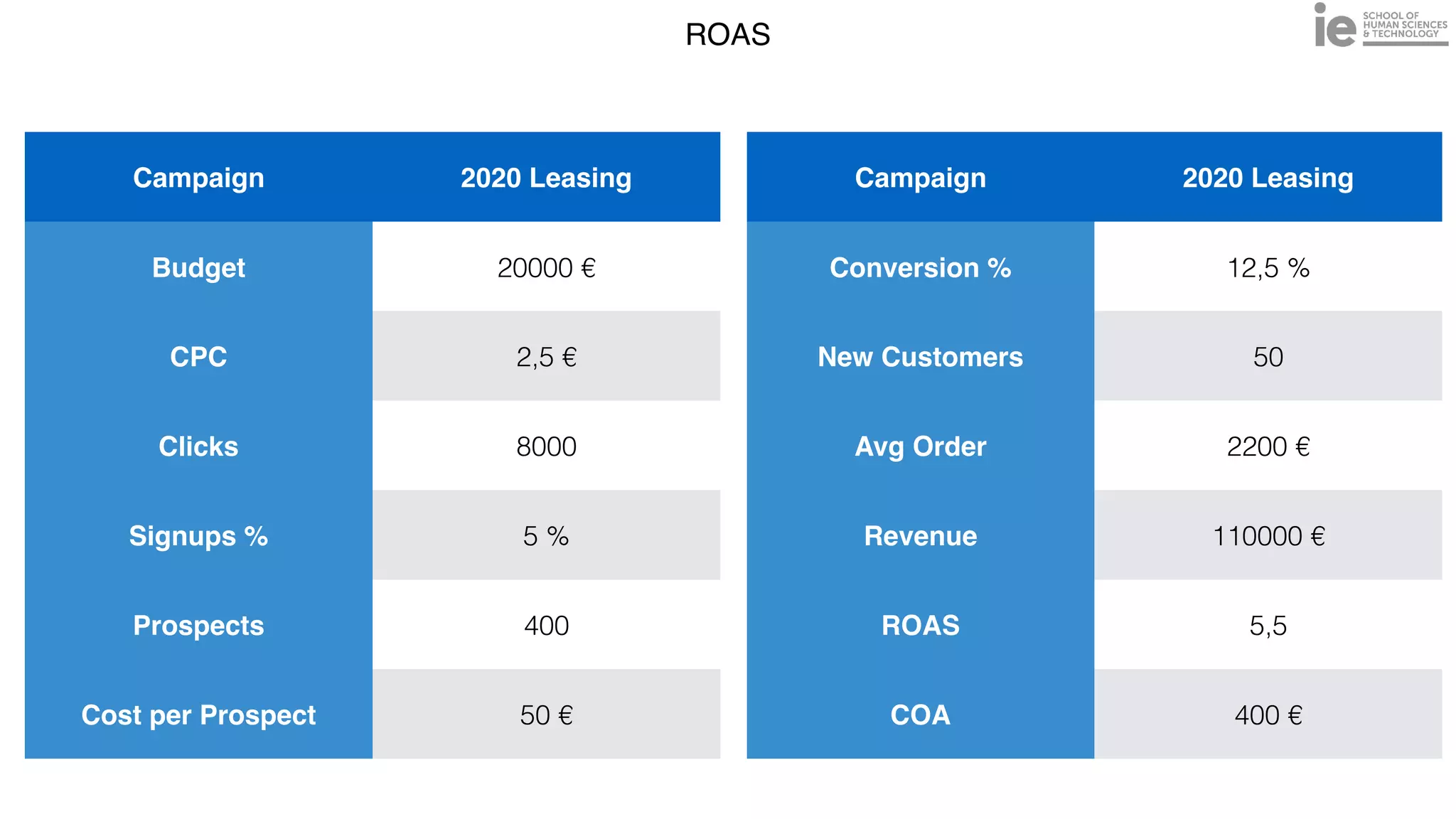
ROAS
Campaign 2020 Leasing
Budget 20000 €
CPC 2,5 €
Clicks 8000
Signups % 5 %
Prospects 400
Cost per Prospect 50 €
Campaign 2020 Leasing
Conversion % 12,5 %
New Customers 50
Avg Order 2200 €
Revenue 110000 €
ROAS 5,5
COA 400 €
ROAS
Campaign 2020 Leasing
Budget 20000 €
CPC 2,5 €
Clicks 8000
Signups % 5 %
Prospects 400
Cost per Prospect 50 €
Campaign 2020 Leasing
Conversion % 12,5 %
New Customers 50
Avg Order 2200 €
Revenue 110000 €
ROAS 5,5
COA 400 €
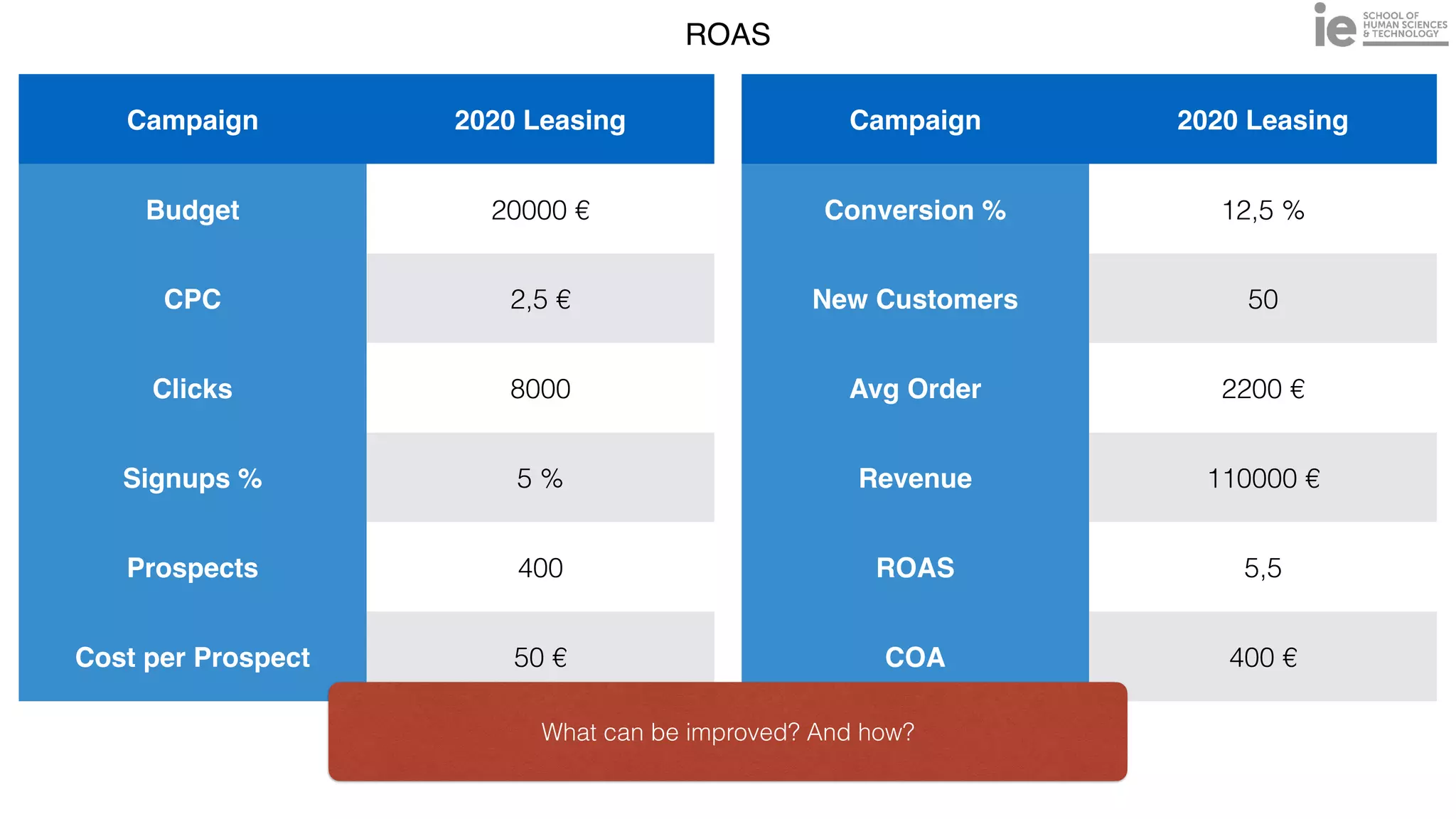
What can be improved? And how?
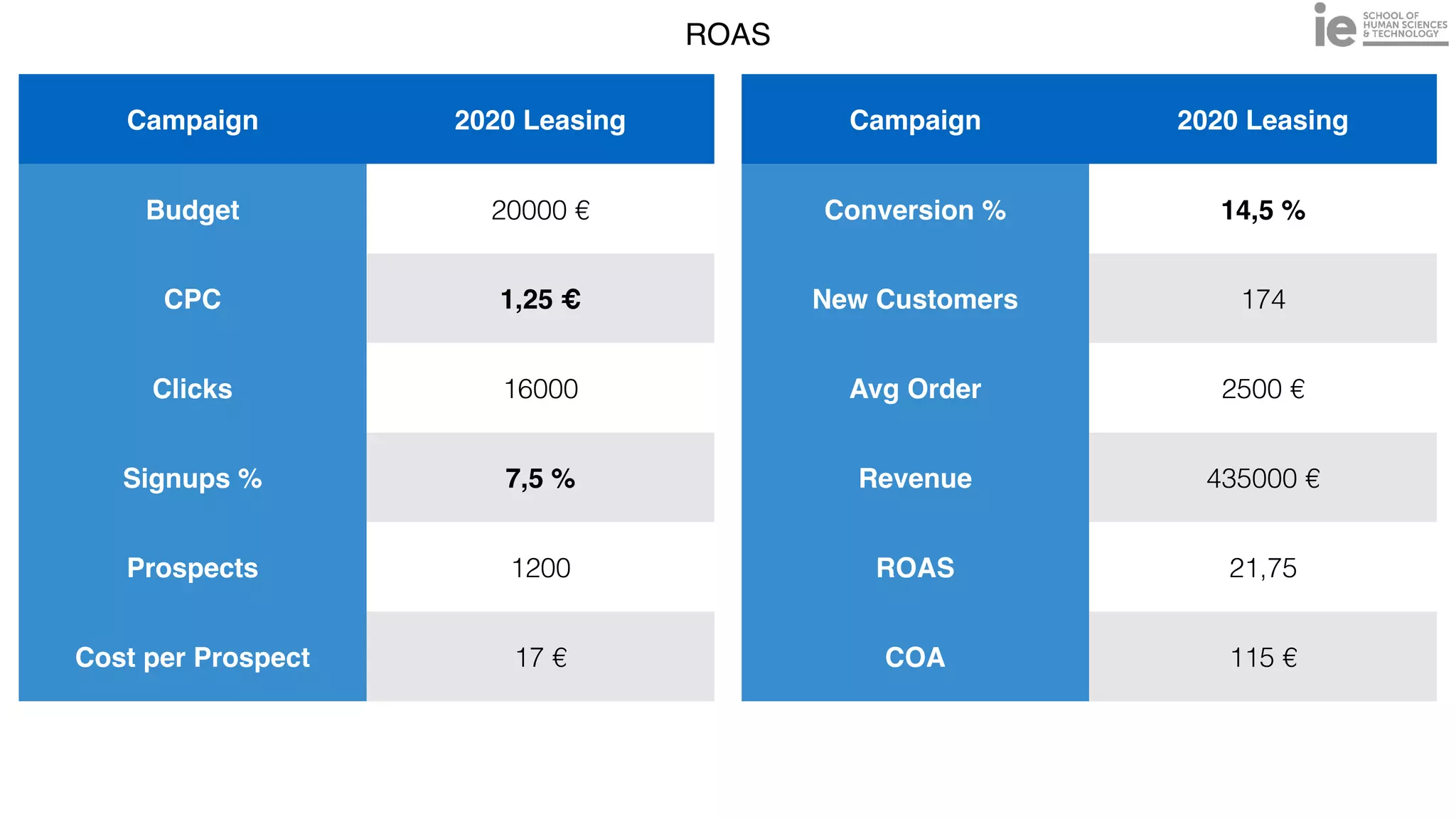
ROAS
Campaign 2020 Leasing
Budget 20000 €
CPC 1,25 €
Clicks 16000
Signups % 7,5 %
Prospects 1200
Cost per Prospect 17 €
Campaign 2020 Leasing
Conversion % 14,5 %
New Customers 174
Avg Order 2500 €
Revenue 435000 €
ROAS 21,75
COA 115 €
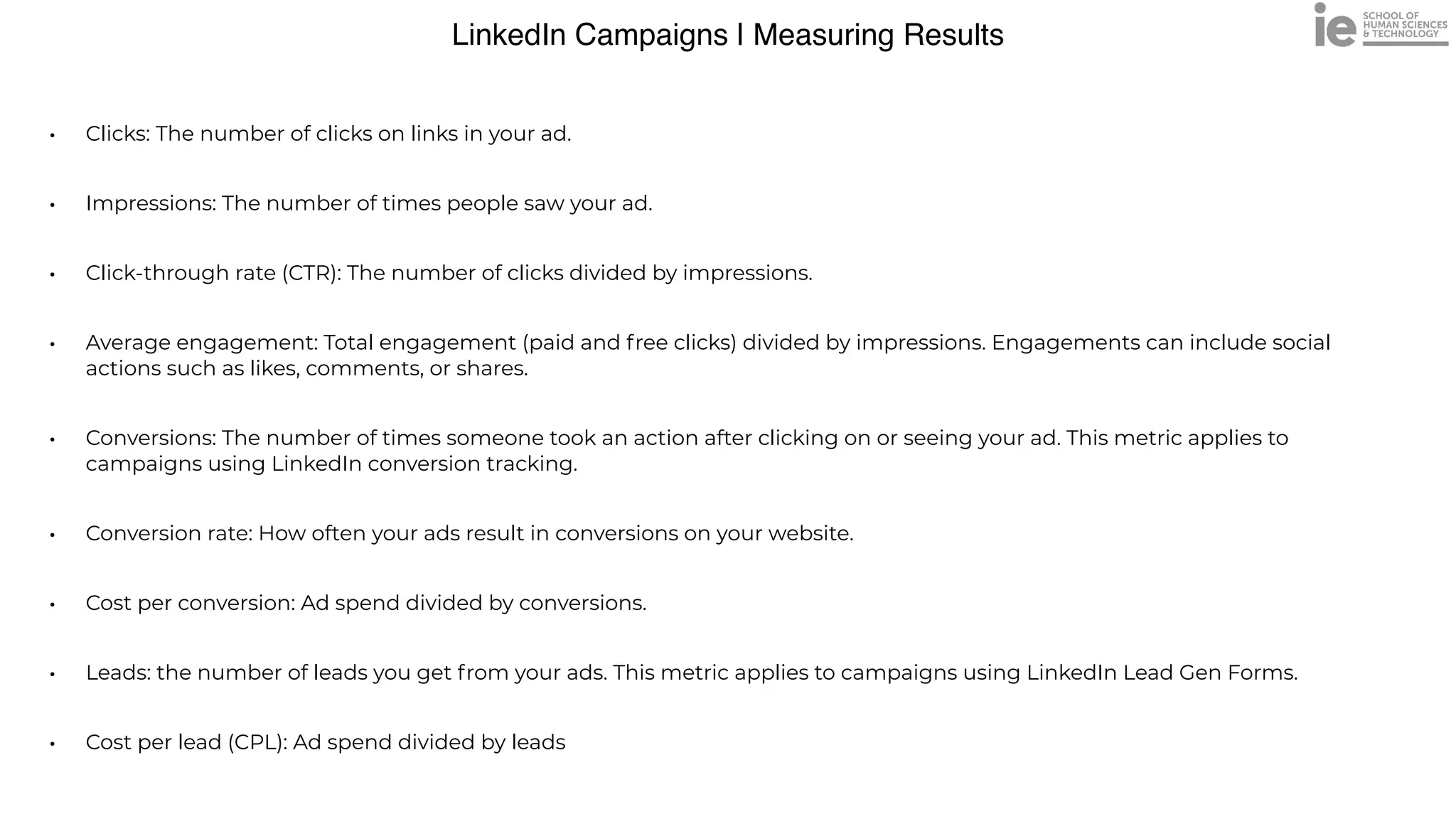
LinkedIn Campaigns | Measuring Results
• Clicks: The number of clicks on links in your ad. 


• Impressions: The number of times people saw your ad.


• Click-through rate (CTR): The number of clicks divided by impressions.


• Average engagement: Total engagement (paid and free clicks) divided by impressions. Engagements can include social
actions such as likes, comments, or shares.


• Conversions: The number of times someone took an action after clicking on or seeing your ad. This metric applies to
campaigns using LinkedIn conversion tracking.


• Conversion rate: How often your ads result in conversions on your website.


• Cost per conversion: Ad spend divided by conversions.


• Leads: the number of leads you get from your ads. This metric applies to campaigns using LinkedIn Lead Gen Forms.


• Cost per lead (CPL): Ad spend divided by leads
Social Media


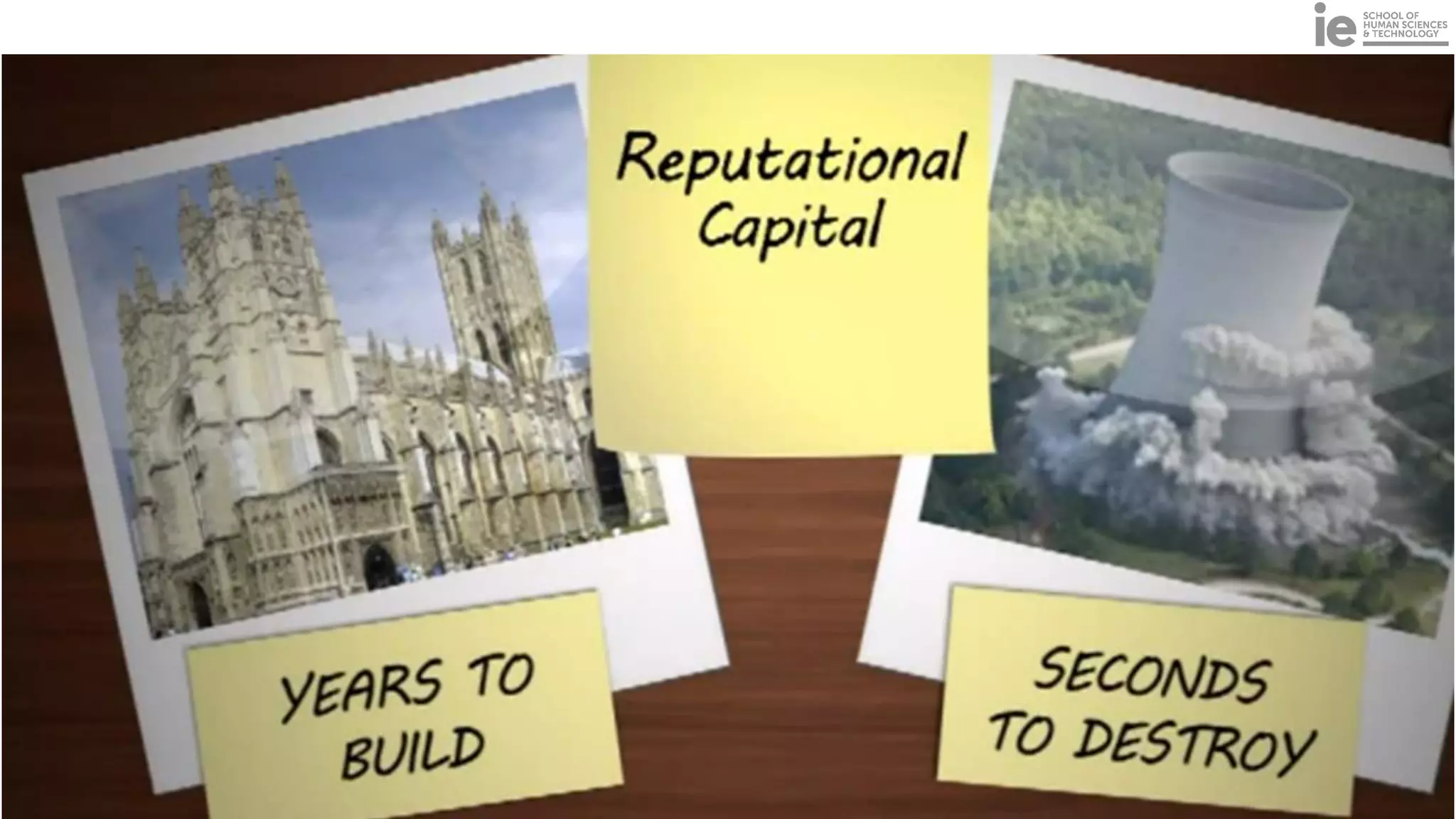
Crisis
Crisis Management
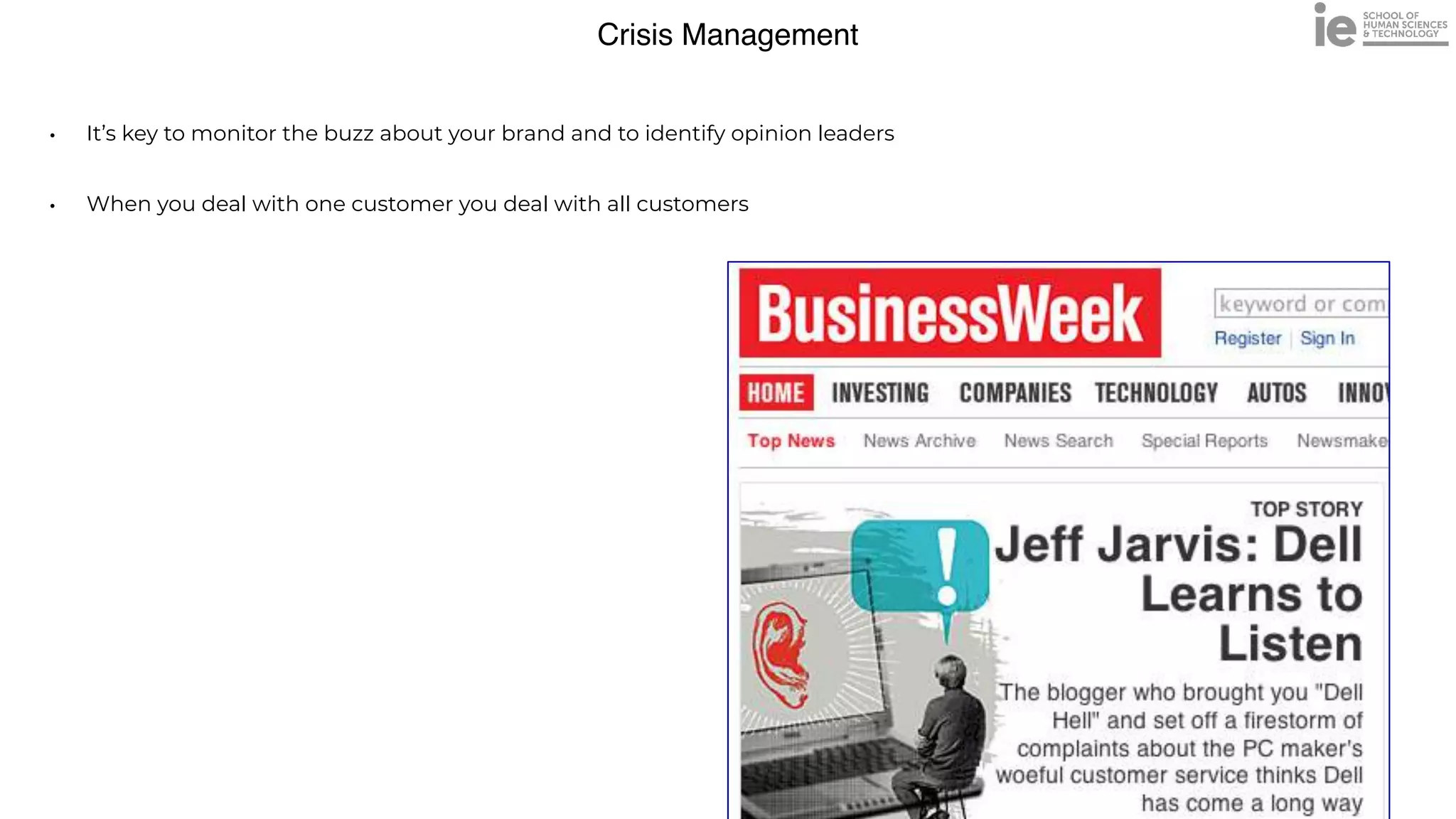
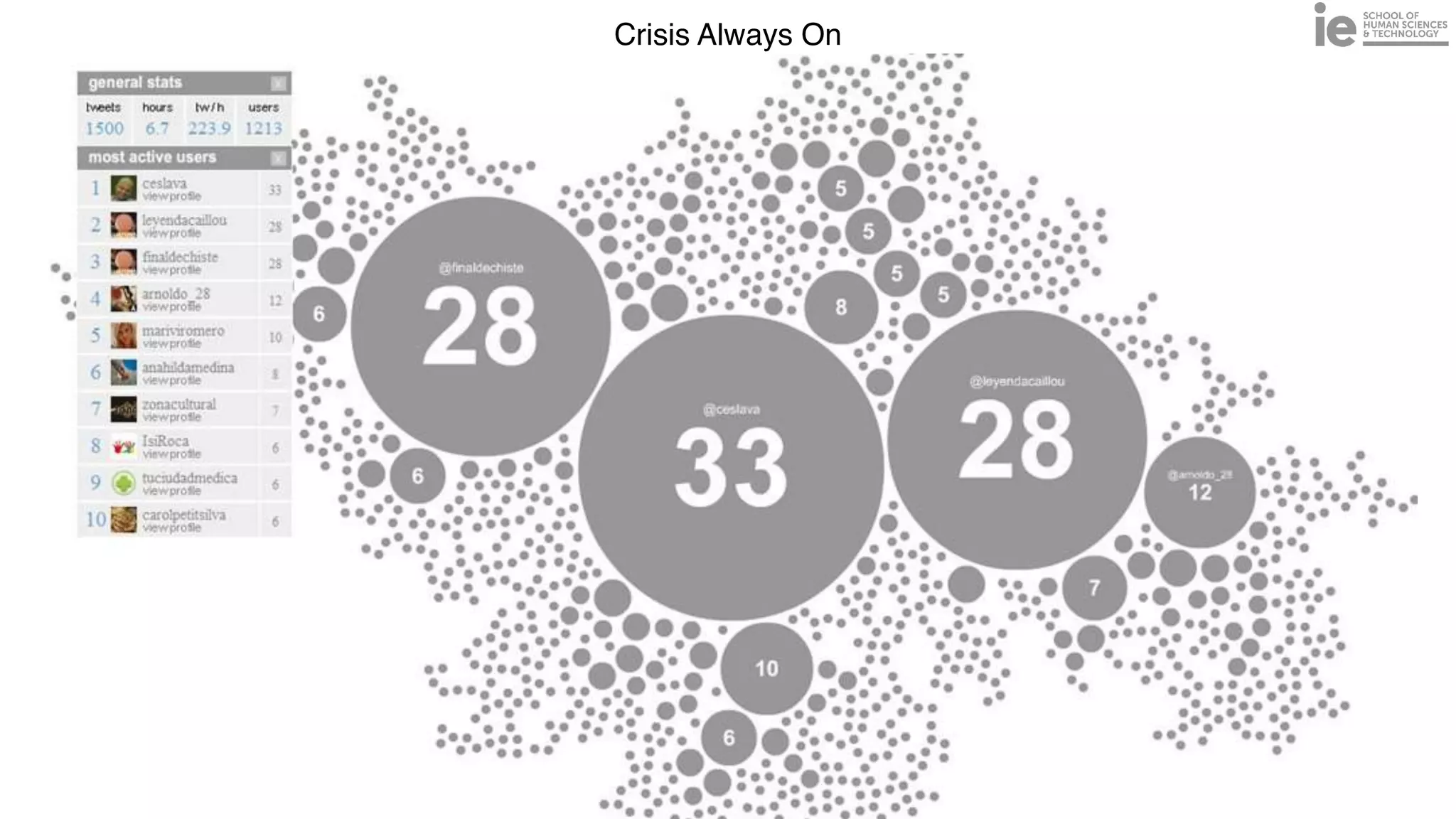
• It’s key to monitor the buzz about your brand and to identify opinion leaders


• When you deal with one customer you deal with all customers
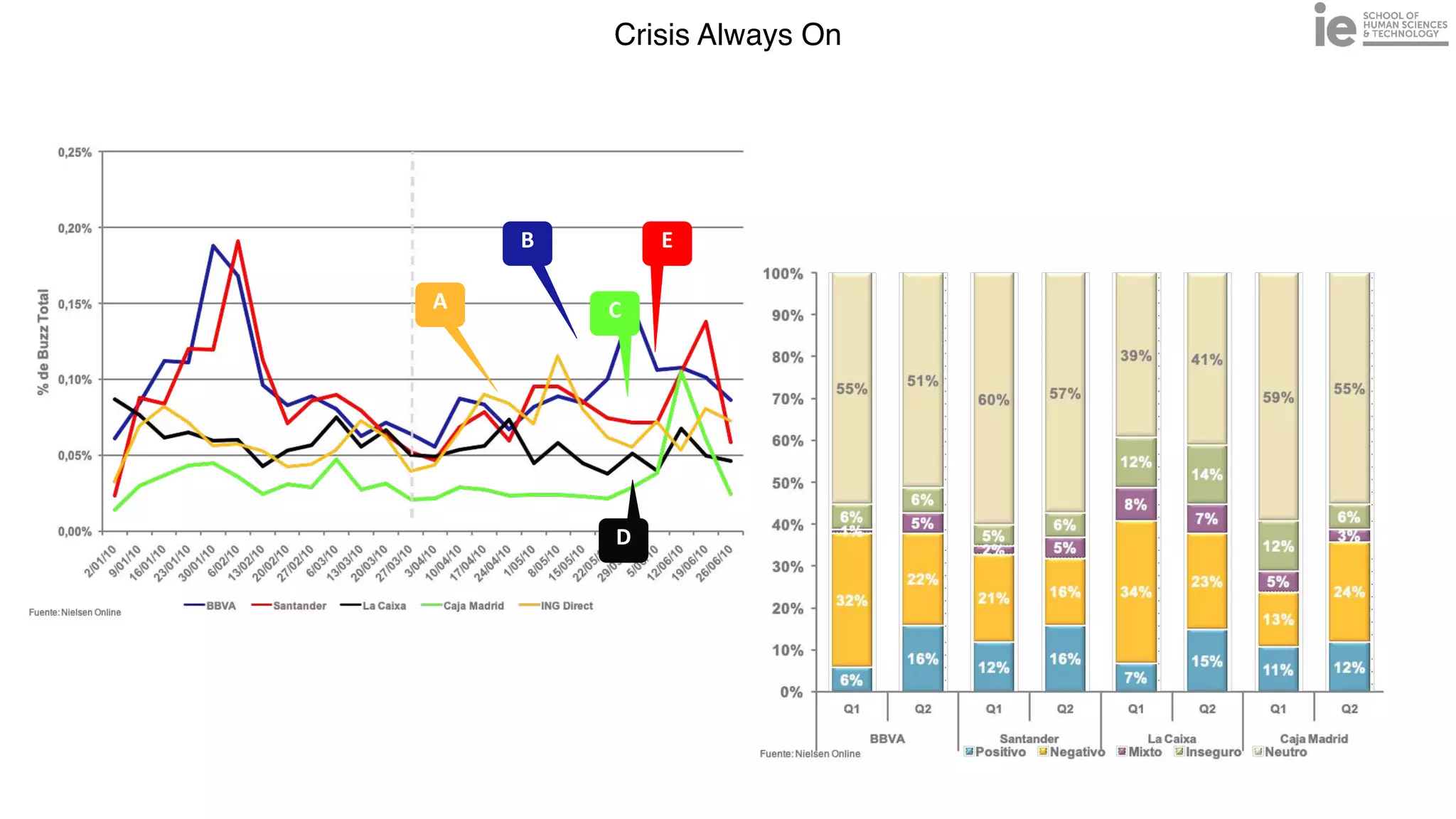
Crisis Always On
A
E
C
D
B
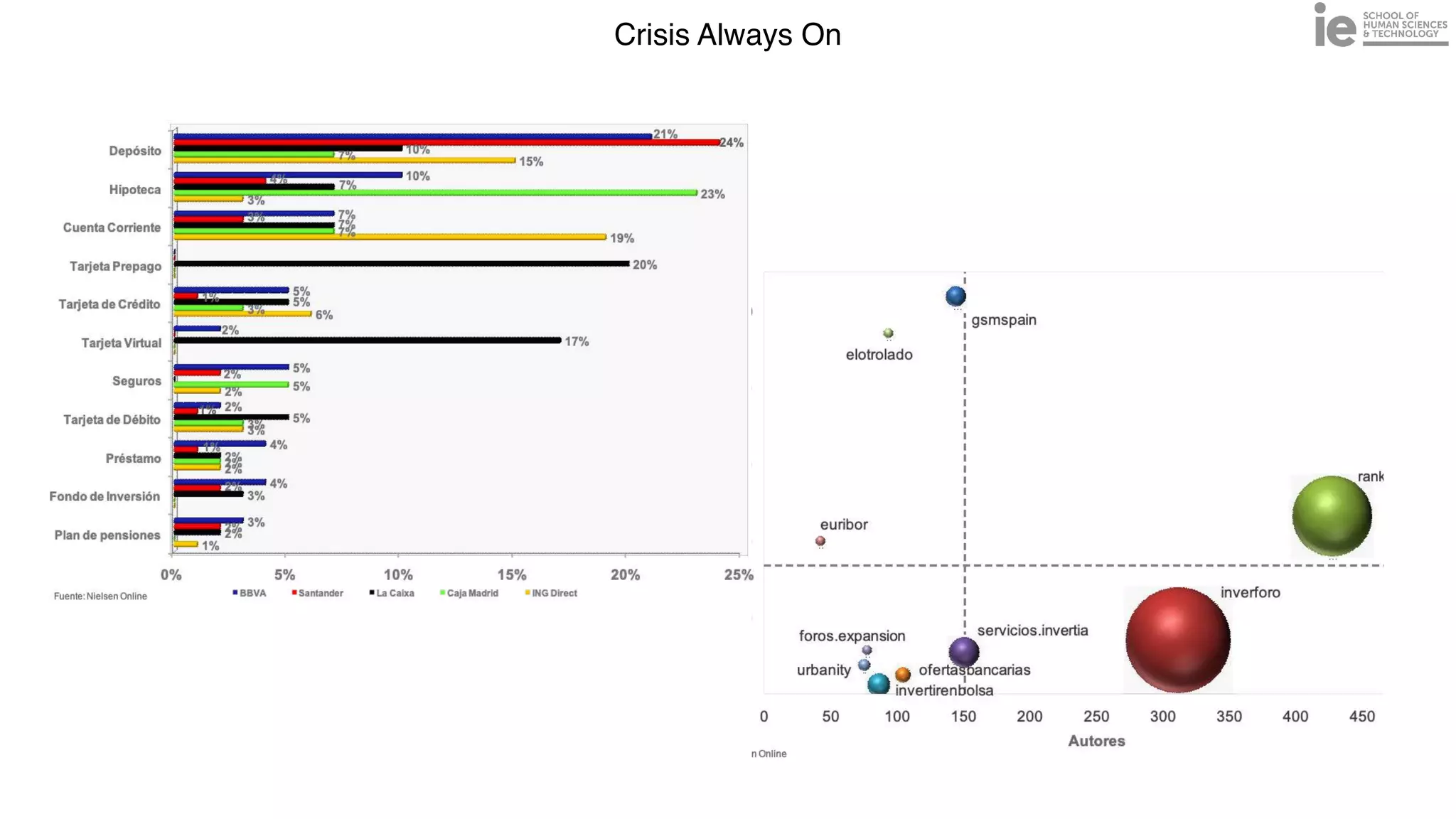
Crisis Always On
Crisis Always On
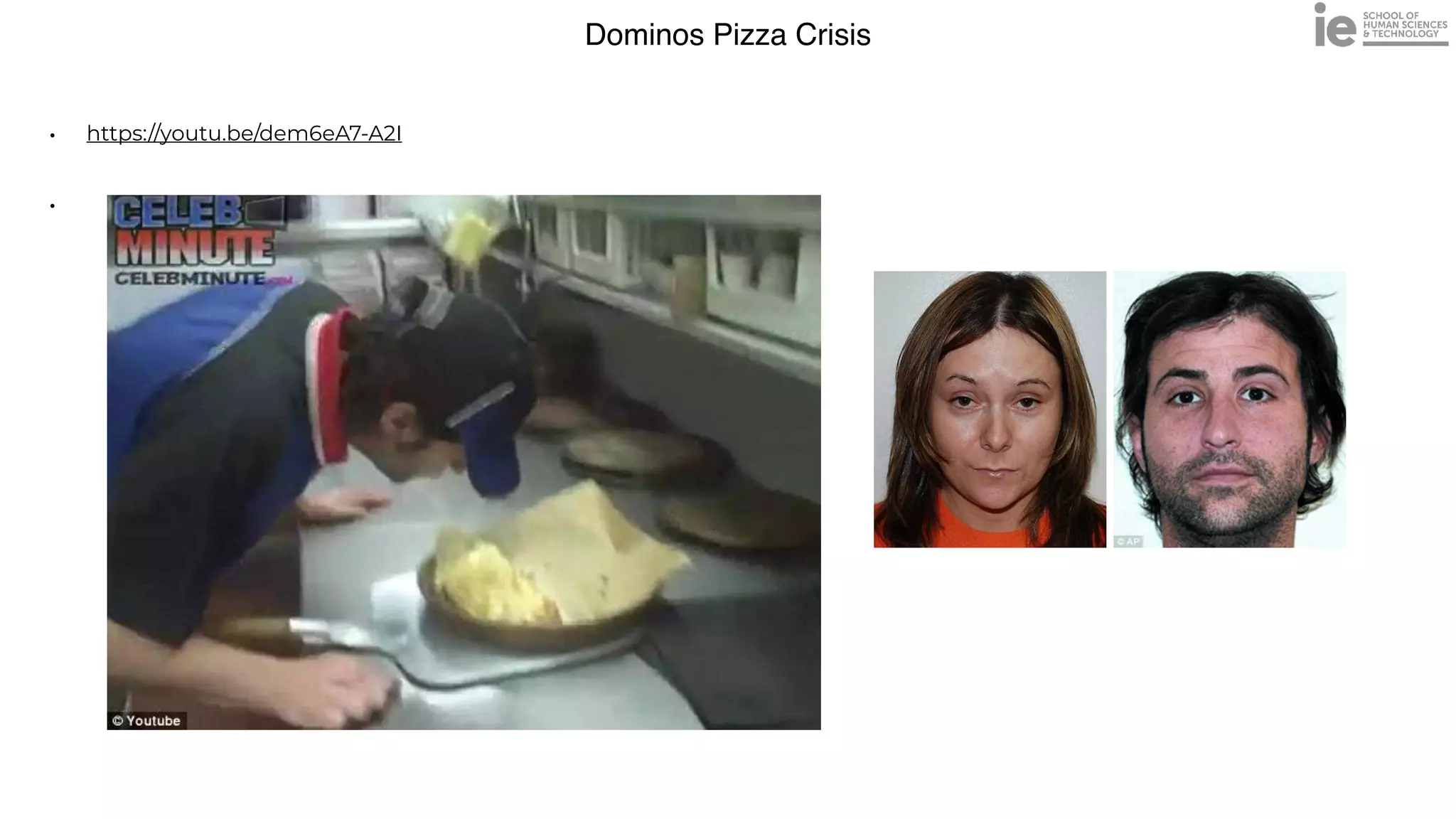
Dominos Pizza Crisis
• https://youtu.be/dem6eA7-A2I


•
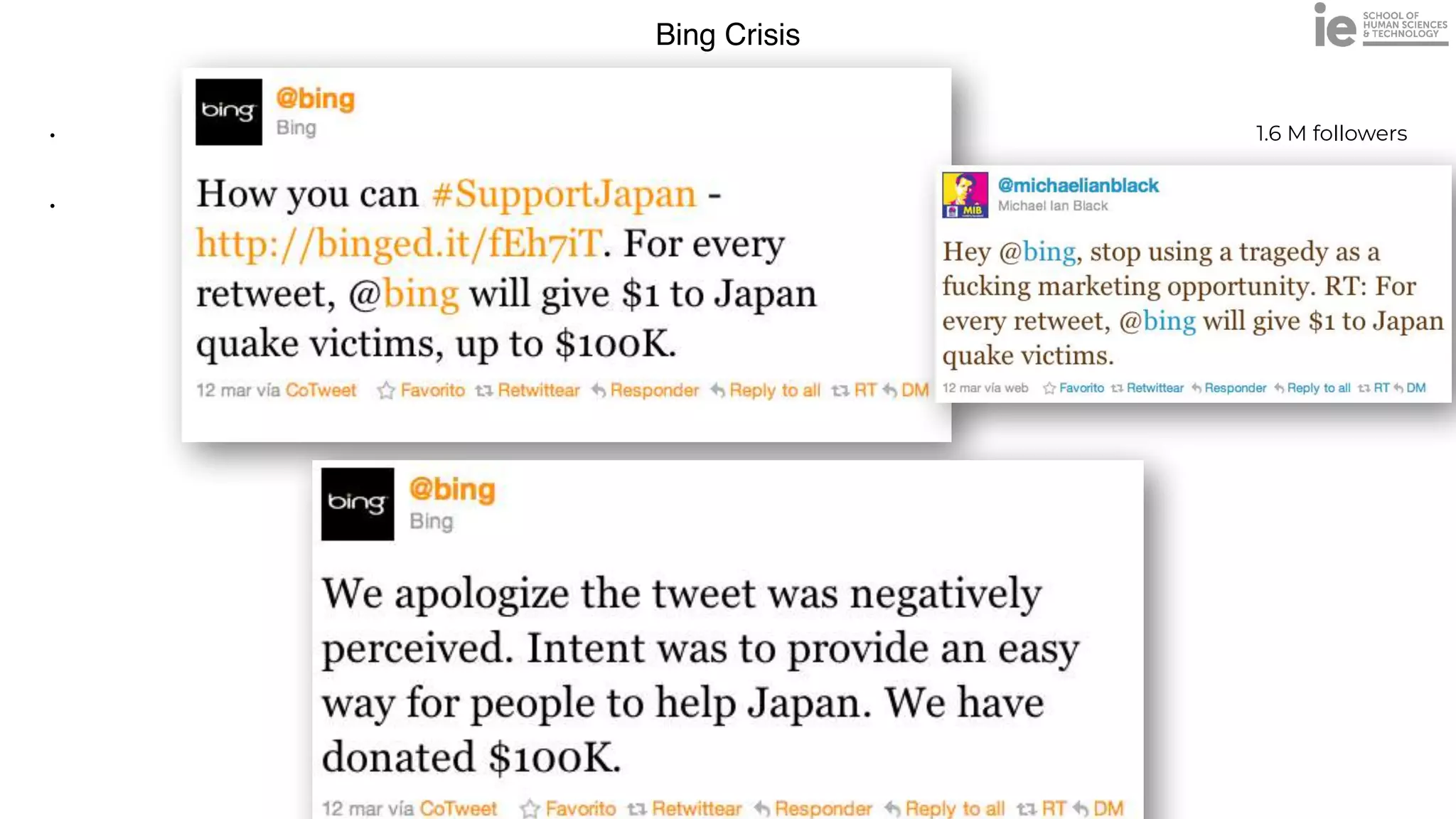
Bing Crisis
• 1.6 M followers


•
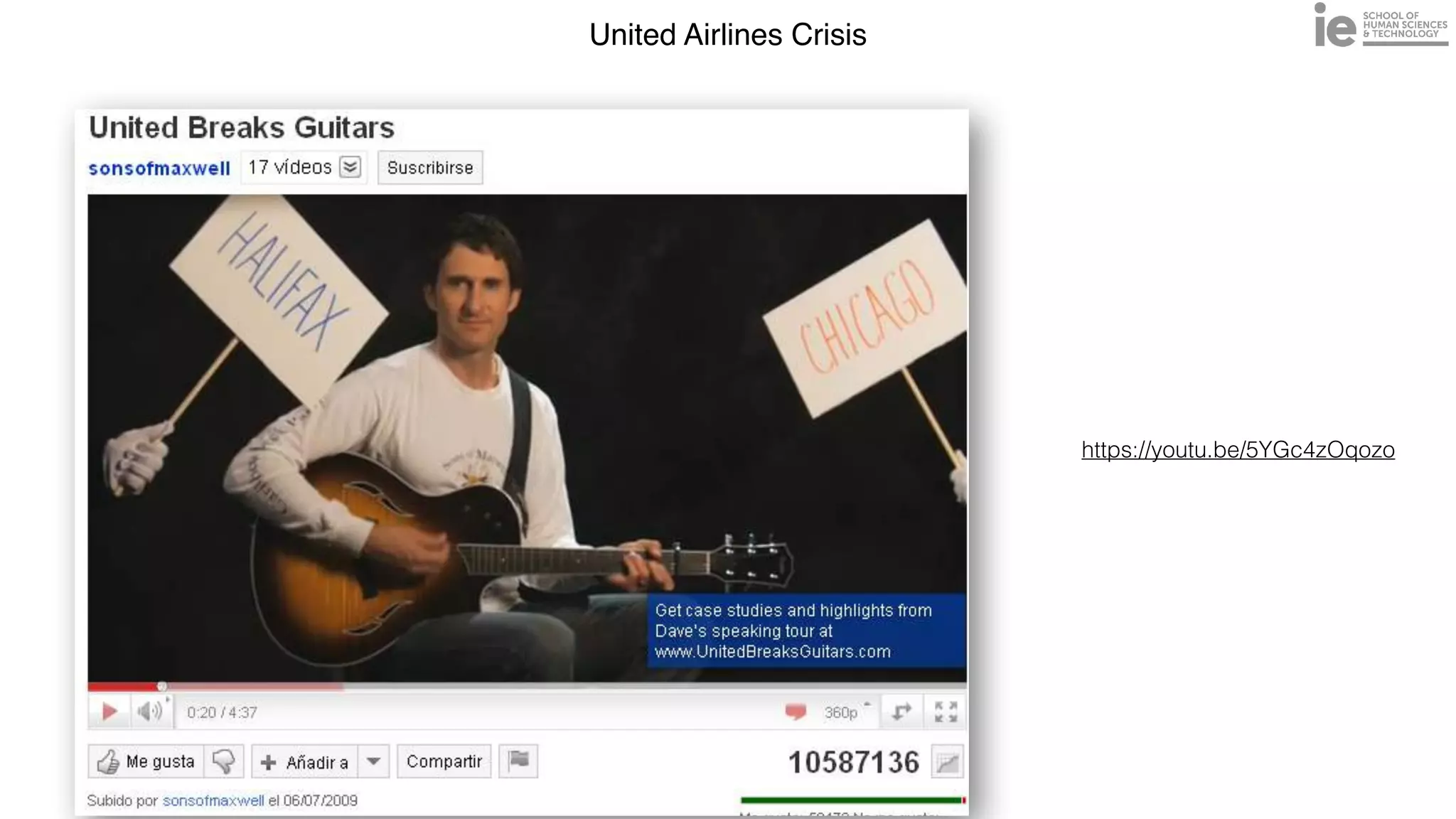
United Airlines Crisis
https://youtu.be/5YGc4zOqozo
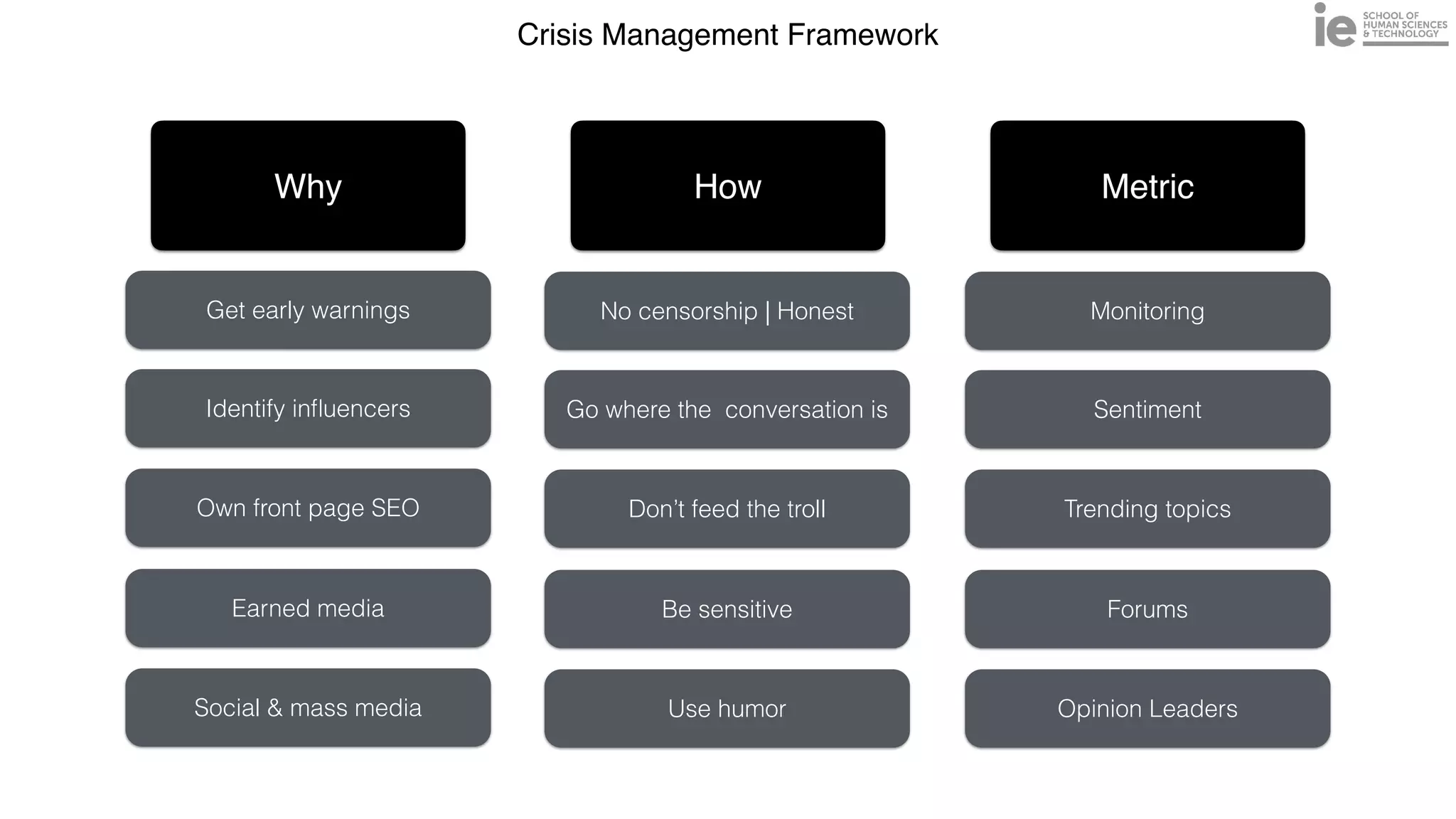
Crisis Management Framework
Get early warnings
Identify in
fl
uencers
Own front page SEO
Earned media
Social & mass media
No censorship | Honest
Go where the conversation is
Don’t feed the troll
Be sensitive
Use humor
Monitoring
Sentiment
Trending topics
Forums
Opinion Leaders
Why How Metric
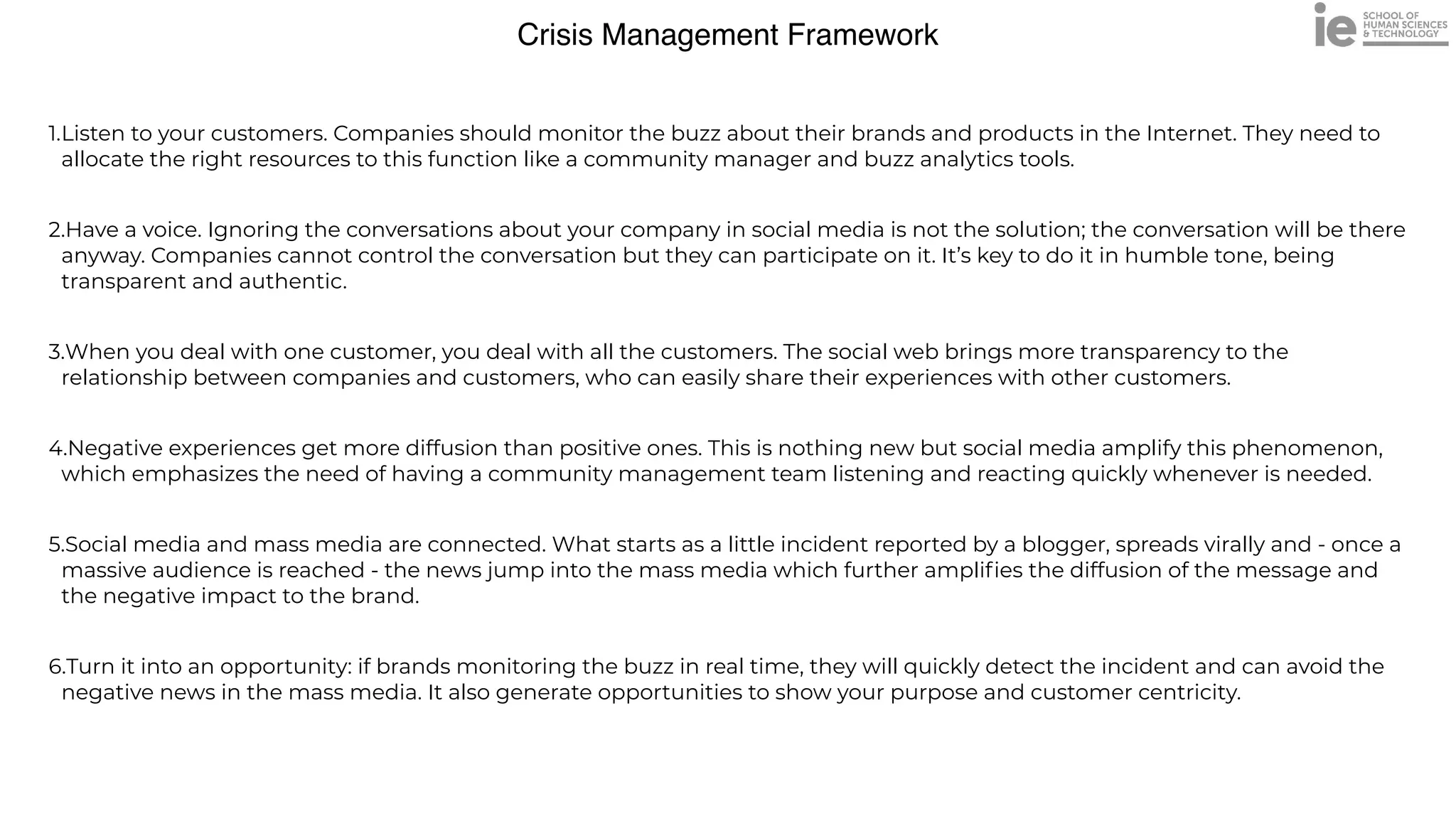
Crisis Management Framework
1.Listen to your customers. Companies should monitor the buzz about their brands and products in the Internet. They need to
allocate the right resources to this function like a community manager and buzz analytics tools.


2.Have a voice. Ignoring the conversations about your company in social media is not the solution; the conversation will be there
anyway. Companies cannot control the conversation but they can participate on it. It’s key to do it in humble tone, being
transparent and authentic.


3.When you deal with one customer, you deal with all the customers. The social web brings more transparency to the
relationship between companies and customers, who can easily share their experiences with other customers.


4.Negative experiences get more diffusion than positive ones. This is nothing new but social media amplify this phenomenon,
which emphasizes the need of having a community management team listening and reacting quickly whenever is needed.


5.Social media and mass media are connected. What starts as a little incident reported by a blogger, spreads virally and - once a
massive audience is reached - the news jump into the mass media which further ampli
fi
es the diffusion of the message and
the negative impact to the brand.


6.Turn it into an opportunity: if brands monitoring the buzz in real time, they will quickly detect the incident and can avoid the
negative news in the mass media. It also generate opportunities to show your purpose and customer centricity.
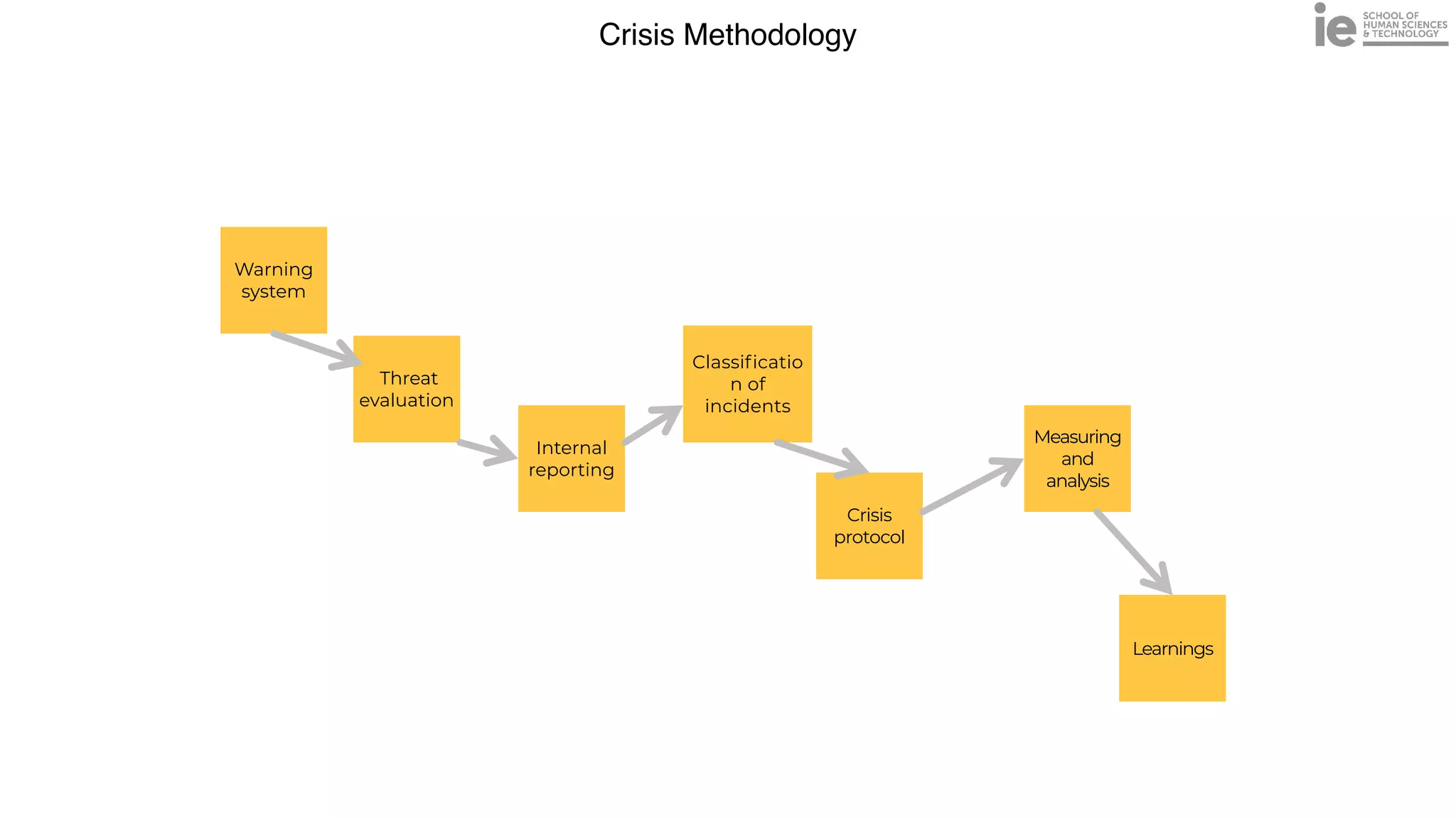
Crisis Methodology
Crisis Methodology
Classificatio
n of
incidents
Threat
evaluation
Internal
reporting
Measuring
and
analysis
Warning
system
Crisis
protocol
Learnings
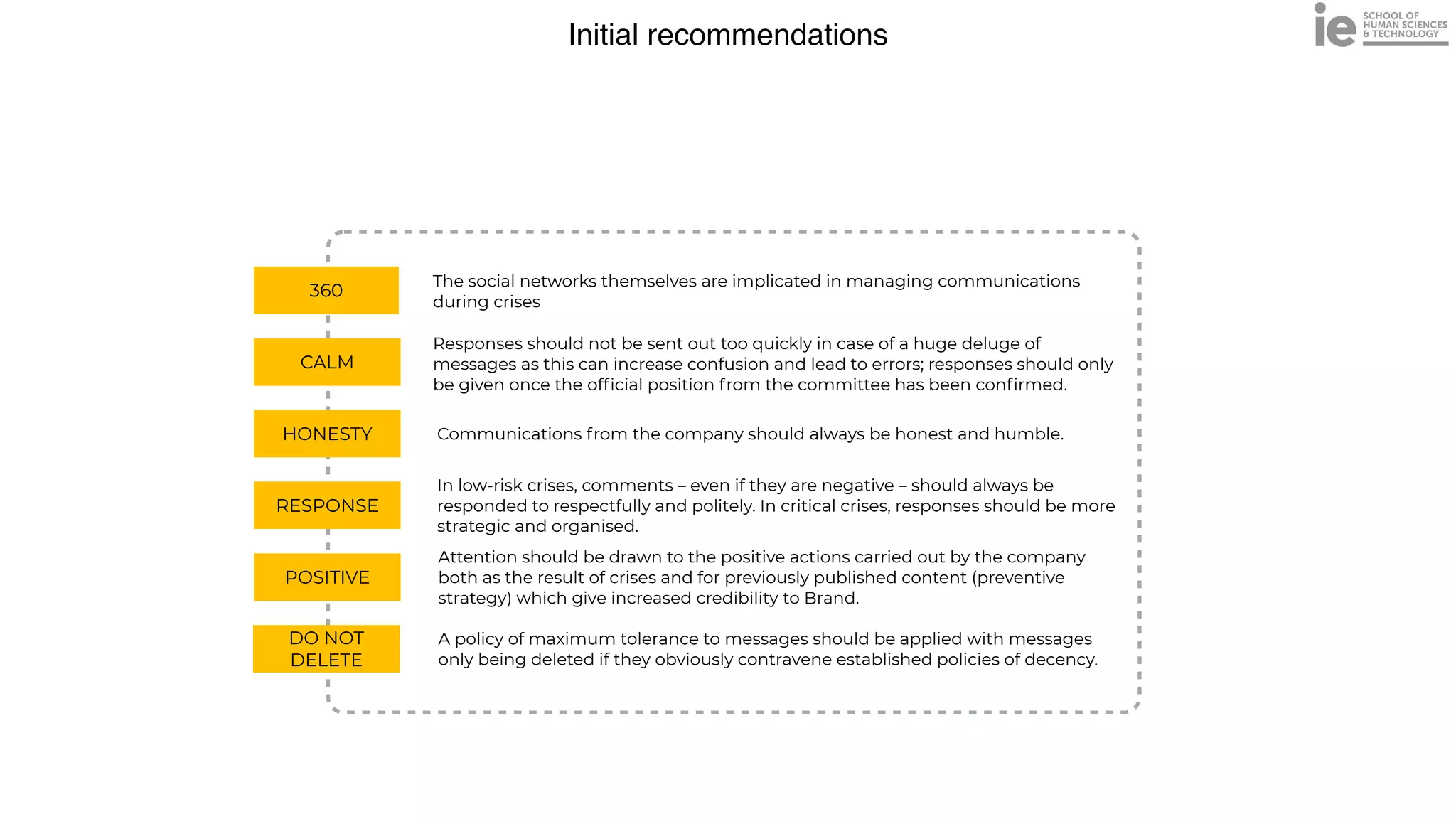
Initial recommendations
CALM
HONESTY
RESPONSE
POSITIVE
DO NOT
DELETE
360
The social networks themselves are implicated in managing communications
during crises
Responses should not be sent out too quickly in case of a huge deluge of
messages as this can increase confusion and lead to errors; responses should only
be given once the official position from the committee has been confirmed.
Communications from the company should always be honest and humble.
In low-risk crises, comments – even if they are negative – should always be
responded to respectfully and politely. In critical crises, responses should be more
strategic and organised.
Attention should be drawn to the positive actions carried out by the company
both as the result of crises and for previously published content (preventive
strategy) which give increased credibility to Brand.
A policy of maximum tolerance to messages should be applied with messages
only being deleted if they obviously contravene established policies of decency.
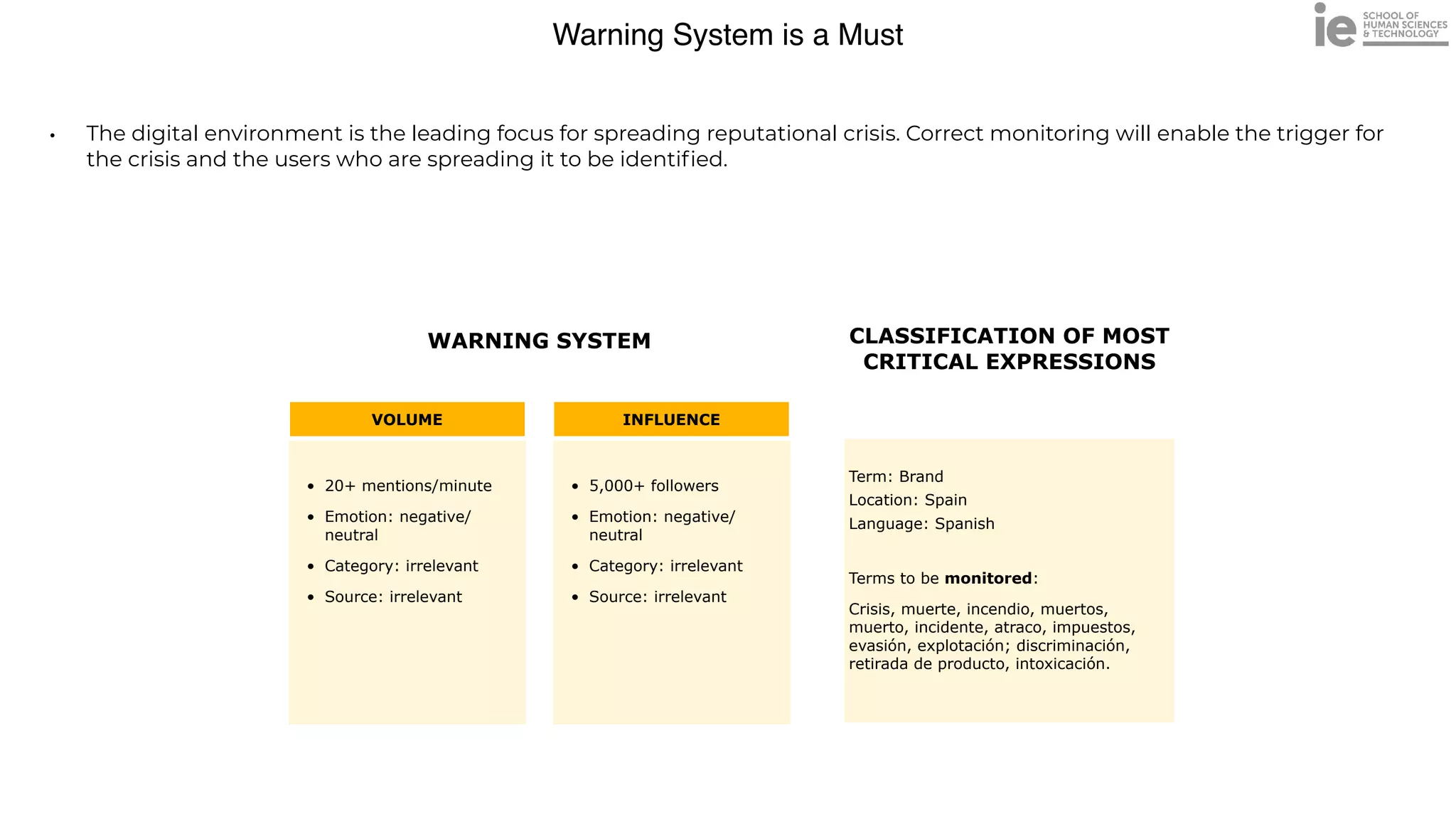
Warning System is a Must
• The digital environment is the leading focus for spreading reputational crisis. Correct monitoring will enable the trigger for
the crisis and the users who are spreading it to be identi
fi
ed.
VOLUME
WARNING SYSTEM
INFLUENCE
CLASSIFICATION OF MOST
CRITICAL EXPRESSIONS
Term: Brand


Location: Spain


Language: Spanish


Terms to be monitored:


Crisis, muerte, incendio, muertos,
muerto, incidente, atraco, impuestos,
evasión, explotación; discriminación,
retirada de producto, intoxicación.
• 20+ mentions/minute


• Emotion: negative/
neutral


• Category: irrelevant


• Source: irrelevant
• 5,000+ followers


• Emotion: negative/
neutral


• Category: irrelevant


• Source: irrelevant
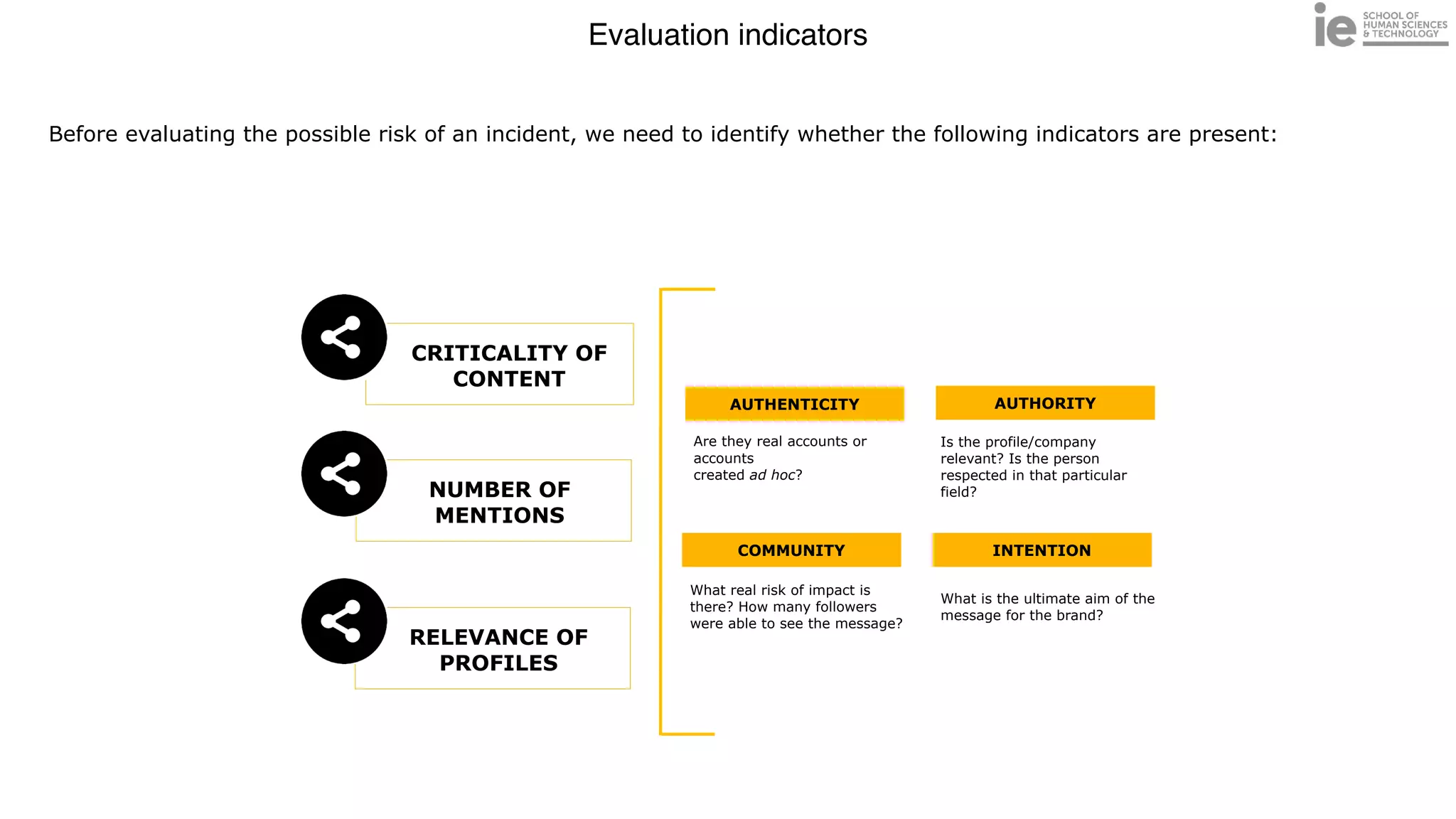
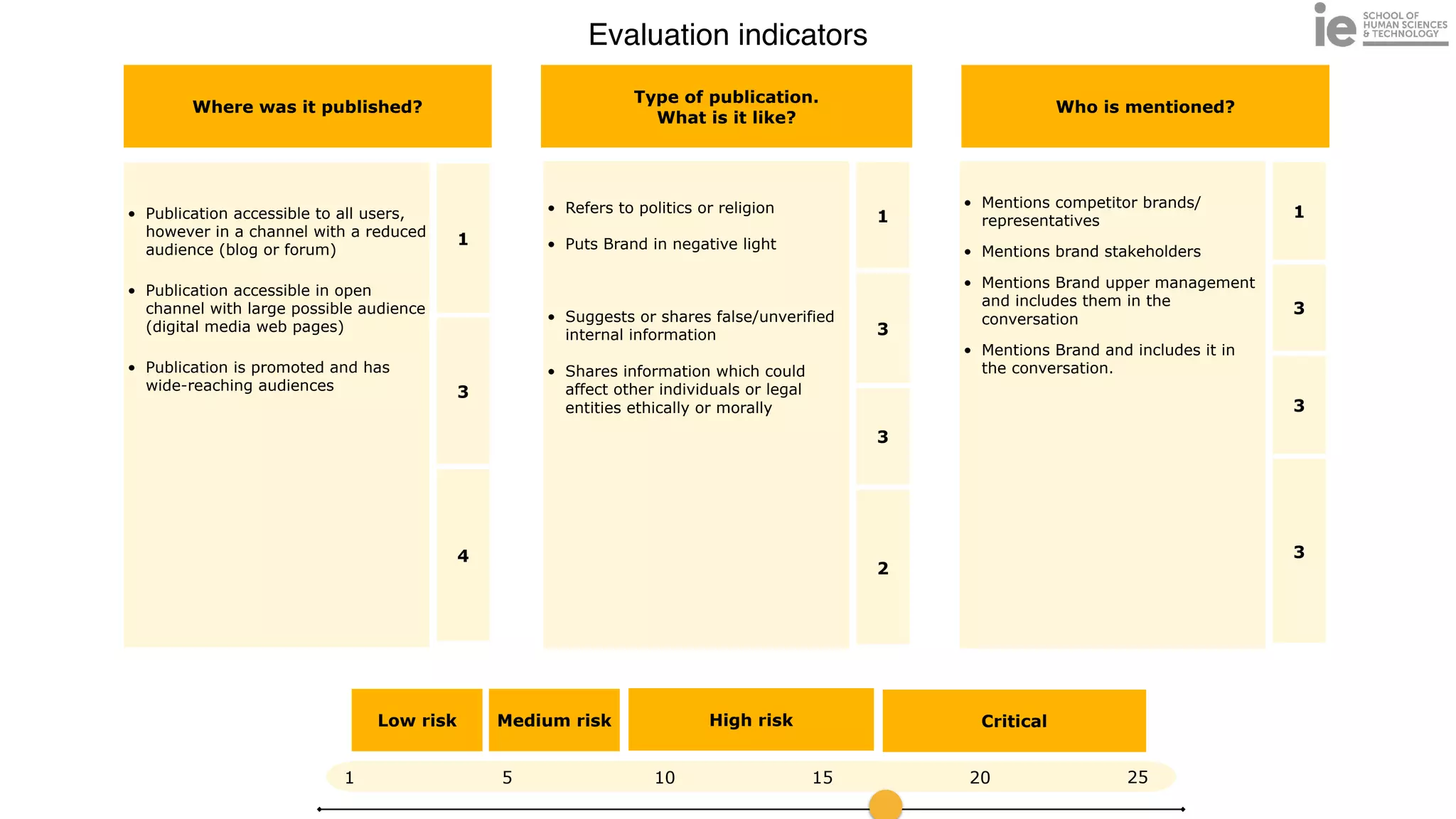
Evaluation indicators
Before evaluating the possible risk of an incident, we need to identify whether the following indicators are present:
CRITICALITY OF
CONTENT
NUMBER OF


MENTIONS
RELEVANCE OF


PROFILES
AUTHENTICITY
COMMUNITY
AUTHORITY
INTENTION
Are they real accounts or
accounts


created ad hoc?
Is the profile/company
relevant? Is the person
respected in that particular
field?
What real risk of impact is
there? How many followers


were able to see the message?
What is the ultimate aim of the
message for the brand?
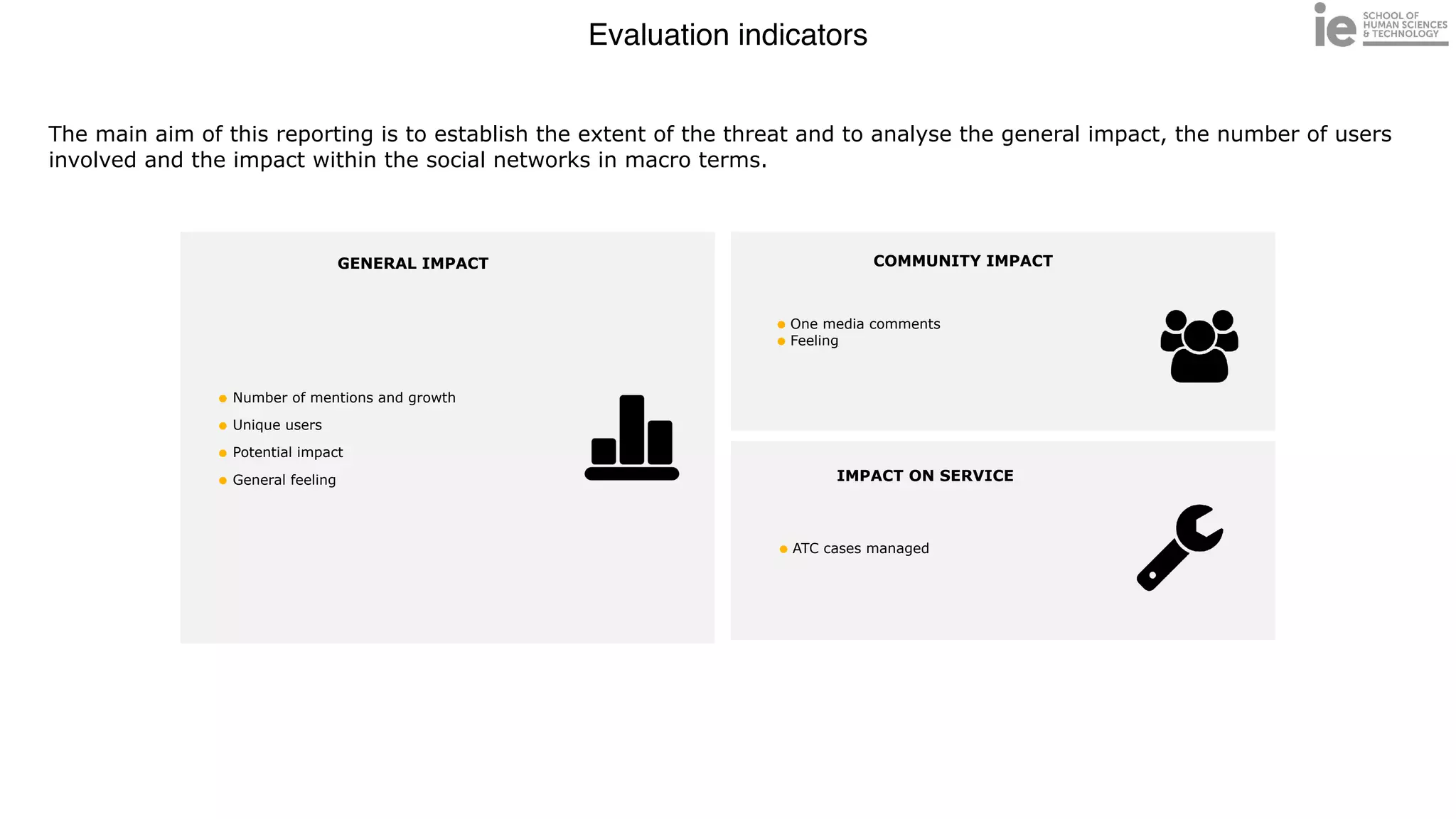
Evaluation indicators
The main aim of this reporting is to establish the extent of the threat and to analyse the general impact, the number of users
involved and the impact within the social networks in macro terms.
• One media comments


• Feeling
IMPACT ON SERVICE
GENERAL IMPACT COMMUNITY IMPACT
• Number of mentions and growth


• Unique users


• Potential impact


• General feeling
• ATC cases managed
Evaluation indicators
Where was it published?
Type of publication.


What is it like?
Who is mentioned?
• Publication accessible to all users,
however in a channel with a reduced
audience (blog or forum)


• Publication accessible in open
channel with large possible audience
(digital media web pages)


• Publication is promoted and has
wide-reaching audiences
1
3
4
• Refers to politics or religion


• Puts Brand in negative light


• Suggests or shares false/unverified
internal information


• Shares information which could
affect other individuals or legal
entities ethically or morally
1
3
3
2
• Mentions competitor brands/
representatives


• Mentions brand stakeholders


• Mentions Brand upper management
and includes them in the
conversation


• Mentions Brand and includes it in
the conversation.
1
3
3
3
Low risk Medium risk High risk Critical
1 5 10 15 20 25
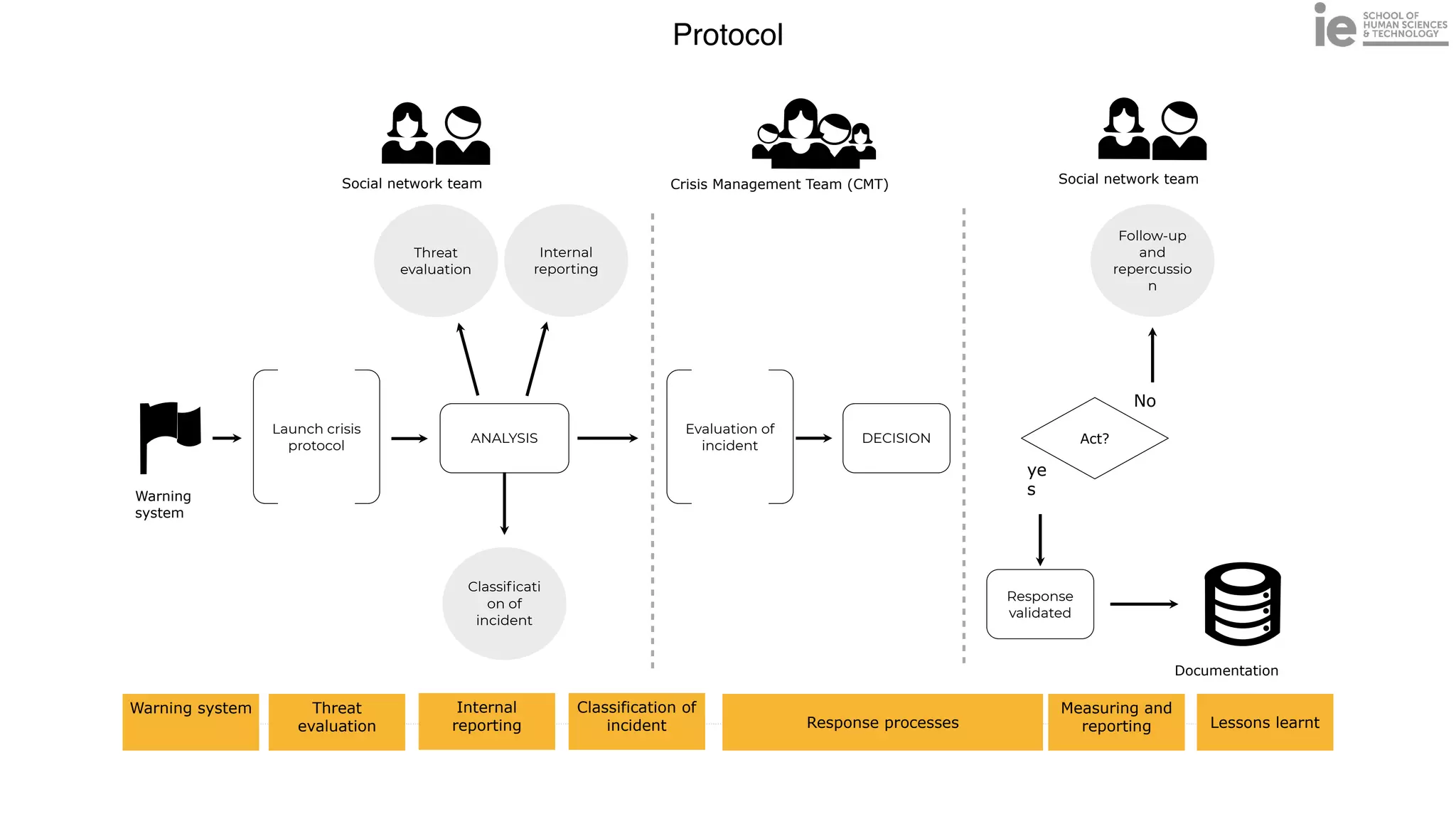
Protocol
Crisis Management Team (CMT)
Warning
system
Launch crisis
protocol
Warning system Classification of
incident
ANALYSIS
Threat
evaluation
Internal
reporting
Evaluation of
incident
DECISION
Response processes
Measuring and
reporting
Social network team
Lessons learnt
Act?
ye
s
No
Response
validated
Follow-up
and
repercussio
n
Social network team
Documentation
Internal
reporting
Threat
evaluation
Classificati
on of
incident
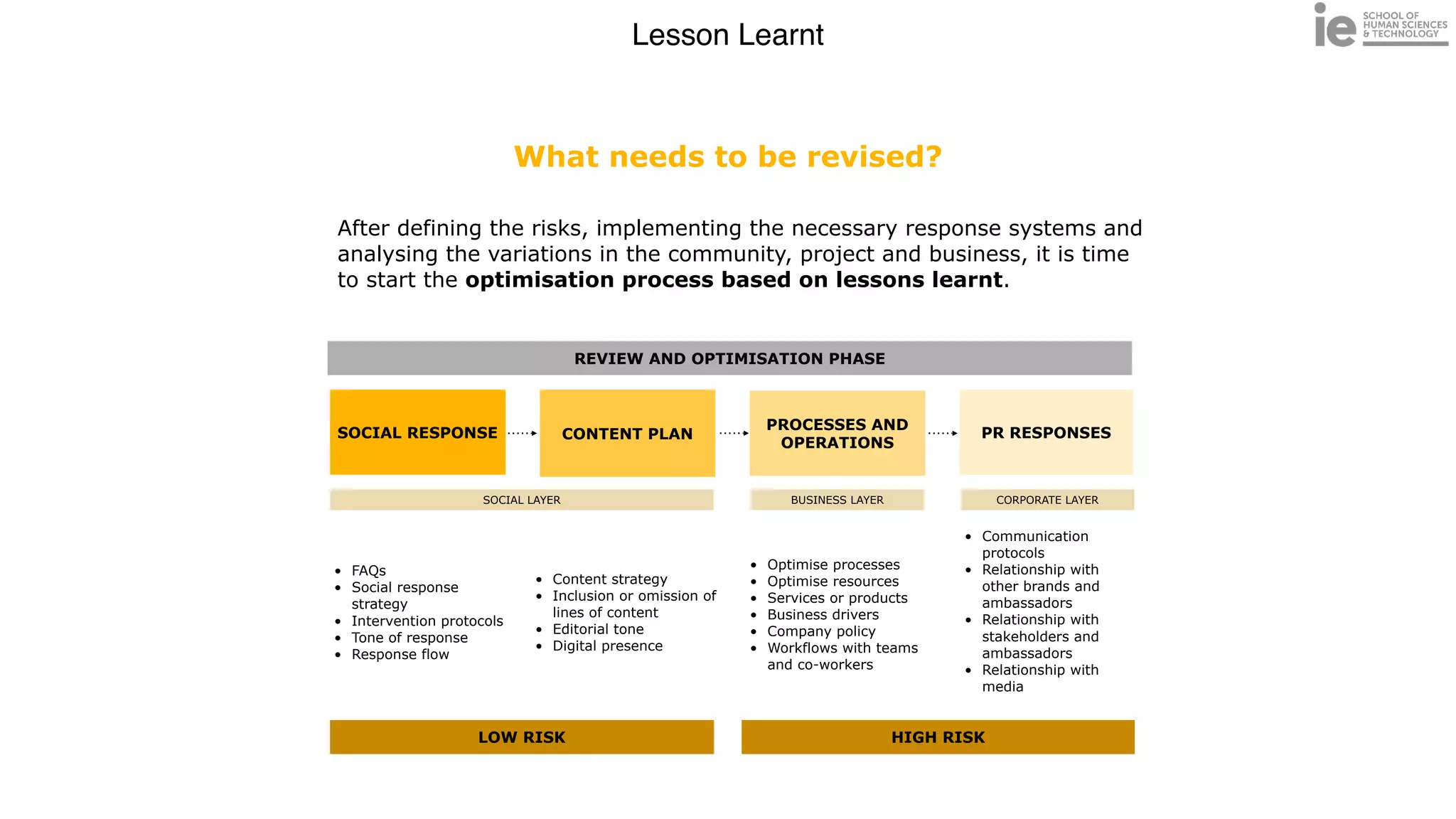
Lesson Learnt
What needs to be revised?
SOCIAL RESPONSE
After defining the risks, implementing the necessary response systems and
analysing the variations in the community, project and business, it is time
to start the optimisation process based on lessons learnt.
• FAQs


• Social response
strategy


• Intervention protocols


• Tone of response


• Response flow
CONTENT PLAN
PROCESSES AND
OPERATIONS
PR RESPONSES
REVIEW AND OPTIMISATION PHASE
SOCIAL LAYER CORPORATE LAYER
• Content strategy


• Inclusion or omission of
lines of content


• Editorial tone


• Digital presence
• Optimise processes


• Optimise resources


• Services or products


• Business drivers


• Company policy


• Workflows with teams
and co-workers
BUSINESS LAYER
• Communication
protocols


• Relationship with
other brands and
ambassadors


• Relationship with
stakeholders and
ambassadors


• Relationship with
media
LOW RISK HIGH RISK
Prof. Kevin Sigliano 

Partner @Good Rebels | Admira.com
@kevinsigliano
es.linkedin.com/in/kevinsigliano
+34 618 457 741

ksigliano@faculty.ie.edu

LinkedIN B2B-2022.pdf

  • 1.
  • 2.
    DISENGAGED WORKERS COST THEU.S. ECONOMY $350 BILLION A YEAR IN LOST PRODUCTIVITY
  • 3.
  • 4.
  • 5.
    People First Framework •Powered by Social Media Business objectives Innovation Culture Collaboration Talent On going education The Right Why Processes Customer Services Financials
  • 6.
    #people fi rst principles • Allowemployees to move around and discover new challenges. 1. Build a strong sense of meaning and build the why on a daily basis 2. Allow employees discover new challenges.
  • 7.
    #people fi rst principles • Allowemployees to move around and discover new challenges. 3. Drive a feedback, praise and acknowledgement. 4. Embrace individuality and worklife balance. 5. Foster good people and autonomy.
  • 8.
    Why employee advocacyis social? The communication landscape is changing CEOs must communicate more openly and directly with their employees, and empower them to become company advocates. Edelman
  • 9.
    What is employeeadvocacy? • Employee advocacy programs strengthen a corporate brand by publicly empowering its leaders and employees to communicate on behalf of the brand. • In doing so: • Employees gain expertise and profile, and become more engaged. • The organisation increases the number, effectiveness and credibility of brand and value proposition.
  • 10.
    Employees are betterat creating trust 52% agree employees are credible spokespeople % who rate each spokesperson as extremely/very credible 0% 35% 70% Expert Academic Citizen Analyst Employee CEO NGO Directors Gov. official 35 33 48 49 52 53 63 64 67 33 39 50 41 48 50 57 64 63 2015 2016 Source: Edelmen, 2017
  • 11.
    Creating brand ambassadorsfrom employees is about more than just throwing out a few incentives. You have to begin by looking at your organizational culture. By assessing your company's core values and cultivating a workforce that lives up to those values, you're creating a company culture that promotes strong customer service, loyalty and a sense of fun. Forbes, 2013 This is about long-term culture change
  • 12.
    Employee advocacy ecosystem ASSETS RESOURCES T R A I N I N G G O V E R N A N C E C HAM PIO NS F O L L O W - U P Leaders/ task force activities Corporate experiences Rewards Guidelines Positioning plan Social media Personal branding Digital communication Corporate content / campaigns Monitoring Reporting Personal / corporate channels (SM, blogs, events etc.)
  • 13.
    Policy for SocialMedia • Policy elements • “Social media” refers to a variety of online communities like blogs, social networks, chat rooms and forums. • We consider two different elements: using personal social media at work and representing our company through social media. •Using personal social media • We allow employees to access their personal accounts at work. But, we expect them to act responsibly and ensure their productivity isn’t affected. Using social media excessively while at work can reduce ef fi ciency and concentration. Whether employees are using their accounts for business or personal purposes, they may easily get sidetracked by the vast amount of available content.
  • 14.
    • TOPICS STAGES 3to 4 • User-generated content • Topics by specialisation • Activity fits communities STAGES 1 to 2 • Contents curated by the brand • Topics limited to a few areas • Low profile activity STAGE 1 STAGE 2 STAGE 3 STAGE 4 CONTROL C-suite Executives Specialists Staff Expected progress Governance Flexible but clear governance provides advocates with the necessary guidance to help them understand how to be relevant and reduce risk. Who, where, when and what to share depends on the person, the organisation and the industry.
  • 15.
    STEP 1 Select your champions •Who is a real in fl uencer? • Who is aligned with our values? • Who is already good at the Internet? • STEP 2 Define whys & rules • Why do we need a reason? • Why do we list the do's and dont's? • Why is there a plan for each one? STEP 3 Train your people • What does it mean? • What are their personal roles? • What are the best techniques? STEP 4 Offer the best resources • Where to serve good content? • Where to share reliable sources? • Where to activate campaigns? STEP 5 Promote your ambassadors • When to give recognition? • When to make them participate? • When to show their expertise? THE TOP NO RISKS DIGITAL SKILLS ORIENTATION LEADERSHIP Where to start? Design a pilot and… Measure and refine
  • 16.
    Step 1: Select yourchampions SCREENING CRITERIA • Digital maturity & influence • Corporate alignment • Internal activity & connectivity • Functional & sociodemographic METHODOLOGY • Surveys (on/off) • Social media monitoring • HR analytics Within the organisation, there are people who strongly influence others around them for other reasons than their job. From the perspective of internal communication and branding, it may be more effective to work with these hidden leaders than launching typical campaigns. The challenge is to detect and involve them in employee advocacy.
  • 17.
    Step 2: De fi ne whys& rules DELIVERY • Social media policy • Brand ambassadors framework • Team action plan APPROACH • Why to participate • Where are we going • What we can contribute • Do’s and don’ts on social media For champions to be involved, it’s crucial to share an inspiring purpose that connects their personal motivations to corporate values. Furthermore, the organization should be able to create a clear set of rules that, far from restricting participation, give co-workers enough background and practical recommendations to avoid unnecessary risks to either the brand or their personal image.
  • 18.
    Step 3: Train yourpeople TRAINING • In-person and online classes • 10 to 40 hours of teaching courses • Case studies and exercises • Ongoing support CONTENTS • Social media • Personal branding • Digital communication tools The company has to help champions to build and promote a strong and consistent digital identity. To do this, they are expected to provide training regarding the use of the right management tools, content formats, and social media platforms. This is where these co-workers best connect with the groups and communities that are relevant to them… where they can become influencers… and where the brand alone will never have as much impact.
  • 19.
    Step 4: Offer thebest resources TOOLS • Web repository • Living content board • Social internal network • RSS Feed readers MATERIALS • Stories, pictures and videos • Pre-created content & campaigns • Top sources by specialty The company can provide their champions with tools and corporate resources that ease participation. Depending on the stage, these materials may be content repositories with fresh stories and image assets, and sometimes a live pipeline of content ready to edit and share on social media In such way, brand ambassadors will never be afraid to publish misaligned messages, and risk is further reduced.
  • 20.
    Step 5: Promote yourambassadors PLATFORMS • Web, blog, Social Media, Newsletters • Events, seminars, training sessions • Rituals & focus groups • Physical bulletin boards OUTCOMES • Visibility • First-hand experiences • Scoops, prices and rewards Companies must recognize and project their ambassadors’ activity by implementing physical and virtual spaces to celebrate their progress to other co-workers and to their clients and stakeholders. We refer to corporate communication assets such as blogs, social media dashboards, events, bulletin boards, discussion forums, newsletters etc,
  • 21.
    Stage 1: illustratedby roles C-suite • Company / media • Reserved • Corporate • Internal / Linkedin Executives • Company / Stakeholders • Low • Corporate (branches) • Internal / Linkedin Specialists • Professionals • Medium • Business • Linkedin / Twitter / Blog Staff • Communities • Medium • Personal • All (by use) TARGET ACTIVITY TOPICS CHANNELS
  • 22.
    KPIs and measurement BUSINESS SocialSelling Index Profitability Sales Volume ROI PROCESSES Productivity Quality Customer Satisfaction Efficiency RECRUITMENT Offer acceptance rate Employee retention Employee Net Promoter Score (ENPS) Talent Attraction BRAND Awareness SoV Sentiment Digital Perception Index (DPI)
  • 23.
  • 24.
    SALES MORE LIKELY toleverage social media TO DRIVE SALES 1. 57% Employees are PRODUCTIVITY more likely to have above- average PRODUCTIVITY 2. 38% Socially-engaged employees are BRAND REPUTATION more likely to APPEAR MORE COMPETITIVE 1. 40% Socially-engaged companies are RECRUITMENT more likely to ATTRACT TALENT 1. 58% Socially-engaged companies are ADVOCACY Employees are the MOST CREDIBLE source of information of the business 3. 52% Benefits are felt across the organisation • The use of Social Media by senior executives within Financial Services impacts employee engagement and company revenue.
  • 25.
  • 26.
    Policy for SocialMedia • Policy elements • “Social media” refers to a variety of online communities like blogs, social networks, chat rooms and forums. • We consider two different elements: using personal social media at work and representing our company through social media. •Using personal social media • We allow employees to access their personal accounts at work. But, we expect them to act responsibly and ensure their productivity isn’t affected. Using social media excessively while at work can reduce ef fi ciency and concentration. Whether employees are using their accounts for business or personal purposes, they may easily get sidetracked by the vast amount of available content.
  • 27.
    Policy for SocialMedia •We advise our employees to: • Use their common sense. If employees neglect their job duties to spend time on social media, their decline in productivity will show on their performance reviews.  • Ensure others know that personal account or statements don’t represent our company. Employees shouldn’t state or imply that their personal opinions and content are authorized or endorsed by our company. We advise using a disclaimer such as “opinions are my own” to avoid misunderstandings. • Avoid sharing intellectual property like trademarks on a personal account without approval. Con fi dentiality policies and laws always apply. • Avoid any defamatory, offensive or derogatory content. It may be considered as a violation of our company’s anti-harassment policy, if directed towards colleagues, clients or partners.
  • 28.
    Policy for SocialMedia •Representing our company: 
 •Some employees represent our company by handling corporate social media accounts or speak on our company’s behalf. We expect them to act carefully and responsibly to protect our company’s image and reputation. Employees should: • Be respectful, polite and patient, when engaging in conversations on our company’s behalf. They should be extra careful when making declarations or promises towards customers and stakeholders. • Avoid speaking on matters outside their fi eld of expertise when possible. Everyone should be careful not to answer questions or make statements that fall under somebody else’s responsibility. • Follow our con fi dentiality policy and data protection policy and observe laws on copyright, trademarks, plagiarism and fair use.
  • 29.
    Policy for SocialMedia •Representing our company: 
 • Inform our [PR/Marketing department] when they’re about to share any major-impact content • Avoid deleting or ignoring comments for no reason. They should listen and reply to criticism. • Never post discriminatory, offensive or libelous content and commentary • Correct or remove any misleading or false content as quickly as possible Disregarding job responsibilities and deadlines to use social media Disclosing confidential information through personal or corporate accounts Directing offensive comments towards other members of the online community
  • 30.
    Advice for SocialMedia • Introduce the purpose of social media as part of your corporate strategy, be it concerning marketing, recruitment or employer branding. • Add value – when employees publish work-related social media content, they should provide useful information or insight that is relevant to the business. • Employees should be prohibited from sharing con fi dential and proprietary information online. • Responsibility for content – employees should know to exercise good judgment and be prepared to deal with any consequences that result from inappropriate actions or statements online. • Authenticity is critical – users of social media should identify themselves by name, and when relevant, position and company.
  • 31.
    Advice for SocialMedia • Keep your audience in mind – before publishing any content, employees should ensure they are not alienating readers that may be current clients, potential clients, or past/current/future employees. • Productivity is essential – social media efforts can only be successful if employees fi nd a proper balance between social media and other work. • Remember to keep it simple so that everyone can easily understand the policy.
  • 32.
  • 33.
    Why is Linkedinso Important? • Senior-level in fl uencers • Decision makers and opinion leaders • C-level execs and talent • Industry news 
 • Expert advice 
 • Career training 
 • Peer insights and recommendations 
 • Content published by LinkedIn’s 500+ In fl uencers 

  • 34.
    Why is Linkedinso Important? • Total Number of Linkedin Users: 675 million • Total Number of Monthly Active Linkedin Users: 310 million • Percentage of Linkedin Monthly Active Users: 46.97% • More than 70% of Linkedin users are from outside the US. • 46 million students and recent college graduates on LinkedIn. • The average income of a LinkedIn user currently stands at $46,644 per year. • 51% of US College Graduates use LinkedIn. • 150 million LinkedIn users are senior-level in fl uencers
  • 35.
    Why is Linkedinso Important? • 1. Targeting 
 
 Creating awareness of your brand and products early in the purchase process • 2. engaging 
 
 Positioning your brand as a thought leader and engaging audiences more deeply 
 with content as they’re forming perceptions and decisions • 3. optimizing 
 
 Driving the right audiences to take action, helping you generate quality leads and new business
  • 36.
    Create Company Page •Complete your Page 
 Pages with complete information get 30% more weekly views. Here’s what you’ll need to fi ll out. • Logo 
 Add your organization’s logo and a cover image to bring your Page to life. • Overview 
 Lead with relevant terms and phrases that describe your organization’s mission and purpose (LinkedIn members can search by keywords). • Organization info 
 Input your website URL and location, and select your industry and company size. • Call-to-action button 
 Customize your button to align with your goals and track who’s clicked in the admin view or in visitor analytics.
  • 38.
  • 39.
    Advanced Features |Showcase & Career Pages
  • 40.
    Advanced Features |C-Management & Paid
  • 41.
  • 42.
  • 43.
    What’s next? How tomaximize your ROI in Linkedin?
  • 44.
  • 45.
    Social B2B Sales AWARENESSLEADS PROFILING 1 2 3 B2B STRATEGY PROMOTED CONTENT MARKETING SOCIAL SALES TECH ROI & KAIZEN x PROSPECTS
  • 46.
    B2B Growth Hacking- Sales Navigator | API Buster
  • 47.
  • 48.
    Social B2B SalesProcess Content and Sales Agent Training APIs and Deployment of Marketing Automation + Connections between Linkedin, Phantom Buster and CRM: Continuous Optimization Leads (real time) 
 Database (weekly) Strategic Validation Profiling
  • 49.
    Social B2B SalesProcess SCRAPPING By industry, geo, profiles, interests. ENRICHMENT Expansion of data from Linkedin (company) SALES NAVIGATOR ACTIVATION Activation of Profiles SW CALENDAR ACTIVATION SW configuration: agenda and alternative of the call or visit. ACCOUNT-BASED TARGETING Lead Generation Form Automated updates REMARKETING Remarketing campaigns on LinkedIn. Optional. Google properties (GDN - Gmail) COPY SALES Generation and activation of personalized messages: Invitation, Followup, CIta AUTOMATIC WORKFLOW Lead generation process activation: Commercial, A / B testing and daily optimization. PROFILES (3) LINKEDIN Improvement of selected Iberostar B2B profiles LINKEDIN POINTDRIVE Cover, Assets, Copy, Analytics LANDING Design, Assets, IP Tracker, Chat Campaigns Configuration Facebook and LinkedIn pixels DataTech Reach Lead Generation Configuration
  • 50.
    LinkedIn Pro fi les • JOBTITLE: Travel Agent • Geo: United States • INDUSTRY: Leisure, Travel & Tourism • Geo: United States • Size: 1-10 employees • Companies: 14,525 • Contacts: 27,547 •
  • 51.
    Sales Navigator • JOBTITLE: Travel Agent • Geo: United States • INDUSTRY: Leisure, Travel & Tourism • Geo: United States • Size: 1-10 employees • Companies: 14,525 • Contacts: 27,547 •
  • 52.
    Leads • JOB TITLE:Travel Agent • Geo: United States • INDUSTRY: Leisure, Travel & Tourism • Geo: United States • Size: 1-10 employees • Companies: 14,525 • Contacts: 27,547 •
  • 53.
  • 54.
    Expected Results 1 MONTHFUNNEL Conversion Rate % Volume Auto-Follow 16,000 Pro fi les Viewed 90 % 14,400 Connections Accepted 80 % 11,520 Top of Funnel - 
 Asset requested after 1st Message 50 % 5,760 Middle of Funnel -
 PointDrive visits after 2nd Message 80 % 4,608 Bottom of Funnel - 
 Pricing / Offer downloads after 3rd Message 20 % 921.6 Visits to "Sales" Landing Page with CTA "Sign Up" 50 % 460.8 Sign Ups 25 % 115 What is a reasonable ROI?
  • 55.
    Bene fi ts • Generation ofnew business | Revenue & LTV • Degree of consideration of the brand and value proposition • Greater impact and reach on LinkedIn • In fl uence and networking of sales agents • Greater knowledge of the sector and degree of sector traction / buyer persona • Commercial activity by interests and interactions • Use of data from the companies CRM | Productivity • Innovation and learning about Social B2B Sales
  • 56.
  • 57.
  • 58.
  • 59.
    B2B Buyer Persona JobRole Position Buying Center KPI Risks Key Initiatives Challenges Needs Knowledge Power Budget Engagement Decision Drivers Lifestyle Hobbies Family Education Contents Asset types Interactions Touchpoints Requirement to solve a problem or capitalize on an opportunity at the organization or industry level Organizational Need The operational requirement 
 of the department or team Functional Need The specific contextual requirement based on the persona’s job role Individual Need
  • 60.
    Decision Process Attributes • What is the business value? •  Why should we spend money on this? Decision Maker: ROI •  Will it help me do my job better? •  Will it enable me to achieve my goals? User: Customer Experience •  What are the alternatives? •  Can we get it cheaper? Ratifier: TCO •  Will the solution meet our needs? •  Does it help with one of our key initiatives? Champion: Business Value •  Is it stable, reliant and efficient? •  How will it perform? Influencer: Performance Buyer Role Engagement Level Decision Drivers
  • 61.
    Decision Drivers • Financial • Revenuegrowth • Pro fi tability • Cost management • Operation • Productivity • Effectiveness • Ef fi ciency • Capabilities • Customer Experience • Strategy • Growth • Expansion • Competencies • Competitive Advantage •
  • 62.
    How to fi nd yournext job app
  • 63.
    Building your LinkedInPower Where to start
  • 64.
    People Is thekey factor for branding
  • 65.
    Be Ubiquitous: CreateMultiple Streams of You
  • 66.
    Be Interesting: Write,Video, Photograph, Share, Give
  • 67.
    Be Social: EffectivelyManage Your Social Systems
  • 68.
    Be Remarkable: DoSomething Worthy Of a Remark
  • 69.
    Be Yourself: LetYour Personality Shine Through
  • 70.
  • 71.
  • 72.
  • 73.
    9 The 12 Steps BLOG 12 3 5 6 7 8 10 11 IDENTITY STYLE OPTIMIZE PUBLISH POSTS NEW INFLUENCERS TOPICS & HASHTAGS WORK ON SOURCE EDITORIAL PLAN PARTICIPATE IN GROUPS CONNECT & NUTURE WORK ON SEO 4 INNOVATE IDENTITY GROWTH ENGAGEMENT SWOT TRENDS 12 @ ABOUT ME
  • 74.
  • 75.
  • 76.
  • 77.
  • 78.
  • 79.
  • 80.
    Richard Branson @richardbranson 9.804.072Followers Culture Talent History
  • 81.
    Bill Gates @BillGates 33.478.779Followers Growth Storytelling Purpose
  • 82.
    Elon Musk @elonmusk 7.461.064Followers Customer Updates Passion Personal
  • 83.
    Muhtar Kent @MuhtarKent 39.286Followers Events Branding Causes
  • 84.
    Jeff Immelt @JeffImmelt 29.286Followers Culture Branding Transformation
  • 85.
    Satya Nadella @satyanadella 1.299.286Followers Collaboration Innovation Personal
  • 86.
    Build your roadmap StrengthsContents Inspire Positioning Reputation
  • 88.
  • 89.
  • 90.
    LinkedIn Formats • SponsoredContent • Direct Sponsored Content (dark posts) • Sponsored InMail • Text Ads • Dynamic Ads • Lead Gen Forms
  • 91.
  • 92.
  • 93.
  • 94.
  • 95.
  • 96.
  • 97.
    LinkedIn Reality • LinkedIn medianCPC is $3.49 • LinkedIn median CPM is $8.23 • LinkedIn median CTR is 0.26%
  • 98.
  • 99.
  • 100.
  • 101.
  • 102.
  • 103.
  • 108.
  • 109.
  • 110.
  • 111.
  • 112.
  • 113.
    ROAS Campaign 2020 Leasing Budget20000 € CPC 2,5 € Clicks 8000 Signups % 5 % Prospects 400 Cost per Prospect 50 € Campaign 2020 Leasing Conversion % 12,5 % New Customers 50 Avg Order 2200 € Revenue 110000 € ROAS 5,5 COA 400 €
  • 114.
    ROAS Campaign 2020 Leasing Budget20000 € CPC 2,5 € Clicks 8000 Signups % 5 % Prospects 400 Cost per Prospect 50 € Campaign 2020 Leasing Conversion % 12,5 % New Customers 50 Avg Order 2200 € Revenue 110000 € ROAS 5,5 COA 400 € What can be improved? And how?
  • 115.
    ROAS Campaign 2020 Leasing Budget20000 € CPC 1,25 € Clicks 16000 Signups % 7,5 % Prospects 1200 Cost per Prospect 17 € Campaign 2020 Leasing Conversion % 14,5 % New Customers 174 Avg Order 2500 € Revenue 435000 € ROAS 21,75 COA 115 €
  • 116.
    LinkedIn Campaigns |Measuring Results • Clicks: The number of clicks on links in your ad.  • Impressions: The number of times people saw your ad. • Click-through rate (CTR): The number of clicks divided by impressions. • Average engagement: Total engagement (paid and free clicks) divided by impressions. Engagements can include social actions such as likes, comments, or shares. • Conversions: The number of times someone took an action after clicking on or seeing your ad. This metric applies to campaigns using LinkedIn conversion tracking. • Conversion rate: How often your ads result in conversions on your website. • Cost per conversion: Ad spend divided by conversions. • Leads: the number of leads you get from your ads. This metric applies to campaigns using LinkedIn Lead Gen Forms. • Cost per lead (CPL): Ad spend divided by leads
  • 117.
  • 118.
    Crisis Management • It’skey to monitor the buzz about your brand and to identify opinion leaders • When you deal with one customer you deal with all customers
  • 119.
  • 120.
  • 121.
  • 122.
    Dominos Pizza Crisis •https://youtu.be/dem6eA7-A2I •
  • 123.
    Bing Crisis • 1.6M followers •
  • 124.
  • 126.
    Crisis Management Framework Getearly warnings Identify in fl uencers Own front page SEO Earned media Social & mass media No censorship | Honest Go where the conversation is Don’t feed the troll Be sensitive Use humor Monitoring Sentiment Trending topics Forums Opinion Leaders Why How Metric
  • 127.
    Crisis Management Framework 1.Listento your customers. Companies should monitor the buzz about their brands and products in the Internet. They need to allocate the right resources to this function like a community manager and buzz analytics tools. 2.Have a voice. Ignoring the conversations about your company in social media is not the solution; the conversation will be there anyway. Companies cannot control the conversation but they can participate on it. It’s key to do it in humble tone, being transparent and authentic. 3.When you deal with one customer, you deal with all the customers. The social web brings more transparency to the relationship between companies and customers, who can easily share their experiences with other customers. 4.Negative experiences get more diffusion than positive ones. This is nothing new but social media amplify this phenomenon, which emphasizes the need of having a community management team listening and reacting quickly whenever is needed. 5.Social media and mass media are connected. What starts as a little incident reported by a blogger, spreads virally and - once a massive audience is reached - the news jump into the mass media which further ampli fi es the diffusion of the message and the negative impact to the brand. 6.Turn it into an opportunity: if brands monitoring the buzz in real time, they will quickly detect the incident and can avoid the negative news in the mass media. It also generate opportunities to show your purpose and customer centricity.
  • 128.
  • 129.
  • 130.
    Initial recommendations CALM HONESTY RESPONSE POSITIVE DO NOT DELETE 360 Thesocial networks themselves are implicated in managing communications during crises Responses should not be sent out too quickly in case of a huge deluge of messages as this can increase confusion and lead to errors; responses should only be given once the official position from the committee has been confirmed. Communications from the company should always be honest and humble. In low-risk crises, comments – even if they are negative – should always be responded to respectfully and politely. In critical crises, responses should be more strategic and organised. Attention should be drawn to the positive actions carried out by the company both as the result of crises and for previously published content (preventive strategy) which give increased credibility to Brand. A policy of maximum tolerance to messages should be applied with messages only being deleted if they obviously contravene established policies of decency.
  • 131.
    Warning System isa Must • The digital environment is the leading focus for spreading reputational crisis. Correct monitoring will enable the trigger for the crisis and the users who are spreading it to be identi fi ed. VOLUME WARNING SYSTEM INFLUENCE CLASSIFICATION OF MOST CRITICAL EXPRESSIONS Term: Brand Location: Spain Language: Spanish Terms to be monitored: Crisis, muerte, incendio, muertos, muerto, incidente, atraco, impuestos, evasión, explotación; discriminación, retirada de producto, intoxicación. • 20+ mentions/minute • Emotion: negative/ neutral • Category: irrelevant • Source: irrelevant • 5,000+ followers • Emotion: negative/ neutral • Category: irrelevant • Source: irrelevant
  • 132.
    Evaluation indicators Before evaluatingthe possible risk of an incident, we need to identify whether the following indicators are present: CRITICALITY OF CONTENT NUMBER OF MENTIONS RELEVANCE OF PROFILES AUTHENTICITY COMMUNITY AUTHORITY INTENTION Are they real accounts or accounts created ad hoc? Is the profile/company relevant? Is the person respected in that particular field? What real risk of impact is there? How many followers were able to see the message? What is the ultimate aim of the message for the brand?
  • 133.
    Evaluation indicators The mainaim of this reporting is to establish the extent of the threat and to analyse the general impact, the number of users involved and the impact within the social networks in macro terms. • One media comments • Feeling IMPACT ON SERVICE GENERAL IMPACT COMMUNITY IMPACT • Number of mentions and growth • Unique users • Potential impact • General feeling • ATC cases managed
  • 134.
    Evaluation indicators Where wasit published? Type of publication. What is it like? Who is mentioned? • Publication accessible to all users, however in a channel with a reduced audience (blog or forum) • Publication accessible in open channel with large possible audience (digital media web pages) • Publication is promoted and has wide-reaching audiences 1 3 4 • Refers to politics or religion • Puts Brand in negative light • Suggests or shares false/unverified internal information • Shares information which could affect other individuals or legal entities ethically or morally 1 3 3 2 • Mentions competitor brands/ representatives • Mentions brand stakeholders • Mentions Brand upper management and includes them in the conversation • Mentions Brand and includes it in the conversation. 1 3 3 3 Low risk Medium risk High risk Critical 1 5 10 15 20 25
  • 135.
    Protocol Crisis Management Team(CMT) Warning system Launch crisis protocol Warning system Classification of incident ANALYSIS Threat evaluation Internal reporting Evaluation of incident DECISION Response processes Measuring and reporting Social network team Lessons learnt Act? ye s No Response validated Follow-up and repercussio n Social network team Documentation Internal reporting Threat evaluation Classificati on of incident
  • 136.
    Lesson Learnt What needsto be revised? SOCIAL RESPONSE After defining the risks, implementing the necessary response systems and analysing the variations in the community, project and business, it is time to start the optimisation process based on lessons learnt. • FAQs • Social response strategy • Intervention protocols • Tone of response • Response flow CONTENT PLAN PROCESSES AND OPERATIONS PR RESPONSES REVIEW AND OPTIMISATION PHASE SOCIAL LAYER CORPORATE LAYER • Content strategy • Inclusion or omission of lines of content • Editorial tone • Digital presence • Optimise processes • Optimise resources • Services or products • Business drivers • Company policy • Workflows with teams and co-workers BUSINESS LAYER • Communication protocols • Relationship with other brands and ambassadors • Relationship with stakeholders and ambassadors • Relationship with media LOW RISK HIGH RISK
  • 137.
    Prof. Kevin Sigliano
 Partner @Good Rebels | Admira.com @kevinsigliano es.linkedin.com/in/kevinsigliano +34 618 457 741
 ksigliano@faculty.ie.edu