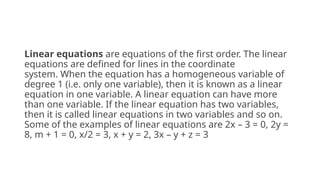
Linear equations are equations of the first order. The linear
equations are defined for lines in the coordinate
system. When the equation has a homogeneous variable of
degree 1 (i.e. only one variable), then it is known as a linear
equation in one variable. A linear equation can have more
than one variable. If the linear equation has two variables,
then it is called linear equations in two variables and so on.
Some of the examples of linear equations are 2x – 3 = 0, 2y =
8, m + 1 = 0, x/2 = 3, x + y = 2, 3x – y + z = 3
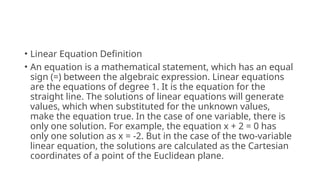
• Linear Equation Definition
• An equation is a mathematical statement, which has an equal
sign (=) between the algebraic expression. Linear equations
are the equations of degree 1. It is the equation for the
straight line. The solutions of linear equations will generate
values, which when substituted for the unknown values,
make the equation true. In the case of one variable, there is
only one solution. For example, the equation x + 2 = 0 has
only one solution as x = -2. But in the case of the two-variable
linear equation, the solutions are calculated as the Cartesian
coordinates of a point of the Euclidean plane.
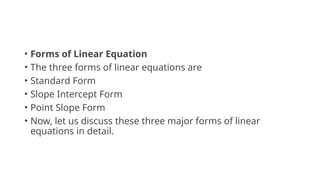
• Forms of Linear Equation
• The three forms of linear equations are
• Standard Form
• Slope Intercept Form
• Point Slope Form
• Now, let us discuss these three major forms of linear
equations in detail.
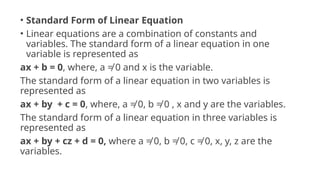
• Standard Form of Linear Equation
• Linear equations are a combination of constants and
variables. The standard form of a linear equation in one
variable is represented as
ax + b = 0, where, a ≠ 0 and x is the variable.
The standard form of a linear equation in two variables is
represented as
ax + by + c = 0, where, a ≠ 0, b ≠ 0 , x and y are the variables.
The standard form of a linear equation in three variables is
represented as
ax + by + cz + d = 0, where a ≠ 0, b ≠ 0, c ≠ 0, x, y, z are the
variables.
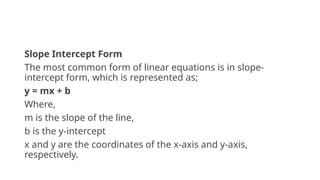
Slope Intercept Form
The most common form of linear equations is in slope-
intercept form, which is represented as;
y = mx + b
Where,
m is the slope of the line,
b is the y-intercept
x and y are the coordinates of the x-axis and y-axis,
respectively.
For example, y = 3x + 7:
slope, m = 3 and intercept = 7
If a straight line is parallel to the x-axis, then the x-coordinate will be equal to zero.
Therefore,
y=b
If the line is parallel to the y-axis then the y-coordinate will be zero.
mx+b = 0
x=-b/m
Slope: The slope of the line is equal to the ratio of the change in y-coordinates to the
change in x-coordinates. It can be evaluated by:
m = (y2-y1)/(x2-x1)
So basically the slope shows the rise of line in the plane along with the distance covered
in the x-axis. The slope of the line is also called a gradient.
Point Slope Form
In this form of linear equation, a straight line equation is
formed by considering the points in the x-y plane, such that:
y – y1 = m(x – x1 )
where (x1, y1) are the coordinates of the point.
We can also express it as:
y = mx + y1 – mx1
Reference
https://byjus.com/maths/linear-equations/

Linear Equations-Definition, Examples, Types.pptx

  • 2.
    Linear equations areequations of the first order. The linear equations are defined for lines in the coordinate system. When the equation has a homogeneous variable of degree 1 (i.e. only one variable), then it is known as a linear equation in one variable. A linear equation can have more than one variable. If the linear equation has two variables, then it is called linear equations in two variables and so on. Some of the examples of linear equations are 2x – 3 = 0, 2y = 8, m + 1 = 0, x/2 = 3, x + y = 2, 3x – y + z = 3
  • 3.
    • Linear EquationDefinition • An equation is a mathematical statement, which has an equal sign (=) between the algebraic expression. Linear equations are the equations of degree 1. It is the equation for the straight line. The solutions of linear equations will generate values, which when substituted for the unknown values, make the equation true. In the case of one variable, there is only one solution. For example, the equation x + 2 = 0 has only one solution as x = -2. But in the case of the two-variable linear equation, the solutions are calculated as the Cartesian coordinates of a point of the Euclidean plane.
  • 4.
    • Forms ofLinear Equation • The three forms of linear equations are • Standard Form • Slope Intercept Form • Point Slope Form • Now, let us discuss these three major forms of linear equations in detail.
  • 5.
    • Standard Formof Linear Equation • Linear equations are a combination of constants and variables. The standard form of a linear equation in one variable is represented as ax + b = 0, where, a ≠ 0 and x is the variable. The standard form of a linear equation in two variables is represented as ax + by + c = 0, where, a ≠ 0, b ≠ 0 , x and y are the variables. The standard form of a linear equation in three variables is represented as ax + by + cz + d = 0, where a ≠ 0, b ≠ 0, c ≠ 0, x, y, z are the variables.
  • 6.
    Slope Intercept Form Themost common form of linear equations is in slope- intercept form, which is represented as; y = mx + b Where, m is the slope of the line, b is the y-intercept x and y are the coordinates of the x-axis and y-axis, respectively.
  • 7.
    For example, y= 3x + 7: slope, m = 3 and intercept = 7 If a straight line is parallel to the x-axis, then the x-coordinate will be equal to zero. Therefore, y=b If the line is parallel to the y-axis then the y-coordinate will be zero. mx+b = 0 x=-b/m Slope: The slope of the line is equal to the ratio of the change in y-coordinates to the change in x-coordinates. It can be evaluated by: m = (y2-y1)/(x2-x1) So basically the slope shows the rise of line in the plane along with the distance covered in the x-axis. The slope of the line is also called a gradient.
  • 8.
    Point Slope Form Inthis form of linear equation, a straight line equation is formed by considering the points in the x-y plane, such that: y – y1 = m(x – x1 ) where (x1, y1) are the coordinates of the point. We can also express it as: y = mx + y1 – mx1
  • 9.