Session
Aerobic Endurance Exercise Training

   9      Lifestyle Factors –
          Physical Activity.

          Staff Cunliffe
          Unit 5 -Physical Preparation, Health and Lifestyle for
          the Public Services
          Unit 6 –Fitness Testing and Training for the
          Uniformed Public Services
Session AIMS

 To provide information on the lifestyle
  factor physical activity in preparation
  to produce an A4 information fact
  sheet. (Assignment 5: Unit5: P4/P5) .
Objectives
By the end of this session you will be
able to:
1. Identify recommendations and guidelines
   for physical activity (Unit 5:P4).
2. Identify & List health & psychological
   benefits of physical activity (Unit 5:P4).
3. Describe strategies to improve physical
   activity (Unit 5:P5).
Activity 1 - Knowledge Probe

Lifestyle factors describe the way people
      live their lives. These include
      behavioural and social issues.

  You have thirty seconds to list as
  many lifestyle factors as you can.

                   End


                           www.A6training.co.uk
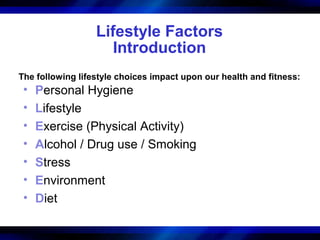
Lifestyle Factors
                     Introduction
The following lifestyle choices impact upon our health and fitness:
 •   Personal Hygiene
 •   Lifestyle
 •   Exercise (Physical Activity)
 •   Alcohol / Drug use / Smoking
 •   Stress
 •   Environment
 •   Diet
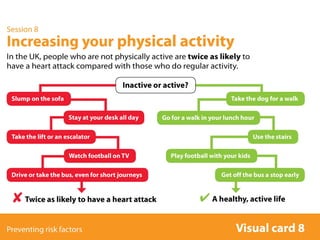
Lifestyle Factors Video Clip

• Watch the short film and take notes of
   the statistics and recommendations
             being highlighted
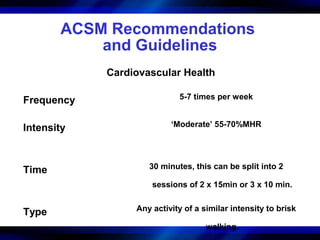
ACSM Recommendations
           and Guidelines
            Cardiovascular Health

Frequency                   5-7 times per week


Intensity                 ‘Moderate’ 55-70%MHR


Time                30 minutes, this can be split into 2

                     sessions of 2 x 15min or 3 x 10 min.


Type             Any activity of a similar intensity to brisk

                                    walking.
Check Learning

Complete the check learning sheet identifying
     the ACSM recommendations for
           cardiovascular health.
Objectives
By the end of this session you will be
able to:
1. Identify recommendations and guidelines
   for physical activity (Unit 5:P4).
2. Identify & List health & psychological
   benefits of physical activity (Unit 5:P4).
3. Describe strategies to improve physical
   activity (Unit 5:P5).
Health Benefits
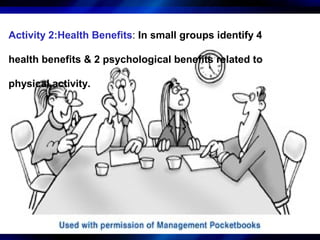
Activity 2:Health Benefits: In small groups identify 4

health benefits & 2 psychological benefits related to

physical activity.
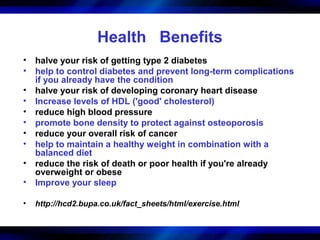
Health Benefits
•   halve your risk of getting type 2 diabetes
•   help to control diabetes and prevent long-term complications
    if you already have the condition
•   halve your risk of developing coronary heart disease
•   Increase levels of HDL ('good' cholesterol)
•   reduce high blood pressure
•   promote bone density to protect against osteoporosis
•   reduce your overall risk of cancer
•   help to maintain a healthy weight in combination with a
    balanced diet
•   reduce the risk of death or poor health if you're already
    overweight or obese
•   Improve your sleep

•   http://hcd2.bupa.co.uk/fact_sheets/html/exercise.html
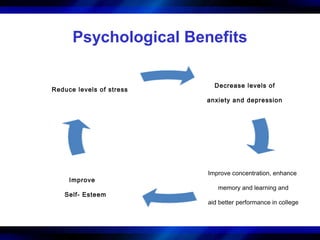
Psychological Benefits

                            Decrease levels of
Reduce levels of stress
                          anxiety and depression


                          Improve concentration, enhance
     Improve
                             memory and learning and
   Self- Esteem
                          aid better performance in college
Check learning

• List 2 health benefits.
• List 2 psychological benefits.
Objectives
By the end of this session you will be
able to:
1. Identify recommendations and guidelines
   for physical activity (Unit 5:P4).
2. Identify & List health & psychological
   benefits of physical activity (Unit 5:P4).
3. Describe strategies to improve physical
   activity (Unit 5:P5).
04   01
                          02
                          03
                          04
                          05
                          06
                          07
                          08
                          09
                          10
                          11
                          12
                          13
                          14
                          15
                          16
                          17
                          18
                          19
                          20
                          21
                          22
                          23
                          24
                          25
                          26
                          27
                          28
                          29
                          30
                          31
                          32
                          33
                          34
                          35
                          36
                          37
                          38
                          39
                          40
                          41
                          42
                          43
                          44
                          45
                          46
                          47
                          48
                          49
                          50
                          51
                          52
                          53
                          54
                          55
                          56
                          57
                          58
                          59


                               Classroom Timer
Back to Clock Home
Objectives
By the end of this session you will be
able to:
1. Identify recommendations and guidelines
   for physical activity (Unit 5:P4).
2. Identify & List health & psychological
   benefits of physical activity (Unit 5:P4).
3. Describe strategies to improve physical
   activity (Unit 5:P5).
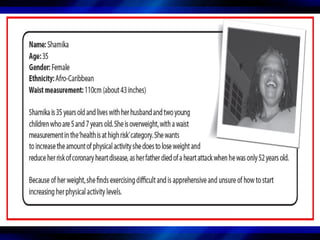
Case Study
• 1. What are Shamika’s risk factors for
  coronary heart disease?

• Known: physical inactivity, overweight,
  family history.

• Unknown: high blood pressure, high blood
  cholesterol, smoking, diabetes.
Case Study
• 2. Which of her known risk factors are
  modifiable, and which are non-modifiable?

• Modifiable: Physical inactivity, overweight,

• Unknown: Family history
Learning Outcomes – True or False
• The ACSM recommend 2 x 30mins sessions
  per week?
• Physical activity reduces coronary heart
  disease by half?
• Physical activity manages depression?
• Physical activity increases Type 2 diabetes?
• Stair climbing is a form of physical activity?
• Stress is increased by physical activity?
Learning Outcomes/ Homework
   Produce an A4 information fact sheet to
   include:
1. Identify recommendations and guidelines
   for physical activity (Unit 5:P4).
2. Identify & List health benefits of physical
   activity (Unit 5:P4).
3. Identify & List psychological benefits of
   physical activity (Unit 5:P4).
4. Describe strategies to improve physical
   activity (Unit 5:P5).
Submission Date Monday 29th Nov 2010.
Conclusions and/or Feedback
References
•   American College of Sports Medicine. (2006). Guidelines for Exercise
    Testing and Prescription. Seventh Edition. Philadelphia: Lippincott,
    Williams & Wilkins.

•   Britton, A and McPherson, K. (2002). Monitoring the Progress of the
    2010 Target for Coronary Heart Disease Mortality: Estimated
    consequences on CHD Incidence and Mortality from Changing
    Prevelence of Risk Factors. National Heart Forum: London

•   Department of Health (2002). Health Survey for England 2002 Trend
    Data. See Department of Health website:
    http://www.publications.doh.gov.uk/stats/trends1.htm

•   WHO. (2005). The Surf Report 2. Surveillance of chronic disease risk
    factors, WHO. Geneva.

Lifestyle factors physical_activity

  • 1.
    Session Aerobic Endurance ExerciseTraining 9 Lifestyle Factors – Physical Activity. Staff Cunliffe Unit 5 -Physical Preparation, Health and Lifestyle for the Public Services Unit 6 –Fitness Testing and Training for the Uniformed Public Services
  • 3.
    Session AIMS  Toprovide information on the lifestyle factor physical activity in preparation to produce an A4 information fact sheet. (Assignment 5: Unit5: P4/P5) .
  • 4.
    Objectives By the endof this session you will be able to: 1. Identify recommendations and guidelines for physical activity (Unit 5:P4). 2. Identify & List health & psychological benefits of physical activity (Unit 5:P4). 3. Describe strategies to improve physical activity (Unit 5:P5).
  • 5.
    Activity 1 -Knowledge Probe Lifestyle factors describe the way people live their lives. These include behavioural and social issues. You have thirty seconds to list as many lifestyle factors as you can. End www.A6training.co.uk
  • 6.
    Lifestyle Factors Introduction The following lifestyle choices impact upon our health and fitness: • Personal Hygiene • Lifestyle • Exercise (Physical Activity) • Alcohol / Drug use / Smoking • Stress • Environment • Diet
  • 7.
    Lifestyle Factors VideoClip • Watch the short film and take notes of the statistics and recommendations being highlighted
  • 8.
    ACSM Recommendations and Guidelines Cardiovascular Health Frequency 5-7 times per week Intensity ‘Moderate’ 55-70%MHR Time 30 minutes, this can be split into 2 sessions of 2 x 15min or 3 x 10 min. Type Any activity of a similar intensity to brisk walking.
  • 9.
    Check Learning Complete thecheck learning sheet identifying the ACSM recommendations for cardiovascular health.
  • 10.
    Objectives By the endof this session you will be able to: 1. Identify recommendations and guidelines for physical activity (Unit 5:P4). 2. Identify & List health & psychological benefits of physical activity (Unit 5:P4). 3. Describe strategies to improve physical activity (Unit 5:P5).
  • 11.
    Health Benefits Activity 2:HealthBenefits: In small groups identify 4 health benefits & 2 psychological benefits related to physical activity.
  • 12.
    Health Benefits • halve your risk of getting type 2 diabetes • help to control diabetes and prevent long-term complications if you already have the condition • halve your risk of developing coronary heart disease • Increase levels of HDL ('good' cholesterol) • reduce high blood pressure • promote bone density to protect against osteoporosis • reduce your overall risk of cancer • help to maintain a healthy weight in combination with a balanced diet • reduce the risk of death or poor health if you're already overweight or obese • Improve your sleep • http://hcd2.bupa.co.uk/fact_sheets/html/exercise.html
  • 13.
    Psychological Benefits Decrease levels of Reduce levels of stress anxiety and depression Improve concentration, enhance Improve memory and learning and Self- Esteem aid better performance in college
  • 14.
    Check learning • List2 health benefits. • List 2 psychological benefits.
  • 15.
    Objectives By the endof this session you will be able to: 1. Identify recommendations and guidelines for physical activity (Unit 5:P4). 2. Identify & List health & psychological benefits of physical activity (Unit 5:P4). 3. Describe strategies to improve physical activity (Unit 5:P5).
  • 18.
    04 01 02 03 04 05 06 07 08 09 10 11 12 13 14 15 16 17 18 19 20 21 22 23 24 25 26 27 28 29 30 31 32 33 34 35 36 37 38 39 40 41 42 43 44 45 46 47 48 49 50 51 52 53 54 55 56 57 58 59 Classroom Timer Back to Clock Home
  • 19.
    Objectives By the endof this session you will be able to: 1. Identify recommendations and guidelines for physical activity (Unit 5:P4). 2. Identify & List health & psychological benefits of physical activity (Unit 5:P4). 3. Describe strategies to improve physical activity (Unit 5:P5).
  • 20.
    Case Study • 1.What are Shamika’s risk factors for coronary heart disease? • Known: physical inactivity, overweight, family history. • Unknown: high blood pressure, high blood cholesterol, smoking, diabetes.
  • 21.
    Case Study • 2.Which of her known risk factors are modifiable, and which are non-modifiable? • Modifiable: Physical inactivity, overweight, • Unknown: Family history
  • 22.
    Learning Outcomes –True or False • The ACSM recommend 2 x 30mins sessions per week? • Physical activity reduces coronary heart disease by half? • Physical activity manages depression? • Physical activity increases Type 2 diabetes? • Stair climbing is a form of physical activity? • Stress is increased by physical activity?
  • 23.
    Learning Outcomes/ Homework Produce an A4 information fact sheet to include: 1. Identify recommendations and guidelines for physical activity (Unit 5:P4). 2. Identify & List health benefits of physical activity (Unit 5:P4). 3. Identify & List psychological benefits of physical activity (Unit 5:P4). 4. Describe strategies to improve physical activity (Unit 5:P5). Submission Date Monday 29th Nov 2010.
  • 24.
  • 25.
    References • American College of Sports Medicine. (2006). Guidelines for Exercise Testing and Prescription. Seventh Edition. Philadelphia: Lippincott, Williams & Wilkins. • Britton, A and McPherson, K. (2002). Monitoring the Progress of the 2010 Target for Coronary Heart Disease Mortality: Estimated consequences on CHD Incidence and Mortality from Changing Prevelence of Risk Factors. National Heart Forum: London • Department of Health (2002). Health Survey for England 2002 Trend Data. See Department of Health website: http://www.publications.doh.gov.uk/stats/trends1.htm • WHO. (2005). The Surf Report 2. Surveillance of chronic disease risk factors, WHO. Geneva.

Editor's Notes

  • #7 Ask the students to produce a yes no card if they did get any of the factors listed above.
  • #25 On a post it note write down your conclusion to the session – what have you learnt? Something you enjoyed or what you would change. As you sign in assignment 1 put your post it on the board and exit.