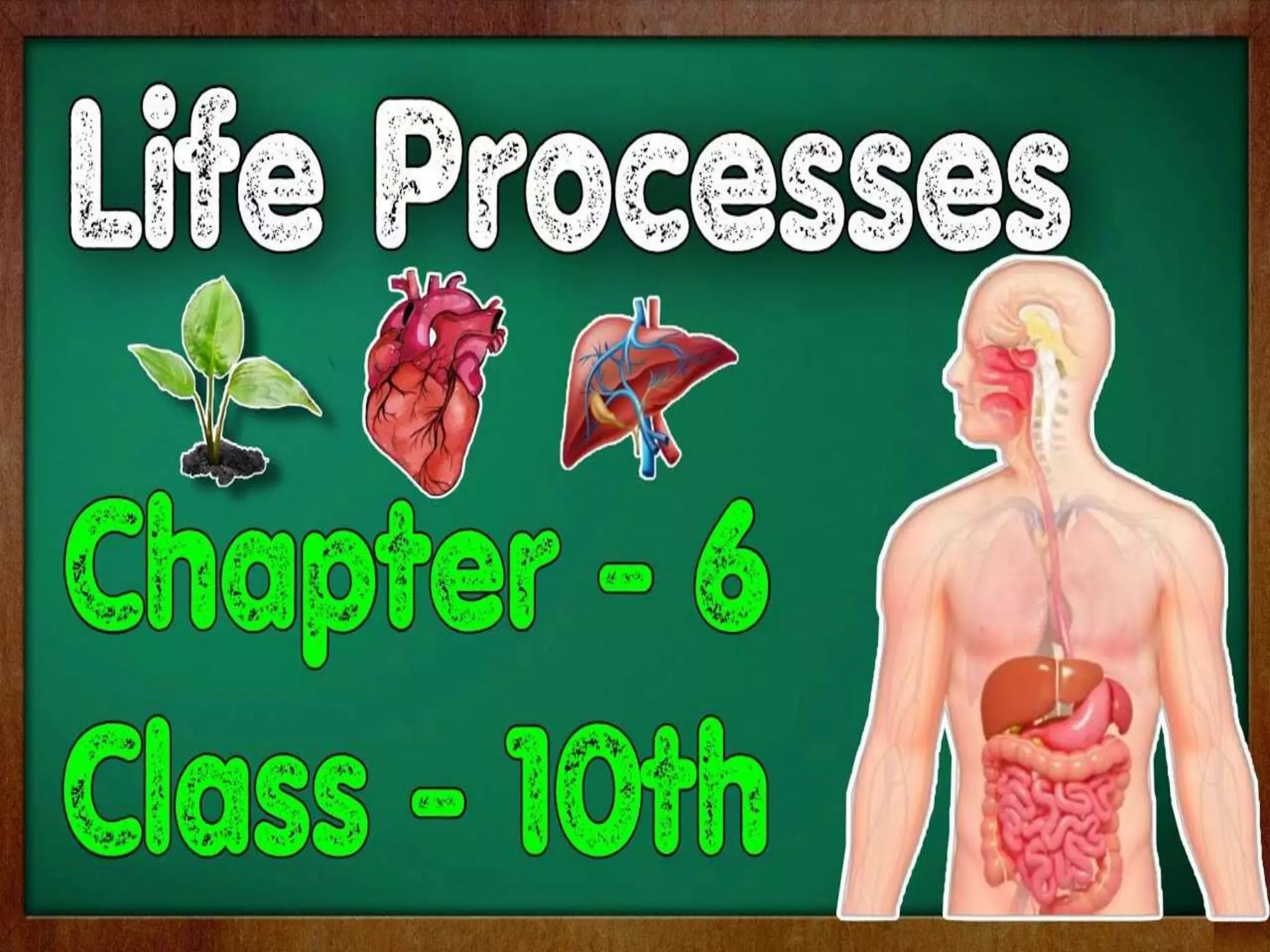
LIFE PROCESSES
9/6/2018
1
khare.forensics@gmail.com
9/6/2018
khare.forensics@gmail.com
2
9/6/2018
3
khare.forensics@gmail.com
Includes the activities involved in
ingestion (obtaining food from the
environment) and digestion
(processing food for use by the
organism). It also includes egestion
(removal of solid wastes)
9/6/2018
4
khare.forensics@gmail.com
9/6/2018
khare.forensics@gmail.com
5
CARBOHYDRATES
PROTEINS
ENERGY
OXIDATION- REDUCTION
REACTIONS
9/6/2018
6
khare.forensics@gmail.com
9/6/2018
7
khare.forensics@gmail.com
9/6/2018
8
khare.forensics@gmail.com
9/6/2018
9
khare.forensics@gmail.com
Multicellular organisms are organisms
that consist of more than one cell, in
contrast to single-cell organisms. To
form a multicellular organism, these
cells need to identify and attach to the
other cells.
9/6/2018
10
khare.forensics@gmail.com
9/6/2018
11
khare.forensics@gmail.com
FOOD
Digestive system digests
complex food and
absorbs simpler form of
nutrients and then
transported to cells.
Respiratory system is
responsible for inhaling O2.
Then O2 is transported to
all cells.
Transport system
Body cells need both to performbiochemical
reactions to produce energy
Excretion9/6/2018
12
khare.forensics@gmail.com
Green plants and some bacteria make their own
food.
They use raw materials like water and carbon
dioxide(inorganic raw materials).
Green plants and some bacteria are autotrophs.
9/6/2018
13
khare.forensics@gmail.com
What is an autotroph?
An organism capable of making its own food from inorganic
substances, using light or chemical energy. Plants are
autotrophs.They take in light (the sun) and convert this into
food or energy. E.g. plants , bacteria and algae.
What is a heterotroph?
An organism that must ingest complex organic substances
in order to create energy. These organisms use
biocatalysts calledenzymes.
Examples of heterotrophs are humans. Humans must
ingest food in order to create energy. They do this through
digestion. Other e.g. animals.
9/6/2018
14
khare.forensics@gmail.com
9/6/2018
15
khare.forensics@gmail.com
Green plants are also called autotrophic
organisms, as they can produce their own
food.
Autotrophic = auto+ trophic, means- making
food by self without depending other living
beings.
Green plants produce food by photosynthesis
process, so they are known as producers in the
environment.
9/6/2018
16
khare.forensics@gmail.com
9/6/2018
17
khare.forensics@gmail.com
9/6/2018
18
khare.forensics@gmail.com
How the plants obtain carbon dioxide?
•There are a large number of tiny pores called stomata on the surface of the
leaves of plants.
•The carbon dioxide gas enters the leaves of the plant through the stomata
present on their surface.
•Each stomatal pore is surrounded by a pair of guard cells. The opening
and closing of stomatal pores is controlled by the guard cells.
•When water flows into the guard cells, they swell, become curved and
cause the pore to open.
•On the other hand, when guard cells lose water, they shrink, become
straight and close the stomatal pores.
9/6/2018
19
khare.forensics@gmail.com
Stomata: They are tiny openings or pores, found mostly on the
undersideof a plant leaf and usedfor gaseousexchange.
The pore is formed by a pair of specialized cells known as guard cells
which are responsiblefor regulating the size of the opening.
9/6/2018
20
khare.forensics@gmail.com
9/6/2018
21
khare.forensics@gmail.com
Site of photosynthesis: Chloroplasts
• The site of photosynthesis in a cell of the leaf are chloroplasts
which contain chlorophyll.
• Chloroplasts are present in the photosynthetic cells (mesophyll
cells) of green plants. These cells contain more chlorophyll than
other plant cells.
9/6/2018
22
khare.forensics@gmail.com
How the plants obtain water for photosynthesis?
•The water required by the plants for photosynthesis is
absorbed by the root of the plants from the soil through the
process of osmosis.
•The water absorbed by the roots of the plants is transported
upward through the xylem vessels to the leaves where it
reaches the photosynthetic cells.
•The plants also need other raw materials such as nitrogen,
phosphorus, iron and magnesium, etc., for building their body.
•The plants take these materials from the soil
•Nitrogen is essential element used by the plants to make
proteins and other compound.
9/6/2018
23
khare.forensics@gmail.com
The photosynthesis takes place in the following three steps:
•Absorption of sunlight energy by chlorophyll.
•Conversion of light energy into chemical energy, and splitting
of water into hydrogen and oxygen by light energy.
•Reduction of carbon dioxide by hydrogen to form
carbohydrate like glucose by utilizing the chemical energy.
9/6/2018
24
khare.forensics@gmail.com
9/6/2018
25
khare.forensics@gmail.com
9/6/2018
26
khare.forensics@gmail.com
9/6/2018
27
khare.forensics@gmail.com
9/6/2018
28
khare.forensics@gmail.com
9/6/2018
29
khare.forensics@gmail.com
9/6/2018
30
khare.forensics@gmail.com
9/6/2018
31
khare.forensics@gmail.com
9/6/2018
32
khare.forensics@gmail.com
9/6/2018
33
khare.forensics@gmail.com
Food material Assimilation
Glucose • Provides energy.
• Stored in liver and muscles.
Fatty acids+
glycerol
• Energy reserves.
•It is stored in liver and in under
skin.
Amino acids •Repairs damages in body parts.
• Forms enzymes, hormones.
• Responsible for growth
9/6/2018
34
khare.forensics@gmail.com
The removal of undigested food or waste
moves to large intestines where water is
absorbed from them, making a semi solid.
This is Faeces.
It is stored in the large intestine called
rectum.
It is sent out of the body through anus.
9/6/2018
35
khare.forensics@gmail.com
9/6/2018
36
khare.forensics@gmail.com
The process of releasing energy from organic
molecules for use by cells.
During respiration glucose is broken down,
and the energy released is stored in the
compound ATP.
Energy released by the compoundATP is used by
organisms to perform lifefunctions.
9/6/2018
37
khare.forensics@gmail.com
9/6/2018
38
khare.forensics@gmail.com
9/6/2018
39
khare.forensics@gmail.com
9/6/2018
40
khare.forensics@gmail.com
9/6/2018
41
khare.forensics@gmail.com
The energy used during cellular respirationis used
to synthesisATP.
ATP– Adenosine Tri Phosphate (currency of cells)
ATP is the fuel to all cellactivities.
ATP s are broken down to release energy which can
be used by cells to carry out movement in
molecules, biochemical reactions.
9/6/2018
42
khare.forensics@gmail.com
 Different organisms use different methods for the intake of oxygen and
expulsion of carbon dioxide.
 Diffusion is the method which is utilized by unicellular simple organisms and
plants.
 Gills are the respiratory organs for fishes that take in oxygen which is dissolved
in water.
 Since, availability of oxygen is less in the aquatic environment, so the breathing
rate of aquatic organisms is faster.
 Insects have a system of spiracles and tracheae which is used for taking in
oxygen.
 Availability of oxygen is not a problem in the terrestrial environment so
breathing rate is slower as compared to what it is in fishes. Terrestrial
organisms have developed lungs for exchange of gases.
9/6/2018
43
khare.forensics@gmail.com
9/6/2018
44
khare.forensics@gmail.com
9/6/2018
45
khare.forensics@gmail.com
9/6/2018
46
khare.forensics@gmail.com
9/6/2018
47
khare.forensics@gmail.com
3 distinct components
Blood - fluid circulates in our body.
Blood vessels - tubes that help the
blood to circulate.
Heart - pumping organ that circulates
the blood around the body.
9/6/2018
48
khare.forensics@gmail.com
PLASMA
(55%)
BLOOD
CELLS(45%
Red blood cells
(Erythrocytes)
White bloodcells
(Leucocytes)
Platelets
(thrombocytes)
9/6/2018
49
khare.forensics@gmail.com
9/6/2018
50
khare.forensics@gmail.com
9/6/2018
51
khare.forensics@gmail.com
 4 chambers
 4 blood vessels
 2 valves
 Double circulation of
blood
9/6/2018
52
khare.forensics@gmail.com
9/6/2018
53
khare.forensics@gmail.com
9/6/2018
54
khare.forensics@gmail.com
Blood pressure - Force exerted by blood on the
walls of artery.
It is greater in arteries than in veins.
The Pressure of blood inside the artery
during ventricular systole (contraction)is
called systolic pressure.
Pressure in artery during ventriculardiastole
(relaxation) is called diastolic pressure.
The normal systolic pressure -120mm Hg.
The normal diastolic pressure-80 mmHg.
9/6/2018
55
khare.forensics@gmail.com
9/6/2018
56
khare.forensics@gmail.com
9/6/2018
57
khare.forensics@gmail.com
9/6/2018
58
khare.forensics@gmail.com
Water absorbed into roots through root hair cells
Water carried to leaves through xylem vessels
Water evaporates from underside ofleaves
Water escapes through holes calledstomata
As water evaporates, more is sucked up xylem
Stomata open and close to control water loss
Open – O2 and CO2 enter and exit
Closed – Reduce water loss
9/6/2018
59
khare.forensics@gmail.com
Water is absorbed in plants by young roots and in the
dermal cells byosmosis
Cell sap of the epidermal cells has higher
concentration than water in the soil
Root hairs significantly increase water
absorption
Root hairs increase the root surface area and
catchment space for water uptake
Epidermal cells have a layer of cuticle.
Cuticle is a waxy coating that prevents excessive water
loss.
9/6/2018
60
khare.forensics@gmail.com
9/6/2018
61
khare.forensics@gmail.com
ii) Ureter
Urine flows from the collecting tubes of kidneys to
the urinary bladder through ureter tube.
iii) Urinary Bladder
Urine flows from ureter to this place where it is
temporarily stored
iv) Urethra
Periodically, urine is EXCRETED from the bladder through
the urethra
MICTURITION – Act of voiding urine.
9/6/2018
62
khare.forensics@gmail.com
9/6/2018
63
khare.forensics@gmail.com
9/6/2018
64
khare.forensics@gmail.com
9/6/2018
65
khare.forensics@gmail.com
9/6/2018
66
khare.forensics@gmail.com
9/6/2018
67
khare.forensics@gmail.com
Normal urine has various organic and inorganic constituents.
The normal inorganic constituents are
chloride,
phosphates,
sulphates,
calcium, etc.,
while organic constituents are
urea,
uric acid, and
creatinine.
COMPOSITION OF URINE
9/6/2018
68
khare.forensics@gmail.com
HAEMODIALYSIS
In hemodialysis, blood is removed from the body and filtered
through a man-made membrane called a dialyzer, or artificial kidney,
and then the filtered blood is returned to the body. The average
person has about 10 to 12 pints of blood; during dialysis only one
pint (about two cups) is outside of the body at a time.
9/6/2018
69
khare.forensics@gmail.com
9/6/2018
70
khare.forensics@gmail.com
EXCRETION IN PLANTS
9/6/2018
71
khare.forensics@gmail.com
Oxygen- waste product.
Photosynthesis
Excretion in plants
Water – transpiration
Dead cells/waste
stored in leaves -
removed by falling
leaves
Waste products
are stored in
cellular vacuoles
Plants excretes
waste into soil
Reference Video - https://www.youtube.com/watch?v=7xDe2K8UFGM
9/6/2018
72
khare.forensics@gmail.com
9/6/2018
73
khare.forensics@gmail.com
9/6/2018
74
khare.forensics@gmail.com
9/6/2018
75
khare.forensics@gmail.com
Biology, Teacher
Reach out – khare.forensics@gmail.com
Slideshare : khare.forensics@gmail.com
“You don’t get results by focusing on results.
You get results by focusing on the Actions that produce results.”
-- Mike Hawkins
9/6/2018
khare.forensics@gmail.com 76

Life Processes cbse