What is lifeprocess
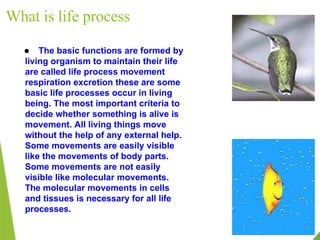
● The basic functions are formed by
living organism to maintain their life
are called life process movement
respiration excretion these are some
basic life processes occur in living
being. The most important criteria to
decide whether something is alive is
movement. All living things move
without the help of any external help.
Some movements are easily visible
like the movements of body parts.
Some movements are not easily
visible like molecular movements.
The molecular movements in cells
and tissues is necessary for all life
processes.
3.
Some characteristic ofliving beings
They can move from one place to another place by
themselves
Living beings need air water and nutrition
They can grow
They can reproduce their new generation
They can respire
Why living things need energy
Living things perform various functions so they need fuel
for these work they take energy from food
4.
2) Life processes:-
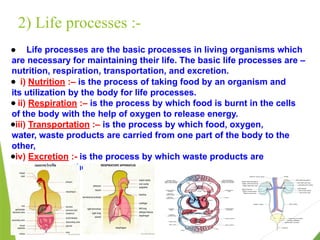
● Life processes are the basic processes in living organisms which
are necessary for maintaining their life. The basic life processes are –
nutrition, respiration, transportation, and excretion.
● i) Nutrition :– is the process of taking food by an organism and
its utilization by the body for life processes.
● ii) Respiration :– is the process by which food is burnt in the cells
of the body with the help of oxygen to release energy.
●iii) Transportation :– is the process by which food, oxygen,
water, waste products are carried from one part of the body to the
other,
●iv) Excretion :- is the process by which waste products are
removed from the body.
5.
3) Nutrition :-
●Nutrition is the process of taking food by an organism and its
utilisation by the body to build the body, for growth, to repair the
damaged parts of the body and for energy.
●a) Modes of nutrition :- There are two main modes of nutrition.
They are autotrophic nutrition and heterotrophic nutrition.
●i) Autotrophic nutrition :- in this process organisms prepare their
own food from simple inorganic substances like carbon dioxide and
water in the presence of sunlight and chlorophyll.
● Eg :- all green plants and some bacteria.
● Plants are photoautotrophic and bacteria are chemoautotrophic .
●ii) Heterotrophic nutrition :- in this process organisms depends
upon other for their food they get their food directly or indirectly
from plants.
● Eg :- all animals fungi and some bacteria.
6.
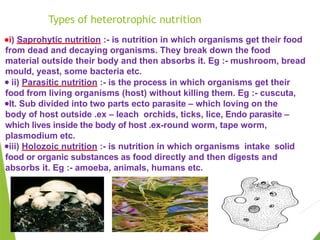
●i) Saprohytic nutrition:- is nutrition in which organisms get their food
from dead and decaying organisms. They break down the food
material outside their body and then absorbs it. Eg :- mushroom, bread
mould, yeast, some bacteria etc.
● ii) Parasitic nutrition :- is the process in which organisms get their
food from living organisms (host) without killing them. Eg :- cuscuta,
●It. Sub divided into two parts ecto parasite – which loving on the
body of host outside .ex – leach orchids, ticks, lice, Endo parasite –
which lives inside the body of host .ex-round worm, tape worm,
plasmodium etc.
●iii) Holozoic nutrition :- is nutrition in which organisms intake solid
food or organic substances as food directly and then digests and
absorbs it. Eg :- amoeba, animals, humans etc.
Types of heterotrophic nutrition
7.
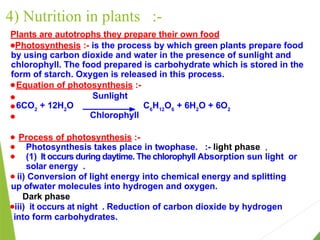
4) Nutrition inplants :-
Plants are autotrophs they prepare their own food
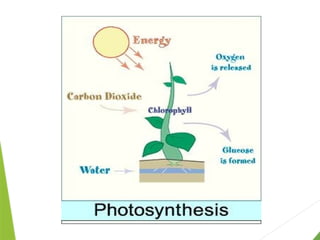
●Photosynthesis :- is the process by which green plants prepare food
by using carbon dioxide and water in the presence of sunlight and
chlorophyll. The food prepared is carbohydrate which is stored in the
form of starch. Oxygen is released in this process.
● Equation of photosynthesis :-
● Sunlight
● 6CO2
+ 12H2
O C6
H12
O6
+ 6H2
O + 6O2
● Chlorophyll
● Process of photosynthesis :-
● Photosynthesis takes place in twophase. :- light phase ,
● (1) It occurs during daytime. The chlorophyll Absorption sun light or
solar energy .
● ii) Conversion of light energy into chemical energy and splitting
up ofwater molecules into hydrogen and oxygen.
Dark phase
●iii) it occurs at night . Reduction of carbon dioxide by hydrogen
into form carbohydrates.
9.
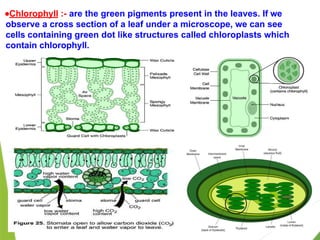
●Chlorophyll :- arethe green pigments present in the leaves. If we
observe a cross section of a leaf under a microscope, we can see
cells containing green dot like structures called chloroplasts which
contain chlorophyll.
10.
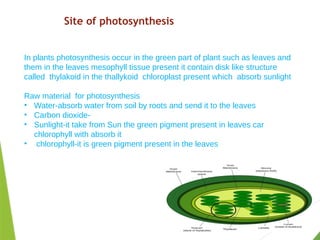
Site of photosynthesis
Inplants photosynthesis occur in the green part of plant such as leaves and
them in the leaves mesophyll tissue present it contain disk like structure
called thylakoid in the thallykoid chloroplast present which absorb sunlight
Raw material for photosynthesis
• Water-absorb water from soil by roots and send it to the leaves
• Carbon dioxide-
• Sunlight-it take from Sun the green pigment present in leaves car
chlorophyll with absorb it
• chlorophyll-it is green pigment present in the leaves
11.
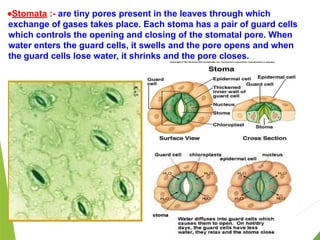
●Stomata :- aretiny pores present in the leaves through which
exchange of gases takes place. Each stoma has a pair of guard cells
which controls the opening and closing of the stomatal pore. When
water enters the guard cells, it swells and the pore opens and when
the guard cells lose water, it shrinks and the pore closes.
12.
5a) Activity toshow that chlorophyll is necessary for
photosynthesis :-
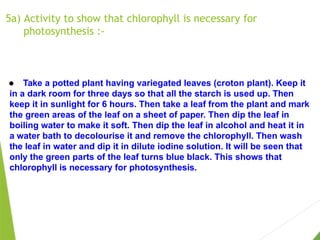
● Take a potted plant having variegated leaves (croton plant). Keep it
in a dark room for three days so that all the starch is used up. Then
keep it in sunlight for 6 hours. Then take a leaf from the plant and mark
the green areas of the leaf on a sheet of paper. Then dip the leaf in
boiling water to make it soft. Then dip the leaf in alcohol and heat it in
a water bath to decolourise it and remove the chlorophyll. Then wash
the leaf in water and dip it in dilute iodine solution. It will be seen that
only the green parts of the leaf turns blue black. This shows that
chlorophyll is necessary for photosynthesis.
13.
b) Activity toshow that carbon dioxide is necessary
for photosynthesis :-
● Take two potted plants of the same size and keep them in a dark
room for three days so that all the starch is used up. Then keep the
plants on separate glass plates. Keep a watch glass containing some
potassium hydroxide near one plant to absorb carbon dioxide. Cover
both the plants with bell jars and seal the bottom of the jars with
vaseline to make it air tight. Keep the plants in sunlight for three hours.
Then take a leaf from each plant and test for starch. The leaf of the
plant kept in the jar containing potassium hydroxide does not show the
presence of starch. This shows that carbon dioxide is necessary for
photosynthesis.
14.
Nutrition in animals
Theanimal are heterotrophs they take food from
other animals and plant
on the basis of eating habits animal divided into 3
groups(1) herbivores(2) carnivores(3) omnivores
1.herbivores these animal which eat only plant or
take food from plant parts example cow goat rabbit
2. Carnivores those animal which eat fresh or meet of
other animals called carnivores example tiger, lion,
fox.
3. Omnivores those animal which eat both plant and
animal part called omnivores example human, bear,
crow
15.
Steps involved inthe process of nutrition in animals or human being
INGESTION it is a process of intake food into body
example eating food by mouth
DIGESTION in this process Las molecular food break
into simple substance by chemicals
ABSORPTION In this process into blood from
intestine a
ASSIMILATION in this process to transporter 2 every
cell of body by blood
EGESTION iT IS the process of removal of waste by
body
16.
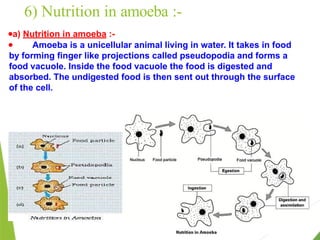
6) Nutrition inamoeba :-
●a) Nutrition in amoeba :-
● Amoeba is a unicellular animal living in water. It takes in food
by forming finger like projections called pseudopodia and forms a
food vacuole. Inside the food vacuole the food is digested and
absorbed. The undigested food is then sent out through the surface
of the cell.
17.
b) Nutrition inHuman beings :-
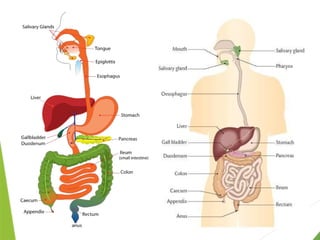
● Nutrition in human beings takes place in the digestive system. It
consists of the alimentary canal and glands which produce
enzymes which breaks down food into smaller molecules.
● The main organs of the digestive system are mouth, oesophagus,
stomach, small intestine, large intestine, and anus. The main glands
are salivary glands, gastric glands, liver, pancreas and intestinal glands
●mouth the ingestion occur in the mouth it contain teeth and tongue
the teeth break food into small pieces and tongue help in the
swallowing of food it mix sliva and make food soft. In mouth salivary
gland present which secrete saliva it contain salivary amylase
enzyme which start the breakdown ofstarch into sugar.
●OESOPHAGUS or food pipe it is a tube like structures start from
mouth and open into stomach it pass food from mouth to stomach by
the muscular movement called peristalic movement
● stomach the mechanical digestion of food occur in the stomach. the
food store up to 6 hour in it screen HCL mucus and enzyme pepsin the
HCL provide acidic medium to the food and kill microorganism present
in food mucus protect stomach wall from acid and pepsin help in the
digestion of protein with act only in acidic medium.
18.
. Then thefood passes into the small intestine.
● In the upper part of the small intestine called duodenum :- the
food is mixed with bile from liver ( largest gland of body) and
pancreatic juice from the pancreas. Bile breaks down fats into
smaller globules. Pancreatic juice contains the enzymes trypsin and
lipase. Trypsin breaks down proteins and lipase breaks down fats.
● In the small intestine :- the glands the walls of the small intestine
produces intestinal juice. The enzymes of the intestinal juice coverts
carbohydrates into glucose, fats into fatty acids and glycerol and
proteins into amino acids. The walls of the small intestine has
several finger like projections called villi having blood vessels. It
helps to increase the surface area for the absorption of digested
food. The digested food is absorbed by the blood and transported to
all cells in the body. Then the undigested food passes into the large
intestine.
● In the large intestine :- water is absorbed and the waste material
is removed through the anus.
●
20.
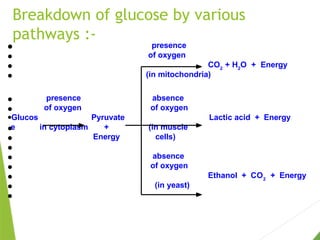
b) Types ofrespiration :-
● There are two main types of respiration. They are aerobic and anaerobic respiration.
●i) Aerobic respiration :- takes place in the presence of oxygen. It produces more energy.
The end products are carbon dioxide, water and energy. It takes place in most organisms.
● In aerobic respiration glucose is converted into pyruvate in the cytoplasm in the
presence of oxygen and then in the presence of oxygen, pyruvate is converted into
carbon dioxide, water and energy in the mitochondria.
● presence of oxygen presence of oxygen
●Glucos
e
Pyruvate CO2
+ H2
O + Energy
● in cytoplasm in mitochondria
●ii) Anaerobic respiration :- takes place in the absence of oxygen. It produces less
energy. The end products are lactic acid or ethanol, carbon dioxide, and energy. It takes
place in muscle cells and yeast.
● In anaerobic respiration in muscle cells, glucose is converted into pyruvate and in
the
absence of oxygen pyruvate is converted into lactic acid and energy.
● presence of oxygen absence of oxygen
●Glucos
e
Pyruvate Lactic acid + Energy
● in cytoplasm in muscle cells
● In anaerobic respiration in yeast, glucose is converted into pyruvate and in the
absence of oxygen pyruvate is converted into ethanol, carbondioxide and energy. This
process is called fermentation.
ygen
Ethanol + CO2
+ Energy
● presence of oxygen
absence of ox
●Glucose Pyruvate
● in cytoplasm in yeast
21.
Breakdown of glucoseby various
pathways :-
●
●
●
●
presence
of oxygen
CO2
+ H2
O + Energy
(in mitochondria)
●
●
presence
of oxygen
absence
of oxygen
●Glucos
e
Pyruvate
+
Energy
Lactic acid + Energy
●
●
●
●
●
●
●
●
in cytoplasm (in muscle
cells)
absence
of oxygen
Ethanol + CO2
+ Energy
(in yeast)
22.
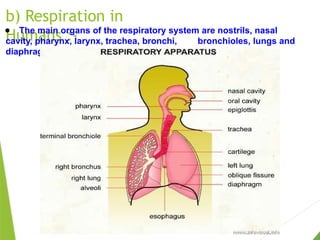
b) Respiration in
Humans:-
● The main organs of the respiratory system are nostrils, nasal
cavity, pharynx, larynx, trachea, bronchi, bronchioles, lungs and
diaphragm.
23.
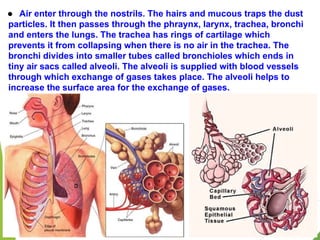
● Air enterthrough the nostrils. The hairs and mucous traps the dust
particles. It then passes through the phraynx, larynx, trachea, bronchi
and enters the lungs. The trachea has rings of cartilage which
prevents it from collapsing when there is no air in the trachea. The
bronchi divides into smaller tubes called bronchioles which ends in
tiny air sacs called alveoli. The alveoli is supplied with blood vessels
through which exchange of gases takes place. The alveoli helps to
increase the surface area for the exchange of gases.
24.
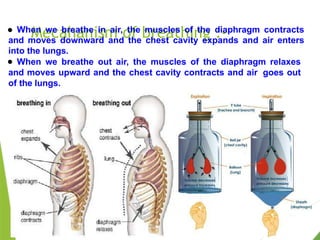
Mecahanism of breathing:-
● When we breathe in air, the muscles of the diaphragm contracts
and moves downward and the chest cavity expands and air enters
into the lungs.
● When we breathe out air, the muscles of the diaphragm relaxes
and moves upward and the chest cavity contracts and air goes out
of the lungs.
25.
8)
Transportation :-
●a) Transportationin Human beings :-
● The main transport system in human beings is the circulatory
●system. It consists of blood, arteries, veins capillaries and heart.
● i) Blood :- transports food, oxygen and waste products. It
consists of
●plasma, red blood cells (RBC), white blood cells (WBC) and
platelets.
●Plasma transports food, water, carbondioxide, nitrogenous waste
etc.
●Red blood cells transports oxygen. White blood cells kills harmful
●microbes and protects the body. Platelets help in clotting of
blood and
●prevents loss of blood during injury.
● ii) Arteries :- carry pure blood from the heart to all parts of the
body.
●They are thick walled and do not have valves.
●iii) Veins :- carry impure blood from all parts of the body to the
heart.
●They are thin walled and have valves.
●iv) Capillaries :- are very narrow blood vessels which connects
●arteries and veins together. The exchange of food, water, oxygen,
●carbon dioxide etc. between the blood and cells take place
through
●the capillaries.
26.
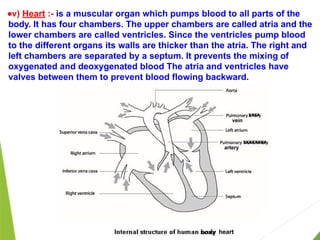
●v) Heart :-is a muscular organ which pumps blood to all parts of the
body. It has four chambers. The upper chambers are called atria and the
lower chambers are called ventricles. Since the ventricles pump blood
to the different organs its walls are thicker than the atria. The right and
left chambers are separated by a septum. It prevents the mixing of
oxygenated and deoxygenated blood The atria and ventricles have
valves between them to prevent blood flowing backward.
xxxxx heart
xxxx
vein
xxxxxxxx
artery
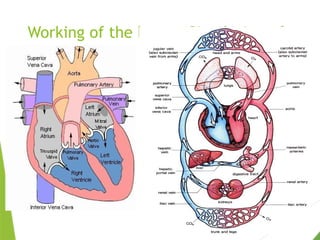
● Working ofthe heart ( Circulation of blood ) :-
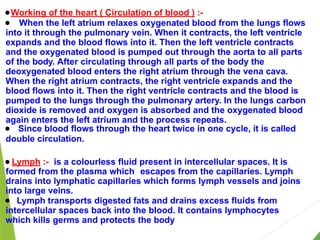
● When the left atrium relaxes oxygenated blood from the lungs flows
into it through the pulmonary vein. When it contracts, the left ventricle
expands and the blood flows into it. Then the left ventricle contracts
and the oxygenated blood is pumped out through the aorta to all parts
of the body. After circulating through all parts of the body the
deoxygenated blood enters the right atrium through the vena cava.
When the right atrium contracts, the right ventricle expands and the
blood flows into it. Then the right ventricle contracts and the blood is
pumped to the lungs through the pulmonary artery. In the lungs carbon
dioxide is removed and oxygen is absorbed and the oxygenated blood
again enters the left atrium and the process repeats.
● Since blood flows through the heart twice in one cycle, it is called
double circulation.
● Lymph :- is a colourless fluid present in intercellular spaces. It is
formed from the plasma which escapes from the capillaries. Lymph
drains into lymphatic capillaries which forms lymph vessels and joins
into large veins.
● Lymph transports digested fats and drains excess fluids from
intercellular spaces back into the blood. It contains lymphocytes
which kills germs and protects the body
29.
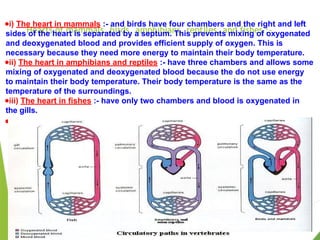
Hearts of mammals,birds, amphibians, reptiles, and fishes :-
●i) The heart in mammals :- and birds have four chambers and the right and left
sides of the heart is separated by a septum. This prevents mixing of oxygenated
and deoxygenated blood and provides efficient supply of oxygen. This is
necessary because they need more energy to maintain their body temperature.
●ii) The heart in amphibians and reptiles :- have three chambers and allows some
mixing of oxygenated and deoxygenated blood because the do not use energy
to maintain their body temperature. Their body temperature is the same as the
temperature of the surroundings.
●iii) The heart in fishes :- have only two chambers and blood is oxygenated in
the gills.
●
30.
b) Transportation in
plants:-
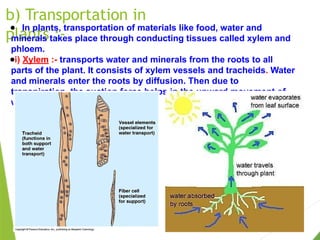
● In plants, transportation of materials like food, water and
minerals takes place through conducting tissues called xylem and
phloem.
●i) Xylem :- transports water and minerals from the roots to all
parts of the plant. It consists of xylem vessels and tracheids. Water
and minerals enter the roots by diffusion. Then due to
transpiration, the suction force helps in the upward movement of
water an minerals.
31.
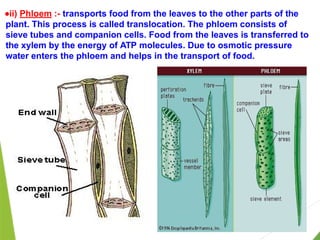
●ii) Phloem :-transports food from the leaves to the other parts of the
plant. This process is called translocation. The phloem consists of
sieve tubes and companion cells. Food from the leaves is transferred to
the xylem by the energy of ATP molecules. Due to osmotic pressure
water enters the phloem and helps in the transport of food.
32.
9) Excretion :-
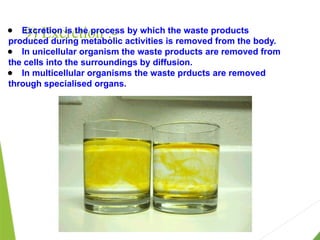
●Excretion is the process by which the waste products
produced during metabolic activities is removed from the body.
● In unicellular organism the waste products are removed from
the cells into the surroundings by diffusion.
● In multicellular organisms the waste prducts are removed
through specialised organs.
33.
a) Excretion inHuman beings :-
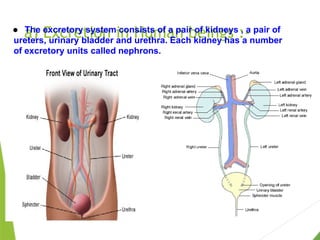
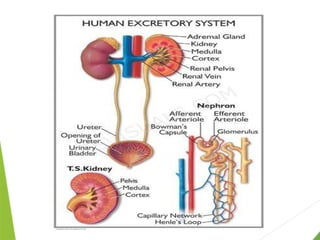
● The excretory system consists of a pair of kidneys , a pair of
ureters, urinary bladder and urethra. Each kidney has a number
of excretory units called nephrons.
36.
●Nephron :-
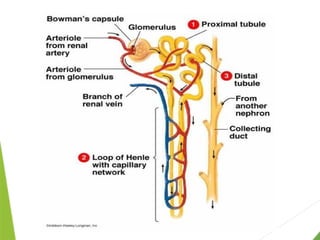
● Eachnephron has a cup like structure called Bowman’s capsule
containing a bundle of capillaries called glomerulus. The Bowman’s
capsule leads into a tubular structure which joins into a collecting duct.
The renal artery brings the nitrogenous waste like ammonia, urea, uric
acid (urine) along with excess water, salts etc. into the nephron. It filters
the nitrogenous waste, water and salts which passes through the tubular
structure into the collecting duct. The waste then passes through the
ureters into the urinary bladder and is then sent out through the urethra
●as urine.
● The useful products like amino acids, glucose, salts etc. are
reabsorbed by the capillaries around the tubular structure and goes into
the real vein.
●b) Excretion in plants :-
● In plants the gaseous waste products produced during respiration
(CO2
) and photosynthesis (O2
) are removed through the stomata. Excess
water is removed through the stomata. This process is called
transpiration.
● Some waste products are stored in the leaves and removed when the
leaves dry and fall off. Some waste products are stored in vacuoles.
Some waste products like gums and resins are stored in the old
xylem cells. Some waste products are removed through the roots.