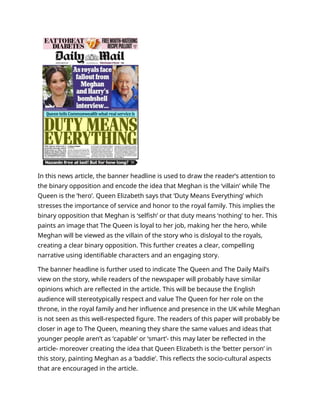
In this news article, the banner headline is used to draw the reader’s attention to
the binary opposition and encode the idea that Meghan is the ‘villain’ while The
Queen is the ‘hero’. Queen Elizabeth says that ‘Duty Means Everything’ which
stresses the importance of service and honor to the royal family. This implies the
binary opposition that Meghan is ‘selfish’ or that duty means ‘nothing’ to her. This
paints an image that The Queen is loyal to her job, making her the hero, while
Meghan will be viewed as the villain of the story who is disloyal to the royals,
creating a clear binary opposition. This further creates a clear, compelling
narrative using identifiable characters and an engaging story.
The banner headline is further used to indicate The Queen and The Daily Mail’s
view on the story, while readers of the newspaper will probably have similar
opinions which are reflected in the article. This will be because the English
audience will stereotypically respect and value The Queen for her role on the
throne, in the royal family and her influence and presence in the UK while Meghan
is not seen as this well-respected figure. The readers of this paper will probably be
closer in age to The Queen, meaning they share the same values and ideas that
younger people aren’t as ‘capable’ or ‘smart’- this may later be reflected in the
article- moreover creating the idea that Queen Elizabeth is the ‘better person’ in
this story, painting Meghan as a ‘baddie’. This reflects the socio-cultural aspects
that are encouraged in the article.
The use of simplistic language in the headline makes it very clear to the audience
that Meghan is the ‘villain’ while the Queen is honorable and dutiful, making the
story easy to side with the ‘good person’- in this case that’s Queen Elizabeth. This
encodes Levi’s idea that binary opposition between good and evil as well as
creating a compelling narrative, easily identifiable characters and audience
identification.
In this article, the sub-headline is used to further demonstrate Levi Strauss’ idea of
binary opposition. The word ‘real’ indicates that The Queen thinks that Meghan
does not value or respect ‘real service’, painting the image to the audience that
Meghan is ‘fake’- therefore the ‘baddie’. The word ‘service’ may also support the
idea that Meghan is ‘selfish’ and ‘disloyal’ to the royals. The anchoring text under
the images of The Queen and The Dutchess of Sussex further contributes to the
idea that Meghan doesn’t fulfill her duty to the royal family and doesn’t hold the
same level of respect over the audience. It says ‘speaking out’ under her photo
while under the Queen’s it says ‘Speech’ where she ‘addresses’ the situation. This
conveys a sense of duty and responsibility while Meghan is painted as
‘complaining’ about the article’s story. This supports the socio-cultural beliefs of
the English audience who value ‘Service, Duty and Hope', alongside The Queen.
18/10/24

Levi Strauss Analasis Task 2 aaaaaaaaaaa

  • 1.
    In this newsarticle, the banner headline is used to draw the reader’s attention to the binary opposition and encode the idea that Meghan is the ‘villain’ while The Queen is the ‘hero’. Queen Elizabeth says that ‘Duty Means Everything’ which stresses the importance of service and honor to the royal family. This implies the binary opposition that Meghan is ‘selfish’ or that duty means ‘nothing’ to her. This paints an image that The Queen is loyal to her job, making her the hero, while Meghan will be viewed as the villain of the story who is disloyal to the royals, creating a clear binary opposition. This further creates a clear, compelling narrative using identifiable characters and an engaging story. The banner headline is further used to indicate The Queen and The Daily Mail’s view on the story, while readers of the newspaper will probably have similar opinions which are reflected in the article. This will be because the English audience will stereotypically respect and value The Queen for her role on the throne, in the royal family and her influence and presence in the UK while Meghan is not seen as this well-respected figure. The readers of this paper will probably be closer in age to The Queen, meaning they share the same values and ideas that younger people aren’t as ‘capable’ or ‘smart’- this may later be reflected in the article- moreover creating the idea that Queen Elizabeth is the ‘better person’ in this story, painting Meghan as a ‘baddie’. This reflects the socio-cultural aspects that are encouraged in the article.
  • 2.
    The use ofsimplistic language in the headline makes it very clear to the audience that Meghan is the ‘villain’ while the Queen is honorable and dutiful, making the story easy to side with the ‘good person’- in this case that’s Queen Elizabeth. This encodes Levi’s idea that binary opposition between good and evil as well as creating a compelling narrative, easily identifiable characters and audience identification. In this article, the sub-headline is used to further demonstrate Levi Strauss’ idea of binary opposition. The word ‘real’ indicates that The Queen thinks that Meghan does not value or respect ‘real service’, painting the image to the audience that Meghan is ‘fake’- therefore the ‘baddie’. The word ‘service’ may also support the idea that Meghan is ‘selfish’ and ‘disloyal’ to the royals. The anchoring text under the images of The Queen and The Dutchess of Sussex further contributes to the idea that Meghan doesn’t fulfill her duty to the royal family and doesn’t hold the same level of respect over the audience. It says ‘speaking out’ under her photo while under the Queen’s it says ‘Speech’ where she ‘addresses’ the situation. This conveys a sense of duty and responsibility while Meghan is painted as ‘complaining’ about the article’s story. This supports the socio-cultural beliefs of the English audience who value ‘Service, Duty and Hope', alongside The Queen. 18/10/24