LEVERAGING AI AND DATA ANALYTICS IN DECISION MAKING.pptx
1.
Leveraging AI &Data Analytics in Decision Making:
Challenges & Future Trends
Prof. Godwin Emmanuel Oyedokun
Professor of Accounting and Financial Development
Department of Management & Accounting
Faculty of Management and Social Sciences
Lead City University, Ibadan, Nigeria
Principal Partner; Oyedokun Godwin Emmanuel & Co
(Accountants, Tax Practitioners & Forensic Auditors)
Being a Paper Presented at the ICAN Ikorodu & District Society Webinar Session Held on
Saturday, April 26, 2025.
2.
ND (Fin), HND(Acct.), BSc. (Acct. Ed), BSc (Fin.), LLB., LLM, MBA (Acct. & Fin.), MSc. (Acct.), MSc. (Bus &Econs), MSc. (Fin), MSc.
(Econs), Ph.D. (Acct), Ph.D. (Fin), Ph.D. (FA), CICA, CFA, CFE, CIPFA, CPFA, CertIFR, ACS, ACIS, ACIArb, ACAMS, ABR, IPA, IFA,
MNIM, FCA, FCTI, FCIB, FCNA, FCFIP, FCE, FERP, FFAR, FPD-CR, FSEAN, FNIOAIM, FCCrFA, FCCFI, FICA, FCECFI, JP
Prof. Godwin Emmanuel Oyedokun
Professor of Accounting and Financial Development
Department of Management & Accounting
Faculty of Management and Social Sciences
Lead City University, Ibadan, Nigeria
Principal Partner; Oyedokun Godwin Emmanuel & Co
(Accountants, Tax Practitioners & Forensic Auditors)
3.
Leveraging AI &Data Analytics
in Decision Making:
Challenges & Future Trends
4.
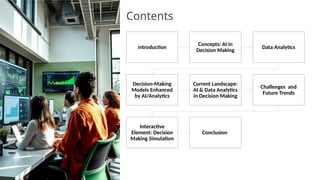
Contents
Introduction
Concepts: AI in
DecisionMaking
Data Analytics
Decision-Making
Models Enhanced
by AI/Analytics
Current Landscape:
AI & Data Analytics
in Decision Making
Challenges and
Future Trends
Interactive
Element: Decision
Making Simulation
Conclusion
5.
Introduction
In today’s fast-paceddigital era, data has become the new oil - a critical
resource that fuels innovation, efficiency, and competitive advantage.
However, data in itself is meaningless unless processed, interpreted, and
utilized for actionable insights. This is where Artificial Intelligence (AI) and
Data Analytics come in. Organizations that effectively harness this data can
gain a significant competitive edge.
Artificial Intelligence (AI) and Data Analytics have emerged as transformative
technologies in this space, enabling smarter, faster, and more accurate
decision-making processes. From predicting customer behavior to optimizing
supply chains, these tools are reshaping the way decisions are made across
industries.
The goal of this paper is to explore how AI and Data Analytics can be
effectively leveraged in decision-making, identify potential challenges,
emerging trends, and exciting new opportunities.
6.
Concepts: AI inDecision
Making
Understand the core concepts of AI in decision-making.
AI Types
Machine Learning, Deep
Learning, and NLP are key.
Key Algorithms
Regression, classification,
and clustering are
important.
Predictive Maintenance
Uses regression models for high accuracy.
7.
Data Analytics
Explore thefoundations of data analytics and its applications.
Types of Analytics
Descriptive, diagnostic, predictive, and prescriptive.
Data Mining
Identifies patterns like market basket analysis.
Visualization Tools
Tableau, Power BI, and Looker enhance insights.
8.
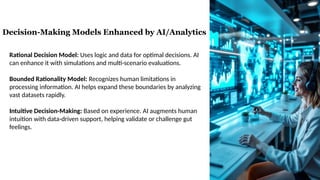
Rational Decision Model:Uses logic and data for optimal decisions. AI
can enhance it with simulations and multi-scenario evaluations.
Bounded Rationality Model: Recognizes human limitations in
processing information. AI helps expand these boundaries by analyzing
vast datasets rapidly.
Intuitive Decision-Making: Based on experience. AI augments human
intuition with data-driven support, helping validate or challenge gut
feelings.
Decision-Making Models Enhanced by AI/Analytics
9.
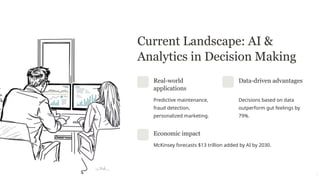
Current Landscape: AI&
Analytics in Decision Making
Real-world
applications
Predictive maintenance,
fraud detection,
personalized marketing.
Data-driven advantages
Decisions based on data
outperform gut feelings by
79%.
Economic impact
McKinsey forecasts $13 trillion added by AI by 2030.
10.
Challenges and FutureTrends
Explore how AI and data analytics transform business strategies. Understand key
challenges and forecast future trends.
11.
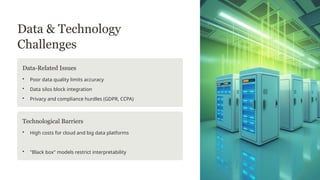
Data & Technology
Challenges
Data-RelatedIssues
• Poor data quality limits accuracy
• Data silos block integration
• Privacy and compliance hurdles (GDPR, CCPA)
Technological Barriers
• High costs for cloud and big data platforms
• "Black box" models restrict interpretability
12.
Human & EthicalChallenges
Organizational Factors
• AI talent shortage
• Leadership lacks data literacy
• Resistance to technology adoption
Ethical & ROI Concerns
• Ethical dilemmas in automation
• Accountability gaps in AI systems
• Difficulty measuring short-term ROI
13.
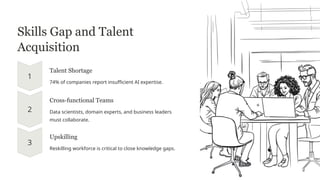
Skills Gap andTalent
Acquisition
Talent Shortage
74% of companies report insufficient AI expertise.
Cross-functional Teams
Data scientists, domain experts, and business leaders
must collaborate.
Upskilling
Reskilling workforce is critical to close knowledge gaps.
14.
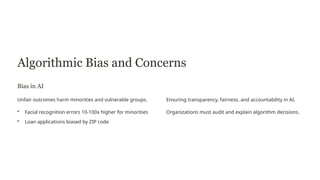
Algorithmic Bias andConcerns
Bias in AI
Unfair outcomes harm minorities and vulnerable groups.
• Facial recognition errors 10-100x higher for minorities
• Loan applications biased by ZIP code
Ensuring transparency, fairness, and accountability in AI.
Organizations must audit and explain algorithm decisions.
15.
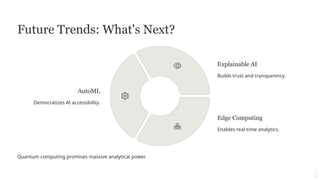
Future Trends: What'sNext?
AutoML
Democratizes AI accessibility.
Explainable AI
Builds trust and transparency.
Edge Computing
Enables real-time analytics.
Quantum computing promises massive analytical power.
16.
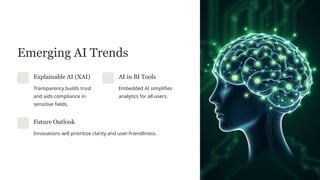
Emerging AI Trends
ExplainableAI (XAI)
Transparency builds trust
and aids compliance in
sensitive fields.
AI in BI Tools
Embedded AI simplifies
analytics for all users.
Future Outlook
Innovations will prioritize clarity and user-friendliness.
17.
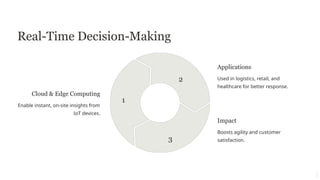
Real-Time Decision-Making
Cloud &Edge Computing
Enable instant, on-site insights from
IoT devices.
1
Applications
Used in logistics, retail, and
healthcare for better response.
2
Impact
Boosts agility and customer
satisfaction.
3
18.
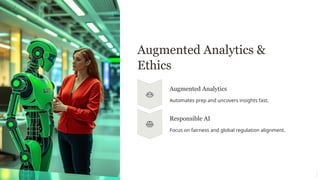
Augmented Analytics &
Ethics
AugmentedAnalytics
Automates prep and uncovers insights fast.
Responsible AI
Focus on fairness and global regulation alignment.
19.
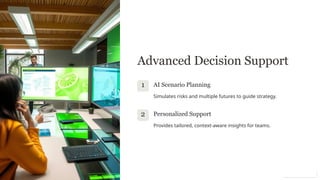
Advanced Decision Support
1AI Scenario Planning
Simulates risks and multiple futures to guide strategy.
2 Personalized Support
Provides tailored, context-aware insights for teams.
20.
Human-AI Collaboration &Global Innovation
Hybrid Human-AI Models
AI enhances, humans provide ethics and judgment.
Global Collaboration
• Shared standards and ethics
• Cross-border data sharing
• Ecosystem-driven innovation
AI and analytics reshape decision-making with responsibility and inclusion.
21.
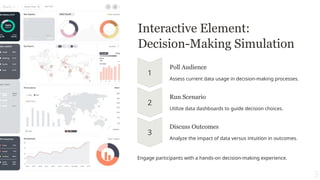
Interactive Element:
Decision-Making Simulation
PollAudience
Assess current data usage in decision-making processes.
Run Scenario
Utilize data dashboards to guide decision choices.
Discuss Outcomes
Analyze the impact of data versus intuition in outcomes.
Engage participants with a hands-on decision-making experience.
22.
Conclusion: Embracing AI-
DrivenDecisions
Key Takeaways
Address data quality,
mitigate bias, and invest in
talent.
Continuous Learning
Adapt and evolve with
accelerating AI advances.
Call to Action
Adopt responsible, transparent AI for smarter decisions.
23.
Prof. Godwin EmmanuelOyedokun
Professor of Accounting & Financial Development
Lead City University, Ibadan, Nigeria
Principal Partner; Oyedokun Godwin Emmanuel & Co
(Accountants, Tax Practitioners & Forensic Auditors)
godwinoye@yahoo.com; godwinoye@oyedokungodwin.com
+2348033737184 & 2348055863944





![[DSC DACH 24] Harnessing AI for Sustainable Results: Strategies for Long-Term...](https://cdn.slidesharecdn.com/ss_thumbnails/johannesschauer-240921154533-335db038-thumbnail.jpg?width=640&height=640&fit=bounds)


