Artificial Intelligence inBusiness
Analytics
B.Ziyaudeen.MCA.,M.Phil.,MBA(IS).,(Ph.D)
Assistant Professor PSGR Krishnammal College For Women.Coimbatore
Humane AI Pin
Hands-free operation
Personalized assistance
Reduced smartphone reliance
Enhanced privacy features
4.
Oura Ring Gen4
Powerful health-tracking device
Sleep Tracking and
Optimization
Sleep Coaching
Activity and Fitness
Tracking
Mental Health and
Stress Management
Temperature
Monitoring
5.
Tempo Move 2.0
Smarthome gym device
AI-Powered Form Correction
Personalized Workout Plans
Weight and Reps Tracking
Recovery and Wellness
Insights
6.
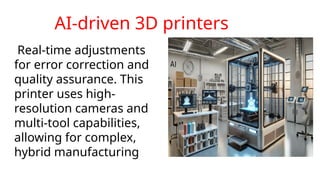
AI-driven 3D printers
Real-timeadjustments
for error correction and
quality assurance. This
printer uses high-
resolution cameras and
multi-tool capabilities,
allowing for complex,
hybrid manufacturing
Introduction to AIin Business
Analytics
What is AI in Business Analytics?
●
Artificial Intelligence (AI) refers to the simulation of human
intelligence processes by machines, especially computer systems.
●
In the context of business analytics, AI uses algorithms and
machine learning models to process large datasets and derive
actionable insights.
Why is AI important in business analytics?
●
AI enables companies to make data-driven decisions, predict future
trends, and optimize processes.
10.
Evolution of BusinessAnalytics
Traditional Business Analytics:
●
Relies on historical data, manual reporting, and descriptive statistics.
●
Modern Business Analytics with AI:
●
Incorporates machine learning, predictive analytics, natural language
processing (NLP), and big data tools to automate and optimize decision-
making.
●
Key Advantages of AI in Business Analytics:
●
Speed
●
Accuracy
●
Predictive power
11.
Key Components ofAI in Business
Analytics
1.Machine Learning (ML)
●
Algorithms that allow systems to learn from data and improve over time.
●
2.Natural Language Processing (NLP)
●
Enables systems to understand and analyze human language (e.g., chatbots, sentiment
analysis).
●
3.Predictive Analytics
●
Uses historical data and AI models to predict future trends and behaviors.
●
4.Data Mining
●
Extracts patterns and knowledge from large datasets.
●
5.Automation
●
AI-driven tools that automate repetitive data analysis tasks, freeing up human resources.
12.
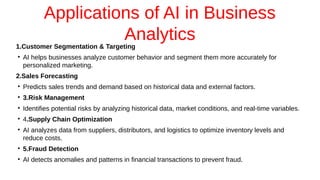
Applications of AIin Business
Analytics
1.Customer Segmentation & Targeting
●
AI helps businesses analyze customer behavior and segment them more accurately for
personalized marketing.
2.Sales Forecasting
●
Predicts sales trends and demand based on historical data and external factors.
●
3.Risk Management
●
Identifies potential risks by analyzing historical data, market conditions, and real-time variables.
●
4.Supply Chain Optimization
●
AI analyzes data from suppliers, distributors, and logistics to optimize inventory levels and
reduce costs.
●
5.Fraud Detection
●
AI detects anomalies and patterns in financial transactions to prevent fraud.
13.
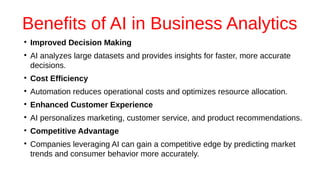
Benefits of AIin Business Analytics
●
Improved Decision Making
●
AI analyzes large datasets and provides insights for faster, more accurate
decisions.
●
Cost Efficiency
●
Automation reduces operational costs and optimizes resource allocation.
●
Enhanced Customer Experience
●
AI personalizes marketing, customer service, and product recommendations.
●
Competitive Advantage
●
Companies leveraging AI can gain a competitive edge by predicting market
trends and consumer behavior more accurately.
14.
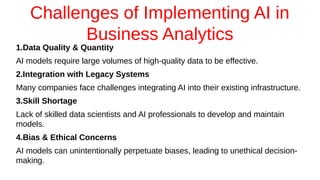
Challenges of ImplementingAI in
Business Analytics
1.Data Quality & Quantity
AI models require large volumes of high-quality data to be effective.
2.Integration with Legacy Systems
Many companies face challenges integrating AI into their existing infrastructure.
3.Skill Shortage
Lack of skilled data scientists and AI professionals to develop and maintain
models.
4.Bias & Ethical Concerns
AI models can unintentionally perpetuate biases, leading to unethical decision-
making.
15.
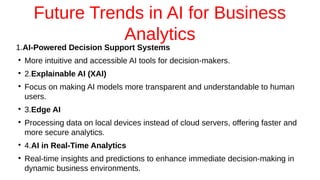
Future Trends inAI for Business
Analytics
1.AI-Powered Decision Support Systems
●
More intuitive and accessible AI tools for decision-makers.
●
2.Explainable AI (XAI)
●
Focus on making AI models more transparent and understandable to human
users.
●
3.Edge AI
●
Processing data on local devices instead of cloud servers, offering faster and
more secure analytics.
●
4.AI in Real-Time Analytics
●
Real-time insights and predictions to enhance immediate decision-making in
dynamic business environments.
16.
Case Study: AIin Retail Analytics
●
Company: Walmart
●
Walmart uses AI to forecast demand, optimize
inventory, and recommend personalized products to
customers.
●
AI-powered chatbots and virtual assistants enhance
the shopping experience.
●
Data-driven predictive analytics improve supply chain
efficiency.
17.
Job Opportunities inAI and
Business Analytics
●
1. Data Scientist
●
Role:
●
Design and implement machine learning models to analyze complex
datasets and extract valuable insights.
●
Key Skills:
●
Machine learning algorithms, statistical analysis, programming
(Python, R), data wrangling, and data visualization.
●
Industry Demand:
●
High demand across tech, finance, healthcare, and retail industries.
18.
AI/ML Engineer
●
Role:
●
Develop anddeploy AI and machine learning algorithms,
ensuring their integration into business systems.
●
Key Skills:
●
Deep learning, NLP, algorithm optimization, TensorFlow,
PyTorch, and software engineering.
●
Industry Demand:
●
Essential for tech companies, healthcare, e-commerce, and
finance.
19.
Business Intelligence Analyst
●
Role:
●
Usedata analytics and AI tools to help businesses make
informed decisions by analyzing historical data and trends.
●
Key Skills:
●
Data visualization (Tableau, Power BI), SQL, data mining, and
problem-solving skills.
●
Industry Demand:
●
Common across most industries, especially in finance, marketing,
and consulting.
20.
Data Engineer
Role:
Build andmaintain the infrastructure (databases, pipelines) needed
for large-scale data processing and AI modeling.
●
Key Skills:
Cloud computing, SQL, NoSQL databases, Hadoop, Spark, and
ETL processes.
Industry Demand:
Growing demand in all sectors, particularly in large tech firms and
data-driven organizations.
21.
AI Research Scientist
●
Role:
●
Conductresearch to develop new AI techniques, algorithms, and
models to push the boundaries of AI technology.
●
Key Skills:
●
Advanced understanding of AI principles, research methodologies,
deep learning, reinforcement learning, and statistical analysis.
●
Industry Demand:
●
Common in academia, tech research labs, and large R&D
departments.
22.
AI Product Manager
●
Role:
●
Overseethe development and deployment of AI-based products,
ensuring alignment with business goals and customer needs.
●
Key Skills:
●
Product development, project management, AI knowledge,
customer experience focus, and cross-functional collaboration.
●
Industry Demand:
●
High demand in tech, software development, and startups.
23.
Ethical AI Specialist
●
Role:
●
Focuson ensuring AI systems are ethical, transparent, and free from
bias. They develop policies for ethical AI implementation.
●
Key Skills:
●
Knowledge of AI ethics, legal frameworks, bias detection, data
privacy, and compliance.
●
Industry Demand:
●
Increasing demand in organizations concerned with AI transparency
and fairness, particularly in healthcare, finance, and government.
24.
AI in MarketingAnalyst
●
Role:
●
Use AI-powered tools to analyze consumer data and optimize
marketing campaigns, enhancing customer targeting and
engagement.
●
Key Skills:
●
Digital marketing, predictive analytics, machine learning models, and
customer behavior analysis.
●
Industry Demand:
●
In high demand in the e-commerce, advertising, and retail industries.
25.
Financial Analyst withAnalytics
Focus
●
Role:
●
Use data analysis and modeling techniques to forecast financial trends,
prepare budgets, and assess the financial performance of a business.
●
Key Skills:
●
Financial modeling, data visualization, Excel, financial forecasting, and
knowledge of financial management tools (like SAP, Oracle).
●
Industry Demand:
●
Strong demand in banking, investment firms, corporate finance
departments, and insurance.
26.
Operations Analyst
●
Role:
●
Improve operationalefficiency by analyzing data related to
business processes, supply chain, and logistics.
●
Key Skills:
●
Process optimization, data modeling, supply chain analytics,
proficiency in Excel and ERP systems (SAP, Oracle).
●
Industry Demand:
●
Particularly relevant in manufacturing, logistics, and retail.
27.
Business Intelligence (BI)Analyst
●
Role:
●
Leverage business intelligence tools to analyze business data and
produce reports that support decision-making and strategic initiatives.
●
Key Skills:
●
BI tools (Power BI, Tableau), SQL, data visualization, strategic
thinking, and report generation.
●
Industry Demand:
●
Growing demand across industries such as retail, banking, healthcare,
and consulting.
28.
Risk Analyst
●
Role:
●
Use dataanalytics to assess and mitigate financial,
operational, and market risks that businesses face.
●
Key Skills:
●
Statistical analysis, risk management tools, predictive
modeling, financial analysis, and reporting.
●
Industry Demand:
●
Strong demand in finance, insurance, and banking sectors.
29.
Customer Insights Analyst
●
Role:
●
Gatherand analyze customer data to identify purchasing behavior,
preferences, and trends that help shape business strategies and
customer experience improvements.
●
Key Skills:
●
Consumer analytics, segmentation, customer journey mapping, and
CRM tools (Salesforce, HubSpot).
●
Industry Demand:
●
Particularly relevant in retail, e-commerce, and customer-centric
businesses.
30.
Supply Chain Analyst
●
Role:
●
Usedata analytics to optimize the supply chain, reduce costs,
and improve inventory management and logistics.
●
Key Skills:
●
Supply chain optimization, demand forecasting, inventory
analysis, and knowledge of logistics software.
●
Industry Demand:
●
In high demand in manufacturing, logistics, retail, and
distribution sectors.