Powerpoint Template V2
Lessons learnt from fibre optics
in aircraft
Andrew Lee
AVoptics Ltd
ESTEC 10/12/15
Powerpoint Template V2
Introduction
• Todays Presentation:
– History
– Differences seen between space and aero
– Previous barriers
– Current State of the Art
– Learning from Aerospace
Powerpoint Template V2
Who are we?
AS9100 certified company formed in 2005
Specialise in research, designing, developing and
manufacturing Fibre Optics in Harsh
Environments
• Harsh Environment Fibre Optics
• Free Space Optical Communications
• Fibre Optic Sensing and Structural Health
Monitoring
• Hyper-Spectral Imaging
• Electronic Design and Prototyping
• Tuneable IR Laser Systems
Powerpoint Template V2
History of Fibre in Aerospace
• Fibre optics first flew over 30 years ago
• Adoption and standardisation however has taken a
long time
• It is still an ongoing process
• Driver for adoption was security and EMI
• Data has only become more prevalent as adoption of
more commercial technologies has become possible
and digital video requirement has grown.
• It is still seen by many as a new and ‘risky’ technology.
Powerpoint Template V2
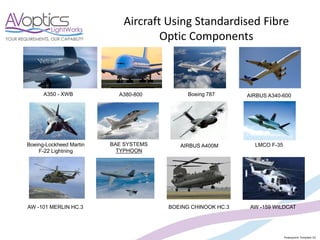
Aircraft Using Standardised Fibre
Optic Components
Boeing-Lockheed Martin
F-22 Lightning
BAE SYSTEMS
TYPHOON
AW -101 MERLIN HC.3
AIRBUS A340-600
A380-800
AIRBUS A400M LMCO F-35
Boeing 787
A350 - XWB
BOEING CHINOOK HC.3 AW -159 WILDCAT
V0415
Powerpoint Template V2
What is the Gap between
Aviation and Space
• Main requirements differences:
– Military avionics requirements are similar or harsher
than a typical LEO (SP2) system
– SP3 however considerably colder
– Radiation and outgassing requirements remain the
two main fundamental differences.
– However, this is changing with a big push towards the
next generation of military UAV’s
• High altitudes and harsher radiation requirements
• A lot of the information regarding radiation requirements of
UAV is difficult to show publicly.
Powerpoint Template V2
Previous barriers to adoption
in aerospace
• Perception
• Supportability
• Training and knowledge
• Real requirement
– Only implemented recently for bandwidth
– Security and EMI historically
• Cost
• Previously poor technology selection and practices
selections has, in cases, discouraged adoption
Powerpoint Template V2
Current State of Aerospace
• Still predominantly mission systems and not flight
critical
• Majority of systems are 2.5Gbps or less.
• Applications:
– Data communications
– Secure communications
– Fibre optics sensing
• Impact detection (growing with composites)
• Stress, strain and temperature
Powerpoint Template V2
Databuses
• Avionics Full-DupleX Switched Ethernet (AFDX)
• GBE and Fibre Channel (Mainly in video systems)
• ARINC818 etc…
• Majority of systems are point to point
• Custom Passive Optical Network Systems
• Long term trend is towards 10 GB Ethernet
• Components are mainly:
– Multimode OM3 / OM4
– VCSEL Systems (850nm or 1300nm)
Powerpoint Template V2
Databuses
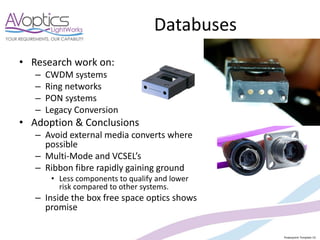
• Research work on:
– CWDM systems
– Ring networks
– PON systems
– Legacy Conversion
• Adoption & Conclusions
– Avoid external media converts where
possible
– Multi-Mode and VCSEL’s
– Ribbon fibre rapidly gaining ground
• Less components to qualify and lower
risk compared to other systems.
– Inside the box free space optics shows
promise
Powerpoint Template V2
Sensing
With the rise in composites interest in load sensing and
monitoring has risen:
• Almost entirely single mode
-600
-400
-200
0
200
400
600
18:40:19 18:40:36 18:40:54 18:41:11 18:41:28 18:41:46 18:42:03 18:42:20 18:42:37
Strain
(microstrain)
Time (HH:MM:SS)
Sensor 1
Sensor 2
Sensor 3
Sensor 21
Sensor 22
Sensor 25
Sensor 26
Sensor 27
Sensor 41
Sensor 42
Sensor 43
Sensor 44
Sensor 45
Sensor 46
Sea-Trial 1: Tack 1
Powerpoint Template V2
Sensing
Damage detection
• Acoustic Emissions detection
Third flight - sustained vibration
-200
0
200
400
600
800
1000
1200
1400
0 500 1000 1500 2000 2500 3000 3500 4000 4500
Time (s)
Sustained
vibration
Acoustic emission events from the third flight
0
500
1000
1500
2000
2500
0 500 1000 1500 2000 2500 3000 3500 4000 4500
Time (s)
Event
amplitude
.
acoustic guard
s1
s2
Powerpoint Template V2
Standards Roadmap
ISO
TC20/SC1
Electrical
NATIONAL STANDARDS BODIES
ANSI
American National
Standards Institute
BSI
British Standards
Institute
CEN
European
Standards Committee
DIN
Deutsches Institut
für Normung e.V.
(Germany)
NOTE: The SAE Aerospace Council serves as the US
sponsor for the US Technical Advisory Committee for
ISO/TC20 providing a focal point for co-ordinating the
needs of the US aerospace industry within ISO/TC20.
SBAC
(UK)
ASD-STAN
(Europe)
EIA/TIA
(USA)
SAE
(USA)
TRADE ASSOCIATIONS
ARINC
(USA)
AFNOR
(France)
ISO TC20
Aerospace
V0415
Powerpoint Template V2
ARINC Standards
• ARINC801 – Termini / Connectors
• ARINC802 – Cable
• ARINC803 – Design Guidelines
• ARINC804 – Active devices
• ARINC805 – Repair and Maintenance
• ARINC806 - Testing
• ARINC807 - Training
Powerpoint Template V2
Learning from Aerospace
• Multiple standards means no standard
• DAPHNE & FONDA programmes showed:
– Optics aren’t always cheaper and lighter.
• Qualification cost, end system costs, power requirements for
MIA’s.
– Multimode can do most things, sensing or RF is the
driver for single mode.
• Training and understanding of the technology is
key, from designer to manufacturer.
• Easy supportability makes adoption easier
Powerpoint Template V2
Learning from Aerospace
• UAV requirements will be driving some aerospace
components in the space direction
• Try to move optics into end systems
• Route optics and electrical harnesses together
• Interest in ribbon fibre is growing rapidly
• Smart structures are coming
– How to interface to structure is a challenge
• Fibre is highly reliable
• Telecoms can mean high obsolesce risk as well
• RF optics and sensing will drive single mode
Powerpoint Template V2
Thank you
Andrew Lee
Call: +44 (0) 1935 471 606
Email: Andrew.lee@avoptics.com

lessons learnt avoptics in aircraft modul avionic integrated

  • 1.
    Powerpoint Template V2 Lessonslearnt from fibre optics in aircraft Andrew Lee AVoptics Ltd ESTEC 10/12/15
  • 2.
    Powerpoint Template V2 Introduction •Todays Presentation: – History – Differences seen between space and aero – Previous barriers – Current State of the Art – Learning from Aerospace
  • 3.
    Powerpoint Template V2 Whoare we? AS9100 certified company formed in 2005 Specialise in research, designing, developing and manufacturing Fibre Optics in Harsh Environments • Harsh Environment Fibre Optics • Free Space Optical Communications • Fibre Optic Sensing and Structural Health Monitoring • Hyper-Spectral Imaging • Electronic Design and Prototyping • Tuneable IR Laser Systems
  • 4.
    Powerpoint Template V2 Historyof Fibre in Aerospace • Fibre optics first flew over 30 years ago • Adoption and standardisation however has taken a long time • It is still an ongoing process • Driver for adoption was security and EMI • Data has only become more prevalent as adoption of more commercial technologies has become possible and digital video requirement has grown. • It is still seen by many as a new and ‘risky’ technology.
  • 5.
    Powerpoint Template V2 AircraftUsing Standardised Fibre Optic Components Boeing-Lockheed Martin F-22 Lightning BAE SYSTEMS TYPHOON AW -101 MERLIN HC.3 AIRBUS A340-600 A380-800 AIRBUS A400M LMCO F-35 Boeing 787 A350 - XWB BOEING CHINOOK HC.3 AW -159 WILDCAT V0415
  • 6.
    Powerpoint Template V2 Whatis the Gap between Aviation and Space • Main requirements differences: – Military avionics requirements are similar or harsher than a typical LEO (SP2) system – SP3 however considerably colder – Radiation and outgassing requirements remain the two main fundamental differences. – However, this is changing with a big push towards the next generation of military UAV’s • High altitudes and harsher radiation requirements • A lot of the information regarding radiation requirements of UAV is difficult to show publicly.
  • 7.
    Powerpoint Template V2 Previousbarriers to adoption in aerospace • Perception • Supportability • Training and knowledge • Real requirement – Only implemented recently for bandwidth – Security and EMI historically • Cost • Previously poor technology selection and practices selections has, in cases, discouraged adoption
  • 8.
    Powerpoint Template V2 CurrentState of Aerospace • Still predominantly mission systems and not flight critical • Majority of systems are 2.5Gbps or less. • Applications: – Data communications – Secure communications – Fibre optics sensing • Impact detection (growing with composites) • Stress, strain and temperature
  • 9.
    Powerpoint Template V2 Databuses •Avionics Full-DupleX Switched Ethernet (AFDX) • GBE and Fibre Channel (Mainly in video systems) • ARINC818 etc… • Majority of systems are point to point • Custom Passive Optical Network Systems • Long term trend is towards 10 GB Ethernet • Components are mainly: – Multimode OM3 / OM4 – VCSEL Systems (850nm or 1300nm)
  • 10.
    Powerpoint Template V2 Databuses •Research work on: – CWDM systems – Ring networks – PON systems – Legacy Conversion • Adoption & Conclusions – Avoid external media converts where possible – Multi-Mode and VCSEL’s – Ribbon fibre rapidly gaining ground • Less components to qualify and lower risk compared to other systems. – Inside the box free space optics shows promise
  • 11.
    Powerpoint Template V2 Sensing Withthe rise in composites interest in load sensing and monitoring has risen: • Almost entirely single mode -600 -400 -200 0 200 400 600 18:40:19 18:40:36 18:40:54 18:41:11 18:41:28 18:41:46 18:42:03 18:42:20 18:42:37 Strain (microstrain) Time (HH:MM:SS) Sensor 1 Sensor 2 Sensor 3 Sensor 21 Sensor 22 Sensor 25 Sensor 26 Sensor 27 Sensor 41 Sensor 42 Sensor 43 Sensor 44 Sensor 45 Sensor 46 Sea-Trial 1: Tack 1
  • 12.
    Powerpoint Template V2 Sensing Damagedetection • Acoustic Emissions detection Third flight - sustained vibration -200 0 200 400 600 800 1000 1200 1400 0 500 1000 1500 2000 2500 3000 3500 4000 4500 Time (s) Sustained vibration Acoustic emission events from the third flight 0 500 1000 1500 2000 2500 0 500 1000 1500 2000 2500 3000 3500 4000 4500 Time (s) Event amplitude . acoustic guard s1 s2
  • 13.
    Powerpoint Template V2 StandardsRoadmap ISO TC20/SC1 Electrical NATIONAL STANDARDS BODIES ANSI American National Standards Institute BSI British Standards Institute CEN European Standards Committee DIN Deutsches Institut für Normung e.V. (Germany) NOTE: The SAE Aerospace Council serves as the US sponsor for the US Technical Advisory Committee for ISO/TC20 providing a focal point for co-ordinating the needs of the US aerospace industry within ISO/TC20. SBAC (UK) ASD-STAN (Europe) EIA/TIA (USA) SAE (USA) TRADE ASSOCIATIONS ARINC (USA) AFNOR (France) ISO TC20 Aerospace V0415
  • 14.
    Powerpoint Template V2 ARINCStandards • ARINC801 – Termini / Connectors • ARINC802 – Cable • ARINC803 – Design Guidelines • ARINC804 – Active devices • ARINC805 – Repair and Maintenance • ARINC806 - Testing • ARINC807 - Training
  • 15.
    Powerpoint Template V2 Learningfrom Aerospace • Multiple standards means no standard • DAPHNE & FONDA programmes showed: – Optics aren’t always cheaper and lighter. • Qualification cost, end system costs, power requirements for MIA’s. – Multimode can do most things, sensing or RF is the driver for single mode. • Training and understanding of the technology is key, from designer to manufacturer. • Easy supportability makes adoption easier
  • 16.
    Powerpoint Template V2 Learningfrom Aerospace • UAV requirements will be driving some aerospace components in the space direction • Try to move optics into end systems • Route optics and electrical harnesses together • Interest in ribbon fibre is growing rapidly • Smart structures are coming – How to interface to structure is a challenge • Fibre is highly reliable • Telecoms can mean high obsolesce risk as well • RF optics and sensing will drive single mode
  • 17.
    Powerpoint Template V2 Thankyou Andrew Lee Call: +44 (0) 1935 471 606 Email: Andrew.lee@avoptics.com