1
Lessons Learned after 190M
Lessons Served
2
Disclaimer
3
Lesson 1 - Keeping a Culture Alive
4
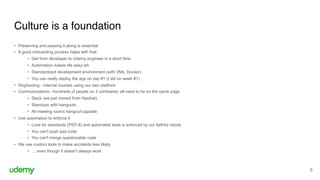
Culture is a foundation
5
• Preserving and passing it along is essential
• A good onboarding process helps with that
• Get from developer to Udemy engineer in a short time
• Automation makes life easy-ish
• Standardized development environment (with VMs, Docker)
• You can really deploy the app on day #1 (I did on week #1)
• Dogfooding - internal courses using our own platform
• Communications - hundreds of people on 3 continents, all need to be on the same page
• Slack (we just moved from Hipchat)
• Standups with hangouts
• All meeting rooms hangout-capable
• Use automation to enforce it
• Love for standards (PEP-8) and automated tests is enforced by our faithful robots
• You can't push bad code
• You can't merge questionable code
• We use custom tools to make accidents less likely
• … even though it doesn’t always work
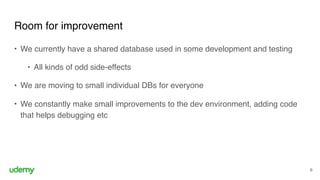
Room for improvement
6
• We currently have a shared database used in some development and testing
• All kinds of odd side-effects
• We are moving to small individual DBs for everyone
• We constantly make small improvements to the dev environment, adding code
that helps debugging etc
7
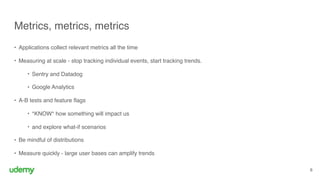
Lesson 2 - Measure Everything, in bulk
Metrics, metrics, metrics
8
• Applications collect relevant metrics all the time
• Measuring at scale - stop tracking individual events, start tracking trends.
• Sentry and Datadog
• Google Analytics
• A-B tests and feature flags
• *KNOW* how something will impact us
• and explore what-if scenarios
• Be mindful of distributions
• Measure quickly - large user bases can amplify trends
9
Lesson 3 - Question Everything
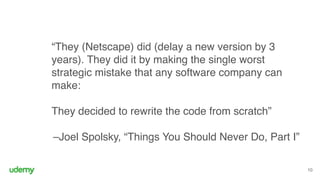
“They (Netscape) did (delay a new version by 3
years). They did it by making the single worst
strategic mistake that any software company can
make:


They decided to rewrite the code from scratch”

–Joel Spolsky, “Things You Should Never Do, Part I”
10
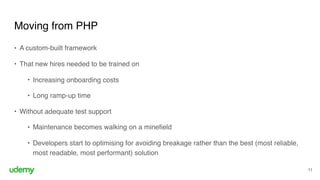
Moving from PHP
11
• A custom-built framework
• That new hires needed to be trained on
• Increasing onboarding costs
• Long ramp-up time
• Without adequate test support
• Maintenance becomes walking on a minefield
• Developers start to optimising for avoiding breakage rather than the best (most reliable,
most readable, most performant) solution
Choosing the way out
12
• Evaluated multiple options
• Laravel
• Node
• Django
• Rails
• Play
13
This was a serious project
What Udemy got in the end
14
• Django-based application
• Legacy-free
• Python 3
• Much shorter developer onboarding
• Great test coverage (88%)
• Lots of new features
• A consistent codebase
• And some scar tissue where PHP and Django coexisted
• Odd table names (that’s really a minor thing)
• Sometimes, we need to fight the opinionated framework we chose
What Udemy learned
15
• It takes a while (2 years to complete)
• It’s a serious commitment (30% of the engineering team on it)
• Incremental (avoid tempting fate)
• It’s easy to lose sight of the goal and get demotivated
• Release early, release often (so that course can be changed quickly)
• Enforce good practices (flake8, testing, mandatory coverage)
Lesson 4 - The Mission Matters
16
17
Help anyone learn anything
18
Anyone can teach something
to someone else
Impact
19
1 in 3 Udemy students are starting or growing their own businesses
Lots of instructors are full-time Udemy instructors
20
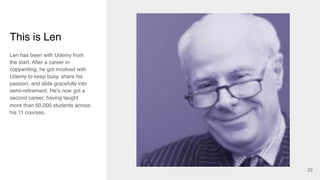
Len has been with Udemy from
the start. After a career in
copywriting, he got involved with
Udemy to keep busy, share his
passion, and slide gracefully into
semi-retirement. He’s now got a
second career, having taught
more than 50,000 students across
his 11 courses.
This is Len
21
By enabling this transformation
in education, we empower
people to change their lives
Thank you
22
@udemy

www.udemy.com

importthis40
23

Lessons learned after 190M lessons served

  • 1.
    1 Lessons Learned after190M Lessons Served
  • 2.
  • 3.
  • 4.
    Lesson 1 -Keeping a Culture Alive 4
  • 5.
    Culture is afoundation 5 • Preserving and passing it along is essential • A good onboarding process helps with that • Get from developer to Udemy engineer in a short time • Automation makes life easy-ish • Standardized development environment (with VMs, Docker) • You can really deploy the app on day #1 (I did on week #1) • Dogfooding - internal courses using our own platform • Communications - hundreds of people on 3 continents, all need to be on the same page • Slack (we just moved from Hipchat) • Standups with hangouts • All meeting rooms hangout-capable • Use automation to enforce it • Love for standards (PEP-8) and automated tests is enforced by our faithful robots • You can't push bad code • You can't merge questionable code • We use custom tools to make accidents less likely • … even though it doesn’t always work
  • 6.
    Room for improvement 6 •We currently have a shared database used in some development and testing • All kinds of odd side-effects • We are moving to small individual DBs for everyone • We constantly make small improvements to the dev environment, adding code that helps debugging etc
  • 7.
    7 Lesson 2 -Measure Everything, in bulk
  • 8.
    Metrics, metrics, metrics 8 •Applications collect relevant metrics all the time • Measuring at scale - stop tracking individual events, start tracking trends. • Sentry and Datadog • Google Analytics • A-B tests and feature flags • *KNOW* how something will impact us • and explore what-if scenarios • Be mindful of distributions • Measure quickly - large user bases can amplify trends
  • 9.
    9 Lesson 3 -Question Everything
  • 10.
    “They (Netscape) did(delay a new version by 3 years). They did it by making the single worst strategic mistake that any software company can make:
 
 They decided to rewrite the code from scratch”
 –Joel Spolsky, “Things You Should Never Do, Part I” 10
  • 11.
    Moving from PHP 11 •A custom-built framework • That new hires needed to be trained on • Increasing onboarding costs • Long ramp-up time • Without adequate test support • Maintenance becomes walking on a minefield • Developers start to optimising for avoiding breakage rather than the best (most reliable, most readable, most performant) solution
  • 12.
    Choosing the wayout 12 • Evaluated multiple options • Laravel • Node • Django • Rails • Play
  • 13.
    13 This was aserious project
  • 14.
    What Udemy gotin the end 14 • Django-based application • Legacy-free • Python 3 • Much shorter developer onboarding • Great test coverage (88%) • Lots of new features • A consistent codebase • And some scar tissue where PHP and Django coexisted • Odd table names (that’s really a minor thing) • Sometimes, we need to fight the opinionated framework we chose
  • 15.
    What Udemy learned 15 •It takes a while (2 years to complete) • It’s a serious commitment (30% of the engineering team on it) • Incremental (avoid tempting fate) • It’s easy to lose sight of the goal and get demotivated • Release early, release often (so that course can be changed quickly) • Enforce good practices (flake8, testing, mandatory coverage)
  • 16.
    Lesson 4 -The Mission Matters 16
  • 17.
  • 18.
    18 Anyone can teachsomething to someone else
  • 19.
    Impact 19 1 in 3Udemy students are starting or growing their own businesses Lots of instructors are full-time Udemy instructors
  • 20.
    20 Len has beenwith Udemy from the start. After a career in copywriting, he got involved with Udemy to keep busy, share his passion, and slide gracefully into semi-retirement. He’s now got a second career, having taught more than 50,000 students across his 11 courses. This is Len
  • 21.
    21 By enabling thistransformation in education, we empower people to change their lives
  • 22.
  • 23.