Mariana Chiarella – Natalia Heick
                             WEBQUESTS - LESSON PLAN
                                  PROJECT: WATER

LESSON 1

TESTING THE WATERS
WATER A NATURAL RESOURCE

The aim of this first lesson is to introduce students to the project and to make them
become acquianted with the importance of water in our lives by discovering and reading
about different facts on this natural resouce.
Students and teacher will read the following webquest sections: Introduction and Task so
that students learn what the project will be about and what they have to achieve.
Then, they will move on to Process, lesson 1 and proceed to work on the first activity.

Activity 1: Watching videos + discussion.

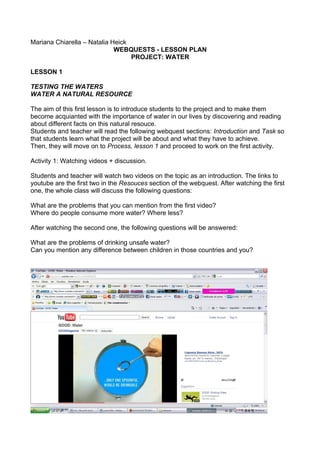
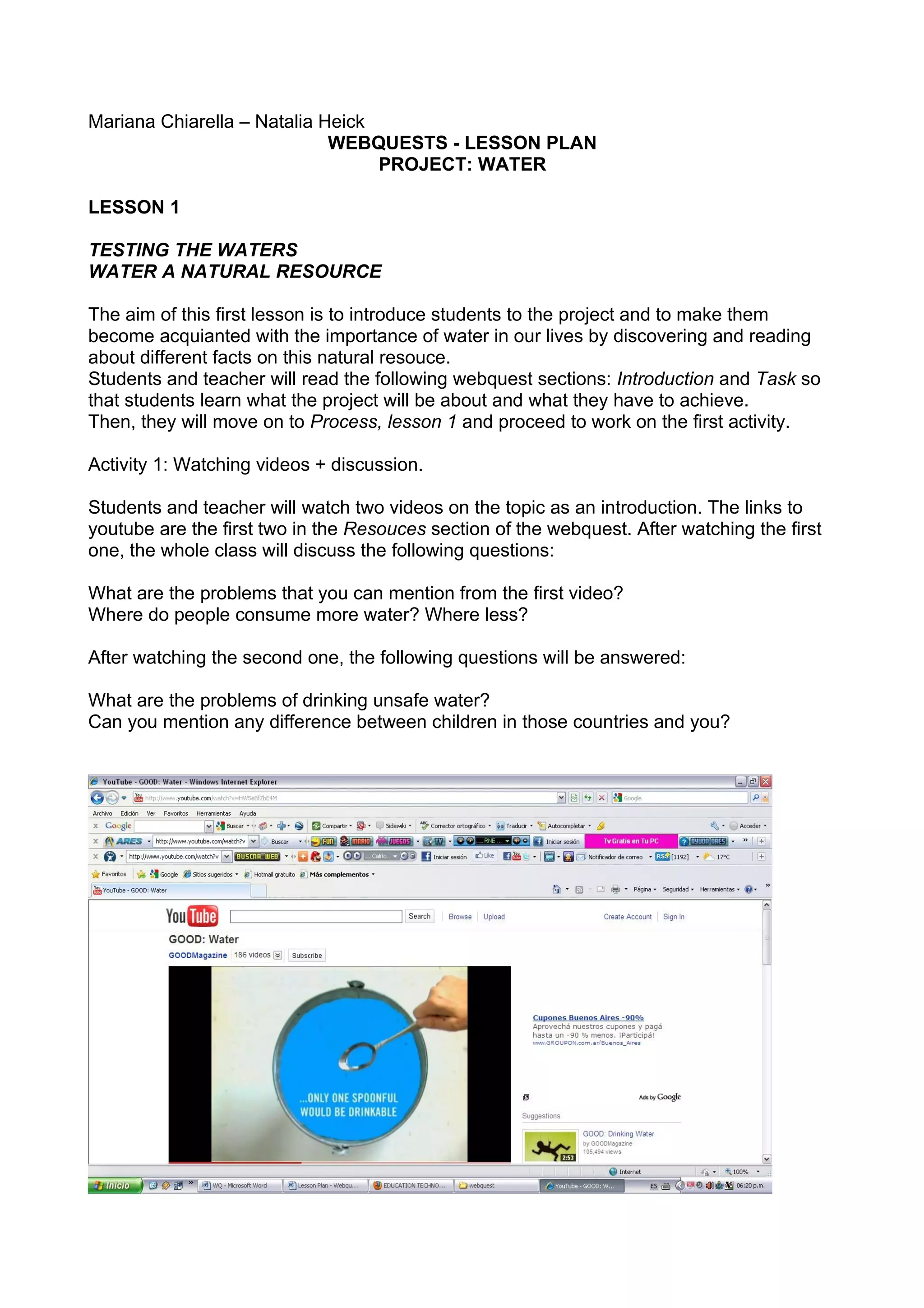
Students and teacher will watch two videos on the topic as an introduction. The links to
youtube are the first two in the Resouces section of the webquest. After watching the first
one, the whole class will discuss the following questions:

What are the problems that you can mention from the first video?
Where do people consume more water? Where less?

After watching the second one, the following questions will be answered:

What are the problems of drinking unsafe water?
Can you mention any difference between children in those countries and you?
Activity 2:

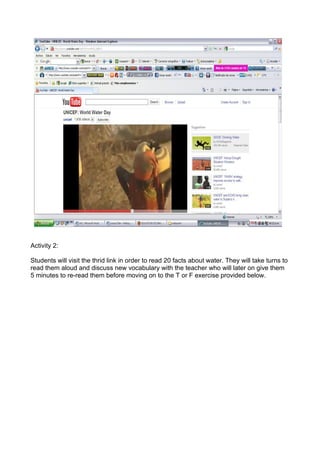
Students will visit the thrid link in order to read 20 facts about water. They will take turns to
read them aloud and discuss new vocabulary with the teacher who will later on give them
5 minutes to re-read them before moving on to the T or F exercise provided below.
20 Interesting and Useful
      Water Facts

TRUE or FALSE?

   1. 70 percent of an adult’s body is made

      up of water.

   2. At birth, water makes approximately 80

      percent of an infant’s body weight.

   3. A healthy person can drink about three gallons (48 cups) of water per day.
   4. Drinking too much water too quickly can’t produce water intoxication. Water
      intoxication causes an imbalance of water in the brain.
   5. Water intoxication can happen more frequently during periods of intense athletic
      performance.
   6. All the water we consume must be of this water must be in the liquid form.
   7. Soft drinks, coffee, and tea are made up almost entirely of water, but they also
      contain caffeine.
   8. Water dissolves more substances than any other liquid. Water carries chemicals,
      minerals, and nutrients with it.
9.   50 percent of the earth’s surface is covered with water.
   10. Not all the water that existed on the earth millions of years ago is still present today.
   11. The total amount of water on the earth is about 326 million cubic miles of water.
   12. Of all the water on the earth humans can only use the water found in groundwater
        aquifers, rivers, and freshwater lakes.
   13. Flushing the toilet actually takes up the largest amount of water we spend in the
        day.
   14. Once you feel thirsty, your body has lost over 3 percent of its total water amount.
   15. After intense physical activity, people lose weight from fat, not water.


LESSON 2

SWIMMING IN CIRCLES
THE WATER CYCLE

The aim of this second lesson is to make students become acquinated with different facts
and specific vocabulary regarding the topic “water cycle” to express the changes of the
state of water.

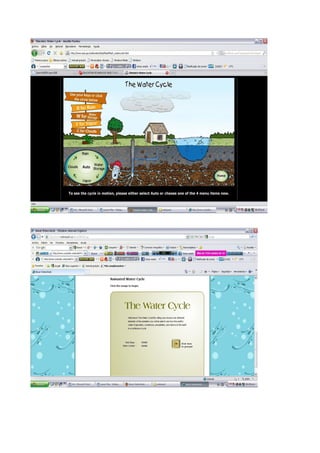
Activity 1: Students will start by watching two animations on links 4 and 5.
After watching the animations, students will work in small groups to answer the following
four questions:
a) Name three processes of water during the water cycle.
b) What is the process of condensation about?
c) When does precipitation occur?
d) How do you call the water stored underground?


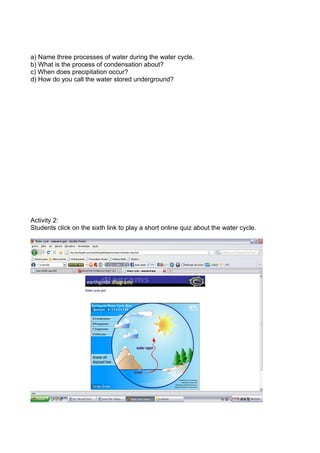
Activity 2:
Students click on the sixth link to play a short online quiz about the water cycle.
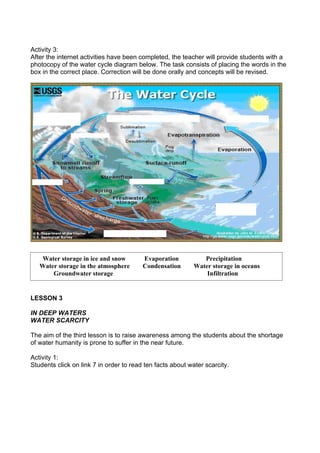
Activity 3:
After the internet activities have been completed, the teacher will provide students with a
photocopy of the water cycle diagram below. The task consists of placing the words in the
box in the correct place. Correction will be done orally and concepts will be revised.


    Water storage in ice and snow        Evaporation           Precipitation
   Water storage in the atmosphere       Condensation       Water storage in oceans
       Groundwater storage                                      Infiltration


LESSON 3

IN DEEP WATERS
WATER SCARCITY

The aim of the third lesson is to raise awareness among the students about the shortage
of water humanity is prone to suffer in the near future.

Activity 1:
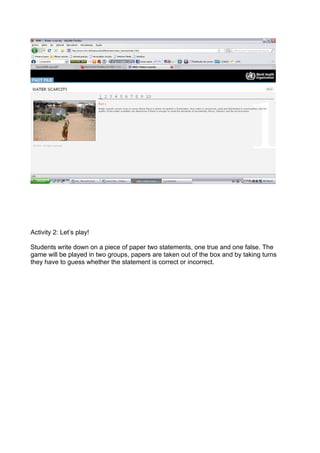
Students click on link 7 in order to read ten facts about water scarcity.
Activity 2: Let’s play!

Students write down on a piece of paper two statements, one true and one false. The
game will be played in two groups, papers are taken out of the box and by taking turns
they have to guess whether the statement is correct or incorrect.
Activity 3:

Students will work on their folders or copybooks on a short reading comprehension
activity.

Place the words in the box in the correct space.
We are in deep waters!
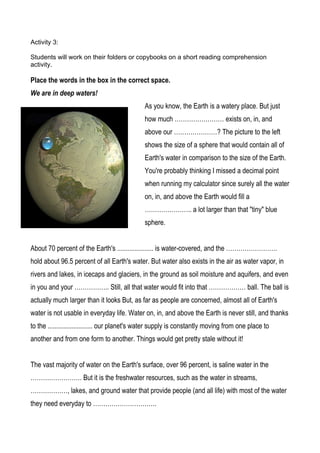
                                              As you know, the Earth is a watery place. But just
                                              how much …………………… exists on, in, and
                                              above our …………………? The picture to the left
                                              shows the size of a sphere that would contain all of
                                              Earth's water in comparison to the size of the Earth.
                                              You're probably thinking I missed a decimal point
                                              when running my calculator since surely all the water
                                              on, in, and above the Earth would fill a
                                              ………………….. a lot larger than that "tiny" blue
                                              sphere.


About 70 percent of the Earth's ..................... is water-covered, and the …………………….
hold about 96.5 percent of all Earth's water. But water also exists in the air as water vapor, in
rivers and lakes, in icecaps and glaciers, in the ground as soil moisture and aquifers, and even
in you and your …………….. Still, all that water would fit into that ……………… ball. The ball is
actually much larger than it looks But, as far as people are concerned, almost all of Earth's
water is not usable in everyday life. Water on, in, and above the Earth is never still, and thanks
to the .......................... our planet's water supply is constantly moving from one place to
another and from one form to another. Things would get pretty stale without it!


The vast majority of water on the Earth's surface, over 96 percent, is saline water in the
……………………. But it is the freshwater resources, such as the water in streams,
………………, lakes, and ground water that provide people (and all life) with most of the water
they need everyday to ………………………….
RIVERS    LIVE      WATER CYCLE                      DOG
        TINY      SURFACE       OCEANS                        BALL
        PLANET             WATER


Activity 4:

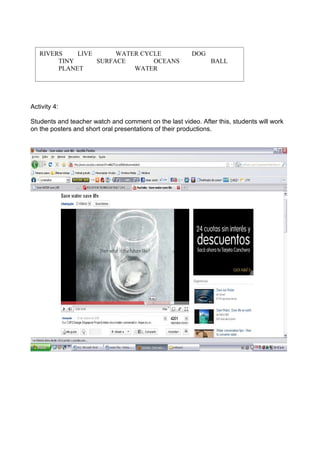
Students and teacher watch and comment on the last video. After this, students will work
on the posters and short oral presentations of their productions.

Lesson plan webquests

  • 1.
    Mariana Chiarella –Natalia Heick WEBQUESTS - LESSON PLAN PROJECT: WATER LESSON 1 TESTING THE WATERS WATER A NATURAL RESOURCE The aim of this first lesson is to introduce students to the project and to make them become acquianted with the importance of water in our lives by discovering and reading about different facts on this natural resouce. Students and teacher will read the following webquest sections: Introduction and Task so that students learn what the project will be about and what they have to achieve. Then, they will move on to Process, lesson 1 and proceed to work on the first activity. Activity 1: Watching videos + discussion. Students and teacher will watch two videos on the topic as an introduction. The links to youtube are the first two in the Resouces section of the webquest. After watching the first one, the whole class will discuss the following questions: What are the problems that you can mention from the first video? Where do people consume more water? Where less? After watching the second one, the following questions will be answered: What are the problems of drinking unsafe water? Can you mention any difference between children in those countries and you?
  • 2.
    Activity 2: Students willvisit the thrid link in order to read 20 facts about water. They will take turns to read them aloud and discuss new vocabulary with the teacher who will later on give them 5 minutes to re-read them before moving on to the T or F exercise provided below.
  • 3.
    20 Interesting andUseful Water Facts TRUE or FALSE? 1. 70 percent of an adult’s body is made up of water. 2. At birth, water makes approximately 80 percent of an infant’s body weight. 3. A healthy person can drink about three gallons (48 cups) of water per day. 4. Drinking too much water too quickly can’t produce water intoxication. Water intoxication causes an imbalance of water in the brain. 5. Water intoxication can happen more frequently during periods of intense athletic performance. 6. All the water we consume must be of this water must be in the liquid form. 7. Soft drinks, coffee, and tea are made up almost entirely of water, but they also contain caffeine. 8. Water dissolves more substances than any other liquid. Water carries chemicals, minerals, and nutrients with it.
  • 4.
    9. 50 percent of the earth’s surface is covered with water. 10. Not all the water that existed on the earth millions of years ago is still present today. 11. The total amount of water on the earth is about 326 million cubic miles of water. 12. Of all the water on the earth humans can only use the water found in groundwater aquifers, rivers, and freshwater lakes. 13. Flushing the toilet actually takes up the largest amount of water we spend in the day. 14. Once you feel thirsty, your body has lost over 3 percent of its total water amount. 15. After intense physical activity, people lose weight from fat, not water. LESSON 2 SWIMMING IN CIRCLES THE WATER CYCLE The aim of this second lesson is to make students become acquinated with different facts and specific vocabulary regarding the topic “water cycle” to express the changes of the state of water. Activity 1: Students will start by watching two animations on links 4 and 5. After watching the animations, students will work in small groups to answer the following four questions:
  • 6.
    a) Name threeprocesses of water during the water cycle. b) What is the process of condensation about? c) When does precipitation occur? d) How do you call the water stored underground? Activity 2: Students click on the sixth link to play a short online quiz about the water cycle.
  • 7.
    Activity 3: After theinternet activities have been completed, the teacher will provide students with a photocopy of the water cycle diagram below. The task consists of placing the words in the box in the correct place. Correction will be done orally and concepts will be revised. Water storage in ice and snow Evaporation Precipitation Water storage in the atmosphere Condensation Water storage in oceans Groundwater storage Infiltration LESSON 3 IN DEEP WATERS WATER SCARCITY The aim of the third lesson is to raise awareness among the students about the shortage of water humanity is prone to suffer in the near future. Activity 1: Students click on link 7 in order to read ten facts about water scarcity.
  • 8.
    Activity 2: Let’splay! Students write down on a piece of paper two statements, one true and one false. The game will be played in two groups, papers are taken out of the box and by taking turns they have to guess whether the statement is correct or incorrect.
  • 9.
    Activity 3: Students willwork on their folders or copybooks on a short reading comprehension activity. Place the words in the box in the correct space. We are in deep waters! As you know, the Earth is a watery place. But just how much …………………… exists on, in, and above our …………………? The picture to the left shows the size of a sphere that would contain all of Earth's water in comparison to the size of the Earth. You're probably thinking I missed a decimal point when running my calculator since surely all the water on, in, and above the Earth would fill a ………………….. a lot larger than that "tiny" blue sphere. About 70 percent of the Earth's ..................... is water-covered, and the ……………………. hold about 96.5 percent of all Earth's water. But water also exists in the air as water vapor, in rivers and lakes, in icecaps and glaciers, in the ground as soil moisture and aquifers, and even in you and your …………….. Still, all that water would fit into that ……………… ball. The ball is actually much larger than it looks But, as far as people are concerned, almost all of Earth's water is not usable in everyday life. Water on, in, and above the Earth is never still, and thanks to the .......................... our planet's water supply is constantly moving from one place to another and from one form to another. Things would get pretty stale without it! The vast majority of water on the Earth's surface, over 96 percent, is saline water in the ……………………. But it is the freshwater resources, such as the water in streams, ………………, lakes, and ground water that provide people (and all life) with most of the water they need everyday to ………………………….
  • 10.
    RIVERS LIVE WATER CYCLE DOG TINY SURFACE OCEANS BALL PLANET WATER Activity 4: Students and teacher watch and comment on the last video. After this, students will work on the posters and short oral presentations of their productions.