WHEATON INTERNATIONAL SCHOOL
FORTHNIGHTLY LESSON PLAN
SESSION 2024-2025
Teacher Name: Juhi Khan
INFORMATION TECHNOLOGY (GRADE IX)
Date from 20.05.2024 Date to 31.05.2024
Class IX Subject
INFORMATION
TECHNOLOGY
Teacher's
Name
JUHI KHAN Focus Application of
IT and ITes
Learning
Outcome:
Student will be able to able to realise the importance of the use of IT and ITes in daily life
SMART
Objectives
To make the
students know
and learn about
various
significance of IT
and ITes
Students will be able
identify and apply
specific IT practices
in their respective
areas of
development.
The students will
be able to solve
questions from
Textbook as well
as questions
from past papers
as well as
competency
based questions.
The syllabus will solely
contain the topic given
in the Grade IX CBSE
syllabus.
This content of the topic will be
completed by the end of May
2024.
Concept to
be learned
Students will be learning the specific application of IT and ITes in various domain of our day to day life.
Skill to be
learned
(Real Life
Application)
Students will be
able to identify
questions related
to IT and ITes
They will be able to
plan the action
required to solve the
given questions
They will be
able to organize
their problems
into hierarchical
stepwise
sequence.
Problem solving ability
will be developed among
students.
This topic will create a need to
practice questions on regular
basis to keep upto date with the
syllabus.
Values
Taught
Through this
topic the students
will be able to
realise the
importance of
digital world in
this modern era of
IT
The students will be
mastering the the
ability to
logical Questions
based on
interconversion of
number system
With the use of
ITes students
will be able to
realize the
importance of
digital literacy.
NIL NIL
Resources
needed
Textbook Lecture by the
teacher
Solve Exercises
from Textbook
as well as
reference books
NIL
Past year question papers
Teaching
Methodology
Lecture Question Solving
through pen and
paper.
Assignments Class Tests Flipped Learning
Acitivities
incorporated
NIL NIL Question Solving NIL NIL
Extended
Learning
Revision of the
chapters will be
done through
practical tests.
Questions will be
given in exam from
this topic
Assignments to be given regularly
Assessments Formative Summative test Quiz Presentation Group discussion
Subject
Integration
Integration of Information Technology and Mathematics (Statistics) will be done with the help of IT Practical Activity.
INFORMATION TECHNOLOGY (GRADE X)
Date from 20.05.2024 Date to 31.05.2024
Class X Subject
INFORMATION TECHN
OLOGY
Teacher's
Name
JUHI KHAN Focus What If Analysis in MS
Excel:Scenario
GoalSeek and Solver
Learning
Outcome:
Student will be able to able to make use of various features of What If Analysis and apply in their daily life handling of a set
of data.
SMART
Objectives
To make the
students know
and learn about
various types of
What If
Analysis.
Students
will be able
apply what
if analysis
in handling
a set of
data.
The students will be able
to solve questions from
Textbook as well as
questions from past
papers as well as
competency based
questions.
The syllabus will solely
contain the topic given
in the Grade 10 CBSE
syllabus.
This content of the topic will be
completed by the end of May 2024.
Concept to
be learned
Students will be learning the use of What if Analysis in MS Excel and use Scenario,Goalseek and Solver judiciously.
Skill to be
learned
(Real Life
Application
)
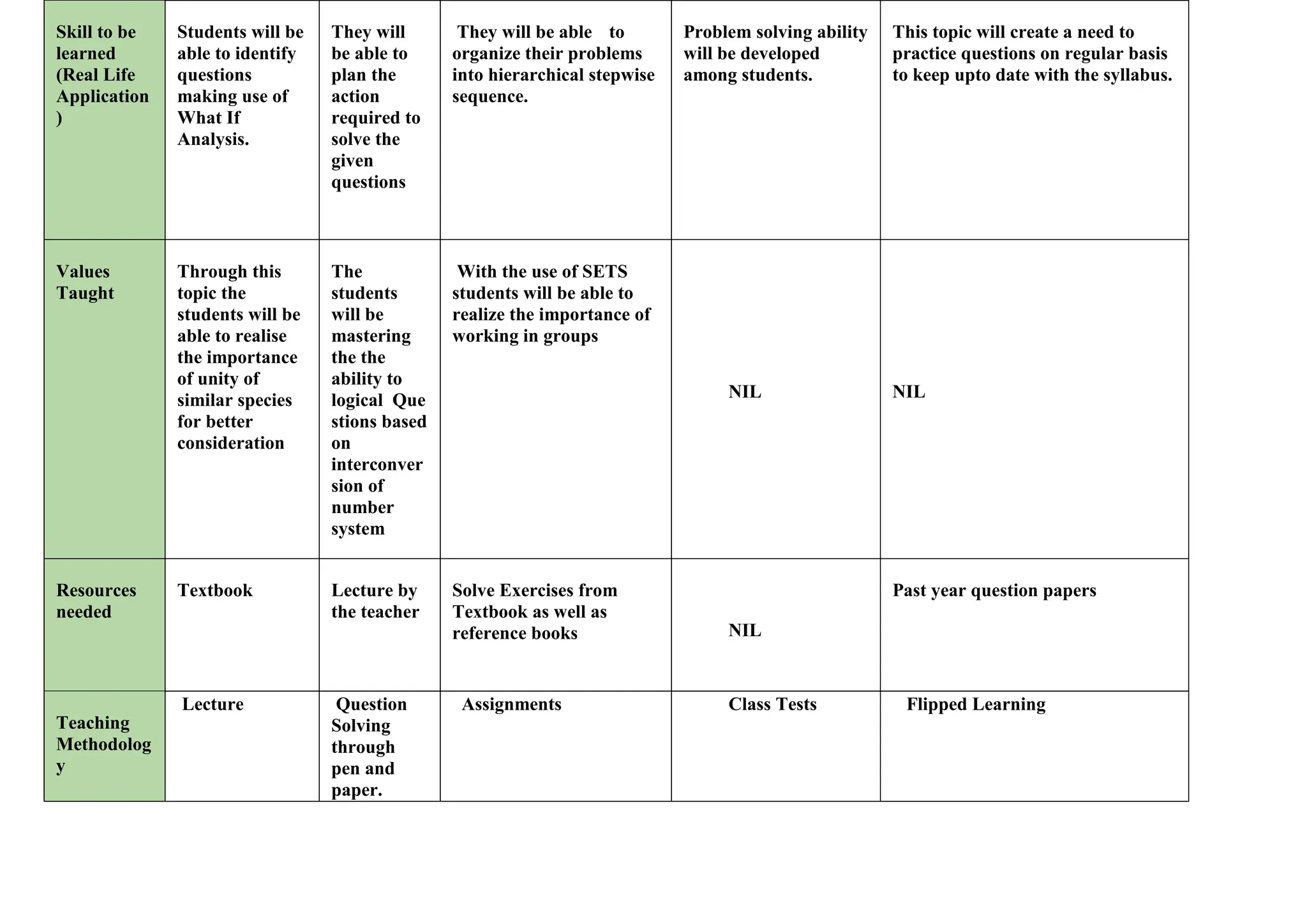
Students will be
able to identify
questions
making use of
What If
Analysis.
They will
be able to
plan the
action
required to
solve the
given
questions
They will be able to
organize their problems
into hierarchical stepwise
sequence.
Problem solving ability
will be developed
among students.
This topic will create a need to
practice questions on regular basis
to keep upto date with the syllabus.
Values
Taught
Through this
topic the
students will be
able to realise
the importance
of unity of
similar species
for better
consideration
The
students
will be
mastering
the the
ability to
logical Que
stions based
on
interconver
sion of
number
system
With the use of SETS
students will be able to
realize the importance of
working in groups
NIL NIL
Resources
needed
Textbook Lecture by
the teacher
Solve Exercises from
Textbook as well as
reference books NIL
Past year question papers
Teaching
Methodolog
y
Lecture Question
Solving
through
pen and
paper.
Assignments Class Tests Flipped Learning
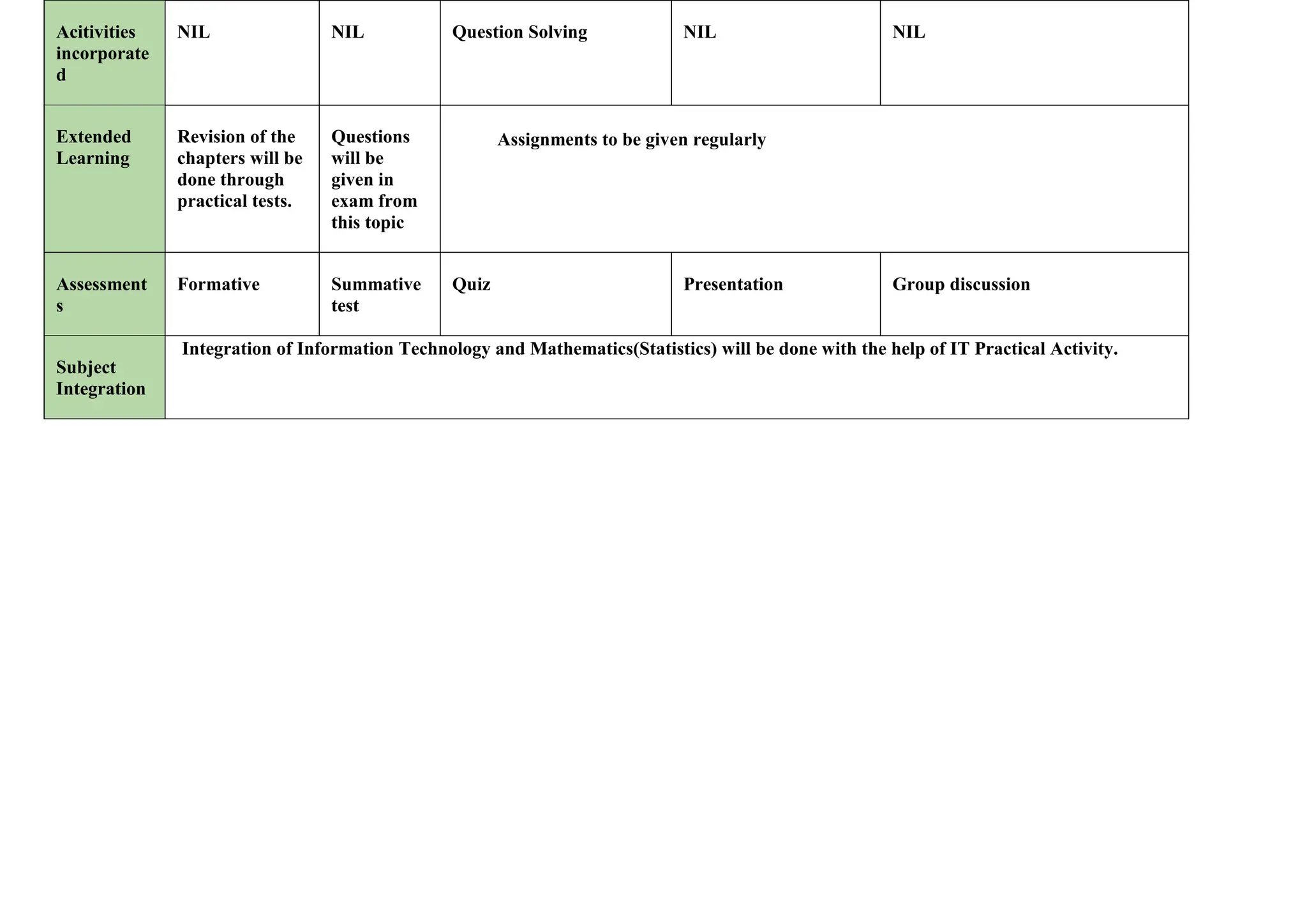
Acitivities
incorporate
d
NIL NIL Question Solving NIL NIL
Extended
Learning
Revision of the
chapters will be
done through
practical tests.
Questions
will be
given in
exam from
this topic
Assignments to be given regularly
Assessment
s
Formative Summative
test
Quiz Presentation Group discussion
Subject
Integration
Integration of Information Technology and Mathematics(Statistics) will be done with the help of IT Practical Activity.
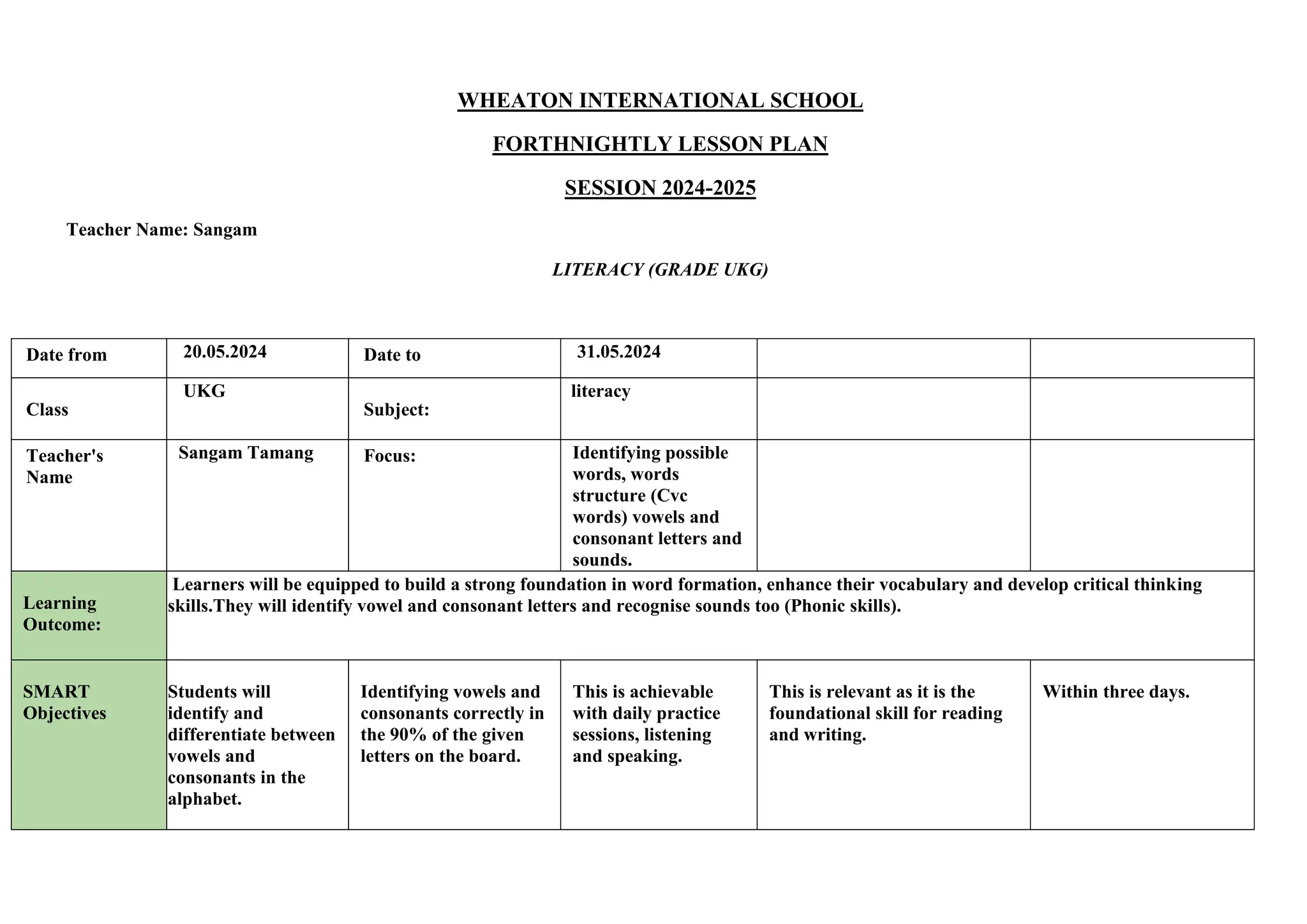
WHEATON INTERNATIONAL SCHOOL
FORTHNIGHTLY LESSON PLAN
SESSION 2024-2025
Teacher Name: Sangam
LITERACY (GRADE UKG)
Date from 20.05.2024 Date to 31.05.2024
Class
UKG
Subject:
literacy
Teacher's
Name
Sangam Tamang Focus: Identifying possible
words, words
structure (Cvc
words) vowels and
consonant letters and
sounds.
Learning
Outcome:
Learners will be equipped to build a strong foundation in word formation, enhance their vocabulary and develop critical thinking
skills.They will identify vowel and consonant letters and recognise sounds too (Phonic skills).
SMART
Objectives
Students will
identify and
differentiate between
vowels and
consonants in the
alphabet.
Identifying vowels and
consonants correctly in
the 90% of the given
letters on the board.
This is achievable
with daily practice
sessions, listening
and speaking.
This is relevant as it is the
foundational skill for reading
and writing.
Within three days.
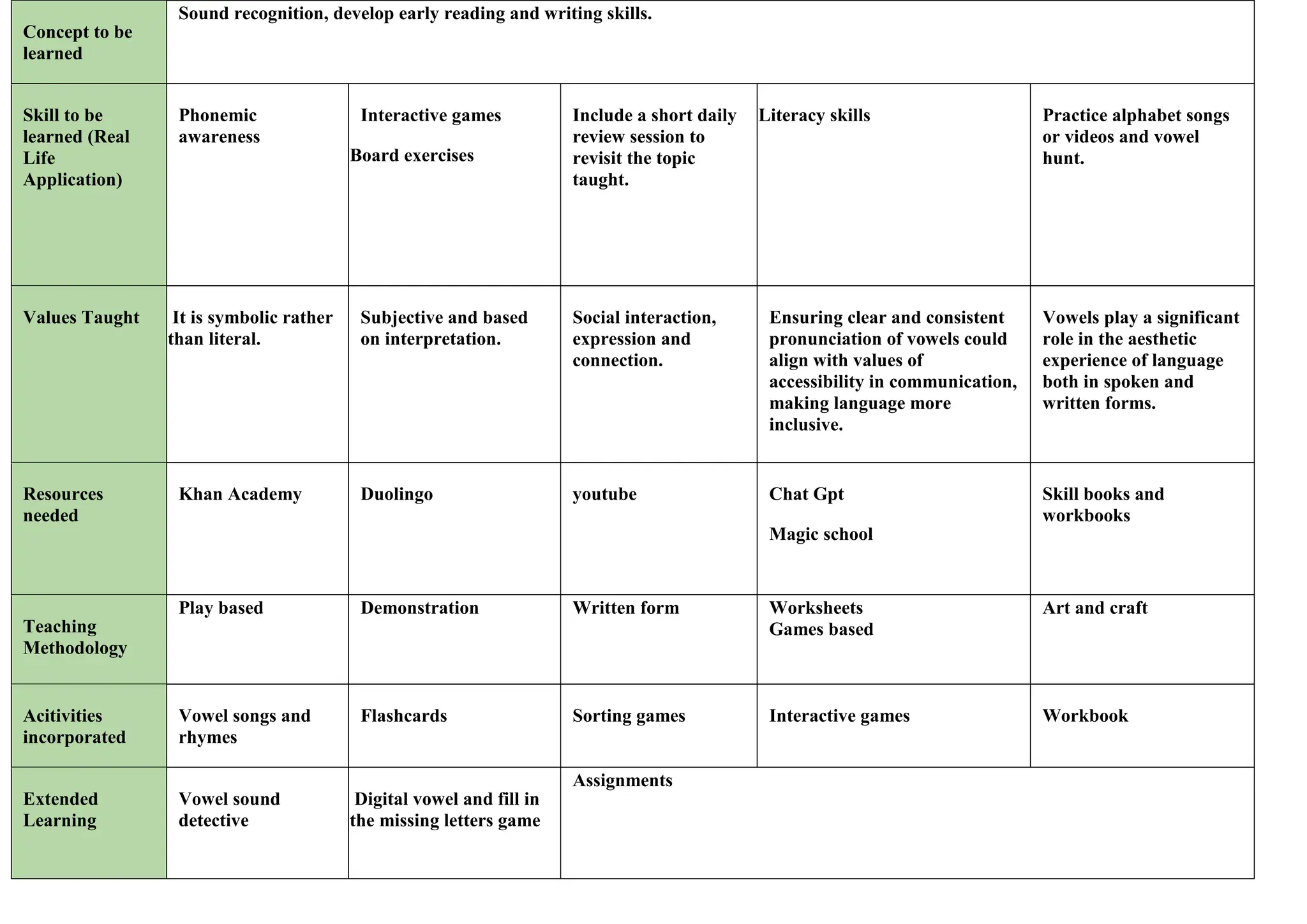
Concept to be
learned
Sound recognition, develop early reading and writing skills.
Skill to be
learned (Real
Life
Application)
Phonemic
awareness
Interactive games
Board exercises
Include a short daily
review session to
revisit the topic
taught.
Literacy skills Practice alphabet songs
or videos and vowel
hunt.
Values Taught It is symbolic rather
than literal.
Subjective and based
on interpretation.
Social interaction,
expression and
connection.
Ensuring clear and consistent
pronunciation of vowels could
align with values of
accessibility in communication,
making language more
inclusive.
Vowels play a significant
role in the aesthetic
experience of language
both in spoken and
written forms.
Resources
needed
Khan Academy Duolingo youtube Chat Gpt
Magic school
Skill books and
workbooks
Teaching
Methodology
Play based Demonstration Written form Worksheets
Games based
Art and craft
Acitivities
incorporated
Vowel songs and
rhymes
Flashcards Sorting games Interactive games Workbook
Extended
Learning
Vowel sound
detective
Digital vowel and fill in
the missing letters game
Assignments
Assessments Formative Summative test Board checks Observation Letter and vowel games
Subject
Integration
Vowel worksheets, flashcards
WHEATON INTERNATIONAL SCHOOL
FORTHNIGHTLY LESSON PLAN
SESSION 2024-2025
Teacher Name: Sangam
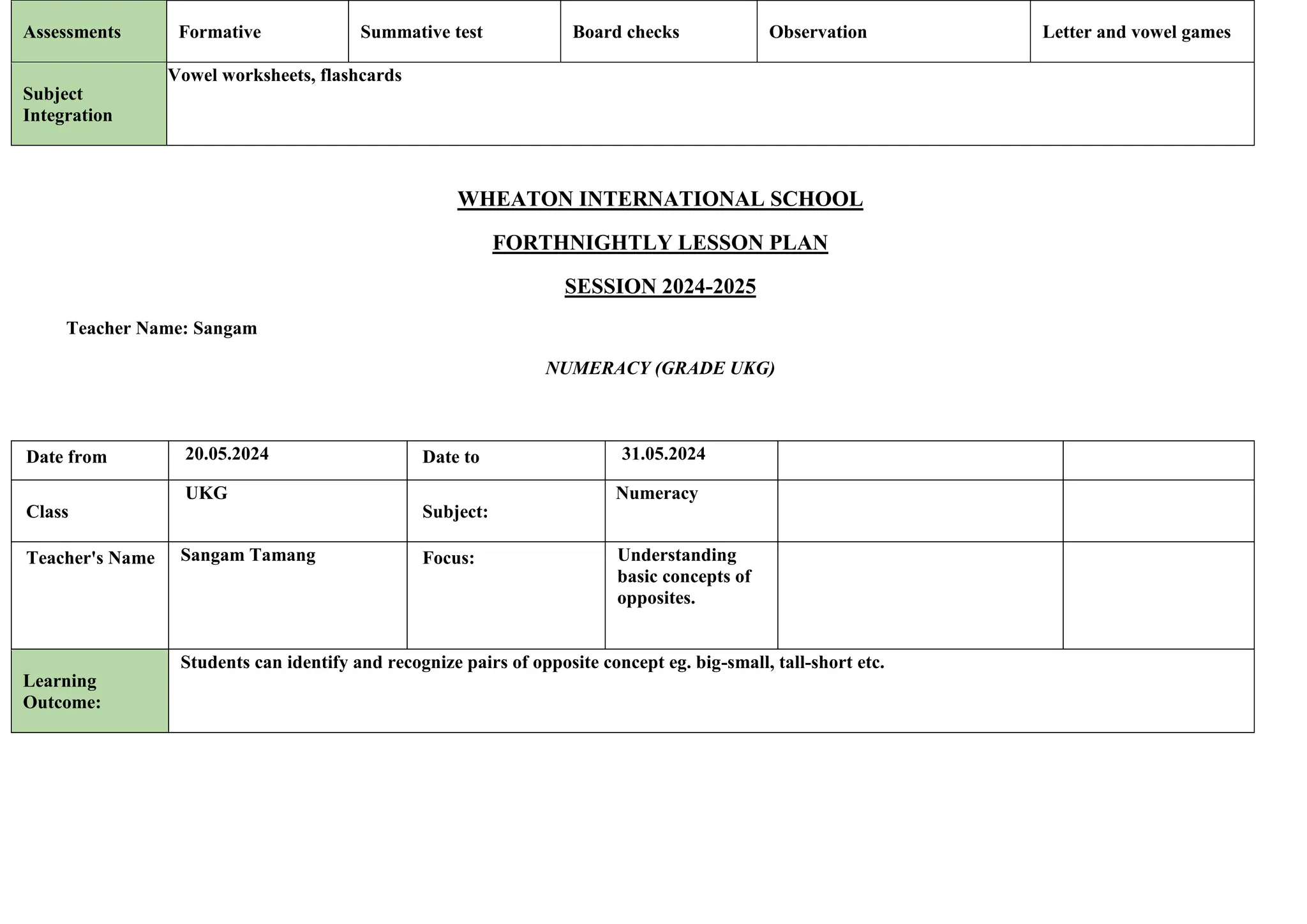
NUMERACY (GRADE UKG)
Date from 20.05.2024 Date to 31.05.2024
Class
UKG
Subject:
Numeracy
Teacher's Name Sangam Tamang Focus: Understanding
basic concepts of
opposites.
Learning
Outcome:
Students can identify and recognize pairs of opposite concept eg. big-small, tall-short etc.
SMART
Objectives
Students will learn to
differentiate between big
and small objects.
Students will
correctly identify and
categorize8 out of 10
objects as either big
or small.
Appropriate for
the developmental
stage.
This concept is essential for
developing early Maths skills.
Within 5 days
Concept to be
learned
Build foundational numeracy skills.
Understanding and identifying size differences.
Skill to be
learned (Real
Life
Application)
Recognising and
distinguishing between
different attributes of
objects.
Daily learning
activities
Group activities
Board games
Children not only will
understand numeracy opposites
but also develop a broad range
of cognitive, linguistic and social
abilities essential for their
overall development.
Comparative skills
Practical exercises
Activity (games)
Values Taught Understanding and
appreciating differences
between opposites.
Activities involving
comparison teach
children the
importance of
fairness.
Collaboration- by
learning to work
together with
peers fosters a
sense of
collaboration.
Children learn that every object,
idea or person has value
regardless of differences.
This helps the
students to develop
an appreciation for
the role of contrast
in art, nature and
design fostering a
sense of aesthetics.
Resources
needed
Educational songs
Blippi
ABCmouse early
learning (includes
early learning
Academy)
youtube ChatGpt
Magic school
flashcards
,worksheet,
textbook and
workbooks
Teaching
Methodology
Song based Video based Play based Written based Practical based
Activities
incorporated
Drawing Sorting and
categorising
Matching games storytelling Technology
integration
Extended
Learning
Complex sorting Colour and size
sorting
Word games, number lines and board games
Assessments Formative Summative test Board checks Observation Letter and vowel
games
Subject
Integration
Games and puzzles, use real life examples and matching with opposites.
WHEATON INTERNATIONAL SCHOOL
FORTHNIGHTLY LESSON PLAN
SESSION 2024-2025
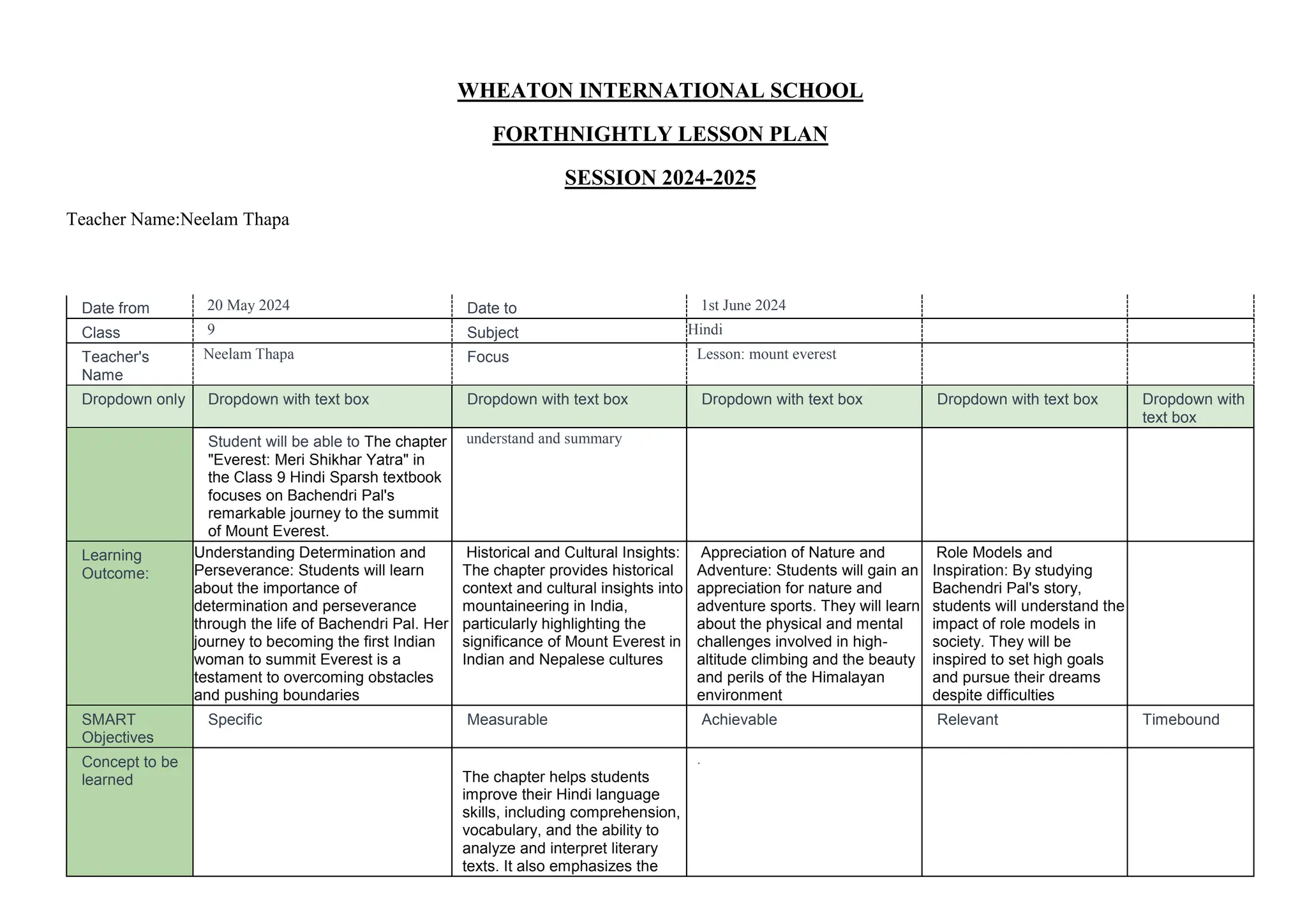
Teacher Name:Neelam Thapa
Date from 20 May 2024 Date to 1st June 2024
Class 9 Subject Hindi
Teacher's
Name
Neelam Thapa Focus Lesson: mount everest
Dropdown only Dropdown with text box Dropdown with text box Dropdown with text box Dropdown with text box Dropdown with
text box
Student will be able to The chapter
"Everest: Meri Shikhar Yatra" in
the Class 9 Hindi Sparsh textbook
focuses on Bachendri Pal's
remarkable journey to the summit
of Mount Everest.
understand and summary
Learning
Outcome:
Understanding Determination and
Perseverance: Students will learn
about the importance of
determination and perseverance
through the life of Bachendri Pal. Her
journey to becoming the first Indian
woman to summit Everest is a
testament to overcoming obstacles
and pushing boundaries
Historical and Cultural Insights:
The chapter provides historical
context and cultural insights into
mountaineering in India,
particularly highlighting the
significance of Mount Everest in
Indian and Nepalese cultures
Appreciation of Nature and
Adventure: Students will gain an
appreciation for nature and
adventure sports. They will learn
about the physical and mental
challenges involved in high-
altitude climbing and the beauty
and perils of the Himalayan
environment
Role Models and
Inspiration: By studying
Bachendri Pal's story,
students will understand the
impact of role models in
society. They will be
inspired to set high goals
and pursue their dreams
despite difficulties
SMART
Objectives
Specific Measurable Achievable Relevant Timebound
Concept to be
learned The chapter helps students
improve their Hindi language
skills, including comprehension,
vocabulary, and the ability to
analyze and interpret literary
texts. It also emphasizes the
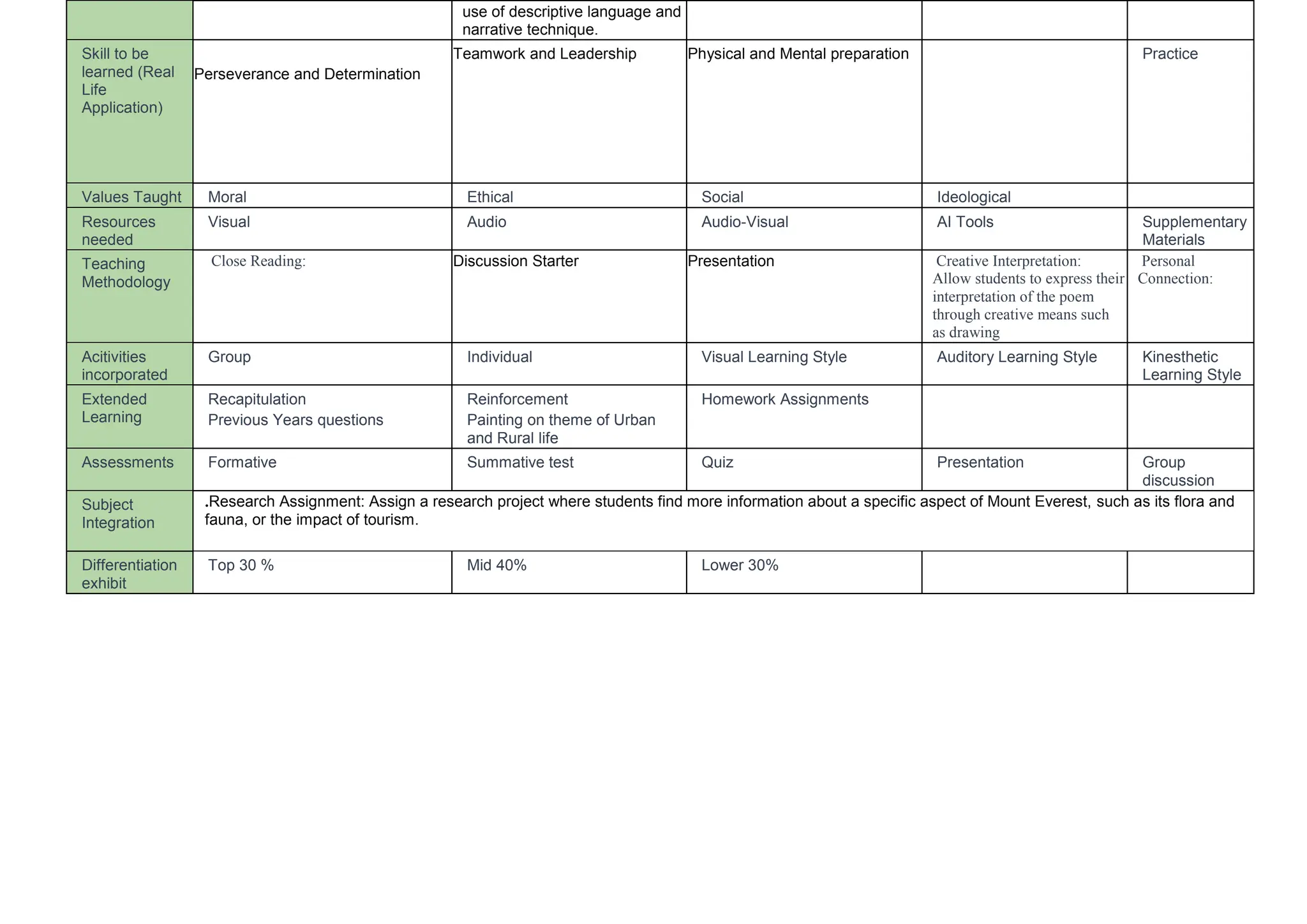
.
use of descriptive language and
narrative technique.
Skill to be
learned (Real
Life
Application)
Perseverance and Determination
Teamwork and Leadership Physical and Mental preparation Practice
Values Taught Moral Ethical Social Ideological
Resources
needed
Visual Audio Audio-Visual AI Tools Supplementary
Materials
Teaching
Methodology
Close Reading: Discussion Starter Presentation Creative Interpretation:
Allow students to express their
interpretation of the poem
through creative means such
as drawing
Personal
Connection:
Acitivities
incorporated
Group Individual Visual Learning Style Auditory Learning Style Kinesthetic
Learning Style
Extended
Learning
Recapitulation
Previous Years questions
Reinforcement
Painting on theme of Urban
and Rural life
Homework Assignments
Assessments Formative Summative test Quiz Presentation Group
discussion
Subject
Integration
.Research Assignment: Assign a research project where students find more information about a specific aspect of Mount Everest, such as its flora and
fauna, or the impact of tourism.
Differentiation
exhibit
Top 30 % Mid 40% Lower 30%
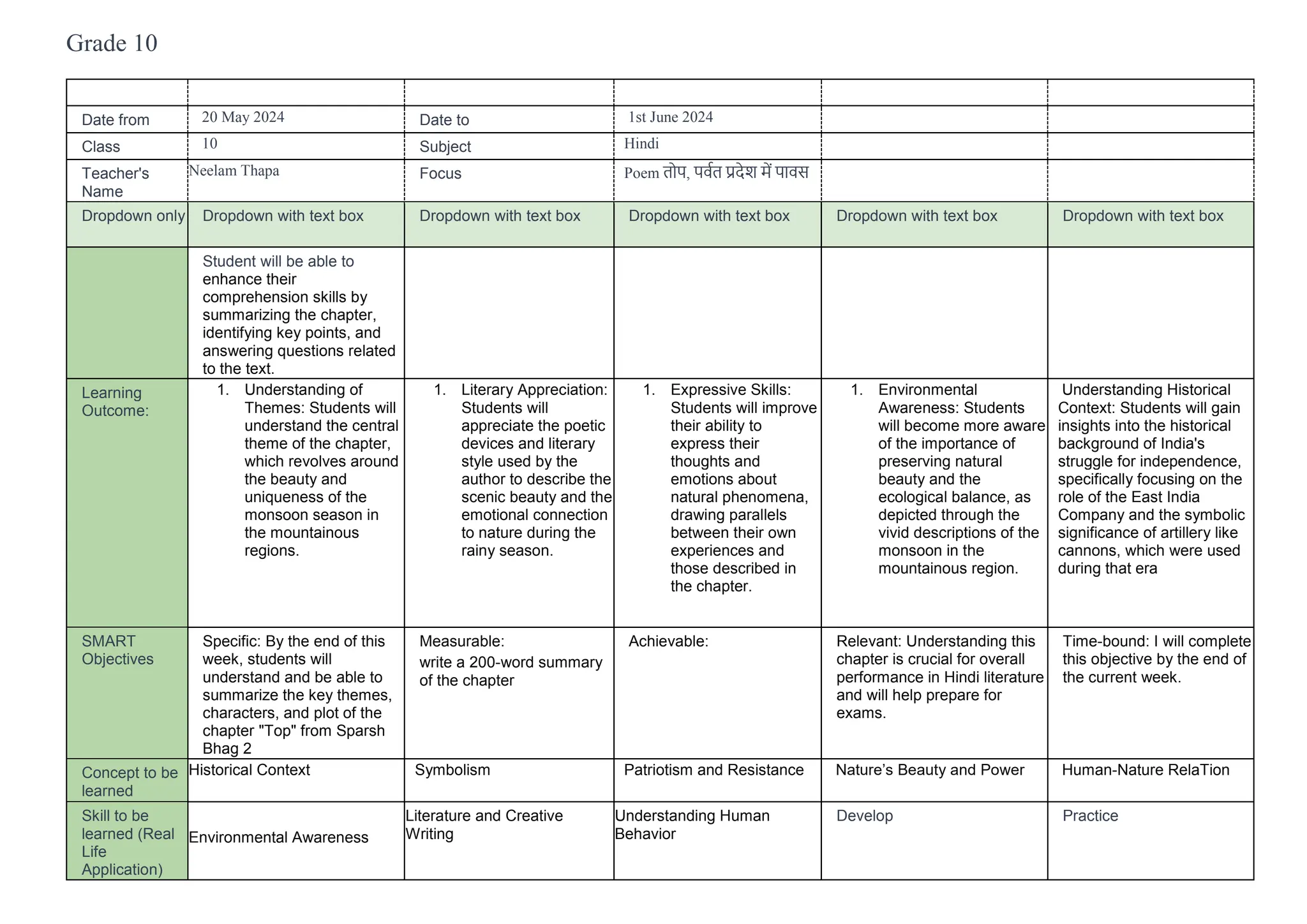
Grade 10
Date from 20 May 2024 Date to 1st June 2024
Class 10 Subject Hindi
Teacher's
Name
Neelam Thapa Focus Poem तोप, पर्वत प्रदेश में पार्स
Dropdown only Dropdown with text box Dropdown with text box Dropdown with text box Dropdown with text box Dropdown with text box
Student will be able to
enhance their
comprehension skills by
summarizing the chapter,
identifying key points, and
answering questions related
to the text.
Learning
Outcome:
1. Understanding of
Themes: Students will
understand the central
theme of the chapter,
which revolves around
the beauty and
uniqueness of the
monsoon season in
the mountainous
regions.
1. Literary Appreciation:
Students will
appreciate the poetic
devices and literary
style used by the
author to describe the
scenic beauty and the
emotional connection
to nature during the
rainy season.
1. Expressive Skills:
Students will improve
their ability to
express their
thoughts and
emotions about
natural phenomena,
drawing parallels
between their own
experiences and
those described in
the chapter.
1. Environmental
Awareness: Students
will become more aware
of the importance of
preserving natural
beauty and the
ecological balance, as
depicted through the
vivid descriptions of the
monsoon in the
mountainous region.
Understanding Historical
Context: Students will gain
insights into the historical
background of India's
struggle for independence,
specifically focusing on the
role of the East India
Company and the symbolic
significance of artillery like
cannons, which were used
during that era
SMART
Objectives
Specific: By the end of this
week, students will
understand and be able to
summarize the key themes,
characters, and plot of the
chapter "Top" from Sparsh
Bhag 2
Measurable:
write a 200-word summary
of the chapter
Achievable: Relevant: Understanding this
chapter is crucial for overall
performance in Hindi literature
and will help prepare for
exams.
Time-bound: I will complete
this objective by the end of
the current week.
Concept to be
learned
Historical Context Symbolism Patriotism and Resistance Nature’s Beauty and Power Human-Nature RelaTion
Skill to be
learned (Real
Life
Application)
Environmental Awareness
Literature and Creative
Writing
Understanding Human
Behavior
Develop Practice
Values Taught
Resources
needed
Textbook PPT Related videos if any AI Tools Supplementary Materials
Reference book : All in one
Teaching
Methodology
Powerpoint Slides Lecture method Group Discussion and peer
collaboration
Experiential Learning Inquiry-Based Learning
Acitivities
incorporated
Group
Group discussion
Individual
Essay writing
Poster Making NIL NIL
Extended
Learning
Recapitulation
Class Test
Reinforcement
Extra important questions
Homework Assignments
Assessments Formative Summative test Quiz Presentation Group discussion
Subject
Integration
Differentiation
exhibit
Top 30 % Mid 40% Lower 30%
Grade 5
Date from 20 May 2024 Date to 1st June 2024
Class 5 Subject Hindi
Teacher's
Name
Neelam Thapa Focus Lesson: kaisa puraskar
Dropdown only Dropdown with text
box
Dropdown with text box Dropdown with text box Dropdown with text box Dropdown with text box
Learning
Outcome:
Students will be able to
identify and explain the
central message or
moral of the story.
Students will analyze the motivations and
behaviors of the main characters.
SMART
Objectives
Specific Measurable Achievable Relevant Timebound
Concept to be
learned
Moral and Ethical
Values:
Understanding the
importance of honesty
and integrity through
the narrative.
Expression Skills: Reading and writing
.
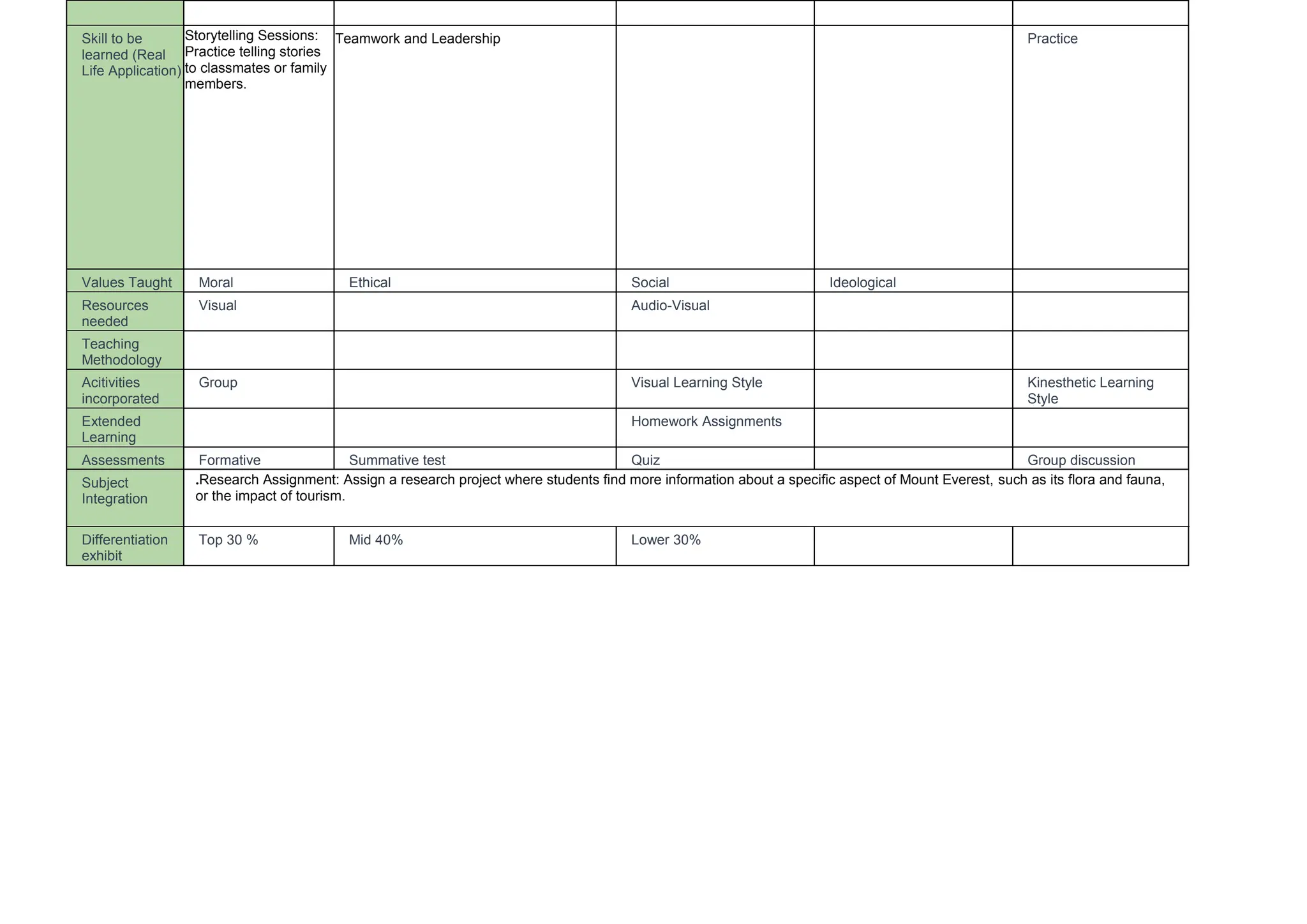
Skill to be
learned (Real
Life Application)
Storytelling Sessions:
Practice telling stories
to classmates or family
members.
Teamwork and Leadership Practice
Values Taught Moral Ethical Social Ideological
Resources
needed
Visual Audio-Visual
Teaching
Methodology
Acitivities
incorporated
Group Visual Learning Style Kinesthetic Learning
Style
Extended
Learning
Homework Assignments
Assessments Formative Summative test Quiz Group discussion
Subject
Integration
.Research Assignment: Assign a research project where students find more information about a specific aspect of Mount Everest, such as its flora and fauna,
or the impact of tourism.
Differentiation
exhibit
Top 30 % Mid 40% Lower 30%
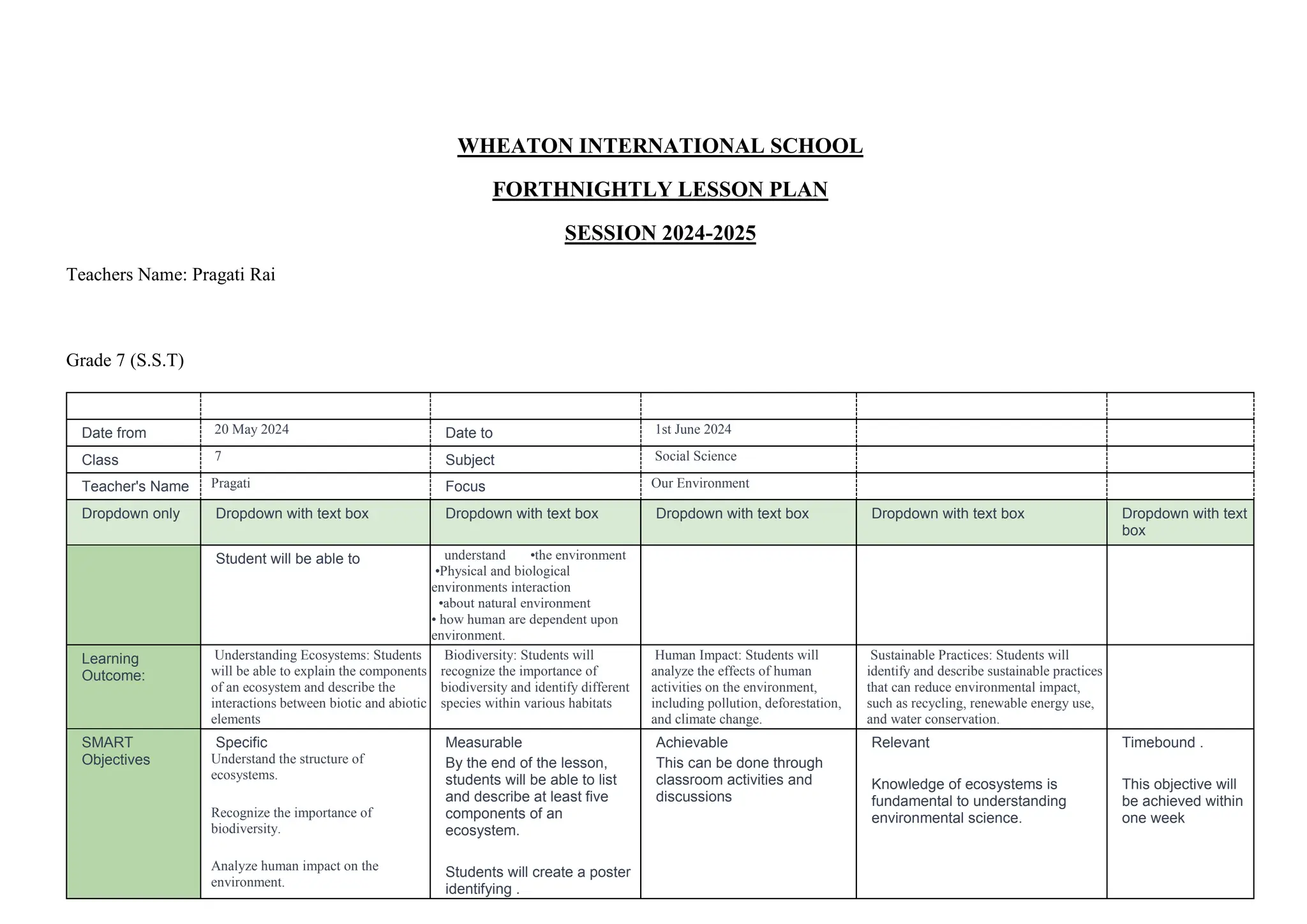
WHEATON INTERNATIONAL SCHOOL
FORTHNIGHTLY LESSON PLAN
SESSION 2024-2025
Teachers Name: Pragati Rai
Grade 7 (S.S.T)
Date from 20 May 2024 Date to 1st June 2024
Class 7 Subject Social Science
Teacher's Name Pragati Focus Our Environment
Dropdown only Dropdown with text box Dropdown with text box Dropdown with text box Dropdown with text box Dropdown with text
box
Student will be able to understand •the environment
•Physical and biological
environments interaction
•about natural environment
• how human are dependent upon
environment.
Learning
Outcome:
Understanding Ecosystems: Students
will be able to explain the components
of an ecosystem and describe the
interactions between biotic and abiotic
elements
Biodiversity: Students will
recognize the importance of
biodiversity and identify different
species within various habitats
Human Impact: Students will
analyze the effects of human
activities on the environment,
including pollution, deforestation,
and climate change.
Sustainable Practices: Students will
identify and describe sustainable practices
that can reduce environmental impact,
such as recycling, renewable energy use,
and water conservation.
SMART
Objectives
Specific
Understand the structure of
ecosystems.
Recognize the importance of
biodiversity.
Analyze human impact on the
environment.
Measurable
By the end of the lesson,
students will be able to list
and describe at least five
components of an
ecosystem.
Students will create a poster
identifying .
Achievable
This can be done through
classroom activities and
discussions
Relevant
Knowledge of ecosystems is
fundamental to understanding
environmental science.
Timebound .
This objective will
be achieved within
one week
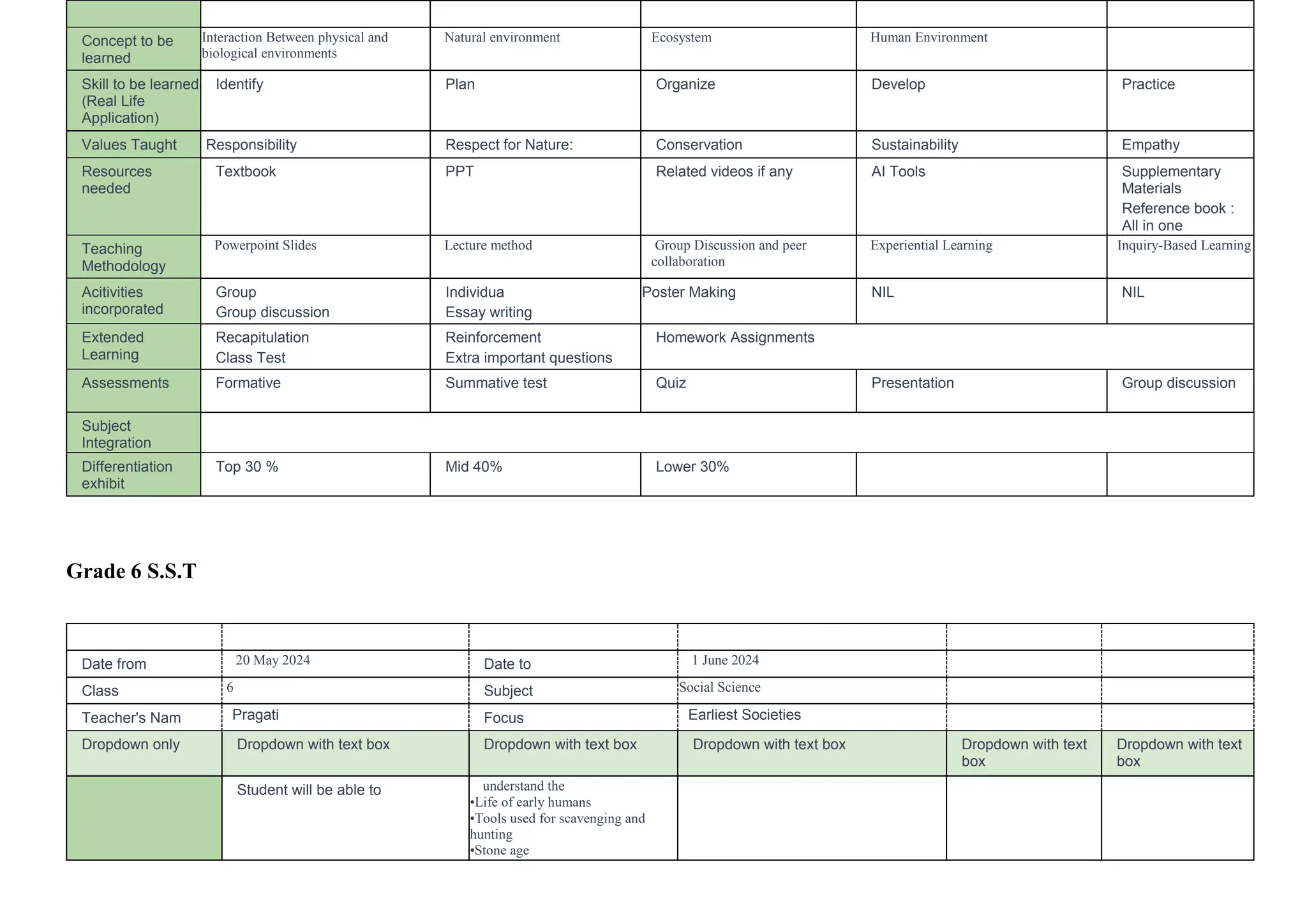
Concept to be
learned
Interaction Between physical and
biological environments
Natural environment Ecosystem Human Environment
Skill to be learned
(Real Life
Application)
Identify Plan Organize Develop Practice
Values Taught Responsibility Respect for Nature: Conservation Sustainability Empathy
Resources
needed
Textbook PPT Related videos if any AI Tools Supplementary
Materials
Reference book :
All in one
Teaching
Methodology
Powerpoint Slides Lecture method Group Discussion and peer
collaboration
Experiential Learning Inquiry-Based Learning
Acitivities
incorporated
Group
Group discussion
Individua
Essay writing
Poster Making NIL NIL
Extended
Learning
Recapitulation
Class Test
Reinforcement
Extra important questions
Homework Assignments
Assessments Formative Summative test Quiz Presentation Group discussion
Subject
Integration
Differentiation
exhibit
Top 30 % Mid 40% Lower 30%
Grade 6 S.S.T
Date from 20 May 2024 Date to 1 June 2024
Class 6 Subject Social Science
Teacher's Nam Pragati Focus Earliest Societies
Dropdown only Dropdown with text box Dropdown with text box Dropdown with text box Dropdown with text
box
Dropdown with text
box
Student will be able to understand the
•Life of early humans
•Tools used for scavenging and
hunting
•Stone age
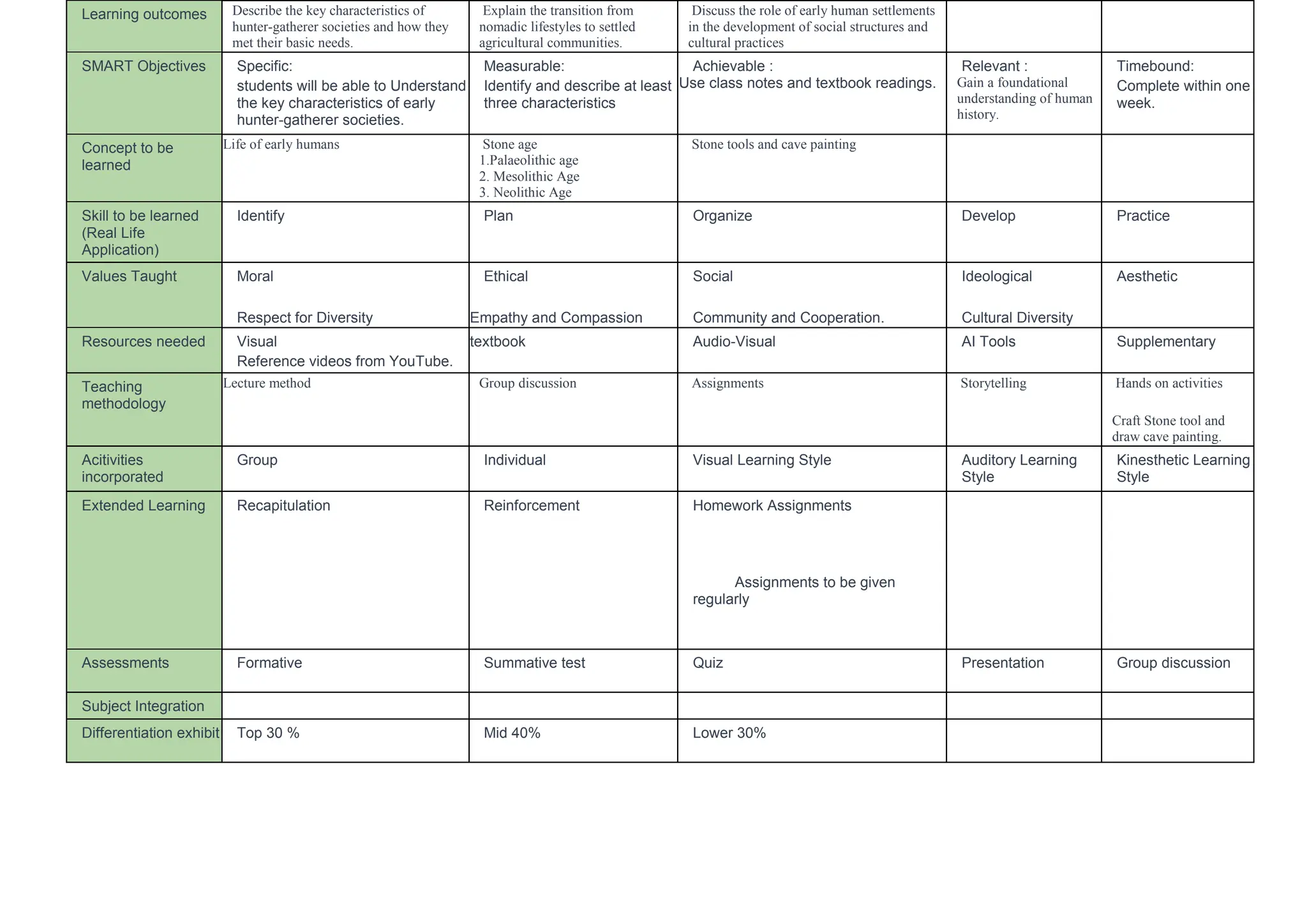
Learning outcomes Describe the key characteristics of
hunter-gatherer societies and how they
met their basic needs.
Explain the transition from
nomadic lifestyles to settled
agricultural communities.
Discuss the role of early human settlements
in the development of social structures and
cultural practices
SMART Objectives Specific:
students will be able to Understand
the key characteristics of early
hunter-gatherer societies.
Measurable:
Identify and describe at least
three characteristics
Achievable :
Use class notes and textbook readings.
Relevant :
Gain a foundational
understanding of human
history.
Timebound:
Complete within one
week.
Concept to be
learned
Life of early humans Stone age
1.Palaeolithic age
2. Mesolithic Age
3. Neolithic Age
Stone tools and cave painting
Skill to be learned
(Real Life
Application)
Identify Plan Organize Develop Practice
Values Taught Moral
Respect for Diversity
Ethical
Empathy and Compassion
Social
Community and Cooperation.
Ideological
Cultural Diversity
Aesthetic
Resources needed Visual
Reference videos from YouTube.
textbook Audio-Visual AI Tools Supplementary
Teaching
methodology
Lecture method Group discussion Assignments Storytelling Hands on activities
Craft Stone tool and
draw cave painting.
Acitivities
incorporated
Group Individual Visual Learning Style Auditory Learning
Style
Kinesthetic Learning
Style
Extended Learning Recapitulation Reinforcement Homework Assignments
Assignments to be given
regularly
Assessments Formative Summative test Quiz Presentation Group discussion
Subject Integration
Differentiation exhibit Top 30 % Mid 40% Lower 30%

Lesson Plan for Inspection.CBSE lesson plan

  • 1.
    WHEATON INTERNATIONAL SCHOOL FORTHNIGHTLYLESSON PLAN SESSION 2024-2025 Teacher Name: Juhi Khan INFORMATION TECHNOLOGY (GRADE IX) Date from 20.05.2024 Date to 31.05.2024 Class IX Subject INFORMATION TECHNOLOGY Teacher's Name JUHI KHAN Focus Application of IT and ITes Learning Outcome: Student will be able to able to realise the importance of the use of IT and ITes in daily life SMART Objectives To make the students know and learn about various significance of IT and ITes Students will be able identify and apply specific IT practices in their respective areas of development. The students will be able to solve questions from Textbook as well as questions from past papers as well as competency based questions. The syllabus will solely contain the topic given in the Grade IX CBSE syllabus. This content of the topic will be completed by the end of May 2024. Concept to be learned Students will be learning the specific application of IT and ITes in various domain of our day to day life.
  • 2.
    Skill to be learned (RealLife Application) Students will be able to identify questions related to IT and ITes They will be able to plan the action required to solve the given questions They will be able to organize their problems into hierarchical stepwise sequence. Problem solving ability will be developed among students. This topic will create a need to practice questions on regular basis to keep upto date with the syllabus. Values Taught Through this topic the students will be able to realise the importance of digital world in this modern era of IT The students will be mastering the the ability to logical Questions based on interconversion of number system With the use of ITes students will be able to realize the importance of digital literacy. NIL NIL Resources needed Textbook Lecture by the teacher Solve Exercises from Textbook as well as reference books NIL Past year question papers Teaching Methodology Lecture Question Solving through pen and paper. Assignments Class Tests Flipped Learning Acitivities incorporated NIL NIL Question Solving NIL NIL Extended Learning Revision of the chapters will be done through practical tests. Questions will be given in exam from this topic Assignments to be given regularly Assessments Formative Summative test Quiz Presentation Group discussion
  • 3.
    Subject Integration Integration of InformationTechnology and Mathematics (Statistics) will be done with the help of IT Practical Activity. INFORMATION TECHNOLOGY (GRADE X) Date from 20.05.2024 Date to 31.05.2024 Class X Subject INFORMATION TECHN OLOGY Teacher's Name JUHI KHAN Focus What If Analysis in MS Excel:Scenario GoalSeek and Solver Learning Outcome: Student will be able to able to make use of various features of What If Analysis and apply in their daily life handling of a set of data. SMART Objectives To make the students know and learn about various types of What If Analysis. Students will be able apply what if analysis in handling a set of data. The students will be able to solve questions from Textbook as well as questions from past papers as well as competency based questions. The syllabus will solely contain the topic given in the Grade 10 CBSE syllabus. This content of the topic will be completed by the end of May 2024. Concept to be learned Students will be learning the use of What if Analysis in MS Excel and use Scenario,Goalseek and Solver judiciously.
  • 4.
    Skill to be learned (RealLife Application ) Students will be able to identify questions making use of What If Analysis. They will be able to plan the action required to solve the given questions They will be able to organize their problems into hierarchical stepwise sequence. Problem solving ability will be developed among students. This topic will create a need to practice questions on regular basis to keep upto date with the syllabus. Values Taught Through this topic the students will be able to realise the importance of unity of similar species for better consideration The students will be mastering the the ability to logical Que stions based on interconver sion of number system With the use of SETS students will be able to realize the importance of working in groups NIL NIL Resources needed Textbook Lecture by the teacher Solve Exercises from Textbook as well as reference books NIL Past year question papers Teaching Methodolog y Lecture Question Solving through pen and paper. Assignments Class Tests Flipped Learning
  • 5.
    Acitivities incorporate d NIL NIL QuestionSolving NIL NIL Extended Learning Revision of the chapters will be done through practical tests. Questions will be given in exam from this topic Assignments to be given regularly Assessment s Formative Summative test Quiz Presentation Group discussion Subject Integration Integration of Information Technology and Mathematics(Statistics) will be done with the help of IT Practical Activity.
  • 6.
    WHEATON INTERNATIONAL SCHOOL FORTHNIGHTLYLESSON PLAN SESSION 2024-2025 Teacher Name: Sangam LITERACY (GRADE UKG) Date from 20.05.2024 Date to 31.05.2024 Class UKG Subject: literacy Teacher's Name Sangam Tamang Focus: Identifying possible words, words structure (Cvc words) vowels and consonant letters and sounds. Learning Outcome: Learners will be equipped to build a strong foundation in word formation, enhance their vocabulary and develop critical thinking skills.They will identify vowel and consonant letters and recognise sounds too (Phonic skills). SMART Objectives Students will identify and differentiate between vowels and consonants in the alphabet. Identifying vowels and consonants correctly in the 90% of the given letters on the board. This is achievable with daily practice sessions, listening and speaking. This is relevant as it is the foundational skill for reading and writing. Within three days.
  • 7.
    Concept to be learned Soundrecognition, develop early reading and writing skills. Skill to be learned (Real Life Application) Phonemic awareness Interactive games Board exercises Include a short daily review session to revisit the topic taught. Literacy skills Practice alphabet songs or videos and vowel hunt. Values Taught It is symbolic rather than literal. Subjective and based on interpretation. Social interaction, expression and connection. Ensuring clear and consistent pronunciation of vowels could align with values of accessibility in communication, making language more inclusive. Vowels play a significant role in the aesthetic experience of language both in spoken and written forms. Resources needed Khan Academy Duolingo youtube Chat Gpt Magic school Skill books and workbooks Teaching Methodology Play based Demonstration Written form Worksheets Games based Art and craft Acitivities incorporated Vowel songs and rhymes Flashcards Sorting games Interactive games Workbook Extended Learning Vowel sound detective Digital vowel and fill in the missing letters game Assignments
  • 8.
    Assessments Formative Summativetest Board checks Observation Letter and vowel games Subject Integration Vowel worksheets, flashcards WHEATON INTERNATIONAL SCHOOL FORTHNIGHTLY LESSON PLAN SESSION 2024-2025 Teacher Name: Sangam NUMERACY (GRADE UKG) Date from 20.05.2024 Date to 31.05.2024 Class UKG Subject: Numeracy Teacher's Name Sangam Tamang Focus: Understanding basic concepts of opposites. Learning Outcome: Students can identify and recognize pairs of opposite concept eg. big-small, tall-short etc.
  • 9.
    SMART Objectives Students will learnto differentiate between big and small objects. Students will correctly identify and categorize8 out of 10 objects as either big or small. Appropriate for the developmental stage. This concept is essential for developing early Maths skills. Within 5 days Concept to be learned Build foundational numeracy skills. Understanding and identifying size differences. Skill to be learned (Real Life Application) Recognising and distinguishing between different attributes of objects. Daily learning activities Group activities Board games Children not only will understand numeracy opposites but also develop a broad range of cognitive, linguistic and social abilities essential for their overall development. Comparative skills Practical exercises Activity (games) Values Taught Understanding and appreciating differences between opposites. Activities involving comparison teach children the importance of fairness. Collaboration- by learning to work together with peers fosters a sense of collaboration. Children learn that every object, idea or person has value regardless of differences. This helps the students to develop an appreciation for the role of contrast in art, nature and design fostering a sense of aesthetics. Resources needed Educational songs Blippi ABCmouse early learning (includes early learning Academy) youtube ChatGpt Magic school flashcards ,worksheet, textbook and workbooks Teaching Methodology Song based Video based Play based Written based Practical based
  • 10.
    Activities incorporated Drawing Sorting and categorising Matchinggames storytelling Technology integration Extended Learning Complex sorting Colour and size sorting Word games, number lines and board games Assessments Formative Summative test Board checks Observation Letter and vowel games Subject Integration Games and puzzles, use real life examples and matching with opposites.
  • 11.
    WHEATON INTERNATIONAL SCHOOL FORTHNIGHTLYLESSON PLAN SESSION 2024-2025 Teacher Name:Neelam Thapa Date from 20 May 2024 Date to 1st June 2024 Class 9 Subject Hindi Teacher's Name Neelam Thapa Focus Lesson: mount everest Dropdown only Dropdown with text box Dropdown with text box Dropdown with text box Dropdown with text box Dropdown with text box Student will be able to The chapter "Everest: Meri Shikhar Yatra" in the Class 9 Hindi Sparsh textbook focuses on Bachendri Pal's remarkable journey to the summit of Mount Everest. understand and summary Learning Outcome: Understanding Determination and Perseverance: Students will learn about the importance of determination and perseverance through the life of Bachendri Pal. Her journey to becoming the first Indian woman to summit Everest is a testament to overcoming obstacles and pushing boundaries Historical and Cultural Insights: The chapter provides historical context and cultural insights into mountaineering in India, particularly highlighting the significance of Mount Everest in Indian and Nepalese cultures Appreciation of Nature and Adventure: Students will gain an appreciation for nature and adventure sports. They will learn about the physical and mental challenges involved in high- altitude climbing and the beauty and perils of the Himalayan environment Role Models and Inspiration: By studying Bachendri Pal's story, students will understand the impact of role models in society. They will be inspired to set high goals and pursue their dreams despite difficulties SMART Objectives Specific Measurable Achievable Relevant Timebound Concept to be learned The chapter helps students improve their Hindi language skills, including comprehension, vocabulary, and the ability to analyze and interpret literary texts. It also emphasizes the .
  • 12.
    use of descriptivelanguage and narrative technique. Skill to be learned (Real Life Application) Perseverance and Determination Teamwork and Leadership Physical and Mental preparation Practice Values Taught Moral Ethical Social Ideological Resources needed Visual Audio Audio-Visual AI Tools Supplementary Materials Teaching Methodology Close Reading: Discussion Starter Presentation Creative Interpretation: Allow students to express their interpretation of the poem through creative means such as drawing Personal Connection: Acitivities incorporated Group Individual Visual Learning Style Auditory Learning Style Kinesthetic Learning Style Extended Learning Recapitulation Previous Years questions Reinforcement Painting on theme of Urban and Rural life Homework Assignments Assessments Formative Summative test Quiz Presentation Group discussion Subject Integration .Research Assignment: Assign a research project where students find more information about a specific aspect of Mount Everest, such as its flora and fauna, or the impact of tourism. Differentiation exhibit Top 30 % Mid 40% Lower 30%
  • 13.
    Grade 10 Date from20 May 2024 Date to 1st June 2024 Class 10 Subject Hindi Teacher's Name Neelam Thapa Focus Poem तोप, पर्वत प्रदेश में पार्स Dropdown only Dropdown with text box Dropdown with text box Dropdown with text box Dropdown with text box Dropdown with text box Student will be able to enhance their comprehension skills by summarizing the chapter, identifying key points, and answering questions related to the text. Learning Outcome: 1. Understanding of Themes: Students will understand the central theme of the chapter, which revolves around the beauty and uniqueness of the monsoon season in the mountainous regions. 1. Literary Appreciation: Students will appreciate the poetic devices and literary style used by the author to describe the scenic beauty and the emotional connection to nature during the rainy season. 1. Expressive Skills: Students will improve their ability to express their thoughts and emotions about natural phenomena, drawing parallels between their own experiences and those described in the chapter. 1. Environmental Awareness: Students will become more aware of the importance of preserving natural beauty and the ecological balance, as depicted through the vivid descriptions of the monsoon in the mountainous region. Understanding Historical Context: Students will gain insights into the historical background of India's struggle for independence, specifically focusing on the role of the East India Company and the symbolic significance of artillery like cannons, which were used during that era SMART Objectives Specific: By the end of this week, students will understand and be able to summarize the key themes, characters, and plot of the chapter "Top" from Sparsh Bhag 2 Measurable: write a 200-word summary of the chapter Achievable: Relevant: Understanding this chapter is crucial for overall performance in Hindi literature and will help prepare for exams. Time-bound: I will complete this objective by the end of the current week. Concept to be learned Historical Context Symbolism Patriotism and Resistance Nature’s Beauty and Power Human-Nature RelaTion Skill to be learned (Real Life Application) Environmental Awareness Literature and Creative Writing Understanding Human Behavior Develop Practice
  • 14.
    Values Taught Resources needed Textbook PPTRelated videos if any AI Tools Supplementary Materials Reference book : All in one Teaching Methodology Powerpoint Slides Lecture method Group Discussion and peer collaboration Experiential Learning Inquiry-Based Learning Acitivities incorporated Group Group discussion Individual Essay writing Poster Making NIL NIL Extended Learning Recapitulation Class Test Reinforcement Extra important questions Homework Assignments Assessments Formative Summative test Quiz Presentation Group discussion Subject Integration Differentiation exhibit Top 30 % Mid 40% Lower 30% Grade 5 Date from 20 May 2024 Date to 1st June 2024 Class 5 Subject Hindi Teacher's Name Neelam Thapa Focus Lesson: kaisa puraskar Dropdown only Dropdown with text box Dropdown with text box Dropdown with text box Dropdown with text box Dropdown with text box Learning Outcome: Students will be able to identify and explain the central message or moral of the story. Students will analyze the motivations and behaviors of the main characters. SMART Objectives Specific Measurable Achievable Relevant Timebound Concept to be learned Moral and Ethical Values: Understanding the importance of honesty and integrity through the narrative. Expression Skills: Reading and writing .
  • 15.
    Skill to be learned(Real Life Application) Storytelling Sessions: Practice telling stories to classmates or family members. Teamwork and Leadership Practice Values Taught Moral Ethical Social Ideological Resources needed Visual Audio-Visual Teaching Methodology Acitivities incorporated Group Visual Learning Style Kinesthetic Learning Style Extended Learning Homework Assignments Assessments Formative Summative test Quiz Group discussion Subject Integration .Research Assignment: Assign a research project where students find more information about a specific aspect of Mount Everest, such as its flora and fauna, or the impact of tourism. Differentiation exhibit Top 30 % Mid 40% Lower 30%
  • 16.
    WHEATON INTERNATIONAL SCHOOL FORTHNIGHTLYLESSON PLAN SESSION 2024-2025 Teachers Name: Pragati Rai Grade 7 (S.S.T) Date from 20 May 2024 Date to 1st June 2024 Class 7 Subject Social Science Teacher's Name Pragati Focus Our Environment Dropdown only Dropdown with text box Dropdown with text box Dropdown with text box Dropdown with text box Dropdown with text box Student will be able to understand •the environment •Physical and biological environments interaction •about natural environment • how human are dependent upon environment. Learning Outcome: Understanding Ecosystems: Students will be able to explain the components of an ecosystem and describe the interactions between biotic and abiotic elements Biodiversity: Students will recognize the importance of biodiversity and identify different species within various habitats Human Impact: Students will analyze the effects of human activities on the environment, including pollution, deforestation, and climate change. Sustainable Practices: Students will identify and describe sustainable practices that can reduce environmental impact, such as recycling, renewable energy use, and water conservation. SMART Objectives Specific Understand the structure of ecosystems. Recognize the importance of biodiversity. Analyze human impact on the environment. Measurable By the end of the lesson, students will be able to list and describe at least five components of an ecosystem. Students will create a poster identifying . Achievable This can be done through classroom activities and discussions Relevant Knowledge of ecosystems is fundamental to understanding environmental science. Timebound . This objective will be achieved within one week
  • 17.
    Concept to be learned InteractionBetween physical and biological environments Natural environment Ecosystem Human Environment Skill to be learned (Real Life Application) Identify Plan Organize Develop Practice Values Taught Responsibility Respect for Nature: Conservation Sustainability Empathy Resources needed Textbook PPT Related videos if any AI Tools Supplementary Materials Reference book : All in one Teaching Methodology Powerpoint Slides Lecture method Group Discussion and peer collaboration Experiential Learning Inquiry-Based Learning Acitivities incorporated Group Group discussion Individua Essay writing Poster Making NIL NIL Extended Learning Recapitulation Class Test Reinforcement Extra important questions Homework Assignments Assessments Formative Summative test Quiz Presentation Group discussion Subject Integration Differentiation exhibit Top 30 % Mid 40% Lower 30% Grade 6 S.S.T Date from 20 May 2024 Date to 1 June 2024 Class 6 Subject Social Science Teacher's Nam Pragati Focus Earliest Societies Dropdown only Dropdown with text box Dropdown with text box Dropdown with text box Dropdown with text box Dropdown with text box Student will be able to understand the •Life of early humans •Tools used for scavenging and hunting •Stone age
  • 18.
    Learning outcomes Describethe key characteristics of hunter-gatherer societies and how they met their basic needs. Explain the transition from nomadic lifestyles to settled agricultural communities. Discuss the role of early human settlements in the development of social structures and cultural practices SMART Objectives Specific: students will be able to Understand the key characteristics of early hunter-gatherer societies. Measurable: Identify and describe at least three characteristics Achievable : Use class notes and textbook readings. Relevant : Gain a foundational understanding of human history. Timebound: Complete within one week. Concept to be learned Life of early humans Stone age 1.Palaeolithic age 2. Mesolithic Age 3. Neolithic Age Stone tools and cave painting Skill to be learned (Real Life Application) Identify Plan Organize Develop Practice Values Taught Moral Respect for Diversity Ethical Empathy and Compassion Social Community and Cooperation. Ideological Cultural Diversity Aesthetic Resources needed Visual Reference videos from YouTube. textbook Audio-Visual AI Tools Supplementary Teaching methodology Lecture method Group discussion Assignments Storytelling Hands on activities Craft Stone tool and draw cave painting. Acitivities incorporated Group Individual Visual Learning Style Auditory Learning Style Kinesthetic Learning Style Extended Learning Recapitulation Reinforcement Homework Assignments Assignments to be given regularly Assessments Formative Summative test Quiz Presentation Group discussion Subject Integration Differentiation exhibit Top 30 % Mid 40% Lower 30%