GLOBAL
SUSTAINABLE
DEVELOPMENT
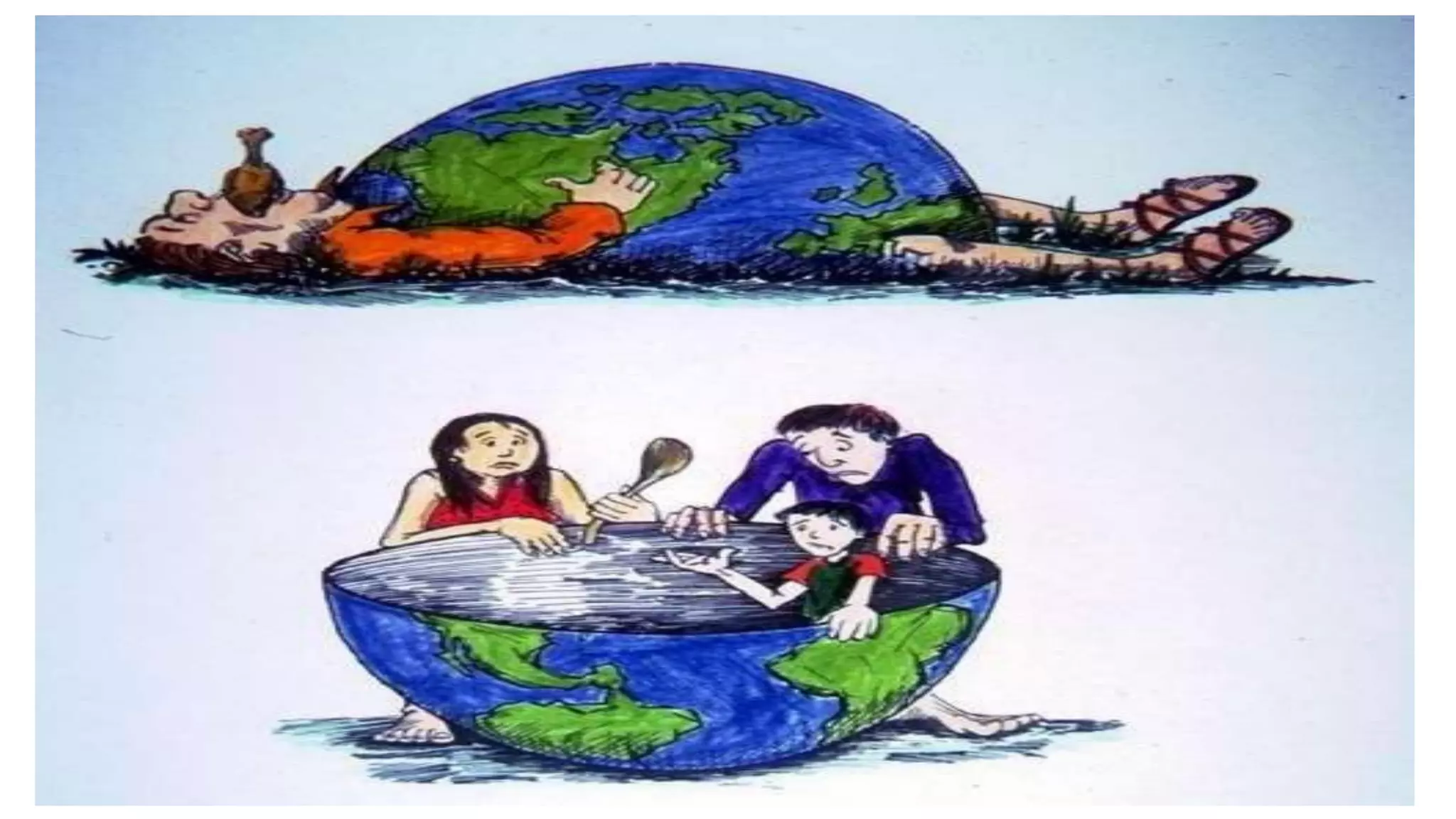
SUSTAINABLE DEVELOPMENT
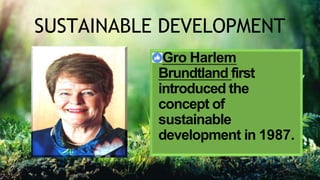
Gro Harlem
Brundtland first
introduced the
concept of
sustainable
development in 1987.
SUSTAINABLE DEVELOPMENT
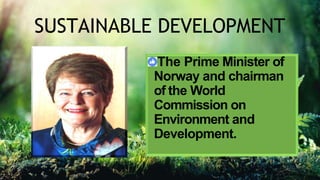
The Prime Minister of
Norway and chairman
of the World
Commission on
Environment and
Development.
SUSTAINABLE DEVELOPMENT
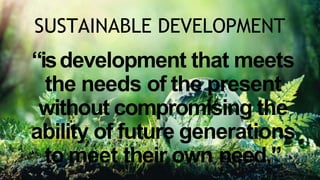
“isdevelopment that meets
the needs of the present
without compromising the
ability of future generations
to meet their own need.”
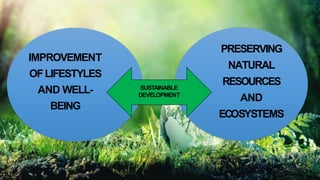
IMPROVEMENT
OFLIFESTYLES
AND WELL-
BEING
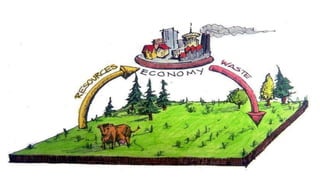
PRESERVING
NATURAL
RESOURCES
AND
ECOSYSTEMS
SUSTAINABLE
DEVELOPMENT
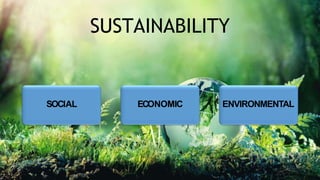
SUSTAINABILITY
SOCIAL ECONOMIC ENVIRONMENTAL
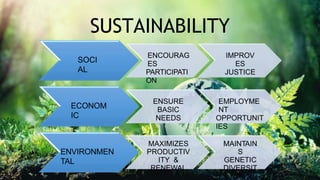
SUSTAINABILITY
SOCI
AL
ENCOURAG
ES
PARTICIPATI
ON
IMPROV
ES
JUSTICE
ECONOM
IC
ENSURE
BASIC
NEEDS
EMPLOYME
NT
OPPORTUNIT
IES
ENVIRONMEN
TAL
MAXIMIZES
PRODUCTIV
ITY &
RENEWAL
MAINTAIN
S
GENETIC
DIVERSIT
Y
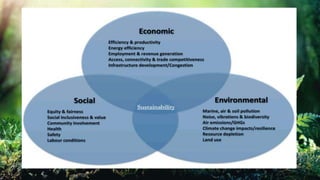
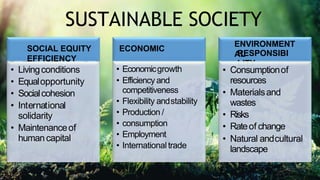
SUSTAINABLE SOCIETY
• Livingconditions
• Equalopportunity
• Socialcohesion
• International
solidarity
• Maintenanceof
humancapital
SOCIAL EQUITY ECONOMIC
EFFICIENCY
• Economicgrowth
• Efficiency and
competitiveness
• Flexibility andstability
• Production /
• consumption
• Employment
• Internationaltrade
ENVIRONMENT
AL
RESPONSIBI
LITY
• Consumptionof
resources
• Materialsand
wastes
• Risks
• Rateof change
• Natural andcultural
landscape
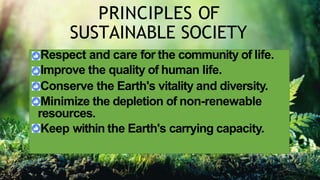
PRINCIPLES OF
SUSTAINABLE SOCIETY
Respect and care for the community of life.
Improve the quality of human life.
Conserve the Earth's vitality and diversity.
Minimize the depletion of non-renewable
resources.
Keep within the Earth's carrying capacity.
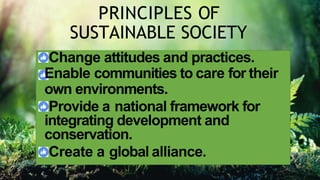
PRINCIPLES OF
SUSTAINABLE SOCIETY
Change attitudes and practices.
Enable communities to care for their
own environments.
Provide a national framework for
integrating development and
conservation.
Create a global alliance.
First and foremost, these Goals
apply to every nation and every
sector. Cities, businesses, schools,
organizations, all are challenged to
act. This is called…
UNIVERSALITY
Second, it is recognized that the
Goals are all inter-connected, in a
system. We cannot aim to achieve
just one Goal. We must achieve
them all. This is called…
INTEGRATION
And finally, it is widely recognized
that achieving these Goals involves
making very big, fundamental
changes in how we live on Earth.
This is called…
TRANSFORMATI
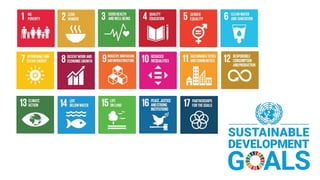
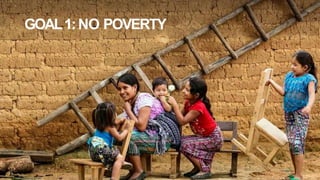
GOAL1:NO POVERTY
736 million people still live in extreme
poverty.
10 percent of the world’s population live in
extreme poverty, down from 36 percent in
1990.
Some 1.3 billion people live in
multidimensional poverty.
Half of all people living in poverty are
under 18.
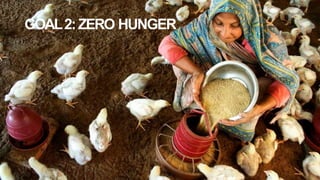
GOAL2:ZERO HUNGER
The number of undernourished people
reached 821 million in 2017.
In 2017 Asia accounted for nearly two
thirds, 63 percent, of the world’s hungry.
Nearly 151 million children under five, 22
percent, were still stunted in 2017.
More than 1 in 8 adults is obese.
1 in 3 women of reproductive age is
anemic.
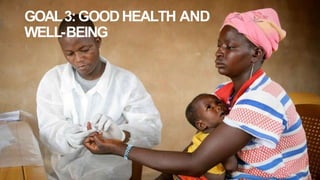
GOAL3:GOODHEALTH AND
WELL-BEING
At least 400 million people have no basic healthcare, and 40
percent lack social protection.
More than 1.6 billion people live in fragile settings where
protracted crises, combined with weak national capacity to
deliver basic health services, present a significant challenge to
global health.
By the end of 2017, 21.7 million people living with HIV were
receiving antiretroviral therapy. Yet more than 15 million people
are still waiting for treatment.
Every 2 seconds someone aged 30 to 70 years dies
prematurely from noncommunicable diseases - cardiovascular
disease, chronic respiratory disease, diabetes or cancer.
7 million people die every year from exposure to fine particles in
polluted air.
More than one of every three women have experienced either
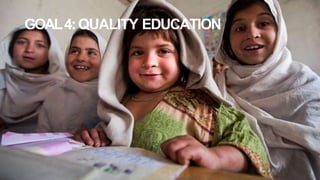
GOAL4:QUALITY EDUCATION
Enrollment in primary education in developing
countries has reached 91 percent.
Still, 57 million primary-aged children remain out of
school, more than half of them in sub-Saharan Africa.
In developing countries, one in four girls is not in
school.
About half of all out-of-school children of primary
school age live in conflict-affected areas.
103 million youth worldwide lack basic literacy skills,
and more than 60 percent of them are women.
6 out of 10 children and adolescents are not
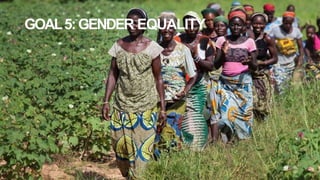
GOAL5:GENDER EQUALITY
Women earn only 77 cents for every dollar that men get
for the same work.
35 percent of women have experienced physical and/or
sexual violence.
Women represent just 13 percent of agricultural
landholders.
Almost 750 million women and girls alive today were
married before their 18th birthday.
Two thirds of developing countries have achieved
gender parity in primary education.
Only 24 percent of national parliamentarians were
women as of November 2018, a small increase from11.3
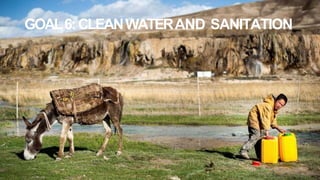
GOAL6:CLEANWATERAND SANITATION
71 percent of the global population, 5.2 billion people, had
safely-managed drinking water in 2015, but 844 million
people still lacked even basic drinking water.
39 percent of the global population, 2.9 billion people, had
safe sanitation in 2015, but 2.3 billion people still lacked
basic sanitation. 892 million people practiced open
defecation.
80 percent of wastewater goes into waterways without
adequate treatment.
Water stress affects more than 2 billion people, with this
figure projected to increase.
80 percent of countries have laid the foundations for
integrated water resources management.
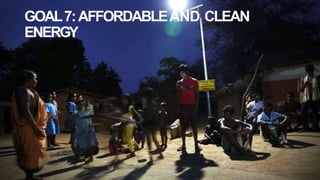
GOAL7:AFFORDABLEAND CLEAN
ENERGY
One in 7 people still lacks electricity, and most of
them live in rural areas of the developing world.
Energy is the main contributor to climate change, it
produces around 60 percent of greenhouse gases.
More efficient energy standards could reduce building
and industry electricity consumption by 14 percent.
More than 40 percent of the world’s population—3
billion—relyon polluting and unhealthy fuels for
cooking.
As of 2015, more than 20 percent of power was
generated through renewable sources.
The renewable energy sector employed a record10.3
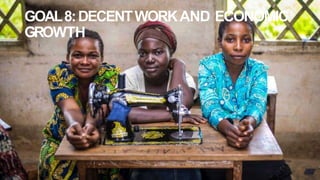
GOAL8:DECENTWORKAND ECONOMIC
GROWTH
An estimated 172 million people worldwide were without
work in 2018 - an unemployment rate of 5 percent.
As a result of an expanding labor force, the number of
unemployed is projected to increase by 1 million every year
and reach 174 million by 2020.
Some 700 million workers lived in extreme or moderate
poverty in 2018, with less than US$3.20 per day.
Women’s participation in the labor force stood at 48 per cent
in 2018, compared with 75 percent for men. Around 3 in 5 of
the 3.5 billion people in the labor force in 2018 were men.
Overall, 2 billion workers were in informal employment in
2016, accounting for 61 per cent of the world’s workforce.
Many more women than men are underutilized in the labour
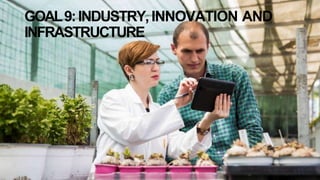
GOAL9:INDUSTRY,INNOVATION AND
INFRASTRUCTURE
Worldwide, 2.3 billion people lack access to basic
sanitation.
In some low-income African countries, infrastructure
constraints cut businesses’ productivity by around 40
percent.
2.6 billion people in developing countries do not have
access to constant electricity.
More than 4 billion people still do not have access to the
Internet; 90 percent of them are in the developing world.
The renewable energy sectors currently employ more
than 2.3 million people; the number could reach 20 million
by 2030.
In developing countries, barely 30 percent of agricultural
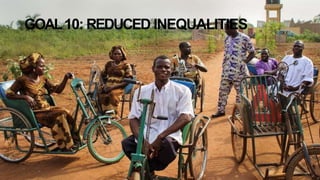
GOAL10: REDUCED INEQUALITIES
In 2016, 22 percent of global income was received by the
top 1 percent compared with 10 percent of income for the
bottom 50 percent.
In 1980, the top one percent had 16 percent of global
income. The bottom 50 percent had 8 percent ofincome.
Economic inequality is largely driven by the unequal
ownership of capital. Since 1980, very large transfers of
public to private wealth occurred in nearly all countries. The
global wealth share of the top 1 percent was 33 percent in
2016.
Under "business as usual", the top 1 percent global wealth
will reach 39 percent by 2050.
Women spend, on average, twice as much time on unpaid
housework as men.
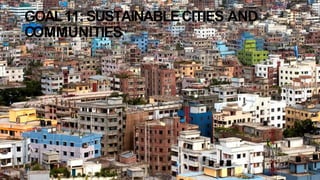
GOAL11: SUSTAINABLECITIES AND
COMMUNITIES
In 2018, 4.2 billion people, 55 percent of the world’s
population, lived in cities. By 2050, the urban population is
expected to reach 6.5 billion.
Cities occupy just 3 percent of the Earth’s land but account
for 60 to 80 percent of energy consumption and at least 70
percent of carbon emissions.
828 million people are estimated to live in slums, and the
number is rising.
In 1990, there were 10 cities with 10 million people or
more; by 2014, the number of mega-cities rose to 28, and
was expected to reach 33 by 2018. In the future, 9 out of 10
mega-cities will be in the developing world.
In the coming decades, 90 percent of urban expansion will
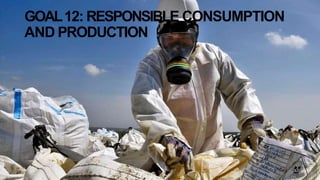
GOAL12: RESPONSIBLE CONSUMPTION
AND PRODUCTION
1.3 billion tonnes of food is wasted every year, while
almost 2 billion people go hungry or undernourished.
The food sector accounts for around 22 percent of
total greenhouse gas emissions, largely from the
conversion of forests into farmland.
Globally, 2 billion people are overweight or obese.
Only 3 percent of the world’s water is fresh
(drinkable), and humans are using it faster than nature
can replenish it.
If people everywhere switched to energy efficient light
bulbs, the world would save US$120 billion annually.
One-fifth of the world’s final energy consumption in
GOAL13: CLIMATE ACTION
As of 2017 humans are estimated to have caused
approximately 1.0°C of global warming above pre-
industrial levels.
Sea levels have risen by about 20 cm (8 inches)
since 1880 and are projected to rise another 30–122
cm (1 to 4 feet) by 2100.
To limit warming to 1.5C, global net CO2 emissions
must drop by 45% between 2010 and 2030, and reach
net zero around 2050.
Climate pledges under The Paris Agreement cover
only one third of the emissions reductions needed to
keep the world below 2°C.
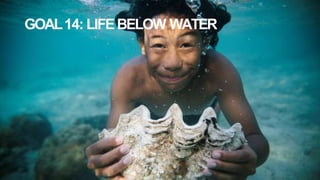
GOAL14: LIFEBELOW WATER
The ocean covers three quarters of the Earth’s
surface and represents 99 percent of the living space
on the planet by volume.
The ocean contains nearly 200,000 identified
species, but actual numbers may lie in the millions.
As much as 40 percent of the ocean is heavily
affected by pollution, depleted fisheries, loss of coastal
habitats and other human activities.
The ocean absorbs about 30 percent of carbon
dioxide produced by humans, buffering the impacts of
global warming.
More than 3 billion people depend on marine and
GOAL15: LIFEON LAND
Around 1.6 billion people depend on forests for
their livelihoods.
Forests are home to more than 80 percent of all
terrestrial species of animals, plants and insects.
2.6 billion people depend directly on agriculture
for a living.
Nature-based climate solutions can contribute
about a third of CO2 reductions by 2030.
The value of ecosystems to human livelihoods
and well-being is $US125 trillion per year.
Mountain regions provide 60-80 percent of the
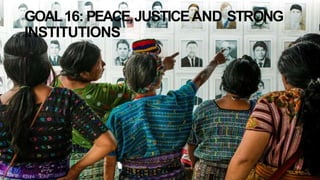
GOAL16: PEACE,JUSTICEAND STRONG
INSTITUTIONS
By the end of 2017, 68.5 million people had been forcibly
displaced as a result of persecution, conflict, violence or
human rights violations.
There are at least 10 million stateless people who have
been denied nationality and its related rights.
Corruption, bribery, theft and tax evasion cost
developing countries US$1.26 trillion per year.
49 countries lack laws protecting women from domestic
violence.
In 46 countries, women now hold more than 30 percent
of seats in at least one chamber of national parliament.
1 billion people are legally ‘invisible’because they
cannot prove who they are. This includes an estimated
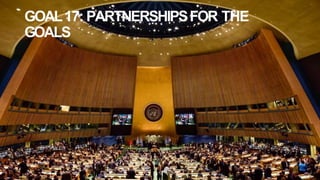
GOAL17: PARTNERSHIPSFOR THE
GOALS
The UN Conference on Trade and Development
(UNCTAD) says achieving SDGs will require US$5 trillion
to $7 trillion in annual investment.
Total official development assistance reached US$147.2
billion in 2017.
In 2017, international remittances totaled US$613 billion;
76 percent of it went to developing countries.
In 2016, 6 countries met the international target to keep
official development assistance at or above 0.7 percent of
gross national income.
Sustainable and responsible investments represent high-
potential sources of capital for SDGs. As of 2016,
US$18.2 trillion was invested in this asset class.
PREPARED BY:
JOANNA MARIE C. RODIL
CAS-DSSH INSTRUCTOR

LESSON 7b GLOBAL SUSTAINABLE DEVELOPMENT.pptx

  • 5.
  • 6.
    SUSTAINABLE DEVELOPMENT Gro Harlem Brundtlandfirst introduced the concept of sustainable development in 1987.
  • 7.
    SUSTAINABLE DEVELOPMENT The PrimeMinister of Norway and chairman of the World Commission on Environment and Development.
  • 8.
    SUSTAINABLE DEVELOPMENT “isdevelopment thatmeets the needs of the present without compromising the ability of future generations to meet their own need.”
  • 9.
  • 10.
  • 11.
  • 13.
    SUSTAINABLE SOCIETY • Livingconditions •Equalopportunity • Socialcohesion • International solidarity • Maintenanceof humancapital SOCIAL EQUITY ECONOMIC EFFICIENCY • Economicgrowth • Efficiency and competitiveness • Flexibility andstability • Production / • consumption • Employment • Internationaltrade ENVIRONMENT AL RESPONSIBI LITY • Consumptionof resources • Materialsand wastes • Risks • Rateof change • Natural andcultural landscape
  • 14.
    PRINCIPLES OF SUSTAINABLE SOCIETY Respectand care for the community of life. Improve the quality of human life. Conserve the Earth's vitality and diversity. Minimize the depletion of non-renewable resources. Keep within the Earth's carrying capacity.
  • 15.
    PRINCIPLES OF SUSTAINABLE SOCIETY Changeattitudes and practices. Enable communities to care for their own environments. Provide a national framework for integrating development and conservation. Create a global alliance.
  • 17.
    First and foremost,these Goals apply to every nation and every sector. Cities, businesses, schools, organizations, all are challenged to act. This is called… UNIVERSALITY
  • 18.
    Second, it isrecognized that the Goals are all inter-connected, in a system. We cannot aim to achieve just one Goal. We must achieve them all. This is called… INTEGRATION
  • 19.
    And finally, itis widely recognized that achieving these Goals involves making very big, fundamental changes in how we live on Earth. This is called… TRANSFORMATI
  • 21.
  • 22.
    736 million peoplestill live in extreme poverty. 10 percent of the world’s population live in extreme poverty, down from 36 percent in 1990. Some 1.3 billion people live in multidimensional poverty. Half of all people living in poverty are under 18.
  • 23.
  • 24.
    The number ofundernourished people reached 821 million in 2017. In 2017 Asia accounted for nearly two thirds, 63 percent, of the world’s hungry. Nearly 151 million children under five, 22 percent, were still stunted in 2017. More than 1 in 8 adults is obese. 1 in 3 women of reproductive age is anemic.
  • 25.
  • 26.
    At least 400million people have no basic healthcare, and 40 percent lack social protection. More than 1.6 billion people live in fragile settings where protracted crises, combined with weak national capacity to deliver basic health services, present a significant challenge to global health. By the end of 2017, 21.7 million people living with HIV were receiving antiretroviral therapy. Yet more than 15 million people are still waiting for treatment. Every 2 seconds someone aged 30 to 70 years dies prematurely from noncommunicable diseases - cardiovascular disease, chronic respiratory disease, diabetes or cancer. 7 million people die every year from exposure to fine particles in polluted air. More than one of every three women have experienced either
  • 27.
  • 28.
    Enrollment in primaryeducation in developing countries has reached 91 percent. Still, 57 million primary-aged children remain out of school, more than half of them in sub-Saharan Africa. In developing countries, one in four girls is not in school. About half of all out-of-school children of primary school age live in conflict-affected areas. 103 million youth worldwide lack basic literacy skills, and more than 60 percent of them are women. 6 out of 10 children and adolescents are not
  • 29.
  • 30.
    Women earn only77 cents for every dollar that men get for the same work. 35 percent of women have experienced physical and/or sexual violence. Women represent just 13 percent of agricultural landholders. Almost 750 million women and girls alive today were married before their 18th birthday. Two thirds of developing countries have achieved gender parity in primary education. Only 24 percent of national parliamentarians were women as of November 2018, a small increase from11.3
  • 31.
  • 32.
    71 percent ofthe global population, 5.2 billion people, had safely-managed drinking water in 2015, but 844 million people still lacked even basic drinking water. 39 percent of the global population, 2.9 billion people, had safe sanitation in 2015, but 2.3 billion people still lacked basic sanitation. 892 million people practiced open defecation. 80 percent of wastewater goes into waterways without adequate treatment. Water stress affects more than 2 billion people, with this figure projected to increase. 80 percent of countries have laid the foundations for integrated water resources management.
  • 33.
  • 34.
    One in 7people still lacks electricity, and most of them live in rural areas of the developing world. Energy is the main contributor to climate change, it produces around 60 percent of greenhouse gases. More efficient energy standards could reduce building and industry electricity consumption by 14 percent. More than 40 percent of the world’s population—3 billion—relyon polluting and unhealthy fuels for cooking. As of 2015, more than 20 percent of power was generated through renewable sources. The renewable energy sector employed a record10.3
  • 35.
  • 36.
    An estimated 172million people worldwide were without work in 2018 - an unemployment rate of 5 percent. As a result of an expanding labor force, the number of unemployed is projected to increase by 1 million every year and reach 174 million by 2020. Some 700 million workers lived in extreme or moderate poverty in 2018, with less than US$3.20 per day. Women’s participation in the labor force stood at 48 per cent in 2018, compared with 75 percent for men. Around 3 in 5 of the 3.5 billion people in the labor force in 2018 were men. Overall, 2 billion workers were in informal employment in 2016, accounting for 61 per cent of the world’s workforce. Many more women than men are underutilized in the labour
  • 37.
  • 38.
    Worldwide, 2.3 billionpeople lack access to basic sanitation. In some low-income African countries, infrastructure constraints cut businesses’ productivity by around 40 percent. 2.6 billion people in developing countries do not have access to constant electricity. More than 4 billion people still do not have access to the Internet; 90 percent of them are in the developing world. The renewable energy sectors currently employ more than 2.3 million people; the number could reach 20 million by 2030. In developing countries, barely 30 percent of agricultural
  • 39.
  • 40.
    In 2016, 22percent of global income was received by the top 1 percent compared with 10 percent of income for the bottom 50 percent. In 1980, the top one percent had 16 percent of global income. The bottom 50 percent had 8 percent ofincome. Economic inequality is largely driven by the unequal ownership of capital. Since 1980, very large transfers of public to private wealth occurred in nearly all countries. The global wealth share of the top 1 percent was 33 percent in 2016. Under "business as usual", the top 1 percent global wealth will reach 39 percent by 2050. Women spend, on average, twice as much time on unpaid housework as men.
  • 41.
  • 42.
    In 2018, 4.2billion people, 55 percent of the world’s population, lived in cities. By 2050, the urban population is expected to reach 6.5 billion. Cities occupy just 3 percent of the Earth’s land but account for 60 to 80 percent of energy consumption and at least 70 percent of carbon emissions. 828 million people are estimated to live in slums, and the number is rising. In 1990, there were 10 cities with 10 million people or more; by 2014, the number of mega-cities rose to 28, and was expected to reach 33 by 2018. In the future, 9 out of 10 mega-cities will be in the developing world. In the coming decades, 90 percent of urban expansion will
  • 43.
  • 44.
    1.3 billion tonnesof food is wasted every year, while almost 2 billion people go hungry or undernourished. The food sector accounts for around 22 percent of total greenhouse gas emissions, largely from the conversion of forests into farmland. Globally, 2 billion people are overweight or obese. Only 3 percent of the world’s water is fresh (drinkable), and humans are using it faster than nature can replenish it. If people everywhere switched to energy efficient light bulbs, the world would save US$120 billion annually. One-fifth of the world’s final energy consumption in
  • 45.
  • 46.
    As of 2017humans are estimated to have caused approximately 1.0°C of global warming above pre- industrial levels. Sea levels have risen by about 20 cm (8 inches) since 1880 and are projected to rise another 30–122 cm (1 to 4 feet) by 2100. To limit warming to 1.5C, global net CO2 emissions must drop by 45% between 2010 and 2030, and reach net zero around 2050. Climate pledges under The Paris Agreement cover only one third of the emissions reductions needed to keep the world below 2°C.
  • 47.
  • 48.
    The ocean coversthree quarters of the Earth’s surface and represents 99 percent of the living space on the planet by volume. The ocean contains nearly 200,000 identified species, but actual numbers may lie in the millions. As much as 40 percent of the ocean is heavily affected by pollution, depleted fisheries, loss of coastal habitats and other human activities. The ocean absorbs about 30 percent of carbon dioxide produced by humans, buffering the impacts of global warming. More than 3 billion people depend on marine and
  • 49.
  • 50.
    Around 1.6 billionpeople depend on forests for their livelihoods. Forests are home to more than 80 percent of all terrestrial species of animals, plants and insects. 2.6 billion people depend directly on agriculture for a living. Nature-based climate solutions can contribute about a third of CO2 reductions by 2030. The value of ecosystems to human livelihoods and well-being is $US125 trillion per year. Mountain regions provide 60-80 percent of the
  • 51.
  • 52.
    By the endof 2017, 68.5 million people had been forcibly displaced as a result of persecution, conflict, violence or human rights violations. There are at least 10 million stateless people who have been denied nationality and its related rights. Corruption, bribery, theft and tax evasion cost developing countries US$1.26 trillion per year. 49 countries lack laws protecting women from domestic violence. In 46 countries, women now hold more than 30 percent of seats in at least one chamber of national parliament. 1 billion people are legally ‘invisible’because they cannot prove who they are. This includes an estimated
  • 53.
  • 54.
    The UN Conferenceon Trade and Development (UNCTAD) says achieving SDGs will require US$5 trillion to $7 trillion in annual investment. Total official development assistance reached US$147.2 billion in 2017. In 2017, international remittances totaled US$613 billion; 76 percent of it went to developing countries. In 2016, 6 countries met the international target to keep official development assistance at or above 0.7 percent of gross national income. Sustainable and responsible investments represent high- potential sources of capital for SDGs. As of 2016, US$18.2 trillion was invested in this asset class.
  • 55.
    PREPARED BY: JOANNA MARIEC. RODIL CAS-DSSH INSTRUCTOR