LESSON 4
ADJECTIVE CLAUSES
PARTICIPLES & PARTICIPIAL PHRASES
Nguyen Thi Tinh, M.A.
ADJECTIVE CLAUSES
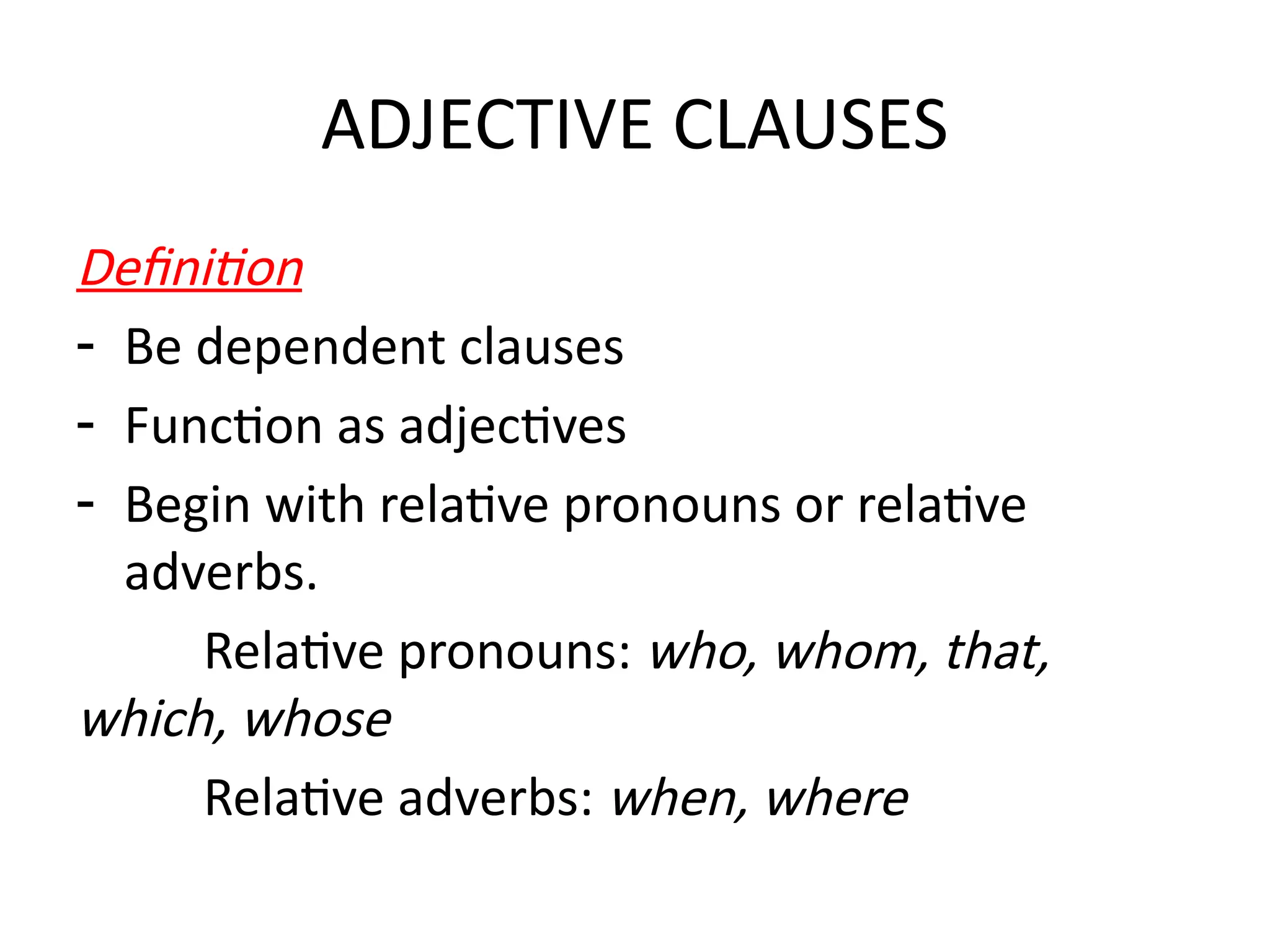
Definition
- Be dependent clauses
- Function as adjectives
- Begin with relative pronouns or relative
adverbs.
Relative pronouns: who, whom, that,
which, whose
Relative adverbs: when, where
ADJECTIVE CLAUSES
Function
- Modify the antecedent (nouns, noun phrases
or pronouns) in the independent clause.
Ex: People who work in mines are called miners.
- Modify the entire sentences
Ex: My mother got angry with me, which made
me afraid.
ADJECTIVE CLAUSES
Position
- Come right after its antecedent.
- Come after other words modifying the
antecedent.
- Come at the end of the sentence.
* Verb agreement
The verb in an adjective clause agrees with its
antecedent.
ADJECTIVE CLAUSES
Classification
- Restrictive adjective clauses
- Non-restrictive adjective clauses
• That – only in restrictive clauses
• Which – only in non-restrictive clauses
• Others – in both
ADJECTIVE CLAUSES
Punctuation
- A restrictive clause does not take a comma
with it.
- A non-restrictive clause takes one or two
comma(s) with it.
- Practice 1 (p.247)
ADJECTIVE CLAUSES
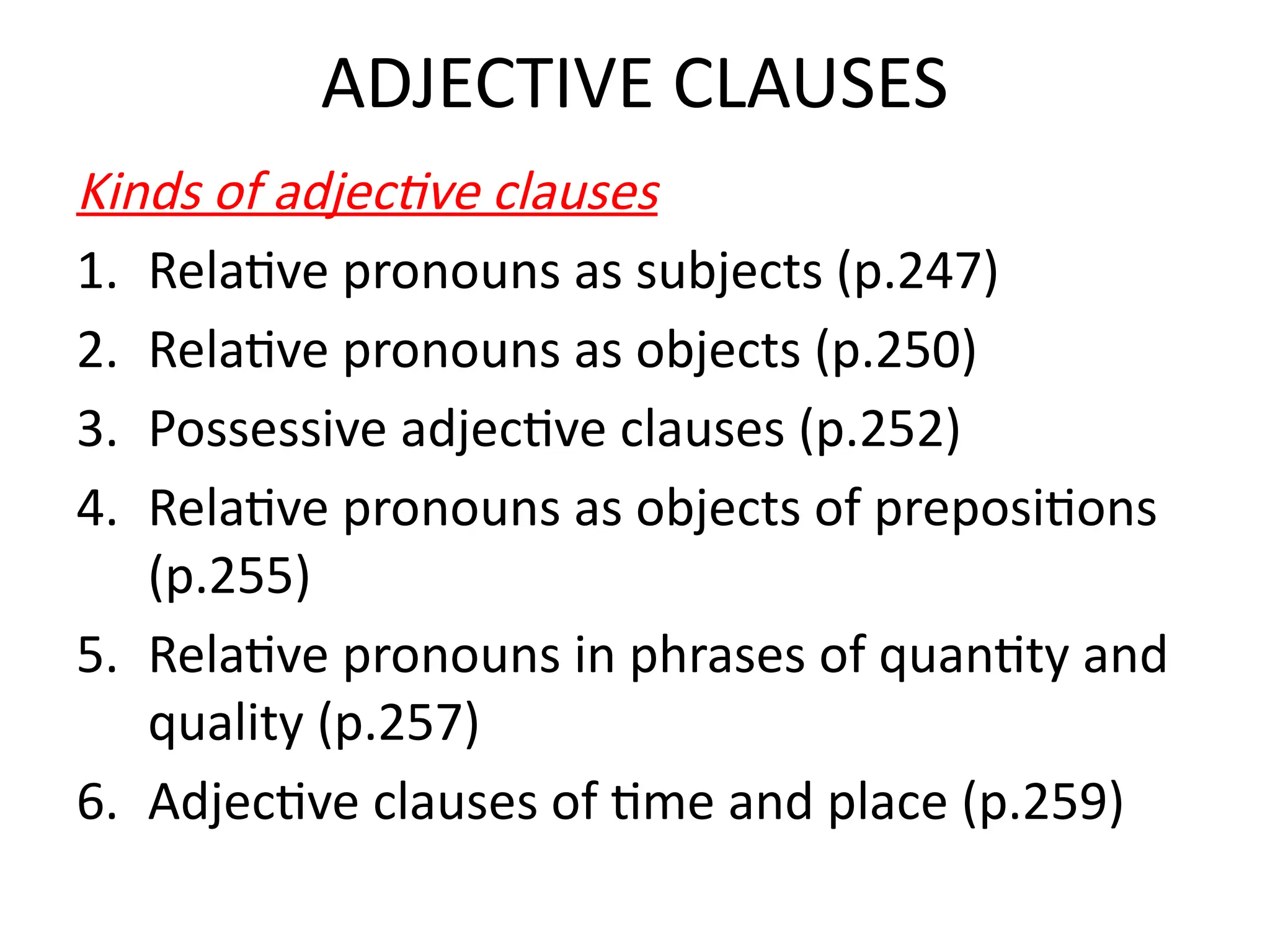
Kinds of adjective clauses
1. Relative pronouns as subjects (p.247)
2. Relative pronouns as objects (p.250)
3. Possessive adjective clauses (p.252)
4. Relative pronouns as objects of prepositions
(p.255)
5. Relative pronouns in phrases of quantity and
quality (p.257)
6. Adjective clauses of time and place (p.259)
ADJECTIVE CLAUSES
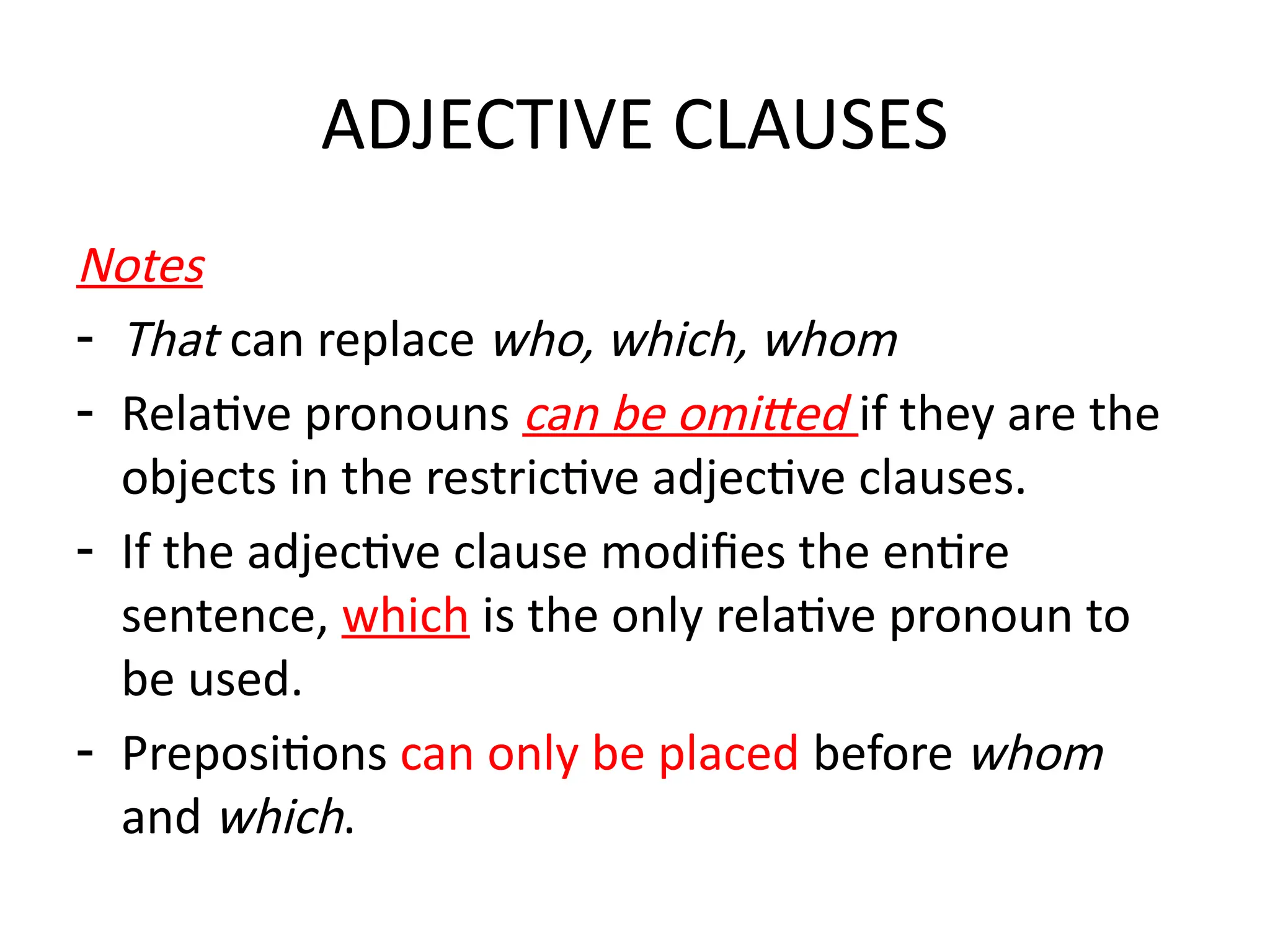
Notes
- That can replace who, which, whom
- Relative pronouns can be omitted if they are the
objects in the restrictive adjective clauses.
- If the adjective clause modifies the entire
sentence, which is the only relative pronoun to
be used.
- Prepositions can only be placed before whom
and which.
PARTICIPLES
Definition
- Be adjectives formed from verbs
- Two types: present participles (V-ing) and past
participles (V-ed/V-pp)
- Participial phrases = participles + other words
PARTICIPLES
Classification
- Active voice verbs become present participles.
Ex: an interesting film
- Passive voice verbs become a past participles.
Ex: a printed version
- Perfect forms of participles.
Ex: Having finished the test, he submitted
and left the room.
PARTICIPIAL PHRASES
Definition
Participial phrases = reduced adj or adv clauses
Position and punctuation
- Restrictive phrases follow the nouns modified
(without commas).
- Non-restrictive phrases precede or follow nouns
modified (with commas).
- If the phrase modify the entire sentence, it follow
the clause (with a comma).
PARTICIPIAL PHRASES
1. Present participial phrases (p.268)
2. Past participial phrases (p.269)
3. Perfect form participial phrases (p.271)
4. Participial phrases and writing style (p.272)
5. Reduced adjective clauses (p.267)
6. Reduced adverb clauses (p.274) –
watch the video
PRACTICE
Handout

LESSON 4-adjective clauses in academic writing.pptx

  • 1.
    LESSON 4 ADJECTIVE CLAUSES PARTICIPLES& PARTICIPIAL PHRASES Nguyen Thi Tinh, M.A.
  • 2.
    ADJECTIVE CLAUSES Definition - Bedependent clauses - Function as adjectives - Begin with relative pronouns or relative adverbs. Relative pronouns: who, whom, that, which, whose Relative adverbs: when, where
  • 3.
    ADJECTIVE CLAUSES Function - Modifythe antecedent (nouns, noun phrases or pronouns) in the independent clause. Ex: People who work in mines are called miners. - Modify the entire sentences Ex: My mother got angry with me, which made me afraid.
  • 4.
    ADJECTIVE CLAUSES Position - Comeright after its antecedent. - Come after other words modifying the antecedent. - Come at the end of the sentence. * Verb agreement The verb in an adjective clause agrees with its antecedent.
  • 5.
    ADJECTIVE CLAUSES Classification - Restrictiveadjective clauses - Non-restrictive adjective clauses • That – only in restrictive clauses • Which – only in non-restrictive clauses • Others – in both
  • 6.
    ADJECTIVE CLAUSES Punctuation - Arestrictive clause does not take a comma with it. - A non-restrictive clause takes one or two comma(s) with it. - Practice 1 (p.247)
  • 7.
    ADJECTIVE CLAUSES Kinds ofadjective clauses 1. Relative pronouns as subjects (p.247) 2. Relative pronouns as objects (p.250) 3. Possessive adjective clauses (p.252) 4. Relative pronouns as objects of prepositions (p.255) 5. Relative pronouns in phrases of quantity and quality (p.257) 6. Adjective clauses of time and place (p.259)
  • 8.
    ADJECTIVE CLAUSES Notes - Thatcan replace who, which, whom - Relative pronouns can be omitted if they are the objects in the restrictive adjective clauses. - If the adjective clause modifies the entire sentence, which is the only relative pronoun to be used. - Prepositions can only be placed before whom and which.
  • 9.
    PARTICIPLES Definition - Be adjectivesformed from verbs - Two types: present participles (V-ing) and past participles (V-ed/V-pp) - Participial phrases = participles + other words
  • 10.
    PARTICIPLES Classification - Active voiceverbs become present participles. Ex: an interesting film - Passive voice verbs become a past participles. Ex: a printed version - Perfect forms of participles. Ex: Having finished the test, he submitted and left the room.
  • 11.
    PARTICIPIAL PHRASES Definition Participial phrases= reduced adj or adv clauses Position and punctuation - Restrictive phrases follow the nouns modified (without commas). - Non-restrictive phrases precede or follow nouns modified (with commas). - If the phrase modify the entire sentence, it follow the clause (with a comma).
  • 12.
    PARTICIPIAL PHRASES 1. Presentparticipial phrases (p.268) 2. Past participial phrases (p.269) 3. Perfect form participial phrases (p.271) 4. Participial phrases and writing style (p.272) 5. Reduced adjective clauses (p.267) 6. Reduced adverb clauses (p.274) – watch the video
  • 13.