UNDERSTAN
DING LOCAL
NETWORKS
By: Jay-Ar C.
Esberto
O MAN IS AN ISLAND
NETWO
RKDefined as a group of
people with whom we
interact daily and it
happens that each time
we take an interest in a
school, get together, visit
from our religious
gathering, chat with our
neighbors, and interface
with our companions on
the web.
NETWO
RKThis includes our family,
companions, colleagues,
and technology enhances
the varied networks
regardless of our location.
Networks are a
“Set of Nodes
and Set of Ties”
(Brass, 1994)
Awareness concerning
social networks is
important to the extent
that people are uncertain
who is connected to
whom. It is a means of
developing contact and
exchange of information.
Networks are a “Set of
Nodes and Set of Ties”
(Brass, 1994)
It provides us the
opportunity to interact
with people outside of our
regular social circle. It is
vital also to
entrepreneurs,
professionals, and job
seekers.
Networks are a “Set of
Nodes and Set of Ties”
(Brass, 1994)
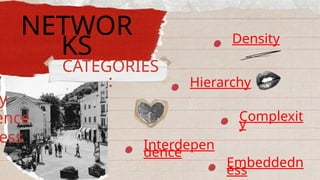
ACCORDING TO KILDUFF
AND TSAL, NETWORKS
ARE ANALYZED IN
TERMS OF:
Density
Hierarchy
Complexit
y
Interdepen
dence
CATEGORIES
:
NETWOR
KS
y
y
ence
ess
Embeddedn
ess
DENSI
TY
• The Density of a network is based on
the number of connections between
and among the actors.
• Density also tells how concentrated or
crowded something is.
HIERARC
HY
• System or organization in which people
or groups are ranked one above the
other according to status or authority.
• Hierarchy describes a system that
organizes or ranks things, often
according to power or importance.
COMPLE
XITY
• Complexity is the extent to which a link
between actors serves a multiplicity of
interests in the community.
• The more complex relations have been
considered to have higher tie strength.
INTERDEPEN
DENCE
• Interdependence is mutual
dependence between things.
• We often use interdependence to
describe complex systems. Example,
marriage creates a state of
interdependence between spouses.
EMBEDDE
DNESS
• The networks of relations within each
person are rooted including family,
friends, and acquaintances.
TWO (2) DISTINCT
SKILLS IN
ANALYZING
NETWORKS
• STRATEGIC
THINKING
Greg Githens defined strategic
thinking as the individual’s
capacity for thinking
conceptually, imaginatively,
systematically, and
opportunistically with regard to
the attainment of success in the
future.
STRATE
GIC
THINKI
NG
ELEMENTS
OF
STRATEGIC
The word “success” needs to be
considered in the context of the
usual meaning of the word
strategy; that is, some field of
competition where the strategy
exploits advantage and leads to
a desirable outcome for the
strategist.
SUCCES
S
ORIENT
ED
For example:
Success in a game involves
winning within the boundaries of
a set of game rules.
SUCCES
S
ORIENT
ED
Strategic thinking involves
looking towards the future with
an appreciation that present-
moment decisions will have an
impact on the future. The future
may be very different from the
status quo.
FUTURE
ORIENT
ED
Any kind of thinking is governed
by the mind, or more specifically
the brain. Commonsense tells us
that individuals – even people
who are genetically identical –
think differently and have
different learned responses to
coping with the world around
them.
• Intuitive Thinking is “quick and
ready insight”
• Far more than using common
sense because it involves
additional sensors to perceive
and get aware of the
information from outside.
Sometimes, it is referred to as
gut feeling, sixth sense, inner
sense, instinct, inner voice,
spiritual guide, etc.
NTUITIVE
THINKIN
G
• Oxford Dictionaries define
intuition as “the ability to
understand something
instinctively, without the need
for conscious reasoning.”
NTUITIVE
THINKIN
G
FOUR
KINDS OF
INTUITIVE
MOTIONAL
INTUITIVE
THINKING
This has to do with your
ability to immediately
pick up on other
people’s personality
traits or emotional
states. You can see who
they are, or how they
are, without them
having to say anything.
MENTAL
INTUITIVE
THINKING
This is about finding an
immediate answer to a
problem, without
analyzing it. It’s very
common in people with
jobs that require quick
decisions, like
firefighters or bomb
technicians.
PSYCHIC
INTUITIVE
THINKING
This means having the
ability to choose the
best path to overcome
a personal difficulty,
without putting much
mental effort into it. It
also means being able
to pick up on social and
work-related dynamics.
SPIRITUAL
INTUITIVE
THINKING
This has to do with
states of
“enlightenment” or
“revelations”. They’re
more of an experience
than a fact. Buddhists
talk about this kind of
intuition more than
anyone else, which has
given it a mystical
quality
THAN
K
YOU!
STAY COOL!!!!

LESSON 3 - UNDERSTANDING LOCAL NETWORK.pptx

  • 1.
  • 2.
    O MAN ISAN ISLAND
  • 3.
    NETWO RKDefined as agroup of people with whom we interact daily and it happens that each time we take an interest in a school, get together, visit from our religious gathering, chat with our neighbors, and interface with our companions on the web.
  • 4.
    NETWO RKThis includes ourfamily, companions, colleagues, and technology enhances the varied networks regardless of our location.
  • 5.
    Networks are a “Setof Nodes and Set of Ties” (Brass, 1994)
  • 6.
    Awareness concerning social networksis important to the extent that people are uncertain who is connected to whom. It is a means of developing contact and exchange of information. Networks are a “Set of Nodes and Set of Ties” (Brass, 1994)
  • 7.
    It provides usthe opportunity to interact with people outside of our regular social circle. It is vital also to entrepreneurs, professionals, and job seekers. Networks are a “Set of Nodes and Set of Ties” (Brass, 1994)
  • 8.
    ACCORDING TO KILDUFF ANDTSAL, NETWORKS ARE ANALYZED IN TERMS OF:
  • 9.
  • 10.
    DENSI TY • The Densityof a network is based on the number of connections between and among the actors. • Density also tells how concentrated or crowded something is.
  • 11.
    HIERARC HY • System ororganization in which people or groups are ranked one above the other according to status or authority. • Hierarchy describes a system that organizes or ranks things, often according to power or importance.
  • 12.
    COMPLE XITY • Complexity isthe extent to which a link between actors serves a multiplicity of interests in the community. • The more complex relations have been considered to have higher tie strength.
  • 13.
    INTERDEPEN DENCE • Interdependence ismutual dependence between things. • We often use interdependence to describe complex systems. Example, marriage creates a state of interdependence between spouses.
  • 14.
    EMBEDDE DNESS • The networksof relations within each person are rooted including family, friends, and acquaintances.
  • 15.
    TWO (2) DISTINCT SKILLSIN ANALYZING NETWORKS • STRATEGIC THINKING
  • 16.
    Greg Githens definedstrategic thinking as the individual’s capacity for thinking conceptually, imaginatively, systematically, and opportunistically with regard to the attainment of success in the future. STRATE GIC THINKI NG
  • 17.
  • 18.
    The word “success”needs to be considered in the context of the usual meaning of the word strategy; that is, some field of competition where the strategy exploits advantage and leads to a desirable outcome for the strategist. SUCCES S ORIENT ED
  • 19.
    For example: Success ina game involves winning within the boundaries of a set of game rules. SUCCES S ORIENT ED
  • 20.
    Strategic thinking involves lookingtowards the future with an appreciation that present- moment decisions will have an impact on the future. The future may be very different from the status quo. FUTURE ORIENT ED
  • 21.
    Any kind ofthinking is governed by the mind, or more specifically the brain. Commonsense tells us that individuals – even people who are genetically identical – think differently and have different learned responses to coping with the world around them.
  • 22.
    • Intuitive Thinkingis “quick and ready insight” • Far more than using common sense because it involves additional sensors to perceive and get aware of the information from outside. Sometimes, it is referred to as gut feeling, sixth sense, inner sense, instinct, inner voice, spiritual guide, etc. NTUITIVE THINKIN G
  • 23.
    • Oxford Dictionariesdefine intuition as “the ability to understand something instinctively, without the need for conscious reasoning.” NTUITIVE THINKIN G
  • 24.
  • 25.
    MOTIONAL INTUITIVE THINKING This has todo with your ability to immediately pick up on other people’s personality traits or emotional states. You can see who they are, or how they are, without them having to say anything.
  • 26.
    MENTAL INTUITIVE THINKING This is aboutfinding an immediate answer to a problem, without analyzing it. It’s very common in people with jobs that require quick decisions, like firefighters or bomb technicians.
  • 27.
    PSYCHIC INTUITIVE THINKING This means havingthe ability to choose the best path to overcome a personal difficulty, without putting much mental effort into it. It also means being able to pick up on social and work-related dynamics.
  • 28.
    SPIRITUAL INTUITIVE THINKING This has todo with states of “enlightenment” or “revelations”. They’re more of an experience than a fact. Buddhists talk about this kind of intuition more than anyone else, which has given it a mystical quality
  • 29.