Green Digital Marketing
Communicate on behalf of brands in a way that is
sustainable, ethical and fun!
Ethical Marketing
Ethical Marketing - why values matter
Take a moment to think about your own personal values. How do they influence
how you see the world? How much have they influenced your decisions?
According to a recent study your values shape more of our lives than we think;
where we shop, our diet, how we dress and much more.
From a brand perspective, we want to align with our target audience and our
values play a crucial role in this. In a new era of trust and transparency, values
should direct a company’s decisions, and not only in marketing.
Why values matter
1. Your Values Echo Your Purpose
A mission statement explains the purpose of your company, and values serve
as the moral compass for the decisions that are made to fulfill that purpose.
When it comes to building out your marketing strategy, it is essential to
know your mission and the values behind your organization to ensure that
your brand messaging is consistent, meaningful, and is driving you where
you want to go.
Why values matter
2. Values Foster Fierce Loyalty
As personal beliefs and values drive many of our daily decisions, it’s no surprise
that values are the main factor in a purchase decision. In today’s marketplace, it’s
more important than ever to openly discuss your internal company values and
share that with your customers, as customers who feel aligned to your business
values tend to be fiercely loyal to you.
Fiercely loyal customers are vital to your business and if you clearly communicate
your value to them, they’ll stick with you, even if you don’t necessarily have the
lowest price.
Why values matter
3. Showcasing Your Values Builds Trust and Transparency
It’s becoming more and more common for businesses to be completely open
and transparent about factors in their business that would have been
proprietary information 50 years ago. The next slide show some examples of
transparency in action, according to an article in the Boston Globe.
Why values matter
❖ Apptopia, a Boston-based company, lets its employees see all of their
security monitors. The monitors show everything from monthly
revenues, client numbers, and customer churn.
❖ HubSpot, a well-known marketing automation software company,
states that all of its employees are “insiders.” Being an insider means
that they can see the company’s financial information before it’s
released to the public.
❖ Whole Foods Market and a travel-website company called How I Travel
discloses all of their employees’ pay. “We’re strong believers that
transparency breeds trust,” the travel firm’s CEO told the Boston Globe.
“And it’s extremely important for us to have a trusting family feel within
our ranks.”
Why values matter
These brands are clearly showcasing their values by being open and
transparent with their employees, but in doing so, they are communicating
to their customers and investors that they have nothing to hide. Chief
executive Eliran Sapir from Apptopia stated, “When you have nothing to
hide, things are going really well.”
Why values matter
4. Values Boost the Bottom Line
So, we know values are good for a company’s image, but how does it affect
the bottom line? Quite a bit, in fact.
According to an Edelman brandshare survey, 87% of people want a
meaningful relationship with brands, but only 17% think brands are actually
delivering.
Marketing based on values can result in big sales. For example, Under
Armour created a marketing campaign entirely based on the values of their
customers. Their campaign titled, “I Will What I Want” sought to tap into
their consumers’ emotions and core values.
Why values matter
So, what happened? According to Droga5, the ad agency in charge of the
campaign, it resulted in 1.5 billion impressions and helped lead to a 28%
increase in sales for Under Armour.
This campaign clearly demonstrated the power of marketing to the values
and unmet needs of consumers. Under Armour successfully showcased their
values and struck a chord with their consumer community, which resulted in
a hefty increase in sales.
Values aren’t just good for
the soul, they are vital to
your business. If your
company has a strong set
of values, it might be
worth considering taking
a values-based approach
to your marketing. Your
customers will love you
for it.
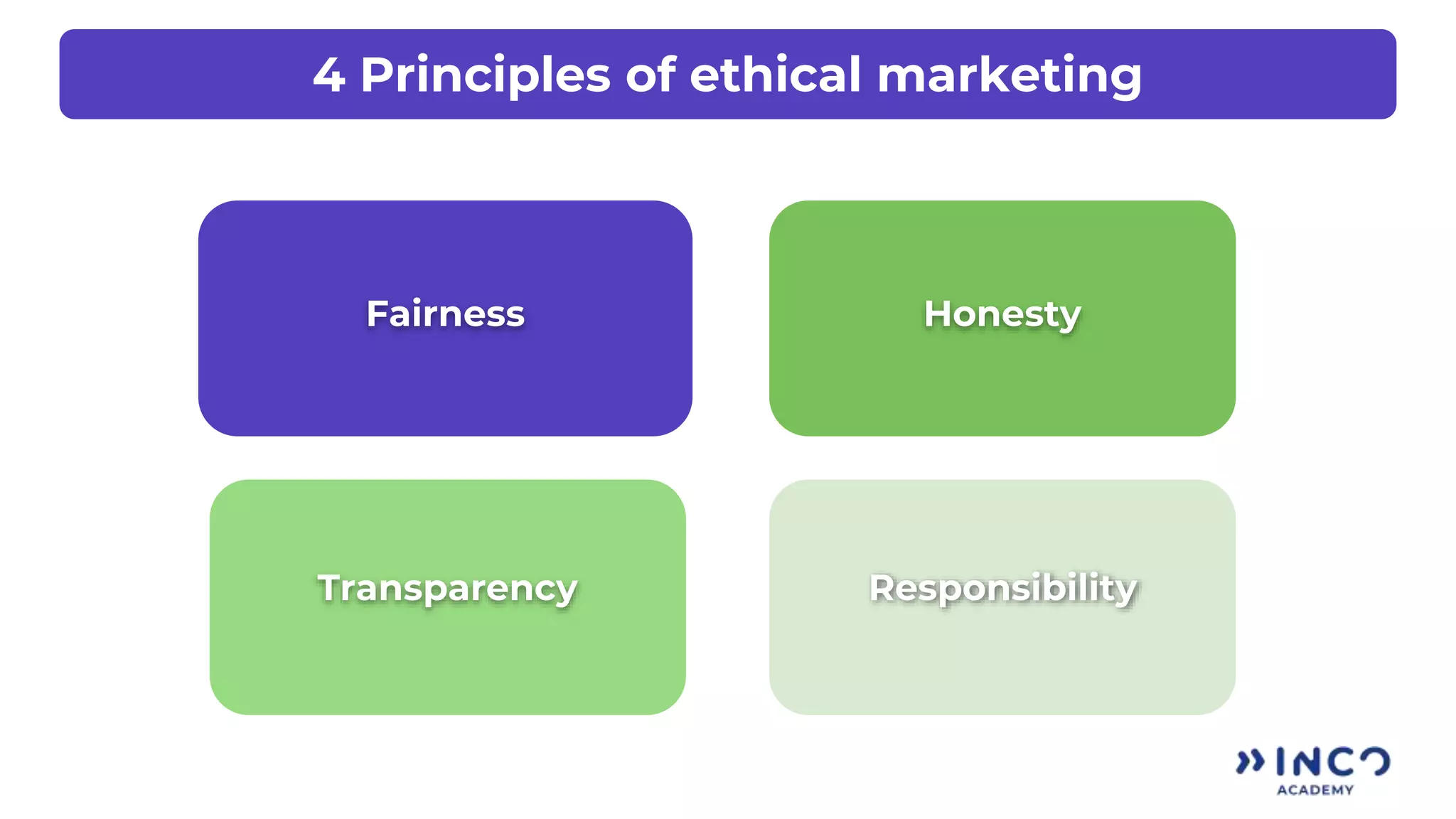
4 Principles of ethical marketing
Fairness Honesty
Transparency Responsibility
4 Principles Explained
Fairness
Establishing fairness
as a decision-making
principle means
companies commit to
fair prices, better
wages, and
sustainable
development.
Honesty
A cornerstone of ethical
behaviour is honesty.
Honest companies use
marketing
communications to
provide factual and
unexaggerated
information about the
functionality and
impact of their
products and services;
they advertise without
attempting to mislead.
Responsibility
Businesses may
emphasize their
responsibility in
several ways,
including their
obligation to provide a
reliable product or
service, support social
causes, give back to
communities, treat
their employees with
respect, or protect the
environment through
sustainable practices.
Transparency
In business,
transparency means
being open to the
public about your
company’s operations,
particularly the ethical
way you treat
employees and the
sustainability and
environmental impact
of your products or
services.
3 Examples
1. A charitable giving campaign
Many ethical companies engage in significant
charitable giving programs, donating money or
goods to social causes and initiatives with a positive
impact.
An example of a charitable giving campaign is a one-to-one
program built into the business model: The company donates
one product to charity for every product they sell.
2. Centering business decisions and
impact on product pages
A common ethical marketing strategy is to advertise the
company’s fair business practices on product pages. The site may
give an inside look at the production process (like a factory or
office space) or provide accurate numbers about the product’s
minimal environmental impact. This aims to establish brand
loyalty and make customers feel proud about supporting a
company that works hard to be ethical.
3. Socially responsible social media
accounts
Many companies work to show their ethical practices
by being responsible and outspoken online about
social and ethical issues. This marketing decision
emphasizes the company is an ethical brand with a
sense of social responsibility that customers want to
support.

Lesson 2 - Ethical Marketing (1).pptx

  • 1.
    Green Digital Marketing Communicateon behalf of brands in a way that is sustainable, ethical and fun!
  • 2.
  • 3.
    Ethical Marketing -why values matter Take a moment to think about your own personal values. How do they influence how you see the world? How much have they influenced your decisions? According to a recent study your values shape more of our lives than we think; where we shop, our diet, how we dress and much more. From a brand perspective, we want to align with our target audience and our values play a crucial role in this. In a new era of trust and transparency, values should direct a company’s decisions, and not only in marketing.
  • 4.
    Why values matter 1.Your Values Echo Your Purpose A mission statement explains the purpose of your company, and values serve as the moral compass for the decisions that are made to fulfill that purpose. When it comes to building out your marketing strategy, it is essential to know your mission and the values behind your organization to ensure that your brand messaging is consistent, meaningful, and is driving you where you want to go.
  • 5.
    Why values matter 2.Values Foster Fierce Loyalty As personal beliefs and values drive many of our daily decisions, it’s no surprise that values are the main factor in a purchase decision. In today’s marketplace, it’s more important than ever to openly discuss your internal company values and share that with your customers, as customers who feel aligned to your business values tend to be fiercely loyal to you. Fiercely loyal customers are vital to your business and if you clearly communicate your value to them, they’ll stick with you, even if you don’t necessarily have the lowest price.
  • 6.
    Why values matter 3.Showcasing Your Values Builds Trust and Transparency It’s becoming more and more common for businesses to be completely open and transparent about factors in their business that would have been proprietary information 50 years ago. The next slide show some examples of transparency in action, according to an article in the Boston Globe.
  • 7.
    Why values matter ❖Apptopia, a Boston-based company, lets its employees see all of their security monitors. The monitors show everything from monthly revenues, client numbers, and customer churn. ❖ HubSpot, a well-known marketing automation software company, states that all of its employees are “insiders.” Being an insider means that they can see the company’s financial information before it’s released to the public. ❖ Whole Foods Market and a travel-website company called How I Travel discloses all of their employees’ pay. “We’re strong believers that transparency breeds trust,” the travel firm’s CEO told the Boston Globe. “And it’s extremely important for us to have a trusting family feel within our ranks.”
  • 8.
    Why values matter Thesebrands are clearly showcasing their values by being open and transparent with their employees, but in doing so, they are communicating to their customers and investors that they have nothing to hide. Chief executive Eliran Sapir from Apptopia stated, “When you have nothing to hide, things are going really well.”
  • 9.
    Why values matter 4.Values Boost the Bottom Line So, we know values are good for a company’s image, but how does it affect the bottom line? Quite a bit, in fact. According to an Edelman brandshare survey, 87% of people want a meaningful relationship with brands, but only 17% think brands are actually delivering. Marketing based on values can result in big sales. For example, Under Armour created a marketing campaign entirely based on the values of their customers. Their campaign titled, “I Will What I Want” sought to tap into their consumers’ emotions and core values.
  • 10.
    Why values matter So,what happened? According to Droga5, the ad agency in charge of the campaign, it resulted in 1.5 billion impressions and helped lead to a 28% increase in sales for Under Armour. This campaign clearly demonstrated the power of marketing to the values and unmet needs of consumers. Under Armour successfully showcased their values and struck a chord with their consumer community, which resulted in a hefty increase in sales.
  • 11.
    Values aren’t justgood for the soul, they are vital to your business. If your company has a strong set of values, it might be worth considering taking a values-based approach to your marketing. Your customers will love you for it.
  • 12.
    4 Principles ofethical marketing Fairness Honesty Transparency Responsibility
  • 13.
    4 Principles Explained Fairness Establishingfairness as a decision-making principle means companies commit to fair prices, better wages, and sustainable development. Honesty A cornerstone of ethical behaviour is honesty. Honest companies use marketing communications to provide factual and unexaggerated information about the functionality and impact of their products and services; they advertise without attempting to mislead. Responsibility Businesses may emphasize their responsibility in several ways, including their obligation to provide a reliable product or service, support social causes, give back to communities, treat their employees with respect, or protect the environment through sustainable practices. Transparency In business, transparency means being open to the public about your company’s operations, particularly the ethical way you treat employees and the sustainability and environmental impact of your products or services.
  • 14.
  • 15.
    1. A charitablegiving campaign Many ethical companies engage in significant charitable giving programs, donating money or goods to social causes and initiatives with a positive impact. An example of a charitable giving campaign is a one-to-one program built into the business model: The company donates one product to charity for every product they sell.
  • 16.
    2. Centering businessdecisions and impact on product pages A common ethical marketing strategy is to advertise the company’s fair business practices on product pages. The site may give an inside look at the production process (like a factory or office space) or provide accurate numbers about the product’s minimal environmental impact. This aims to establish brand loyalty and make customers feel proud about supporting a company that works hard to be ethical.
  • 17.
    3. Socially responsiblesocial media accounts Many companies work to show their ethical practices by being responsible and outspoken online about social and ethical issues. This marketing decision emphasizes the company is an ethical brand with a sense of social responsibility that customers want to support.