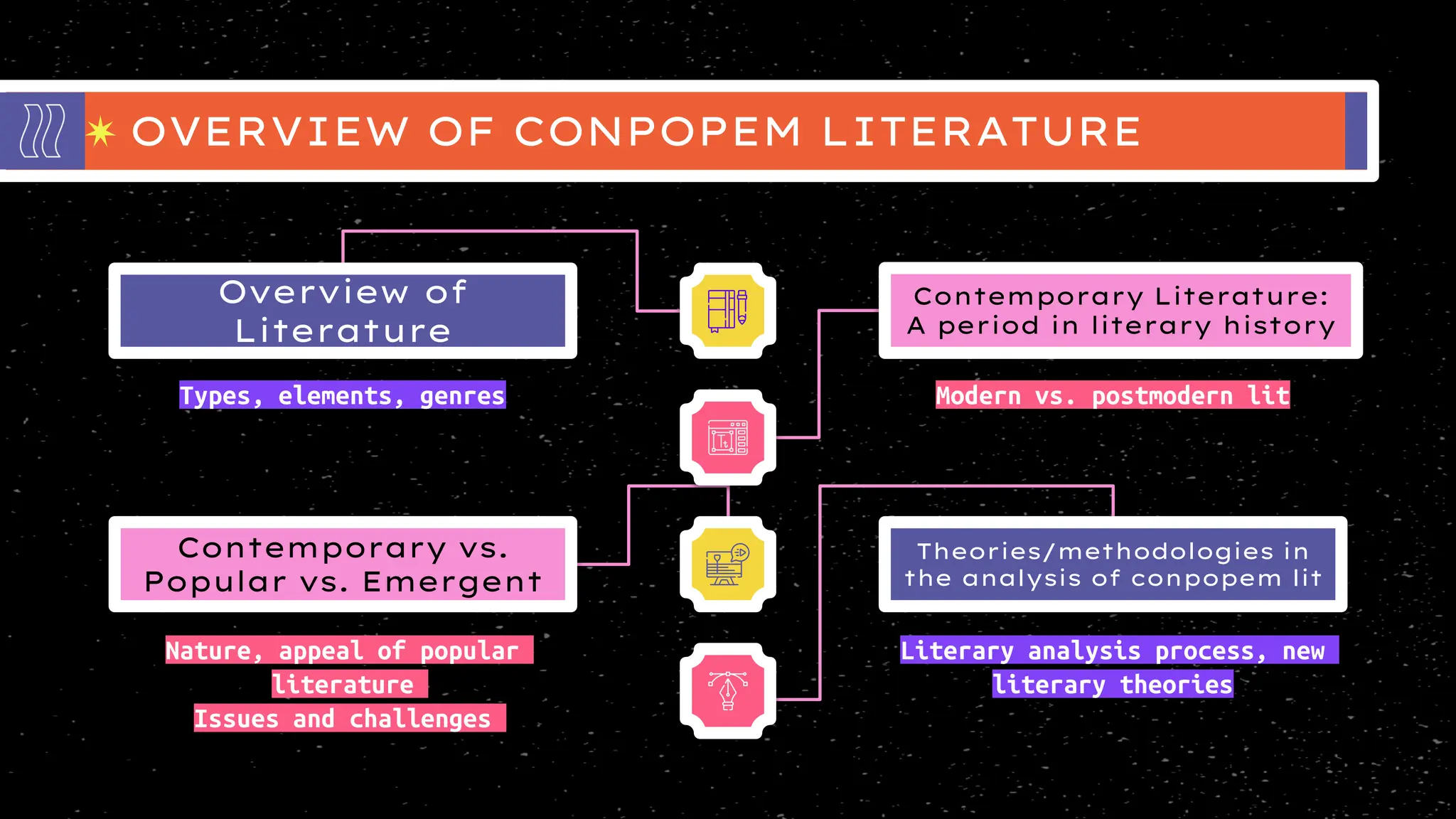
OVERVIEW OF CONPOPEMLITERATURE
Overview of
Literature
Types, elements, genres Modern vs. postmodern lit
Nature, appeal of popular
literature
Issues and challenges
Theories/methodologies in
the analysis of conpopem lit
Literary analysis process, new
literary theories
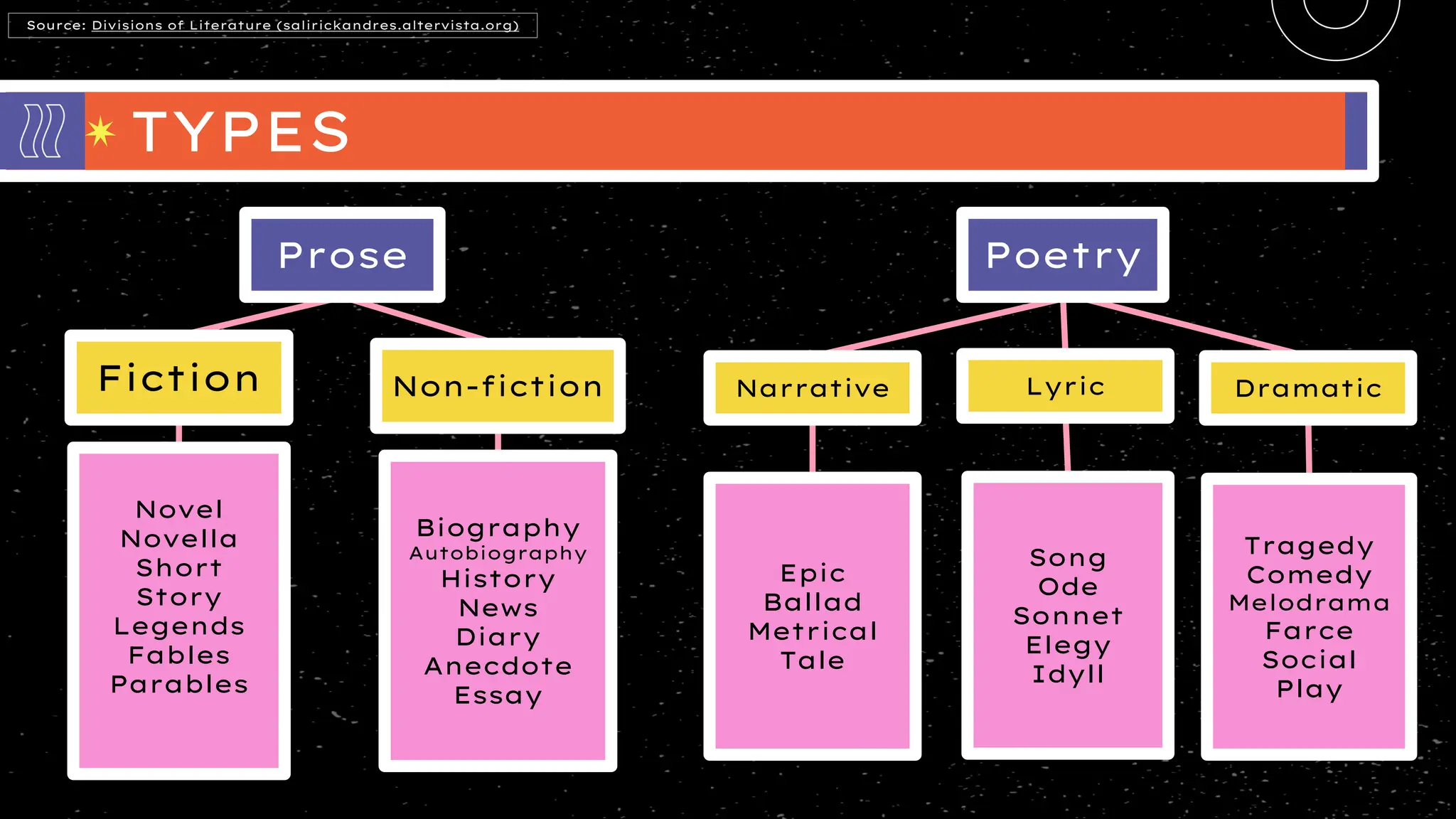
Prose Poetry
Narrative
TYPES
Non-fiction
Fiction LyricDramatic
Novel
Novella
Short
Story
Legends
Fables
Parables
Biography
Autobiography
History
News
Diary
Anecdote
Essay
Epic
Ballad
Metrical
Tale
Song
Ode
Sonnet
Elegy
Idyll
Tragedy
Comedy
Melodrama
Farce
Social
Play
Source: Divisions of Literature (salirickandres.altervista.org)
5.
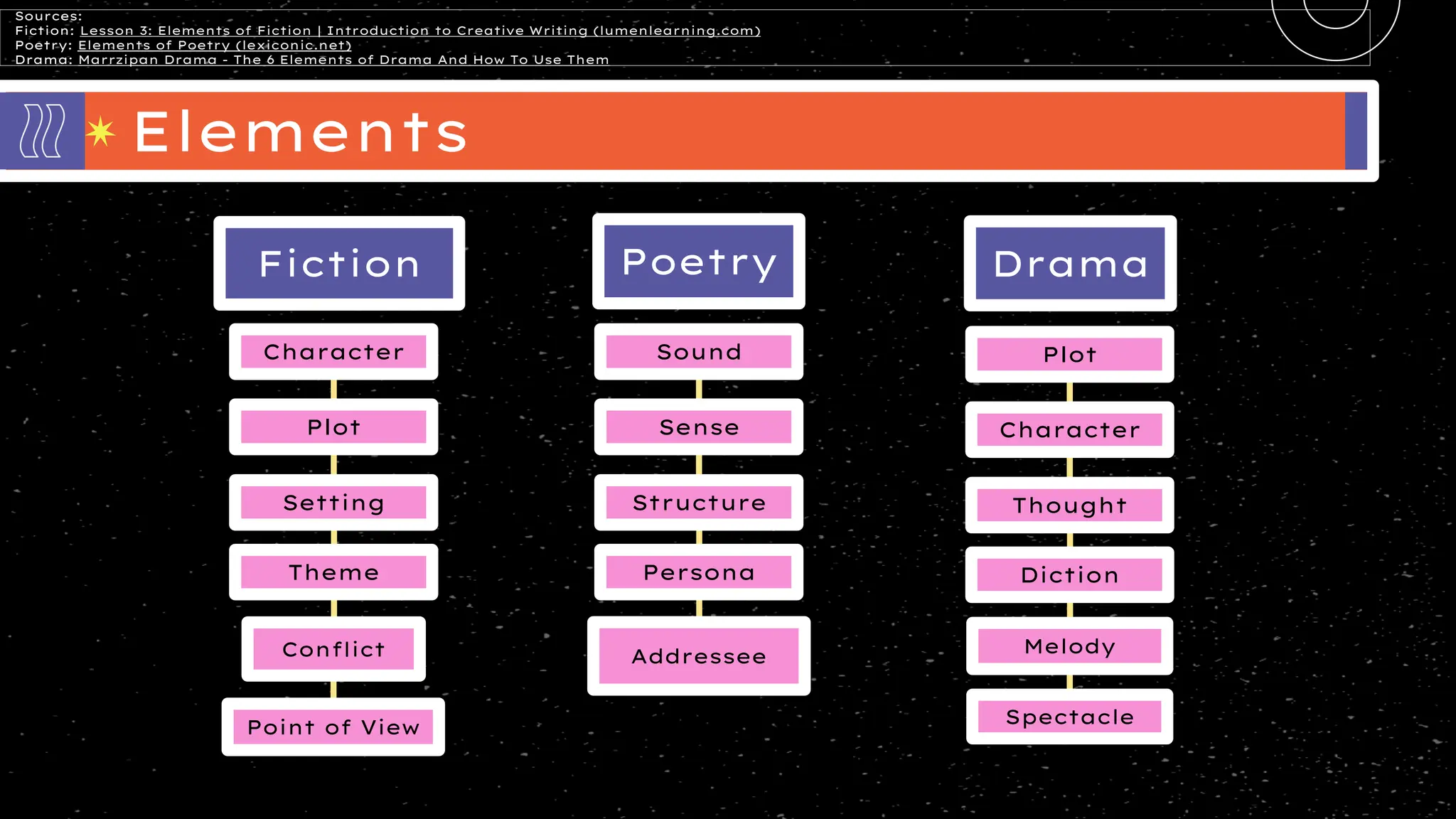
Fiction Poetry
Elements
Character
Sources:
Fiction: Lesson3: Elements of Fiction | Introduction to Creative Writing (lumenlearning.com)
Poetry: Elements of Poetry (lexiconic.net)
Drama: Marrzipan Drama - The 6 Elements of Drama And How To Use Them
Drama
Plot
Setting
Theme
Point of View
Sound
Sense
Structure
Persona
Addressee
Conflict
Plot
Character
Thought
Diction
Melody
Spectacle
6.
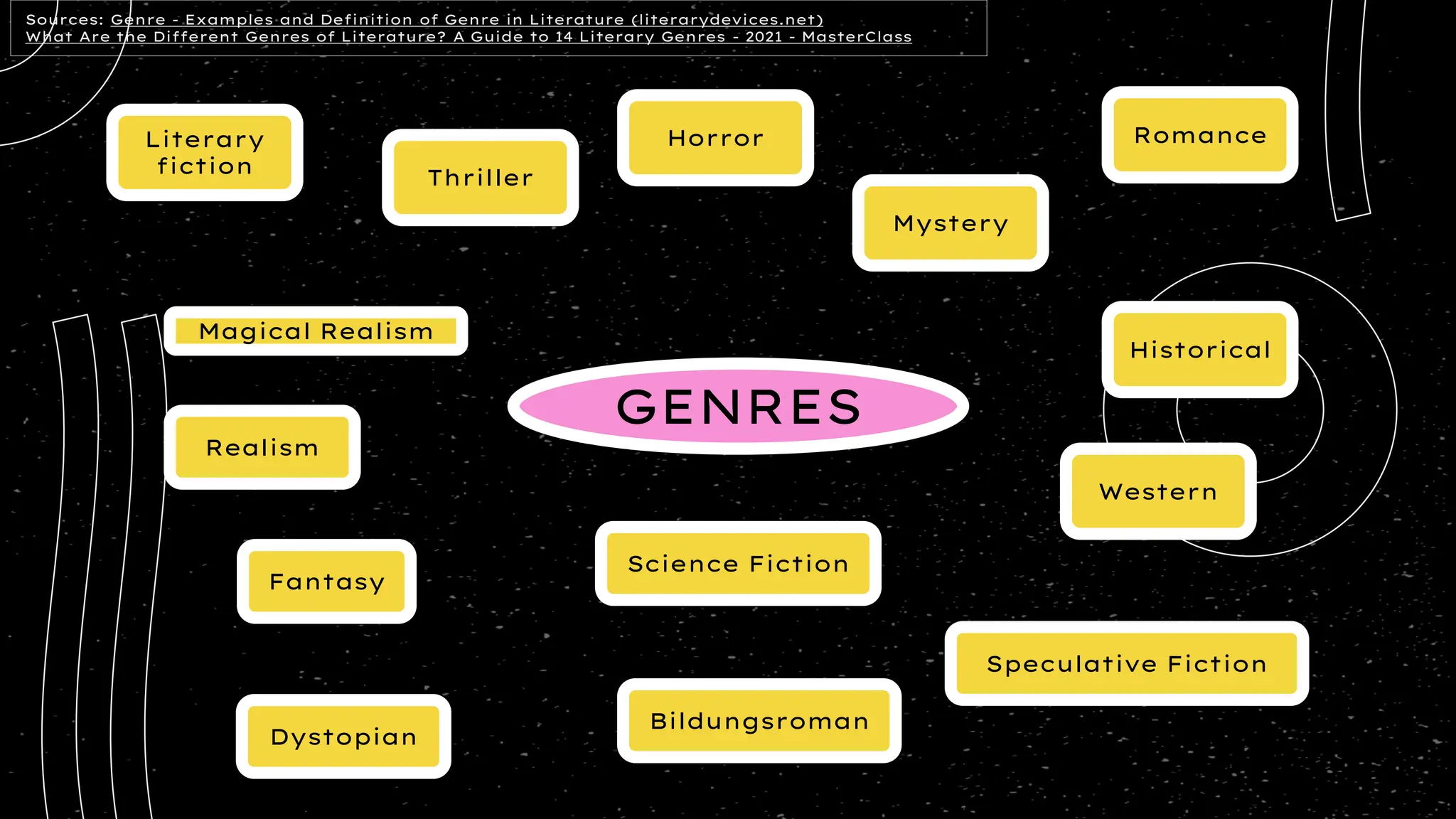
Sources: Genre -Examples and Definition of Genre in Literature (literarydevices.net)
What Are the Different Genres of Literature? A Guide to 14 Literary Genres - 2021 - MasterClass
GENRES
Literary
fiction
Thriller
Horror
Mystery
Romance
Historical
Western
Bildungsroman
Science Fiction
Dystopian
Magical Realism
Fantasy
Realism
Speculative Fiction
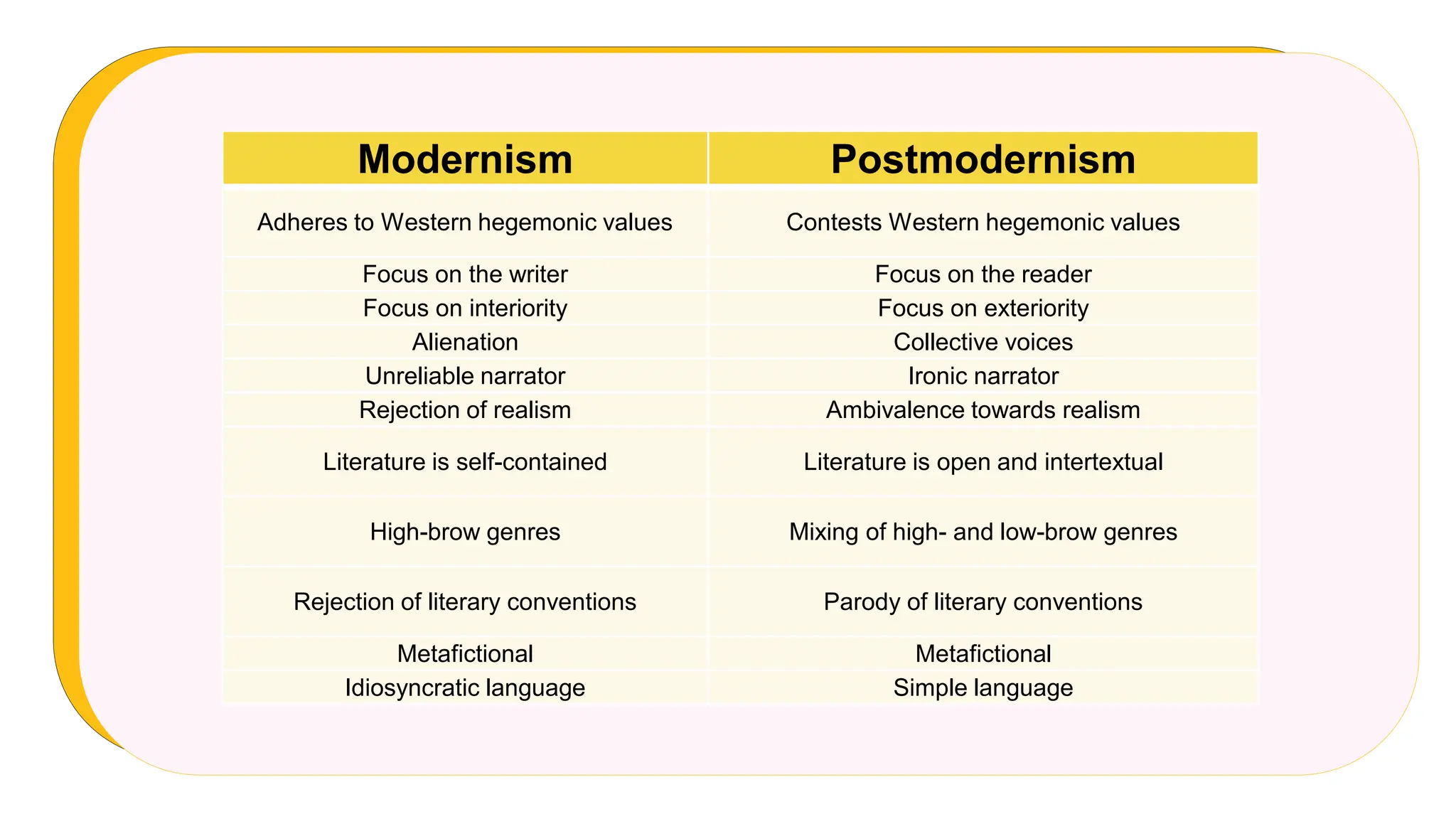
Modernism Postmodernism
Adheres toWestern hegemonic values Contests Western hegemonic values
Focus on the writer Focus on the reader
Focus on interiority Focus on exteriority
Alienation Collective voices
Unreliable narrator Ironic narrator
Rejection of realism Ambivalence towards realism
Literature is self-contained Literature is open and intertextual
High-brow genres Mixing of high- and low-brow genres
Rejection of literary conventions Parody of literary conventions
Metafictional Metafictional
Idiosyncratic language Simple language
9.
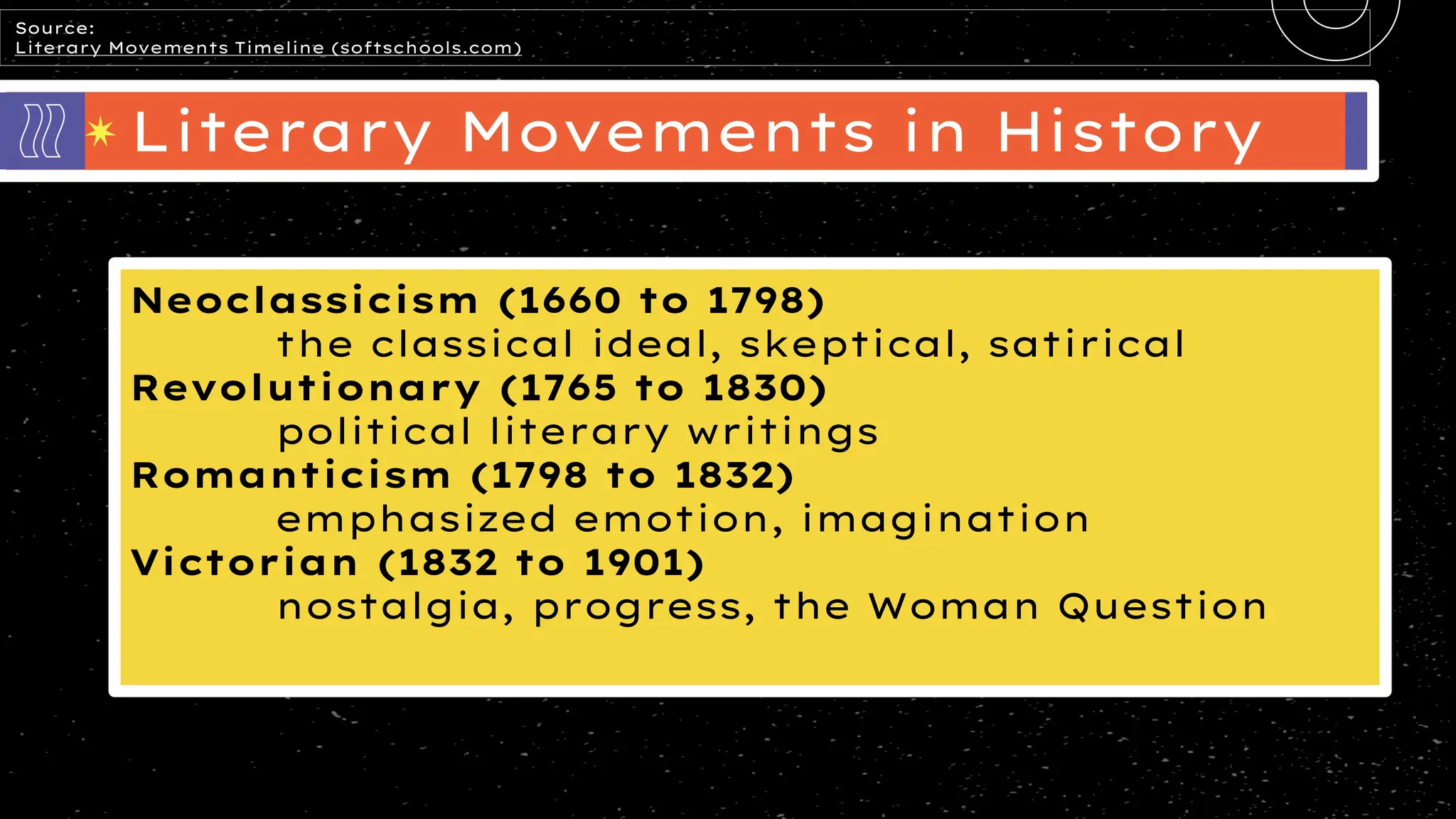
Literary Movements inHistory
Source:
Literary Movements Timeline (softschools.com)
Neoclassicism (1660 to 1798)
the classical ideal, skeptical, satirical
Revolutionary (1765 to 1830)
political literary writings
Romanticism (1798 to 1832)
emphasized emotion, imagination
Victorian (1832 to 1901)
nostalgia, progress, the Woman Question
10.
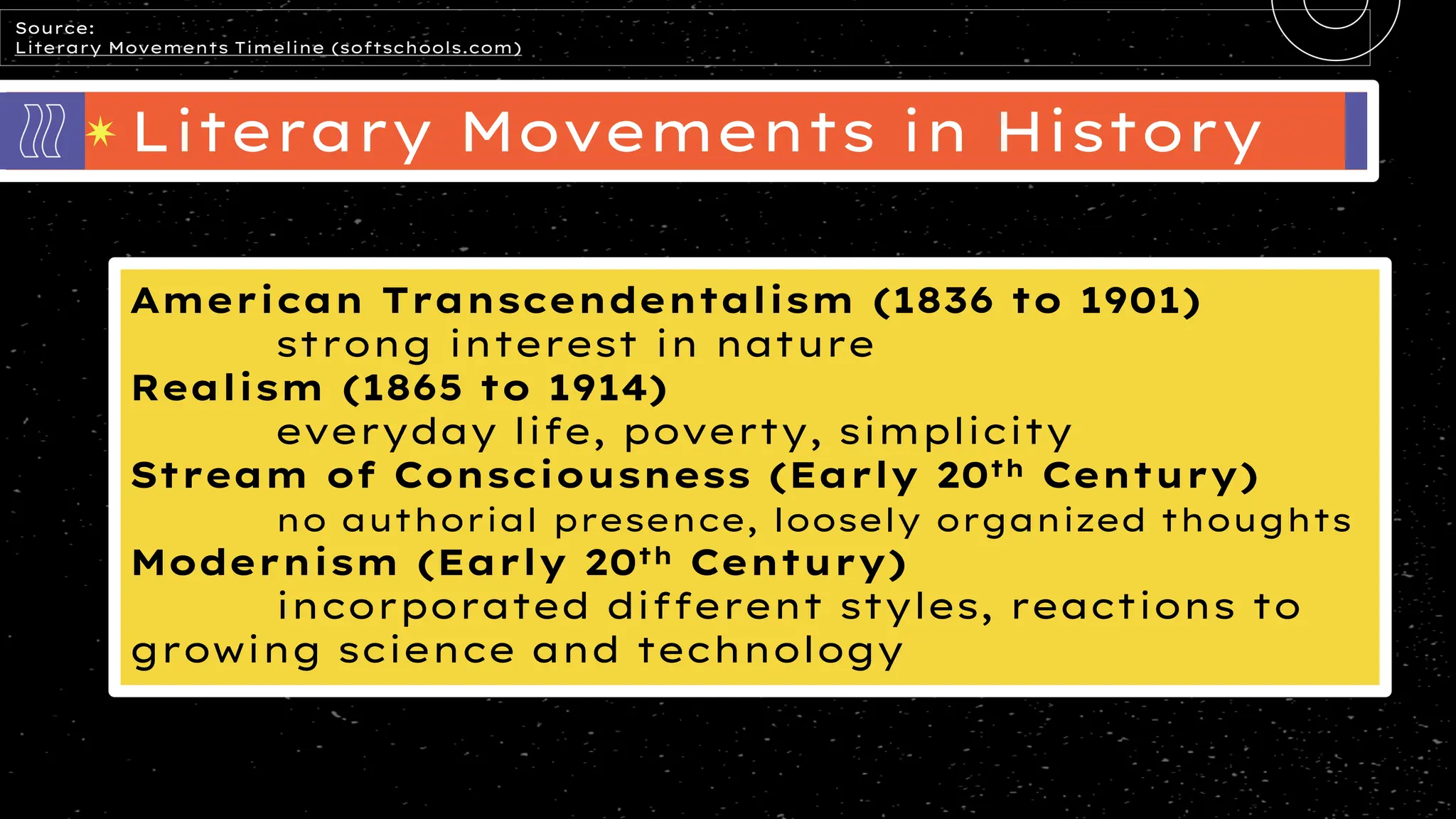
Literary Movements inHistory
American Transcendentalism (1836 to 1901)
strong interest in nature
Realism (1865 to 1914)
everyday life, poverty, simplicity
Stream of Consciousness (Early 20th Century)
no authorial presence, loosely organized thoughts
Modernism (Early 20th Century)
incorporated different styles, reactions to
growing science and technology
Source:
Literary Movements Timeline (softschools.com)
11.
Literary Movements inHistory
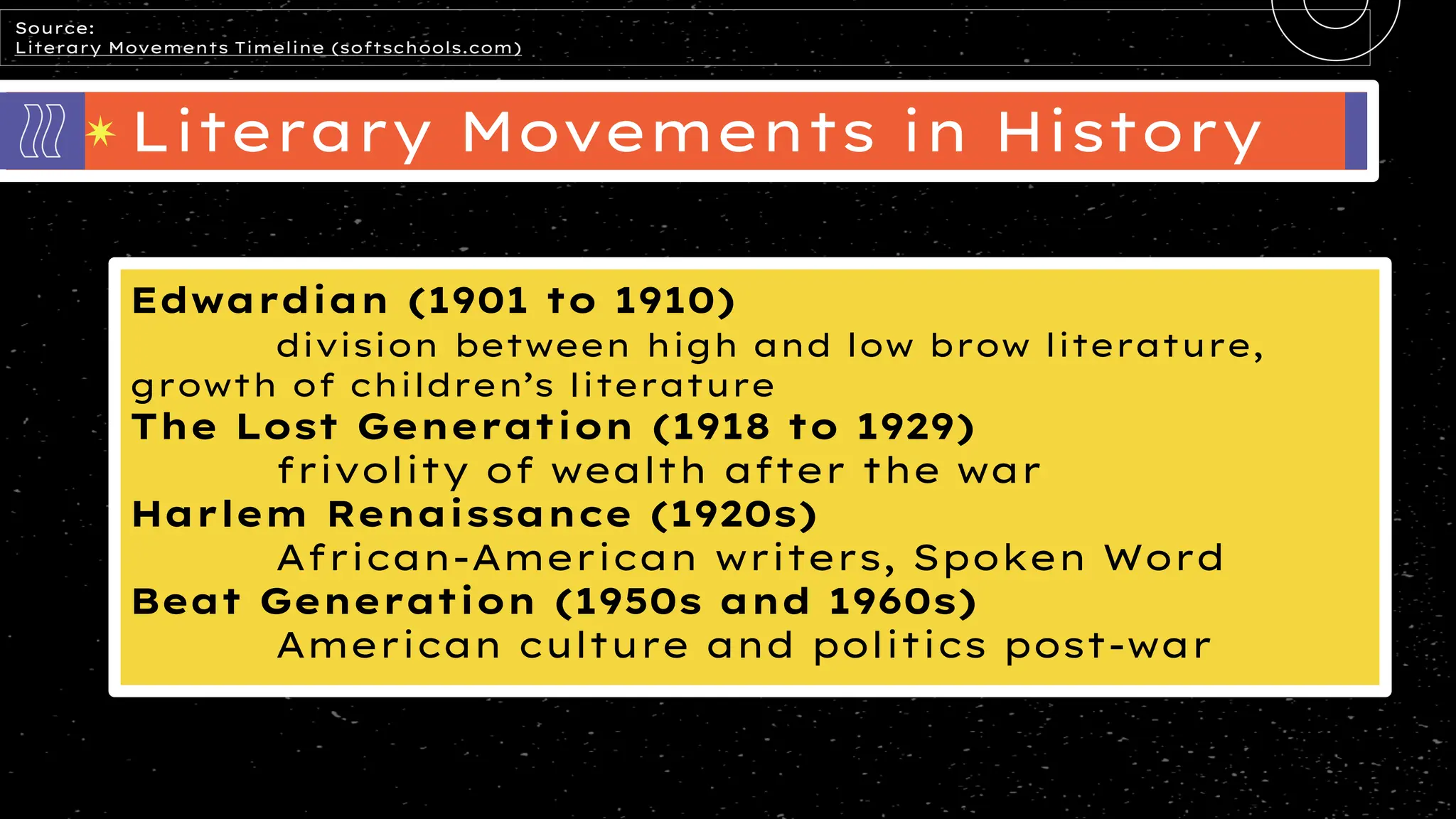
Edwardian (1901 to 1910)
division between high and low brow literature,
growth of children’s literature
The Lost Generation (1918 to 1929)
frivolity of wealth after the war
Harlem Renaissance (1920s)
African-American writers, Spoken Word
Beat Generation (1950s and 1960s)
American culture and politics post-war
Source:
Literary Movements Timeline (softschools.com)
Delineating terms
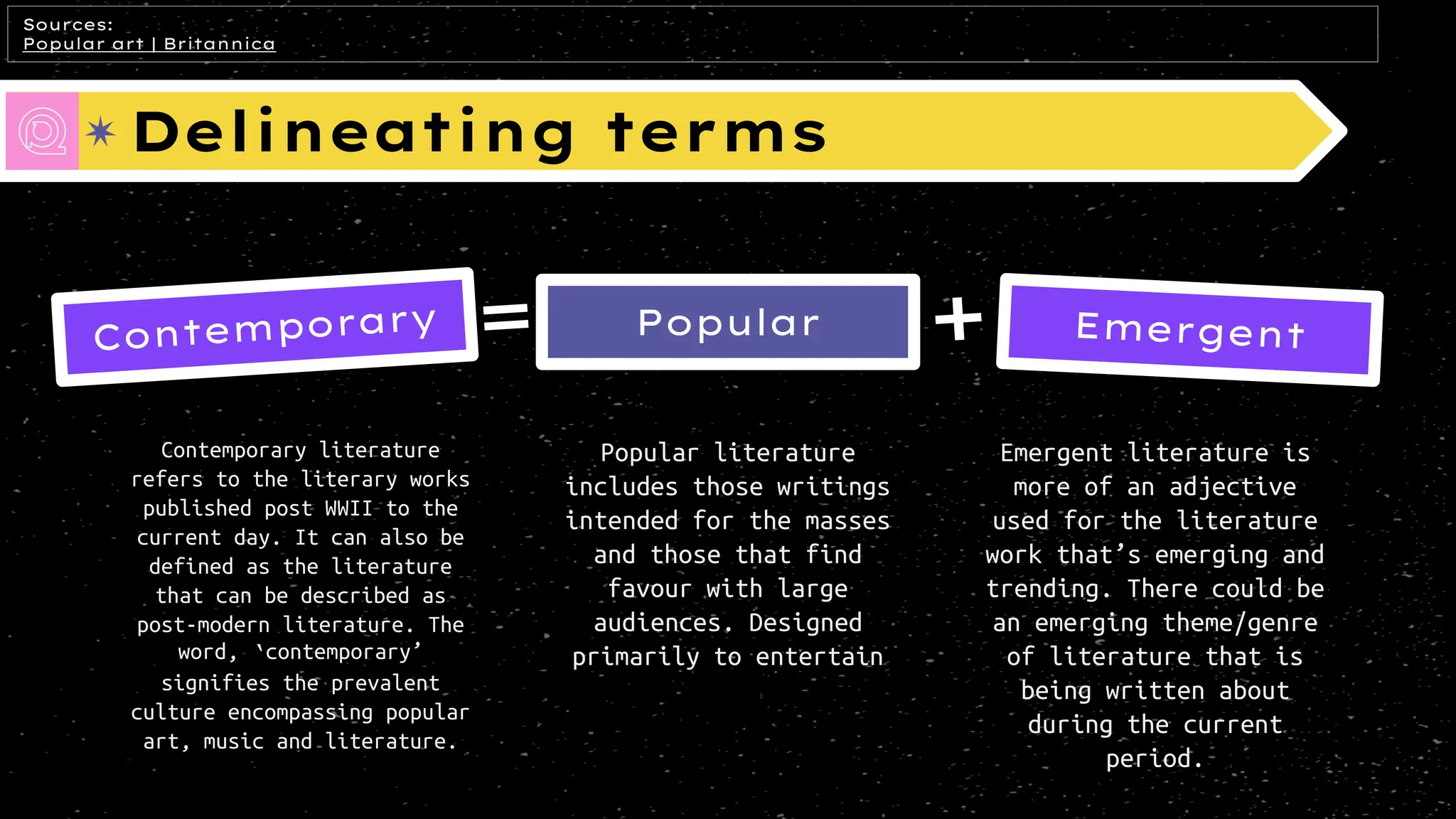
Contemporary literature
refersto the literary works
published post WWII to the
current day. It can also be
defined as the literature
that can be described as
post-modern literature. The
word, ‘contemporary’
signifies the prevalent
culture encompassing popular
art, music and literature.
Popular
Popular literature
includes those writings
intended for the masses
and those that find
favour with large
audiences. Designed
primarily to entertain
Emergent literature is
more of an adjective
used for the literature
work that’s emerging and
trending. There could be
an emerging theme/genre
of literature that is
being written about
during the current
period.
Sources:
Popular art | Britannica
15.
Nature & Appeal
●The growth of popular literature has paralleled the spread of
literacy through education and has been facilitated by
technological developments in printing.
● With the Industrial Revolution, works of literature, which
were previously produced for consumption by small, well-
educated elites, became accessible to large sections and even
majorities of the members of a population.
Source:
Popular art | Britannica
16.
Nature & Appeal
●The boundary between artistic and popular literature is
murky, due to clashing of public preference and critical
evaluation.
● While he was alive William Shakespeare could be thought of as
a writer of popular literature, but he is now regarded as a
creator of artistic literature.
● Indeed, the main, though not invariable, method of defining a
work as belonging to popular literature is whether it
is ephemeral, that is, losing its appeal and significance with
the passage of time.
Source:
Popular art | Britannica
17.
Nature & Appeal
●The most important genre in popular literature is and always
has been the romance, extending as it does from the Middle
Ages to the present.
● Fantasy, science fiction, detective stories
● Popular literature has also come to include such genres as
comic books and cartoon strips.
Source:
Popular art | Britannica
18.
Nature & Appeal
●Popular literature is fiction that does not deal with
abstract problems; it takes moral principles as the given,
accepting certain generalized, common-sense ideas and values
as its base.
● (Common-sense values and conventional values are not the same
thing; the first can be justified rationally, the second
cannot. Even though the second may include some of the first,
they are justified, not on the ground of reason, but on the
ground of social conformity.)
Source:
—Ayn Rand Lexicon (aynrandlexicon.com)
19.
Issues & Challenges
Source:
Theproblem of popular literature | Literati | thenews.com.pk
• Popular literature is ephemeral and fleeting
• Popular authors incline to familiar, cliché
ridden and easily digestible language
• Popular literature tend to sacrifice artistic
values at the cost of popularity
20.
Fallacies (extracted fromFlores, 2019)
Source:
Third Generation Electronic Literature › electronic book review
• First, the Pioneer Fallacy posits that to be the first
to do something doesn’t mean it is a quality work;
• Second, The Generational Fallacy reminds just because it
is the most recent generation does not mean its work is
better;
• Third, the Technical Fallacy states that technical
complexity does not equal quality;
• Fourth, The Viral Fallacy posits that just because
something is popular does not mean it is good;
21.
Fallacies (extracted fromFlores, 2019)
Source:
Third Generation Electronic Literature › electronic book review
• Fifth, The Hipster Fallacy states that made-from-scratch does
not equal quality;
• Finally, The User Fallacy is the opposite of the Hipster
Fallacy, meaning, someone creating something for Snapchat or
some other [accessible] platform cannot have merit from an e-
literary perspective (Flores, 2019, p. 11)
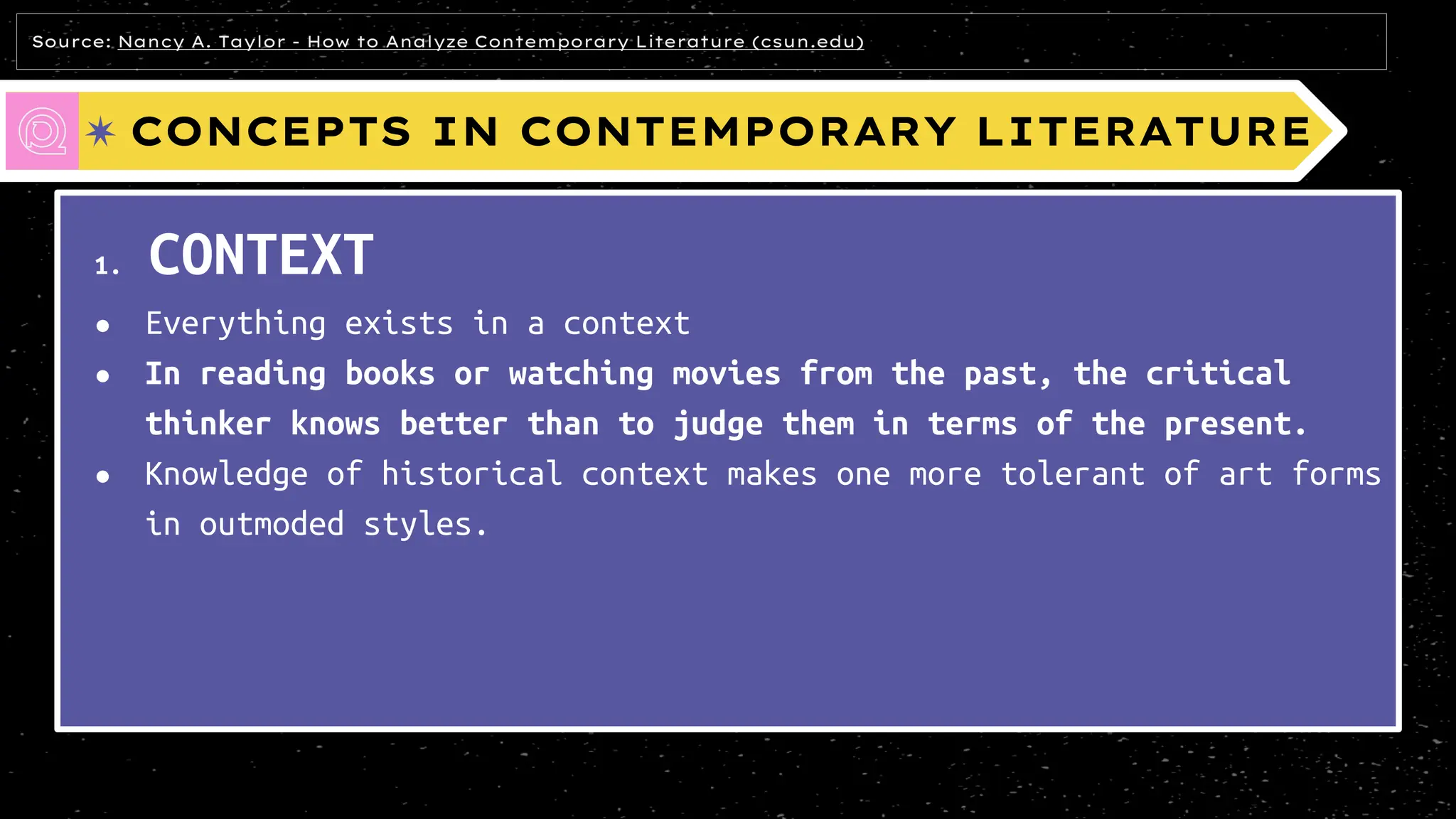
CONCEPTS IN CONTEMPORARYLITERATURE
1. CONTEXT
● Everything exists in a context
● In reading books or watching movies from the past, the critical
thinker knows better than to judge them in terms of the present.
● Knowledge of historical context makes one more tolerant of art forms
in outmoded styles.
Source: Nancy A. Taylor - How to Analyze Contemporary Literature (csun.edu)
26.
CONCEPTS IN CONTEMPORARYLITERATURE
1. CONTEXT
● Consider some of the historical, social, cultural, political
influences of the contemporary age: literature as a response to a
world lived under the threat of Nuclear/Global War, Environmental
Catastrophe, and AIDS; a world lived under the influence of
technology (in which genuine experience has been replaced by
simulation and spectacle), mass media expansion, faster
communication, greater diversity of culture/religion/values, and
globalization.
Source: Nancy A. Taylor - How to Analyze Contemporary Literature (csun.edu)
27.
CONCEPTS IN CONTEMPORARYLITERATURE
2. CULTURE
● Literary texts may highlight cultural voices and sociological
contexts.
● Analyzing the represented cultural traditions (and codes of
language) can lead to a greater understanding of that culture.
● Studying the history of that culture will create a more enlightening
appreciation of cultural attitudes, motivations, and actions.
Source: Nancy A. Taylor - How to Analyze Contemporary Literature (csun.edu)
28.
CONCEPTS IN CONTEMPORARYLITERATURE
3. A QUESTION OF MEANING
● Literature shows people struggling to find meaning in a world that
doesn't offer us the old assurances, as it breaks down our faith in
the supremacy of the rational, scientific human being (e.g.
comparisons between animals and humans and machines).
● In our contemporary world, meaning is not stable or absolute; values
and identity are relative to culture, religion, and geography.
Source: Nancy A. Taylor - How to Analyze Contemporary Literature (csun.edu)
29.
CONCEPTS IN CONTEMPORARYLITERATURE
4. DEFINING REALITY
● Authors use metafiction, magical realism, and surrealism to draw our
attention to their literary work’s relationship (or non-
relationship) to “reality.”
● Literature emphasizes the fragmentation in the human experience of
contemporary culture, and uses it as an artistic strategy.
● Literature questions our ability to understand ourselves and our
culture, questions omniscience by questioning our ability to
accurately see reality, and questions the link between language and
reality.
Source: Nancy A. Taylor - How to Analyze Contemporary Literature (csun.edu)
30.
CONCEPTS IN CONTEMPORARYLITERATURE
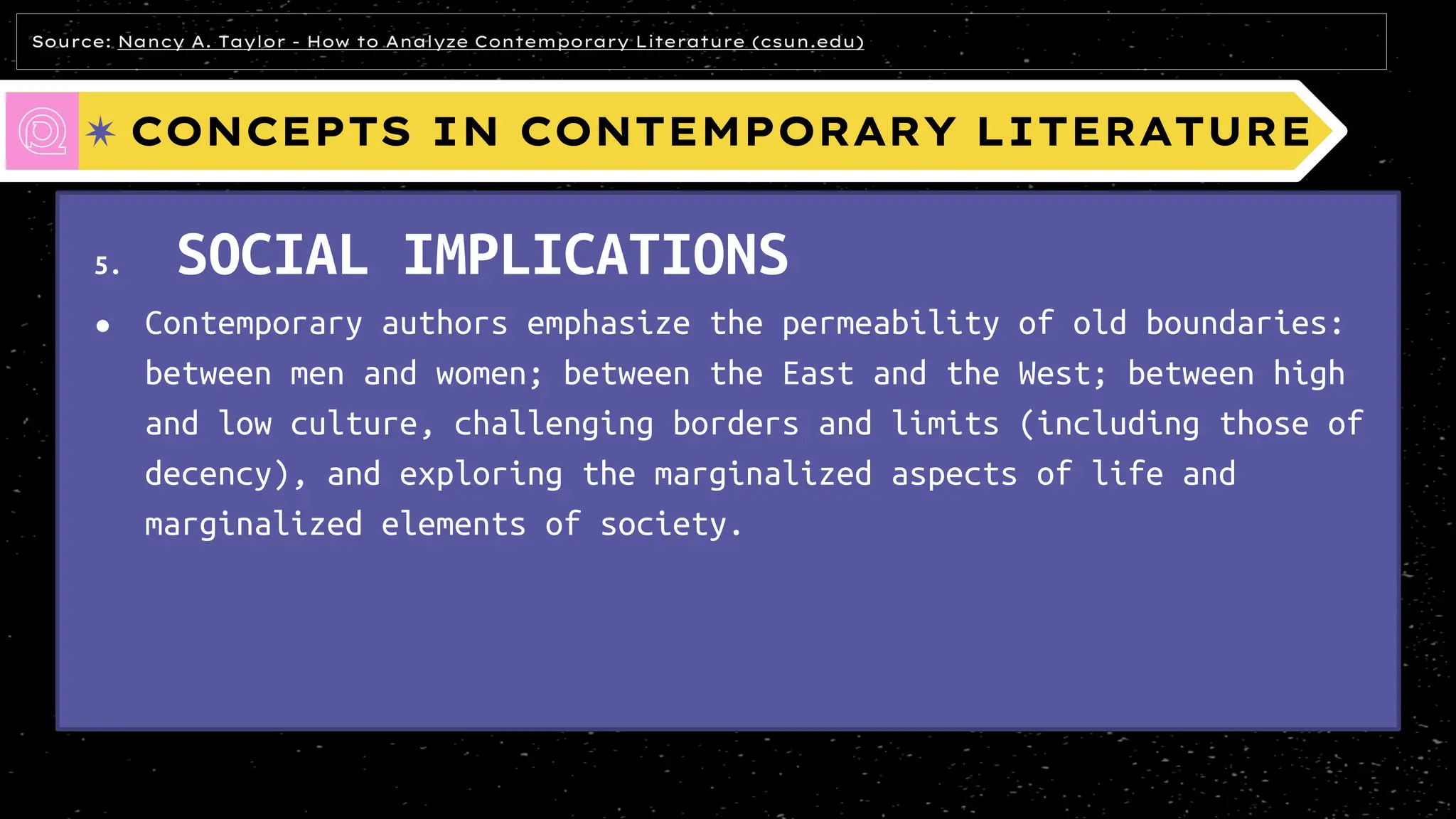
5. SOCIAL IMPLICATIONS
● Contemporary authors emphasize the permeability of old boundaries:
between men and women; between the East and the West; between high
and low culture, challenging borders and limits (including those of
decency), and exploring the marginalized aspects of life and
marginalized elements of society.
Source: Nancy A. Taylor - How to Analyze Contemporary Literature (csun.edu)
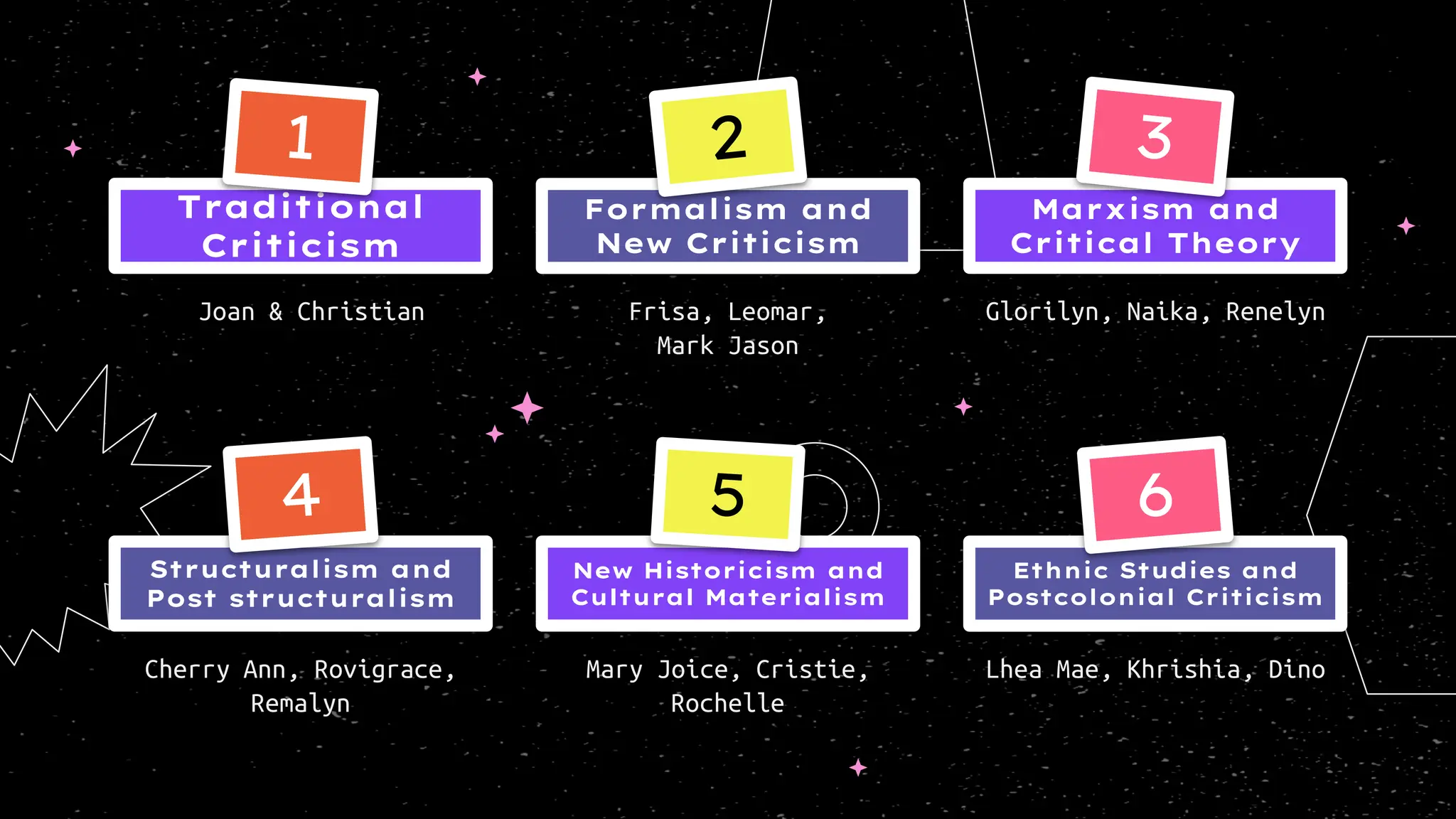
Joan & Christian
Formalismand
New Criticism
Frisa, Leomar,
Mark Jason
Glorilyn, Naika, Renelyn
Cherry Ann, Rovigrace,
Remalyn
New Historicism and
Cultural Materialism
Mary Joice, Cristie,
Rochelle
Lhea Mae, Khrishia, Dino
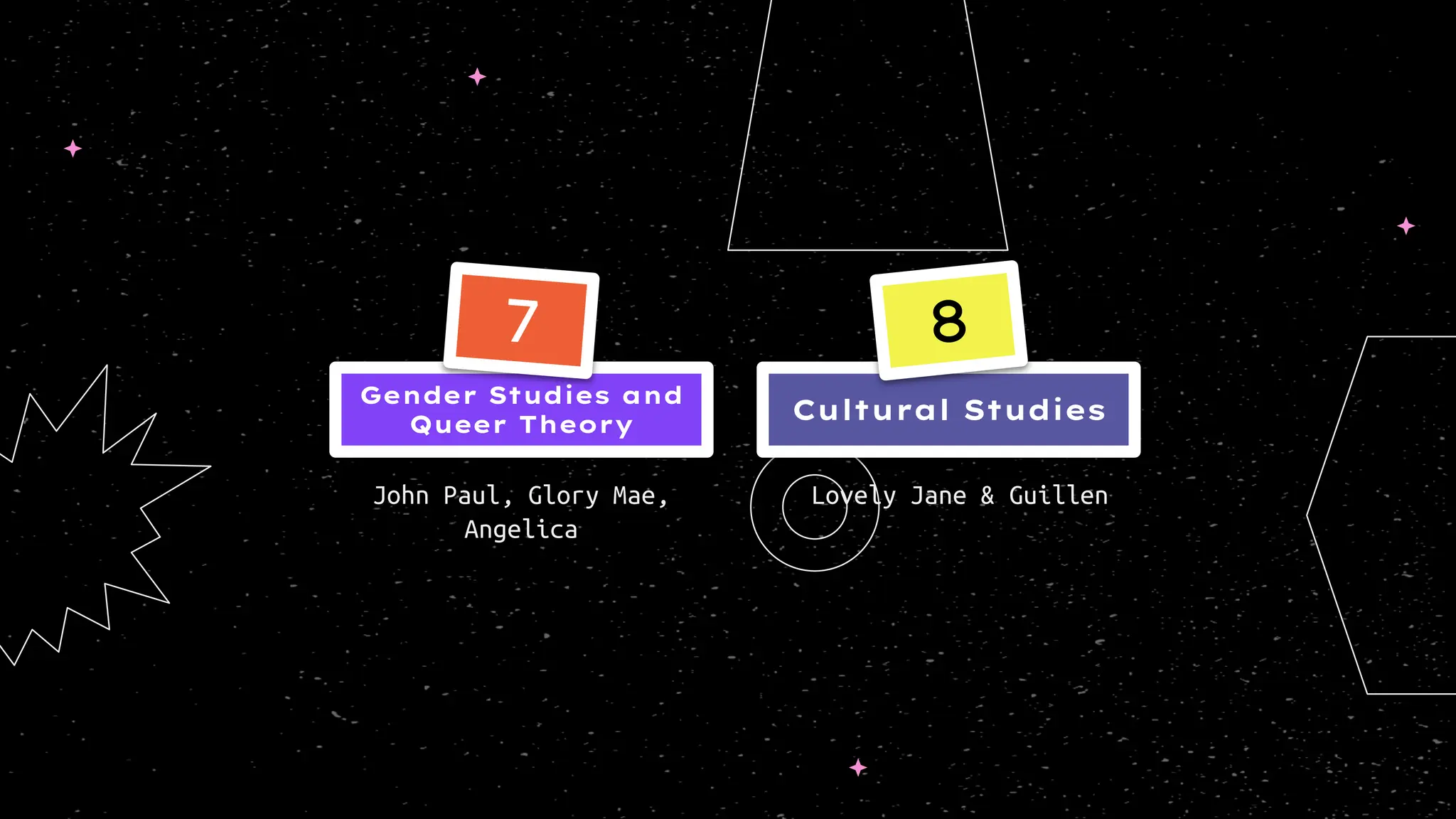
33.
John Paul, GloryMae,
Angelica
Cultural Studies
Lovely Jane & Guillen
34.
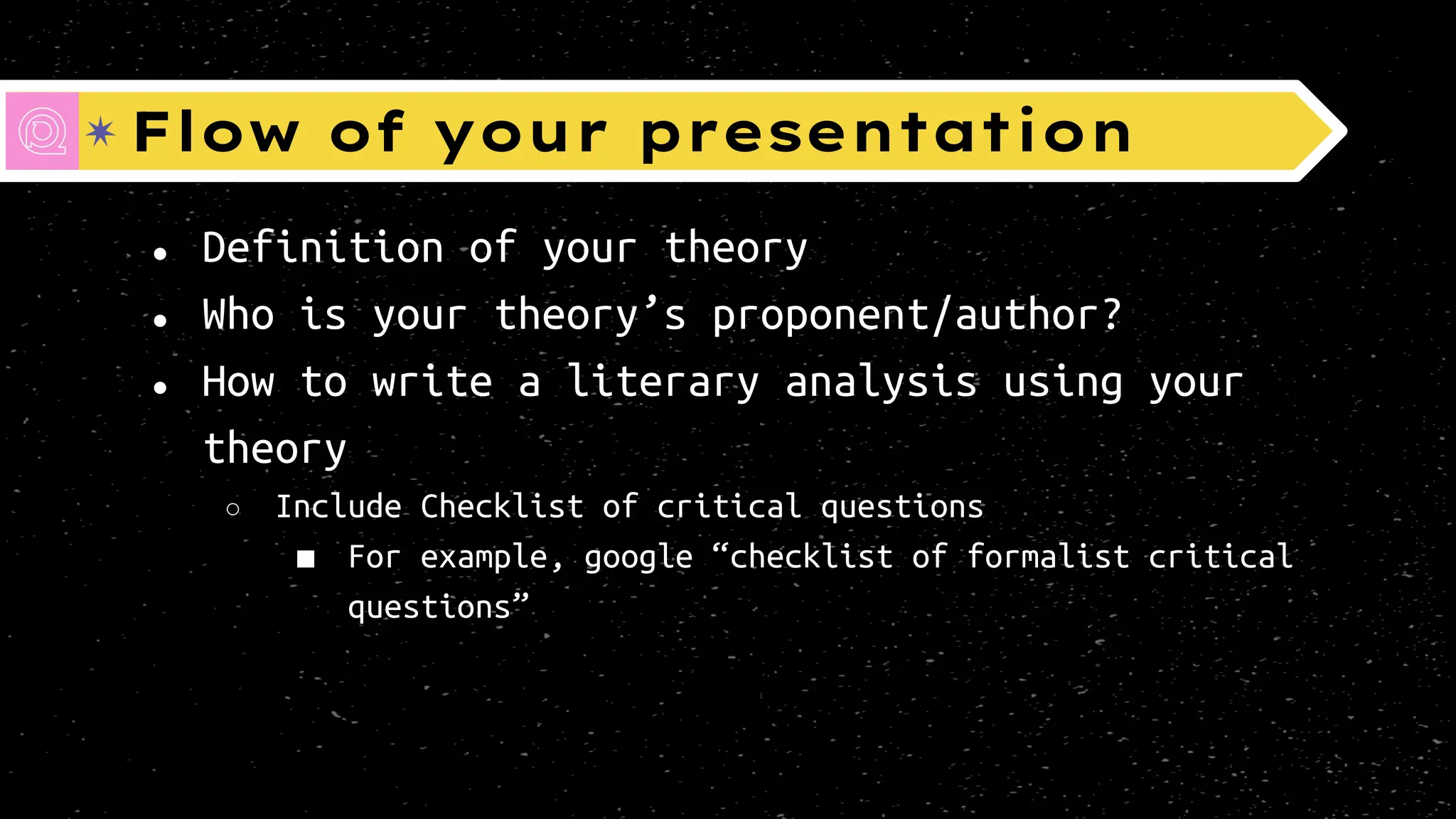
Flow of yourpresentation
● Definition of your theory
● Who is your theory’s proponent/author?
● How to write a literary analysis using your
theory
○ Include Checklist of critical questions
■ For example, google “checklist of formalist critical
questions”
35.
Literary Theory |Internet Encyclopedia of Philosophy
(utm.edu)
You may refer to the link
below. But it is best if you
branch out and research
more on your assigned
theory. :)
P.S: you can reach out to me via our class groupchat for
any concerns and/or clarifications. Thank you!
![Fallacies (extracted from Flores, 2019)
Source:
Third Generation Electronic Literature › electronic book review
• Fifth, The Hipster Fallacy states that made-from-scratch does
not equal quality;
• Finally, The User Fallacy is the opposite of the Hipster
Fallacy, meaning, someone creating something for Snapchat or
some other [accessible] platform cannot have merit from an e-
literary perspective (Flores, 2019, p. 11)](https://image.slidesharecdn.com/lesson1-overviewofconpopliterature-250824013109-b9be4029/75/LESSON-1-OVERVIEW-OF-CONPOP-LITERATURE-pdf-21-2048.jpg)