CHAPTER
1
+
INTRODUCTIO
N TO
PHYSICS
+
SCIENC
E
systematized or organized body of
knowledge based on observation,
experimentation and study.
comes from the Latin word
- knowledge or knowing
Scientia
+
BRANCHES
OF SCIENCE
Social Science
Physical Science
+
BIOLOGICAL
SCIENCE
ex.
Biology,
Botany,
Zoology,
Ornithology
deals with the study
of living things
+
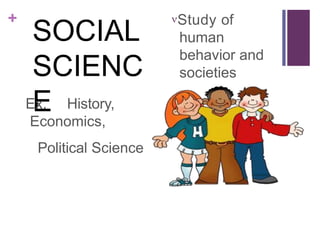
SOCIAL
SCIENC
E
Ex. History,
Economics,
Political Science
Study of
human
behavior and
societies
+
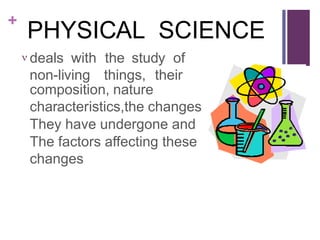
PHYSICAL SCIENCE
 deals with the study of
non-living things, their
composition, nature
characteristics,the changes
They have undergone and
The factors affecting these
changes
+
BRANCHES OF
PHYSICAL
SCIENCE
 Chemistry- the
study of “matter”-
its composition,
properties,
structure and the
changes it
undergoes.
+
BRANCHES OF
PHYSICAL
SCIENCE
 Physics- the science of matter and
energy and their interaction with each
other.
+
BRANCHES OF
PHYSICAL
SCIENCE
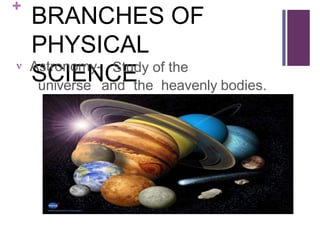
Astronomy-
 Study of the
universe and the heavenly bodies.
+
BRANCHES OF
PHYSICAL
SCIENCE
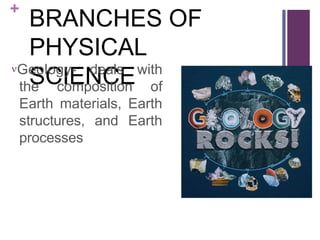
Geology- deals with
the composition of
Earth materials, Earth
structures, and Earth
processes
+
BRANCHES OF
PHYSICAL
SCIENCE
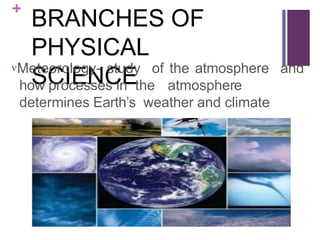
Meteorology- study of the atmosphere and
how processes in the atmosphere
determines Earth’s weather and climate
+
+
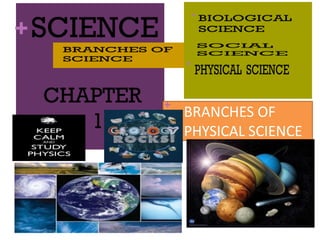
BRANCHES OF
PHYSICAL SCIENCE
+
CHAPTER 2
MEASUREMEN
T
rust
14
• smear
• ram
• ten
• sea
• tea
• eat
• seem
• mend
• ream
• send
• stare
• treat
• treasure
• tease
What is MEASUREMENT?
15
16
Measurement is defined as the act of
measuring or giving the size of
something..
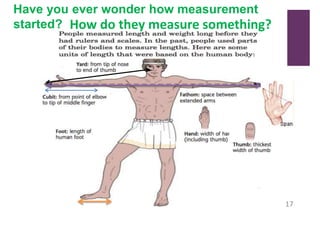
Have you ever wonder how measurement
started?
17
How do they measure something?
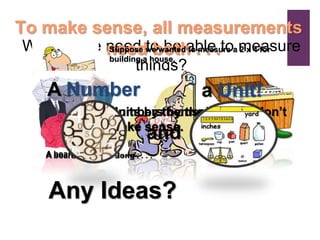
Why do we need to be able to measure
things?
To make sense, all measurements
need both . . .
Any Ideas?
Suppose we wanted to measure a 2 x 4 for
building a house.
Numbers by themselves don’t
make sense.
A board is 350 long . . . .
A board is meters long . . . .
Units by themselves don’t
make sense.
A Number
and
a Unit!
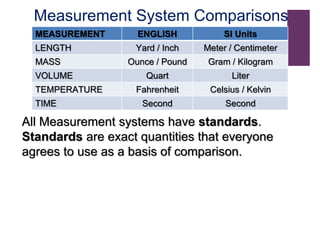
Measurement System Comparisons
All Measurement systems have standards.
Standards are exact quantities that everyone
agrees to use as a basis of comparison.
MEASUREMENT ENGLISH SI Units
LENGTH Yard / Inch Meter / Centimeter
MASS Ounce / Pound Gram / Kilogram
VOLUME Quart Liter
TEMPERATURE Fahrenheit Celsius / Kelvin
TIME Second Second
 Measurements are easily understood by all scientists
 Measurements are easier to convert than the English
system
Scientists use the SI System
worldwide because:
Why use the SI System?
In the U.S. we use the
English or Standard System,
most of the rest of the world
uses the Metric or SI
System.
The SI (International System of Units) system is
the form of measurement typically used by
scientists.
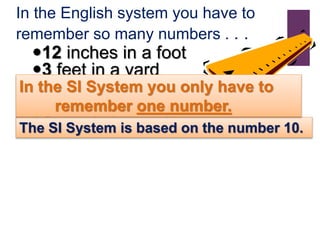
In the English system you have to
remember so many numbers . . .
12 inches in a foot
3 feet in a yard
5,280 feet in a mile
16 ounces in a pound
4 quarts to a gallon
The SI System is based on the number 10.
In the SI System you only have to
remember one number.
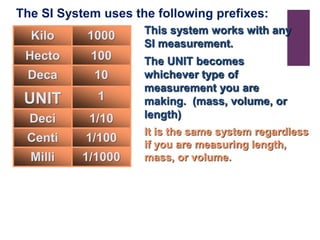
The SI System uses the following prefixes:
This system works with any
SI measurement.
The UNIT becomes
whichever type of
measurement you are
making. (mass, volume, or
length)
It is the same system regardless
if you are measuring length,
mass, or volume.
Kilo 1000
Hecto 100
Deca 10
UNIT 1
Deci 1/10
Centi 1/100
Milli 1/1000
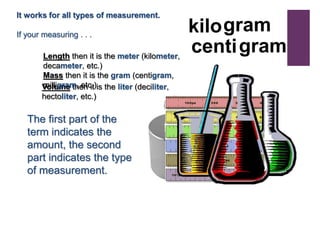
It works for all types of measurement.
If your measuring . . .
Volume then it is the liter (deciliter,
hectoliter, etc.)
The first part of the
term indicates the
amount, the second
part indicates the type
of measurement.
centigram
Mass then it is the gram (centigram,
milligram, etc.)
Length then it is the meter (kilometer,
decameter, etc.)
kilogram
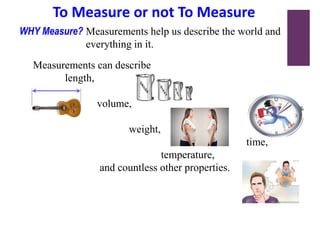
To Measure or not To Measure
Measurements help us describe the world and
everything in it.
24
WHY Measure?
Measurements can describe
length,
volume,
weight,
time,
temperature,
and countless other properties.
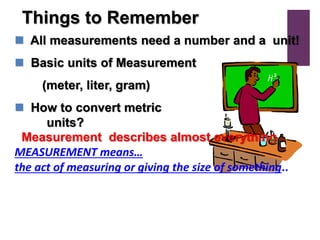
Things to Remember
 All measurements need a number and a unit!
 Basic units of Measurement
(meter, liter, gram)
 How to convert metric
units?
Measurement describes almost everything
MEASUREMENT means…
the act of measuring or giving the size of something..
Activity will be posted
during asynchronous in the
2nd QUARTER assignment tab
27

Lesson 1 introduction to measurement

  • 1.
  • 2.
    + SCIENC E systematized or organizedbody of knowledge based on observation, experimentation and study. comes from the Latin word - knowledge or knowing Scientia
  • 3.
  • 4.
  • 5.
  • 6.
    + PHYSICAL SCIENCE  dealswith the study of non-living things, their composition, nature characteristics,the changes They have undergone and The factors affecting these changes
  • 7.
    + BRANCHES OF PHYSICAL SCIENCE  Chemistry-the study of “matter”- its composition, properties, structure and the changes it undergoes.
  • 8.
    + BRANCHES OF PHYSICAL SCIENCE  Physics-the science of matter and energy and their interaction with each other.
  • 9.
    + BRANCHES OF PHYSICAL SCIENCE Astronomy-  Studyof the universe and the heavenly bodies.
  • 10.
    + BRANCHES OF PHYSICAL SCIENCE Geology- dealswith the composition of Earth materials, Earth structures, and Earth processes
  • 11.
    + BRANCHES OF PHYSICAL SCIENCE Meteorology- studyof the atmosphere and how processes in the atmosphere determines Earth’s weather and climate
  • 12.
  • 13.
  • 14.
    rust 14 • smear • ram •ten • sea • tea • eat • seem • mend • ream • send • stare • treat • treasure • tease
  • 15.
  • 16.
    16 Measurement is definedas the act of measuring or giving the size of something..
  • 17.
    Have you everwonder how measurement started? 17 How do they measure something?
  • 18.
    Why do weneed to be able to measure things? To make sense, all measurements need both . . . Any Ideas? Suppose we wanted to measure a 2 x 4 for building a house. Numbers by themselves don’t make sense. A board is 350 long . . . . A board is meters long . . . . Units by themselves don’t make sense. A Number and a Unit!
  • 19.
    Measurement System Comparisons AllMeasurement systems have standards. Standards are exact quantities that everyone agrees to use as a basis of comparison. MEASUREMENT ENGLISH SI Units LENGTH Yard / Inch Meter / Centimeter MASS Ounce / Pound Gram / Kilogram VOLUME Quart Liter TEMPERATURE Fahrenheit Celsius / Kelvin TIME Second Second
  • 20.
     Measurements areeasily understood by all scientists  Measurements are easier to convert than the English system Scientists use the SI System worldwide because: Why use the SI System? In the U.S. we use the English or Standard System, most of the rest of the world uses the Metric or SI System. The SI (International System of Units) system is the form of measurement typically used by scientists.
  • 21.
    In the Englishsystem you have to remember so many numbers . . . 12 inches in a foot 3 feet in a yard 5,280 feet in a mile 16 ounces in a pound 4 quarts to a gallon The SI System is based on the number 10. In the SI System you only have to remember one number.
  • 22.
    The SI Systemuses the following prefixes: This system works with any SI measurement. The UNIT becomes whichever type of measurement you are making. (mass, volume, or length) It is the same system regardless if you are measuring length, mass, or volume. Kilo 1000 Hecto 100 Deca 10 UNIT 1 Deci 1/10 Centi 1/100 Milli 1/1000
  • 23.
    It works forall types of measurement. If your measuring . . . Volume then it is the liter (deciliter, hectoliter, etc.) The first part of the term indicates the amount, the second part indicates the type of measurement. centigram Mass then it is the gram (centigram, milligram, etc.) Length then it is the meter (kilometer, decameter, etc.) kilogram
  • 24.
    To Measure ornot To Measure Measurements help us describe the world and everything in it. 24 WHY Measure? Measurements can describe length, volume, weight, time, temperature, and countless other properties.
  • 25.
    Things to Remember All measurements need a number and a unit!  Basic units of Measurement (meter, liter, gram)  How to convert metric units? Measurement describes almost everything MEASUREMENT means… the act of measuring or giving the size of something..
  • 26.
    Activity will beposted during asynchronous in the 2nd QUARTER assignment tab
  • 27.

Editor's Notes

  • #25 Starts 5:50 pm
  • #28 Answer for the most efficient-zero waste distribution