Lego Mindstorms EV3
History - 3
EV3 parts – 7
EV3 Education Core builds – 14
Driving base – 16
EV3 programming - 18
History
LEGO is a line of plastic construction toys that
are manufactured by The Lego Group, a
company based in Billund, Denmark. The Lego
Group began manufacturing the interlocking toy
bricks in 1949. As of July 2015, 600 billion Lego
parts had been produced.
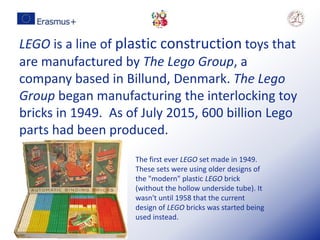
The first ever LEGO set made in 1949.
These sets were using older designs of
the "modern" plastic LEGO brick
(without the hollow underside tube). It
wasn't until 1958 that the current
design of LEGO bricks was started being
used instead.
Lego Mindstorms is a hardware/software
platform which is produced by Lego for the
development of programmable robots based
on Lego building blocks.
There have been four generations of the
Mindstorms platform: the original Robotics
Invention System, NXT, NXT 2.0, and EV3. With
each platform release, the motor and sensor
capabilities expanded.
a programmable brick from the
Robotics Invention System set
brick of Lego Mindstorms EV3
Lego Mindstorms EV3 is the successor to the
second generation Lego Mindstorms NXT 2.0 kit.
It was released in stores on September 1, 2013.
There are many competitions using this set,
among them are the First Lego League and
the World Robot Olympiad. The biggest change
in the Lego Mindstorms EV3 is the technological
advances in the programmable brick.
EV3 parts
The computer/“Brick”
- Programs are executed from the
Brick.
- Programs are downloaded to the
Brick.
- Sends programmed information
to motors.
- Receives information from
sensors.
- It’s interface can be used for
basic programming.
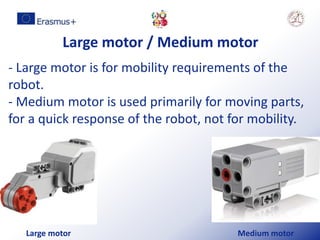
Large motor / Medium motor
- Large motor is for mobility requirements of the
robot.
- Medium motor is used primarily for moving parts,
for a quick response of the robot, not for mobility.
Large motor Medium motor
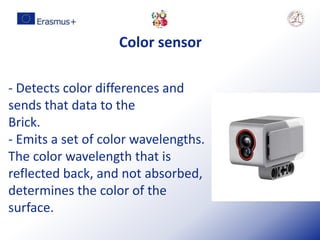
Color sensor
- Detects color differences and
sends that data to the
Brick.
- Emits a set of color wavelengths.
The color wavelength that is
reflected back, and not absorbed,
determines the color of the
surface.
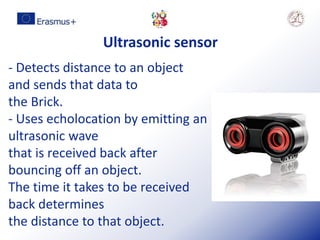
Ultrasonic sensor
- Detects distance to an object
and sends that data to
the Brick.
- Uses echolocation by emitting an
ultrasonic wave
that is received back after
bouncing off an object.
The time it takes to be received
back determines
the distance to that object.
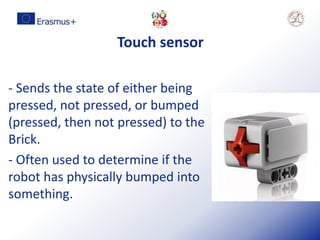
Touch sensor
- Sends the state of either being
pressed, not pressed, or bumped
(pressed, then not pressed) to the
Brick.
- Often used to determine if the
robot has physically bumped into
something.
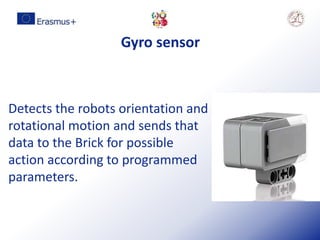
Gyro sensor
Detects the robots orientation and
rotational motion and sends that
data to the Brick for possible
action according to programmed
parameters.
EV3 Education Core builds
Driving base
Gyro sensor
Medium motor
Touch sensor
Ultrasonic sensor
Color sensor
For more builds, click here
Driving base
It‘s one of the most universal builds for the Lego
Mindstorms EV3 kit. It can be used to perform a
multitude of different tasks.
All of the other builds mentioned in the slide
before are made from this build.
Buildings instructions here.
EV3 programming
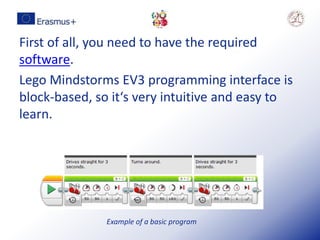
First of all, you need to have the required
software.
Lego Mindstorms EV3 programming interface is
block-based, so it‘s very intuitive and easy to
learn.
Example of a basic program
Here are some sample programs for the EV3.
Here are some tutorials on how to program your
Lego Mindstorms EV3 using the software -
EV3lessons.com / education.lego.com.

Lego presentation lt

  • 1.
  • 2.
    History - 3 EV3parts – 7 EV3 Education Core builds – 14 Driving base – 16 EV3 programming - 18
  • 3.
  • 4.
    LEGO is aline of plastic construction toys that are manufactured by The Lego Group, a company based in Billund, Denmark. The Lego Group began manufacturing the interlocking toy bricks in 1949. As of July 2015, 600 billion Lego parts had been produced. The first ever LEGO set made in 1949. These sets were using older designs of the "modern" plastic LEGO brick (without the hollow underside tube). It wasn't until 1958 that the current design of LEGO bricks was started being used instead.
  • 5.
    Lego Mindstorms isa hardware/software platform which is produced by Lego for the development of programmable robots based on Lego building blocks.
  • 6.
    There have beenfour generations of the Mindstorms platform: the original Robotics Invention System, NXT, NXT 2.0, and EV3. With each platform release, the motor and sensor capabilities expanded. a programmable brick from the Robotics Invention System set brick of Lego Mindstorms EV3
  • 7.
    Lego Mindstorms EV3is the successor to the second generation Lego Mindstorms NXT 2.0 kit. It was released in stores on September 1, 2013. There are many competitions using this set, among them are the First Lego League and the World Robot Olympiad. The biggest change in the Lego Mindstorms EV3 is the technological advances in the programmable brick.
  • 8.
  • 9.
    The computer/“Brick” - Programsare executed from the Brick. - Programs are downloaded to the Brick. - Sends programmed information to motors. - Receives information from sensors. - It’s interface can be used for basic programming.
  • 10.
    Large motor /Medium motor - Large motor is for mobility requirements of the robot. - Medium motor is used primarily for moving parts, for a quick response of the robot, not for mobility. Large motor Medium motor
  • 11.
    Color sensor - Detectscolor differences and sends that data to the Brick. - Emits a set of color wavelengths. The color wavelength that is reflected back, and not absorbed, determines the color of the surface.
  • 12.
    Ultrasonic sensor - Detectsdistance to an object and sends that data to the Brick. - Uses echolocation by emitting an ultrasonic wave that is received back after bouncing off an object. The time it takes to be received back determines the distance to that object.
  • 13.
    Touch sensor - Sendsthe state of either being pressed, not pressed, or bumped (pressed, then not pressed) to the Brick. - Often used to determine if the robot has physically bumped into something.
  • 14.
    Gyro sensor Detects therobots orientation and rotational motion and sends that data to the Brick for possible action according to programmed parameters.
  • 15.
  • 16.
    Driving base Gyro sensor Mediummotor Touch sensor Ultrasonic sensor Color sensor For more builds, click here
  • 17.
  • 18.
    It‘s one ofthe most universal builds for the Lego Mindstorms EV3 kit. It can be used to perform a multitude of different tasks. All of the other builds mentioned in the slide before are made from this build. Buildings instructions here.
  • 19.
  • 20.
    First of all,you need to have the required software. Lego Mindstorms EV3 programming interface is block-based, so it‘s very intuitive and easy to learn. Example of a basic program
  • 21.
    Here are somesample programs for the EV3. Here are some tutorials on how to program your Lego Mindstorms EV3 using the software - EV3lessons.com / education.lego.com.