BOOLEAN ALGEBRA
LOGIC CIRCUITS AND SWITCHING THEORY
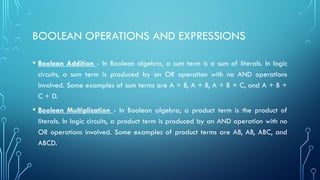
BOOLEAN OPERATIONS AND EXPRESSIONS
• Boolean Addition - In Boolean algebra, a sum term is a sum of literals. In logic
circuits, a sum term is produced by an OR operation with no AND operations
involved. Some examples of sum terms are A + B, A + B, A + B + C, and A + B +
C + D.
• Boolean Multiplication - In Boolean algebra, a product term is the product of
literals. In logic circuits, a product term is produced by an AND operation with no
OR operations involved. Some examples of product terms are AB, AB, ABC, and
ABCD.
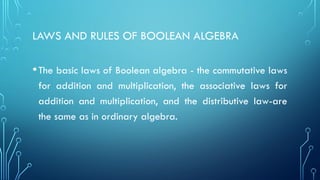
LAWS AND RULES OF BOOLEAN ALGEBRA
•The basic laws of Boolean algebra - the commutative laws
for addition and multiplication, the associative laws for
addition and multiplication, and the distributive law-are
the same as in ordinary algebra.
COMMUTATIVE LAWS
• The commutative law of addition for two variables is written as A+B = B+A.
• This law states that the order in which the variables are ORed makes no
difference.
• The commutative law of multiplication for two variables is A.B = B.A
• This law states that the order in which the variables are ANDed makes no
difference.
ASSOCIATIVE LAWS
• The associative law of addition is written as follows for three variables:
A + (B + C) = (A + B) + C.
• This law states that when ORing more than two variables, the result is the same regardless of
the grouping of the variables.
• The associative law of multiplication is written as follows for three variables:
A(BC) = (AB)C
• This law states that it makes no difference in what order the variables are grouped when
ANDing more than two variables.
DISTRIBUTIVE LAW
• The distributive law is written for three variables as follows:
A(B + C) = AB + AC
• This law states that ORing two or more variables and then ANDing the result
with a single variable is equivalent to ANDing the single variable with each of
the two or more variables and then ORing the products.
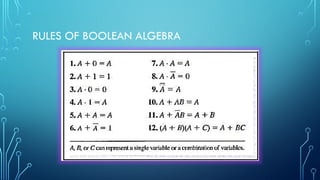
RULES OF BOOLEAN ALGEBRA
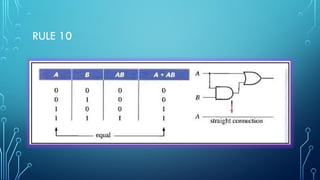
RULE 10
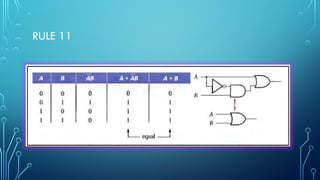
RULE 11
RULE 12
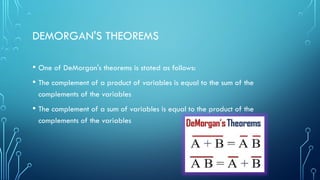
DEMORGAN'S THEOREMS
• One of DeMorgan's theorems is stated as follows:
• The complement of a product of variables is equal to the sum of the
complements of the variables
• The complement of a sum of variables is equal to the product of the
complements of the variables
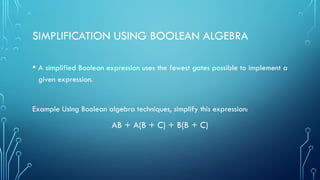
SIMPLIFICATION USING BOOLEAN ALGEBRA
• A simplified Boolean expression uses the fewest gates possible to implement a
given expression.
Example Using Boolean algebra techniques, simplify this expression:
AB + A(B + C) + B(B + C)

Lecture3 - Boolean Algebra - Digital Logic Design.pptx

  • 1.
    BOOLEAN ALGEBRA LOGIC CIRCUITSAND SWITCHING THEORY
  • 2.
    BOOLEAN OPERATIONS ANDEXPRESSIONS • Boolean Addition - In Boolean algebra, a sum term is a sum of literals. In logic circuits, a sum term is produced by an OR operation with no AND operations involved. Some examples of sum terms are A + B, A + B, A + B + C, and A + B + C + D. • Boolean Multiplication - In Boolean algebra, a product term is the product of literals. In logic circuits, a product term is produced by an AND operation with no OR operations involved. Some examples of product terms are AB, AB, ABC, and ABCD.
  • 3.
    LAWS AND RULESOF BOOLEAN ALGEBRA •The basic laws of Boolean algebra - the commutative laws for addition and multiplication, the associative laws for addition and multiplication, and the distributive law-are the same as in ordinary algebra.
  • 4.
    COMMUTATIVE LAWS • Thecommutative law of addition for two variables is written as A+B = B+A. • This law states that the order in which the variables are ORed makes no difference. • The commutative law of multiplication for two variables is A.B = B.A • This law states that the order in which the variables are ANDed makes no difference.
  • 5.
    ASSOCIATIVE LAWS • Theassociative law of addition is written as follows for three variables: A + (B + C) = (A + B) + C. • This law states that when ORing more than two variables, the result is the same regardless of the grouping of the variables. • The associative law of multiplication is written as follows for three variables: A(BC) = (AB)C • This law states that it makes no difference in what order the variables are grouped when ANDing more than two variables.
  • 6.
    DISTRIBUTIVE LAW • Thedistributive law is written for three variables as follows: A(B + C) = AB + AC • This law states that ORing two or more variables and then ANDing the result with a single variable is equivalent to ANDing the single variable with each of the two or more variables and then ORing the products.
  • 7.
  • 8.
  • 9.
  • 10.
  • 11.
    DEMORGAN'S THEOREMS • Oneof DeMorgan's theorems is stated as follows: • The complement of a product of variables is equal to the sum of the complements of the variables • The complement of a sum of variables is equal to the product of the complements of the variables
  • 13.
    SIMPLIFICATION USING BOOLEANALGEBRA • A simplified Boolean expression uses the fewest gates possible to implement a given expression. Example Using Boolean algebra techniques, simplify this expression: AB + A(B + C) + B(B + C)