8/21/2023 1
Introduction to ObjectOrientedProgrammingand
Methodology
By
SMITA SANKHE
Assistant Professor
Department of Computer Engineering
K. J.Somaiya College of Engineering
Somaiya Vidyavihar University
8/21/2023 2
Lecture -01
8/21/2023 3
Contents
• What is Programming?
• Different approaches for Programming
• Different Programming Languages
• Difference between C,C++,Java
• What is Java?
• Features of Java
• Sample Program
8/21/2023 4
What is Programming?
• Programming is somewhat like working with building
blocks.
• The five basic elements in programming are:
o input: getting data and commands into the computer
o output: getting your results out of the computer
o arithmetic: performing mathematical calculations on your
data
o conditional: testing to see if a condition is true or false
o looping: cycling through a set of instructions until some
condition is met
• Example: ATM Machine
8/21/2023 5
Computer Programming
• Way of giving computers instructions about what they should
do next.
These instructions are known as code, and computer
programmers write code to solve problems or perform a task.
• End goal is to create something:
Anything from a web page or a piece of software or even
just a pretty picture.
• A computer program is a list of instructions that
enable a computer to perform a specific task.
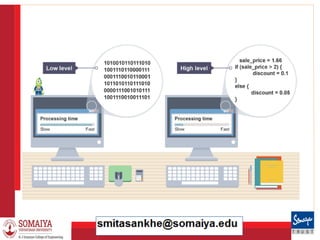
• Computer programs can be written in high and low
level languages, depending on the task and the
hardware being used.
8/21/2023 6
8/21/2023 7
Approaches of Programming
• Procedural Programming
• Structured Approach
• Object Oriented Approach
8/21/2023 8
Procedural programming
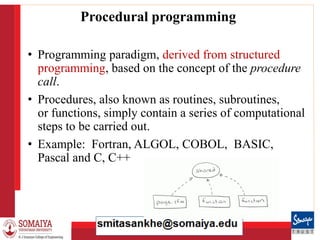
• Programming paradigm, derived from structured
programming, based on the concept of the procedure
call.
• Procedures, also known as routines, subroutines,
or functions, simply contain a series of computational
steps to be carried out.
• Example: Fortran, ALGOL, COBOL, BASIC,
Pascal and C, C++
8/21/2023 9
Object-oriented programming
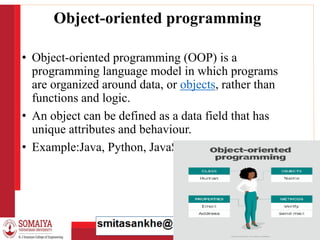
• Object-oriented programming (OOP) is a
programming language model in which programs
are organized around data, or objects, rather than
functions and logic.
• An object can be defined as a data field that has
unique attributes and behaviour.
• Example:Java, Python, JavaScript, C++ etc.
8/21/2023 10
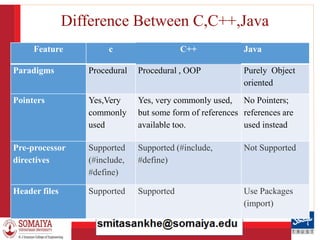
Difference Between C,C++,Java
Feature c C++ Java
Paradigms Procedural Procedural , OOP Purely Object
oriented
Pointers Yes,Very
commonly
used
Yes, very commonly used,
but some form of references
available too.
No Pointers;
references are
used instead
Pre-processor
directives
Supported
(#include,
#define)
Supported (#include,
#define)
Not Supported
Header files Supported Supported Use Packages
(import)
8/21/2023 11
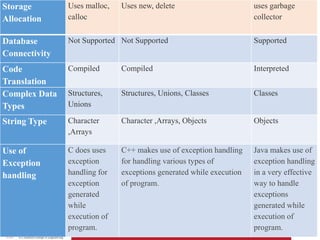
Storage
Allocation
Uses malloc,
calloc
Uses new, delete uses garbage
collector
Database
Connectivity
Not Supported Not Supported Supported
Code
Translation
Compiled Compiled Interpreted
Complex Data
Types
Structures,
Unions
Structures, Unions, Classes Classes
String Type Character
,Arrays
Character ,Arrays, Objects Objects
Use of
Exception
handling
C does uses
exception
handling for
exception
generated
while
execution of
program.
C++ makes use of exception handling
for handling various types of
exceptions generated while execution
of program.
Java makes use of
exception handling
in a very effective
way to handle
exceptions
generated while
execution of
program.
8/21/2023 12
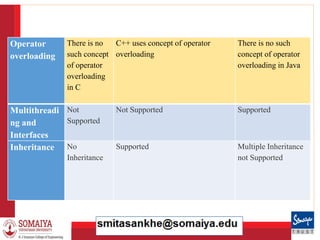
Operator
overloading
There is no
such concept
of operator
overloading
in C
C++ uses concept of operator
overloading
There is no such
concept of operator
overloading in Java
Multithreadi
ng and
Interfaces
Not
Supported
Not Supported Supported
Inheritance No
Inheritance
Supported Multiple Inheritance
not Supported
8/21/2023 13
What is java ?
• Java is a programming language and a platform.
• Java is a high level, robust, object-oriented and secure
programming language.
• Platform: Any hardware or software environment in
which a program runs, is known as a platform.
8/21/2023 14
Different Programming Paradigms
• Functional/procedural programming:
o program is a list of instructions to the computer
• Object-oriented programming
o program is composed of a collection objects that
communicate with each other
8/21/2023 15
Features of Java
8/21/2023 16
A list of most important features of Java
language is given below
• Simple
• Object-Oriented
• Portable
• Platform independent
• Secured
• Robust
• Architecture neutral
• Interpreted
• High Performance
• Multithreaded
• Distributed
• Dynamic
8/21/2023 17
Simple
• Java is very easy to learn, and its syntax is simple,
clean and easy to understand. According to Sun, Java
language is a simple programming language because
• Java syntax is based on C++ (so easier for
programmers to learn it after C++).
8/21/2023 18
Object-oriented
• Java is an object-oriented programming language.
Everything in Java is an object. Object-oriented means we
organize our software as a combination of different types
of objects that incorporates both data and behaviour.
• Object-oriented programming (OOPs) is a methodology
that simplifies software development and maintenance by
providing some rules.
• Basic concepts of OOPs are:
• Object
• Class
• Inheritance
• Polymorphism
• Abstraction
• Encapsulation
8/21/2023 19
Objects and Classes in Java
• An object in Java is the physical as well as a logical entity,
whereas, a class in Java is a logical entity only.
• An entity that has state and behaviour is known as an object
e.g., chair, bike, marker, pen, table, car, etc. An object has three
characteristics:
• State: represents the data (value) of an object.
• Behaviour: represents the behaviour (functionality) of an
object such as deposit, withdraw, etc.
• Identity: An object identity is typically implemented via a
unique ID. The value of the ID is not visible to the external
user. However, it is used internally by the JVM to identify each
object uniquely.
8/21/2023 20
• An object is an instance of a class. A class is a
template or blueprint from which objects are created.
So, an object is the instance(result) of a class.
• Object Definitions:
• An object is a real-world entity.
• An object is a runtime entity.
• The object is an entity which has state and behavior.
• The object is an instance of a class.
8/21/2023 21
Class
• A class is a group of objects which have common
properties. It is a template or blueprint from which
objects are created. It is a logical entity. It can't be
physical.
• A class in Java can contain:
• Fields
• Methods
• Constructors
• Blocks
• Nested class and interface
8/21/2023 22
Inheritance
• Inheritance in Java is a mechanism in which one
object acquires all the properties and behaviours of a
parent object. It is an important part of OOPs (Object
Oriented programming system).
• The idea behind inheritance in Java is that you can
create new classes that are built upon existing classes.
When you inherit from an existing class, you can
reuse methods and fields of the parent class.
Moreover, you can add new methods and fields in
your current class also.
• Inheritance represents the IS-A relationship which is
also known as a parent-child relationship.
8/21/2023 23
Polymorphism
• Polymorphism in Java is a concept by which we can
perform a single action in different ways.
Polymorphism is derived from 2 Greek words: poly
and morphs. The word "poly" means many and
"morphs" means forms. So polymorphism means
many forms.
• There are two types of polymorphism in Java:
compile-time polymorphism and runtime
polymorphism.
• We can perform polymorphism in java by method
overloading and method overriding.
8/21/2023 24
Abstraction
• Abstraction is a process of hiding the implementation
details and showing only functionality to the user.
• Another way, it shows only essential things to the user
and hides the internal details, for Example:sending
SMS where you type the text and send the message.
You don't know the internal processing about the
message delivery.
8/21/2023 25
Encapsulation
• Encapsulation in Java is a process of wrapping code
and data together into a single unit.
• Example, a capsule which is mixed of several
medicines.
8/21/2023 26
Platform Independent
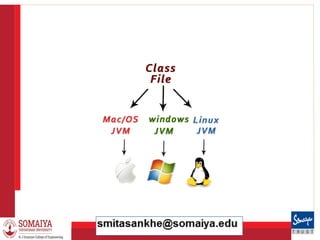
• Java is platform independent because it is different
from other languages like C, C++, etc. which are
compiled into platform specific machines
• while Java is a write once, run anywhere language.
A platform is the hardware or software environment in
which a program runs.
8/21/2023 27
8/21/2023 28
Secured
• Java is best known for its security. With Java, we can
develop virus-free systems. Java is secured because:
• No explicit pointer
• Java Programs run inside a virtual machine
8/21/2023 29
Robust
• Robust simply means strong. Java is robust because:
• It uses strong memory management.
• There is a lack of pointers that avoids security
problems.
• There are exception handling and the type checking
mechanism in Java. All these points make Java robust.
8/21/2023 30
Architecture-neutral
• Java is architecture neutral because there are no
implementation dependent features, for example, the
size of primitive types is fixed.
8/21/2023 31
Portable
• Java is portable because it facilitates you to carry the
Java bytecode to any platform. It doesn't require any
implementation
8/21/2023 32
High-performance
• Java is faster than other traditional interpreted
programming languages because Java bytecode is
"close" to native code. It is still a little bit slower than
a compiled language (e.g., C++).
• Java is an interpreted language that is why it is slower
than compiled languages, e.g., C, C++, etc.
8/21/2023 33
Distributed
• Java is distributed because it facilitates users to create
distributed applications in Java.
8/21/2023 34
Multi-threaded
• A thread is like a separate program, executing
concurrently. We can write Java programs that deal
with many tasks at once by defining multiple threads.
• The main advantage of multi-threading is that it
doesn't occupy memory for each thread. It shares a
common memory area. Threads are important for
multi-media, Web applications, etc.
8/21/2023 35
Dynamic
• Java is a dynamic language. It supports dynamic
loading of classes. It means classes are loaded on
demand. It also supports functions from its native
languages, i.e., C and C++.
• Java supports dynamic compilation and automatic
memory management (garbage collection)
8/21/2023 36
Getting Started with Java Programming
• A Simple Java Application
• Compiling Programs
• Executing Applications
8/21/2023 37
A Simple Java Program
Example 1.1
//This application program prints
Welcome to Java!
public class Welcome
{
public static void main(String[] args)
{
System.out.println("Welcome to Java!");
}
}
8/21/2023 38
Creating and Compiling Programs
• On command line
o javac file.java
Source Code
Create/Modify Source Code
Compile Source Code
i.e. javac Welcome.java
Bytecode
Run Byteode
i.e. java Welcome
Result
If compilation errors
If runtime errors or incorrect result
8/21/2023 39
Executing Applications
• On command line
o java classname
Java
Interpreter
on Windows
Java
Interpreter
on Sun Solaris
Java
Interpreter
on Linux
Bytecode
...
8/21/2023 40
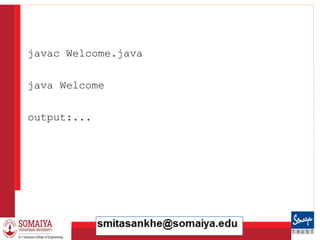
javac Welcome.java
java Welcome
output:...

lecture-1111111111111111111111111111.pdf

  • 1.
    8/21/2023 1 Introduction toObjectOrientedProgrammingand Methodology By SMITA SANKHE Assistant Professor Department of Computer Engineering K. J.Somaiya College of Engineering Somaiya Vidyavihar University
  • 2.
  • 3.
    8/21/2023 3 Contents • Whatis Programming? • Different approaches for Programming • Different Programming Languages • Difference between C,C++,Java • What is Java? • Features of Java • Sample Program
  • 4.
    8/21/2023 4 What isProgramming? • Programming is somewhat like working with building blocks. • The five basic elements in programming are: o input: getting data and commands into the computer o output: getting your results out of the computer o arithmetic: performing mathematical calculations on your data o conditional: testing to see if a condition is true or false o looping: cycling through a set of instructions until some condition is met • Example: ATM Machine
  • 5.
    8/21/2023 5 Computer Programming •Way of giving computers instructions about what they should do next. These instructions are known as code, and computer programmers write code to solve problems or perform a task. • End goal is to create something: Anything from a web page or a piece of software or even just a pretty picture. • A computer program is a list of instructions that enable a computer to perform a specific task. • Computer programs can be written in high and low level languages, depending on the task and the hardware being used.
  • 6.
  • 7.
    8/21/2023 7 Approaches ofProgramming • Procedural Programming • Structured Approach • Object Oriented Approach
  • 8.
    8/21/2023 8 Procedural programming •Programming paradigm, derived from structured programming, based on the concept of the procedure call. • Procedures, also known as routines, subroutines, or functions, simply contain a series of computational steps to be carried out. • Example: Fortran, ALGOL, COBOL, BASIC, Pascal and C, C++
  • 9.
    8/21/2023 9 Object-oriented programming •Object-oriented programming (OOP) is a programming language model in which programs are organized around data, or objects, rather than functions and logic. • An object can be defined as a data field that has unique attributes and behaviour. • Example:Java, Python, JavaScript, C++ etc.
  • 10.
    8/21/2023 10 Difference BetweenC,C++,Java Feature c C++ Java Paradigms Procedural Procedural , OOP Purely Object oriented Pointers Yes,Very commonly used Yes, very commonly used, but some form of references available too. No Pointers; references are used instead Pre-processor directives Supported (#include, #define) Supported (#include, #define) Not Supported Header files Supported Supported Use Packages (import)
  • 11.
    8/21/2023 11 Storage Allocation Uses malloc, calloc Usesnew, delete uses garbage collector Database Connectivity Not Supported Not Supported Supported Code Translation Compiled Compiled Interpreted Complex Data Types Structures, Unions Structures, Unions, Classes Classes String Type Character ,Arrays Character ,Arrays, Objects Objects Use of Exception handling C does uses exception handling for exception generated while execution of program. C++ makes use of exception handling for handling various types of exceptions generated while execution of program. Java makes use of exception handling in a very effective way to handle exceptions generated while execution of program.
  • 12.
    8/21/2023 12 Operator overloading There isno such concept of operator overloading in C C++ uses concept of operator overloading There is no such concept of operator overloading in Java Multithreadi ng and Interfaces Not Supported Not Supported Supported Inheritance No Inheritance Supported Multiple Inheritance not Supported
  • 13.
    8/21/2023 13 What isjava ? • Java is a programming language and a platform. • Java is a high level, robust, object-oriented and secure programming language. • Platform: Any hardware or software environment in which a program runs, is known as a platform.
  • 14.
    8/21/2023 14 Different ProgrammingParadigms • Functional/procedural programming: o program is a list of instructions to the computer • Object-oriented programming o program is composed of a collection objects that communicate with each other
  • 15.
  • 16.
    8/21/2023 16 A listof most important features of Java language is given below • Simple • Object-Oriented • Portable • Platform independent • Secured • Robust • Architecture neutral • Interpreted • High Performance • Multithreaded • Distributed • Dynamic
  • 17.
    8/21/2023 17 Simple • Javais very easy to learn, and its syntax is simple, clean and easy to understand. According to Sun, Java language is a simple programming language because • Java syntax is based on C++ (so easier for programmers to learn it after C++).
  • 18.
    8/21/2023 18 Object-oriented • Javais an object-oriented programming language. Everything in Java is an object. Object-oriented means we organize our software as a combination of different types of objects that incorporates both data and behaviour. • Object-oriented programming (OOPs) is a methodology that simplifies software development and maintenance by providing some rules. • Basic concepts of OOPs are: • Object • Class • Inheritance • Polymorphism • Abstraction • Encapsulation
  • 19.
    8/21/2023 19 Objects andClasses in Java • An object in Java is the physical as well as a logical entity, whereas, a class in Java is a logical entity only. • An entity that has state and behaviour is known as an object e.g., chair, bike, marker, pen, table, car, etc. An object has three characteristics: • State: represents the data (value) of an object. • Behaviour: represents the behaviour (functionality) of an object such as deposit, withdraw, etc. • Identity: An object identity is typically implemented via a unique ID. The value of the ID is not visible to the external user. However, it is used internally by the JVM to identify each object uniquely.
  • 20.
    8/21/2023 20 • Anobject is an instance of a class. A class is a template or blueprint from which objects are created. So, an object is the instance(result) of a class. • Object Definitions: • An object is a real-world entity. • An object is a runtime entity. • The object is an entity which has state and behavior. • The object is an instance of a class.
  • 21.
    8/21/2023 21 Class • Aclass is a group of objects which have common properties. It is a template or blueprint from which objects are created. It is a logical entity. It can't be physical. • A class in Java can contain: • Fields • Methods • Constructors • Blocks • Nested class and interface
  • 22.
    8/21/2023 22 Inheritance • Inheritancein Java is a mechanism in which one object acquires all the properties and behaviours of a parent object. It is an important part of OOPs (Object Oriented programming system). • The idea behind inheritance in Java is that you can create new classes that are built upon existing classes. When you inherit from an existing class, you can reuse methods and fields of the parent class. Moreover, you can add new methods and fields in your current class also. • Inheritance represents the IS-A relationship which is also known as a parent-child relationship.
  • 23.
    8/21/2023 23 Polymorphism • Polymorphismin Java is a concept by which we can perform a single action in different ways. Polymorphism is derived from 2 Greek words: poly and morphs. The word "poly" means many and "morphs" means forms. So polymorphism means many forms. • There are two types of polymorphism in Java: compile-time polymorphism and runtime polymorphism. • We can perform polymorphism in java by method overloading and method overriding.
  • 24.
    8/21/2023 24 Abstraction • Abstractionis a process of hiding the implementation details and showing only functionality to the user. • Another way, it shows only essential things to the user and hides the internal details, for Example:sending SMS where you type the text and send the message. You don't know the internal processing about the message delivery.
  • 25.
    8/21/2023 25 Encapsulation • Encapsulationin Java is a process of wrapping code and data together into a single unit. • Example, a capsule which is mixed of several medicines.
  • 26.
    8/21/2023 26 Platform Independent •Java is platform independent because it is different from other languages like C, C++, etc. which are compiled into platform specific machines • while Java is a write once, run anywhere language. A platform is the hardware or software environment in which a program runs.
  • 27.
  • 28.
    8/21/2023 28 Secured • Javais best known for its security. With Java, we can develop virus-free systems. Java is secured because: • No explicit pointer • Java Programs run inside a virtual machine
  • 29.
    8/21/2023 29 Robust • Robustsimply means strong. Java is robust because: • It uses strong memory management. • There is a lack of pointers that avoids security problems. • There are exception handling and the type checking mechanism in Java. All these points make Java robust.
  • 30.
    8/21/2023 30 Architecture-neutral • Javais architecture neutral because there are no implementation dependent features, for example, the size of primitive types is fixed.
  • 31.
    8/21/2023 31 Portable • Javais portable because it facilitates you to carry the Java bytecode to any platform. It doesn't require any implementation
  • 32.
    8/21/2023 32 High-performance • Javais faster than other traditional interpreted programming languages because Java bytecode is "close" to native code. It is still a little bit slower than a compiled language (e.g., C++). • Java is an interpreted language that is why it is slower than compiled languages, e.g., C, C++, etc.
  • 33.
    8/21/2023 33 Distributed • Javais distributed because it facilitates users to create distributed applications in Java.
  • 34.
    8/21/2023 34 Multi-threaded • Athread is like a separate program, executing concurrently. We can write Java programs that deal with many tasks at once by defining multiple threads. • The main advantage of multi-threading is that it doesn't occupy memory for each thread. It shares a common memory area. Threads are important for multi-media, Web applications, etc.
  • 35.
    8/21/2023 35 Dynamic • Javais a dynamic language. It supports dynamic loading of classes. It means classes are loaded on demand. It also supports functions from its native languages, i.e., C and C++. • Java supports dynamic compilation and automatic memory management (garbage collection)
  • 36.
    8/21/2023 36 Getting Startedwith Java Programming • A Simple Java Application • Compiling Programs • Executing Applications
  • 37.
    8/21/2023 37 A SimpleJava Program Example 1.1 //This application program prints Welcome to Java! public class Welcome { public static void main(String[] args) { System.out.println("Welcome to Java!"); } }
  • 38.
    8/21/2023 38 Creating andCompiling Programs • On command line o javac file.java Source Code Create/Modify Source Code Compile Source Code i.e. javac Welcome.java Bytecode Run Byteode i.e. java Welcome Result If compilation errors If runtime errors or incorrect result
  • 39.
    8/21/2023 39 Executing Applications •On command line o java classname Java Interpreter on Windows Java Interpreter on Sun Solaris Java Interpreter on Linux Bytecode ...
  • 40.