Chapter 1
Introduction to Computer Systems
1
OBJECTIVES
• To identify the definition and basic
components of computer.
• To explain types of computer.
• To describe computer usage in society.
• To discuss computer ethics.
• To describe advantages and
disadvantages of computer.
2
3
4
5
Basic Definitions : Computer
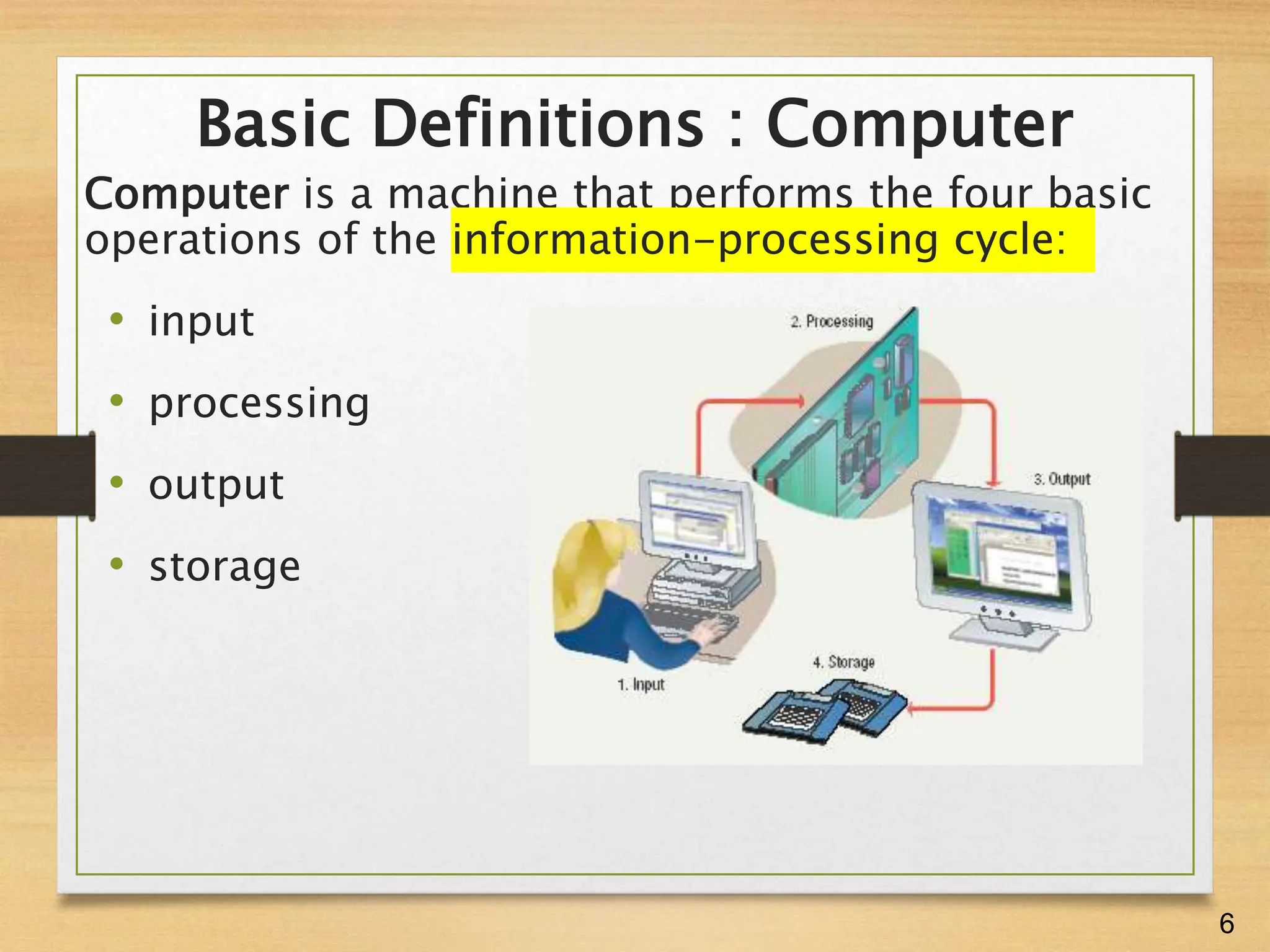
Computer is a machine that performs the four basic
operations of the information-processing cycle:
• input
• processing
• output
• storage
6
INFORMATION
PROCESSING CYCLE
• Input – accept the data that entered by the users
from input devices for processing.
• Process – perform a processing to the data sent by
input devices.
• Output – Displayed the information on the output
devices.
• Storage – Store the data/information for future use.
Parts of the Computer
System
• Computer systems have four parts
• Hardware
• Software
• Data
• User
8
Parts of the Computer
System
• Hardware
• Mechanical devices in the computer
• Software
• Instructions Tell the computer what to do
• Also called a program
• System software, application software
9
Parts of the Computer
System
• Data
• Pieces of information
• Computer organize and present data
• Users
• People operating the computer
• Most important part
• Tell the computer what to do
10
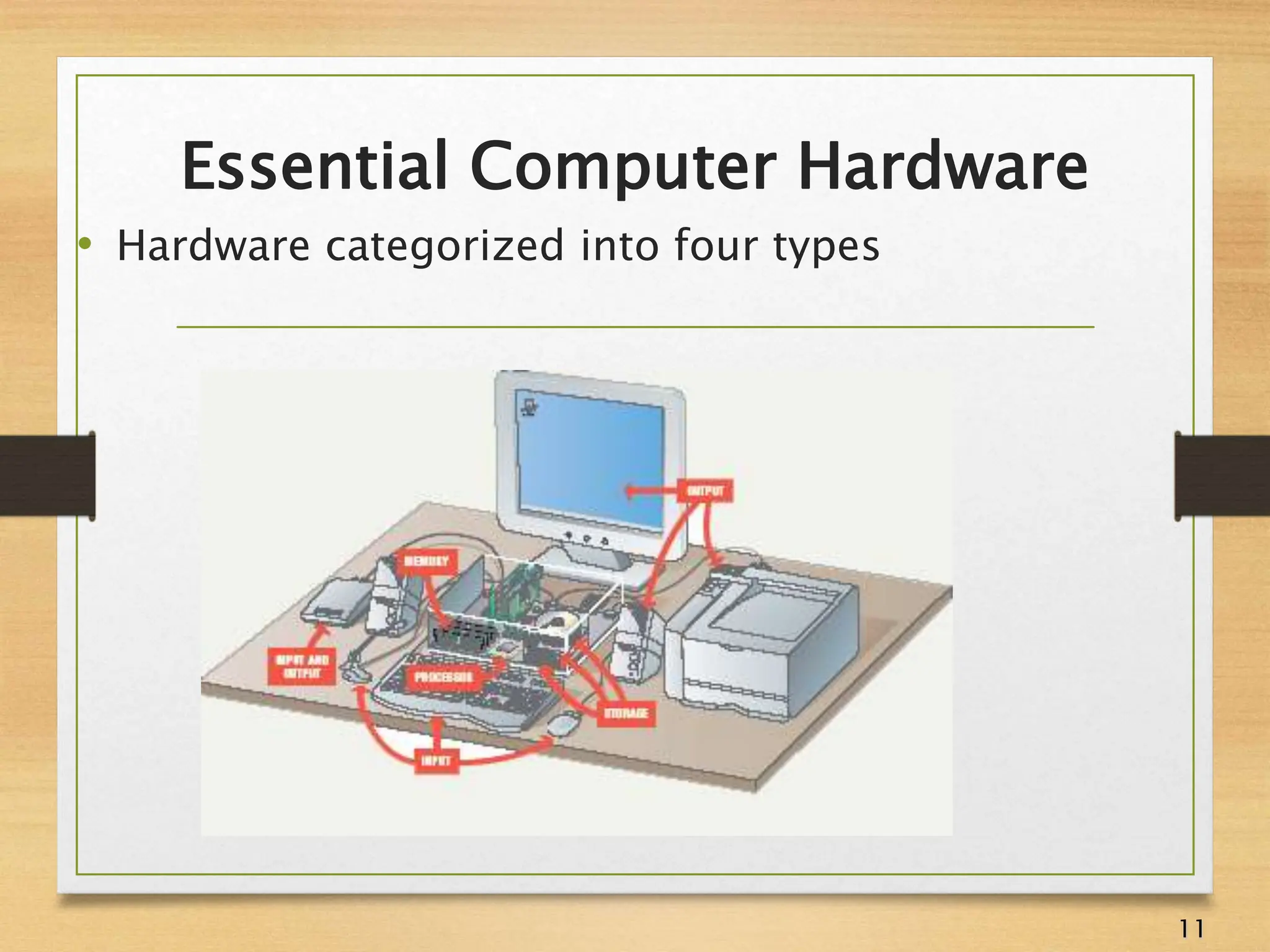
Essential Computer Hardware
• Hardware categorized into four types
11
Essential Computer Hardware
• Input and output devices
• Allows the user to interact
• Input devices accept data
• Keyboard, mouse
• Output devices deliver data
• Monitor, printer, speaker
• Some devices are input and output
• Touch screens
12
Essential Computer Hardware
• Processing devices
• Brains of the computer
• Carries out instructions from the program
• Manipulate the data
• Most computers have several processors
• Central Processing Unit (CPU)
• Processors made of silicon and copper
13
Essential Computer Hardware
• Memory devices
• Stores data or programs
• Random Access Memory (RAM)
• Volatile
• Stores current data and programs
• More RAM results in a faster system
• Read Only Memory (ROM)
• Permanent storage of programs
• Holds the computer boot directions
14
Essential Computer Hardware
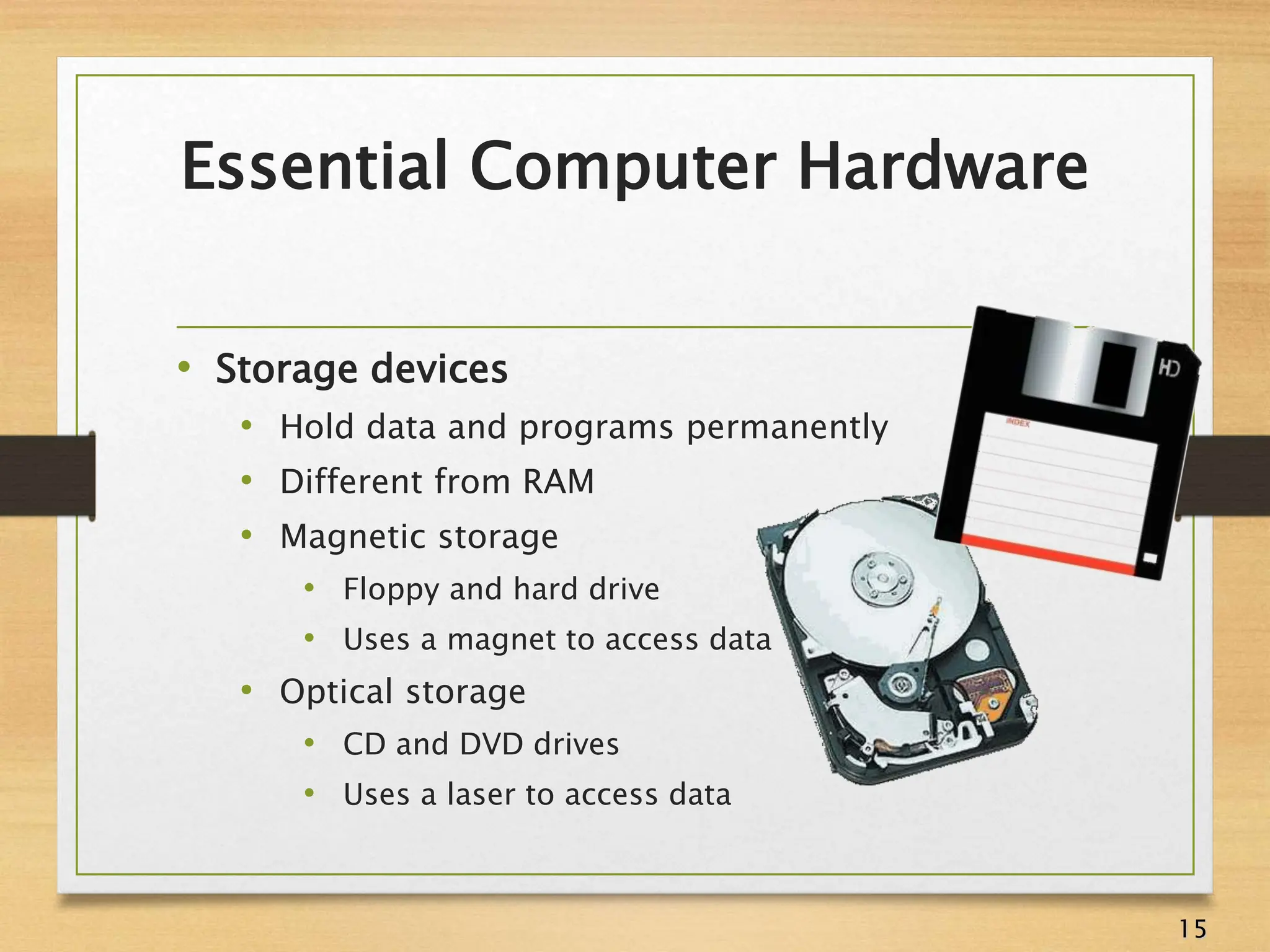
• Storage devices
• Hold data and programs permanently
• Different from RAM
• Magnetic storage
• Floppy and hard drive
• Uses a magnet to access data
• Optical storage
• CD and DVD drives
• Uses a laser to access data
15
Hard Drive
Floppy Disk Drive
Zip
Drive
CD/DVD
Drive
Jaz
Drive
Tape
Drive
Micro Drive
Storage Devices
16
Software Runs The
Machine
• Tells the computer what to do
• Two types
• System software
• Application software
17
Software Runs The
Machine
• System software
• Most important software
• Operating system
• Windows 2016
• Network operating system (OS)
• Windows Server
• Utility
• Symantec AntiVirus
18
Software Runs The
Machine
• Application software
• Accomplishes a specific task
• Most common type of software
• MS Word
• Covers most common uses of computers
19
Computer data
• Fact with no meaning on its own
• Stored using the binary number system
• Data can be organized into files
20
Computer users
• Role depends on ability
• Setup the system
• Install software
• Manage files
• Maintain the system
• “Userless” computers
• Run with no user input
• Automated systems
21
Communications
• Communication is the process of moving data
between computers or even within the computer.
• Communications devices enable computers to
connect to a computer network.
• Network – Two or more computer systems
that are connected.
• Modem – A device that enables the
computer to access other computers.
22
Network Interface
Card – NIC
Communications Devices
23
Modem
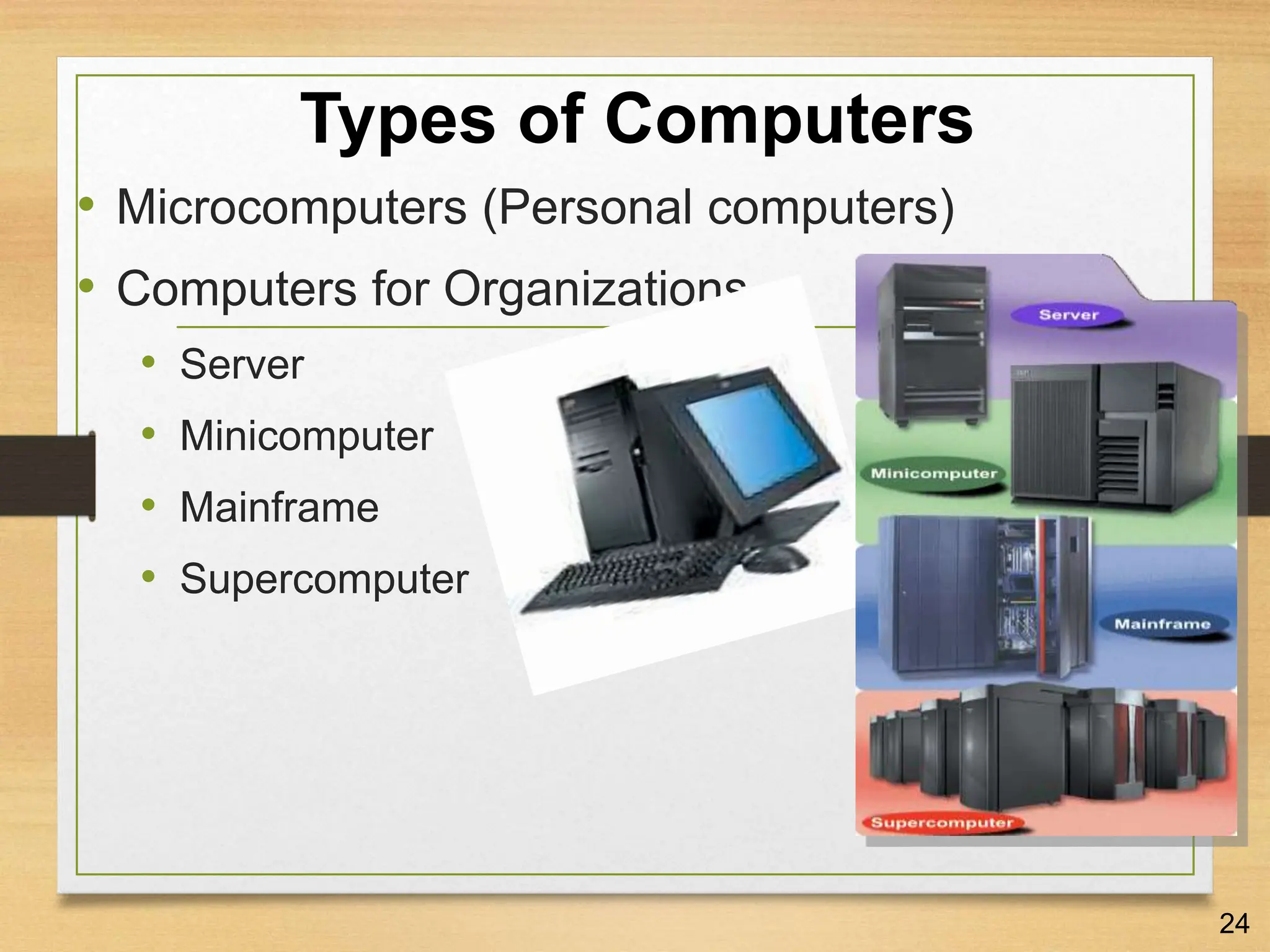
Types of Computers
24
• Microcomputers (Personal computers)
• Computers for Organizations
• Server
• Minicomputer
• Mainframe
• Supercomputer
• Microcomputers are the most common type of
computers in existence today, whether at work
in school or on the desk at home.
• Desktop computers
• The most common type of computer
• Sits on the desk or floor
• Performs a variety of tasks
Microcomputers - Computers For
Individual Use
25
Microcomputers - Computers
For Individual Use
• Workstations
• Specialized computers
• Optimized for science or graphics
• More powerful than a desktop
• Notebook computers
• Small portable computers
• Weighs between 3 and 8 pounds
• About 8 ½ by 11 inches
• Typically as powerful as a desktop
26
Microcomputers - Computers For
Individual Use
• Tablet computers
• Development in portable computers
• Input is through a stylus or digital pen
2
• A tablet PC is a wireless, portable personal
computer with a touch screen interface. The
tablet form factor is typically smaller than a
notebook computer but larger than a
smartphone.
• The most common type of tablet is the slate
style, like Apple's iPad or Microsoft's Surface.
Microcomputers - Computers
For Individual Use
• The idea of tablet computing is generally
credited to Alan Kay of Xerox, who sketched
out the idea in 1971.
• The first widely-sold tablet computer was
Apple Computer's Newton, which was not a
commercial success.
• Technological advances in battery life, display
resolution, handwriting recognition software,
larger memory, and wireless Internet access
have since made tablets a viable computing
option.
28
Microcomputers - Computers
For Individual Use
• The iPad is a touch screen tablet PC
• The iPad is basically a netbook without a
keyboard or a trackpad, but instead has a
touchscreen interface, which is used to
control the device.
29
Microcomputers - Computers
For Individual Use
• Handheld computers
• Very small computers
• Personal Digital Assistants (PDA)
• Note taking or contact management
• Data can synchronize with a desktop
• Smart phones
• Hybrid of cell phone and PDA
• Web surfing, e-mail access
30
Notebook / Laptop /
Netbook
Workstation
Examples of Microcomputers
All-in-One
Tablet PC
31
Computers For
Organizations
• Network servers
• Computer networks utilize high performance computer systems
called "servers".
• Centralized computer
• All other computers connect
• Provides access to network resources
• Multiple servers are called server farms
32
– typically have high performance processors
and contain hardware and software capable
of handling large amounts of data.
– has multiple hard disk drives connected in
series.
– provide a large number of computer users
with access to large stores of information
33
Computers For
Organizations
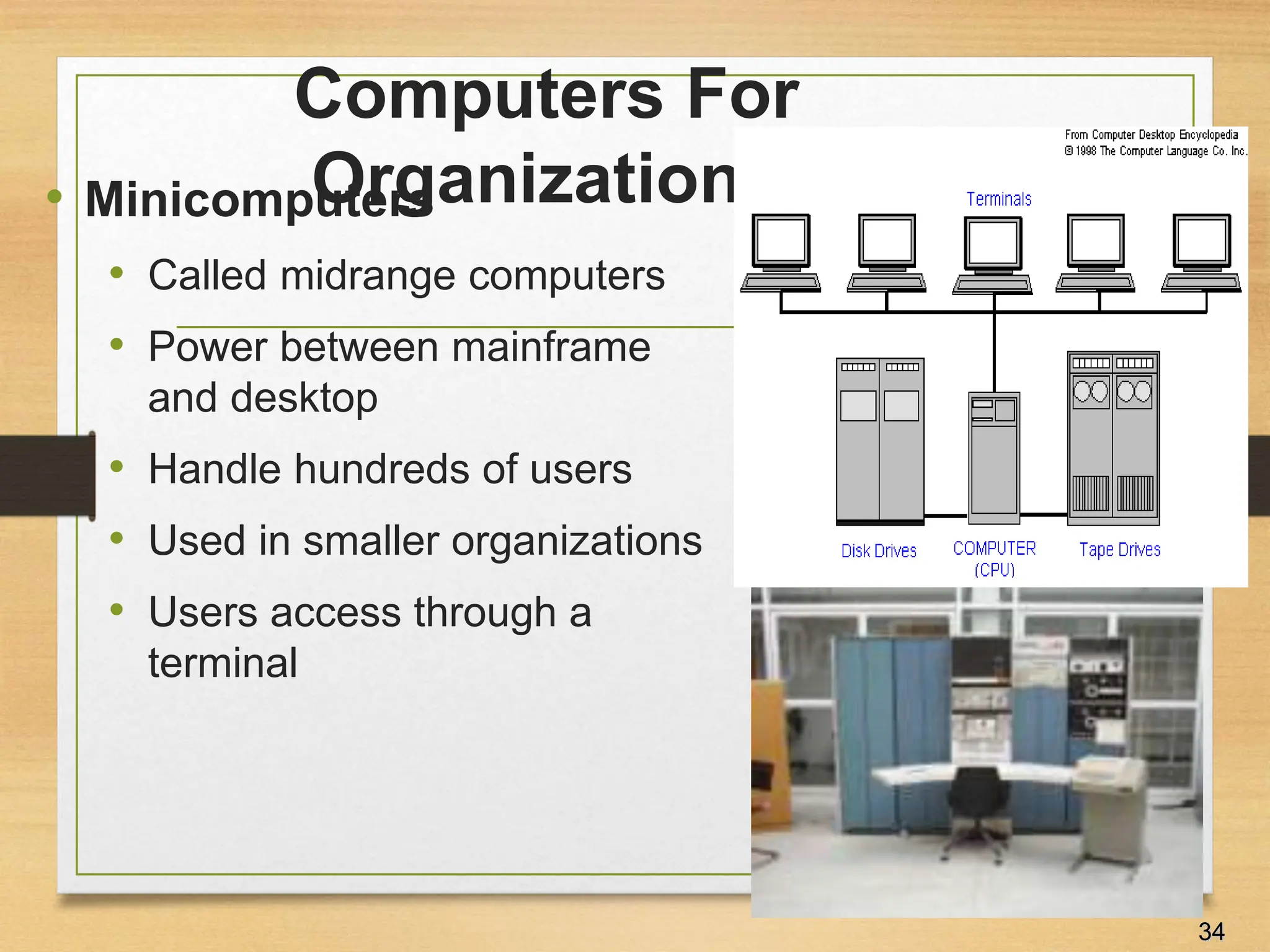
• Minicomputers
• Called midrange computers
• Power between mainframe
and desktop
• Handle hundreds of users
• Used in smaller organizations
• Users access through a
terminal
34
Computers For Organizations
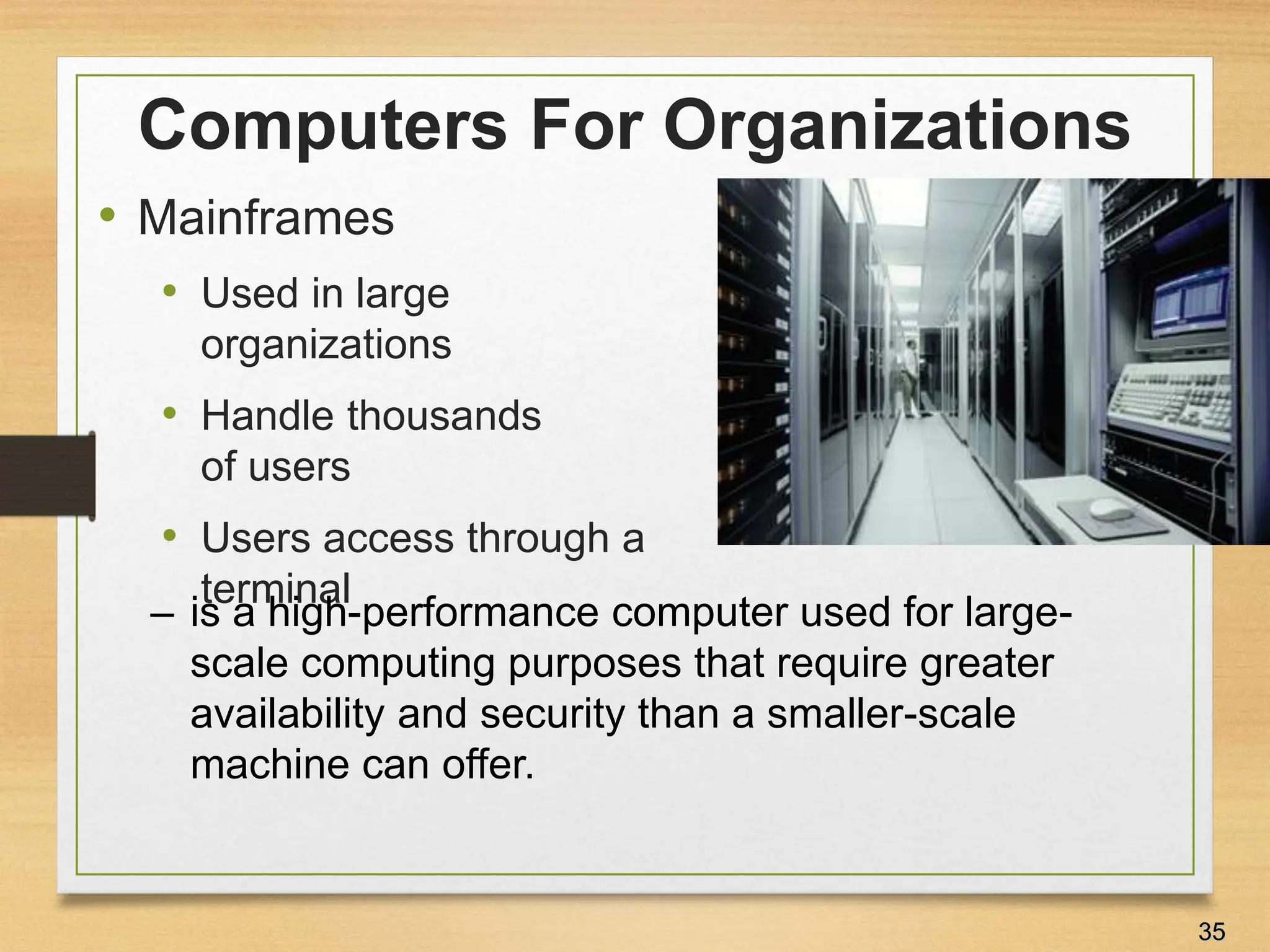
• Mainframes
• Used in large
organizations
• Handle thousands
of users
• Users access through a
terminal
35
– is a high-performance computer used for large-
scale computing purposes that require greater
availability and security than a smaller-scale
machine can offer.
Computers For Organizations
• Supercomputers
• The most powerful computers
made
• Handle large and complex
calculations
• Process trillions of operations per
second
• Found in research organizations
NASA
• are very expensive and are
employed for specialized
applications that require immense
amounts of mathematical
calculations.
3
• For example, weather forecasting
• Other uses of supercomputers include animated
graphics, fluid dynamic calculations, nuclear energy
research, and petroleum exploration.
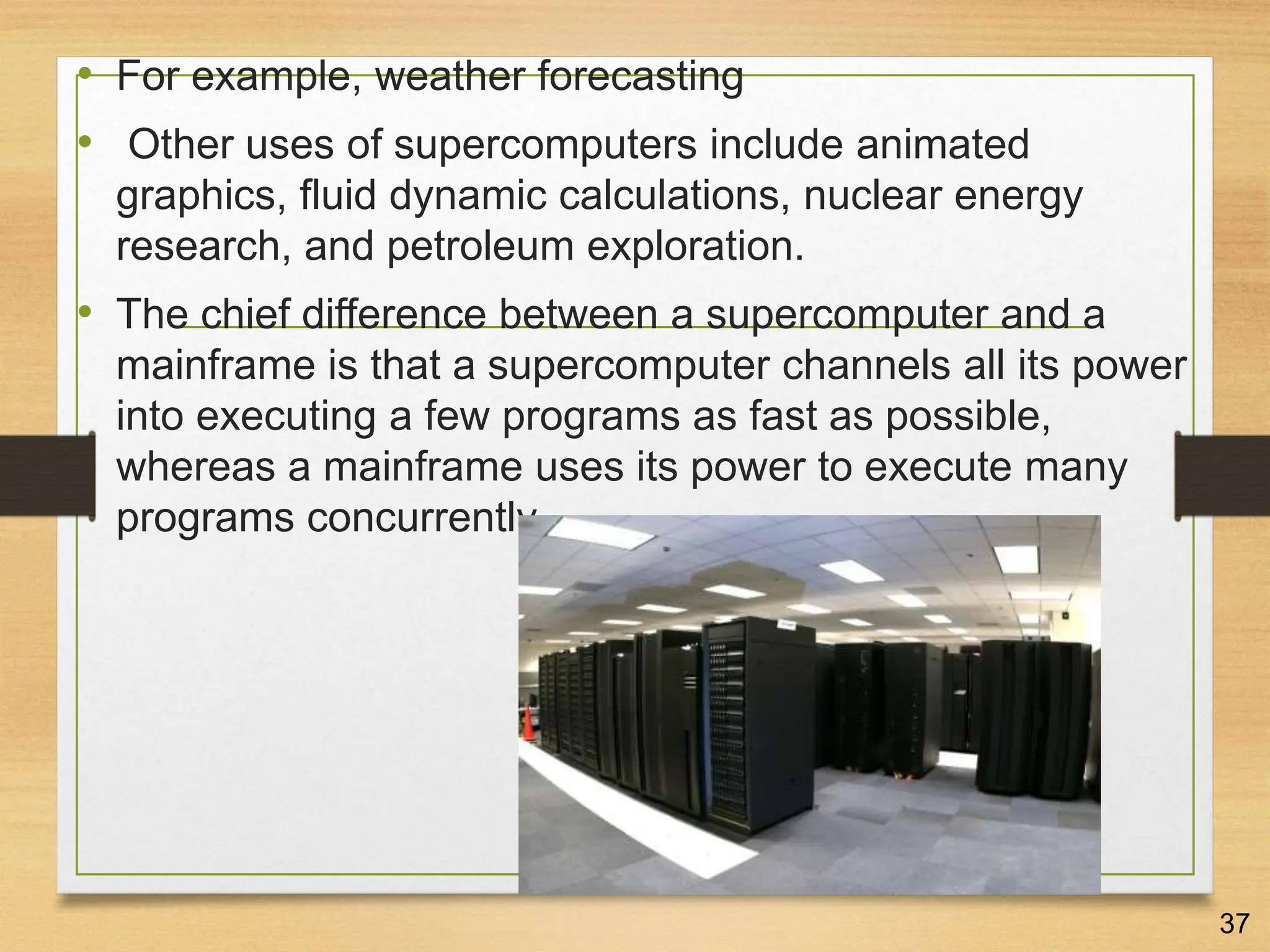
• The chief difference between a supercomputer and a
mainframe is that a supercomputer channels all its power
into executing a few programs as fast as possible,
whereas a mainframe uses its power to execute many
programs concurrently.
37
Computer Maintenance
• Do not overload electrical
outlets.
• Do not position hardware
where it can fall.
• Leave space for proper
ventilation.
• Check that cords are
fastened securely.
38
Responsible Computer User
• Be considerate of other sharing the same
connection.
• Dispose of old computers properly.
• Internet overuse may promote unhealthy
behavior.
39
Computers In Society
• More impact than any other invention
• Changed work and leisure activities
• Used by all demographic groups
• Computers are important because:
• Provide information to users
• Information is critical to our society
• Managing information is difficult
40
Computers In Society
• Computers at home
• Many homes have multiple computers + Internet
• Computers are used for
• Business
• Entertainment
• Communication
• Education
41
Computers In Society
• Computers in education
• Computer literacy required at all levels
• Computers in small business
• Makes businesses more profitable
• Allows owners to manage
• Computers in industry
• Computers are used to design products
• Assembly lines are automated
42
Computers In Society
• Computers in government
• Necessary to track data for population
• Police officers
• Tax calculation and collection
• Governments were the first computer users
43
Computers In Society
• Computers in health care
• Revolutionized health care
• New treatments possible
• Scheduling of patients has improved
• Delivery of medicine is safer
44
The Effect of Computers on
Employment
• Skilled workers earn more wages, but . . .
• Computer guided robots take over many
manufacturing and repetitive jobs.
• Structural unemployment results when advancing
technology makes an entire job category
obsolete.
45
Impacts of Computer Use
• The Americans with Disabilities Act of 1990
requires schools to provide computer access for
people with disabilities
• Speech recognition software for
visually impaired
• Special input devices for
motor impaired
46
Example: Touchless Keyboard for the Disabled
• those without the use of their hands and fingers,
have a much more difficult time navigating a
computer keyboard
• Using a head-mounted sensor, the keyboard, which
hangs over the top of your screen, picks up your
noggin's movements and transmits the data to the
computer as text.
47
Example: Speech Recognition Software for
Visually Impaired
• Dragon NaturallySpeaking, the world’s best-selling
speech recognition software.
• Turn your voice into text three times faster than
most people type with up to 99% accuracy.
• works with the most commonly used desktop
applications, including Microsoft Word &Internet
Explorer.
48
Recognize the Risks of Using Flawed
Software
• All programs often contain
errors.
• All computer use entails a
certain level of risk.
Bug – An error or defect in
software or hardware that
causes a program to
malfunction
49
Advantages and Disadvantages
of Using Computers
Advantages
Speed
Reliability
Consistency
Storage
Communications
Disadvantages
Health Risks
Violation of Privacy
Public Safety
Impact on Labor Force
Impact on Environment
50
THE END
51

Lecture-1 Introduction to Information Technology .ppt

  • 1.
    Chapter 1 Introduction toComputer Systems 1
  • 2.
    OBJECTIVES • To identifythe definition and basic components of computer. • To explain types of computer. • To describe computer usage in society. • To discuss computer ethics. • To describe advantages and disadvantages of computer. 2
  • 3.
  • 4.
  • 5.
  • 6.
    Basic Definitions :Computer Computer is a machine that performs the four basic operations of the information-processing cycle: • input • processing • output • storage 6
  • 7.
    INFORMATION PROCESSING CYCLE • Input– accept the data that entered by the users from input devices for processing. • Process – perform a processing to the data sent by input devices. • Output – Displayed the information on the output devices. • Storage – Store the data/information for future use.
  • 8.
    Parts of theComputer System • Computer systems have four parts • Hardware • Software • Data • User 8
  • 9.
    Parts of theComputer System • Hardware • Mechanical devices in the computer • Software • Instructions Tell the computer what to do • Also called a program • System software, application software 9
  • 10.
    Parts of theComputer System • Data • Pieces of information • Computer organize and present data • Users • People operating the computer • Most important part • Tell the computer what to do 10
  • 11.
    Essential Computer Hardware •Hardware categorized into four types 11
  • 12.
    Essential Computer Hardware •Input and output devices • Allows the user to interact • Input devices accept data • Keyboard, mouse • Output devices deliver data • Monitor, printer, speaker • Some devices are input and output • Touch screens 12
  • 13.
    Essential Computer Hardware •Processing devices • Brains of the computer • Carries out instructions from the program • Manipulate the data • Most computers have several processors • Central Processing Unit (CPU) • Processors made of silicon and copper 13
  • 14.
    Essential Computer Hardware •Memory devices • Stores data or programs • Random Access Memory (RAM) • Volatile • Stores current data and programs • More RAM results in a faster system • Read Only Memory (ROM) • Permanent storage of programs • Holds the computer boot directions 14
  • 15.
    Essential Computer Hardware •Storage devices • Hold data and programs permanently • Different from RAM • Magnetic storage • Floppy and hard drive • Uses a magnet to access data • Optical storage • CD and DVD drives • Uses a laser to access data 15
  • 16.
    Hard Drive Floppy DiskDrive Zip Drive CD/DVD Drive Jaz Drive Tape Drive Micro Drive Storage Devices 16
  • 17.
    Software Runs The Machine •Tells the computer what to do • Two types • System software • Application software 17
  • 18.
    Software Runs The Machine •System software • Most important software • Operating system • Windows 2016 • Network operating system (OS) • Windows Server • Utility • Symantec AntiVirus 18
  • 19.
    Software Runs The Machine •Application software • Accomplishes a specific task • Most common type of software • MS Word • Covers most common uses of computers 19
  • 20.
    Computer data • Factwith no meaning on its own • Stored using the binary number system • Data can be organized into files 20
  • 21.
    Computer users • Roledepends on ability • Setup the system • Install software • Manage files • Maintain the system • “Userless” computers • Run with no user input • Automated systems 21
  • 22.
    Communications • Communication isthe process of moving data between computers or even within the computer. • Communications devices enable computers to connect to a computer network. • Network – Two or more computer systems that are connected. • Modem – A device that enables the computer to access other computers. 22
  • 23.
    Network Interface Card –NIC Communications Devices 23 Modem
  • 24.
    Types of Computers 24 •Microcomputers (Personal computers) • Computers for Organizations • Server • Minicomputer • Mainframe • Supercomputer
  • 25.
    • Microcomputers arethe most common type of computers in existence today, whether at work in school or on the desk at home. • Desktop computers • The most common type of computer • Sits on the desk or floor • Performs a variety of tasks Microcomputers - Computers For Individual Use 25
  • 26.
    Microcomputers - Computers ForIndividual Use • Workstations • Specialized computers • Optimized for science or graphics • More powerful than a desktop • Notebook computers • Small portable computers • Weighs between 3 and 8 pounds • About 8 ½ by 11 inches • Typically as powerful as a desktop 26
  • 27.
    Microcomputers - ComputersFor Individual Use • Tablet computers • Development in portable computers • Input is through a stylus or digital pen 2 • A tablet PC is a wireless, portable personal computer with a touch screen interface. The tablet form factor is typically smaller than a notebook computer but larger than a smartphone. • The most common type of tablet is the slate style, like Apple's iPad or Microsoft's Surface.
  • 28.
    Microcomputers - Computers ForIndividual Use • The idea of tablet computing is generally credited to Alan Kay of Xerox, who sketched out the idea in 1971. • The first widely-sold tablet computer was Apple Computer's Newton, which was not a commercial success. • Technological advances in battery life, display resolution, handwriting recognition software, larger memory, and wireless Internet access have since made tablets a viable computing option. 28
  • 29.
    Microcomputers - Computers ForIndividual Use • The iPad is a touch screen tablet PC • The iPad is basically a netbook without a keyboard or a trackpad, but instead has a touchscreen interface, which is used to control the device. 29
  • 30.
    Microcomputers - Computers ForIndividual Use • Handheld computers • Very small computers • Personal Digital Assistants (PDA) • Note taking or contact management • Data can synchronize with a desktop • Smart phones • Hybrid of cell phone and PDA • Web surfing, e-mail access 30
  • 31.
    Notebook / Laptop/ Netbook Workstation Examples of Microcomputers All-in-One Tablet PC 31
  • 32.
    Computers For Organizations • Networkservers • Computer networks utilize high performance computer systems called "servers". • Centralized computer • All other computers connect • Provides access to network resources • Multiple servers are called server farms 32
  • 33.
    – typically havehigh performance processors and contain hardware and software capable of handling large amounts of data. – has multiple hard disk drives connected in series. – provide a large number of computer users with access to large stores of information 33
  • 34.
    Computers For Organizations • Minicomputers •Called midrange computers • Power between mainframe and desktop • Handle hundreds of users • Used in smaller organizations • Users access through a terminal 34
  • 35.
    Computers For Organizations •Mainframes • Used in large organizations • Handle thousands of users • Users access through a terminal 35 – is a high-performance computer used for large- scale computing purposes that require greater availability and security than a smaller-scale machine can offer.
  • 36.
    Computers For Organizations •Supercomputers • The most powerful computers made • Handle large and complex calculations • Process trillions of operations per second • Found in research organizations NASA • are very expensive and are employed for specialized applications that require immense amounts of mathematical calculations. 3
  • 37.
    • For example,weather forecasting • Other uses of supercomputers include animated graphics, fluid dynamic calculations, nuclear energy research, and petroleum exploration. • The chief difference between a supercomputer and a mainframe is that a supercomputer channels all its power into executing a few programs as fast as possible, whereas a mainframe uses its power to execute many programs concurrently. 37
  • 38.
    Computer Maintenance • Donot overload electrical outlets. • Do not position hardware where it can fall. • Leave space for proper ventilation. • Check that cords are fastened securely. 38
  • 39.
    Responsible Computer User •Be considerate of other sharing the same connection. • Dispose of old computers properly. • Internet overuse may promote unhealthy behavior. 39
  • 40.
    Computers In Society •More impact than any other invention • Changed work and leisure activities • Used by all demographic groups • Computers are important because: • Provide information to users • Information is critical to our society • Managing information is difficult 40
  • 41.
    Computers In Society •Computers at home • Many homes have multiple computers + Internet • Computers are used for • Business • Entertainment • Communication • Education 41
  • 42.
    Computers In Society •Computers in education • Computer literacy required at all levels • Computers in small business • Makes businesses more profitable • Allows owners to manage • Computers in industry • Computers are used to design products • Assembly lines are automated 42
  • 43.
    Computers In Society •Computers in government • Necessary to track data for population • Police officers • Tax calculation and collection • Governments were the first computer users 43
  • 44.
    Computers In Society •Computers in health care • Revolutionized health care • New treatments possible • Scheduling of patients has improved • Delivery of medicine is safer 44
  • 45.
    The Effect ofComputers on Employment • Skilled workers earn more wages, but . . . • Computer guided robots take over many manufacturing and repetitive jobs. • Structural unemployment results when advancing technology makes an entire job category obsolete. 45
  • 46.
    Impacts of ComputerUse • The Americans with Disabilities Act of 1990 requires schools to provide computer access for people with disabilities • Speech recognition software for visually impaired • Special input devices for motor impaired 46
  • 47.
    Example: Touchless Keyboardfor the Disabled • those without the use of their hands and fingers, have a much more difficult time navigating a computer keyboard • Using a head-mounted sensor, the keyboard, which hangs over the top of your screen, picks up your noggin's movements and transmits the data to the computer as text. 47
  • 48.
    Example: Speech RecognitionSoftware for Visually Impaired • Dragon NaturallySpeaking, the world’s best-selling speech recognition software. • Turn your voice into text three times faster than most people type with up to 99% accuracy. • works with the most commonly used desktop applications, including Microsoft Word &Internet Explorer. 48
  • 49.
    Recognize the Risksof Using Flawed Software • All programs often contain errors. • All computer use entails a certain level of risk. Bug – An error or defect in software or hardware that causes a program to malfunction 49
  • 50.
    Advantages and Disadvantages ofUsing Computers Advantages Speed Reliability Consistency Storage Communications Disadvantages Health Risks Violation of Privacy Public Safety Impact on Labor Force Impact on Environment 50
  • 51.