Credit Hours: (3+0)
Prerequisites: Introduction to Information Technology
PERSPECTIVES ON INFORMATION SYSTEMS
 What is Information System?
An information system can be defined technically as a set of
interrelated components that collect (or retrieve), process,
store, and distribute information to support decision making
and control in an organization. In addition to supporting
decision making, coordination, and control, information
systems may also help managers and workers analyze
problems, visualize complex subjects, and create new
products.
PERSPECTIVES ON INFORMATION SYSTEMS
 Information systems contain information about
significant people, places, and things within the
organization or in the environment surrounding it. By
information we mean data that have been shaped
into a form that is meaningful and useful to human
beings.
Data VS Information
 Data VS Information:
 Data: Data is raw, unorganized facts that need to be
processed. Data can be something simple and seemingly
random.
 Information: When data is processed, organized,
structured or presented in a given context so as to make
it useful, it is called information.
Example - Data VS Information
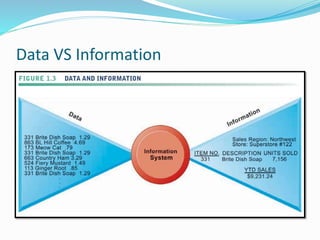
 A brief example contrasting information and data may
prove useful. Supermarket checkout counters scan
millions of pieces of data from bar codes, which
describe each product. Such pieces of data can be
totaled and analyzed to provide meaningful
information, such as the total number of bottles of
dish detergent sold at a particular store, which brands
of dish detergent were selling the most rapidly at that
store or sales territory, or the total amount spent on
that brand of dish detergent at that store or sales
region
Data VS Information
Input, Processing, and Output
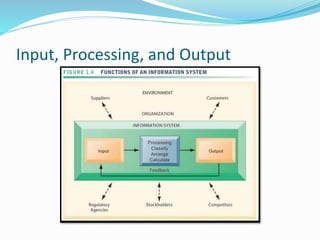
 Three activities in an information system produce the
information that organizations need to make decisions,
control operations, analyze problems, and create new
products or services.
 These activities are input, processing, and output (see
Figure 1.4).
 Input captures or collects raw data from within the
organization or from its external environment.
 Processing converts this raw input into a meaningful
form.
 Output transfers the processed information to the people
who will use it or to the activities for which it will be used.
Input, Processing, and Output
 Information systems also require feedback, which is
output that is returned to appropriate members of the
organization to help them evaluate or correct the input
stage.
Input, Processing, and Output
Example
 In Disney World’s systems for controlling crowds, the
raw input consists of data from airline bookings and
hotel reservations, satellite weather data, historic
attendance data for the date being analyzed, and
images of crowds from video cameras stationed at key
locations throughout the park.
 Computers store these data and process them to
calculate projected total attendance for a specific date
as well as attendance figures and wait times for each
ride and restaurant at various times during the day.
Example Cont…
 The systems indicate which rides or attractions are too
overcrowded, which have spare capacity, and which can
add capacity.
 The system provides meaningful information such as the
number of guests attending on a particular day or time
period, the average wait time per ride, the average number
of restaurant and shop visits, the average number of rides
guests squeezed into a single day’s visit, and the average
amount spent per customer during a specific time period.
Such information helps Disney management gauge the
theme park’s overall efficiency and profitability.
Information Technology
 Information technology (IT) consists of all the hardware and
software that a firm needs to use in order to achieve its business
objectives.
 This includes not only computer machines, storage devices, and
handheld mobile devices, but also software, such as the Windows or
Linux operating systems, the Microsoft Office desktop productivity
suite, and the many thousands of computer programs that can be
found in a typical large firm.
 Thank you

Lecture No 1 & 2.pptx

  • 1.
    Credit Hours: (3+0) Prerequisites:Introduction to Information Technology
  • 2.
    PERSPECTIVES ON INFORMATIONSYSTEMS  What is Information System? An information system can be defined technically as a set of interrelated components that collect (or retrieve), process, store, and distribute information to support decision making and control in an organization. In addition to supporting decision making, coordination, and control, information systems may also help managers and workers analyze problems, visualize complex subjects, and create new products.
  • 3.
    PERSPECTIVES ON INFORMATIONSYSTEMS  Information systems contain information about significant people, places, and things within the organization or in the environment surrounding it. By information we mean data that have been shaped into a form that is meaningful and useful to human beings.
  • 4.
    Data VS Information Data VS Information:  Data: Data is raw, unorganized facts that need to be processed. Data can be something simple and seemingly random.  Information: When data is processed, organized, structured or presented in a given context so as to make it useful, it is called information.
  • 5.
    Example - DataVS Information  A brief example contrasting information and data may prove useful. Supermarket checkout counters scan millions of pieces of data from bar codes, which describe each product. Such pieces of data can be totaled and analyzed to provide meaningful information, such as the total number of bottles of dish detergent sold at a particular store, which brands of dish detergent were selling the most rapidly at that store or sales territory, or the total amount spent on that brand of dish detergent at that store or sales region
  • 6.
  • 7.
    Input, Processing, andOutput  Three activities in an information system produce the information that organizations need to make decisions, control operations, analyze problems, and create new products or services.  These activities are input, processing, and output (see Figure 1.4).  Input captures or collects raw data from within the organization or from its external environment.  Processing converts this raw input into a meaningful form.  Output transfers the processed information to the people who will use it or to the activities for which it will be used.
  • 8.
    Input, Processing, andOutput  Information systems also require feedback, which is output that is returned to appropriate members of the organization to help them evaluate or correct the input stage.
  • 9.
  • 10.
    Example  In DisneyWorld’s systems for controlling crowds, the raw input consists of data from airline bookings and hotel reservations, satellite weather data, historic attendance data for the date being analyzed, and images of crowds from video cameras stationed at key locations throughout the park.  Computers store these data and process them to calculate projected total attendance for a specific date as well as attendance figures and wait times for each ride and restaurant at various times during the day.
  • 11.
    Example Cont…  Thesystems indicate which rides or attractions are too overcrowded, which have spare capacity, and which can add capacity.  The system provides meaningful information such as the number of guests attending on a particular day or time period, the average wait time per ride, the average number of restaurant and shop visits, the average number of rides guests squeezed into a single day’s visit, and the average amount spent per customer during a specific time period. Such information helps Disney management gauge the theme park’s overall efficiency and profitability.
  • 12.
    Information Technology  Informationtechnology (IT) consists of all the hardware and software that a firm needs to use in order to achieve its business objectives.  This includes not only computer machines, storage devices, and handheld mobile devices, but also software, such as the Windows or Linux operating systems, the Microsoft Office desktop productivity suite, and the many thousands of computer programs that can be found in a typical large firm.
  • 13.