ENZYMES
They are protein molecules which are in the cell
It plays the role of a catalyst in chemical reactions
What is a catalyst?
WHAT IS A CATALYST?
It is called a substance that controls the rate of chemical reactions
SO IT IS SAID
In nature, enzymes are specialized proteins that control the rate of chemical reactions
in living organisms.
CHARACTERIZE THE ENZYME
Enzymes have a protein structure. The difference between an enzyme and a non-
enzyme is explained in three points.
Enzymes perform their actions under normal conditions, such as maltose, which converts
maltose sugar into glucose at 37 degrees Celsius, but HCL performs this action at a
very high temperature, that is, high temperature is required.
Enzymes can make only a small group of chemical changes, that is, three different
enzymes are needed to break down the three sugars (glucose, lactose, maltose).
CONT…
Enzymes have the ability to reverse reactions, but non-enzymatic catalysts do not
have this ability, such as carbonic anhydrase, which has the ability to convert water
and carbon dioxide into hydrocarbonic acid and can convert hydrocarbon back into
water and carbon dioxide.
SUBSTRATES?
The material whose speed of reaction is accelerated by enzymes is called Substrate
which remains in the form of products after the reaction
THE CHEMICAL NATURE OF ENZYMES
Enzymes are organic catalysts
It is proteinaceous in nature
Formed on the surface of living cells
Has a high molecular weight
A long chain of amino acids joined together by peptide bonds
Some enzymes require compounds called cofactors for their catabolic activity
CO FACTOR
For the bibliographic activity of some enzymes, it is very important that the effect of
the cofactor on the enzyme is present and causes the catabolic activity of the enzyme.
Cofactors can be organic compounds or chemical ions such as K, Mg, Ca, Mn, Co, Cu,
Fe, Mo.
APO ENZYME + CO FACTOR= HOLO ENZYME
When a cofactor joins an enzyme and forms a common bond, the two are called
holoenzymes
The protein part of Holo enzyme is called Apo enzyme
It is clear here that when the co-factor is combined with the Apo enzyme, then the
Holo enzyme is produced.
SPECIFICITY OF ENZYME
All enzymes have specific properties
Each enzyme has the ability to act on a specific substrate
is divided into different groups based on their characteristics
ENZYME TYPES ACCORDING TO SPECIFICITY
Absolute Specificity enzyme
Group Specificity enzyme
Linkage or bond Specificity enzyme
Stereo chemical Specificity enzyme
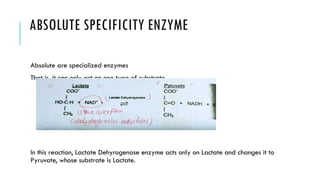
ABSOLUTE SPECIFICITY ENZYME
Absolute are specialized enzymes
That is, it can only act on one type of substrate
In this reaction, Lactate Dehyrogenase enzyme acts only on Lactate and changes it to
Pyruvate, whose substrate is Lactate.
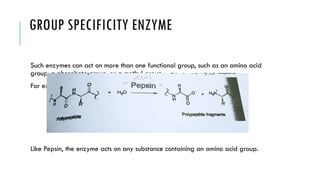
GROUP SPECIFICITY ENZYME
Such enzymes can act on more than one functional group, such as an amino acid
group, a phosphate group, or a methyl group.
For example, page 30 of the chapter
Like Pepsin, the enzyme acts on any substance containing an amino acid group.
LINKAGE OR BOND SPECIFICITY ENZYME
Such enzymes act only on specific chemical bonds, if these chemical bonds are present
in any type of molecule.
That is, the peptidase enzyme acts on the peptide bonds that are in any compound
that these bonds are between amino acids.
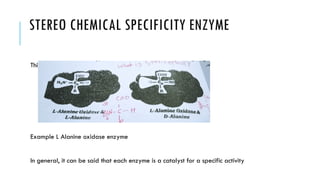
STEREO CHEMICAL SPECIFICITY ENZYME
This type of enzyme acts only on the steric optical isomer.
Example L Alanine oxidase enzyme
In general, it can be said that each enzyme is a catalyst for a specific activity
ASSESSMENT OF THE PAST
Whats the ATP?
ATP is formed as a result of which two important processes?
As a result of which of the following chemical reactions in the cell, AMP is converted to ADP to
ATP?
How much energy is produced when ATP is converted to ADP?
What is the open system?
What is the steady
EVALUATION OF PREVIOUS LESSONS?
Enzyme definition?
What is a cofactor?
How many types of enzymes are there according to their specific properties?
What is the function of an enzyme?
Explain the characteristics of enzymes?
CLASSIFICATION OF ENZYME
A small number of enzymes such as trypsin, chymotrypsin, and pepsin are traditionally
named by adding a suffix to the end of the substrate, for example, the enzyme that
breaks down collagen is called collagenase, and the enzyme that breaks down lipids
is called lipase. Classified by source or by other institutions
In order to better understand enzymes, enzymes have been divided into six major
groups by the International Biochemical Society (IUB).
CLASSIFICATION OF ENZYME
Oxidoreductases:- They are enzymes whose function is oxidation and reduction, i.e.
taking hydrogen electrons from one substance to another.
Transferases:- They are enzymes whose job is to transfer groups from one substance
to another, such as methyl transfer, amino group transfer, etc. Trans aminase, trans
methylase, trans acethylase.
Hydrolases:- They are enzymes that break a molecule at the expense of water, water
is also decomposed and another compound joins the hydrogen of water with one part
and the hydroxyl with the other part. Such as Esterase, Carbohydratease, Nucleuses,
Amidase, Protease.
CLASSIFICATION OF ENZYME
Lyases:- They are enzymes that break molecules of a substance without water and
change them into smaller molecules. They are also called C-C bond makers or
destroyers.
Isomerases:- They are enzymes that convert a single molecule into its isomer, such as
converting glucose to fructose.
Ligases/synthetases:- These are the enzymes that combine two molecules to form a
new molecule such as fatty acid synthase, glycogen synthase
FUNCTION OF ENZYMES
Speeds up chemical reactions.
These activities are inside the cell or outside the cell.
It is necessary to break down the material in the intestines and stomach
Each enzyme acts on the substrate
FACTORS INFLUENCING THE ACTION OF ENZYMES
There are a number of factors that affect enzyme activity
Environmental heat
Ph
Enzyme or substrate concentration
Enzyme and substrate contact with other molecules or substances
Effect of oxidizing agents. Page 166
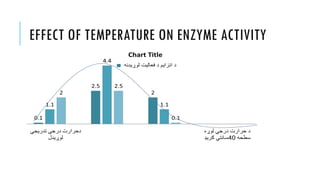
EFFECT OF TEMPERATURE ON ENZYME ACTIVITY
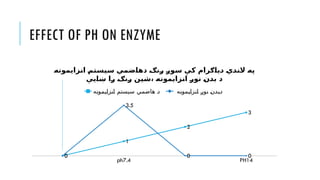
EFFECT OF PH ON ENZYME
ph7.4 PH14
0
1
2
3
0
3.5
0 0
‫انزایمونه‬ ‫سیستم‬ ‫دهاضمي‬ ‫رنګ‬ ‫سور‬ ‫کې‬ ‫دیاګرام‬ ‫الندي‬ ‫په‬
‫ښایې‬ ‫را‬ ‫رنګ‬ ‫شین‬، ‫انزایمونه‬ ‫نور‬ ‫بدن‬ ‫د‬
‫انزایمونه‬ ‫سیستم‬ ‫هاضمي‬ ‫د‬ ‫انزایمونه‬ ‫نور‬ ‫دبدن‬
EFFECT OF SUBSTRATE CONCENTRATION ON
ENZYME ACTIVITY
If the amount of enzyme is constant
If the substrate concentration starts at a low level
If the concentration of the substrate is gradually increased, the rate of reaction
increases as the substrate increases
Finally, a situation is reached where further addition of substrate does not affect the
reaction rate but decreases
ENZYME INHIBITORS
A chemical molecule that inhibits enzyme activity is called a molecule
There are two types of activity
Competitive inhibitors:- These are molecules that bind to the active site of the enzyme
and prevent the binding of the substrate.
Non-competitive: Non-competitive inhibitors are those molecules that do not bind to
the active site or the active site of the enzyme. Prevents connection
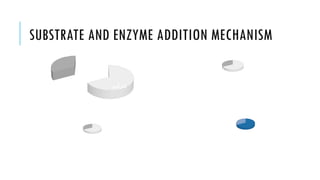
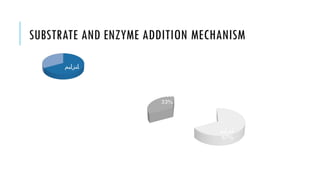
SUBSTRATE AND ENZYME ADDITION MECHANISM
‫انزایم‬
sub
‫انزایم‬
67%
sub
33%
Enzyme and substrate- complex
or
(lock and key)
‫انزایم‬
67%
sub
33%
Enzyme and substrate- complex
‫انزایم‬
product
Enzyme and product- complex
SUBSTRATE AND ENZYME ADDITION MECHANISM
‫انزایم‬
67%
product
33%
+ ‫انزایم‬
‫سبستریټ‬
‫انزایم‬
produ
ct
Enzyme and
product- complex
BRIEF DESCRIPTION
In the past, it was thought that each substrate binds to the active part of the enzyme,
which has already been completely assigned to it.
Now it is also believed that each enzyme does not have an active part for the
substrate, but as a result of combining with the substrate, it creates an active part that
is completely ready for the substrate.
REGULATION OF ENZYME ACTION
Enzymes self-regulate their actions
Many enzymes control their activity by feedback loops of their product.
Some enzymes exist as proenzymes that are activated when needed, such as
pancreatic enzymes.
Changes in protein structure
by enzyme-inhibiting molecules
USING OF ENZYMES
To find the disease
For treatment of disease
To monitor the disease
TO FIND THE DISEASE
Different enzymes are used to detect different diseases, some examples are as
follows
The normal level of amylase enzyme is 80-180 units, and this level increases in acute
inflammation of the pancreas.
Alanine transaminase ALT, SGPT enzyme, which is normally 7-56 units in the blood,
increases in inflammatory diseases of the liver.
Aspartate transaminase AST, SGOT are normally 5-40 units in the blood, the amount
increases in acute inflammatory bowel disease, heart attack, and kidney disease.
TO FIND THE DISEASE
Lactate dehydrogenase:- lactate dehydrogenase is 140-280 units in normal form, its
amount increases in diseases such as heart attack, kidney disease, kidney cancer.
Lipase lipase is normally 10-160 units or less. Its amount increases in pancreatic
inflammation, pancreatic cancer and other diseases.
Acid phosphatase normally has a level of 1, but is elevated in prostate cancer.
Creatine kinase normally has a value of 60-175 units, its value increases in heart
attacks and muscle diseases.
Cholinesterase cholinesterase is normally 8-18 units URI and increases in heart attack.
TO TREAT THE DISEASE
Enzyme is used in the treatment of common problems to deadly diseases.
Digestive system enzymes that are widely available in the market are used for digestion
such as trypsin, chymo trypsin.
Seratio peptidase, an enzyme produced by some bacteria, is used to prevent inflammation.
Streptokinase This enzyme is also made by bacteria and affects the formation of blood
clots inside the veins. It will be used in the treatment of heart attacks or other diseases.
The enzyme called L asparaginase also prevents the combination of the amino acid called
asparagine in the peptide chain, preventing the formation of protein and the growth of
cells. has a role
Thrombin enzyme is also used to prevent bleeding at the site of injury
IN DISEASE SURVEILLANCE
In the detection of diseases, we have learned that the level of enzymes in the blood is
constant, if the level increases, it causes disease.
For example, if a person has a bone disease, we follow the level of alkaline
phosphatase enzyme, if it is more than the standard amount, the patient needs to be
treated.

Lecture ENZYME for first semester student only.pptx

  • 1.
    ENZYMES They are proteinmolecules which are in the cell It plays the role of a catalyst in chemical reactions What is a catalyst?
  • 2.
    WHAT IS ACATALYST? It is called a substance that controls the rate of chemical reactions
  • 3.
    SO IT ISSAID In nature, enzymes are specialized proteins that control the rate of chemical reactions in living organisms.
  • 4.
    CHARACTERIZE THE ENZYME Enzymeshave a protein structure. The difference between an enzyme and a non- enzyme is explained in three points. Enzymes perform their actions under normal conditions, such as maltose, which converts maltose sugar into glucose at 37 degrees Celsius, but HCL performs this action at a very high temperature, that is, high temperature is required. Enzymes can make only a small group of chemical changes, that is, three different enzymes are needed to break down the three sugars (glucose, lactose, maltose).
  • 5.
    CONT… Enzymes have theability to reverse reactions, but non-enzymatic catalysts do not have this ability, such as carbonic anhydrase, which has the ability to convert water and carbon dioxide into hydrocarbonic acid and can convert hydrocarbon back into water and carbon dioxide.
  • 6.
    SUBSTRATES? The material whosespeed of reaction is accelerated by enzymes is called Substrate which remains in the form of products after the reaction
  • 7.
    THE CHEMICAL NATUREOF ENZYMES Enzymes are organic catalysts It is proteinaceous in nature Formed on the surface of living cells Has a high molecular weight A long chain of amino acids joined together by peptide bonds Some enzymes require compounds called cofactors for their catabolic activity
  • 8.
    CO FACTOR For thebibliographic activity of some enzymes, it is very important that the effect of the cofactor on the enzyme is present and causes the catabolic activity of the enzyme. Cofactors can be organic compounds or chemical ions such as K, Mg, Ca, Mn, Co, Cu, Fe, Mo.
  • 9.
    APO ENZYME +CO FACTOR= HOLO ENZYME When a cofactor joins an enzyme and forms a common bond, the two are called holoenzymes The protein part of Holo enzyme is called Apo enzyme It is clear here that when the co-factor is combined with the Apo enzyme, then the Holo enzyme is produced.
  • 10.
    SPECIFICITY OF ENZYME Allenzymes have specific properties Each enzyme has the ability to act on a specific substrate is divided into different groups based on their characteristics
  • 11.
    ENZYME TYPES ACCORDINGTO SPECIFICITY Absolute Specificity enzyme Group Specificity enzyme Linkage or bond Specificity enzyme Stereo chemical Specificity enzyme
  • 12.
    ABSOLUTE SPECIFICITY ENZYME Absoluteare specialized enzymes That is, it can only act on one type of substrate In this reaction, Lactate Dehyrogenase enzyme acts only on Lactate and changes it to Pyruvate, whose substrate is Lactate.
  • 13.
    GROUP SPECIFICITY ENZYME Suchenzymes can act on more than one functional group, such as an amino acid group, a phosphate group, or a methyl group. For example, page 30 of the chapter Like Pepsin, the enzyme acts on any substance containing an amino acid group.
  • 14.
    LINKAGE OR BONDSPECIFICITY ENZYME Such enzymes act only on specific chemical bonds, if these chemical bonds are present in any type of molecule. That is, the peptidase enzyme acts on the peptide bonds that are in any compound that these bonds are between amino acids.
  • 15.
    STEREO CHEMICAL SPECIFICITYENZYME This type of enzyme acts only on the steric optical isomer. Example L Alanine oxidase enzyme In general, it can be said that each enzyme is a catalyst for a specific activity
  • 16.
    ASSESSMENT OF THEPAST Whats the ATP? ATP is formed as a result of which two important processes? As a result of which of the following chemical reactions in the cell, AMP is converted to ADP to ATP? How much energy is produced when ATP is converted to ADP? What is the open system? What is the steady
  • 17.
    EVALUATION OF PREVIOUSLESSONS? Enzyme definition? What is a cofactor? How many types of enzymes are there according to their specific properties? What is the function of an enzyme? Explain the characteristics of enzymes?
  • 18.
    CLASSIFICATION OF ENZYME Asmall number of enzymes such as trypsin, chymotrypsin, and pepsin are traditionally named by adding a suffix to the end of the substrate, for example, the enzyme that breaks down collagen is called collagenase, and the enzyme that breaks down lipids is called lipase. Classified by source or by other institutions In order to better understand enzymes, enzymes have been divided into six major groups by the International Biochemical Society (IUB).
  • 19.
    CLASSIFICATION OF ENZYME Oxidoreductases:-They are enzymes whose function is oxidation and reduction, i.e. taking hydrogen electrons from one substance to another. Transferases:- They are enzymes whose job is to transfer groups from one substance to another, such as methyl transfer, amino group transfer, etc. Trans aminase, trans methylase, trans acethylase. Hydrolases:- They are enzymes that break a molecule at the expense of water, water is also decomposed and another compound joins the hydrogen of water with one part and the hydroxyl with the other part. Such as Esterase, Carbohydratease, Nucleuses, Amidase, Protease.
  • 20.
    CLASSIFICATION OF ENZYME Lyases:-They are enzymes that break molecules of a substance without water and change them into smaller molecules. They are also called C-C bond makers or destroyers. Isomerases:- They are enzymes that convert a single molecule into its isomer, such as converting glucose to fructose. Ligases/synthetases:- These are the enzymes that combine two molecules to form a new molecule such as fatty acid synthase, glycogen synthase
  • 21.
    FUNCTION OF ENZYMES Speedsup chemical reactions. These activities are inside the cell or outside the cell. It is necessary to break down the material in the intestines and stomach Each enzyme acts on the substrate
  • 22.
    FACTORS INFLUENCING THEACTION OF ENZYMES There are a number of factors that affect enzyme activity Environmental heat Ph Enzyme or substrate concentration Enzyme and substrate contact with other molecules or substances Effect of oxidizing agents. Page 166
  • 23.
    EFFECT OF TEMPERATUREON ENZYME ACTIVITY
  • 24.
    EFFECT OF PHON ENZYME ph7.4 PH14 0 1 2 3 0 3.5 0 0 ‫انزایمونه‬ ‫سیستم‬ ‫دهاضمي‬ ‫رنګ‬ ‫سور‬ ‫کې‬ ‫دیاګرام‬ ‫الندي‬ ‫په‬ ‫ښایې‬ ‫را‬ ‫رنګ‬ ‫شین‬، ‫انزایمونه‬ ‫نور‬ ‫بدن‬ ‫د‬ ‫انزایمونه‬ ‫سیستم‬ ‫هاضمي‬ ‫د‬ ‫انزایمونه‬ ‫نور‬ ‫دبدن‬
  • 25.
    EFFECT OF SUBSTRATECONCENTRATION ON ENZYME ACTIVITY If the amount of enzyme is constant If the substrate concentration starts at a low level If the concentration of the substrate is gradually increased, the rate of reaction increases as the substrate increases Finally, a situation is reached where further addition of substrate does not affect the reaction rate but decreases
  • 26.
    ENZYME INHIBITORS A chemicalmolecule that inhibits enzyme activity is called a molecule There are two types of activity Competitive inhibitors:- These are molecules that bind to the active site of the enzyme and prevent the binding of the substrate. Non-competitive: Non-competitive inhibitors are those molecules that do not bind to the active site or the active site of the enzyme. Prevents connection
  • 27.
    SUBSTRATE AND ENZYMEADDITION MECHANISM ‫انزایم‬ sub ‫انزایم‬ 67% sub 33% Enzyme and substrate- complex or (lock and key) ‫انزایم‬ 67% sub 33% Enzyme and substrate- complex ‫انزایم‬ product Enzyme and product- complex
  • 28.
    SUBSTRATE AND ENZYMEADDITION MECHANISM ‫انزایم‬ 67% product 33% + ‫انزایم‬ ‫سبستریټ‬ ‫انزایم‬ produ ct Enzyme and product- complex
  • 29.
    BRIEF DESCRIPTION In thepast, it was thought that each substrate binds to the active part of the enzyme, which has already been completely assigned to it. Now it is also believed that each enzyme does not have an active part for the substrate, but as a result of combining with the substrate, it creates an active part that is completely ready for the substrate.
  • 30.
    REGULATION OF ENZYMEACTION Enzymes self-regulate their actions Many enzymes control their activity by feedback loops of their product. Some enzymes exist as proenzymes that are activated when needed, such as pancreatic enzymes. Changes in protein structure by enzyme-inhibiting molecules
  • 31.
    USING OF ENZYMES Tofind the disease For treatment of disease To monitor the disease
  • 32.
    TO FIND THEDISEASE Different enzymes are used to detect different diseases, some examples are as follows The normal level of amylase enzyme is 80-180 units, and this level increases in acute inflammation of the pancreas. Alanine transaminase ALT, SGPT enzyme, which is normally 7-56 units in the blood, increases in inflammatory diseases of the liver. Aspartate transaminase AST, SGOT are normally 5-40 units in the blood, the amount increases in acute inflammatory bowel disease, heart attack, and kidney disease.
  • 33.
    TO FIND THEDISEASE Lactate dehydrogenase:- lactate dehydrogenase is 140-280 units in normal form, its amount increases in diseases such as heart attack, kidney disease, kidney cancer. Lipase lipase is normally 10-160 units or less. Its amount increases in pancreatic inflammation, pancreatic cancer and other diseases. Acid phosphatase normally has a level of 1, but is elevated in prostate cancer. Creatine kinase normally has a value of 60-175 units, its value increases in heart attacks and muscle diseases. Cholinesterase cholinesterase is normally 8-18 units URI and increases in heart attack.
  • 34.
    TO TREAT THEDISEASE Enzyme is used in the treatment of common problems to deadly diseases. Digestive system enzymes that are widely available in the market are used for digestion such as trypsin, chymo trypsin. Seratio peptidase, an enzyme produced by some bacteria, is used to prevent inflammation. Streptokinase This enzyme is also made by bacteria and affects the formation of blood clots inside the veins. It will be used in the treatment of heart attacks or other diseases. The enzyme called L asparaginase also prevents the combination of the amino acid called asparagine in the peptide chain, preventing the formation of protein and the growth of cells. has a role Thrombin enzyme is also used to prevent bleeding at the site of injury
  • 35.
    IN DISEASE SURVEILLANCE Inthe detection of diseases, we have learned that the level of enzymes in the blood is constant, if the level increases, it causes disease. For example, if a person has a bone disease, we follow the level of alkaline phosphatase enzyme, if it is more than the standard amount, the patient needs to be treated.