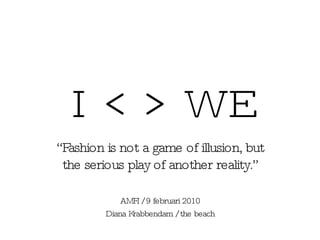
I  < > WE “ Fashion is not a game of illusion, but the serious play of another reality.” AMFI / 9 februari 2010 Diana Krabbendam / the beach
What kind of reality do we want it to be?
“ Fashion is not something that exists in dresses only. Fashion is in the sky, in the street, fashion has to do with ideas, the way we live, what is happening.” Coco Chanel
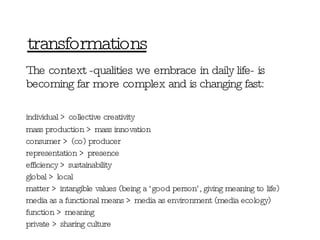
transformations The context - qualities we embrace in daily life-  is becoming far more complex and is changing fast: individual > collective creativity mass production > mass innovation consumer > (co) producer representation > presence efficiency > sustainability global > local matter > intangible values (being a ‘good person’, giving meaning to life) media as a functional means > media as environment (media ecology) function > meaning private > sharing culture
 
“ In the economy of things you are identified by what you own -your landhouse, car. In the economy of ideas that the web is creating,  you are what you share  -who you are linked to, who you network with and which ideas, pictures, videos, links, or comments you share.” Charles Leadbeater, 2008
What do you have to offer? What position do you take?
Position 1 “ We can’t change the fastness of our industry. The industry is so big, you can’t change the machine. It’s going to take a lot of time.” Anne Chapelle, ...a moment in...
...a moment in...  No egos, no designer names just products. The price points are similar to the designer labels. The knits are all hand made.
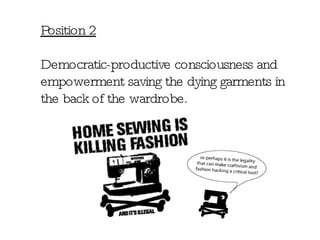
Position 2 Democratic-productive consciousness and empowerment saving the dying garments in the back of the wardrobe.
Position 3 Hello Fashion  of   Monique van Heist came out of her frustration with manic pace. “Designers are creating more and more collections, and I'm thinking: Who's going to wear all these garments?” From the collection each piece will remain available. “There's a lot of beauty in fashion, and we shouldn't throw it away.”
Position 4 Very rarely does theory approach the emancipatory, magical, extravagant, or luminous sides of fashion. The aim of VakkoVamps is to probe the connections and interfaces between the critical standpoint and the glamorous shimmer of high fashion and act as a negotiating bridge between these two worlds.  A ‘sell-out’ to the system? (since it is taking fashion as a serious partner)
Position 5 Throughout history, fashion has been a way to portray social values and political ideas. Fashion has been used to address many important topics, such as feminism, nationalism and other cultural movements significant to the identity of citizens.
We come to meet fashion codes every day through the magical process where we come to believe that a piece of clothing is fashion.  What is that code?  Where is it influenced by? What impact has it?
What / how can fashion professionals contribute?

lecture diana krabbendam

  • 1.
    I <> WE “ Fashion is not a game of illusion, but the serious play of another reality.” AMFI / 9 februari 2010 Diana Krabbendam / the beach
  • 2.
    What kind ofreality do we want it to be?
  • 3.
    “ Fashion isnot something that exists in dresses only. Fashion is in the sky, in the street, fashion has to do with ideas, the way we live, what is happening.” Coco Chanel
  • 4.
    transformations The context- qualities we embrace in daily life- is becoming far more complex and is changing fast: individual > collective creativity mass production > mass innovation consumer > (co) producer representation > presence efficiency > sustainability global > local matter > intangible values (being a ‘good person’, giving meaning to life) media as a functional means > media as environment (media ecology) function > meaning private > sharing culture
  • 5.
  • 6.
    “ In theeconomy of things you are identified by what you own -your landhouse, car. In the economy of ideas that the web is creating, you are what you share -who you are linked to, who you network with and which ideas, pictures, videos, links, or comments you share.” Charles Leadbeater, 2008
  • 7.
    What do youhave to offer? What position do you take?
  • 8.
    Position 1 “We can’t change the fastness of our industry. The industry is so big, you can’t change the machine. It’s going to take a lot of time.” Anne Chapelle, ...a moment in...
  • 9.
    ...a moment in... No egos, no designer names just products. The price points are similar to the designer labels. The knits are all hand made.
  • 10.
    Position 2 Democratic-productiveconsciousness and empowerment saving the dying garments in the back of the wardrobe.
  • 11.
    Position 3 HelloFashion of Monique van Heist came out of her frustration with manic pace. “Designers are creating more and more collections, and I'm thinking: Who's going to wear all these garments?” From the collection each piece will remain available. “There's a lot of beauty in fashion, and we shouldn't throw it away.”
  • 12.
    Position 4 Veryrarely does theory approach the emancipatory, magical, extravagant, or luminous sides of fashion. The aim of VakkoVamps is to probe the connections and interfaces between the critical standpoint and the glamorous shimmer of high fashion and act as a negotiating bridge between these two worlds. A ‘sell-out’ to the system? (since it is taking fashion as a serious partner)
  • 13.
    Position 5 Throughouthistory, fashion has been a way to portray social values and political ideas. Fashion has been used to address many important topics, such as feminism, nationalism and other cultural movements significant to the identity of citizens.
  • 14.
    We come tomeet fashion codes every day through the magical process where we come to believe that a piece of clothing is fashion. What is that code? Where is it influenced by? What impact has it?
  • 15.
    What / howcan fashion professionals contribute?