Technology, Innovation, and Great
Power Competition
INTLPOL 340; MS&E 296
Steve Blank, Joe Felter, Raj Shah
Lecture #5: Artificial Intelligence
19 October 2021
Agenda
• Logistics
• Identifying and Deploying Defense Technologies for
Great Power Competition
• Global AI Arms Race and GPC
• Team Problem Statements
Logistics
• November 2 class rescheduled. Now Monday, November 1
at 5:30 - 8:30 PM (normal time)
• Individual Assignments due by the start of Nov. 1 class
• By next OH, teams should be focused on the problem
they would like to solve
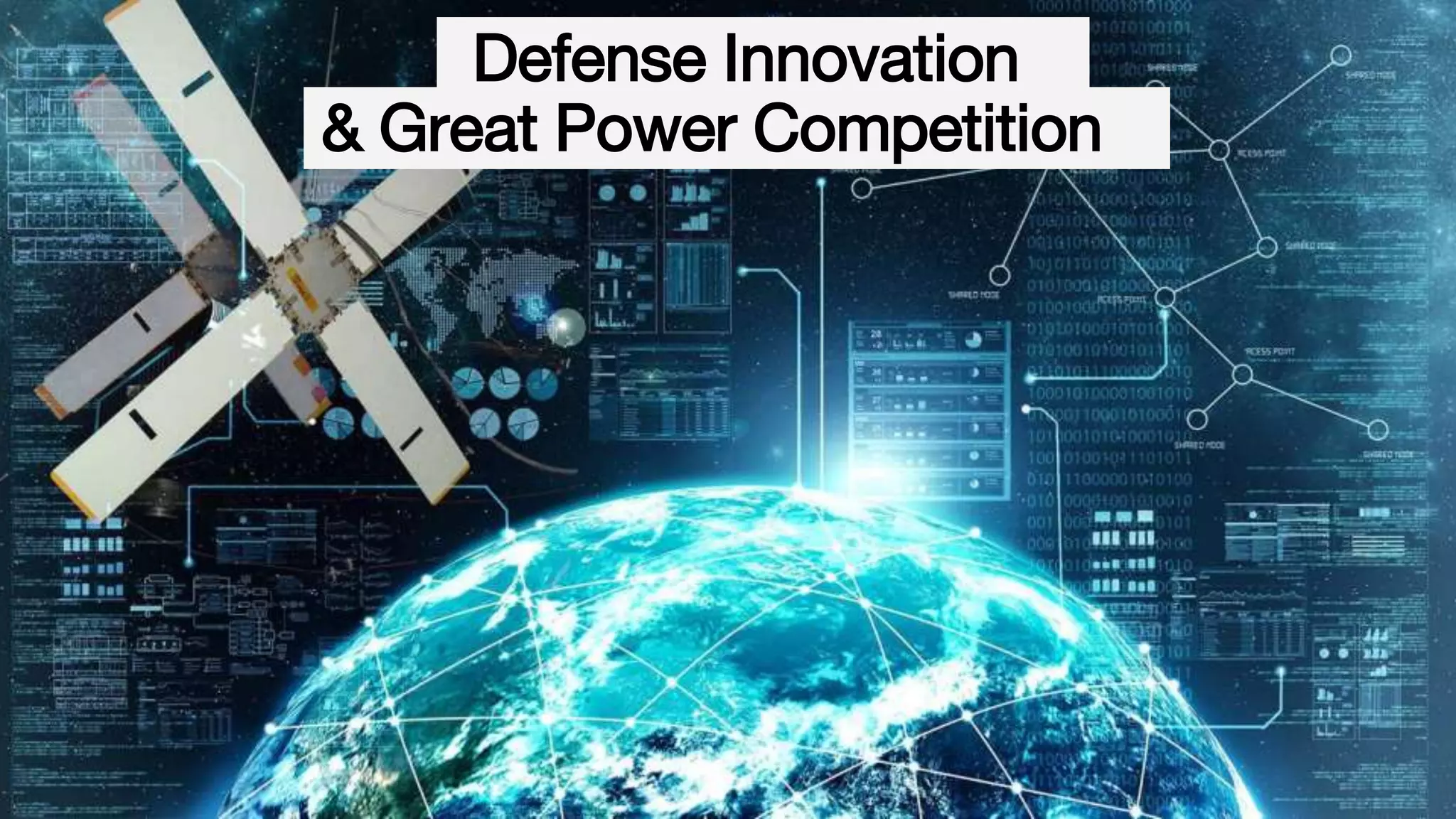
Defense Innovation
& Great Power Competition x
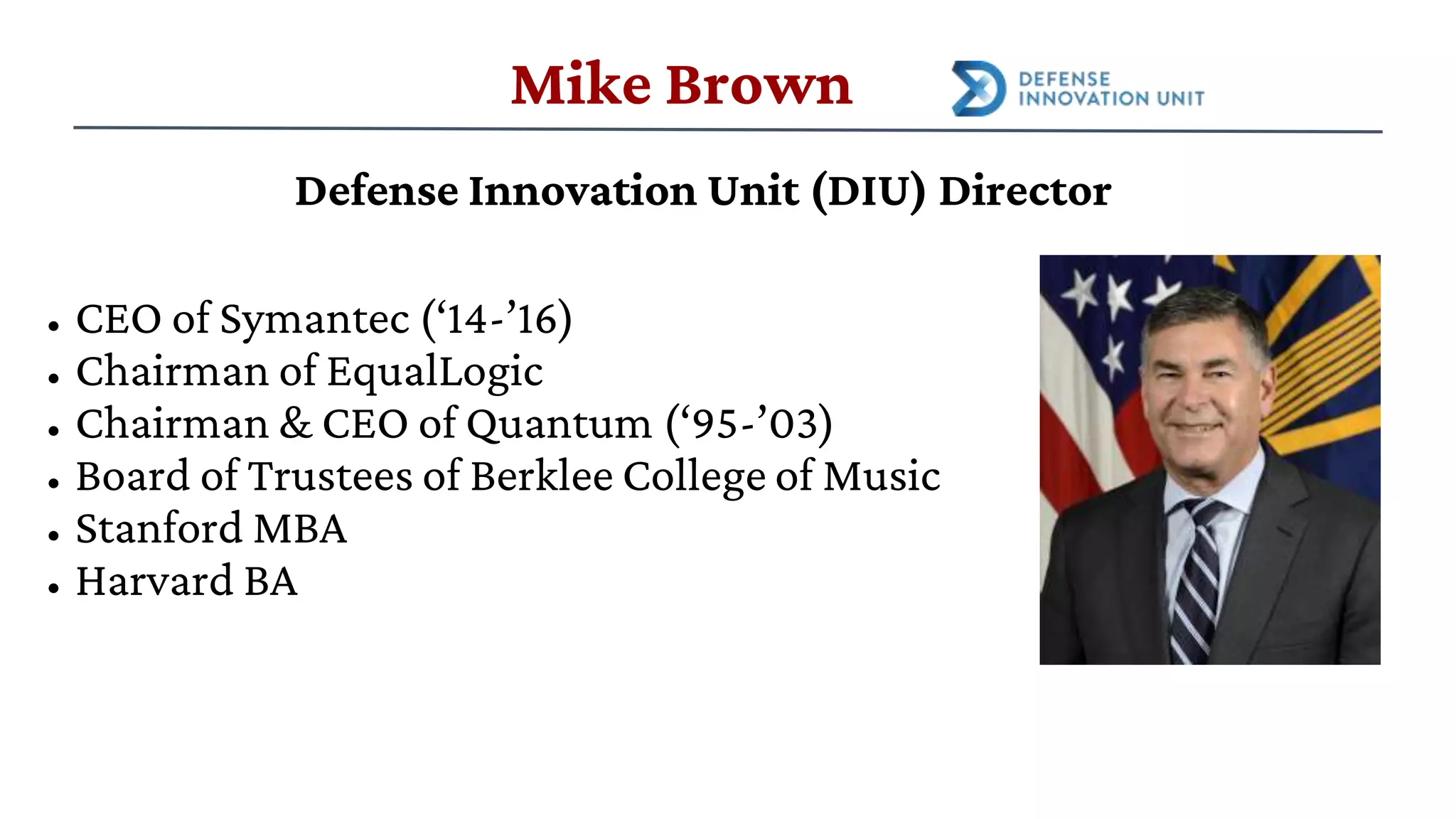
Defense Innovation Unit (DIU) Director
• CEO of Symantec (‘14-’16)
• Chairman of EqualLogic
• Chairman & CEO of Quantum (‘95-’03)
• Board of Trustees of Berklee College of Music
• Stanford MBA
• Harvard BA
Mike Brown
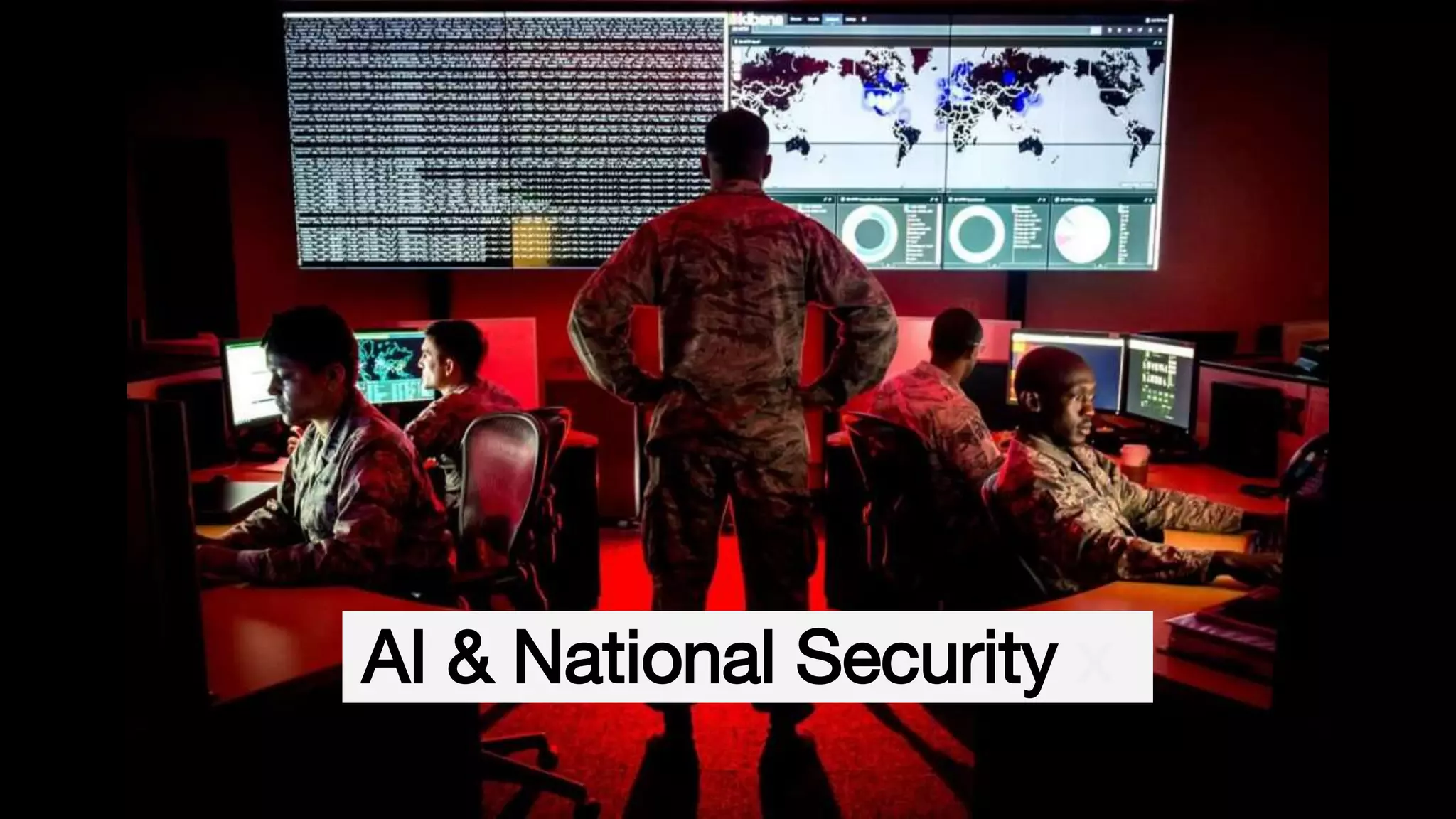
AI & National Security x
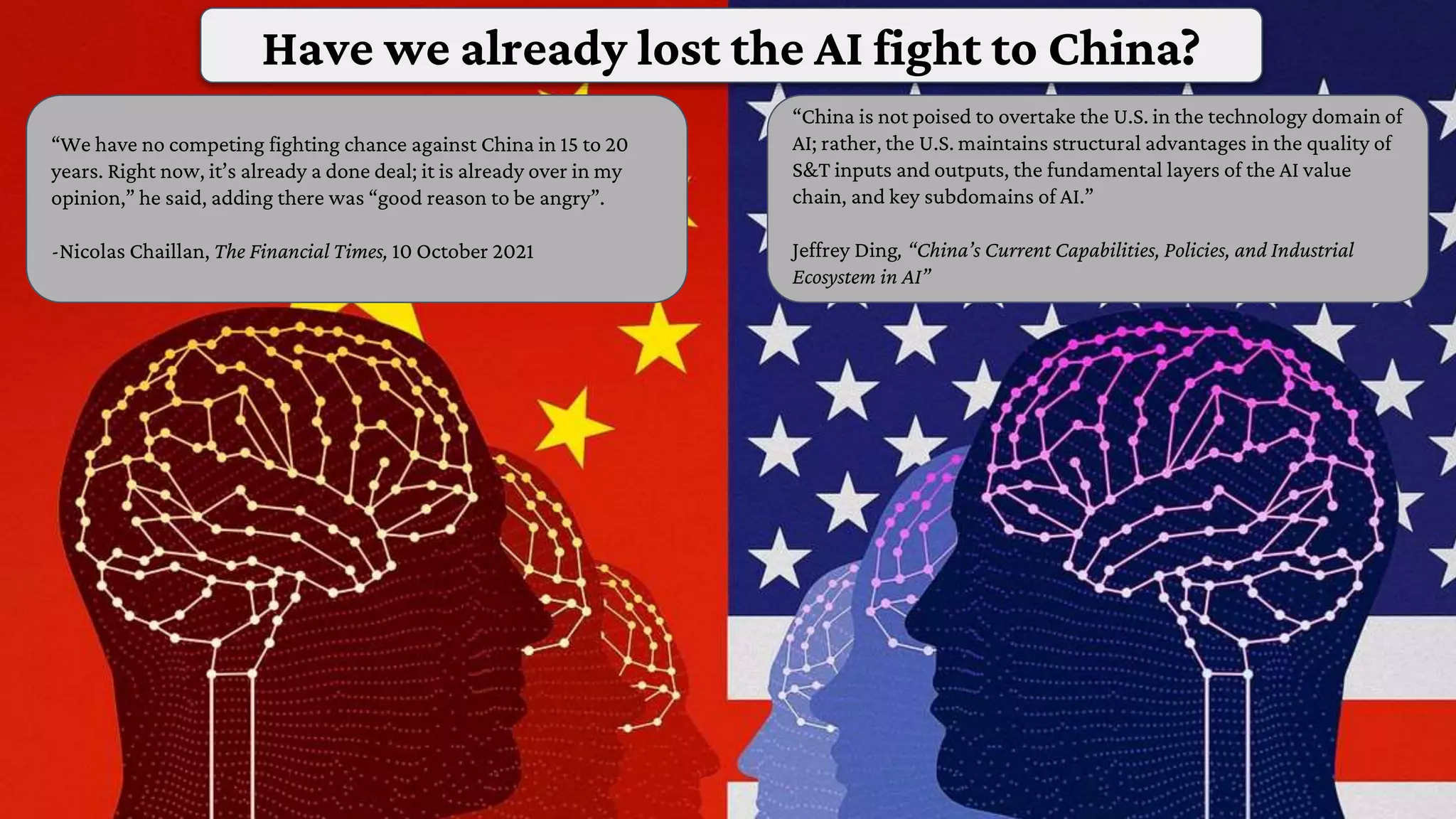
“We have no competing fighting chance against China in 15 to 20
years. Right now, it’s already a done deal; it is already over in my
opinion,” he said, adding there was “good reason to be angry”.
-Nicolas Chaillan, The Financial Times, 10 October 2021
“China is not poised to overtake the U.S. in the technology domain of
AI; rather, the U.S. maintains structural advantages in the quality of
S&T inputs and outputs, the fundamental layers of the AI value
chain, and key subdomains of AI.”
Jeffrey Ding, “China’s Current Capabilities, Policies, and Industrial
Ecosystem in AI”
Have we already lost the AI fight to China?
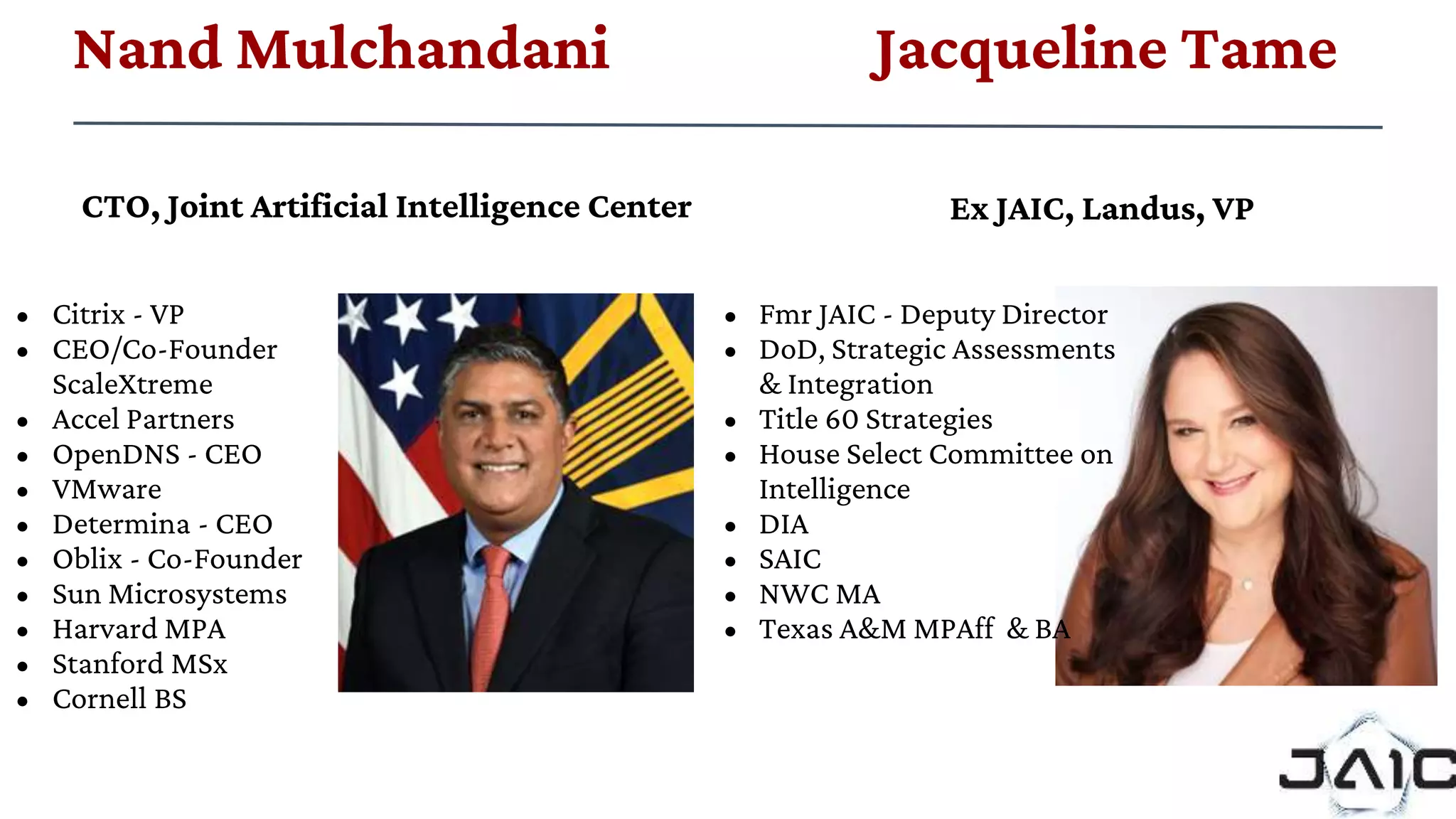
• Citrix - VP
• CEO/Co-Founder
ScaleXtreme
• Accel Partners
• OpenDNS - CEO
• VMware
• Determina - CEO
• Oblix - Co-Founder
• Sun Microsystems
• Harvard MPA
• Stanford MSx
• Cornell BS
Ex JAIC, Landus, VP
• Fmr JAIC - Deputy Director
• DoD, Strategic Assessments
& Integration
• Title 60 Strategies
• House Select Committee on
Intelligence
• DIA
• SAIC
• NWC MA
• Texas A&M MPAff & BA
CTO, Joint Artificial Intelligence Center
Nand Mulchandani Jacqueline Tame
AI and Great Power Competition
“Artificial intelligence is the
future, not only for Russia, but for
all humankind. It comes with
colossal opportunities, but also
threats that are difficult to
predict. Whoever becomes the
leader in this sphere will become
the ruler of the world.”
The Geopolitical Implications of AI
“As new technologies continue to
evolve, we’ll work together with our
Democratic partners to ensure that
new advances in areas from
biotechnology to quantum computing,
5G, artificial intelligence and more are
used to lift people up, to solve
problems and advance human
freedom, not to suppress dissent or
target minority communities.”
“[The PRC] must ensure that our
country marches in the front ranks
where it comes to theoretical research
in this important area of AI, and
occupies the high ground in critical
and AI core technologies...critical and
core AI technologies [must be] firmly
grasped in our own hands.”
How will AI affect: [D]iplomacy
Deep fake technology Collaborative big data
solutions
How will AI affect: [I]ntelligence
Computer Vision + Satellite Images Empowered hacking & cyber security
How will AI affect: [M]ilitary
Joint All Domain Command & Control (JADC2) AI/ML improved targeting
How will AI affect: [E]conomics
Smart / Predictive Manufacturing &
Maintenance
Improving logistical efficiency
● How would you characterize the
strengths and weaknesses of the U.S.’s AI
Strategy?
● How would you advise the Biden
Administration to pursue an AI Strategy?
Group Projects
Group Project
• Problem Statement Review and Feedback
• 5 minutes per group
• Blunt and direct feedback
• “Socratic method with a stick” - Steve Blank
• We give feedback this way because it will help you move faster;
indirect feedback takes too long for the course
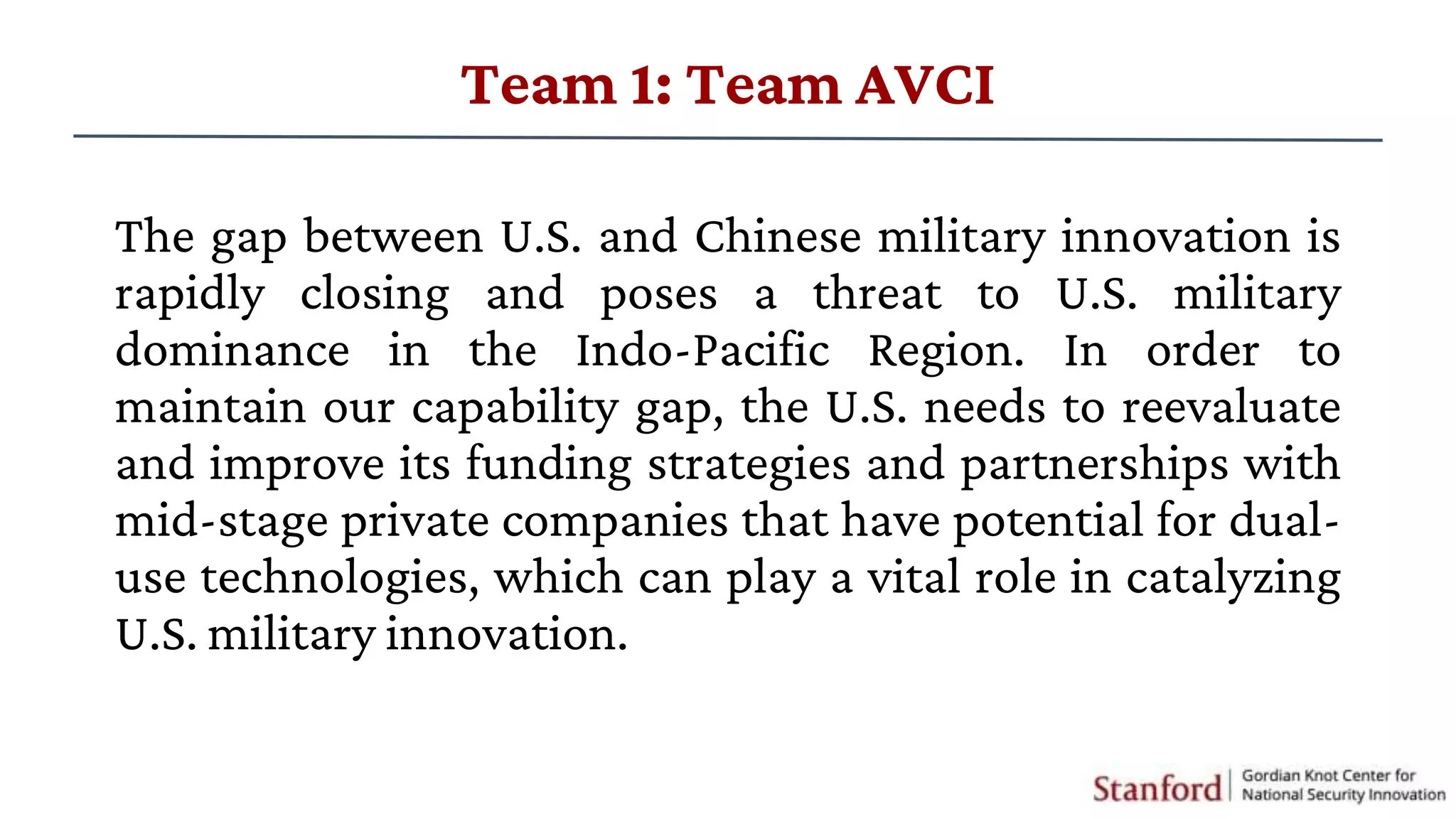
The gap between U.S. and Chinese military innovation is
rapidly closing and poses a threat to U.S. military
dominance in the Indo-Pacific Region. In order to
maintain our capability gap, the U.S. needs to reevaluate
and improve its funding strategies and partnerships with
mid-stage private companies that have potential for dual-
use technologies, which can play a vital role in catalyzing
U.S. military innovation.
Team 1: Team AVCI
Chinese investment in US start-ups poses a threat to US
military capabilities across critical technologies. The
greatest threats to DOD military advantage in AI/ML are
from forced JVs or possible trade secret theft, either
through direct investment or LP investment. However, it is
unclear how widespread of a phenomenon these two
threat scenarios are due to the open nature and lack of
transparency in venture capital.
Team 2: Team Conflicted Capital
Hong Kong presents a unique opportunity to support activists
currently attempting to maintain democratic institutions inside the
PRC. The US can amplify its soft power by supporting these activists
through facilitating free information access and secure
communication channels outside the control of the CCP security
apparatus. The US should also pursue opportunities to support pro-
democracy activists through their execution of protests,
unsanctioned expression, and other mobilization activities. The US
should explore this through application of cyber policy, encouraging
changes to tech companies’ international policies, and security /
technical support to activists.
Team 3: Project Aurora
How should the United States best prepare for the
upcoming paradigm shift in the semiconductor industry
through reimagined education and more effective funding
to protect the American leadership in the global supply
chain of semiconductors?
Team 4: Team ShortCircuit
Team Drone analyzes the People’s Republic of China's
(PRC) joint service (联合作战样式) operational concept
for the future of drone swarm support to amphibious
warfare (两栖登陆作战), Taiwan’s current Overall
Defense Concept (ODC) at the intersection of Counter
Small Unmanned Aircraft Systems (C-sUAS), and
emerging US swarm defense tech in conjunction with the
DoD's official "C-sUAS Strategy," in order to protect
against asymmetric PRC's swarm technologies in a
potential Taiwan Strait crisis.
Team 5: Team Drones
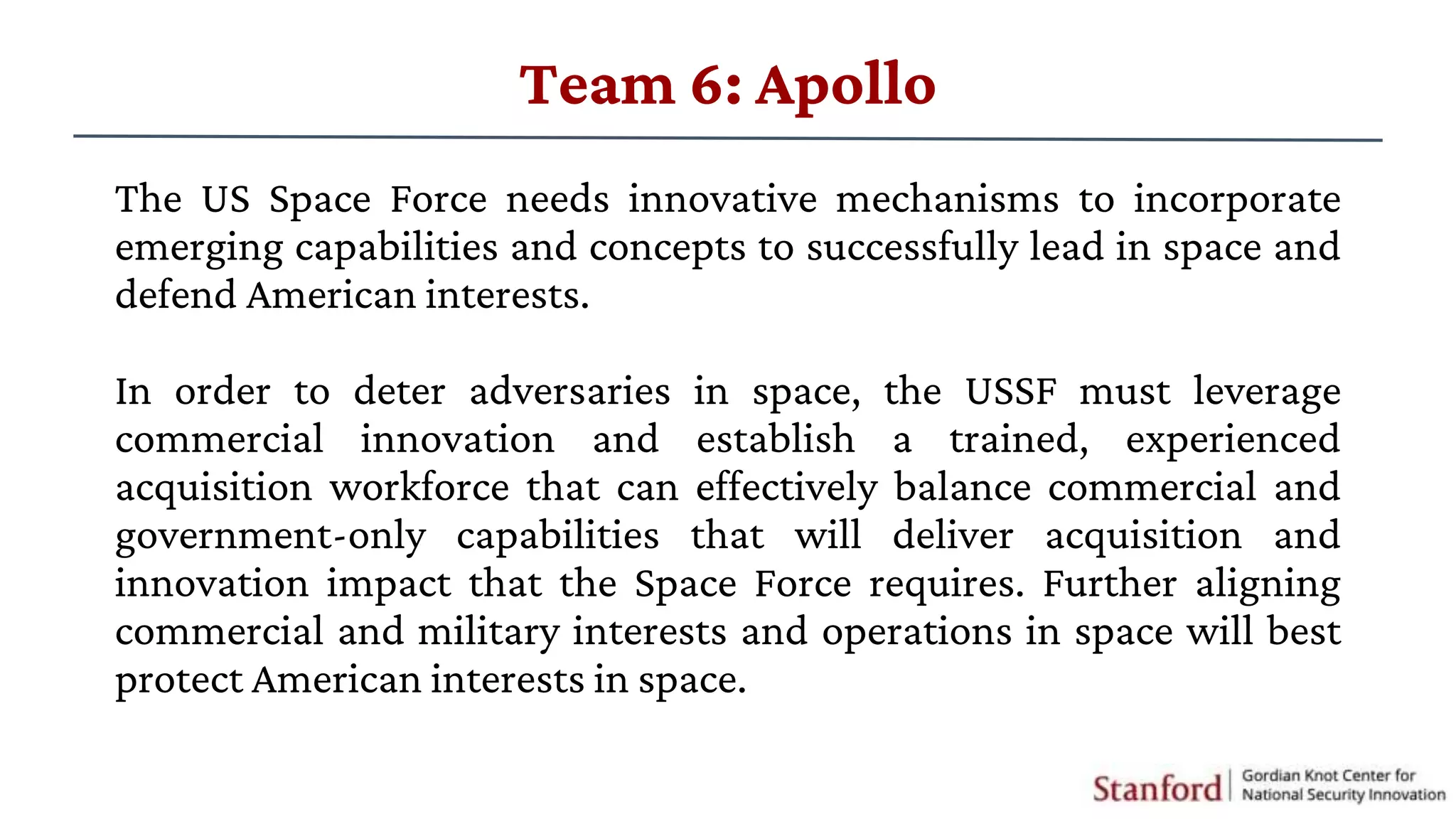
The US Space Force needs innovative mechanisms to incorporate
emerging capabilities and concepts to successfully lead in space and
defend American interests.
In order to deter adversaries in space, the USSF must leverage
commercial innovation and establish a trained, experienced
acquisition workforce that can effectively balance commercial and
government-only capabilities that will deliver acquisition and
innovation impact that the Space Force requires. Further aligning
commercial and military interests and operations in space will best
protect American interests in space.
Team 6: Apollo
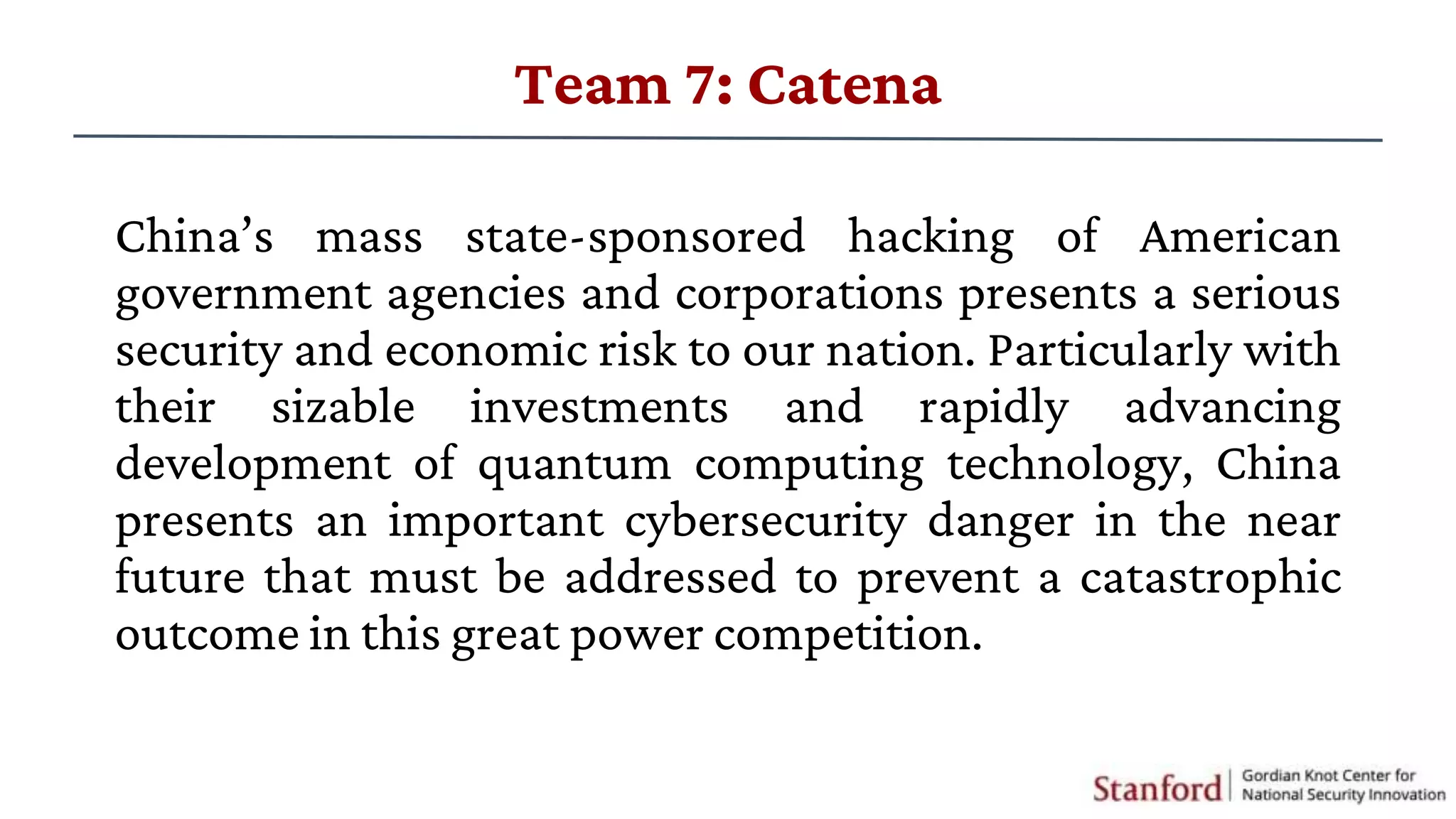
China’s mass state-sponsored hacking of American
government agencies and corporations presents a serious
security and economic risk to our nation. Particularly with
their sizable investments and rapidly advancing
development of quantum computing technology, China
presents an important cybersecurity danger in the near
future that must be addressed to prevent a catastrophic
outcome in this great power competition.
Team 7: Catena
Questions?
We are here to support!
Reach out to teaching team with questions!
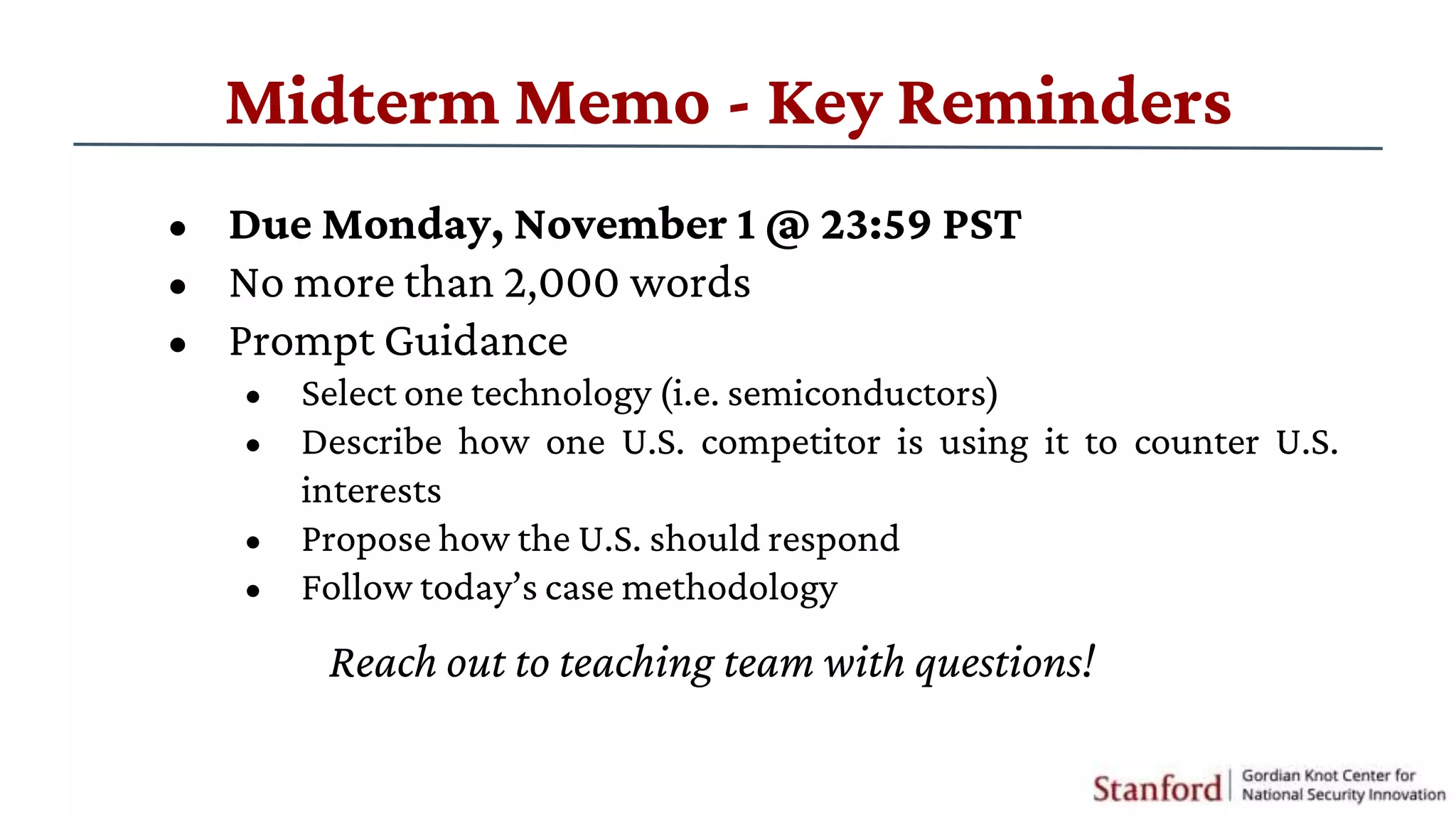
Midterm Memo - Key Reminders
• Due Monday, November 1 @ 23:59 PST
• No more than 2,000 words
• Prompt Guidance
• Select one technology (i.e. semiconductors)
• Describe how one U.S. competitor is using it to counter U.S.
interests
• Propose how the U.S. should respond
• Follow today’s case methodology
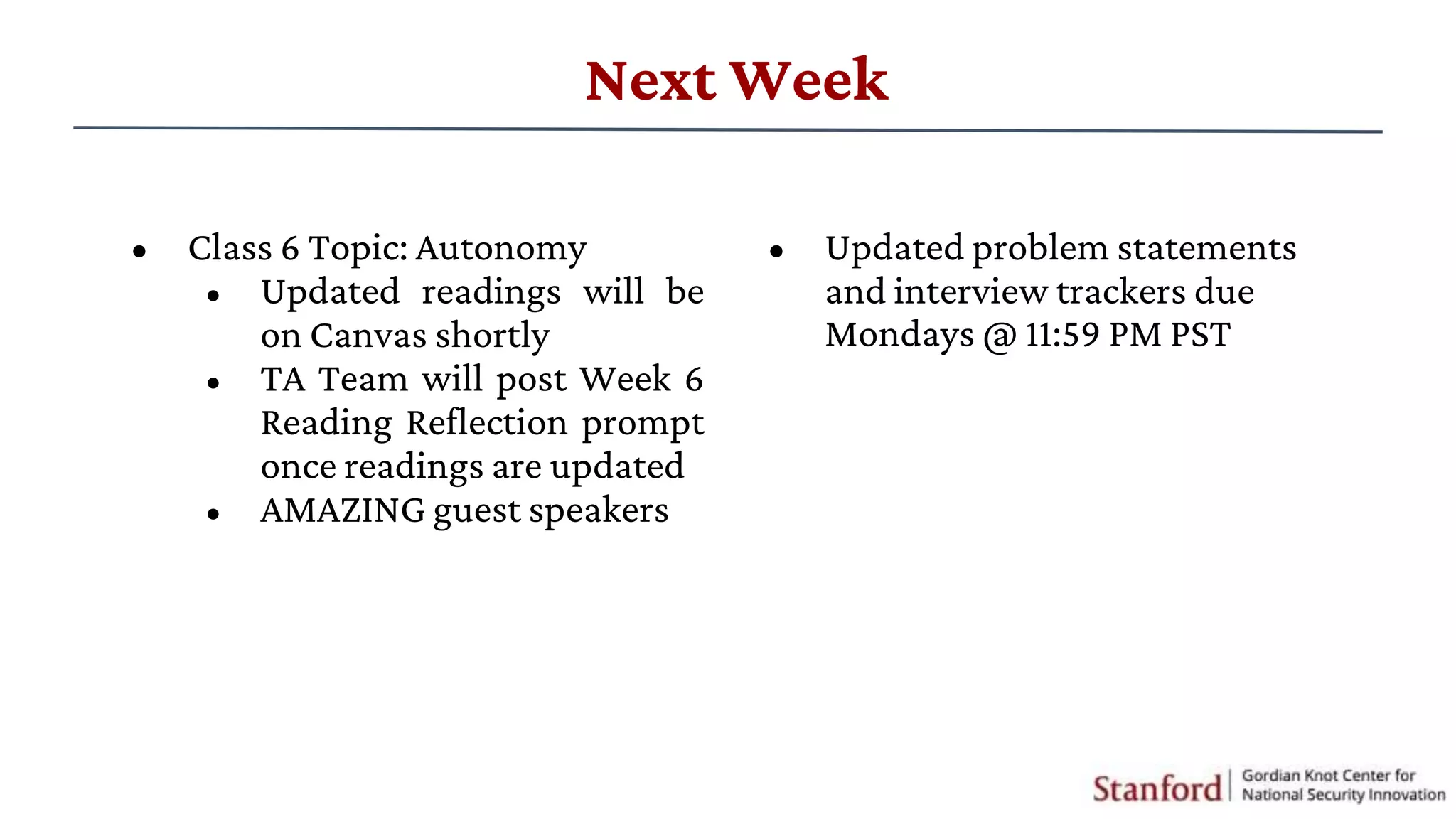
Next Week
• Class 6 Topic: Autonomy
• Updated readings will be
on Canvas shortly
• TA Team will post Week 6
Reading Reflection prompt
once readings are updated
• AMAZING guest speakers
• Updated problem statements
and interview trackers due
Mondays @ 11:59 PM PST
Technology, Innovation, and Great
Power Competition
INTLPOL 340; MS&E 296
Steve Blank, Joe Felter, Raj Shah
Lecture #5: Artificial Intelligence
19 October 2021
● How would you characterize the
strengths and weaknesses of China’s AI
Strategy?
● Do you agree more with Kai-Fu Lee or
Jeffrey Ding’s analysis? Why?

Lecture 5- Technology, Innovation and Great Power Competition

  • 1.
    Technology, Innovation, andGreat Power Competition INTLPOL 340; MS&E 296 Steve Blank, Joe Felter, Raj Shah Lecture #5: Artificial Intelligence 19 October 2021
  • 2.
    Agenda • Logistics • Identifyingand Deploying Defense Technologies for Great Power Competition • Global AI Arms Race and GPC • Team Problem Statements
  • 3.
    Logistics • November 2class rescheduled. Now Monday, November 1 at 5:30 - 8:30 PM (normal time) • Individual Assignments due by the start of Nov. 1 class • By next OH, teams should be focused on the problem they would like to solve
  • 4.
    Defense Innovation & GreatPower Competition x
  • 5.
    Defense Innovation Unit(DIU) Director • CEO of Symantec (‘14-’16) • Chairman of EqualLogic • Chairman & CEO of Quantum (‘95-’03) • Board of Trustees of Berklee College of Music • Stanford MBA • Harvard BA Mike Brown
  • 6.
    AI & NationalSecurity x
  • 7.
    “We have nocompeting fighting chance against China in 15 to 20 years. Right now, it’s already a done deal; it is already over in my opinion,” he said, adding there was “good reason to be angry”. -Nicolas Chaillan, The Financial Times, 10 October 2021 “China is not poised to overtake the U.S. in the technology domain of AI; rather, the U.S. maintains structural advantages in the quality of S&T inputs and outputs, the fundamental layers of the AI value chain, and key subdomains of AI.” Jeffrey Ding, “China’s Current Capabilities, Policies, and Industrial Ecosystem in AI” Have we already lost the AI fight to China?
  • 8.
    • Citrix -VP • CEO/Co-Founder ScaleXtreme • Accel Partners • OpenDNS - CEO • VMware • Determina - CEO • Oblix - Co-Founder • Sun Microsystems • Harvard MPA • Stanford MSx • Cornell BS Ex JAIC, Landus, VP • Fmr JAIC - Deputy Director • DoD, Strategic Assessments & Integration • Title 60 Strategies • House Select Committee on Intelligence • DIA • SAIC • NWC MA • Texas A&M MPAff & BA CTO, Joint Artificial Intelligence Center Nand Mulchandani Jacqueline Tame
  • 9.
    AI and GreatPower Competition
  • 10.
    “Artificial intelligence isthe future, not only for Russia, but for all humankind. It comes with colossal opportunities, but also threats that are difficult to predict. Whoever becomes the leader in this sphere will become the ruler of the world.” The Geopolitical Implications of AI “As new technologies continue to evolve, we’ll work together with our Democratic partners to ensure that new advances in areas from biotechnology to quantum computing, 5G, artificial intelligence and more are used to lift people up, to solve problems and advance human freedom, not to suppress dissent or target minority communities.” “[The PRC] must ensure that our country marches in the front ranks where it comes to theoretical research in this important area of AI, and occupies the high ground in critical and AI core technologies...critical and core AI technologies [must be] firmly grasped in our own hands.”
  • 11.
    How will AIaffect: [D]iplomacy Deep fake technology Collaborative big data solutions
  • 12.
    How will AIaffect: [I]ntelligence Computer Vision + Satellite Images Empowered hacking & cyber security
  • 13.
    How will AIaffect: [M]ilitary Joint All Domain Command & Control (JADC2) AI/ML improved targeting
  • 14.
    How will AIaffect: [E]conomics Smart / Predictive Manufacturing & Maintenance Improving logistical efficiency
  • 15.
    ● How wouldyou characterize the strengths and weaknesses of the U.S.’s AI Strategy? ● How would you advise the Biden Administration to pursue an AI Strategy?
  • 16.
  • 17.
    Group Project • ProblemStatement Review and Feedback • 5 minutes per group • Blunt and direct feedback • “Socratic method with a stick” - Steve Blank • We give feedback this way because it will help you move faster; indirect feedback takes too long for the course
  • 18.
    The gap betweenU.S. and Chinese military innovation is rapidly closing and poses a threat to U.S. military dominance in the Indo-Pacific Region. In order to maintain our capability gap, the U.S. needs to reevaluate and improve its funding strategies and partnerships with mid-stage private companies that have potential for dual- use technologies, which can play a vital role in catalyzing U.S. military innovation. Team 1: Team AVCI
  • 19.
    Chinese investment inUS start-ups poses a threat to US military capabilities across critical technologies. The greatest threats to DOD military advantage in AI/ML are from forced JVs or possible trade secret theft, either through direct investment or LP investment. However, it is unclear how widespread of a phenomenon these two threat scenarios are due to the open nature and lack of transparency in venture capital. Team 2: Team Conflicted Capital
  • 20.
    Hong Kong presentsa unique opportunity to support activists currently attempting to maintain democratic institutions inside the PRC. The US can amplify its soft power by supporting these activists through facilitating free information access and secure communication channels outside the control of the CCP security apparatus. The US should also pursue opportunities to support pro- democracy activists through their execution of protests, unsanctioned expression, and other mobilization activities. The US should explore this through application of cyber policy, encouraging changes to tech companies’ international policies, and security / technical support to activists. Team 3: Project Aurora
  • 21.
    How should theUnited States best prepare for the upcoming paradigm shift in the semiconductor industry through reimagined education and more effective funding to protect the American leadership in the global supply chain of semiconductors? Team 4: Team ShortCircuit
  • 22.
    Team Drone analyzesthe People’s Republic of China's (PRC) joint service (联合作战样式) operational concept for the future of drone swarm support to amphibious warfare (两栖登陆作战), Taiwan’s current Overall Defense Concept (ODC) at the intersection of Counter Small Unmanned Aircraft Systems (C-sUAS), and emerging US swarm defense tech in conjunction with the DoD's official "C-sUAS Strategy," in order to protect against asymmetric PRC's swarm technologies in a potential Taiwan Strait crisis. Team 5: Team Drones
  • 23.
    The US SpaceForce needs innovative mechanisms to incorporate emerging capabilities and concepts to successfully lead in space and defend American interests. In order to deter adversaries in space, the USSF must leverage commercial innovation and establish a trained, experienced acquisition workforce that can effectively balance commercial and government-only capabilities that will deliver acquisition and innovation impact that the Space Force requires. Further aligning commercial and military interests and operations in space will best protect American interests in space. Team 6: Apollo
  • 24.
    China’s mass state-sponsoredhacking of American government agencies and corporations presents a serious security and economic risk to our nation. Particularly with their sizable investments and rapidly advancing development of quantum computing technology, China presents an important cybersecurity danger in the near future that must be addressed to prevent a catastrophic outcome in this great power competition. Team 7: Catena
  • 25.
  • 26.
    Reach out toteaching team with questions! Midterm Memo - Key Reminders • Due Monday, November 1 @ 23:59 PST • No more than 2,000 words • Prompt Guidance • Select one technology (i.e. semiconductors) • Describe how one U.S. competitor is using it to counter U.S. interests • Propose how the U.S. should respond • Follow today’s case methodology
  • 27.
    Next Week • Class6 Topic: Autonomy • Updated readings will be on Canvas shortly • TA Team will post Week 6 Reading Reflection prompt once readings are updated • AMAZING guest speakers • Updated problem statements and interview trackers due Mondays @ 11:59 PM PST
  • 28.
    Technology, Innovation, andGreat Power Competition INTLPOL 340; MS&E 296 Steve Blank, Joe Felter, Raj Shah Lecture #5: Artificial Intelligence 19 October 2021
  • 29.
    ● How wouldyou characterize the strengths and weaknesses of China’s AI Strategy? ● Do you agree more with Kai-Fu Lee or Jeffrey Ding’s analysis? Why?