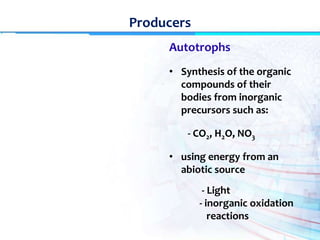
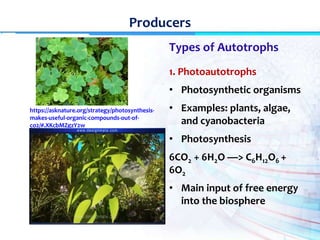
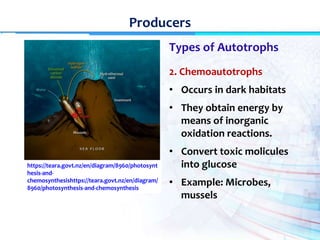
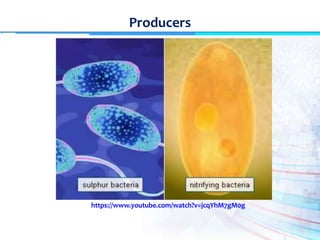
Producers, also known as autotrophs, are organisms that can synthesize their own organic compounds from inorganic precursors like carbon dioxide, water, and nitrates using energy from sunlight or inorganic chemical reactions. There are two main types of autotrophs: photoautotrophs, which use photosynthesis to convert carbon dioxide and water into glucose and oxygen using sunlight as an energy source, including plants, algae, and cyanobacteria; and chemoautotrophs, which obtain energy through inorganic oxidation reactions in dark environments and convert toxic molecules into glucose, such as microbes and mussels.