Introduction
• Traditionally, discoursewas broken down
largely into oral and written
• This age is characterized by the rapid
advancement of technology, with the
introduction of new discourse tools for the
expression of meaning.
• Discourses have, apart from verbal and
written forms extended to any semiotic
element that can be subjected to analytical
procedure to produce meaning.
4.
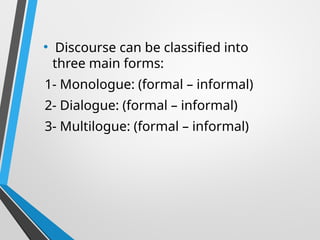
• Discourse canbe classified into
three main forms:
1- Monologue: (formal – informal)
2- Dialogue: (formal – informal)
3- Multilogue: (formal – informal)
5.
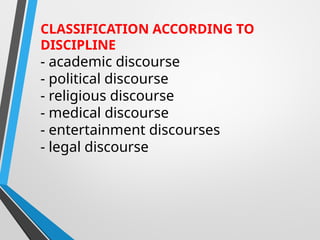
CLASSIFICATION ACCORDING TO
DISCIPLINE
-academic discourse
- political discourse
- religious discourse
- medical discourse
- entertainment discourses
- legal discourse
6.
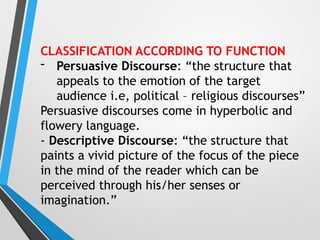
CLASSIFICATION ACCORDING TOFUNCTION
- Persuasive Discourse: “the structure that
appeals to the emotion of the target
audience i.e, political – religious discourses”
Persuasive discourses come in hyperbolic and
flowery language.
- Descriptive Discourse: “the structure that
paints a vivid picture of the focus of the piece
in the mind of the reader which can be
perceived through his/her senses or
imagination.”
7.
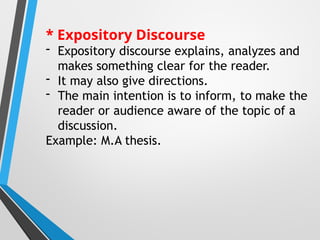
* Expository Discourse
-Expository discourse explains, analyzes and
makes something clear for the reader.
- It may also give directions.
- The main intention is to inform, to make the
reader or audience aware of the topic of a
discussion.
Example: M.A thesis.
8.
* Narrative Discourse
-Real (biography - autobiography - history)
- Fictional: (short story – novel – drama …)
* Argumentative Discourse
- Its purpose is to convince through logic.
- It is based on a belief or opinion that the
writer holds as true.
- The argument should be supported with
evidence or cases.


![Discourse [Original].pptx](https://cdn.slidesharecdn.com/ss_thumbnails/discourseoriginal-230907171216-a39121cf-thumbnail.jpg?width=640&height=640&fit=bounds)


