1
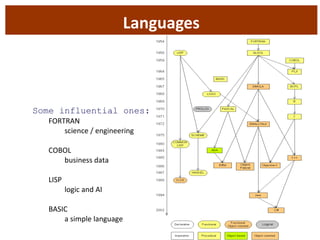
Some influential ones:
FORTRAN
science / engineering
COBOL
business data
LISP
logic and AI
BASIC
a simple language
2
Languages
Programming basics
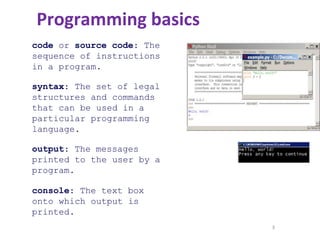
code or source code: The
sequence of instructions
in a program.
syntax: The set of legal
structures and commands
that can be used in a
particular programming
language.
output: The messages
printed to the user by a
program.
console: The text box
onto which output is
printed.
3
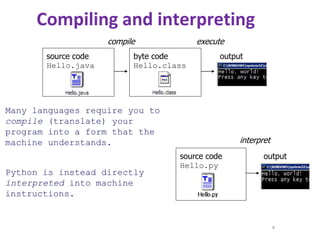
Compiling and interpreting
Many languages require you to
compile (translate) your
program into a form that the
machine understands.
Python is instead directly
interpreted into machine
instructions.
4
compile execute
output
source code
Hello.java
byte code
Hello.class
interpret
output
source code
Hello.py
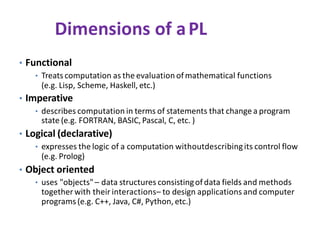
Dimensions of aPL
• Functional
• Treatscomputation as the evaluation ofmathematical functions
(e.g. Lisp, Scheme, Haskell, etc.)
• Imperative
• describes computation in terms of statements that changea program
state (e.g. FORTRAN, BASIC, Pascal, C, etc. )
• Logical (declarative)
• expresses the logic of a computation withoutdescribingits control flow
(e.g. Prolog)
• Object oriented
• uses "objects"– data structures consistingof data fields and methods
together with their interactions– to design applications and computer
programs (e.g. C++, Java, C#, Python, etc.)
Slide credit: Thomas J. Cortina
C (1973)
• Developed by Ken Thompson and Dennis Ritchie at
AT&T Bell Labs for use on the UNIXoperating system.
– now used on practicallyevery operatingsystem
– popular languagefor writing system software
• Features:
– An extremely simple core language, with non-essential
functionality provided by a standardizedsetof library routines.
– Low-level access to computer memory via the use of pointers.
• C ancestors: C++, C#, Java
9
Slide credit: Thomas J. Cortina
Python
• Created by Guido van Rossum in the late 1980s
• Allows programming in multiple paradigms: object-
oriented, structured,functional
• Uses dynamic typing and garbage collection
8
Building a simple program in
Python (as compared to C)
• Compilers versusinterpreters
• Variable declarations
• Whitespace
• The printf() function
• Functions
9
Compilers versus interpreters
• One major difference between C and Python is how the
programs written in these two languages are executed.
• With C programs, you usually use a compiler when you
are ready to see a C program execute.
• By contrast, with Python, you typically use an interpreter.
10
Compilers versus interpreters
• An interpreter reads the user-written programand
performs it directly.
• A compiler generates a file containing the translation
of the program into the machine's native code.
– The compiler does not actually execute the program!
– Instead, you first execute the compiler to create a native
executable, and then you execute the generatedexecutable.
11
Variable declarations
• C requires variable declarations, informing the compiler
about the variable before the variable is actuallyused.
• In C, the variable declaration defines the variable'stype.
• No such thing in Python!
20
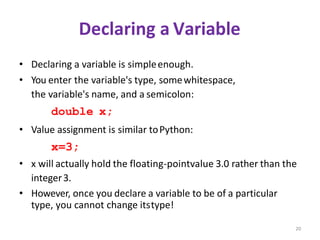
Declaring a Variable
• Declaring a variable is simpleenough.
• You enter the variable's type, somewhitespace,
the variable's name, and a semicolon:
double x;
• Value assignment is similar toPython:
x=3;
• x will actually hold the floating-pointvalue 3.0 rather than the
integer3.
• However, once you declare a variable to be of a particular
type, you cannot change itstype!
13
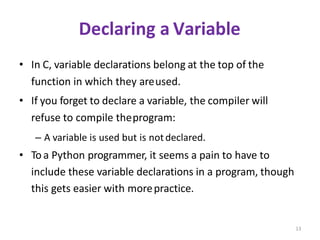
Declaring a Variable
• In C, variable declarations belong at the top of the
function in which they areused.
• If you forget to declare a variable, the compiler will
refuse to compile theprogram:
– A variable is used but is notdeclared.
• To a Python programmer, it seems a pain to have to
include these variable declarations in a program, though
this gets easier with morepractice.
14
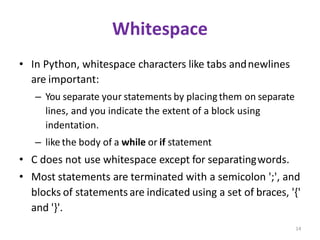
Whitespace
• In Python, whitespace characters like tabs andnewlines
are important:
– You separate your statements by placingthem on separate
lines, and you indicate the extent of a block using
indentation.
– like the body of a while or if statement
• C does not use whitespace except for separatingwords.
• Most statements are terminated with a semicolon ';', and
blocks of statementsare indicated using a set of braces, '{'
and '}'.
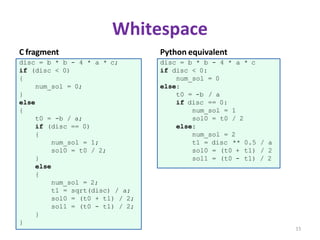
Whitespace
15
C fragment
disc = b * b - 4 * a * c;
if (disc < 0)
{
num_sol = 0;
}
else
{
t0 = -b / a;
if (disc == 0)
{
num_sol = 1;
sol0 = t0 / 2;
}
else
{
num_sol = 2;
t1 = sqrt(disc) / a;
sol0 = (t0 + t1) / 2;
sol1 = (t0 - t1) / 2;
}
}
Python equivalent
disc = b * b - 4 * a * c
if disc < 0:
num_sol = 0
else:
t0 = -b
if disc
/ a
== 0:
num_sol = 1
sol0 = t0 / 2
else:
num_sol = 2
**
t1 = disc
sol0
sol1
= (t0 +
= (t0 -
0.5 / a
t1) / 2
t1) / 2
16
Whitespace
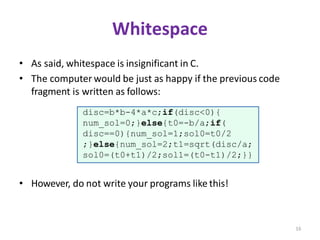
• As said, whitespace is insignificant in C.
• The computer would be just as happy if the previous code
fragment is written as follows:
disc=b*b-4*a*c;if(disc<0){
num_sol=0;}else{t0=-b/a;if(
disc==0){num_sol=1;sol0=t0/2
;}else{num_sol=2;t1=sqrt(disc/a;
sol0=(t0+t1)/2;sol1=(t0-t1)/2;}}
• However, do not write your programs like this!
30
Functions
• Unlike Python, all C code must be nested within functions,
and functions cannot be nested withineach other.
• A C program's overall structure is typicallyvery
straightforward.
• It is a list of function definitions, one after another, each
containing a list of statements to be executed when the
function iscalled.
18
Functions
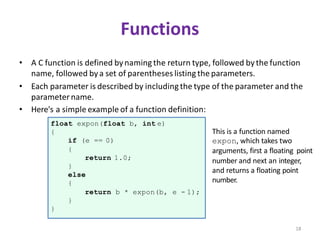
• A C function is defined bynamingthe return type, followed bythe function
name, followed bya set of parentheses listing the parameters.
• Each parameter is described by includingthe type of the parameter and the
parametername.
• Here's a simple example of a function definition:
float expon(float b, int e)
{
if (e == 0)
{
return 1.0;
}
else
{
return b * expon(b, e - 1);
}
}
This is a function named
expon, which takes two
arguments, first a floating point
number and next an integer,
and returns a floating point
number.
19
Functions
• If you have a function that does not have any useful
return value, then you'd use void as the return type.
• Programs have one special function named main, whose
return type is aninteger.
• This function is the “starting point” for the program:
– The computer essentially calls the program's mainfunction
when it wants to execute theprogram.
– The integer return value is largely meaningless; we'll
always return 0 rather than worrying about howthe return
value might beused.
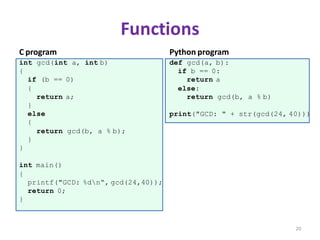
Functions
20
C program
int gcd(int a, int b)
{
if (b == 0)
{
return a;
}
else
{
return gcd(b, a % b);
}
}
int main()
{
printf("GCD: %dn“, gcd(24,40));
return 0;
}
Python program
def gcd(a, b):
if b == 0:
return a
else:
return gcd(b, a % b)
print("GCD: " + str(gcd(24, 40)))

Lecture 1.pptx

  • 1.
  • 2.
    Some influential ones: FORTRAN science/ engineering COBOL business data LISP logic and AI BASIC a simple language 2 Languages
  • 3.
    Programming basics code orsource code: The sequence of instructions in a program. syntax: The set of legal structures and commands that can be used in a particular programming language. output: The messages printed to the user by a program. console: The text box onto which output is printed. 3
  • 4.
    Compiling and interpreting Manylanguages require you to compile (translate) your program into a form that the machine understands. Python is instead directly interpreted into machine instructions. 4 compile execute output source code Hello.java byte code Hello.class interpret output source code Hello.py
  • 5.
    Dimensions of aPL •Functional • Treatscomputation as the evaluation ofmathematical functions (e.g. Lisp, Scheme, Haskell, etc.) • Imperative • describes computation in terms of statements that changea program state (e.g. FORTRAN, BASIC, Pascal, C, etc. ) • Logical (declarative) • expresses the logic of a computation withoutdescribingits control flow (e.g. Prolog) • Object oriented • uses "objects"– data structures consistingof data fields and methods together with their interactions– to design applications and computer programs (e.g. C++, Java, C#, Python, etc.)
  • 6.
    Slide credit: ThomasJ. Cortina C (1973) • Developed by Ken Thompson and Dennis Ritchie at AT&T Bell Labs for use on the UNIXoperating system. – now used on practicallyevery operatingsystem – popular languagefor writing system software • Features: – An extremely simple core language, with non-essential functionality provided by a standardizedsetof library routines. – Low-level access to computer memory via the use of pointers. • C ancestors: C++, C#, Java 9
  • 7.
    Slide credit: ThomasJ. Cortina Python • Created by Guido van Rossum in the late 1980s • Allows programming in multiple paradigms: object- oriented, structured,functional • Uses dynamic typing and garbage collection
  • 8.
    8 Building a simpleprogram in Python (as compared to C) • Compilers versusinterpreters • Variable declarations • Whitespace • The printf() function • Functions
  • 9.
    9 Compilers versus interpreters •One major difference between C and Python is how the programs written in these two languages are executed. • With C programs, you usually use a compiler when you are ready to see a C program execute. • By contrast, with Python, you typically use an interpreter.
  • 10.
    10 Compilers versus interpreters •An interpreter reads the user-written programand performs it directly. • A compiler generates a file containing the translation of the program into the machine's native code. – The compiler does not actually execute the program! – Instead, you first execute the compiler to create a native executable, and then you execute the generatedexecutable.
  • 11.
    11 Variable declarations • Crequires variable declarations, informing the compiler about the variable before the variable is actuallyused. • In C, the variable declaration defines the variable'stype. • No such thing in Python!
  • 12.
    20 Declaring a Variable •Declaring a variable is simpleenough. • You enter the variable's type, somewhitespace, the variable's name, and a semicolon: double x; • Value assignment is similar toPython: x=3; • x will actually hold the floating-pointvalue 3.0 rather than the integer3. • However, once you declare a variable to be of a particular type, you cannot change itstype!
  • 13.
    13 Declaring a Variable •In C, variable declarations belong at the top of the function in which they areused. • If you forget to declare a variable, the compiler will refuse to compile theprogram: – A variable is used but is notdeclared. • To a Python programmer, it seems a pain to have to include these variable declarations in a program, though this gets easier with morepractice.
  • 14.
    14 Whitespace • In Python,whitespace characters like tabs andnewlines are important: – You separate your statements by placingthem on separate lines, and you indicate the extent of a block using indentation. – like the body of a while or if statement • C does not use whitespace except for separatingwords. • Most statements are terminated with a semicolon ';', and blocks of statementsare indicated using a set of braces, '{' and '}'.
  • 15.
    Whitespace 15 C fragment disc =b * b - 4 * a * c; if (disc < 0) { num_sol = 0; } else { t0 = -b / a; if (disc == 0) { num_sol = 1; sol0 = t0 / 2; } else { num_sol = 2; t1 = sqrt(disc) / a; sol0 = (t0 + t1) / 2; sol1 = (t0 - t1) / 2; } } Python equivalent disc = b * b - 4 * a * c if disc < 0: num_sol = 0 else: t0 = -b if disc / a == 0: num_sol = 1 sol0 = t0 / 2 else: num_sol = 2 ** t1 = disc sol0 sol1 = (t0 + = (t0 - 0.5 / a t1) / 2 t1) / 2
  • 16.
    16 Whitespace • As said,whitespace is insignificant in C. • The computer would be just as happy if the previous code fragment is written as follows: disc=b*b-4*a*c;if(disc<0){ num_sol=0;}else{t0=-b/a;if( disc==0){num_sol=1;sol0=t0/2 ;}else{num_sol=2;t1=sqrt(disc/a; sol0=(t0+t1)/2;sol1=(t0-t1)/2;}} • However, do not write your programs like this!
  • 17.
    30 Functions • Unlike Python,all C code must be nested within functions, and functions cannot be nested withineach other. • A C program's overall structure is typicallyvery straightforward. • It is a list of function definitions, one after another, each containing a list of statements to be executed when the function iscalled.
  • 18.
    18 Functions • A Cfunction is defined bynamingthe return type, followed bythe function name, followed bya set of parentheses listing the parameters. • Each parameter is described by includingthe type of the parameter and the parametername. • Here's a simple example of a function definition: float expon(float b, int e) { if (e == 0) { return 1.0; } else { return b * expon(b, e - 1); } } This is a function named expon, which takes two arguments, first a floating point number and next an integer, and returns a floating point number.
  • 19.
    19 Functions • If youhave a function that does not have any useful return value, then you'd use void as the return type. • Programs have one special function named main, whose return type is aninteger. • This function is the “starting point” for the program: – The computer essentially calls the program's mainfunction when it wants to execute theprogram. – The integer return value is largely meaningless; we'll always return 0 rather than worrying about howthe return value might beused.
  • 20.
    Functions 20 C program int gcd(inta, int b) { if (b == 0) { return a; } else { return gcd(b, a % b); } } int main() { printf("GCD: %dn“, gcd(24,40)); return 0; } Python program def gcd(a, b): if b == 0: return a else: return gcd(b, a % b) print("GCD: " + str(gcd(24, 40)))