Process activities
Realsoftware processes are inter-leaved sequences of
technical, collaborative and managerial activities with the
overall goal of specifying, designing, implementing and
testing a software system.
The four basic process activities of specification,
development, validation and evolution are organized
differently in different development processes.
For example, in the waterfall model, they are organized
in sequence, whereas in incremental development
they are interleaved.
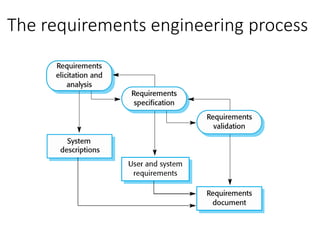
Requirements
engineering process
Theprocess of establishing what services are required
and the constraints on the system’s operation and
development.
Requirements elicitation and analysis
• What do the system stakeholders require or expect from the
system?
Requirements specification
• Defining the requirements in detail
Requirements validation
• Checking the validity of the requirements
5.
Software design and
implementation
The process of converting the system specification into
an executable system.
Software design
Design a software structure that realises the specification;
Implementation
Translate this structure into an executable program;
The activities of design and implementation are closely
related and may be inter-leaved.
System implementation
Thesoftware is implemented either by developing a
program or programs or by configuring an application
system.
Design and implementation are interleaved activities for
most types of software system.
Programming is an individual activity with no standard
process.
Debugging is the activity of finding program faults and
correcting these faults.
8.
Classical Approach
Waterfall approachwas first SDLC (System
Development Life Cycle) Model to be used widely in
Software Engineering to ensure success of the
project.
In "The Waterfall" approach, the whole process of
software development is divided into separate
phases.
In this Waterfall model, typically, the outcome of
one phase acts as the input for the next phase
sequentially.
10.
Incremental delivery
Ratherthan deliver the system as a single delivery, the
development and delivery is broken down into
increments with each increment delivering part of the
required functionality.
User requirements are prioritised and the highest
priority
requirements are included in early increments.
Once the development of an increment is started, the
requirements are frozen though requirements for later
increments can continue to evolve.
11.
Incremental development anddelivery
Incremental development
Develop the system in increments and evaluate each
increment before proceeding to the development of the next
increment;
Normal approach used in agile methods;
Evaluation done by user/customer proxy.
Incremental delivery
Deploy an increment for use by end-users;
More realistic evaluation about practical use of software;
Difficult to implement for replacement systems as
increments have less functionality than the system being
replaced.
Incremental delivery advantages
Customer value can be delivered with each increment so
system functionality is available earlier.
Early increments act as a prototype to help elicit
requirements for later increments.
Lower risk of overall project failure.
The highest priority system services tend to receive the
most testing.








![SOFTWARE ENGINEERING SEM 4 [Read-Only] [Read-Only] (3).pptx](https://cdn.slidesharecdn.com/ss_thumbnails/softwareengineeringsem4read-onlyread-only3-251216044811-dd17b10d-thumbnail.jpg?width=640&height=640&fit=bounds)


