Randomized Algorithms
CS648

Lecture 14
Expected duration of a randomized experiment
Part II
1
REVISITING
SOME DISCRETE MATHEMATICS

2
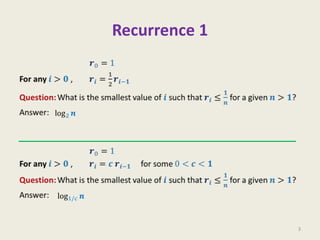
Recurrence 1

3
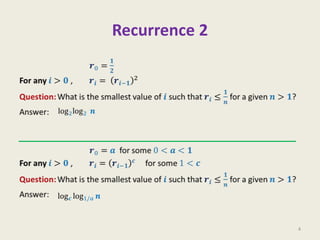
Recurrence 2

4
DISTRIBUTED CLIENT-SERVER PROBLEM

5
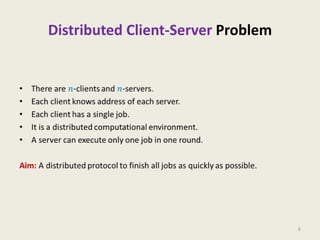
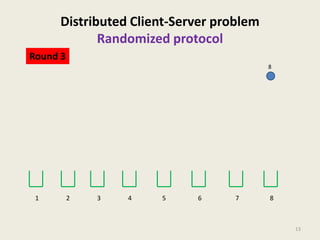
Distributed Client-Server Problem

6
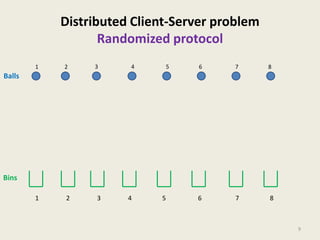
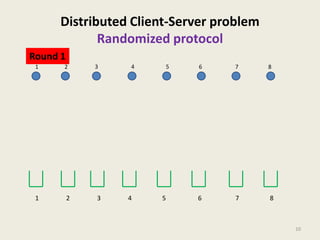
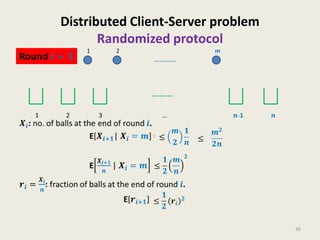
Distributed Client-Server Problem
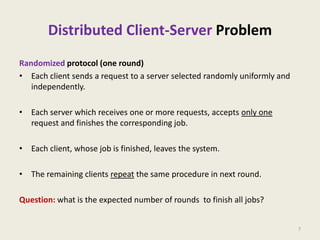
Randomized protocol (one round)
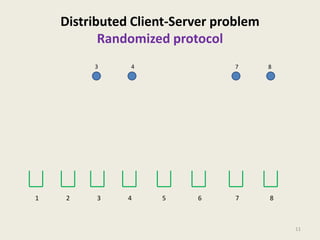
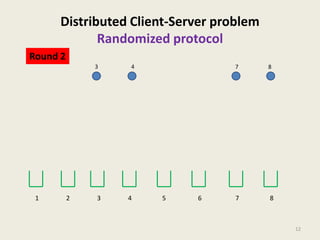
• Each client sends a request to a server selected randomly uniformly and
independently.
• Each server which receives one or more requests, accepts only one
request and finishes the corresponding job.
• Each client, whose job is finished, leaves the system.
• The remaining clients repeat the same procedure in next round.
Question: what is the expected number of rounds to finish all jobs?
7
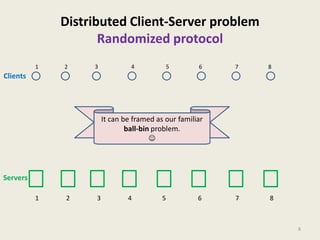
Distributed Client-Server problem
Randomized protocol
1

2

3

4

5

6

7

8

7

8

Clients

It can be framed as our familiar
ball-bin problem.


Servers
1

2

3

4

5

6

8
Distributed Client-Server problem
Randomized protocol
1

2

1

2

3

4

5

6

7

8

6

7

8

Balls

Bins
3

4

5

9
Distributed Client-Server problem
Randomized protocol
Round 1
1

2

1

2

3

3

4

4

5

5

6

7

8

6

7

8

10
Distributed Client-Server problem
Randomized protocol
3

1

2

3

4

4

7

5

6

8

7

8

11
Distributed Client-Server problem
Randomized protocol
Round 2
3

1

2

3

4

4

7

5

6

8

7

8

12
Distributed Client-Server problem
Randomized protocol
Round 3
8

1

2

3

4

5

6

7

8

13
CALCULATING EXPECTED NO. OF ROUNDS
FIRST APPROACH

14
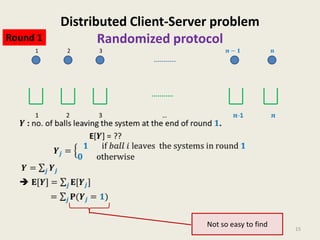
Round 1
1

Distributed Client-Server problem
Randomized protocol
2

3

Not so easy to find

15
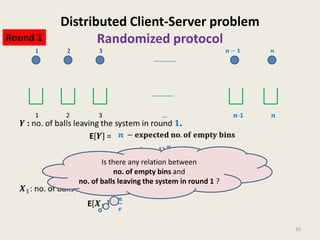
Round 1
1

Distributed Client-Server problem
Randomized protocol
2

3

Is there any relation between
no. of empty bins and
no. of balls leaving the system in round 1 ?

16
Distributed Client-Server problem
Randomized protocol
1

2

17
Distributed Client-Server problem
Randomized protocol

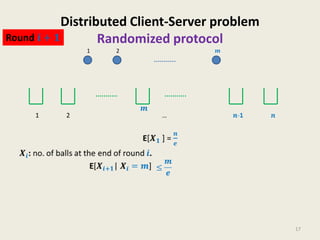
Round

0

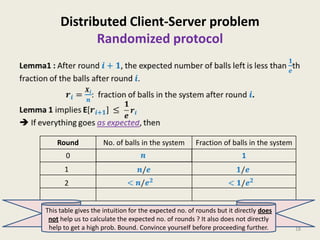
No. of balls in the system

Fraction of balls in the system

1

1
2
This table gives the intuition for the expected no. of rounds but it directly does
not help us to calculate the expected no. of rounds ? It also does not directly
help to get a high prob. Bound. Convince yourself before proceeding further.

18
Distributed Client-Server problem
Randomized protocol

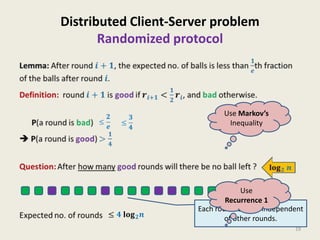
Use Markov’s
Inequality

Use
Recurrence 1
Each round is good independent
of other rounds.
19
Distributed Client-Server problem
Randomized protocol

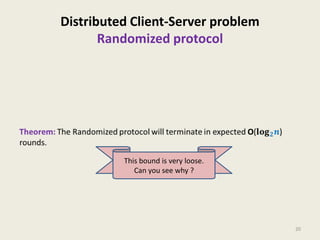
This bound is very loose.
Can you see why ?

20
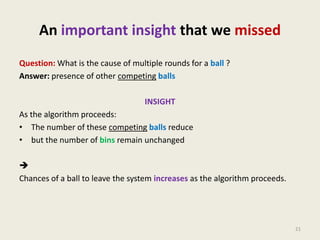
An important insight that we missed
Question: What is the cause of multiple rounds for a ball ?
Answer: presence of other competing balls
INSIGHT
As the algorithm proceeds:
• The number of these competing balls reduce
• but the number of bins remain unchanged

Chances of a ball to leave the system increases as the algorithm proceeds.

21
CALCULATING EXPECTED NO. OF ROUNDS
WITH NEW INSIGHT

22
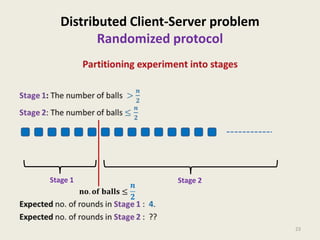
Distributed Client-Server problem
Randomized protocol

Stage 1

Stage 2

23
CALCULATING EXPECTED NO. OF ROUNDS
IN STAGE 2

24
Distributed Client-Server problem
Randomized protocol
1

2

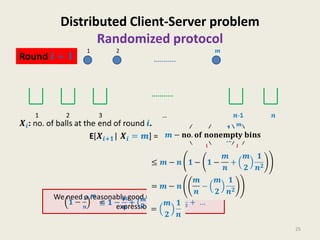
We need a reasonably good upper bound for this
expression
25
Distributed Client-Server problem
Randomized protocol
1

2

26
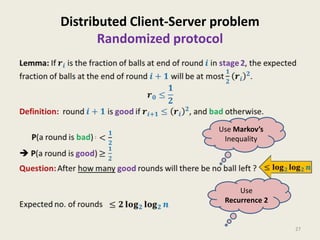
Distributed Client-Server problem
Randomized protocol

Use Markov’s
Inequality

Use
Recurrence 2

27
Distributed Client-Server problem
Randomized protocol

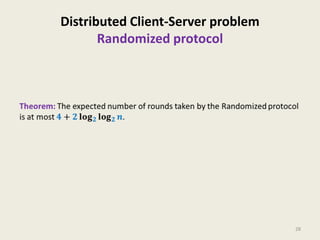
28
Distributed Client-Server problem
Randomized protocol

29
RUMOR SPREADING

30
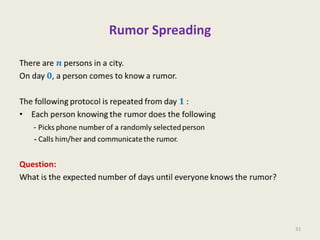
Rumor Spreading

31
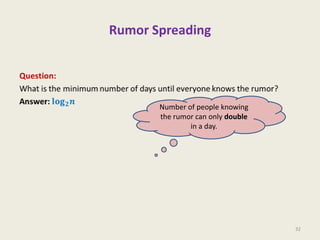
Rumor Spreading

Number of people knowing
the rumor can only double
in a day.

32
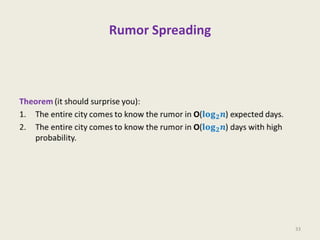
Rumor Spreading

33
Rumor Spreading

34
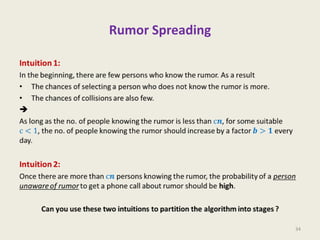
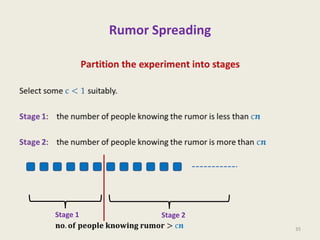
Rumor Spreading

Stage 1

Stage 2
35
EXPECTED NO. OF DAYS IN
STAGE 2

36
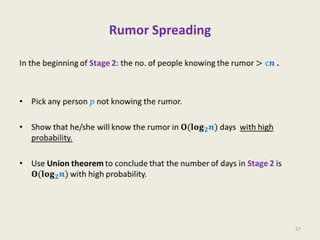
Rumor Spreading

37
EXPECTED NO. OF DAYS IN
STAGE 1

38
It is left as a home work to be
discussed in some future class.
I shall be happy to see a correct
solution by some of you in the next
class.

39

Lecture 14-cs648-2013