Introductions
Lecture: 1
AERO-213 : Incompressible Aerodynamics
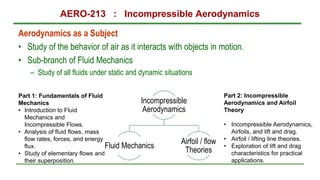
Aerodynamics as a Subject
• Study of the behavior of air as it interacts with objects in motion.
• Sub-branch of Fluid Mechanics
– Study of all fluids under static and dynamic situations
Incompressible
Aerodynamics
Fluid Mechanics
Airfoil / flow
Theories
Part 1: Fundamentals of Fluid
Mechanics
• Introduction to Fluid
Mechanics and
Incompressible Flows.
• Analysis of fluid flows, mass
flow rates, forces, and energy
flux.
• Study of elementary flows and
their superposition.
Part 2: Incompressible
Aerodynamics and Airfoil
Theory
• Incompressible Aerodynamics,
Airfoils, and lift and drag.
• Airfoil / lifting line theories.
• Exploration of lift and drag
characteristics for practical
applications.
AERO-213 : Incompressible Aerodynamics
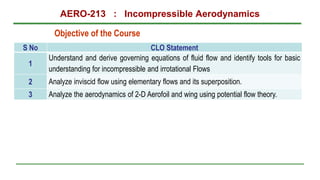
Objective of the Course
S No CLO Statement
1
Understand and derive governing equations of fluid flow and identify tools for basic
understanding for incompressible and irrotational Flows
2 Analyze inviscid flow using elementary flows and its superposition.
3 Analyze the aerodynamics of 2-D Aerofoil and wing using potential flow theory.
AERO-213 : Incompressible Aerodynamics
Fundamentals of Aerodynamics
by John D. Anderson
Description
• Widely regarded as a classic and authoritative textbook in the field of
aerodynamics.
• Used as a cornerstone resource by aerospace engineering students and
professionals worldwide.
• Comprehensive coverage of key aerodynamic concepts and principles.
• Numerous real-world examples and applications to enhance understanding.
• Valuable exercises and problems for hands-on learning and practice.
• A trusted reference for anyone passionate about flight and aerospace
engineering.
AERO-213 : Incompressible Aerodynamics
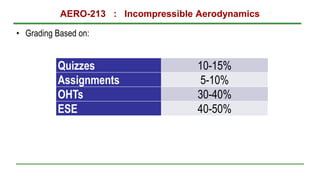
• Grading Based on:
Quizzes 10-15%
Assignments 5-10%
OHTs 30-40%
ESE 40-50%
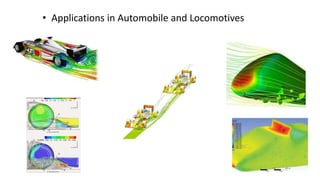
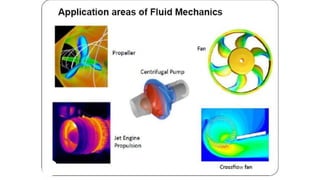
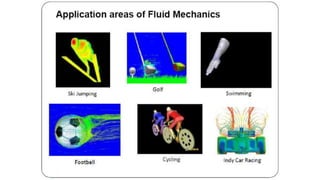
• Applications in Automobile and Locomotives
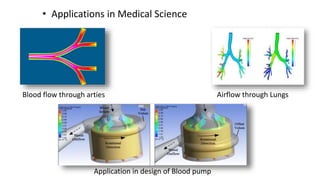
• Applications in Medical Science
Blood flow through arties
Application in design of Blood pump
Airflow through Lungs
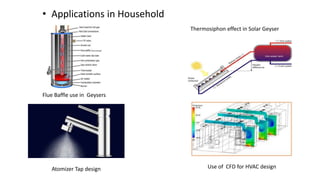
• Applications in Household
Flue Baffle use in Geysers
Thermosiphon effect in Solar Geyser
Use of CFD for HVAC design
Atomizer Tap design
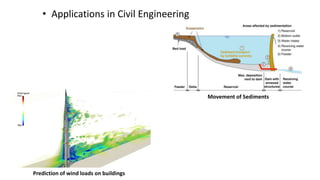
• Applications in Civil Engineering
Transport of sediments in Dams
Movement of Sediments
Prediction of wind loads on buildings
Chapter-1
Fundamental Concepts
AERO-213 : Incompressible Aerodynamics
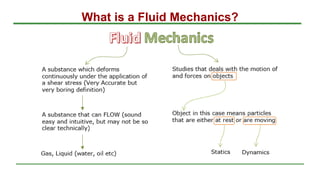
What is a Fluid Mechanics?
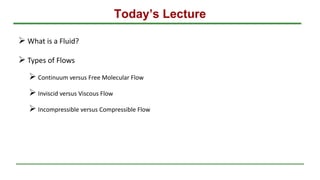
Today’s Lecture
 What is a Fluid?
 Types of Flows
 Continuum versus Free Molecular Flow
 Inviscid versus Viscous Flow
 Incompressible versus Compressible Flow
What is a Fluid?
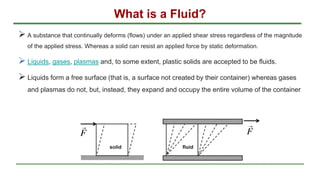
 A substance that continually deforms (flows) under an applied shear stress regardless of the magnitude
of the applied stress. Whereas a solid can resist an applied force by static deformation.
 Liquids, gases, plasmas and, to some extent, plastic solids are accepted to be fluids.
 Liquids form a free surface (that is, a surface not created by their container) whereas gases
and plasmas do not, but, instead, they expand and occupy the entire volume of the container
Fluid as a Continuum
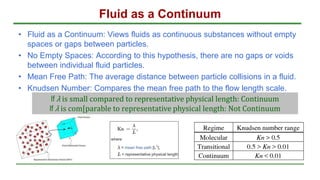
• Fluid as a Continuum: Views fluids as continuous substances without empty
spaces or gaps between particles.
• No Empty Spaces: According to this hypothesis, there are no gaps or voids
between individual fluid particles.
• Mean Free Path: The average distance between particle collisions in a fluid.
• Knudsen Number: Compares the mean free path to the flow length scale.
If λ is small compared to representative physical length: Continuum
If λ is com[parable to representative physical length: Not Continuum
Fluid Flow under shear Stress
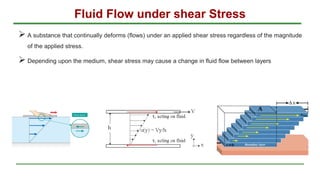
 A substance that continually deforms (flows) under an applied shear stress regardless of the magnitude
of the applied stress.
 Depending upon the medium, shear stress may cause a change in fluid flow between layers
Fluid Flow under shear Stress
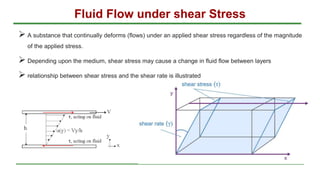
 A substance that continually deforms (flows) under an applied shear stress regardless of the magnitude
of the applied stress.
 Depending upon the medium, shear stress may cause a change in fluid flow between layers
 relationship between shear stress and the shear rate is illustrated
Newtonian vs Non-Newtonian Fluids
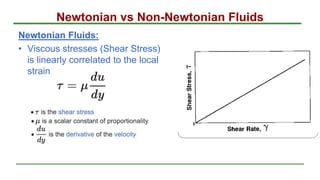
Newtonian Fluids:
• Viscous stresses (Shear Stress)
is linearly correlated to the local
strain rate
Newtonian vs Non-Newtonian Fluids
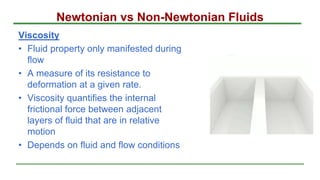
Viscosity
• Fluid property only manifested during
flow
• A measure of its resistance to
deformation at a given rate.
• Viscosity quantifies the internal
frictional force between adjacent
layers of fluid that are in relative
motion
• Depends on fluid and flow conditions
Newtonian vs Non-Newtonian Fluids
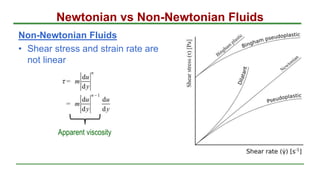
Non-Newtonian Fluids
• Shear stress and strain rate are
not linear
Apparent viscosity
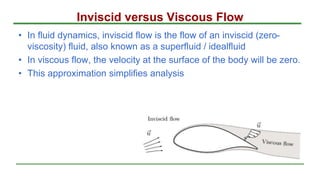
Inviscid versus Viscous Flow
• In fluid dynamics, inviscid flow is the flow of an inviscid (zero-
viscosity) fluid, also known as a superfluid / idealfluid
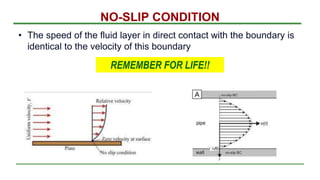
• In viscous flow, the velocity at the surface of the body will be zero.
• This approximation simplifies analysis
NO-SLIP CONDITION
• The speed of the fluid layer in direct contact with the boundary is
identical to the velocity of this boundary
REMEMBER FOR LIFE!!
Incompressible versus Compressible Flow
• A compressible fluid can experience a density change during flow
while an incompressible fluid does not experience such a change
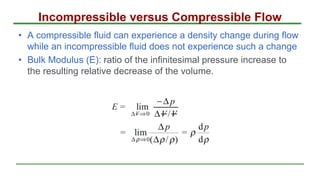
• Bulk Modulus (E): ratio of the infinitesimal pressure increase to
the resulting relative decrease of the volume.
Incompressible versus Compressible Flow
• A compressible fluid can experience a density change during flow
while an incompressible fluid does not experience such a change
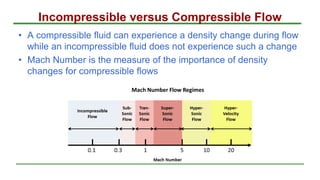
• Mach Number is the measure of the importance of density
changes for compressible flows
QUESTIONS??

Lecture 1 introduction to aerodynamics.pptx

  • 1.
  • 2.
    AERO-213 : IncompressibleAerodynamics Aerodynamics as a Subject • Study of the behavior of air as it interacts with objects in motion. • Sub-branch of Fluid Mechanics – Study of all fluids under static and dynamic situations Incompressible Aerodynamics Fluid Mechanics Airfoil / flow Theories Part 1: Fundamentals of Fluid Mechanics • Introduction to Fluid Mechanics and Incompressible Flows. • Analysis of fluid flows, mass flow rates, forces, and energy flux. • Study of elementary flows and their superposition. Part 2: Incompressible Aerodynamics and Airfoil Theory • Incompressible Aerodynamics, Airfoils, and lift and drag. • Airfoil / lifting line theories. • Exploration of lift and drag characteristics for practical applications.
  • 3.
    AERO-213 : IncompressibleAerodynamics Objective of the Course S No CLO Statement 1 Understand and derive governing equations of fluid flow and identify tools for basic understanding for incompressible and irrotational Flows 2 Analyze inviscid flow using elementary flows and its superposition. 3 Analyze the aerodynamics of 2-D Aerofoil and wing using potential flow theory.
  • 4.
    AERO-213 : IncompressibleAerodynamics Fundamentals of Aerodynamics by John D. Anderson Description • Widely regarded as a classic and authoritative textbook in the field of aerodynamics. • Used as a cornerstone resource by aerospace engineering students and professionals worldwide. • Comprehensive coverage of key aerodynamic concepts and principles. • Numerous real-world examples and applications to enhance understanding. • Valuable exercises and problems for hands-on learning and practice. • A trusted reference for anyone passionate about flight and aerospace engineering.
  • 5.
    AERO-213 : IncompressibleAerodynamics • Grading Based on: Quizzes 10-15% Assignments 5-10% OHTs 30-40% ESE 40-50%
  • 6.
    • Applications inAutomobile and Locomotives
  • 7.
    • Applications inMedical Science Blood flow through arties Application in design of Blood pump Airflow through Lungs
  • 8.
    • Applications inHousehold Flue Baffle use in Geysers Thermosiphon effect in Solar Geyser Use of CFD for HVAC design Atomizer Tap design
  • 9.
    • Applications inCivil Engineering Transport of sediments in Dams Movement of Sediments Prediction of wind loads on buildings
  • 13.
    Chapter-1 Fundamental Concepts AERO-213 :Incompressible Aerodynamics
  • 14.
    What is aFluid Mechanics?
  • 15.
    Today’s Lecture  Whatis a Fluid?  Types of Flows  Continuum versus Free Molecular Flow  Inviscid versus Viscous Flow  Incompressible versus Compressible Flow
  • 16.
    What is aFluid?  A substance that continually deforms (flows) under an applied shear stress regardless of the magnitude of the applied stress. Whereas a solid can resist an applied force by static deformation.  Liquids, gases, plasmas and, to some extent, plastic solids are accepted to be fluids.  Liquids form a free surface (that is, a surface not created by their container) whereas gases and plasmas do not, but, instead, they expand and occupy the entire volume of the container
  • 17.
    Fluid as aContinuum • Fluid as a Continuum: Views fluids as continuous substances without empty spaces or gaps between particles. • No Empty Spaces: According to this hypothesis, there are no gaps or voids between individual fluid particles. • Mean Free Path: The average distance between particle collisions in a fluid. • Knudsen Number: Compares the mean free path to the flow length scale. If λ is small compared to representative physical length: Continuum If λ is com[parable to representative physical length: Not Continuum
  • 18.
    Fluid Flow undershear Stress  A substance that continually deforms (flows) under an applied shear stress regardless of the magnitude of the applied stress.  Depending upon the medium, shear stress may cause a change in fluid flow between layers
  • 19.
    Fluid Flow undershear Stress  A substance that continually deforms (flows) under an applied shear stress regardless of the magnitude of the applied stress.  Depending upon the medium, shear stress may cause a change in fluid flow between layers  relationship between shear stress and the shear rate is illustrated
  • 20.
    Newtonian vs Non-NewtonianFluids Newtonian Fluids: • Viscous stresses (Shear Stress) is linearly correlated to the local strain rate
  • 21.
    Newtonian vs Non-NewtonianFluids Viscosity • Fluid property only manifested during flow • A measure of its resistance to deformation at a given rate. • Viscosity quantifies the internal frictional force between adjacent layers of fluid that are in relative motion • Depends on fluid and flow conditions
  • 22.
    Newtonian vs Non-NewtonianFluids Non-Newtonian Fluids • Shear stress and strain rate are not linear Apparent viscosity
  • 23.
    Inviscid versus ViscousFlow • In fluid dynamics, inviscid flow is the flow of an inviscid (zero- viscosity) fluid, also known as a superfluid / idealfluid • In viscous flow, the velocity at the surface of the body will be zero. • This approximation simplifies analysis
  • 24.
    NO-SLIP CONDITION • Thespeed of the fluid layer in direct contact with the boundary is identical to the velocity of this boundary REMEMBER FOR LIFE!!
  • 25.
    Incompressible versus CompressibleFlow • A compressible fluid can experience a density change during flow while an incompressible fluid does not experience such a change • Bulk Modulus (E): ratio of the infinitesimal pressure increase to the resulting relative decrease of the volume.
  • 26.
    Incompressible versus CompressibleFlow • A compressible fluid can experience a density change during flow while an incompressible fluid does not experience such a change • Mach Number is the measure of the importance of density changes for compressible flows
  • 27.