Lec1 Relational Model databases computer science.pdf
1.
CS315: DATABASE SYSTEMS
RELATIONALMODEL
Arnab Bhattacharya
arnabb@cse.iitk.ac.in
Computer Science and Engineering,
Indian Institute of Technology, Kanpur
http://web.cse.iitk.ac.in/˜cs315/
2nd
semester, 2024-25
Tue, Wed 12:00-13:15
Arnab Bhattacharya (arnabb@cse.iitk.ac.in) CS315: Relational Model 2024-25 1 / 16
2.
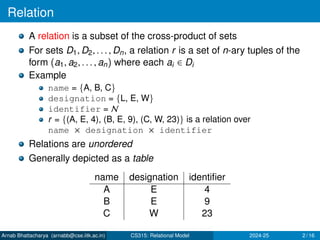
Relation
A relation isa subset of the cross-product of sets
For sets D1, D2, . . . , Dn, a relation r is a set of n-ary tuples of the
form (a1, a2, . . . , an) where each ai ∈ Di
Example
name = {A, B, C}
designation = {L, E, W}
identifier = N
r = {(A, E, 4), (B, E, 9), (C, W, 23)} is a relation over
name × designation × identifier
Relations are unordered
Generally depicted as a table
name designation identifier
A E 4
B E 9
C W 23
Arnab Bhattacharya (arnabb@cse.iitk.ac.in) CS315: Relational Model 2024-25 2 / 16
3.
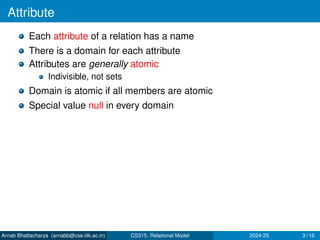
Attribute
Each attribute ofa relation has a name
There is a domain for each attribute
Attributes are generally atomic
Indivisible, not sets
Domain is atomic if all members are atomic
Special value null in every domain
Arnab Bhattacharya (arnabb@cse.iitk.ac.in) CS315: Relational Model 2024-25 3 / 16
4.
Relation Schema andTuple
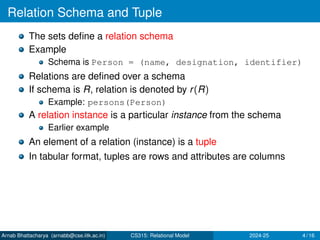
The sets define a relation schema
Example
Schema is Person = (name, designation, identifier)
Relations are defined over a schema
If schema is R, relation is denoted by r(R)
Example: persons(Person)
A relation instance is a particular instance from the schema
Earlier example
An element of a relation (instance) is a tuple
In tabular format, tuples are rows and attributes are columns
Arnab Bhattacharya (arnabb@cse.iitk.ac.in) CS315: Relational Model 2024-25 4 / 16
5.
Database
A database consistsof multiple inter-related relations
Each relation stores information about a particular relationship
Alternatively, a single relation can store all data
Problems
Data repetition
Need for null values
Normalization theory deals with how to design relation schemas
Arnab Bhattacharya (arnabb@cse.iitk.ac.in) CS315: Relational Model 2024-25 5 / 16
6.
Key
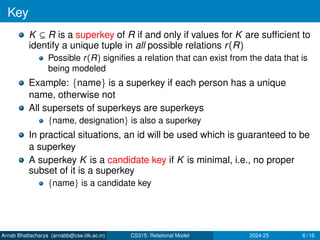
K ⊆ Ris a superkey of R if and only if values for K are sufficient to
identify a unique tuple in all possible relations r(R)
Possible r(R) signifies a relation that can exist from the data that is
being modeled
Example: {name} is a superkey if each person has a unique
name, otherwise not
All supersets of superkeys are superkeys
{name, designation} is also a superkey
In practical situations, an id will be used which is guaranteed to be
a superkey
A superkey K is a candidate key if K is minimal, i.e., no proper
subset of it is a superkey
{name} is a candidate key
Arnab Bhattacharya (arnabb@cse.iitk.ac.in) CS315: Relational Model 2024-25 6 / 16
7.
Primary and SecondaryKeys
There may be multiple candidate keys
{name}, {identifier} are candidate keys
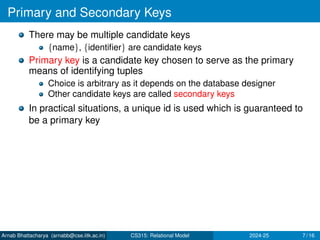
Primary key is a candidate key chosen to serve as the primary
means of identifying tuples
Choice is arbitrary as it depends on the database designer
Other candidate keys are called secondary keys
In practical situations, a unique id is used which is guaranteed to
be a primary key
Arnab Bhattacharya (arnabb@cse.iitk.ac.in) CS315: Relational Model 2024-25 7 / 16
8.
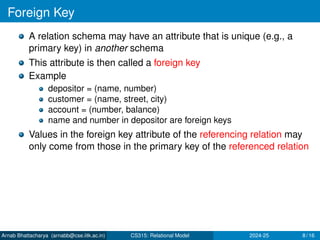
Foreign Key
A relationschema may have an attribute that is unique (e.g., a
primary key) in another schema
This attribute is then called a foreign key
Example
depositor = (name, number)
customer = (name, street, city)
account = (number, balance)
name and number in depositor are foreign keys
Values in the foreign key attribute of the referencing relation may
only come from those in the primary key of the referenced relation
Arnab Bhattacharya (arnabb@cse.iitk.ac.in) CS315: Relational Model 2024-25 8 / 16
9.
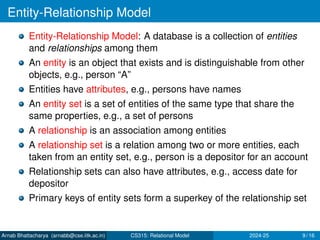
Entity-Relationship Model
Entity-Relationship Model:A database is a collection of entities
and relationships among them
An entity is an object that exists and is distinguishable from other
objects, e.g., person “A”
Entities have attributes, e.g., persons have names
An entity set is a set of entities of the same type that share the
same properties, e.g., a set of persons
A relationship is an association among entities
A relationship set is a relation among two or more entities, each
taken from an entity set, e.g., person is a depositor for an account
Relationship sets can also have attributes, e.g., access date for
depositor
Primary keys of entity sets form a superkey of the relationship set
Arnab Bhattacharya (arnabb@cse.iitk.ac.in) CS315: Relational Model 2024-25 9 / 16
10.
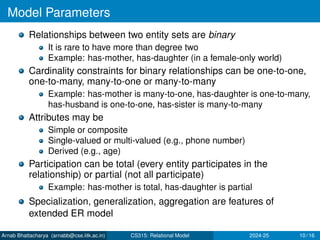
Model Parameters
Relationships betweentwo entity sets are binary
It is rare to have more than degree two
Example: has-mother, has-daughter (in a female-only world)
Cardinality constraints for binary relationships can be one-to-one,
one-to-many, many-to-one or many-to-many
Example: has-mother is many-to-one, has-daughter is one-to-many,
has-husband is one-to-one, has-sister is many-to-many
Attributes may be
Simple or composite
Single-valued or multi-valued (e.g., phone number)
Derived (e.g., age)
Participation can be total (every entity participates in the
relationship) or partial (not all participate)
Example: has-mother is total, has-daughter is partial
Specialization, generalization, aggregation are features of
extended ER model
Arnab Bhattacharya (arnabb@cse.iitk.ac.in) CS315: Relational Model 2024-25 10 / 16
11.
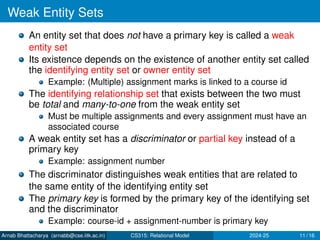
Weak Entity Sets
Anentity set that does not have a primary key is called a weak
entity set
Its existence depends on the existence of another entity set called
the identifying entity set or owner entity set
Example: (Multiple) assignment marks is linked to a course id
The identifying relationship set that exists between the two must
be total and many-to-one from the weak entity set
Must be multiple assignments and every assignment must have an
associated course
A weak entity set has a discriminator or partial key instead of a
primary key
Example: assignment number
The discriminator distinguishes weak entities that are related to
the same entity of the identifying entity set
The primary key is formed by the primary key of the identifying set
and the discriminator
Example: course-id + assignment-number is primary key
Arnab Bhattacharya (arnabb@cse.iitk.ac.in) CS315: Relational Model 2024-25 11 / 16
12.
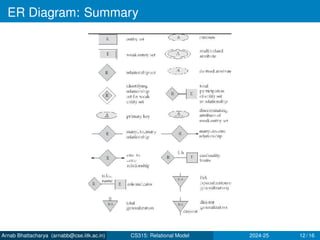
ER Diagram: Summary
ArnabBhattacharya (arnabb@cse.iitk.ac.in) CS315: Relational Model 2024-25 12 / 16
13.
ER Diagram: Description
Entitysets: rectangles
Relationship sets: diamonds
Attributes: ellipses
Multivalued attributes: double ellipses
Derived attributes: dashed ellipses
Primary keys: underlines
Roles: on links
Cardinality constraints
One: directed
Many: undirected
One-to-many: directed-diamond-undirected
Cardinality limits: on lines
Participation
Total: double line
Partial: single line
Weak entity sets: double rectangle
Discriminator of a weak entity sets: underline with dashed lines
Weak relationship set: double ellipse
Arnab Bhattacharya (arnabb@cse.iitk.ac.in) CS315: Relational Model 2024-25 13 / 16
Reduction to RelationalModel: Entities
Entity sets are reduced to relations
Example: course
Each component of a composite attribute is modeled separately
Example: first-name, last-name
Multivalued attributes are reduced to relations that include the
primary key of the entity set
Example: id, mobile
A weak entity set is reduced to a relation by including the primary
key attributes of the identifying set
A foreign key relationship is established
Example: assignment
Arnab Bhattacharya (arnabb@cse.iitk.ac.in) CS315: Relational Model 2024-25 15 / 16
16.
Reduction to RelationalModel: Relationships
Relationships sets are reduced to relations
Example: enrollment (of a student in a course)
Many-to-many relationships must be reduced to a relation
Many-to-one and one-to-many relationships that are total on the
“many” side may not be reduced to a relation
Primary key of entity on “one” side is added to relation of entity on
“many” side
Example: mother is added as an attribute to every daughter entity
If “many” side has partial participation, not reducing may have null
values
Example: husband may be null
For one-to-one relationships, any side can be chosen as “many”
Arnab Bhattacharya (arnabb@cse.iitk.ac.in) CS315: Relational Model 2024-25 16 / 16