By Adam Krieger
By Adam Krieger


Lebanese Bounty:
     Wine
By Adam Krieger


Lebanese Bounty:
     Wine
A n   I n v e s t m e n t P r o p o s a l
      o n B e h a l f o f t h e
L e b a n e s e W i n e I n d u s t ry
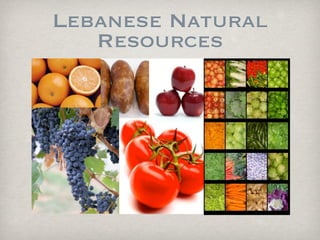
Lebanese Natural
   Resources
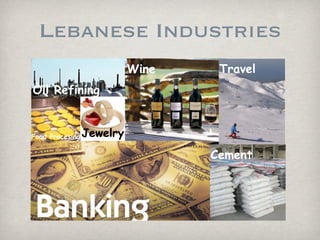
Lebanese Industries
                           Wine    Travel
Oil Refining


Food Procesing   Jewelry
                                  Cement
Wine
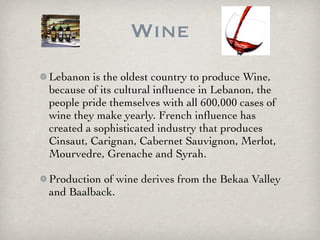
Lebanon is the oldest country to produce Wine,
because of its cultural influence in Lebanon, the
people pride themselves with all 600,000 cases of
wine they make yearly. French influence has
created a sophisticated industry that produces
Cinsaut, Carignan, Cabernet Sauvignon, Merlot,
Mourvedre, Grenache and Syrah.

Production of wine derives from the Bekaa Valley
and Baalback.
Business Plan
Negotiate contracts with local wineries to sell their wine
to us

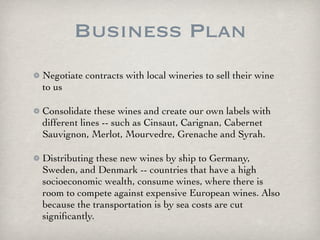
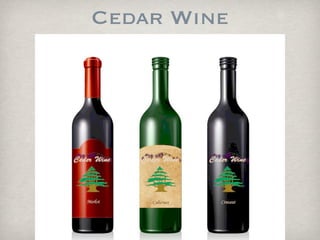
Consolidate these wines and create our own labels with
different lines -- such as Cinsaut, Carignan, Cabernet
Sauvignon, Merlot, Mourvedre, Grenache and Syrah.

Distributing these new wines by ship to Germany,
Sweden, and Denmark -- countries that have a high
socioeconomic wealth, consume wines, where there is
room to compete against expensive European wines. Also
because the transportation is by sea costs are cut
significantly.
Cedar Wine
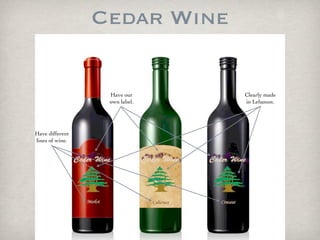
Cedar Wine

                  Have our     Clearly made
                  own label.   in Lebanon.


Have different
lines of wine.
Exporting wine from Lebanon to
 wealthier EU nations is a win-win
proposition for both the Lebanese
wine industry and the exporter (us)
  Why?
Due to Lebanon's low standard of living, Lebanese
wine sells for little above the actual cost of its
production, resulting in a precariously fine profit-
margin for the individual vintner and a dangerously
high risk of business failure. By exporting the product
to wealthier EU nations, even after absorbing the
costs of transport, marketing and the retailer's
markup, the wine can be competitively priced and still
yield significant profits. This represents a far more
attractive business model for the local vintner.
Exporting wine from Lebanon to
 wealthier EU nations is a win-win
proposition for both the Lebanese
wine industry and the exporter (us)
  Why?
Due to Lebanon's low standard of living, Lebanese
wine sells for little above the actual cost of its
production, resulting in a precariously fine profit-
margin for the individual vintner and a dangerously
high risk of business failure. By exporting the product
to wealthier EU nations, even after absorbing the
costs of transport, marketing and the retailer's
markup, the wine can be competitively priced and still
yield significant profits. This represents a far more
attractive business model for the local vintner.
Industry Benefits

The consolidation of wines from a wide range of
small vintners allows for a wider marketing
strategy that will build an international reputation
for Lebanese wines.
Domestic Market

Allowing individual wine makers to continue
selling their wines domestically under their
own labels at the customary low prices will
ensure that the local people continue to benefit
from their home-grown products and ensure
political goodwill for the export arrangement.
The market for wine within Lebanon is small
because 49% of population is Muslim, they
may not drink alcohol. (We would not buy all
there wine, only as much as we could sell.)
Financial Security


Multi-year contracts with a large distributor allow
small wineries to weather bad seasons or economic
downturns that could otherwise destroy a small
business.
Financial Security


Multi-year contracts with a large distributor allow
small wineries to weather bad seasons or economic
downturns that could otherwise destroy a small
business.
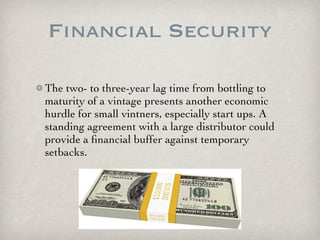
Financial Security

The two- to three-year lag time from bottling to
maturity of a vintage presents another economic
hurdle for small vintners, especially start ups. A
standing agreement with a large distributor could
provide a financial buffer against temporary
setbacks.
Possibility of Loans

Over time, as trust grows between individual
wineries and the distributor, vintners could borrow
(from the distributor) against future harvests to
invest in higher quality or more sophisticated
equipment (stainless steal vats, oak barrels, etc) ,
resulting in an improved overall product.
Where?
               Transportation

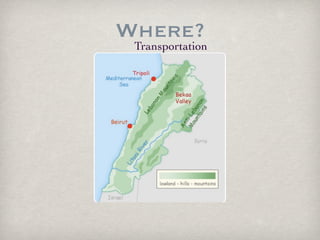
Lebanon is located in the Middle East on the
Mediterranean Sea. Thus, distribution to
Europe is easy.


The business plan requires transportation of
Lebanese wines by ship to affluent countries
accessible by water from Lebanon to compete
against more expensive European wines.
Where?
 Transportation
Business Benefits

•   Inexpensive labor

•   Small country making it easier to consolidate small wine makers into a
    larger distribution system

•   Easy accessibility to water transportation

•   The weak Lebanese pound makes the cost of the wine cheap when it
    competes in Northern Europe

•   Few government regulations
Political Issues
Despite seeming political unrest, in fact, all
governments have supported private wine industry


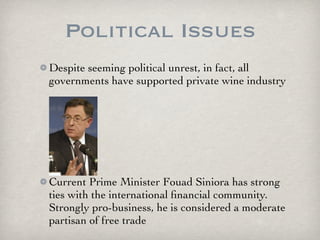
Current Prime Minister Fouad Siniora has strong
ties with the international financial community.
Strongly pro-business, he is considered a moderate
partisan of free trade
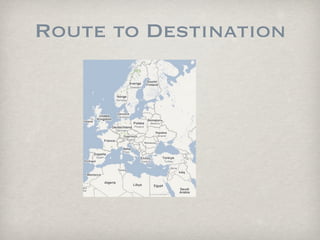
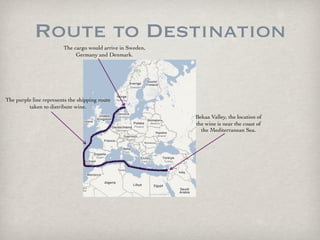
Route to Destination
                        The cargo would arrive in Sweden,
                             Germany and Denmark.


The purple line represents the shipping route
         taken to distribute wine.
                                                            Bekaa Valley, the location of
                                                            the wine is near the coast of
                                                              the Mediterranean Sea.
Bibliography
    “Business.” The Daily Star. The Daily Star. 28 Feb. 2009 <http://www.dailystar.com.lb/‌business.asp?

         edition_id=1>.

CIA. “Lebanon.” The World Factbook. 9 Apr. 2009. CIA. 14 Mar. 2009 <https://www.cia.gov/‌library/‌

    publications/‌the-world-factbook/‌print/‌le.html>.

“Google Search.” Google. 20 Apr. 2009. Google. 19 Apr. 2009 <http://www.google.com>. I searched for

    information on Lebanon...

“Lebanon.” Map. CountryWatch. 2009. CountryWatch. 18 Mar. 2009 <http://www.countrywatch.com/>.

“Lebanon.” Map. CultureGrams World Edition. 2009. ProQuest. 18 Mar. 2009 <http://

    online.culturegrams.com/>.

“Lebanon.” Wikipedia. 2009. Wikipedia. 11 Apr. 2009 <http://en.wikipedia.org/‌wiki/‌Lebanon>. I only used it

    to verify information that was presented either unclearly or seemed false.

“Lebanon.” Map. World Atlas. 2009. Facts On File. 18 Mar. 2009 <http://www.fofweb.com/>.
Your slide show is over. Click Escape to end the presentation.

Lebanese Wine

  • 1.
  • 2.
  • 3.
    By Adam Krieger LebaneseBounty: Wine A n I n v e s t m e n t P r o p o s a l o n B e h a l f o f t h e L e b a n e s e W i n e I n d u s t ry
  • 4.
  • 5.
    Lebanese Industries Wine Travel Oil Refining Food Procesing Jewelry Cement
  • 6.
    Wine Lebanon is theoldest country to produce Wine, because of its cultural influence in Lebanon, the people pride themselves with all 600,000 cases of wine they make yearly. French influence has created a sophisticated industry that produces Cinsaut, Carignan, Cabernet Sauvignon, Merlot, Mourvedre, Grenache and Syrah. Production of wine derives from the Bekaa Valley and Baalback.
  • 7.
    Business Plan Negotiate contractswith local wineries to sell their wine to us Consolidate these wines and create our own labels with different lines -- such as Cinsaut, Carignan, Cabernet Sauvignon, Merlot, Mourvedre, Grenache and Syrah. Distributing these new wines by ship to Germany, Sweden, and Denmark -- countries that have a high socioeconomic wealth, consume wines, where there is room to compete against expensive European wines. Also because the transportation is by sea costs are cut significantly.
  • 8.
  • 9.
    Cedar Wine Have our Clearly made own label. in Lebanon. Have different lines of wine.
  • 10.
    Exporting wine fromLebanon to wealthier EU nations is a win-win proposition for both the Lebanese wine industry and the exporter (us) Why? Due to Lebanon's low standard of living, Lebanese wine sells for little above the actual cost of its production, resulting in a precariously fine profit- margin for the individual vintner and a dangerously high risk of business failure. By exporting the product to wealthier EU nations, even after absorbing the costs of transport, marketing and the retailer's markup, the wine can be competitively priced and still yield significant profits. This represents a far more attractive business model for the local vintner.
  • 11.
    Exporting wine fromLebanon to wealthier EU nations is a win-win proposition for both the Lebanese wine industry and the exporter (us) Why? Due to Lebanon's low standard of living, Lebanese wine sells for little above the actual cost of its production, resulting in a precariously fine profit- margin for the individual vintner and a dangerously high risk of business failure. By exporting the product to wealthier EU nations, even after absorbing the costs of transport, marketing and the retailer's markup, the wine can be competitively priced and still yield significant profits. This represents a far more attractive business model for the local vintner.
  • 12.
    Industry Benefits The consolidationof wines from a wide range of small vintners allows for a wider marketing strategy that will build an international reputation for Lebanese wines.
  • 13.
    Domestic Market Allowing individualwine makers to continue selling their wines domestically under their own labels at the customary low prices will ensure that the local people continue to benefit from their home-grown products and ensure political goodwill for the export arrangement. The market for wine within Lebanon is small because 49% of population is Muslim, they may not drink alcohol. (We would not buy all there wine, only as much as we could sell.)
  • 14.
    Financial Security Multi-year contractswith a large distributor allow small wineries to weather bad seasons or economic downturns that could otherwise destroy a small business.
  • 15.
    Financial Security Multi-year contractswith a large distributor allow small wineries to weather bad seasons or economic downturns that could otherwise destroy a small business.
  • 16.
    Financial Security The two-to three-year lag time from bottling to maturity of a vintage presents another economic hurdle for small vintners, especially start ups. A standing agreement with a large distributor could provide a financial buffer against temporary setbacks.
  • 17.
    Possibility of Loans Overtime, as trust grows between individual wineries and the distributor, vintners could borrow (from the distributor) against future harvests to invest in higher quality or more sophisticated equipment (stainless steal vats, oak barrels, etc) , resulting in an improved overall product.
  • 18.
    Where? Transportation Lebanon is located in the Middle East on the Mediterranean Sea. Thus, distribution to Europe is easy. The business plan requires transportation of Lebanese wines by ship to affluent countries accessible by water from Lebanon to compete against more expensive European wines.
  • 19.
  • 20.
    Business Benefits • Inexpensive labor • Small country making it easier to consolidate small wine makers into a larger distribution system • Easy accessibility to water transportation • The weak Lebanese pound makes the cost of the wine cheap when it competes in Northern Europe • Few government regulations
  • 21.
    Political Issues Despite seemingpolitical unrest, in fact, all governments have supported private wine industry Current Prime Minister Fouad Siniora has strong ties with the international financial community. Strongly pro-business, he is considered a moderate partisan of free trade
  • 22.
  • 23.
    Route to Destination The cargo would arrive in Sweden, Germany and Denmark. The purple line represents the shipping route taken to distribute wine. Bekaa Valley, the location of the wine is near the coast of the Mediterranean Sea.
  • 24.
    Bibliography “Business.” The Daily Star. The Daily Star. 28 Feb. 2009 <http://www.dailystar.com.lb/‌business.asp? edition_id=1>. CIA. “Lebanon.” The World Factbook. 9 Apr. 2009. CIA. 14 Mar. 2009 <https://www.cia.gov/‌library/‌ publications/‌the-world-factbook/‌print/‌le.html>. “Google Search.” Google. 20 Apr. 2009. Google. 19 Apr. 2009 <http://www.google.com>. I searched for information on Lebanon... “Lebanon.” Map. CountryWatch. 2009. CountryWatch. 18 Mar. 2009 <http://www.countrywatch.com/>. “Lebanon.” Map. CultureGrams World Edition. 2009. ProQuest. 18 Mar. 2009 <http:// online.culturegrams.com/>. “Lebanon.” Wikipedia. 2009. Wikipedia. 11 Apr. 2009 <http://en.wikipedia.org/‌wiki/‌Lebanon>. I only used it to verify information that was presented either unclearly or seemed false. “Lebanon.” Map. World Atlas. 2009. Facts On File. 18 Mar. 2009 <http://www.fofweb.com/>.
  • 25.
    Your slide showis over. Click Escape to end the presentation.

Editor's Notes

  • #2 Lebanese Bounty: Wine My proposal on behalf of the Lebanese Wine industry
  • #3 Lebanese Bounty: Wine My proposal on behalf of the Lebanese Wine industry
  • #4 Lebanon has an assortment of fruits and vegtables including tomatos, oranges, and grapes.
  • #5 Some Industries of Lebanon are travel, banking and Wine.
  • #6 Lebanon has produced wine for longer than any other country. Because of it history the people pride themselves with all 600 thousand cases they make yearly. A sophisticated industry is due to the French&amp;#x2019;s control of Lebanon in the 1920&amp;#x2019;s.
  • #7 We would begin by negotiating contracts with local wineries to sell their wine to us, as a distributor. Then, we would consolidate these wines and create our own labels with different lines. Lastly we would distribute these wines to Germany, Denmark, and Sweden -- countries with a high socioeconomic wealth that also consume wine where we would compete with the more expensive European wines. Because of transportation by sea we cut cost significantly.
  • #8 Ceder Wineries, our label. We would have different lines of wine, our own labels that are clearly made in lebanon. The ceder the symbol of lebanon represents prosperity and the wealth the country had. Years ago the cedar was lebanons main source of income.
  • #9 Ceder Wineries, our label. We would have different lines of wine, our own labels that are clearly made in lebanon. The ceder the symbol of lebanon represents prosperity and the wealth the country had. Years ago the cedar was lebanons main source of income.
  • #10 Ceder Wineries, our label. We would have different lines of wine, our own labels that are clearly made in lebanon. The ceder the symbol of lebanon represents prosperity and the wealth the country had. Years ago the cedar was lebanons main source of income.
  • #11 Ceder Wineries, our label. We would have different lines of wine, our own labels that are clearly made in lebanon. The ceder the symbol of lebanon represents prosperity and the wealth the country had. Years ago the cedar was lebanons main source of income.
  • #12 Ceder Wineries, our label. We would have different lines of wine, our own labels that are clearly made in lebanon. The ceder the symbol of lebanon represents prosperity and the wealth the country had. Years ago the cedar was lebanons main source of income.
  • #13 Ceder Wineries, our label. We would have different lines of wine, our own labels that are clearly made in lebanon. The ceder the symbol of lebanon represents prosperity and the wealth the country had. Years ago the cedar was lebanons main source of income.
  • #14 Ceder Wineries, our label. We would have different lines of wine, our own labels that are clearly made in lebanon. The ceder the symbol of lebanon represents prosperity and the wealth the country had. Years ago the cedar was lebanons main source of income.
  • #15 Ceder Wineries, our label. We would have different lines of wine, our own labels that are clearly made in lebanon. The ceder the symbol of lebanon represents prosperity and the wealth the country had. Years ago the cedar was lebanons main source of income.
  • #16 Ceder Wineries, our label. We would have different lines of wine, our own labels that are clearly made in lebanon. The ceder the symbol of lebanon represents prosperity and the wealth the country had. Years ago the cedar was lebanons main source of income.
  • #17 Ceder Wineries, our label. We would have different lines of wine, our own labels that are clearly made in lebanon. The ceder the symbol of lebanon represents prosperity and the wealth the country had. Years ago the cedar was lebanons main source of income.
  • #18 Ceder Wineries, our label. We would have different lines of wine, our own labels that are clearly made in lebanon. The ceder the symbol of lebanon represents prosperity and the wealth the country had. Years ago the cedar was lebanons main source of income.
  • #19 Ceder Wineries, our label. We would have different lines of wine, our own labels that are clearly made in lebanon. The ceder the symbol of lebanon represents prosperity and the wealth the country had. Years ago the cedar was lebanons main source of income.
  • #20 Exporting Wine from Lebanon is Win-Win for both us, the distributor, and the wineries. - Wineries make small profit in lebanon We pay more for wine then they getting, and large profit by exporting to wealthier EU nations -- where even after transportation, marketing and shipping, the wine can be competitively price and we still make a significant profit.
  • #21 Benefits, consolidation of wines from small vintners allows for a wider marketing strategy the will build international reputation for Lebanese wines.
  • #22 We would not takeover the wine industry within Lebanon by allowing wine makers to continue selling wines domesticly with their own labels at customary low prices. This would ensure that local people would still benefit from homegrown products and ensure goodwill for the export arrangement. 49% of Lebanon is Muslim and they may not consume alcohol. (We shouldn&amp;#x2019;t buy all their wines just as much as we could sell.)
  • #23 Financial Security *next* Multi year contracts with a large distributor *next, next* would help wineries weather bad seasons or economic downturns the might destroy a small business.
  • #24 Financial Security *next* Multi year contracts with a large distributor *next, next* would help wineries weather bad seasons or economic downturns the might destroy a small business.
  • #25 Financial Security *next* Multi year contracts with a large distributor *next, next* would help wineries weather bad seasons or economic downturns the might destroy a small business.
  • #26 Financial Security *next* Multi year contracts with a large distributor *next, next* would help wineries weather bad seasons or economic downturns the might destroy a small business.
  • #27 Our plan gives security to small vintners who otherwise can suffer during the 2 to 3 year lag time from bottling to maturity of the wine. A standing agreement with our large conglomerate will provide a financial bufferent against economic hard times.
  • #28 As trust grows wineries could borrow against future harvests to invest in higher quality equipment.
  • #29 Lebanon is located in the Middle East. Because it is on the Mediterranean Sea, shipping is easy. Business plan requires transportaion of wine to affluent countries by ship from lebanon to compete with expensive european wines.
  • #30 Lebanon is located in the Middle East. Because it is on the Mediterranean Sea, shipping is easy. Business plan requires transportaion of wine to affluent countries by ship from lebanon to compete with expensive european wines.
  • #31 Business Benefits. labor is cheap, because of small size it is easier to consolidate small wineries into a larger distributing system. Accesibility to water. Weak lebanese pound makes the cost of wine cheap when competing in Northern Europe. Few regulations by the government.
  • #32 Favorable political enviornment where despite political unrest, all governments supported private wine industry. The current administration is also very pro-business.
  • #33 The Shipping Route. The purple line represents the shipping route taken to distribute wine. Cargo arrives in Sweden Denmark and germany. Wineries near coast of mediteranean sea.
  • #34 The Shipping Route. The purple line represents the shipping route taken to distribute wine. Cargo arrives in Sweden Denmark and germany. Wineries near coast of mediteranean sea.
  • #35 The Shipping Route. The purple line represents the shipping route taken to distribute wine. Cargo arrives in Sweden Denmark and germany. Wineries near coast of mediteranean sea.
  • #36 The Shipping Route. The purple line represents the shipping route taken to distribute wine. Cargo arrives in Sweden Denmark and germany. Wineries near coast of mediteranean sea.
  • #37 The Shipping Route. The purple line represents the shipping route taken to distribute wine. Cargo arrives in Sweden Denmark and germany. Wineries near coast of mediteranean sea.
  • #38 The Shipping Route. The purple line represents the shipping route taken to distribute wine. Cargo arrives in Sweden Denmark and germany. Wineries near coast of mediteranean sea.
  • #39 The Shipping Route. The purple line represents the shipping route taken to distribute wine. Cargo arrives in Sweden Denmark and germany. Wineries near coast of mediteranean sea.
  • #40 The Shipping Route. The purple line represents the shipping route taken to distribute wine. Cargo arrives in Sweden Denmark and germany. Wineries near coast of mediteranean sea.
  • #41 Thank you!