DESIGN & TECHNICAL
DEVELOPMENT WORKSHOP
ON
Secondary
Research Report
Warangal, Telangana
Cluster for
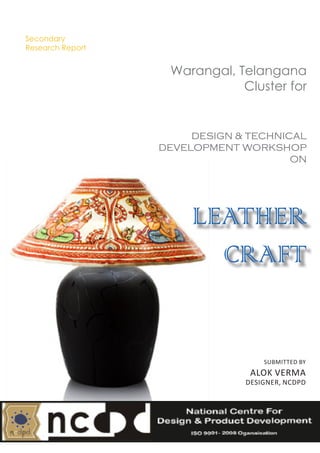
LEATHER
CRAFT
SUBMITTED BY
ALOK VERMA
DESIGNER, NCDPD
Preface
Crafts is an integral part of any culture or tradition
around the world. Some parts of it have been ableto still
practise it and some were not fortunate enough to have
sustained its existence in its actual formand meaning. In the
western world, people and organisations are trying to
remember and recognizethe lost crafts that used to define
and essentuate the meaning of their cultural values. In a
country like India, where tradition, rituals and culture still
hold asignificant value and importance, crafts have been
able to retain its integral substance in the form of many
definitions, according to individuals, groups and organisa-
tions. Yet there is need for resources, documentations and
retainment of skills,material and processes within crafts as a
sector in all fields.
This report deals with the role of design interventions in crafts
in India and its execution in practical application with a
systematic implementation of careful steps, i.e., its frame-
work proposed in Indian context. It deals with defining crafts
and its relation with culture and tradition, which further
enablesto understand the role of a designer in that of an
artisan’s contribution to crafts.
The report is about a royal Indian craft technique known as
Leather Craft, which ia practiced in Warangal, Telangana.
This consists of its origin, historic significance, its ingredients,
process and the design intervention of a designer and of an
organization, NCDPD.
Design & Technical Development Workshop/NCDPD/2014………..P a g e 3 | 44
C o n t e n t
ABOUT
NCDPD
CRAFT
WARANGAL,
TELANGANA
LATHER CRAFT,
AN INDIA CRAFT
MARKET STUDY
Area Of Involvement
Vision
Its Defination
Artisans & Designers
Why Design Intervention In Crafts
About Warangal
Etymolgy
History
Geography & Climate
Demographics
Administration
Economy
Transport
Eduction
Culture
Turisum
Its Origin
Significance of collection of Leather craft
The Workshop
Products
Old style products of Leather Craft
New style products in market of Leather
Craft
The Need Of Design Intervention
Design intervention & Market
The Framework
References
Design & Technical Development Workshop/NCDPD/2014………..P a g e 5 | 46
About NCDPD
Set up in 1999, under society’s Act by Development
Commissioner (Handicrafts) Ministry of Textiles,
Govt. of India. The Board of NCDPD is represented
by eminent exporters, policy makers and
renowned people of trade industry. Development
Commissioner (Handicrafts), Ministry of Textiles,
Govt. of India was Ex-Officio Chairman of NCDPD
Board.
NCDPD was set up with the objective to fulfil the
gaps in the handicraft sector of soft and hard goods
in the areas of Design / Product Development and
Technology. NCDPD works in close cooperation
with Development Commissioner (Handicrafts)
to undertake design and product development
activities on pan India basis for clusters. It also
works closely with Export Promotion Council for
Handicrafts (EPCH) and its member exporters to
create future linkage.
NCDPD is equipped with professional International
& National designers who work to provide complete
array of services for customized design / product
development.
Area Of Involvement
• Product design & development
• Design research & dissemination
• Design promotion
• Image building and branding
• Product standards and product excellence
• Exhibitions design, showroom and store
development and visual merchandisin
• Industry linkages, tie-ups and networking
• Vendors compliance
• Package design
• Graphic design
• Technology upgradation
• Design, market and technical trends information
• Design research and library / resource centre
• Design training, mentoring, apprenticeship and
career opportunities
Vision
• To Cater to the needs of changing taste & Design
concepts of international buyers.
• To provide regular design inputs to handicraft
exporting community about trends & forecast
periodically.
• To create and reinforce the uniqueness of Indian
designs, and demonstration how the design can
be implement in the products.
• To update the sector about the changing
global scenario with reference to technical
advancement.
• To support artisan and exports with product
development and upgrade quality.
Design & Technical Development Workshop/NCDPD/2014………..P a g e 7 | 46
SURVEY REPORT
About
Handicrafts Artisans
Welfare Association
Design & Technical Development Workshop/NCDPD/2014………..P a g e 9 | 46
SURVEY REPORT
Handicrafts Artisans Welfare Association
is a Non-Profit Voluntary Organisation in
operation since 1984 operating
various activities for social benefit in over
67 villages all over Warangal district.
The main objective of Handicrafts Artisans
Welfare Association is to work towads the
improvements in the living conditions of
the rural and urban poor with emphasis
on women, children, farmers, diabled
persons, social minorities, Dalits, Land-
less labourers and rural artisans. To
attai its objectives Handicrafts Artisans
Welfare Association has been organizing
various programs.
Handicrafts Artisans Welfare Associa-
tion has been identified by Development
Commissioner (handicraft), Ministry of
Textiles, for Leather cluster Develop-
ment Program under their National
Programme for rural Industrialization, and
has been helping in formation of Self Help
Groups among artisans and their linkage,
exibitions and other training workshops.
The office of the Development
Commissioner (handicraft), Ministry of
Textiles, Govt. of India has sanctioned
AHVY scheme for Leather Cluster
Development to Handicrafts Artisans
Welfare Association for activities like
conduction of exibitions, Design and
Technical Development workshops,
Upgradation training programs, Margin
Money Scheme, Publicity and CFC etc.
Craft, In India
Its Defination
Professor M.P. Ranjan has defined Crafts as
“those activities that deal with the conversion of
specificmaterials into products, using primarily
hand skills with simple tools and employing the
localtraditional wisdom of craft processes.” He
further adds,” Such activities usually form the
core economic activity of a community of people
called ‘craftsmen’.” Another definition states that
craftsdeveloped out of necessity to fulfill everyday
needs of people (Dhamija, 1979). The products
andobjects made were for personal use and were
instrumental in expressing their individuality and
their way of life. The very act of creation gave a
new meaning to their life, to their self expression
and tothe rituals, and also helped to develop an
aesthetic sensibility. In the Indian context crafts
have been both for personal use and an expres-
sional fulfillment and economic activity. It evolved
out of being a product of use, then was ornament-
ed and given an aesthetic appeal to it. As the royals
always lookedfor possessions that identified with
their stature and affluence, they chose items from
within their territory, which craftsmen and artisans
made, and thus the concept of patronage evolved.
Thereafter craftsmen started to produce artifacts
and products for the royals on commissioned or-
ders, following a brief provided by the royals. In
this way, crafts have been an economic
activity since a long time.If crafts are assumed
to be “artisanal product”, then according to
the definition adopted by UNESCO defines
artisanal products as the ones that are produced
by artisans, made entirely by hand, tools or
even mechanical means, till the direct manual
input of the artisan remains the most significant
andvalue adding component of the final
product. These products tend to have a unique
feature that can be,utilitarian, aesthetic, artistic,
creative,culturallyattachedandsociallysymbolic
and significant. Thisdefinition places
‘manual input’ as the most significant and value
adding component and thusconfirms the
importance of the artisan and his skills, that need
to remain original and without manipulation.
Craft can be defined as a personal journey of
a craftsperson where the mainobjective is self
expression. The personalization, imperfections
imparted because of hand work anduse of
indigenoustools and skills are the factors
that differentiate “craft” from a commodity.
Although craft is a form of commodity for the
craftsmen and for people who commission a
craft product, with a particular cultural, ritual-
istic or utility context, they need to be clearly
differentiatedfrom “machine-made” prod-
ucts. The input of handwork and time invested
Design & Technical Development Workshop/NCDPD/2014………..P a g e 11 | 46
SURVEY REPORT
With ritualistic crafts, that are no more prevelant
inpractice,thequestionofrelevancebecomeseven
more intense. How would a ritualistic craftfind
a place in a modern household and what will be
its function? If this goes through somechanges,
will it loose its identity as a craft? Alongwith
considering everyone in mankind as adesigner, it
is also important to note the responsibility of the
designer in such a case of intervention for reviving
a dying craft or maintaining its existence. This
also invites for importance given to a balance that
needstobecreatedbetweendesignerandhisinputs
and theinput of the artisan, in order to create a
marketable product and yet sustain its identity.As
craftsareutilitybased,andaneconomicallyviable
product, they must respond to thedemands of the
markets,consumerneeds,fashiontrendsandusage
preferences.Itisconsideredtheroleofthedesigner
tointerpretthesechangesaccurately,andcarrying
out suitableimplementations with thorough
understanding and sentitized strategies. While
doing this thedesigner must consider the identity
and relevance of the craft with the target market,
andconducttheintervetionaccordingly.Thetarget
marketshouldbeabletodecodetheculturalvalues
and semantics encoded in the product, which in
turn will ensure the understanding of the craft in
its true meaning. This can be made possible with
a meaningful interaction betweenartisans and
designers,toresultinaproperdevelopmentofcraft,
econmically and aesthetically.
a amplifying factor, rather than a walled cage. It
must create potential rather thanconfinement.
Futher clarifying, crafts have been an economic
activity, as seen in the jajmani system, wherethe
client decides to invest in a craft because of its
aesthetics, price point and efficientusefulness in a
competent way, rather than from a philantrophic
concern. In order to remaineconomically viable,
developmentprocesseslikemarketingarenecessary.
Artisans thus needdesign interventions to compete
efficiently with the products and services provided
by theindustrialized modern producers at cheaper
price points. Design interventions also assist in
creating an awareness among artisans of methods,
materials,tools,processesandclientelebase.Inmany
casestheartisansofaregionhavelostorratherdonot
have a documented form of the craft. Traditional
crafts are memory based, and onlymemory is the
knowledge bank of their traditional methods and
materials . Also in a situationwhere a material may
not be available at a region, and is a significant part
of a craft production process, is at times available in
nearby regions and states. Design intervention can
help in documenting the processes and materials
involved in a craft, toform a database that can be
interpreted by an illiterate artisan, who lacks in the
knowledge of traditional methods and processes.
Thus design interventions can become a means for
preservation of cultural resources. And as craft is a
direct outcome of culture, preserving theessence of
craftisequivalenttopreservingtheculturalnuances
of a region and community.
Why design intervention in crafts?
There has been distortions and deterioration in
crafttraditionsandactivities,resultingoutofmany
intentional design interventions. The validity of
design intervention is understood if it isseen as
in producing a craft,imparts such values within it,
which a machine-made, mass produced product
can never achieve. Theidea is not to consider craft
as only a ritualistic or cultural product, but also as
a utilitarian product,that has certain background to
its elements, materials, form and use.
the principles or elements of design, or with any
guidelinesthat design as a field requires today to
exist. It was his natural sensibility of colors and
formsthat made him the designer that was suc-
cessful and accurate.It is further explained by
S.Balaram, 1998, from an Indian perspective,
“Innovative men fromall walks of life- the
poorest street vendor, the social worker, the
engineer, the craftsman andthe teacher are
designers without being called so”. It is well
understood that the indegenoussensibility of
design was always existent and resulted in flawless
designs and compositions.In the paper “Anyone
designing anything?” Philip Pacey argues about
the non-professionaldesigners, that have been
designing throughout the history of design.
The indian craftsmen canalso be considered as
nonprofessional designer. Over emphasisation on
design as a“professional activity” has resulted in
theunderestimation of the value of an artisan,
i.e. a nonprofessional designer in this case. If we
consider an artisan as a non-professional
designer, wecan clearly see the context of the
statementinrelevancetocraftsmenandtheirskills.
Globalisation has been able to link spaces, but has
resulted in separating the past from the present.
There is need to find the lost connection in the past
and present. Designers bridge thegap between
the market and the artisan, as today the artisan is
geographically apart from his/ her client, to be able
to understand his/her aesthetic and socio-cultural
needs. Designers help infinding the relevance of
craft with respect to the artisan, the consumer
and to the global market.Designers are thus an
interface, between the past and the present,
the traditional and themodern, trying to match
craft production to the needs of modern times
and demands as stated by Sethi, 2005. But it does
evoke some new concers, as to is it necessary for a
traditional craftto find relevance in global market?
Inawesternperspective,Craftisdefinedasanintegral
part of day-to-day human experience,expressed
with the skilled manipulation of materials (Rosner,
2009).Ithastodowithmaterials,mindandsensesall
together,manyatimeswiththehelpoftechnological
tools. Rosner includes tools like, paintbrushes,
to potter’s wheel, to computer to 3D printers, all
under the tools required and used incrafts, which
is in contradiction with the Indian perspective.
Where in India crafts have beenemphasized as a
product of “hand skills” with values and tradition
imparted, in western context evencomputers and
othertechnologicaltoolsareinvolvedintheprocess
of craftsmanship with ease. Thisclearly states that,
crafts, in India, need to be addressed only in a
regional and cultural context. Thatregion can be a
local cluster, a state or the country depending upon
its relevance, marketability, andcultural back-
ground.
Artisans & Designers
Inthepastwhentherewereartisansandconsumers,
and the artisan was in direct connect withthe
consumer, being familiar with their aesthetic and
socio-cultural requirements. The artisan never had
to depend on external sources to understand his
client. He knew his clients personally and could
easily predict his preferences and demands. The
artisan used to interacwith the client on a regular
basis and somewhere in this process of interaction,
design evolved.The artisan was never trained in
Design & Technical Development Workshop/NCDPD/2014………..P a g e 13 | 46
SURVEY REPORT
warangal
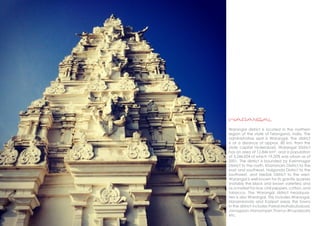
Warangal district is located in the northern
region of the state of Telangana, India. The
administrative seat is Warangal. The district
is at a distance of approx. 80 km. from the
state capital Hyderabad. Warangal District
has an area of 12,846 km², and a population
of 3,246,004 of which 19.20% was urban as of
2001. The district is bounded by Karimnagar
District to the north, Khammam District to the
east and southeast, Nalgonda District to the
southwest, and Medak District to the west.
Warangal is well known for its granite quarries
(notably the black and brown varieties) and
as a market for rice, chili peppers, cotton, and
tobacco. The Warangal district headquar-
ters is also Warangal. This includes Warangal,
Hanamkonda and Kazipet areas the towns
in the district includes Parkal,Mahabubabad,
Janagaon,Narsampet,Thorrur,Bhupalpally
etc.
Recognized as one of the best heritage cities of India, Warangal is situated 145 km away
from Hyderabad.
Warangal is the fifth largest city in the state. Its name is derived from the word Orugal-
lu – ‘Oru’ which means one and ‘Kallu’ means stone. The city was also known as Ekasila
Nagaram. It is presently an ushering industrial and cultural centre in the state of Andhra
Pradesh in India.
Warangal was the capital of the great Kakatiya kingdom which ruled
between 12th and 14th century. It is assumed that the Prola Raja of great Kakatiya
Kingdom built the beautiful town in the 12th century. The Kakatiyas, who ruled for
more than 200 years, have left many grand monuments and architectural marvels like
the famous Warangal fort, Swayambhu Temple and many other ancient structures.
In February 2013, Warangal was accorded World Heritage city status by UNESCO.
Government of India’s Tourism Ministry also recognized the city as the Best Heritage City
along with Jaipur.
Warangal attracts many tourists, thanks to its important history. Warangal’s temples are well
known for its outstanding architecture and splendid history. Warangal is also known for its
granite quarries and is famous for blue granite.
The main attraction of the city is the Warangal Fort, which is spread over a radius of 19
km between Warangal and Hanamkonda. This fort was constructed in the 13th century
during the reign of King Ganapati Deva. This fort is most famous for its intricately carved
arches and pillars and four large stone gateways.
The fort’s remarkable main gateway is made with four gigantic pillars which have
been extracted from one single rock stone. The three protective layers in the Warangal
fort epitomizes the standards of Kakatiya kingdom. The fort also contains a temple inside it
which is dedicated to the Mother Earth, Swayambhudevi. At present, the fort lies in ruins.
Natural beauty mixed with magnificent manmade structures makes Warangal an
attractive destination. The 13th century star shaped Shiva temple, Bhadrakali temple
and the thousand pillared temple are the city’s charm. Wildlife Sanctuaries at Pakhal
and Eturnagaram and the Pakhal Lake are other tourist spots which are worth visiting.
About Warangal
E T Y M O L G Y
"Oru" terms the word 'single', "Kallu" is referred as a 'stone'. The word
"Orugallu" synonyms, one rock, which describes the city was carved
out of a single large stone. The word "Ekashilanagaram" is other way
of describing the name Orugallu which literally means same as "City
Carved Out of Single Stone", used very commonly in the period of
kakatiyan empire. As the time went on, orugallu was changed to
"Warangallu" and finally settled as Warangal.[10] It is also nick named
as Tri-City, as warangal is the combination of Warangal, Hanam-
konda and Kazipet sub urbans areas. While referring to the historical
monuments in the city, it is termed as "Kakatiyula Nagaram" as it was the
capital city of Kakatiya kingdom.
H I S T O R Y
In historical times, Warangal was the capital of a Shaivaite
kingdom that was ruled by the Kakatiya dynasty from 12th to the
14th centuries. Its old name was Orugallu where Oru means one
and Kallu means stone. The entire city was reportedly carved in
a single rock, hence the name Orukallu that means one rock.
The Kakatiyas built many monuments, impressive fortress, massive
stone gateways, a temple dedicated to Shiva, and also the Ramappa
temple. The cultural distinction of the Kakatiyas was penned by the
famous traveler Marco Polo. Ganapathi Deva, Prathapa Rudra, and
Rani Rudrama Devi were among the main rulers. It was occupied
by Bahmani Sultanate followed by the takeover of Mughal emperor
Aurangzeb and later in 1724, it had become part of Telangana region.
Warangal is well connected by rail from Hyderabad, New Delhi,
Vijayawada, Visakhapatnam and Chennai. The city represents a
cluster of three towns such as Warangal, Kazipet and Hanamkonda.
The city is famous for many attractions.
Design & Technical Development Workshop/NCDPD/2014………..P a g e 17 | 46
SURVEY REPORT
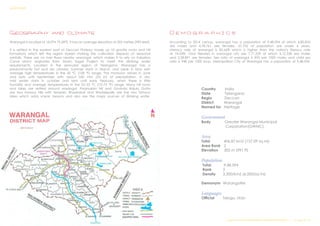
Geography and climate
Warangal is located at 18.0°N 79.58°E. It has an average elevation of 302 metres (990 feet).
It is settled in the eastern part of Deccan Plateau made up of granite rocks and hill
formations which left the region barren making the cultivation depend on seasonal
rainfalls. There are no river flows nearby warangal, which makes it to rely on Kakatiya
Canal which originates from Sriram Sagar Project to meet the drinking water
requirements. Located in the semi-arid region of Telangana, Warangal has a
predominantly hot and dry climate. Summer starts in March, and peak in May with
average high temperatures in the 42 °C (108 °F) range. The monsoon arrives in June
and lasts until September with about 550 mm (22 in) of precipitation. A dry,
mild winter starts in october and lasts until early February, when there is little
humidity and average temperatures in the 22–23 °C (72–73 °F) range. Many hill rocks
and lakes are settled around warangal. Padmakshi hill and Govinda Rajula Gutta
are two famous hills with temples. Bhadrakali and Waddepally are the two famous
lakes which adds scenic beauty and also are the major sources of drinking water.
D e m o g r a p h i c s
According to 2014 census, warangal has a population of 9,48,594 of which 4,80,833
are males and 4,78,761 are females. 67,732 of population are under 6 years.
Literacy rate of warangal is 82.56% which is higher than the nation's literacy rate
of 74.04%. Total literates in warangal city are 7,71,229 of which 4,12,338 are males
and 3,58,891 are females. Sex ratio of warangal is 995 per 1000 males and child sex
ratio is 948 per 1000 boys. Metropolitan City of Warangal has a population of 9,48,594.
Country	 India
State	 Telangana
Regio Deccan
District Warangal
Named for Heritage
Government
Body	 Greater Warangal Municipal
Corporation(GWMC)
Area
Total	 406.87 km2 (157.09 sq mi)
Area Rank	 2
Elevation	 302 m (991 ft)
Population
Total	 9,48,594
Rank	 2
Density	 2,300/km2 (6,000/sq mi)
Demonym	 Warangalite
Languages
Official	 Telugu, Urdu
Design & Technical Development Workshop/NCDPD/2014………..P a g e 19 | 46
SURVEY REPORT
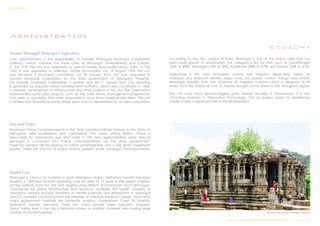
A d m i n i s t r a t i o n
Greater Warangal Municipal Corporation
Civic administration is the responsibility of Greater Warangal Municipal Corporation
(GWMC), which oversees the three cities of Warangal, Hanamkonda and Kazipet.
In July 1951 the city was upgraded to Special Grade Municipality status. Later, in July
1960, it was upgraded to Selection Grade Municipality. On 18 August 1994, the city
was declared a municipal corporation. On 28 January 2015, city was upgraded to
Greater Municipal Corporation by the state government of Telangana Presently,
the Greater Municipal Corporation is spread over 407.71 square km2. City planning
is governed by Kakatiya Urban Development Authority, which was constituted in 1982.
It oversees development of infrastructure and other projects in the city. The Corporation
implemented some pilot projects, such as the Solid Waste Management programme,
that were so successful that other corporations have since implemented them. The city
is divided into 58 political wards where each ward is represented by an area corporator.
Law and Order
Warangal Police Commissionerate is the third commissionerate formed in the state of
Telangana after Hyderabad and Cyberabad. The urban police district, which is
responsible for maintaining law and order in city and agglomerated areas around
warangal is converted into Police commissionerate by the state government.
Inspector General will be working as police commissionear who is also given magisterial
powers. There are around 19 police stations present under warangal commissionerate.
Health Care
Warangal is famous for hospitals in north telangana region. Mahatma Gandhi Memorial
Hospital a 1200-bed hospital sprawling over an area of 13 acres is the largest hospital,
serving patients from the city and neighbouring districts of Khammam and Karimnagar.
Considering the better infrastructure and resources available, first health university of
telangana named Dr.Kaloji University of Health Sciences was established in warangal
which is currently functioning from the premises of Kakatiya Medical College. Apart from
major government hospitals like Maternity Hospital, Government Chest TB Hospital,
Mahatma Gandhi Memorial, there are many private super speciality hospitals.
Vijaya talkies lane in the city is famously known as hospital clustered area having large
number of private hospitals.
E c o n o m y
According to the 2011 census of India, Warangal is one of the Indian cities that has
seen rapid growth of urbanisation. This category is led by cities such as Gandhinagar
(35% to 43%), Warangal (19% to 28%), Kozhikode (38% to 67%) and Krishna (32% to 41%).
Agriculture is the main economic activity with irrigation depending mainly on
monsoon and seasonal rainfalls. Major crops are paddy, cotton, mango and wheat.
Warangal benefits from the Godavari lift irrigation scheme which is designed to lift
water from the Godavari river to irrigate drought prone areas in the Telangana region.
The city hosts Asia's second-biggest grain market, located in Enumamula. It is also
attracting investors in information technology. The incubation tower at Madikonda
is likely to play a significant role in this development.
Thausand Piller Temple, Warangal, Telangana
Design & Technical Development Workshop/NCDPD/2014………..P a g e 21 | 46
SURVEY REPORT
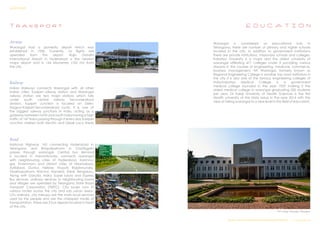
T r a n s p o r t
Airway
Warangal had a domestic airport which was
established in 1930. Currently, no flights are
operated from this airport. Rajiv Gandhi
International Airport in Hyderabad is the nearest
major airport and is 164 kilometres (102 mi) from
the city.
Railway
Indian Railways connects Warangal with all other
Indian cities. Kazipet railway station and Warangal
railway station are two major stations which falls
under south central railway Secunderabad
division. Kazipet Junction is located on Delhi-
Nagpur-Kazipet-Secunderabad route. It is one of
the biggest railway junctions in India, acting as a
gateway between north and south India having a high
traffic of 147 trains passing through it every day.Kazipet
Junction shelters both Electric and Diesel Loco sheds
Road
National Highway 163 connecting Hyderabad in
Telangana and Bhopalpatnam in Chattisgarh
passes through warangal. Central bus terminal
is located in Hanamkonda, connects warangal
with neighbouring cities of Hyderabad, Karimna-
gar, Khammam and distant cities of Nizamabad,
Adilabad, Guntur, Nellore, Tirupati, Rajahmundry,
Visakhapatnam, Raichur, Nanded, Shirdi, Bengaluru.
Along with Garuda, Indra, Super luxury and Express
Bus services, ordinary services to neighbouring towns
and villages are operated by Telangana State Road
Transport Corporation (TSRTC). City buses runs in
various routes across the city and sub urban areas.
City ordinary, city merupu are the main local services
used by the people and are the cheapest mode of
transportation. There are 3 bus depots located in heart
of the city.
E D U C A T I O N
Warangal is considered as educational hub in
Telangana, there are number of primary and higher schools
located in the city. In addition to government institutions
there are private institutions, missionary schools and colleges.
Kakatiya University is a major and the oldest university of
warangal affiliating 471 colleges under it providing various
streams in the courses of engineering, medicine, commerce,
business management. NIT Warangal, formerly known as
Regional Engineering College is another top most institution in
the city it is also one of the famous engineering colleges of
India.Kakatiya Medical College is a government
medical college founded in the year 1959 making it the
oldest medical college in warangal graduating 200 students
per year. Dr Kaloji University of Health Sciences is the first
Health university of the state setup in the year 2014 with the
view of taking warangal to a new level in the field of education.
NIT College, Warangal, Telamgana
Design & Technical Development Workshop/NCDPD/2014………..P a g e 23| 46
SURVEY REPORT
c u l t u r e
City has a diverse culture with different religions and
their respected traditions. Major proportion of city
population are Hindus followed by Muslims,
Christians, Sikhs and Jains. Dussera, Sankranthi, Ugadi,
Ramzan, Christmas and Diwali are the famous festivals
celebrated by the people.Telugu and Hindi are
major languages spoken by the city people, how ever
english is also widely used for communication purpose.
Warangal has a mix of urban, rural and cosmopolitan
lifestyles.
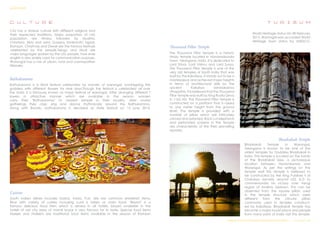
Bathukamma
Bathukamma is a floral festival celebrated by women of warangal, worshipping the
goddess with different flowers for nine days.Though the festival is celebrated all over
the state, it is famously known as major festival of warangal. After arranging different f
lowers in attractive manner which are available in the season, women
carry their "Bathukamma" to nearest temple in their locality, after crowd
gatherings they clap, sing and dance rhythmically around the Bathukamma.
Along with Bonalu, bathukamma is declared as state festival on 15 june 2014.
Cuisine
South Indian dishes includes Dosha, Vada, Puri, Idly are common breakfast items.
Rice with variety of curries including curd is taken as main food. "Biryani" is a
famous delicious food item which is served in all hotels, biryani available in the
hotels of old city area of mandi bazar is very famous for its taste. Special food items
Harees and Haleem are traditional food items available in the season of Ramzan
t u r i s u m
World Heritage status On 28 February
2013, Warangal was accorded World
Heritage town status by UNESCO.
Thousand Pillar Temple
The Thousand Pillar Temple is a historic
Hindu temple located in Hanamakonda
Town, Telangana, India. It is dedicated to
Lord Shiva, Lord Vishnu and Lord Surya.
The Thousand Pillar Temple is one of the
very old temples of South India that was
built by the kakatiyas. It stands out to be a
masterpiece and achieved major heights
in terms of architectural skills by the
ancient Kakatiya vishwakarma
sthapathis. It is believed that the Thousand
Pillar Temple was built by King Rudra Deva
in 1163 AD. The Thousand Pillar Temple is
constructed on a platform that is raised
to one meter height from the ground
level. The temple is provided with a
number of pillars which are intricately
carved and adorned. Rock cut elephants
and perforated screens in the temple
are characteristic of the then prevailing
dynasty.
Bhadrakali Temple
Bhadrakali Temple in Warangal,
Telangana is known to be one of the
oldest temples for Goddess Bhadrakali in
India. This temple is located on the banks
of the Bhadrakali lake, a picturesque
location between Hanamkonda and
Warangal. As per the writings on the
temple wall this temple is believed to
be constructed by the King Pulakesi II of
Chalukya dynasty around 625 A.D to
commemorate his victory over Vengi
region of Andhra Desham. This can be
observed from the square pillars used
in the temple structure which were
different from the circular pillars
commonly used in temples construct-
ed by Kakatiyas. Bhadrakali Temple has
become a major tourist place and people
from many parts of India visit this temple.
Design & Technical Development Workshop/NCDPD/2014………..P a g e 25 | 46
SURVEY REPORT
Warangal fort
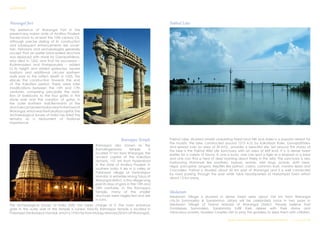
The existence of Warangal Fort in the
present-day Indian state of Andhra Pradesh
traced back to at least the 13th century CE.
Although precise dating of its construction
and subsequent enhancements are uncer-
tain, historians and archaeologists generally
accept that an earlier brick-walled structure
was replaced with stone by Ganapatideva,
who died in 1262, and that his successors –
Rudramadevi and Prataparudra – added
to its height and added gateways, square
bastions and additional circular earthern
walls prior to the latter's death in 1323. This
places the construction towards the end
of the Kakatiya period. There were later
modifications between the 15th and 17th
centuries, comprising principally the addi-
tion of barbicans to the four gates in the
stone wall and the creation of gates in
the outer earthern wall.Remnants of the
structurecanbeseentodayneartothetownof
Warangal,whichwastheKakatiyacapital.The
Archaeological Survey of India has listed the
remains as a Monument of National
Importance.
Ramappa Temple
Ramappa also known as the
Ramalingeswara temple, is
located 77 km from Warangal, the
ancient capital of the Kakatiya
dynasty, 157 km from Hyderabad
in the state of Andhra Pradesh in
southern India. It lies in a valley at
Palampet village of Venkatapur
Mandal, in erstwhile Mulug Taluq of
Warangal district, a tiny village long
past its days of glory in the 13th and
14th centuries. In the Ramappa
Temple, many of the smaller
structures were neglected and are
in ruins.
The Archeological Survey of India (ASI) has taken charge of it. The main entrance
gate in the outer wall of the temple is ruined. Exactly Ramappa temple is located in
Palampet,Venkatapur mandal, which is 19 km far from Mulugu Mandal (50 km off Warangal).
Pakhal Lake
Pakhal Lake, situated amidst undulating forest land hills and dales is a popular retreat for
the tourists. The lake, constructed around 1213 A.D. by Kakatiyan Ruler, Ganapathidev
and spread over an area of 30 km2., provides a beautiful site. Set around the shores of
this lake is the Pakhal Wild Life Sanctuary with an area of 839 km2. It is a dense forest
shelter for a variety of fauna. If, one is lucky, one can spot a tiger or a leopard or a bear
and one can find a herd of deer roaming about freely in the wild. The sanctuary is also
harbouring Mammals like panthers, hyenas, wolves, wild dogs, jackals, sloth bear,
nilgal, porcupine, langoor, Reptiles like python, cobra, common krait, monitor lizard and
Crocodiles. Pakhal is situaled about 50 km east of Warangal and it is well connected
by road passing through the east while taluk headquarters of Narsampet town which
about 12 km away.
Medaram
Medaram Village is situated in dense forest area about 104 km from Warangal
city.Sri Sammakka & Saralamma Jatara will be celebrated once in two years in
Medaram Village of Tadvai Mandal of Warangal District. People believe that
Goddesses Sammakka, Saralamma fulfill their desires with their divine and
miraculous powers. Issueless Couples visit to pray the goddess to bless them with children.
Design & Technical Development Workshop/NCDPD/2014………..P a g e 27| 46
SURVEY REPORT
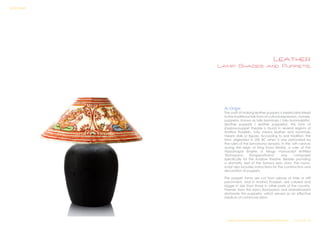
The craft of making leather puppets is inextricably linked
to the traditional folk form of cultural expression, namely,
puppetry. Known as tollu bommalu / tollu bommalatta
(leather puppets / leather puppetry), this form of
shadow-puppet theatre is found in several regions of
Andhra Pradesh. Tollu means leather and bommalu
means dolls or figures. According to oral tradition, the
form originated in 200 BC when it was patronized by
the rulers of the Satvahana dynasty. In the 16th century
during the reign of King Kona Reddy, a ruler of the
Vijayanagar Empire, a Telugu manuscript entitled
‘Ramayana Ranganathana’ was composed
specifically for the shadow theatre. Besides providing
a dramatic text of the famous epic story, the manu-
script also includes instructions for the construction and
decoration of puppets.
Its Origin
The puppet forms are cut from pieces of hide or stiff
parchment, and in Andhra Pradesh, are colored and
bigger in size than those in other parts of the country.
Themes from the epics Ramayana and Mahabharata
dominate this puppetry, which served as an effective
medium of communication.
Leather
Lamp Shades and Puppets,
Design & Technical Development Workshop/NCDPD/2014………..P a g e 29 | 46
SURVEY REPORT
Producer Communities
The main community engaged in this craft is the Marathi Balija, and it
is said that these groups originally came from the Marathwada region.
In earlier times, puppet making was a flourishing business, especially as
puppetry was one of the main forms of entertainment in the villages. But
slowly with the decline in this form of shadow theatre, leather puppet
makers are being forced to diversify their ware into making utility items
such as colorful lampshades or even toys, in order to cater to a new
market.
Raw Materials and Tools Used
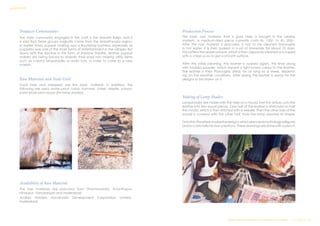
Goat hide and sheepskin are the basic material. In addition, the
following are used: water proof colors, hammer, chisel, needle, scissors,
paint-brush and mould (for lamp shades).
The raw materials are procured from Dharmavaram, Ananthapur,
Hindupur, Narsaraopet and Hyderabad.
Availability of Raw Material:
Production Process
The basic raw material, that is goat hide, is bought in the nearby
markets. A medium-sized piece currently costs Rs. 150/- to Rs. 200/-.
After the raw material is procured, it has to be cleaned thoroughly
in hot water. It is then soaked in a pit of limewater for about 10 days.
This softens the upper surface, which is then vigorously cleaned or scraped
with a chisel so as to get a smooth surface.
After this initial cleaning, the leather is soaked again, this time along
with kadaka powder, which imparts a light brown colour to the leather.
The leather is then thoroughly dried, for as long as a week, depend-
ing on the weather conditions. After drying the leather is ready for the
designs to be drawn on it.
Making of Lamp Shades:
Lampshades are made with the help of a mould. First the artisan cuts the
leather into two equal pieces. One half of the leather is stretched on half
the mould, which is then stitched with a needle. Then the other side of the
mould is covered with the other half. Now the lamp assumes its shape.
Ontothis,theartisanmakesthedesigns,whicharemainlymythologicalfigures
andoccasionallyhisowncreations.Thesedrawingsaredonewithapencil.
Andhra Pradesh Handicrafts Development Corporation Limited,
Hyderabad.
Design & Technical Development Workshop/NCDPD/2014………..P a g e 31 | 46
SURVEY REPORT
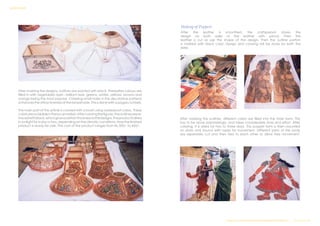
After marking the designs, outlines are painted with black. Thereafter colours are
filled in with vegetables dyes - brilliant reds, greens, whites, yellows, browns and
orange being the most popular. Chiseling small holes in the decorative patterns
enhances the attractiveness of the lampshade. This is done with a pogaru (chisel).
The main part of the article is colored with a brush using waterproof colors. These
colorsareavailableinthelocalmarket.Aftercoloringthefigures,theoutlinesarere-
tracedwithblack,whichgivesacertainthicknesstothedesigns.Theproductisdried
insunlightforadayortwo,dependingontheclimaticconditions.Nowthefinished
product is ready for sale. The cost of the product ranges from Rs.300/- to 450/-.
Making of Puppets
After the leather is smoothed, the craftsperson draws the
design on both sides of the leather with pencil. Then the
leather is cut as per the shape of the design. Then the outline portion
is marked with black color. Design and coloring will be done for both the
sides.
After marking the outlines, different colors are filled into the main form. This
has to be done painstakingly, and takes considerable time and effort. After
coloring, it is dried for two to three days. This puppet form is then mounted
on sticks and bound with ropes for movement. Different parts of the body
are separately cut and then tied to each other to allow free movement.
Design & Technical Development Workshop/NCDPD/2014………..P a g e 33 | 46
SURVEY REPORT
It is interesting to note that while generally puppets are made of
goat-skin, some demon puppets are made of buffalo hide, while gods
and other heroes are depicted on deerskin. The size of puppets varies; it
is said that puppets from Madanapally and Kakinada go up to 4-5 feet.
The leather puppet is wedged into a split bamboo strip and tied along the
length of the strip from the head to the crotch to provide support. Many
puppets have movable hands and legs and some, movable heads and
necks. While black, red and green are some of the colors commonly used
for the puppets, female figures and sages are characteristically depicted
in yellow.
Elaborate ornamentation of puppets indicating jewelry and
clothing is also typical. This effect is done by perforating small
designs on the skin with the help of sharp chisels. The colouring of the
puppets, as mentioned above, is the most elaborate process in the
preparation of the puppets. The designs of the puppets are largely based
on the traditional Puranic figures seen in temple sculpture and idols.
The product takes thirty to forty days to be completed. The
present cost of the product ranges from Rs.500/- to 4000/-,
depending on the size, elaborateness of ornamentation and other details.
Bringing The Puppets To Life
These brilliantly crafted puppets were once the mainstay of riveting
performances of episodes from the Indian epics. For earlier generations
of puppet makers and puppeteers, as many as fifteen performances a
month was the norm. The main puppeteer would stand behind the screen
and narrate stories while simultaneously manipulating the movements
of figures, so as to convey the full essence of the theme being enacted.
Improvisations were not rare, and an interactive performance would
make for greater rapport with the audience. A typical troupe was
composedofbetweensixandtenpeople:manipulators,singers,dancersand
instrumentalists. The sounds and musical accompaniment matched the
actions, and often regaled the audience throughout the long
performance.
Both the Ramayana and Mahabharata stories require at least a hundred
puppet figures. A stick holds aloft each puppet from below and the limbs
are manipulated by means of strings. A white screen is stretched across
the place of performance, a little above the head of the puppeteers who
sit behind. Bright light is thrown from behind the puppets so as to project
their shadows on the curtain to be seen by the spectators on the other
side. The colours stand out beautifully and figures are magnified or short-
ened by varying the distance between the light and the puppets. Tolu
Bommalata is best described as a
Marketing
The market for leather puppets and leather lampshades is through
exhibitions and through emporia (such as Lepakshi) and other crafts
stores. According to the crafts persons, the government needs to play
a more proactive role in marketing, and in providing infrastructural
support such as setting up exclusive showrooms. However, as of
now, the main channel for sales is exhibitions in metros and big cities.
Export potential exists but does not seem to have been tapped enough.
Design & Technical Development Workshop/NCDPD/2014………..P a g e 34 | 46
SURVEY REPORT
Designs
Leather puppets being a pre-requisite of a traditional art form like
puppetry, the figures, themes and design motifs have largely been drawn
from traditional and religious sources. Epics like the Ramayana and
Mahabharata largely inspire lampshades of different shapes and sizes.
Hindu deities such as Ganesh, Vishnu and Krishna are also
depicted on these, as are floral and animal motifs. Ramayana themes often
predominate in the designs, with vivid depictions of Hanuman,
Ravana with his ten heads, Vinayaka seated regally. Sundarakanda,
Lankadahanam, Ravana Vadha and Laxmana Moksha are all portrayed on
these. Characters from the Panchatantra are also used. In contemporary
times, the eye-catching leather puppets double up as wall decorations.
The fact that the product is now a decorative and/or utility item in a
modern world has also brought some changes. The move to make
lampshades instead of leather puppets alone is one such strategy to
remain responsive to the changing market. However, design
inputs will have to keep in mind the different markets being
targeted. What is popular in an export market may not necessarily sell
well in national exhibitions; so dual product lines need to be developed.
The
Workshop
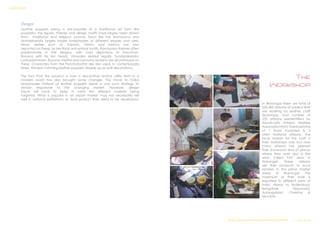
In Warangal there are total of
350-400 artisans at present that
are working for leather craft
technique. And number of
235 artisans areidentified by
Handicrafts Artisans Welfare
AssociationNGO.Therearetotal
of 1 State Awarded & 3
Merit National artisans. The
local market for this craft is
their workshops only but now
many artisans has opened
their showroom kind of places
where they work also in the
area called Fort area in
Warangal. These artisans
sell their products to local
retailers in the prime market
areas of Warangal. The
maximum of their work is
exported to different parts of
India. Mainly to Hyderabad,
Bangalore, Vijaywada,
Aurangabad, Chennai &
Mumbai.
Design & Technical Development Workshop/NCDPD/2014………..P a g e 35| 46
SURVEY REPORT
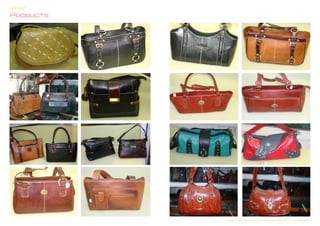
Products
Design & Technical Development Workshop/NCDPD/2014………..P a g e 39| 46
SURVEY REPORT
MARKET POTENTIAL
(LOCAL/EXPORT) / MARKET STUDY
STRENGTHS
Large, diversified and potential market.
There is large product variety and range is available because of diversified
culture.
It has strong, diversified and supportive retail infrastructure.
Diversified product range that service different market.
Cheap labor rates that result to competitive price.
Need low capital investment.
There is flexible production flexibility.
Low barriers of new entry.
WEAKNESSES
Lack of infrastructure and communication facilities.
Unawareness about international requirements and market.
Lack of co-ordination between government bodies and private players.
Inadequate information of new technology.
Inadequate information of current market trends.
Less interest of young people in craft industry.
OPPORTUNITIES
Rising demand for handicraft products in developed countries such as USA,
Canada, Britain, France, Germany, Italy etc.
Developing fashion industry requires handicrafts products.
Development of sectors like Retail, Real Estate that offers great requirements
of handicrafts products.
Development of domestic and international tourism sector.
e-Commerce and Internet are emerged as promissory distribution channels
to market and sell the craft products.
IMPLEMENTATION STRATEGY
Implementation of modern design
After studying the cluster and craft to get the details of methodology
and persons associates with the craft; we will keep the naturality and the
tradition of the craft so that we can implement new design and new
technique without changing the beauty and tradition of the craft.
We analyzed the market to get the idea of the salable product we will
design. Looing at the budget and limitation of crafts we will implement
the designs which are more economic and consumer friendly.
Looking at the market and cluster we decide to develop products which will
be similar the existing product.
Design & Technical Development Workshop/NCDPD/2014………..P a g e 41| 46
SURVEY REPORT
The Need of a Design Intervention
Design intervention has a role in every step
of the process in creation of the craft. This
couldinvolve designing new products;
redesigning existing products, with
changes in shape, size,color, surface
manipulation, function and utility; exploring
new markets and reviving lapsedmarkets;
applying traditional skills to meet new
opportunities and challenges; and the
introduction of new materials, new
processess, new tools and technologies.
Design interventionis seen as an interface
between traditional and modernity, that
matches craft production to theneeds of
modern living. But Sethi has not explained
as to how function and utility of a craft-
can be changed and manipulated for
commercial viability. Function and utility
are the core of the essence and identity of
a craft. If these are manipulated with, how
the craft retains itsidentity, is a question
that Sethi has not addressed to. Here it is
necessary to keep in mind therelevance
of ritualistic crafts that are not prevalent
and need commercialization to be able
tosurvive and earn a livelihood for the
craftsmen. Means of creating balance is
necessary betweenmaking the product
commercially viable and still retaining its
identity.
Also this new client follows an
ephermal guideline of trends and fashion,
that changes withalarming frequency. This
provides for a short term solution for the
artisans as a potentialmarket. Even the
changes brought-in by design interventions
are applicable for a short periodof time
because of the ever changing, fickle
demands of the urban client.
Supporters of thisargument are in favor of a
form of design intervention that opens up
local, organic and closelyrelated markets
to artisans, as it used to be in earlier times.
They support the viewpoint that it ismore
profitable in the long run for the designers
to intervene in design development
that provides unique point and edge to
the product that competes well in the
local market. However in the conventional
setup, designers come in close interac-
tion with such artisans for a shortspan of a
project periods, which makes it challanging
to incorporate long term interventionsand
review of implementations. (Sethi, et al.,
2005)Design intervention has a profound
responsibility, for it to not manupulate the
artisan’s trainingand creative vision with a
aesthetic idea of developing his product
for a temporary market.
The Design Intervention & Market
There is potential for debate about
what kind of market should a design
intervention open for acraftsman. As a
result of design intervention, the artisan
is creating products for lifestyles thatare
alien and remote from their own, in highly
competitive markets. They may not have
evenseen that client, or for the fact even
know them. Designers are continuously
trying to assist theartisan in coping with
the demands of the new markets or to get
familiar with an alien client.
This can be achieved if the designers
underplay their own individual
creativity and facilitatethat of the artisan.
Artisinal creativity needs to be respected
and protected. This helps in preventing the
artisan to become equivalent to skilled
labor, executing the design expression-
sof professional designers. Insensitive
design intervention separates elements
of craft and then juxtaposes them in new
ways. The purpose of design range is to
inspire the artisan to undertaketheir own
innovations a step forward and not to
direct them into passive replication. The
uniqueness of each craft needs to be
understood
by the design team. The design
intervention should not end in breaking
the link between craft and artisan, i.e.,
culture. Such designintervention results
in the craft, i.e., the product to get
decontextualized. Design interventions
are not only product based interven-
tions, but can also be technological.
Technology can play a role at solving
problems without compromising core
of the craft. For this to happen, they
should be efficient and gradual, because
if sudden they can result incasualty of
a complete cultural literacy. Suitable
technology for design intervention
can beachieved by either upgrading
traditional technology or scaling down
modern technology. Thisway the
technology would only help in making
the process fast and commercially viable,
yetnot manipulating or changing the
original steps and processes. Thus it
provides with tools and processes that
allow more time for the application
of hand skills, that is the core of crafts.
Design interventions should focus on the
identity of a craft, its social and cultural
relevance toits region, and the process-
es and materials involved, to incorporate
the interventions in the rightsituations, with
efficient expected outcomes and
reasonings.
The Framework
Design interventions are carried out
everyday for crafts for various reasons.
This has a framework that is followed :
• To preserve a heritage, a dying craft,and
a way of life.
• To preserve cultural values and crafts as
cultural symbol.
• To create a database to support
proactive intervention.
• To create sustainable livelihoods and
development.
• To create visibility for a particular craft,
or a group of artisans.
• For problem solving.
• To create new product lines, to provide
knowledge of the market and
establishnew market links.
• Selecting the Craft, the Artisans and the
Geographical Area.
• Determining a Realistic Scope for the
Intervention.
• Selection of the Format for Intervention.
• Preparation and orientation of the
design team.
• Understanding the Craft, Its Context
and Environment. Integrating the con
text nto theFormat of the Planned
Intervention.
• Understanding the existing processes of
the Craft: Materials, Processes, Technol
ogiesand Practices.
• Understanding the Artisan and estab
lishing Communication. Humanizing
the interaction and Respecting the
Artisan.
• Treating the Artisan as a Creative
part ner, not as a Skilled labor.
• Building skills and capacities of Artisan,
orienting the Artisan.
• Recognizing and developing the
Product USP (Unique Selling
Proposition).
• Tradition and Adaptation. Product
semantics.
• Understanding the Markets.
• Sustained followups of interventions.
Design & Technical Development Workshop/NCDPD/2014………..P a g e 43| 46
SURVEY REPORT
References
http://en.wikipedia.org/wiki/Warangal
http://en.wikipedia.org/wiki/Warangal_district
http://warangal.nic.in/
http://kakatiya.ac.in/historicalcity
http://www.indovacations.net/english/Warangal_about.htm
http://travel.india.com/warangal/
http://www.craftclustersofindia.in/site/index.aspx?Clid=633
Design & Technical Development Workshop/NCDPD/2014………..P a g e 45| 46
SURVEY REPORT
Development Commissioner Handicrafts
Ministry Of Textiles, Govt. Of India
West Block No. VII, R.K. Puram, New Dehi- 110066
Tel: +91-11-26126902, Fax: +91-11-26163085
Web: www.handicrafts.nic.in, www.craftclusterof india.in
Sponsored by:-
National Center For Design & Product Development
43, Okhala Industrial Estate-III (Behind Modi Mill), New Delhi-110020
Tel: +91-11-26821262 / 26821265 Fax: +91-11-26821260
Email: ncdpd@ncdpd.in Web: www.ncdpd.in
Organized by:-

Leather Craft Project Survey Report

  • 1.
    DESIGN & TECHNICAL DEVELOPMENTWORKSHOP ON Secondary Research Report Warangal, Telangana Cluster for LEATHER CRAFT SUBMITTED BY ALOK VERMA DESIGNER, NCDPD
  • 2.
    Preface Crafts is anintegral part of any culture or tradition around the world. Some parts of it have been ableto still practise it and some were not fortunate enough to have sustained its existence in its actual formand meaning. In the western world, people and organisations are trying to remember and recognizethe lost crafts that used to define and essentuate the meaning of their cultural values. In a country like India, where tradition, rituals and culture still hold asignificant value and importance, crafts have been able to retain its integral substance in the form of many definitions, according to individuals, groups and organisa- tions. Yet there is need for resources, documentations and retainment of skills,material and processes within crafts as a sector in all fields. This report deals with the role of design interventions in crafts in India and its execution in practical application with a systematic implementation of careful steps, i.e., its frame- work proposed in Indian context. It deals with defining crafts and its relation with culture and tradition, which further enablesto understand the role of a designer in that of an artisan’s contribution to crafts. The report is about a royal Indian craft technique known as Leather Craft, which ia practiced in Warangal, Telangana. This consists of its origin, historic significance, its ingredients, process and the design intervention of a designer and of an organization, NCDPD. Design & Technical Development Workshop/NCDPD/2014………..P a g e 3 | 44
  • 3.
    C o nt e n t ABOUT NCDPD CRAFT WARANGAL, TELANGANA LATHER CRAFT, AN INDIA CRAFT MARKET STUDY Area Of Involvement Vision Its Defination Artisans & Designers Why Design Intervention In Crafts About Warangal Etymolgy History Geography & Climate Demographics Administration Economy Transport Eduction Culture Turisum Its Origin Significance of collection of Leather craft The Workshop Products Old style products of Leather Craft New style products in market of Leather Craft The Need Of Design Intervention Design intervention & Market The Framework References Design & Technical Development Workshop/NCDPD/2014………..P a g e 5 | 46
  • 4.
    About NCDPD Set upin 1999, under society’s Act by Development Commissioner (Handicrafts) Ministry of Textiles, Govt. of India. The Board of NCDPD is represented by eminent exporters, policy makers and renowned people of trade industry. Development Commissioner (Handicrafts), Ministry of Textiles, Govt. of India was Ex-Officio Chairman of NCDPD Board. NCDPD was set up with the objective to fulfil the gaps in the handicraft sector of soft and hard goods in the areas of Design / Product Development and Technology. NCDPD works in close cooperation with Development Commissioner (Handicrafts) to undertake design and product development activities on pan India basis for clusters. It also works closely with Export Promotion Council for Handicrafts (EPCH) and its member exporters to create future linkage. NCDPD is equipped with professional International & National designers who work to provide complete array of services for customized design / product development. Area Of Involvement • Product design & development • Design research & dissemination • Design promotion • Image building and branding • Product standards and product excellence • Exhibitions design, showroom and store development and visual merchandisin • Industry linkages, tie-ups and networking • Vendors compliance • Package design • Graphic design • Technology upgradation • Design, market and technical trends information • Design research and library / resource centre • Design training, mentoring, apprenticeship and career opportunities Vision • To Cater to the needs of changing taste & Design concepts of international buyers. • To provide regular design inputs to handicraft exporting community about trends & forecast periodically. • To create and reinforce the uniqueness of Indian designs, and demonstration how the design can be implement in the products. • To update the sector about the changing global scenario with reference to technical advancement. • To support artisan and exports with product development and upgrade quality. Design & Technical Development Workshop/NCDPD/2014………..P a g e 7 | 46 SURVEY REPORT
  • 5.
    About Handicrafts Artisans Welfare Association Design& Technical Development Workshop/NCDPD/2014………..P a g e 9 | 46 SURVEY REPORT Handicrafts Artisans Welfare Association is a Non-Profit Voluntary Organisation in operation since 1984 operating various activities for social benefit in over 67 villages all over Warangal district. The main objective of Handicrafts Artisans Welfare Association is to work towads the improvements in the living conditions of the rural and urban poor with emphasis on women, children, farmers, diabled persons, social minorities, Dalits, Land- less labourers and rural artisans. To attai its objectives Handicrafts Artisans Welfare Association has been organizing various programs. Handicrafts Artisans Welfare Associa- tion has been identified by Development Commissioner (handicraft), Ministry of Textiles, for Leather cluster Develop- ment Program under their National Programme for rural Industrialization, and has been helping in formation of Self Help Groups among artisans and their linkage, exibitions and other training workshops. The office of the Development Commissioner (handicraft), Ministry of Textiles, Govt. of India has sanctioned AHVY scheme for Leather Cluster Development to Handicrafts Artisans Welfare Association for activities like conduction of exibitions, Design and Technical Development workshops, Upgradation training programs, Margin Money Scheme, Publicity and CFC etc.
  • 6.
    Craft, In India ItsDefination Professor M.P. Ranjan has defined Crafts as “those activities that deal with the conversion of specificmaterials into products, using primarily hand skills with simple tools and employing the localtraditional wisdom of craft processes.” He further adds,” Such activities usually form the core economic activity of a community of people called ‘craftsmen’.” Another definition states that craftsdeveloped out of necessity to fulfill everyday needs of people (Dhamija, 1979). The products andobjects made were for personal use and were instrumental in expressing their individuality and their way of life. The very act of creation gave a new meaning to their life, to their self expression and tothe rituals, and also helped to develop an aesthetic sensibility. In the Indian context crafts have been both for personal use and an expres- sional fulfillment and economic activity. It evolved out of being a product of use, then was ornament- ed and given an aesthetic appeal to it. As the royals always lookedfor possessions that identified with their stature and affluence, they chose items from within their territory, which craftsmen and artisans made, and thus the concept of patronage evolved. Thereafter craftsmen started to produce artifacts and products for the royals on commissioned or- ders, following a brief provided by the royals. In this way, crafts have been an economic activity since a long time.If crafts are assumed to be “artisanal product”, then according to the definition adopted by UNESCO defines artisanal products as the ones that are produced by artisans, made entirely by hand, tools or even mechanical means, till the direct manual input of the artisan remains the most significant andvalue adding component of the final product. These products tend to have a unique feature that can be,utilitarian, aesthetic, artistic, creative,culturallyattachedandsociallysymbolic and significant. Thisdefinition places ‘manual input’ as the most significant and value adding component and thusconfirms the importance of the artisan and his skills, that need to remain original and without manipulation. Craft can be defined as a personal journey of a craftsperson where the mainobjective is self expression. The personalization, imperfections imparted because of hand work anduse of indigenoustools and skills are the factors that differentiate “craft” from a commodity. Although craft is a form of commodity for the craftsmen and for people who commission a craft product, with a particular cultural, ritual- istic or utility context, they need to be clearly differentiatedfrom “machine-made” prod- ucts. The input of handwork and time invested Design & Technical Development Workshop/NCDPD/2014………..P a g e 11 | 46 SURVEY REPORT
  • 7.
    With ritualistic crafts,that are no more prevelant inpractice,thequestionofrelevancebecomeseven more intense. How would a ritualistic craftfind a place in a modern household and what will be its function? If this goes through somechanges, will it loose its identity as a craft? Alongwith considering everyone in mankind as adesigner, it is also important to note the responsibility of the designer in such a case of intervention for reviving a dying craft or maintaining its existence. This also invites for importance given to a balance that needstobecreatedbetweendesignerandhisinputs and theinput of the artisan, in order to create a marketable product and yet sustain its identity.As craftsareutilitybased,andaneconomicallyviable product, they must respond to thedemands of the markets,consumerneeds,fashiontrendsandusage preferences.Itisconsideredtheroleofthedesigner tointerpretthesechangesaccurately,andcarrying out suitableimplementations with thorough understanding and sentitized strategies. While doing this thedesigner must consider the identity and relevance of the craft with the target market, andconducttheintervetionaccordingly.Thetarget marketshouldbeabletodecodetheculturalvalues and semantics encoded in the product, which in turn will ensure the understanding of the craft in its true meaning. This can be made possible with a meaningful interaction betweenartisans and designers,toresultinaproperdevelopmentofcraft, econmically and aesthetically. a amplifying factor, rather than a walled cage. It must create potential rather thanconfinement. Futher clarifying, crafts have been an economic activity, as seen in the jajmani system, wherethe client decides to invest in a craft because of its aesthetics, price point and efficientusefulness in a competent way, rather than from a philantrophic concern. In order to remaineconomically viable, developmentprocesseslikemarketingarenecessary. Artisans thus needdesign interventions to compete efficiently with the products and services provided by theindustrialized modern producers at cheaper price points. Design interventions also assist in creating an awareness among artisans of methods, materials,tools,processesandclientelebase.Inmany casestheartisansofaregionhavelostorratherdonot have a documented form of the craft. Traditional crafts are memory based, and onlymemory is the knowledge bank of their traditional methods and materials . Also in a situationwhere a material may not be available at a region, and is a significant part of a craft production process, is at times available in nearby regions and states. Design intervention can help in documenting the processes and materials involved in a craft, toform a database that can be interpreted by an illiterate artisan, who lacks in the knowledge of traditional methods and processes. Thus design interventions can become a means for preservation of cultural resources. And as craft is a direct outcome of culture, preserving theessence of craftisequivalenttopreservingtheculturalnuances of a region and community. Why design intervention in crafts? There has been distortions and deterioration in crafttraditionsandactivities,resultingoutofmany intentional design interventions. The validity of design intervention is understood if it isseen as in producing a craft,imparts such values within it, which a machine-made, mass produced product can never achieve. Theidea is not to consider craft as only a ritualistic or cultural product, but also as a utilitarian product,that has certain background to its elements, materials, form and use. the principles or elements of design, or with any guidelinesthat design as a field requires today to exist. It was his natural sensibility of colors and formsthat made him the designer that was suc- cessful and accurate.It is further explained by S.Balaram, 1998, from an Indian perspective, “Innovative men fromall walks of life- the poorest street vendor, the social worker, the engineer, the craftsman andthe teacher are designers without being called so”. It is well understood that the indegenoussensibility of design was always existent and resulted in flawless designs and compositions.In the paper “Anyone designing anything?” Philip Pacey argues about the non-professionaldesigners, that have been designing throughout the history of design. The indian craftsmen canalso be considered as nonprofessional designer. Over emphasisation on design as a“professional activity” has resulted in theunderestimation of the value of an artisan, i.e. a nonprofessional designer in this case. If we consider an artisan as a non-professional designer, wecan clearly see the context of the statementinrelevancetocraftsmenandtheirskills. Globalisation has been able to link spaces, but has resulted in separating the past from the present. There is need to find the lost connection in the past and present. Designers bridge thegap between the market and the artisan, as today the artisan is geographically apart from his/ her client, to be able to understand his/her aesthetic and socio-cultural needs. Designers help infinding the relevance of craft with respect to the artisan, the consumer and to the global market.Designers are thus an interface, between the past and the present, the traditional and themodern, trying to match craft production to the needs of modern times and demands as stated by Sethi, 2005. But it does evoke some new concers, as to is it necessary for a traditional craftto find relevance in global market? Inawesternperspective,Craftisdefinedasanintegral part of day-to-day human experience,expressed with the skilled manipulation of materials (Rosner, 2009).Ithastodowithmaterials,mindandsensesall together,manyatimeswiththehelpoftechnological tools. Rosner includes tools like, paintbrushes, to potter’s wheel, to computer to 3D printers, all under the tools required and used incrafts, which is in contradiction with the Indian perspective. Where in India crafts have beenemphasized as a product of “hand skills” with values and tradition imparted, in western context evencomputers and othertechnologicaltoolsareinvolvedintheprocess of craftsmanship with ease. Thisclearly states that, crafts, in India, need to be addressed only in a regional and cultural context. Thatregion can be a local cluster, a state or the country depending upon its relevance, marketability, andcultural back- ground. Artisans & Designers Inthepastwhentherewereartisansandconsumers, and the artisan was in direct connect withthe consumer, being familiar with their aesthetic and socio-cultural requirements. The artisan never had to depend on external sources to understand his client. He knew his clients personally and could easily predict his preferences and demands. The artisan used to interacwith the client on a regular basis and somewhere in this process of interaction, design evolved.The artisan was never trained in Design & Technical Development Workshop/NCDPD/2014………..P a g e 13 | 46 SURVEY REPORT
  • 8.
    warangal Warangal district islocated in the northern region of the state of Telangana, India. The administrative seat is Warangal. The district is at a distance of approx. 80 km. from the state capital Hyderabad. Warangal District has an area of 12,846 km², and a population of 3,246,004 of which 19.20% was urban as of 2001. The district is bounded by Karimnagar District to the north, Khammam District to the east and southeast, Nalgonda District to the southwest, and Medak District to the west. Warangal is well known for its granite quarries (notably the black and brown varieties) and as a market for rice, chili peppers, cotton, and tobacco. The Warangal district headquar- ters is also Warangal. This includes Warangal, Hanamkonda and Kazipet areas the towns in the district includes Parkal,Mahabubabad, Janagaon,Narsampet,Thorrur,Bhupalpally etc.
  • 9.
    Recognized as oneof the best heritage cities of India, Warangal is situated 145 km away from Hyderabad. Warangal is the fifth largest city in the state. Its name is derived from the word Orugal- lu – ‘Oru’ which means one and ‘Kallu’ means stone. The city was also known as Ekasila Nagaram. It is presently an ushering industrial and cultural centre in the state of Andhra Pradesh in India. Warangal was the capital of the great Kakatiya kingdom which ruled between 12th and 14th century. It is assumed that the Prola Raja of great Kakatiya Kingdom built the beautiful town in the 12th century. The Kakatiyas, who ruled for more than 200 years, have left many grand monuments and architectural marvels like the famous Warangal fort, Swayambhu Temple and many other ancient structures. In February 2013, Warangal was accorded World Heritage city status by UNESCO. Government of India’s Tourism Ministry also recognized the city as the Best Heritage City along with Jaipur. Warangal attracts many tourists, thanks to its important history. Warangal’s temples are well known for its outstanding architecture and splendid history. Warangal is also known for its granite quarries and is famous for blue granite. The main attraction of the city is the Warangal Fort, which is spread over a radius of 19 km between Warangal and Hanamkonda. This fort was constructed in the 13th century during the reign of King Ganapati Deva. This fort is most famous for its intricately carved arches and pillars and four large stone gateways. The fort’s remarkable main gateway is made with four gigantic pillars which have been extracted from one single rock stone. The three protective layers in the Warangal fort epitomizes the standards of Kakatiya kingdom. The fort also contains a temple inside it which is dedicated to the Mother Earth, Swayambhudevi. At present, the fort lies in ruins. Natural beauty mixed with magnificent manmade structures makes Warangal an attractive destination. The 13th century star shaped Shiva temple, Bhadrakali temple and the thousand pillared temple are the city’s charm. Wildlife Sanctuaries at Pakhal and Eturnagaram and the Pakhal Lake are other tourist spots which are worth visiting. About Warangal E T Y M O L G Y "Oru" terms the word 'single', "Kallu" is referred as a 'stone'. The word "Orugallu" synonyms, one rock, which describes the city was carved out of a single large stone. The word "Ekashilanagaram" is other way of describing the name Orugallu which literally means same as "City Carved Out of Single Stone", used very commonly in the period of kakatiyan empire. As the time went on, orugallu was changed to "Warangallu" and finally settled as Warangal.[10] It is also nick named as Tri-City, as warangal is the combination of Warangal, Hanam- konda and Kazipet sub urbans areas. While referring to the historical monuments in the city, it is termed as "Kakatiyula Nagaram" as it was the capital city of Kakatiya kingdom. H I S T O R Y In historical times, Warangal was the capital of a Shaivaite kingdom that was ruled by the Kakatiya dynasty from 12th to the 14th centuries. Its old name was Orugallu where Oru means one and Kallu means stone. The entire city was reportedly carved in a single rock, hence the name Orukallu that means one rock. The Kakatiyas built many monuments, impressive fortress, massive stone gateways, a temple dedicated to Shiva, and also the Ramappa temple. The cultural distinction of the Kakatiyas was penned by the famous traveler Marco Polo. Ganapathi Deva, Prathapa Rudra, and Rani Rudrama Devi were among the main rulers. It was occupied by Bahmani Sultanate followed by the takeover of Mughal emperor Aurangzeb and later in 1724, it had become part of Telangana region. Warangal is well connected by rail from Hyderabad, New Delhi, Vijayawada, Visakhapatnam and Chennai. The city represents a cluster of three towns such as Warangal, Kazipet and Hanamkonda. The city is famous for many attractions. Design & Technical Development Workshop/NCDPD/2014………..P a g e 17 | 46 SURVEY REPORT
  • 10.
    Geography and climate Warangalis located at 18.0°N 79.58°E. It has an average elevation of 302 metres (990 feet). It is settled in the eastern part of Deccan Plateau made up of granite rocks and hill formations which left the region barren making the cultivation depend on seasonal rainfalls. There are no river flows nearby warangal, which makes it to rely on Kakatiya Canal which originates from Sriram Sagar Project to meet the drinking water requirements. Located in the semi-arid region of Telangana, Warangal has a predominantly hot and dry climate. Summer starts in March, and peak in May with average high temperatures in the 42 °C (108 °F) range. The monsoon arrives in June and lasts until September with about 550 mm (22 in) of precipitation. A dry, mild winter starts in october and lasts until early February, when there is little humidity and average temperatures in the 22–23 °C (72–73 °F) range. Many hill rocks and lakes are settled around warangal. Padmakshi hill and Govinda Rajula Gutta are two famous hills with temples. Bhadrakali and Waddepally are the two famous lakes which adds scenic beauty and also are the major sources of drinking water. D e m o g r a p h i c s According to 2014 census, warangal has a population of 9,48,594 of which 4,80,833 are males and 4,78,761 are females. 67,732 of population are under 6 years. Literacy rate of warangal is 82.56% which is higher than the nation's literacy rate of 74.04%. Total literates in warangal city are 7,71,229 of which 4,12,338 are males and 3,58,891 are females. Sex ratio of warangal is 995 per 1000 males and child sex ratio is 948 per 1000 boys. Metropolitan City of Warangal has a population of 9,48,594. Country India State Telangana Regio Deccan District Warangal Named for Heritage Government Body Greater Warangal Municipal Corporation(GWMC) Area Total 406.87 km2 (157.09 sq mi) Area Rank 2 Elevation 302 m (991 ft) Population Total 9,48,594 Rank 2 Density 2,300/km2 (6,000/sq mi) Demonym Warangalite Languages Official Telugu, Urdu Design & Technical Development Workshop/NCDPD/2014………..P a g e 19 | 46 SURVEY REPORT
  • 11.
    A d mi n i s t r a t i o n Greater Warangal Municipal Corporation Civic administration is the responsibility of Greater Warangal Municipal Corporation (GWMC), which oversees the three cities of Warangal, Hanamkonda and Kazipet. In July 1951 the city was upgraded to Special Grade Municipality status. Later, in July 1960, it was upgraded to Selection Grade Municipality. On 18 August 1994, the city was declared a municipal corporation. On 28 January 2015, city was upgraded to Greater Municipal Corporation by the state government of Telangana Presently, the Greater Municipal Corporation is spread over 407.71 square km2. City planning is governed by Kakatiya Urban Development Authority, which was constituted in 1982. It oversees development of infrastructure and other projects in the city. The Corporation implemented some pilot projects, such as the Solid Waste Management programme, that were so successful that other corporations have since implemented them. The city is divided into 58 political wards where each ward is represented by an area corporator. Law and Order Warangal Police Commissionerate is the third commissionerate formed in the state of Telangana after Hyderabad and Cyberabad. The urban police district, which is responsible for maintaining law and order in city and agglomerated areas around warangal is converted into Police commissionerate by the state government. Inspector General will be working as police commissionear who is also given magisterial powers. There are around 19 police stations present under warangal commissionerate. Health Care Warangal is famous for hospitals in north telangana region. Mahatma Gandhi Memorial Hospital a 1200-bed hospital sprawling over an area of 13 acres is the largest hospital, serving patients from the city and neighbouring districts of Khammam and Karimnagar. Considering the better infrastructure and resources available, first health university of telangana named Dr.Kaloji University of Health Sciences was established in warangal which is currently functioning from the premises of Kakatiya Medical College. Apart from major government hospitals like Maternity Hospital, Government Chest TB Hospital, Mahatma Gandhi Memorial, there are many private super speciality hospitals. Vijaya talkies lane in the city is famously known as hospital clustered area having large number of private hospitals. E c o n o m y According to the 2011 census of India, Warangal is one of the Indian cities that has seen rapid growth of urbanisation. This category is led by cities such as Gandhinagar (35% to 43%), Warangal (19% to 28%), Kozhikode (38% to 67%) and Krishna (32% to 41%). Agriculture is the main economic activity with irrigation depending mainly on monsoon and seasonal rainfalls. Major crops are paddy, cotton, mango and wheat. Warangal benefits from the Godavari lift irrigation scheme which is designed to lift water from the Godavari river to irrigate drought prone areas in the Telangana region. The city hosts Asia's second-biggest grain market, located in Enumamula. It is also attracting investors in information technology. The incubation tower at Madikonda is likely to play a significant role in this development. Thausand Piller Temple, Warangal, Telangana Design & Technical Development Workshop/NCDPD/2014………..P a g e 21 | 46 SURVEY REPORT
  • 12.
    T r an s p o r t Airway Warangal had a domestic airport which was established in 1930. Currently, no flights are operated from this airport. Rajiv Gandhi International Airport in Hyderabad is the nearest major airport and is 164 kilometres (102 mi) from the city. Railway Indian Railways connects Warangal with all other Indian cities. Kazipet railway station and Warangal railway station are two major stations which falls under south central railway Secunderabad division. Kazipet Junction is located on Delhi- Nagpur-Kazipet-Secunderabad route. It is one of the biggest railway junctions in India, acting as a gateway between north and south India having a high traffic of 147 trains passing through it every day.Kazipet Junction shelters both Electric and Diesel Loco sheds Road National Highway 163 connecting Hyderabad in Telangana and Bhopalpatnam in Chattisgarh passes through warangal. Central bus terminal is located in Hanamkonda, connects warangal with neighbouring cities of Hyderabad, Karimna- gar, Khammam and distant cities of Nizamabad, Adilabad, Guntur, Nellore, Tirupati, Rajahmundry, Visakhapatnam, Raichur, Nanded, Shirdi, Bengaluru. Along with Garuda, Indra, Super luxury and Express Bus services, ordinary services to neighbouring towns and villages are operated by Telangana State Road Transport Corporation (TSRTC). City buses runs in various routes across the city and sub urban areas. City ordinary, city merupu are the main local services used by the people and are the cheapest mode of transportation. There are 3 bus depots located in heart of the city. E D U C A T I O N Warangal is considered as educational hub in Telangana, there are number of primary and higher schools located in the city. In addition to government institutions there are private institutions, missionary schools and colleges. Kakatiya University is a major and the oldest university of warangal affiliating 471 colleges under it providing various streams in the courses of engineering, medicine, commerce, business management. NIT Warangal, formerly known as Regional Engineering College is another top most institution in the city it is also one of the famous engineering colleges of India.Kakatiya Medical College is a government medical college founded in the year 1959 making it the oldest medical college in warangal graduating 200 students per year. Dr Kaloji University of Health Sciences is the first Health university of the state setup in the year 2014 with the view of taking warangal to a new level in the field of education. NIT College, Warangal, Telamgana Design & Technical Development Workshop/NCDPD/2014………..P a g e 23| 46 SURVEY REPORT
  • 13.
    c u lt u r e City has a diverse culture with different religions and their respected traditions. Major proportion of city population are Hindus followed by Muslims, Christians, Sikhs and Jains. Dussera, Sankranthi, Ugadi, Ramzan, Christmas and Diwali are the famous festivals celebrated by the people.Telugu and Hindi are major languages spoken by the city people, how ever english is also widely used for communication purpose. Warangal has a mix of urban, rural and cosmopolitan lifestyles. Bathukamma Bathukamma is a floral festival celebrated by women of warangal, worshipping the goddess with different flowers for nine days.Though the festival is celebrated all over the state, it is famously known as major festival of warangal. After arranging different f lowers in attractive manner which are available in the season, women carry their "Bathukamma" to nearest temple in their locality, after crowd gatherings they clap, sing and dance rhythmically around the Bathukamma. Along with Bonalu, bathukamma is declared as state festival on 15 june 2014. Cuisine South Indian dishes includes Dosha, Vada, Puri, Idly are common breakfast items. Rice with variety of curries including curd is taken as main food. "Biryani" is a famous delicious food item which is served in all hotels, biryani available in the hotels of old city area of mandi bazar is very famous for its taste. Special food items Harees and Haleem are traditional food items available in the season of Ramzan t u r i s u m World Heritage status On 28 February 2013, Warangal was accorded World Heritage town status by UNESCO. Thousand Pillar Temple The Thousand Pillar Temple is a historic Hindu temple located in Hanamakonda Town, Telangana, India. It is dedicated to Lord Shiva, Lord Vishnu and Lord Surya. The Thousand Pillar Temple is one of the very old temples of South India that was built by the kakatiyas. It stands out to be a masterpiece and achieved major heights in terms of architectural skills by the ancient Kakatiya vishwakarma sthapathis. It is believed that the Thousand Pillar Temple was built by King Rudra Deva in 1163 AD. The Thousand Pillar Temple is constructed on a platform that is raised to one meter height from the ground level. The temple is provided with a number of pillars which are intricately carved and adorned. Rock cut elephants and perforated screens in the temple are characteristic of the then prevailing dynasty. Bhadrakali Temple Bhadrakali Temple in Warangal, Telangana is known to be one of the oldest temples for Goddess Bhadrakali in India. This temple is located on the banks of the Bhadrakali lake, a picturesque location between Hanamkonda and Warangal. As per the writings on the temple wall this temple is believed to be constructed by the King Pulakesi II of Chalukya dynasty around 625 A.D to commemorate his victory over Vengi region of Andhra Desham. This can be observed from the square pillars used in the temple structure which were different from the circular pillars commonly used in temples construct- ed by Kakatiyas. Bhadrakali Temple has become a major tourist place and people from many parts of India visit this temple. Design & Technical Development Workshop/NCDPD/2014………..P a g e 25 | 46 SURVEY REPORT
  • 14.
    Warangal fort The existenceof Warangal Fort in the present-day Indian state of Andhra Pradesh traced back to at least the 13th century CE. Although precise dating of its construction and subsequent enhancements are uncer- tain, historians and archaeologists generally accept that an earlier brick-walled structure was replaced with stone by Ganapatideva, who died in 1262, and that his successors – Rudramadevi and Prataparudra – added to its height and added gateways, square bastions and additional circular earthern walls prior to the latter's death in 1323. This places the construction towards the end of the Kakatiya period. There were later modifications between the 15th and 17th centuries, comprising principally the addi- tion of barbicans to the four gates in the stone wall and the creation of gates in the outer earthern wall.Remnants of the structurecanbeseentodayneartothetownof Warangal,whichwastheKakatiyacapital.The Archaeological Survey of India has listed the remains as a Monument of National Importance. Ramappa Temple Ramappa also known as the Ramalingeswara temple, is located 77 km from Warangal, the ancient capital of the Kakatiya dynasty, 157 km from Hyderabad in the state of Andhra Pradesh in southern India. It lies in a valley at Palampet village of Venkatapur Mandal, in erstwhile Mulug Taluq of Warangal district, a tiny village long past its days of glory in the 13th and 14th centuries. In the Ramappa Temple, many of the smaller structures were neglected and are in ruins. The Archeological Survey of India (ASI) has taken charge of it. The main entrance gate in the outer wall of the temple is ruined. Exactly Ramappa temple is located in Palampet,Venkatapur mandal, which is 19 km far from Mulugu Mandal (50 km off Warangal). Pakhal Lake Pakhal Lake, situated amidst undulating forest land hills and dales is a popular retreat for the tourists. The lake, constructed around 1213 A.D. by Kakatiyan Ruler, Ganapathidev and spread over an area of 30 km2., provides a beautiful site. Set around the shores of this lake is the Pakhal Wild Life Sanctuary with an area of 839 km2. It is a dense forest shelter for a variety of fauna. If, one is lucky, one can spot a tiger or a leopard or a bear and one can find a herd of deer roaming about freely in the wild. The sanctuary is also harbouring Mammals like panthers, hyenas, wolves, wild dogs, jackals, sloth bear, nilgal, porcupine, langoor, Reptiles like python, cobra, common krait, monitor lizard and Crocodiles. Pakhal is situaled about 50 km east of Warangal and it is well connected by road passing through the east while taluk headquarters of Narsampet town which about 12 km away. Medaram Medaram Village is situated in dense forest area about 104 km from Warangal city.Sri Sammakka & Saralamma Jatara will be celebrated once in two years in Medaram Village of Tadvai Mandal of Warangal District. People believe that Goddesses Sammakka, Saralamma fulfill their desires with their divine and miraculous powers. Issueless Couples visit to pray the goddess to bless them with children. Design & Technical Development Workshop/NCDPD/2014………..P a g e 27| 46 SURVEY REPORT
  • 15.
    The craft ofmaking leather puppets is inextricably linked to the traditional folk form of cultural expression, namely, puppetry. Known as tollu bommalu / tollu bommalatta (leather puppets / leather puppetry), this form of shadow-puppet theatre is found in several regions of Andhra Pradesh. Tollu means leather and bommalu means dolls or figures. According to oral tradition, the form originated in 200 BC when it was patronized by the rulers of the Satvahana dynasty. In the 16th century during the reign of King Kona Reddy, a ruler of the Vijayanagar Empire, a Telugu manuscript entitled ‘Ramayana Ranganathana’ was composed specifically for the shadow theatre. Besides providing a dramatic text of the famous epic story, the manu- script also includes instructions for the construction and decoration of puppets. Its Origin The puppet forms are cut from pieces of hide or stiff parchment, and in Andhra Pradesh, are colored and bigger in size than those in other parts of the country. Themes from the epics Ramayana and Mahabharata dominate this puppetry, which served as an effective medium of communication. Leather Lamp Shades and Puppets, Design & Technical Development Workshop/NCDPD/2014………..P a g e 29 | 46 SURVEY REPORT
  • 16.
    Producer Communities The maincommunity engaged in this craft is the Marathi Balija, and it is said that these groups originally came from the Marathwada region. In earlier times, puppet making was a flourishing business, especially as puppetry was one of the main forms of entertainment in the villages. But slowly with the decline in this form of shadow theatre, leather puppet makers are being forced to diversify their ware into making utility items such as colorful lampshades or even toys, in order to cater to a new market. Raw Materials and Tools Used Goat hide and sheepskin are the basic material. In addition, the following are used: water proof colors, hammer, chisel, needle, scissors, paint-brush and mould (for lamp shades). The raw materials are procured from Dharmavaram, Ananthapur, Hindupur, Narsaraopet and Hyderabad. Availability of Raw Material: Production Process The basic raw material, that is goat hide, is bought in the nearby markets. A medium-sized piece currently costs Rs. 150/- to Rs. 200/-. After the raw material is procured, it has to be cleaned thoroughly in hot water. It is then soaked in a pit of limewater for about 10 days. This softens the upper surface, which is then vigorously cleaned or scraped with a chisel so as to get a smooth surface. After this initial cleaning, the leather is soaked again, this time along with kadaka powder, which imparts a light brown colour to the leather. The leather is then thoroughly dried, for as long as a week, depend- ing on the weather conditions. After drying the leather is ready for the designs to be drawn on it. Making of Lamp Shades: Lampshades are made with the help of a mould. First the artisan cuts the leather into two equal pieces. One half of the leather is stretched on half the mould, which is then stitched with a needle. Then the other side of the mould is covered with the other half. Now the lamp assumes its shape. Ontothis,theartisanmakesthedesigns,whicharemainlymythologicalfigures andoccasionallyhisowncreations.Thesedrawingsaredonewithapencil. Andhra Pradesh Handicrafts Development Corporation Limited, Hyderabad. Design & Technical Development Workshop/NCDPD/2014………..P a g e 31 | 46 SURVEY REPORT
  • 17.
    After marking thedesigns, outlines are painted with black. Thereafter colours are filled in with vegetables dyes - brilliant reds, greens, whites, yellows, browns and orange being the most popular. Chiseling small holes in the decorative patterns enhances the attractiveness of the lampshade. This is done with a pogaru (chisel). The main part of the article is colored with a brush using waterproof colors. These colorsareavailableinthelocalmarket.Aftercoloringthefigures,theoutlinesarere- tracedwithblack,whichgivesacertainthicknesstothedesigns.Theproductisdried insunlightforadayortwo,dependingontheclimaticconditions.Nowthefinished product is ready for sale. The cost of the product ranges from Rs.300/- to 450/-. Making of Puppets After the leather is smoothed, the craftsperson draws the design on both sides of the leather with pencil. Then the leather is cut as per the shape of the design. Then the outline portion is marked with black color. Design and coloring will be done for both the sides. After marking the outlines, different colors are filled into the main form. This has to be done painstakingly, and takes considerable time and effort. After coloring, it is dried for two to three days. This puppet form is then mounted on sticks and bound with ropes for movement. Different parts of the body are separately cut and then tied to each other to allow free movement. Design & Technical Development Workshop/NCDPD/2014………..P a g e 33 | 46 SURVEY REPORT
  • 18.
    It is interestingto note that while generally puppets are made of goat-skin, some demon puppets are made of buffalo hide, while gods and other heroes are depicted on deerskin. The size of puppets varies; it is said that puppets from Madanapally and Kakinada go up to 4-5 feet. The leather puppet is wedged into a split bamboo strip and tied along the length of the strip from the head to the crotch to provide support. Many puppets have movable hands and legs and some, movable heads and necks. While black, red and green are some of the colors commonly used for the puppets, female figures and sages are characteristically depicted in yellow. Elaborate ornamentation of puppets indicating jewelry and clothing is also typical. This effect is done by perforating small designs on the skin with the help of sharp chisels. The colouring of the puppets, as mentioned above, is the most elaborate process in the preparation of the puppets. The designs of the puppets are largely based on the traditional Puranic figures seen in temple sculpture and idols. The product takes thirty to forty days to be completed. The present cost of the product ranges from Rs.500/- to 4000/-, depending on the size, elaborateness of ornamentation and other details. Bringing The Puppets To Life These brilliantly crafted puppets were once the mainstay of riveting performances of episodes from the Indian epics. For earlier generations of puppet makers and puppeteers, as many as fifteen performances a month was the norm. The main puppeteer would stand behind the screen and narrate stories while simultaneously manipulating the movements of figures, so as to convey the full essence of the theme being enacted. Improvisations were not rare, and an interactive performance would make for greater rapport with the audience. A typical troupe was composedofbetweensixandtenpeople:manipulators,singers,dancersand instrumentalists. The sounds and musical accompaniment matched the actions, and often regaled the audience throughout the long performance. Both the Ramayana and Mahabharata stories require at least a hundred puppet figures. A stick holds aloft each puppet from below and the limbs are manipulated by means of strings. A white screen is stretched across the place of performance, a little above the head of the puppeteers who sit behind. Bright light is thrown from behind the puppets so as to project their shadows on the curtain to be seen by the spectators on the other side. The colours stand out beautifully and figures are magnified or short- ened by varying the distance between the light and the puppets. Tolu Bommalata is best described as a Marketing The market for leather puppets and leather lampshades is through exhibitions and through emporia (such as Lepakshi) and other crafts stores. According to the crafts persons, the government needs to play a more proactive role in marketing, and in providing infrastructural support such as setting up exclusive showrooms. However, as of now, the main channel for sales is exhibitions in metros and big cities. Export potential exists but does not seem to have been tapped enough. Design & Technical Development Workshop/NCDPD/2014………..P a g e 34 | 46 SURVEY REPORT
  • 19.
    Designs Leather puppets beinga pre-requisite of a traditional art form like puppetry, the figures, themes and design motifs have largely been drawn from traditional and religious sources. Epics like the Ramayana and Mahabharata largely inspire lampshades of different shapes and sizes. Hindu deities such as Ganesh, Vishnu and Krishna are also depicted on these, as are floral and animal motifs. Ramayana themes often predominate in the designs, with vivid depictions of Hanuman, Ravana with his ten heads, Vinayaka seated regally. Sundarakanda, Lankadahanam, Ravana Vadha and Laxmana Moksha are all portrayed on these. Characters from the Panchatantra are also used. In contemporary times, the eye-catching leather puppets double up as wall decorations. The fact that the product is now a decorative and/or utility item in a modern world has also brought some changes. The move to make lampshades instead of leather puppets alone is one such strategy to remain responsive to the changing market. However, design inputs will have to keep in mind the different markets being targeted. What is popular in an export market may not necessarily sell well in national exhibitions; so dual product lines need to be developed. The Workshop In Warangal there are total of 350-400 artisans at present that are working for leather craft technique. And number of 235 artisans areidentified by Handicrafts Artisans Welfare AssociationNGO.Therearetotal of 1 State Awarded & 3 Merit National artisans. The local market for this craft is their workshops only but now many artisans has opened their showroom kind of places where they work also in the area called Fort area in Warangal. These artisans sell their products to local retailers in the prime market areas of Warangal. The maximum of their work is exported to different parts of India. Mainly to Hyderabad, Bangalore, Vijaywada, Aurangabad, Chennai & Mumbai. Design & Technical Development Workshop/NCDPD/2014………..P a g e 35| 46 SURVEY REPORT
  • 20.
    Products Design & TechnicalDevelopment Workshop/NCDPD/2014………..P a g e 39| 46 SURVEY REPORT
  • 21.
    MARKET POTENTIAL (LOCAL/EXPORT) /MARKET STUDY STRENGTHS Large, diversified and potential market. There is large product variety and range is available because of diversified culture. It has strong, diversified and supportive retail infrastructure. Diversified product range that service different market. Cheap labor rates that result to competitive price. Need low capital investment. There is flexible production flexibility. Low barriers of new entry. WEAKNESSES Lack of infrastructure and communication facilities. Unawareness about international requirements and market. Lack of co-ordination between government bodies and private players. Inadequate information of new technology. Inadequate information of current market trends. Less interest of young people in craft industry. OPPORTUNITIES Rising demand for handicraft products in developed countries such as USA, Canada, Britain, France, Germany, Italy etc. Developing fashion industry requires handicrafts products. Development of sectors like Retail, Real Estate that offers great requirements of handicrafts products. Development of domestic and international tourism sector. e-Commerce and Internet are emerged as promissory distribution channels to market and sell the craft products. IMPLEMENTATION STRATEGY Implementation of modern design After studying the cluster and craft to get the details of methodology and persons associates with the craft; we will keep the naturality and the tradition of the craft so that we can implement new design and new technique without changing the beauty and tradition of the craft. We analyzed the market to get the idea of the salable product we will design. Looing at the budget and limitation of crafts we will implement the designs which are more economic and consumer friendly. Looking at the market and cluster we decide to develop products which will be similar the existing product. Design & Technical Development Workshop/NCDPD/2014………..P a g e 41| 46 SURVEY REPORT
  • 22.
    The Need ofa Design Intervention Design intervention has a role in every step of the process in creation of the craft. This couldinvolve designing new products; redesigning existing products, with changes in shape, size,color, surface manipulation, function and utility; exploring new markets and reviving lapsedmarkets; applying traditional skills to meet new opportunities and challenges; and the introduction of new materials, new processess, new tools and technologies. Design interventionis seen as an interface between traditional and modernity, that matches craft production to theneeds of modern living. But Sethi has not explained as to how function and utility of a craft- can be changed and manipulated for commercial viability. Function and utility are the core of the essence and identity of a craft. If these are manipulated with, how the craft retains itsidentity, is a question that Sethi has not addressed to. Here it is necessary to keep in mind therelevance of ritualistic crafts that are not prevalent and need commercialization to be able tosurvive and earn a livelihood for the craftsmen. Means of creating balance is necessary betweenmaking the product commercially viable and still retaining its identity. Also this new client follows an ephermal guideline of trends and fashion, that changes withalarming frequency. This provides for a short term solution for the artisans as a potentialmarket. Even the changes brought-in by design interventions are applicable for a short periodof time because of the ever changing, fickle demands of the urban client. Supporters of thisargument are in favor of a form of design intervention that opens up local, organic and closelyrelated markets to artisans, as it used to be in earlier times. They support the viewpoint that it ismore profitable in the long run for the designers to intervene in design development that provides unique point and edge to the product that competes well in the local market. However in the conventional setup, designers come in close interac- tion with such artisans for a shortspan of a project periods, which makes it challanging to incorporate long term interventionsand review of implementations. (Sethi, et al., 2005)Design intervention has a profound responsibility, for it to not manupulate the artisan’s trainingand creative vision with a aesthetic idea of developing his product for a temporary market. The Design Intervention & Market There is potential for debate about what kind of market should a design intervention open for acraftsman. As a result of design intervention, the artisan is creating products for lifestyles thatare alien and remote from their own, in highly competitive markets. They may not have evenseen that client, or for the fact even know them. Designers are continuously trying to assist theartisan in coping with the demands of the new markets or to get familiar with an alien client. This can be achieved if the designers underplay their own individual creativity and facilitatethat of the artisan. Artisinal creativity needs to be respected and protected. This helps in preventing the artisan to become equivalent to skilled labor, executing the design expression- sof professional designers. Insensitive design intervention separates elements of craft and then juxtaposes them in new ways. The purpose of design range is to inspire the artisan to undertaketheir own innovations a step forward and not to direct them into passive replication. The uniqueness of each craft needs to be understood by the design team. The design intervention should not end in breaking the link between craft and artisan, i.e., culture. Such designintervention results in the craft, i.e., the product to get decontextualized. Design interventions are not only product based interven- tions, but can also be technological. Technology can play a role at solving problems without compromising core of the craft. For this to happen, they should be efficient and gradual, because if sudden they can result incasualty of a complete cultural literacy. Suitable technology for design intervention can beachieved by either upgrading traditional technology or scaling down modern technology. Thisway the technology would only help in making the process fast and commercially viable, yetnot manipulating or changing the original steps and processes. Thus it provides with tools and processes that allow more time for the application of hand skills, that is the core of crafts. Design interventions should focus on the identity of a craft, its social and cultural relevance toits region, and the process- es and materials involved, to incorporate the interventions in the rightsituations, with efficient expected outcomes and reasonings. The Framework Design interventions are carried out everyday for crafts for various reasons. This has a framework that is followed : • To preserve a heritage, a dying craft,and a way of life. • To preserve cultural values and crafts as cultural symbol. • To create a database to support proactive intervention. • To create sustainable livelihoods and development. • To create visibility for a particular craft, or a group of artisans. • For problem solving. • To create new product lines, to provide knowledge of the market and establishnew market links. • Selecting the Craft, the Artisans and the Geographical Area. • Determining a Realistic Scope for the Intervention. • Selection of the Format for Intervention. • Preparation and orientation of the design team. • Understanding the Craft, Its Context and Environment. Integrating the con text nto theFormat of the Planned Intervention. • Understanding the existing processes of the Craft: Materials, Processes, Technol ogiesand Practices. • Understanding the Artisan and estab lishing Communication. Humanizing the interaction and Respecting the Artisan. • Treating the Artisan as a Creative part ner, not as a Skilled labor. • Building skills and capacities of Artisan, orienting the Artisan. • Recognizing and developing the Product USP (Unique Selling Proposition). • Tradition and Adaptation. Product semantics. • Understanding the Markets. • Sustained followups of interventions. Design & Technical Development Workshop/NCDPD/2014………..P a g e 43| 46 SURVEY REPORT
  • 23.
  • 24.
    Development Commissioner Handicrafts MinistryOf Textiles, Govt. Of India West Block No. VII, R.K. Puram, New Dehi- 110066 Tel: +91-11-26126902, Fax: +91-11-26163085 Web: www.handicrafts.nic.in, www.craftclusterof india.in Sponsored by:- National Center For Design & Product Development 43, Okhala Industrial Estate-III (Behind Modi Mill), New Delhi-110020 Tel: +91-11-26821262 / 26821265 Fax: +91-11-26821260 Email: ncdpd@ncdpd.in Web: www.ncdpd.in Organized by:-