Learning Ios Programming From Xcode To App Store Third Edition Allan
Learning Ios Programming From Xcode To App Store Third Edition Allan
Learning Ios Programming From Xcode To App Store Third Edition Allan
Learning Ios Programming From Xcode To App Store Third Edition Allan
Learning Ios Programming From Xcode To App Store Third Edition Allan
1.
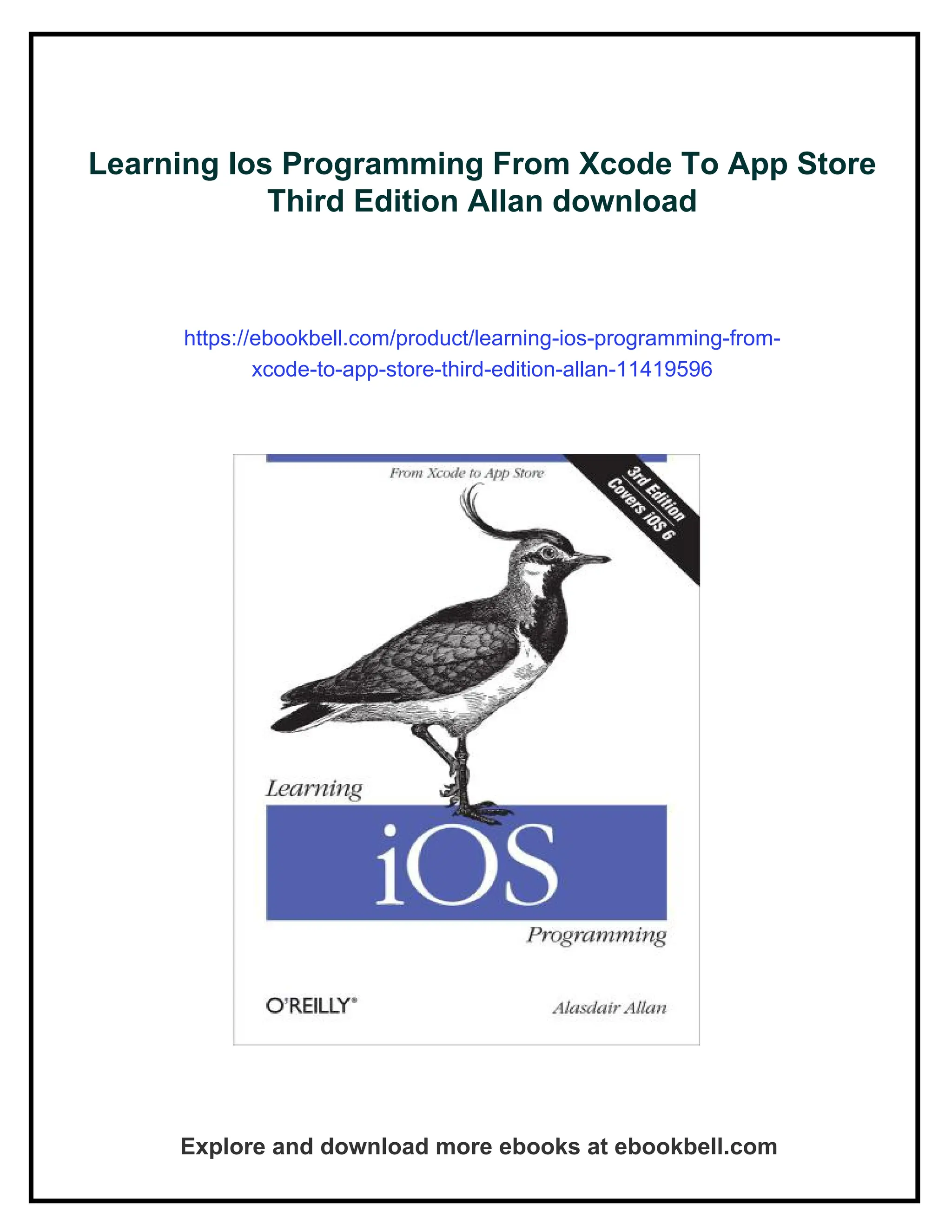
Learning Ios ProgrammingFrom Xcode To App Store
Third Edition Allan download
https://ebookbell.com/product/learning-ios-programming-from-
xcode-to-app-store-third-edition-allan-11419596
Explore and download more ebooks at ebookbell.com
2.
Here are somerecommended products that we believe you will be
interested in. You can click the link to download.
Learning Ios Programming From Xcode To App Store 3rd Ed Allan
https://ebookbell.com/product/learning-ios-programming-from-xcode-to-
app-store-3rd-ed-allan-22034610
Learning Ios Programming From Xcode To App Store Alasdair Allan
https://ebookbell.com/product/learning-ios-programming-from-xcode-to-
app-store-alasdair-allan-2582992
Learning Ios Programming Alasdair Allan
https://ebookbell.com/product/learning-ios-programming-alasdair-
allan-53639206
Learning Ios Programming Alasdair Allan Alasdair Allan
https://ebookbell.com/product/learning-ios-programming-alasdair-allan-
alasdair-allan-35374602
3.
Learning Ios Programming2nd Edition Alasdair Allan
https://ebookbell.com/product/learning-ios-programming-2nd-edition-
alasdair-allan-4150812
Learning Ios Development A Handson Guide To The Fundamentals Of Ios
Programming Maurice Sharp
https://ebookbell.com/product/learning-ios-development-a-handson-
guide-to-the-fundamentals-of-ios-programming-maurice-sharp-5474208
Learning Ios Game Programming A Handson Guide To Building Your First
Iphone Game Daley
https://ebookbell.com/product/learning-ios-game-programming-a-handson-
guide-to-building-your-first-iphone-game-daley-22041244
Learning Ipad Programming A Handson Guide To Building Ipad Apps With
Ios 5 1st Edition Kirby Turner
https://ebookbell.com/product/learning-ipad-programming-a-handson-
guide-to-building-ipad-apps-with-ios-5-1st-edition-kirby-
turner-2627348
Learning Opengl Es For Ios A Handson Guide To Modern 3d Graphics
Programming Erik M Buck
https://ebookbell.com/product/learning-opengl-es-for-ios-a-handson-
guide-to-modern-3d-graphics-programming-erik-m-buck-42353648
c. 1840. Mansfield,School-Life at Winchester (1866), 221. Nestor—
Any boy who was past eighteen, or was old for his position in the
school, or who was known to be much older than he looked.
New-bug, subs. (general).—A new boy.
New Guinea, subs. (Oxford: obsolete).—See
quot.
1823. Grose, Vulg. Tongue [Egan], s.v. New Guinea. First possession
of income.
News, subs. (The Leys).—One division of the
“School House,” with three dormitories
—“Upper News,” “Under News,” “Further
News.” See Olds.
New Settlements, subs. (Oxford: obsolete).
—See quot.
1823. Grose, Vulg. Tongue [Egan], s.v. New Settlements. Final
reckonings.
Newy, subs. (Winchester).—The CAD (q.v.)
paid to look after the canvas tent in
Commoner (q.v.) field.
7.
Nezzar, subs. (Durham:obsolete).—A young
lady.
Nick, verb (Durham).—To pray.
Nicks, intj. (Manchester Grammar).—Cave!
Look out! [Said also to be common in
Manchester as a warning of the approach of
the police.] See Appendix.
Niff, verb (Derby).—To smell.
Nig, subs. (Christ’s Hospital).—A dodge.
Obsolete.
Nigshious, adj. (Christ’s Hospital).—
Ingenious: e.g. “a NIGSHIOUS dodge.”
Obsolete.
Nihil-ad-rem, adj. (Winchester).—Vague;
unconscious. Ex. “He sported NIHIL-AD-REM
ducks.”
8.
Nine Steps. SeeKittle-nine-steps.
Nipper, subs. (Loretto).—Originally a boy of
the lowest Form: since there has been a
preparatory House the term is applied to all
the boys there.
Nipperkin, subs. (Winchester: obsolete).—A
stone jug used for serving beer in College
between meals. Tea has long been
substituted for beer.
c. 1696. B. E., Dict. Cant. Crew, s.v. Nipperkin. Half a pint of Wine,
and but half a Quartern of Brandy, strong waters, &c.
1698-1700. Ward, Lond. Spy, II. (1706), i. 31. By that time we had
sipp’d off our Nipperkin of my Grannums Aqua Mirabilis.
1719. Durfey, Pills to Purge.... Song, Quart-pot, pint-pot, NIPPERKEN,
&c.
1785. GROSE, Vulg. Tongue, s.v.
1832. Noctes Ambrosianæ, Sept. William III., who only snoozed
over a NIPPERKIN of Schiedam with a few Dutch favourites.
1882. J. Ashton, Social Life in Reign of Q. Anne, i. 197. [Beer] was
of different qualities, from the “penny NIPPERKIN of Molassas Ale” to
“a pint of Ale cost me five-pence.”
1883. Trollope, What I Remember. It was the duty of the
bedmakers to carry every evening into each chamber a huge
NIPPERKIN of beer.
9.
Nob, subs. (Oxford:obsolete).—The Fellow of
a College. [Probably the original application
of the colloquial usage = a person of rank
or position; from “nobility.” Cf. Mob, from
mobile vulgus.]
1825. English Spy, i. 136. “We must find you some more tractable
personage; some good-humoured NOB.”
Noggs, subs. (Harrow).—A hereditary name
for Custos’ assistant. [From Dickens: the
first owner’s name was Newman—hence
Noggs.]
Nomenclature (Harrow).—See Upper School.
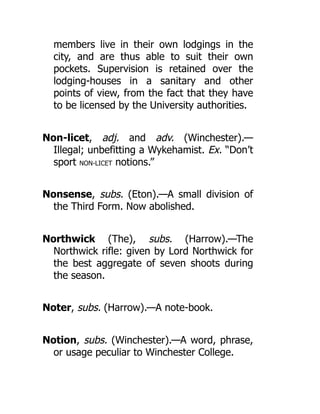
Non-attached (or Non-collegiate), adj.
(Oxford).—Most of the students belong to a
college or hall, but in 1868 what was at first
known as the “NON-ATTACHED,” and is now
designated the “NON-COLLEGIATE” system, was
established. The system, a revival of one
that prevailed in ancient times, is under the
control of a body termed the Delegacy, the
chief officer being named the Censor.
Efficient provision is made for tuition, but its
10.
members live intheir own lodgings in the
city, and are thus able to suit their own
pockets. Supervision is retained over the
lodging-houses in a sanitary and other
points of view, from the fact that they have
to be licensed by the University authorities.
Non-licet, adj. and adv. (Winchester).—
Illegal; unbefitting a Wykehamist. Ex. “Don’t
sport NON-LICET notions.”
Nonsense, subs. (Eton).—A small division of
the Third Form. Now abolished.
Northwick (The), subs. (Harrow).—The
Northwick rifle: given by Lord Northwick for
the best aggregate of seven shoots during
the season.
Noter, subs. (Harrow).—A note-book.
Notion, subs. (Winchester).—A word, phrase,
or usage peculiar to Winchester College.
11.
Novi, subs. (Tonbridge).—Anew boy.
Nurse, subs. (Christ’s Hospital).—A matron.
c. 1800. “Christ’s Hospital Seventy-five Years Ago” (Blue, Nov.,
1875). The NURSES were permitted to flog and punish the boys as
they thought proper, and some of the NURSES were cruel women.
One poor fellow in my ward was labouring under a bodily infirmity.
The brute of a nurse used constantly to flog him with nettles,
fresh-gathered from time to time for the purpose, declaring they
had the virtue of strengthening his bodily frame, &c.! [See
Appendix.]
Nursery (The), subs. (King Edward’s, Birm.).
—A gallery at one end of Big School, in
which the lowest two classes are taught.
12.
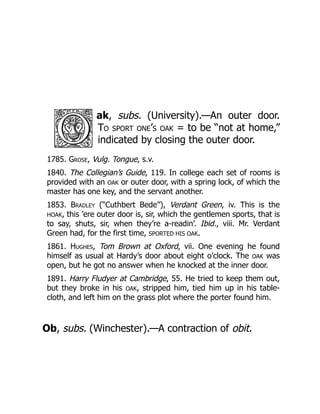
ak, subs. (University).—Anouter door.
To sport one’s oak = to be “not at home,”
indicated by closing the outer door.
1785. Grose, Vulg. Tongue, s.v.
1840. The Collegian’s Guide, 119. In college each set of rooms is
provided with an OAK or outer door, with a spring lock, of which the
master has one key, and the servant another.
1853. Bradley (“Cuthbert Bede”), Verdant Green, iv. This is the
HOAK, this ’ere outer door is, sir, which the gentlemen sports, that is
to say, shuts, sir, when they’re a-readin’. Ibid., viii. Mr. Verdant
Green had, for the first time, SPORTED HIS OAK.
1861. Hughes, Tom Brown at Oxford, vii. One evening he found
himself as usual at Hardy’s door about eight o’clock. The OAK was
open, but he got no answer when he knocked at the inner door.
1891. Harry Fludyer at Cambridge, 55. He tried to keep them out,
but they broke in his OAK, stripped him, tied him up in his table-
cloth, and left him on the grass plot where the porter found him.
Ob, subs. (Winchester).—A contraction of obit.
13.
Obeum (The), subs.(Cambridge).—A water-
closet building at King’s College. [Attributed
by the undergraduates to the energy of
O[scar] B[rowning].]
Off-bat, subs. (Winchester: obsolete).
—“Point”: at cricket.
c. 1840. Mansfield, School-Life at Winchester, 222. Off bat, the
station of one of the field in a cricket match, called by the outer
world “Point.”
Officer, subs. (Winchester).—A College
Præfect when in office: as the Præfect of
Hall, Chapel, School, or Library.
-oi, inseparable suffix (Tonbridge).—Indicative
of complaisant disdain: e.g. TO DO THE BLEED-OI
(see Bleed) = to swagger; to appear to be
distinguishing oneself.
Oiler, subs. (University).—A cad.
Oips, subs. (Haileybury).—Boys who are not
good enough for the 1st, 2nd, 3rd, or Below
14.
Bigside Elevens playin the Oips. [An
abbreviation of Hoi polloi.]
Old Cars, subs. (Charterhouse).—Old
Carthusians: regarded as a vulgarism.
Old Pig (The).—See Pig.
Old Schools, The (Harrow).—The original
school building erected by John Lyon,
together with the “Old Speech-room,”
which, however, is of much later date.
Olds, subs. (The Leys).—A division of the
“School House,” three dormitories—“Upper
Olds,” “Under Olds,” and “Under Under.” See
News.
On, adv. and intj. (Winchester: obsolete).—
The word to start given by the Præfect of
Hall when the School went in procession to
Hills, Cathedral, &c. Also as in quot. See
Appendix.
15.
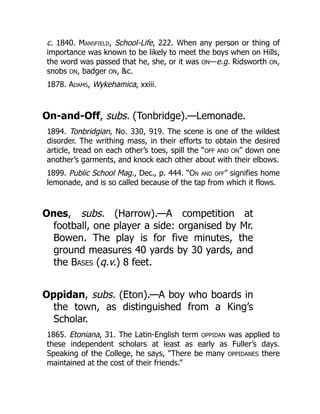
c. 1840. Mansfield,School-Life, 222. When any person or thing of
importance was known to be likely to meet the boys when on Hills,
the word was passed that he, she, or it was ON—e.g. Ridsworth ON,
snobs ON, badger ON, &c.
1878. Adams, Wykehamica, xxiii.
On-and-Off, subs. (Tonbridge).—Lemonade.
1894. Tonbridgian, No. 330, 919. The scene is one of the wildest
disorder. The writhing mass, in their efforts to obtain the desired
article, tread on each other’s toes, spill the “OFF AND ON” down one
another’s garments, and knock each other about with their elbows.
1899. Public School Mag., Dec., p. 444. “On and off” signifies home
lemonade, and is so called because of the tap from which it flows.
Ones, subs. (Harrow).—A competition at
football, one player a side: organised by Mr.
Bowen. The play is for five minutes, the
ground measures 40 yards by 30 yards, and
the Bases (q.v.) 8 feet.
Oppidan, subs. (Eton).—A boy who boards in
the town, as distinguished from a King’s
Scholar.
1865. Etoniana, 31. The Latin-English term OPPIDAN was applied to
these independent scholars at least as early as Fuller’s days.
Speaking of the College, he says, “There be many OPPIDANES there
maintained at the cost of their friends.”
16.
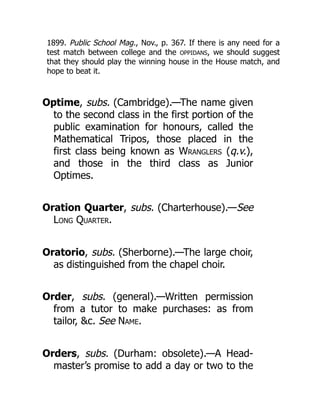
1899. Public SchoolMag., Nov., p. 367. If there is any need for a
test match between college and the OPPIDANS, we should suggest
that they should play the winning house in the House match, and
hope to beat it.
Optime, subs. (Cambridge).—The name given
to the second class in the first portion of the
public examination for honours, called the
Mathematical Tripos, those placed in the
first class being known as Wranglers (q.v.),
and those in the third class as Junior
Optimes.
Oration Quarter, subs. (Charterhouse).—See
Long Quarter.
Oratorio, subs. (Sherborne).—The large choir,
as distinguished from the chapel choir.
Order, subs. (general).—Written permission
from a tutor to make purchases: as from
tailor, &c. See Name.
Orders, subs. (Durham: obsolete).—A Head-
master’s promise to add a day or two to the
17.
holidays: sometimes obtained,so tradition
says, by barricading Big School against him.
Ostiar, subs. (Sherborne: obsolete).—The
Præfect on duty at the Big School door:
seventeenth century.
Ostiarius, subs. (Winchester: obsolete).—See
quots.
c. 1840. Mansfield, School-Life at Winchester, 223. Ostiarius, an
office held by the Præfects in succession. The duties were, to keep
order in school, collect the Vulguses, and prevent the boys from
shirking out. It is also the official title for the Second Master.
1865. Etoniana, 133. A peculiarity in the arrangements at Eton is,
that the school is practically divided into two. The division seems
to have been in force from the very earliest times—the three lower
forms having been then, as now, under the charge of the OSTIARIUS,
or, as he is now called, the lower master, who has the appointment
of his own provost-assistants, and is practically independent of the
head-master, and subject only to the control of the provost.
1866. Wykehamist, No. 1, Oct. We know of nothing more which
calls for notice, except the revival by Dr. Moberly of the OSTIARIUS—
an office which had been discontinued for many years, but was
revived by the Head-master on account of the great increase in the
number of the school.
1878. Adams, Wykehamica, xxiii. 429. Ostiarius, the Præfect in
charge of school.
18.
Othello. See Round.
Outer,subs. (Durham).—A cad; a “bounder.”
Out-houses (Charterhouse).—All the
boarding-houses except Sanderites, Verites,
and Gownboys. The names of the eight OUT-
HOUSES are Girdlestonites, Lockites, Weekites,
Hodgsonites, Bodeites, Daviesites, Pageites,
and Robinites (the last a contraction of
Robinsonites). Except Bodeites, each house
bears the name of its first master. One
house, Uskites—from a supposed similarity
of the surroundings to the valley of the Usk
—disappeared in 1878.
Out-match, subs. (Stonyhurst).—A match
played against a visiting team.
Over-school, subs. (Rugby).—A kind of
common sitting-room in the “new” building
of 1755. The boys’ boxes were kept there,
and Ash-planting (q.v.) inflicted. The present
school-house hall was built on the site.
19.
Overtoys-box. See Toys.
Ovid(Harrow).—See Upper School.
Owl, subs. (Cambridge: obsolete).—A member
of Sidney Sussex College.
20.
acking-up, intj. (Winchester).—See
Peals.
Pad,subs. (King Edward’s, Birm.).—Writing-
paper: e.g. “a sheet of PAD”; “lend me some
PAD.” [The paper for exercises is generally in
the form of writing-pads, from which a
sheet may be separated as wanted.]
Pageites (Charterhouse).—See Out-houses.
Palmer, subs. (Durham: obsolete).—A sly
fellow.
Pancake. Tossing the pancake, verb. phr.
(Westminster).—See quot.
1867. Collins, The Public Schools, 171. The old Shrove-Tuesday
custom of TOSSING THE PANCAKE, though now peculiar to Westminster,
21.
is said tohave been also formerly in use at Eton. The ceremony as
at present performed is this. The cook, preceded by the verger,
enters the large school, in full official costume, with the hot cake in
the pan. He tosses it—or tries to toss it, for it is no easy feat—over
the iron bar, which has been already mentioned as having once
held a curtain screening off the upper school from the lower. If he
succeeds he claims a fee of two guineas. There is a scramble
among the boys, who stand on the other side of the bar, for the
PANCAKE, and if any boy can secure it whole, which seldom
happens, he carries it up to the dean, who presents him with a
sovereign. They also claim a right to “book” the performer (i.e.
hurl a shower of books at him) if he fails more than once. This
right was liberally exercised in 1865, when the wrath of the school
had culminated owing to repeated failures in that and the previous
year. The exasperated cook replied to the attack with his only
available missile—the frying-pan—and a serious row was the
consequence. The battle is celebrated in a clever mock-heroic
poem, in Greek Homeric verse, attributed to a high Westminster
authority.
Pandie, subs. (Royal High School, Edin.:
obsolete).—A stroke from the leather strap
known as the TAWSE (q.v.), used in Scotland
instead of the cane; a PAUMIE (q.v.). [From
the order given in Latin, Pande manum. See
Redgauntlet.]
Pantile, subs. (general).—A flat cake covered
with jam.
22.
Panupetaston, subs. (University:obsolete).
—A loose overcoat with wide sleeves.
Paradise, subs. 1. (Oxford).—A grove of trees
outside St. John’s College.
2. (Rugby).—A room in the old school (built
in 1755) on the site of which the school-
house hall now stands. [From its pleasant
look-out.]
Part. See Books.
Party Roll, subs. (Winchester).—A list of boys
going home together. See Peals.
Passy, adj. (Christ’s Hospital).—Severe: of a
master. [That is, “passionate.”—Blanch.] See
Appendix.
1844. Reminis. of Christ’s Hospital [The Blue, Aug. 1874]. Rightly
or wrongly, it was the general opinion in our time that punishment
in school depended less upon the correctness with which the
lessons were said, than upon the temper of the particular master.
Frequently and anxiously the question was asked, “Is he PASSY this
morning?” and the arrival of a new master created immense
excitement. Our first queries were invariably of his manners and
23.
temper—matters of farmore importance to us than any question
as to his ability.
Patrol, subs. (Dulwich).—Keeping order in
Form rooms between morning and
afternoon school: a duty of school Præfects.
Paul’s-pigeons, subs. (common).—The
scholars of St. Paul’s School.
Pawmie, subs. (Royal High School, Edin.:
obsolete).—A stroke on the hand from the
leather strap known as the TAWSE (q.v.), used
in Scotland instead of the cane: also PANDIE
(q.v.). [Paum = palm of the hand.]
Pavvy, The (Harrow).—The pavilion on the
cricket-ground.
Pax, subs. (Winchester).—A chum; an
intimate friend. [Cf. Scots pack = intimate,
familiar.]
1891. Wrench, Word-Book, 30. Possibly the plural of “pack,” which
word has an extended use in reference to friendship ... as adj.,
24.
subs., and verb.This seems a more likely origin than the PAX of the
Church.
Intj. An injunction to desist or to silence
—“Be quiet!” “Hands off!” Also HAVE PAX!
[Almost the pure Latin use of the word.]
P. D., subs. (Dulwich).—Punishment drill: in
Junior School.
Peal, subs. (Winchester: obsolete).—A custom
in Commoners of singing out comments on
Præfects at the beginning of CLOISTER-TIME
(q.v.). Also cheers given on the last three
Sundays of the Half for articles of dress,
&c., connected with going home, such as
“Gomer Hats,” “Party Rolls,” &c.... “The
ringing of Chapel bells is also divided into
PEALS.” [Halliwell.—Peals = a noise or uproar.
Cf. Mid. Eng. apel = an old term in hunting
music, consisting of three long moots.]
c. 1840. Mansfield, School-Life at Winchester College, p. 62. The
junior in chamber had a hard time of it; ... while endeavouring to
get through his multifarious duties, he had to keep a sharp ear on
the performance of the chapel bell, and to call out accordingly,
“first PEAL!” “second PEAL!” “bells down!”
1867. Collins, The Public Schools, p. 22. The scholars at this time
were expected to rise at the sound of “first PEAL” at five o’clock,
25.
and were recommendedto say privately a short Latin selection
from the Psalms as soon as they were dressed. Ibid. They then
swept out their chambers and made their beds (consisting in those
days of nothing better than bundles of straw with a coverlet), and
SECOND PEAL at half-past five summoned them to chapel.
1881. Felstedian, Nov., p. 75, “A Day’s Fagging at Winchester.” At
6.30, I had to get back to call everybody again; and again at 6.40
(five minutes to second PEAL); at 6.45 (“second PEAL”) when the
chapel bell started and kept on till seven. When the bell stops I
wait at the door and call out “præfect of chapel going in”—i.e. the
præfect of the week who calls names; then “præfect of chapel in”
when he reaches the door.
1900. St. James’s Gazette, Mar. 15, “Arnoldiana.”—He [Matthew
Arnold] was the victim of public expression of disapproval—in
connection, Mr. Arnold thinks, with the lively ceremony known as
CLOISTER PEALINGS, when he was placed at the end of the great
school, and, amid howls and jeers, pelted with a rain of “pontos”
for some time. [Cloister pealings is here incorrectly used: see
Sticking-up.]
Pec, subs. (Eton: obsolete).—Money. [Lat.
pecunia.]
Pempe, subs. (Winchester).—An imaginary
object in search of which a new-comer is
sent: the equivalent of “pigeon’s milk,” or
the “squad-umbrella.” [From πεμπε μω̂ρον
προτερον = “Send the fool farther.”]
26.
Penance-table, subs. (Stonyhurst).—Atable
in the refectory at which a boy is
condemned to sit alone for bad behaviour
during meals. Tradition says, with some
authority, that the present PENANCE-TABLE is the
one on which Cromwell slept when he spent
a night at Stonyhurst. It is hence also called
“Cromwell’s Table.”
Penance-walk, subs. (Stonyhurst).—A path
in the playground where malefactors are
condemned to tramp in silence during
recreation time. The form of the order given
is: “Take an hour’s PENANCE,” or “Go on
PENANCE.”
Pensioner, subs. (Cambridge).—One who
pays a “pensio” or rent for rooms in College.
At Oxford a COMMONER (q.v.).
1780. Mansel [Whibley, Cap and Gown]. A Cambridge
Commencement’s the time When gentlemen come for degrees And
with wild-looking cousins and wives Through a smart mob of
PENSIONERS squeeze.
Pepper, verb (University).—To mark the
accents of a Greek exercise.
27.
Welcome to ourwebsite – the perfect destination for book lovers and
knowledge seekers. We believe that every book holds a new world,
offering opportunities for learning, discovery, and personal growth.
That’s why we are dedicated to bringing you a diverse collection of
books, ranging from classic literature and specialized publications to
self-development guides and children's books.
More than just a book-buying platform, we strive to be a bridge
connecting you with timeless cultural and intellectual values. With an
elegant, user-friendly interface and a smart search system, you can
quickly find the books that best suit your interests. Additionally,
our special promotions and home delivery services help you save time
and fully enjoy the joy of reading.
Join us on a journey of knowledge exploration, passion nurturing, and
personal growth every day!
ebookbell.com



![c. 1840. Mansfield, School-Life at Winchester (1866), 221. Nestor—
Any boy who was past eighteen, or was old for his position in the
school, or who was known to be much older than he looked.
New-bug, subs. (general).—A new boy.
New Guinea, subs. (Oxford: obsolete).—See
quot.
1823. Grose, Vulg. Tongue [Egan], s.v. New Guinea. First possession
of income.
News, subs. (The Leys).—One division of the
“School House,” with three dormitories
—“Upper News,” “Under News,” “Further
News.” See Olds.
New Settlements, subs. (Oxford: obsolete).
—See quot.
1823. Grose, Vulg. Tongue [Egan], s.v. New Settlements. Final
reckonings.
Newy, subs. (Winchester).—The CAD (q.v.)
paid to look after the canvas tent in
Commoner (q.v.) field.](https://image.slidesharecdn.com/5709798-250529203005-1510f841/85/Learning-Ios-Programming-From-Xcode-To-App-Store-Third-Edition-Allan-6-320.jpg)
![Nezzar, subs. (Durham: obsolete).—A young
lady.
Nick, verb (Durham).—To pray.
Nicks, intj. (Manchester Grammar).—Cave!
Look out! [Said also to be common in
Manchester as a warning of the approach of
the police.] See Appendix.
Niff, verb (Derby).—To smell.
Nig, subs. (Christ’s Hospital).—A dodge.
Obsolete.
Nigshious, adj. (Christ’s Hospital).—
Ingenious: e.g. “a NIGSHIOUS dodge.”
Obsolete.
Nihil-ad-rem, adj. (Winchester).—Vague;
unconscious. Ex. “He sported NIHIL-AD-REM
ducks.”](https://image.slidesharecdn.com/5709798-250529203005-1510f841/85/Learning-Ios-Programming-From-Xcode-To-App-Store-Third-Edition-Allan-7-320.jpg)
![Nine Steps. See Kittle-nine-steps.
Nipper, subs. (Loretto).—Originally a boy of
the lowest Form: since there has been a
preparatory House the term is applied to all
the boys there.
Nipperkin, subs. (Winchester: obsolete).—A
stone jug used for serving beer in College
between meals. Tea has long been
substituted for beer.
c. 1696. B. E., Dict. Cant. Crew, s.v. Nipperkin. Half a pint of Wine,
and but half a Quartern of Brandy, strong waters, &c.
1698-1700. Ward, Lond. Spy, II. (1706), i. 31. By that time we had
sipp’d off our Nipperkin of my Grannums Aqua Mirabilis.
1719. Durfey, Pills to Purge.... Song, Quart-pot, pint-pot, NIPPERKEN,
&c.
1785. GROSE, Vulg. Tongue, s.v.
1832. Noctes Ambrosianæ, Sept. William III., who only snoozed
over a NIPPERKIN of Schiedam with a few Dutch favourites.
1882. J. Ashton, Social Life in Reign of Q. Anne, i. 197. [Beer] was
of different qualities, from the “penny NIPPERKIN of Molassas Ale” to
“a pint of Ale cost me five-pence.”
1883. Trollope, What I Remember. It was the duty of the
bedmakers to carry every evening into each chamber a huge
NIPPERKIN of beer.](https://image.slidesharecdn.com/5709798-250529203005-1510f841/85/Learning-Ios-Programming-From-Xcode-To-App-Store-Third-Edition-Allan-8-320.jpg)
![Nob, subs. (Oxford: obsolete).—The Fellow of
a College. [Probably the original application
of the colloquial usage = a person of rank
or position; from “nobility.” Cf. Mob, from
mobile vulgus.]
1825. English Spy, i. 136. “We must find you some more tractable
personage; some good-humoured NOB.”
Noggs, subs. (Harrow).—A hereditary name
for Custos’ assistant. [From Dickens: the
first owner’s name was Newman—hence
Noggs.]
Nomenclature (Harrow).—See Upper School.
Non-attached (or Non-collegiate), adj.
(Oxford).—Most of the students belong to a
college or hall, but in 1868 what was at first
known as the “NON-ATTACHED,” and is now
designated the “NON-COLLEGIATE” system, was
established. The system, a revival of one
that prevailed in ancient times, is under the
control of a body termed the Delegacy, the
chief officer being named the Censor.
Efficient provision is made for tuition, but its](https://image.slidesharecdn.com/5709798-250529203005-1510f841/85/Learning-Ios-Programming-From-Xcode-To-App-Store-Third-Edition-Allan-9-320.jpg)
![Novi, subs. (Tonbridge).—A new boy.
Nurse, subs. (Christ’s Hospital).—A matron.
c. 1800. “Christ’s Hospital Seventy-five Years Ago” (Blue, Nov.,
1875). The NURSES were permitted to flog and punish the boys as
they thought proper, and some of the NURSES were cruel women.
One poor fellow in my ward was labouring under a bodily infirmity.
The brute of a nurse used constantly to flog him with nettles,
fresh-gathered from time to time for the purpose, declaring they
had the virtue of strengthening his bodily frame, &c.! [See
Appendix.]
Nursery (The), subs. (King Edward’s, Birm.).
—A gallery at one end of Big School, in
which the lowest two classes are taught.](https://image.slidesharecdn.com/5709798-250529203005-1510f841/85/Learning-Ios-Programming-From-Xcode-To-App-Store-Third-Edition-Allan-11-320.jpg)
![Obeum (The), subs. (Cambridge).—A water-
closet building at King’s College. [Attributed
by the undergraduates to the energy of
O[scar] B[rowning].]
Off-bat, subs. (Winchester: obsolete).
—“Point”: at cricket.
c. 1840. Mansfield, School-Life at Winchester, 222. Off bat, the
station of one of the field in a cricket match, called by the outer
world “Point.”
Officer, subs. (Winchester).—A College
Præfect when in office: as the Præfect of
Hall, Chapel, School, or Library.
-oi, inseparable suffix (Tonbridge).—Indicative
of complaisant disdain: e.g. TO DO THE BLEED-OI
(see Bleed) = to swagger; to appear to be
distinguishing oneself.
Oiler, subs. (University).—A cad.
Oips, subs. (Haileybury).—Boys who are not
good enough for the 1st, 2nd, 3rd, or Below](https://image.slidesharecdn.com/5709798-250529203005-1510f841/85/Learning-Ios-Programming-From-Xcode-To-App-Store-Third-Edition-Allan-13-320.jpg)
![Bigside Elevens play in the Oips. [An
abbreviation of Hoi polloi.]
Old Cars, subs. (Charterhouse).—Old
Carthusians: regarded as a vulgarism.
Old Pig (The).—See Pig.
Old Schools, The (Harrow).—The original
school building erected by John Lyon,
together with the “Old Speech-room,”
which, however, is of much later date.
Olds, subs. (The Leys).—A division of the
“School House,” three dormitories—“Upper
Olds,” “Under Olds,” and “Under Under.” See
News.
On, adv. and intj. (Winchester: obsolete).—
The word to start given by the Præfect of
Hall when the School went in procession to
Hills, Cathedral, &c. Also as in quot. See
Appendix.](https://image.slidesharecdn.com/5709798-250529203005-1510f841/85/Learning-Ios-Programming-From-Xcode-To-App-Store-Third-Edition-Allan-14-320.jpg)
![acking-up, intj. (Winchester).—See
Peals.
Pad, subs. (King Edward’s, Birm.).—Writing-
paper: e.g. “a sheet of PAD”; “lend me some
PAD.” [The paper for exercises is generally in
the form of writing-pads, from which a
sheet may be separated as wanted.]
Pageites (Charterhouse).—See Out-houses.
Palmer, subs. (Durham: obsolete).—A sly
fellow.
Pancake. Tossing the pancake, verb. phr.
(Westminster).—See quot.
1867. Collins, The Public Schools, 171. The old Shrove-Tuesday
custom of TOSSING THE PANCAKE, though now peculiar to Westminster,](https://image.slidesharecdn.com/5709798-250529203005-1510f841/85/Learning-Ios-Programming-From-Xcode-To-App-Store-Third-Edition-Allan-20-320.jpg)
![is said to have been also formerly in use at Eton. The ceremony as
at present performed is this. The cook, preceded by the verger,
enters the large school, in full official costume, with the hot cake in
the pan. He tosses it—or tries to toss it, for it is no easy feat—over
the iron bar, which has been already mentioned as having once
held a curtain screening off the upper school from the lower. If he
succeeds he claims a fee of two guineas. There is a scramble
among the boys, who stand on the other side of the bar, for the
PANCAKE, and if any boy can secure it whole, which seldom
happens, he carries it up to the dean, who presents him with a
sovereign. They also claim a right to “book” the performer (i.e.
hurl a shower of books at him) if he fails more than once. This
right was liberally exercised in 1865, when the wrath of the school
had culminated owing to repeated failures in that and the previous
year. The exasperated cook replied to the attack with his only
available missile—the frying-pan—and a serious row was the
consequence. The battle is celebrated in a clever mock-heroic
poem, in Greek Homeric verse, attributed to a high Westminster
authority.
Pandie, subs. (Royal High School, Edin.:
obsolete).—A stroke from the leather strap
known as the TAWSE (q.v.), used in Scotland
instead of the cane; a PAUMIE (q.v.). [From
the order given in Latin, Pande manum. See
Redgauntlet.]
Pantile, subs. (general).—A flat cake covered
with jam.](https://image.slidesharecdn.com/5709798-250529203005-1510f841/85/Learning-Ios-Programming-From-Xcode-To-App-Store-Third-Edition-Allan-21-320.jpg)
![Panupetaston, subs. (University: obsolete).
—A loose overcoat with wide sleeves.
Paradise, subs. 1. (Oxford).—A grove of trees
outside St. John’s College.
2. (Rugby).—A room in the old school (built
in 1755) on the site of which the school-
house hall now stands. [From its pleasant
look-out.]
Part. See Books.
Party Roll, subs. (Winchester).—A list of boys
going home together. See Peals.
Passy, adj. (Christ’s Hospital).—Severe: of a
master. [That is, “passionate.”—Blanch.] See
Appendix.
1844. Reminis. of Christ’s Hospital [The Blue, Aug. 1874]. Rightly
or wrongly, it was the general opinion in our time that punishment
in school depended less upon the correctness with which the
lessons were said, than upon the temper of the particular master.
Frequently and anxiously the question was asked, “Is he PASSY this
morning?” and the arrival of a new master created immense
excitement. Our first queries were invariably of his manners and](https://image.slidesharecdn.com/5709798-250529203005-1510f841/85/Learning-Ios-Programming-From-Xcode-To-App-Store-Third-Edition-Allan-22-320.jpg)
![temper—matters of far more importance to us than any question
as to his ability.
Patrol, subs. (Dulwich).—Keeping order in
Form rooms between morning and
afternoon school: a duty of school Præfects.
Paul’s-pigeons, subs. (common).—The
scholars of St. Paul’s School.
Pawmie, subs. (Royal High School, Edin.:
obsolete).—A stroke on the hand from the
leather strap known as the TAWSE (q.v.), used
in Scotland instead of the cane: also PANDIE
(q.v.). [Paum = palm of the hand.]
Pavvy, The (Harrow).—The pavilion on the
cricket-ground.
Pax, subs. (Winchester).—A chum; an
intimate friend. [Cf. Scots pack = intimate,
familiar.]
1891. Wrench, Word-Book, 30. Possibly the plural of “pack,” which
word has an extended use in reference to friendship ... as adj.,](https://image.slidesharecdn.com/5709798-250529203005-1510f841/85/Learning-Ios-Programming-From-Xcode-To-App-Store-Third-Edition-Allan-23-320.jpg)
![subs., and verb. This seems a more likely origin than the PAX of the
Church.
Intj. An injunction to desist or to silence
—“Be quiet!” “Hands off!” Also HAVE PAX!
[Almost the pure Latin use of the word.]
P. D., subs. (Dulwich).—Punishment drill: in
Junior School.
Peal, subs. (Winchester: obsolete).—A custom
in Commoners of singing out comments on
Præfects at the beginning of CLOISTER-TIME
(q.v.). Also cheers given on the last three
Sundays of the Half for articles of dress,
&c., connected with going home, such as
“Gomer Hats,” “Party Rolls,” &c.... “The
ringing of Chapel bells is also divided into
PEALS.” [Halliwell.—Peals = a noise or uproar.
Cf. Mid. Eng. apel = an old term in hunting
music, consisting of three long moots.]
c. 1840. Mansfield, School-Life at Winchester College, p. 62. The
junior in chamber had a hard time of it; ... while endeavouring to
get through his multifarious duties, he had to keep a sharp ear on
the performance of the chapel bell, and to call out accordingly,
“first PEAL!” “second PEAL!” “bells down!”
1867. Collins, The Public Schools, p. 22. The scholars at this time
were expected to rise at the sound of “first PEAL” at five o’clock,](https://image.slidesharecdn.com/5709798-250529203005-1510f841/85/Learning-Ios-Programming-From-Xcode-To-App-Store-Third-Edition-Allan-24-320.jpg)
![and were recommended to say privately a short Latin selection
from the Psalms as soon as they were dressed. Ibid. They then
swept out their chambers and made their beds (consisting in those
days of nothing better than bundles of straw with a coverlet), and
SECOND PEAL at half-past five summoned them to chapel.
1881. Felstedian, Nov., p. 75, “A Day’s Fagging at Winchester.” At
6.30, I had to get back to call everybody again; and again at 6.40
(five minutes to second PEAL); at 6.45 (“second PEAL”) when the
chapel bell started and kept on till seven. When the bell stops I
wait at the door and call out “præfect of chapel going in”—i.e. the
præfect of the week who calls names; then “præfect of chapel in”
when he reaches the door.
1900. St. James’s Gazette, Mar. 15, “Arnoldiana.”—He [Matthew
Arnold] was the victim of public expression of disapproval—in
connection, Mr. Arnold thinks, with the lively ceremony known as
CLOISTER PEALINGS, when he was placed at the end of the great
school, and, amid howls and jeers, pelted with a rain of “pontos”
for some time. [Cloister pealings is here incorrectly used: see
Sticking-up.]
Pec, subs. (Eton: obsolete).—Money. [Lat.
pecunia.]
Pempe, subs. (Winchester).—An imaginary
object in search of which a new-comer is
sent: the equivalent of “pigeon’s milk,” or
the “squad-umbrella.” [From πεμπε μω̂ρον
προτερον = “Send the fool farther.”]](https://image.slidesharecdn.com/5709798-250529203005-1510f841/85/Learning-Ios-Programming-From-Xcode-To-App-Store-Third-Edition-Allan-25-320.jpg)
![Penance-table, subs. (Stonyhurst).—A table
in the refectory at which a boy is
condemned to sit alone for bad behaviour
during meals. Tradition says, with some
authority, that the present PENANCE-TABLE is the
one on which Cromwell slept when he spent
a night at Stonyhurst. It is hence also called
“Cromwell’s Table.”
Penance-walk, subs. (Stonyhurst).—A path
in the playground where malefactors are
condemned to tramp in silence during
recreation time. The form of the order given
is: “Take an hour’s PENANCE,” or “Go on
PENANCE.”
Pensioner, subs. (Cambridge).—One who
pays a “pensio” or rent for rooms in College.
At Oxford a COMMONER (q.v.).
1780. Mansel [Whibley, Cap and Gown]. A Cambridge
Commencement’s the time When gentlemen come for degrees And
with wild-looking cousins and wives Through a smart mob of
PENSIONERS squeeze.
Pepper, verb (University).—To mark the
accents of a Greek exercise.](https://image.slidesharecdn.com/5709798-250529203005-1510f841/85/Learning-Ios-Programming-From-Xcode-To-App-Store-Third-Edition-Allan-26-320.jpg)