Learning GitHub Actions 1 / converted Edition Brent Laster
1.
Learning GitHub Actions1 / converted Edition
Brent Laster install download
https://ebookmeta.com/product/learning-github-
actions-1-converted-edition-brent-laster/
Download more ebook from https://ebookmeta.com
2.
We believe theseproducts will be a great fit for you. Click
the link to download now, or visit ebookmeta.com
to discover even more!
Learning GitHub Actions: Automation and Integration of
CI/CD with GitHub 1st Edition Brent Laster
https://ebookmeta.com/product/learning-github-actions-automation-
and-integration-of-ci-cd-with-github-1st-edition-brent-laster/
Hands-on GitHub Actions 1st Edition Chaminda
Chandrasekara
https://ebookmeta.com/product/hands-on-github-actions-1st-
edition-chaminda-chandrasekara/
Practical GitOps: Infrastructure Management Using
Terraform, AWS, and GitHub Actions 1st Edition Rohit
Salecha
https://ebookmeta.com/product/practical-gitops-infrastructure-
management-using-terraform-aws-and-github-actions-1st-edition-
rohit-salecha/
Cook s Illustrated 169 2021 march april 1st Edition
America S Test Kitchen
https://ebookmeta.com/product/cook-s-illustrated-169-2021-march-
april-1st-edition-america-s-test-kitchen/
3.
Bite Size Daddy(Love Bites #2) 1st Edition Jayda Marx
[Marx
https://ebookmeta.com/product/bite-size-daddy-love-bites-2-1st-
edition-jayda-marx-marx/
Deadly Corsage Witch in the Woods Mystery 9 Jenna St
James
https://ebookmeta.com/product/deadly-corsage-witch-in-the-woods-
mystery-9-jenna-st-james/
Zooplankton Ecology 1st Edition Maria Alexandra
Teodosio Ana Maria Branco Barbosa
https://ebookmeta.com/product/zooplankton-ecology-1st-edition-
maria-alexandra-teodosio-ana-maria-branco-barbosa/
Shanah Tovah Grover Joni Kibort Sussman
https://ebookmeta.com/product/shanah-tovah-grover-joni-kibort-
sussman/
Deep learning for the Earth Sciences A comprehensive
approach to remote sensing climate science and
geosciences 1st Edition Camps-Valls
https://ebookmeta.com/product/deep-learning-for-the-earth-
sciences-a-comprehensive-approach-to-remote-sensing-climate-
science-and-geosciences-1st-edition-camps-valls/
4.
Sunflowers 1st EditionStephen A. Harris
https://ebookmeta.com/product/sunflowers-1st-edition-stephen-a-
harris/
See https://oreilly.com/catalog/errata.csp?isbn=9781098131074 forrelease
details.
The O’Reilly logo is a registered trademark of O’Reilly Media, Inc.
Learning GitHub Actions, the cover image, and related trade dress are
trademarks of O’Reilly Media, Inc.
The views expressed in this work are those of the author and do not
represent the publisher’s views. While the publisher and the author have
used good faith efforts to ensure that the information and instructions
contained in this work are accurate, the publisher and the author disclaim all
responsibility for errors or omissions, including without limitation
responsibility for damages resulting from the use of or reliance on this
work. Use of the information and instructions contained in this work is at
your own risk. If any code samples or other technology this work contains
or describes is subject to open source licenses or the intellectual property
rights of others, it is your responsibility to ensure that your use thereof
complies with such licenses and/or rights.
978-1-098-13107-4
[LSI]
9.
Dedication
To all myfamily and friends who have helped me write the best chapters of
my life.
10.
Foreword
The fundamental conceptsof continuous integration/continuous delivery
(CI/CD) have now been around for several decades, since Martin Fowler
and Matthew Foemmel of Thoughtworks first popularized CI in their
seminal essay of September 2000, and Jez Humble and Dave Farley wrote
about CD in their 2010 book Continuous Delivery: Reliable Software
Releases Through Build, Test, and Deployment Automation (Addison-
Wesley Professional). Yet it has taken years for widespread adoption of
tools for CI/CD and for the notion of a software delivery pipeline to take
root. I believe this is because three fundamental socio-technical changes in
how we do software development had to occur first:
Development had to become collaborative, rather than performed by
isolated, individual engineers. This was driven first by a truly
distributed version control system (Git) and then accelerated through
pull-request platforms like GitHub.
Widespread adoption of agile practices needed to occur. Motivated by
metrics from DevOps leaders like DevOps Research Associates
(DORA) that, contrary to intuition, showed more frequent delivery of
smaller changes reduces risk, savvy engineering leaders drove the
implementation of frequently used build pipelines where software was
continuously built, tested, and deployed directly to customers—
sometimes dozens of times per day.
The overburdening of traditional IT operations functions with
increased complexity drove massive cultural changes via the DevOps
movement. This led to a you-build-it, you-own-it approach to software
operations where, increasingly, developers take full ownership for the
success, failure, and performance of their software in production,
rather than throwing code over the wall to a release engineering team
that would operate a build process and somehow “add quality” to
software that didn’t have it already.
All these changes mean that GitHub Actions, as a relatively recent entrant
to the CI/CD pipeline and automation category, is a substantially different
product from incumbents. It is natively integrated into GitHub, making it a
11.
natural fit fordevelopers who are already familiar with storing their source
code there. GitHub Actions is also designed around the concept of a
workflow, which can be used to create CI/CD pipelines but also handle any
other kind of software automation tasks like managing open issues and
tasks that open source and enterprise developers alike need to perform in
the course of their work. Finally, GitHub Actions, as the name would
suggest, is based on the notion of an action: a reusable component that
helps to encapsulate common tasks and reduce repetition when authoring
workflows. The GitHub Marketplace offers nearly 20,000 actions at the
time of writing, making it easy for developers, DevOps engineers, and site
reliability engineers to get started with any kind of build automation task.
Although GitHub Actions is a sophisticated product, learning it doesn’t
need to be complicated. Brent Laster has written an excellent book that
relies on progressive disclosure, starting with the most basic concepts to get
you up and running with GitHub Actions while also providing a
comprehensive tour of GitHub Actions’ most advanced features to help you
to optimize your use of the product as you adopt it across your organization.
My team and I have been delighted to partner with Brent in ensuring that
the content covered here is as current as possible. Whether you are new to
CI/CD and starting with GitHub Actions as your first product in this space
or are already a CI/CD expert and migrating from another tool, Brent’s
book has the right balance of information to help you become productive
quickly.
We wish you the greatest success in automating your software delivery
processes.
Julian C. Dunn
Senior Director of Product Management
GitHub Actions
12.
Preface
Releasing software shouldbe easy.… Automate almost everything, and
keep everything you need to build, deploy, test, and release your
application in version control.
—David Farley, Continuous Delivery: Reliable Software
Releases Through Build, Test, and Deployment
Automation
Back in 1968, the London Underground in the United Kingdom needed a
digital sign to warn passengers to be careful while crossing the gaps
between train doors and station platforms. Since data storage for such signs
was very expensive back in the day, they chose a very short phrase to help
keep riders alert: “mind the gap.”
These days, the word “mind” is less commonly used, but the intent to bring
awareness to missing parts or things that can trip you up and to act on them
is still meaningful. And it is just as important when we apply the idea to
business and technical processes that can benefit from automation.
From its inception in 2008, GitHub has filled gaps in terms of allowing
users to collaborate and build communities around open source software.
And it has done this very well. It is challenging not to overestimate the
significance of the SaaS hosting model that GitHub pioneered and the
collaborative ecosystem it has built around it. Yet up until a few years ago,
there was one key piece of that ecosystem that was clearly missing—a
tightly integrated automation platform for key functions like CI/CD.
Certainly, there has been no shortage of applications that have worked to fill
that gap. Tools such as Jenkins, Travis CI, CircleCI, Azure DevOps, and
more have provided integration methods through various approaches such
as webhooks. However, users of GitHub still had to go outside their
collaboration environment to use another application to get the basic
functionality they needed. All of that has changed with the addition of
GitHub Actions.
13.
Actions is challengingto classify with a standalone designation. It is a
logical extension of the larger GitHub model. And while this is not a
general book on GitHub, I have tried to write it in such a way that you can
see how GitHub Actions plays with the larger GitHub ecosystem, regardless
of your experience level with automation in GitHub.
The Structure of This Book
Since you’re reading this book, I imagine you’re at least somewhat curious
and perhaps even excited about the potential of Actions. I’ve tried to
capture that potential along with the relevant details throughout the text. So
let me tell you a bit about the organization of this Learning GitHub Actions
book and how you can get the most out of it.
14.
Part I: Foundations
Aswith any technical journey, we start off discussing the foundations of
GitHub Actions. Part I of the book covers the basics of what GitHub
Actions is and how it works, and it helps you understand its core pieces and
how to navigate its flow. My intent here is to answer the basic why and how
questions that you need to know to get up and running with the technology,
while providing you the insight and understanding to establish the firm
footing to launch your use of actions on.
15.
Part II: BuildingBlocks
Part II extends your depth of knowledge on Actions with the building
blocks to take advantage of the wider range of options available to you for
configuration, sharing and storing data, and triggering and controlling the
execution of your workflows. These techniques form the core of using
actions to get your tasks done, while showing you how to customize their
use to best suit your needs.
16.
Part III: Securityand Monitoring
Use of a technology includes the explicit requirement to use it securely.
And the need to understand the security aspects of any new technology is
critical. So Part III of the book discusses the key areas of security and
monitoring. This section looks at security from the triple lenses of
configuration, design, and monitoring. Then it further delves into
monitoring in its own right, by describing the different options available for
logging and the techniques available to you for debugging issues.
17.
Part IV: AdvancedTopics
When you’re ready for more advanced interaction with Actions, Part IV
provides insight on a number of less typical (but arguably more fun) topics.
These include creating your own custom actions, creating your own starter
workflows and reusable workflows, working with the GitHub CLI, APIs,
and using matrix strategies and containers in your workflows. And to finish
up, I’ve included some practical tips and examples of how to migrate to
GitHub Actions if you’re using another automation toolset. The book’s last
chapter also includes an in-depth review and examples of the new GitHub
Importer tool to help bootstrap and automate migrations.
With this general structure in mind, the next section provides a further
breakdown by audience type.
Intended Audience
This book is for anyone who is trying to learn more about GitHub Actions.
If you’re picking this book up, you should already have a basic knowledge
of Git and GitHub, and now you’re trying to figure out how to implement
Actions into your workflow. You likely have some experience with
solutions like Jenkins, Travis CI, and so on, and the automation platform
and framework of GitHub Actions may improve your software development
lifecycle process.
You might be a software developer, SRE, DevOps engineer, or something
else entirely, but it is my hope that the sections outlined above will provide
a complete learning solution for GitHub Actions for all readers. Here are
some audiences that I had in mind while writing it and that I think can
benefit from it:
Those who are new (or newish) to GitHub and looking to understand
how the automation component of it works
Those who already understand the concepts and flow of GitHub
Actions and want or need assistance with actually implementing the
code and syntax for workflows
18.
Those who wantto understand and evaluate GitHub Actions as a
potential CI/CD/automation target
Those who already have some experience with GitHub Actions and
want to leverage it more fully for custom purposes
Those who are working on implementing or have implemented GitHub
Actions and need to make sure they do it securely
Those who are responsible for, or want to, roll out GitHub Actions
across a department, organization, or unit
Those who are experienced GitHub users and want to migrate their
current CI/CD solutions to GitHub Actions
If one of these fits your use case, I hope the book will provide you with the
value you’re looking for. If you read it and have the opportunity, feedback
is always welcome through reviews or interactions at future conferences or
training venues.
Continuing with GitHub Actions
Of course, technology continues to evolve, and we can predict it will evolve
more quickly in some areas than in others. Thus you will notice that some
sections of the text include disclaimers that reference “as of the time of
writing.” While GitHub and I have worked together to make this book
comprehensive and as current as possible as of the time of writing, you
should always consult the current GitHub documentation to get the most
timely information—especially on features that are currently marked beta.
Fortunately, the text contains many links to the current GitHub
documentation for relevant areas.
Over a decade of use in various forms has shown that continuous,
automated processes are durable models in the industry, proving out their
long-term potential, reliability, and adaptability. Over time, the tooling will
change, and the inputs will change, and the steps will evolve. But a well-
done CI/CD/automation framework will always provide the best means to
produce software in a timely manner to meet the demands of the users. If
19.
you are workingin GitHub, you can find no better framework to achieve
that goal than GitHub Actions.
I hope that this book helps you mind the gaps in your knowledge of GitHub
Actions and fill them all in. Best of luck in your journey and thank you for
reading.
Conventions Used in This Book
The following typographical conventions are used in this book:
Italic
Indicates new terms, URLs, email addresses, filenames, and file
extensions.
Constant width
Used for program listings, as well as within paragraphs to refer to
program elements such as variable or function names, databases, data
types, environment variables, statements, and keywords.
NOTE
This element signifies a general note.
WARNING
This element indicates a warning or caution.
Using Code Examples
Supplemental material (code examples, exercises, etc.) is available for
download at https://github.com/techupskills/learning-github-actions.
20.
If you havea technical question or a problem using the code examples,
please send email to support@oreilly.com.
This book is here to help you get your job done. In general, if example code
is offered with this book, you may use it in your programs and
documentation. You do not need to contact us for permission unless you’re
reproducing a significant portion of the code. For example, writing a
program that uses several chunks of code from this book does not require
permission. Selling or distributing examples from O’Reilly books does
require permission. Answering a question by citing this book and quoting
example code does not require permission. Incorporating a significant
amount of example code from this book into your product’s documentation
does require permission.
We appreciate, but generally do not require, attribution. An attribution
usually includes the title, author, publisher, and ISBN. For example:
“Learning GitHub Actions by Brent Laster (O’Reilly). Copyright 2023 Tech
Skills Transformations, LLC, 978-1-098-13107-4.”
If you feel your use of code examples falls outside fair use or the
permission given above, feel free to contact us at permissions@oreilly.com.
O’Reilly Online Learning
NOTE
For more than 40 years, O’Reilly Media has provided technology and business
training, knowledge, and insight to help companies succeed.
Our unique network of experts and innovators share their knowledge and
expertise through books, articles, and our online learning platform.
O’Reilly’s online learning platform gives you on-demand access to live
training courses, in-depth learning paths, interactive coding environments,
and a vast collection of text and video from O’Reilly and 200+ other
publishers. For more information, visit https://oreilly.com.
21.
How to ContactUs
Please address comments and questions concerning this book to the
publisher:
O’Reilly Media, Inc.
1005 Gravenstein Highway North
Sebastopol, CA 95472
800-889-8969 (in the United States or Canada)
707-829-7019 (international or local)
707-829-0104 (fax)
support@oreilly.com
https://www.oreilly.com/about/contact.html
We have a web page for this book, where we list errata, examples, and any
additional information. You can access this page at https://oreil.ly/learning-
github-actions.
For news and information about our books and courses, visit
https://oreilly.com.
Find us on LinkedIn: https://linkedin.com/company/oreilly-media
Follow us on Twitter: https://twitter.com/oreillymedia
Watch us on YouTube: https://youtube.com/oreillymedia
Acknowledgments
Writing a book is a serious investment. Throughout the duration of writing
this one, I have invested many early mornings, late nights, and weekends
22.
researching and craftingthe content. But as Learning GitHub Actions nears
publication, I am also reminded of the many others who have invested their
time and energy to help get it from idea to print. It is my hope that these
collective efforts ultimately lead to you feeling that it is worthy of the
investment you are making by reading it.
I can’t thank everyone involved enough for their commitment to this
project, and their support, but I will try. It has been well over a year since I
first started typing out Chapter 1, and many of the individuals mentioned
here have been along for all, or the biggest part, of the journey. (And if you
were involved in the journey and I neglected to acknowledge you here,
please excuse the oversight. I can assure you it is an unintentional cognitive
slip rather than an intentional slight.)
First, many thanks to John Devins, my acquisitions editor at O’Reilly who
believed in, and advocated for, this book—as he has done on my behalf for
so many other projects. I have truly come to respect and appreciate John’s
vision and desire to provide quality training opportunities and find new
ways to bridge learning gaps. John is most often behind the scenes, but his
efforts are core to much of the learning that I and other content creators get
to bring to the attendees of O’Reilly Learning.
Also behind the scenes, Michele Cronin has worked tirelessly as the
development editor for this project, keeping it (and me) on track, helping
resolve any potential roadblocks, and giving me sage advice on how to
navigate any and all challenges that have come up along the way. Her
advice has always been relevant and what I needed to hear at the time. But
perhaps most impressive is that she has always done it with a smile on her
face, as an optimistic and supportive guide in the process. I will honestly
say that I have never been a fan of the editing part of writing books. But
with Michele, I knew I would come away with a confident sense of how to
proceed based on her experience and guidance.
There are numerous other people at O’Reilly that have had a hand in the
book process that I want to also call out. Kate Dullea did a yeoman’s share
of work in reviewing all of the screenshots and images going into the book
to make sure they were suitable and legible. She also provided invaluable
tips for me to validate them as I was creating the content. Clare Laylock,
23.
Kim Sandoval, andJonathan Owen have been exceptional in proofreading
and clarifying the content to make it clear and readable. And thanks to
Karen Montgomery for the cool cover picture and David Futato for the
interior design.
I next need to thank Julian C. Dunn, senior director of product management
for Actions at GitHub. In any extended discussion on a technology that is
supported by a company as well as a community, it is incredibly helpful to
have a contact point who can help you understand the current and future
direction of the technology, answer questions, and dispel confusion around
topics. Julian has done all that and more as a reviewer and advisor while
I’ve been building out the content. His collaboration has unquestionably
helped the book become a better, more relevant text. My appreciation goes
to Julian and GitHub for their active participation in making sure the
content is the best and most up to date it can be as of the time of writing. (I
should also note that he wrote the foreword for the book, which I hope
you’ll take a moment to read if you haven’t already.)
Along with Julian, I could not have asked for a better team of technical
reviewers than Brent Beer, Taylor Dolezal, Kerim Satirli, and Daniel
Hinojosa. Each provided very useful feedback and suggestions that helped
to keep me straight on the technical topics and presentation of the material.
I feel very fortunate that I was able to get the investment of time from this
group and get the benefit of their collective technical backgrounds and
collective eyes for detail.
I also want to thank Ethan Dennis from GitHub for his collaboration on the
Actions Importer tooling and process. I was very excited when I found out
that this unique new tool existed. I knew quickly that the book needed to
include it as part of the final chapter on migration. Ethan was incredibly
helpful as I worked through examples and the use of the tool, quickly
addressing any questions and issues I ran into and serving as a reviewer for
that chapter. His efforts and involvement are much appreciated.
As I mentioned earlier, the work on this book was done mainly on mornings
and weekends—outside of my full-time job as a director in the DevOps
organization at SAS. But it is only because of the support of my coworkers
and management at SAS that I am able to keep my feet in both the
24.
corporate and opensource worlds. I especially want to thank Rob Stephens
for his mentorship on getting things done, his attempts to help me learn to
write concisely for business communications (which I am still working
towards), and his support for leveraging my training and writing interests as
a part of my job at SAS. Also thanks to Jared Peterson for his leadership,
support, and focus on open-source opportunities, and Bryan Harris—our
incredible CTO and EVP—for his examples of technical and people
leadership and support.
I would be remiss not to give a shout-out here to Todd Lewis, chairman of
the All Things Open organization, and Jay Zimmerman, director of the No
Fluff Just Stuff conferences, for providing me with opportunities to speak
and present at their respective conferences over the years. The material in
this book is better because of the many presentations I’ve done on related
topics in virtual workshops and conferences for ATO and NFJS since I
started learning about Actions. If you ever have a chance to attend one of
these conferences or a meetup or virtual event sponsored by these
organizations, I encourage you to do so.
On a lighter note, thanks to “the gang” (you know who you are), who meet
for team building every week at Rally Point (building RP) after work. This
is one of the few chances I get to relax while enjoying the conversation and
unwinding with people who are not only current and past coworkers, beer
aficionados, world philosophers, and technical gurus, but also friends.
Most importantly, I want to thank my wife, Anne-Marie, for being my
soulmate and always supporting me in everything I do. Through her and our
kids, Walker, Chase, Tanner, and Katie, I am constantly reminded that the
people and relationships, especially family, that we have in our lives are the
most important thing. Everything else is simply a means to an end—or
should be—to get the time to make the connections and share experiences
with our family and friends.
Finally, thanks to you, the reader, for getting this book and reading it. I
sincerely hope that you will find it useful and something that helps you
achieve the goals that you’re looking for as you start or continue your
journey with GitHub Actions.
Chapter 1. TheBasics
Welcome to Learning GitHub Actions. I’m excited that you’re here and for
all that you’re about to learn. This is an amazing time to be working in the
software field. From containers to clusters to clouds, from automation to
generative AI, from security to SREs, the opportunities to create and
contribute to interesting software projects has never been greater. And
thanks to powerful platforms such as GitHub, that creation and contribution
has never been easier to do.
GitHub has led the field in developing an ecosystem for managing the
components of software and enabling collaboration, as witnessed by the
vast number of open-source projects managed in its repositories. And it has
continually provided additional value for users through enhancements to its
interfaces, tracking contributions and issues, mechanisms to publish and
share information, and much more.
For the last decade or slightly longer, creating software effectively has not
just been about writing the code. It has been (and is) also about better and
faster delivery technologies. The capabilities of continuous
integration/continuous delivery (aka CI/CD), DevOps, and related practices
are now largely taken for granted and easy to achieve. But historically with
GitHub, you still needed to do some amount of integration with a separate
tool to provide a delivery pipeline or other significant automation. While
there have long been ways to bolt on extended CI/CD processes, GitHub
has been missing a truly integrated solution to enable CI/CD and an end-to-
end software development lifecycle (SDLC) within its ecosystem. The
answer to that has now arrived in the form of GitHub Actions.
So how does GitHub Actions achieve this? How does it provide real value
on its own and over other solutions? And, probably most important to you,
how do you easily learn it and start to use it for your own needs?
When you’re learning a new technology, it’s important (or at least helpful)
to have some basic context before diving into the technical details. So in
27.
this chapter, I’llbriefly cover some basic information around the following
questions:
What are GitHub Actions?
What are the use cases for GitHub Actions?
What are the costs involved?
When does moving to GitHub Actions make sense?
By the end of this chapter, you’ll have a solid context to frame the rest of
your learning on GitHub Actions. Now, let’s get started.
PREREQS
This book assumes you already have a basic knowledge of Git and GitHub. If that’s
not the case, there are a number of free resources to help you understand both.
If you already have a cursory knowledge of GitHub Actions, you can skip to
Chapter 2 to start diving in on more technical details. But if you’re new to the
technology or need to be able to make an informed decision about whether it makes
sense for your project or team, I recommend reading the material here.
What Is GitHub Actions?
You can define GitHub Actions this way: GitHub Actions is an end-to-end
GitHub-centric SDLC process. It provides an automation platform and
framework that has been missing from GitHub previously and has had to be
added on with other solutions such as Jenkins or Travis CI.
There’s a lot packed into that one statement. But let’s key in on two parts
that are at the heart of the functionality: automation platform and
framework.
Automation Platform
28.
For purposes ofthe end user, GitHub Actions is a way to create and execute
automated workflows tied to GitHub events. Most commonly, you might
think of this in the context of CI/CD. As an example, you make a change
via a pull request, and GitHub kicks off a continuous delivery pipeline.
Prior to GitHub Actions, you would have needed some external tool or
process to respond to a notification from GitHub that the pull request
happened and then to process it. And the automation that happened after the
pull request and initial notification would have been implemented via that
external tool.
With Actions, you now have the means to create this automation within a
context managed by, and within, GitHub. You can define the what, when,
and how for automated responses to events such as pushes or pull requests.
For example, when a push happens in a branch of your repository,
automatically grab the latest code and attempt to build it. If a pull request
happens for a different branch, automatically build and test the code. If that
results in a failure, update a GitHub issue. If there’s not a failure,
automatically proceed with putting out a new release.
Conveniently, you can create and store your automation definitions and
workflows alongside your code in the GitHub repository. And you can edit
them there as well. In short, actions make it easier to automate within
GitHub because they are a part of GitHub. They are based in a GitHub-
provided framework that adds structure and flow. I’ll discuss that next.
Framework
Taking an automation platform from a jumbled collection of mechanisms to
an organized and consumable process requires imposing structure and flow.
Without them, you simply have a collection of tools. With them, you can
assemble truly useful automation to accomplish whatever set of tasks needs
to be done.
For Actions, this framework is composed of a core set of related
components in GitHub. These components can be put together to execute
simple or complex automation in an understandable and predictable way.
And this automation is stored in the repository as code.
29.
I’ll be talkingmore about these individual components in Chapter 2. But for
a quick overview, it works like this: In response to an occurrence of a
matching event, a workflow definition stored within the repository is
triggered, which in turn fires off jobs on designated systems called runners.
The jobs are made up of sequences of steps that either invoke a predefined
action or run a command on the runner’s OS shell.
While similar capabilities were available previously in GitHub via
mechanisms such as API calls, they were not as easy to assemble at a higher
level. Developers often had to invest considerable time and effort to learn
how to string together the right API calls and/or integrations with other
external tooling (such as Jenkins, Travis CI, etc.). Or they would use
custom scripting and programming to be able to get to the desired end goal.
This was especially true if they wanted to be able to manage processes
through GitHub. (Another workaround was to mirror the repository outside
of GitHub for products to use.)
Actions implements a native framework in GitHub providing a more
seamless and flexible experience. This flexibility is enhanced by the
Actions Marketplace, a public registry where actions can be published and
shared. If you want to create workflows to do common activities (such as
checking out code or building with a particular build tool), you can choose
from existing actions in the marketplace. If you want or need more
extensive logic, for which an action doesn’t already exist, you can code
your own custom action using a well-defined structure. Then you can
publish and share it with others via the Marketplace if desired. This
approach provides a measure of flexibility, reusability, and extensibility not
previously available with GitHub. A secondary benefit is that it can enable
rapid prototyping and implementation through combining actions for
various use cases. I’ll talk about those topics in the next section.
30.
ACTIONS VERSUS ACTIONS
Youmay notice that at times the term actions is capitalized and other times it is not.
This is because there is both the larger framework/platform to talk about and also
the smaller, predefined pieces of functionality. Both of these are referred to with the
same term. Following a recommendation from GitHub, I’ll refer to the larger
platform/framework as GitHub Actions or Actions (uppercase “A”) and the
individual units of functionality as actions (lowercase “a”).
What Are the Use Cases for GitHub Actions?
When CI/CD first came on the scene, dedicated tools such as Jenkins were
the primary means of creating pipelines. These tools were flexible—
arguably, too flexible. You had to work hard to tie together individual parts
into a pipeline. Gradually, with the widespread adoption of CI/CD, the
concept of pipelines has come into its own as a predefined structure. And so
too has the ability to define pipelines that go beyond just the basics of
building simple tests. Today’s CI/CD pipelines can be very complex and
can include advanced testing, multiple integration levels, and automated
deployments/releases. GitHub Actions allows you to create workflows as
complex as needed to handle these types of operations without ever leaving
GitHub’s ecosystem. Further, it allows you to create as many different
workflows as needed for additional automation use cases.
While GitHub Actions does not use the term pipeline in its processes, the
overall workflow approach it uses is a similar concept. Workflows chain
together smaller units of work called jobs. Jobs are what you often might
see in other applications as stages, meaning parts of a larger process that
perform a distinct and separate function. In fact, if you’re coming from
working with another automation tool, you can think of the overall GitHub
Actions flow as being a pipeline, meaning some change or event causes a
series of automated actions to happen automatically in response.
The main use cases would be in response to something happening in
GitHub. But there are also ways for workflows to be kicked off by events
outside of that environment, started on a particular schedule, or even
31.
initiated manually throughthe Actions interface in GitHub. I’ll have more
to say about these different ways of initiating a workflow in Chapter 2 and
also in Chapter 8.
While CI or CI/CD is the primary purpose that comes to mind, workflows
and actions can be used to automate nearly any process. There are two
primary places you can look to get ideas about what actions can be used for:
the starter workflows and the Actions Marketplace.
WORKFLOWS VERSUS ACTIONS
Just to make sure it’s clear, workflows are the scripts or pipelines that control the
flow and sequence of activity in GitHub Actions. The individual actions are the
functions that can be called to do targeted tasks from within workflows (like
checking out code).
Starter Workflows
To help users bootstrap using Actions, when you start to create a new
workflow, GitHub will present example starter workflows. Figure 1-1
shows an example. You don’t have to use one of these, but if they suit your
purpose or come close to it, you can click the Configure button and be
working on a new workflow very quickly.
As of the time of this writing, the main categories that have starter
workflows are:
Deployment
A set of example workflows for creating deployable objects (like
containers) and then deploying them to various cloud platforms
Security
Primarily a set of code-scanning workflows using various security
platforms and their tools
32.
Continuous Integration
A largenumber of workflows that cover the areas of building, testing,
and/or publishing for a large number of different programming
languages and tools
Automation
Some simple examples for basic automation, including a hello world
type, one that demonstrates how to trigger a workflow manually, and a
couple that deal with other GitHub constructs such as pull requests and
issues
Pages
Workflows to package/deploy sites using common tools like Gatsby,
Astro, Jekyll, etc.
You can drill into the full list and code for the starter workflows at
https://github.com/actions/starter-workflows.
33.
Figure 1-1. Starterworkflows for use with GitHub Actions
Actions Marketplace
As opposed to workflows that call actions, you can find a useful set of
existing actions to call on the GitHub Marketplace in the Actions section.
That’s available at the GitHub Marketplace. Figure 1-2 shows an example
of this area in GitHub.
These are fully functional units that you can select from and use in your
own workflows. Think of it as being like the plug-ins or other add-on
modules that add functionality in other applications. As you’ll see in a later
chapter, you can get to the Actions Marketplace from within the GitHub
built-in environment for creating a workflow. You can easily browse and
find actions here to save you time and effort versus having to code your
own. (Creating your own actions is covered in Chapter 11.)
34.
Figure 1-2. GitHubActions Marketplace
As examples of the kinds of functionality you can find, the Marketplace has
featured categories for interacting with IDEs, working on localization tasks,
doing mobile development, and even working with project management
tasks through applications such as JIRA. The actions on the Marketplace
can be from GitHub or from other sources, such as individuals,
organizations, or companies that want to integrate with Actions.
When you’re creating a new workflow, the Actions Marketplace is a great
place to find existing actions that may already do what you need, thus
saving you the effort of coding the functionality otherwise. And they’re also
free. In fact, you can get started with GitHub Actions for free. But there are
costs associated with certain levels of usage. I’ll cover more details on that
in the next section.
What Costs Are Involved?
One of the first questions that comes to mind when any individual, team, or
organization starts thinking about migrating to a new technology is the cost.
35.
With GitHub Actions,you may simply qualify for the free version. But if
not, it’s important to have at least a basic understanding of how the paid
model works so you’re not surprised.
The Free Model
GitHub Actions is free if either or both of the following two conditions are
true:
The repositories you use with actions are public.
The systems you execute the actions on (the runners) are your own
(rather than using the ones provided by GitHub).
That means if you are OK with having your GitHub repositories viewable
by everyone, or if you can host the systems that will execute the code
contained in the steps of the workflow, you can use the technology for free.
GitHub will not charge you to use self-hosted runners, but you will be
required to install and run the runner application on your own servers. This
is needed to allow GitHub Actions to communicate with your servers to
execute your workflows. (Runners, including the process to create your
own, are covered in Chapter 5.)
If the free model doesn’t fit the way you work, you’ll move into the paid
model.
The Paid Model
Private repositories are ones with restricted access. Enterprise/corporate
GitHub clients may frequently use this model, either via restricting access
on the public GitHub site or by using an in-house or on-cloud GitHub
instance restricted for their use.
There are two types of items you pay for with GitHub Actions:
Storage: Actions allow you to store artifacts and packages on GitHub’s
resources. After a certain point, the amount of storage you’re using for
artifacts and packages will start to cost you.
36.
Minutes: Actions requireprocessing time on virtual systems.
ARTIFACTS AND PACKAGES
Artifacts refer to objects that you upload or generate through your workflows on
GitHub. GitHub Packages are a convenient way to make things like containers and
dependencies accessible.
For a private repository, you start with a certain amount of storage (for
artifacts uploaded during processing of workflows) and minutes on runners
that are free. After those are used up, you may be able to pay for and use
more, or you may be cut off, depending on how you’re paying/billed by
GitHub and the defaults for spending limits you have set up. (Artifacts are
discussed in more detail in Chapter 7.)
If you’re paying/billed a regular amount monthly, after you’ve used up the
free storage and minutes, by default, that’s it. You won’t be able to create
new artifacts or do additional processing.
If, instead, you just get an invoice from GitHub for whatever amount of
resources you’ve used during a billing period and pay that variable amount
each time, by default you can continue to use (and pay for) more minutes
and/or storage without limits.
DEFAULT SPENDING LIMITS
Default spending limits are referenced in the preceding discussion. Within GitHub,
if you have access and authority to do so, those default spending limits can be
changed through the settings for the type of account you have (user, organization, or
enterprise). Changing them for an organization or enterprise requires that you are an
owner or billing manager.
For machine usage on a system provided by GitHub, the compute cost is
measured in the minutes you use on the runners. This accumulates as you
use more compute but resets to 0 each month. The amount of storage you
37.
use accumulates asyou store more artifacts but is not reset each month. So
you just continue to pay the storage cost as long as you keep the artifacts
around on GitHub.
Table 1-1 from GitHub’s documentation shows the breakdown of the free
minutes and free storage you get per month, depending on your account
type. This is current as of the time of this writing and subject to change.
Always consult the official documentation for the latest pricing information.
Table 1-1. GitHub Actions pricing plans
Plan Storage
Minutes (per
month)
GitHub Free 500 MB 2,000
GitHub Pro 1 GB 3,000
GitHub Free for
Organizations
500 MB 2,000
GitHub Team 2 GB 3,000
GitHub Enterprise Cloud 50 GB 50,000
The storage usage is calculated for each month based on hourly usage
during the month.
USAGE ROUNDING
For billing calculations, storage usage is rounded up to the nearest megabyte, and
minute usage is rounded up to the nearest minute.
One other key factor to be aware of is that GitHub Actions charge more for
jobs run on a system provided by GitHub if it requires a Windows or
38.
macOS system toexecute. So, in a paid scenario, your cost to use one of
those system versus a Linux system gets scaled up and you pay a premium,
as shown in Table 1-2.
Table 1-2. Cost scaling per OS
Operating system Minute multiplier
Linux 1
macOS 10
Windows 2
Table 1-3 shows an example of how the per-minute costs would compare
for a process run on different kinds of systems (taken from GitHub’s
documentation).
Table 1-3. Per-minute costs across OS
Operating system Per-minute rate (USD)
Linux $0.008
macOS $0.08
Windows $0.016
CURRENT COST INFORMATION
The information in the preceding tables is current as of the time of this writing and
is subject to change. For the latest up-to-date information on costs around GitHub
Actions, refer to the GitHub documentation.
39.
The price youpay for use is certainly one factor to consider if you’re
thinking about moving to GitHub Actions. But it should not be the only
one. In the final section of this chapter, I’ll discuss how to decide when
moving to GitHub Actions makes sense.
When Does Moving to GitHub Actions Make
Sense?
Aside from price, what other factors are worth considering for moving to
and using GitHub Actions? Here are a few that may be helpful.
Investment in GitHub
By definition, GitHub Actions are tightly bound to the GitHub ecosystem.
They can only work when run through GitHub’s engine. So anyone needing
to work with Actions will need to be familiar with, and comfortable
working with, GitHub as an interface and environment.
And, if you are using your own runners to execute workflows and actions,
you need to be comfortable with having the runner application installed on
your systems.
Use of Public Actions
As discussed previously, GitHub Actions maintains a Marketplace for
contributed actions. As with any public place where you can download
components to pull in, you want to be sure that you are aware of what those
actions are doing and that they meet your security requirements. In short,
the responsibility for fit, purpose, and security when using a public action is
yours.
HELPFUL SECURITY TIPS
Chapter 9 in this book covers security. But GitHub also has tips on securely using
actions. See the GitHub documentation for more details.
40.
Creating Your OwnActions
You have the flexibility to create and use your own actions. There are a
couple of different types, as I discuss in Chapter 11. If you have already
invested in creating custom functionality another way, you’ll need to learn
the action structure and syntax. Then consider how you would either
migrate to more action-based approaches or have a workflow invoke your
existing functionality if feasible to do so. (Chapter 14 discusses approaches
for migration.)
Artifact Management
GitHub Actions artifact management is convenient for quick, easy storage
and sharing of artifacts. But it is not a package management system like
GitHub Packages or Artifactory. There is a built-in retention period, after
which artifacts are removed. If this is not suitable for your needs, you’ll
need to establish another way to manage artifacts and connect your
workflows to it.
Action Management
GitHub Actions provides a framework for creating and using actions to
automate nearly anything. If you are in a corporate/enterprise environment,
you may not want everyone creating and pulling in actions for shared
repositories. Allowing this without proper controls could open security
holes. Controls might take the form of making sure the set of actions used
are approved and manageable. There should also be a regular update
process to ensure any public actions used are kept up to date and use of
them is reviewed as needed.
If employees are creating actions and sharing them for broader use, some
sort of code review and standards should be in place. In short, since actions
are written with code based in GitHub repositories, the same kinds of best
practices you would use with other repositories in GitHub should also
apply.
41.
ENFORCING POLICIES FORACTIONS
For information on how to set policies within an enterprise or organization, see the
Enterprise administrator documentation.
In general, the question of how much to invest in, and use, GitHub Actions
comes down to how much you or your organization or enterprise want to
gain the benefits of the new functionality, can migrate any needed existing
functionality, and feel comfortable having your code and automation
managed in this environment.
Conclusion
In this chapter, I’ve introduced GitHub Actions and shared some basic
information about what the platform is for, its use cases and costs, and
factors to consider when moving to it. GitHub Actions provides a full
framework to automate the content you manage in GitHub. If you are
invested in the GitHub ecosystem or considering moving to it, workflows
and actions provide a good option for implementing automation such as
CI/CD without having to rely on another application. As with any
framework, the automation can be simple or complex. And while the
underlying engine is provided by GitHub, there is an ever-growing
community of users providing ready-made actions and workflows to draw
on and lessen the setup/custom investment required.
Now that the basics of GitHub Actions have been explained, in the next
chapter, I’ll dive in more to help you understand how actions work.
42.
Chapter 2. HowDoes Actions Work?
In Chapter 1, you got acquainted at a high level with the overall framework
and value of GitHub Actions. In this chapter, we’ll dive into the parts that
make up GitHub Actions and how they work together, meaning what kicks
them off, what happens when they run, and so on.
As a reminder, in the world of GitHub Actions, actions can refer to the
following:
The entire system for executing automated workflows in response to
events
The actual units of code and related pieces that implement individual
actions
Following the convention suggested by GitHub, the book will use GitHub
Actions or Actions (with an uppercase “A”) to refer to the system and
actions (with a lowercase “a”) to refer to the code units.
To better understand the Actions environment, I’ll provide you with an
overview of how the overall flow works. This includes the types of events
that can start the automation and a high-level overview of the components
that are involved in the execution of the automation. Throughout the
chapter, I’ll offer some simple example code. This will give you a solid
understanding of how the flow works.
An Overview
At a high level, the GitHub Actions flow is this:
1. Some triggering event happens in a GitHub repository. This event is
most often associated with a unique SHA1 (Secure Hashing Algorithm
1) value and a Git reference that resolves to an SHA1 value (a ref),
such as a branch. But it may also be an event in GitHub that is not an
43.
update to aref. An example would be a comment made in a pull
request or an issue being updated.
2. A dedicated directory in the repository (.github/workflows) is searched
for workflow files that are coded to respond to the event type. Many
events can also include additional qualifiers. For example, a workflow
can be set up to be triggered only when a push operation happens on
the branch named main.
3. Corresponding workflows are identified, and new runs of the matching
workflows are triggered.
The workflow object is the key piece here. A GitHub Actions workflow is a
set of code that defines a sequence and set of steps to execute, similar to a
script or a program. The file itself must be coded in YAML format and
stored in the <repository>/.github/workflows directory.
Workflow files have a specific syntax. A workflow contains one or more
jobs. Each job can be as simple or as complex as needed. Once a workflow
is kicked off, the jobs begin executing. By default, they run in parallel.
Jobs, in turn, are made up of steps. A step either runs a shell command or
invokes a predefined GitHub action. All of the steps in a job are executed
on a runner. The runner is a server (virtual or physical) or a container that
has been set up to understand how to interact with GitHub Actions.
I’ll go into more detail on each of these items later, but Figure 2-1 illustrates
the basic design.
44.
Figure 2-1. Relationshipof GitHub Actions components
If this seems familiar, it’s probably because it’s a CI pattern. Some change
is made that is automatically detected and that triggers a set of automated
processes to run and respond to the change.
In GitHub Actions, the changes that signal that work needs to be kicked off
are triggering events (aka triggers).
Triggering Workflows
Events trigger workflows. They serve as the signal for work to start
happening if a GitHub Actions workflow is present and the triggering event
matches the start conditions specified in the workflow. An event can be
defined in several different ways:
A person or a process does some operation in a GitHub repository.
A matching external trigger happens—that is, an event from outside of
GitHub.
45.
A schedule isset up to run a workflow at particular times or intervals.
A workflow is initiated manually, without an operation having to be
done first.
I’ll dive into these different types more in Chapter 3 and extensively in
Chapter 8, but an event triggered from an operation in a GitHub repository
is probably the most common type. An example of this kind of event is a
GitHub pull request. If you or a process initiates a pull request, then a
corresponding pull request event is triggered. There is also a push event for
code pushes. In GitHub, there are a large number of common operations
you can do that can serve as triggers for a workflow.
There are also multiple ways to govern when workflows react to the
triggers. To understand this, here’s the first piece of workflow syntax to
become familiar with—the on clause. The on keyword and the lines that
follow it define which types of triggers the workflow will match on and
start executing. Some basic types of triggers and simple examples of the
syntax for each follow:
The workflow can respond to a single event such as when a push happens:
on: push
The workflow can respond to a list (multiple events):
on: [push, pull_request]
The workflow can respond to event types with qualifiers, such as branches,
tags, or file paths:
on:
push:
branches:
- main
- 'rel/v*'
tags:
- v1.*
- beta
46.
paths:
- '**.ts'
The workflowcan execute on a specific schedule or interval (using standard
cron syntax):
on:
scheduled:
- cron: '30 5,15 * * *'
@INTERVAL SYNTAX
Syntax like @daily, @hourly, and so on is not supported.
The workflow can respond to specific manual events (more about these
later):
on: [workflow-dispatch, repository-dispatch]
The workflow can be called from other workflows (referred to as a reuse
event):
on: workflow_call
The workflow can respond to webhook events—that is, when a webhook
executes and sends a payload. (See the related documentation for more
details on events and payloads in webhooks.)
The workflow can respond to common activities on GitHub items, such as
adding a comment to a GitHub issue:
on: issue_comment
47.
EVENTS THAT TRIGGERONLY IF THE WORKFLOW
FILE EXISTS ON THE DEFAULT BRANCH
Be aware that a subset of less-common events will only trigger a
workflow run if the workflow file (the YAML file in .github/workflows)
is on the default branch (usually main). For those events, if you have
the workflow file only on a non-default branch and you trigger the
activity that would normally cause the workflow to run, nothing will
happen.
You can trigger the event from another branch. But, for these special
cases, the workflow file has to exist on the default branch, regardless of
which branch the trigger actually happens on. This can present tricky
situations when you are trying to develop a workflow in a different
branch and prove it prior to doing a pull request.
To see if an event is one that can only be triggered for the default
branch in your repository, go to the documentation and check for a Note
section that says, “This event will only trigger a workflow run if the
workflow file is on the default branch.”
Deciding how you want your workflows to be triggered is one of the first
steps to implementing functionality with GitHub Actions. To complete the
picture, you need to understand more about the other parts that make up a
workflow. I briefly touched on these in Chapter 1, but I’ll explain more
about them in the next section.
Components
I’m using components here as an umbrella term (not an official one), for the
major pieces that GitHub Actions defines for you to use to build and
execute a workflow. For simplicity, I’ll just do a brief survey of each one to
help you understand them from a higher level.
Steps
48.
Steps are thebasic unit of execution you deal with when working with
GitHub Actions. They consist of either invocations of a predefined action or
a shell command to be run on the runner. Any shell commands are executed
via a run clause. And any predefined actions are pulled in via a uses
clause. The steps keyword indicates the start of a series of steps to be run
sequentially.
The code listing that follows shows an example of three basic steps from a
workflow. These steps check out a set of code, set up a go environment
based on a particular version, and run the go process on a source file. In the
YAML syntax, the - character indicates where a step starts. The uses
clause indicates that this step invokes a predefined action. The with clause
is used to specify arguments/parameters to pass to the action. And the run
clause indicates a command to be run in the shell.
Note that steps can have a name associated with them as well:
steps:
- uses: actions/checkout@v3
- name: setup Go version
uses: actions/setup-go@v2
with:
go-version: '1.14.0'
- run: go run helloworld.go
Runners
Runners are the physical or virtual computers or containers where the code
for a workflow is executed. They can be systems provided and hosted by
GitHub (and run within their control), or they can be instances you set up,
host, and control. In either case, the systems are configured to understand
how to interact with the GitHub Actions framework. This mean they can
interact with GitHub to access workflows and predefined actions, execute
steps, and report outcomes.
In a workflow file, runners are defined for jobs simply via the runs-on
clause. (Runners are discussed in more detail in Chapter 5.)
49.
runs-on: ubuntu-latest
Jobs
Jobs aggregatesteps and define which runner to execute them on. An
individual job is usually targeted towards accomplishing one particular goal
of the overall workflow. An example could be a workflow that implements
a CI/CD pipeline with separate jobs for building, testing, and packaging.
Aside from the definition of the runner, a job in a workflow is like a
function or procedure in a programming language. It is made up of a series
of individual commands to run and/or predefined actions to call. This is
similar to how a function or procedure in a programming language is made
of individual lines of code and/or calls to other functions or procedures.
The outcome of the job is surfaced in the GitHub Actions interfaces.
Success or failure is displayed at the level of the job, not the individual
steps. It’s helpful to keep this success/failure status at the job level in mind
when determining how much work you want any individual job to do. It’s
also helpful when considering how much detail you want to know about
success or failure within the workflow execution without having to drill
down.
If you need more granular reports of success or failure displayed at the top
level, you may want to put fewer steps in a job. Or, if you need less-
granular indications of whether a set of steps succeeded or failed, you might
put more steps into a job.
Building on the steps and runners previously shown, the next listing shows
a simple job that does the checkout and setup and performs a build:
jobs:
build:
runs-on: ubuntu-latest
steps:
- uses: actions/checkout@v3
- name: setup Go version'
uses: actions/setup-go@v2
with:
it might besaid, of the XIXth century; for never was there an age
that required more firmness of purpose and constancy to the truth
than this, with its glorious confessors of the faith in Asia, and as
large an army of martyrs on the other side of the globe undergoing
the slower torture of heart and soul that is far worse than that of the
cangue.
The lives of the two missionaries before us are affecting to the
last degree. Every Catholic youth should read them, if not to fully
emulate their example, to which all have not the happiness of being
called, at least to catch something of the unworldliness and burning
piety they manifested from their very childhood. Indeed, we wish
everybody could read them, for there could be no better proof of the
holy influences of the Catholic religion upon the young heart. We
linger with admiration over the account of their boyhood
overshadowed by their future martyrdom. One golden thread runs
through their whole lives—one constant aim—the wish to win souls
to Christ, and at last to gain the martyr’s crown. And this intense
desire for martyrdom was no mere youthful enthusiasm, as was
proved when their lifelong prayer was granted. But amid all the self-
denial with which they fitted themselves for their glorious destiny,
nothing in their character is more striking than the tender affection—
passing ordinary human love—apparent in their intercourse with
their families, as if religion had refined every fibre of their hearts,
and made them more keenly susceptible of love, of suffering, and of
devotion to the service of God. They never allowed earthly
affections, however, to come between them and their great aim in
life. What angels of the sanctuary they were while preparing for the
sublime functions of the priesthood! What a lofty conception they
had of the sacrament of holy orders that consecrated them to a life
of sacrifice! How joyfully they entered upon the life that promised
them the radiant crown.
“Prepared for virgin souls and them
Who seek the martyr’s diadem.”
52.
“Souffrir pour Dieu—Tosuffer for God—will henceforth be my
motto,” said Henri Dorié, about to leave his country for ever.
Everything at the Séminaire des Missions Etrangères was calculated
to strengthen this desire for suffering. Old missionaries, who bore in
their bodies the marks of the Lord Jesus, were their professors.
Every day they went to pray in the Hall of Martyrs, around which are
ranged the relics of those who have suffered for the faith in China,
Japan, and the isles of the sea, together with the instruments of
their martyrdom—an appalling shrine at which to pray! And the
whole room is crimsoned with the light diffused through the red
hangings—significant of blood and suffering.... Among other sacred
articles in this hall is the blood-stained crucifix of Bishop Borie,
whose interesting life has been written by the Rev. F. Hewit.
One of the most affecting scenes related in these books is when
a band of missionaries is about to leave for their field of labor. On
the eve of their departure, the young apostles all stand before the
altar—victims ready for the glorious sacrifice—and one by one the
loved companions and friends they are to leave behind come up to
prostrate themselves, and kiss the feet of these heralds of salvation,
the whole congregation meanwhile chanting: Quam speciosi pedes
evangelizantium pacem, evangelizantium bona!—How beautiful are
the feet of them who preach the Gospel of peace, of them that bring
glad tidings of good things!
M. Vénard went to labor in Tonquin. When the first missionary to
that country—a Dominican friar—landed there in 1596, he found a
great cross on that unknown shore, which seemed to prefigure what
awaited those who should attempt to evangelize it. And to see how
truly, we need go no further back than 1861, when, in the course of
nine months, sixteen thousand Christians were martyred in only two
provinces of Anam, and twenty thousand condemned to perpetual
slavery. This was the year in which M. Vénard was martyred. The
letter he wrote his beloved sister in his cage at midnight on the eve
of his martyrdom has been styled by an eminent Frenchman “one of
the most beautiful pages of the history of the martyrs of the XIXth
century.”
53.
Henry Dorié wassent to Corea—the very name of which is
symbolical to the Christian ear of persecution and martyrdom. The
whole history of the church in that country is written in blood. Its
first missionaries were all martyrs, its first bishop, its first converts.
In one year—1839—over eight hundred Christians were martyred,
and a still larger number perished from want in the mountains where
they had taken refuge. But M. Dorié had but one desire—when his
labors were ended, to win the palm. His prayer was not denied him.
It is thus the sufferings of Christ are daily perpetuated in some
member of his body in various parts of the world. We should all have
a share in this great sacrifice of atonement, according to the
measure of our calling, if not by personal labors, at least by our
prayers and contributions. England is taking up the foreign
missionary work. America, too, should have her part in it. Such a
work would react on our own hearts, and develop a self-denial and
generosity that would constrain us more powerfully in promoting
every good work at home. As Archbishop Manning says: “It is
because we have need of men and means at home that I am
convinced we ought to send both men and means abroad—in exact
proportion as we freely give what we have freely received will our
works at home prosper, and the zeal and number of our priests be
multiplied.”
The Money God; or, The Empire and the Papacy. A Tale of the Third Century. By M.
A. Quinton. Baltimore: Kelly, Piet & Co. 1873.
The Empire and the Papacy—a title of fresh significance in these
days. It is remarkable how soon the Roman emperors realized that
their authority could not exist in Rome with that of the pope, the
importance of whose office became more and more apparent. The
influence of the papacy gradually widened, and so asserted itself as
to overshadow the very authority of the emperor himself. It excited
alarm. Decius declared he would rather hear of a rival springing up
to contest for the empire than of the election of a new bishop of
Rome. How notoriously eminent must have been the dignity of that
office to excite such jealousy! Was it the dread of this new
54.
mysterious power thatled so many of the emperors to exile
themselves, as it were, from their capital? Though pope after pope
lived in Rome, and died there, even if by martyrdom, not one
emperor from the time of Heliogabalus till Constantine ended his
days in that city. One was killed in Germany, another strangled in
Carthage, a third slain in Thrace, a fourth killed by lightning beyond
the Tigris; not one died in Rome. And for more than a century and a
half they resided elsewhere, hardly daring to show themselves in the
capital, because they felt more and more their moral isolation in the
midst of the Roman people. Diocletian went to Rome to be
recognized as emperor, but returned to Nicomedia. When Maximian
was made his colleague and assumed the government of Italy, he
did not establish himself at Rome, but chose Milan as his residence.
Constantine’s great object, after triumphing over his enemies, was to
leave Rome and found a new capital. “The same girdle could not
enclose both the emperor and the pontiff,” says M. de Maistre;
“Constantine gave up Rome to the pope.” It was a moral necessity
that the papacy—a power “far above king, law, or popular right,”
should be free, and this has never been contested with impunity
since.
In the work before us, the contrasting influence of the empire
and the papacy is exemplified in the history of two boys who were
stolen from their mother in Thrace and sold at Rome as slaves.
Separated in their childhood, one providentially fell into the hands of
Agatho, a Christian hermit; the other gave himself to the service of
Plutus, the “Money God.” We wish, for the sake of the young into
whose hands this book may fall, that the early history of Eva, their
mother, had been somewhat veiled. It affords, however, a strong
contrast between the violent, passionate courtesan and the subdued
and humble Christian which she finally becomes. A confessor of the
faith, she fully redeems her early career by a life of penitence. Her
sad form gives relief to that of Plautia, a noble Christian matron.
Tertullian tells us how much Christianity improved the condition of
woman. No sage of antiquity ever thought of developing her spiritual
nature and thereby giving her greater moral elevation, but the
55.
humblest Christian priestmade this a duty. We have only to read the
writings of the Fathers, particularly S. Jerome, to realize the great
renovation that took place in woman’s nature when her soul was
awakened to higher aims and became conscious of a holier destiny.
The Acts of the early martyrs set before us some of the noblest
types of womanhood. There is a grandeur in their unalterable
serenity of soul under persecution, examples of which are given in
the book before us. Indebted so greatly to the Christian religion,
woman became its efficient supporter. We learn from Ammianus
Marcellinus that the first popes were chiefly supported by the
offerings of the Roman matrons. Their devotion to the service of the
church is manifest from the jealous exclamation of Diocletian: “I
hate, as a usurpation of my powers, the influence of these Christian
priests over the matrons.”
This tale of the IIId century evinces great familiarity on the part
of the author with classical and antiquarian lore as well as the early
Christian writers.
The Nesbits; or, A Mother’s Last Request, and other Tales. By Uncle Paul. New York:
The Catholic Publication Society. 1873.
The first of these stories and the principal one, The Nesbits, is a
rapid sketch of the life and fortunes of a young American, none the
less interesting and, it may be hoped, true to nature because the
figure of the hero, Ned Nesbit, is exactly the reverse of the “Young
America” of the popular imagination. He is honest, manly, truthful,
and religious; and it may be a surprise to some readers to find that
those unusual characteristics of “Young America” neither make him
insipid nor offer an insurmountable barrier to his success in life. The
scenes of the story shift from the backwoods to New Orleans, from
New Orleans to Mexico. There is plenty of fresh air, of sea and sky,
pleasant bits of Mexican scenery and vistas of Mexican life; there are
camping out and long rides and “brushes” with the Indians, hit off
rapidly, and though in an unpretentious style, one admirably adapted
to its purpose. There is a pleasant and harmless little love-plot that
Uncle Paul’s chief readers—the young folk—are likely to vote “slow,”
56.
but they willfind plenty of other things more congenial to their
sanguinary tastes scattered throughout the book, while the tone is
thoroughly Catholic from beginning to end. The second story of the
volume—“The Little Sister of the Poor”—is a sketch, condensed from
the French, of a little hunchback, who, finding her deformity rather
an obstacle to her walking pleasantly in the ways of this world, and
that even a dower of 10,000 francs did not serve to smooth it down,
finally hides it away in religion, and becomes “a little sister.” The
story would be very entertaining only that it may tend to strengthen
the stupid idea so prevalent among non-Catholics, that the nun’s
habit is a good covering for personal deformity, and that a convent is
a sort of receptacle for ladies who can “do no better”: whereas, God
culls his flowers where he wills, and women in convents are just the
same as women anywhere else, with the exception that they have
devoted their lives entirely to God’s service. In his last story—“The
Orphan”—Uncle Paul has struck upon a vein which might be worked
with as much profit as interest. It is a short, indeed too short, sketch
of a thing that a few years back was of very common occurrence in
this country. An Irish emigrant girl finds herself suddenly bereft of
her parents, and placed in the keeping of a Protestant family. The
author has made her position superior to that of the generality of
her sisters under similar circumstances; she is a ward rather than a
servant, and among friends rather than enemies to her race and
faith. But even so, she finds herself, young and friendless, placed
amid the thousand difficulties of Protestant surroundings. Her
triumph over them is very touchingly told. The idea contained in this
story might be worked to much greater advantage; and the tracing
up some of those poor children who were snatched away and buried
among heretical families, which, even if acting with the very best
intentions, might consider the religion of these orphans something
they were bound to abolish, would form a sadly interesting story,
and one which would take in much of our recent Catholic history in
this country.
Wild Times. A Tale of the Days of Queen Elizabeth. By Cecilia M. Caddell. New
York: The Catholic Publication Society.
57.
This is anew and handsome edition of a story which, though it
came out some years back in London, is probably unknown to very
many of our readers. It is just one of those books which Catholics
sadly stand in need of to adorn and grace their, to a certain extent,
cumbersome literature. Miss Caddell has been fortunate in her
choice of Wild Times, and Wild Times have been fortunate in Miss
Caddell. The period of the Reformation forms for the Catholic of to-
day the most interesting one of English history; and recent
researches, such as are exhibited in F. Morris’ late books (Our
Catholic Forefathers, and The Condition of Catholics under James I.)
and others similar, are bringing that particular period home to us
with a clearness and fulness of knowledge which tend to make us
acquainted with all the intricacies and common details of life,
particularly Catholic life in those wild times, as we are with the
humdrum life of to-day. Miss Caddell’s story is really the history of
one of the very few noble English Catholic families who stood firm to
their faith in that dark hour, and who, for the simple reason of being
true to their God, were, according to law, false to their sovereign
and country. The chief characters are two young brothers, Sir Hugh
and Amadée Glenthorne, the latter a Jesuit educated on the
Continent, and returning by stealth to the work of the ministry,
which at that time meant martyrdom; the former a fiery, high-
spirited English gentleman, whose hot blood and lofty aspirations
cannot run tamely in the dismal groove set him by the “law,”
because he happens to be a Catholic, but who, when the hour of
trial comes, and he is weighed in the balance, is not found wanting.
Around these two, with their charming sister Amy, the plot gathers;
and the tracing of their fortunes and misfortunes makes a most
beautiful and moving tale. There are plenty of other characters in
the book: Blanche Monteman, Hugh’s betrothed, and Guy, the lover
of Amy, both Protestants, give occasion for some very skilfully
constructed complications; and the proud nature of the girl, and the
terrible fall of that pride, are given with what the lady author may
allow to be called a masterhand. There is also a weird gipsy queen,
Ulrique, who turns out eventually to be something quite different,
powerfully drawn, whilst the premature death of the mischievous
58.
little imp, TomTit, is as touchingly told, if not more so, as that of
Little Paul Dombey. To enter into the plot of the story further than
has been done would be to deprive the reader of Wild Times of half
the pleasure of a story so skilfully woven that the interest is
sustained to the very last line, and its development hidden until the
author chooses to disclose it. The style is of the purest, occasionally
rising to the strongest, English. Miss Caddell has mastered the old
forms, without making them as wearisome as some of Scott’s
Northern dialects cannot fail to be to the unhappy uninitiated. The
love in the story is by no means of the namby-pamby order, but
good, and honest, and true; in a word, manly and womanly in the
true sense of those words; and though mainly carried on between
Catholic and Protestant, it serves for that very reason to heighten
the interest of the story, and as here depicted seems a very natural
thing in those wild times; whilst one has the hope all through that
earthly love will blend with a higher. The gradual change effected in
the blunt, fiery character of Hugh by the chastening hand of
affliction, under which at first he chafes till you fear for him, but
finally rises with all his strength of character to the heroism of a
Sebastian, is as ably, though naturally and unconsciously, developed
as anything the writer remembers seeing in this style of book. The
only thing he quarrels with is the preface. Without being dogmatic
on the point, it is very doubtful whether, “when the queen—Elizabeth
—ascended the throne, Catholicity was still the religion of the great
masses of the people, and was either secretly followed or openly
professed by a large half of the noblest families in the land.” English
history scarcely bears this out; and had only one-half the noblest
families in the land been even secretly Catholics, still less such
Catholics as Hugh Glenthorne and his brother, England would never
have sworn by a goddess in petticoats, and Mr. Froude would never
have felt compelled to write his history. Again, when the author
speaks of “the brightest and bravest of the band who form a halo of
glory round the throne of Queen Elizabeth,” the reader involuntarily
asks himself, What band? And the very question is its own answer.
Still, a notice is not for a preface; and however one may quarrel with
that, with the story itself no fault can be found. It is a beautiful,
59.
high-toned, moving pictureof noble Catholic struggle, suffering, and
death, drawn evidently with infinite pains and after historic study,
and with that highest art which is nearest nature.
Peter’s Journey, and other Tales. By the author of Marion Howard and Maggie’s
Rosary. Wilfulness and its Consequences. By Lady Herbert. New York: The Catholic
Publication Society. 1873.
The little book before us is intended for a premium-book for
schools, and is admirably adapted to this purpose. The stories are
thoroughly natural, and written in a good, healthy Catholic spirit.
They are calculated to reach the masses in the most satisfactory way
which could be chosen, that is, through their children. A great deal is
constantly said about the authority of parents in the home, but we
should not forget the immense and preponderating element of the
children’s influence on their parents. This, if used in the right
direction (which means, if guided in that direction by the teacher)
may become of the utmost importance. It may civilize many a half-
savage unfortunate who seems dead even to the stings of his own
conscience; it may turn to serious reasoning the mind hitherto
careless, because not exercised on spiritual things; it may shame
into decency a character not irredeemably bad, but overgrown with
the evil habits of half a century. In Peter’s Journey, or a drunkard’s
dream, we see put into plain words the devil’s plea against the
victim of intemperance. He claims him as his own by fair barter.
“When thou didst ask for drink, did I not ask thee in return, not only
thy wife’s affection, thy children’s happiness, thy home’s comfort,
but, more than all, did I not demand thy soul? I asked thee openly,
and thou didst willingly agree.... Well, didst thou not have the drink,
morning, noon, and night? And if so, shall I not have my price in
full?” This is a dark, but far from overwrought picture. Yet the mercy
of God is greater than even such malicious sins, and till the very last
the “pearly shadow” of his angel guardian protects the poor sinner.
Peter awakes, and a sudden reformation is at hand. The poor wife,
breaking down under her troubles, is weary and fretful, but Peter
does not heed this, and in his stormy exit is only stopped by the
60.
baby, who is“examining the handle [of the door] with an attention
worthy of an amateur locksmith.” Peter raised it in his arms, looked
at it for a moment, and then, kissing it almost reverently, gave it to
Mike and clumped down-stairs. “Poor Norah hoped he had not got
delirium tremens.” It was a long time before Peter came back; when
he did, it was behind the rampart of a large basket bursting with
eatables. He goes down on his knees to his wife and begs
forgiveness in the most charmingly abrupt and natural way, and
when Norah recovers from a fainting-fit, everything is bright and
happy again. “Certain it is that, when the Angelus rang, it found
them sitting side by side, shelling peas, and the baby on his knee,
chuckling over a stick of rhubarb that it expected every one to smell
every five minutes.” And what is the end? A triumph for Peter, and a
hopeful example for all those who are honestly trying to follow in his
footsteps. “In the whole parish there is not a cleaner house, better
children, or a happier wife than Peter’s.... He collects the
subscriptions for the schools, takes the money in church, carries the
big banner at processions, and seems to do the work of half a dozen
men made into one.... Is there a drunkard to reclaim, Peter is the
man to take him in hand, depend upon it. Is there a drunkard’s
widow struggling with her little ones alone, Peter will help her and
put her in a way to get her living ... and he thanks God for all things,
for his home, his little ones, his means of doing good, but, more
than all, he thanks him for his wife Norah, and for a journey he took,
of which he never speaks, on the Feast of S. Peter and S. Paul.”
Of the “other tales,” we much prefer “A Carpenter’s Holiday.” The
evils of bad companionship are here depicted, the absurd
temptations which human respect thrusts in the path of young and
often weak men, the manliness and true Anglo-Saxon spirit which
even outsiders recognize in a firm refusal to yield to such
temptations. The character of Sam is very interesting, and the
history of his conversion quite a natural one. A lesson here and there
is worth taking from it. For instance, the Catholic carpenter says to
his friend, “People talk so much about our flowers and candles that
really one would think they was a great part of our religion, and, as
61.
it is, they’rejust nothing.” The old lesson of the example of converts
is also well put forward. The end is, of course, an introduction to an
earthly paradise, in the shape of a snug little farm, “the house
hidden by roses, jasmine, ivy, and honeysuckle ... a dear, large, old-
fashioned garden, with its apple and pear trees, its currant and
gooseberry bushes, and its bed of flowers and cabbages, never
thinking, as grand people’s flowers and cabbages seem to think, that
they are not fit company for each other.” We are inclined to think
that, if all discontented, restless people believed this sort of thing to
be the inevitable reward of virtue, they would immediately become
virtuous and leave off being discontented and restless. We should, at
any rate. And if this kind of life was the ending to which all good
carpenters who spent their early holidays properly had a chance of
attaining, why, then, we should be much freer than we are from
trades-union strikes and International Associations. “The Carpenter’s
Holiday” is the story most full of human interest and natural incident
among all the little group by the author of Maggie’s Rosary.—We
now come to Lady Herbert’s story of Wilfulness. This is an extract
from the diary of a Sister of Mercy, and reveals one of the many
phases of silent misery of which a large city is always full. The story
is interesting if only as a picture of the heroism, the sacrifices, the
sufferings, and the charity of people in humble, struggling
circumstances, who could never hope to have their virtues set before
an admiring public, and whose only motive was evidently the love of
God and reverent trust in his divine providence. The last days of the
heroine are touchingly told, her unselfishness in behalf of her father
especially. “Every shilling which had been given her to spend in the
little comforts so urgently required, had been hoarded up by her for
this long-expected situation, when she was determined that her
father’s appearance should do no discredit to his kind recommender.
‘Only think,’ she continued, ‘I had enough for everything but one pair
of boots, and I could not conceive where that eighteen shillings was
to come from. But I set to work and prayed one whole night for it,
and the next morning a young priest came to see me, and brought
me a sovereign, which he said a gentleman had given him that very
day to give to his first sick call!’”
62.
Two Thousand Mileson Horseback. A Summer Tour to the Plains and New Mexico. By
James F. Meline. New York: The Catholic Publication Society. 1873.
This is the fourth edition of this excellent book, which is now
published by The Catholic Publication Society. As we noticed this
book at some length in The Catholic World for February, 1868, we
can only reiterate what we then said, viz.:
“There is just about enough fact to make the work decently solid,
a good deal of fancy and impression, and, above all, a light hand.
The style as a whole is really good, because it does pretty evenly
just what it attempts and professes—sometimes more, seldom less.
The descriptions of Denver and Central City, and the account of the
Pueblos of New Mexico, interested us especially—the former for its
manner, the latter for its interesting and curious facts. But another
reader would call our selection invidious, and cite quite another set
of incidents. The fact is, Mr. Meline is everywhere vivid, easy, and
suggestive, and we do think we like those two parts best because
we have friends in Denver and take a special interest in the old
Poltec question.”
Proceedings of the Fourth Annual Convention of the Irish Catholic Benevolent Union,
held at Philadelphia, October 16-18, 1872; together with the Constitution,
Addresses, etc. Philadelphia: Office of the Catholic Standard. 1872.
This was a convention of the representatives of nearly 20,000
Catholic workingmen. These men, living in different parts of the
country, are organized into numerous beneficial societies, each
independent for its own purposes and government, yet enjoying a
fellowship with all the others for the sake of mutual benefit. The
Benevolent Union makes these men each others’ friends, in sickness
and in death, in any part of the country where a society exists. We
say it makes them friends—we might better say brothers; for
attention and support in sickness and Catholic burial after death are
acts more than friendly. Any society which is beneficial and
composed exclusively of practical Catholics, can become associated
on payment of five dollars initiation fee, and not to exceed twenty-
five cents a year for each member—this tax last year having been
63.
but ten cents.From these sources a fund is raised to pay the
expenses of the conventions and a very small salary to the secretary
and treasurer. Any member away from home is entitled to
recognition by simply presenting his travelling card. In case of
sickness, it entitles him to receive from any affiliated society
whatever aid his own would give him, and in case of death, to the
expenditure of the same amount for his funeral as would have been
allowed at home. Expenses thus incurred are refunded by the
society to which the recipient belonged.
The mere statement of these advantages suffices to explain the
extraordinary success which has attended the Union. Begun in the
little city of Dayton, Ohio, with a small number of societies, it has in
four years extended itself in every direction; sometimes creating new
societies, sometimes affiliating old ones, everywhere attracting great
attention and eliciting the warmest encouragement; until it is not too
much to say of it now that it is one of the great beneficial
institutions of the country. At the last convention, the President of
the Philadelphia City Council extended a public welcome to the
delegates. The proceedings were opened by a sermon from the
distinguished Jesuit Father Maguire, and the speeches and debates
were orderly and dignified, and sometimes eloquent, the most
important questions being discussed and decided expeditiously and
without ill-temper. Among other things, we noticed that measures
were instituted looking to the settlement of immigrants in favorable
places, and to their safety and comfort while in transit. A full and
minute account was rendered of the receipt and disbursement of the
common fund, and expression frankly and powerfully given to the
unanimous sentiment of the societies with regard to Catholic
education, and of sympathy with the Holy Father in his present
distress. There was no evidence whatever of any spirit of rivalry; on
the contrary, a committee was appointed to negotiate for the
extension of the benefits of the Benevolent Union among other
Catholic bodies.
These large assemblages of intelligent and zealous Catholics
supply one of the greatest wants of the church. After business
64.
matters are fairlydisposed of, the convention becomes a great
Catholic representative body—not indeed to make laws or to enforce
them, but to give voice to the thoughts of the Catholic laity on
questions which concern the general welfare of the church. Never
did the clergy, from the Pope down to the parish priest, stand in
greater need of the encouragement of the faithful, and never before
have the faithful exhibited greater alacrity in giving it. Such
gatherings as these are the best support which the church nowadays
can have in resisting oppression and securing her rights. We
therefore pray God to give this Benevolent Union a great success;
and we are at a loss to perceive why such should not be the prayer
of every good Catholic. The organization of a branch society in a
parish will be the best preventive of Freemasonry and other
condemned societies; it will secure the poor man and his family from
want in case of sickness or accident at home or among strangers; it
will give the priest and the educated layman an audience outside the
church for the advocacy of Catholic public rights; and at least once a
year the convention will exhibit to the American public, in a most
striking manner, the unity, the charity, the patriotism, and the power
of the Catholic people of this country.
The Homes of Ober-Ammergau. A series of Twenty Etchings in heliotype, from the
original pen-and-ink drawings, together with Notes from a diary kept during a
three months’ residence in Ober-Ammergau, in the summer of 1871. By Eliza
Greatorex. Munich: Published by Jos. Albert, photographer to the courts of
Munich and St. Petersburg. 1872. New York: Putnam.
Many books have been published about Ober-Ammergau and its
Passion-Play. This one is not, however, a mere repetition of their
substance under a different form. It is altogether different in
substance, and, therefore, a really new as well as most interesting
description. The accomplished author does not occupy her pages
with an account of the play itself, but takes us into the homes of the
actors, and among the scenes of that picturesque German village.
Though she is not a Catholic, her heart is full of kindliness,
sympathy, and reverence, and we have read her truly exquisite
portrayal of the primitive and most Christian life of the favored
65.
inhabitants of Ammergauwith pleasure and admiration. The
etchings are in the style of the best and truest art. The author has
been honored by an autograph letter from the King of Bavaria, who,
in spite of his faults as a ruler, is a man of taste and cultivation in
the fine arts, and by a very kind reception at the private audience
which was granted to her by the august Pius IX. We recommend this
beautiful volume very cordially to all lovers of art, and of the most
genuine, simple, and charming phases of nature and of Catholic
piety which are to be found in the modern world, which is so full of
glaring but empty illusions. As the edition in the hands of the New
York publisher is a small one, those who desire to procure a copy
would do well to be in haste about ordering it from the publisher.
Filiola. Baltimore: Kelly, Piet & Co. 1873.
Ernscliff Hall. The Reverse of the Medal. Dramas for young ladies’ school
exhibitions. New York: The Catholic Publication Society. 1873.
The latter of these, a whimsical satire on the discontent of each
class with its own duties, pleasures, and belongings, and envy of
those of every other class, is amusing. To every rose there is a
thorn, and while some envy their superiors in position those luxuries
which the latter care nothing for, these again are often constrained
to envy the freedom of those on a lower level. But nothing is truer
than the adage, that the back is fitted to the burden.
The Deaf-Mute: or, The Abbé De l’Epée. Historical Drama in Four Acts. New York: The
Catholic Publication Society. 1873.
The following, taken from the preface of the work, is a synopsis
of this little play: Julius is exposed in Paris at the age of ten by his
uncle, who procures a written evidence of the boy’s death, and then
seizes upon his property. The Abbé De l’Epée, Director of the Deaf
and Dumb Asylum in Paris, finds the youth, and educates him.
Suspecting the boy to be of noble blood, he bestows all his care on
the helpless deaf-mute during eight years, creates his soul anew, as
it were, and in the meantime endeavors to find out the place of his
birth. For this purpose the Abbé travels with his protégé over a great
66.
part of France,and finally arrives at Toulouse, which city the young
man recognizes as the place of his home. The Abbé consults the
young lawyer Frauval, a friend of St. Alme, who is the son of Julius’s
uncle. Darlemont refuses to recognize his nephew, but is at last
prevailed upon to restore Julius to his rightful inheritance, by the
threatened exposure of his son St. Alme. So the matter is settled
amicably, and Julius grants to St. Alme, his former playmate, half of
his estate.
67.
THE
CATHOLIC WORLD.
VOL. XVII.,No. 99.—JUNE, 1873.
Entered according to Act of Congress, in the year 1873, by Rev. I. T. Hecker, in the
Office of the Librarian of Congress, at Washington, D. C.
68.
JEROME SAVONAROLA.
“No breathof calumny ever attainted the personal purity of Savonarola.”—
Henry Hart Milman, Dean of S. Paul’s.
The bright and shining fame of Girolamo Savonarola, the man
upon whom, in the XVth century, the wondering attention of the
whole civilized world was admiringly fixed, fell during the XVIIIth
century into oblivion or contempt—a not uncommon fate in that
period for religious reputations and religious works. The generally
received opinion concerning him was that of the sceptic Bayle, who,
with show of impartiality and phrase of fairness (‘Opinion is divided
as to whether he was an honest man or a hypocrite’), but with cold
and cruel cynicism, covered the unhappy Dominican with his
sharpest and most pungent sarcasm, leaving the reader to infer that
he was a mean impostor, who most probably deserved the
martyrdom he suffered.
In our own day, Dean Milman, of the Established Church of
England, asks:
“Was he a hypocritical impostor, self-deluded fanatic, holy, single-
minded Christian preacher, heaven-commissioned prophet, wonder-
working saint? Martyr, only wanting the canonization which was his due?
Was he the turbulent, priestly demagogue, who desecrated his holy office
by plunging into the intrigue and strife of civic politics, or a courageous
and enlightened lover of liberty?”
69.
And—unkindest cut ofall—punishment transcending in degree
the worst faults and most terrible crimes of which he has been
unjustly accused by his most cruel enemies—modern German
Protestantism has placed him in bronze effigy in company with the
bigamous Landgrave Philip of Hesse, and with Prince Frederick of
Saxony, on the monument at Worms, as one of the predecessors
and helpers of Luther. The ascetic Savonarola the acolyte of the
beery Monk of Wittenberg! The chaste Dominican the inferior of the
sensual Reformer! The ecclesiastic who, in the flower of his
manhood and the fulness of his intellect, made the unreserved
declaration of Catholic faith[118] in which he lived and died, the aider
and precursor of the archheresiarch!
Truly, so far as the judgment of this world is concerned, one hour
of the degradation of Worms is sufficient to have cancelled all his
sins. Poor Savonarola!
Jerome Savonarola, born in Ferrara, in 1452 (Sept. 21), was the
son of Nicholas Savonarola. His mother Helen was of the
Buonaccorsi family of Mantua, and his paternal grandfather a
physician of Padua of such high reputation that Nicholas, Prince of
Este, induced him, by the bestowal of honors and a pension, to
come to Ferrara. Jerome’s youth was serious and studious, and,
under the fostering care of one of the best of mothers, his character
developed favorably. At the age of ten, he went to the public school
of his native city, and it was intended that he should complete the
usual studies necessary to his becoming a physician.
The traveller of to-day, who sees the deserted squares and grass-
grown streets of Ferrara, can form but little idea of the Ferrara of
that period; a splendid city of one hundred thousand inhabitants,
possessing one of the most brilliant courts of Italy, and witnessing
the frequent passage of princes, emperors, and popes, whose
presence gave constant occasion for pageants, processions, and
banquets. The young Jerome, it was noticed, sought none of these,
but was fond of lonely walks and solitude, even avoiding the
beautiful promenades in the gardens of the ducal palace.
70.
He pursued hismedical studies for some time, but his favorite
reading was found in the works of Aristotle and S. Thomas Aquinas.
Long years afterward, he said of the latter: “When I was in the
world, I held him in the greatest reverence. I have always kept to his
teaching, and, whenever I wish to feel small, I read him, and he
always appears to me as a giant, and I to myself as a dwarf.”
Although, like most youths of his age, he indulged in making verses,
his were not of the ordinary callow model. One of his short youthful
poems which survived him was on the spread of sceptical philosophy
and the decay of virtue. “Where,” he asks—“where are the pure
diamonds, the bright lamps, the sapphires, the white robes, and
white roses of the church?” Such language, taken in connection with
his declaration at the time that he would never become a monk,
shows that the idea, although in a negative form, was already
working in his mind. He afterwards related that, being at Faenza one
day, he by chance entered the church of S. Augustine, and heard a
remarkable word fall from the lips of the preacher. “I will not tell you
what it was,” he added, “but it is here, graven on my heart. One
year afterwards, I became a religious.”
Modern novels and the average silly judgment of worldly people
in such matters are usually unable to comprehend why any man or
woman should enter a convent unless they are what is called
“crossed in love.” Some such story is related of Savonarola, and
Milman says of it: “There is a vague story, resting on but slight
authority, that Savonarola was the victim of a tender but honorable
passion for a beautiful female.” We should also incline to be of the
same opinion, were it not that Villari[119] refers to it as having some
foundation. He says that, in 1472, a Florentine exile, bearing the
illustrious name of Strozzi, and his daughter, took up their abode
next to the dwelling of Savonarola’s family. The mere fact that he
was an exile from Dante’s native city was sufficient to excite
Savonarola’s sympathies. He imagined him oppressed by the
injustice of enemies, suffering for his country and for the cause of
liberty. His eyes met those of the Florentine maiden. Overflowing
with confident hope, he revealed his heart to her. What was his
71.
bitter disappointment onreceiving a disdainful answer rejecting him,
and giving him at the same time to understand that the house of
Strozzi could not lower itself by condescending to an alliance with
the family of Savonarola. He resented the insult with honest
indignation, but, says his chronicler, il suo cuore ne restó desolato
—“his heart was broken.” This may all be, but certain it is that the
disappointed youth did not instantly rush into a convent to bury his
blasted hopes. On the contrary, the incident of the sermon at Faenza
occurred nearly two years afterward. On this circumstance he
frequently dwelt, saying that a word, una parola, of the preacher still
strongly affected him, but he always reserved it as a sort of
mysterious secret even from his most intimate friends.
In returning from Faenza, he was light of heart, but found, on
reaching home, that a hard trial was before him. It was necessary to
conceal his intention from his parents, but his mother, as though she
read his secret, would fix her eyes upon him with a gaze which
seemed to penetrate his very soul. This struggle went on for a year,
and Savonarola often refers to his mental sufferings during that
period. “If I had made known my resolution,” he says, “I believe my
heart must have broken, and I should have allowed myself to be
shaken in my purpose.” Again, on another day, the 22d of April,
1475, Jerome, seating himself, took a lute, and played an air so sad
that his mother, turning to him suddenly, as if moved by the spirit of
prophecy, said to him in a tone of sorrow: “My dear son, that is a
farewell song.” With great effort, the young man continued to play
with trembling hand, but dared not raise his eyes from the ground.
The next day, April 23, was the feast of S. George, a great
festival for all Florence. Savonarola had fixed upon it to leave his
father’s house, and, as soon as the religious ceremonies of the
morning were over, he quitted home, and made his way to Bologna,
where he knocked for admittance at the
CONVENT OF THE DOMINICANS.
He was then just twenty-two and a half years old. Announcing his
desire to enter on his novitiate, he wished, he said, to be employed
72.
in the mostmenial of the offices of the community, and to be the
servant of all the others. Being admitted, he seized his first leisure
moment that same day to write a long and affectionate letter to his
father, in which he sought to comfort him and explain the step he
had taken. It is a memorable letter:
“Dear Father: I fear my departure from home has caused you much
sorrow—the more so that I left you furtively. Permit me to explain my
motives. You who so well know how to appreciate the perishable things of
earth, judge not with passion like a woman, but, guided by truth, judge
according to reason whether I am not right in carrying out my project and
abandoning the world. The motive determining me to enter on a religious
life is this: the great misery of the world, the iniquities of men, the crimes,
the pride, the shocking blasphemies, by which the world is polluted, for
there is none that doeth good—no, not one. Often and daily have I
uttered this verse with tears:
‘Heu fuge crudelas terras! Fuge littus avarum.’
I could not support the wickedness of the people. Everywhere I saw virtue
despised, and vice honored. No greater suffering could I have in this
world. Wherefore every day I prayed our Lord Jesus Christ to lift me out
of this mire. It has pleased God in his infinite mercy to show me the right
way, and I have entered upon it, although unworthy of such a grace.
Sweet Jesus, may I suffer a thousand deaths rather than oppose thee and
show myself ungrateful! Thus, my dear father, far from shedding tears,
you should thank our Lord Jesus, for he has given you a son, has
preserved him to you up to the age of twenty-two, and has deigned to
admit him among his knights militant. Can you imagine that I have not
endured the greatest affliction in separating from you? Never have I
suffered such mental torment as in abandoning my own father to make
the sacrifice of my body to Jesus Christ, and to surrender my will into the
hands of persons I had never seen. In mercy, then, most loving father, dry
your tears, and add not to my pain and sorrow. I am satisfied with what I
have done, and I would not return to the world even with the certainty of
becoming greater than Cæsar. But, like you, I am of flesh and blood; the
senses wage war with reason, and I must struggle furiously with the
assaults of the devil.[120] They will soon pass by, these first sad days,
bitterest in the freshness of their grief, and I trust we will be consoled by
grace in this world, and glory in the next. Comfort my mother, I beseech
you, of whom, with yourself, I entreat your blessing.”
73.
In the conventat Bologna, Savonarola spent seven years. During
his novitiate, his conduct was the admiration of all his brethren.
They wondered at his modesty, his humility, and his faultless
obedience. He appeared to be entirely absorbed in ecstatic
contemplation of heavenly things, and to have no other desire than
to be allowed to pass his time in prayer and humble obedience. To
one looking at him walking in the cloisters, he had more the
appearance of a shadow than of a living man, so much was he
emaciated by abstinence and fasts. The severest trials of the
novitiate seemed light to him, and his superiors had frequently to
restrain his self-imposed denials. Even when not fasting, he ate
hardly enough to sustain life. His bed was of rough wood with a sack
of straw and one coarse sheet; his clothes, the plainest possible, but
always scrupulously neat. In personal appearance, Savonarola was
of middle stature, dark, of sanguine-bilious temperament, and of
extraordinary nervous sensibility. His eyes flamed from beneath dark
eyebrows; his nose was aquiline, mouth large, lips thick but firmly
compressed, and manifesting an immovable determination of
purpose. His forehead was already marked with deep furrows,
indicating a mind absorbed in the contemplation of grave subjects.
Of beauty of physiognomy there was none, but it bore the
expression of severe dignity. A certain sad smile, passing over his
rough features, gave them a kindly expression which inspired
confidence at first sight. His manners were simple and uncultivated;
his discourse, plain to roughness, became at times so eloquent and
powerful that it convinced or subdued every one.
As Savonarola advanced in his studies, he devoted all the time he
could possibly spare to the writings of the Fathers and to the Holy
Scriptures. There are no less than four different copies of the Bible
still existing in the libraries of Florence, and a fifth in the library of S.
Mark, in Venice, of which the margins are covered with Latin notes
written by him, which are excessively abridged, and in a writing so
fine as to be read only with difficulty. According to the custom of the
order, the young monk was in due time sent out on the mission, that
is, to different cities and towns, to preach and exercise his other
74.
clerical duties. In1482, he was ordered to Ferrara, whither he went,
very much against his will. His relatives desired that he should
remain there, in order to be near his family. Referring to this, he
wrote to his mother: “I could not do as much good at Ferrara as
elsewhere. It is seldom that a religious succeeds in his native place.
Hence it is that the Scripture commands us to go forth into the
world. A stranger is better received everywhere. No one is a prophet
in his own country. Even concerning Christ, they asked: ‘Is not this
the son of the carpenter?’ As to me, it would be inquired, ‘Is not this
Master Jerome, who committed such and such sins, and who was
not a whit better than ourselves? Ah! we know him.’”
THE CONVENT OF S. MARK.
From Ferrara, Fra Hieronimo was sent to the Convent of S. Mark,
at Florence. A mass of saintly and artistic recollections cluster
around the history of this convent. Holy men passed their lives
within its austere cloisters, and eminent artists here consecrated
their works by Christian inspiration. It is sufficient to mention from
among them the names of Fra Angelico, whose admirable frescoes
adorn its walls, of Fra Bartolomeo, known to the world as Baccio
della Porta, the equal of Andrea del Sarto, of Fra Benedetto, and of
the brothers Luke and Paul della Robbia. Villari dwells on one of its
greatest illustrations, F. Sant’ Antonino, the founder or renewer of
nearly all the charitable institutions of Florence, and in particular of
the Buoni Uomini di San Martino, which exists to this day in all its
beautiful Christian edification, if, haply, the tide of modern progress,
under Victor Emmanuel, have not swept it away.
F. Sant’ Antonino’s memory is still cherished there as that of a
man burning with divine charity, and consumed with the love of his
neighbor. His death, which took place in 1459, was deplored in
Florence as a public calamity.
The early history of the convent is closely connected with that of
Cosmo de’ Medici, who was its munificent patron. Besides large
amounts spent on the building, he made them a still more valuable
donation. Niccolo Niccoli, a name well known to scholars, a collector
75.
of manuscripts ofEuropean fame, had spent his life and a large
fortune in making a collection of valuable manuscripts which was the
admiration of all Italy. At his death, he bequeathed it to the public,
but the donation was useless by reason of the heavy debts against
his estate. Cosmo paid them, and, retaining for himself a few of the
most precious documents, gave all the rest to the convent. This was
the first public library in Italy, and it was cared for by the monks in a
manner which proved them worthy of the gift they had received. S.
Mark became, as it were, a centre of learning, and not only the most
learned monks of its affiliated convents in Northern Italy, but the
most distinguished men of that period, sought every occasion to
frequent it.
Savonarola’s arrival in the Florentine convent had been preceded
by his reputation for learning and for piety. It was even said of him
that he had made some miraculous conversions, and the story was
told that, in making the journey from Ferrara to Mantua by the river,
he had been shocked by the obscene ribaldry of the boatmen. He
turned upon them with terrible earnestness, and, after half an hour
of his impressive exhortation, eleven of them threw themselves at
his feet, confessing their sins, and humbly demanding his pardon.
Savonarola was at first delighted with all he saw of Florence. The
delicious landscape bounded by the soft outline of the Tuscan hills,
the elegance of language, the manners of the people, which
appeared to increase in refinement and courtesy as you approached
Florence, all had predisposed him to find delight in this flower of
Italian cities, where nature and art rival each other in beauty. To his
mind, so strongly imbued with the religious feeling, Florentine art
seemed like a strain of sacred music, attesting the omnipotence of
genius inspired by faith. The paintings of Fra Angelico appeared to
him to have summoned the angels to take up their abode in these
cloisters; and, gazing at them, the young religious was transported
into a world of bliss. The holy traditions of Sant’ Antonino and of his
works of charity were still fresh among the brethren, and everything
appeared to draw him closer to them. His heart was filled with hopes
of better days, he forgot his former disappointments, as well as the
76.
possibility that theremight be fresh ones in store for him when in
time he came to know the Florentines better.
LORENZO THE MAGNIFICENT.
When Savonarola came to Florence, Lorenzo the Magnificent had
been its ruler for many years, and was then at the apogee of his
fame and his power. Under his sway[121] everything looked
prosperous and happy. The struggles that formerly convulsed the
city had long ceased. Those who refused to bend to the domination
of the Medici were imprisoned, exiled, or dead. All was peace and
tranquillity. Feasts, dances, and tournaments filled up the leisure of
this Florentine people, who, once so jealous of their rights, now
seemed to have forgotten the very name of liberty. Lorenzo
participated in all these diversions, and even exerted himself to
invent new ones. Among these were the Canti Carnascialeschi, first
written by him and sung by the young nobility and gentry of
Florence in the masquerades of the Carnival. Nothing perhaps can
better depict the corruption of the period than these songs. At this
day not only educated young men, but the lowest of the populace,
would hold them in scorn, and their repetition in public would be an
offence against decency swiftly to be suppressed by the police. And
yet such were the occupations of predilection of a prince praised by
all, and considered as the model of a sovereign, a prodigy of
courtesy, a political and literary genius. And there are those who are
to-day inclined to think of him as he was then looked upon, to
pardon him the blood cruelly spilled to maintain a power unjustly
acquired by him and his, the ruin of the republic, the violence by
which he forced from the community the sum necessary for his
reckless expenditure, the shameless libertinism to which he
abandoned himself, and even the rapid and infernal corruption of the
people which he studied to maintain with all his force and mental
capacity.[122] And all this must be pardoned him forsooth, because
he was the protector of literature and the fine arts!







![See https://oreilly.com/catalog/errata.csp?isbn=9781098131074 for release
details.
The O’Reilly logo is a registered trademark of O’Reilly Media, Inc.
Learning GitHub Actions, the cover image, and related trade dress are
trademarks of O’Reilly Media, Inc.
The views expressed in this work are those of the author and do not
represent the publisher’s views. While the publisher and the author have
used good faith efforts to ensure that the information and instructions
contained in this work are accurate, the publisher and the author disclaim all
responsibility for errors or omissions, including without limitation
responsibility for damages resulting from the use of or reliance on this
work. Use of the information and instructions contained in this work is at
your own risk. If any code samples or other technology this work contains
or describes is subject to open source licenses or the intellectual property
rights of others, it is your responsibility to ensure that your use thereof
complies with such licenses and/or rights.
978-1-098-13107-4
[LSI]](https://image.slidesharecdn.com/118579-250528161816-8caab8e0/85/Learning-GitHub-Actions-1-converted-Edition-Brent-Laster-8-320.jpg)











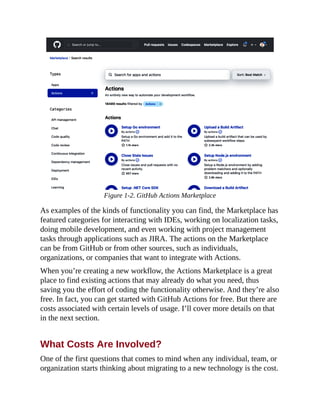


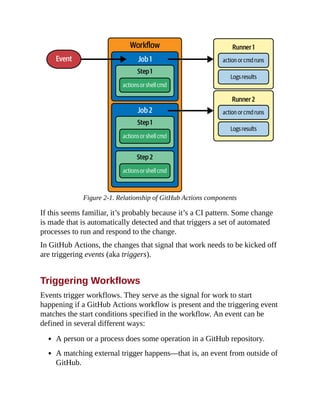
![A schedule is set up to run a workflow at particular times or intervals.
A workflow is initiated manually, without an operation having to be
done first.
I’ll dive into these different types more in Chapter 3 and extensively in
Chapter 8, but an event triggered from an operation in a GitHub repository
is probably the most common type. An example of this kind of event is a
GitHub pull request. If you or a process initiates a pull request, then a
corresponding pull request event is triggered. There is also a push event for
code pushes. In GitHub, there are a large number of common operations
you can do that can serve as triggers for a workflow.
There are also multiple ways to govern when workflows react to the
triggers. To understand this, here’s the first piece of workflow syntax to
become familiar with—the on clause. The on keyword and the lines that
follow it define which types of triggers the workflow will match on and
start executing. Some basic types of triggers and simple examples of the
syntax for each follow:
The workflow can respond to a single event such as when a push happens:
on: push
The workflow can respond to a list (multiple events):
on: [push, pull_request]
The workflow can respond to event types with qualifiers, such as branches,
tags, or file paths:
on:
push:
branches:
- main
- 'rel/v*'
tags:
- v1.*
- beta](https://image.slidesharecdn.com/118579-250528161816-8caab8e0/85/Learning-GitHub-Actions-1-converted-Edition-Brent-Laster-45-320.jpg)
![paths:
- '**.ts'
The workflow can execute on a specific schedule or interval (using standard
cron syntax):
on:
scheduled:
- cron: '30 5,15 * * *'
@INTERVAL SYNTAX
Syntax like @daily, @hourly, and so on is not supported.
The workflow can respond to specific manual events (more about these
later):
on: [workflow-dispatch, repository-dispatch]
The workflow can be called from other workflows (referred to as a reuse
event):
on: workflow_call
The workflow can respond to webhook events—that is, when a webhook
executes and sends a payload. (See the related documentation for more
details on events and payloads in webhooks.)
The workflow can respond to common activities on GitHub items, such as
adding a comment to a GitHub issue:
on: issue_comment](https://image.slidesharecdn.com/118579-250528161816-8caab8e0/85/Learning-GitHub-Actions-1-converted-Edition-Brent-Laster-46-320.jpg)
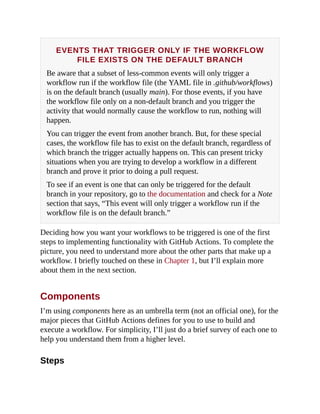
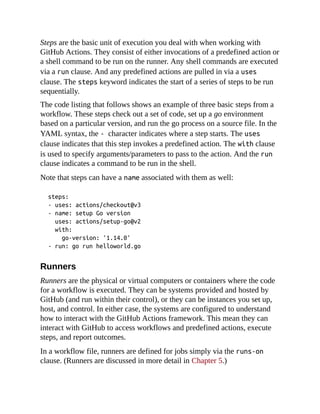
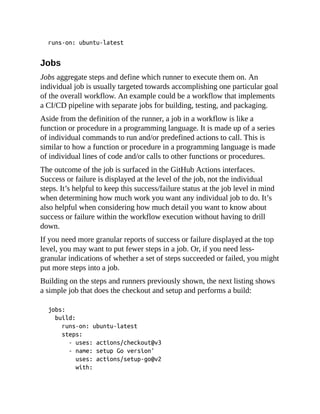

![baby, who is “examining the handle [of the door] with an attention
worthy of an amateur locksmith.” Peter raised it in his arms, looked
at it for a moment, and then, kissing it almost reverently, gave it to
Mike and clumped down-stairs. “Poor Norah hoped he had not got
delirium tremens.” It was a long time before Peter came back; when
he did, it was behind the rampart of a large basket bursting with
eatables. He goes down on his knees to his wife and begs
forgiveness in the most charmingly abrupt and natural way, and
when Norah recovers from a fainting-fit, everything is bright and
happy again. “Certain it is that, when the Angelus rang, it found
them sitting side by side, shelling peas, and the baby on his knee,
chuckling over a stick of rhubarb that it expected every one to smell
every five minutes.” And what is the end? A triumph for Peter, and a
hopeful example for all those who are honestly trying to follow in his
footsteps. “In the whole parish there is not a cleaner house, better
children, or a happier wife than Peter’s.... He collects the
subscriptions for the schools, takes the money in church, carries the
big banner at processions, and seems to do the work of half a dozen
men made into one.... Is there a drunkard to reclaim, Peter is the
man to take him in hand, depend upon it. Is there a drunkard’s
widow struggling with her little ones alone, Peter will help her and
put her in a way to get her living ... and he thanks God for all things,
for his home, his little ones, his means of doing good, but, more
than all, he thanks him for his wife Norah, and for a journey he took,
of which he never speaks, on the Feast of S. Peter and S. Paul.”
Of the “other tales,” we much prefer “A Carpenter’s Holiday.” The
evils of bad companionship are here depicted, the absurd
temptations which human respect thrusts in the path of young and
often weak men, the manliness and true Anglo-Saxon spirit which
even outsiders recognize in a firm refusal to yield to such
temptations. The character of Sam is very interesting, and the
history of his conversion quite a natural one. A lesson here and there
is worth taking from it. For instance, the Catholic carpenter says to
his friend, “People talk so much about our flowers and candles that
really one would think they was a great part of our religion, and, as](https://image.slidesharecdn.com/118579-250528161816-8caab8e0/85/Learning-GitHub-Actions-1-converted-Edition-Brent-Laster-60-320.jpg)

![And—unkindest cut of all—punishment transcending in degree
the worst faults and most terrible crimes of which he has been
unjustly accused by his most cruel enemies—modern German
Protestantism has placed him in bronze effigy in company with the
bigamous Landgrave Philip of Hesse, and with Prince Frederick of
Saxony, on the monument at Worms, as one of the predecessors
and helpers of Luther. The ascetic Savonarola the acolyte of the
beery Monk of Wittenberg! The chaste Dominican the inferior of the
sensual Reformer! The ecclesiastic who, in the flower of his
manhood and the fulness of his intellect, made the unreserved
declaration of Catholic faith[118] in which he lived and died, the aider
and precursor of the archheresiarch!
Truly, so far as the judgment of this world is concerned, one hour
of the degradation of Worms is sufficient to have cancelled all his
sins. Poor Savonarola!
Jerome Savonarola, born in Ferrara, in 1452 (Sept. 21), was the
son of Nicholas Savonarola. His mother Helen was of the
Buonaccorsi family of Mantua, and his paternal grandfather a
physician of Padua of such high reputation that Nicholas, Prince of
Este, induced him, by the bestowal of honors and a pension, to
come to Ferrara. Jerome’s youth was serious and studious, and,
under the fostering care of one of the best of mothers, his character
developed favorably. At the age of ten, he went to the public school
of his native city, and it was intended that he should complete the
usual studies necessary to his becoming a physician.
The traveller of to-day, who sees the deserted squares and grass-
grown streets of Ferrara, can form but little idea of the Ferrara of
that period; a splendid city of one hundred thousand inhabitants,
possessing one of the most brilliant courts of Italy, and witnessing
the frequent passage of princes, emperors, and popes, whose
presence gave constant occasion for pageants, processions, and
banquets. The young Jerome, it was noticed, sought none of these,
but was fond of lonely walks and solitude, even avoiding the
beautiful promenades in the gardens of the ducal palace.](https://image.slidesharecdn.com/118579-250528161816-8caab8e0/85/Learning-GitHub-Actions-1-converted-Edition-Brent-Laster-69-320.jpg)
![He pursued his medical studies for some time, but his favorite
reading was found in the works of Aristotle and S. Thomas Aquinas.
Long years afterward, he said of the latter: “When I was in the
world, I held him in the greatest reverence. I have always kept to his
teaching, and, whenever I wish to feel small, I read him, and he
always appears to me as a giant, and I to myself as a dwarf.”
Although, like most youths of his age, he indulged in making verses,
his were not of the ordinary callow model. One of his short youthful
poems which survived him was on the spread of sceptical philosophy
and the decay of virtue. “Where,” he asks—“where are the pure
diamonds, the bright lamps, the sapphires, the white robes, and
white roses of the church?” Such language, taken in connection with
his declaration at the time that he would never become a monk,
shows that the idea, although in a negative form, was already
working in his mind. He afterwards related that, being at Faenza one
day, he by chance entered the church of S. Augustine, and heard a
remarkable word fall from the lips of the preacher. “I will not tell you
what it was,” he added, “but it is here, graven on my heart. One
year afterwards, I became a religious.”
Modern novels and the average silly judgment of worldly people
in such matters are usually unable to comprehend why any man or
woman should enter a convent unless they are what is called
“crossed in love.” Some such story is related of Savonarola, and
Milman says of it: “There is a vague story, resting on but slight
authority, that Savonarola was the victim of a tender but honorable
passion for a beautiful female.” We should also incline to be of the
same opinion, were it not that Villari[119] refers to it as having some
foundation. He says that, in 1472, a Florentine exile, bearing the
illustrious name of Strozzi, and his daughter, took up their abode
next to the dwelling of Savonarola’s family. The mere fact that he
was an exile from Dante’s native city was sufficient to excite
Savonarola’s sympathies. He imagined him oppressed by the
injustice of enemies, suffering for his country and for the cause of
liberty. His eyes met those of the Florentine maiden. Overflowing
with confident hope, he revealed his heart to her. What was his](https://image.slidesharecdn.com/118579-250528161816-8caab8e0/85/Learning-GitHub-Actions-1-converted-Edition-Brent-Laster-70-320.jpg)
![in the most menial of the offices of the community, and to be the
servant of all the others. Being admitted, he seized his first leisure
moment that same day to write a long and affectionate letter to his
father, in which he sought to comfort him and explain the step he
had taken. It is a memorable letter:
“Dear Father: I fear my departure from home has caused you much
sorrow—the more so that I left you furtively. Permit me to explain my
motives. You who so well know how to appreciate the perishable things of
earth, judge not with passion like a woman, but, guided by truth, judge
according to reason whether I am not right in carrying out my project and
abandoning the world. The motive determining me to enter on a religious
life is this: the great misery of the world, the iniquities of men, the crimes,
the pride, the shocking blasphemies, by which the world is polluted, for
there is none that doeth good—no, not one. Often and daily have I
uttered this verse with tears:
‘Heu fuge crudelas terras! Fuge littus avarum.’
I could not support the wickedness of the people. Everywhere I saw virtue
despised, and vice honored. No greater suffering could I have in this
world. Wherefore every day I prayed our Lord Jesus Christ to lift me out
of this mire. It has pleased God in his infinite mercy to show me the right
way, and I have entered upon it, although unworthy of such a grace.
Sweet Jesus, may I suffer a thousand deaths rather than oppose thee and
show myself ungrateful! Thus, my dear father, far from shedding tears,
you should thank our Lord Jesus, for he has given you a son, has
preserved him to you up to the age of twenty-two, and has deigned to
admit him among his knights militant. Can you imagine that I have not
endured the greatest affliction in separating from you? Never have I
suffered such mental torment as in abandoning my own father to make
the sacrifice of my body to Jesus Christ, and to surrender my will into the
hands of persons I had never seen. In mercy, then, most loving father, dry
your tears, and add not to my pain and sorrow. I am satisfied with what I
have done, and I would not return to the world even with the certainty of
becoming greater than Cæsar. But, like you, I am of flesh and blood; the
senses wage war with reason, and I must struggle furiously with the
assaults of the devil.[120] They will soon pass by, these first sad days,
bitterest in the freshness of their grief, and I trust we will be consoled by
grace in this world, and glory in the next. Comfort my mother, I beseech
you, of whom, with yourself, I entreat your blessing.”](https://image.slidesharecdn.com/118579-250528161816-8caab8e0/85/Learning-GitHub-Actions-1-converted-Edition-Brent-Laster-72-320.jpg)
![possibility that there might be fresh ones in store for him when in
time he came to know the Florentines better.
LORENZO THE MAGNIFICENT.
When Savonarola came to Florence, Lorenzo the Magnificent had
been its ruler for many years, and was then at the apogee of his
fame and his power. Under his sway[121] everything looked
prosperous and happy. The struggles that formerly convulsed the
city had long ceased. Those who refused to bend to the domination
of the Medici were imprisoned, exiled, or dead. All was peace and
tranquillity. Feasts, dances, and tournaments filled up the leisure of
this Florentine people, who, once so jealous of their rights, now
seemed to have forgotten the very name of liberty. Lorenzo
participated in all these diversions, and even exerted himself to
invent new ones. Among these were the Canti Carnascialeschi, first
written by him and sung by the young nobility and gentry of
Florence in the masquerades of the Carnival. Nothing perhaps can
better depict the corruption of the period than these songs. At this
day not only educated young men, but the lowest of the populace,
would hold them in scorn, and their repetition in public would be an
offence against decency swiftly to be suppressed by the police. And
yet such were the occupations of predilection of a prince praised by
all, and considered as the model of a sovereign, a prodigy of
courtesy, a political and literary genius. And there are those who are
to-day inclined to think of him as he was then looked upon, to
pardon him the blood cruelly spilled to maintain a power unjustly
acquired by him and his, the ruin of the republic, the violence by
which he forced from the community the sum necessary for his
reckless expenditure, the shameless libertinism to which he
abandoned himself, and even the rapid and infernal corruption of the
people which he studied to maintain with all his force and mental
capacity.[122] And all this must be pardoned him forsooth, because
he was the protector of literature and the fine arts!](https://image.slidesharecdn.com/118579-250528161816-8caab8e0/85/Learning-GitHub-Actions-1-converted-Edition-Brent-Laster-76-320.jpg)


![[Part-1] Automating MuleSoft Deployment with Github Actions | MuleSoft Mysore...](https://cdn.slidesharecdn.com/ss_thumbnails/meetup-automatemulesoftdeploymentwithgithubactions-part12-240717083415-d4c0ece9-thumbnail.jpg?width=640&height=640&fit=bounds)


