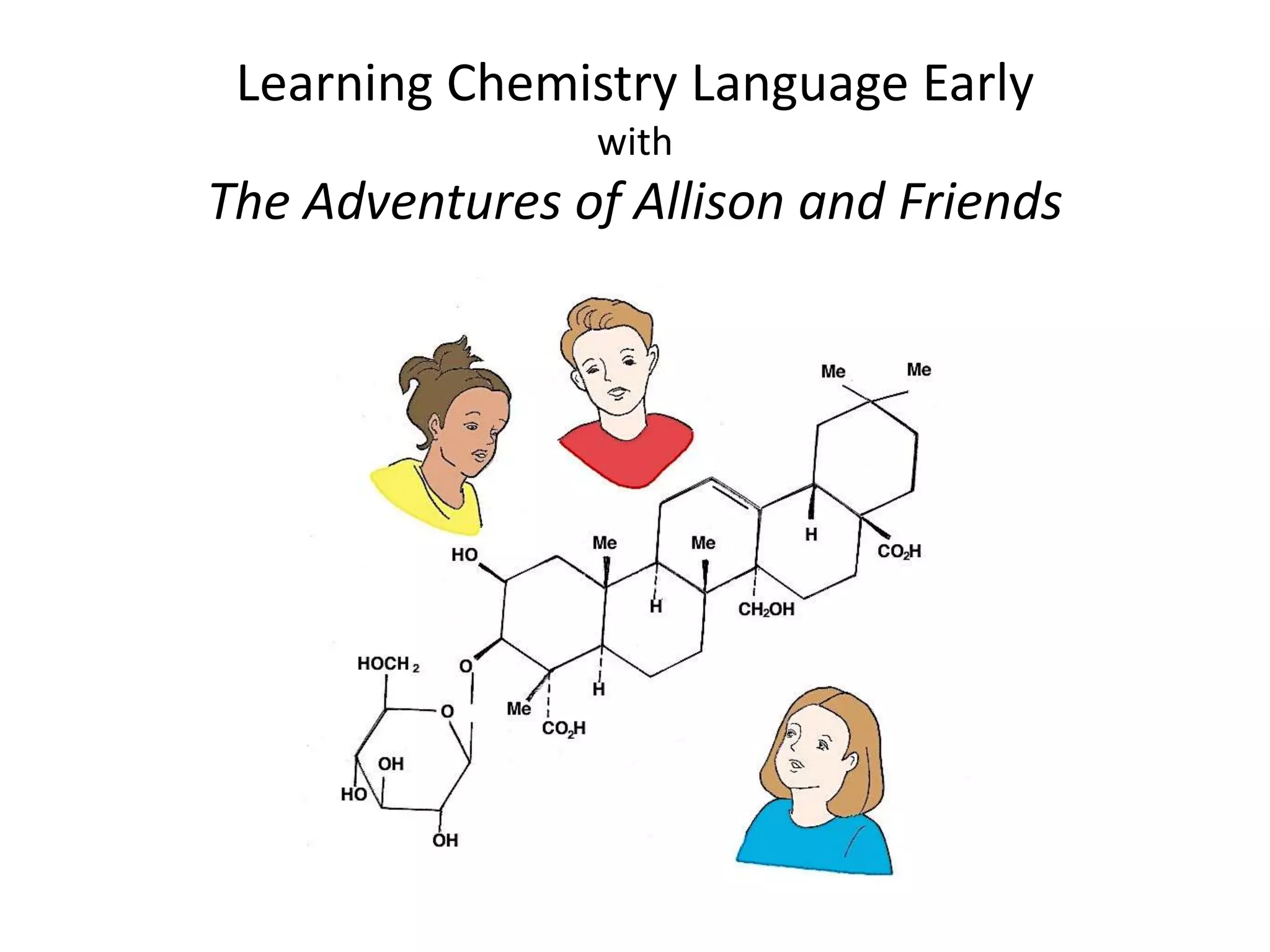
Learning Chemistry Language Early
with
The Adventures of Allison and Friends
“Education has very little to do with explanation; it has to do
with engagement, falling in love with the material… There is
no good learning without strong emotion.”
-- Seymour Papert
Imagination is more important than Knowledge
“Imagination is more important than knowledge. Knowledge is
limited, whereas imagination embraces the entire world,
stimulating progress, giving birth to evolution. It is, strictly
speaking, a real factor in scientific research.”
-- Albert Einstein
Chemistry Language is similar to Natural Language
“The language of chemistry is very similar to any natural
language. Thus, there exists a great similarity between the
language of chemistry and the natural language including the
process as well as the mechanics of learning.”
-- Mahadev Kumbar
Storytelling is Critical
“Storytelling is critical. If you organize information in storytelling,
children are more likely to learn it. And adults are, too.”
-- Jennifer Kotler Clarke,
Sesame Street’s VP for
research and evaluation
The Adventures of
Allison and Friends
A comic series for young
readers exploring the world
of everyday chemistry,
where chemistry language
is treated as
a natural language with
chemical structures as words
in a visual narrative.
Samples from the series are as
follows.
The Context of a Chemical
Structure is depicted in the
Visual Narrative
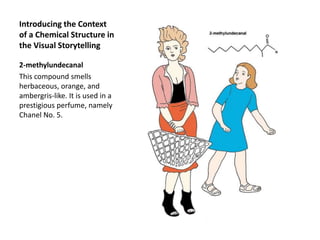
2-methylundecanal
This compound smells
herbaceous, orange, and
ambergris-like. It is used in a
prestigious perfume, namely
Chanel No. 5.
The Context of a Chemical
Structure is depicted in the
Visual Narrative
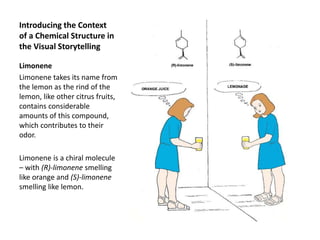
Limonene
Limonene takes its name from
the lemon as the rind of the
lemon, like other citrus fruits,
contains considerable
amounts of this compound,
which contributes to their
odor.
Limonene is a chiral molecule
– with (R)-limonene smelling
like orange and (S)-limonene
smelling like lemon.
The Context of a Chemical
Structure is depicted in the
Visual Narrative
Silk Protein Molecule
What is shown here is known
as the pleated structure of the
molecules making up silk ,
where chains of the protein
molecule are aligned side-by-
side with every other chain
aligned in the opposite
direction.
One source of such silk
molecules is the thick mat of
byssus threads of a pen shell
used to anchor it in the
seabed.
The Context of a Chemical
Structure is depicted in the
Visual Narrative
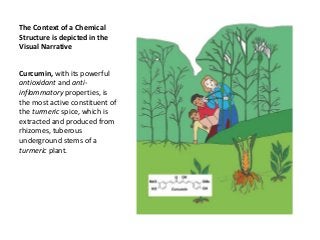
Curcumin, with its powerful
antioxidant and anti-
inflammatory properties, is
the most active constituent of
the turmeric spice, which is
extracted and produced from
rhizomes, tuberous
underground stems of a
turmeric plant.
The Context of a Chemical
Structure is depicted in the
Visual Narrative
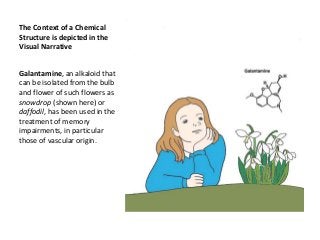
Galantamine, an alkaloid that
can be isolated from the bulb
and flower of such flowers as
snowdrop (shown here) or
daffodil, has been used in the
treatment of memory
impairments, in particular
those of vascular origin.
The Context of a Chemical
Structure is depicted in the
Visual Narrative
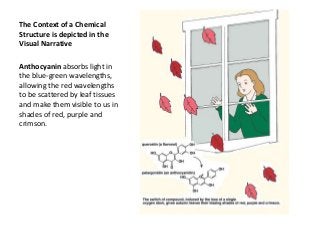
Anthocyanin absorbs light in
the blue-green wavelengths,
allowing the red wavelengths
to be scattered by leaf tissues
and make them visible to us in
shades of red, purple and
crimson.
The Context of a Chemical
Structure is depicted in the
Visual Narrative
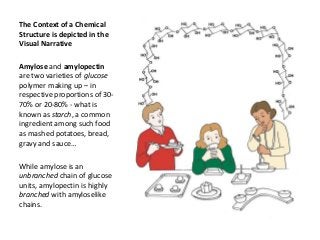
Amylose and amylopectin
are two varieties of glucose
polymer making up – in
respective proportions of 30-
70% or 20-80% - what is
known as starch, a common
ingredient among such food
as mashed potatoes, bread,
gravy and sauce…
While amylose is an
unbranched chain of glucose
units, amylopectin is highly
branched with amyloselike
chains.
For Further Exploration
Available on Amazon com in both formats – digital and print:
The Adventures of Allison and Friends
A Treasure on the Beach
The Secret of the Golden Yarn
Hidden Treasure Pathways of the Great Forest
More to come
References
• Roald Hoffmann and Pierre Laszlo, Representation in Chemistry [in Roald
Hoffmann on the Philosophy, Art, and Science of Chemistry, Oxford
University Press (2012)]
• Mahadev Kumbar, Chemistry in a Day of Student’s Life, iUniverse (2003)
• Jim Tankersley, Study: Kids can learn as much from ‘Sesame Street’ as
from preschool, Washington Post, June 7th, 2015.
• Stephen J Weininger, Contemplating the Finger: Visuality and the
Semiotics of Chemistry, An International Journal for the Philosophy of
Chemistry, Vol. 4 (1998), 3-27.

Learning Chemistry Language Early

  • 1.
    Learning Chemistry LanguageEarly with The Adventures of Allison and Friends
  • 2.
    “Education has verylittle to do with explanation; it has to do with engagement, falling in love with the material… There is no good learning without strong emotion.” -- Seymour Papert
  • 3.
    Imagination is moreimportant than Knowledge “Imagination is more important than knowledge. Knowledge is limited, whereas imagination embraces the entire world, stimulating progress, giving birth to evolution. It is, strictly speaking, a real factor in scientific research.” -- Albert Einstein
  • 4.
    Chemistry Language issimilar to Natural Language “The language of chemistry is very similar to any natural language. Thus, there exists a great similarity between the language of chemistry and the natural language including the process as well as the mechanics of learning.” -- Mahadev Kumbar
  • 5.
    Storytelling is Critical “Storytellingis critical. If you organize information in storytelling, children are more likely to learn it. And adults are, too.” -- Jennifer Kotler Clarke, Sesame Street’s VP for research and evaluation
  • 6.
    The Adventures of Allisonand Friends A comic series for young readers exploring the world of everyday chemistry, where chemistry language is treated as a natural language with chemical structures as words in a visual narrative. Samples from the series are as follows.
  • 7.
    The Context ofa Chemical Structure is depicted in the Visual Narrative 2-methylundecanal This compound smells herbaceous, orange, and ambergris-like. It is used in a prestigious perfume, namely Chanel No. 5.
  • 8.
    The Context ofa Chemical Structure is depicted in the Visual Narrative Limonene Limonene takes its name from the lemon as the rind of the lemon, like other citrus fruits, contains considerable amounts of this compound, which contributes to their odor. Limonene is a chiral molecule – with (R)-limonene smelling like orange and (S)-limonene smelling like lemon.
  • 9.
    The Context ofa Chemical Structure is depicted in the Visual Narrative Silk Protein Molecule What is shown here is known as the pleated structure of the molecules making up silk , where chains of the protein molecule are aligned side-by- side with every other chain aligned in the opposite direction. One source of such silk molecules is the thick mat of byssus threads of a pen shell used to anchor it in the seabed.
  • 10.
    The Context ofa Chemical Structure is depicted in the Visual Narrative Curcumin, with its powerful antioxidant and anti- inflammatory properties, is the most active constituent of the turmeric spice, which is extracted and produced from rhizomes, tuberous underground stems of a turmeric plant.
  • 11.
    The Context ofa Chemical Structure is depicted in the Visual Narrative Galantamine, an alkaloid that can be isolated from the bulb and flower of such flowers as snowdrop (shown here) or daffodil, has been used in the treatment of memory impairments, in particular those of vascular origin.
  • 12.
    The Context ofa Chemical Structure is depicted in the Visual Narrative Anthocyanin absorbs light in the blue-green wavelengths, allowing the red wavelengths to be scattered by leaf tissues and make them visible to us in shades of red, purple and crimson.
  • 13.
    The Context ofa Chemical Structure is depicted in the Visual Narrative Amylose and amylopectin are two varieties of glucose polymer making up – in respective proportions of 30- 70% or 20-80% - what is known as starch, a common ingredient among such food as mashed potatoes, bread, gravy and sauce… While amylose is an unbranched chain of glucose units, amylopectin is highly branched with amyloselike chains.
  • 14.
    For Further Exploration Availableon Amazon com in both formats – digital and print: The Adventures of Allison and Friends A Treasure on the Beach The Secret of the Golden Yarn Hidden Treasure Pathways of the Great Forest More to come
  • 15.
    References • Roald Hoffmannand Pierre Laszlo, Representation in Chemistry [in Roald Hoffmann on the Philosophy, Art, and Science of Chemistry, Oxford University Press (2012)] • Mahadev Kumbar, Chemistry in a Day of Student’s Life, iUniverse (2003) • Jim Tankersley, Study: Kids can learn as much from ‘Sesame Street’ as from preschool, Washington Post, June 7th, 2015. • Stephen J Weininger, Contemplating the Finger: Visuality and the Semiotics of Chemistry, An International Journal for the Philosophy of Chemistry, Vol. 4 (1998), 3-27.