











LEARNING RUBY BY
READING THE SOURCE
tw:@burkelibbey / gh:@burke
THESIS:
The best way to learn a piece of infrastructure is to learn about
how it’s implemented.
So let’s dig in to ruby’s source!
TOPICS
• Basic

Object Structure

• Class

inheritance

• Singleton
• Module
• MRI

classes

inheritance

Source spelunking
BASIC OBJECT STRUCTURE
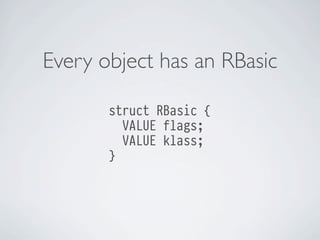
Every object has an RBasic
struct RBasic {
VALUE flags;
VALUE klass;
}
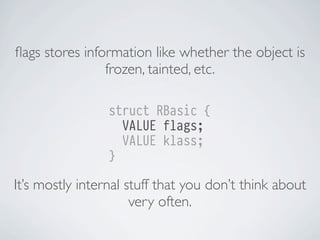
flags stores information like whether the object is
frozen, tainted, etc.
struct RBasic {
VALUE flags;
VALUE klass;
}

It’s mostly internal stuff that you don’t think about
very often.
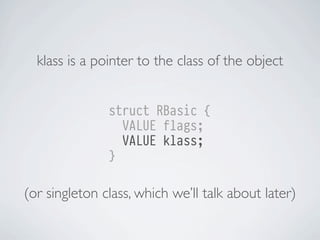
klass is a pointer to the class of the object
struct RBasic {
VALUE flags;
VALUE klass;
}

(or singleton class, which we’ll talk about later)
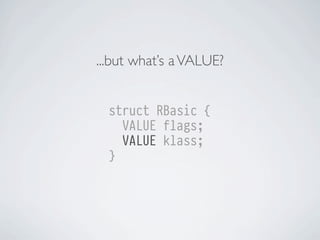
...but what’s a VALUE?
struct RBasic {
VALUE flags;
VALUE klass;
}
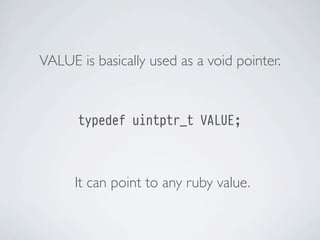
VALUE is basically used as a void pointer.

typedef uintptr_t VALUE;

It can point to any ruby value.
You should interpret “VALUE” as:
“a (pointer to a) ruby object”
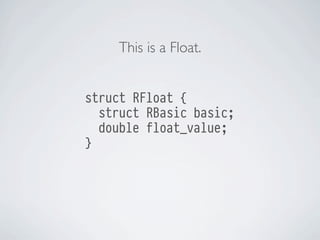
This is a Float.
struct RFloat {
struct RBasic basic;
double float_value;
}
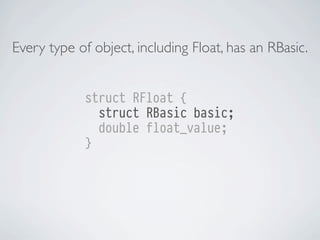
Every type of object, including Float, has an RBasic.
struct RFloat {
struct RBasic basic;
double float_value;
}
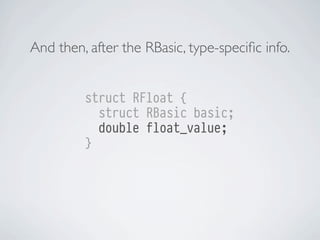
And then, after the RBasic, type-specific info.
struct RFloat {
struct RBasic basic;
double float_value;
}
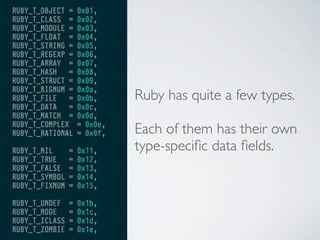
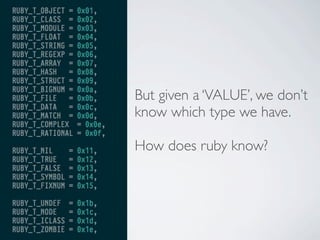
Ruby has quite a few types.
Each of them has their own
type-specific data fields.
But given a ‘VALUE’, we don’t
know which type we have.
How does ruby know?
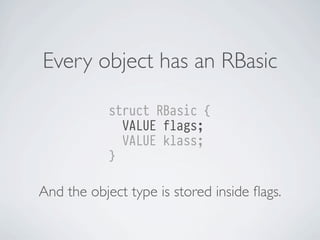
Every object has an RBasic
struct RBasic {
VALUE flags;
VALUE klass;
}

And the object type is stored inside flags.
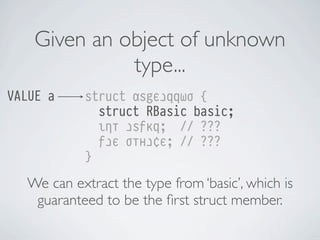
Given an object of unknown
type...
VALUE a

struct αѕgє‫נ‬qqωσ {
struct RBasic basic;
ιηт ‫נ‬ѕƒкq; // ???
ƒ‫נ‬є σтн‫¢נ‬є; // ???
}

We can extract the type from ‘basic’, which is
guaranteed to be the first struct member.
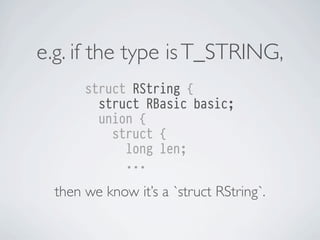
e.g. if the type is T_STRING,
struct RString {
struct RBasic basic;
union {
struct {
long len;
...

then we know it’s a `struct RString`.
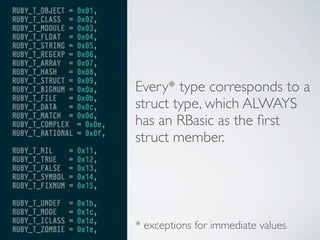
Every* type corresponds to a
struct type, which ALWAYS
has an RBasic as the first
struct member.

* exceptions for immediate values
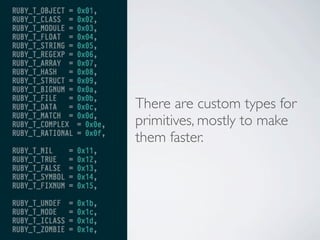
There are custom types for
primitives, mostly to make
them faster.
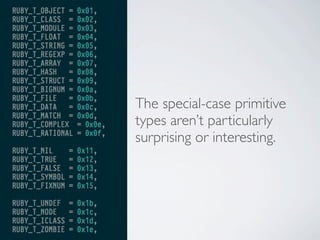
The special-case primitive
types aren’t particularly
surprising or interesting.
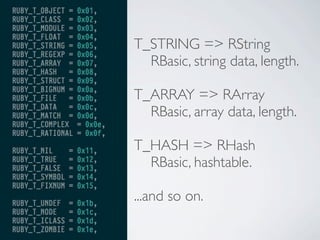
T_STRING => RString
RBasic, string data, length.
T_ARRAY => RArray
RBasic, array data, length.
T_HASH => RHash
RBasic, hashtable.
...and so on.
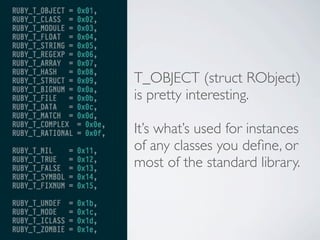
T_OBJECT (struct RObject)
is pretty interesting.
It’s what’s used for instances
of any classes you define, or
most of the standard library.
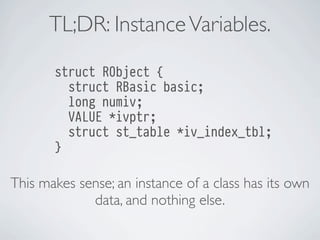
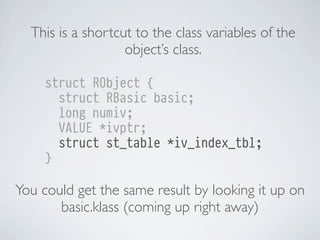
TL;DR: Instance Variables.
struct RObject {
struct RBasic basic;
long numiv;
VALUE *ivptr;
struct st_table *iv_index_tbl;
}

This makes sense; an instance of a class has its own
data, and nothing else.
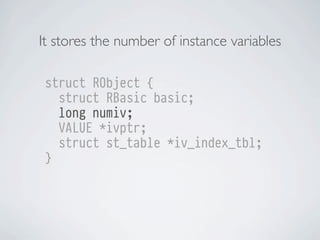
It stores the number of instance variables
struct RObject {
struct RBasic basic;
long numiv;
VALUE *ivptr;
struct st_table *iv_index_tbl;
}
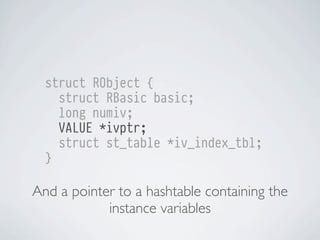
struct RObject {
struct RBasic basic;
long numiv;
VALUE *ivptr;
struct st_table *iv_index_tbl;
}

And a pointer to a hashtable containing the
instance variables
This is a shortcut to the class variables of the
object’s class.
struct RObject {
struct RBasic basic;
long numiv;
VALUE *ivptr;
struct st_table *iv_index_tbl;
}

You could get the same result by looking it up on
basic.klass (coming up right away)
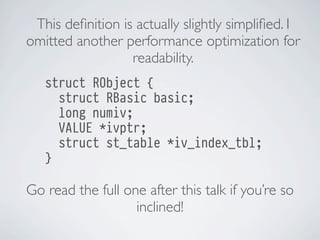
This definition is actually slightly simplified. I
omitted another performance optimization for
readability.
struct RObject {
struct RBasic basic;
long numiv;
VALUE *ivptr;
struct st_table *iv_index_tbl;
}

Go read the full one after this talk if you’re so
inclined!
Class and Module types
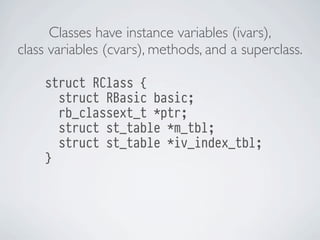
Classes have instance variables (ivars),
class variables (cvars), methods, and a superclass.
struct RClass {
struct RBasic basic;
rb_classext_t *ptr;
struct st_table *m_tbl;
struct st_table *iv_index_tbl;
}
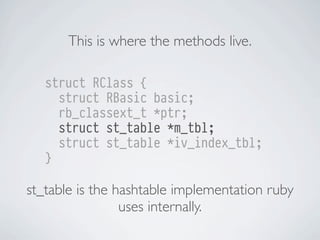
This is where the methods live.
struct RClass {
struct RBasic basic;
rb_classext_t *ptr;
struct st_table *m_tbl;
struct st_table *iv_index_tbl;
}

st_table is the hashtable implementation ruby
uses internally.
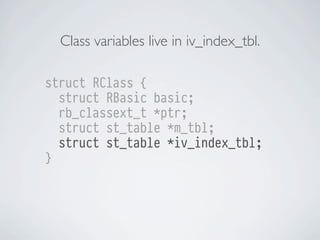
Class variables live in iv_index_tbl.
struct RClass {
struct RBasic basic;
rb_classext_t *ptr;
struct st_table *m_tbl;
struct st_table *iv_index_tbl;
}
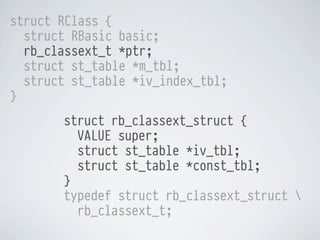
struct RClass {
struct RBasic basic;
rb_classext_t *ptr;
struct st_table *m_tbl;
struct st_table *iv_index_tbl;
}
struct rb_classext_struct {
VALUE super;
struct st_table *iv_tbl;
struct st_table *const_tbl;
}
typedef struct rb_classext_struct 
rb_classext_t;
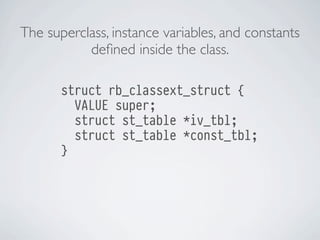
The superclass, instance variables, and constants
defined inside the class.
struct rb_classext_struct {
VALUE super;
struct st_table *iv_tbl;
struct st_table *const_tbl;
}
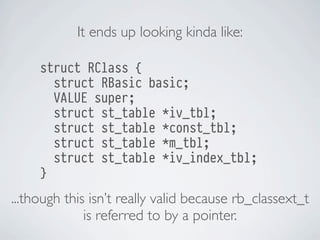
It ends up looking kinda like:
struct RClass {
struct RBasic basic;
VALUE super;
struct st_table *iv_tbl;
struct st_table *const_tbl;
struct st_table *m_tbl;
struct st_table *iv_index_tbl;
}

...though this isn’t really valid because rb_classext_t
is referred to by a pointer.
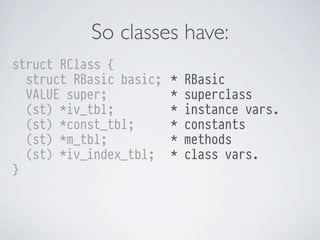
So classes have:
struct RClass {
struct RBasic basic;
VALUE super;
(st) *iv_tbl;
(st) *const_tbl;
(st) *m_tbl;
(st) *iv_index_tbl;
}

*
*
*
*
*
*

RBasic
superclass
instance vars.
constants
methods
class vars.
Modules
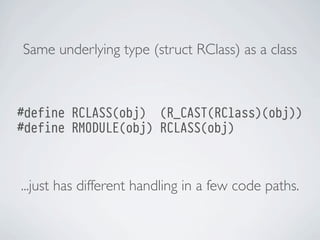
Same underlying type (struct RClass) as a class

#define RCLASS(obj) (R_CAST(RClass)(obj))
#define RMODULE(obj) RCLASS(obj)

...just has different handling in a few code paths.
Immediate values
Sort of complicated.
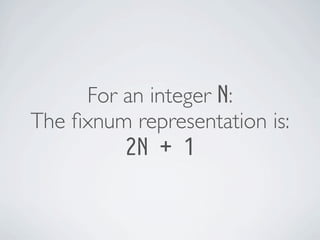
For an integer N:
The fixnum representation is:
2N + 1
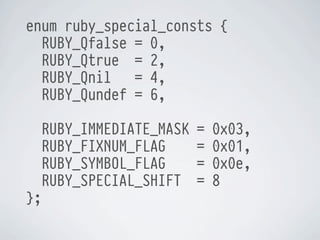
enum ruby_special_consts {
RUBY_Qfalse = 0,
RUBY_Qtrue = 2,
RUBY_Qnil
= 4,
RUBY_Qundef = 6,
RUBY_IMMEDIATE_MASK
RUBY_FIXNUM_FLAG
RUBY_SYMBOL_FLAG
RUBY_SPECIAL_SHIFT
};

=
=
=
=

0x03,
0x01,
0x0e,
8
enum ruby_special_consts {
RUBY_Qfalse = 0,
RUBY_Qtrue = 2,
RUBY_Qnil
= 4,
RUBY_Qundef = 6,
RUBY_IMMEDIATE_MASK = 0x03,
RUBY_FIXNUM_FLAG
= 0x01,
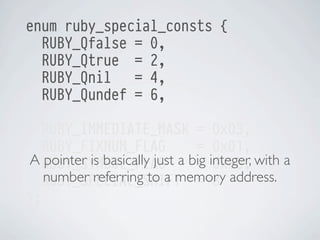
A RUBY_SYMBOL_FLAG a big integer, with a
pointer is basically just
= 0x0e,
number referring to a memory
RUBY_SPECIAL_SHIFT = 8 address.
};
enum ruby_special_consts {
RUBY_Qfalse = 0,
RUBY_Qtrue = 2,
RUBY_Qnil
= 4,
RUBY_Qundef = 6,
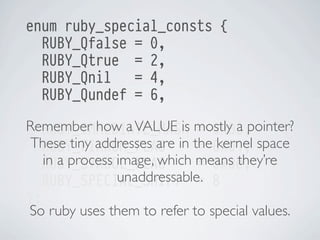
Remember how a VALUE is mostly a pointer?
RUBY_IMMEDIATE_MASK = 0x03,
These tiny addresses are in the0x01, space
RUBY_FIXNUM_FLAG
= kernel
in a process image, which means they’re
RUBY_SYMBOL_FLAG
= 0x0e,
unaddressable.
RUBY_SPECIAL_SHIFT = 8
};
So ruby uses them to refer to special values.
enum ruby_special_consts {
RUBY_Qfalse = 0,
RUBY_Qtrue = 2,
RUBY_Qnil
= 4,
RUBY_Qundef = 6,
RUBY_IMMEDIATE_MASK = 0x03,
RUBY_FIXNUM_FLAG
= 0x01,
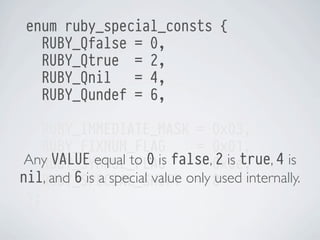
Any VALUE equal to 0 is false,0x0e,
2 is true, 4 is
RUBY_SYMBOL_FLAG
=
nil, and 6 is a special value only 8
RUBY_SPECIAL_SHIFT = used internally.
};
enum ruby_special_consts {
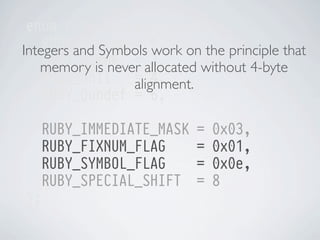
RUBY_Qfalse = 0, on the principle that
Integers and Symbols work
RUBY_Qtrue = allocated without 4-byte
2,
memory is never
RUBY_Qnil
= 4,
alignment.
RUBY_Qundef = 6,
RUBY_IMMEDIATE_MASK
RUBY_FIXNUM_FLAG
RUBY_SYMBOL_FLAG
RUBY_SPECIAL_SHIFT
};

=
=
=
=

0x03,
0x01,
0x0e,
8
enum ruby_special_consts {
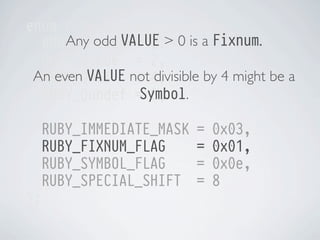
Any odd VALUE
RUBY_Qfalse = 0,> 0 is a Fixnum.
RUBY_Qtrue = 2,
An even VALUE not 4,
RUBY_Qnil
= divisible by 4 might be a
RUBY_Qundef =Symbol.
6,
RUBY_IMMEDIATE_MASK
RUBY_FIXNUM_FLAG
RUBY_SYMBOL_FLAG
RUBY_SPECIAL_SHIFT
};

=
=
=
=

0x03,
0x01,
0x0e,
8
Symbols are just integers.
There is a global table mapping
Symbol IDs to the strings they
represent.
Symbols are immediates because
their IDs are stored in VALUE,
and looked up in the symbol
table for display.
CLASS INHERITANCE
We have a pretty good picture of how values are
represented; now we’re going to talk about how
they interact.
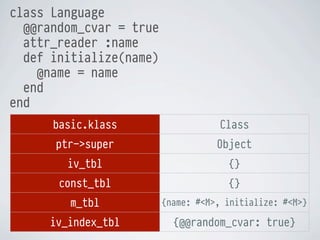
class Language
@@random_cvar = true
attr_reader :name
def initialize(name)
@name = name
end
end
basic.klass

Class

ptr->super

Object

iv_tbl

{}

const_tbl

{}

m_tbl

{name: #<M>, initialize: #<M>}

iv_index_tbl

{@@random_cvar: true}
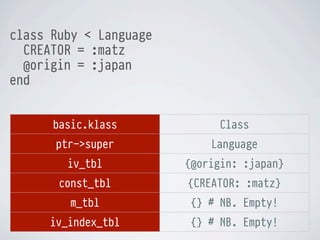
class Ruby < Language
CREATOR = :matz
@origin = :japan
end
basic.klass

Class

ptr->super

Language

iv_tbl

{@origin: :japan}

const_tbl

{CREATOR: :matz}

m_tbl

{} # NB. Empty!

iv_index_tbl

{} # NB. Empty!
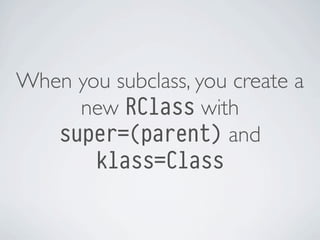
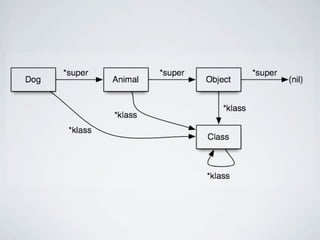
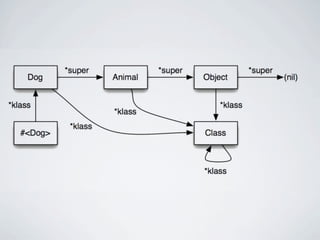
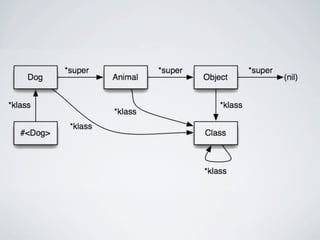
When you subclass, you create a
new RClass with
super=(parent) and
klass=Class
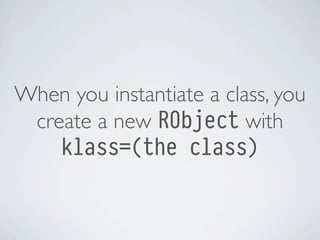
When you instantiate a class, you
create a new RObject with
klass=(the class)
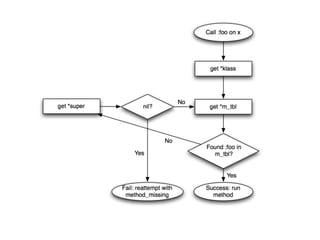
Method lookup
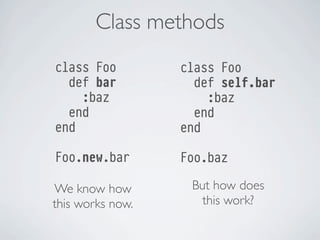
Class methods
class Foo
def bar
:baz
end
end

class Foo
def self.bar
:baz
end
end

Foo.new.bar

Foo.baz

We know how
this works now.

But how does
this work?
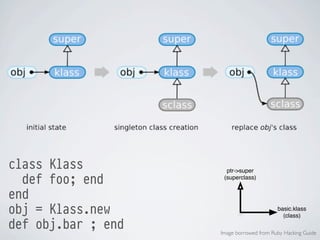
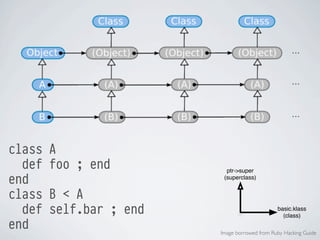
SINGLETON CLASSES
class Klass
def foo; end
end
obj = Klass.new
def obj.bar ; end

ptr->super
(superclass)

basic.klass
(class)
Image borrowed from Ruby Hacking Guide
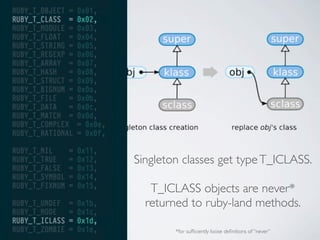
Singleton classes get type T_ICLASS.
T_ICLASS objects are never*
returned to ruby-land methods.
*for sufficiently loose definitions of “never”
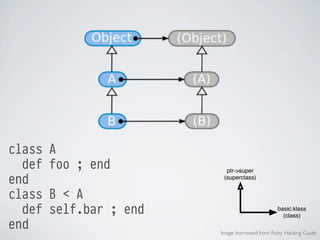
class
def
end
class
def
end

A
foo ; end
B < A
self.bar ; end

ptr->super
(superclass)

basic.klass
(class)
Image borrowed from Ruby Hacking Guide
class
def
end
class
def
end

A
foo ; end
B < A
self.bar ; end

ptr->super
(superclass)

basic.klass
(class)
Image borrowed from Ruby Hacking Guide
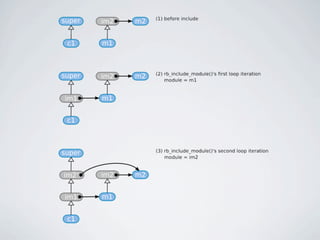
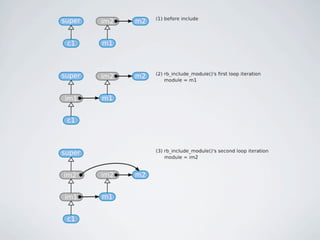
MODULE INHERITANCE
MRI SOURCE SPELUNKING
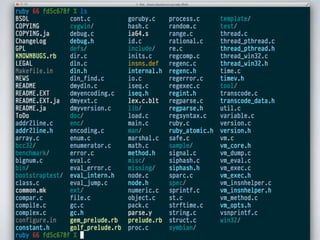
First, check out the source
github.com/ruby/ruby
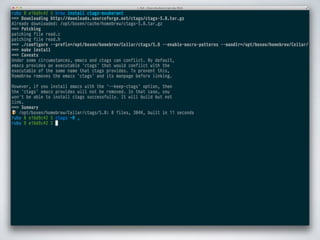
google “<your editor> ctags”
CASE STUDY:
How does Array#cycle work?
brb live demo
Builtin types have a <type>.c
(string.c, array.c, proc.c, re.c, etc.)
Interesting methods tend to be in
those files
They are always present inside
double quotes
(easy to search for)
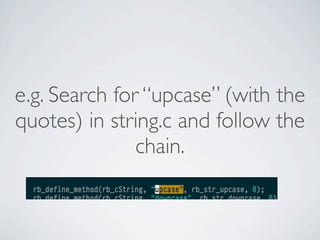
The next parameter after the
string is the C function name
e.g. Search for “upcase” (with the
quotes) in string.c and follow the
chain.
Most of the supporting VM
internals are in vm_*.c
Garbage collection is in gc.c
Don’t look at parse.y.
Trust me.
Almost all of the stuff we’ve
looked at today is in object.c,
class.c, or ruby.h
I mostly look up definitions of
built-in methods
Further reading:
Ruby under a Microscope
http://patshaughnessy.net/ruby-under-a-microscope

Ruby Hacking Guide
http://ruby-hacking-guide.github.io/
Thanks, questions?

Learn Ruby by Reading the Source

  • 1.
    LEARNING RUBY BY READINGTHE SOURCE tw:@burkelibbey / gh:@burke
  • 2.
    THESIS: The best wayto learn a piece of infrastructure is to learn about how it’s implemented.
  • 3.
    So let’s digin to ruby’s source!
  • 4.
    TOPICS • Basic Object Structure •Class inheritance • Singleton • Module • MRI classes inheritance Source spelunking
  • 5.
  • 6.
    Every object hasan RBasic struct RBasic { VALUE flags; VALUE klass; }
  • 7.
    flags stores informationlike whether the object is frozen, tainted, etc. struct RBasic { VALUE flags; VALUE klass; } It’s mostly internal stuff that you don’t think about very often.
  • 8.
    klass is apointer to the class of the object struct RBasic { VALUE flags; VALUE klass; } (or singleton class, which we’ll talk about later)
  • 9.
    ...but what’s aVALUE? struct RBasic { VALUE flags; VALUE klass; }
  • 10.
    VALUE is basicallyused as a void pointer. typedef uintptr_t VALUE; It can point to any ruby value.
  • 11.
    You should interpret“VALUE” as: “a (pointer to a) ruby object”
  • 12.
    This is aFloat. struct RFloat { struct RBasic basic; double float_value; }
  • 13.
    Every type ofobject, including Float, has an RBasic. struct RFloat { struct RBasic basic; double float_value; }
  • 14.
    And then, afterthe RBasic, type-specific info. struct RFloat { struct RBasic basic; double float_value; }
  • 15.
    Ruby has quitea few types. Each of them has their own type-specific data fields.
  • 16.
    But given a‘VALUE’, we don’t know which type we have. How does ruby know?
  • 17.
    Every object hasan RBasic struct RBasic { VALUE flags; VALUE klass; } And the object type is stored inside flags.
  • 18.
    Given an objectof unknown type... VALUE a struct αѕgє‫נ‬qqωσ { struct RBasic basic; ιηт ‫נ‬ѕƒкq; // ??? ƒ‫נ‬є σтн‫¢נ‬є; // ??? } We can extract the type from ‘basic’, which is guaranteed to be the first struct member.
  • 19.
    e.g. if thetype is T_STRING, struct RString { struct RBasic basic; union { struct { long len; ... then we know it’s a `struct RString`.
  • 20.
    Every* type correspondsto a struct type, which ALWAYS has an RBasic as the first struct member. * exceptions for immediate values
  • 21.
    There are customtypes for primitives, mostly to make them faster.
  • 22.
    The special-case primitive typesaren’t particularly surprising or interesting.
  • 23.
    T_STRING => RString RBasic,string data, length. T_ARRAY => RArray RBasic, array data, length. T_HASH => RHash RBasic, hashtable. ...and so on.
  • 24.
    T_OBJECT (struct RObject) ispretty interesting. It’s what’s used for instances of any classes you define, or most of the standard library.
  • 25.
    TL;DR: Instance Variables. structRObject { struct RBasic basic; long numiv; VALUE *ivptr; struct st_table *iv_index_tbl; } This makes sense; an instance of a class has its own data, and nothing else.
  • 26.
    It stores thenumber of instance variables struct RObject { struct RBasic basic; long numiv; VALUE *ivptr; struct st_table *iv_index_tbl; }
  • 27.
    struct RObject { structRBasic basic; long numiv; VALUE *ivptr; struct st_table *iv_index_tbl; } And a pointer to a hashtable containing the instance variables
  • 28.
    This is ashortcut to the class variables of the object’s class. struct RObject { struct RBasic basic; long numiv; VALUE *ivptr; struct st_table *iv_index_tbl; } You could get the same result by looking it up on basic.klass (coming up right away)
  • 29.
    This definition isactually slightly simplified. I omitted another performance optimization for readability. struct RObject { struct RBasic basic; long numiv; VALUE *ivptr; struct st_table *iv_index_tbl; } Go read the full one after this talk if you’re so inclined!
  • 30.
  • 31.
    Classes have instancevariables (ivars), class variables (cvars), methods, and a superclass. struct RClass { struct RBasic basic; rb_classext_t *ptr; struct st_table *m_tbl; struct st_table *iv_index_tbl; }
  • 32.
    This is wherethe methods live. struct RClass { struct RBasic basic; rb_classext_t *ptr; struct st_table *m_tbl; struct st_table *iv_index_tbl; } st_table is the hashtable implementation ruby uses internally.
  • 33.
    Class variables livein iv_index_tbl. struct RClass { struct RBasic basic; rb_classext_t *ptr; struct st_table *m_tbl; struct st_table *iv_index_tbl; }
  • 34.
    struct RClass { structRBasic basic; rb_classext_t *ptr; struct st_table *m_tbl; struct st_table *iv_index_tbl; } struct rb_classext_struct { VALUE super; struct st_table *iv_tbl; struct st_table *const_tbl; } typedef struct rb_classext_struct rb_classext_t;
  • 35.
    The superclass, instancevariables, and constants defined inside the class. struct rb_classext_struct { VALUE super; struct st_table *iv_tbl; struct st_table *const_tbl; }
  • 36.
    It ends uplooking kinda like: struct RClass { struct RBasic basic; VALUE super; struct st_table *iv_tbl; struct st_table *const_tbl; struct st_table *m_tbl; struct st_table *iv_index_tbl; } ...though this isn’t really valid because rb_classext_t is referred to by a pointer.
  • 37.
    So classes have: structRClass { struct RBasic basic; VALUE super; (st) *iv_tbl; (st) *const_tbl; (st) *m_tbl; (st) *iv_index_tbl; } * * * * * * RBasic superclass instance vars. constants methods class vars.
  • 38.
  • 39.
    Same underlying type(struct RClass) as a class #define RCLASS(obj) (R_CAST(RClass)(obj)) #define RMODULE(obj) RCLASS(obj) ...just has different handling in a few code paths.
  • 40.
  • 41.
  • 42.
    For an integerN: The fixnum representation is: 2N + 1
  • 43.
    enum ruby_special_consts { RUBY_Qfalse= 0, RUBY_Qtrue = 2, RUBY_Qnil = 4, RUBY_Qundef = 6, RUBY_IMMEDIATE_MASK RUBY_FIXNUM_FLAG RUBY_SYMBOL_FLAG RUBY_SPECIAL_SHIFT }; = = = = 0x03, 0x01, 0x0e, 8
  • 44.
    enum ruby_special_consts { RUBY_Qfalse= 0, RUBY_Qtrue = 2, RUBY_Qnil = 4, RUBY_Qundef = 6, RUBY_IMMEDIATE_MASK = 0x03, RUBY_FIXNUM_FLAG = 0x01, A RUBY_SYMBOL_FLAG a big integer, with a pointer is basically just = 0x0e, number referring to a memory RUBY_SPECIAL_SHIFT = 8 address. };
  • 45.
    enum ruby_special_consts { RUBY_Qfalse= 0, RUBY_Qtrue = 2, RUBY_Qnil = 4, RUBY_Qundef = 6, Remember how a VALUE is mostly a pointer? RUBY_IMMEDIATE_MASK = 0x03, These tiny addresses are in the0x01, space RUBY_FIXNUM_FLAG = kernel in a process image, which means they’re RUBY_SYMBOL_FLAG = 0x0e, unaddressable. RUBY_SPECIAL_SHIFT = 8 }; So ruby uses them to refer to special values.
  • 46.
    enum ruby_special_consts { RUBY_Qfalse= 0, RUBY_Qtrue = 2, RUBY_Qnil = 4, RUBY_Qundef = 6, RUBY_IMMEDIATE_MASK = 0x03, RUBY_FIXNUM_FLAG = 0x01, Any VALUE equal to 0 is false,0x0e, 2 is true, 4 is RUBY_SYMBOL_FLAG = nil, and 6 is a special value only 8 RUBY_SPECIAL_SHIFT = used internally. };
  • 47.
    enum ruby_special_consts { RUBY_Qfalse= 0, on the principle that Integers and Symbols work RUBY_Qtrue = allocated without 4-byte 2, memory is never RUBY_Qnil = 4, alignment. RUBY_Qundef = 6, RUBY_IMMEDIATE_MASK RUBY_FIXNUM_FLAG RUBY_SYMBOL_FLAG RUBY_SPECIAL_SHIFT }; = = = = 0x03, 0x01, 0x0e, 8
  • 48.
    enum ruby_special_consts { Anyodd VALUE RUBY_Qfalse = 0,> 0 is a Fixnum. RUBY_Qtrue = 2, An even VALUE not 4, RUBY_Qnil = divisible by 4 might be a RUBY_Qundef =Symbol. 6, RUBY_IMMEDIATE_MASK RUBY_FIXNUM_FLAG RUBY_SYMBOL_FLAG RUBY_SPECIAL_SHIFT }; = = = = 0x03, 0x01, 0x0e, 8
  • 49.
  • 50.
    There is aglobal table mapping Symbol IDs to the strings they represent.
  • 51.
    Symbols are immediatesbecause their IDs are stored in VALUE, and looked up in the symbol table for display.
  • 52.
  • 53.
    We have apretty good picture of how values are represented; now we’re going to talk about how they interact.
  • 54.
    class Language @@random_cvar =true attr_reader :name def initialize(name) @name = name end end basic.klass Class ptr->super Object iv_tbl {} const_tbl {} m_tbl {name: #<M>, initialize: #<M>} iv_index_tbl {@@random_cvar: true}
  • 55.
    class Ruby <Language CREATOR = :matz @origin = :japan end basic.klass Class ptr->super Language iv_tbl {@origin: :japan} const_tbl {CREATOR: :matz} m_tbl {} # NB. Empty! iv_index_tbl {} # NB. Empty!
  • 56.
    When you subclass,you create a new RClass with super=(parent) and klass=Class
  • 57.
    When you instantiatea class, you create a new RObject with klass=(the class)
  • 61.
  • 63.
    Class methods class Foo defbar :baz end end class Foo def self.bar :baz end end Foo.new.bar Foo.baz We know how this works now. But how does this work?
  • 64.
  • 65.
    class Klass def foo;end end obj = Klass.new def obj.bar ; end ptr->super (superclass) basic.klass (class) Image borrowed from Ruby Hacking Guide
  • 66.
    Singleton classes gettype T_ICLASS. T_ICLASS objects are never* returned to ruby-land methods. *for sufficiently loose definitions of “never”
  • 67.
    class def end class def end A foo ; end B< A self.bar ; end ptr->super (superclass) basic.klass (class) Image borrowed from Ruby Hacking Guide
  • 68.
    class def end class def end A foo ; end B< A self.bar ; end ptr->super (superclass) basic.klass (class) Image borrowed from Ruby Hacking Guide
  • 69.
  • 73.
  • 74.
    First, check outthe source
  • 75.
  • 78.
  • 79.
    CASE STUDY: How doesArray#cycle work?
  • 80.
  • 81.
    Builtin types havea <type>.c (string.c, array.c, proc.c, re.c, etc.)
  • 82.
    Interesting methods tendto be in those files
  • 83.
    They are alwayspresent inside double quotes (easy to search for)
  • 84.
    The next parameterafter the string is the C function name
  • 85.
    e.g. Search for“upcase” (with the quotes) in string.c and follow the chain.
  • 86.
    Most of thesupporting VM internals are in vm_*.c
  • 87.
  • 88.
    Don’t look atparse.y. Trust me.
  • 89.
    Almost all ofthe stuff we’ve looked at today is in object.c, class.c, or ruby.h
  • 90.
    I mostly lookup definitions of built-in methods
  • 91.
    Further reading: Ruby undera Microscope http://patshaughnessy.net/ruby-under-a-microscope Ruby Hacking Guide http://ruby-hacking-guide.github.io/
  • 92.