More recently the concept of leapfrogging is being used in the context of
sustainable development for developing countries as a theory of development
which may accelerate development by skipping inferior, less efficient, more
expensive or more polluting technologies and industries and move directly to
more advanced ones. It is proposed that through leapfrogging developing
countries can avoid environmentally harmful stages of development and do not
need to follow the polluting development trajectory of industrialized countries.
The adoption of solar energy technologies in developing countries are examples
of where countries do not repeat the mistakes of highly industrialized countries
in creating an energy infrastructure based on fossil fuels, but “jump” directly
into the Solar Age.
meaning..
rather than go through a change incrementally/linearly/bureaucratically…
jump right to where you want to be.
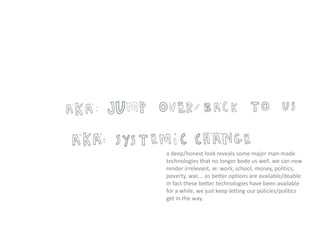
a deep/honest look reveals some major man-made
technologies that no longer bode us well. we can now
render irrelevant, ie: work, school, money, politics,
poverty, war, .. as better options are available/doable.
in fact these better technologies have been available
for a while, we just keep letting our policies/politics
get in the way.
like.. so many examples from ie: africa – Toby Shapshak et al
like.. David Graeber on – acting as if we’re already free.
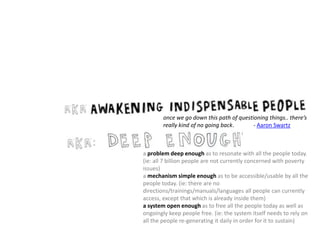
once we go down this path of questioning things.. there’s
really kind of no going back. - Aaron Swartz
a problem deep enough as to resonate with all the people today.
(ie: all 7 billion people are not currently concerned with poverty
issues)
a mechanism simple enough as to be accessible/usable by all the
people today. (ie: there are no
directions/trainings/manuals/languages all people can currently
access, except that which is already inside them)
a system open enough as to free all the people today as well as
ongoingly keep people free. (ie: the system itself needs to rely on
all the people re-generating it daily in order for it to sustain)
what we need to do.. we can now do.
jump over all the assumed steps to getting to a betterness.
ie: a nother way; rev in reverse; 1 yr to be 5; 1 yr to try commons; ..
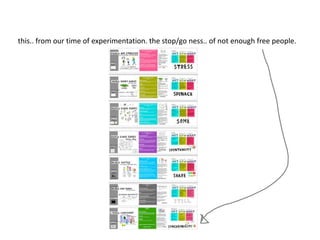
this.. from our time of experimentation. the stop/go ness.. of not enough free people.
deep gratitude to all the meanwhile focused
folks. freeing me/us up.. mentally at least.. to
focus on leapfrogging.
i believe this is a moment in time.. where we
can leapfrog to a space 7 billion+ of us crave.
but
for
that
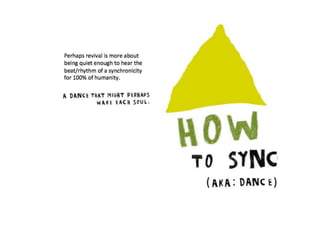
dance
to
dance/sync
it
begs
jump
at
once.
perhaps we haven’t yet seen/believed in the natural order of things
(ie: stigmergy ness) because nature assumes inclusion.
and we haven’t yet let go of our non-inclusive ness.
enough.
to see how we can dance.
all of us.
together.
ie: rather than changing (patent et al) laws; getting money out of politics; ed reform;….
which all perpetuate an unnatural out of step ness..
let’s leap frog to
what we want.
to where all the
things that are
keeping us from us
become irrelevant.
:
redefineschool.com/leap-frog/

leapfrogging

  • 2.
    More recently theconcept of leapfrogging is being used in the context of sustainable development for developing countries as a theory of development which may accelerate development by skipping inferior, less efficient, more expensive or more polluting technologies and industries and move directly to more advanced ones. It is proposed that through leapfrogging developing countries can avoid environmentally harmful stages of development and do not need to follow the polluting development trajectory of industrialized countries. The adoption of solar energy technologies in developing countries are examples of where countries do not repeat the mistakes of highly industrialized countries in creating an energy infrastructure based on fossil fuels, but “jump” directly into the Solar Age.
  • 3.
    meaning.. rather than gothrough a change incrementally/linearly/bureaucratically… jump right to where you want to be.
  • 4.
    a deep/honest lookreveals some major man-made technologies that no longer bode us well. we can now render irrelevant, ie: work, school, money, politics, poverty, war, .. as better options are available/doable. in fact these better technologies have been available for a while, we just keep letting our policies/politics get in the way.
  • 5.
    like.. so manyexamples from ie: africa – Toby Shapshak et al like.. David Graeber on – acting as if we’re already free.
  • 6.
    once we godown this path of questioning things.. there’s really kind of no going back. - Aaron Swartz a problem deep enough as to resonate with all the people today. (ie: all 7 billion people are not currently concerned with poverty issues) a mechanism simple enough as to be accessible/usable by all the people today. (ie: there are no directions/trainings/manuals/languages all people can currently access, except that which is already inside them) a system open enough as to free all the people today as well as ongoingly keep people free. (ie: the system itself needs to rely on all the people re-generating it daily in order for it to sustain)
  • 7.
    what we needto do.. we can now do. jump over all the assumed steps to getting to a betterness. ie: a nother way; rev in reverse; 1 yr to be 5; 1 yr to try commons; ..
  • 9.
    this.. from ourtime of experimentation. the stop/go ness.. of not enough free people.
  • 12.
    deep gratitude toall the meanwhile focused folks. freeing me/us up.. mentally at least.. to focus on leapfrogging.
  • 13.
    i believe thisis a moment in time.. where we can leapfrog to a space 7 billion+ of us crave.
  • 14.
  • 15.
    perhaps we haven’tyet seen/believed in the natural order of things (ie: stigmergy ness) because nature assumes inclusion. and we haven’t yet let go of our non-inclusive ness. enough. to see how we can dance. all of us. together.
  • 16.
    ie: rather thanchanging (patent et al) laws; getting money out of politics; ed reform;…. which all perpetuate an unnatural out of step ness.. let’s leap frog to what we want. to where all the things that are keeping us from us become irrelevant.
  • 17.