Leading open innovation First Mit Press
Paperback Edition Huff download
https://ebookgate.com/product/leading-open-innovation-first-mit-
press-paperback-edition-huff/
Get Instant Ebook Downloads – Browse at https://ebookgate.com
Get Your Digital Files Instantly: PDF, ePub, MOBI and More
Quick Digital Downloads: PDF, ePub, MOBI and Other Formats
Enduring innocence global architecture and its
political masquerades First Mit Press Paperback
Edition. Edition Keller Easterling
https://ebookgate.com/product/enduring-innocence-global-
architecture-and-its-political-masquerades-first-mit-press-
paperback-edition-edition-keller-easterling/
Birdsong speech and language exploring the evolution of
mind and brain First Mit Press Paperback Edition
Bolhuis
https://ebookgate.com/product/birdsong-speech-and-language-
exploring-the-evolution-of-mind-and-brain-first-mit-press-
paperback-edition-bolhuis/
Aesthetics of interaction in digital art 1. MIT Press
paperback ed Edition Kwastek
https://ebookgate.com/product/aesthetics-of-interaction-in-
digital-art-1-mit-press-paperback-ed-edition-kwastek/
Fair Division and Collective Welfare The MIT Press
Moulin
https://ebookgate.com/product/fair-division-and-collective-
welfare-the-mit-press-moulin/
Play between worlds exploring online game culture 1st
MIT Press pbk. ed Edition Taylor
https://ebookgate.com/product/play-between-worlds-exploring-
online-game-culture-1st-mit-press-pbk-ed-edition-taylor/
Religion in human evolution from the Paleolithic to the
Axial Age First Harvard University Press Paperback
Edition Bellah
https://ebookgate.com/product/religion-in-human-evolution-from-
the-paleolithic-to-the-axial-age-first-harvard-university-press-
paperback-edition-bellah/
In the shadow of the Ayatollah a CIA hostage in Iran
First Naval Institute Press Paperback Edition Daugherty
https://ebookgate.com/product/in-the-shadow-of-the-ayatollah-a-
cia-hostage-in-iran-first-naval-institute-press-paperback-
edition-daugherty/
The last utopia human rights in history 1st Belknap
Press of Harvard University Press paperback ed Edition
Moyn
https://ebookgate.com/product/the-last-utopia-human-rights-in-
history-1st-belknap-press-of-harvard-university-press-paperback-
ed-edition-moyn/
Routes of War The World of Movement in the Confederate
South First Harvard University Press Paperback Edition
Yael A. Sternhell
https://ebookgate.com/product/routes-of-war-the-world-of-
movement-in-the-confederate-south-first-harvard-university-press-
paperback-edition-yael-a-sternhell/
Leading Open Innovation
LEADING OPEN INNOVATION
edited by Anne Sigismund Huff, Kathrin M. Möslein, and Ralf Reichwald
The MIT Press
Cambridge, Massachusetts
London, England
© 2013 Massachusetts Institute of Technology
All rights reserved. No part of this book may be reproduced in any form by any electronic or
mechanical means (including photocopying, recording, or information storage and retrieval)
without permission in writing from the publisher.
MIT Press books may be purchased at special quantity discounts for business or sales promotional
use. For information, please email special_sales@mitpress.mit.edu or write to Special Sales Depart-
ment, The MIT Press, 55 Hayward Street, Cambridge, MA 02142.
This book was set in Stone Sans and Stone Serif by Toppan Best-set Premedia Limited. Printed
and bound in the United States of America.
Library of Congress Cataloging-in-Publication Data
Leading open innovation / edited by Anne Sigismund Huff, Kathrin M. Möslein, and Ralf
Reichwald.
p. cm.
Includes bibliographical references and index.
ISBN 978-0-262-01849-4 (hardcover : alk. paper)
1. Technological innovations—Economic aspects. 2. Diffusion of innovations. 3. Open inno-
vation. I. Huff, Anne Sigismund. II. Möslein, Kathrin M. III. Reichwald, Ralf
HD45.L337 2013
658.4'063—dc23
2012020392
10 9 8 7 6 5 4 3 2 1
Contents
Acknowledgments xi
I WHY AND HOW OPEN INNOVATION WORKS 1
1 Introduction to Open Innovation 3
Anne Sigismund Huff, Kathrin M. Möslein, and Ralf Reichwald
Definitions of Open Innovation 5
Why Open Innovation Now? 7
Purpose of This Volume and Chapter Overviews 8
Potential Problems of Open Innovation 13
The Promise of Open Innovation 14
Conclusion—Leading Open Innovation 15
2 Open Innovation at Siemens AG 19
Thomas Lackner
The Innovation–Market Connection 19
Leveraging Existing Technology into New Markets 21
Innovation at Siemens 22
Open Innovation 25
Potential Problems of Open Innovation 27
Examples of Open Innovation Projects Underway at Siemens 28
An Ideal Picture of Siemens as an Open Innovator 31
Idea for Innovative Leaders: Bring Knowledge-Holders Together 31
Further Investigation 33
3 The Need for Speed: Fostering Strategic Agility for Renewed Growth 35
Yves Doz
Research Approach 35
Focus on Successful Competitors in the IT Industry 37
vi Contents
A Successful and Widely Accepted Recipe for Success 37
The Relationship between Past Success and Current Difficulties 39
The Cumulative Effect of Growing Rapidly 42
Escaping the Rigidities Caused by Success 46
Achieving Greater Resource Fluidity and Increasing Teamwork at the Top 49
Conclusion 50
Idea for Innovative Leaders: Pay Attention to Emotion 51
4 Leading Innovation 55
Rudolf Gröger
Background to Becoming CEO of O2 55
The Most Important Characteristics of Leadership 56
Vision Is Central 57
Market Position Is Important 58
Becoming CEO of VIAG Interkom 58
Vision as the Basis of Turnaround 59
Actions after Targets Were Established 61
Communicating a Complex Agenda 62
The Centrality of Open Leadership 64
Dealing with Resistance to Change 65
Conclusion 66
Idea for Innovative Leaders: Share the Need to Do Everything All at Once 67
5 Open Innovation: Actors, Tools, and Tensions 69
Kathrin M. Möslein
Three Types of Innovators in Open Innovation 70
Tools for Open Innovation 72
Conclusion: Inherent Tensions of Open Innovation 81
Idea for Innovative Leaders: Learn from Those Who Successfully Balance Open and Closed
Innovation 83
II WHO CONTRIBUTES TO OPEN INNOVATION? 87
6 Opening Organizations for Innovation 89
John Bessant and Bettina von Stamm
Exploration versus Exploitation 89
The Innovation Lab 95
Search Routines to Support Discontinuous Innovation 96
Contents vii
Conclusion: Turning New Opportunities into Company Routines 101
Idea for Innovative Leaders: Prepare Your Company to Absorb Outside Ideas 102
7 Cooperation for Innovation 105
Lynda Gratton
Hot Spots 106
Identifying and Understanding Hot Spots 106
How Do Organizations Break away from Current Practice? 107
The Need for Balance 109
Igniting Purpose 111
Making Signature Processes 112
Conclusion: Priorities for Leaders and Researchers Interested in Creating Hot Spots 115
Idea for Innovative Leaders: Organizational Structures Facilitate Cooperation 116
8 User Innovation 117
Eric von Hippel
Open User Innovation 117
Importance of Innovation by Users 118
Why Many Users Want Custom Products 122
Users’ Innovate-or-Buy Decisions 123
Users’ Low-Cost Innovation Niches 124
Why Users Often Freely Reveal Their Innovations 126
Innovation Communities 128
Adapting Policy to User Innovation 129
Summary 133
9 Co-creation with Customers 139
Frank Piller and Christoph Ihl
Structuring Customer Co-Creation 142
Two Dyadic (Individual) Based Co-creation Methods 143
Two Network (Community) Based Co-creation Methods 146
Conclusion: Next Tasks for Co-Creation 149
Idea for Innovative Leaders: Recognize the Power of NIH (Not Invented Here) 150
10 Contributions by Developers 155
Karim R. Lakhani
The Revolution Changing the Way We Can Think about Innovation 155
The Principles of Open Source Innovation 157
Why Contribute? 159
viii Contents
The Community’s Role in Motivating Input 160
What Leaders of Distributed Innovation Do 161
What Business Can Learn from Open Source Development 162
Examples of Open Source Development 163
The Characteristics of Winning Problem Solvers 167
Conclusion: The Importance of Collaboration 167
Ideas for Innovative Leaders: Learn to Post Problems and Consider Providing More Information to
Open Communities 168
11 Strategic Crowdsourcing: The Emergence of Online Distributed Innovation 171
J. Andrei Villarroel
The Rise of Crowdsourcing 171
The Encyclopedia Revolution: When Excellence Meets Digitization and Crowdsourcing 172
Crowdsourcing as Organizational Design 174
The Competitive Advantage of Crowdsourcing 175
Online Distributed Organization: The End of One Era, the Beginning of Another 177
Online Distributed Innovation as an Extension to the Firm 185
The ODI Platform: A Strategic Dynamic Capability of the Firm 188
Conclusion: Implications of Crowdsourcing for Innovation 189
Mini Case A—Facebook Translations 191
Mini Case B—Netflix Prize 192
III TRENDS IN OPEN INNOVATION 201
12 Educating Open Innovation Ambassadors 203
Anne-Katrin Neyer and Nizar Abdelkafi
Designing a Teaching Tool for Educating Open Innovation Ambassadors 204
Case Study: University of Erlangen-Nuremberg 206
Conclusion: Toward Open School 215
Idea for Innovative Leaders: Live What You Teach 217
13 Viral Marketing on Facebook for a New Open Innovation Platform 221
Catharina van Delden and Nancy Wünderlich
The Power of Social Media 222
innosabi’s Vision 223
How Market Research Helped Design the Perfect Open Innovation Platform 224
Conclusion 236
Idea for Innovative Leaders: Engage Communication 237
Contents ix
14 The Future of Crowdsourcing: From Idea Contests to MASSive Ideation 241
Johann Füller, Katja Hutter, and Julia Hautz
One Example of an Innovation Contest: The OSRAM Design Contest/LED Emotionalize Your Light 242
Difficulties and Hurdles Arising from Online Innovation Contests 243
MASSive Ideation: A New Approach 248
Discussion/Conclusion 258
15 Open Manufacturing 263
Mitchell M. Tseng
An Example of Open Manufacturing: Shanzhai Cell Phones 265
Value Chain Differences 267
Quality and Innovation 269
Other Examples of Open Manufacturing 271
Labor Participation in Open Manufacturing: New Employment 272
Conclusion: Coordination as the Center of Open Manufacturing 274
Ideas for Innovative Leaders: Enable Open Manufacturing by Orchestrating Idea Flows and Material
Flows 275
Epilogue: Learning to be More Competitive, More Cooperative, and More
Innovative 279
Anne Sigismund Huff, Yves Doz, and Karim R. Lakhani
How Open Innovation Fits into Organizational Strategy 279
Unlearning Competitive Habits 280
Examples of New Ways of Thinking and Working 281
Learning to Be Part of a Cooperative/Competitive Ecosystem 282
Learning from Lean Environments 284
Advice to Newcomers 286
The Changing Definition of Strategy 287
Future Absorption of Open Innovation 289
Peter and Hannelore Pribilla’s Vision for Practical Research 293
Ralf Reichwald
Contributors 295
Index 309
Acknowledgments
This book is sponsored by the Peter Pribilla Foundation. The foundations’ goal is to
promote research and knowledge transfer in the domain of innovation and leadership.
Peter and Hannelore Pribilla’s personal efforts in this area are described in more detail
at the end of the volume. We gratefully dedicate this publication to their memory.
We also acknowledge the many people who have facilitated the annual meetings of
the Pribilla network since 2006. Special appreciation goes to Claudia Lehmann, who
provides essential organization of the meetings, Ilsa Brink, who designed and pro-
duced the booklets that summarized each of the first four meetings, and Vivek Velamui,
who organized figures and supported the editors in many other ways as we moved
toward publication.
Of course, the most important energy came from network participants. Their interest
in and knowledge about open innovation led to wonderful conversations and endur-
ing friendships. A book can only be a static snapshot of our ongoing exchange, but
we hope that readers are also engaged by our commitment to understand and advance
open innovation.
I WHY AND HOW OPEN INNOVATION WORKS
1 Introduction to Open Innovation
Anne Sigismund Huff, Kathrin M. Möslein, and Ralf Reichwald
Introduction
There are two different types of open innovation. The first is self-organized and self-
motivated collaborative activity to achieve a common goal. The second is an organi-
zational strategy to broaden innovation boundaries, often while retaining internal
R&D capabilities as well.
An example of open innovation driven by individual contributors is the surprising
speed with which publically sourced Wikipedia challenged the niche that the Ency-
clopedia Britannica had dominated for two centuries. As described in chapter 11 by
Andrei Villarroel, in 2000 the Encyclopedia Britannica was employing 4,000 experts
to compose a rather expensive 32-volume set of books that contained 65,000 articles
written in English. It was widely taken as the best summary of human knowledge
available for a general audience. Yet ten years later, Wikipedia was the sixth most
frequently consulted site on the Internet. Self-selected contributors from around the
world had created a much more encyclopedic free resource of over 3.5 million articles
in English, with parallel offerings in 279 other languages. Thirty-six sites in widely
used languages went well beyond the Encyclopedia Britannica by each offering at least
100,000 articles.
Several aspects of founder Jimmy Wales’s philosophy appear to have been critical
in motivating these contributions. Wikipedia was conceived as a free, global site for
collecting and dispensing information. Its articles were expected to be written from a
neutral point of view and to be accurate, but were not expected to be perfect. Con-
tributors could suggest revisions of current content as long as they followed a code of
conduct that assumed good faith and avoided personal attacks (Lakhani and McAffee
2007).
Despite the phenomenal amount of material that quickly accrued and its widespread
access, many people were dismissive of this effort. As one junior high school teacher
4 Anne Sigismund Huff, Kathrin M. Möslein, Ralf Reichwald
said when she banned student references to Wikipedia, “I am not interested in what
someone’s Aunt Nancy thinks about your topic.” Then in 2005, less than five years
after going online, a study published in Nature magazine reported that the quality of
articles from Wikipedia and Encyclopedia Britannica was basically even, based on a
blind review by subject experts (Gilles 2005). After a period of fierce debate, discussion
of quality diminished, though it continues.1
At the same time, Wikipedia keeps
growing, along with staff and volunteer efforts to improve input and editing.
Wikipedia is an example of what Eric von Hippel (2006) calls the “democratization”
of innovation. In chapter 8 he suggests that organizations as institutions and managers
as important drivers of innovation are becoming obsolete. In a groundbreaking empiri-
cal study von Hippel and his colleagues support this view with an estimate that UK
investment in development and modification of products by private individuals is
more than two times corporate investment in R&D (von Hippel, de Jong, and Flowers
2010). Harnessing this widely dispersed creative energy is the great promise of open
innovation.
At the same time organizations are becoming active participants in open innovation
by following a somewhat different logic. Relatively small retailers like Threadless, Muji,
and Quirky have shown how products can be designed, selected, and marketed by
customers (Seybold 2006 provides an early view of customer-led innovation). Other
companies are involved in a much broader range of activities. The most-cited example
of success is Procter & Gamble. With experience in over 1,000 partnerships, P&G
attributed a decade of increasing sales to open innovation.2
By the end of 2011 other
well-known sponsors of OI initiatives included Apple, eBay, Clorox, Cisco, Ericsson,
GlaxoSmithKline, General Mills, HP, Johnson & Johnson, Nestlé, Phillips, Royal Dutch
Shell, SAP, Whirlpool, Xerox, among many others.
General Mills’ G-Win site is particularly well organized. The homepage says:
At General Mills, we believe that there is a great opportunity for us to enhance and accelerate
our innovation efforts by teaming up with world-class innovators from outside of the company.
To facilitate this effort, we created the General Mills Worldwide Innovation Network (G-WIN)
to actively seek partners who can help us deliver breakthrough innovation in the following
categories:
Products New products that fit within a General Mills brand or solve a customer need.
Packaging Novel packaging technologies or new, consumer-friendly formats.
Processes Improvements to quality, efficiency and profitability.
Ingredients New ingredients to enhance taste, texture, quality or health benefits.
Technologies Enabling food technologies.
Digital Emerging digital marketing technologies.3
Introduction to Open Innovation 5
Specific examples of projects in each area are supplemented by stories focused on how
customers, suppliers, academics, consumers, employees, and entrepreneurs have made
contributions.
Definitions of Open Innovation
To formalize the definition of open innovation it is useful to distinguish invention
and innovation. Invention, in patent law as well as in common conversation, is typi-
cally defined as the creation of something new, or something that did not previously
exist. The word “innovation” can be used the same way, but more accurately is defined
as translating an invention into something that people will pay for—it brings some-
thing new to market. A few companies have aspired to invent; many more have
worked on developing the ability to innovate. Historically, as companies grew in size
and complexity, and technologies also became complex, research and development
departments grew as well. Over several centuries, secrecy and control were seen as the
requirements of success.
While historically there are interesting examples of calls for open invention, current
attention to open innovation is the result of the limits of internal, closed develop-
ment. Henry Chesbrough defined the departure from established practice when he
said “open innovation assumes . . . firms can and should use external as well as internal
ideas and internal and external paths to market” (2006, p. 1). Five years later Stefan
Lindegaard, an author, company advisor, and blogger interested in open innovation
elaborated:
Open innovation should be viewed as a two-way process in which companies have an inbound
process in which they bring in ideas, technologies, or other resources needed to develop their own
business and an outbound process in which they out-license or sell their own ideas, technologies,
and other resources. This should take place during all stages of the innovation process. (2010, p. 4)
Authors of chapters in this volume have been interested in further developing these
definitions. Mitchell Tseng, who wrote chapter 15, proposes that the prerequisites of
contemporary open innovation projects include:
• a platform (almost always electronic) that promotes information exchange;
• leadership (frequently distributed) that coordinates participation of varied actors and
organizes solutions; and
• agreed norms of behavior (often democratic) that specify how resources will be
identified, how assets will be exchanged, and how outcomes of interaction will be
valued.
6 Anne Sigismund Huff, Kathrin M. Möslein, Ralf Reichwald
The projects he and others describe in this volume point to other details:
1. The ecosystem supporting OI typically is much larger than required by other inno-
vation efforts and is often global in its reach.
2. Complicated problems typically are modularized so that they can be simultane-
ously addressed by multiple contributors.
3. In contrast to well-established innovation efforts driven by trained professionals,
there are lower (often no) a priori qualifications for participation in OI.
4. Participation (especially by solution providers) tends to be voluntary rather than
assigned.
5. Intrinsic and/or social motivation is important for many participants.
6. Costs of exchange are relatively low.
7. Transparency both in process and content is valued and used to improve results
over time.
8. Control systems tend to be limited and unobtrusive, though they often become
more complex in use.
9. Often task-related information is shared freely among participants.
10. Often leaders are selected by those doing the work.
11. Users and customers can be crucial contributors of ideas, inventions, and inno-
vations.
12. The solution set tends to be more varied than solutions produced in other ways.
13. Solution advancing contributions frequently come from people with experience
in subject domains unanticipated by problem specifiers.
14. The most successful solutions often improve previously developed ideas.
In aggregate, these characteristics establish a mindset about discovering and devel-
oping new ideas that can be used at multiple levels by different kinds of participants
to achieve different degrees of openness. As a set, however, they are a startling depar-
ture from images of closed innovation that extend from the lonely eccentric working
to develop what may become a brilliant new product to the well-run R&D labs of experts
found in high-science companies and universities. Closed innovation is carried out
by specialists who are employees (think scientists in Bell Labs, Merck, and many other
organizations). While a growing number of companies now are broadening their approach,
the logic of this kind of closed innovation still has considerable influence on individual
actions, organizational investments, and almost all legal systems.4
This volume examines
the limits of that logic.
Introduction to Open Innovation 7
Why Open Innovation Now?
The growing attraction of open innovation is the result of changes in social organiza-
tion and markets. Five trends in particular lie behind open innovation as an important
strategic option.
First, increasing interactions among individuals and groups around the world are
generating new and more varied demands for products, services, and experiences. This
is a first important impetus toward OI, made stronger by the growing number of stake-
holders who expect to contribute to problem definition and solution.
Luckily, a second development—technological changes that help innovators quickly
connect across space and time—facilitates contribution. Collaboration is increasing
because of advances in the way goods and services can be produced and distributed.
The possibility of cheaply creating prototypes that until recently required expensive
equipment and large-scale operations is of particular importance. Individuals and small
groups, in varied places and with varied access to resources, have more opportunities
to invent and innovate than they have had in the past.
A third contribution to the growth of open innovation is that organizations need
more ideas and more varied ideas to face growing global competition and its cost-
cutting standards. This pressure faces all organizations—public and private, large and
small. Almost all organizational leaders are finding they do not have the intellectual
resources they need to meet market demands and opportunities. Opening the innova-
tion process therefore has strong attraction.
Economic uncertainty can be identified as a fourth force that makes leveraging
limited innovation resources attractive. As mentioned above, the success of Procter &
Gamble’s Connect + Develop program has been particularly compelling. P&G’s CEO
A. G. Lafley followed the lead of pioneers IBM, Eli Lilly, and a few other companies
to aggressively channel a major portion of the company’s innovation budget to work
with outsiders in 2000 (Huston and Sakkab 2006). The strategy is considered a key
factor in P&G’s renewed sales growth, even during recent economic turmoil.
Finally, an increasingly accessible international labor pool makes open innovation
attractive. It is widely recognized that both well-trained workers and low-cost workers
can be found in many different locations. The more specific impact of labor on inno-
vation was first expressed by Bill Joy, a founder of Sun Microsystems:
No matter who you are, most of the smart people work for someone else.5
By extension, no matter how insightful the individual, group or organization, an
enormous, global pool of people with complementary intelligence and skill is available
to help advance innovative ideas.
8 Anne Sigismund Huff, Kathrin M. Möslein, Ralf Reichwald
Purpose of This Volume and Chapter Overviews
This volume describes OI’s search for smart people who might expand the space for
innovation. It reflects international, cross-sector, and transdisciplinary interests among
contributors from the United States, Germany, France, Finland, the United Kingdom,
Portugal, Tunisia, Austria, and China working in large multinational organizations, aca-
demic institutions, or entrepreneurial projects. They are part of the Peter Pribilla network,
which Ralf Reichwald describes at the end of the volume as a point of contact that sup-
ports overlapping interests in innovation and leadership.
The objective of the volume is to describe the broad canvas of OI practices, its par-
ticipants, and future promise. The authors believe the use of open innovation is, in
and of itself, a major innovation in the way innovation can be achieved. Since almost
all aspects of OI depart from the practices of closed innovation (which include, as
noted above, problem definition, participation, control, motivation, cost, information
exchange, organizational processes, outputs, and evaluation), it seems obvious that
the way OI is managed must involve innovation as well. Yet understanding the demands
of open innovation, in our minds and the minds of many observers, is only an interim
step. As discussed in the epilogue of this volume, once open innovation becomes estab-
lished and is understood, it can and should become part of an integrated innovation
strategy to successfully bring new offerings to market.
Figure 1.1, based on a graphic used in Siemens and shown in chapter 2, pro-
vides an overview. It suggests on the x-axis that the steps of innovation are blurring
while the number of potential contributors shown on the y-axis is vastly expand-
ing. We discuss results of these developments under three headings: the way open
innovation works, the contributions of primary participants, and promising future
developments.
How Open Innovation Works
In chapter 2, Thomas Lackner provides an overview of the OI landscape from the
perspective of a large multinational corporation. He emphasizes that all innovation
projects must generate money-making products and services—an idea, we observe,
that has recently been strongly embraced by many social entrepreneurs interested in
the public good as well. Lackner describes the increasing budget devoted to outside
innovation by large companies around the world, and then provides illustrative
examples from the broad range of OI activities underway in different units of his
company. The smart people sought for Siemens’s OI projects are sometimes solicited
from inside the company. Other projects reach out to targeted groups of outsiders. In
Introduction to Open Innovation 9
some cases an open call for contributions is made, often facilitated by independent
e-brokers. OI projects vary in their use of these and other possibilities over the course
of product and service development. Thus leaders have the very challenging task of
defining needed knowledge and bringing knowledge-holders together across compli-
cated organizational structures.
It is interesting that leaders of very successful organizations are taking up this chal-
lenge. In chapter 3, Yves Doz reports on a study carried out with Mikko Kosonen,
currently head of the Finnish National Fund for Innovation and until recently the chief
strategy officer at Nokia. The study focused on six IT companies, including Nokia, an
early adopter of OI practices that has nonetheless struggled to maintain its position
as an industry innovator. A central conclusion of the study is that actions that sustain
Ch. 2 Siemens
Ch. 15 Open manufacturing
Ch.
6
Search
strategies
Ch. 10 Open development
Ch. 9 Integrating customers
Ch. 3 Agility
Ch. 14 MASSive ideation
Ch. 8 Lead users
Ch. 8 Lead
users
Ch. 12 Open schools
Ch. 4 Open
leadership
Ch. 7 Team cooperation
Open to all
Individual
Generation of ideas
Selection and conceptualization
Technical development
Market launch
Improvement
Stage in innovation development
Ch. 5
Tools
Source
of
innovative
ideas/
extent
of
openness
Ch. 11 Crowdsourcing
Ch. 13
Viral marketing
via social media
Figure 1.1
Overview of chapters in Leading Open Innovation
10 Anne Sigismund Huff, Kathrin M. Möslein, Ralf Reichwald
growth and high performance of leading information technology firms create rigidities
over time that “require strategic processes to be decentralized, distributed, internally
participative, and (selectively) open externally.”
Doz focuses on an organization’s leaders as smart contributors to this process.
Rebuilding agility is a process of increasing internal tension via more varied informa-
tion sources while simultaneously addressing strategic, leadership, and resource issues.
The energy for this very challenging task comes from emotional commitment—a topic
that is rarely discussed in organizational life.
Companies that have not yet found success also can benefit from open innovation.
Rudolf Gröger was responsible for the rapid turnaround of O2, a mobile phone service
in the German market at that time owned by British Telecom. In chapter 4, Gröger
describes how open access to performance and other information was a key aspect of
achieving profitability, which also focused on rebranding and repositioning services
offered. Everyone in the organization is a smart person in charge of change. In Gröger’s
view, leaders must lead by example and encourage people in the organization to use
their emotional energy. The most difficult leadership task, however, is to work on
everything at once. In his words, “there is a logical chain of things that must be done,
and they all depend on each other.” As organizations become more open to inputs,
this perennial leadership challenge is exacerbated.
Kathrin Möslein concludes the first part of the volume by laying out five categories
of tools available for open innovation in chapter 5. This chapter returns to the idea
that open innovation is advancing on two fronts: among individuals who are affiliated
by common interests rather than institutional ties, and among organizations that are
discovering new ways to blend internal efforts with the contributions of outsiders. She
describes innovation contests, innovation markets, communities, toolkits, and tech-
nologies that leaders might use to increase smart contributions to their innovation efforts.
Open Innovation Participants
The second section of this volume looks in more detail at various players involved in
OI. Chapter 6 focuses on tactics for finding innovative ideas shared among peer orga-
nizations. John Bessant has worked with Bettina von Stamm to promote an on-going
series of innovation workshops in the United Kingdom, Denmark, Germany, France,
and other countries. The smart people for developing innovations who they describe
are managers from different organizations with OI experience. Leaders of other orga-
nizations are encouraged to try strategies that OI pioneers have used successfully, but
also to think about whether their organization has the mechanisms and people skills
to translate potentially profitable but unfamiliar ideas into practice.
Introduction to Open Innovation 11
In chapter 7, Lynda Gratton discusses how internal exchange of information sup-
ports innovation. Her research shows a high correlation between cooperation within
a group and knowledge transfer across group boundaries. According to her data, the
smartest contributors to team efforts have strong contacts outside the team. Gratton
suggests that leaders consider when organizational boundaries protect valuable knowl-
edge and when they stymie it. Her even stronger advice is that leaders create projects
that ignite the latent energy for cooperation found in every organization.
Eric von Hippel looks at how individuals innovate in a wide variety of situations in
chapter 8. A diverse group of people responding to their own and others’ needs is the
source of smart ideas in his view. Many develop relatively minor innovations, but
“lead users” tend to be more visionary and help organizational leaders understand
trends in the market. This group is ahead of, but similar to, customers in the broader
market. Examples in the chapter come from many organizations, from librarians to
sports enthusiasts, that are interesting reminders that innovations occur in many dif-
ferent settings.
A closely related topic is covered in chapter 9, written by Frank Piller and Chris-
toph Ihl. Piller’s team does research on the tools available to companies that want
to involve customers in decisions about product design, production, and marketing.
The chapter shows how smart customers can be involved in co-creating new products
and services. Leaders must decide, however, on suitable targets for co-creation. They
must consider how to integrate co-creation with organizational processes. And they
must be aware of and overcome the power of NIH “not invented here” reactions to
these ideas.
Karim Lakhani moves to the contributors’ point of view. In chapter 10 he describes
modular collective problem-solving activity that is often motivated by intrinsic
rewards. These development projects tend to have peer leaders who promote a common
view of the work being done. They flourish in open organizational structures. The
smart people in these projects are willing to work on problems outside of their spe-
cialty and build on solutions proposed by others. Leaders of organizations who want
to tap this source have to learn to post problems to these diverse communities, rather
than take on the problem-solving role themselves.
Chapter 11, on motivating firm-sponsored e-collective work, looks at an even
broader range of contributors. Andrei Villarroel describes “crowdsourcing” projects
carried out by large numbers of geographically distributed individuals acting indepen-
dently but contributing to a collective whole. He then develops a model showing how
OI squeezes firms to pay more attention to complex tasks that are less easily addressed
by innovative individuals and groups.
12 Anne Sigismund Huff, Kathrin M. Möslein, Ralf Reichwald
Trends in Open Innovation
OI decentralizes innovation and potentially accelerates learning as it does so. That
means formal training may be less important because many individuals find it easier
to learn from seeing and responding to what others do than engage in theoretic dis-
cussion or adaptation of established vocabulary and techniques. The third section of
this volume looks at this and other trends.
Chapter 12 by Anne-Katrin Neyer and Nizar Abdelkafi begins with the possibil-
ities of open innovation for education. Their case study shows how large groups
of students can learn by interacting among themselves and with outsiders to create
solutions to real problems. As an extension, the authors also argue for a broader con-
cept, open schools, in which students are considered active staff and integrated into
the life of an educational institution. This is an example of how leaders (including
instructors and policy makers) can discover new sources of creativity within their
organization.
Catharina van Delden and Nancy Wünderlich report on the use of social media for
open innovation in chapter 13. Few companies have an effective presence in social
networks that might facilitate word of mouth or viral marketing. This chapter sum-
marizes the authors’ research on the effectiveness of four appeals aimed at students
that was followed by a project involving Facebook fans in the development of a new
mustard. The smart people sought in this kind of effort are potential customers with
an affinity for a firm’s product characteristics and links to like-minded individuals.
Leaders are urged to find language and campaigns that attract their attention.
In chapter 14, Johann Füller, Katja Hutter, and Julia Hautz describe the rationale
behind their software platform, MASSive Ideation. In contrast to currently popular idea
contests, MASSive Ideation not only allows for generating and evaluating numerous
ideas, it supports their further elaboration into promising concepts with the collabora-
tion of a large and geographically scattered crowd. This resource aims to capture the
advantages of both real-life innovation workshops and virtual online interaction.
Leaders who organize such projects must be aware of participant characteristics and
also deal with integration issues within their own organization.
In chapter 15, Mitchell Tseng describes an open manufacturing paradigm that builds
on many principles of open innovation. Smart companies in his description temporar-
ily unite to quickly respond to specific customer needs. Product specifications often
build on ideas found in the mass market, including patented material. While prob-
lematic from an intellectual property point of view, Tseng nevertheless suggests that
it is worth learning from the speed and adaptability of these “bandits.” Those inter-
ested in using open manufacturing principles are advised to collectively (1) develop
Introduction to Open Innovation 13
the means of tracing system components to assure accountability, (2) create standards
to facilitate communication among different organizations, and (3) use established
platforms to simplify and speed collaboration.
Most of the chapters in this volume were first presented at meetings of the Peter
Pribilla Network. An epilogue to the volume summarizes conversation between three
participants—Anne Huff, Yves Doz, and Karim Lakani. They discuss barriers to and
facilitators of open innovation and describe successful leaders as finding a balance
between competition and cooperation in OI projects. The future they envision, how-
ever, is one in which open innovation is fully integrated into a broader innovation
strategy.
Potential Problems of Open Innovation
The tone and vision of this volume are basically positive, but all new efforts face dif-
ficulties; invention and innovation in particular are risky by definition. Well-publicized
OI failures include BP’s inability to process ideas suggested during the Gulf oil spill by
scientists associated with InnoCentive6
and Lego’s decision to drop their Lego Universe
game after an investment of 50 million USD.7
Many other disappointments are less well publicized. One generic problem associ-
ated with OI is the massive amount of material it generates. Too many organizations
enthused about OI have been faced by a suggestion box crammed with unrelated,
hard-to-process, and often irrelevant ideas, and abandoned their OI efforts. Those who
continue can find that congestion means attention is given to only a subset of ideas,
reducing arguments for the expanded solution space OI can provide while potentially
demotivating and even angering those who took the time to make suggestions left
unaddressed.
Then there is the problem that the definition of smart problems and smart answers
depends on perspective. A fascinating aspect of Wikipedia’s development, for example,
has to do with the difficulties of handing different interpretations of “facts.” OI proj-
ects typically use outsiders (including solution providers) to evaluate proffered inputs,
even though these outsiders have less information about organizational resources and
strategic commitments. This decision is very consistent with the basic assertion of OI
that the crowd has wisdom (Howe 2009), but it is not problem-free. For example, ideas
and rankings tend to become more homogeneous and less innovative as a community
interacts over time. Wikipedia attracts such a large and diverse base of contributors it
might be expected to avoid this problem, but its history exemplifies another problem:
value differences make evaluation and integration of some inputs impossible.
14 Anne Sigismund Huff, Kathrin M. Möslein, Ralf Reichwald
Furthermore not all innovation issues are easily outsourced to open innovation.
Problem modularity is often a pre-requisite for success, as is the broad distribution
of relevant knowledge, but these are not the characteristics of all difficult problems.
Furthermore, in chapter 2 Thomas Lackner indicates that companies like Siemens
typically spend months generating the apparently simple questions asked of out-
siders. The difficulties involved are one of the major reasons why brokers such as Inno-
Centive, yet2.com, and NineSigma are used. While these intermediaries are helpful, they
increase the costs associated with a strategy often adopted because of limited funds for
innovation.
Similar problems are likely throughout the innovation process. Once a promising
idea is enthusiastically accepted, for example, a new idea can distract the organization
from core activities. This is one way to lose competitive advantage, but there are
others. Some organizations, including a significant number of startups, have become
so deeply involved in outside alliances that they have given away intellectual property
without sufficient return. Of equal concern, competitors can look for clues about
market opportunities and the knowledge needed to address them from problems
posted on public sites, potentially shifting competitive balance in their favor.
In short, invention and innovation are inherently risky endeavors. Opening the
processes involved also opens new areas of risk. Of course, failure is part of learning
and even expensive dead ends can be useful. Basically, successful OI requires maturity
in processes and well as thought (Habicht, Möslein, and Reichwald 2012) and that is
the product of failure as well as success.
The Promise of Open Innovation
Some OI failures may be the result of inexperience that lessens over time. In chapter
9, Karim Lakhani’s study of 166 problems posted relatively early in InnoCentive’s
history showed a 29 percent success rate. An April 8, 2009, article in Business Week
raised the success rate to 50 percent, a plausible indication that participants have
learned to use the platform more effectively (Hagel and Brown 2009).
Enthusiasm and potential growth associated with innovation also help balance the
problems of limited control over innovation processes and outcomes. Organizations
need energy (Bruch and Ghoshal 2003). OI can be especially positive in this regard,
in part due to technology that facilitates immediate and graphic communication. OI
is also associated with other valued traits. Cooperation, for example, is essential to
innovation, as many chapters in this volume explain. Lynda Gratton in particular
Introduction to Open Innovation 15
focuses on cooperation in chapter 7, showing that valuable contributions to innova-
tion often depend on broadly connected individuals.
The outputs of OI projects thus yield results that individuals are unlikely to achieve
alone. In one study InnoCentive found that their most successful solver was in fact a
group that discussed and developed solutions before the most promising were submit-
ted (Hagel and Brown 2009). An obvious conclusion from these and other experiences
is that interaction among promising problem solvers tends to improve ideas for inno-
vation. Luckily new technologies facilitate the involvement of larger groups in this
process.
Eric von Hippel has been among those who argue that innovation will accelerate
even faster if governments change intellectual property rights laws based on processes
and environments that are rapidly eroding. Significant changes are occurring. In the
United States, the America Invents Act, the first significant change in US Patent law
in 60 years, was signed into law in September 2011. One stated purpose was to stream-
line patent applications and increase certainty. While the results are currently debated,
efforts to create common international procedures are also underway.
Nevertheless, learning and evolution continues. Supporters suggest that the many
forces leading to innovation are growing stronger. Old ways of working therefore
cannot be expected to be successful. OI is a necessary change in mindset. Leaders must
clarify the kind of knowledge that might be gained from open innovation and where
useful inputs are most likely to be obtained. They must also assess whether the orga-
nization has the capability to recognize and incorporate external ideas. John Bessant
and Bettina von Stamm have evidence from workshops described in chapter 6 that
many organizations are dissatisfied with their ability in these important areas affecting
long-term viability.
Conclusion—Leading Open Innovation
A common definition of leaders, as opposed to managers, is that they are able to
articulate an inspirational vision for action (Nanus 1992). In the case of open innova-
tion we believe leaders must help others understand how this new way of working
departs from well-established ideas about closed innovation. More specific tactics for
leading open innovation presented in this volume are summarized in Table 1.1.
While these ideas seem promising, a major challenge for leaders involves resistance
to new ideas, especially those that come from outsiders, a problem that is colloquially
known as NIH (not invented here). This resistance can occur across the spectrum of
16 Anne Sigismund Huff, Kathrin M. Möslein, Ralf Reichwald
Table 1.1
Advice to leaders of open innovation
1 Define the knowledge needed through open innovation (chapter 2)
2 Bring knowledge-holders together within the organization and beyond (chapter 2)
3 Deliberately seek and manage tensions between established practices and ideas from
outsiders (chapter 3)
4 Maintain energy for innovation via emotional commitment (chapter 3)
5 Make relevant operating information available to all innovators (chapter 4)
6 Accept the challenge of simultaneously addressing multiple tasks (chapter 4)
7 Search for and use tools for identifying new ideas and blending them with the ideas of
insiders (chapter 5)
8 Consider successful OI practices developed in other organizations (chapter 6)
9 Assure that the organization has the mechanisms and people skills to put unfamiliar
ideas into practice (chapter 6)
10 Create projects that ignite energy for cooperation (chapter 7)
11 Consider whether internal boundaries stymie rather than protect valuable knowledge
(chapter 7)
12 Look to those who are highly motivated to develop solutions to problems they
experience as users (chapter 8)
13 Work with customers to co-create new products and services (chapter 9)
14 Post problems to relevant but diverse groups of outsiders rather than assume to role of
solution generator yourself (chapter 10)
15 Focus on tasks less easily addressed by innovating individuals and groups (chapter 11)
16 Treat employees and users as important sources for developing new solutions (chapter
12)
17 Seek ideas from potential customers with an affinity for your product or service, using
familiar language and tone in your communications with them (chapter 13)
18 Facilitate collaboration from large groups via online tools that allow interaction among
small groups (chapter 14)
19 Trace innovation components to assure accountability (chapter 15)
20 Create standards to facilitate communication among different OI participants (chapter
15)
21 Use established platforms to simplify and speed collaboration (chapter 15)
Introduction to Open Innovation 17
innovation activities, from initial ideation through development and evaluation. They
can be as difficult for entrepreneurs as for established organizations because open
innovation practices depart from assumed innovation procedures.
In other words, OI success seems to require “skunk works” procedures writ large.
Skunk works typically succeed because they are championed by those with deep
knowledge of potential support and resistance. The chapters in this volume suggest
that successful leaders of open innovation projects must not only champion OI as a
general approach but also help develop new processes and structures to help it succeed.
In short, leaders of open innovation are called upon to become involved in imple-
menting new ideas. As Neyer and Abdelkafi say in chapter 12, they must teach the
teachers. While this is again a familiar concept about leadership, open innovation
pushes boundaries. Few are eager to learn from unfamiliar, often younger innovators
or adapt practices developed in resource-strapped developing countries; yet open
innovation has shown how rich these resources are.
As we consider the daunting tasks summarized in table 1.1, we are nonetheless
encouraged by a cluster of arguments. Open innovation potentially is a cost-effective
approach to finding and developing new solutions. It often is emotionally energizing
for those involved. Furthermore, successful experiences are accumulating to give con-
fidence and some direction to those who wish to experiment with OI. We hope this
volume inspires its readers to take up the challenges and promises of this innovation
in innovation.
Notes
1. http://en.wikipedia.org/wiki/Reliability_of_Wikipedia.
2. See http://news.pg.com/pg_views, http://www.annualreport.pg.com/annualreport2009/letter/
lead.shtml, ahttps://secure3.verticali.net/pg-connection-portal/ctx/noauth/PortalHome, all accessed
April 25, 2010.
3. http://www.generalmills.com/en/Company/Innovation/G-Win.aspx.
4. For a description of the America Invents Act, the first significant change in US Patent law in
60 years see http://www.uspto.gov/news/speeches/2011/kappos_georgetown.jsp.
5. Henry W. Chesbrough, The era of open innovation, MIT Sloan Management Review, Spring 2003,
p. 38.
6. Alissa Walker, BP to InnoCentive: Sorry, we don’t want your 908 ideas for saving the Gulf.
Fast Company, June 23 2010. Accessed at http://www.fastcompany.com/1663156/bp-innocentive
-sorry-we-dont-want-your-908-ideas-saving-gulf.
18 Anne Sigismund Huff, Kathrin M. Möslein, Ralf Reichwald
7. http://www.innovationexcellence.com/blog/2011/11/18/legos-50-million-open-innovation
-failure/.
References and Further Reading
Bruch, H., and S. Ghoshal. 2003. Unleashing organisational energy. MIT Sloan Management Review
45 (1): 45–51.
Chesbrough, H. 2006. Open Innovation: The New Imperative for Creating and Profiting from Technol-
ogy. Cambridge, MA: Harvard Business School Publishing.
Habicht, H., K. M. Möslein, and R. Reichwald. 2012. Open innovation maturity. International
Journal of Knowledge-Based Organizations 2 (1): 92–111.
Gilles, J. 2005. Special report: Internet encyclopedias go head to head. Nature 438 (December 15):
900–901.
Hagel, J., and J. D. Brown. 2009. The next wave of innovation. Business Week April 8. Accessed
at: http://www.businessweek.com/innovate/content/apr2009/id2009048_360417.htm.
Howe, J. 2009. Crowdsourcing: Why the Power of the Crowd Is Driving Business. New York: Crown
Business.
Huston, L., and N. Sakkab. 2006. Connect and develop: Inside Procter & Gamble’s new model
for innovation. Harvard Business Review 84 (3): 58–66.
Johnson, B. 2010. Shanzhai! Wired UK, December 7. Accessed at http://www.wired.co.uk/
magazine/archive/2011/01/features/shanzai?page=3.
Lakhani, K. R., and Z. Kanji. 2008. Threadless: A Business Community. Multimedia Case 608707,
Harvard Business School. Accessed at http://cb.hbsp.harvard.edu/cb/web/product_detail.seam
?R=608707-MMC-ENG,
Lakhani, K. R., and A. McAfee. 2007. Case study on deleting “Enterprise 2.0” article. Courseware
9–607–712. Harvard Business School. Accessed at http://courseware.hbs.edu/public/cases/
wikipedia/.
Lindegaard, S. 2010. The Open Innovation Revolution. Hoboken, NJ: Wiley.
Nanus, B. 1992. Visionary Leadership. San Francisco: Jossey-Bass.
Seybold, P. B. 2006. Outside Innovation: How Your Customers Will Co-design Your Company’s Future.
Hammersmith, UK: Collins.
von Hippel, E. 2006. Democratizing Innovation. Cambridge: MIT Press.
von Hippel, E., J. P. J. de Jong, and S. Flowers. 2010. Comparing business and household sector
innovation in consumer products: Findings from a representative study in the UK. Available at
SSRN: http://ssrn.com/abstract=1683503.
2 Open Innovation at Siemens AG
Thomas Lackner
Introduction
In 2009 Siemens had around 56,000 active patents and spent €3.9 billion on R&D, or
5.1 percent of its revenue. This was accomplished in large part by 30,800 R&D employ-
ees based in 176 locations worldwide, a huge community in itself, with its own size-
centric challenges. In this chapter, I focus on the vast open innovation program in
Siemens that augments the internal research community in churning out successful
product and service innovations.
Siemens has always had a strong, historical emphasis on innovation. The company
was started 150 years ago with a telegraph line from India to England, which it pre-
financed, so the idea of a business model was understood even in the company’s very
early days. From that point forward, people at Siemens have known that it is not
always easy to innovate, but innovation must be central to the way the company does
business. Accordingly, when I talk about either R&D or innovation in the context of
Siemens, I am talking about transforming knowledge into money. At Siemens we
further distinguish between research and innovation. This difference and its conse-
quences are illustrated in figure 2.1.
The Innovation–Market Connection
As is often seen, it is not always the best technology that leads to business success.
One of the most quoted examples of a better technology losing to inferior is the
famous Betamax–VHS battle, where the inferior VHS technology, thanks to better
marketing, decimated the Betamax offering. Hence, what is crucial for a market success
is to make the most effective connection between innovation and market. Generically
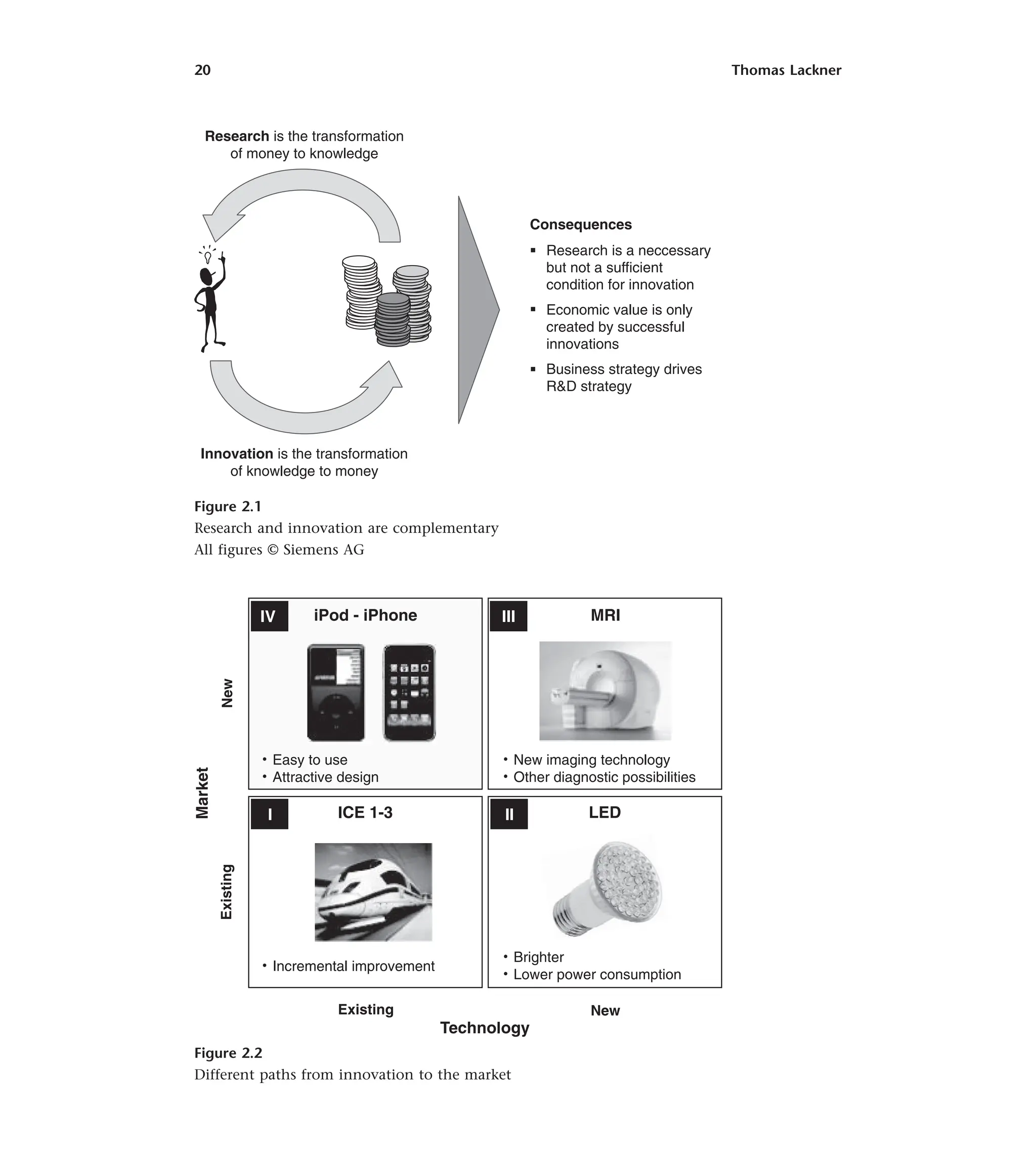
speaking, there are four options (quadrants I to IV) to make an innovation-market
connection as shown in figure 2.2.
20 Thomas Lackner
Consequences
Research is the transformation
of money to knowledge
Innovation is the transformation
of knowledge to money
Research is a neccessary
but not a sufficient
condition for innovation
Economic value is only
created by successful
innovations
Business strategy drives
R&D strategy
Figure 2.1
Research and innovation are complementary
All figures © Siemens AG
Existing
Existing
New
New
Technology
Market
LED
MRI
ICE 1-3
IV
I II
III
• Easy to use
• Attractive design
• Incremental improvement
• New imaging technology
• Other diagnostic possibilities
• Brighter
• Lower power consumption
iPod - iPhone
Figure 2.2
Different paths from innovation to the market
Open Innovation at Siemens AG 21
Penetrating existing markets with existing technology (quadrant I) has played a big
part in Siemens’ current success. For example, the high-speed intercity-express (ICE)
trains now running in Germany, Switzerland, Austria, Belgium, and the Netherlands
can travel at the top speed of 300 km/h due to enhanced aerodynamics and braking
technology developed at Siemens. The trains also are exceptionally efficient. They
consume, on average, a mere 0.33 liters of gasoline per passenger for every 100 kilo-
meters. We have developed special trains to endure extremely cold temperatures in
Russia and just announced another Chinese contract worth €750 million for 100 high-
speed trains to run from Beijing to Shanghai, the most vital high-speed train connec-
tion in mainland China. Clearly, this is an important way of using our innovative
capacity to continuously improve and adapt existing offerings to better meet the
demands of our diverse customers..
Siemens also is strong at taking a new technology to an existing market (quadrant
II). LED lights, for example, are based on a new physical principle that led to the
development of a new technology. This has brought us new advantages such as devel-
oping innovative lighting that evokes emotions with a continuous spectrum of color
lights. Siemens also is adept at entering new markets with new technologies (quadrant
III). For example, our state-of-the-art magnetic resonance imaging (MRI) technology
is novel and unique when compared to x-ray and other similar devices. With MRIs,
we have created and entered a new market, as our technology displays tissue with
greater accuracy and finer resolution than any other available alternative.
Siemens is often not so strong in bringing existing technologies into new markets
(quadrant IV). While many other companies have a similar weakness, we need to learn
from innovators like Apple. An iPod, for example, used existing technologies but was
a new product that became a huge market success. Why does Siemens have problems
doing the same thing? In part, it is because we have very good R&D people who are,
not surprisingly, most focused on developing their products and technologies. This is
sometimes an obstacle.
Leveraging Existing Technology into New Markets
As figure 2.3 shows, there are several possibilities for moving into new markets. There
is the strategy of being the first mover, that is, not only fast (and often first) at devel-
oping new technologies but also fast at seeing discontinuities and changing the rules
of the game. For example, ten years ago Cisco bought all of IBM’s networking patents,
products, and customers. They began to dominate networked communications before
other firms realized how big the market would grow.
22 Thomas Lackner
There is a saying that the early bird catches the worm. That is true. Cisco was fast
and they got the worm. But there also are fast followers. The companies following this
strategy rely on basic technologies but make improvements on them. Garrison Keillor,
a famous columnist, recently said, “The early bird catches the worm, but the second
mouse gets the cheese.” That means that the first mover is often in the trap, while
the second captures the market.
A third trendsetting strategy, shown on the right in this figure, seems to be the most
versatile. This strategy controls both the wormholes and the mousetraps. If one can
do that, one gets both the worms and the cheese. That is what Siemens systematically
strives for. In the following, I will describe how Siemens is using open innovation
approaches to be a formidable trendsetter.
Innovation at Siemens
Different people mean different things when they say “open innovation.” Currently
there is no common understanding, even in the academic world, on how porous an
Pace-setting
technologies:
Determine tomorrow’s
competitiveness
Key technologies:
Determine today’s
competitiveness
Basic technologies:
Basic competence
for today’s business
New technologies:
Discontinuity
New rules of the game
Maturity
Time
Fast follower
“The early bird catches
the worm, but the second
mouse gets the cheese”
(G. Keillor)
First mover
“The early bird catches
the worm”
(American saying)
Trendsetter
“If you’re in control of
wormholes and mouse-
traps, you get both—
the worms and
the cheese”
Figure 2.3
Most important innovation strategies and their positioning along the technology life cycle
Open Innovation at Siemens AG 23
innovation process should be in order to be defined as an open innovation process.
At Siemens we follow a generic map (see figure 2.4) to structure our endeavors to
innovate. The x-axis follows the innovation process from generation of ideas, to selec-
tion of concepts, to technical development, to market launch—typical phases in any
innovation process. The y-axis shows the level of openness during these steps from a
seemingly closed business unit level to completely open sourcing of knowledge from
any available external person or firm. At Siemens, for example, one can run innova-
tion development within a business unit, which is typically a closed process. Or one
can operate within a sector, say energy or health. One could also go cross-sector, which
is often termed a companywide activity. An even broader option is to develop an
innovation within one or more value chains, including customers. Finally, at Siemens,
one can source knowledge from external communities to complement or substitute
internal research.
As seen in figure 2.4, the R&D and Sales and Marketing departments at Siemens are
typically run within the boundaries of a business unit and are considered examples
of closed innovation. Interestingly, some activities such as licensing and transaction
activities conducted at this level are considered examples of open innovation at many
External
communities
Cross-
sector
Along the
value chain
Within
sector/
division
Within
BU
Spin-in
Extent of
openness
Innovation
process
External
cooperations
Supplier/customer
integration
Idea
generation
Technology
e-broker
Spin-out
Open
expert
networks
Venture capital
Corporate
labs
Idea
management
Research and development
Sales and marketing
Generation
of ideas
Selection and
conceptualization
Technical
development
Market
launch
Figure 2.4
Generic map with different paths to innovation at Siemens
24 Thomas Lackner
other companies. In total, Siemens has been successful with traditional innovation
activities.
In addition Siemens is regularly engaged in venture capital activities, to not only
identify but also invest in the next big idea on the market. Simultaneously the
company runs corporate labs that provide a platform for the transfer of knowledge
and ideas between the various sectors and divisions of Siemens.
Siemens also has spin-offs. The spin-off enterprises come under the purview of the
Siemens Technology Accelerator (STA), a unit that was established in 2001. These enter-
prises have technologies that could not be commercialized internally by Siemens, for
reasons that are not connected to the innovation or technology. During the early phase
of a spin-off, STA plays the role of a mentor and provides legal, financial, and organi-
zational support in every possible way to help the spin-offs become successful.
For example, EnOcean, a battery-free sensor company was the first company that
was spun off with the help of STA in 2001. This new firm, started by three former
Siemens employees, quickly developed a viable business model targeting the building
installation sector. But, with its scalable products, the company had the vision to enter
other markets such as the automotive sector, in this case promoting a battery-less tire
pressure senor. The start-up company soon acquired venture capital, now employs over
forty people, and has expanded its markets to the United States and elsewhere. EnOcean
has a great new technology, and continues to be important as part of the sustain-
ability movement. Today it has more than 300 interoperable products offered by 70
OEM customers.
Siemens also regularly cooperates with universities, with around 8,000 projects run
by 800 university partners. To complement this, Siemens also has structured spin-in
activities based in Berkeley and Shanghai. The company is in direct three-way relation-
ships with universities and entrepreneurs. These Technology-to-Business programs
source the brightest ideas and help found companies at an early stage. The companies
are brought to a point where they add value to Siemens. This companywide idea
management effort, called the 3i-program, has a long history and generates over
100,000 ideas every year. The ideas developed have ranged from improvement sugges-
tions up to new business proposals. They are usually thought up by one person, sent
to a department, and then evaluated. There are also many other programs within
Siemens that attempt to improve interactions with suppliers and customers. What
Siemens does not have—and what I am talking about in this chapter—is a good col-
laboration process for generating new ideas. The chapter shows the extent of our
current efforts to generate good technological ideas and improvements by connecting
external and internal sources.
Open Innovation at Siemens AG 25
Open Innovation
This point is illustrated by the dark gray bubbles in figure 2.4—the use of idea genera-
tion processes, open expert networks, and technology e-brokers. Siemens started open
innovation activities in these areas in 2008. There was some benchmarking. Lots of
other companies were asked what they were doing to stimulate innovation. It became
clear that every company had to develop an open innovation strategy that would fit
their requirements best. Open innovation was not a standard approach that could be
successfully replicated in different companies. First, one needed to analyze the external
environment a company finds itself in, and the internal processes and procedures that
it uses to conduct business. Second, depending on these external and internal condi-
tions, companies would need to identify and customize specific open innovation
methods to meet their specific goals.
Procter & Gamble was the first, I would say, to emphasize an open innovation
strategy. Hewlett-Packard partners with universities in a unique way. BMW focuses on
idea generation with external partners. Every organization has to find a way to develop
its own means of innovation.
At Siemens we are just beginning to develop open innovation activities based on
web 2.0 technologies. We simply post a question, a challenge, or a business question
to a huge community. That is the gist of open innovation. It is not a “simple” coop-
eration with a university, or with a partner, where we formalize the cooperation. It is
an open cooperation. We are working to complement our existing, relatively open
processes to address unsolved business challenges.
You might ask why we are developing these new activities. The answer is that there
is a lot of knowledge, good people, and untapped brainpower outside of Siemens that
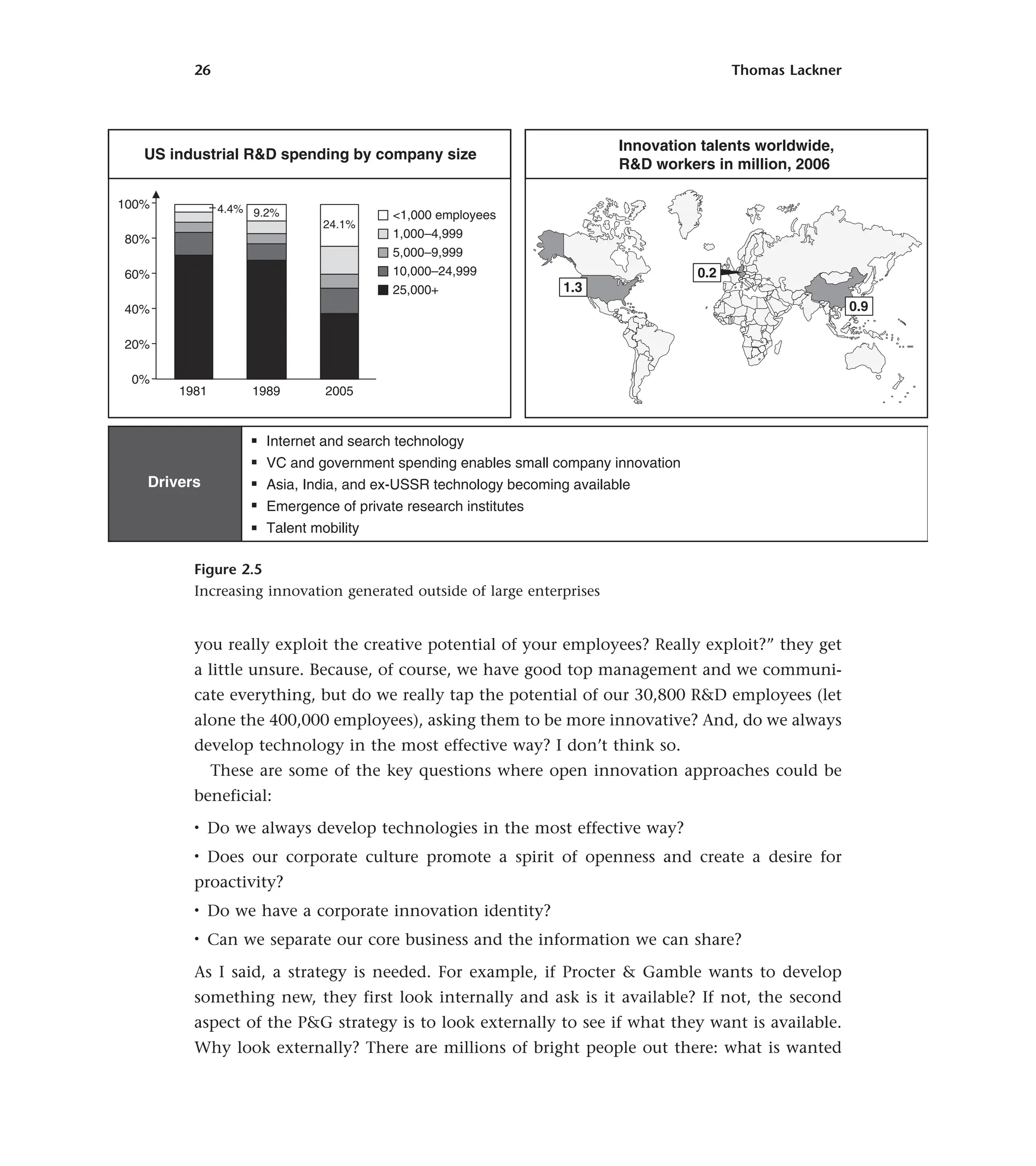
we would be foolhardy not to access. By reaching out, we can access not just 30,000
plus Siemens R&D workers, but 1.3 million experts in the United States and many
more around the world, as shown in right-hand side of figure 2.5. In the bar chart on
the left, one can see a global trend toward a proportionate shift in R&D spending from
large enterprises (≥ 25,000 employees) to smaller companies.
At the same time we keep in mind that innovations are no longer the product of
small solitary workshops. Rather, innovators are working with networks to access knowl-
edge that is distributed among people spread across national boundaries. There are new
ways to access global talent, both through the Internet and with the help of search
technologies but using these resources requires a strategy.
If you raise the issue of open innovation in a big company, you usually get the
response that “We are doing everything already.” But if you ask management, “Do
26 Thomas Lackner
you really exploit the creative potential of your employees? Really exploit?” they get
a little unsure. Because, of course, we have good top management and we communi-
cate everything, but do we really tap the potential of our 30,800 R&D employees (let
alone the 400,000 employees), asking them to be more innovative? And, do we always
develop technology in the most effective way? I don’t think so.
These are some of the key questions where open innovation approaches could be
beneficial:
• Do we always develop technologies in the most effective way?
• Does our corporate culture promote a spirit of openness and create a desire for
proactivity?
• Do we have a corporate innovation identity?
• Can we separate our core business and the information we can share?
As I said, a strategy is needed. For example, if Procter & Gamble wants to develop
something new, they first look internally and ask is it available? If not, the second
aspect of the P&G strategy is to look externally to see if what they want is available.
Why look externally? There are millions of bright people out there: what is wanted
1.3
0.9
0.2
Innovation talents worldwide,
R&D workers in million, 2006
US industrial R&D spending by company size
0%
20%
40%
60%
80%
100%
25,000+
10,000–24,999
1981
5,000–9,999
4.4%
<1,000 employees
1,000–4,999
2005
9.2%
24.1%
1989
Drivers
Internet and search technology
VC and government spending enables small company innovation
Asia, India, and ex-USSR technology becoming available
Emergence of private research institutes
Talent mobility
Figure 2.5
Increasing innovation generated outside of large enterprises
Open Innovation at Siemens AG 27
could be readily available. If P&G cannot find what they want internally or externally;
only then do they commit resources to develop the required product internally. It is
a very simple strategy. I can imagine that if departments within Siemens would pursue
a similar strategy, they could be more focused. But at Siemens, we have a special chal-
lenge: “Wenn Siemens wüsste, was Siemens weiß.” Very simply it means, “If Siemens
only knew what Siemens knows.” It is a true challenge within our company.
Potential Problems of Open Innovation
No strategy is without risks. Open innovation is a strategic opening of the company.
It moves from the idea “the lab is our world” to the idea “the world is our lab.” This is
an important figure of speech we are using to communicate the change that is required
in Siemens. It sounds very reasonable, but it means, in depth, a culture change in our
company. In “the lab is our world” view you have people who are renowned and rewarded
for doing R&D on their own. A change to “the world is our lab” means you need
people who find a solution as fast as possible, wherever available. It is a different mindset.
You have to have both in a company. You need to have people who are really doing
in-depth work and people who have real fun in finding something very fast. But it is
not so easy to find a balance between these two groups of people.
Procter & Gamble had the goal of sourcing, within five years, 50 percent of its new
technologies from external sources. They achieved it and brought down their R&D
costs substantially. And at the same time they improved their innovation success rate
by 100 percent. Of course, if you are telling these stories to an R&D department, they
are not very happy, but nevertheless, if management is talking about these examples,
R&D departments do pay attention.
The details help people who are oriented toward internal processes start thinking.
For example, Procter & Gamble was looking for a technology that would allow them
to print on Pringles, a potato chip, because they thought it would allow them to expand
their market. First they looked internally for a process, but it was complicated to print
on dough, and they did not find a good solution. Then they partnered with a printer
company. That did not succeed either. Finally, they used an open innovation approach.
They asked worldwide: Who has a technology that can print on food? They found
a professor in Bologna, Italy, who had developed an ink-jet technology, for a small bakery,
that could print on cookies and cakes. P&G sourced this technology, made modest changes
in it, and succeeded.
The critical mindset is always: What is my core business? What is my core R&D and
what is not? These are the questions you have to ask yourself. To ask this question in
28 Thomas Lackner
Siemens at the company level is stupid. We have to go down and ask at the business
unit level: What is core and what is not core?
That is the process we are pursuing in Siemens, as we look for new technologies and
ideas both externally and internally. My job is to go to business units and tell them
the stories that I have just told you. A little bit more in-depth, of course, with some
best-practice examples. We have a tool box to help them start their own open innova-
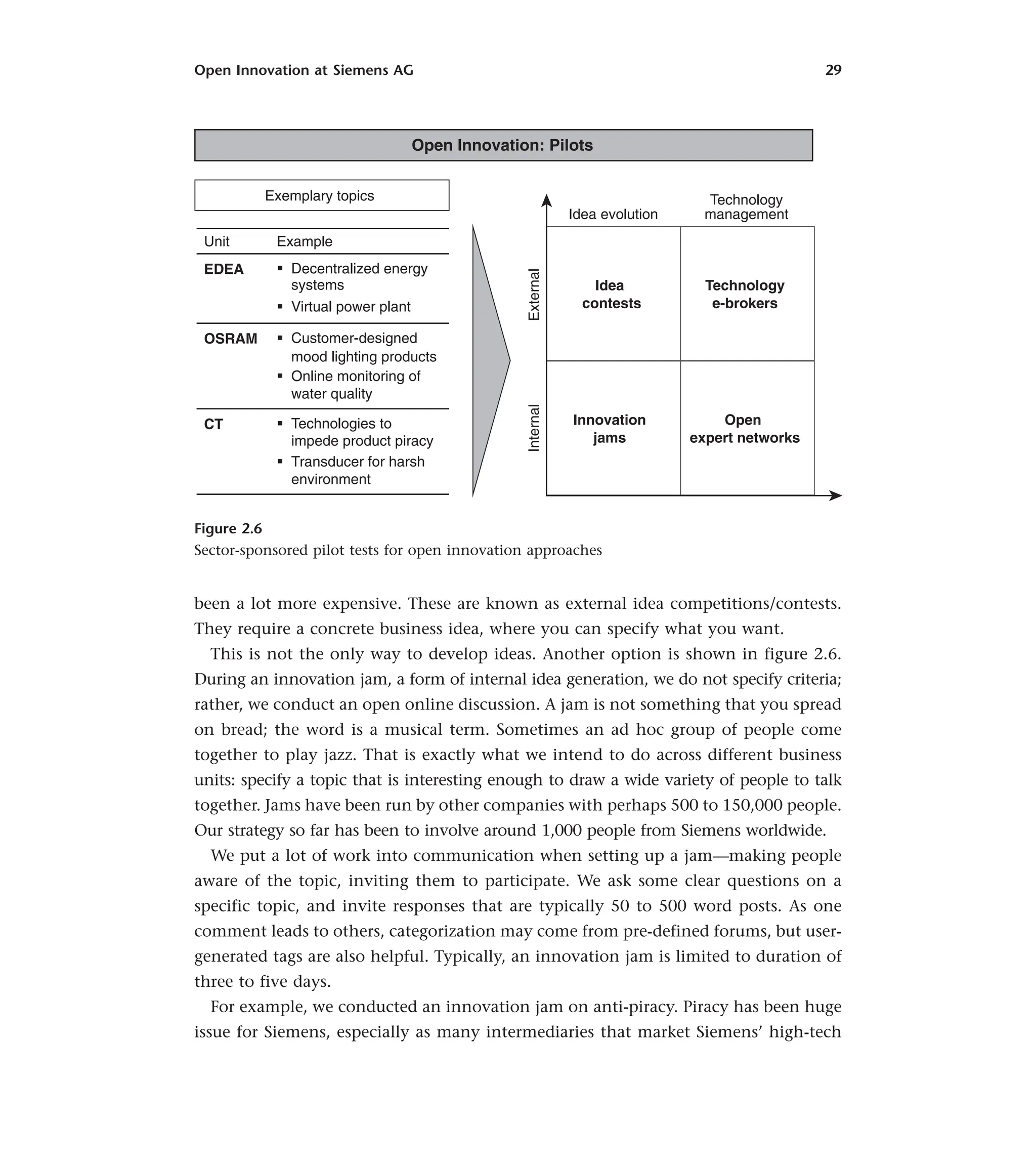
tion processes. We point to pilot projects in the areas you see in dark gray on figure
2.4. We ask, “Do you have a topic for one of these open innovation approaches?”
Examples of Open Innovation Projects Underway at Siemens
We are running quite a few external idea contests. For example, some years ago,
Fujitsu-Siemens had a question: What services could be offered by next generation IT
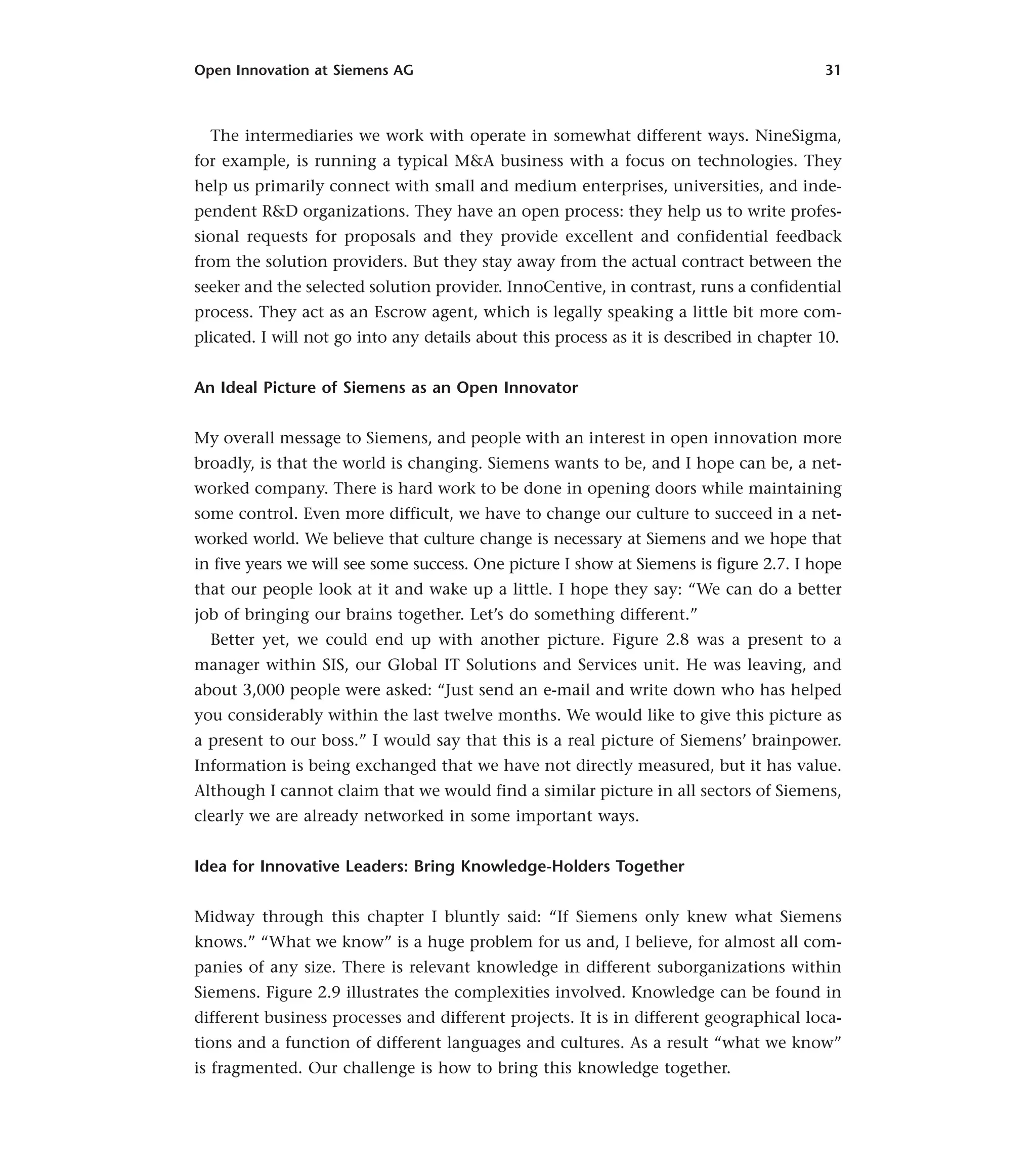
centers? If you are posting such a question you have to ask yourself: what is the right
way to express this question? Whom do I address it to? Do I want to post a question
with the branding of Fujitsu-Siemens? Would I be selling a secret if I sent it to an open
community? What would I do with the ideas that come in? Is my organization pre-
pared to digest novel ideas? What does an innovation idea contest cost? How do I
approach an open community? And so on and so forth.
The challenging problem is “how should I ask this question?” If our business devel-
opment people want to find interesting services for an IT center, they have to decide
what they are really looking for. If you try to nail them down to formulate a precise
question, they are likely to run into difficulties. But that is precisely what they have
to do. First, keeping the goals in mind, they have to formulate a question appro-
priately. Second, only then should the question be broadcasted to a wide community.
Here is another example of an idea contest in Siemens. OSRAM was seeking input
from a large external community to help them emotionalize light, what might be
called “mood lighting.” The company wanted to know how people would use light
to make them feel better and energize themselves. They did not want to develop these
ideas just within the OSRAM community; they wanted to get a lot of people from
different walks of life to get involved in their project. The contest was opened to
general public (http://www.led-emotionalize.com/). In the first phase, ideas from all
participants are collected and discussed. In the second phase, the best ideas were
jointly developed by the community. It was a very simple and open process. The
winners received attractive monetary and nonmonetary prizes amounting to just
€7000. Traditionally, to achieve similar results, OSRAM would have conducted such
a brainstorming process internally or outsourced it to a design firm. This would have
Open Innovation at Siemens AG 29
been a lot more expensive. These are known as external idea competitions/contests.
They require a concrete business idea, where you can specify what you want.
This is not the only way to develop ideas. Another option is shown in figure 2.6.
During an innovation jam, a form of internal idea generation, we do not specify criteria;
rather, we conduct an open online discussion. A jam is not something that you spread
on bread; the word is a musical term. Sometimes an ad hoc group of people come
together to play jazz. That is exactly what we intend to do across different business
units: specify a topic that is interesting enough to draw a wide variety of people to talk
together. Jams have been run by other companies with perhaps 500 to 150,000 people.
Our strategy so far has been to involve around 1,000 people from Siemens worldwide.
We put a lot of work into communication when setting up a jam—making people
aware of the topic, inviting them to participate. We ask some clear questions on a
specific topic, and invite responses that are typically 50 to 500 word posts. As one
comment leads to others, categorization may come from pre-defined forums, but user-
generated tags are also helpful. Typically, an innovation jam is limited to duration of
three to five days.
For example, we conducted an innovation jam on anti-piracy. Piracy has been huge
issue for Siemens, especially as many intermediaries that market Siemens’ high-tech
Exemplary topics
Idea evolution
Technology
management
Internal
External
Idea
contests
Technology
e-brokers
Innovation
jams
Open
expert networks
Unit Example
EDEA Decentralized energy
systems
Virtual power plant
OSRAM Customer-designed
mood lighting products
Online monitoring of
water quality
CT Technologies to
impede product piracy
Transducer for harsh
environment
Open Innovation: Pilots
Figure 2.6
Sector-sponsored pilot tests for open innovation approaches
30 Thomas Lackner
products—in secondary markets—have been replacing some genuine components
with counterfeits. This consistently hurts the Siemens image as a producer of high-
quality goods. In a worst-case scenario, people using Siemens products have been
physically hurt. This online jam brought together people from all sectors of the
company worldwide faced with this specific challenge. It provided a discussion board
where piracy problems encountered were listed and ideas to counter piracy were
developed. Collectively, we have a lot of expertise in IP law protection and IP rights
enforcement. This innovation jam helped channel the scattered knowledge and exper-
tise to solve current piracy problems and prevent future piracy.
As our experience with this innovation jam was very positive, we intend to run more
on other topics. A number of very interesting ideas are currently floating within the
company, including a discussion on new business ideas for services in the health care
industry and on cooperating beyond the boundaries of our firewall. We can also use open
innovation tools to develop precompetitive ideas, for example, in the area of robotics. We
can imagine developing a lot of ideas, but it is not so easy to get them implemented.
Now let me address the tools of figure 2.6, where we are using open innovation to
develop and manage technologies. For example, a unit with special applications is
looking for a decentralized energy storage system, another for a special sensor system.
We assumed that there was a huge group of people outside Siemens working on rel-
evant ideas who might offer a solution, a product, maybe even a prototype. We are
using expert networks to find these innovations rather than spend more money on
new internal solutions.
Finally, we are partnering with technology e-brokers such as InnoCentive, Nine-
Sigma, and Yet2.com. The benefit of using these kind of companies is first the large
communities they help us access. Second, they have the experience to customize our
questions to reach a certain group. If you address an abstract question to a crowd, usually
you get answers that are not useful. So the trick is to specify your question and, more
important, address the right people. For example, NineSigma has a target group of two
to three million people. We might post a question through them that they channel to
approximately 100,000 relevant solvers. By doing so, we collect feedback from perhaps
fifty or hundred people. Then we can select the best three or four solutions, and some-
times combine the input to come up with one best solution.
We have some performance indicators that show collaborating with these technol-
ogy e-brokers can increase our speed of innovation. For example, a company in the
automobile sector was looking for oil sensor technology; through an e-broker, they
found the technology they needed in the Ukraine from a supplier who catered to
the food industry. This type of cross-sector contribution is typical with technology
e-brokers.
Open Innovation at Siemens AG 31
The intermediaries we work with operate in somewhat different ways. NineSigma,
for example, is running a typical M&A business with a focus on technologies. They
help us primarily connect with small and medium enterprises, universities, and inde-
pendent R&D organizations. They have an open process: they help us to write profes-
sional requests for proposals and they provide excellent and confidential feedback
from the solution providers. But they stay away from the actual contract between the
seeker and the selected solution provider. InnoCentive, in contrast, runs a confidential
process. They act as an Escrow agent, which is legally speaking a little bit more com-
plicated. I will not go into any details about this process as it is described in chapter 10.
An Ideal Picture of Siemens as an Open Innovator
My overall message to Siemens, and people with an interest in open innovation more
broadly, is that the world is changing. Siemens wants to be, and I hope can be, a net-
worked company. There is hard work to be done in opening doors while maintaining
some control. Even more difficult, we have to change our culture to succeed in a net-
worked world. We believe that culture change is necessary at Siemens and we hope that
in five years we will see some success. One picture I show at Siemens is figure 2.7. I hope
that our people look at it and wake up a little. I hope they say: “We can do a better
job of bringing our brains together. Let’s do something different.”
Better yet, we could end up with another picture. Figure 2.8 was a present to a
manager within SIS, our Global IT Solutions and Services unit. He was leaving, and
about 3,000 people were asked: “Just send an e-mail and write down who has helped
you considerably within the last twelve months. We would like to give this picture as
a present to our boss.” I would say that this is a real picture of Siemens’ brainpower.
Information is being exchanged that we have not directly measured, but it has value.
Although I cannot claim that we would find a similar picture in all sectors of Siemens,
clearly we are already networked in some important ways.
Idea for Innovative Leaders: Bring Knowledge-Holders Together
Midway through this chapter I bluntly said: “If Siemens only knew what Siemens
knows.” “What we know” is a huge problem for us and, I believe, for almost all com-
panies of any size. There is relevant knowledge in different suborganizations within
Siemens. Figure 2.9 illustrates the complexities involved. Knowledge can be found in
different business processes and different projects. It is in different geographical loca-
tions and a function of different languages and cultures. As a result “what we know”
is fragmented. Our challenge is how to bring this knowledge together.
32 Thomas Lackner
“Who has helped you in your professional work during the last 12 months”
Figure 2.8
Knowledge networking across Siemens that already works
Think creatively or “outside of the box”
Think in networks, not in organizations
Create open doors with well-defined access
controls
Foster open market innovations
Connect the best with the best
Create competitive advantage by managing complexity of
internal and external know-how and flow of information
Figure 2.7
At Siemens—networked, different, and open approaches to innovation
Discovering Diverse Content Through
Random Scribd Documents
The Project Gutenberg eBook of Captain
Peabody
This ebook is for the use of anyone anywhere in the United States
and most other parts of the world at no cost and with almost no
restrictions whatsoever. You may copy it, give it away or re-use it
under the terms of the Project Gutenberg License included with this
ebook or online at www.gutenberg.org. If you are not located in the
United States, you will have to check the laws of the country where
you are located before using this eBook.
Title: Captain Peabody
Author: Rog Phillips
Illustrator: Ernest Kurt Barth
Release date: October 6, 2019 [eBook #60442]
Most recently updated: October 17, 2024
Language: English
Credits: Produced by Greg Weeks, Mary Meehan and the Online
Distributed Proofreading Team at http://www.pgdp.net
*** START OF THE PROJECT GUTENBERG EBOOK CAPTAIN
PEABODY ***
Captain PEABODY
BY ROG PHILLIPS
He carried the monkey of fear on his back for
all to see; and until he could shake the beast
he knew he would be a captain in name only....
[Transcriber's Note: This etext was produced from
Worlds of If Science Fiction, December 1957.
Extensive research did not uncover any evidence that
the U.S. copyright on this publication was renewed.]
The gavel rapped sharply, and the murmur of conversation
throughout the banquet room drifted into hushed silence. The
occasion was the seventy-fifth meeting of RETSCAP, the organization
of Retired Space Captains; the place, a banquet room in the Empire
Club on the hundred and sixty-fourth floor of the New Empire State
Building in Manhattan; the time, approximately nine thirty in the
evening, August 9, 2231 A.D.; those present, the four hundred and
eighteen members of RETSCAP—or rather, four hundred and
nineteen, including the new member, Captain Arthur Peabody, who
had reached his ninety-fifth birthday just two weeks before, and by
doing so had been automatically retired from active service and
thereby become eligible for membership while still in the prime of
life.
"Quiet everybody," the Secretary and master of ceremonies, Captain
John Evers, said good-naturedly, rapping the gavel again. He turned
to the new member, sitting next to him. "Captain Peabody," he said
in his loud clear voice, "The time has come for fulfillment of a
traditional part of our get-togethers—one we all look forward to with
great pleasure and anticipation."
There was a subdued clapping of hands, then Captain Evers cleared
his throat loudly and continued. "Each of us here has become a
member of RETSCAP only after a lifetime of space travel, much of
that time as a Captain in charge of the destinies of our crews and
passengers and ships. Inevitably each of us has had some unusual
experiences in his time, and we like to talk about them, boring each
other to death, no doubt, as we repeat the same stories among
ourselves meeting after meeting. So it's always a treat to us to get a
new member and by so doing get some fresh stories to listen to. I
am about to give you the floor, and what we would like to hear is the
one experience you have had which you think is the most unusual,
in some way, of your entire career. The floor is now yours, Captain
Arthur Peabody!"
Arthur Peabody stood up slowly, a tall man, long legged and short
bodied in his seven foot height, his sharply bridged nose and high
forehead giving his features the stamp of authority comfortably
worn, and waited, a quiet smile on his firm lips, until the applause
subsided. Then he began his speech.
The one experience that stands out in my mind more than any other
really began about five minutes after I was assigned to my first ship,
the Alabama, when I was given the list of my officers and crew to
check over. Half way down the list I came to a name, Oscar Resnick,
and suddenly the thrill of being a captain was gone. For two cents,
at that moment, I would gladly have become a retired Space Captain
before I started. I was fifty-two years old then, and it had been
about thirty years since I last saw Resnick. His rating was still
spaceman first class, and I knew if he had ever risen higher he had
been demoted again, as was inevitable, sooner or later. He was an
incurable bully with the worst streak of sadistic cruelty in him I've
ever run across.
Even the sight of his name on that list sent an instinctive fear
through me. Once, when I was still a space recruit he had whipped
me to within an inch of my life and instilled in me the realization that
he could do it any time, anywhere.
A man like that is slightly mad, or strikes you that way. You stay out
of his way if you can, and if you can't you let him have his way,
swallow his insults, do anything to avoid the beating you would get if
he took the whim. Live with that for two years as I had thirty years
before, and you never get over it.
Now I was captain of my first ship and he was to be one of the crew.
And I knew in my heart that if he walked up to me and suddenly
reached up to scratch his head I would cringe and turn pale. I
wouldn't be able to help it. And if that happened it would be the end
of me. The crew would think I was yellow—and I was when it came
to Oscar Resnick.
Oh, he wouldn't do anything that would give me cause to toss him in
the brig, nor even anything that would give me cause to fire him—at
least a reason that would stand up under a union inquiry if he
demanded one, which he would. He would just grin at me knowingly
with eyes that told me he thought I was yellow, and hesitate just
long enough after an order to make me wonder if he was going to
obey—the kind of stuff that could break me down completely, in
time. And there would be nothing I could do about it.
I made a try to keep him off my crew. The Dispatcher admitted
Resnick had the reputation of being a trouble maker, but if I didn't
take him there was likelihood the Union would call out the whole
crew and ground the ship.
Then the Dispatcher pointed out the fact that the list was short one
man, my personal orderly. I hadn't thought about an orderly at all,
and hadn't chosen one yet. He gave me the list of available orderlies
and I looked it over, most of the names meaning nothing at all to
me. Suddenly I ran across a name I knew. I didn't know the man,
but I had heard of him, and probably all of you have.
The name was David Markham. He was the David Markham all right,
the Dispatcher said when I asked him—the one who was kicked out
of Space Patrol for abject cowardice. The Dispatcher told me the
man had been trying for two years to get back into space, the Union
wouldn't take him, and the only way he could get into service was
an orderly to a Captain—if any Captain took him.
The Dispatcher suggested two or three other men he knew
personally, any one of which I would probably like and decide to
keep permanently. But a crazy idea was running around in my head.
It was a clutching at straws, but what it amounted to was this: I had
a bully on my crew, a man who had my number and knew how to
use it. Why not balance him out by making my one choice on the
crew a man who was the exact opposite, an abject coward? Possibly,
on some level of thought, I wanted company if Resnick showed me
up to the crew, someone who couldn't look down on me because of
the simple fact that he was the lowest there was.
The Dispatcher almost cried with happiness over my choice of David
Markham. It turned out he was sorry for the guy, and felt only a
man with real guts would have the courage to sign Markham on. He
would certainly have been surprised if I had told him the truth.
I met Markham the next morning at seven o'clock when I returned
to the Dispatch Office at Spaceport, New Mexico. He was a fine
looking fellow, twenty-five, rather short—just over the six foot four
minimum of the Space Patrol, about one ninety mass, blonde,
square jaw. I took a liking to him at once—but there was a haunting
something at the back of his eyes that never went away even when
he was smiling, and he smiled often during the time I knew him,
though he never laughed but once—and it was a sound I never want
to hear again. But that came much later.
I sent him aboard with my bags to get my quarters in order, then
steeled myself to check in the crew. You know how it is, you sit at
the window and the men come by, one at a time, you introduce
yourself, fix his face in your mind, size him up, then call for the next
man. Finally it was Oscar Resnick looking through the window at me,
his thick shock of sandy red hair glued down, clean-shaven, six foot
eight, about two hundred and forty pounds mass, his brown eyes a
little too large, his thin lipped mouth a little too small, his teeth a
little too long.
The minute I saw him the old fear descended. It took him a few
seconds to place where he had seen me before. Then he recognized
me, and I could see memory flowing through his mind as his wide
eyes widened even more, and his thin lips pulled back into a
knowing grin. "Well, Cap'n Peabody!" he said, rolling the word Cap'n
with his tongue as though flavoring it with contempt. "It's a small
world. Fancy...." I could read his thoughts as they flashed across his
face. He would play a waiting game, taking his time, but it would be
a game to his liking. Showing up the yellow streak in a Captain.
Suddenly, he was completely respectful, almost too respectful. "It is
certainly good to be shipping with you, sir," he said.
"That's the proper spirit, Resnick," I said. "All right, get aboard. Gate
seven."
After he had gone I checked in the rest of the crew, seeing liking
and respect in their eyes, and wondering how quickly it would
change to barely concealed contempt, wondering what Resnick
would do to show me up. Like a renegade wolf he would bide his
time, staying out of range, until the moment he decided was right,
then he would dart in with a swift attack that would tear open my
fear of him for all to see—and dart away again to sit and laugh while
my soul withered within me. That's all he would do. That's all he
would have to do, and he and I both knew it.
In the days following take-off, I watched the slow build-up with a
certainty of knowledge that can only come from personal
experience. I knew Resnick's methods.
A successful bully must be a shrewd psychologist and know how to
capitalize on weaknesses. I watched Oscar Resnick size up this man
and that one, and go to work on each. It's a subtle formula he used.
Wait until you are alone with a man, then trip him when he goes by
you, or dig your elbow into his ribs painfully, then claim it was an
accident, but in such a way that both he and you know it wasn't an
accident yet nobody else will believe it. Mock him with your eyes and
your smile, dare him to do something about it. What can a man do?
He can't go running to the Mate with the complaint that you are
picking on him. He can't bring the thing into the open by fighting
you without striking the first blow and being branded the aggressor
in an unprovoked assault, and unless he is a professional fighter
your sneering confidence bluffs him out of an open fight at first.
Gradually you establish a fear reaction in him that would keep him
from winning a fight even if, originally, he could have beaten you.
When you are the victim of that sort of thing you really have only
two courses of action open to you. Try to keep out of his way as
much as possible, if you have any personal integrity, or kowtow to
him, grovel in his presence, sneer with him at his other victims,
flatter him, and hope he will direct his sadistic streak elsewhere.
Soon four or five of the crewmen start hanging around with the
bully, admiring him too much, laughing too much at what he says,
siding with him against others, and even doing a little minor bullying
themselves by ganging up on this or that victim as soon as each has
recognized the streak of cowardly sadism in the other which binds
them together as human jackals.
A man like Resnick leaves the strong alone at first; waits until the
jackals have gathered around him. When this stage is reached, when
anybody who says anything is a yellow stool-pigeon, you find the
best man in your crew a hospital case with bleeding nose, bruised
face, black eyes, and maybe a couple of broken ribs caved in by
someone's shoe. After the doctor gives him first aid you go to the
infirmary and ask him who did it. He clamps his lips together and
tells you he didn't see who it was. He's lying, and he knows you
know he is lying, but can you torture it out of him or punish him for
not telling you? No. And there's nothing a Captain can do about it.
He must have the testimony of the injured party in writing, signed
and witnessed, and the Code Book must be followed specifically in
punishing the aggressors; and if the Captain does anything at all he
is almost certain to be tied up in court at the first port of call by the
punished parties. Even if the Captain has provable justification for
putting a man in the brig or fining him or giving him a demotion in
assigned type of work, his ship will be delayed by the trial, and the
owners will decide they need a Captain who knows how to avoid
such costly delays.
A man like Oscar Resnick is a social cancer, and I saw the symptoms
of his presence on the ship come into being, and grow, and I knew
he was too cunning and too shrewd to let them get out of hand. Any
other Captain, knowing all this, would sit back and do nothing,
knowing that that was his only safe course consistent with his duty
of keeping the ship on schedule.
I had to follow this course of action too. But I knew that it was just a
prelude, that when Resnick sensed the time was ripe for his
purposes, he would get at me.
It would be subtle and would only take a minute. It would take place
in the presence of the crew. It would be something that would catch
me unawares, bring the light of fear into my eyes for all the crew to
see. That would be enough. The word would go back that Captain
Peabody was yellow.
Some of the crew would quit the ship at North Marsport, telling the
Union business agent they didn't want to ship with a yellow Captain.
The business agent would find men refusing to sign on my ship
because I was a yellow Captain. And inevitably the time would come
when I could not keep a full crew. Then the owners would dismiss
me, and I wouldn't be able to get another berth as Captain.
I didn't know how to avoid it. It was only a question of time. When
would it happen? Today? Not for six months yet? Tomorrow? When?
David Markham proved from the start to be an extremely
conscientious orderly. My quarters were kept spotless, I had only to
lift my eyebrows and he was there ready to obey. How many hours a
day he spent wiping up imaginary dust, rubbing nonexistent
detergent off my eating utensils for the nth time before I sat down
to eat, polishing my already mirror-bright shoes, and the million and
one things I didn't even know about, I'll never know.
Few orderlies mix with the crew, and he was no exception. Most
orderlies either have the personality of a spinster to start with or
acquire it after a few years. He had none of that, but then he wasn't
the type that orderlies are made of.
There was a tension in him at all times that was so strong it seemed
almost visible—a tension that made each minor chore a matter of life
and death to him. It was pitiful to watch, and I usually avoided
watching him as much as possible. But a Captain may not pick up
something he has dropped, or do a lot of things that any ordinary
man does for himself but which are the traditional duties of the
orderly—if for no other reason than to keep him busy; so by
necessity David Markham was with me during most of my waking
hours.
A pattern of speculation about him grew up in one corner of my
mind. David Markham was the type of man you instinctively like and
respect, the type that in the service should have climbed the career
ladder to an Admiralship by the time he was seventy-five.
As the days passed the haunting fear in the depths of his eyes
seemed almost to have vanished. If I had not known who he was I
would have laughed at the possibility of his being a coward. Even
knowing who he was, I began to doubt it.
I thought a great deal about the circumstances brought out at his
court-martial, the testimony that proved he had broken cover and
run, then groveled at the feet of his captors, crying and pleading for
his life. Later the enemy had captured outposts they could not have
located without his help, proving that he had spilled his guts to save
his skin. That had, of course, been in the fuss on Venus with Porter's
Renegades. I didn't see how there could be any doubt of David
Markham's guilt, even though the more I saw of the man the more
unbelievable it seemed. I tried to figure out alternative explanations.
I tried to believe them. I wanted to believe.
I would catch Markham gazing through a viewport into the subdued
silver velvet of infinity and at the millions of flashing jewels that are
the individually visible suns of our galaxy and the nebulae that are
other galaxies, with his tortured soul, for the moment, at peace. I
would hesitate, wanting to join him in his quiet mood as I would
have joined any other man, then I would steal away, unable
somehow to bring myself to create any kind of bond between us. I
had, I realized by then, chosen David Markham in the hopes that he
might become a tidbit I could toss to Resnick to pacify him and
divert him from me. A cowardly motivation, no matter how you look
at it. It had been an impulse I was now ashamed of. It haunted me.
Because of it I couldn't bring myself to extend to him a Judas
friendship, which is what I felt it would be.
We were forty days out from Earth when Resnick turned his
attention to David Markham. I discovered it quite by accident. Ten
minutes after my regular sleep period had begun the First Mate saw
fit to inform me that an uncharted meteor swarm was going to
intercept us in four hours, and of course it was my responsibility to
determine what precautions should be taken.
Under ordinary circumstances I would merely have rung for my
orderly, but I was half asleep and did the more natural thing. I went
to the door to his room, next to mine, and opened it without
knocking. He had just undressed, getting ready for bed. He stood
there, startled at my unexpected entrance. And I saw the ugly
purple splotch over his kidneys that could have come only from the
blow of a fist.
I pretended I hadn't noticed it. I merely told him that there would be
emergency duty, and backed out, sliding the door shut.
When he came out two minutes later, he gave no indication of
whether he thought I had noticed the bruise or not. And for the next
few hours I was far too busy to concern myself about it anyway. But
I felt as though I had given him that bruise myself, with my own fist,
and I was as surely responsible for it as though I had.
To make it worse, I realized that despite the guilt I felt I still hoped
that Resnick would settle for a famous coward, and leave me alone.
While I plotted the courses of hundreds of chunks of meteor iron to
search out safe holes through the intercepting meteor group my
thoughts whispered gleefully, "All you have to do is pretend you
don't know anything and maybe Resnick will be grateful and leave
you alone."
Later, trying to get some sleep, I tried to think what could be done.
Could I come right out and ask Markham about that bruise? Suppose
I did, and he told me Resnick had done it, and I used that as an
excuse to toss Resnick in the brig? Then the men would throw
Markham's reputation in my face and claim it was a cowardly lie; and
if I didn't release Resnick it would mean an official investigation at
North Marsport—on the first leg of my first command. Suppose he
told me and I did nothing. Then he would know I was afraid of
Resnick!
I didn't sleep much. I didn't get much sleep for several days.
Coupled with my guilt feeling, my hate for myself, was a growing
feeling that striking my orderly was the first step in Resnick's plan to
get at me, smoke me into the open where he could find an
opportunity to expose me.
It was obvious how Resnick had gotten to Markham. It had to be
when Markham went to the kitchen to bring my meals, and it had to
be with the knowledge of the cook, which meant that Resnick
already ruled the crew openly, behind the scenes.
There was no danger of mutiny or any of the claptrap of fiction, of
course. Resnick was no fool, and had no insane ambitions other than
that of feeding his streak of sadism.
A few days later I noticed a small spot of blood on the back of
Markham's shirt. I said nothing, but that evening after I had
dismissed him and he had gone to his room I took a small flat metal
mirror and slid it under his door just far enough to peek in and
watch him undress, and I saw the welts across his back.
Worse, I saw him crying. He shook with silent sobs while tears
streamed from his eyes, and hopelessness and discouragement and
friendlessness held possession of him.
At that moment I knew with absolute conviction that the court-
martial had been right. He was a coward and would never be
anything else. But at the same moment, I suddenly understood him.
It was something he couldn't help.
I lay in the darkness of my own cubicle, a dull anger growing within
me, turning me into a slightly irrational being.
There was, I suppose, a sort of self-flagellation to it. A psychiatrist
would possibly diagnose it as that, anyway. In my own mind I was
responsible for everything Resnick did to David Markham, which
meant that by "punishing" Resnick I was punishing myself. When
you descend to such levels of pure and obsessing emotional
thinking, logic gets mixed up quite a bit.
I came out of that sleepless sleep period with one thing quite clear
in my thoughts. Things couldn't go on the way they were.
Oh, sure, I had a sneaking hunch that this frame of mind I was in
was what Resnick had been angling for. By now I had invested
Resnick with omniscience so that it seemed perfectly logical that he
should know I had spent a sleepless night, that he should know I
had seen those welts on Markham's back. In my mind's eye I could
see him, a sneer on his thin lipped small mouth, while he waited for
me to stick my neck out. I could see his muscular arms, covered by
freckled skin that covered sleek muscles, dangling at his sides,
fingers uncoiled but ready to double into fists—fists that had once
beaten me into shuddering unconsciousness, years ago—fists that
could do it again while slightly mad brown eyes glittered at me,
mocking....
David Markham served my breakfast, the perfect orderly, quick to
anticipate my wishes, so attuned to my habits by now that he almost
seemed to read my thoughts before I was aware of them myself. He
seemed to have not a care in the world. A cold shower can cover a
multitude of inner tortures with a pink glow of well being....
Suddenly the idea came to me. I would talk to Oscar Resnick. I
would plead with him. I would offer him money—my whole salary on
this trip. Such men have their price. As Captain I made five times
more than he. I would give it all to him if he would agree to lay off.
All I wanted was to get through my first command without trouble,
get back to Earth on schedule, make a good showing. I was,
suddenly, pathetically confident that he would agree. A deal like that
would have to be discussed in absolute privacy, however. The
slightest inkling of it to the crew—
In a panic of haste lest my confidence wane, I skipped my third cup
of coffee and hurried to my office. Switching the intercom to crews'
quarters I said with the crisp tones of command, "Mr. Resnick, report
to the Captain's office," repeating it three times as is customary on
intercom calls aboard ship. Then I made sure the intercom was off,
and sat there behind my desk waiting, my heart pounding painfully
within my chest, my fingers clenched into white knuckled fists to
keep them from trembling.
Five minutes later there came a polite knock at the door. Composing
myself as much as possible I said, "Come in," in what I hoped was a
calm authoritative voice.
The door slid open and Oscar Resnick stood there, his shoulders
almost as wide as the door opening, his space-faded sandy hair
neatly combed back, his brown eyes darting around the room in a
quick survey and just as quickly masking their triumphant glitter as
he saw that I was alone, his thin lips which had been in a firm
straight line breaking into a satisfied and anticipatory smile.
"Come in and close the door," I commanded, my voice breaking into
nervous uncertainty on the last three words.
He stepped inside and closed the door firmly behind him, his eyes
never leaving me. When the door was firmly closed he said, "Sure,
Art, old boy." With those four words he took command of the
situation. They had been uttered so softly that they could not have
sent a whisper over the intercom even if it had been on. He walked
toward me until he came to the edge of the desk, then planting his
fists on the desk top, he said, "I've been wondering how long it
would take for you to call me in for a little talk." He exuded an aura
of quiet contemptuous strength as his eyes flicked over me in
speculation.
"That's right," I said, hearing the nervous squeak in my voice, not
sure whether my comment had any relation to what he had said or
not. "I want to have a talk with you. Things can't go on the way they
are!"
Resnick drew back in pretended surprise. "Why, I don't know what
you mean, sir," he said.
"You know perfectly well what I mean," I said, my voice breaking
completely. "This is my first command! My whole future hangs on it.
What satisfaction could you possibly get from ruining me?"
In that moment the past descended upon me completely. Once
again I was pleading for mercy where there was no mercy, hoping
against hope before those soft mad eyes, searching for something
that could never be there.
"Why, sir," he said, mockingly, "I don't know what you mean at all.
Perhaps the stress of your new duties...?"
"How much would you take?" I blurted desperately. "How much, to
lay off of—David Markham—leave me alone...?"
"Birds of a feather, huh?" he said. His eyes became thoughtful.
"Every man has his price, I suppose...."
A surge of hope coursed through me. Maybe we could dicker. Maybe
it wouldn't cost as much as I was prepared to pay.
He scratched his chin slowly, then said, "Well—how about your
salary for this trip and five thousand dollars?" His thin lips flicked
back in a grin. "And a promise on your part that you will sign me on
for the next trip—or turn in your Captain's papers?"
The universe stood still as I saw ruin facing me. There was no way
out. No way out at all. I heard myself blurt, "Why? Why? WHY?"
He leaned over my desk slowly, his fists planted on it once again,
until his face was scant inches from mine. He whispered, "Because
you're yellow. That's why. You never had any business becoming a
captain." His hoarse, taunting whisper hung in the silence of the
room like the knell of doom.
There is a madness beyond madness, of that I am sure. I should
have been grovelling in fear, I should have been making a decision
to step into an airlock and eject myself into space, a suicide unable
to live longer with himself, because what he said was true and I
knew it was true beyond any shadow of doubt.
Instead, I heard myself saying, "All right, Resnick. You win." My
voice was perfectly calm. It was not me. Whatever it was, it was not
me, talking. My part of my mind was in a numb stupor, unable to
act, unable even to think. I heard my voice say, "It's a deal. You
promise to lay off. In return I promise to turn my salary for this trip
over to you when we get paid, and to sign you on for the next trip."
My voice was perfectly calm, even practical. I felt my lips curve into
a calculated and bitter smile of defeat. I heard myself say, "Such an
agreement can't be put into writing, of course, but—shall we drink
on it?"
I saw disappointment, disbelief, amazed surprise, cross his lean
angular features as I rose from behind my desk. As though in a
dream I turned my back on him as I crossed the office to the liquor
cabinet, the prerogative of a space Captain. I opened it up with
unshaking hands. He followed me, came to stand behind me, very
close. I lifted out a bottle of Scotch, the seal still unbroken, and
turned to him.
"Scotch?" I asked.
He hulked over me, his thin lips stretched into a gleeful grin. "Sure,"
he said softly, his lips pasted against his stained teeth.
He sensed my sudden movement, a movement I was not conscious
of dictating, but he was too slow as the full bottle crashed down on
his skull, shattering and sending a shower of alcohol over his
uniform and the floor. His eyes did not close, but blanked into
unconsciousness as he sagged to the floor.
I stood there for a moment, blinking down at his unconscious form,
not quite believing what had happened. Even in unconsciousness he
sent fear icing through my veins.
In one mad moment I had ruined it all. When he recovered he would
be unforgiving, without mercy. For a minute or two I broke down
completely, crying like a baby.
Then, gradually, a calm settled over me. I turned him over onto his
back and pulled his slack arms together. I took off my belt and
wrapped it around his wrists until I could fasten the buckle firmly.
Then I went to my cubicle and brought back a roll of adhesive tape
and taped his lips closed, laughing in a low, mad voice that was not
my own.
I used the rest of the roll of tape to fasten his ankles together. And
just as I finished he opened his eyes.
It took him a few minutes to organize his thoughts and fix his
attention on me, his eyes questioning me. I continued to chuckle
under my breath. I was mad, conscious of the fact that I was mad,
and beyond caring.
"You have nice eyes," I heard myself say. "Nice soft brown eyes." I
examined his scalp with careful concern for a moment. "Good thing,"
I said. "The bottle broke, so there will be no sign of abrasion that
could be proof of anything."
I took out a cigarette and lit it with trembling fingers, while he
watched me. Blowing out a streamer of smoke and jabbing in his
direction with my fingers, I said, "I'm learning a few things, Resnick.
Already—I'm learning. I wonder how much it will take to break you
down."
I pushed his head back and tried to put my thumb against his
eyeball. He closed his eyes tightly and I forced his right eye open
and pressed the ball of my thumb against the exposed eyeball.
"Not too much or it will make your eye bloodshot," I said, in hardly
more than a whisper. "Evidence, you know. Who's going to believe
that the Captain did such a thing? Not even the crew! Sure, they'll
agree with you to keep from being beat up. That is, if you have any
stomach for that sort of thing when I get through with you. I'm just
beginning, you know."
I lifted my thumb from his eye and squeezed his nostrils together,
watching the terror build up in him, watching his struggles, watching
him grow weaker and weaker, and releasing him at the last moment
before he lost consciousness, and watching his chest heave as he
sucked in lungsful of air.
"I just thought of something," I said to him. "You wouldn't dare
retaliate after I let you go. To strike me would be treason,
punishable by life imprisonment, wouldn't it? And what would be
your defense? That the Captain had tortured you? Who would
believe that? Who are your witnesses? See how I have stolen your
weapons?" I pried his left eye open and pressed against it with a
thumbnail. "A half hour ought to do it," I taunted. "No marks. I have
to be very careful so that an examination by the ship's doctor won't
show a thing."
In ten minutes—or was it ten eternities?—he became a quivering
mass of flesh.
I did things to him that left him too weak to move. At the end of half
an hour I pulled the tape off his mouth and listened to him blubber. I
took the tape off his ankles, and the belt off his wrists. I tortured
him some more and he took it.
"And when I call for you over the intercom," I said, "if you don't
come at once I have you for gross insubordination to your Captain.
And if you so much as touch one member of the crew again I'll call
you, boy. I'll call you."
Finally I let him go.
After he had gone I trembled like a leaf. Slowly a little bit of sanity
returned to me, and with it a realization of what I had done. Nausea
overcame me and I staggered into the washroom and got rid of my
breakfast, then returned to my desk.
For hours I sat there while my mind picked up the threads of life and
began functioning again. There was still the feeling that Resnick was
omniscient, that he would be able to topple me into disgrace. But
with it, gradually, came the realization that he wouldn't, that he
couldn't.
I had used his own psychological weapons on him, building up in
him a fear psychosis that he couldn't successfully fight. I had turned
the tables.
I couldn't really believe it just yet, but I couldn't disbelieve it either.
For the next three days I went about my customary routines with a
calm exterior, waiting for the storm to break, but it never did.
Finally, to test it, I deliberately went on a tour of inspection through
the ship, until I came to where Resnick was working, along with
several others of the crew. As I entered the compartment and saw
him look up, I saw the instinctive cringing that he couldn't help. In a
flash of inspiration I saw that his sadism was a cover for his own
cowardice, a compensation mechanism.
I knew then that I had won. After one long silent moment I turned
my back on him and left the compartment.
As I walked by myself to the central tube and pulled myself up to the
Captain's deck, for the first time I began to realize what being
Captain meant. It means a lot of things, of course, but most of all it
means facing up to one's command, being in charge.
I knew that I would never again be afraid—least of all afraid of
Oscar Resnick. Nor would I ever again be afraid of fear. In the future
I might be faced with the problem of a bully on my crew again, but I
would know how to deal with him—with his own weapons, the ones
he used because he would be most vulnerable to them himself.
When the Alabama reached North Marsport Resnick quit the ship. I
was glad to see him go. The rest of the crew remained with me, and
I had no more trouble during the five years I commanded the
Alabama.
David Markham remained with me as my orderly until I retired, and
he is still with me. A few years after the incidents of this story I had
an opportunity to get him a commission but he turned it down and
refused to leave me. Sometimes I think he knows what happened in
my office that day that I called Resnick in, but he has never given
any hint whether he does or not.
You wonder that I am not ashamed to confess publicly to you that I
was a coward? You shouldn't wonder. We are all cowards—or fools. I
am not ashamed of the fact that once I was a coward. Bravery, in a
way, consists in not being afraid of being afraid.
Just one thing remains in my story. When I reached North Marsport
on that first leg of my first command, I was a Captain.
I have been one ever since.
*** END OF THE PROJECT GUTENBERG EBOOK CAPTAIN PEABODY
***
Updated editions will replace the previous one—the old editions will
be renamed.
Creating the works from print editions not protected by U.S.
copyright law means that no one owns a United States copyright in
these works, so the Foundation (and you!) can copy and distribute it
in the United States without permission and without paying
copyright royalties. Special rules, set forth in the General Terms of
Use part of this license, apply to copying and distributing Project
Gutenberg™ electronic works to protect the PROJECT GUTENBERG™
concept and trademark. Project Gutenberg is a registered trademark,
and may not be used if you charge for an eBook, except by following
the terms of the trademark license, including paying royalties for use
of the Project Gutenberg trademark. If you do not charge anything
for copies of this eBook, complying with the trademark license is
very easy. You may use this eBook for nearly any purpose such as
creation of derivative works, reports, performances and research.
Project Gutenberg eBooks may be modified and printed and given
away—you may do practically ANYTHING in the United States with
eBooks not protected by U.S. copyright law. Redistribution is subject
to the trademark license, especially commercial redistribution.
START: FULL LICENSE
THE FULL PROJECT GUTENBERG LICENSE
Welcome to Our Bookstore - The Ultimate Destination for Book Lovers
Are you passionate about books and eager to explore new worlds of
knowledge? At our website, we offer a vast collection of books that
cater to every interest and age group. From classic literature to
specialized publications, self-help books, and children’s stories, we
have it all! Each book is a gateway to new adventures, helping you
expand your knowledge and nourish your soul
Experience Convenient and Enjoyable Book Shopping Our website is more
than just an online bookstore—it’s a bridge connecting readers to the
timeless values of culture and wisdom. With a sleek and user-friendly
interface and a smart search system, you can find your favorite books
quickly and easily. Enjoy special promotions, fast home delivery, and
a seamless shopping experience that saves you time and enhances your
love for reading.
Let us accompany you on the journey of exploring knowledge and
personal growth!
ebookgate.com

Leading open innovation First Mit Press Paperback Edition Huff

  • 1.
    Leading open innovationFirst Mit Press Paperback Edition Huff download https://ebookgate.com/product/leading-open-innovation-first-mit- press-paperback-edition-huff/ Get Instant Ebook Downloads – Browse at https://ebookgate.com
  • 2.
    Get Your DigitalFiles Instantly: PDF, ePub, MOBI and More Quick Digital Downloads: PDF, ePub, MOBI and Other Formats Enduring innocence global architecture and its political masquerades First Mit Press Paperback Edition. Edition Keller Easterling https://ebookgate.com/product/enduring-innocence-global- architecture-and-its-political-masquerades-first-mit-press- paperback-edition-edition-keller-easterling/ Birdsong speech and language exploring the evolution of mind and brain First Mit Press Paperback Edition Bolhuis https://ebookgate.com/product/birdsong-speech-and-language- exploring-the-evolution-of-mind-and-brain-first-mit-press- paperback-edition-bolhuis/ Aesthetics of interaction in digital art 1. MIT Press paperback ed Edition Kwastek https://ebookgate.com/product/aesthetics-of-interaction-in- digital-art-1-mit-press-paperback-ed-edition-kwastek/ Fair Division and Collective Welfare The MIT Press Moulin https://ebookgate.com/product/fair-division-and-collective- welfare-the-mit-press-moulin/
  • 3.
    Play between worldsexploring online game culture 1st MIT Press pbk. ed Edition Taylor https://ebookgate.com/product/play-between-worlds-exploring- online-game-culture-1st-mit-press-pbk-ed-edition-taylor/ Religion in human evolution from the Paleolithic to the Axial Age First Harvard University Press Paperback Edition Bellah https://ebookgate.com/product/religion-in-human-evolution-from- the-paleolithic-to-the-axial-age-first-harvard-university-press- paperback-edition-bellah/ In the shadow of the Ayatollah a CIA hostage in Iran First Naval Institute Press Paperback Edition Daugherty https://ebookgate.com/product/in-the-shadow-of-the-ayatollah-a- cia-hostage-in-iran-first-naval-institute-press-paperback- edition-daugherty/ The last utopia human rights in history 1st Belknap Press of Harvard University Press paperback ed Edition Moyn https://ebookgate.com/product/the-last-utopia-human-rights-in- history-1st-belknap-press-of-harvard-university-press-paperback- ed-edition-moyn/ Routes of War The World of Movement in the Confederate South First Harvard University Press Paperback Edition Yael A. Sternhell https://ebookgate.com/product/routes-of-war-the-world-of- movement-in-the-confederate-south-first-harvard-university-press- paperback-edition-yael-a-sternhell/
  • 5.
  • 7.
    LEADING OPEN INNOVATION editedby Anne Sigismund Huff, Kathrin M. Möslein, and Ralf Reichwald The MIT Press Cambridge, Massachusetts London, England
  • 8.
    © 2013 MassachusettsInstitute of Technology All rights reserved. No part of this book may be reproduced in any form by any electronic or mechanical means (including photocopying, recording, or information storage and retrieval) without permission in writing from the publisher. MIT Press books may be purchased at special quantity discounts for business or sales promotional use. For information, please email special_sales@mitpress.mit.edu or write to Special Sales Depart- ment, The MIT Press, 55 Hayward Street, Cambridge, MA 02142. This book was set in Stone Sans and Stone Serif by Toppan Best-set Premedia Limited. Printed and bound in the United States of America. Library of Congress Cataloging-in-Publication Data Leading open innovation / edited by Anne Sigismund Huff, Kathrin M. Möslein, and Ralf Reichwald. p. cm. Includes bibliographical references and index. ISBN 978-0-262-01849-4 (hardcover : alk. paper) 1. Technological innovations—Economic aspects. 2. Diffusion of innovations. 3. Open inno- vation. I. Huff, Anne Sigismund. II. Möslein, Kathrin M. III. Reichwald, Ralf HD45.L337 2013 658.4'063—dc23 2012020392 10 9 8 7 6 5 4 3 2 1
  • 9.
    Contents Acknowledgments xi I WHYAND HOW OPEN INNOVATION WORKS 1 1 Introduction to Open Innovation 3 Anne Sigismund Huff, Kathrin M. Möslein, and Ralf Reichwald Definitions of Open Innovation 5 Why Open Innovation Now? 7 Purpose of This Volume and Chapter Overviews 8 Potential Problems of Open Innovation 13 The Promise of Open Innovation 14 Conclusion—Leading Open Innovation 15 2 Open Innovation at Siemens AG 19 Thomas Lackner The Innovation–Market Connection 19 Leveraging Existing Technology into New Markets 21 Innovation at Siemens 22 Open Innovation 25 Potential Problems of Open Innovation 27 Examples of Open Innovation Projects Underway at Siemens 28 An Ideal Picture of Siemens as an Open Innovator 31 Idea for Innovative Leaders: Bring Knowledge-Holders Together 31 Further Investigation 33 3 The Need for Speed: Fostering Strategic Agility for Renewed Growth 35 Yves Doz Research Approach 35 Focus on Successful Competitors in the IT Industry 37
  • 10.
    vi Contents A Successfuland Widely Accepted Recipe for Success 37 The Relationship between Past Success and Current Difficulties 39 The Cumulative Effect of Growing Rapidly 42 Escaping the Rigidities Caused by Success 46 Achieving Greater Resource Fluidity and Increasing Teamwork at the Top 49 Conclusion 50 Idea for Innovative Leaders: Pay Attention to Emotion 51 4 Leading Innovation 55 Rudolf Gröger Background to Becoming CEO of O2 55 The Most Important Characteristics of Leadership 56 Vision Is Central 57 Market Position Is Important 58 Becoming CEO of VIAG Interkom 58 Vision as the Basis of Turnaround 59 Actions after Targets Were Established 61 Communicating a Complex Agenda 62 The Centrality of Open Leadership 64 Dealing with Resistance to Change 65 Conclusion 66 Idea for Innovative Leaders: Share the Need to Do Everything All at Once 67 5 Open Innovation: Actors, Tools, and Tensions 69 Kathrin M. Möslein Three Types of Innovators in Open Innovation 70 Tools for Open Innovation 72 Conclusion: Inherent Tensions of Open Innovation 81 Idea for Innovative Leaders: Learn from Those Who Successfully Balance Open and Closed Innovation 83 II WHO CONTRIBUTES TO OPEN INNOVATION? 87 6 Opening Organizations for Innovation 89 John Bessant and Bettina von Stamm Exploration versus Exploitation 89 The Innovation Lab 95 Search Routines to Support Discontinuous Innovation 96
  • 11.
    Contents vii Conclusion: TurningNew Opportunities into Company Routines 101 Idea for Innovative Leaders: Prepare Your Company to Absorb Outside Ideas 102 7 Cooperation for Innovation 105 Lynda Gratton Hot Spots 106 Identifying and Understanding Hot Spots 106 How Do Organizations Break away from Current Practice? 107 The Need for Balance 109 Igniting Purpose 111 Making Signature Processes 112 Conclusion: Priorities for Leaders and Researchers Interested in Creating Hot Spots 115 Idea for Innovative Leaders: Organizational Structures Facilitate Cooperation 116 8 User Innovation 117 Eric von Hippel Open User Innovation 117 Importance of Innovation by Users 118 Why Many Users Want Custom Products 122 Users’ Innovate-or-Buy Decisions 123 Users’ Low-Cost Innovation Niches 124 Why Users Often Freely Reveal Their Innovations 126 Innovation Communities 128 Adapting Policy to User Innovation 129 Summary 133 9 Co-creation with Customers 139 Frank Piller and Christoph Ihl Structuring Customer Co-Creation 142 Two Dyadic (Individual) Based Co-creation Methods 143 Two Network (Community) Based Co-creation Methods 146 Conclusion: Next Tasks for Co-Creation 149 Idea for Innovative Leaders: Recognize the Power of NIH (Not Invented Here) 150 10 Contributions by Developers 155 Karim R. Lakhani The Revolution Changing the Way We Can Think about Innovation 155 The Principles of Open Source Innovation 157 Why Contribute? 159
  • 12.
    viii Contents The Community’sRole in Motivating Input 160 What Leaders of Distributed Innovation Do 161 What Business Can Learn from Open Source Development 162 Examples of Open Source Development 163 The Characteristics of Winning Problem Solvers 167 Conclusion: The Importance of Collaboration 167 Ideas for Innovative Leaders: Learn to Post Problems and Consider Providing More Information to Open Communities 168 11 Strategic Crowdsourcing: The Emergence of Online Distributed Innovation 171 J. Andrei Villarroel The Rise of Crowdsourcing 171 The Encyclopedia Revolution: When Excellence Meets Digitization and Crowdsourcing 172 Crowdsourcing as Organizational Design 174 The Competitive Advantage of Crowdsourcing 175 Online Distributed Organization: The End of One Era, the Beginning of Another 177 Online Distributed Innovation as an Extension to the Firm 185 The ODI Platform: A Strategic Dynamic Capability of the Firm 188 Conclusion: Implications of Crowdsourcing for Innovation 189 Mini Case A—Facebook Translations 191 Mini Case B—Netflix Prize 192 III TRENDS IN OPEN INNOVATION 201 12 Educating Open Innovation Ambassadors 203 Anne-Katrin Neyer and Nizar Abdelkafi Designing a Teaching Tool for Educating Open Innovation Ambassadors 204 Case Study: University of Erlangen-Nuremberg 206 Conclusion: Toward Open School 215 Idea for Innovative Leaders: Live What You Teach 217 13 Viral Marketing on Facebook for a New Open Innovation Platform 221 Catharina van Delden and Nancy Wünderlich The Power of Social Media 222 innosabi’s Vision 223 How Market Research Helped Design the Perfect Open Innovation Platform 224 Conclusion 236 Idea for Innovative Leaders: Engage Communication 237
  • 13.
    Contents ix 14 TheFuture of Crowdsourcing: From Idea Contests to MASSive Ideation 241 Johann Füller, Katja Hutter, and Julia Hautz One Example of an Innovation Contest: The OSRAM Design Contest/LED Emotionalize Your Light 242 Difficulties and Hurdles Arising from Online Innovation Contests 243 MASSive Ideation: A New Approach 248 Discussion/Conclusion 258 15 Open Manufacturing 263 Mitchell M. Tseng An Example of Open Manufacturing: Shanzhai Cell Phones 265 Value Chain Differences 267 Quality and Innovation 269 Other Examples of Open Manufacturing 271 Labor Participation in Open Manufacturing: New Employment 272 Conclusion: Coordination as the Center of Open Manufacturing 274 Ideas for Innovative Leaders: Enable Open Manufacturing by Orchestrating Idea Flows and Material Flows 275 Epilogue: Learning to be More Competitive, More Cooperative, and More Innovative 279 Anne Sigismund Huff, Yves Doz, and Karim R. Lakhani How Open Innovation Fits into Organizational Strategy 279 Unlearning Competitive Habits 280 Examples of New Ways of Thinking and Working 281 Learning to Be Part of a Cooperative/Competitive Ecosystem 282 Learning from Lean Environments 284 Advice to Newcomers 286 The Changing Definition of Strategy 287 Future Absorption of Open Innovation 289 Peter and Hannelore Pribilla’s Vision for Practical Research 293 Ralf Reichwald Contributors 295 Index 309
  • 15.
    Acknowledgments This book issponsored by the Peter Pribilla Foundation. The foundations’ goal is to promote research and knowledge transfer in the domain of innovation and leadership. Peter and Hannelore Pribilla’s personal efforts in this area are described in more detail at the end of the volume. We gratefully dedicate this publication to their memory. We also acknowledge the many people who have facilitated the annual meetings of the Pribilla network since 2006. Special appreciation goes to Claudia Lehmann, who provides essential organization of the meetings, Ilsa Brink, who designed and pro- duced the booklets that summarized each of the first four meetings, and Vivek Velamui, who organized figures and supported the editors in many other ways as we moved toward publication. Of course, the most important energy came from network participants. Their interest in and knowledge about open innovation led to wonderful conversations and endur- ing friendships. A book can only be a static snapshot of our ongoing exchange, but we hope that readers are also engaged by our commitment to understand and advance open innovation.
  • 17.
    I WHY ANDHOW OPEN INNOVATION WORKS
  • 19.
    1 Introduction toOpen Innovation Anne Sigismund Huff, Kathrin M. Möslein, and Ralf Reichwald Introduction There are two different types of open innovation. The first is self-organized and self- motivated collaborative activity to achieve a common goal. The second is an organi- zational strategy to broaden innovation boundaries, often while retaining internal R&D capabilities as well. An example of open innovation driven by individual contributors is the surprising speed with which publically sourced Wikipedia challenged the niche that the Ency- clopedia Britannica had dominated for two centuries. As described in chapter 11 by Andrei Villarroel, in 2000 the Encyclopedia Britannica was employing 4,000 experts to compose a rather expensive 32-volume set of books that contained 65,000 articles written in English. It was widely taken as the best summary of human knowledge available for a general audience. Yet ten years later, Wikipedia was the sixth most frequently consulted site on the Internet. Self-selected contributors from around the world had created a much more encyclopedic free resource of over 3.5 million articles in English, with parallel offerings in 279 other languages. Thirty-six sites in widely used languages went well beyond the Encyclopedia Britannica by each offering at least 100,000 articles. Several aspects of founder Jimmy Wales’s philosophy appear to have been critical in motivating these contributions. Wikipedia was conceived as a free, global site for collecting and dispensing information. Its articles were expected to be written from a neutral point of view and to be accurate, but were not expected to be perfect. Con- tributors could suggest revisions of current content as long as they followed a code of conduct that assumed good faith and avoided personal attacks (Lakhani and McAffee 2007). Despite the phenomenal amount of material that quickly accrued and its widespread access, many people were dismissive of this effort. As one junior high school teacher
  • 20.
    4 Anne SigismundHuff, Kathrin M. Möslein, Ralf Reichwald said when she banned student references to Wikipedia, “I am not interested in what someone’s Aunt Nancy thinks about your topic.” Then in 2005, less than five years after going online, a study published in Nature magazine reported that the quality of articles from Wikipedia and Encyclopedia Britannica was basically even, based on a blind review by subject experts (Gilles 2005). After a period of fierce debate, discussion of quality diminished, though it continues.1 At the same time, Wikipedia keeps growing, along with staff and volunteer efforts to improve input and editing. Wikipedia is an example of what Eric von Hippel (2006) calls the “democratization” of innovation. In chapter 8 he suggests that organizations as institutions and managers as important drivers of innovation are becoming obsolete. In a groundbreaking empiri- cal study von Hippel and his colleagues support this view with an estimate that UK investment in development and modification of products by private individuals is more than two times corporate investment in R&D (von Hippel, de Jong, and Flowers 2010). Harnessing this widely dispersed creative energy is the great promise of open innovation. At the same time organizations are becoming active participants in open innovation by following a somewhat different logic. Relatively small retailers like Threadless, Muji, and Quirky have shown how products can be designed, selected, and marketed by customers (Seybold 2006 provides an early view of customer-led innovation). Other companies are involved in a much broader range of activities. The most-cited example of success is Procter & Gamble. With experience in over 1,000 partnerships, P&G attributed a decade of increasing sales to open innovation.2 By the end of 2011 other well-known sponsors of OI initiatives included Apple, eBay, Clorox, Cisco, Ericsson, GlaxoSmithKline, General Mills, HP, Johnson & Johnson, Nestlé, Phillips, Royal Dutch Shell, SAP, Whirlpool, Xerox, among many others. General Mills’ G-Win site is particularly well organized. The homepage says: At General Mills, we believe that there is a great opportunity for us to enhance and accelerate our innovation efforts by teaming up with world-class innovators from outside of the company. To facilitate this effort, we created the General Mills Worldwide Innovation Network (G-WIN) to actively seek partners who can help us deliver breakthrough innovation in the following categories: Products New products that fit within a General Mills brand or solve a customer need. Packaging Novel packaging technologies or new, consumer-friendly formats. Processes Improvements to quality, efficiency and profitability. Ingredients New ingredients to enhance taste, texture, quality or health benefits. Technologies Enabling food technologies. Digital Emerging digital marketing technologies.3
  • 21.
    Introduction to OpenInnovation 5 Specific examples of projects in each area are supplemented by stories focused on how customers, suppliers, academics, consumers, employees, and entrepreneurs have made contributions. Definitions of Open Innovation To formalize the definition of open innovation it is useful to distinguish invention and innovation. Invention, in patent law as well as in common conversation, is typi- cally defined as the creation of something new, or something that did not previously exist. The word “innovation” can be used the same way, but more accurately is defined as translating an invention into something that people will pay for—it brings some- thing new to market. A few companies have aspired to invent; many more have worked on developing the ability to innovate. Historically, as companies grew in size and complexity, and technologies also became complex, research and development departments grew as well. Over several centuries, secrecy and control were seen as the requirements of success. While historically there are interesting examples of calls for open invention, current attention to open innovation is the result of the limits of internal, closed develop- ment. Henry Chesbrough defined the departure from established practice when he said “open innovation assumes . . . firms can and should use external as well as internal ideas and internal and external paths to market” (2006, p. 1). Five years later Stefan Lindegaard, an author, company advisor, and blogger interested in open innovation elaborated: Open innovation should be viewed as a two-way process in which companies have an inbound process in which they bring in ideas, technologies, or other resources needed to develop their own business and an outbound process in which they out-license or sell their own ideas, technologies, and other resources. This should take place during all stages of the innovation process. (2010, p. 4) Authors of chapters in this volume have been interested in further developing these definitions. Mitchell Tseng, who wrote chapter 15, proposes that the prerequisites of contemporary open innovation projects include: • a platform (almost always electronic) that promotes information exchange; • leadership (frequently distributed) that coordinates participation of varied actors and organizes solutions; and • agreed norms of behavior (often democratic) that specify how resources will be identified, how assets will be exchanged, and how outcomes of interaction will be valued.
  • 22.
    6 Anne SigismundHuff, Kathrin M. Möslein, Ralf Reichwald The projects he and others describe in this volume point to other details: 1. The ecosystem supporting OI typically is much larger than required by other inno- vation efforts and is often global in its reach. 2. Complicated problems typically are modularized so that they can be simultane- ously addressed by multiple contributors. 3. In contrast to well-established innovation efforts driven by trained professionals, there are lower (often no) a priori qualifications for participation in OI. 4. Participation (especially by solution providers) tends to be voluntary rather than assigned. 5. Intrinsic and/or social motivation is important for many participants. 6. Costs of exchange are relatively low. 7. Transparency both in process and content is valued and used to improve results over time. 8. Control systems tend to be limited and unobtrusive, though they often become more complex in use. 9. Often task-related information is shared freely among participants. 10. Often leaders are selected by those doing the work. 11. Users and customers can be crucial contributors of ideas, inventions, and inno- vations. 12. The solution set tends to be more varied than solutions produced in other ways. 13. Solution advancing contributions frequently come from people with experience in subject domains unanticipated by problem specifiers. 14. The most successful solutions often improve previously developed ideas. In aggregate, these characteristics establish a mindset about discovering and devel- oping new ideas that can be used at multiple levels by different kinds of participants to achieve different degrees of openness. As a set, however, they are a startling depar- ture from images of closed innovation that extend from the lonely eccentric working to develop what may become a brilliant new product to the well-run R&D labs of experts found in high-science companies and universities. Closed innovation is carried out by specialists who are employees (think scientists in Bell Labs, Merck, and many other organizations). While a growing number of companies now are broadening their approach, the logic of this kind of closed innovation still has considerable influence on individual actions, organizational investments, and almost all legal systems.4 This volume examines the limits of that logic.
  • 23.
    Introduction to OpenInnovation 7 Why Open Innovation Now? The growing attraction of open innovation is the result of changes in social organiza- tion and markets. Five trends in particular lie behind open innovation as an important strategic option. First, increasing interactions among individuals and groups around the world are generating new and more varied demands for products, services, and experiences. This is a first important impetus toward OI, made stronger by the growing number of stake- holders who expect to contribute to problem definition and solution. Luckily, a second development—technological changes that help innovators quickly connect across space and time—facilitates contribution. Collaboration is increasing because of advances in the way goods and services can be produced and distributed. The possibility of cheaply creating prototypes that until recently required expensive equipment and large-scale operations is of particular importance. Individuals and small groups, in varied places and with varied access to resources, have more opportunities to invent and innovate than they have had in the past. A third contribution to the growth of open innovation is that organizations need more ideas and more varied ideas to face growing global competition and its cost- cutting standards. This pressure faces all organizations—public and private, large and small. Almost all organizational leaders are finding they do not have the intellectual resources they need to meet market demands and opportunities. Opening the innova- tion process therefore has strong attraction. Economic uncertainty can be identified as a fourth force that makes leveraging limited innovation resources attractive. As mentioned above, the success of Procter & Gamble’s Connect + Develop program has been particularly compelling. P&G’s CEO A. G. Lafley followed the lead of pioneers IBM, Eli Lilly, and a few other companies to aggressively channel a major portion of the company’s innovation budget to work with outsiders in 2000 (Huston and Sakkab 2006). The strategy is considered a key factor in P&G’s renewed sales growth, even during recent economic turmoil. Finally, an increasingly accessible international labor pool makes open innovation attractive. It is widely recognized that both well-trained workers and low-cost workers can be found in many different locations. The more specific impact of labor on inno- vation was first expressed by Bill Joy, a founder of Sun Microsystems: No matter who you are, most of the smart people work for someone else.5 By extension, no matter how insightful the individual, group or organization, an enormous, global pool of people with complementary intelligence and skill is available to help advance innovative ideas.
  • 24.
    8 Anne SigismundHuff, Kathrin M. Möslein, Ralf Reichwald Purpose of This Volume and Chapter Overviews This volume describes OI’s search for smart people who might expand the space for innovation. It reflects international, cross-sector, and transdisciplinary interests among contributors from the United States, Germany, France, Finland, the United Kingdom, Portugal, Tunisia, Austria, and China working in large multinational organizations, aca- demic institutions, or entrepreneurial projects. They are part of the Peter Pribilla network, which Ralf Reichwald describes at the end of the volume as a point of contact that sup- ports overlapping interests in innovation and leadership. The objective of the volume is to describe the broad canvas of OI practices, its par- ticipants, and future promise. The authors believe the use of open innovation is, in and of itself, a major innovation in the way innovation can be achieved. Since almost all aspects of OI depart from the practices of closed innovation (which include, as noted above, problem definition, participation, control, motivation, cost, information exchange, organizational processes, outputs, and evaluation), it seems obvious that the way OI is managed must involve innovation as well. Yet understanding the demands of open innovation, in our minds and the minds of many observers, is only an interim step. As discussed in the epilogue of this volume, once open innovation becomes estab- lished and is understood, it can and should become part of an integrated innovation strategy to successfully bring new offerings to market. Figure 1.1, based on a graphic used in Siemens and shown in chapter 2, pro- vides an overview. It suggests on the x-axis that the steps of innovation are blurring while the number of potential contributors shown on the y-axis is vastly expand- ing. We discuss results of these developments under three headings: the way open innovation works, the contributions of primary participants, and promising future developments. How Open Innovation Works In chapter 2, Thomas Lackner provides an overview of the OI landscape from the perspective of a large multinational corporation. He emphasizes that all innovation projects must generate money-making products and services—an idea, we observe, that has recently been strongly embraced by many social entrepreneurs interested in the public good as well. Lackner describes the increasing budget devoted to outside innovation by large companies around the world, and then provides illustrative examples from the broad range of OI activities underway in different units of his company. The smart people sought for Siemens’s OI projects are sometimes solicited from inside the company. Other projects reach out to targeted groups of outsiders. In
  • 25.
    Introduction to OpenInnovation 9 some cases an open call for contributions is made, often facilitated by independent e-brokers. OI projects vary in their use of these and other possibilities over the course of product and service development. Thus leaders have the very challenging task of defining needed knowledge and bringing knowledge-holders together across compli- cated organizational structures. It is interesting that leaders of very successful organizations are taking up this chal- lenge. In chapter 3, Yves Doz reports on a study carried out with Mikko Kosonen, currently head of the Finnish National Fund for Innovation and until recently the chief strategy officer at Nokia. The study focused on six IT companies, including Nokia, an early adopter of OI practices that has nonetheless struggled to maintain its position as an industry innovator. A central conclusion of the study is that actions that sustain Ch. 2 Siemens Ch. 15 Open manufacturing Ch. 6 Search strategies Ch. 10 Open development Ch. 9 Integrating customers Ch. 3 Agility Ch. 14 MASSive ideation Ch. 8 Lead users Ch. 8 Lead users Ch. 12 Open schools Ch. 4 Open leadership Ch. 7 Team cooperation Open to all Individual Generation of ideas Selection and conceptualization Technical development Market launch Improvement Stage in innovation development Ch. 5 Tools Source of innovative ideas/ extent of openness Ch. 11 Crowdsourcing Ch. 13 Viral marketing via social media Figure 1.1 Overview of chapters in Leading Open Innovation
  • 26.
    10 Anne SigismundHuff, Kathrin M. Möslein, Ralf Reichwald growth and high performance of leading information technology firms create rigidities over time that “require strategic processes to be decentralized, distributed, internally participative, and (selectively) open externally.” Doz focuses on an organization’s leaders as smart contributors to this process. Rebuilding agility is a process of increasing internal tension via more varied informa- tion sources while simultaneously addressing strategic, leadership, and resource issues. The energy for this very challenging task comes from emotional commitment—a topic that is rarely discussed in organizational life. Companies that have not yet found success also can benefit from open innovation. Rudolf Gröger was responsible for the rapid turnaround of O2, a mobile phone service in the German market at that time owned by British Telecom. In chapter 4, Gröger describes how open access to performance and other information was a key aspect of achieving profitability, which also focused on rebranding and repositioning services offered. Everyone in the organization is a smart person in charge of change. In Gröger’s view, leaders must lead by example and encourage people in the organization to use their emotional energy. The most difficult leadership task, however, is to work on everything at once. In his words, “there is a logical chain of things that must be done, and they all depend on each other.” As organizations become more open to inputs, this perennial leadership challenge is exacerbated. Kathrin Möslein concludes the first part of the volume by laying out five categories of tools available for open innovation in chapter 5. This chapter returns to the idea that open innovation is advancing on two fronts: among individuals who are affiliated by common interests rather than institutional ties, and among organizations that are discovering new ways to blend internal efforts with the contributions of outsiders. She describes innovation contests, innovation markets, communities, toolkits, and tech- nologies that leaders might use to increase smart contributions to their innovation efforts. Open Innovation Participants The second section of this volume looks in more detail at various players involved in OI. Chapter 6 focuses on tactics for finding innovative ideas shared among peer orga- nizations. John Bessant has worked with Bettina von Stamm to promote an on-going series of innovation workshops in the United Kingdom, Denmark, Germany, France, and other countries. The smart people for developing innovations who they describe are managers from different organizations with OI experience. Leaders of other orga- nizations are encouraged to try strategies that OI pioneers have used successfully, but also to think about whether their organization has the mechanisms and people skills to translate potentially profitable but unfamiliar ideas into practice.
  • 27.
    Introduction to OpenInnovation 11 In chapter 7, Lynda Gratton discusses how internal exchange of information sup- ports innovation. Her research shows a high correlation between cooperation within a group and knowledge transfer across group boundaries. According to her data, the smartest contributors to team efforts have strong contacts outside the team. Gratton suggests that leaders consider when organizational boundaries protect valuable knowl- edge and when they stymie it. Her even stronger advice is that leaders create projects that ignite the latent energy for cooperation found in every organization. Eric von Hippel looks at how individuals innovate in a wide variety of situations in chapter 8. A diverse group of people responding to their own and others’ needs is the source of smart ideas in his view. Many develop relatively minor innovations, but “lead users” tend to be more visionary and help organizational leaders understand trends in the market. This group is ahead of, but similar to, customers in the broader market. Examples in the chapter come from many organizations, from librarians to sports enthusiasts, that are interesting reminders that innovations occur in many dif- ferent settings. A closely related topic is covered in chapter 9, written by Frank Piller and Chris- toph Ihl. Piller’s team does research on the tools available to companies that want to involve customers in decisions about product design, production, and marketing. The chapter shows how smart customers can be involved in co-creating new products and services. Leaders must decide, however, on suitable targets for co-creation. They must consider how to integrate co-creation with organizational processes. And they must be aware of and overcome the power of NIH “not invented here” reactions to these ideas. Karim Lakhani moves to the contributors’ point of view. In chapter 10 he describes modular collective problem-solving activity that is often motivated by intrinsic rewards. These development projects tend to have peer leaders who promote a common view of the work being done. They flourish in open organizational structures. The smart people in these projects are willing to work on problems outside of their spe- cialty and build on solutions proposed by others. Leaders of organizations who want to tap this source have to learn to post problems to these diverse communities, rather than take on the problem-solving role themselves. Chapter 11, on motivating firm-sponsored e-collective work, looks at an even broader range of contributors. Andrei Villarroel describes “crowdsourcing” projects carried out by large numbers of geographically distributed individuals acting indepen- dently but contributing to a collective whole. He then develops a model showing how OI squeezes firms to pay more attention to complex tasks that are less easily addressed by innovative individuals and groups.
  • 28.
    12 Anne SigismundHuff, Kathrin M. Möslein, Ralf Reichwald Trends in Open Innovation OI decentralizes innovation and potentially accelerates learning as it does so. That means formal training may be less important because many individuals find it easier to learn from seeing and responding to what others do than engage in theoretic dis- cussion or adaptation of established vocabulary and techniques. The third section of this volume looks at this and other trends. Chapter 12 by Anne-Katrin Neyer and Nizar Abdelkafi begins with the possibil- ities of open innovation for education. Their case study shows how large groups of students can learn by interacting among themselves and with outsiders to create solutions to real problems. As an extension, the authors also argue for a broader con- cept, open schools, in which students are considered active staff and integrated into the life of an educational institution. This is an example of how leaders (including instructors and policy makers) can discover new sources of creativity within their organization. Catharina van Delden and Nancy Wünderlich report on the use of social media for open innovation in chapter 13. Few companies have an effective presence in social networks that might facilitate word of mouth or viral marketing. This chapter sum- marizes the authors’ research on the effectiveness of four appeals aimed at students that was followed by a project involving Facebook fans in the development of a new mustard. The smart people sought in this kind of effort are potential customers with an affinity for a firm’s product characteristics and links to like-minded individuals. Leaders are urged to find language and campaigns that attract their attention. In chapter 14, Johann Füller, Katja Hutter, and Julia Hautz describe the rationale behind their software platform, MASSive Ideation. In contrast to currently popular idea contests, MASSive Ideation not only allows for generating and evaluating numerous ideas, it supports their further elaboration into promising concepts with the collabora- tion of a large and geographically scattered crowd. This resource aims to capture the advantages of both real-life innovation workshops and virtual online interaction. Leaders who organize such projects must be aware of participant characteristics and also deal with integration issues within their own organization. In chapter 15, Mitchell Tseng describes an open manufacturing paradigm that builds on many principles of open innovation. Smart companies in his description temporar- ily unite to quickly respond to specific customer needs. Product specifications often build on ideas found in the mass market, including patented material. While prob- lematic from an intellectual property point of view, Tseng nevertheless suggests that it is worth learning from the speed and adaptability of these “bandits.” Those inter- ested in using open manufacturing principles are advised to collectively (1) develop
  • 29.
    Introduction to OpenInnovation 13 the means of tracing system components to assure accountability, (2) create standards to facilitate communication among different organizations, and (3) use established platforms to simplify and speed collaboration. Most of the chapters in this volume were first presented at meetings of the Peter Pribilla Network. An epilogue to the volume summarizes conversation between three participants—Anne Huff, Yves Doz, and Karim Lakani. They discuss barriers to and facilitators of open innovation and describe successful leaders as finding a balance between competition and cooperation in OI projects. The future they envision, how- ever, is one in which open innovation is fully integrated into a broader innovation strategy. Potential Problems of Open Innovation The tone and vision of this volume are basically positive, but all new efforts face dif- ficulties; invention and innovation in particular are risky by definition. Well-publicized OI failures include BP’s inability to process ideas suggested during the Gulf oil spill by scientists associated with InnoCentive6 and Lego’s decision to drop their Lego Universe game after an investment of 50 million USD.7 Many other disappointments are less well publicized. One generic problem associ- ated with OI is the massive amount of material it generates. Too many organizations enthused about OI have been faced by a suggestion box crammed with unrelated, hard-to-process, and often irrelevant ideas, and abandoned their OI efforts. Those who continue can find that congestion means attention is given to only a subset of ideas, reducing arguments for the expanded solution space OI can provide while potentially demotivating and even angering those who took the time to make suggestions left unaddressed. Then there is the problem that the definition of smart problems and smart answers depends on perspective. A fascinating aspect of Wikipedia’s development, for example, has to do with the difficulties of handing different interpretations of “facts.” OI proj- ects typically use outsiders (including solution providers) to evaluate proffered inputs, even though these outsiders have less information about organizational resources and strategic commitments. This decision is very consistent with the basic assertion of OI that the crowd has wisdom (Howe 2009), but it is not problem-free. For example, ideas and rankings tend to become more homogeneous and less innovative as a community interacts over time. Wikipedia attracts such a large and diverse base of contributors it might be expected to avoid this problem, but its history exemplifies another problem: value differences make evaluation and integration of some inputs impossible.
  • 30.
    14 Anne SigismundHuff, Kathrin M. Möslein, Ralf Reichwald Furthermore not all innovation issues are easily outsourced to open innovation. Problem modularity is often a pre-requisite for success, as is the broad distribution of relevant knowledge, but these are not the characteristics of all difficult problems. Furthermore, in chapter 2 Thomas Lackner indicates that companies like Siemens typically spend months generating the apparently simple questions asked of out- siders. The difficulties involved are one of the major reasons why brokers such as Inno- Centive, yet2.com, and NineSigma are used. While these intermediaries are helpful, they increase the costs associated with a strategy often adopted because of limited funds for innovation. Similar problems are likely throughout the innovation process. Once a promising idea is enthusiastically accepted, for example, a new idea can distract the organization from core activities. This is one way to lose competitive advantage, but there are others. Some organizations, including a significant number of startups, have become so deeply involved in outside alliances that they have given away intellectual property without sufficient return. Of equal concern, competitors can look for clues about market opportunities and the knowledge needed to address them from problems posted on public sites, potentially shifting competitive balance in their favor. In short, invention and innovation are inherently risky endeavors. Opening the processes involved also opens new areas of risk. Of course, failure is part of learning and even expensive dead ends can be useful. Basically, successful OI requires maturity in processes and well as thought (Habicht, Möslein, and Reichwald 2012) and that is the product of failure as well as success. The Promise of Open Innovation Some OI failures may be the result of inexperience that lessens over time. In chapter 9, Karim Lakhani’s study of 166 problems posted relatively early in InnoCentive’s history showed a 29 percent success rate. An April 8, 2009, article in Business Week raised the success rate to 50 percent, a plausible indication that participants have learned to use the platform more effectively (Hagel and Brown 2009). Enthusiasm and potential growth associated with innovation also help balance the problems of limited control over innovation processes and outcomes. Organizations need energy (Bruch and Ghoshal 2003). OI can be especially positive in this regard, in part due to technology that facilitates immediate and graphic communication. OI is also associated with other valued traits. Cooperation, for example, is essential to innovation, as many chapters in this volume explain. Lynda Gratton in particular
  • 31.
    Introduction to OpenInnovation 15 focuses on cooperation in chapter 7, showing that valuable contributions to innova- tion often depend on broadly connected individuals. The outputs of OI projects thus yield results that individuals are unlikely to achieve alone. In one study InnoCentive found that their most successful solver was in fact a group that discussed and developed solutions before the most promising were submit- ted (Hagel and Brown 2009). An obvious conclusion from these and other experiences is that interaction among promising problem solvers tends to improve ideas for inno- vation. Luckily new technologies facilitate the involvement of larger groups in this process. Eric von Hippel has been among those who argue that innovation will accelerate even faster if governments change intellectual property rights laws based on processes and environments that are rapidly eroding. Significant changes are occurring. In the United States, the America Invents Act, the first significant change in US Patent law in 60 years, was signed into law in September 2011. One stated purpose was to stream- line patent applications and increase certainty. While the results are currently debated, efforts to create common international procedures are also underway. Nevertheless, learning and evolution continues. Supporters suggest that the many forces leading to innovation are growing stronger. Old ways of working therefore cannot be expected to be successful. OI is a necessary change in mindset. Leaders must clarify the kind of knowledge that might be gained from open innovation and where useful inputs are most likely to be obtained. They must also assess whether the orga- nization has the capability to recognize and incorporate external ideas. John Bessant and Bettina von Stamm have evidence from workshops described in chapter 6 that many organizations are dissatisfied with their ability in these important areas affecting long-term viability. Conclusion—Leading Open Innovation A common definition of leaders, as opposed to managers, is that they are able to articulate an inspirational vision for action (Nanus 1992). In the case of open innova- tion we believe leaders must help others understand how this new way of working departs from well-established ideas about closed innovation. More specific tactics for leading open innovation presented in this volume are summarized in Table 1.1. While these ideas seem promising, a major challenge for leaders involves resistance to new ideas, especially those that come from outsiders, a problem that is colloquially known as NIH (not invented here). This resistance can occur across the spectrum of
  • 32.
    16 Anne SigismundHuff, Kathrin M. Möslein, Ralf Reichwald Table 1.1 Advice to leaders of open innovation 1 Define the knowledge needed through open innovation (chapter 2) 2 Bring knowledge-holders together within the organization and beyond (chapter 2) 3 Deliberately seek and manage tensions between established practices and ideas from outsiders (chapter 3) 4 Maintain energy for innovation via emotional commitment (chapter 3) 5 Make relevant operating information available to all innovators (chapter 4) 6 Accept the challenge of simultaneously addressing multiple tasks (chapter 4) 7 Search for and use tools for identifying new ideas and blending them with the ideas of insiders (chapter 5) 8 Consider successful OI practices developed in other organizations (chapter 6) 9 Assure that the organization has the mechanisms and people skills to put unfamiliar ideas into practice (chapter 6) 10 Create projects that ignite energy for cooperation (chapter 7) 11 Consider whether internal boundaries stymie rather than protect valuable knowledge (chapter 7) 12 Look to those who are highly motivated to develop solutions to problems they experience as users (chapter 8) 13 Work with customers to co-create new products and services (chapter 9) 14 Post problems to relevant but diverse groups of outsiders rather than assume to role of solution generator yourself (chapter 10) 15 Focus on tasks less easily addressed by innovating individuals and groups (chapter 11) 16 Treat employees and users as important sources for developing new solutions (chapter 12) 17 Seek ideas from potential customers with an affinity for your product or service, using familiar language and tone in your communications with them (chapter 13) 18 Facilitate collaboration from large groups via online tools that allow interaction among small groups (chapter 14) 19 Trace innovation components to assure accountability (chapter 15) 20 Create standards to facilitate communication among different OI participants (chapter 15) 21 Use established platforms to simplify and speed collaboration (chapter 15)
  • 33.
    Introduction to OpenInnovation 17 innovation activities, from initial ideation through development and evaluation. They can be as difficult for entrepreneurs as for established organizations because open innovation practices depart from assumed innovation procedures. In other words, OI success seems to require “skunk works” procedures writ large. Skunk works typically succeed because they are championed by those with deep knowledge of potential support and resistance. The chapters in this volume suggest that successful leaders of open innovation projects must not only champion OI as a general approach but also help develop new processes and structures to help it succeed. In short, leaders of open innovation are called upon to become involved in imple- menting new ideas. As Neyer and Abdelkafi say in chapter 12, they must teach the teachers. While this is again a familiar concept about leadership, open innovation pushes boundaries. Few are eager to learn from unfamiliar, often younger innovators or adapt practices developed in resource-strapped developing countries; yet open innovation has shown how rich these resources are. As we consider the daunting tasks summarized in table 1.1, we are nonetheless encouraged by a cluster of arguments. Open innovation potentially is a cost-effective approach to finding and developing new solutions. It often is emotionally energizing for those involved. Furthermore, successful experiences are accumulating to give con- fidence and some direction to those who wish to experiment with OI. We hope this volume inspires its readers to take up the challenges and promises of this innovation in innovation. Notes 1. http://en.wikipedia.org/wiki/Reliability_of_Wikipedia. 2. See http://news.pg.com/pg_views, http://www.annualreport.pg.com/annualreport2009/letter/ lead.shtml, ahttps://secure3.verticali.net/pg-connection-portal/ctx/noauth/PortalHome, all accessed April 25, 2010. 3. http://www.generalmills.com/en/Company/Innovation/G-Win.aspx. 4. For a description of the America Invents Act, the first significant change in US Patent law in 60 years see http://www.uspto.gov/news/speeches/2011/kappos_georgetown.jsp. 5. Henry W. Chesbrough, The era of open innovation, MIT Sloan Management Review, Spring 2003, p. 38. 6. Alissa Walker, BP to InnoCentive: Sorry, we don’t want your 908 ideas for saving the Gulf. Fast Company, June 23 2010. Accessed at http://www.fastcompany.com/1663156/bp-innocentive -sorry-we-dont-want-your-908-ideas-saving-gulf.
  • 34.
    18 Anne SigismundHuff, Kathrin M. Möslein, Ralf Reichwald 7. http://www.innovationexcellence.com/blog/2011/11/18/legos-50-million-open-innovation -failure/. References and Further Reading Bruch, H., and S. Ghoshal. 2003. Unleashing organisational energy. MIT Sloan Management Review 45 (1): 45–51. Chesbrough, H. 2006. Open Innovation: The New Imperative for Creating and Profiting from Technol- ogy. Cambridge, MA: Harvard Business School Publishing. Habicht, H., K. M. Möslein, and R. Reichwald. 2012. Open innovation maturity. International Journal of Knowledge-Based Organizations 2 (1): 92–111. Gilles, J. 2005. Special report: Internet encyclopedias go head to head. Nature 438 (December 15): 900–901. Hagel, J., and J. D. Brown. 2009. The next wave of innovation. Business Week April 8. Accessed at: http://www.businessweek.com/innovate/content/apr2009/id2009048_360417.htm. Howe, J. 2009. Crowdsourcing: Why the Power of the Crowd Is Driving Business. New York: Crown Business. Huston, L., and N. Sakkab. 2006. Connect and develop: Inside Procter & Gamble’s new model for innovation. Harvard Business Review 84 (3): 58–66. Johnson, B. 2010. Shanzhai! Wired UK, December 7. Accessed at http://www.wired.co.uk/ magazine/archive/2011/01/features/shanzai?page=3. Lakhani, K. R., and Z. Kanji. 2008. Threadless: A Business Community. Multimedia Case 608707, Harvard Business School. Accessed at http://cb.hbsp.harvard.edu/cb/web/product_detail.seam ?R=608707-MMC-ENG, Lakhani, K. R., and A. McAfee. 2007. Case study on deleting “Enterprise 2.0” article. Courseware 9–607–712. Harvard Business School. Accessed at http://courseware.hbs.edu/public/cases/ wikipedia/. Lindegaard, S. 2010. The Open Innovation Revolution. Hoboken, NJ: Wiley. Nanus, B. 1992. Visionary Leadership. San Francisco: Jossey-Bass. Seybold, P. B. 2006. Outside Innovation: How Your Customers Will Co-design Your Company’s Future. Hammersmith, UK: Collins. von Hippel, E. 2006. Democratizing Innovation. Cambridge: MIT Press. von Hippel, E., J. P. J. de Jong, and S. Flowers. 2010. Comparing business and household sector innovation in consumer products: Findings from a representative study in the UK. Available at SSRN: http://ssrn.com/abstract=1683503.
  • 35.
    2 Open Innovationat Siemens AG Thomas Lackner Introduction In 2009 Siemens had around 56,000 active patents and spent €3.9 billion on R&D, or 5.1 percent of its revenue. This was accomplished in large part by 30,800 R&D employ- ees based in 176 locations worldwide, a huge community in itself, with its own size- centric challenges. In this chapter, I focus on the vast open innovation program in Siemens that augments the internal research community in churning out successful product and service innovations. Siemens has always had a strong, historical emphasis on innovation. The company was started 150 years ago with a telegraph line from India to England, which it pre- financed, so the idea of a business model was understood even in the company’s very early days. From that point forward, people at Siemens have known that it is not always easy to innovate, but innovation must be central to the way the company does business. Accordingly, when I talk about either R&D or innovation in the context of Siemens, I am talking about transforming knowledge into money. At Siemens we further distinguish between research and innovation. This difference and its conse- quences are illustrated in figure 2.1. The Innovation–Market Connection As is often seen, it is not always the best technology that leads to business success. One of the most quoted examples of a better technology losing to inferior is the famous Betamax–VHS battle, where the inferior VHS technology, thanks to better marketing, decimated the Betamax offering. Hence, what is crucial for a market success is to make the most effective connection between innovation and market. Generically speaking, there are four options (quadrants I to IV) to make an innovation-market connection as shown in figure 2.2.
  • 36.
    20 Thomas Lackner Consequences Researchis the transformation of money to knowledge Innovation is the transformation of knowledge to money Research is a neccessary but not a sufficient condition for innovation Economic value is only created by successful innovations Business strategy drives R&D strategy Figure 2.1 Research and innovation are complementary All figures © Siemens AG Existing Existing New New Technology Market LED MRI ICE 1-3 IV I II III • Easy to use • Attractive design • Incremental improvement • New imaging technology • Other diagnostic possibilities • Brighter • Lower power consumption iPod - iPhone Figure 2.2 Different paths from innovation to the market
  • 37.
    Open Innovation atSiemens AG 21 Penetrating existing markets with existing technology (quadrant I) has played a big part in Siemens’ current success. For example, the high-speed intercity-express (ICE) trains now running in Germany, Switzerland, Austria, Belgium, and the Netherlands can travel at the top speed of 300 km/h due to enhanced aerodynamics and braking technology developed at Siemens. The trains also are exceptionally efficient. They consume, on average, a mere 0.33 liters of gasoline per passenger for every 100 kilo- meters. We have developed special trains to endure extremely cold temperatures in Russia and just announced another Chinese contract worth €750 million for 100 high- speed trains to run from Beijing to Shanghai, the most vital high-speed train connec- tion in mainland China. Clearly, this is an important way of using our innovative capacity to continuously improve and adapt existing offerings to better meet the demands of our diverse customers.. Siemens also is strong at taking a new technology to an existing market (quadrant II). LED lights, for example, are based on a new physical principle that led to the development of a new technology. This has brought us new advantages such as devel- oping innovative lighting that evokes emotions with a continuous spectrum of color lights. Siemens also is adept at entering new markets with new technologies (quadrant III). For example, our state-of-the-art magnetic resonance imaging (MRI) technology is novel and unique when compared to x-ray and other similar devices. With MRIs, we have created and entered a new market, as our technology displays tissue with greater accuracy and finer resolution than any other available alternative. Siemens is often not so strong in bringing existing technologies into new markets (quadrant IV). While many other companies have a similar weakness, we need to learn from innovators like Apple. An iPod, for example, used existing technologies but was a new product that became a huge market success. Why does Siemens have problems doing the same thing? In part, it is because we have very good R&D people who are, not surprisingly, most focused on developing their products and technologies. This is sometimes an obstacle. Leveraging Existing Technology into New Markets As figure 2.3 shows, there are several possibilities for moving into new markets. There is the strategy of being the first mover, that is, not only fast (and often first) at devel- oping new technologies but also fast at seeing discontinuities and changing the rules of the game. For example, ten years ago Cisco bought all of IBM’s networking patents, products, and customers. They began to dominate networked communications before other firms realized how big the market would grow.
  • 38.
    22 Thomas Lackner Thereis a saying that the early bird catches the worm. That is true. Cisco was fast and they got the worm. But there also are fast followers. The companies following this strategy rely on basic technologies but make improvements on them. Garrison Keillor, a famous columnist, recently said, “The early bird catches the worm, but the second mouse gets the cheese.” That means that the first mover is often in the trap, while the second captures the market. A third trendsetting strategy, shown on the right in this figure, seems to be the most versatile. This strategy controls both the wormholes and the mousetraps. If one can do that, one gets both the worms and the cheese. That is what Siemens systematically strives for. In the following, I will describe how Siemens is using open innovation approaches to be a formidable trendsetter. Innovation at Siemens Different people mean different things when they say “open innovation.” Currently there is no common understanding, even in the academic world, on how porous an Pace-setting technologies: Determine tomorrow’s competitiveness Key technologies: Determine today’s competitiveness Basic technologies: Basic competence for today’s business New technologies: Discontinuity New rules of the game Maturity Time Fast follower “The early bird catches the worm, but the second mouse gets the cheese” (G. Keillor) First mover “The early bird catches the worm” (American saying) Trendsetter “If you’re in control of wormholes and mouse- traps, you get both— the worms and the cheese” Figure 2.3 Most important innovation strategies and their positioning along the technology life cycle
  • 39.
    Open Innovation atSiemens AG 23 innovation process should be in order to be defined as an open innovation process. At Siemens we follow a generic map (see figure 2.4) to structure our endeavors to innovate. The x-axis follows the innovation process from generation of ideas, to selec- tion of concepts, to technical development, to market launch—typical phases in any innovation process. The y-axis shows the level of openness during these steps from a seemingly closed business unit level to completely open sourcing of knowledge from any available external person or firm. At Siemens, for example, one can run innova- tion development within a business unit, which is typically a closed process. Or one can operate within a sector, say energy or health. One could also go cross-sector, which is often termed a companywide activity. An even broader option is to develop an innovation within one or more value chains, including customers. Finally, at Siemens, one can source knowledge from external communities to complement or substitute internal research. As seen in figure 2.4, the R&D and Sales and Marketing departments at Siemens are typically run within the boundaries of a business unit and are considered examples of closed innovation. Interestingly, some activities such as licensing and transaction activities conducted at this level are considered examples of open innovation at many External communities Cross- sector Along the value chain Within sector/ division Within BU Spin-in Extent of openness Innovation process External cooperations Supplier/customer integration Idea generation Technology e-broker Spin-out Open expert networks Venture capital Corporate labs Idea management Research and development Sales and marketing Generation of ideas Selection and conceptualization Technical development Market launch Figure 2.4 Generic map with different paths to innovation at Siemens
  • 40.
    24 Thomas Lackner othercompanies. In total, Siemens has been successful with traditional innovation activities. In addition Siemens is regularly engaged in venture capital activities, to not only identify but also invest in the next big idea on the market. Simultaneously the company runs corporate labs that provide a platform for the transfer of knowledge and ideas between the various sectors and divisions of Siemens. Siemens also has spin-offs. The spin-off enterprises come under the purview of the Siemens Technology Accelerator (STA), a unit that was established in 2001. These enter- prises have technologies that could not be commercialized internally by Siemens, for reasons that are not connected to the innovation or technology. During the early phase of a spin-off, STA plays the role of a mentor and provides legal, financial, and organi- zational support in every possible way to help the spin-offs become successful. For example, EnOcean, a battery-free sensor company was the first company that was spun off with the help of STA in 2001. This new firm, started by three former Siemens employees, quickly developed a viable business model targeting the building installation sector. But, with its scalable products, the company had the vision to enter other markets such as the automotive sector, in this case promoting a battery-less tire pressure senor. The start-up company soon acquired venture capital, now employs over forty people, and has expanded its markets to the United States and elsewhere. EnOcean has a great new technology, and continues to be important as part of the sustain- ability movement. Today it has more than 300 interoperable products offered by 70 OEM customers. Siemens also regularly cooperates with universities, with around 8,000 projects run by 800 university partners. To complement this, Siemens also has structured spin-in activities based in Berkeley and Shanghai. The company is in direct three-way relation- ships with universities and entrepreneurs. These Technology-to-Business programs source the brightest ideas and help found companies at an early stage. The companies are brought to a point where they add value to Siemens. This companywide idea management effort, called the 3i-program, has a long history and generates over 100,000 ideas every year. The ideas developed have ranged from improvement sugges- tions up to new business proposals. They are usually thought up by one person, sent to a department, and then evaluated. There are also many other programs within Siemens that attempt to improve interactions with suppliers and customers. What Siemens does not have—and what I am talking about in this chapter—is a good col- laboration process for generating new ideas. The chapter shows the extent of our current efforts to generate good technological ideas and improvements by connecting external and internal sources.
  • 41.
    Open Innovation atSiemens AG 25 Open Innovation This point is illustrated by the dark gray bubbles in figure 2.4—the use of idea genera- tion processes, open expert networks, and technology e-brokers. Siemens started open innovation activities in these areas in 2008. There was some benchmarking. Lots of other companies were asked what they were doing to stimulate innovation. It became clear that every company had to develop an open innovation strategy that would fit their requirements best. Open innovation was not a standard approach that could be successfully replicated in different companies. First, one needed to analyze the external environment a company finds itself in, and the internal processes and procedures that it uses to conduct business. Second, depending on these external and internal condi- tions, companies would need to identify and customize specific open innovation methods to meet their specific goals. Procter & Gamble was the first, I would say, to emphasize an open innovation strategy. Hewlett-Packard partners with universities in a unique way. BMW focuses on idea generation with external partners. Every organization has to find a way to develop its own means of innovation. At Siemens we are just beginning to develop open innovation activities based on web 2.0 technologies. We simply post a question, a challenge, or a business question to a huge community. That is the gist of open innovation. It is not a “simple” coop- eration with a university, or with a partner, where we formalize the cooperation. It is an open cooperation. We are working to complement our existing, relatively open processes to address unsolved business challenges. You might ask why we are developing these new activities. The answer is that there is a lot of knowledge, good people, and untapped brainpower outside of Siemens that we would be foolhardy not to access. By reaching out, we can access not just 30,000 plus Siemens R&D workers, but 1.3 million experts in the United States and many more around the world, as shown in right-hand side of figure 2.5. In the bar chart on the left, one can see a global trend toward a proportionate shift in R&D spending from large enterprises (≥ 25,000 employees) to smaller companies. At the same time we keep in mind that innovations are no longer the product of small solitary workshops. Rather, innovators are working with networks to access knowl- edge that is distributed among people spread across national boundaries. There are new ways to access global talent, both through the Internet and with the help of search technologies but using these resources requires a strategy. If you raise the issue of open innovation in a big company, you usually get the response that “We are doing everything already.” But if you ask management, “Do
  • 42.
    26 Thomas Lackner youreally exploit the creative potential of your employees? Really exploit?” they get a little unsure. Because, of course, we have good top management and we communi- cate everything, but do we really tap the potential of our 30,800 R&D employees (let alone the 400,000 employees), asking them to be more innovative? And, do we always develop technology in the most effective way? I don’t think so. These are some of the key questions where open innovation approaches could be beneficial: • Do we always develop technologies in the most effective way? • Does our corporate culture promote a spirit of openness and create a desire for proactivity? • Do we have a corporate innovation identity? • Can we separate our core business and the information we can share? As I said, a strategy is needed. For example, if Procter & Gamble wants to develop something new, they first look internally and ask is it available? If not, the second aspect of the P&G strategy is to look externally to see if what they want is available. Why look externally? There are millions of bright people out there: what is wanted 1.3 0.9 0.2 Innovation talents worldwide, R&D workers in million, 2006 US industrial R&D spending by company size 0% 20% 40% 60% 80% 100% 25,000+ 10,000–24,999 1981 5,000–9,999 4.4% <1,000 employees 1,000–4,999 2005 9.2% 24.1% 1989 Drivers Internet and search technology VC and government spending enables small company innovation Asia, India, and ex-USSR technology becoming available Emergence of private research institutes Talent mobility Figure 2.5 Increasing innovation generated outside of large enterprises
  • 43.
    Open Innovation atSiemens AG 27 could be readily available. If P&G cannot find what they want internally or externally; only then do they commit resources to develop the required product internally. It is a very simple strategy. I can imagine that if departments within Siemens would pursue a similar strategy, they could be more focused. But at Siemens, we have a special chal- lenge: “Wenn Siemens wüsste, was Siemens weiß.” Very simply it means, “If Siemens only knew what Siemens knows.” It is a true challenge within our company. Potential Problems of Open Innovation No strategy is without risks. Open innovation is a strategic opening of the company. It moves from the idea “the lab is our world” to the idea “the world is our lab.” This is an important figure of speech we are using to communicate the change that is required in Siemens. It sounds very reasonable, but it means, in depth, a culture change in our company. In “the lab is our world” view you have people who are renowned and rewarded for doing R&D on their own. A change to “the world is our lab” means you need people who find a solution as fast as possible, wherever available. It is a different mindset. You have to have both in a company. You need to have people who are really doing in-depth work and people who have real fun in finding something very fast. But it is not so easy to find a balance between these two groups of people. Procter & Gamble had the goal of sourcing, within five years, 50 percent of its new technologies from external sources. They achieved it and brought down their R&D costs substantially. And at the same time they improved their innovation success rate by 100 percent. Of course, if you are telling these stories to an R&D department, they are not very happy, but nevertheless, if management is talking about these examples, R&D departments do pay attention. The details help people who are oriented toward internal processes start thinking. For example, Procter & Gamble was looking for a technology that would allow them to print on Pringles, a potato chip, because they thought it would allow them to expand their market. First they looked internally for a process, but it was complicated to print on dough, and they did not find a good solution. Then they partnered with a printer company. That did not succeed either. Finally, they used an open innovation approach. They asked worldwide: Who has a technology that can print on food? They found a professor in Bologna, Italy, who had developed an ink-jet technology, for a small bakery, that could print on cookies and cakes. P&G sourced this technology, made modest changes in it, and succeeded. The critical mindset is always: What is my core business? What is my core R&D and what is not? These are the questions you have to ask yourself. To ask this question in
  • 44.
    28 Thomas Lackner Siemensat the company level is stupid. We have to go down and ask at the business unit level: What is core and what is not core? That is the process we are pursuing in Siemens, as we look for new technologies and ideas both externally and internally. My job is to go to business units and tell them the stories that I have just told you. A little bit more in-depth, of course, with some best-practice examples. We have a tool box to help them start their own open innova- tion processes. We point to pilot projects in the areas you see in dark gray on figure 2.4. We ask, “Do you have a topic for one of these open innovation approaches?” Examples of Open Innovation Projects Underway at Siemens We are running quite a few external idea contests. For example, some years ago, Fujitsu-Siemens had a question: What services could be offered by next generation IT centers? If you are posting such a question you have to ask yourself: what is the right way to express this question? Whom do I address it to? Do I want to post a question with the branding of Fujitsu-Siemens? Would I be selling a secret if I sent it to an open community? What would I do with the ideas that come in? Is my organization pre- pared to digest novel ideas? What does an innovation idea contest cost? How do I approach an open community? And so on and so forth. The challenging problem is “how should I ask this question?” If our business devel- opment people want to find interesting services for an IT center, they have to decide what they are really looking for. If you try to nail them down to formulate a precise question, they are likely to run into difficulties. But that is precisely what they have to do. First, keeping the goals in mind, they have to formulate a question appro- priately. Second, only then should the question be broadcasted to a wide community. Here is another example of an idea contest in Siemens. OSRAM was seeking input from a large external community to help them emotionalize light, what might be called “mood lighting.” The company wanted to know how people would use light to make them feel better and energize themselves. They did not want to develop these ideas just within the OSRAM community; they wanted to get a lot of people from different walks of life to get involved in their project. The contest was opened to general public (http://www.led-emotionalize.com/). In the first phase, ideas from all participants are collected and discussed. In the second phase, the best ideas were jointly developed by the community. It was a very simple and open process. The winners received attractive monetary and nonmonetary prizes amounting to just €7000. Traditionally, to achieve similar results, OSRAM would have conducted such a brainstorming process internally or outsourced it to a design firm. This would have
  • 45.
    Open Innovation atSiemens AG 29 been a lot more expensive. These are known as external idea competitions/contests. They require a concrete business idea, where you can specify what you want. This is not the only way to develop ideas. Another option is shown in figure 2.6. During an innovation jam, a form of internal idea generation, we do not specify criteria; rather, we conduct an open online discussion. A jam is not something that you spread on bread; the word is a musical term. Sometimes an ad hoc group of people come together to play jazz. That is exactly what we intend to do across different business units: specify a topic that is interesting enough to draw a wide variety of people to talk together. Jams have been run by other companies with perhaps 500 to 150,000 people. Our strategy so far has been to involve around 1,000 people from Siemens worldwide. We put a lot of work into communication when setting up a jam—making people aware of the topic, inviting them to participate. We ask some clear questions on a specific topic, and invite responses that are typically 50 to 500 word posts. As one comment leads to others, categorization may come from pre-defined forums, but user- generated tags are also helpful. Typically, an innovation jam is limited to duration of three to five days. For example, we conducted an innovation jam on anti-piracy. Piracy has been huge issue for Siemens, especially as many intermediaries that market Siemens’ high-tech Exemplary topics Idea evolution Technology management Internal External Idea contests Technology e-brokers Innovation jams Open expert networks Unit Example EDEA Decentralized energy systems Virtual power plant OSRAM Customer-designed mood lighting products Online monitoring of water quality CT Technologies to impede product piracy Transducer for harsh environment Open Innovation: Pilots Figure 2.6 Sector-sponsored pilot tests for open innovation approaches
  • 46.
    30 Thomas Lackner products—insecondary markets—have been replacing some genuine components with counterfeits. This consistently hurts the Siemens image as a producer of high- quality goods. In a worst-case scenario, people using Siemens products have been physically hurt. This online jam brought together people from all sectors of the company worldwide faced with this specific challenge. It provided a discussion board where piracy problems encountered were listed and ideas to counter piracy were developed. Collectively, we have a lot of expertise in IP law protection and IP rights enforcement. This innovation jam helped channel the scattered knowledge and exper- tise to solve current piracy problems and prevent future piracy. As our experience with this innovation jam was very positive, we intend to run more on other topics. A number of very interesting ideas are currently floating within the company, including a discussion on new business ideas for services in the health care industry and on cooperating beyond the boundaries of our firewall. We can also use open innovation tools to develop precompetitive ideas, for example, in the area of robotics. We can imagine developing a lot of ideas, but it is not so easy to get them implemented. Now let me address the tools of figure 2.6, where we are using open innovation to develop and manage technologies. For example, a unit with special applications is looking for a decentralized energy storage system, another for a special sensor system. We assumed that there was a huge group of people outside Siemens working on rel- evant ideas who might offer a solution, a product, maybe even a prototype. We are using expert networks to find these innovations rather than spend more money on new internal solutions. Finally, we are partnering with technology e-brokers such as InnoCentive, Nine- Sigma, and Yet2.com. The benefit of using these kind of companies is first the large communities they help us access. Second, they have the experience to customize our questions to reach a certain group. If you address an abstract question to a crowd, usually you get answers that are not useful. So the trick is to specify your question and, more important, address the right people. For example, NineSigma has a target group of two to three million people. We might post a question through them that they channel to approximately 100,000 relevant solvers. By doing so, we collect feedback from perhaps fifty or hundred people. Then we can select the best three or four solutions, and some- times combine the input to come up with one best solution. We have some performance indicators that show collaborating with these technol- ogy e-brokers can increase our speed of innovation. For example, a company in the automobile sector was looking for oil sensor technology; through an e-broker, they found the technology they needed in the Ukraine from a supplier who catered to the food industry. This type of cross-sector contribution is typical with technology e-brokers.
  • 47.
    Open Innovation atSiemens AG 31 The intermediaries we work with operate in somewhat different ways. NineSigma, for example, is running a typical M&A business with a focus on technologies. They help us primarily connect with small and medium enterprises, universities, and inde- pendent R&D organizations. They have an open process: they help us to write profes- sional requests for proposals and they provide excellent and confidential feedback from the solution providers. But they stay away from the actual contract between the seeker and the selected solution provider. InnoCentive, in contrast, runs a confidential process. They act as an Escrow agent, which is legally speaking a little bit more com- plicated. I will not go into any details about this process as it is described in chapter 10. An Ideal Picture of Siemens as an Open Innovator My overall message to Siemens, and people with an interest in open innovation more broadly, is that the world is changing. Siemens wants to be, and I hope can be, a net- worked company. There is hard work to be done in opening doors while maintaining some control. Even more difficult, we have to change our culture to succeed in a net- worked world. We believe that culture change is necessary at Siemens and we hope that in five years we will see some success. One picture I show at Siemens is figure 2.7. I hope that our people look at it and wake up a little. I hope they say: “We can do a better job of bringing our brains together. Let’s do something different.” Better yet, we could end up with another picture. Figure 2.8 was a present to a manager within SIS, our Global IT Solutions and Services unit. He was leaving, and about 3,000 people were asked: “Just send an e-mail and write down who has helped you considerably within the last twelve months. We would like to give this picture as a present to our boss.” I would say that this is a real picture of Siemens’ brainpower. Information is being exchanged that we have not directly measured, but it has value. Although I cannot claim that we would find a similar picture in all sectors of Siemens, clearly we are already networked in some important ways. Idea for Innovative Leaders: Bring Knowledge-Holders Together Midway through this chapter I bluntly said: “If Siemens only knew what Siemens knows.” “What we know” is a huge problem for us and, I believe, for almost all com- panies of any size. There is relevant knowledge in different suborganizations within Siemens. Figure 2.9 illustrates the complexities involved. Knowledge can be found in different business processes and different projects. It is in different geographical loca- tions and a function of different languages and cultures. As a result “what we know” is fragmented. Our challenge is how to bring this knowledge together.
  • 48.
    32 Thomas Lackner “Whohas helped you in your professional work during the last 12 months” Figure 2.8 Knowledge networking across Siemens that already works Think creatively or “outside of the box” Think in networks, not in organizations Create open doors with well-defined access controls Foster open market innovations Connect the best with the best Create competitive advantage by managing complexity of internal and external know-how and flow of information Figure 2.7 At Siemens—networked, different, and open approaches to innovation
  • 49.
    Discovering Diverse ContentThrough Random Scribd Documents
  • 53.
    The Project GutenbergeBook of Captain Peabody
  • 54.
    This ebook isfor the use of anyone anywhere in the United States and most other parts of the world at no cost and with almost no restrictions whatsoever. You may copy it, give it away or re-use it under the terms of the Project Gutenberg License included with this ebook or online at www.gutenberg.org. If you are not located in the United States, you will have to check the laws of the country where you are located before using this eBook. Title: Captain Peabody Author: Rog Phillips Illustrator: Ernest Kurt Barth Release date: October 6, 2019 [eBook #60442] Most recently updated: October 17, 2024 Language: English Credits: Produced by Greg Weeks, Mary Meehan and the Online Distributed Proofreading Team at http://www.pgdp.net *** START OF THE PROJECT GUTENBERG EBOOK CAPTAIN PEABODY ***
  • 56.
  • 57.
    BY ROG PHILLIPS Hecarried the monkey of fear on his back for all to see; and until he could shake the beast he knew he would be a captain in name only.... [Transcriber's Note: This etext was produced from Worlds of If Science Fiction, December 1957. Extensive research did not uncover any evidence that the U.S. copyright on this publication was renewed.]
  • 58.
    The gavel rappedsharply, and the murmur of conversation throughout the banquet room drifted into hushed silence. The occasion was the seventy-fifth meeting of RETSCAP, the organization of Retired Space Captains; the place, a banquet room in the Empire Club on the hundred and sixty-fourth floor of the New Empire State Building in Manhattan; the time, approximately nine thirty in the evening, August 9, 2231 A.D.; those present, the four hundred and eighteen members of RETSCAP—or rather, four hundred and nineteen, including the new member, Captain Arthur Peabody, who had reached his ninety-fifth birthday just two weeks before, and by doing so had been automatically retired from active service and thereby become eligible for membership while still in the prime of life. "Quiet everybody," the Secretary and master of ceremonies, Captain John Evers, said good-naturedly, rapping the gavel again. He turned to the new member, sitting next to him. "Captain Peabody," he said in his loud clear voice, "The time has come for fulfillment of a traditional part of our get-togethers—one we all look forward to with great pleasure and anticipation." There was a subdued clapping of hands, then Captain Evers cleared his throat loudly and continued. "Each of us here has become a member of RETSCAP only after a lifetime of space travel, much of that time as a Captain in charge of the destinies of our crews and passengers and ships. Inevitably each of us has had some unusual experiences in his time, and we like to talk about them, boring each other to death, no doubt, as we repeat the same stories among ourselves meeting after meeting. So it's always a treat to us to get a new member and by so doing get some fresh stories to listen to. I am about to give you the floor, and what we would like to hear is the one experience you have had which you think is the most unusual, in some way, of your entire career. The floor is now yours, Captain Arthur Peabody!"
  • 59.
    Arthur Peabody stoodup slowly, a tall man, long legged and short bodied in his seven foot height, his sharply bridged nose and high forehead giving his features the stamp of authority comfortably worn, and waited, a quiet smile on his firm lips, until the applause subsided. Then he began his speech. The one experience that stands out in my mind more than any other really began about five minutes after I was assigned to my first ship, the Alabama, when I was given the list of my officers and crew to check over. Half way down the list I came to a name, Oscar Resnick, and suddenly the thrill of being a captain was gone. For two cents, at that moment, I would gladly have become a retired Space Captain before I started. I was fifty-two years old then, and it had been about thirty years since I last saw Resnick. His rating was still spaceman first class, and I knew if he had ever risen higher he had been demoted again, as was inevitable, sooner or later. He was an incurable bully with the worst streak of sadistic cruelty in him I've ever run across. Even the sight of his name on that list sent an instinctive fear through me. Once, when I was still a space recruit he had whipped me to within an inch of my life and instilled in me the realization that he could do it any time, anywhere. A man like that is slightly mad, or strikes you that way. You stay out of his way if you can, and if you can't you let him have his way, swallow his insults, do anything to avoid the beating you would get if he took the whim. Live with that for two years as I had thirty years before, and you never get over it. Now I was captain of my first ship and he was to be one of the crew. And I knew in my heart that if he walked up to me and suddenly reached up to scratch his head I would cringe and turn pale. I wouldn't be able to help it. And if that happened it would be the end
  • 60.
    of me. Thecrew would think I was yellow—and I was when it came to Oscar Resnick. Oh, he wouldn't do anything that would give me cause to toss him in the brig, nor even anything that would give me cause to fire him—at least a reason that would stand up under a union inquiry if he demanded one, which he would. He would just grin at me knowingly with eyes that told me he thought I was yellow, and hesitate just long enough after an order to make me wonder if he was going to obey—the kind of stuff that could break me down completely, in time. And there would be nothing I could do about it. I made a try to keep him off my crew. The Dispatcher admitted Resnick had the reputation of being a trouble maker, but if I didn't take him there was likelihood the Union would call out the whole crew and ground the ship. Then the Dispatcher pointed out the fact that the list was short one man, my personal orderly. I hadn't thought about an orderly at all, and hadn't chosen one yet. He gave me the list of available orderlies and I looked it over, most of the names meaning nothing at all to me. Suddenly I ran across a name I knew. I didn't know the man, but I had heard of him, and probably all of you have. The name was David Markham. He was the David Markham all right, the Dispatcher said when I asked him—the one who was kicked out of Space Patrol for abject cowardice. The Dispatcher told me the man had been trying for two years to get back into space, the Union wouldn't take him, and the only way he could get into service was an orderly to a Captain—if any Captain took him. The Dispatcher suggested two or three other men he knew personally, any one of which I would probably like and decide to keep permanently. But a crazy idea was running around in my head. It was a clutching at straws, but what it amounted to was this: I had a bully on my crew, a man who had my number and knew how to use it. Why not balance him out by making my one choice on the crew a man who was the exact opposite, an abject coward? Possibly,
  • 61.
    on some levelof thought, I wanted company if Resnick showed me up to the crew, someone who couldn't look down on me because of the simple fact that he was the lowest there was. The Dispatcher almost cried with happiness over my choice of David Markham. It turned out he was sorry for the guy, and felt only a man with real guts would have the courage to sign Markham on. He would certainly have been surprised if I had told him the truth. I met Markham the next morning at seven o'clock when I returned to the Dispatch Office at Spaceport, New Mexico. He was a fine looking fellow, twenty-five, rather short—just over the six foot four minimum of the Space Patrol, about one ninety mass, blonde, square jaw. I took a liking to him at once—but there was a haunting something at the back of his eyes that never went away even when he was smiling, and he smiled often during the time I knew him, though he never laughed but once—and it was a sound I never want to hear again. But that came much later. I sent him aboard with my bags to get my quarters in order, then steeled myself to check in the crew. You know how it is, you sit at the window and the men come by, one at a time, you introduce yourself, fix his face in your mind, size him up, then call for the next man. Finally it was Oscar Resnick looking through the window at me, his thick shock of sandy red hair glued down, clean-shaven, six foot eight, about two hundred and forty pounds mass, his brown eyes a little too large, his thin lipped mouth a little too small, his teeth a little too long. The minute I saw him the old fear descended. It took him a few seconds to place where he had seen me before. Then he recognized me, and I could see memory flowing through his mind as his wide eyes widened even more, and his thin lips pulled back into a knowing grin. "Well, Cap'n Peabody!" he said, rolling the word Cap'n with his tongue as though flavoring it with contempt. "It's a small world. Fancy...." I could read his thoughts as they flashed across his face. He would play a waiting game, taking his time, but it would be a game to his liking. Showing up the yellow streak in a Captain.
  • 62.
    Suddenly, he wascompletely respectful, almost too respectful. "It is certainly good to be shipping with you, sir," he said. "That's the proper spirit, Resnick," I said. "All right, get aboard. Gate seven." After he had gone I checked in the rest of the crew, seeing liking and respect in their eyes, and wondering how quickly it would change to barely concealed contempt, wondering what Resnick would do to show me up. Like a renegade wolf he would bide his time, staying out of range, until the moment he decided was right, then he would dart in with a swift attack that would tear open my fear of him for all to see—and dart away again to sit and laugh while my soul withered within me. That's all he would do. That's all he would have to do, and he and I both knew it. In the days following take-off, I watched the slow build-up with a certainty of knowledge that can only come from personal experience. I knew Resnick's methods. A successful bully must be a shrewd psychologist and know how to capitalize on weaknesses. I watched Oscar Resnick size up this man and that one, and go to work on each. It's a subtle formula he used. Wait until you are alone with a man, then trip him when he goes by you, or dig your elbow into his ribs painfully, then claim it was an accident, but in such a way that both he and you know it wasn't an accident yet nobody else will believe it. Mock him with your eyes and your smile, dare him to do something about it. What can a man do? He can't go running to the Mate with the complaint that you are picking on him. He can't bring the thing into the open by fighting you without striking the first blow and being branded the aggressor in an unprovoked assault, and unless he is a professional fighter your sneering confidence bluffs him out of an open fight at first. Gradually you establish a fear reaction in him that would keep him from winning a fight even if, originally, he could have beaten you.
  • 63.
    When you arethe victim of that sort of thing you really have only two courses of action open to you. Try to keep out of his way as much as possible, if you have any personal integrity, or kowtow to him, grovel in his presence, sneer with him at his other victims, flatter him, and hope he will direct his sadistic streak elsewhere. Soon four or five of the crewmen start hanging around with the bully, admiring him too much, laughing too much at what he says, siding with him against others, and even doing a little minor bullying themselves by ganging up on this or that victim as soon as each has recognized the streak of cowardly sadism in the other which binds them together as human jackals. A man like Resnick leaves the strong alone at first; waits until the jackals have gathered around him. When this stage is reached, when anybody who says anything is a yellow stool-pigeon, you find the best man in your crew a hospital case with bleeding nose, bruised face, black eyes, and maybe a couple of broken ribs caved in by someone's shoe. After the doctor gives him first aid you go to the infirmary and ask him who did it. He clamps his lips together and tells you he didn't see who it was. He's lying, and he knows you know he is lying, but can you torture it out of him or punish him for not telling you? No. And there's nothing a Captain can do about it. He must have the testimony of the injured party in writing, signed and witnessed, and the Code Book must be followed specifically in punishing the aggressors; and if the Captain does anything at all he is almost certain to be tied up in court at the first port of call by the punished parties. Even if the Captain has provable justification for putting a man in the brig or fining him or giving him a demotion in assigned type of work, his ship will be delayed by the trial, and the owners will decide they need a Captain who knows how to avoid such costly delays. A man like Oscar Resnick is a social cancer, and I saw the symptoms of his presence on the ship come into being, and grow, and I knew he was too cunning and too shrewd to let them get out of hand. Any other Captain, knowing all this, would sit back and do nothing,
  • 64.
    knowing that thatwas his only safe course consistent with his duty of keeping the ship on schedule. I had to follow this course of action too. But I knew that it was just a prelude, that when Resnick sensed the time was ripe for his purposes, he would get at me. It would be subtle and would only take a minute. It would take place in the presence of the crew. It would be something that would catch me unawares, bring the light of fear into my eyes for all the crew to see. That would be enough. The word would go back that Captain Peabody was yellow. Some of the crew would quit the ship at North Marsport, telling the Union business agent they didn't want to ship with a yellow Captain. The business agent would find men refusing to sign on my ship because I was a yellow Captain. And inevitably the time would come when I could not keep a full crew. Then the owners would dismiss me, and I wouldn't be able to get another berth as Captain. I didn't know how to avoid it. It was only a question of time. When would it happen? Today? Not for six months yet? Tomorrow? When? David Markham proved from the start to be an extremely conscientious orderly. My quarters were kept spotless, I had only to lift my eyebrows and he was there ready to obey. How many hours a day he spent wiping up imaginary dust, rubbing nonexistent detergent off my eating utensils for the nth time before I sat down to eat, polishing my already mirror-bright shoes, and the million and one things I didn't even know about, I'll never know. Few orderlies mix with the crew, and he was no exception. Most orderlies either have the personality of a spinster to start with or acquire it after a few years. He had none of that, but then he wasn't the type that orderlies are made of.
  • 65.
    There was atension in him at all times that was so strong it seemed almost visible—a tension that made each minor chore a matter of life and death to him. It was pitiful to watch, and I usually avoided watching him as much as possible. But a Captain may not pick up something he has dropped, or do a lot of things that any ordinary man does for himself but which are the traditional duties of the orderly—if for no other reason than to keep him busy; so by necessity David Markham was with me during most of my waking hours. A pattern of speculation about him grew up in one corner of my mind. David Markham was the type of man you instinctively like and respect, the type that in the service should have climbed the career ladder to an Admiralship by the time he was seventy-five. As the days passed the haunting fear in the depths of his eyes seemed almost to have vanished. If I had not known who he was I would have laughed at the possibility of his being a coward. Even knowing who he was, I began to doubt it. I thought a great deal about the circumstances brought out at his court-martial, the testimony that proved he had broken cover and run, then groveled at the feet of his captors, crying and pleading for his life. Later the enemy had captured outposts they could not have located without his help, proving that he had spilled his guts to save his skin. That had, of course, been in the fuss on Venus with Porter's Renegades. I didn't see how there could be any doubt of David Markham's guilt, even though the more I saw of the man the more unbelievable it seemed. I tried to figure out alternative explanations. I tried to believe them. I wanted to believe. I would catch Markham gazing through a viewport into the subdued silver velvet of infinity and at the millions of flashing jewels that are the individually visible suns of our galaxy and the nebulae that are other galaxies, with his tortured soul, for the moment, at peace. I would hesitate, wanting to join him in his quiet mood as I would have joined any other man, then I would steal away, unable somehow to bring myself to create any kind of bond between us. I
  • 66.
    had, I realizedby then, chosen David Markham in the hopes that he might become a tidbit I could toss to Resnick to pacify him and divert him from me. A cowardly motivation, no matter how you look at it. It had been an impulse I was now ashamed of. It haunted me. Because of it I couldn't bring myself to extend to him a Judas friendship, which is what I felt it would be. We were forty days out from Earth when Resnick turned his attention to David Markham. I discovered it quite by accident. Ten minutes after my regular sleep period had begun the First Mate saw fit to inform me that an uncharted meteor swarm was going to intercept us in four hours, and of course it was my responsibility to determine what precautions should be taken. Under ordinary circumstances I would merely have rung for my orderly, but I was half asleep and did the more natural thing. I went to the door to his room, next to mine, and opened it without knocking. He had just undressed, getting ready for bed. He stood there, startled at my unexpected entrance. And I saw the ugly purple splotch over his kidneys that could have come only from the blow of a fist. I pretended I hadn't noticed it. I merely told him that there would be emergency duty, and backed out, sliding the door shut. When he came out two minutes later, he gave no indication of whether he thought I had noticed the bruise or not. And for the next few hours I was far too busy to concern myself about it anyway. But I felt as though I had given him that bruise myself, with my own fist, and I was as surely responsible for it as though I had. To make it worse, I realized that despite the guilt I felt I still hoped that Resnick would settle for a famous coward, and leave me alone. While I plotted the courses of hundreds of chunks of meteor iron to search out safe holes through the intercepting meteor group my thoughts whispered gleefully, "All you have to do is pretend you don't know anything and maybe Resnick will be grateful and leave you alone."
  • 67.
    Later, trying toget some sleep, I tried to think what could be done. Could I come right out and ask Markham about that bruise? Suppose I did, and he told me Resnick had done it, and I used that as an excuse to toss Resnick in the brig? Then the men would throw Markham's reputation in my face and claim it was a cowardly lie; and if I didn't release Resnick it would mean an official investigation at North Marsport—on the first leg of my first command. Suppose he told me and I did nothing. Then he would know I was afraid of Resnick! I didn't sleep much. I didn't get much sleep for several days. Coupled with my guilt feeling, my hate for myself, was a growing feeling that striking my orderly was the first step in Resnick's plan to get at me, smoke me into the open where he could find an opportunity to expose me. It was obvious how Resnick had gotten to Markham. It had to be when Markham went to the kitchen to bring my meals, and it had to be with the knowledge of the cook, which meant that Resnick already ruled the crew openly, behind the scenes. There was no danger of mutiny or any of the claptrap of fiction, of course. Resnick was no fool, and had no insane ambitions other than that of feeding his streak of sadism. A few days later I noticed a small spot of blood on the back of Markham's shirt. I said nothing, but that evening after I had dismissed him and he had gone to his room I took a small flat metal mirror and slid it under his door just far enough to peek in and watch him undress, and I saw the welts across his back. Worse, I saw him crying. He shook with silent sobs while tears streamed from his eyes, and hopelessness and discouragement and friendlessness held possession of him. At that moment I knew with absolute conviction that the court- martial had been right. He was a coward and would never be anything else. But at the same moment, I suddenly understood him. It was something he couldn't help.
  • 68.
    I lay inthe darkness of my own cubicle, a dull anger growing within me, turning me into a slightly irrational being. There was, I suppose, a sort of self-flagellation to it. A psychiatrist would possibly diagnose it as that, anyway. In my own mind I was responsible for everything Resnick did to David Markham, which meant that by "punishing" Resnick I was punishing myself. When you descend to such levels of pure and obsessing emotional thinking, logic gets mixed up quite a bit. I came out of that sleepless sleep period with one thing quite clear in my thoughts. Things couldn't go on the way they were. Oh, sure, I had a sneaking hunch that this frame of mind I was in was what Resnick had been angling for. By now I had invested Resnick with omniscience so that it seemed perfectly logical that he should know I had spent a sleepless night, that he should know I had seen those welts on Markham's back. In my mind's eye I could see him, a sneer on his thin lipped small mouth, while he waited for me to stick my neck out. I could see his muscular arms, covered by freckled skin that covered sleek muscles, dangling at his sides, fingers uncoiled but ready to double into fists—fists that had once beaten me into shuddering unconsciousness, years ago—fists that could do it again while slightly mad brown eyes glittered at me, mocking.... David Markham served my breakfast, the perfect orderly, quick to anticipate my wishes, so attuned to my habits by now that he almost seemed to read my thoughts before I was aware of them myself. He seemed to have not a care in the world. A cold shower can cover a multitude of inner tortures with a pink glow of well being.... Suddenly the idea came to me. I would talk to Oscar Resnick. I would plead with him. I would offer him money—my whole salary on this trip. Such men have their price. As Captain I made five times more than he. I would give it all to him if he would agree to lay off. All I wanted was to get through my first command without trouble, get back to Earth on schedule, make a good showing. I was,
  • 69.
    suddenly, pathetically confidentthat he would agree. A deal like that would have to be discussed in absolute privacy, however. The slightest inkling of it to the crew— In a panic of haste lest my confidence wane, I skipped my third cup of coffee and hurried to my office. Switching the intercom to crews' quarters I said with the crisp tones of command, "Mr. Resnick, report to the Captain's office," repeating it three times as is customary on intercom calls aboard ship. Then I made sure the intercom was off, and sat there behind my desk waiting, my heart pounding painfully within my chest, my fingers clenched into white knuckled fists to keep them from trembling. Five minutes later there came a polite knock at the door. Composing myself as much as possible I said, "Come in," in what I hoped was a calm authoritative voice. The door slid open and Oscar Resnick stood there, his shoulders almost as wide as the door opening, his space-faded sandy hair neatly combed back, his brown eyes darting around the room in a quick survey and just as quickly masking their triumphant glitter as he saw that I was alone, his thin lips which had been in a firm straight line breaking into a satisfied and anticipatory smile. "Come in and close the door," I commanded, my voice breaking into nervous uncertainty on the last three words. He stepped inside and closed the door firmly behind him, his eyes never leaving me. When the door was firmly closed he said, "Sure, Art, old boy." With those four words he took command of the situation. They had been uttered so softly that they could not have sent a whisper over the intercom even if it had been on. He walked toward me until he came to the edge of the desk, then planting his fists on the desk top, he said, "I've been wondering how long it would take for you to call me in for a little talk." He exuded an aura of quiet contemptuous strength as his eyes flicked over me in speculation.
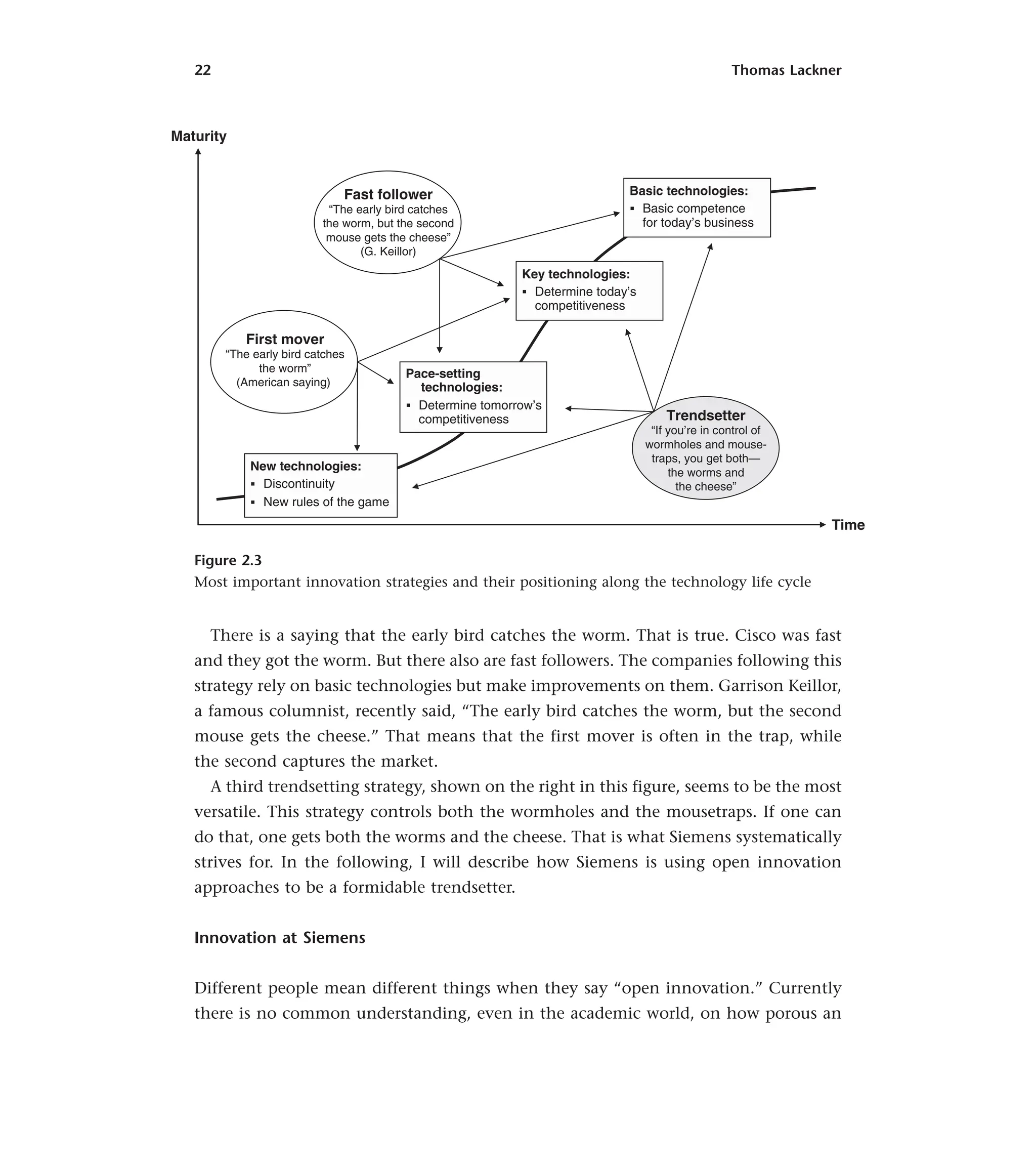
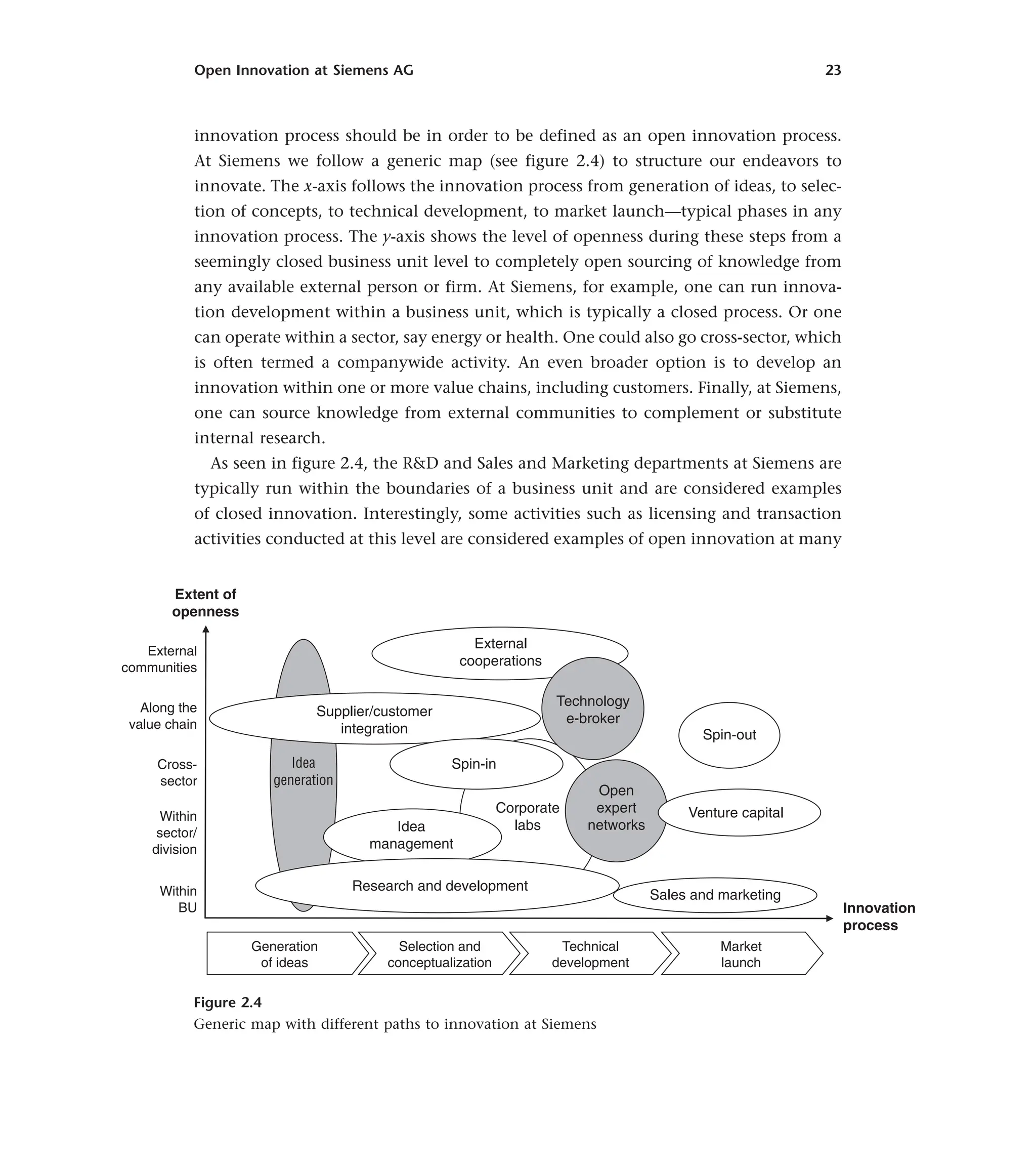
  • 70.
    "That's right," Isaid, hearing the nervous squeak in my voice, not sure whether my comment had any relation to what he had said or not. "I want to have a talk with you. Things can't go on the way they are!" Resnick drew back in pretended surprise. "Why, I don't know what you mean, sir," he said. "You know perfectly well what I mean," I said, my voice breaking completely. "This is my first command! My whole future hangs on it. What satisfaction could you possibly get from ruining me?" In that moment the past descended upon me completely. Once again I was pleading for mercy where there was no mercy, hoping against hope before those soft mad eyes, searching for something that could never be there. "Why, sir," he said, mockingly, "I don't know what you mean at all. Perhaps the stress of your new duties...?" "How much would you take?" I blurted desperately. "How much, to lay off of—David Markham—leave me alone...?" "Birds of a feather, huh?" he said. His eyes became thoughtful. "Every man has his price, I suppose...." A surge of hope coursed through me. Maybe we could dicker. Maybe it wouldn't cost as much as I was prepared to pay. He scratched his chin slowly, then said, "Well—how about your salary for this trip and five thousand dollars?" His thin lips flicked back in a grin. "And a promise on your part that you will sign me on for the next trip—or turn in your Captain's papers?" The universe stood still as I saw ruin facing me. There was no way out. No way out at all. I heard myself blurt, "Why? Why? WHY?" He leaned over my desk slowly, his fists planted on it once again, until his face was scant inches from mine. He whispered, "Because you're yellow. That's why. You never had any business becoming a
  • 71.
    captain." His hoarse,taunting whisper hung in the silence of the room like the knell of doom. There is a madness beyond madness, of that I am sure. I should have been grovelling in fear, I should have been making a decision to step into an airlock and eject myself into space, a suicide unable to live longer with himself, because what he said was true and I knew it was true beyond any shadow of doubt. Instead, I heard myself saying, "All right, Resnick. You win." My voice was perfectly calm. It was not me. Whatever it was, it was not me, talking. My part of my mind was in a numb stupor, unable to act, unable even to think. I heard my voice say, "It's a deal. You promise to lay off. In return I promise to turn my salary for this trip over to you when we get paid, and to sign you on for the next trip." My voice was perfectly calm, even practical. I felt my lips curve into a calculated and bitter smile of defeat. I heard myself say, "Such an agreement can't be put into writing, of course, but—shall we drink on it?" I saw disappointment, disbelief, amazed surprise, cross his lean angular features as I rose from behind my desk. As though in a dream I turned my back on him as I crossed the office to the liquor cabinet, the prerogative of a space Captain. I opened it up with unshaking hands. He followed me, came to stand behind me, very close. I lifted out a bottle of Scotch, the seal still unbroken, and turned to him. "Scotch?" I asked. He hulked over me, his thin lips stretched into a gleeful grin. "Sure," he said softly, his lips pasted against his stained teeth. He sensed my sudden movement, a movement I was not conscious of dictating, but he was too slow as the full bottle crashed down on his skull, shattering and sending a shower of alcohol over his uniform and the floor. His eyes did not close, but blanked into unconsciousness as he sagged to the floor.
  • 72.
    I stood therefor a moment, blinking down at his unconscious form, not quite believing what had happened. Even in unconsciousness he sent fear icing through my veins. In one mad moment I had ruined it all. When he recovered he would be unforgiving, without mercy. For a minute or two I broke down completely, crying like a baby. Then, gradually, a calm settled over me. I turned him over onto his back and pulled his slack arms together. I took off my belt and
  • 73.
    wrapped it aroundhis wrists until I could fasten the buckle firmly. Then I went to my cubicle and brought back a roll of adhesive tape and taped his lips closed, laughing in a low, mad voice that was not my own. I used the rest of the roll of tape to fasten his ankles together. And just as I finished he opened his eyes. It took him a few minutes to organize his thoughts and fix his attention on me, his eyes questioning me. I continued to chuckle under my breath. I was mad, conscious of the fact that I was mad, and beyond caring. "You have nice eyes," I heard myself say. "Nice soft brown eyes." I examined his scalp with careful concern for a moment. "Good thing," I said. "The bottle broke, so there will be no sign of abrasion that could be proof of anything." I took out a cigarette and lit it with trembling fingers, while he watched me. Blowing out a streamer of smoke and jabbing in his direction with my fingers, I said, "I'm learning a few things, Resnick. Already—I'm learning. I wonder how much it will take to break you down." I pushed his head back and tried to put my thumb against his eyeball. He closed his eyes tightly and I forced his right eye open and pressed the ball of my thumb against the exposed eyeball. "Not too much or it will make your eye bloodshot," I said, in hardly more than a whisper. "Evidence, you know. Who's going to believe that the Captain did such a thing? Not even the crew! Sure, they'll agree with you to keep from being beat up. That is, if you have any stomach for that sort of thing when I get through with you. I'm just beginning, you know." I lifted my thumb from his eye and squeezed his nostrils together, watching the terror build up in him, watching his struggles, watching him grow weaker and weaker, and releasing him at the last moment
  • 74.
    before he lostconsciousness, and watching his chest heave as he sucked in lungsful of air. "I just thought of something," I said to him. "You wouldn't dare retaliate after I let you go. To strike me would be treason, punishable by life imprisonment, wouldn't it? And what would be your defense? That the Captain had tortured you? Who would believe that? Who are your witnesses? See how I have stolen your weapons?" I pried his left eye open and pressed against it with a thumbnail. "A half hour ought to do it," I taunted. "No marks. I have to be very careful so that an examination by the ship's doctor won't show a thing." In ten minutes—or was it ten eternities?—he became a quivering mass of flesh. I did things to him that left him too weak to move. At the end of half an hour I pulled the tape off his mouth and listened to him blubber. I took the tape off his ankles, and the belt off his wrists. I tortured him some more and he took it. "And when I call for you over the intercom," I said, "if you don't come at once I have you for gross insubordination to your Captain. And if you so much as touch one member of the crew again I'll call you, boy. I'll call you." Finally I let him go. After he had gone I trembled like a leaf. Slowly a little bit of sanity returned to me, and with it a realization of what I had done. Nausea overcame me and I staggered into the washroom and got rid of my breakfast, then returned to my desk. For hours I sat there while my mind picked up the threads of life and began functioning again. There was still the feeling that Resnick was omniscient, that he would be able to topple me into disgrace. But
  • 75.
    with it, gradually,came the realization that he wouldn't, that he couldn't. I had used his own psychological weapons on him, building up in him a fear psychosis that he couldn't successfully fight. I had turned the tables. I couldn't really believe it just yet, but I couldn't disbelieve it either. For the next three days I went about my customary routines with a calm exterior, waiting for the storm to break, but it never did. Finally, to test it, I deliberately went on a tour of inspection through the ship, until I came to where Resnick was working, along with several others of the crew. As I entered the compartment and saw him look up, I saw the instinctive cringing that he couldn't help. In a flash of inspiration I saw that his sadism was a cover for his own cowardice, a compensation mechanism. I knew then that I had won. After one long silent moment I turned my back on him and left the compartment. As I walked by myself to the central tube and pulled myself up to the Captain's deck, for the first time I began to realize what being Captain meant. It means a lot of things, of course, but most of all it means facing up to one's command, being in charge. I knew that I would never again be afraid—least of all afraid of Oscar Resnick. Nor would I ever again be afraid of fear. In the future I might be faced with the problem of a bully on my crew again, but I would know how to deal with him—with his own weapons, the ones he used because he would be most vulnerable to them himself. When the Alabama reached North Marsport Resnick quit the ship. I was glad to see him go. The rest of the crew remained with me, and I had no more trouble during the five years I commanded the Alabama. David Markham remained with me as my orderly until I retired, and he is still with me. A few years after the incidents of this story I had an opportunity to get him a commission but he turned it down and
  • 76.
    refused to leaveme. Sometimes I think he knows what happened in my office that day that I called Resnick in, but he has never given any hint whether he does or not. You wonder that I am not ashamed to confess publicly to you that I was a coward? You shouldn't wonder. We are all cowards—or fools. I am not ashamed of the fact that once I was a coward. Bravery, in a way, consists in not being afraid of being afraid. Just one thing remains in my story. When I reached North Marsport on that first leg of my first command, I was a Captain. I have been one ever since.
  • 77.
    *** END OFTHE PROJECT GUTENBERG EBOOK CAPTAIN PEABODY *** Updated editions will replace the previous one—the old editions will be renamed. Creating the works from print editions not protected by U.S. copyright law means that no one owns a United States copyright in these works, so the Foundation (and you!) can copy and distribute it in the United States without permission and without paying copyright royalties. Special rules, set forth in the General Terms of Use part of this license, apply to copying and distributing Project Gutenberg™ electronic works to protect the PROJECT GUTENBERG™ concept and trademark. Project Gutenberg is a registered trademark, and may not be used if you charge for an eBook, except by following the terms of the trademark license, including paying royalties for use of the Project Gutenberg trademark. If you do not charge anything for copies of this eBook, complying with the trademark license is very easy. You may use this eBook for nearly any purpose such as creation of derivative works, reports, performances and research. Project Gutenberg eBooks may be modified and printed and given away—you may do practically ANYTHING in the United States with eBooks not protected by U.S. copyright law. Redistribution is subject to the trademark license, especially commercial redistribution. START: FULL LICENSE
  • 78.
    THE FULL PROJECTGUTENBERG LICENSE
  • 79.
    Welcome to OurBookstore - The Ultimate Destination for Book Lovers Are you passionate about books and eager to explore new worlds of knowledge? At our website, we offer a vast collection of books that cater to every interest and age group. From classic literature to specialized publications, self-help books, and children’s stories, we have it all! Each book is a gateway to new adventures, helping you expand your knowledge and nourish your soul Experience Convenient and Enjoyable Book Shopping Our website is more than just an online bookstore—it’s a bridge connecting readers to the timeless values of culture and wisdom. With a sleek and user-friendly interface and a smart search system, you can find your favorite books quickly and easily. Enjoy special promotions, fast home delivery, and a seamless shopping experience that saves you time and enhances your love for reading. Let us accompany you on the journey of exploring knowledge and personal growth! ebookgate.com